
Problems with the custom PDFs created on the BHL website on 11/22 and 11/23 have now been resolved. The links to access any PDFs that were generated during this time should now work. If you still experience problems, please send us feedback: http://biodiversitylibrary.org/contact. Thanks for your patience!
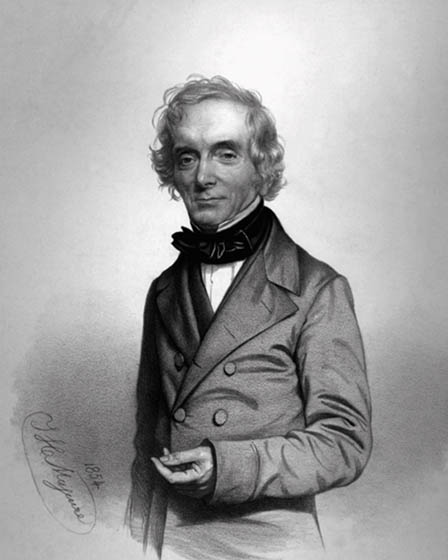
William John Burchell is credited “with having been the most prolific collector of botanical and zoological specimens.” [1] During a four-year scientific exploration of South Africa, he amassed a collection of over 63,000 specimens. And yet, Burchell’s contributions to science have been largely overlooked. As William Swainson bemoaned, “science must ever regret that one whose powers of mind were so varied…was so signally neglected in his own country.” [2]
 |
| Portrait of William John Burchell by Thomas Herbert Maguire (1854). http://www.capeorchids.co.za/history.htm. |
2015 marks the 200th anniversary of Burchell’s return to Cape Town following his four-year expedition in South Africa. The University of Pretoria recently digitized Burchell’s account of this journey, a two-volume work entitled Travels in the Interior of Southern Africa (1822-24) for BHL. This offers an excellent opportunity to not only highlight this recent addition from our colleagues in BHL Africa, but recognize the incredible accomplishments of a remarkable man.
William Burchell was born in Fulham, England, in 1781. His family owned the prosperous nine-and-a-half acre Fulham Nursery and Botanical Garden, which afforded him many opportunities to study botany and interact with some of the most influential natural historians of the day. Sir William Hooker, the first director of the Royal Gardens in Kew, was Burchell’s friend and mentor. The prosperity of his family’s business provided Burchell with the means to travel and nurture his interest in natural history and particularly botany.
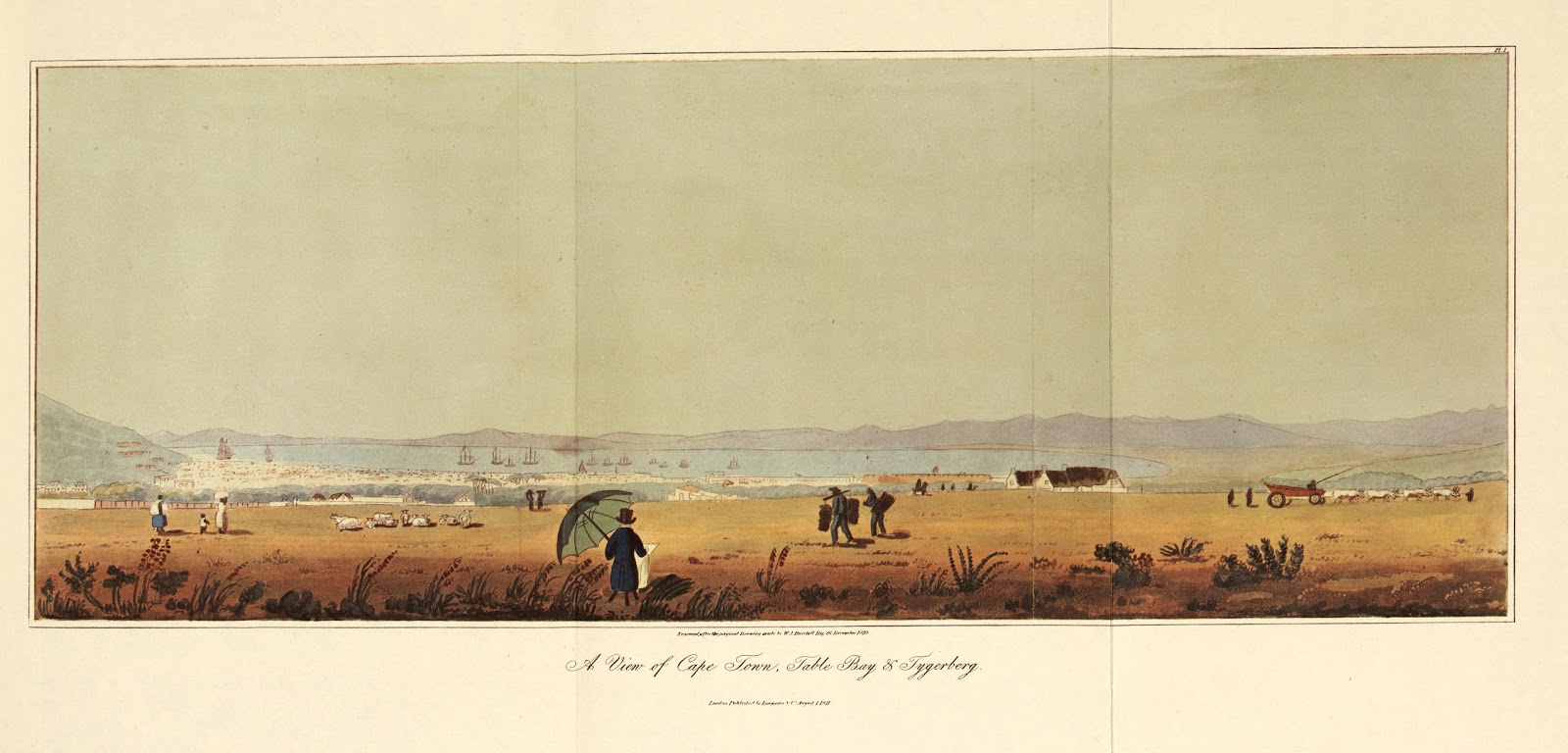 |
| View of Cape Town, Table Bay and Tygerberg, 26 December, 1810. Engraved from a drawing by William John Burchell. Travels in the Interior of Southern Africa. v. 1 (1822). http://biodiversitylibrary.org/page/48904900. Digitized by: University of Pretoria. |
In 1810, Burchell arrived in Cape Town, South Africa, and on 19 June 1811, he set out from that city on a four-year expedition throughout the interior of southern Africa “solely for the purpose of acquiring knowledge.” [2] During the journey, he covered 7,000 km, mostly in an ox-wagon that he designed to serve as his home, laboratory, and library. He traveled as far north-east as the asbestos mountains just north of Chue Spring and became the first recorded European explorer to successfully travel through Bushmanland. The account of his expedition, Travels in the Interior of Southern Africa, covers only the period from his arrival in Cape Town through his departure from Litakun in August 1812.
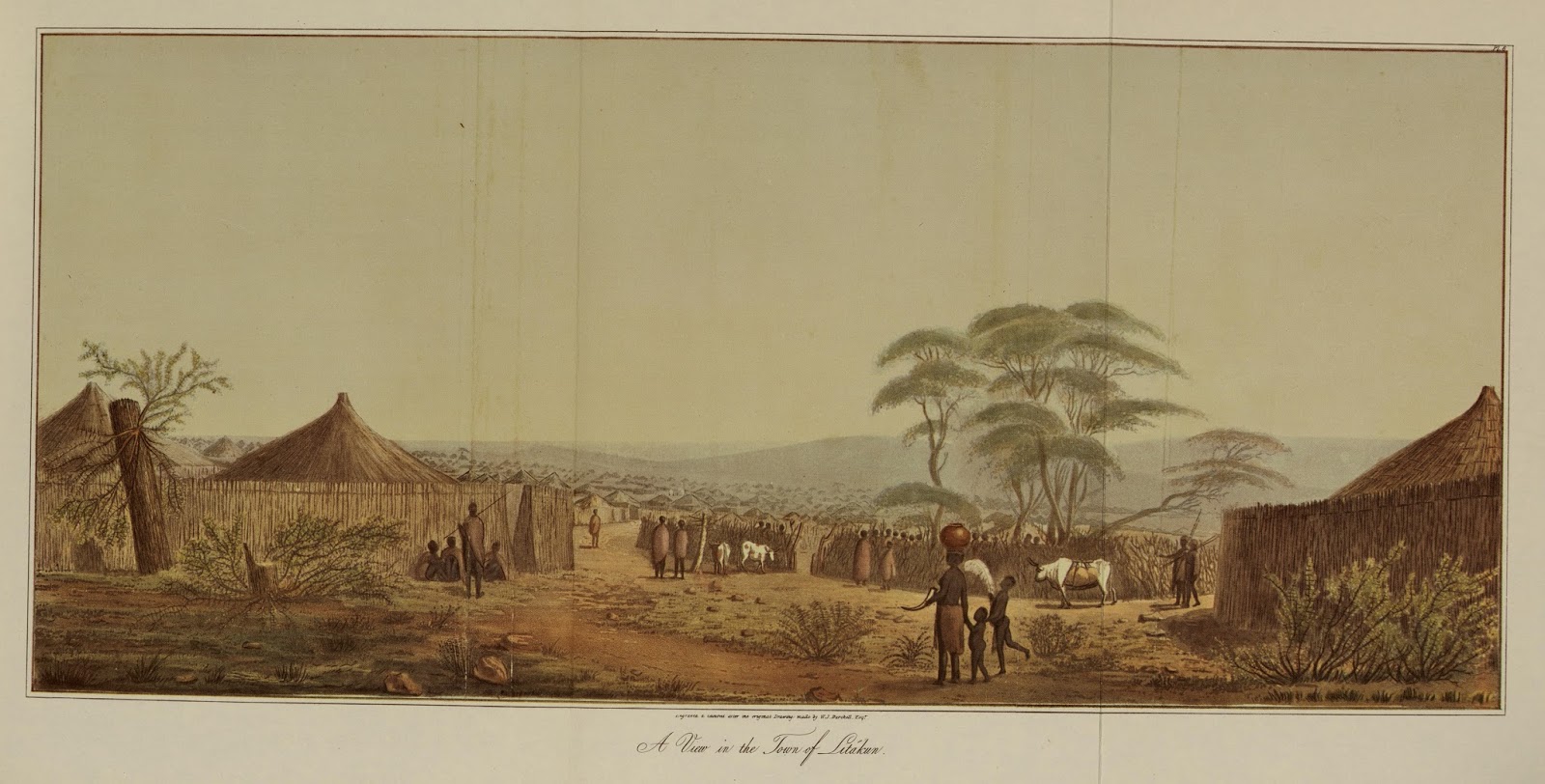 |
| “A view in the town of Litakun.” Engraved from a drawing by William John Burchell. Travels in the Interior of Southern Africa. v. 2 (1824). http://biodiversitylibrary.org/page/48905971. Digitized by: University of Pretoria. |
Burchell’s accomplishments on the journey were extensive, particularly in the field of natural history. He collected 50,000 species of plants, seeds and bulbs, 10,000 specimens of insects, animal skins, skeletons, and fish, numerous anthropological artifacts, and created 500 drawings during the expedition. The Royal Botanical Gardens in Kew now holds a vast majority of Burchell’s extensive botanical collections. His journals document the precise location, morphological features, and habitat of the specimens he collected.
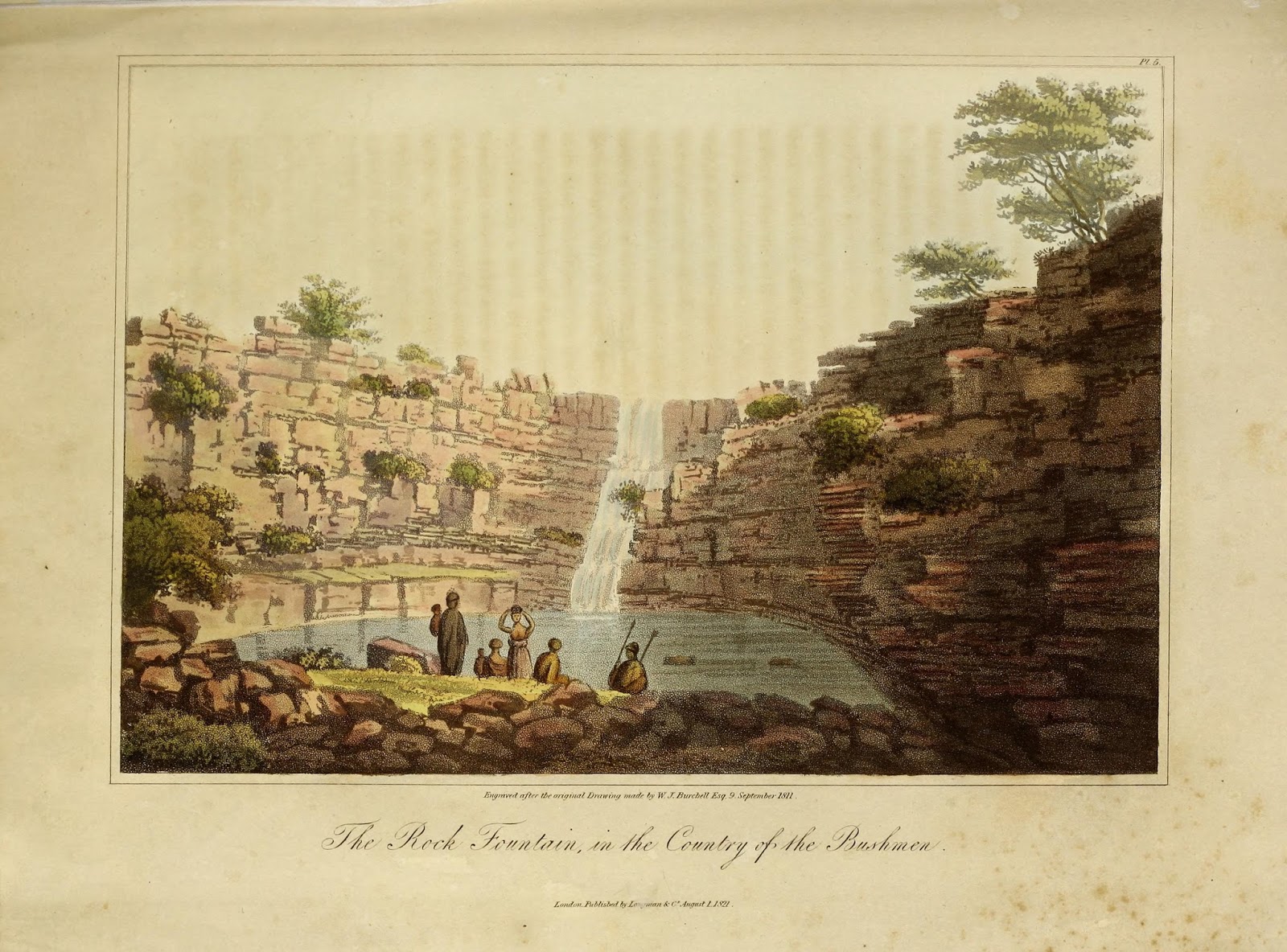 |
| “Rock Fountain in the Country of the Bushmen.” 9 September, 1811. Engraved from a drawing by William John Burchell. Travels in the Interior of Southern Africa. v. 1 (1822). http://biodiversitylibrary.org/page/48905175. Digitized by: University of Pretoria. |
In addition to natural history, Burchell made important observations in the earth sciences during the expedition, being the first recorded person to identify asbestos in the Northern Cape and the “first to describe glacial pavements in the country.” [2] He also charted his entire route, creating a “Map of the Extratropical Parts of Southern Africa” (published in v.1 of his book), which was a “milestone in the cartography of the country.” [1] In the field of astronomy, he observed the variability of Eta Carinae’s brightness, and, by using a combination of Friar’s Balsam (Compound Tincture Benzoin), laudanum, Buchu vinegar, and Wild Wormwood to treat a serious gunshot wound afflicting one of the expedition’s members, became the first recorded person to successfully integrate indigenous herbal medicine with medicines used in Europe “into the management of such a serious condition.” [2]
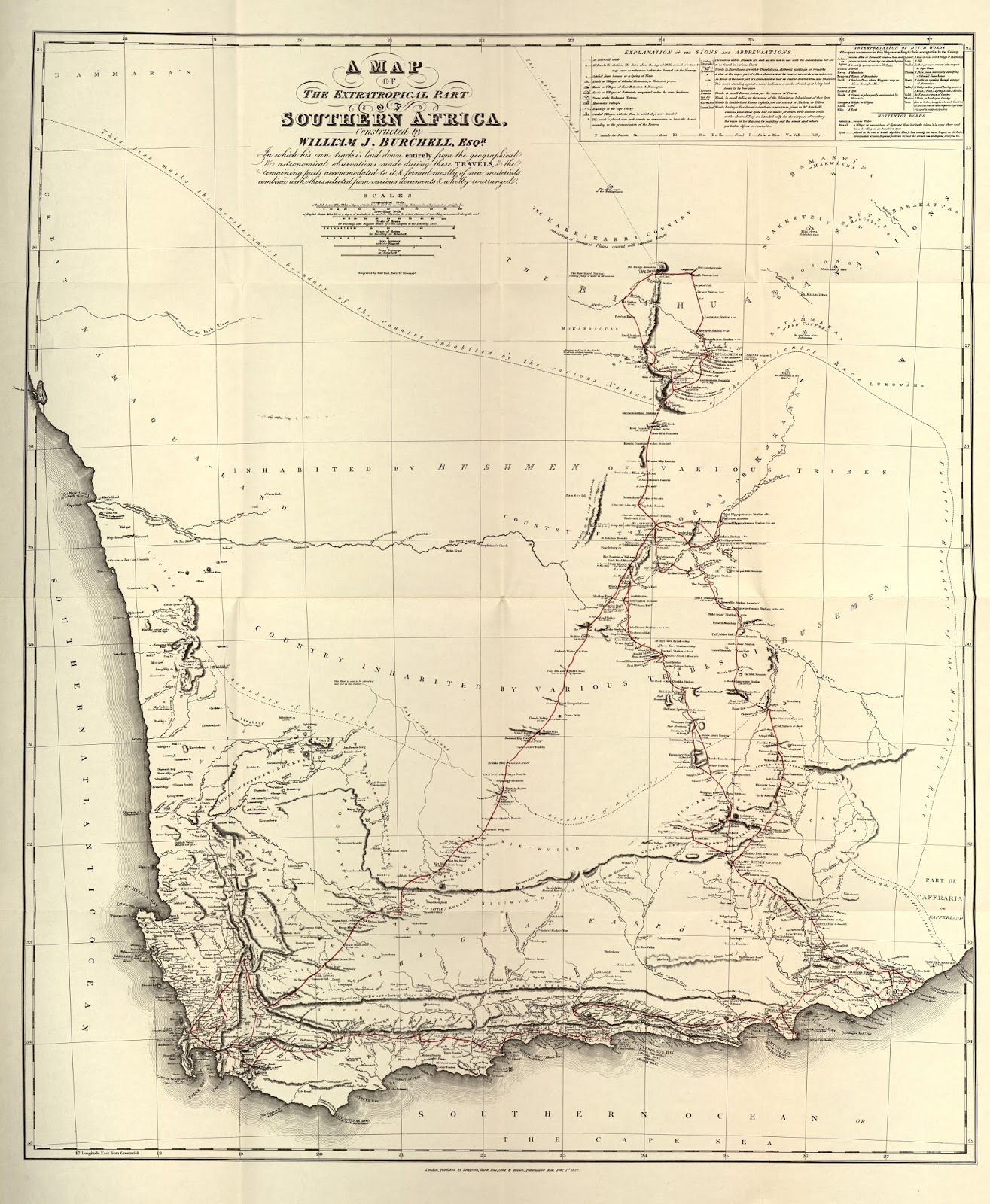 |
| Map of the Extratropical parts of Southern Africa. Travels in the Interior of Southern Africa. v. 1 (1822). http://biodiversitylibrary.org/page/48905480. Digitized by: University of Pretoria. |
After Burchell’s return to Cape Town in April 1815, he went on to travel in Brazil, collecting over 23,000 additional specimens. However, after his return to England, Burchell became increasingly reclusive and protective of his collections, focusing on cataloging his vast botanical specimens but also refusing to allow others to access his collections. Some historians hypothesize that he may have suffered from a bipolar-type disorder. [2] In 1863, at the age of 82, after one unsuccessful suicide attempt by gunshot, he hung himself in a small outhouse in his garden. He is buried near his home in Fulham, in the family tomb at All Saints Church, Hammersmith.
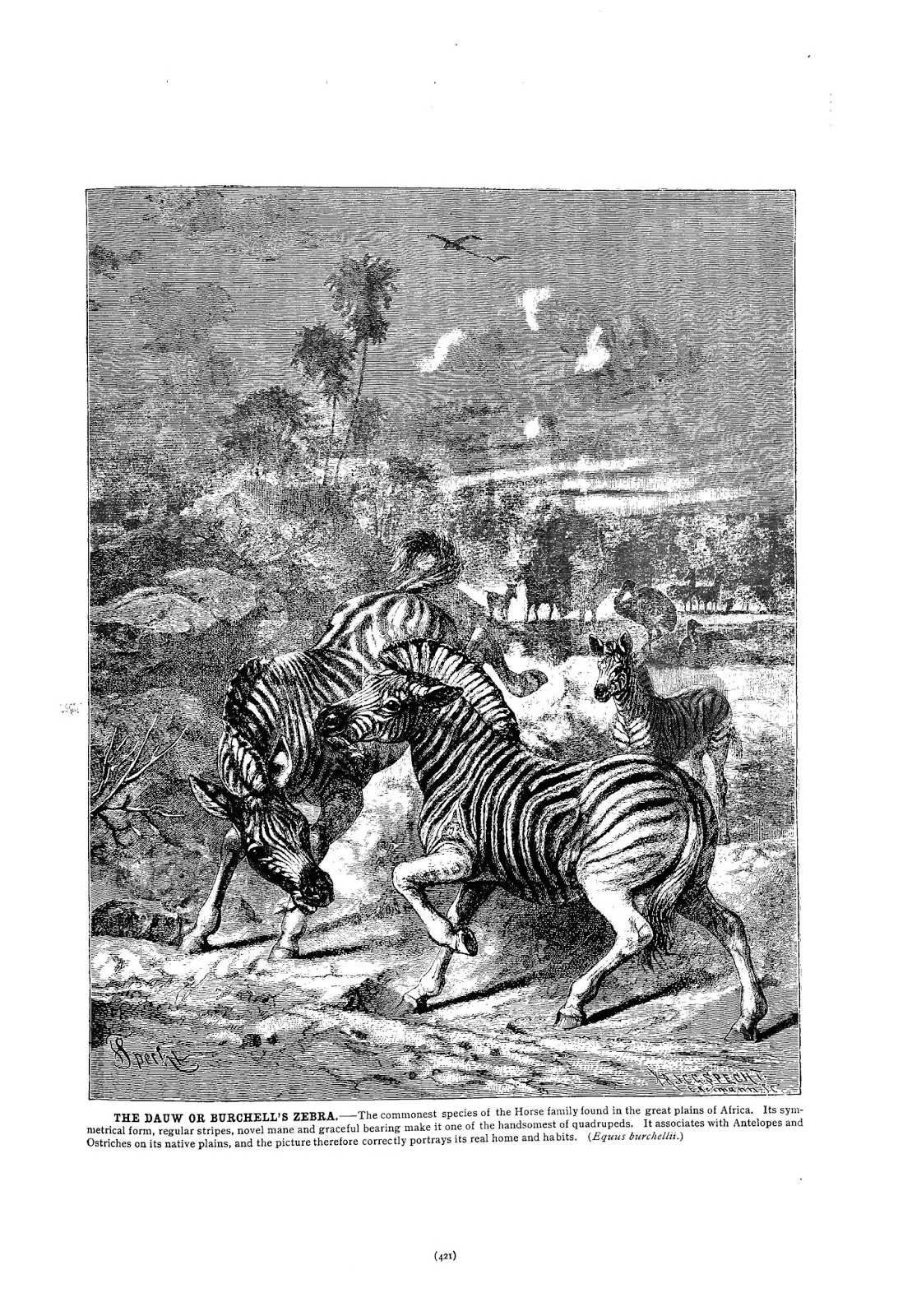 |
| Burchell’s Zebra (Equus quagga burchellii), named after William John Burchell by John Edward Gray. Brehm, Alfred Edmund. The Animals of the World (1895). http://biodiversitylibrary.org/page/37569339. Digitized by: Cornell University Library. |
Though his life had a tragic ending, Burchell’s accomplishments are remarkable. In addition to the many specimens he collected, a species of South African wild pomegranate (Burchellia bubalina) is named after him, and the common names of many animals bear his moniker, including Burchell’s zebra, Burchell’s coucal, three birds (Burchell’s starling, coarser, and grouse), a lizard (Burchell’s sand lizard), and the white rhinoceros (for which Burchell was the first to give a scientific name and is also known, although less-commonly, as Burchell’s rhinoceros). He also recommended the establishment of a public garden in Cape Town. He described the Kirstenbosch area as “the most picturesque I had seen in the vicinity.” [2] The Kirstenbosch National Botanical Garden was founded in 1913.
We are honored to have a copy of Burchell’s Travels in the Interior of Southern Africa in BHL, thanks to the University of Pretoria, as, to quote historian George Theal, it is “one of the most trustworthy and valuable books ever issued upon South Africa.” [1]
William John Burchell was an extraordinary man. We have not forgotten him.
[1] Stewart, Roger. “William John Burchell’s Medical Challenges: A 19th Century Natural Philosopher in the Field.” South African Medical Journal: 2012;102(4). pgs. 252-255.[2] Stewart, Roger and Brian Warner. “William John Burchell: The Multi-skilled Polymath.” South African Journal of Science. 2012;108(11/12), Art. #1207, 9 pages. http://dx.doi.org/10.4102/sajs.v108i11/12.1207
Have you ever stumbled across a caterpillar and wondered what kind of adult moth or butterfly it would metamorphose into?
Short of catching the caterpillar and actually observing what adult it becomes, this answer might be harder to come by than you might think. Most taxonomy and identification has been performed on the adults of various Lepidopteran species, and there are still many species whose caterpillar forms are not readily known.
This is particularly true for many Australian species whose early life stages remain a scientific mystery.
Dr. Don Herbison-Evans hopes to shed some light on these Australian larval mysteries through the website Australian Caterpillars and their Butterflies and Moths, which is hosted by the Coffs Harbour Butterfly House in New South Whales, Australia.
 |
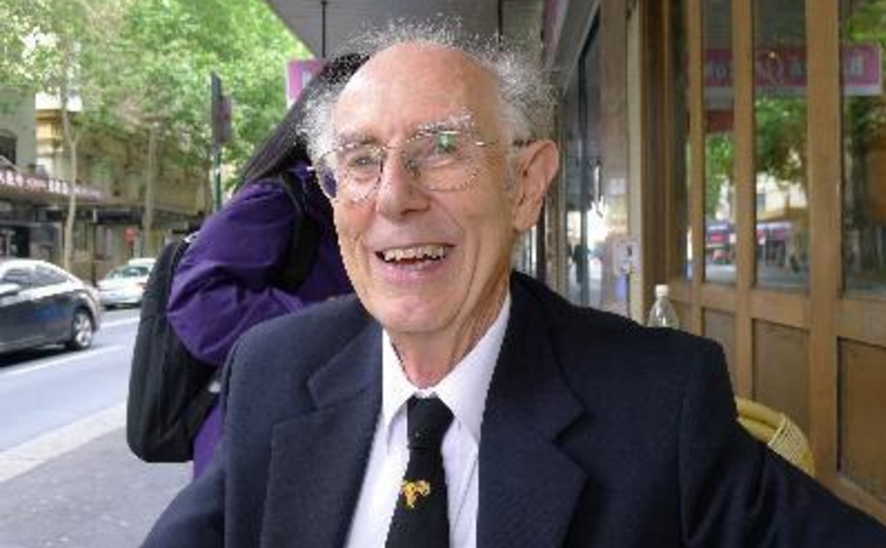
| Dr. Don Herbison-Evans. |
Dr. Herbison-Evans has professional experience in a variety of scientific disciplines, including information technology and computer science, astronomy, and chemistry. His interest in entomology, however, was sparked when he emigrated from the UK to Sydney to start his academic career in the 1960s. He and good friend Dr. Stella A. Crossley (who also emigrated from the UK to Melbourne around the same time to lecture in the Psychology Department at Monash University) were fascinated by the number of caterpillar species they found in their gardens.
“I remember taking one beastie to the enquiries desk at the Australian Museum, and asking what species it was,” recalled Don. “The lady there laughed, and then explained that most of the taxonomy of Australian Lepidoptera was done by entomologists at the British Museum on dried adult specimens sent back to the UK by Joseph Banks and other British explorers, so the entomologists had no idea what the early life stages, such as the caterpillars, were like.”
Thus, Don and Stella started photographing the caterpillars they found and rearing them into adults to discover their mature counterparts. In an effort to share what they discovered, they wrote a manuscript entitled 100 Common Australian Caterpillars, but unfortunately, publishers’ interest in caterpillars in the 1970s was virtually nonexistent. So Don and Stella shelved the manuscript.
And then, some twenty years later, along came the Internet.
“We were encouraged as univerisity staff to put potted biographies of ourselves on the web for students to know more about us, and of course we included a note in ours that we were interested in caterpillars,” explained Don. “We then got increasing numbers of people sending descriptions and photos of caterpillars asking what they were. So we said: ‘OK let’s just put our book on the web.'”
And so Australian Caterpillars and their Butterflies and Moths was born. The website contains webpages for over 3,600 Australian Lepidopteran species (having grown from an original 100). These webpages include descriptive information about the species as well as, where available, images of the adult and caterpillar forms. The pages are grouped according to family, and these pages are linked via a single page for moths and another for butterflies.
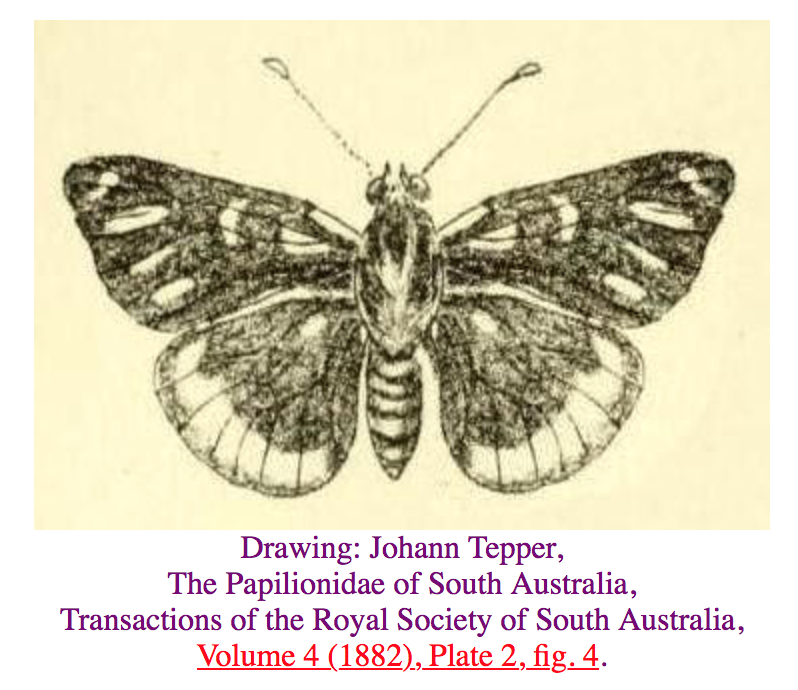 |
| Example of BHL image in Australian Caterpillars and their Butterflies and Moths. Hesperilla bifasciata species page. |
The Biodiversity Heritage Library serves as an excellent source of information for the website.
“BHL has enabled me to add historical richness to my popular descriptions of the biology of the Lepidoptera of Australia,” stated Don.
Using BHL everyday, Don searches for references to species of interest in BHL using our taxonomic name finding tool. If this does not yield results, he searches the OCR of likely journal issues for genus or species names. He then links these pages to relevant content in the website. Where illustrations are available in BHL, these are also uploaded to the corresponding species pages. These illustrations, which offer an interesting juxtaposition to modern photographs, are, in fact, Don’s favorite feature on BHL.
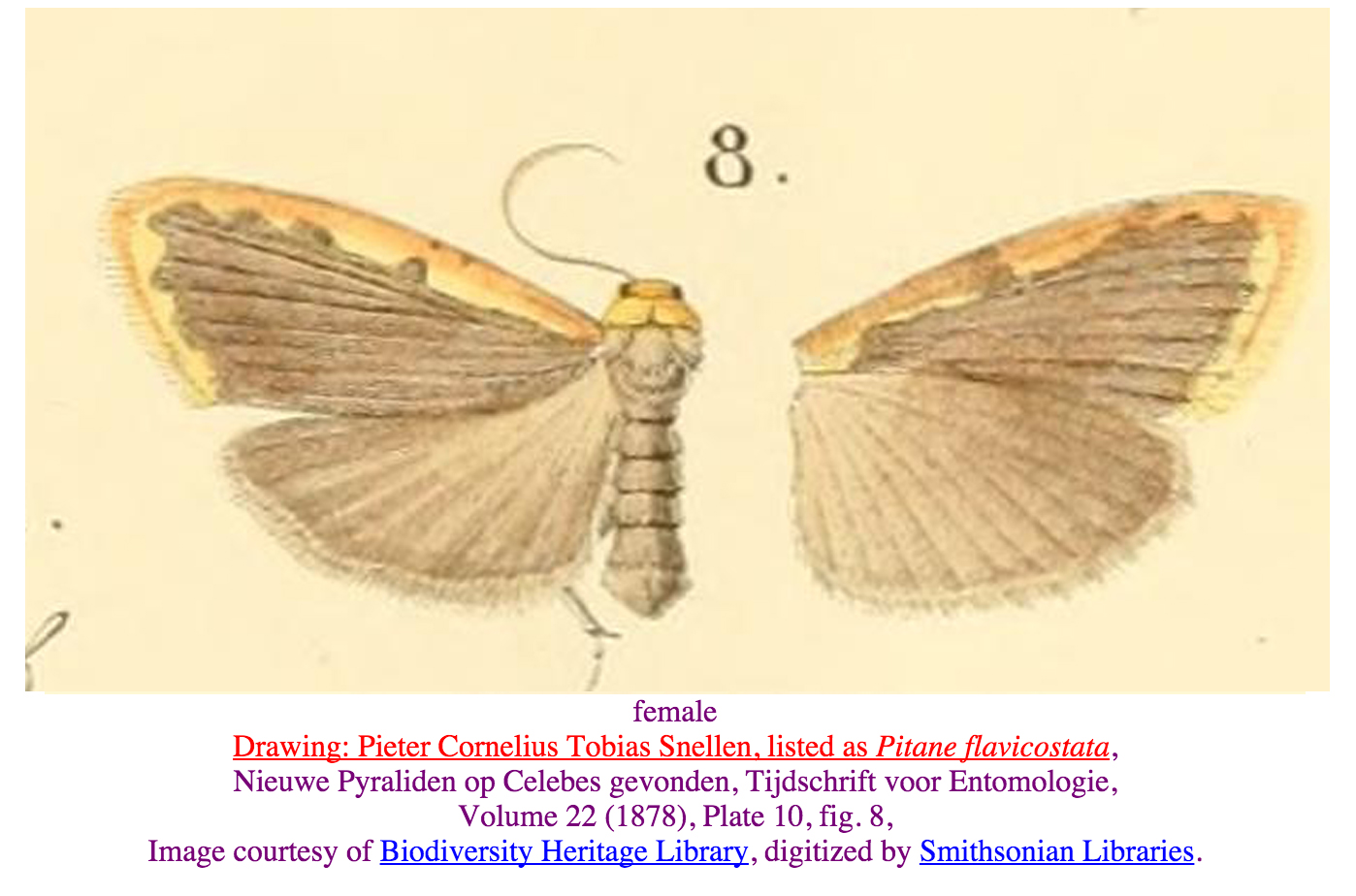 |
| Example of BHL image in Australian Caterpillars and their Butterflies and Moths. Diduga flavicostata species page. |
In addition to information about specific species, the website also provides some pretty incredible facts about caterpillars. For example, did you know that caterpillars have thousands of muscles, whereas humans only have about 500? Or that the female moths of the Australian species such as Teia anartoides have no wings, and the species disperses by the young caterpillars making an open gossamer sail out of silk, and sailing away on it in the wind?
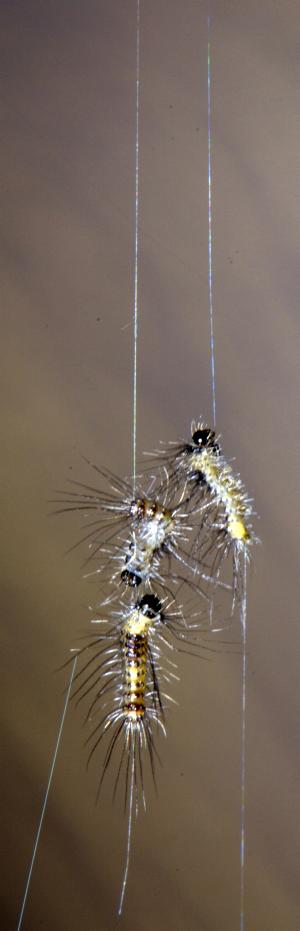 |
| Teia anartoides young caterpillars ballooning (Photo: courtesy of Rudie Kuiter, Aquatic Photographics, Victoria). http://lepidoptera.butterflyhouse.com.au/lyma/anart.html. |
The website has become an incredible resource for those interested in exploring Australian Lepidoptera. Don particularly hopes that it will help spark an interest in these insects among younger audiences.
“Our idea in the webpages is to help, particularly young Australian people, understand and value the unique entomological heritage to which they are heirs, and to foster an understanding of how to preserve that heritage for future generations,” Don explained. “The webpages try to be chatty and intriguing to, say, an intelligent 12 year old, but to include enough technical information to tempt them deeper into the ecology and taxonomy of Australian Lepidoptera. With the help of the Biodiversity Heritage Library and Wikipedia, we are able to link the current descriptions of the biology of the species to the original descriptions from two or more centuries ago and to biographies of their authors who can be seen to have been real people, who too were intensely interested in Australian fauna. I think this helps establish the idea in our readers that these organisms have perhaps as much right to live in Australia as they do, and that our living biological heritage can be preserved and maintained, just as [BHL] preserves our literary and scientific heritage.”
We think the website is well on its way to achieving this goal. After all, what young person wouldn’t want to learn more about a caterpillar that can fire fecal pellets from its anus?
Thanks very much to Dr. Herbison-Evans for sharing his work and use of BHL with us. Be sure to explore Australian Caterpillars and their Butterflies and Moths today.
Do you use BHL regularly for your work? Want to be featured on our blog? Send a message to [email protected].
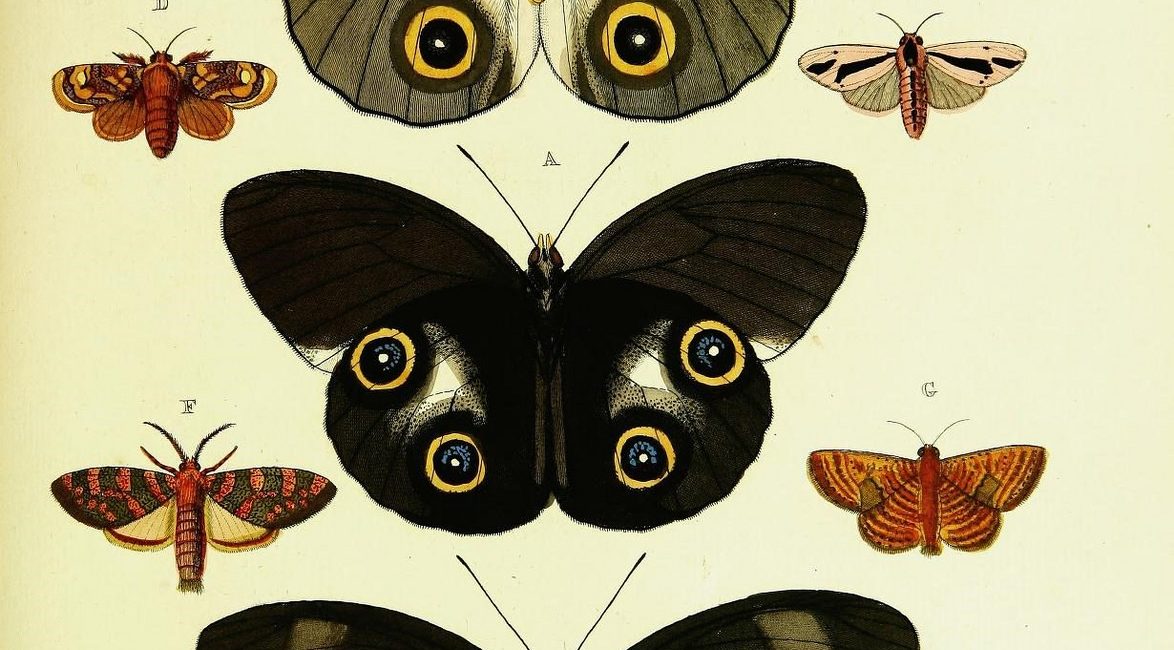
How could you make a visual record of a collection before the advent of photography? Through illustrations, of course. It was a desire to produce just such a record that prompted the creation of the magnificent plates accompanying De uitlandsche kapellen voorkomende in de drie waereld-deelen, Asia, Africa en America ([1775]-1782), by Pieter Cramer, which has been digitized for BHL by Mann Library, Cornell University.
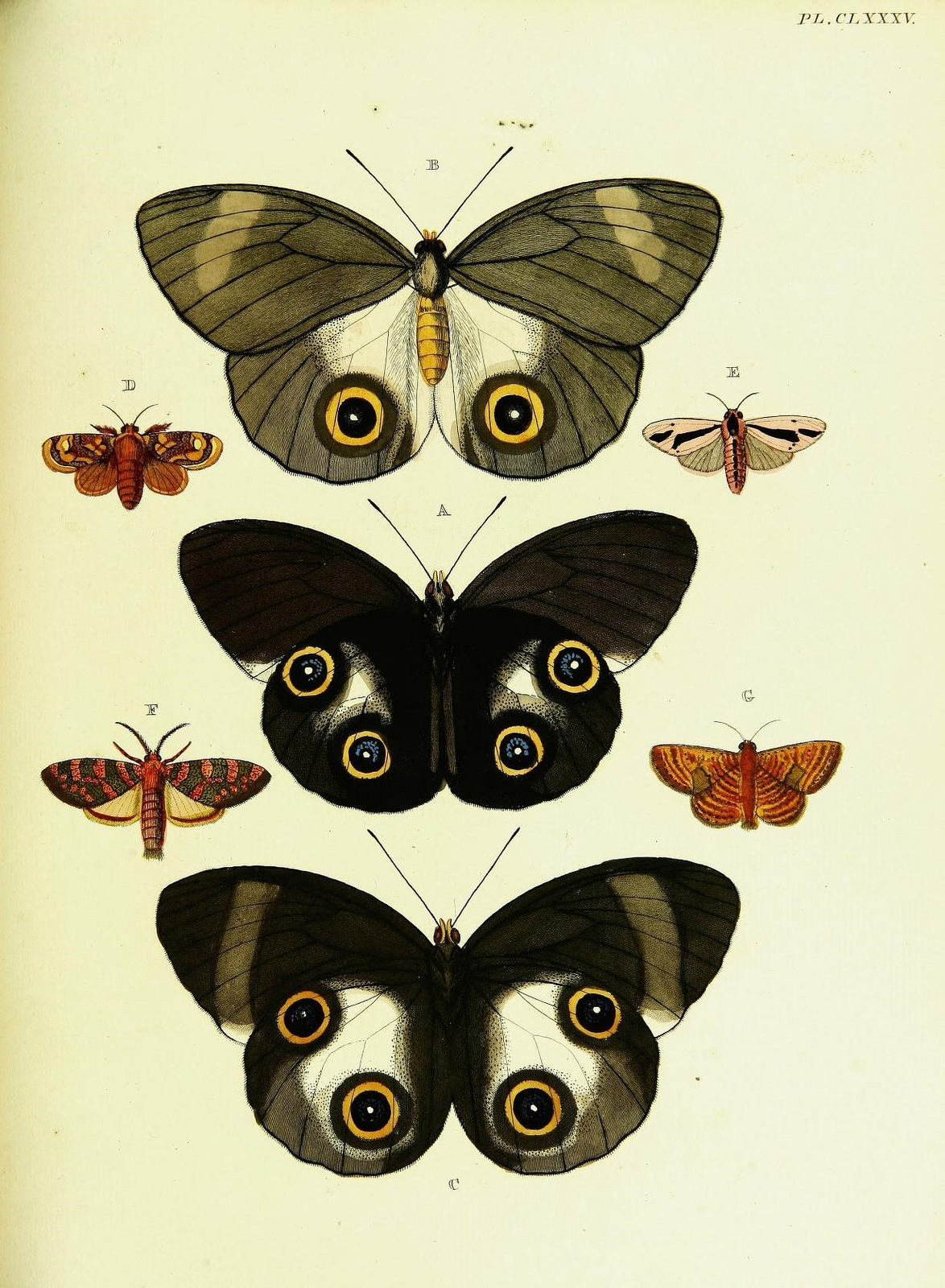 |
| De uitlandsche kapellen voorkomende in de drie waereld-deelen, Asia, Africa en America. [1775]-1782. Digitized by Mann Library, Cornell University. http://biodiversitylibrary.org/page/42111657. |
Pieter Cramer was a wealthy linen and wool merchant from Amsterdam. Born in 1721, he had a keen interest in natural history – particularly Lepidoptera (butterflies and moths). Through purchase and trade, Cramer amassed a large collection of Lepidoptera specimens from Suriname, Sri Lanka (then Ceylon), Indonesia, North America, Africa, and Asia. Cramer hired Amsterdam artist Gerrit Wartenaar to illustrate his collection in order to make a permanent record of it. The resulting hand-colored plates were so magnificent that Cramer was encouraged to publish them. He did so via De uitlandsche kapellen, which includes 400 plates featuring 1,658 moth and butterfly species, each accompanied by a brief description of the antennal shape and wing pattern. The plates and text were published in thirty-four parts between 1775-82, with one issue being sent out to a list of subscribers every three months. The final work consists of four volumes.
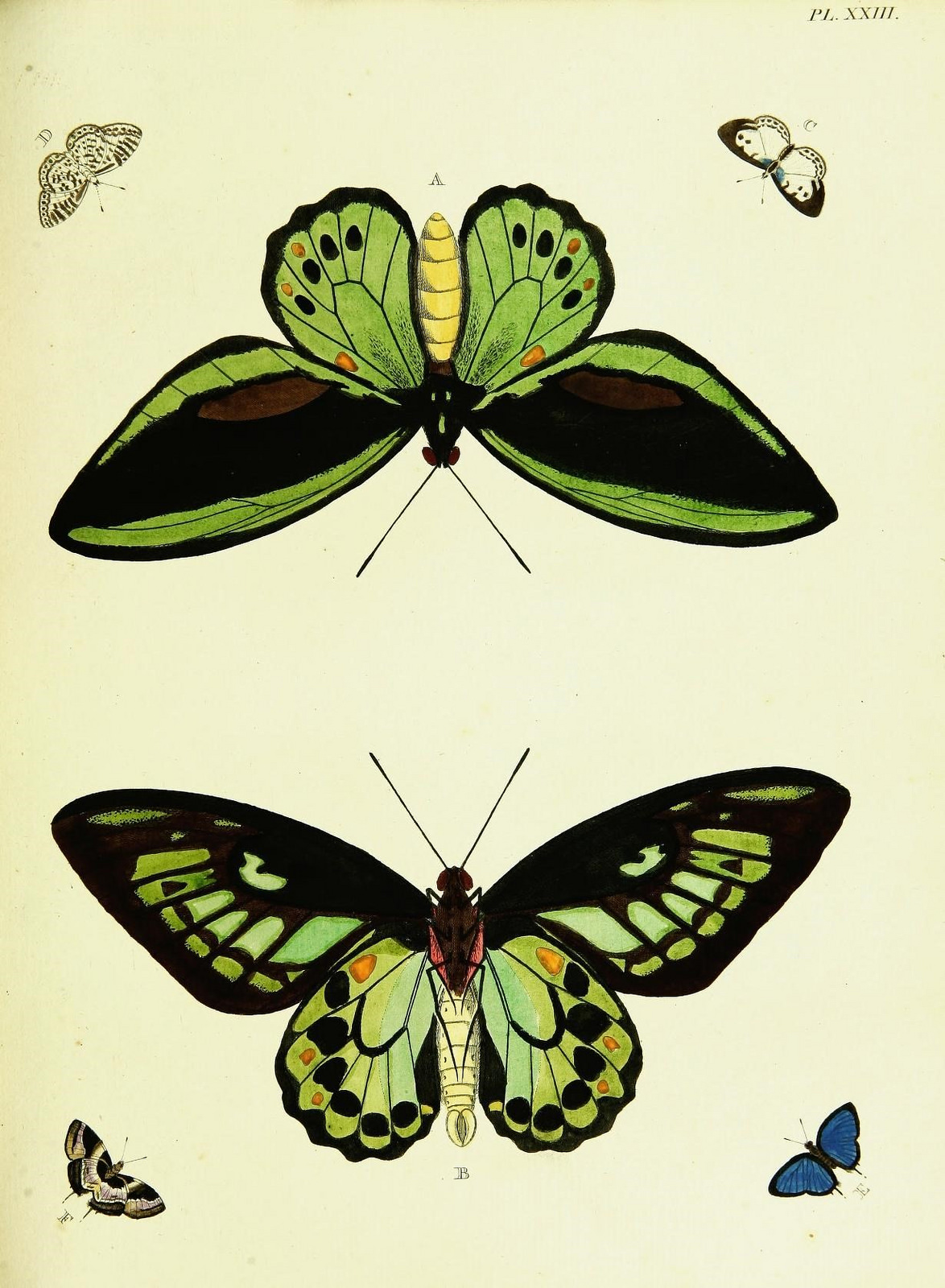 |
| De uitlandsche kapellen voorkomende in de drie waereld-deelen, Asia, Africa en America. [1775]-1782. Digitized by Mann Library, Cornell University. http://biodiversitylibrary.org/page/42111331. |
Sadly, Cramer died of a fever in 1776, before the first volume was complete. His nephew and business partner, Anthony Wellemzoon van Rensselaar, enlisted the help of Caspar Stoll (who had been involved in the production of the first volume) to complete the final volumes. Stoll wrote most of the text for volume four, and, between 1787-90, published a supplement to the work that included forty-two plates of 250 additional species.
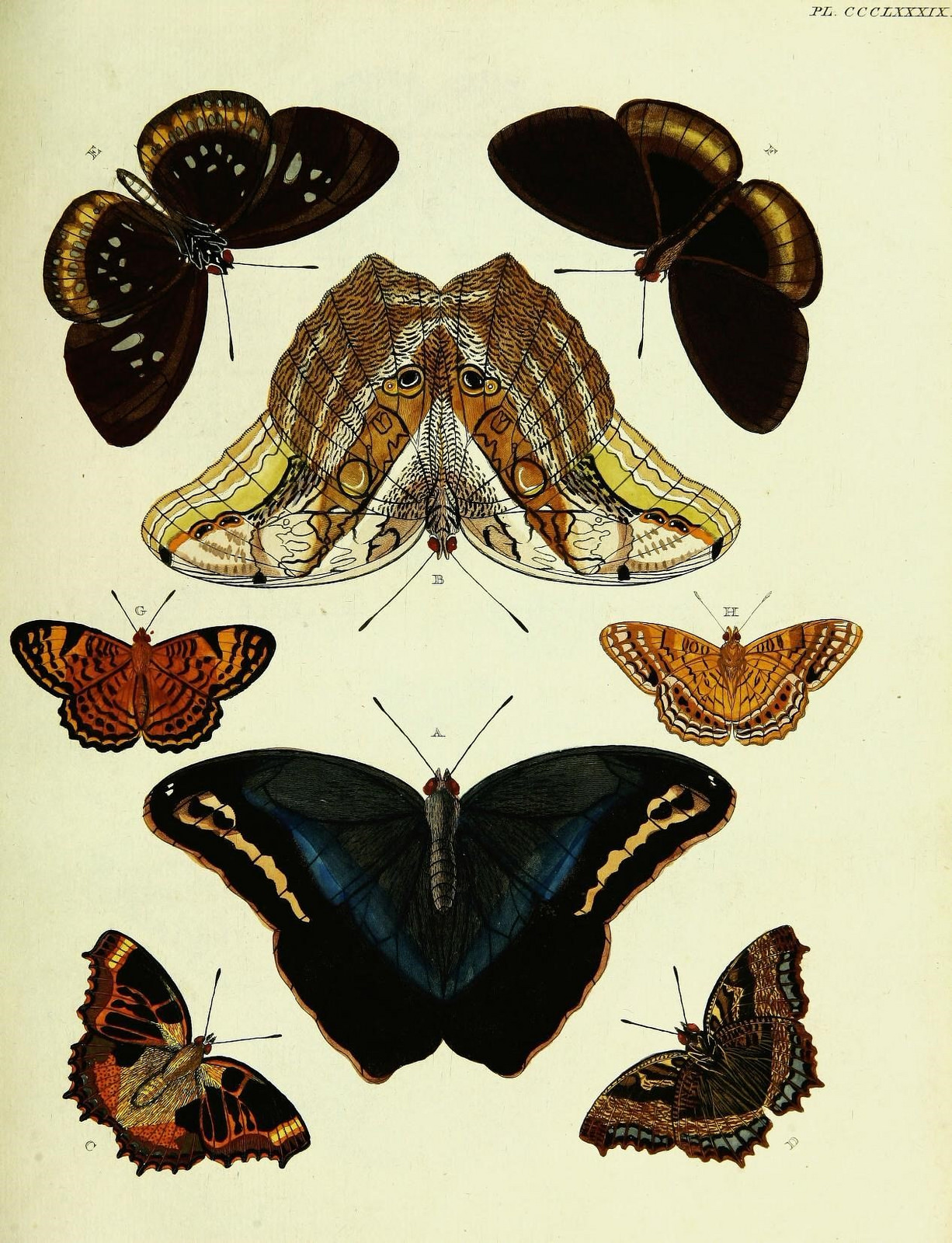 |
| De uitlandsche kapellen voorkomende in de drie waereld-deelen, Asia, Africa en America. [1775]-1782. Digitized by Mann Library, Cornell University. http://biodiversitylibrary.org/page/42111247. |
De uitlandsche kapellen is important for a number of reasons. It depicts each species at life-size and illustrates both the upper and lower wings for each. It was also the first treatise on Lepidoptera to use the newly-introduced classification system from Carl Linnaeus. Cramer and Stoll assigned each butterfly and moth to one of the three then-existing Lepidopteran genera (designated by Linnaeus) – today there are thousands of genera for butterflies and moths. In providing scientific names to the species, they not only used any existing binomials for the specimens included in the work, but, as many of the species had not yet been named, they also assigned a name and provided the first formal scientific description for many species depicted in the volumes. As a result, De uitlandsche kapellen contains hundreds of “original descriptions” and as such is still integral to the work of scientists today.
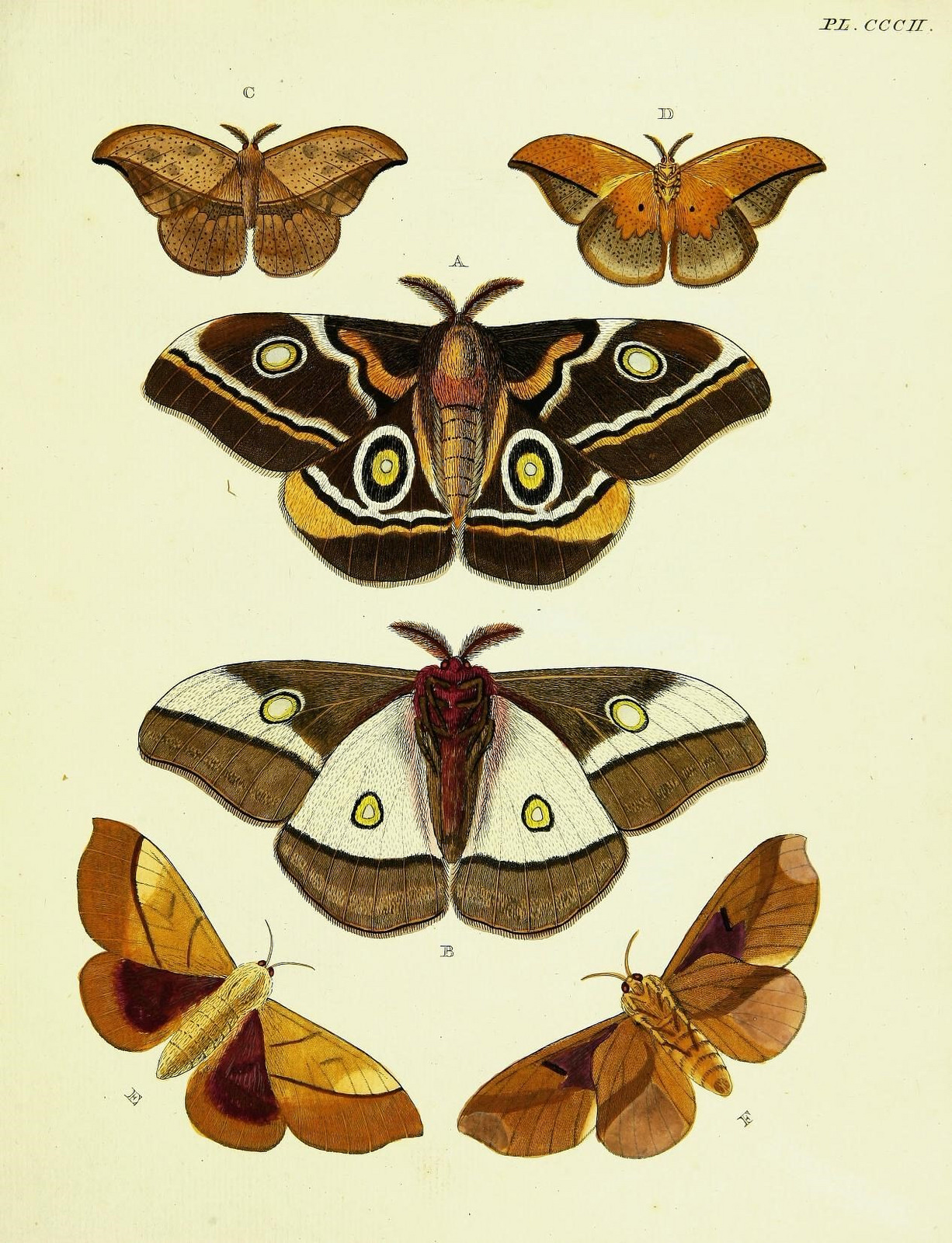 |
| De uitlandsche kapellen voorkomende in de drie waereld-deelen, Asia, Africa en America. [1775]-1782. Digitized by Mann Library, Cornell University. http://biodiversitylibrary.org/page/42111073. |
You can explore De uitlandsche kapellen voorkomende in de drie waereld-deelen, Asia, Africa en America (1779-1782), by Pieter Cramer, for free in BHL, digitized by Mann Library, Cornell University Library. You can view the illustrations in this work on Flickr: Pts. 1-2 | Pts. 3-4.
Source: James, Miller. “The Volumes of Cramer and Stoll: A Timeless Contribution to the Science of Butterflies and Moths.” Natural Histories. New York: American Museum of Natural History, 2012. 57-58. Print.
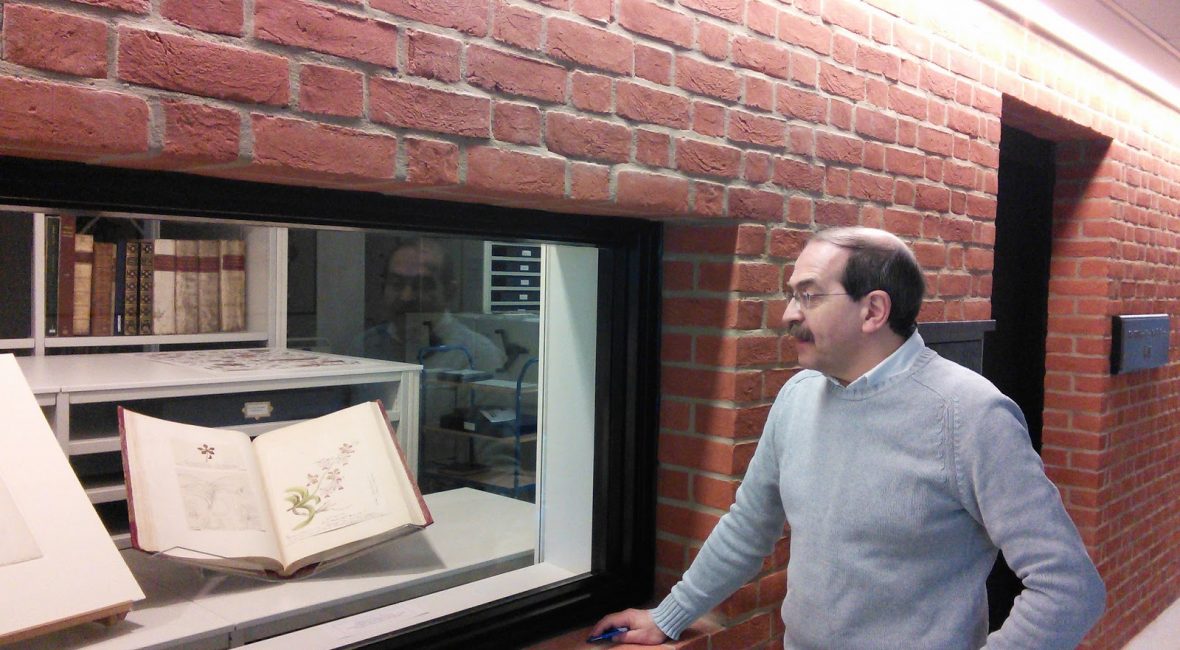
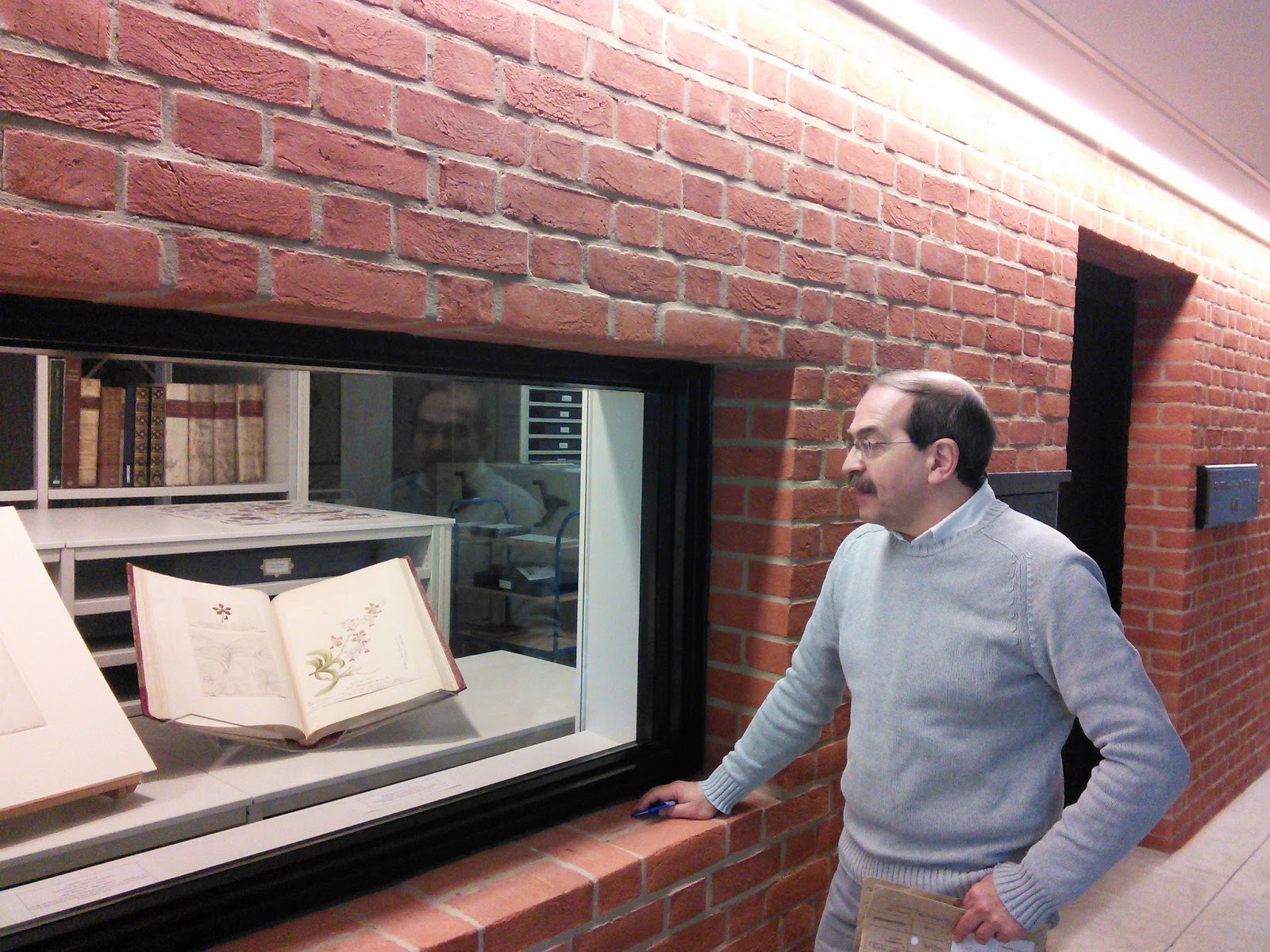
This week, Chris Mills, Head of Library, Art, and Archives at the Royal Botanic Gardens, Kew, celebrates his retirement. Chris has served as the Head of the Library at Kew since 2006, before which he served as the Head of Collections and Services at the Natural History Museum, London.
The Library, Art and Archives at the Royal Botanic Gardens, Kew, has the distinction of being one of BHL’s 10 founding institutions, and now represents one of BHL’s 16 Member Libraries. Chris has served as Kew’s representative to BHL since its beginning, and has been an important member of BHL’s community.
“Chris made sure that Kew Gardens was a founding member of the Biodiversity Heritage Library and has continued faithful representation as a valued colleague on the BHL Members Council,” emphasized Dr. Nancy Gwinn, Chair of the BHL Executive Committee and Director of the Smithsonian Libraries. “His wisdom and good humor will be missed!”
One of the most important botanical reference sources in the world, Kew’s Library, Art and Archives contains more than half a million items, including books, botanical illustrations, photographs, letters and manuscripts, periodicals, biographies and maps. From this impressive collection, the Library has contributed over 13,000 pages to BHL to date, thanks in large part to Chris’ leadership.
“We have all benefited widely by the expertise and humor that Chris has brought to BHL,” stated Martin R. Kalfatovic, BHL Program Director and Associate Director, Digital Services Division, at the Smithsonian Libraries. “His personal contributions and support of Kew’s participation in the BHL will be greatly missed.”
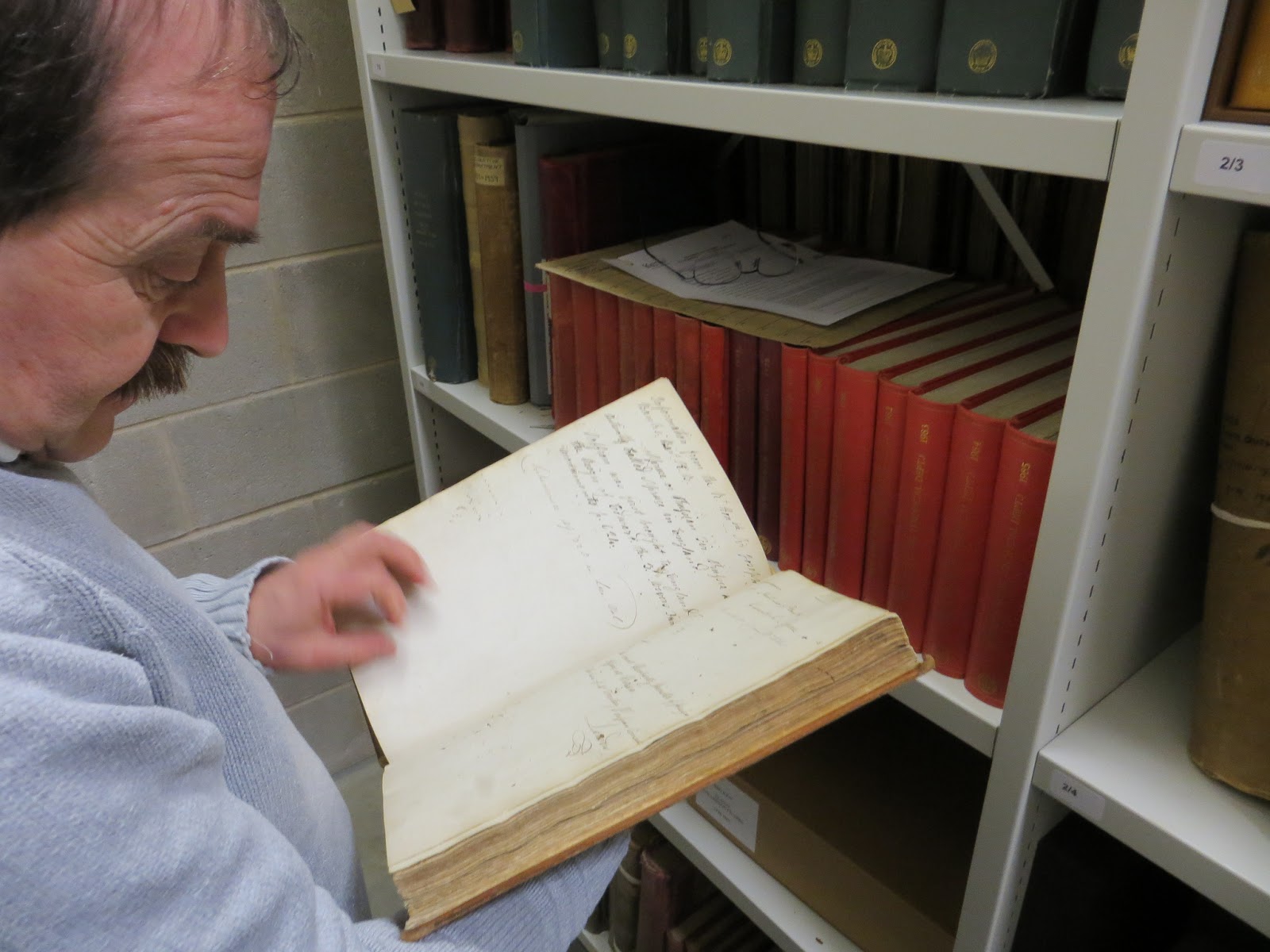
Jane Smith, Head of Library and Archives at the Natural History Museum, London and Secretary of the BHL Executive Committee, also expressed her appreciation of Chris’ contributions to the program. “Chris’s wit, lovely sense of fun and kindness makes him a good companion,” she said. “His considerable knowledge, expertise and understanding of natural history collections, particularly of botanical art, and good judgement has made him a valued colleague.”
David Iggulden, Electronic Resources Manager at the Library, Art, and Archives at the Royal Botanic Gardens, Kew, will serve as the Kew Member Representative to BHL following Chris’ retirement. David has long represented Kew on the BHL Staff Committee, making him highly qualified to now represent the Library on the Members Council.
“Chris first introduced me to BHL when I started at Kew in 2007,” remembers David. “He explained how he and a few colleagues had come up with the idea originally for a joint union catalogue of their library resources which could be searched online. But as time and technology moved on, they decided that this wasn’t enough and that perhaps instead digitisation of the collections was the way to go. The aim then (as now) was to provide the digitised content free of charge to all, online via a web portal.
“Chris truly inspired me about BHL with his highly infectious enthusiasm for the resource and its aims. He quietly helped me to further develop my professional interest in BHL over the years and always supported our involvement even when times were tough. In 2009 I was delighted to deputise for Chris at the Institutional Council meeting in Boston, representing Kew in the discussions as BHL began to go global. After this he fully supported me to attend the BHL Life and Literature conference in 2011. This incredible event uncovered the huge potential for the BHL to further develop its services and content in response to the challenges of working with biodiversity literature.
“Chris will be sorely missed but I very much hope to continue Kew’s involvement with BHL and progress towards Chris’s and the other founder members’ original vision for this ambitious resource.”
While he will indeed be greatly missed, we are excited to celebrate with Chris as he begins this next chapter in his life. We wish him happiness and a wonderful retirement, and extend a warm and hearty thanks for all of his wonderful contributions to BHL. We look forward to the many wonderful contributions to BHL still to come from Kew under David’s able leadership.
Thank you, Chris, and Happy Retirement, from your Family at the Biodiversity Heritage Library.
We hope you’ve been enjoying the fossil-mania this week with Fossil Stories! We’ve been exploring the fascinating history of paleontology, learning some great fossil facts, and hearing from experts (via a series of live webcasts) about current fossil research.
Our posts have demonstrated the important role that natural history publications have played in the history of paleontology. These works disseminated new research and ideas, documented the evolution of human knowledge about fossils and their origins, and recorded the first scientific descriptions of many ancient creatures.
But this literature is important not just for the historical information it provides. It is also highly relevant to modern paleontological research.
“Traditional ways of knowing about the fossil record are still relevant for modern questions in paleontology because specimens matter,” explains Dr. Nicholas D. Pyenson, Curator of Fossil Marine Mammals at the Smithsonian National Museum of Natural History. “Many important fossils were intially described and published in monographic, folio formats, and in many cases, those descriptions can be still be used 100-150 years later. I use them all the time.”
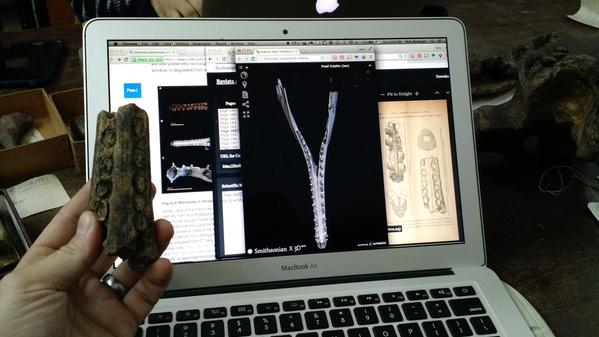
And indeed he does. During a recent trip to Argentina, Dr. Pyenson was able to compare specimens in the Museo Argentino de Ciencias Naturales with illustrations of those specimens in BHL alongside 3D scans of the related cetacean.
 |
| Comparing specimens to digitized literature and 3D scans. Dr. Nicholas D. Pyenson conducting research at the Museo Argentino de Ciencias Naturales. Photo by Nicholas D. Pyenson, via Twitter: https://twitter.com/PyensonLab/status/647111438222389248. |
The importance of historic literature to modern fossil research is echoed by those in the field of paleobotany as well.
“Just as in research on living plant and animal biodiversity, research on the fossil record of plants and animals depends crucially on the published literature,” emphasizes Dr. Patrick Herendeen, Director of Systematics and Evolutionary Biology at the Chicago Botanic Garden. “Plant systematics literature goes back hundreds of years, and having access to this literature is essential for ongoing research in plant taxonomy and systematics. This is equally true for paleobotany.”
Knowing that historic literature is so important to modern paleontological work, we asked paleontologists at several BHL partner institutions to share some of their favorite historic publications with us. We think the results constitute a pretty awesome Recommended Reading List for Paleontology Enthusiasts!
Dr. Hans-Dieter Sues
Chair, Department of Paleobiology. Curator of Fossil Vertebrates.
Smithsonian National Museum of Natural History
“Not surprisingly, my favorite early book on paleontology is Recherches sur les ossemens fossiles de quadrupèdes by G. Cuvier (first published in 1812, with three later editions). Not only did it found the scientific study of fossil vertebrates but it is written in a clear yet elegant style but that makes it a pleasure to read. Cuvier did not just describe fossils but tried to interpret their anatomy in functional terms. As a foundational work in the field, it will always be relevant to researchers interested in the fossil record of backboned animals.”
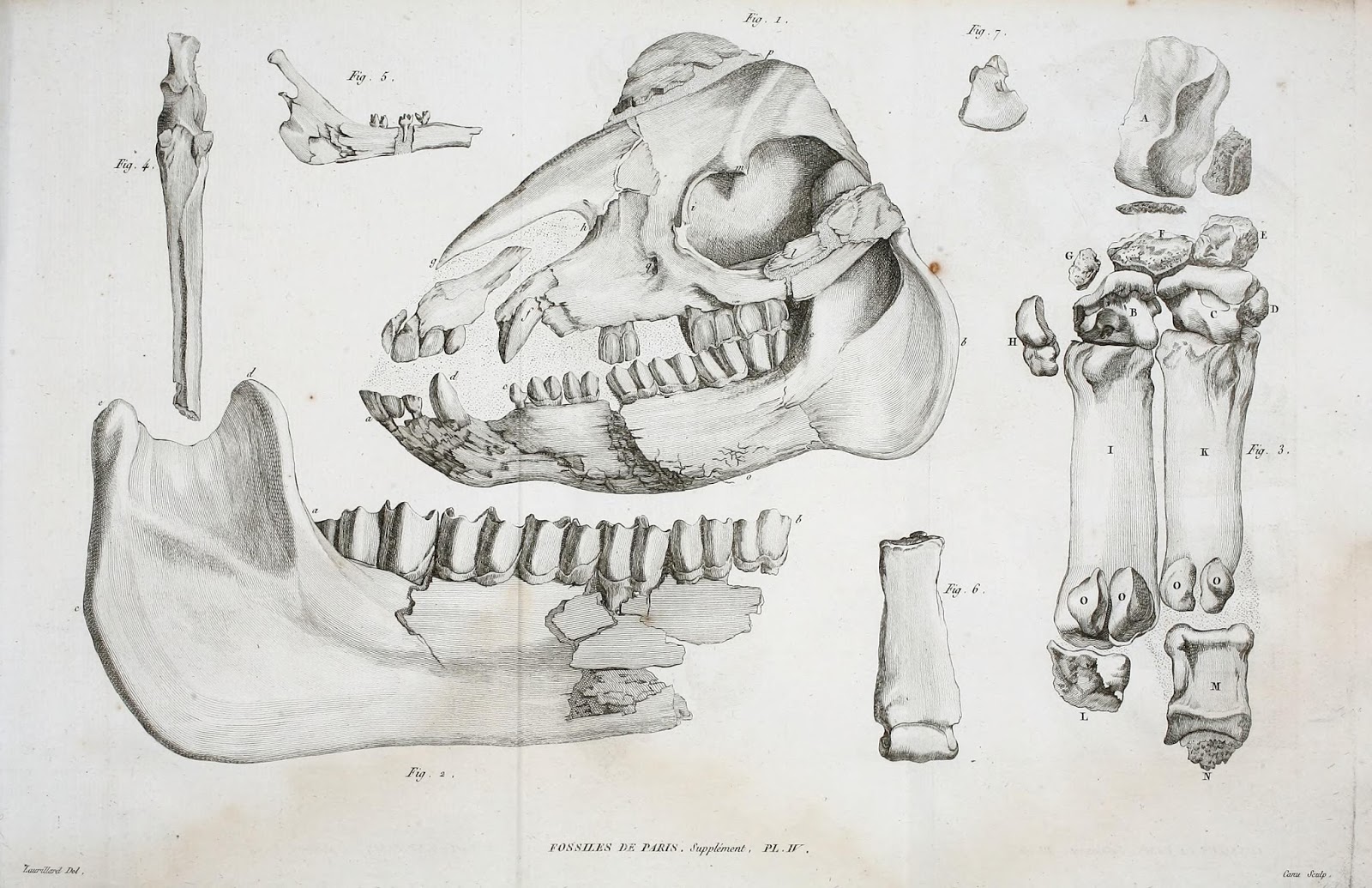 |
| Cuvier, Georges. Recherches sur les ossemens fossiles de quadrupèdes. v. 3 (1812). http://biodiversitylibrary.org/page/40078532. Digitized by Smithsonian Libraries. |
Dr. Maria A. Gandolfo
Senior Researcher, L.H. Bailey Hortorium, Plant Biology Section
School of Integrative Plant Science, Cornell University
Dr. Gandolfo’s favorite early paleobotany book is Ancient Plants, written by Mary C. Stopes in 1910. When asked why it is her favorite, Dr. Gandolfo referred to a quote from the book: “The lore of the plants which have successively clothed this ancient earth during the thousands of centuries before men appeared is generally ignored or tossed on one side with a contemptuous comment on the dullness and ‘dryness’ of fossil botany.” According to Dr. Gandolfo, “This book was written in 1910 and even after 105 years of incredible advances in the field of Paleobotany, this sentence still reflects what people feels about Paleobotany.”
Dr. Peter J. Makovicky
Department Chair and Associate Curator, Department of Geology
The Field Museum
The Ceratopsia are a group of herbivorous, beaked dinosaurs that thrived during the Cretaceous Period. They include such iconic genera as Triceratops and Montanoceratops. The name Ceratopsia was coined by Othniel Charles Marsh in 1890, and in 1907 he, along with John B. Hatcher and Richard S. Lull, published a monograph on the group, entitled The Ceratopsia. According to Dr. Makovicky, this work is one of his favorites and a classic amongst the pre-1923 published materials.
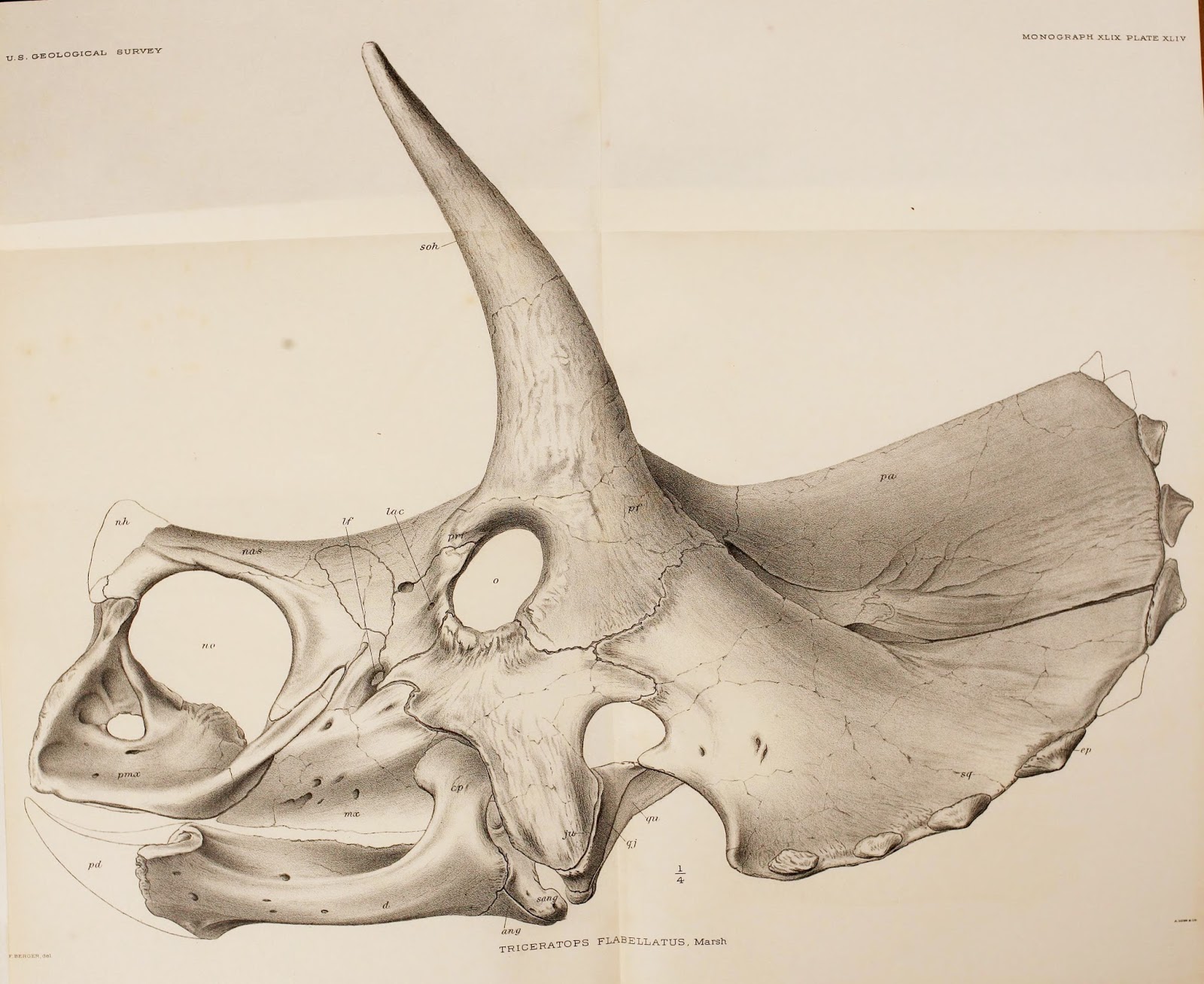 |
| The Ceratopsia. 1907. http://biodiversitylibrary.org/page/39875988. Digitized by Smithsonian Libraries. |
Dr. William A. DiMichele
Research Paleontologist and Curator
Smithsonian National Museum of Natural History
Dr. DiMichele’s favorite historic paleontology work is Description of the Coal Flora of the Carboniferous Formation in Pennsylvania and Throughout the United States, by Leo Lesquereux (1879-80). According to Dr. DiMichele, “This is the foundational book/atlas on American Carboniferous (coal age) floras and contains detailed descriptions and illustrations of many of the species that occur commonly in coal fields of the eastern and midwestern US. Many of the species that occur in the rocks I study were first described in this set of volumes, so the books remain a primary source of information to which I turn regularly.”
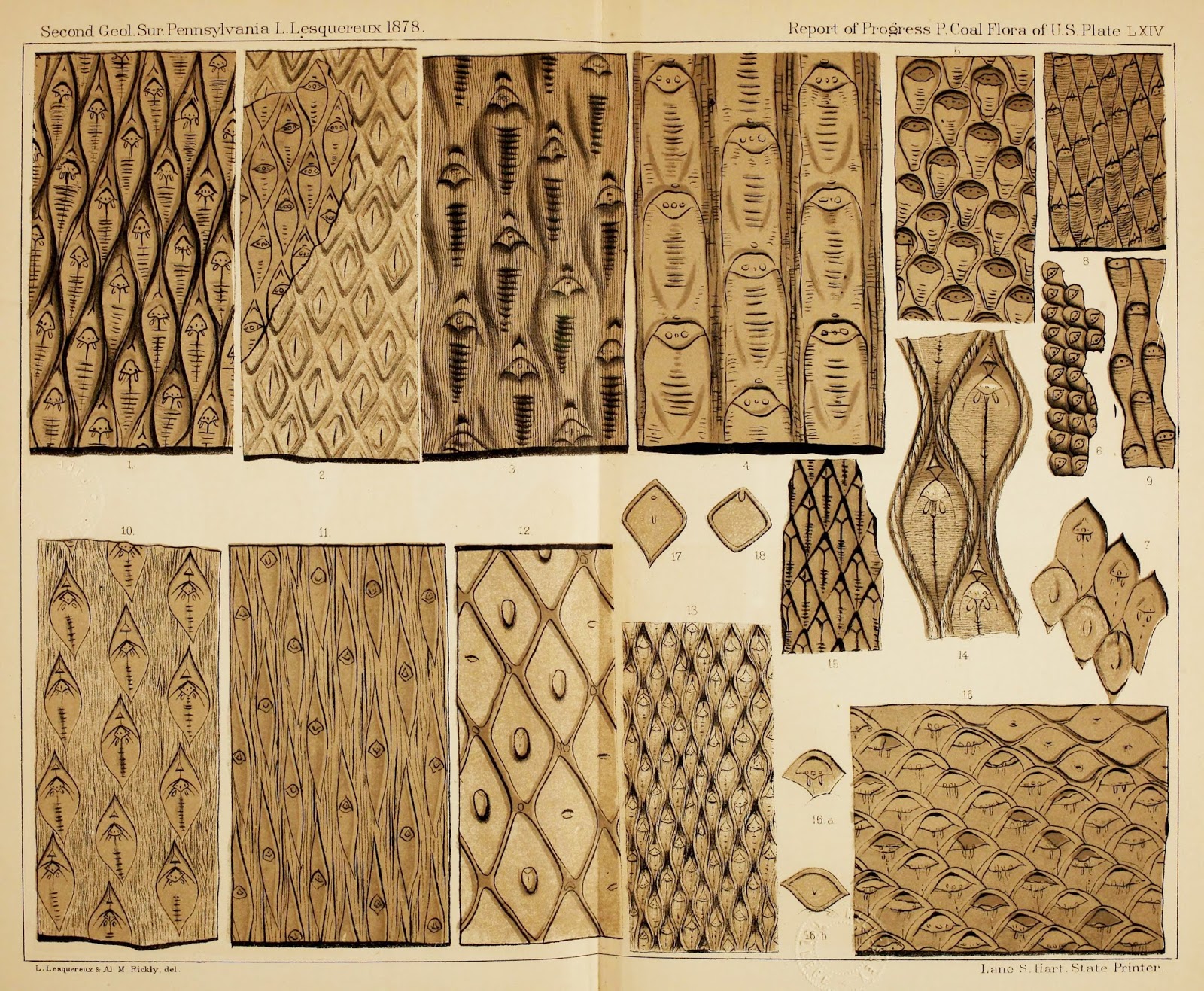 |
| Lesquereux, Leo. Description of the coal flora of the Carboniferous formation in Pennsylvania and throughout the United States. Atlas (1879). http://biodiversitylibrary.org/page/46854192. Digitized by Wellesley College Library. |
Dr. Karl J. Niklas
The Liberty Hyde Bailey Professor of Plant Biology
Cornell University
Dr. Niklas’ favorite historic paleontological work is The Origin of a Land Flora (1908) written by F. O. Bower. According to Dr. Niklas, “This book presents the first conceptualization of the evolution of ‘The Alternation of Generations’ in the land plants. I have worked on the evolution of plant body plans and the evolution of plant life cycles,” thus making this work particularly relevant to Dr. Niklas’ research.
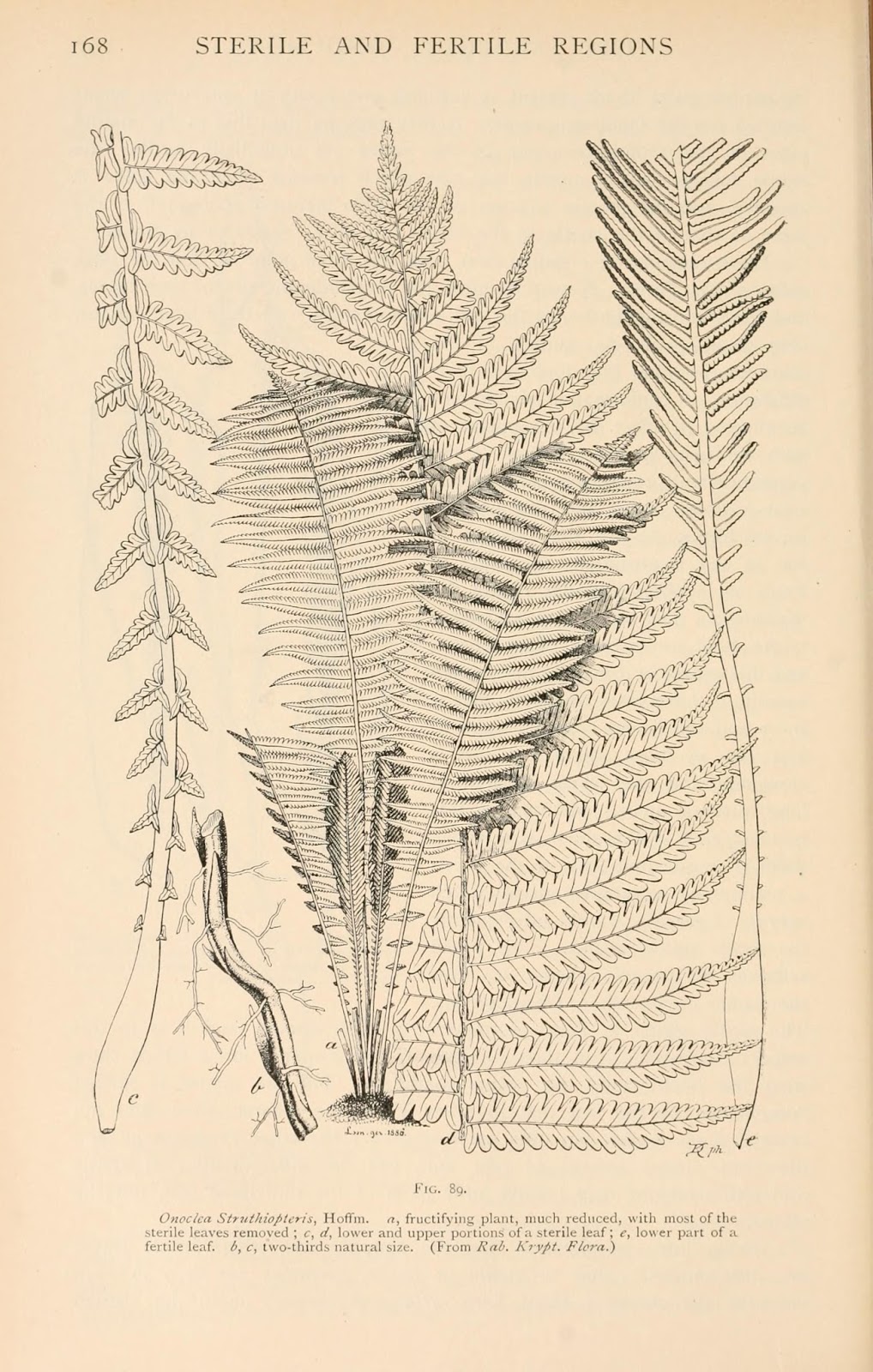 |
| Bower, F.O. The Origin of Land Flora. (1908). http://biodiversitylibrary.org/page/1312200. Digitized by the MBLWHOI Library. |
Dr. Nicholas D. Pyenson
Curator of Fossil Marine Mammals
Smithsonian National Museum of Natural History
Dr. Pyenson’s favorite historic paleontology book is Ostéographie des cétacés vivants et fossiles (1868-79), by Pierre Joseph Beneden and Paul Gervais. “This work showcased specimens and species that no one had really seen outside of the areas where the specimens were collected,” explains Dr. Pyenson. “It’s a catalog of the world’s whales, and the authors didn’t discriminate between fossil and modern species. It’s cool that these were integrated together into one work this early on, before it was fashionable to do so.”
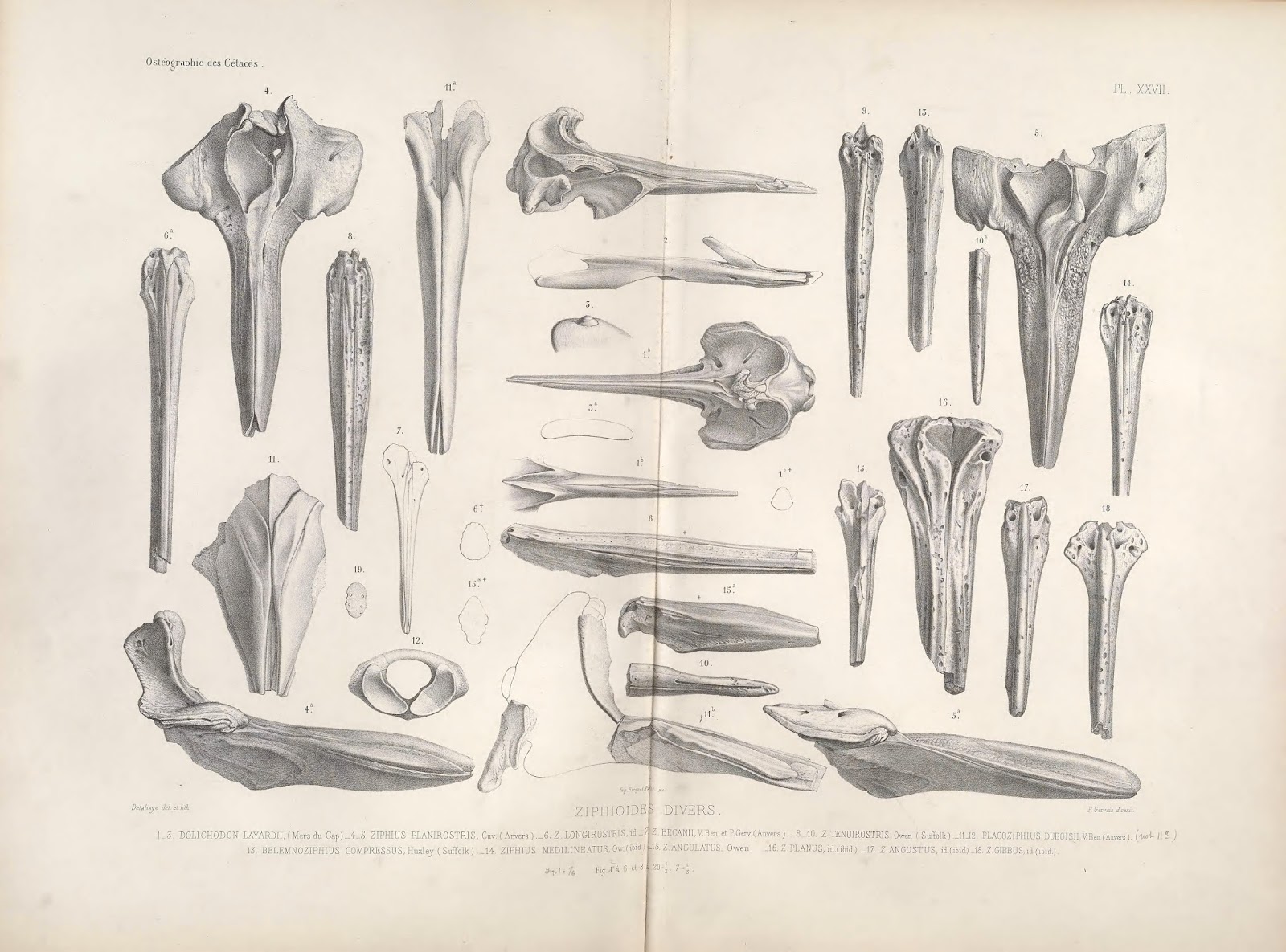 |
| Modern whale skulls alongside fossil skulls. “You can tell which are the fossil skulls by the condition of the specimens,” explains Dr. Pyenson. Ostéographie des cétacés vivants et fossiles. (1869-79). http://biodiversitylibrary.org/page/41066967. Digitized by Smithsonian Libraries. |
Thanks to all of our experts for sharing their favorite historic publications with us! We hope you’ve enjoyed our series of blog posts this week highlighting key works in the history of paleontology. Can’t get enough of the fossil publications? Then check out other great works in the BHL Fossil Stories digital book collection.
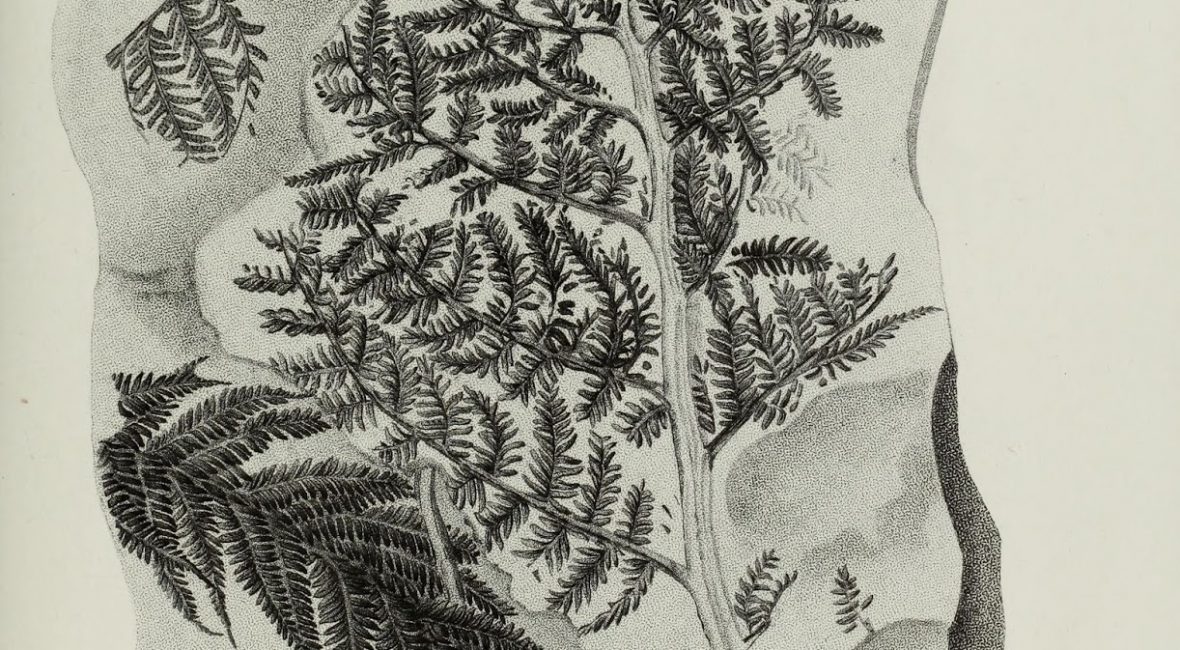
Phytology is an historic term, not widely used today, for the study of plants. Antediluvian was a term much used by early paleontologists to describe the “time before the great Biblical flood.” These two terms are necessary to understand the title of an important work in paleobotany: Antediluvian Phytology (1838), by Edmund Tyrell Artis.
The formal study of paleobotany has roots in 1828, when Adolphe-Théodore Brongniart, known as the Father of Paleobotany, published Histoire des végétaux fossiles. A decade after this publication, Artis’ work was published. It was remarkable for including some the best paleobotanical illustrations published up to that time, describing many new-to-science species, and interpreting fossils through the lens of the individual that actually collected the fossils: Artis himself. At the time, many paleontologists obtained fossils from collectors, but did not collect themselves. Understanding the context in which a fossil is found, and the surrounding environment, can have important implications in the analysis and interpretation of the specimen.
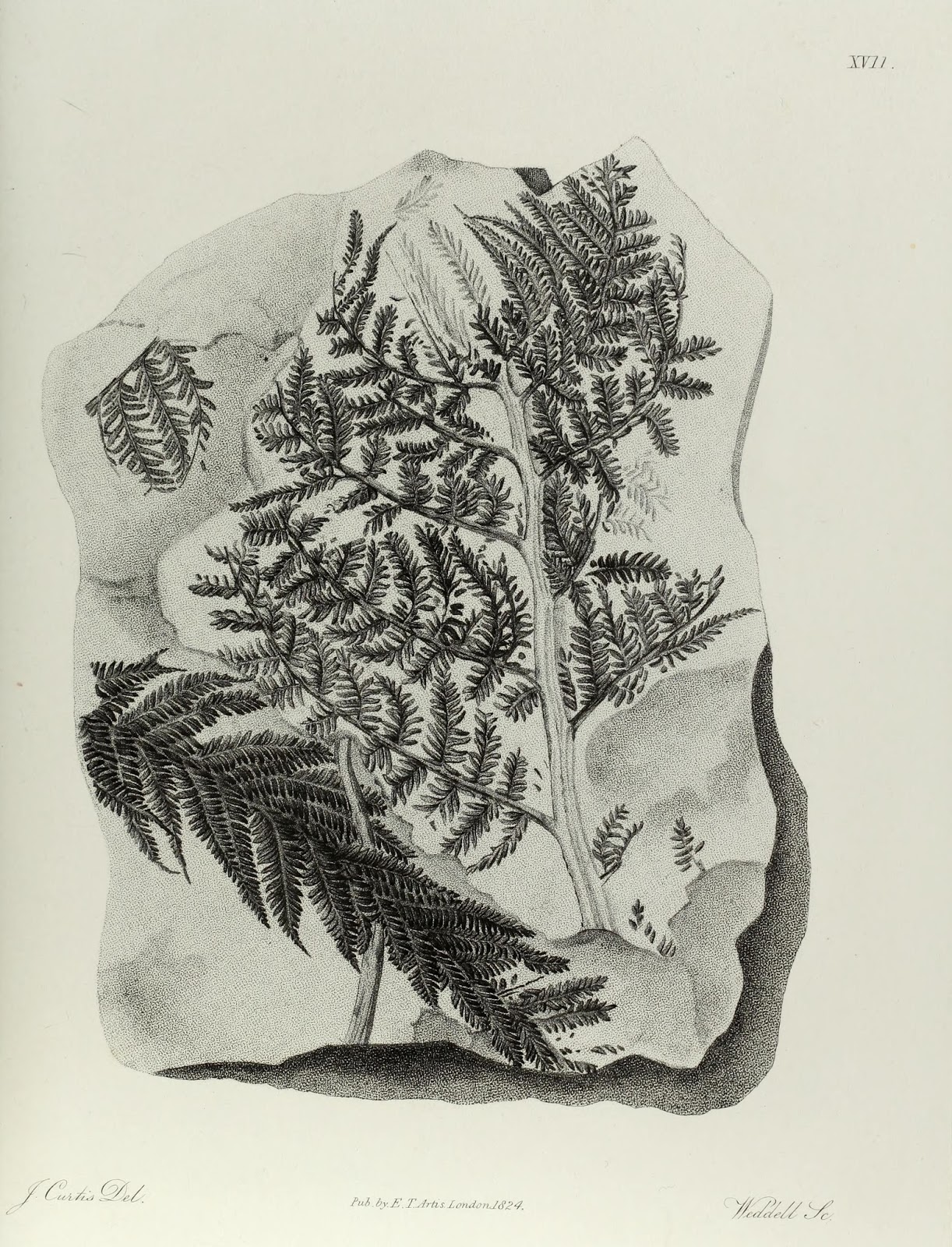 |
| Artis, Edmund Tyrell. Antediluvian Phytology. 1838. http://biodiversitylibrary.org/page/39307886. Digitized by the California Academy of Sciences. |
These accomplishments are even more remarkable considering the humble origins of Artis himself, which also contributes to much of the mystery surrounding him and his work.
Artis was the son of a carpenter, born in 1789 in the small village of Sweffling in Suffolk, England. After moving to London to work in the wine trade with his uncle, he opened a confectionary shop, where his work caught the eye of the Earl Fitzwilliam, who asked Milton to join his staff at Milton Hall near Castor. Artis proved very adept, and was promoted to House Steward within three years.
Artis often accompanied the Fitzwilliams on their visits to the other family property, Wentworth Woodhouse in south Yorkshire. The region boasted some of the most important coal mines in England, and Artis soon began collecting plant fossils from the area. He amassed a collection of between 1,000-1,500 plant fossils, some of which he described in his only publication, Antediluvian Phytology. The work included 24 illustrations, some based on his own paintings and the rest the work of leading natural history illustrator John Curtis.
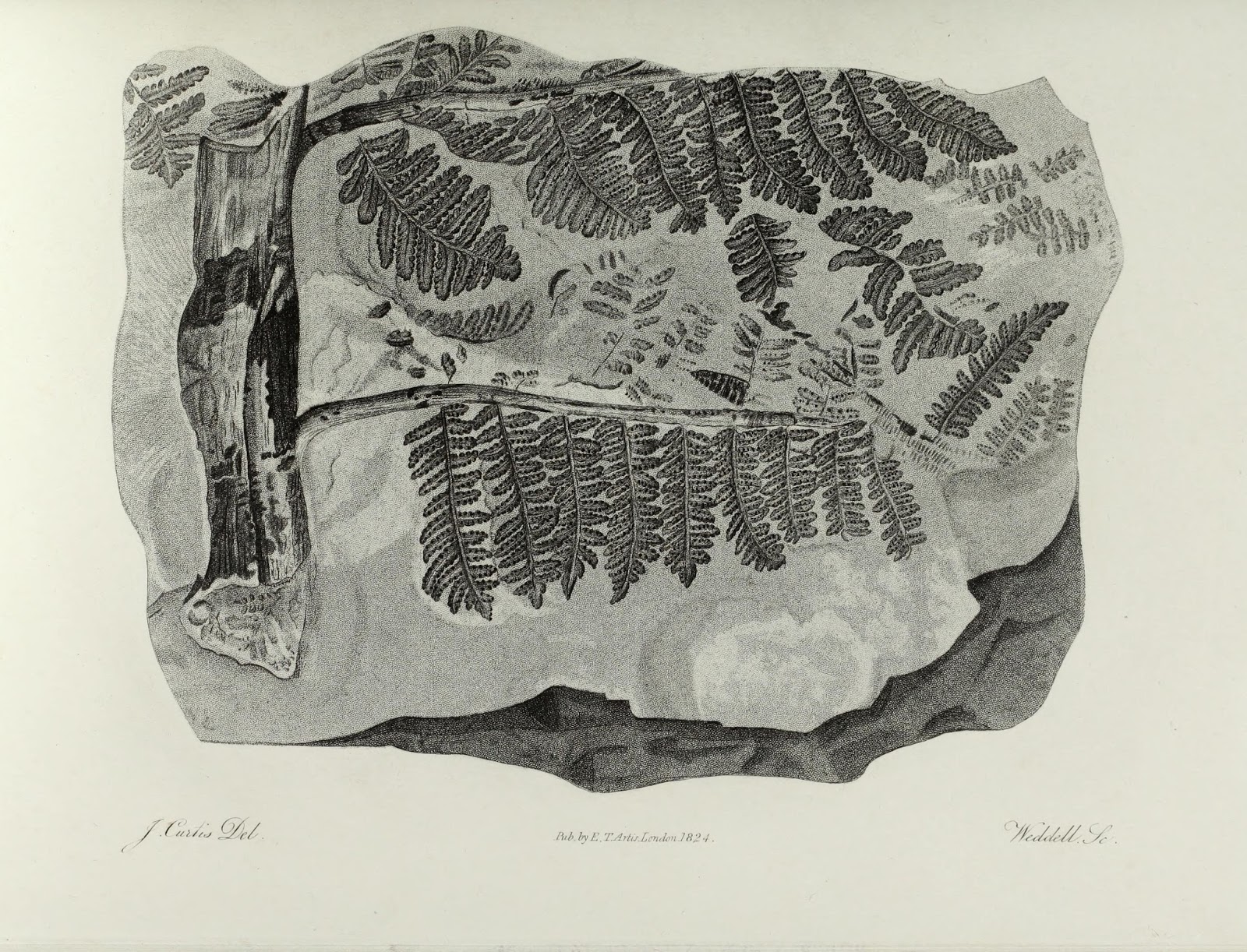 |
| Artis, Edmund Tyrell. Antediluvian Phytology. 1838. http://biodiversitylibrary.org/page/39307868. Digitized by the California Academy of Sciences. |
Artis and his publication are something of a mystery. For instance, it’s unclear who paid for the publication of his work. There’s no evidence of pre-subscriptions that could have funded the work, or that Fitzwilliam contributed funds to it. Artis himself is not likely to have been able to afford such a venture. Furthermore, Artis was evidently familiar with the relevant natural history literature of the day, but how he gained access to it is alsoa mystery. Artis also apparently had influential friends. He claimed to have met Georges Cuvier, and William Buckland sponsored Artis to become a Fellow of the Geological Society in 1824. How he met Buckland, or when he would have had occasion to meet Cuvier, are unknown.
Artis would later find an interest in archeology, becoming famous for his excavations of the Roman remains near Milton Hall. In 1847, he fell ill, possibly due to exposure to a harsh winter while excavating ruins in Northamptonshire. He died on Christmas Eve, 1847.
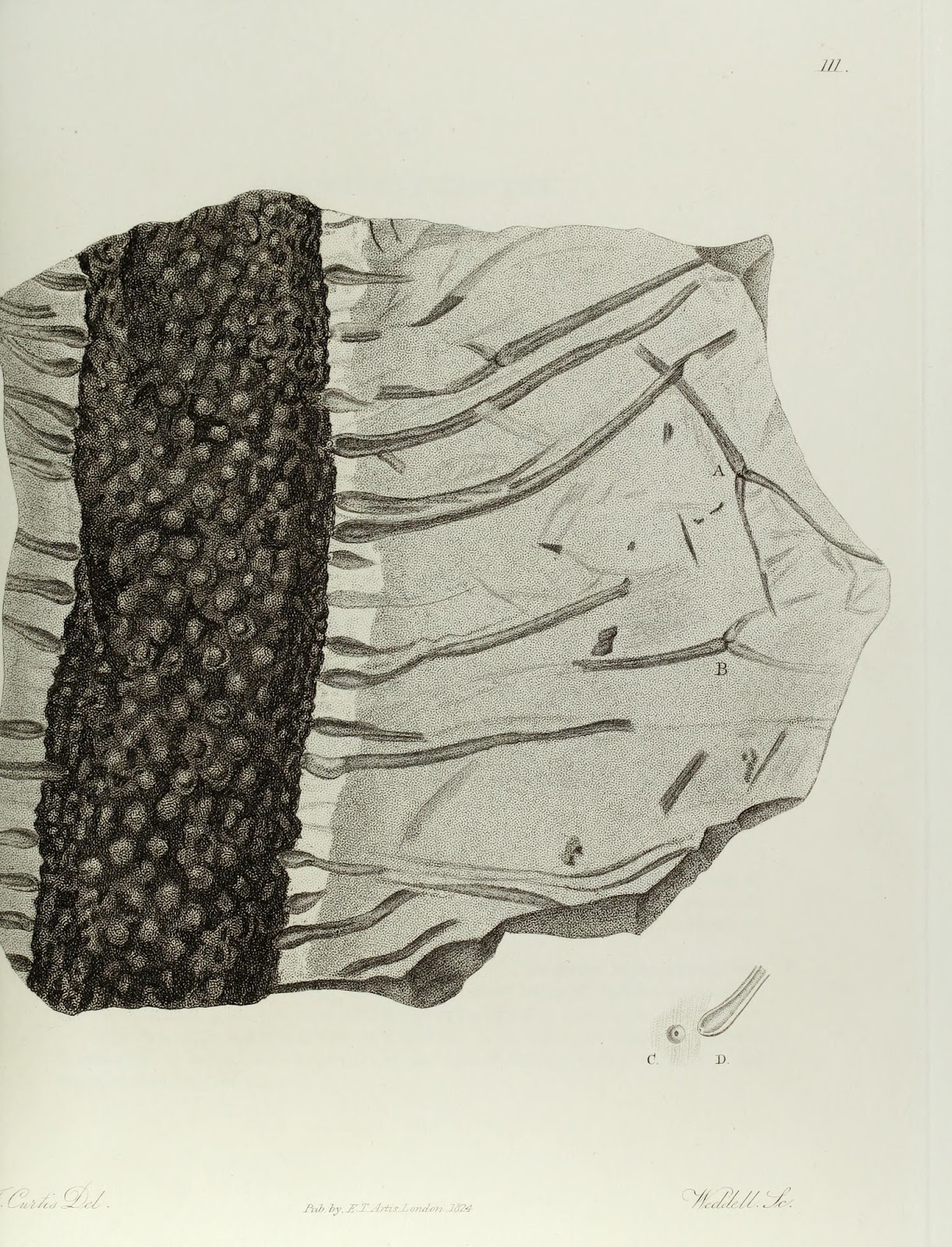 |
| Artis, Edmund Tyrell. Antediluvian Phytology. 1838. http://biodiversitylibrary.org/page/39307762. Digitized by the California Academy of Sciences. |
Although much mystery still surrounds this enigmatic man, his contributions to the field of paleobotany are forever immortalized through his Antediluvian Phytology.
Fossil Stories
Stay tuned all week for more great fossil fun with our #FossilStories campaign, including:
- Tweets and Facebook Posts
- Blog Posts highlighting milestones and key publications in the history of fossil research
- A Flickr Collection with hundreds of historic fossil illustrations
- A Pinterest Collection featuring a selection of our favorite fossil illustrations
- A BHL Collection containing seminal publications in the history of paleontology
- A series of live webcasts at BHL partner institutions
- A citizen science challenge in collaboration with The Field Book Project, the Smithsonian Transcription Center, and Smithsonian Institution Archives
Follow #FossilStories on Twitter and Facebook to learn more.