Biodiversity Heritage Library - Program news and collection highlights from BHL
  • Home
  • News
  • Featured Books
    • All Featured Books
    • Book of the Month Series
    • BHL at 20
  • User Stories
  • Campaigns
    • Fossil Stories
    • Garden Stories
    • Monsters Are Real
    • Page Frights
    • Her Natural History
    • Earth Optimism 2020
  • Tech Blog
  • Visit BHL
Home
News
Featured Books
    All Featured Books
    Book of the Month Series
    BHL at 20
User Stories
Campaigns
    Fossil Stories
    Garden Stories
    Monsters Are Real
    Page Frights
    Her Natural History
    Earth Optimism 2020
Tech Blog
Visit BHL
  • Home
  • News
  • Featured Books
    • All Featured Books
    • Book of the Month Series
    • BHL at 20
  • User Stories
  • Campaigns
    • Fossil Stories
    • Garden Stories
    • Monsters Are Real
    • Page Frights
    • Her Natural History
    • Earth Optimism 2020
  • Tech Blog
  • Visit BHL
Biodiversity Heritage Library - Program news and collection highlights from BHL
Blog Reel, Featured Books

The Garden: A Place to Learn and Experiment

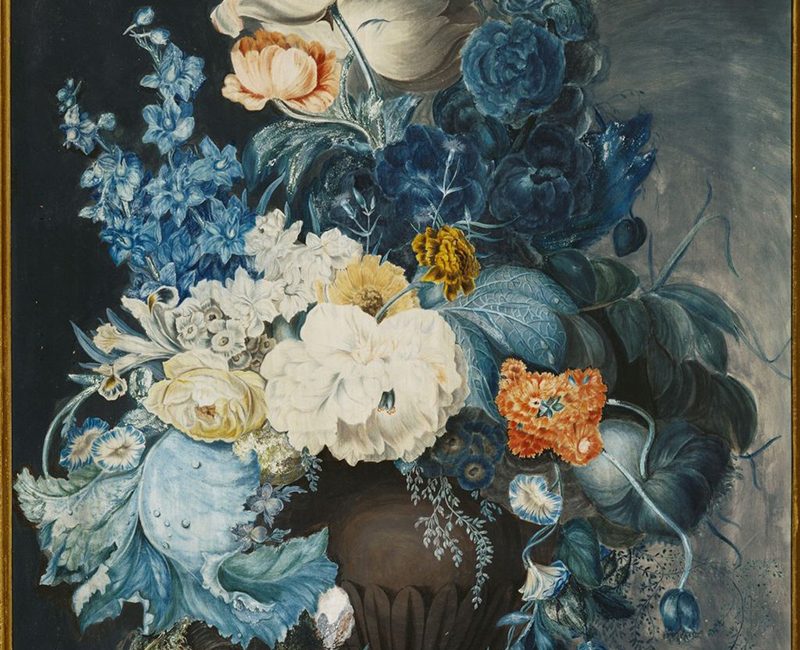
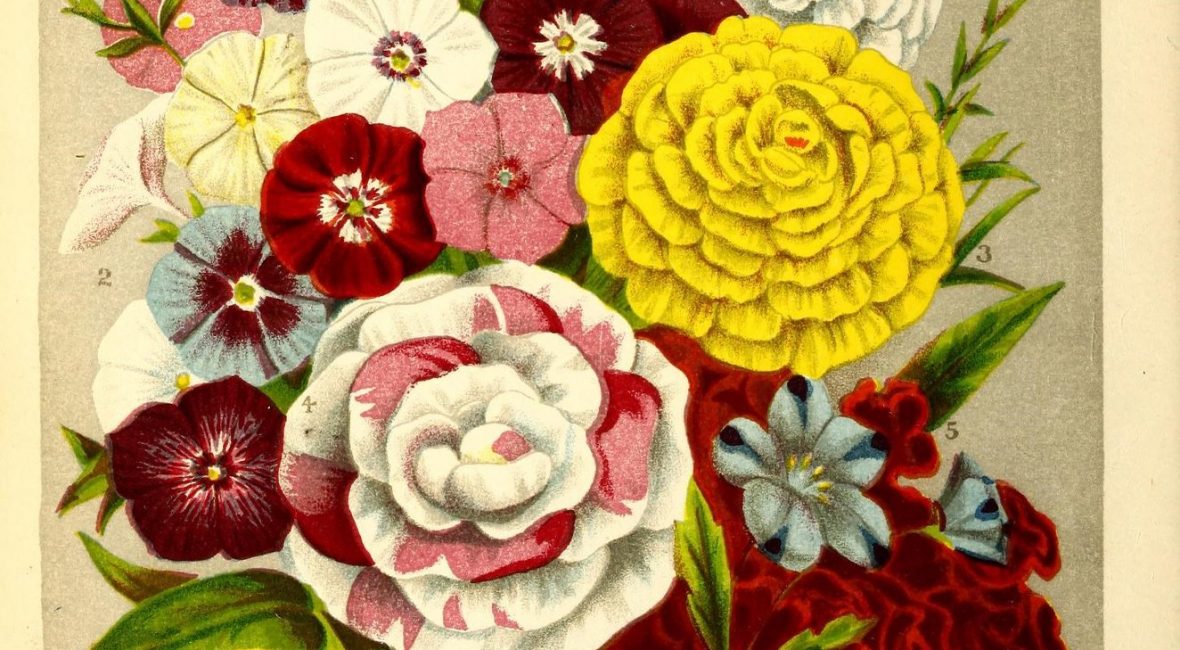
illustration of a colorful bouquet of flowers

This post originally published on the Smithsonian Libraries and Archives’ blog, Unbound.

A garden is a place to rest, relax, rejuvenate. It also provides an opportunity to learn about nature. Staff at Smithsonian Libraries and Archives are also learning and developing new skills. Some of these new skills are related to digitization and accessibility of biodiversity literature.

During these months of telework, I am assisting the Digital Library and Digitization Department to enhance page-level and image-level access to previously digitized books for the Biodiversity Heritage Library (BHL). This involves improving page-level metadata for items in BHL, uploading full-page illustrations to the BHL Flickr, and tagging the images in Flickr with species’ common and scientific names. These digitized books include a variety of content: plants, birds, mammals, reptiles, crustaceans, insects, and so much more. In the course of this work, I have the opportunity to view lovely illustrations. Recently a horticultural catalog caught my attention. The item is titled Vick’s Flower and Vegetable Garden (1878) by James Vick.

title page

James Vick, Rochester, NY. Vick’s Flower and Vegetable Garden (1878), title page. Available online in the Biodiversity Heritage Library.

James Vick was born in England and arrived in New York City at a young age. There, he learned the printer’s trade. He later moved to Rochester, New York. In Rochester, he set type for several newspapers and went on to serve as writer, editor, owner, or publisher of various publications. In 1862, he issued the first Floral Guide and Catalogue. Due to his past experience in the printer and journalist fields, he created a personal style offering gardening advice, anecdotes, correspondence, a complaint section, a children’s section, and color prints. James Vick also began a seed store which later became a well-known seed-display garden. After his death, the company continued into the 20th Century until it was sold to Burpee Seed Co.

Flowers including Perennials: Aquilegia, Perennial Pea, Digitalis (Fox Glove), Double Pink, Perennial Larkspur, Campanula (Canterbury Bell), Sweet William, Picotee, and Pentstemon

James Vick, Rochester, NY. Vick’s Flower and Vegetable Garden (1878), page preceding page 99, Perennials including (1) Aquilegia, (2) Perennial Pea, (3) Digitalis (Fox Glove), (4) Double Pink, (5) Perennial Larkspur, (6) Campanula (Canterbury Bell), (7) Sweet William, (8) Picotee, (9) Pentstemon. Available online in the Biodiversity Heritage Library.

This particular item, Vick’s Flower and Vegetable Garden (1878) by James Vick, is filled with gardening advice, botanical descriptions, and many illustrations. It seems to speak directly to the reader with a conversational tone and focus on learning. As it states on page 5,

“The study of Agriculture and Horticulture has engaged the attention of the wisest from the earliest ages, and yet what wonderful discoveries and improvements have we witnessed in our own day; and we are still learners.”

Flowers including Tender Bulbs: Tritoma uvaria, Gladioli, Tuberose, Dahlia, and Tigridia

James Vick, Rochester, NY. Vick’s Flower and Vegetable Garden (1878), page preceding page 109, Tender Bulbs including (1) Tritoma uvaria, (2) Gladioli, (3) Tuberose, (4) Dahlia, (5) Tigridia. Available online in the Biodiversity Heritage Library.

The catalog includes practical suggestions for selecting seeds, preparing soil, and planting gardens. On the subject of garden design, it suggests keeping the future in mind. When planting trees, it emphasizes the awareness of knowing the size, form, and habits of the full-grown tree as opposed to only thinking of its small size when planted. For those with little outdoor space, there are ideas for creating balcony gardens and window boxes.

Entrance Court and Balcony Garden

James Vick, Rochester, NY. Vick’s Flower and Vegetable Garden (1878), page 20, Entrance Court and Balcony Garden. Available online in the Biodiversity Heritage Library.

Another section focuses on floral decorations, such as incorporating greenery and flowers into decorations. This might include covering letters with greenery to form welcoming words for a guest, adorning a table with a floral centerpiece, decorating a room with garlands, or creating bouquets and button-hole flowers.

Let’s take a closer look at one of these floral decorations, forming and covering letters with greenery and flowers. Perhaps, someone wanted to welcome a guest by displaying a “Welcome” sign or, as in the example below, decorate the words, “Peace on Earth.” As the catalog explains, the first step was to determine the height of all letters. Then, the width of each letter was determined proportional to its height. For example, if six inches was chosen for the height of all upper-case letters, the proportional width for “P” would be four inches, “E” three and a half inches, “A” four and a half inches, and so on, as detailed in the explanation shown in the image below. Once the letters were outlined on heavy straw board, each letter was cut out and dark thread was used to fasten small branches of evergreens or dry moss to the letters. Finally as a finishing touch, berries or everlasting flowers were added to brighten the decoration, as detailed below.

Forming letters to make floral decorations

James Vick, Rochester, NY. Vick’s Flower and Vegetable Garden (1878), page 31, Forming Letters for Floral Decorations. Available online in the Biodiversity Heritage Library.

Another floral decoration is the button-hole flower or bouquet. The button-hole flower was simply that, a single flower with a “pretty, sweet-scented leaf” positioned behind it. Thread or string was used to attach the two together (below, bottom right), and then it was inserted into the bouquet holder which was already filled with water. To fasten the button-hole flower to clothing or hair, a pin was attached to the bouquet holder.

On the other hand, the button-hole bouquet was composed of “a few very fine flowers” (below, bottom left). Once the flowers were nicely arranged, the stems were covered with damp moss or cotton and then tinfoil. The button-hole bouquet was inserted into the bouquet holder or attached directly to clothing with a pin.

English Holly, Winter Berry (Ilex verticillata), Button-hole Bouquet, and Button-hole Flower

James Vick, Rochester, NY. Vick’s Flower and Vegetable Garden (1878), page 36, English Holly, Winter Berry (Ilex verticillata), Button-hole Bouquet, and Button-hole Flower. Available online in the Biodiversity Heritage Library.

Almost every page of Vick’s Flower and Vegetable Garden (1878) includes an illustration. With its conversational style and focus on learning, it encourages readers to try their hand at something new. This might be designing their own garden, planting a small garden in a window box, placing vases or ornamentation around the garden, or creating a floral decoration for a party. For reference purposes, it includes a handy “Botanical Glossary” and guide to “Pronouncing Vocabulary of Botanical Names.”

Towards the end, there are many pages illustrating and describing specific plants. A page focusing on “Classification and Names of Flowers” assists with understanding the divisions of plants as described in this catalog. These divisions include Annuals, Perennials, Greenhouse, Bulbs and Plants, and Holland Bulbs. There is also a section devoted to Vegetables. Detailed information for specific plants includes such things as descriptions, origin, and tips for planting. Every so often, the reader might stumble across a full-page illustration, like the Annuals shown below. Perhaps an illustration such as this might have inspired a bouquet or floral decoration to brighten a room for a holiday or special occasion.

Flowers including Annuals: Ten-Weeks Stock, Phlox drummondii, Double Portulaca, Balsam, Nemophila, Japan Cockscomb, Pansy, and Striped Petunia.

James Vick, Rochester, NY. Vick’s Flower and Vegetable Garden (1878), page preceding page 55, Annuals including (1) Ten-Weeks Stock, (2) Phlox drummondii, (3) Double Portulaca, (4) Balsam, (5) Nemophila, (6) Japan Cockscomb, (7) Pansy, (8) Striped Petunia. Available online in the Biodiversity Heritage Library.

Vick’s Flower and Vegetable Garden (1878) by James Vick is located in the Joseph F. Cullman 3rd Library of Natural History. A digitized version is available on the Biodiversity Heritage Library (BHL) and a Flickr album of its full-page illustrations is available on the BHL Flickr. For more information about James Vick, take a look at this BHL Blog post.

Other seed catalogs by James Vick’s Sons are located in a horticultural collection within the Trade Literature Collection at the National Museum of American History Library. For more information on one of these catalogs, take a look at this post about Vick’s Garden and Floral Guide (1898) by James Vick’s Sons.

Reference

“Vick, James.” Biographies of American Seedsmen & Nurserymen, compiled by Marca L. Woodhams, Librarian, Horticulture Branch Library, Smithsonian Institution Libraries, December 1999. Accessed January 8, 2021. https://www.sil.si.edu/SILPublications/seeds/bios.html#Vick,%20James
April 15, 2021by michelle.underhill
Blog Reel, Featured Books

Charles Lathrop Pack: Pioneering the Idea of the “Victory Garden” in the United States

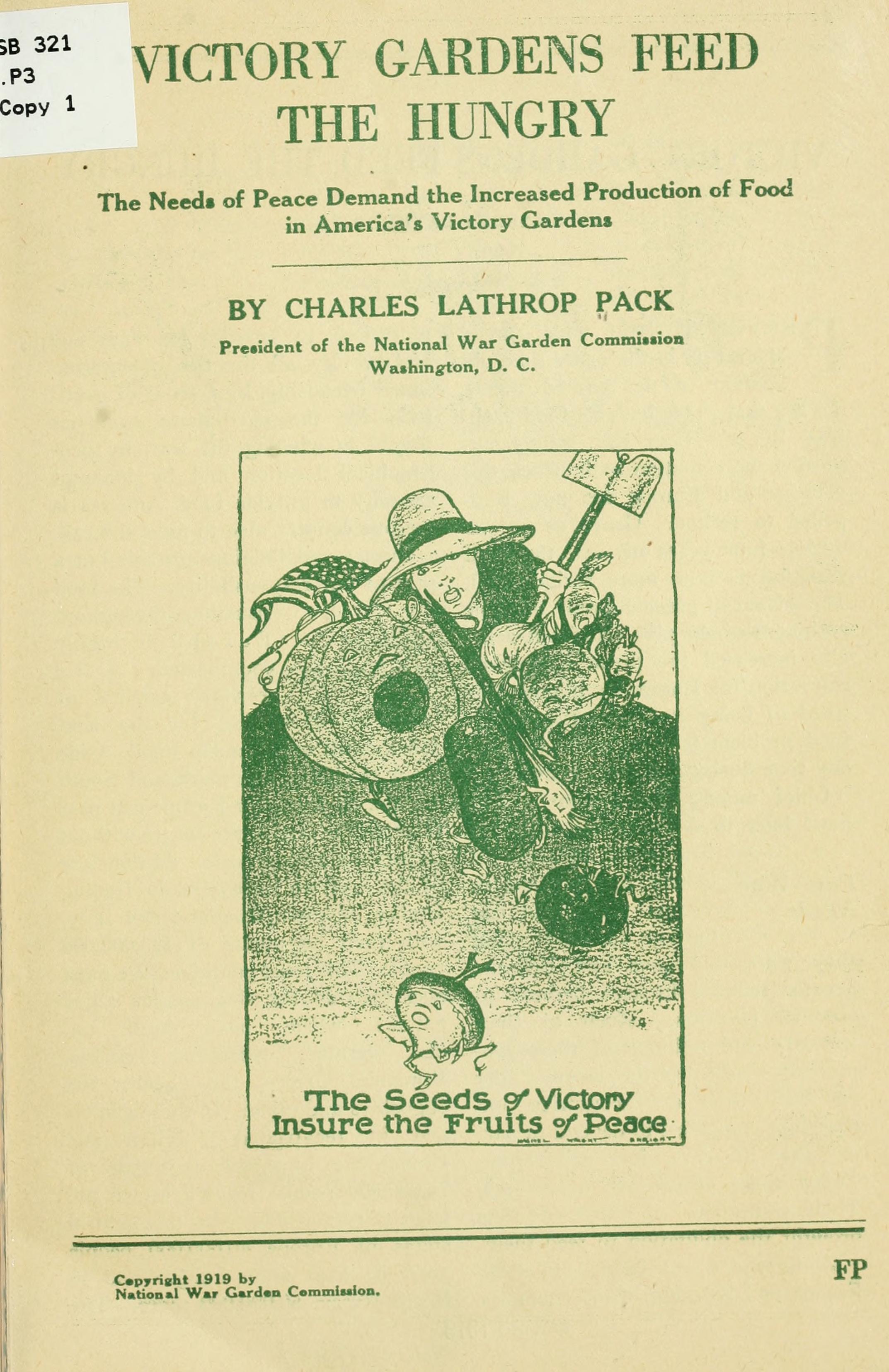
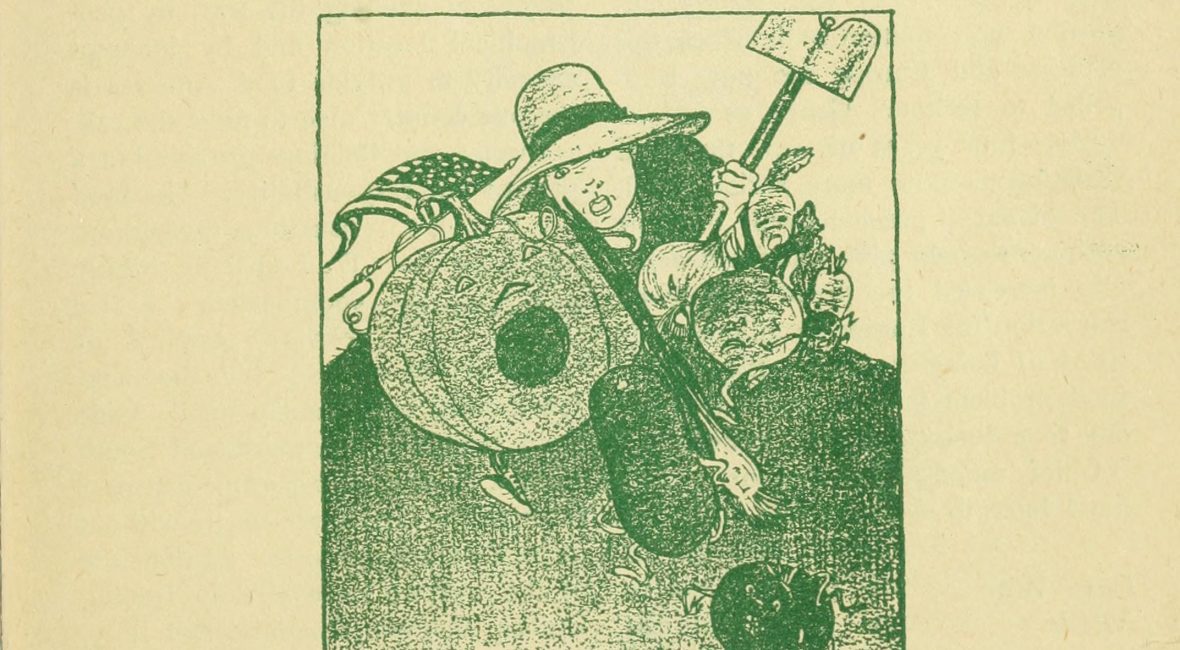
Illustrated cover of the manual "Victory Gardens Feed the Hungry".
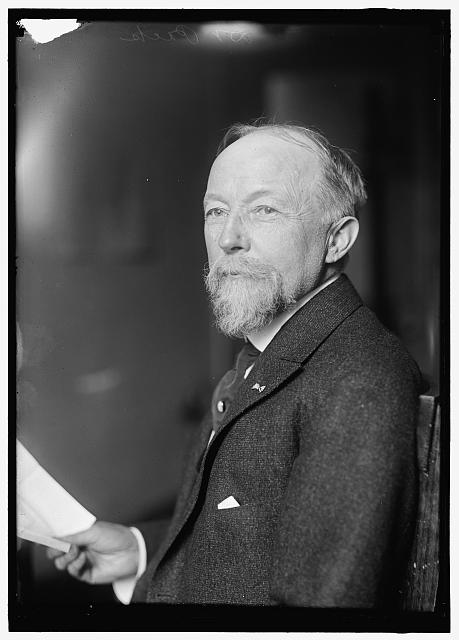
Black and white photograph of an elderly man

Charles Lathrop Pack, President, U.S. National War Garden Commission. Source: https://loc.gov/pictures/resource/hec.08264/.

Charles Lathrop Pack (May 7, 1857 – June 14, 1937) was a forestry expert and third-generation businessman. Both his father, George Willis Pack, and grandfather, George Pack, Jr., were in the forestry business. Charles continued this successful forestry dynasty by investing in the timber business as well as banking and real estate. By the time World War I started in Europe, he was a multi-millionaire and was named one of the five wealthiest men in America.

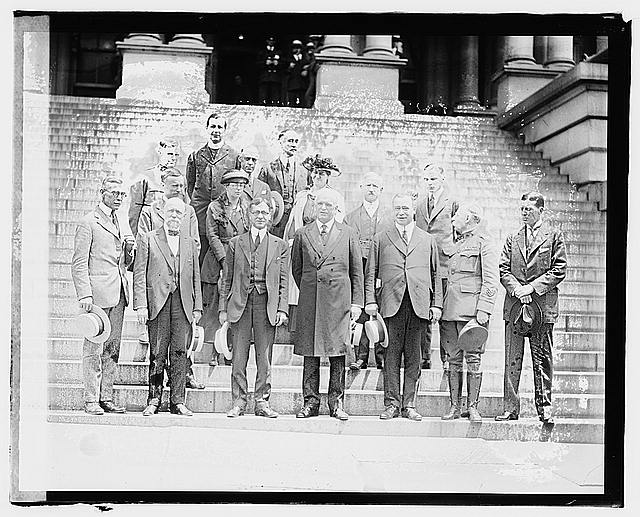
Black and white photograph of a group of men standing on steps.

War Memorial Committee. Source: https://loc.gov/pictures/resource/npcc.01780/.

In addition to being an outstanding businessman, Charles Pack was keen about public education and wrote several instructional books and manual. During World War I, he was eager to promote the importance of self-sustainability of food supplies in the United States and went on to become the President of the U.S. National War Garden Commission.

Pack was a principal organizer of the Victory Garden movement. Victory gardens, war gardens, or, as they were sometimes called, “food gardens for defense,” are gardens meant to be supplement and even improve upon the food supply in times of shortage and rationing due to war, providing a variety of home-grown vegetables, fruits, and herbs. Not limited to typical farming areas or countryside, Victory Gardens were planted in urban areas as well. They sprang up at private homes and in public parks and allotments in the United States, the United Kingdom, Canada, Australia, and Germany during World War I and again in World War II.

Charles Pack helped to promote the understanding that the war efforts were not just frontline battles, but that it is crucial to strengthen the home front of the country by producing healthy food to feed the nation — a concept that has endured into the present.

Illustrated cover of the manual "Victory Gardens Feed the Hungry".

Pack, Charles Lathrop. Victory Gardens Feed the Hungry. c1919. Contributed in BHL from The Library of Congress.

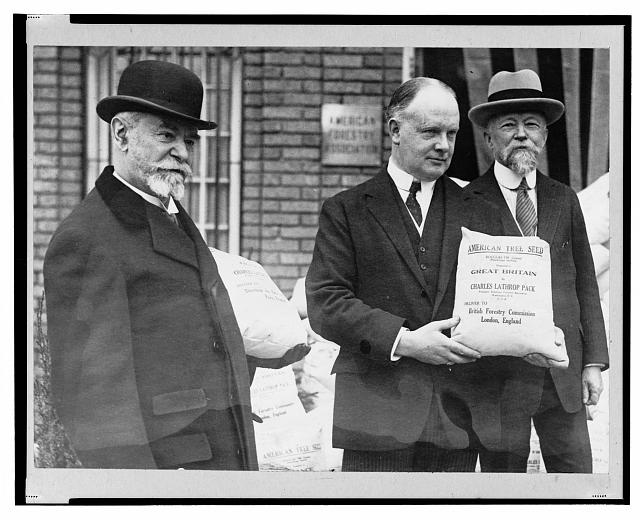
The highlighted book, Victory gardens feed the hungry: the needs of peace demand the increased production of food in America’s victory gardens, is one of the leading monographs in the campaign for the Victory Garden program. In it, Pack also talks about the unfortunate conditions in some European countries (Ex. Belgium and France) due to the ongoing war and the need for Americans to come to their aid by providing seeds for food products and trees.

Black and white photograph of three men, one holding a sack of seeds with the text "American seeds to reforest France and Great Britain."

American seeds to reforest France and Great Britain. Source: https://loc.gov/pictures/resource/cph.3c33281/.

A statement at the bottom of the cover page of Victory gardens feed the hungry sums up his philosophy: “The Seeds of Victory Insure the Fruits of Peace.”

If you are in Washington, please visit the Library of Congress and see the “Victory Garden” at the side of the James Madison Building on First Street between C Street and Independence Ave.

Referenced Works

Victory gardens feed the hungry: the needs of peace demand the increased production of food in America’s victory gardens. By Pack, Charles Lathrop, 1857-1937 National war garden commission. Washington: National War Garden Commission, 1919. Holding Institution: Library of Congress. DOI: https://doi.org/10.5962/bhl.title.41724

The school book of forestry, By Pack, Charles Lathrop, Washington, D.C., The American Tree Association [1922]. Holding Institution: Library of Congress. DOI: https://doi.org/10.5962/bhl.title.49097.

July 2, 2019by michelle.underhill
Blog Reel, Campaigns, Her Natural History

The Life and Works of Margaret Meen

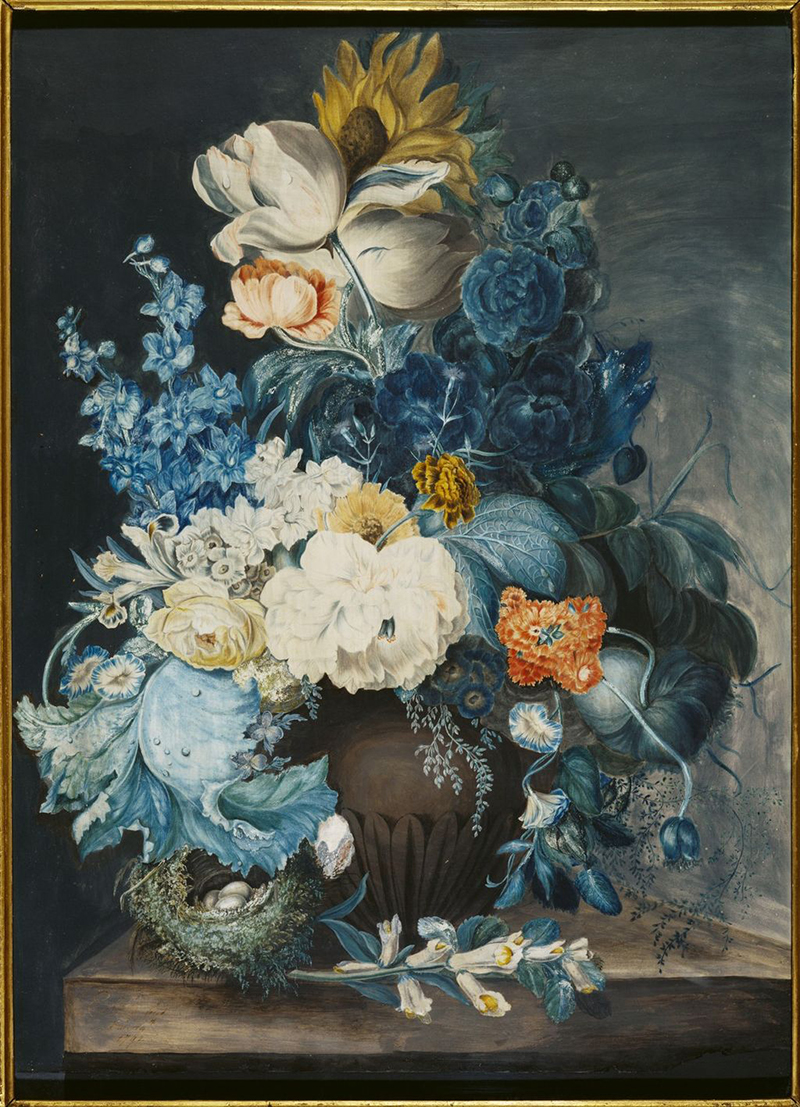
“A group of flowers in a jar and a bird’s nest,” by Princess Elizabeth after Margaret Meen. Now in the Victoria and Albert Museum, London. Public domain, retrieved from Wikimedia Commons.

As you may have seen in BHL’s blog yesterday, The Royal Botanic Gardens, Kew, has been partnering with the Oak Spring Garden Foundation to digitize works by women botanical artists held in Kew’s archives. One of these talented but largely unknown artists is Margaret Meen – whose botanicals graced the walls of royal palaces and scientific academies. In fact, though little remembered or written about today, Meen’s botanicals and her prowess as an instructor of fledgling artists left a lasting impression on British botanical illustration.

Margaret Meen was born sometime around 1751 in the English county of Suffolk, but lived most of her life in London in order to better sustain herself as a working artist and teacher.  Though it is not known where or how Meen developed her skill as an artist, her brother Henry was Prebend of Twyford and also taught at St. Paul’s, indicating that Margaret most likely came from a family of some wealth and standing and thus would have had access to an education in the arts.  Certainly Henry’s status in London allowed Margaret to come into contact with the upper echelon of British aristocracy, and Meen’s talent as an artist was soon recognized by the royals.

One of her most celebrated patrons, in fact, was Queen Charlotte—wife of George III—who wrote in her diary in 1789 that she “drew with Miss Mean [sic] from 10 till one,” and who most likely purchased a painting of flowers that now hangs at the Victoria and Albert Museum in London.

Additionally, the queen’s daughter, Princess Elizabeth, was quite the budding artist herself, and her notable painting “Flower piece with bird’s nest” (1792) is modeled after Meen’s work purchased by the queen.  The princess even maintained a friendly correspondence with Meen as late as 1822.

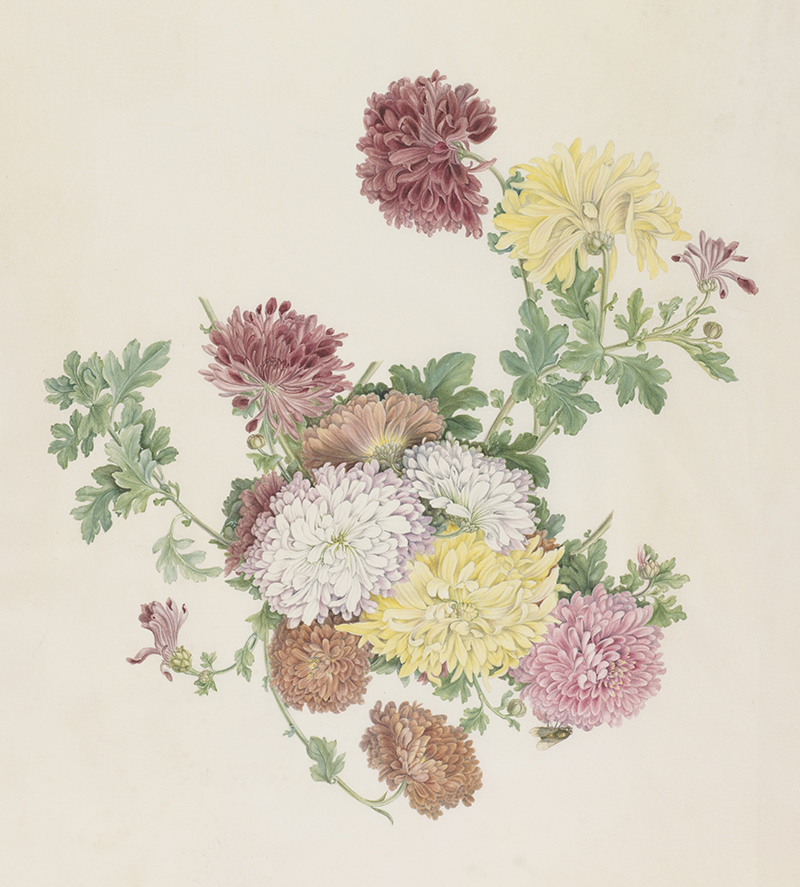
Chrysanthemums and a fly. Reproduced with permission from the Board of Trustees of the Royal Botanic Gardens, Kew, digitized with support from the Oak Spring Garden Foundation.

Aside from being the occasional tutor to artistically-inclined members of the royal family, Meen was a member of and exhibited her work at the Royal Academy from 1775 to 1785 and also with the Associated Artist in 1810. She was also employed to document the many new plants being grown in the Royal Gardens at Kew in the late 18th and early 19th centuries, using William Aiton’s Hortus Kewensis to name the species she illustrated. At this time, the Gardens at Kew were unrivaled in Britain for their botanical collection.

Her work, though largely unheralded, has been highly praised on the occasions that it is critiqued with special notice of Meen’s prodigious output and effective illustrative techniques.  Also, usually mentioned with Meen’s name is her founding of the periodical Exotic Plants from the Royal Gardens at Kew (1790), which she dedicated to Queen Charlotte but which only lasted for two issues.

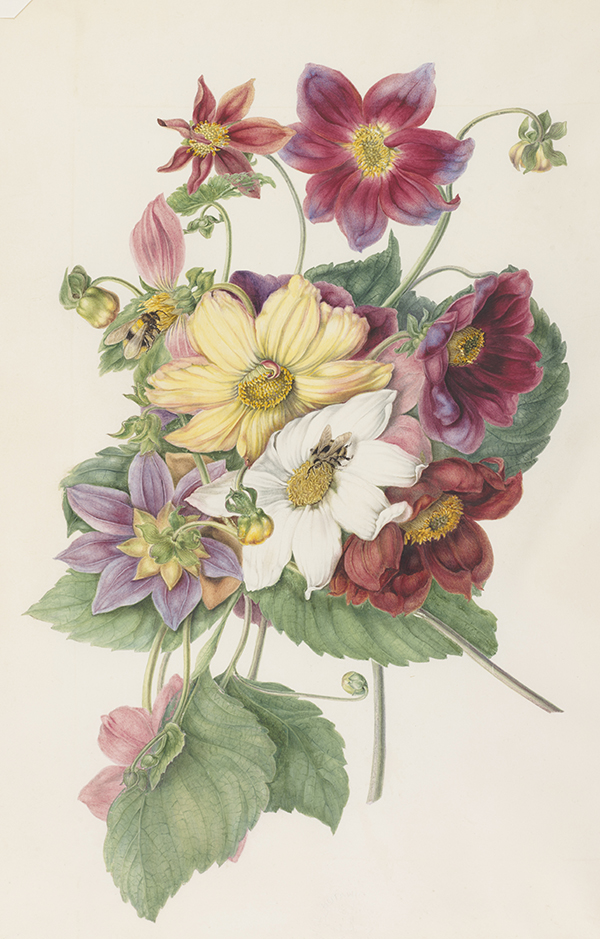
Watercolor of various flowers and bees. Reproduced with permission from the Board of Trustees of the Royal Botanic Gardens, Kew, digitized with support from the Oak Spring Garden Foundation.

Finally, Meen spent a large part of her later years as a drawing tutor for families with the means to provide their children with one and as an instructor for larger groups of students at a school in Notting Hill, London.  Among Meen’s pupils was the future Lady Northampton and Emma Smith, the future wife of Jane Austen’s nephew and biographer. Meen kept up her teaching until late in her life and as she never married or had children of her own, was especially determined to impart her artist lessons on to young minds in whom she saw latent talent.

Margaret Meen’s career as a botanical artist took her from the halls of Buckingham Palace to chambers of the Royal Academy and the schoolrooms of London. Over her long life she not only contributed to the furtherance of scientific knowledge through her botanical prints but also to the development of young artists from the most privileged to those who simply attended her classes in Notting Hill. Her artwork was appreciated by everyone from the Queen of England to its most revered scientists and its precocious young scholars. Though little remembered today, Margaret Meen’s art and legacy thus stands as an important part of late 18th and early 19th century British botanical history and deserves to be better celebrated today.

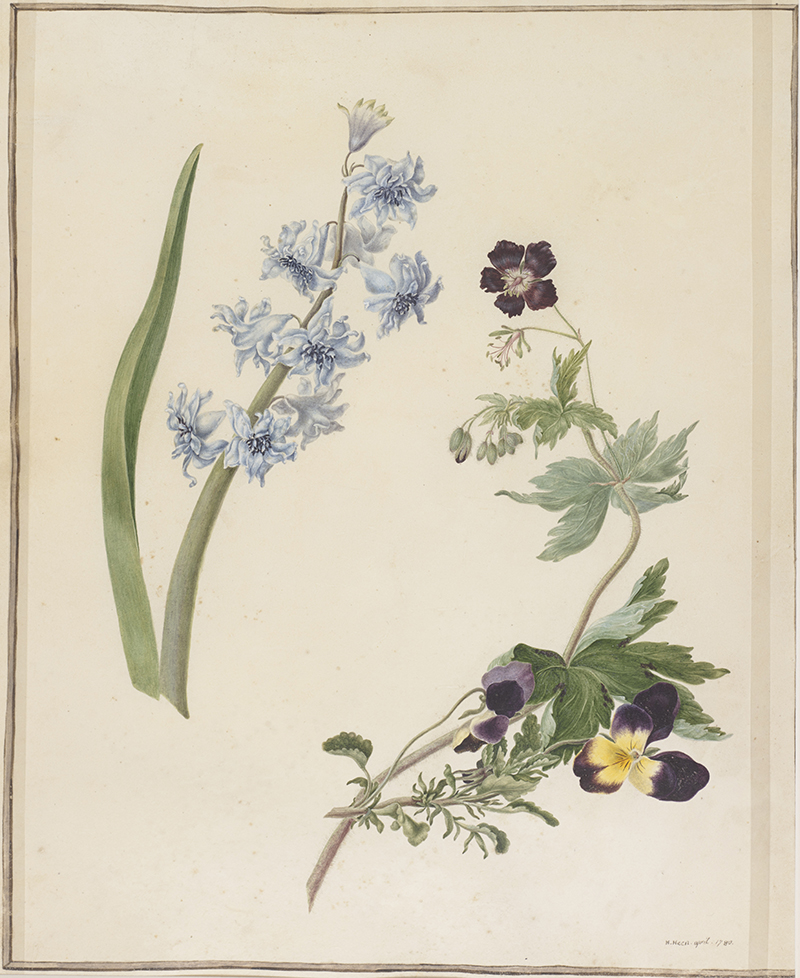
Watercolor of pansy and unknown flower. Reproduced with permission from the Board of Trustees of the Royal Botanic Gardens, Kew, digitized with support from the Oak Spring Garden Foundation.

This post was updated on 22 February 2021 to correct birth and death dates for Meen and a typo in quoted materials from Queen Charlotte’s diary.

References

Blunt, Wilfrid and William T. Stearn. The Art of Botanical Illustration. New York: Antique Collectors Club Press, 1993. Originally published in 1950.

Mabey, Richard. The Flowering of Kew. London, UK: Ebury Press, 1988.

McDonald, Kelly M. “Margaret Meen: A Life in Four Letters.” Academia.edu.

Royal Academy. “Anderson’s Notes on the 1775 Exhibits of James Lambert, William Laranson, P.J. Loutherbourg, William Martin, J. Mauris, Jeremiah Meyer, Margaret Meen and Mary Moser.”

Royal Collection Trust. “Description of ‘Flower piece with bird’s nest.’”

March 14, 2019by Joel Richard
Blog Reel, Featured Books

American Daffodil Society Expands Access through BHL and ‘DaffLibrary’

1_daff.jpg

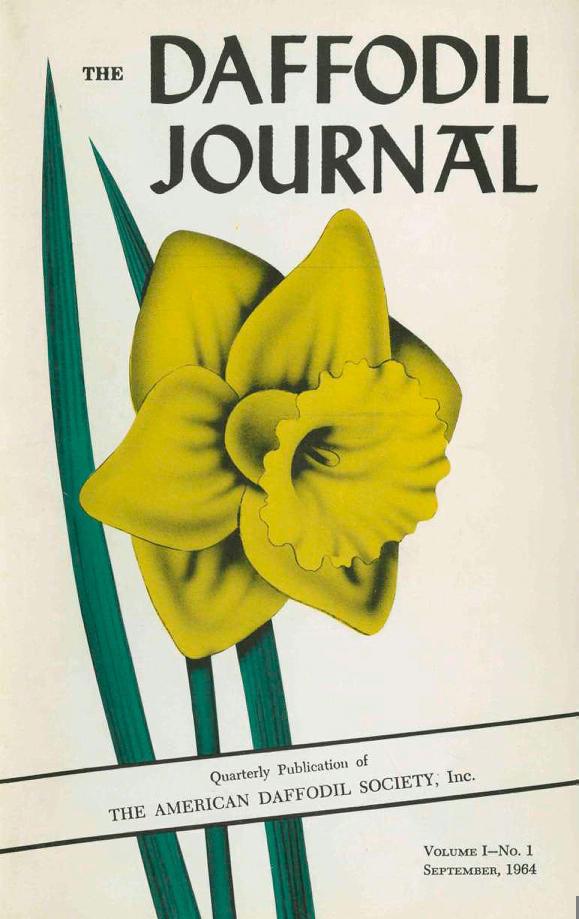
Illustration of a large, yellow flower with green stem and leaves. American Daffodil Society. The Daffodil Journal. Volume 1. 1961. Digitized in BHL by American Daffodil Society.

For Mary Lou Gripshover, daffodils started as an easy entry into horticulture, but led her to the unexpected, too.

“Half a century ago, when I was a young housewife, I belonged to a garden club which in turn participated in an area-wide flower show,” she explains. “Everyone had to enter. At that point I wasn’t much good at flower arrangements, and entering daffodils in the Horticulture Section was easy. Just cut a bloom and put it in the vase provided. And the stems didn’t bend, like tulips did. So then of course I had to get more daffodils so I could enter all the classes for the various divisions… and it just grew from there. Who knew 50 years ago that I’d make friends the world over, just because of a little yellow flower?”

2_daff.jpg

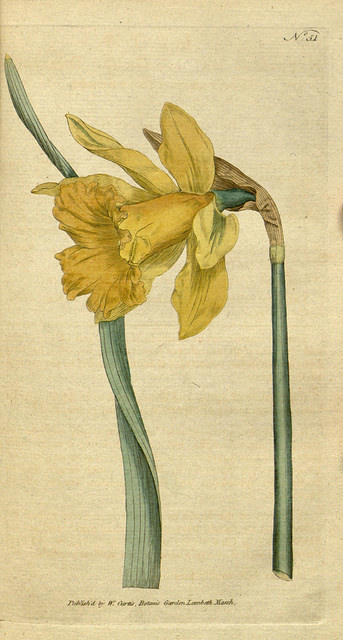
A delicate painting of a single daffodil flower with a green stem and leaf. Curtis, William. The Botanical magazine, or, Flower-garden displayed. 1790. Digitized in BHL by Missouri Botanical Garden, Peter H. Raven Library.

Gripshover serves as a librarian / digitizer for the American Daffodil Society (ADS), a group with international membership that has connected daffodil enthusiasts since its founding in 1954. In the spirit of National Gardening Month, we’re highlighting the ADS’ publication, The Daffodil Journal, which comes to BHL as part of the Expanding Access to Biodiversity Literature project. Early volumes of this quarterly journal from 1964-1968 are currently available on BHL, with more volumes on the way.

4_daff.jpg

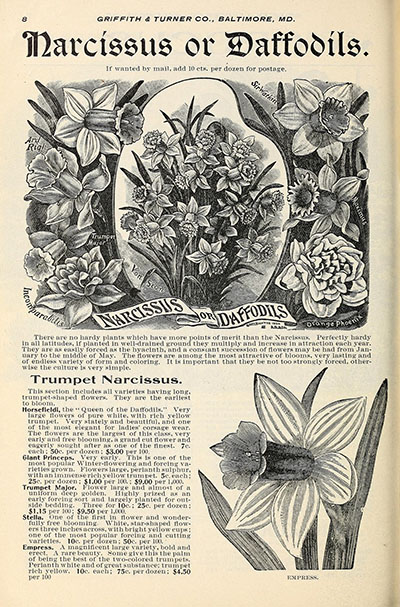
A page from a seed catalog with descriptions of varieties of Daffodil for sale, and two black and white illustrations; one a close-up of a flower variety called Empress, the other a mix of many flowers. Griffith and Turner Co. Bulbs and seeds.  1900. Digitized in BHL by U.S. Department of Agriculture, National Agricultural Library.

According to the ADS website, ‘daffodil’ is the common name for all members of the genus Narcissus. There are somewhere between 40 and 200 different species/subspecies/varieties (depending on who you ask), and more than 25,000 registered cultivars (named hybrids).

The first mission of the ADS was to create a publication, starting with a small bulletin and yearbook. After its first decade, the society released its quarterly publication, The Daffodil Journal, to share information on “all aspects of daffodil culture, breeding, and exhibition.” Now the ADS has its own digitization project, DaffLibrary, where more than 3,000 resources on daffodils are available as downloadable PDFs or as links to other websites. The Daffodil Journal through the year 2012 is available on DaffLibrary, so you can view more recent issues of the publication there until more are added to BHL.

5_daff.jpg

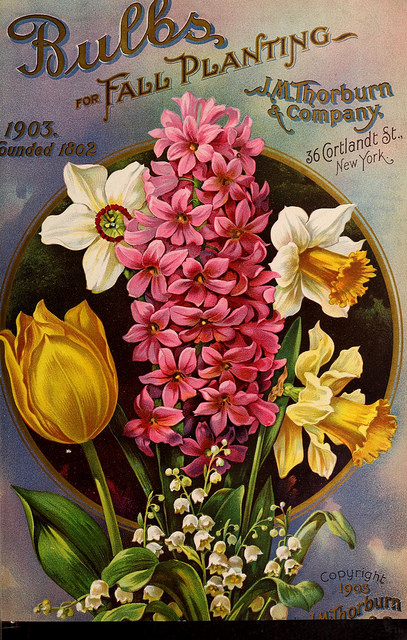
Colorful painting from the cover of a bulb magazine, including white and yellow daffodils and other yellow, white and pink flowers. Thorburn, J.M. & Co. Annual descriptive catalogue of flower seeds. 1903. Digitized in BHL by New York Botanical Garden, LuEsther T. Mertz Library.

“The ADS has had a ‘paper library’ almost from the beginning,” Gripshover says. But because the society has no permanent headquarters, the physical collection had to move several times, and didn’t get much use. “Occasionally a list of available titles would be published in the Journal, and maybe there’d be a little action then, but interest didn’t last. Eventually, it was decided that we should at least get back issues of the Journal scanned, so in 2004 we had 40 years’ worth of the Journal professionally scanned. Several years later, someone suggested that we should think about scanning some of the other materials we had. I foolishly said that I could do some scanning… and it’s turned into a permanent job! But it’s one I enjoy.”

6_daff.jpg

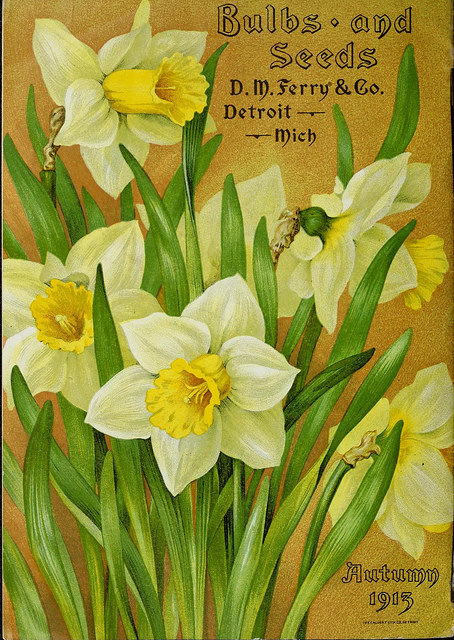
A painting of yellow flowers with a darker yellow background. Ferry, D.M. & Co. Bulbs and seeds. 1913. Digitized in BHL by U.S. Department of Agriculture, National Agricultural Library.

DaffLibrary is now the most-viewed of the ADS’ websites, and gets much more use than the physical collection did: in just the first 3 months of 2018, it connected close to 15,700 visitors to nearly 55,000 pages. Popular resources included book, historic, and scientific references; plant show handouts/material; casual-reading books and articles; biography information; and information about growing daffodils using different methods.

Many thanks to the American Daffodil Society for contributing The Daffodil Journal to BHL, and to Mary Lou Gripshover for sharing her story with us and dedicating years of work to support open access information!

7_daff.jpg

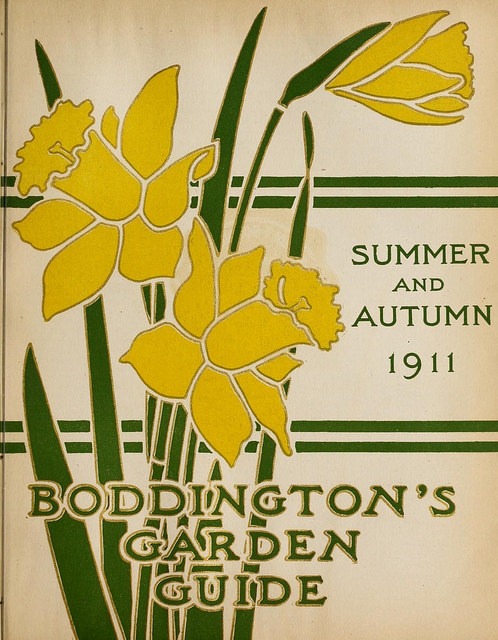
A bold stencil-style image of yellow daffodils with green leaves and stems. Boddington, Arthur T.  Boddington’s quality bulbs, seeds and plants. 1911. Digitized on BHL by New York Botanical Garden, LuEsther T. Mertz Library.

References

American Daffodil Society

‘About’ DaffLibrary

April 19, 2018by Joel Richard
BHL News, Blog Reel

BHL Welcomes Oak Spring Garden Foundation as a New Affiliate

View Full Size Image

This quarter, the Biodiversity Heritage Library welcomed the Oak Spring Garden Foundation (OSGF) as a new Affiliate. The BHL consortium now consists of 19 Members and 18 Affiliates.

With a mission to perpetuate and share the gifts of Rachel (“Bunny”) Lambert Mellon, OSGF is dedicated to inspiring and facilitating scholarship and public dialogue on the history and future of plants. The Foundation operates from Bunny Mellon’s 263-acre estate in Upperville, VA, which includes her residence, garden, and Library.

The Oak Spring Garden Library is home to Bunny Mellon’s personal collection of rare books, manuscripts, and artworks, which she acquired to support her research and design work. Consisting of approximately 19,000 objects, the collection’s strengths include garden and garden design, horticulture, botanical studies, natural history, voyages, architecture, and decorative arts.

View Full Size Image
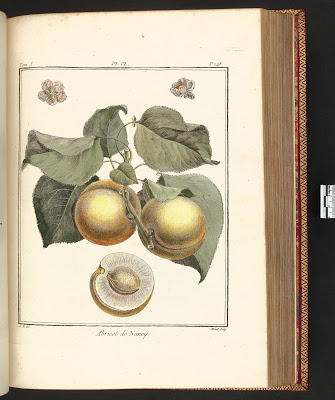
Duhamel du Monceau, M. Traité des arbres fruitiers. v. 1 (1768). Contributed by the Oak Spring Garden Library. http://s.si.edu/2fFO3O5.

As an Affiliate, OSGF will enhance BHL’s collection by contributing rare and unique material from the Library. Providing open access to this significant collection will allow the Foundation to share Bunny Mellon’s legacy with a global community and impact research around the world.

Visit BHL to explore Traité des arbres fruitiers, the first title contributed by the Oak Spring Garden Library to BHL. This title was hand-picked by Bunny Mellon for contribution to the Biodiversity Heritage Library. Learn more.

October 3, 2017by ulib-libraryjobs
Blog Reel, Campaigns, Garden Stories

Revolutionizing the Garden Industry with Art: Part Two

View Full Size Image
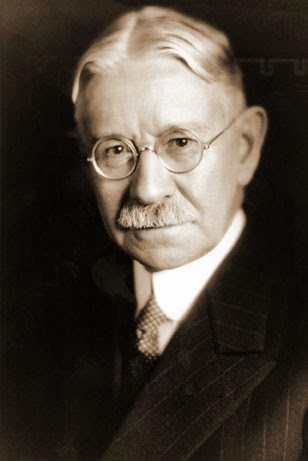
J. Horace McFarland. Pennsylvania Capitol Preservation Committee.

J. Horace McFarland’s name is little known today. In the early twentieth century, however, he was a prominent figure in American horticulture and the nascent environmental movement. McFarland (1859-1948) was a master printer, horticulturist, and conservationist, whose Harrisburg, Pennsylvania printing company specialized in horticultural trade publications. He was particularly noted for his use of photographs and color photoengraving in nursery and seed trade catalogs.

As a boy, McFarland learned the nursery trade by working in his family’s business, Riverside Nurseries of Harrisburg. His father, who published a small weekly newspaper, gave Horace a printing press in 1878. He merged his skills in horticulture, printing, and business and formed his own printing company. McFarland sought clients among people he knew—the growers who provided seed and stock to Riverside Nurseries. He called his venture Mount Pleasant Press. (The company was incorporated in 1891 as the J. Horace McFarland Company and was known for many years under both names.)

McFarland initially printed eight-page seed lists for spring and fall planting seasons. Wanting to generate a steadier stream of year-round business, he pitched ideas to nurserymen throughout the country for producing informative publications and more frequent catalogs full of enticing illustrations. Eventually, through skillful marketing, he won large contracts for thousands of catalogs.

View Full Size Image
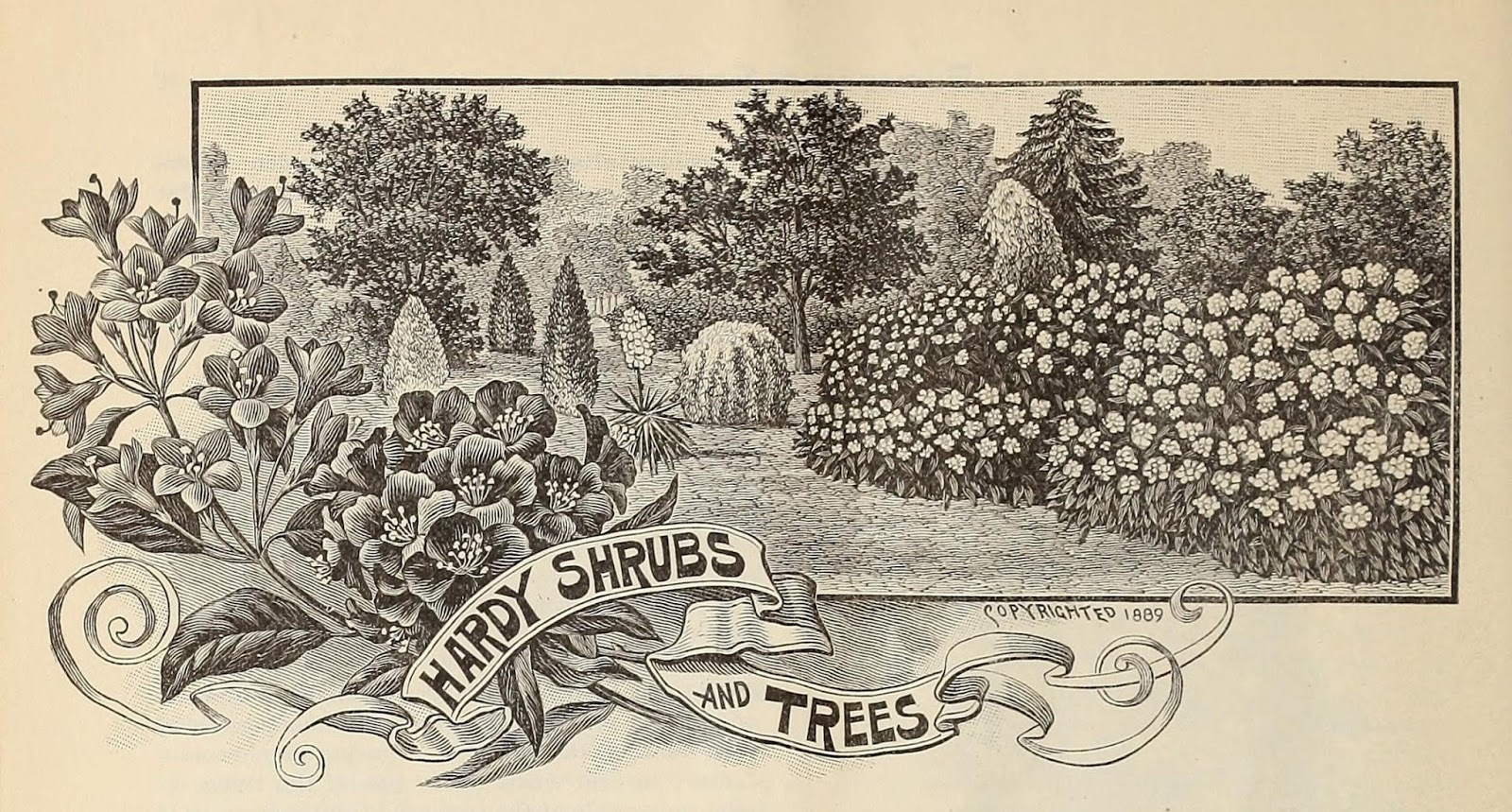
An example of an early catalog printed by “J. Horace McFarland, Horticultural Printer, Harrisburg, PA” titled “Descriptive Catalogue of Ornamental Trees, Plants, Vines, Fruits, Etc.”, Morrisville Nursery, 1891. The catalog contains woodcut illustrations; many are signed by Albert Blanc in this catalog. http://biodiversitylibrary.org/page/45708656.

An innovative businessman with diverse interests, McFarland also mastered the art of horticultural photography. It’s not known when he started carrying bulky camera equipment with him to capture images of growers’ plant stock, fruit, and produce. He most likely began doing this well before 1896, when he was elected to the Photographic Society of Philadelphia.

View Full Size Image
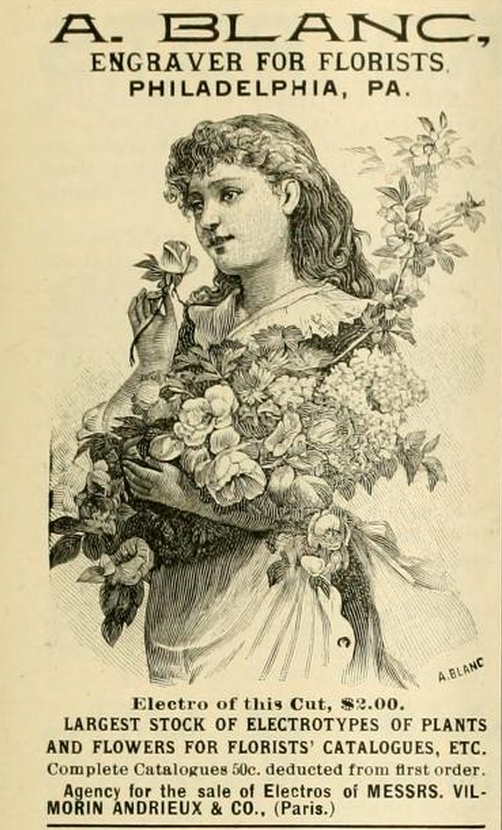
Albert Blanc prepared and sold thousands of illustrations for seed catalogs, including many for J. Horace McFarland. Here’s an ad Blanc placed in the 1889-90 volume of The American Florist. http://biodiversitylibrary.org/page/24949896.

McFarland sent his early photographs to one of the foremost woodcut illustrators of plants, Albert Blanc of Philadelphia. Blanc prepared woodcuts which McFarland printed in his plant lists to develop the look of his catalogs. By 1890, the first commercial use of photographs in magazines and newspapers began thanks to Frederic E. Ives’ invention of the halftone printing technique. McFarland is thought to be the first to use halftone images in horticultural publications (Morrison, p. 41).

As the use of photography in publishing increased, so did McFarland’s collection of plant and garden photographs. He found most of his photo subjects in gardens along the East Coast and in his own trial gardens. Mount Pleasant Press kept an extensive library of photographs mounted on cards and offered the images for sale to clients wishing to use the illustrations in publications. This was a method of expanding the company’s service. McFarland aimed to offer a full range of services to his customers in addition to printing, including publicity, editorial and design, and direct mailing.

View Full Size Image
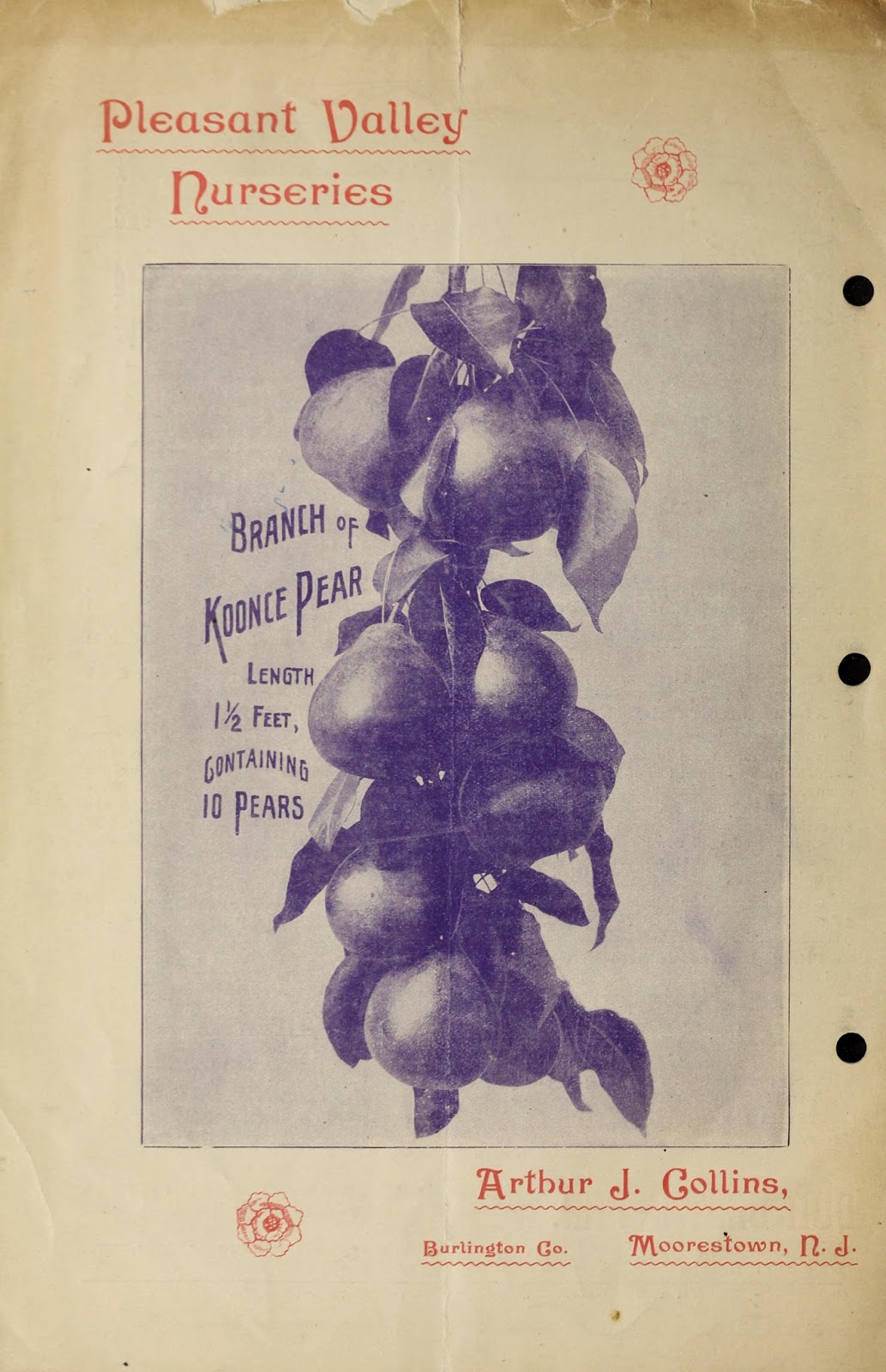
An 1895 catalog printed by “J. Horace McFarland Co., Horticultural Printers, Harrisburg, PA” titled “Pleasant Valley Nurseries”. Note the use of color on the front and back covers. There are also several black and white photographs in the catalog, but the illustrations are primarily woodcut. http://biodiversitylibrary.org/page/45686558.

William Kurtz, a New York photographer and founder of the Coloritype Company, instructed McFarland in a new photomechanical technique for mass printing color images known as three-color photoengraving. Kurtz, impressed with McFarland’s abilities, hired him to manage the company in 1893. With less than one year’s experience in this position, McFarland launched color photoengraving techniques at Mount Pleasant Press, and was soon using four-color process.

Despite the advances in color photoengraving, McFarland was not satisfied that the new color photographic methods of the early twentieth century measured up to his exacting standards. His solution was to hire artists, who went to work in the 2.5 acre trial gardens at his residence, Breeze Hill, in Harrisburg. These skilled artists painted plant images in watercolor in order to capture an accurate color record on paper. Sometimes they created several versions of the same plant variety in order to get a proper average of the colors found in nature. Eventually, these colors were transferred to plates that were run in the printing of nursery catalogs or other publications.

View Full Size Image
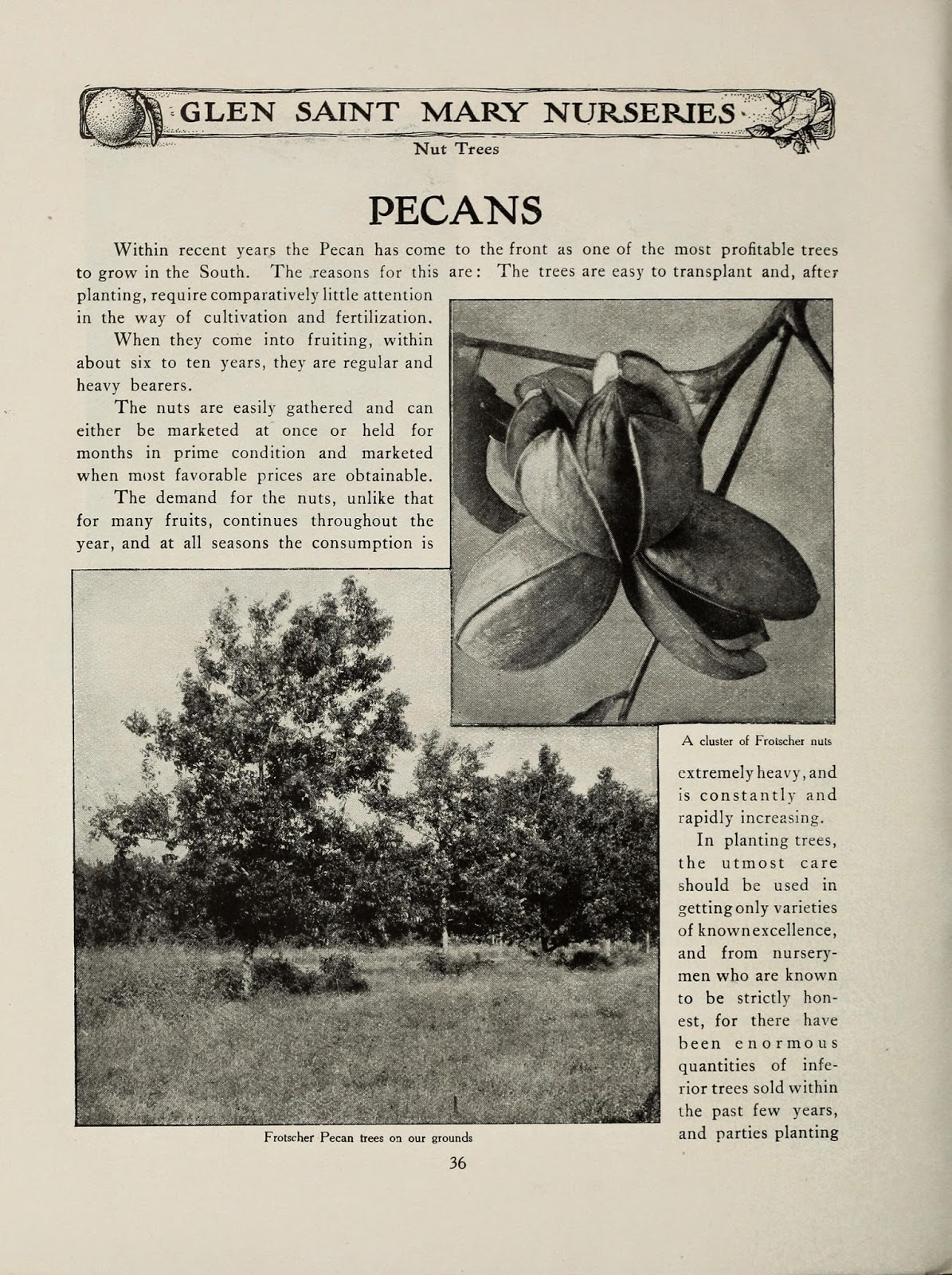
A 1906 catalog printed by “Mount Pleasant Press, J. Horace McFarland Company, Harrisburg, Pennsylvania” titled Glen Saint Mary Nurseries. Note that by this time period, most of the plant illustrations are black and white photographs. http://biodiversitylibrary.org/page/46778542.

McFarland’s philosophy behind his painstaking efforts to produce realistic images was simple—good pictures sell products. In a booklet marking his company’s sixtieth year he writes, “Since the natural appearance of a flower or plant is an important selling factor in advertising, nearly all progressive horticultural tradesmen are anxious to use colored illustrations.” His passion for the inherent beauty in nature appealed to many growers and established McFarland’s legacy as a trailblazer in horticultural printing.

View Full Size Image
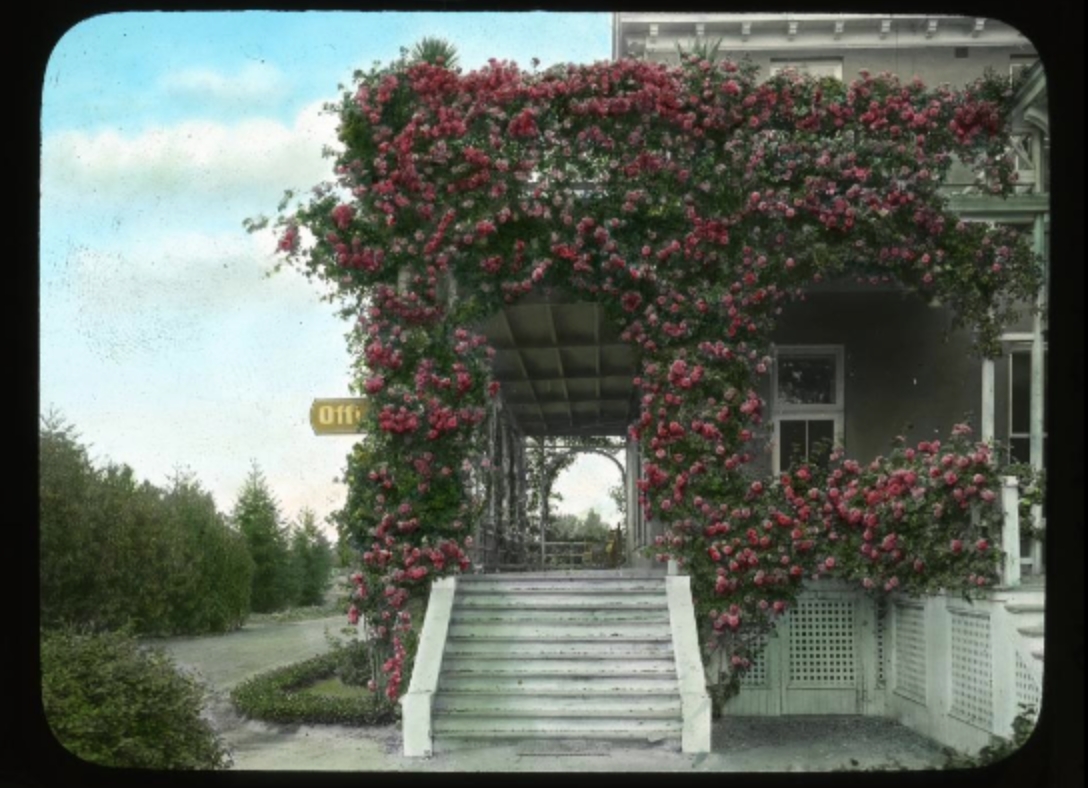
Glass lantern slide of Kearney Park. Photographer: J. Horace McFarland Company. This slide is part of the Archives of American Art J. Horace McFarland Collection. http://siris-archives.si.edu/ipac20/ipac.jsp?&profile;=all&source;=~!siarchives&uri;=full=3100001~!186055~!0#focus.

Some of the companies for which the J. Horace McFarland Company printed catalogs include:

  • Bobbink & Atkins
  • Joseph Breck and Company
  • Carroll Gardens
  • Henry A. Dreer
  • Glen St. Mary
  • Jackson & Perkins
  • Walter S. Schnell
  • Stokes Seeds
  • Stump & Walter Co.
  • Stark Brothers
  • Three Point Gardens
  • Wayside Gardens

J. Horace McFarland’s personal and business records are now housed at several institutions:

  • Special Collections of the National Agricultural Library has 432 linear feet of over 40,000 photographic images, watercolor paintings, rose cards, and other publishing materials.
  • The Smithsonian Institution’s Archives of American Gardens holds some of McFarland’s photographic images depicting gardens, landscape plantings, and nurseries.
  • The Archives of the Pennsylvania Historical and Museum Commission is the major repository of McFarland’s manuscripts, including articles, speeches, diaries, correspondence, and personal photographs. It also has a large number of horticultural catalogs printed by the J. Horace McFarland Company.
  • The Arnold Arboretum Library, Harvard University, maintains a collection which includes photographs of the Arboretum taken by J. Horace McFarland during his visits there.

Post Sources

  • Morrison, Ernest. J. Horace McFarland: A Thorn for Beauty. Harrisburg, PA: Pennsylvania Historical and Museum Commission, 1995.
  • Sixty Years of Printing Service, second edition. Harrisburg, PA: J. Horace McFarland Company/Mount Pleasant Press, 1940.

More Garden Stories Fun

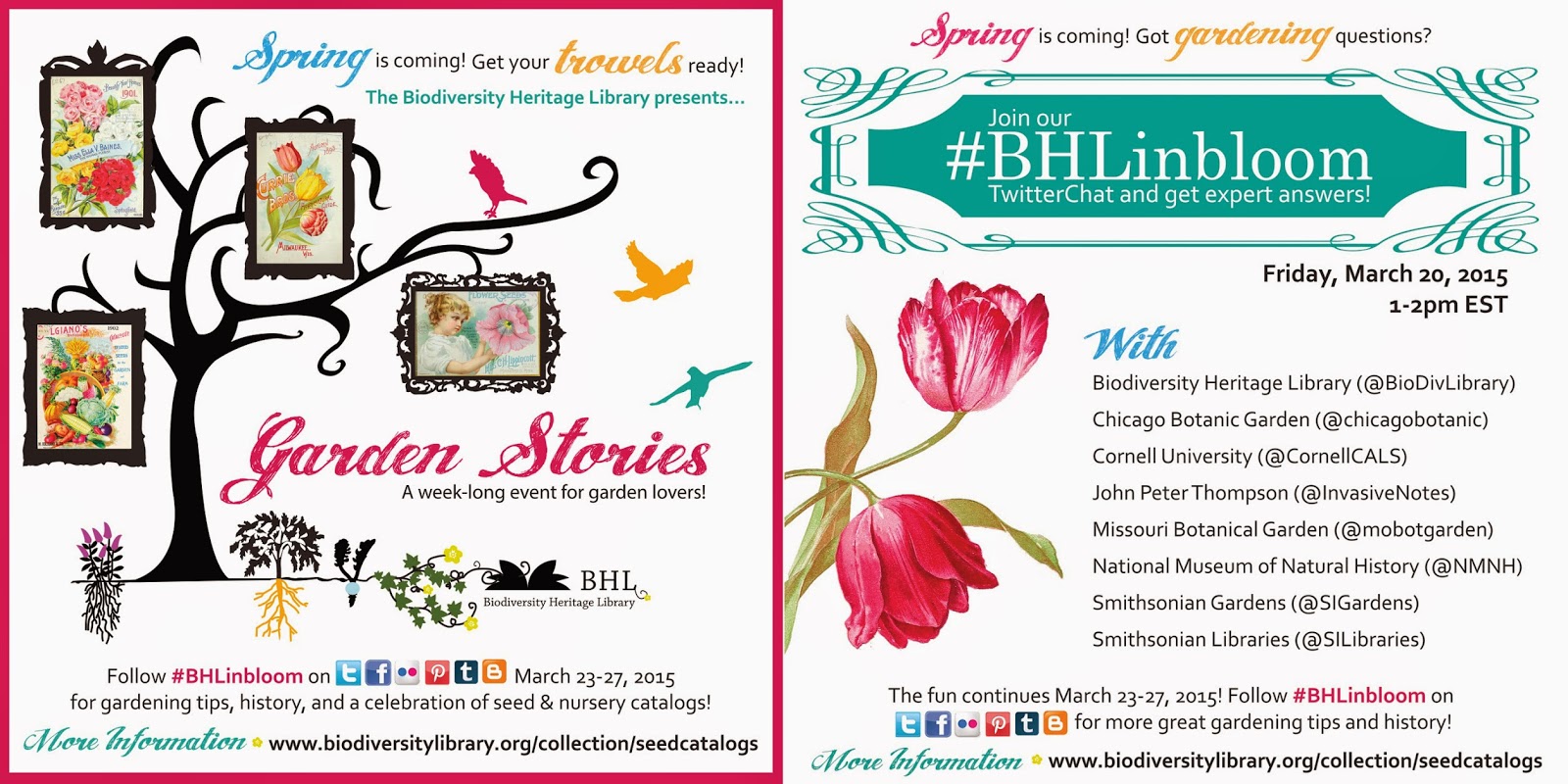
  • Follow our blog and #BHLinbloom on Twitter and Facebook (or go directly to BHL’s Twitter and Facebook) this week as we explore the fascinating world of gardening, from its history to plant factoids and practical gardening tips.
  • Browse over 14,000 seed and nursery catalogs in our collection.
  • Browse over 2,500 seed and nursery catalog images in our Flickr collection.
  • Explore select seed catalog art, and stunning bookmarks and postcards developed by Cornell Library, on Pinterest.
  • See historic gardening come to life on the Smithsonian Libraries’ Tumblr.
  • Purchase your very own Garden Stories T-Shirt through T-Fund. All proceeds will go to help us digitize more pages for BHL. Our goal is to sell enough shirts to digitized 5,000 pages. Can you help us get there?
  • Help us improve access to seed and nursery catalogs by transcribing some today as part of our the Institute of Museum and Library Services (IMLS)-funded Purposeful Gaming project!
  • Find great online gardening resources, tips, and help on the BHL Gardening Resources Page.
March 26, 2015by ulib-libraryjobs
Blog Reel, Campaigns, Featured Books, Garden Stories

Shaping Early American Gardening: Bernard M’Mahon

Our Garden Stories campaign is just under a week away! We’re excited to share fantastic gardening information, history, art, and tips with you March 23-27, 2015. And don’t forget our TwitterChat this Friday, March 20, from 1-2pm EST! If you have gardening questions, send them our way with the hashtag #BHLinbloom. Don’t miss out!

View Full Size Image

We thought we’d give you a taste of the fascinating history and stories you can expect next week by featuring a post on one of the individuals that helped shape the gardening industry in America: Bernard M’Mahon. It is written by Robin Everly, Botany and Horticultural Librarian at the Smithsonian Libraries and one of the experts that will be on hand to answer your gardening questions during our TwitterChat this Friday!

Bernard M’Mahon (spelled M’Mahon or McMahon) shaped American gardening during its formative years in early 19th century. Although M’Mahon left his mark by creating a successful seed and nursery business and writing an early popular horticultural book specific to American plants, accurate biographical information on him is sketchy. Born in Ireland, he came to America between 1796-1798 for political reasons. Like many immigrant stories, Ireland’s loss was the United States’ gain. Botanist William Darlington recalled meeting him in Dilworthtown, Chester County, “In autumn, I think, of 1799”, where many Philadelphians went to escape an outbreak of yellow fever. Although it is speculated he had extensive training in gardening while in Ireland, M’Mahon first worked in the printing business for William Duane and the newspaper, the Aurora, beginning in 1800. However, a few years later, he began working in the seed and nursery business, collecting and exporting seeds of America’s wild plants to Europe. At the time, native plants from America were all the rage for European gardeners.

View Full Size Image
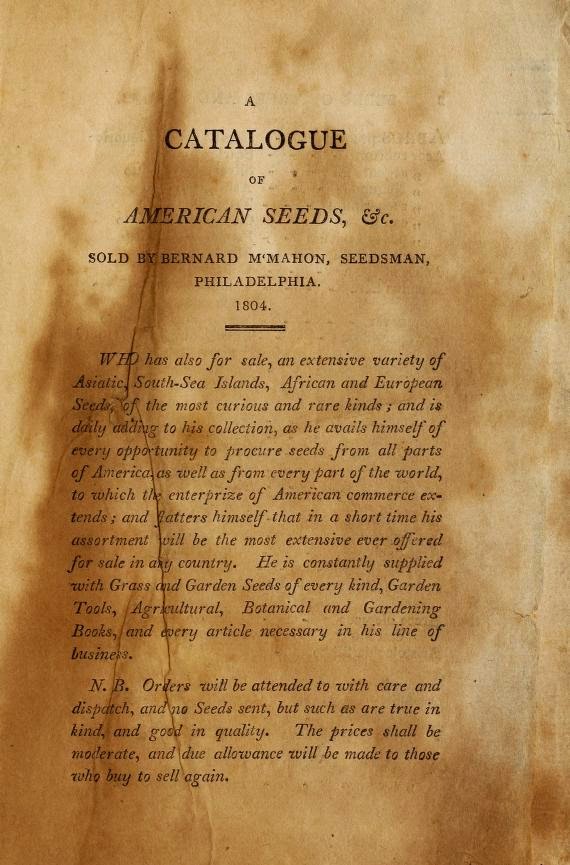
M’Mahon, Bernard. A Catalogue of American Seeds. 1804. http://biodiversitylibrary.org/page/44425433.

He is credited with publishing the first American seed catalog in booklet form in 1804. It is actually more a seed list than what we think of as a seed catalog today. It simply lists plants in alphabetical order under major categories such as “trees and shrubs” and “herbaceous plants.” For each plant the scientific and common name is given. No illustrations were included. Printing and publishing in the United States was still very new at this time. Many publishers still sent their works to England to be published and shipped back to the states. Philadelphia, with sixty paper mills located nearby, was a popular area for papermaking and printing during this period of time.

View Full Size Image
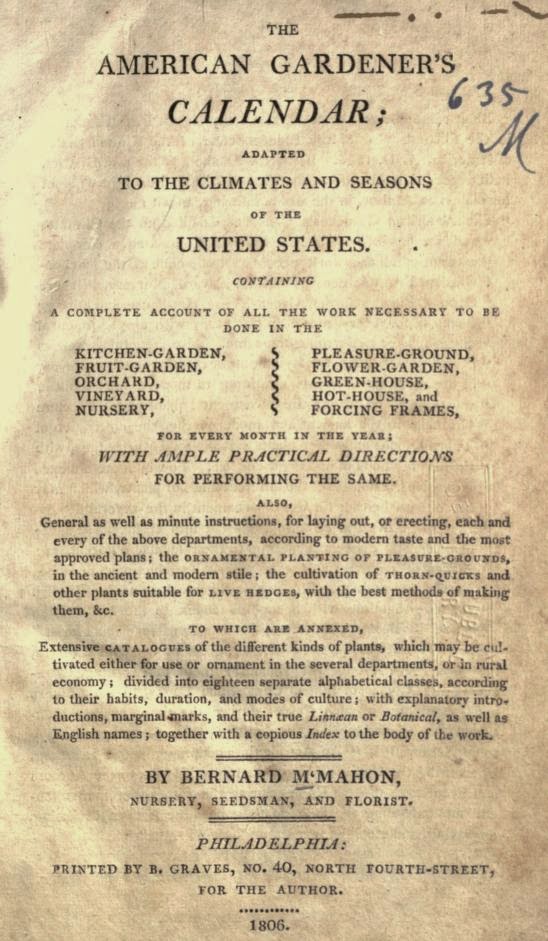
M’Mahon, Bernard. The American Gardener’s Calendar. 1806.  http://biodiversitylibrary.org/page/20142803.


In 1806, while operating his business, he published The American gardener’s calendar; adapted to the climates and seasons of the United States. Liberty Hyde Bailey, in his Cyclopedia of American Horticulture referenced it with: “He gave America its first great horticultural book.” In a sense, it became what we would call a bestseller. The book was popular for 50 years and went through 11 editions, the last published in 1857, long after M’Mahon’s death in 1818.

View Full Size Image
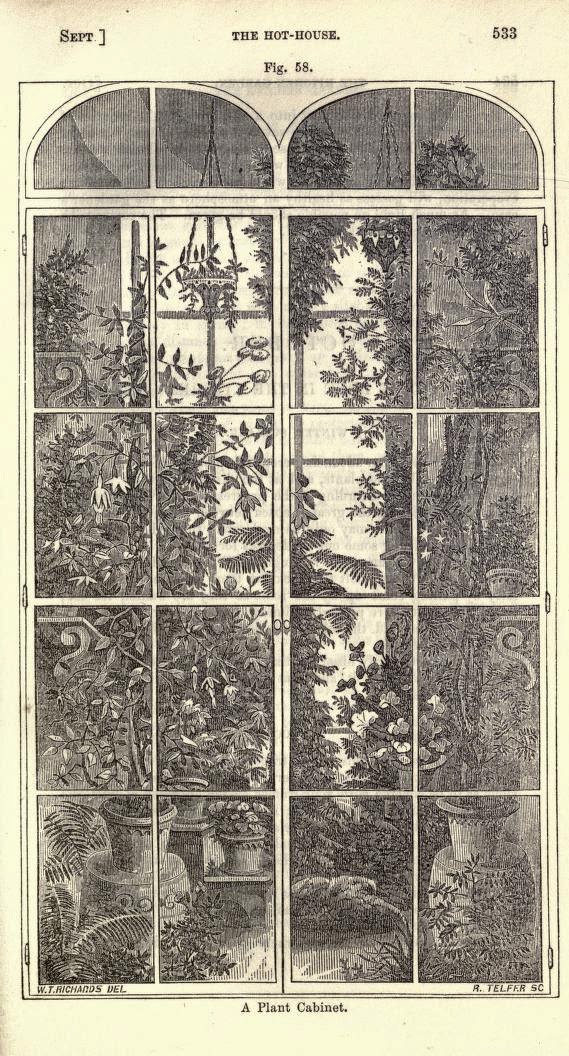
A Plant Cabinet, or Hot-House. M’Mahon, Bernard. The American Gardener’s Calendar. 11th Ed. 1857. http://biodiversitylibrary.org/page/20141911.

It was through The American gardener’s calendar that President Thomas Jefferson became acquainted and befriended M’Mahon. Jefferson found the book useful for his gardening and growing food at Monticello. M’Mahon and Jefferson began an exchange of books and seeds that went on for several years. Jefferson asked M’Mahon, along with fellow Philadelphia gardener, William Hamilton, to receive and propagate seeds and roots from plants collected on the Lewis and Clark Expedition, also known as the Corps of Discovery, in 1804 to 1806.

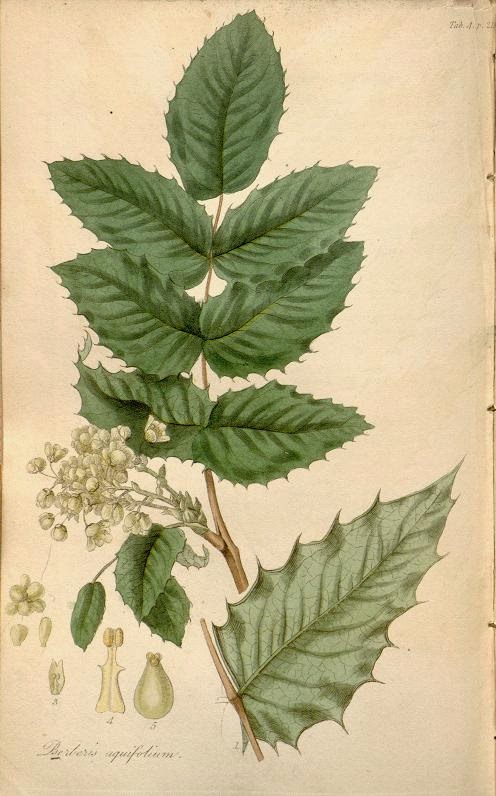
M’Mahon was a friend to many botanists; for example, Thomas Nuttall named a genus of evergreen shrubs discovered in the western U.S. during the Lewis and Clark expedition to honor him. While the name Mahonia is still used frequently in horticulture to identify these shrubs; scientifically, the Oregon grape holly or mountain holly (Berberis aquifolium) is now in the genus Berberis.

View Full Size Image
Berberis aquifolium. Pursh, Frederick. Flora Americae Septentrionalis. v. 1 (1814). http://biodiversitylibrary.org/page/396637.

In the 11th edition of The American gardener’s calendar, Jay J. Smith, who handled the revision, wrote a very personal memoir dedicated to M’Mahon which includes a tribute letter by Darlington. It is one of the few personal recollections I came across for such an important person in American gardening. M’Mahon’s publications can be found online through the BHL website.

Be sure to check out our Garden Stories event next week, March 23-27, and our TwitterChat this Friday, March 20, at 1-2pm EST. Happy gardening!

March 17, 2015by Grace Costantino
Page 1 of 212»

Help Support BHL

BHL's existence depends on the financial support of its patrons. Help us keep this free resource alive!

search

About BHL

The Biodiversity Heritage Library (BHL) is the world’s largest open access digital library for biodiversity literature and archives. BHL operates as a worldwide consortium of natural history, botanical, research, and national libraries working together to digitize the natural history literature held in their collections and make it freely available for open access as part of a global “biodiversity community.”

Join Our Mailing List

Sign up to receive the latest news, content highlights, and promotions.

Subscribe Now

Subscribe to Blog via Email

Enter your email address to subscribe to this blog and receive notifications of new posts by email.

Join 319 other subscribers

Subscribe to Blog Via RSS

Subscribe to the blog RSS feed to stay up-to-date on all the latest BHL posts.

Access RSS Feed

Inspiring Discovery through Free Access to Biodiversity Knowledge.

The Biodiversity Heritage Library makes it easier than ever for you to access the information you need to study and explore life on Earth…for free, anytime, anywhere.


64+ Million Pages of
Biodiversity Literature Online.

EXPLORE

Tools and Services
to Transform Research.

EXPLORE

300,000+
Illustrations on Flickr.

EXPLORE

ABOUT | HARMFUL CONTENT | PRIVACY | SITE MAP | TERMS OF USE