Biodiversity Heritage Library - Program news and collection highlights from BHL
  • Home
  • News
  • Featured Books
    • All Featured Books
    • Book of the Month Series
    • BHL at 20
  • User Stories
  • Campaigns
    • Fossil Stories
    • Garden Stories
    • Monsters Are Real
    • Page Frights
    • Her Natural History
    • Earth Optimism 2020
  • Tech Blog
  • Visit BHL
Home
News
Featured Books
    All Featured Books
    Book of the Month Series
    BHL at 20
User Stories
Campaigns
    Fossil Stories
    Garden Stories
    Monsters Are Real
    Page Frights
    Her Natural History
    Earth Optimism 2020
Tech Blog
Visit BHL
  • Home
  • News
  • Featured Books
    • All Featured Books
    • Book of the Month Series
    • BHL at 20
  • User Stories
  • Campaigns
    • Fossil Stories
    • Garden Stories
    • Monsters Are Real
    • Page Frights
    • Her Natural History
    • Earth Optimism 2020
  • Tech Blog
  • Visit BHL
Biodiversity Heritage Library - Program news and collection highlights from BHL
Blog Reel, User Stories

What Makes a Citizen Science Project Successful?

BHL supports a variety of crowdsourcing, or citizen science, initiatives that allow our community to help enhance our data, making it easier for scientists, researchers, educators, students, and others around the world to discover BHL content and use it to support scientific, conservation, and historical research. These initiatives include Flickr image tagging, transcription, image description via Science Gossip, and games that help improve our OCR.

But what motivates a citizen scientist to volunteer their time on a crowdsourcing project? How do they discover new projects or get support while tackling a challenging question? What can we do to keep our communities engaged and interested in our projects?

These are questions that any institution or organization that supports crowdsourcing activities might ask. Here at BHL, we figured the best way to get some answers was to ask our citizen scientists. We decided to start with one of our most dedicated volunteers, Siobhan Leachman.

View Full Size Image
Siobhan Leachman.

Siobhan lives in Wellington, New Zealand. She initially trained as a lawyer, but became interested in crowdsourcing and citizen science after she decided to stay home to raise her children. About two years ago, her sister, who works in a museum, introduced her to the Smithsonian Transcription Center, which offered just the sort of challenge that Siobhan was looking for.

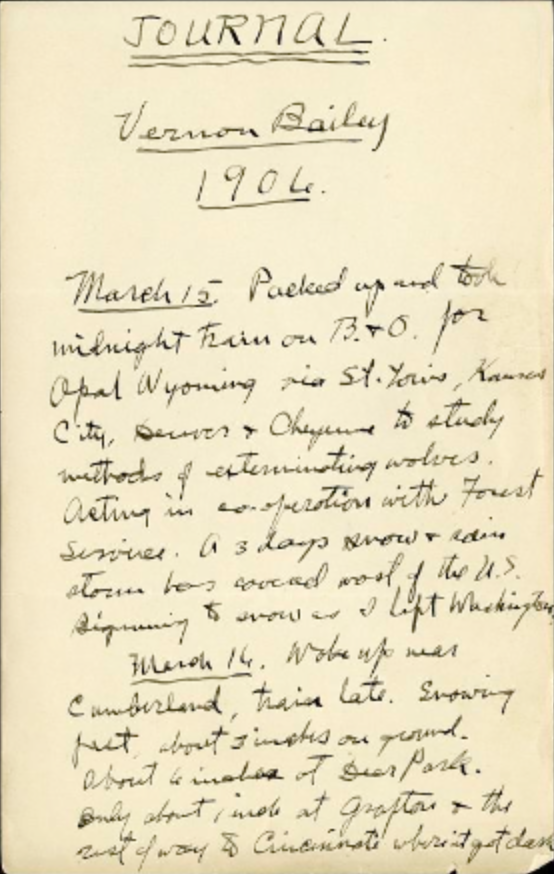
At the time, the Transcription Center was still in its beta phase, and at first, Siobhan’s activity in the project was occasional. Then, Vernon Bailey’s field books were added to the site, and that all changed.

“I became hooked,” Siobhan enthused. “I helped transcribe the field book in about three days. I loved his spare writing style, his drawings and occasional lyrical prose mixed in with unfamiliar North American species names that forced me to investigate further and in turn learn about various birds and animals. His writing was also quite an intellectual puzzle that I found fun to solve.”
View Full Size Image
“JOURNAL KEPT BY BAILEY ON FIELD TRIP TO WYOMING AND NEW MEXICO, MARCH 15-JUNE 1906.” Smithsonian Institution Archives. Smithsonian Transcription Center. https://transcription.si.edu/project/6656.

For the next six months, Siobhan worked exclusively on the Transcription Center. The variety of projects (including bumblebee labels, field books, and astronomy logbooks), the inviting and lively conversations among participants on social media, and the opportunity to provide input on improvements to the site (which was still in its beta phase), continually sparked her interest and nurtured a sense of community and teamwork.

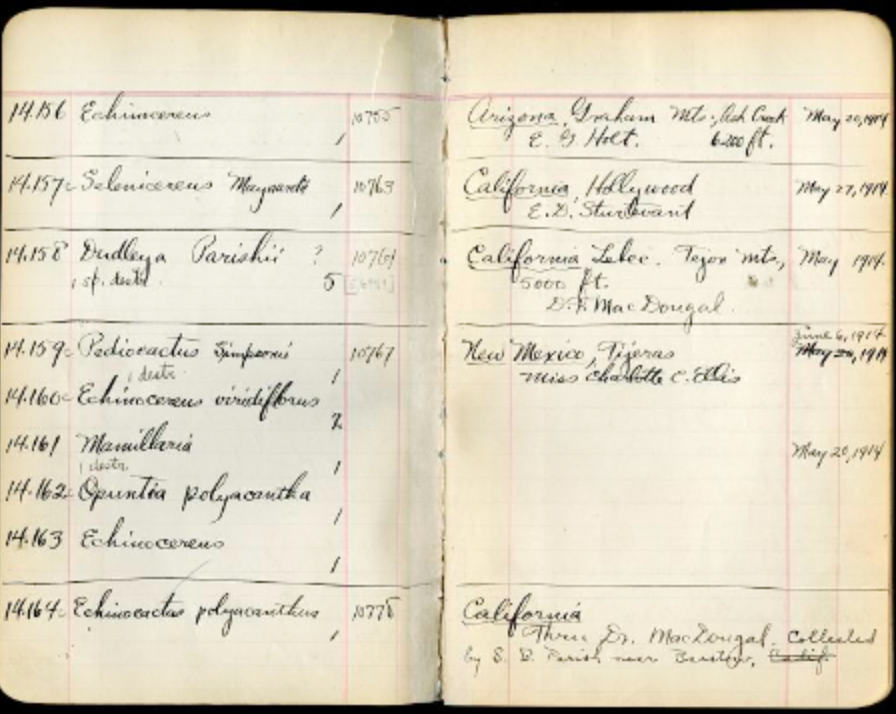
Then one day, an “unassuming log book on Cacti written by Joseph Nelson Rose,” led Siobhan to expand her crowdsourcing activities. The log book included a list of people who collected specimens for Rose, and Siobhan was surprised at how many women were listed. Research on one of them, Charlotte Cortlandt Ellis, led her to the JSTOR Global Plants database, where the record for Ellis was lacking a death date. Siobhan emailed JSTOR with the information, the database was updated, and the Transcription Center, delighted by the links and connections that the transcription projects were inspiring, highlighted the work in a blog post.
View Full Size Image
Rose’s log book, containing mention of Charlotte Cortlandt Ellis. ROSE, CACTI, 1909 – 1917. Smithsonian Institution Archives. Smithsonian Transcription Center. https://transcription.si.edu/project/6712.

“I found this positive reinforcement very gratifying and inspiring,” explains Siobhan. “I continued to research other women listed in the project and in the process started to realize that these amazing botanists were frequently overlooked. I also realized that few if any had a presence or mention in one of my main ‘go to’ sources of information – Wikipedia. So I began the journey of learning how to edit Wikipedia by focusing on writing articles about women I discovered via this project [see Siobhan’s articles on Charlotte Cortlandt Ellis and Rose E Collom].”

It was social media that introduced Siobhan to BHL. By following the Transcription Center on twitter (@TranscribeSI), Siobhan became aware that BHL was seeking volunteers to add species name tags to images in Flickr, and that these tagged images would be added to the Encyclopedia of Life (EOL). She frequently used EOL to research species names when transcribing field books, and she knew that many species pages lacked images. She realized that, by tagging BHL images, should could help enhance one of her go-to sources for species information.

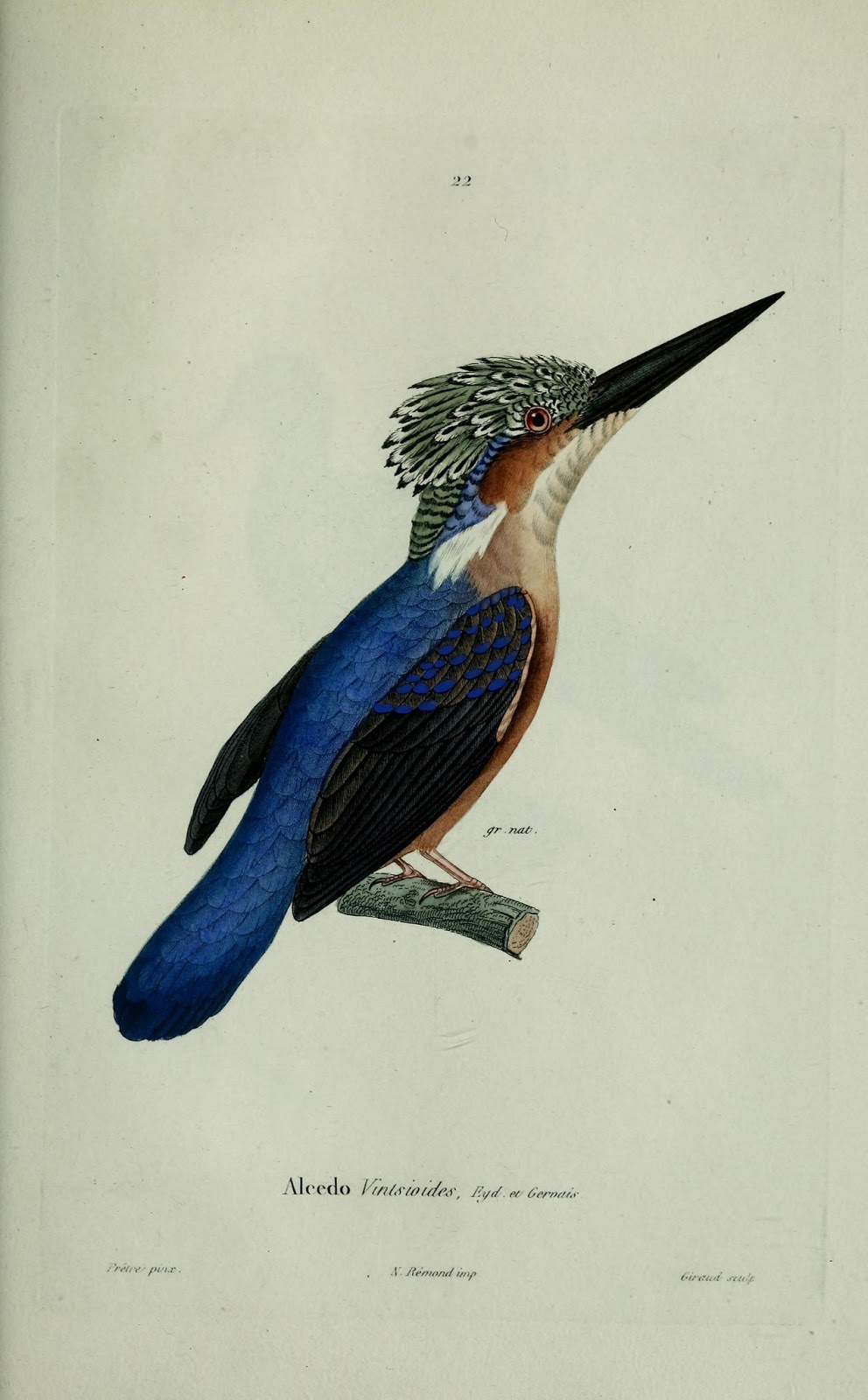
“My sister, Victoria, had been involved in machine tagging of the British Library images on Flickr and was able to get me up to speed as well as give me resources to assist in helping the BHL,” explains Siobhan. “I started out being keen about the species shown but expanded my interest in the artists of the images. The quality of the scientific illustrations in these old texts amazed me, and again I fell into a world I knew little about but found absolutely fascinating as well as beautiful.”
View Full Size Image
BHL Flickr image tagged by Siobhan. Alecedo vintsioides. Artist: Jean-Gabriel Prêtre. Oiseaux. 1839. http://biodiversitylibrary.org/page/33110158.

In addition to the Transcription Center and BHL Flickr image tagging, Siobhan also participates in several Zooniverse projects, including BHL’s Science Gossip, the Atlas of Living Australia’s DigiVol transcription site, and several local Wellington initiatives, including Nature Watch, the New Zealand Garden Bird survey and the Great Kereru Count.

Social media is the primary way that Siobhan discovers new projects; she follows a variety of organizations on Twitter and Facebook. She also subscribes to mailing lists for institutions she’s interested in, and relies on her network of fellow citizen scientists to alert her to new opportunities and developments.

Social media is also a critical source of support when she has questions. By reaching out to the organizations hosting the citizen science projects on Twitter or via the projects’ forums, or asking for help via Twitter from her network of friends, Siobhan is able to get answers to even her toughest questions. As such, she emphasizes that developing a strong social media strategy is important for crowdsourcing success. The strategy should involve easy and frequent communication that encourages input from volunteers, welcomes new participants, and highlights volunteer contributions.  Furthermore, she believes institutions should facilitate community building and encourage conversations amongst participants. Such networks are not only vital sources of support, but can also be very rewarding.

“One of the most beneficial but unforeseen consequences of me volunteering for the Smithsonian Transcription Center are the friends I have made the world over who enjoy the same hobby as I do,” affirms Siobhan. “They have and continue to enrich my life in numerous ways.”

Forging and fostering friendships with like-minded people is a major motivator for Siobhan. But what else motivates her to participate (and keep contributing to) a particular citizen science project?

“I want to be entertained, interested and learn something new,” divulges Siobhan. “I also want to feel like I’m contributing to the greater good and, in my small way, to the progression of science in general. I’ll keep working on a project if I believe it is worthwhile and interesting. I tend to be one of those people who finish what they start, so task completion is a motivation in itself.

“I also swap and change what I do depending on how I feel. Variety really is the spice of crowdsourcing. If I really want to concentrate and create, I’ll research and write a Wikipedia article. If I’m watching TV and want a relatively easy task, I’ll review bumblebee specimens. When I want to do something a bit more visually interesting, I’ll machine tag for BHL or contribute to projects like Science Gossip or Snapshot Serengeti on Zooniverse. And if I come across something that interests me such as a new artist or collector, I’ll head off researching and emailing organizations to hopefully make connections that aren’t easily obtained via a basic Google search.”
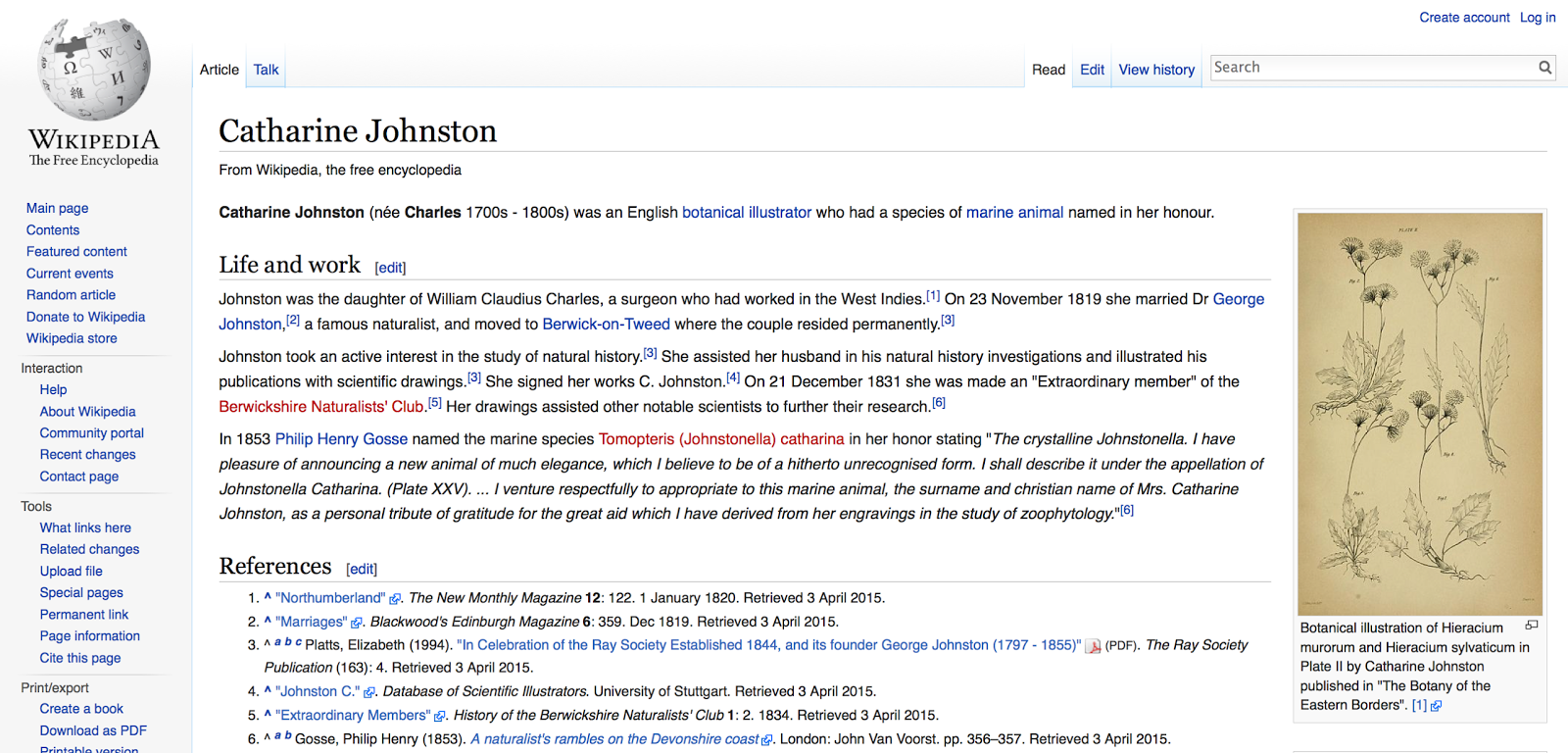
View Full Size Image
Catharine Johnston. Wikipedia page created by Siobhan. https://en.wikipedia.org/wiki/Catharine_Johnston.

For Siobhan, the biggest challenge to crowdsourcing is the immensity of the task and the limited time she has to commit to projects. While she is energized by the discoveries made possible by unlocking the data contained in field books or specimen labels, and how connecting this often disparate data together allows for powerful new insights into questions related to, for example, extinction or invasive species, the reality of the amount of work to be done is daunting.

“So much to do, so little time, is my mantra,” admits Siobhan.

But while there is much to do, the generosity of citizen scientists like Siobhan allows organizations the world over to consistently chip away at the work – work that may not ever get done otherwise.

We figured that someone who had dedicated so much time to citizen science initiatives probably had a pretty good idea of how they would design one if given the opportunity. So we asked Siobhan what her ideal project would be.

“My ideal citizen science project would entail everything that I do already but all in one place,” reveals Siobhan. “It would be like a tail to nose (so to speak) project, where people could collect data on a particular subject, link that data, undertake research to obtain further data to link to the subject being crowdsourced, transcribe data relating to the subject, add images, maps etc. so that the end result would be the ability to have access to everything ever collected or known about the subject. And it would all be open access i.e. unrestricted access and unrestricted reuse for anyone, anywhere. This would result in artists, scientists, historians etc. the world over reusing the information to create new and wonderfully unforeseen ways of interacting with that knowledge. Now that I think about it, it sort of sounds similar to my ideal version of the Internet.”
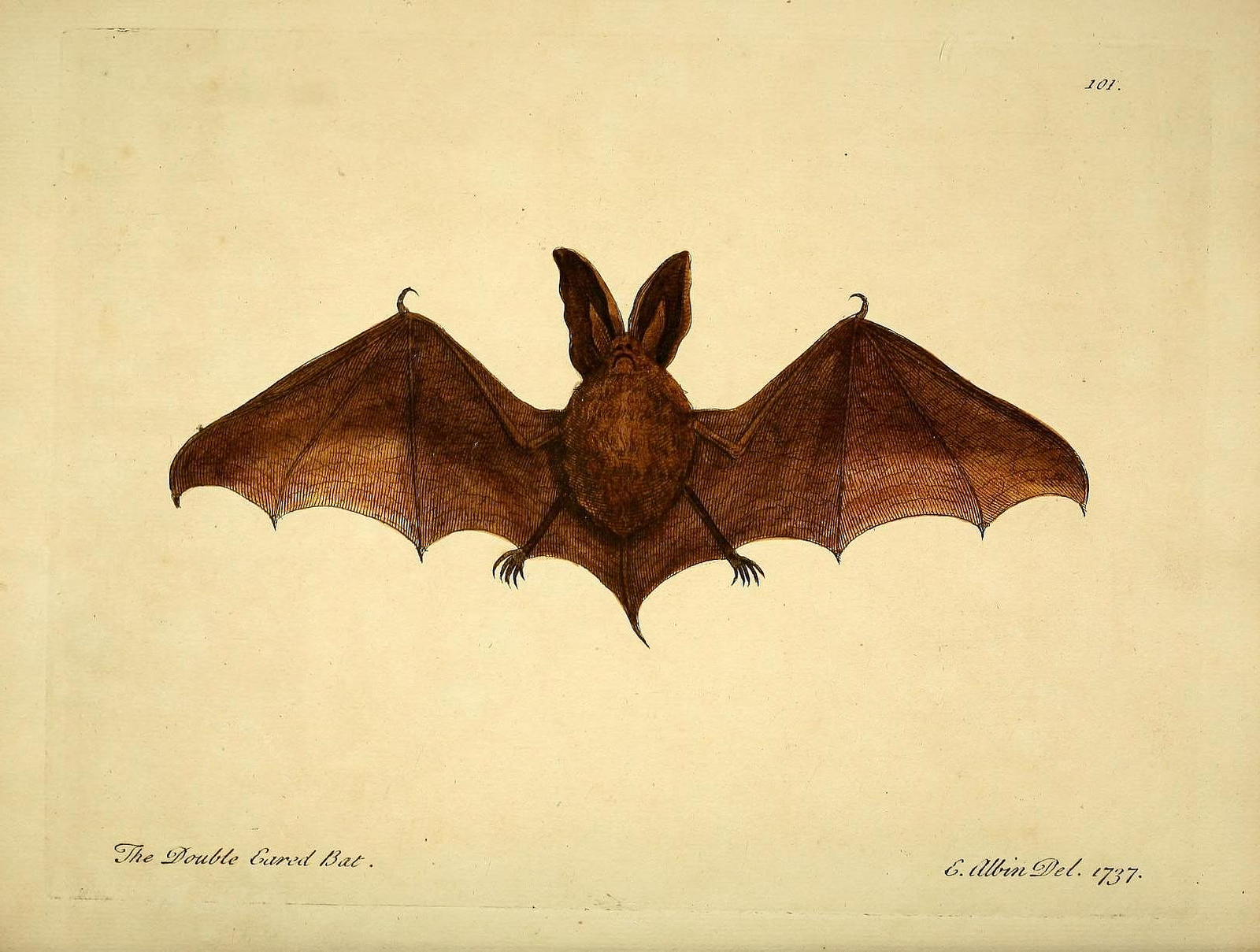
View Full Size Image
BHL Flickr image tagged by Siobhan. Artist: Plecotus auritus. Eleazar Albin. A natural history of birds. 1731-38. http://biodiversitylibrary.org/page/41131200.

We think that sounds like a pretty awesome aspiration, and hope that, as we continue to forge new partnerships and collaborations, we can all work towards that connected, open, and discovery-inspiring vision. And what will be the key to the success of such a project? An environment that offers a variety of activities, acknowledges and positively reinforcing the work of its participants, and facilitates active communication and community development.

And that’s the kind of environment we hope to create.

Learn more about how you can volunteer with BHL today.

October 1, 2015by michelle.underhill
BHL News, Blog Reel

Herding the Fuzzy Bits: What do you do after Crowdsourcing?

Portrait version of the Biodiversity Heritage Library logo.

So you’ve been crowdsourcing and now you’ve collected lots of fantastic data. What do you do with it?

Or maybe you’ve been thinking about crowdsourcing but you’re not sure how you would integrate what you get with the data you already have.

The truth is that crowdsourcing often yields lots of fuzzy data and fuzzy solutions for reintegration with existing content. It can be challenging to figure out how to herd all of that fuzziness together in an effective way for reuse in your own project, library, or database.

Join staff from the Smithsonian Libraries and the Biodiversity Heritage Library at the American Library Association (ALA) Annual Meeting in San Francisco, CA, on Saturday, 27 June, 2015, 8:30-10:00am, for “Herding the Fuzzy Bits: What do you do after Crowdsourcing?” We’ll share ideas for incorporating crowdsource-enhanced data from many sources (flickr, transcription, twitter) back into collections, along with approaches–including “whoopsies” and remaining challenges–for quality control, data discovery, data disagreement, building communities, and scalability. We’ll be using Twitter, and our own session hashtag #alafuzzy, as well as interactive activities (such as live polls!) to discuss successes and challenges and demonstrate the issues and methods at play.

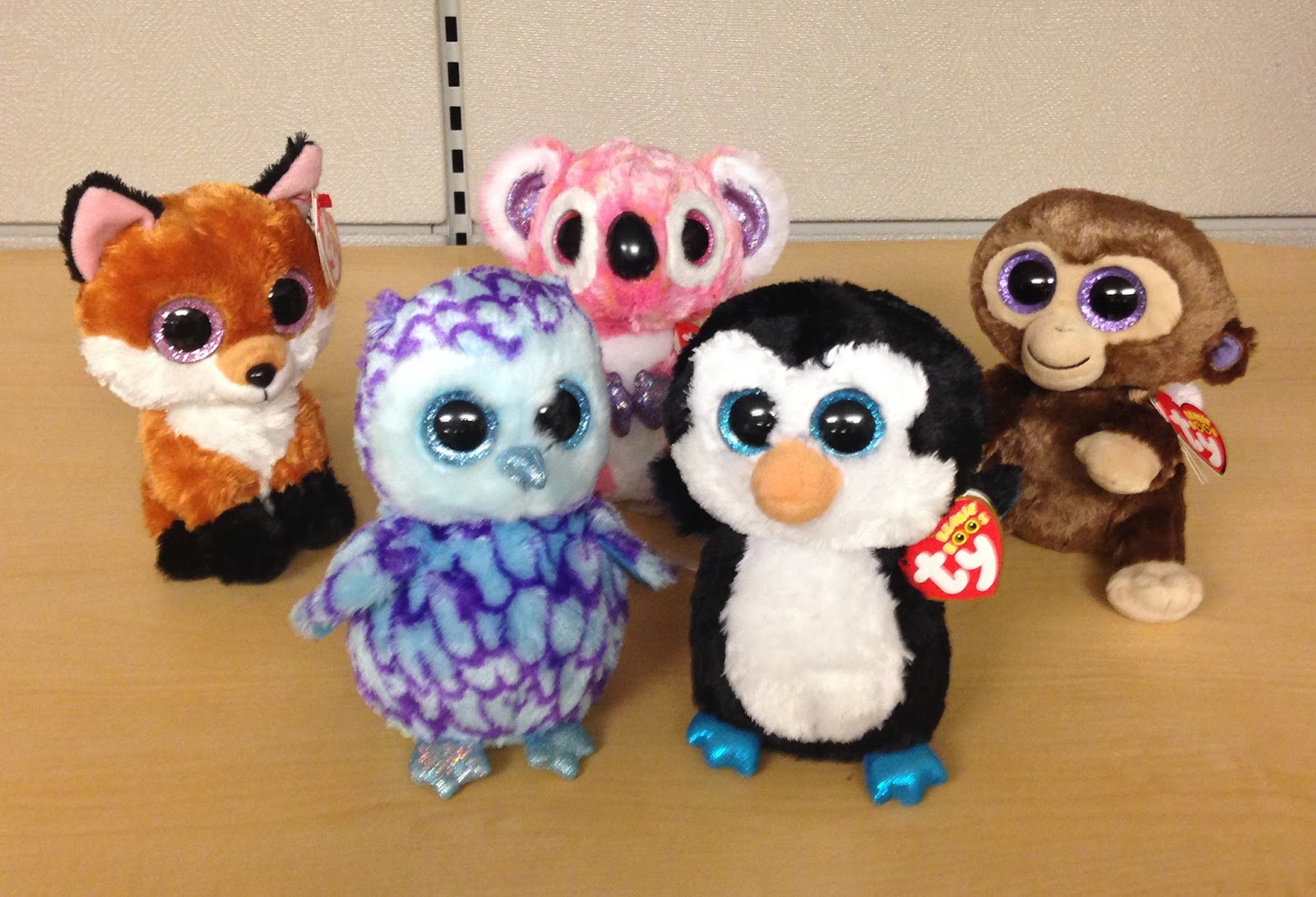
You’ll also have a chance to win one of these fabulous fuzzy prizes!

View Full Size Image
One of the awesome fuzzy prizes you could win at our ALA session on crowdsourcing!

The session is free with conference registration. We encourage you to bring your own laptop and smart phone in order to get the most out of our interactive activities.

We look forward to seeing you there, and follow #alafuzzy on Twitter and Facebook for more information!

June 16, 2015by michelle.underhill
BHL News, Blog Reel

Citizen Science Uses Art to Unlock Scientific Knowledge

Citizen Science in Science Gossip

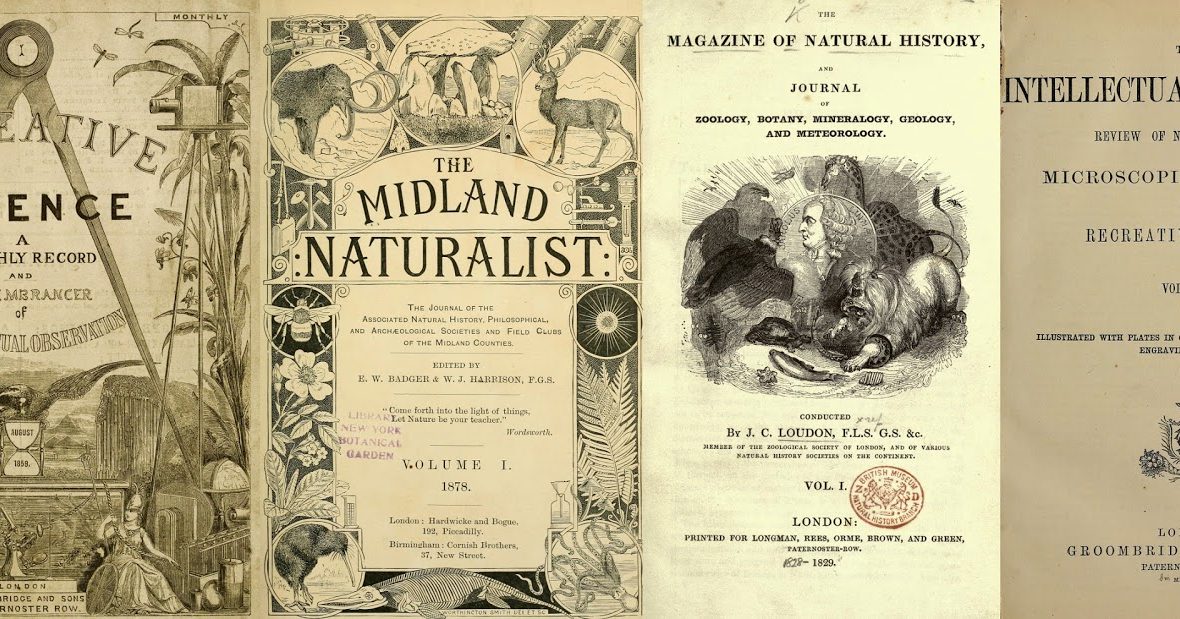
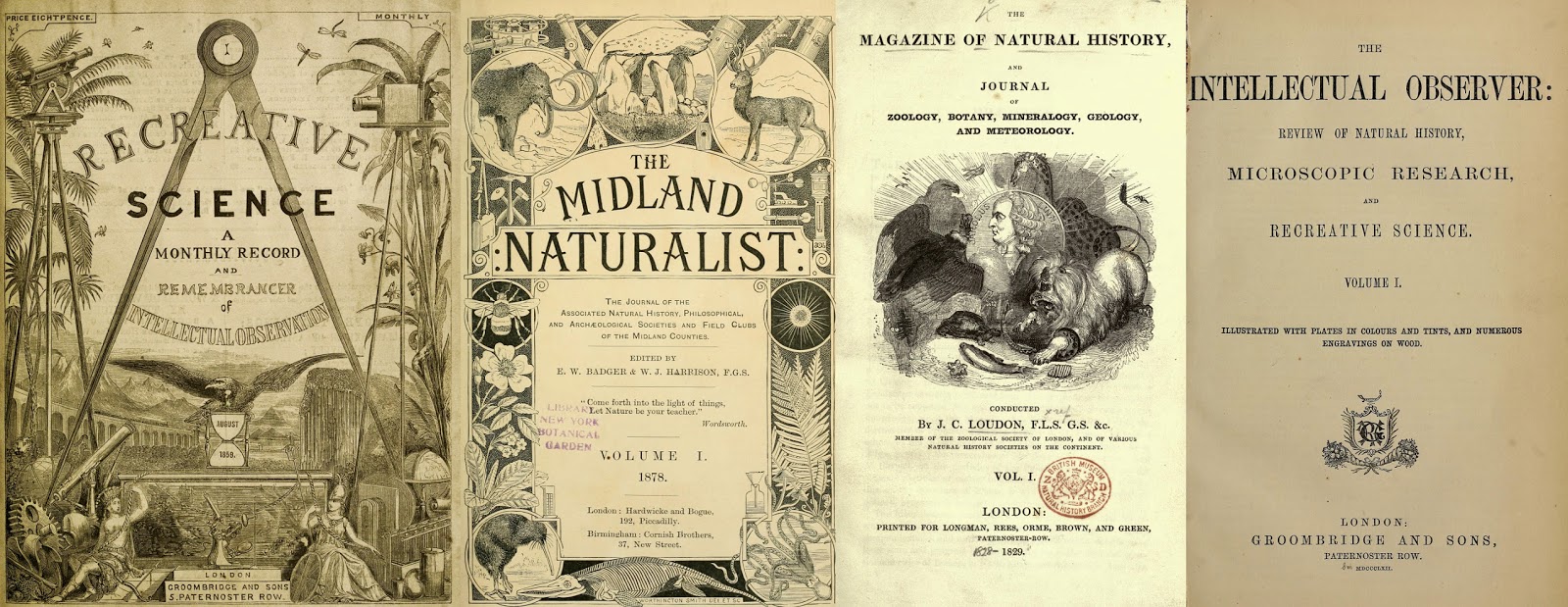
Since the release of Science Gossip a little less than a month ago, 3,600 volunteers have enthusiastically completed 160,000 classifications of natural history illustrations from the pages of 19th century science periodicals! As a result, the periodicals Recreative Science and Midland Naturalist are now fully classified and both the Magazine of Natural History and Journal of Zoology, Botany, Mineralogy, Geology and Meteorology and the Intellectual Observer are nearly complete (approximately 80%).

View Full Size Image

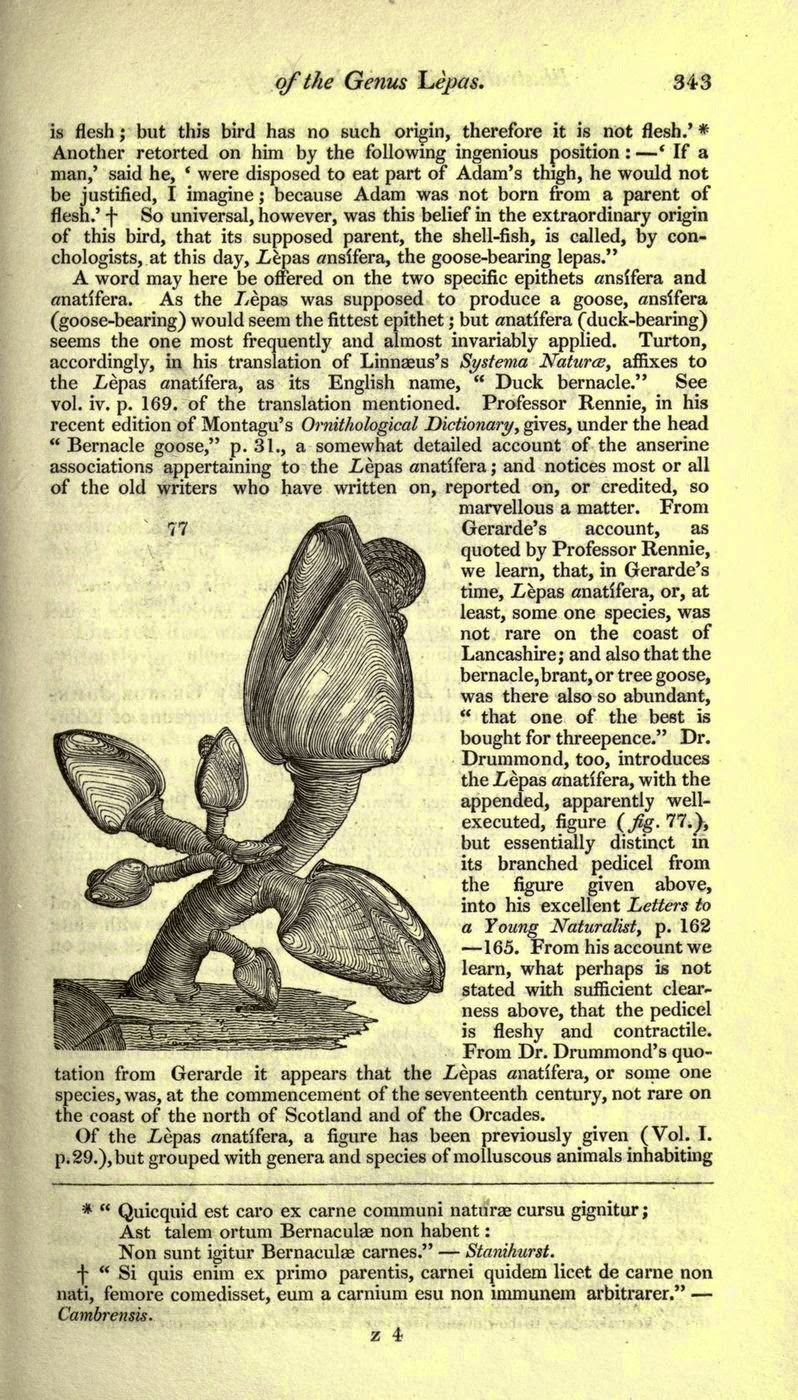
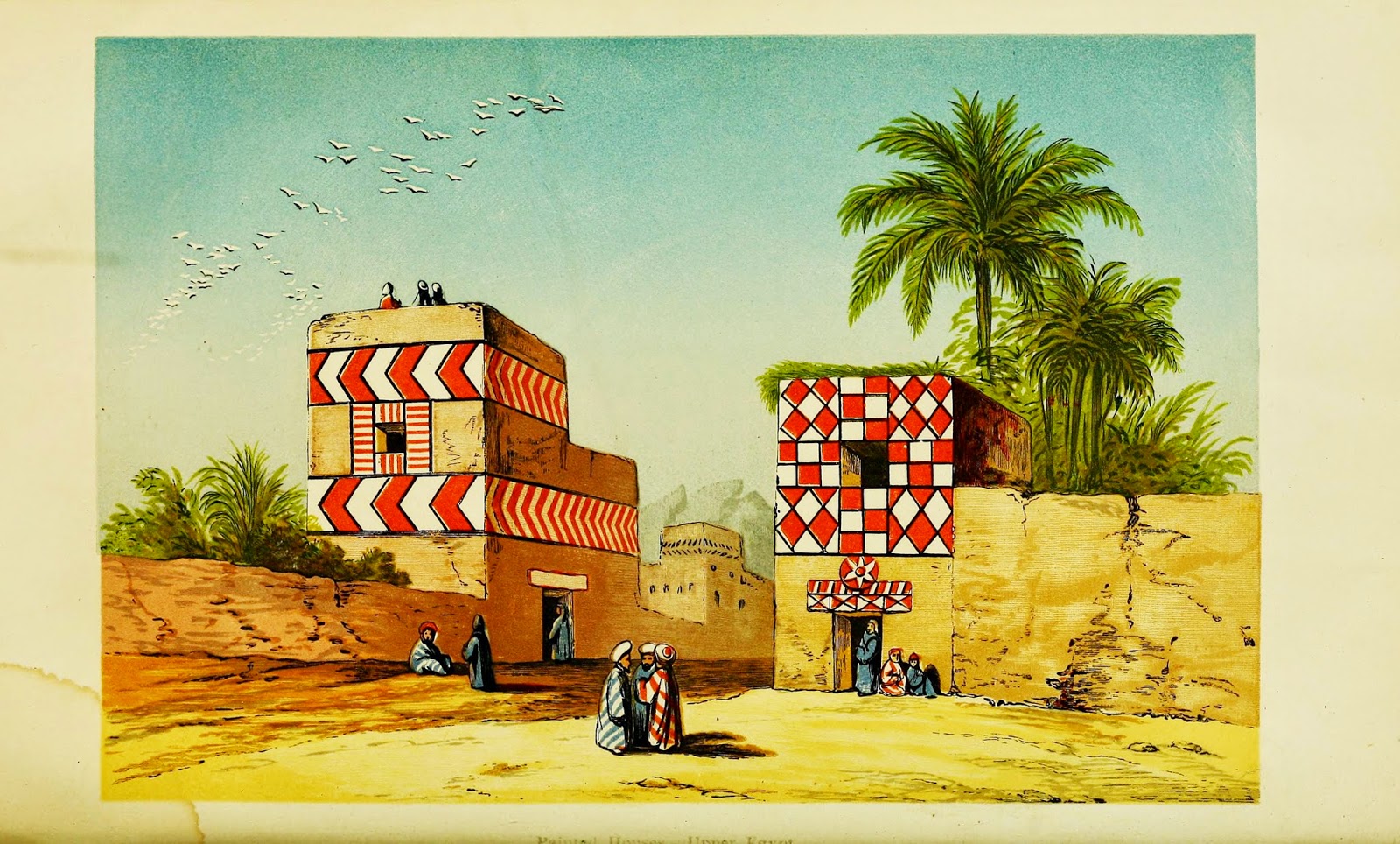
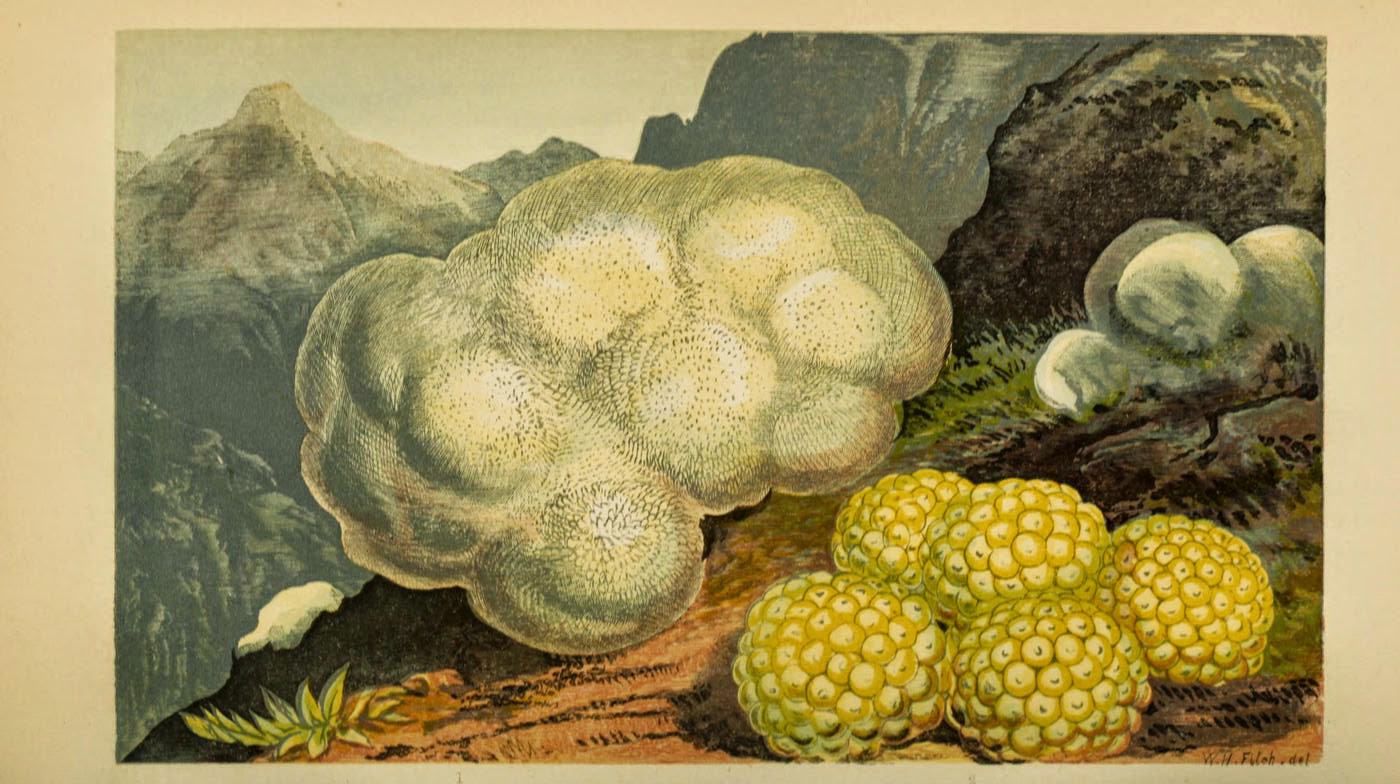
Volunteers have identified illustrations from a wide variety of topics, from Barnacles transforming into Geese to Egyptian Village Life to a plant called Vegetable Sheep, all of which demonstrate the diversity of domains covered in these 19th century science periodicals.

View Full Size Image
Barnacles transforming into Geese. Magazine of Natural History. v. 5 (1832).http://biodiversitylibrary.org/page/2301212.

Some of the illustrations volunteers have discovered relate to other Zooniverse projects such as these gems:

  • Penguins
  • Galaxies
  • Weather


View Full Size Image
Egyptian Village Life. The Intellectual Observer. v. 7 (1865). http://biodiversitylibrary.org/page/39464460.

Furthermore, within the first week, one of the volunteers managed to uncover the background image we use for the Science Gossip website!

Talk has been very active with questions about the best way to classify. Based on regularly recurring questions from users we have begun an FAQ, and this list will grow over time. If you have a question you think should be added to the FAQ, please post here.

View Full Size Image
Vegetable Sheep! The Intellectual Observer. v. 11 (1867). http://biodiversitylibrary.org/page/39544035.

We are in the process of uploading new content and are looking to reduce the number of blank and text only pages that volunteers have to weed through to get to pages with illustrations. Algorithms that can help automatically identify pages with text are being tested, although they are not 100% accurate. Stay tuned for progress and we look forward to seeing what other illustrative treasures our volunteers will unearth over the next month!

Citizen Science in Flickr

We’ve also been encouraging our user community to help us unlock knowledge in scientific illustrations through Flickr tagging. In January, we announced that, in addition to the nearly 100,000 images in our own Flickr collection, over a million BHL images are also being uploaded to Flickr Commons via the Internet Archive Flickr stream. As part of our Art of Life project, we asked you to help us enhance these images by tagging them with species names.

Since our request in January, over 1,700 images in the BHL Flickr collection have been tagged by our user community, translating to over 18,000 total images tagged. Those images with species name machine tags are automatically ingested into the Encyclopedia of Life and associated with the corresponding species page. To date, there are over 17,000 BHL images in EOL.

View Full Size Image
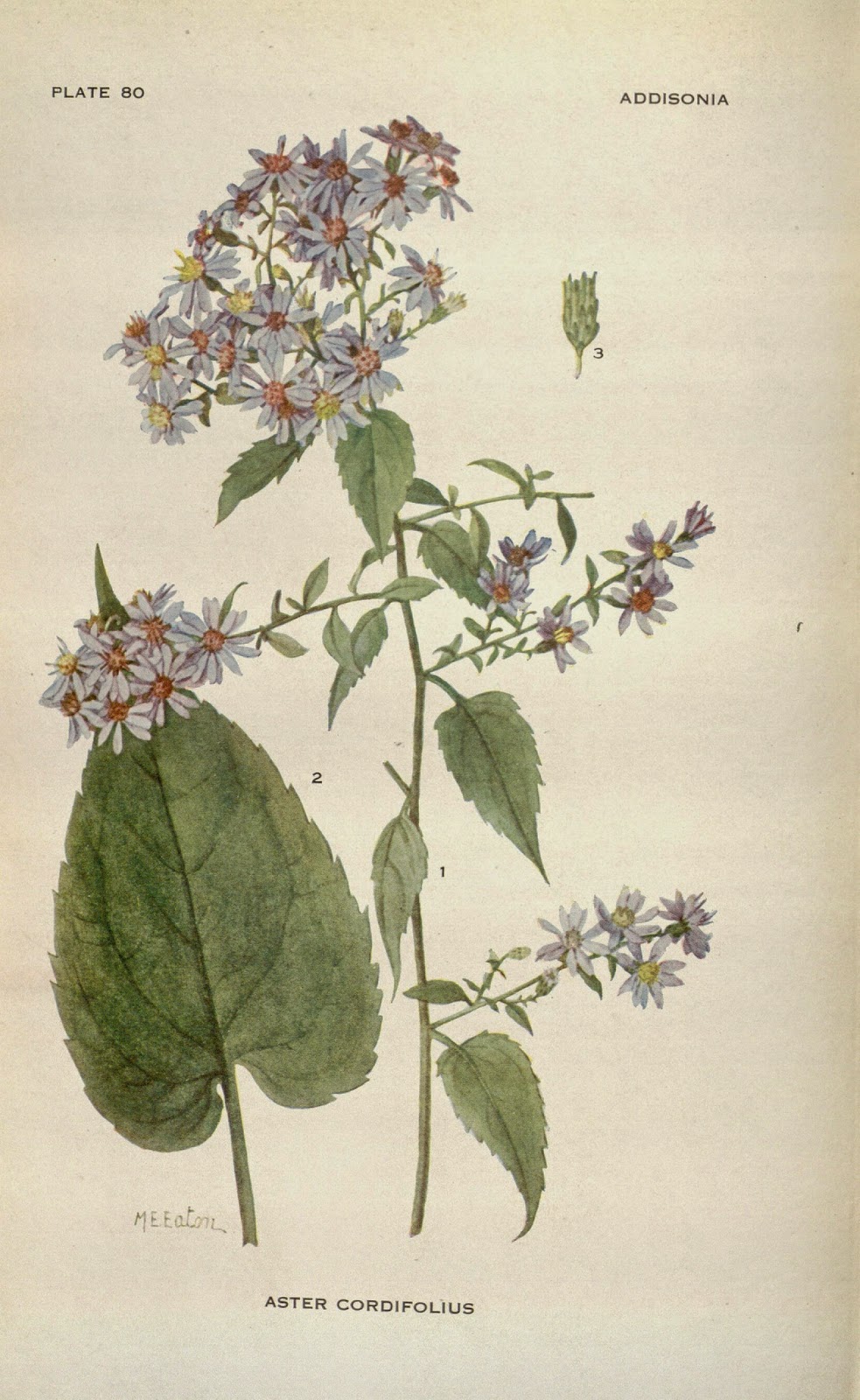
Aster cordifolius, tagged by @SiobhanLeachman. Addisonia. v. 2 (1917). http://biodiversitylibrary.org/page/28890239.

Our community has also been adding much more information than just species names. @SiobhanLeachman and @VLeachman shared a great guide from the British Library on additional machine tag formats, including artist name, dates, and VIAF information. As a result, knowledge such as the artists who created these amazing illustrations is also being captured.

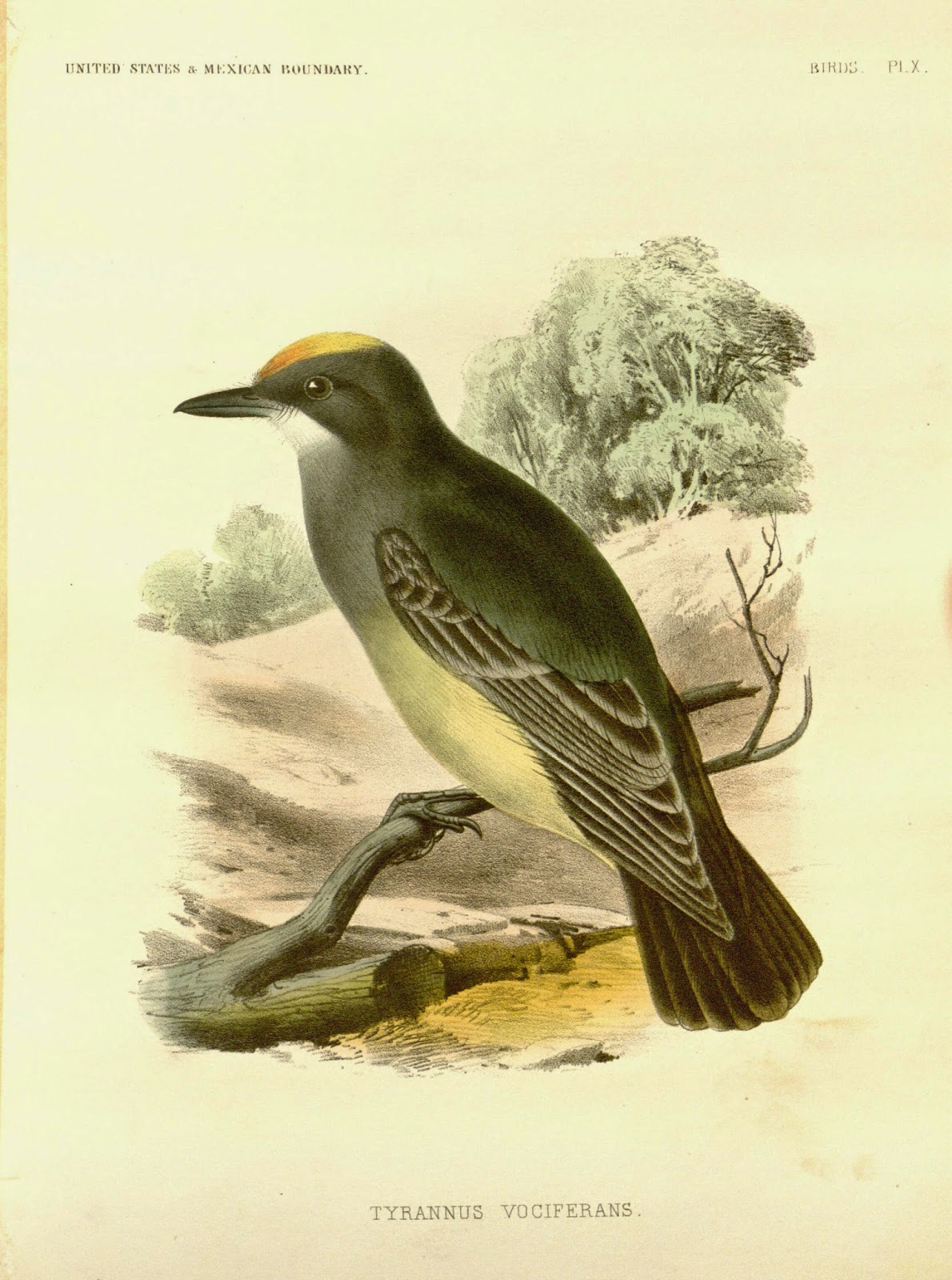
Thanks to our interaction with taggers on social media, we’ve also discovered some really amazing things about these illustrations. For example, through transcription activities with the Smithsonian Transcription Center, @Bailiuchan discovered a great mention by Vernon Bailey of Cassin’s Kingbird (Tyrannus vociferans), which she shared on Twitter. We shared an illustration of the bird from BHL, and a suggestion of the possible artist from one of our image taggers led us to discover that this image, and the other plates from this work, were prepared by the same firm that did Audubon’s famous Birds of America!

View Full Size Image
Cassin’s Kingbird. Plate prepared by same firm that did Birds of America, a fact we discovered thanks to our Flickr image tagging conversations on social media! Report on the United States and Mexican Boundary Survey. v. 2, pt. 2 (1859). http://biodiversitylibrary.org/page/28880648.

We are so excited about the ways that citizen science is allowing us to learn new things about our collections and capture this knowledge in ways that allow others to more easily discover them. The ultimate goal for all of these activities is to ingest the tags and descriptions provided by users on Science Gossip and Flickr into BHL to enhance our own metadata and eventually support image search within the portal itself.

Thank you for helping us learn about our collection and improve access to it! We hope you will continue to explore and describe our illustrations on Science Gossip and Flickr. What will you discover?

March 31, 2015by ulib-libraryjobs
BHL News, Blog Reel

BHL Update at the EOL Executive Committee Meeting

View Full Size Image

The BHL and Encylopedia of Life (EOL) share the vision of open access to knowledge about life on earth. BHL works to achieve this goal by providing open access to biodiversity literature. EOL tackles this challenge by gathering, generating, and sharing biodiversity knowledge in an open, freely accessible digital repository.

BHL and EOL have been collaborating since 2007, sharing content, best practices, and expertise. Both websites are also extensively interlinked. Taxa identified on pages in BHL are linked to the corresponding species page in EOL. Likewise,  EOL species pages contain links to all identified literature in BHL referencing those species. Through the use of machine tagging, BHL also supplies species illustrations to EOL. To date, 16,496,376 pages in BHL link to EOL species pages, and 1,177,510 EOL pages link to BHL literature. BHL has contributed 13,808 images to EOL.

On 28-29 July, 2014, the EOL Executive Committee Meeting was held at the National Museum of Natural History in Washington, D.C. Agenda topics included strategic planning, EOL content growth and integration with external databases, repackaging content for educational purposes, and the success of Traitbank (a searchable, comprehensive, open digital repository for organism traits, measurements, interactions and other facts for all taxa across the tree of life).

View Full Size Image

Dr. Nancy Gwinn, Director of Smithsonian Libraries and the BHL Executive Committee Chair, was asked to give a BHL update at the meeting. Her presentation highlighted BHL content and membership growth, the Art of Life project, and notable activities over the past six months, including the Field Book Project, participation in the Bouchout Declaration, the joint SIL/BHL exhibit “Once There Were Billions,” Purposeful Gaming, Mining Biodiversity, and the Global Names Project.

Dr. Gwinn also showcased notable BHL/EOL collaborative activities and achievements over the past six months. The May 28th Smithsonian Associates event on Digital Volunteerism, which provided volunteers an opportunity to tag BHL illustrations with species names and explore the iNaturalist platform, was of particular interest.

“Planning for EOL’s future is proceeding with vigor and enthusiasm,” said Dr. Gwinn following the meeting. “I am pleased that BHL continues to contribute to this process.”

Making biodiversity knowledge freely available to everyone is an ambitious goal. But by continuing to share content and collaborate with EOL and like-minded initiatives through joint events, knowledge transfer, and cooperative needs analysis and service development, we are confident we will achieve it.

View Nancy’s Presentation: http://www.slideshare.net/costantinog/bhl-update-at-the-encyclopedia-of-life-executive-committee-meeting-2014

August 19, 2014by michelle.underhill
BHL News, Blog Reel

BHL and EOL co-host a Smithsonian Associates event

On May 28, the Biodiversity Heritage Library (BHL) and the Encyclopedia of Life (EOL) co-hosted an evening program on digital volunteerism.  The event was organized by The Smithsonian Associates (TSA) and was attended by 74 people.

View Full Size Image
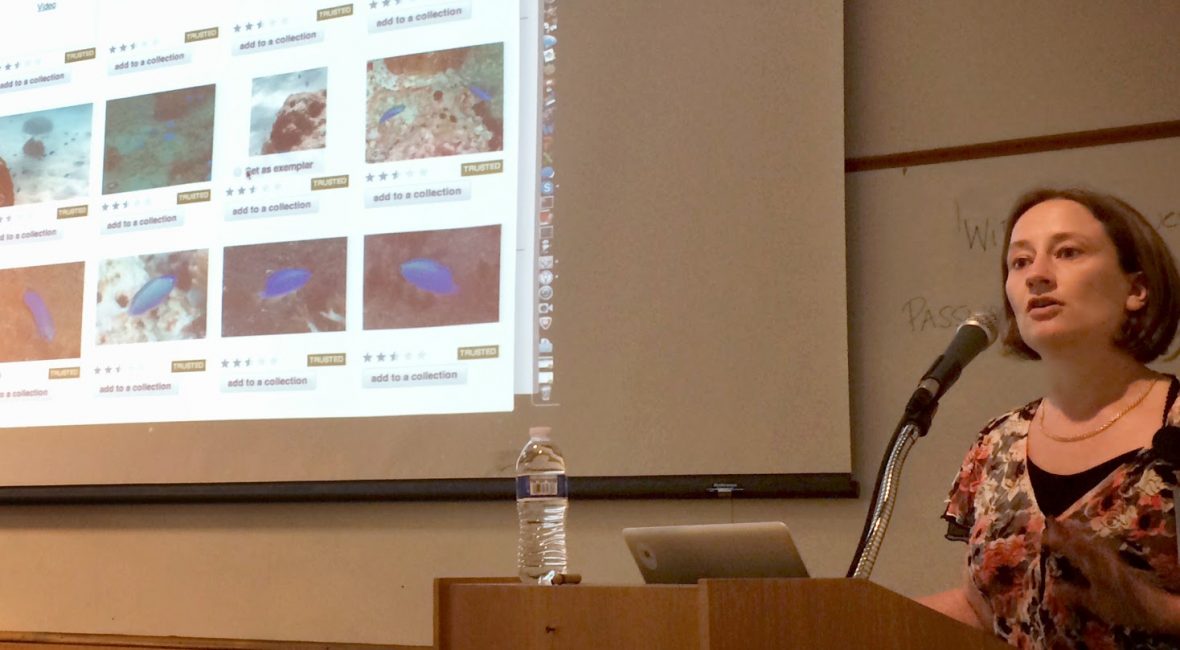
Jen Hammock presenting at the
Smithsonian Associates program

Carolyn Sheffield (BHL), Katja Schulz (EOL), and Jen Hammock (EOL) presented on BHL, EOL, and examples of how people could contribute to growing our knowledge of the planet’s biodiversity.  Presentations were followed by a hands-on session where attendees were encouraged to start machine tagging images in BHL’s Flickr Photostream, cropping and rating images, and exploring the iNaturalist platform.

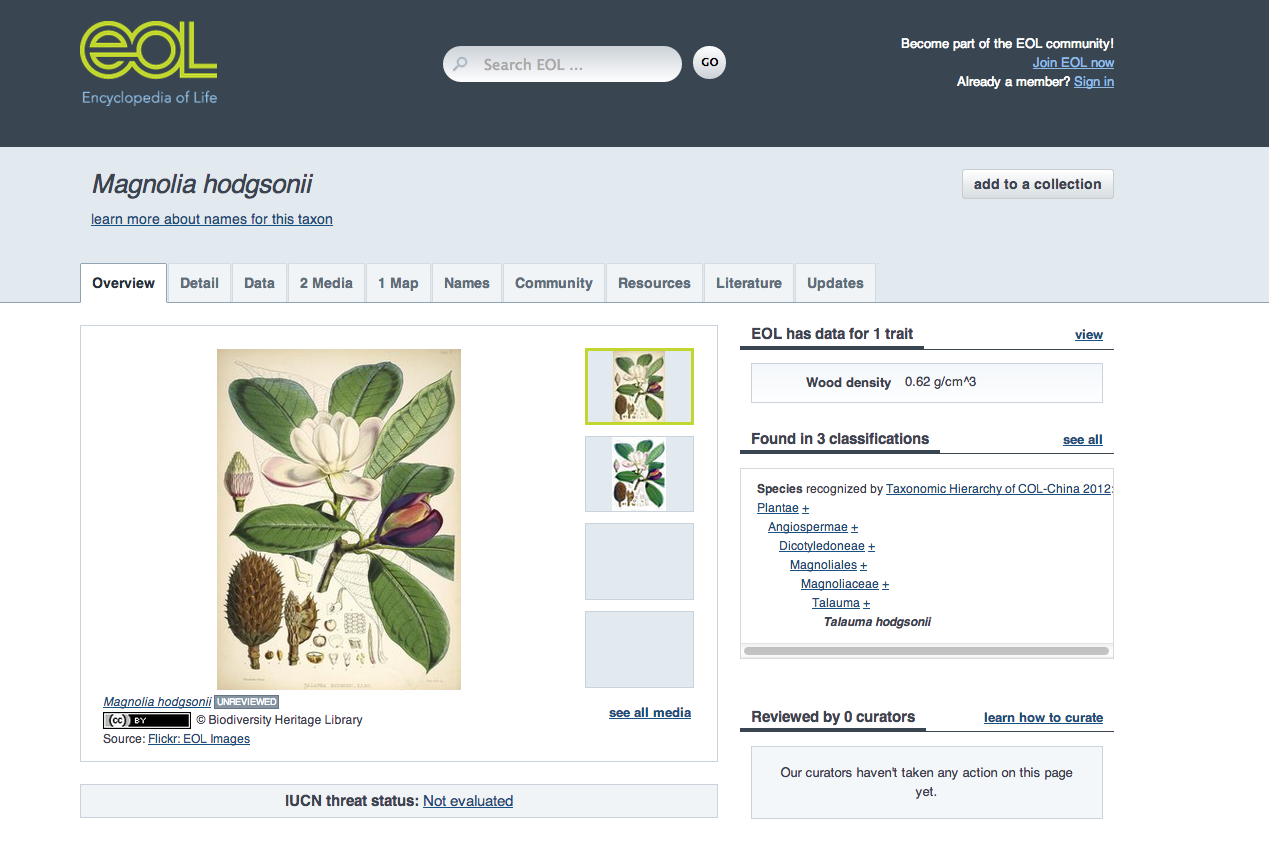
BHL has hosted similar events in the past for Smithsonian staff to learn about–and add–machine tags to the images in BHL’s Flickr Photostream.  A machine tag is a tag that is structured in such a way that a machine can read and understand it. In our case, we’re assigning machine tags of scientific names to the BHL illustrations in Flickr so that EOL can recognize those as images that can be harvested and associated with the appropriate species page in EOL.  See an example of an EOL species page with a BHL image here:

View Full Size Image
EOL species page for Magnolia hodgsonii with
illustration from BHL’s Flickr photostream

The structure that we use for the machine tags is:

taxonomy:binomial=”genus species”

You can replace “binomial” with another taxonomic tag, such as “genus” or “family, if you can only identify the organism at that level.  Learn more about the Flickr tagging process and machine tag formats in the instructions we provided to session attendees.

View Full Size Image
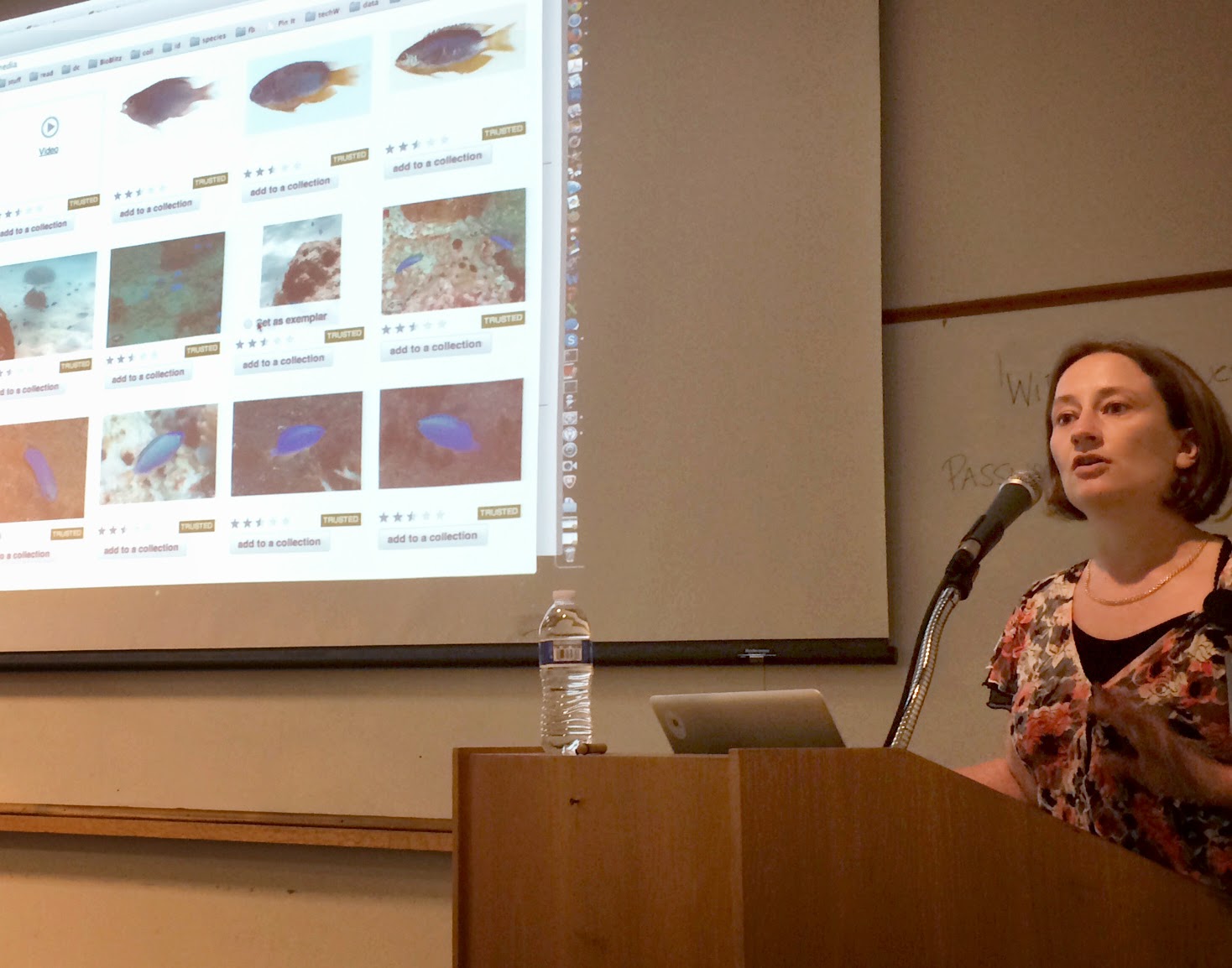
Katja Schulz working with
some of the TSA attendees

The TSA event was not only an opportunity to expand our cadre of machine taggers but also gave us a chance to share multiple ways that people could get involved with BHL and EOL. For example, images that depict multiple species can create confusion when associated with a single species page in EOL.  Attendees were shown how to replace such images with a cropped version showing only the relevant species.  The evening also provided a chance to showcase EOL’s recently launched iNaturalist Collections.

All told, it was a very successful event.  Several guests said they were delighted to learn about EOL and BHL and, by the end of the day, 129 more images in BHL’s Flickr Photostream boasted machine tags.  We look forward to the continued contributions of these amazing Smithsonian Associates session attendees!

Looking for a way that you can get involved?
Check out the instructions on machine tagging or visit EOL to sign up for an account and to learn more about recording your own observations of the natural world through EOL’s iNaturalist collections.

June 17, 2014by brooksm
BHL News, Blog Reel

Decoding the Ocean’s Treasures One Tag at a Time

Tagging BHL Marine Images at the Smithsonian


View Full Size Image

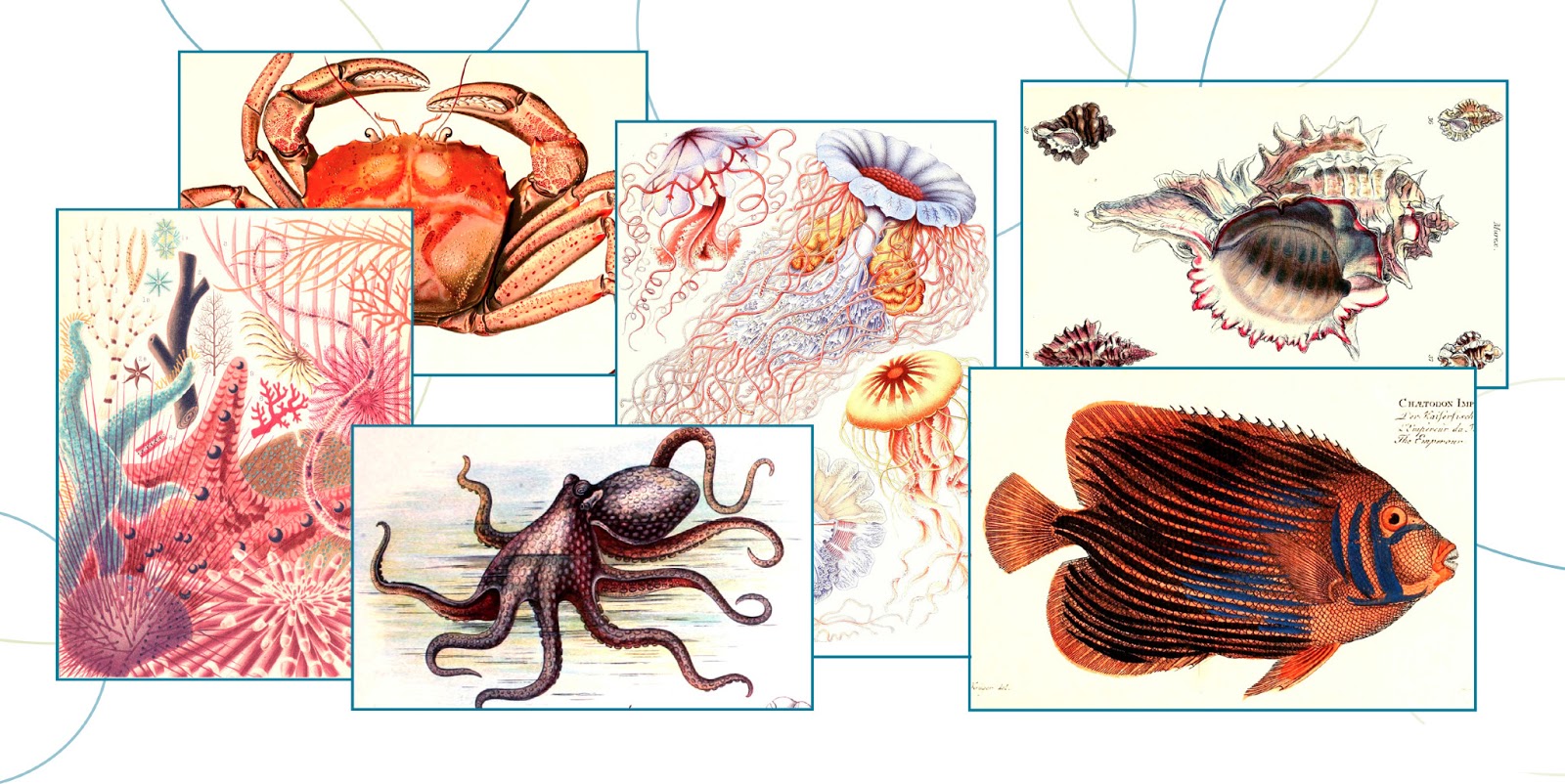
There are approximately 32,000 species of fish, representing the greatest species diversity of any vertebrate group. Mollusks, with around 85,000 extant species, constitute the largest marine phylum and about 23% of all named marine organisms. Crustaceans, with about 67,000 described species, are arthropods that range in size from .004 inches (Stygotantulus stocki) to over 12.5 feet (Japanese Spider Crab). The diverse algae group includes unicellular and multicellular organisms, such as seaweeds, dinoflagellates, red, green, brown, yellow and golden algae, and diatoms, to name a few.

Looking at the big picture, we know of over 210,000 marine species, though it is estimated that there are more than one million in total. It should come as no surprise to you that BHL has millions of pages of literature related to the topic of marine biodiversity. What you may not know is that we also have thousands of images of marine species in our Flickr.

We’ve written before about our mission to add species name tags to the images in our Flickr account so that users can not only search for and find illustrations of specific organisms, but also so that we can easily share these images with external projects like the Encyclopedia of Life. To accomplish this goal, we’ve not only created instructional material and encouraged our user community to take up the charge, but we’ve also hosted two tagging parties at the Smithsonian Libraries. On April 2, 2013, we hosted our third tagging party at the Smithsonian, in conjunction with both the Encyclopedia of Life and Smithsonian’s Ocean Portal. This time, we focused our event on a theme: Marine Biodiversity.

View Full Size Image
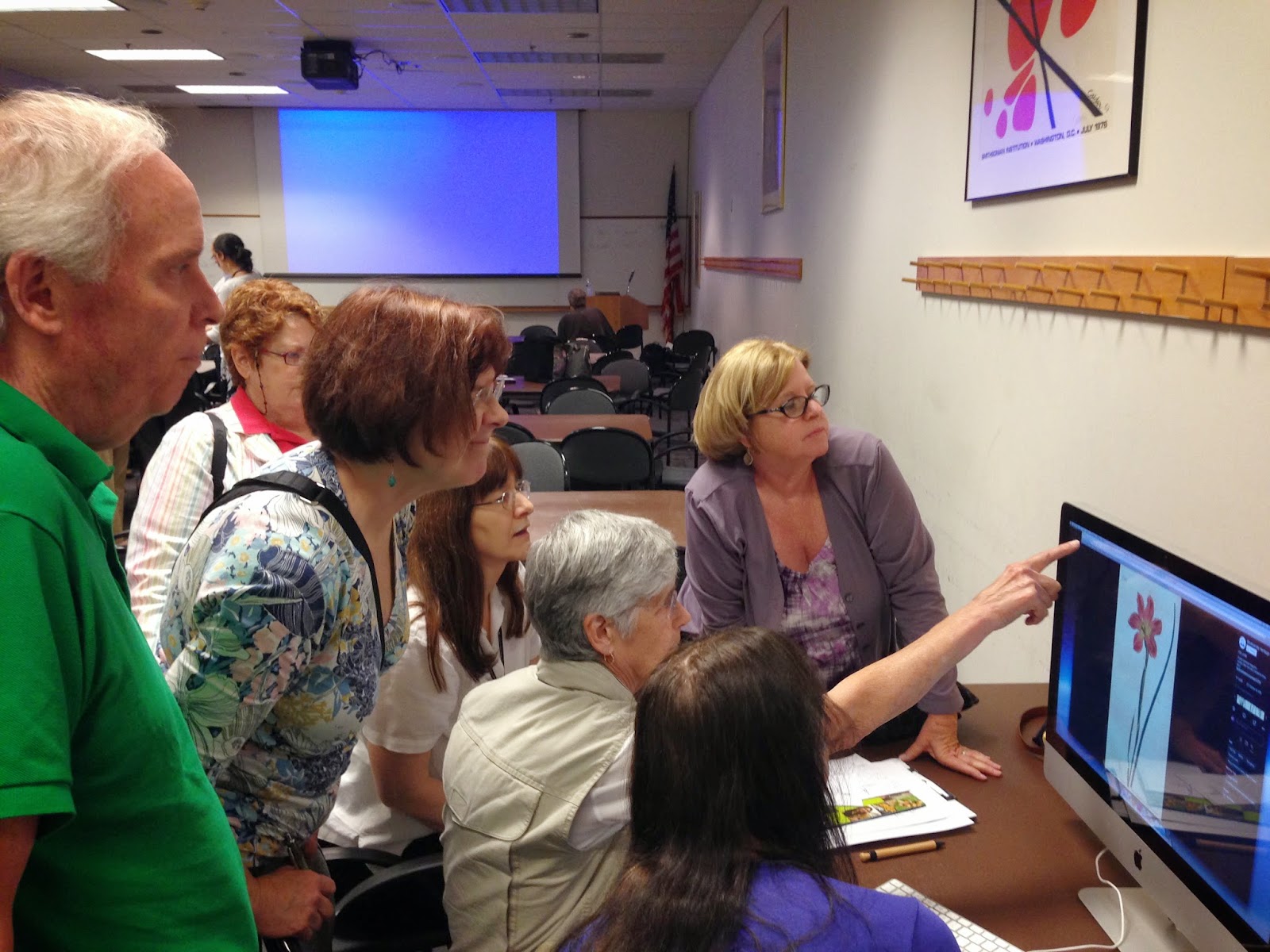
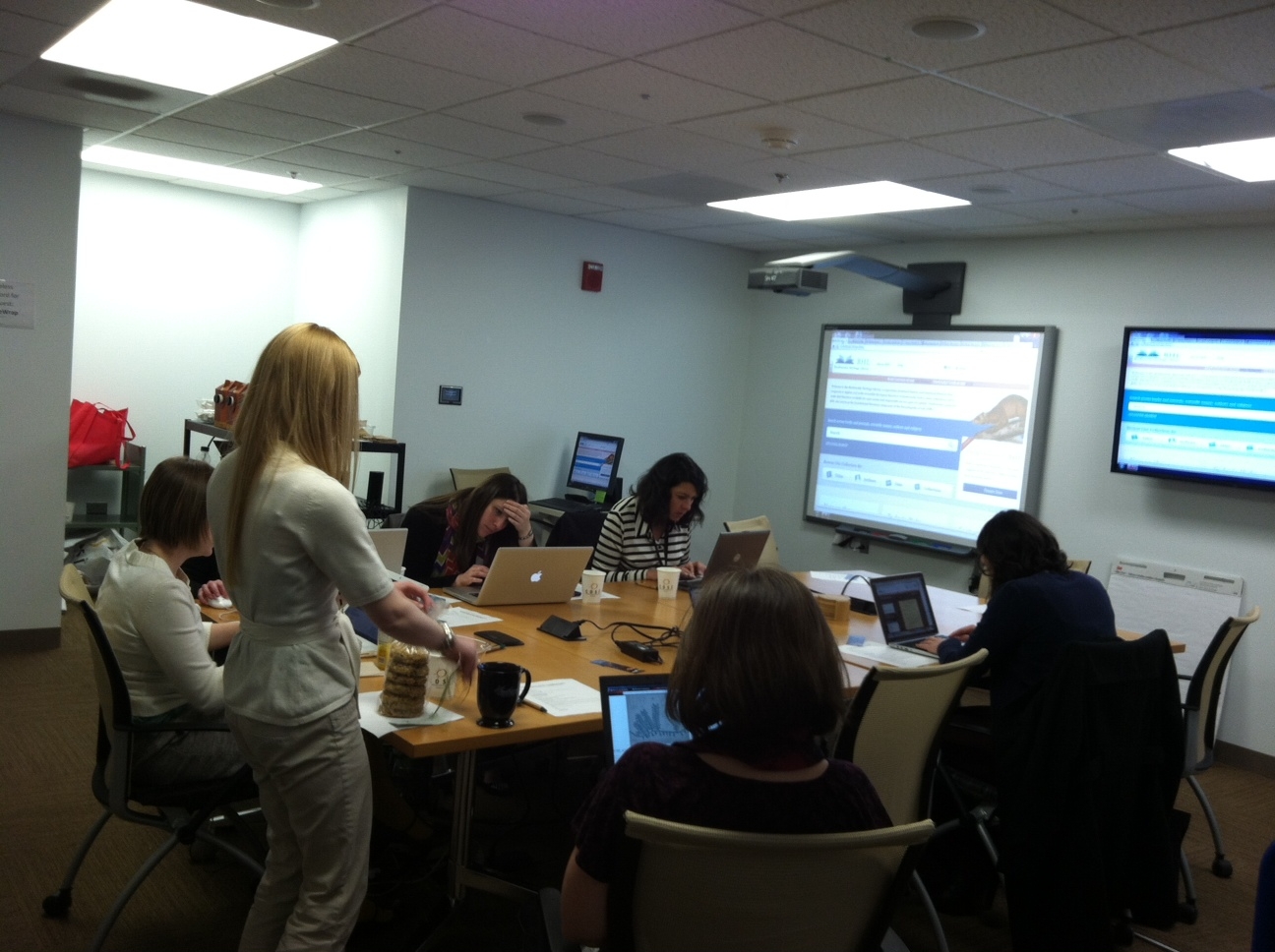
Attendees at the Tagging Party, adding tags! Photo by Gilbert Borrego.

At our tagging parties, we invite Smithsonian staff, including curators, volunteers, interns, fellows, and librarians, to gather in person for an hour and a half to help us add tags to images in a group setting. Since this was a themed event, we directed attendees to specific sets of marine images in need of tagging. We’re happy to say that the 17 people that attended the party made some good headway on the thousands of marine images that need tagging!

You can Help!

As mentioned, all of our tagging events thus far have been staff-only occasions. While we hope to hold public events in the future, hosted at various BHL member institutions, you can actually help us tag our images right now!

How?

If you’re looking at an image in Flickr for which you know the species name, simply click “add a tag” and input the name in the following format:

Taxonomy:Binomial=”Genus species”

Replace the “Genus Species” text with the actual binomial for the creature you are identifying and be sure to put quotation marks around the name as shown above. So, a complete tag would look like:

Taxonomy:Binomial=”Zea mays”

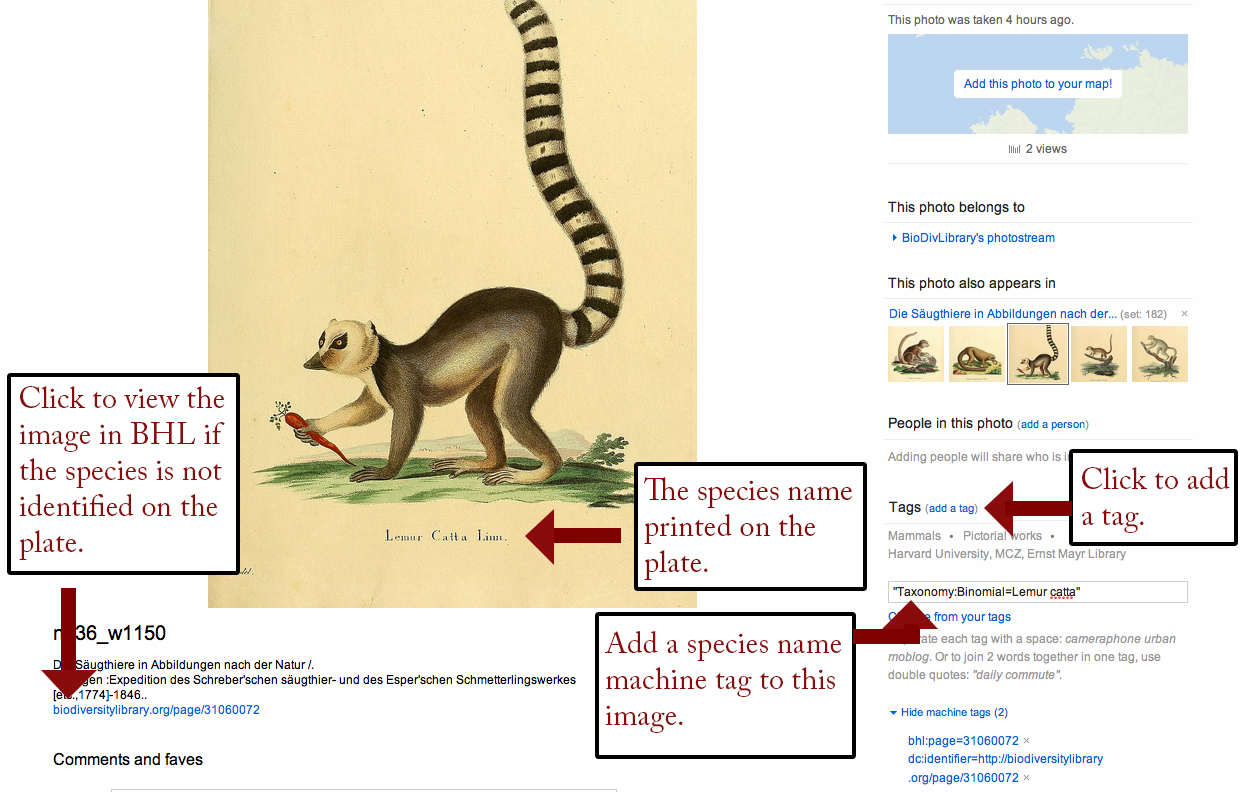
How can you identify the species if you don’t recognize it on sight? Many of our illustrations actually have the species name printed on the image itself. Simply transcribe that name into the machine tag format. If the name isn’t printed on the illustration, you may be able to find an identification in BHL. Click on the link below each image to view the book in BHL, then navigate through the text pages surrounding the image to see if the species identification is given. If so, input the name into the machine tag format in Flickr.

View Full Size Image
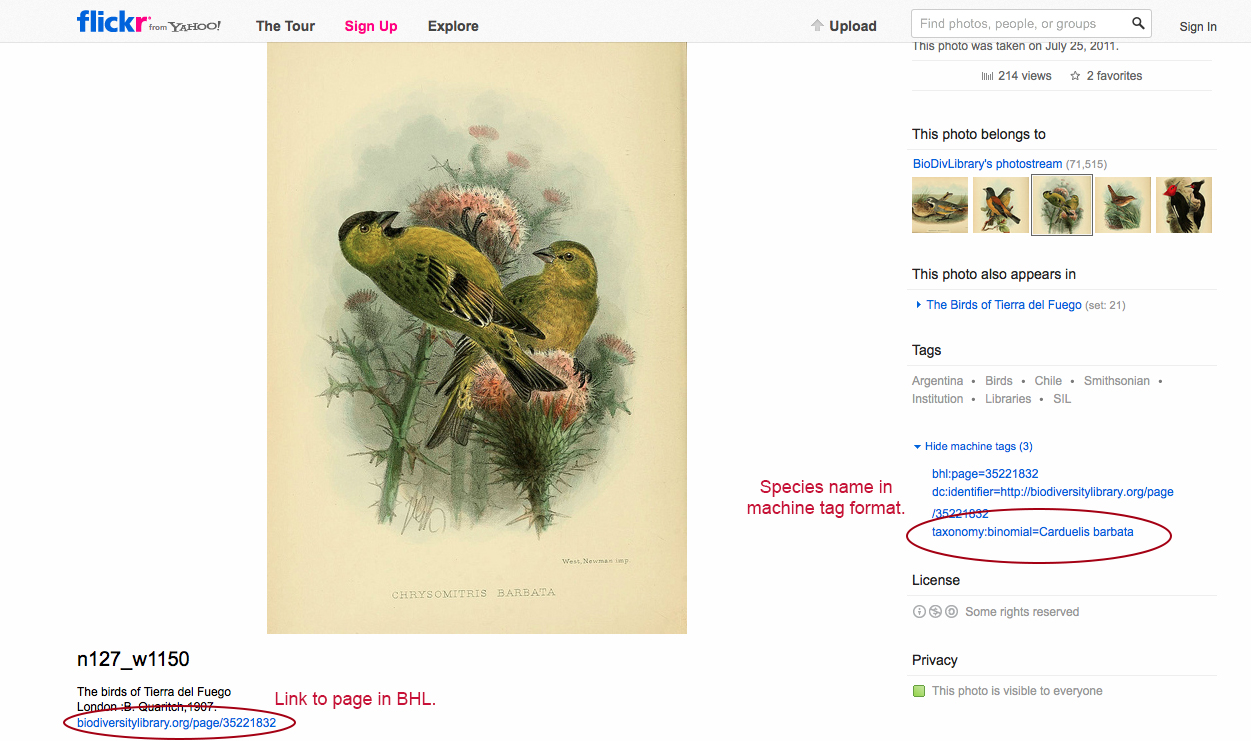
Example of an image with a machine tag and the link to that image in BHL. Click this image to enlarge.

Every image that is tagged with a species name machine tag will automatically be added to the BHL Collection in EOL and associated with the corresponding EOL species page.

Need more help? Check out the Tagging Instructions composed by the Encyclopedia of Life, send us feedback, post a comment on this blog, or write to us at [email protected]. We’d also love to hear from you about your experience adding tags and/or suggestions for making our instructional materials or process better!

April 3, 2013by michelle.underhill
BHL News, Blog Reel

BHL Image Collection on EOL!

View Full Size Image
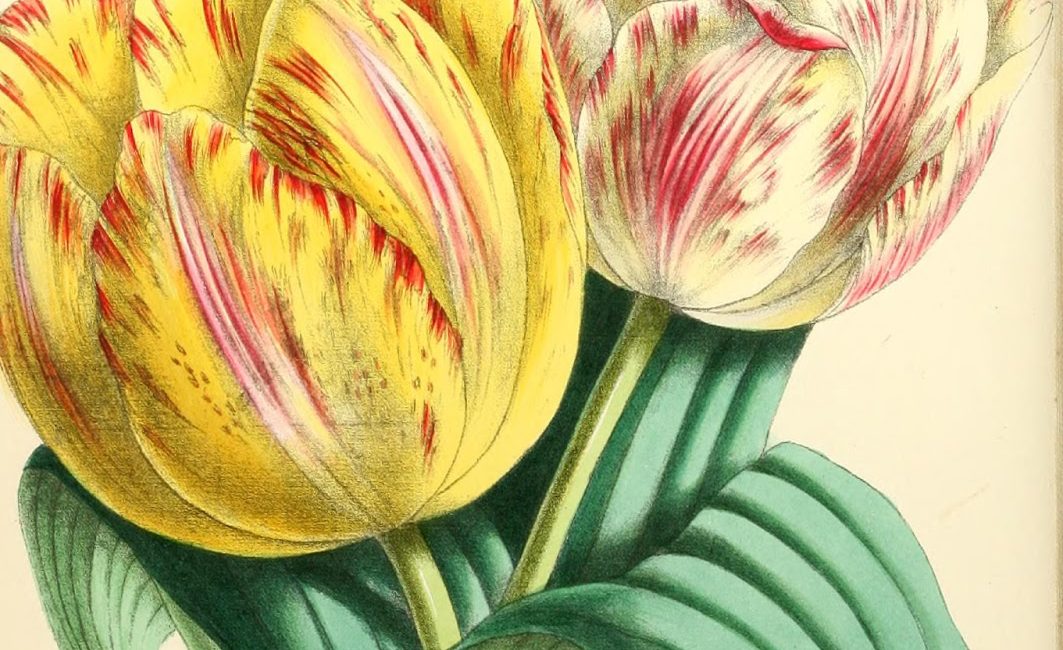
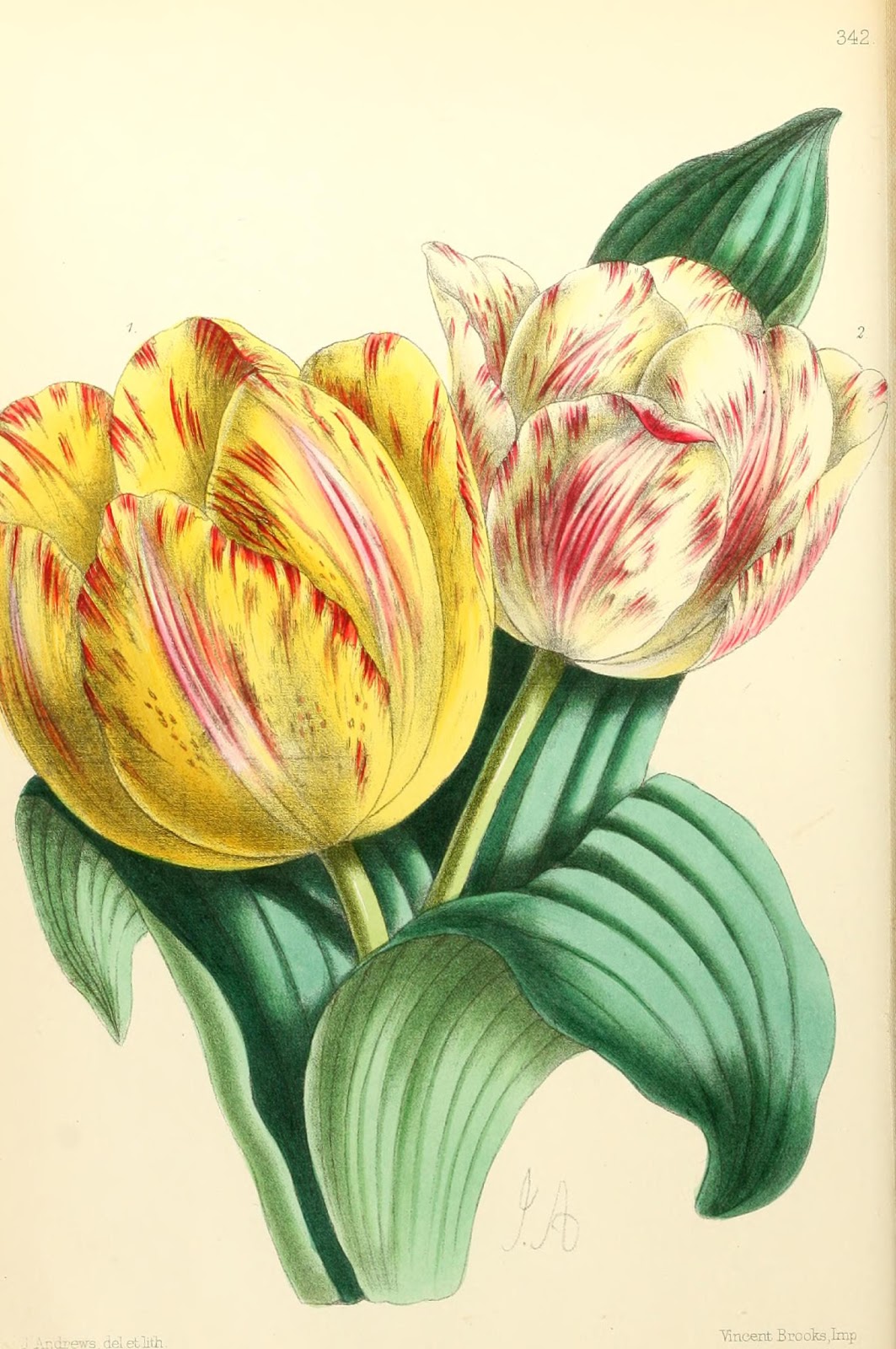
The Floral Magazine, v. 6, pl. 342.

The Biodiversity Heritage Library now has its own collection of images in the Encyclopedia of Life! This collection is comprised of images that have been tagged with species name machine tags, relating the species depicted in each image. The collection currently comprises over 11,000 images representing over 10,000 taxa, and will continue to grow as additional illustrations are tagged in the BHL Flickr.

The BHL Flickr

By now, you’re no doubt aware of the Biodiversity Heritage Library Flickr, which provides free access to over 104,000 illustrations gleaned from the BHL collections. These images span over five hundred years and range in topic from fish to reptiles, mammals to birds, insects to mollusks, and everything in between!

Building the Collection: Tagging Images

To make it easier for you to search our Flickr collection and for us to share images with external websites like EOL, we’re adding species name machine tags to our images, and we’ve been encouraging you to help us do this.

A tag is basically a searchable keyword that you can add to an image to describe it, and a machine tag is a tag with special formatting to allow it to be read by computers. Thus, a species name machine tag is a tag that describes the species depicted in an image in a format that can be understood by computers.

When you add species name machine tags to our images, you as a user can not only search the BHL Flickr and retrieve any images tagged with a desired name, but these images can also automatically be uploaded to EOL and associated with the corresponding species page.

View Full Size Image
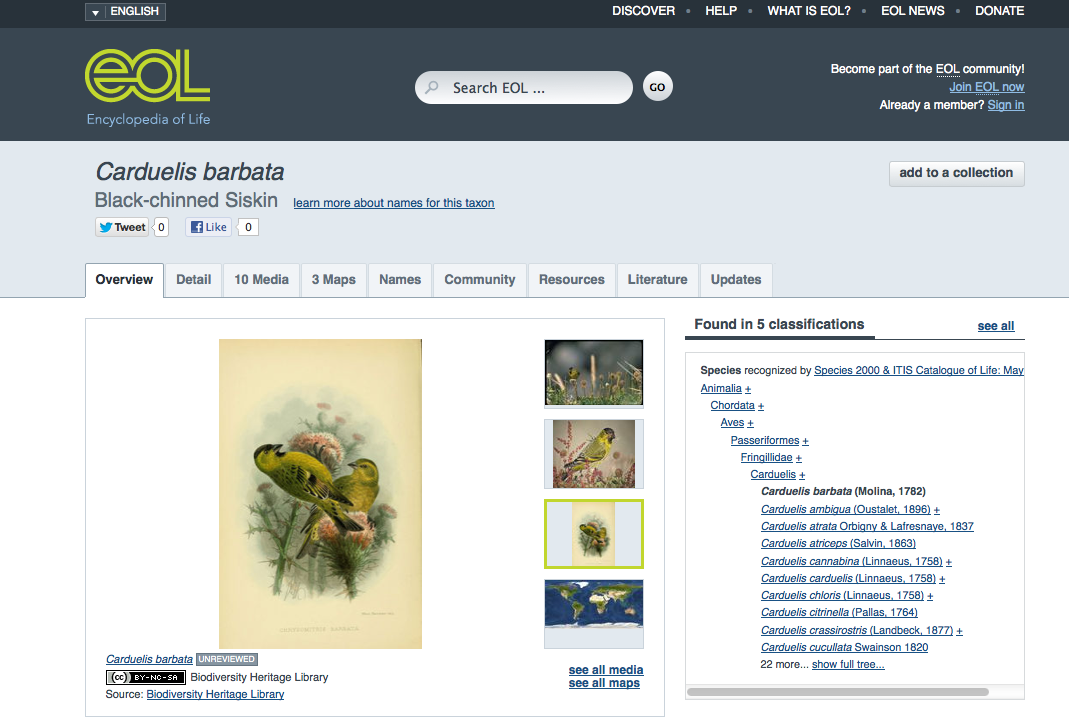
Example of an image from the BHL Flickr automatically associated with the EOL species page for Carduelis barbata, the Black-chinned Siskin, because a species name machine tag was added to the image in Flickr.

The format for species name machine tags is “taxonomy:binomial=Genus species,” where “Genus” and “species” are replaced with the particulars of the organism you’re describing. You can replace “binomial” with another taxonomic tag, such as “genus” or “family”, if you can only identify the organism at that level. Learn more about the Flickr tagging process and machine tag formats in our previous blog post.

The images in the new EOL Collection are images from the BHL Flickr that have a species name machine tag associated with them. Each time new images are tagged in the BHL Flickr, they will automatically be added to our collection in EOL, as well as associated with appropriate species pages.

You Can Help us Grow this Collection!

With over 104,000 images in our Flickr collection to date, and that number growing daily, it’s impossible for BHL staff to tag all of our images by ourselves. That’s why we need your help! You can help us by adding species name machine tags to our images in Flickr. All you have to have is a free Flickr account to add tags to BHL images.

Once you’re signed in to Flickr, browse our collection of images and when you see some with species you can identify, simply click “add a tag” and add the species name in the machine tag format (“Taxonomy:Binomial=Genus species”). Be sure to include the quotation marks around your machine tag.

Many images actually have the species name printed on the plate itself. In these cases, you can simply transcribe that name as a tag for the image. If the species is not identified on the plate, navigate to the book in BHL to find the associated description pages outlining the species depicted. We encourage you to tag the image with the species name provided by the book itself, but if that name is no longer valid, and you know the current, accepted name, feel free to add that name as an additional tag to the image.

View Full Size Image
Adding a species name machine tag to an image in the BHL Flickr. Click this image to enlarge for better viewing.

If there are multiple species depicted on an image, add a separate tag for each species depicted (or as many as you can identify). Learn more about tagging BHL images, and get additional tips, in our Guide.

Every time you add a species name machine tag to an image in our Flickr, you’re growing the BHL EOL Collection, as your tagged images will automatically be added to that collection.

We hope we’ve inspired you to help us identify life on earth, as portrayed through some of the most incredible scientific illustrations ever created! Keep exploring, and keep tagging!

Visit the BHL Image Collection on EOL today!

March 11, 2013by Grace Costantino

Help Support BHL

BHL's existence depends on the financial support of its patrons. Help us keep this free resource alive!

search

About BHL

The Biodiversity Heritage Library (BHL) is the world’s largest open access digital library for biodiversity literature and archives. BHL operates as a worldwide consortium of natural history, botanical, research, and national libraries working together to digitize the natural history literature held in their collections and make it freely available for open access as part of a global “biodiversity community.”

Join Our Mailing List

Sign up to receive the latest news, content highlights, and promotions.

Subscribe Now

Subscribe to Blog via Email

Enter your email address to subscribe to this blog and receive notifications of new posts by email.

Join 319 other subscribers

Subscribe to Blog Via RSS

Subscribe to the blog RSS feed to stay up-to-date on all the latest BHL posts.

Access RSS Feed

Inspiring Discovery through Free Access to Biodiversity Knowledge.

The Biodiversity Heritage Library makes it easier than ever for you to access the information you need to study and explore life on Earth…for free, anytime, anywhere.


64+ Million Pages of
Biodiversity Literature Online.

EXPLORE

Tools and Services
to Transform Research.

EXPLORE

300,000+
Illustrations on Flickr.

EXPLORE

ABOUT | HARMFUL CONTENT | PRIVACY | SITE MAP | TERMS OF USE