Biodiversity Heritage Library - Program news and collection highlights from BHL
  • Home
  • News
  • Featured Books
    • All Featured Books
    • Book of the Month Series
    • BHL at 20
  • User Stories
  • Campaigns
    • Fossil Stories
    • Garden Stories
    • Monsters Are Real
    • Page Frights
    • Her Natural History
    • Earth Optimism 2020
  • Tech Blog
  • Visit BHL
Home
News
Featured Books
    All Featured Books
    Book of the Month Series
    BHL at 20
User Stories
Campaigns
    Fossil Stories
    Garden Stories
    Monsters Are Real
    Page Frights
    Her Natural History
    Earth Optimism 2020
Tech Blog
Visit BHL
  • Home
  • News
  • Featured Books
    • All Featured Books
    • Book of the Month Series
    • BHL at 20
  • User Stories
  • Campaigns
    • Fossil Stories
    • Garden Stories
    • Monsters Are Real
    • Page Frights
    • Her Natural History
    • Earth Optimism 2020
  • Tech Blog
  • Visit BHL
Biodiversity Heritage Library - Program news and collection highlights from BHL
Blog Reel, Featured Books

Unearthing Scientific History through Art: New Insights from the Archives of Lewis David von Schweinitz, the “Father of North American Mycology”

illustration of fungi

The information in this post is derived from the article “New Light on the Mycological Work of Lewis David von Schweinitz” (2018) by Jason M. Karakehian, William R. Burk and Donald H. Pfister, published in IMA Fungus: 9(1).
fungi illustration

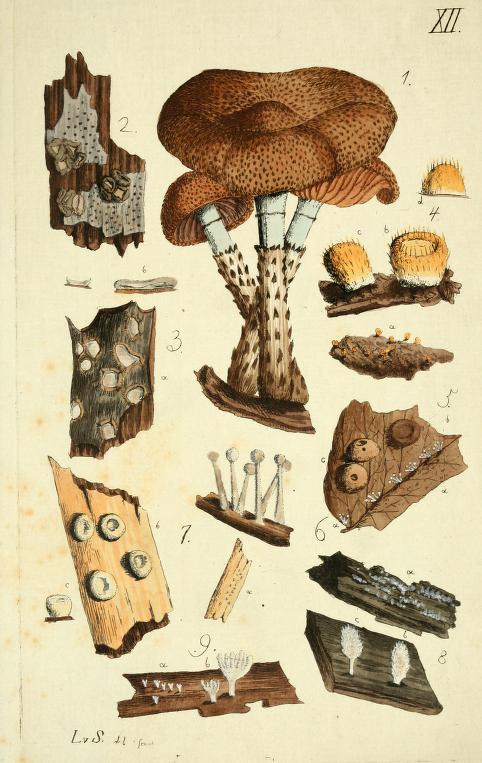
Plate 12. Conspectus fungorum in Lusatiae Superioris agro Niskiensi crescentium, e methodo Persooniana (1805). Figures based on drawings by Schweinitz. Icones fungorum Niskiensium served as a sketchbook to inform this work. Contributed to BHL by the LuEsther T. Mertz Library of The New York Botanical Garden.

In 1805, the “Father of North American mycology”, Lewis David von Schweinitz (1780-1834), published an account of the fungi in Niesky, Germany with his friend and mentor, Johannes Baptista von Albertini (1769-1831). Documenting over 1,000 species, including 100 published as new-to-science, Conspectus fungorum in Lusatiae Superioris agro Niskiensi crescentium, e methodo Persooniana is still referenced to this day as a classic mycological text and ecological record.

The Conspectus is illustrated with 12 hand-colored plates based on drawings by Schweinitz, each featuring 6-10 figures of new species described. Whenever possible, Schweinitz based his drawings on fresh specimens, but when this was not an option, he referred to fungarium specimens or to a collection of earlier watercolors he’d created of representative specimens.
fungi illustrations

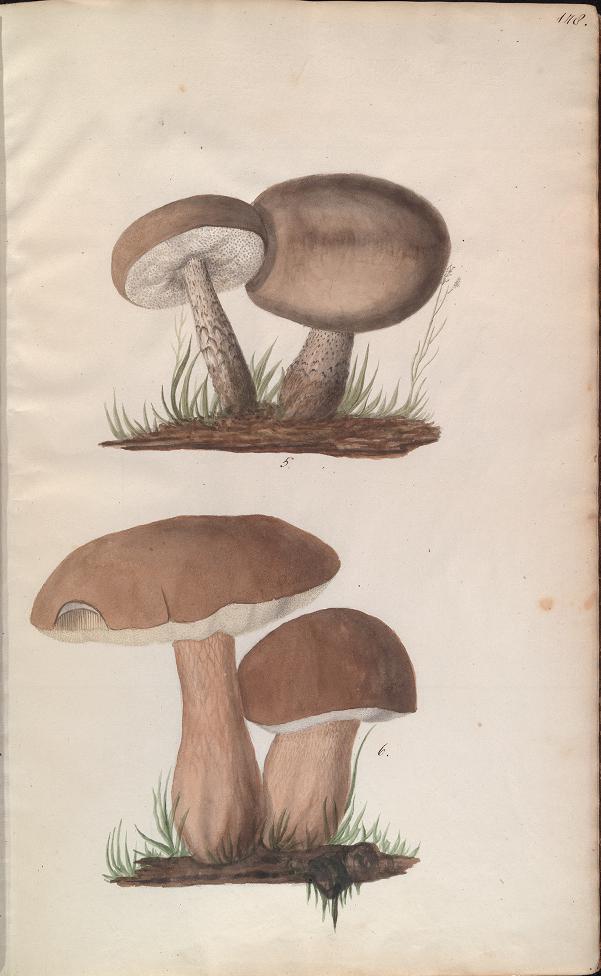
Plate 178. Fungorum Nieskiensium Icones. (ca.) 1802-1805. v. 3. Contributed in BHL from the Academy of Natural Sciences of Drexel University, Library & Archives.

Today, these watercolor volumes are dispersed between several American institutions and offer a wealth of insight into the history and development of the Conspectus. A five-volume set created (ca.) 1802-1805 and bearing the title Fungorum Nieskiensium Icones is distributed between the Archives of the Academy of Natural Sciences of Drexel University, Philadelphia (volumes 1-3 and 5) and the Rare Book Collection, Wilson Library, University of North Carolina, Chapel Hill (volume 4). Nearly every specimen featured in the Conspectus has a corresponding illustration in these 5-volumes.

A volume of original watercolors consisting of copies of figures from the 5-volume set, bearing the title Icones Fungorum and created (ca.) 1818-1826, is held by the Herbarium Library, University of Michigan, Ann Arbor, MI.

The earliest volume of original watercolors related to the Conspectus, however, is the Icones Fungorum Niskiensium, created (ca.) 1798-1802 and held in the archives of the Farlow Reference Library of Cryptogamic Botany at Harvard University. This volume (hereafter referred to as the Harvard Icones) served Schweinitz as a sketchbook of sorts, which he used to inform the final paintings in the 5-volume Fungorum Nieskiensium Icones and eventually the Conspectus itself.
fungi illustrations

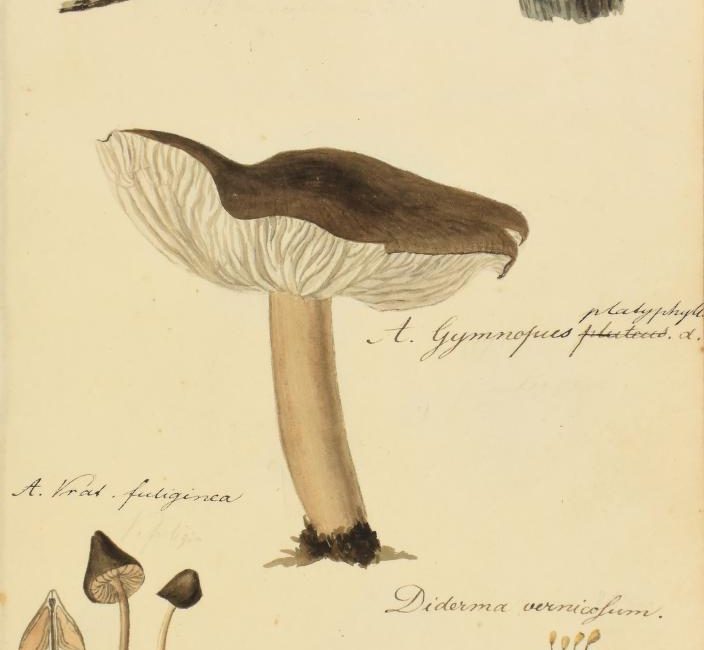
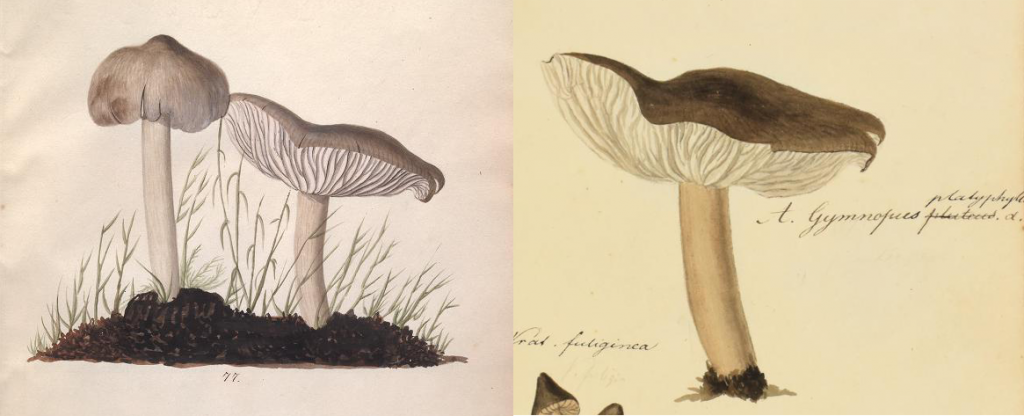
Agaricus (Gymnopus) platyphyllus. Illustration from Fungorum Nieskiensium Icones v. 2, pl. 113, fig. 77 (left) and corresponding illustration in Icones Fungorum Niskiensium, pl. 23 (right). Contributed in BHL from the Library & Archives of the Academy of Natural Sciences of Drexel University and Botany Libraries, Farlow Reference Library of Cryptogamic Botany, Harvard University.

The Harvard Icones has been digitized in the Biodiversity Heritage Library thanks to the Botany Libraries, Farlow Reference Library of Cryptogamic Botany, Harvard University, while the 5-volume set is available in BHL thanks to the Library & Archives of the Academy of Natural Sciences of Drexel University and the Wilson Library of the University of North Carolina at Chapel Hill. The Conspectus has been digitized in BHL by the LuEsther T. Mertz Library of The New York Botanical Garden.

The history of these watercolor volumes and their relationship to the Conspectus was recently examined in-depth within the article “New Light on the Mycological Work of Lewis David von Schweinitz” (2018) by Jason M. Karakehian, William R. Burk and Donald H. Pfister, published in IMA Fungus: 9(1). The article presents research made possible in-part thanks to the digital copies available in BHL.

As a sketchbook, the Harvard Icones provides a unique window into the development of Schweinitz’s research on the fungal species presented in the Conspectus. The 249 watercolor figures in the the Harvard Icones depict specimens he collected and painted during his time attending a Moravian seminary in Niesky. Most figures are labeled with a binomial in ink, although edits and annotations to the names throughout the work, as well as notes on the quality of the illustrated specimen, varieties, and colorations, illustrate the working-manuscript nature of the volume.
fungi illustration

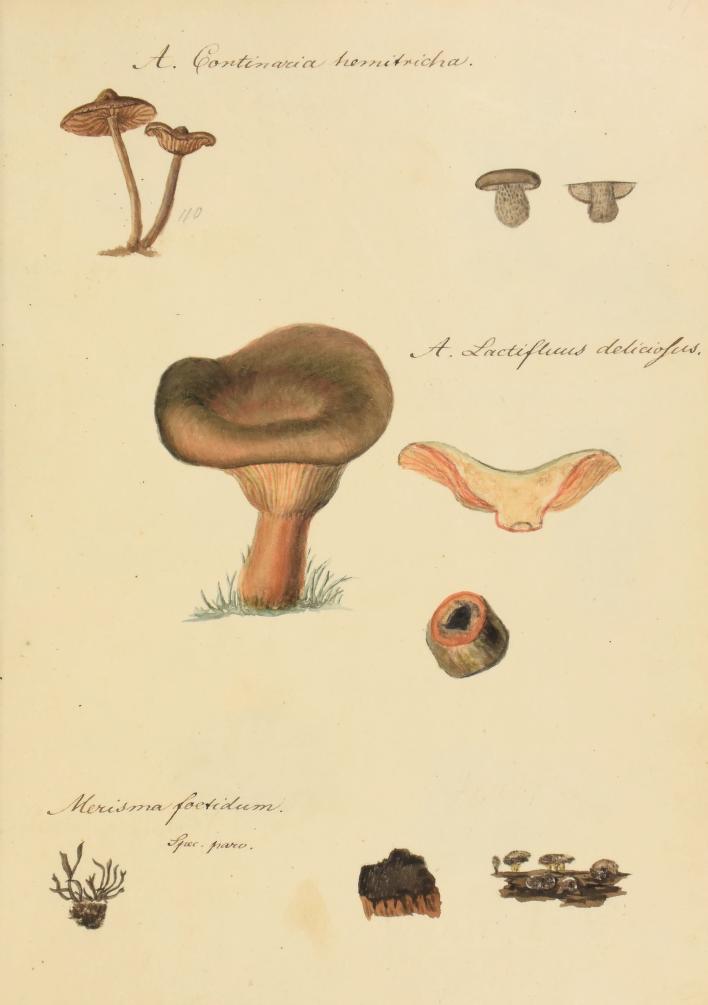
Plate 17. Merisma foetidum specimen labeled as “spec. parv.” [meager specimen]. Schweinitz, Lewis David von. Icones fungorum Niskiensium. (ca.) 1798-1802. Contributed in BHL from Botany Libraries, Farlow Reference Library of Cryptogamic Botany, Harvard University.
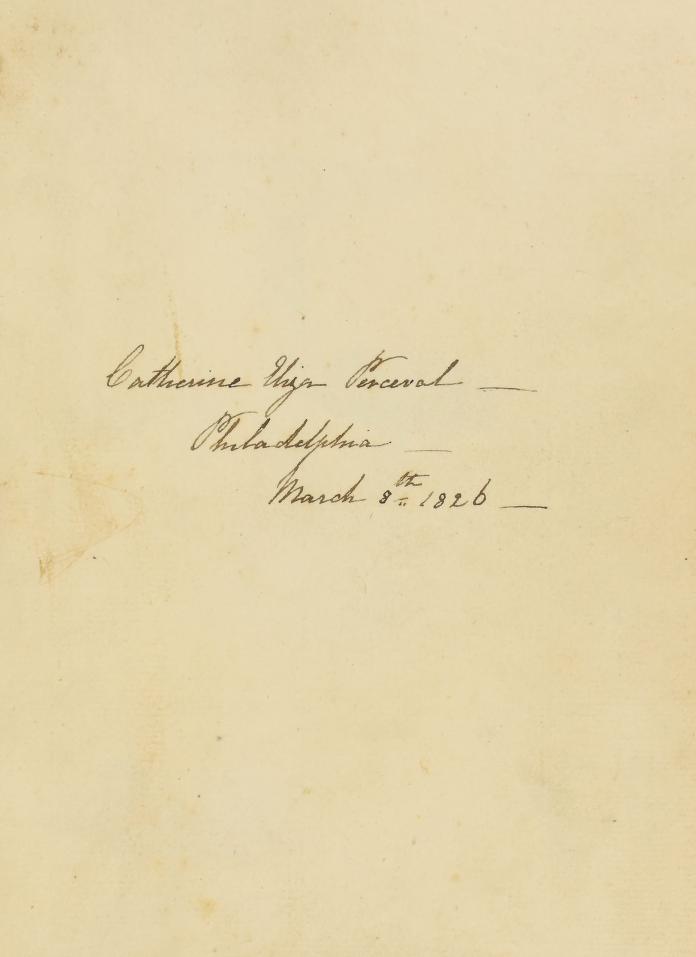
As outlined in the IMA Fungus article, the Harvard Icones has a rather convoluted history. A clue to that history can be found in the single fly-leaf bound within the volume and featuring the hand-written inscription on the recto: “Catherine Eliza Perceval — Philadelphia — March 8th 1826 —”.

fly-leaf

Fly-leaf featuring inscription for “Catherine Eliza Perceval”. Schweinitz, Lewis David von. Icones fungorum Niskiensium. (ca.) 1798-1802. Contributed in BHL from Botany Libraries, Farlow Reference Library of Cryptogamic Botany, Harvard University.

Born in Quebec in 1811, Catherine Perceval was the daughter of Anne Mary Perceval and Michael Henry Perceval. Anne had an interest in botany fueled by her association with other local female botanists, Christian Ramsay, the Countess of Dalhousie, and Harriet Campbell Sheppard. The group actively botanized together, and Anne is listed as a collector in several important botanical works of the era, including Hooker’s Flora boreali-americana ([1829]-1840) and Torrey and Gray’s A Flora of North America (1838-43).

The Harvard Icones passed into the Perceval family’s possession during a meeting in 1826 between Anne and William Darlington, a correspondent of Anne’s, at their mutual friend J. Daniel Steinhauer’s residence in Philadelphia. Schweinitz described Steinhauer as an “excellent friend…[and]…botanist”. As detailed in the IMA Fungus article, Schweinitz and Daniel Steinhauer were likely introduced by Daniel’s brother, Henry Steinhauer, who was also a friend of Schweinitz’s from his time at the Moravian seminary in Germany.

Henry had attempted to have copies made of the figures in Schweinitz’s 5-volume watercolor set, and towards this end, Schweinitz had given Henry his “Icones Fungorum Niesk’m” shortly prior to January 1818. The watercolor volume held in the Michigan Herbarium Library is the result of these endeavors. Karakehian et al. postulate that as part of this exchange the Harvard Icones may have ended up in Henry’s possession and passed to Daniel Steinhauer upon Henry’s death, after which it was passed along to Anne or directly to her daughter, Catherine (whose name is found in the Icones inscription).
fungi illustration

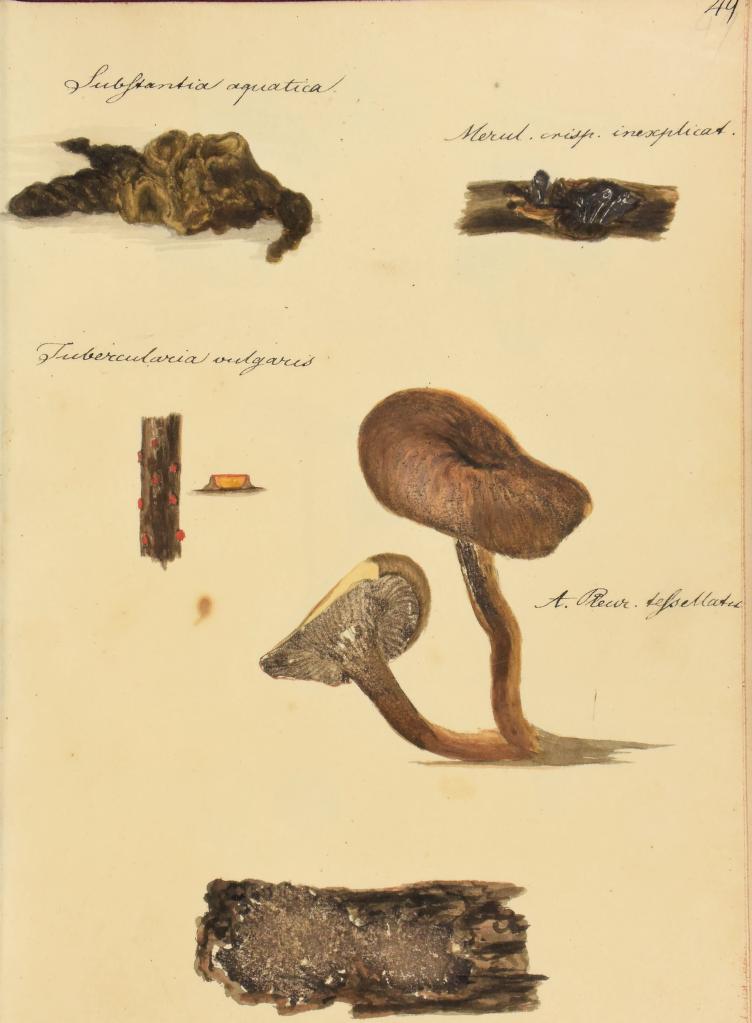
Plate 49. Merulius crispus labeled as “inexplicat[us]”, reflecting doubt as to whether the specimen was a fungus. Similarly, label of “Substantia aquatica” [watery substance]. Schweinitz, Lewis David von. Icones fungorum Niskiensium. (ca.) 1798-1802. Contributed in BHL from Botany Libraries, Farlow Reference Library of Cryptogamic Botany, Harvard University.

The volume later passed from Catherine to her son Francis Denys and eventually ended up in the possession of antiquarian book dealers and scholars William and Marianne Salloch, after whose death it was sold to a Bungay book dealer at a Christie’s auction in 1991, advertised as “Original American Watercolors” by Catherine Eliza Perceval.

Microbiologist and mycophile Elio Schaechter eventually purchased the volume from the book dealer and showed it to Donald Pfister at the Farlow Herbarium, whose research ultimately allowed him to attribute the work to Schweinitz. He also generated a manuscript index to the illustrations, which has also been digitized in BHL along with the Harvard Icones itself.

In the early 2000s, David Hewitt of the Farlow Herbarium was the first to propose that the Harvard Icones served Schweinitz as a sketchbook after comparing it to the four volumes of watercolors held at the Academy of Natural Sciences. Karakehian et al. support this conclusion, presenting further evidence within their IMA Fungus article including the incomplete quality of the sketches, the lack of any systematic arrangement of the specimens on the plates, and the annotations reflecting edits or uncertainty about species identifications, none of which are present in the five-volume set or the Conspectus.
fungi illustrations

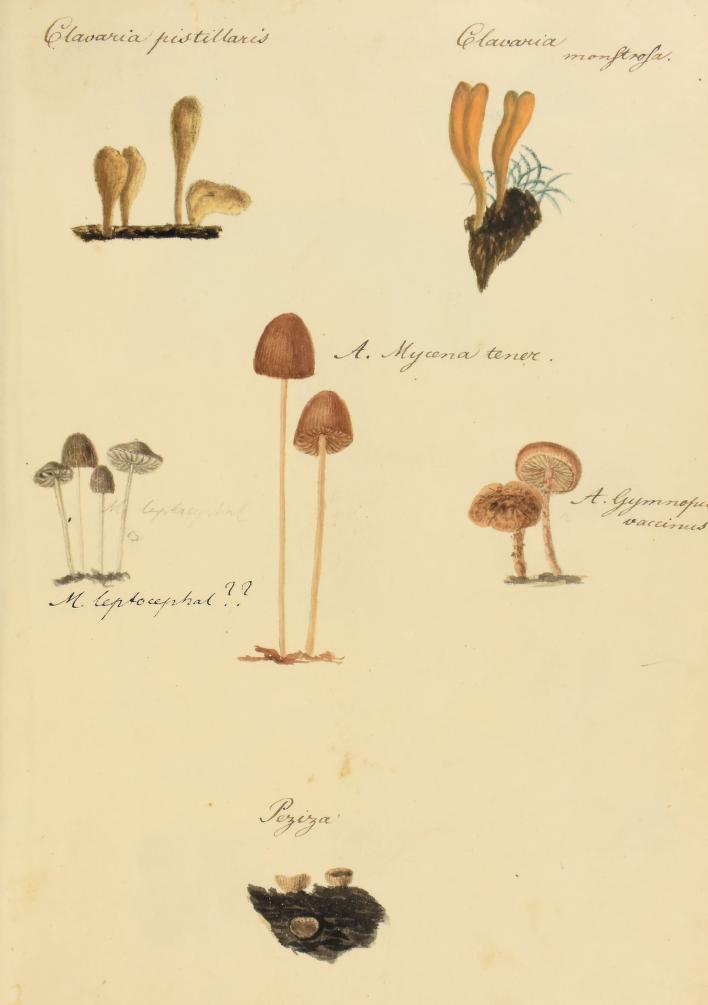
Plate 20. “Clavaria monstrosa” label indicating an anomalous specimen. Question marks indicating uncertainty over “Mycena leptocephalus” identification. Schweinitz, Lewis David von. Icones fungorum Niskiensium. (ca.) 1798-1802. Contributed in BHL from Botany Libraries, Farlow Reference Library of Cryptogamic Botany, Harvard University.

The research presented by Karakehian et al. provides novel insight into the development of a foundational mycological work. As Karakehian explains,

“These watercolor volumes are part of the knowledge-base that Schweinitz employed in his studies of American fungi. Therefore, understanding the history of these volumes is essential not only to a clearer understanding of the American mycobiota, but to an elucidation of the depth of the scientific knowledge-base at the founding of mycology in North America.”
fungi illustration

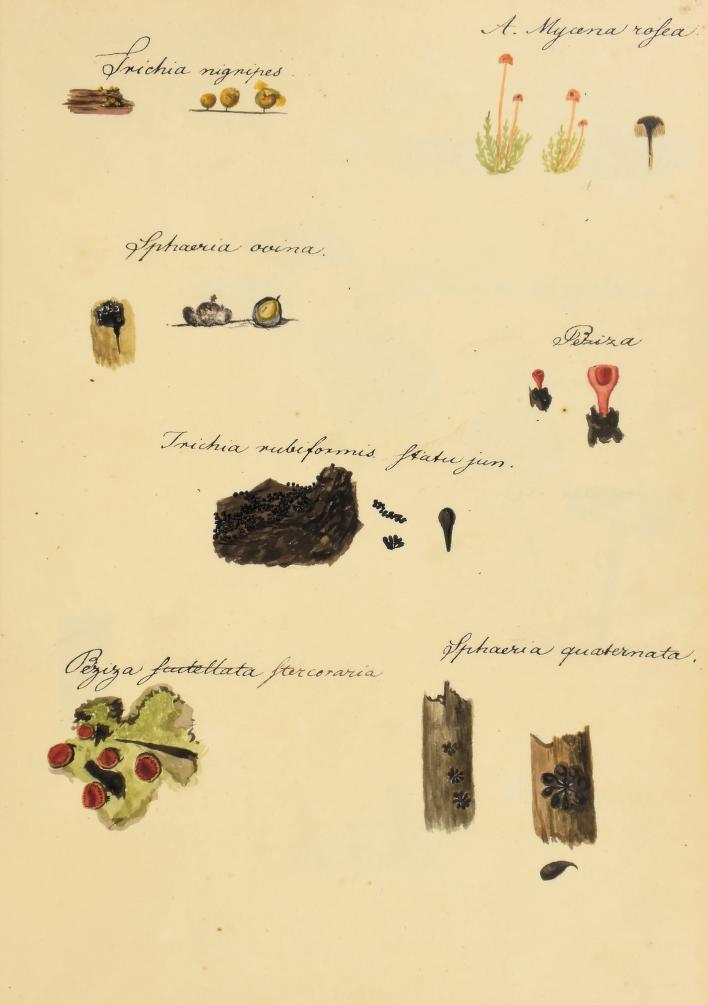
Plate 6. Trichia rubiformis labeled as “statu jun.” [immature state]. Schweinitz, Lewis David von. Icones fungorum Niskiensium. (ca.) 1798-1802. Contributed in BHL from Botany Libraries, Farlow Reference Library of Cryptogamic Botany, Harvard University.

The Harvard Icones and its related works also provide a prime example of how unprecedented research is made possible thanks to digitization initiatives like the Biodiversity Heritage Library, which allow easy reference to and comparison between volumes held in multiple institutions across the United States. As Karakehian et al. acknowledge within their paper,

“It is important to note that much of this work that resulted in this paper was made possible because archives, manuscripts and books are becoming increasingly available through digital efforts being made around the world.”

Given the unique and rare nature of the  Harvard Icones, the book was scanned at Harvard using an Internet Archive TableTop Scanner that is shared with between the Harvard Botany Libraries and the Ernst Mayr Library of the Museum of Comparative Zoology.  This mini version of an Internet Archive scribe allows Harvard librarians to scan rare or fragile materials without the wear and tear of off-site transportation. Once scanned, the Internet Archive processed the images and the final product was made accessible in the Internet Archive and BHL.  We are so grateful to the Botany Libraries, Farlow Reference Library of Cryptogamic Botany, Harvard University for all of their work to digitize the Harvard Icones in BHL and make it freely available to the world.

Similarly, we extend our sincere thanks to the LuEsther T. Mertz Library of The New York Botanical Garden, the Library & Archives of the Academy of Natural Sciences of Drexel University and the Wilson Library of the University of North Carolina at Chapel Hill, for digitizing Schweinitz’s Conspectus and other, complementary archival works, ensuring that they are also now freely available through BHL.

Take a closer look at how BHL facilitated research on these remarkable archives with our BHL User series, where Karakehian provides more insight into BHL’s impact on his work to unravel the mysteries surrounding Schweinitz’s Icones.

Post with contributions from Jason M. Karakehian (Master’s degree candidate at the Harvard Extension School), Judith A. Warnement (Librarian of Harvard University Botany Libraries), and Diane Rielinger (Digital Projects Librarian, Harvard University Herbaria & Libraries).
November 1, 2018by Grace Costantino
Blog Reel, User Stories

Women in Enlightenment Science

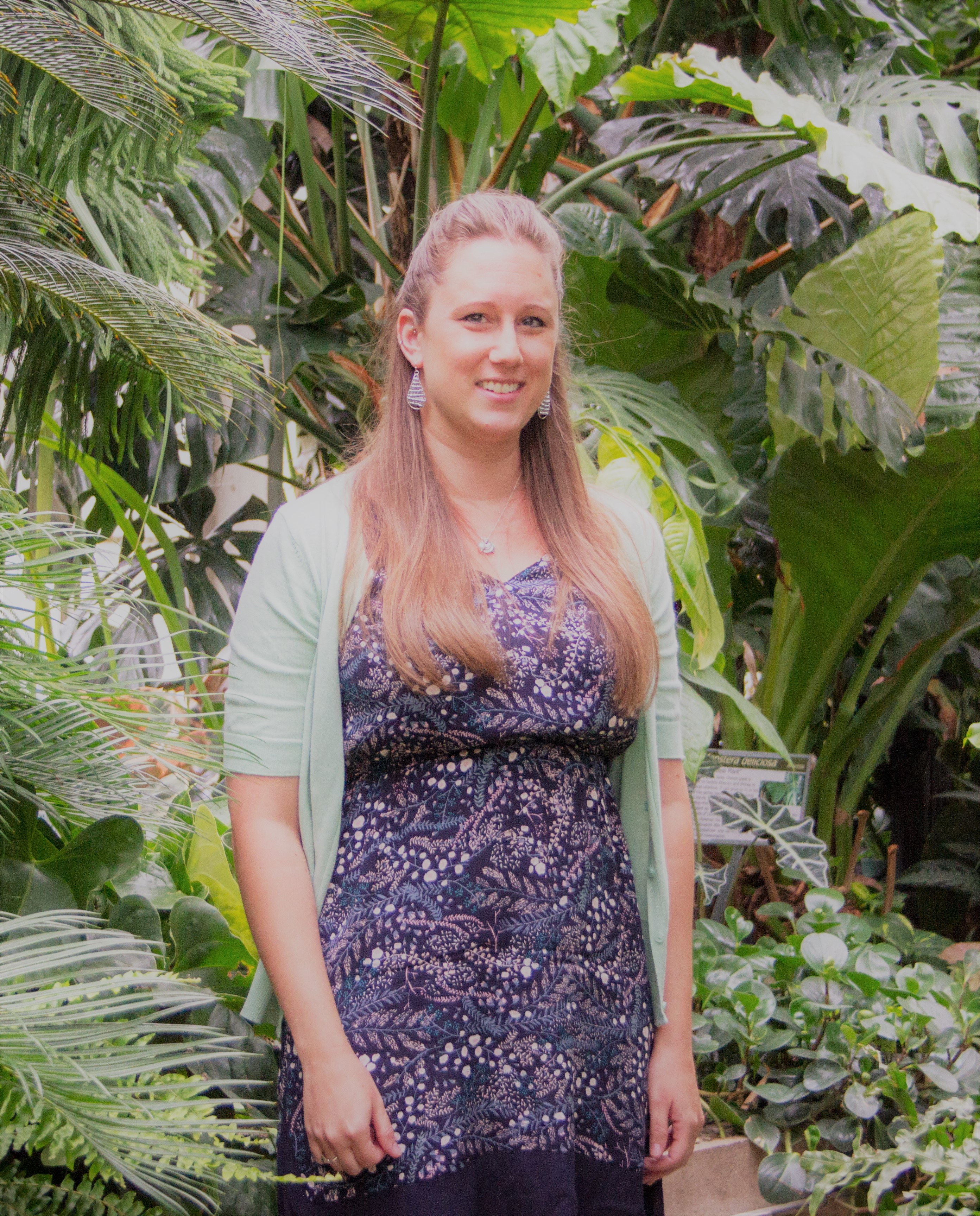
Photo of a woman standing in front of foliage.
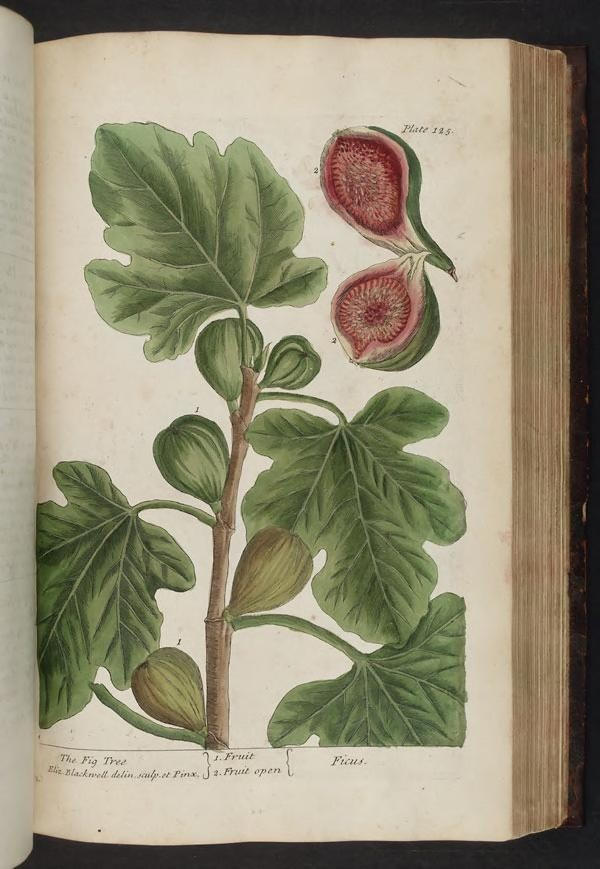
Illustration of fig tree

“The Fig Tree”. Blackwell, Elizabeth. A Curious Herbal. v. 1 (1737). Contributed in BHL from the Peter H. Raven Library of the Missouri Botanical Garden.

In 1737, Elizabeth Blackwell published the first weekly installment of a very ambitious project. The final work, entitled A Curious Herbal (1737-39), ultimately consisted of 500 plates of plants alongside 111 pages of text providing descriptions of their medicinal uses. Endorsed by the Royal College of Physicians, the publication helped satisfy the need for an up-to-date reference work for apothecaries.

The motivation to produce this remarkable herbal arose from equally remarkable circumstances.

The daughter of a successful merchant, Elizabeth married Alexander Blackwell at the age of 28. Her husband had a long history of operating outside of the law, and his shady business dealings resulted in huge debts that ultimately landed him in debtor’s prison.

With her husband in prison and a child to support, Elizabeth decided to use her artistic skills to produce a new herbal to support herself and pay her husband’s debts. Using specimens from the Chelsea Physic Garden as models for her illustrations, Elizabeth drew, engraved, and colored all 500 plates herself and used Joseph Miller’s Botanicum Officinale (1722) as a point of reference for the text, while her husband provided the translated names of the plants.

The Herbal’s income secured Alexander’s release from prison. Sadly, he soon accumulated more debts, which required Elizabeth to sell some of the rights to her publication in order to raise additional funds. Ultimately, her husband left his family for Sweden, where he served as a court physician to the Swedish king until his involvement in a political conspiracy resulted in his execution. [1]

Little else is known of Elizabeth’s life, but her herbal is a lasting testament to her artistic skill and entrepreneurial prowess.

A Curious Herbal is the subject of a chapter in Dr. Anna K. Sagal’s first monograph project, Botanical Entanglements: Women, Plants, Literature, and Artwork in the Eighteenth Century, which will be published by the University of Virginia Press in fall 2021.

The book, which has been generously supported by the Newberry Library’s Monticello College Foundation & Audrey Lumsden-Kouvel Fellowship, explores how women — who were always considered amateur naturalists — participated in discourses which were often culturally barred to them. By engaging in literary and artistic projects that intersected with scientific discourse, these women made space for themselves in what was otherwise an overwhelmingly male-dominated conversation. The monograph features several women writers and artists, including Eliza Haywood, Charlotte Lennox, Mary Delany, Maria Edgeworth, Maria Jacson, Priscilla Wakefield, and Henrietta Maria Moriarty, along with Blackwell herself.

By providing free, online access to relevant literature, such as Blackwell’s Herbal, the Biodiversity Heritage Library has been an important resource for Sagal’s research on the project.

“Thanks to BHL, which provides access to texts by little-known women-naturalists and the male-authored texts that influenced them, I can conduct research around the globe without leaving my office,” shares Sagal. “Although I do have access to some research libraries and archives, many botanical texts are held by overseas libraries, which I do not have the funds to travel to.”

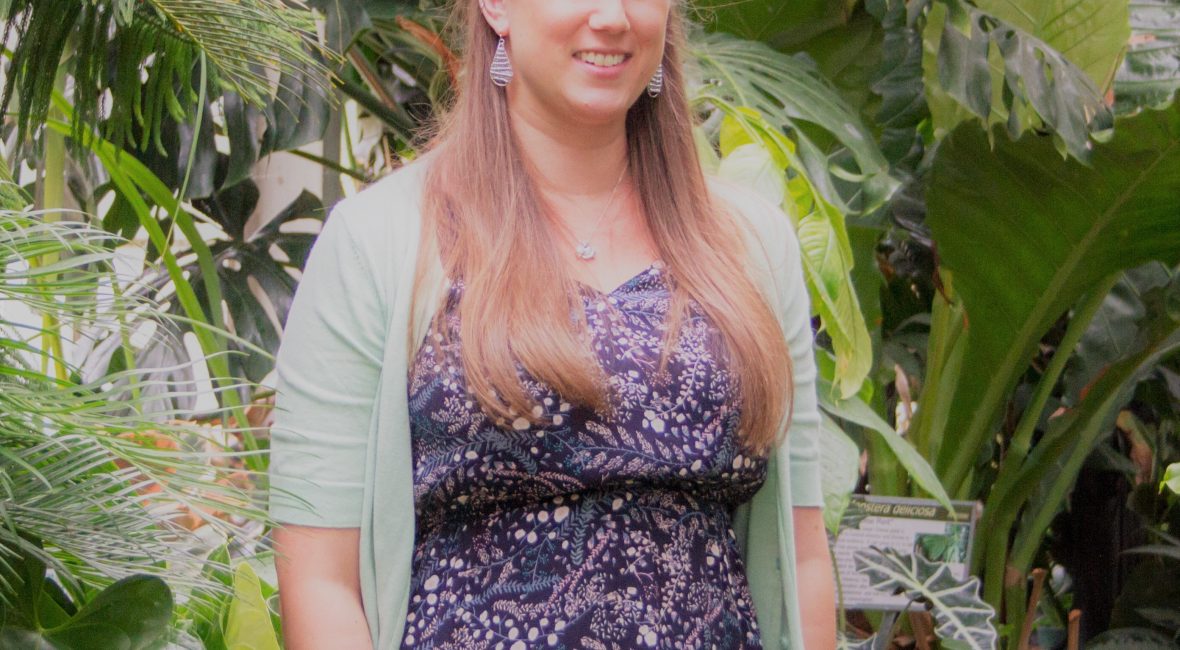
Photo of a woman standing in front of foliage.

Dr. Anna K. Sagal. Image credit: McMaster University

Sagal, a Teaching Fellow at Cornell College, has been studying eighteenth century British literature for eleven years. She first discovered BHL about a year ago, while searching the Internet for botanical texts. Now, when actively working on her monograph project, she uses BHL daily, most often reading titles online, but sometimes downloading select pages for later offline reference.

“I really appreciate the breadth and depth of resources pertaining to eighteenth-century botany,” affirms Sagal. “Much of the content from the Peter H. Raven Library at the Missouri Botanical Garden is very useful to me, and a lot of it is available via the BHL. I also really like that you can download files and images to look at later.”

Many works accessed through BHL beyond Blackwell’s Herbal have informed sections of Sagal’s monograph. According to Sagal, perhaps the most influential title, used in multiple contexts within several chapters of her book, is The Botanical Magazine, or Flower-Garden Displayed, published from 1787-1800. First published by William Curtis, a botanist at Kew Gardens, the name of the publication was changed in his honour to Curtis’s Botanical Magazine following his death in 1799. Still published today by Kew Gardens, it is the world’s longest running botanical magazine illustrated in color, representing two centuries of botanical history and discovery. [3]

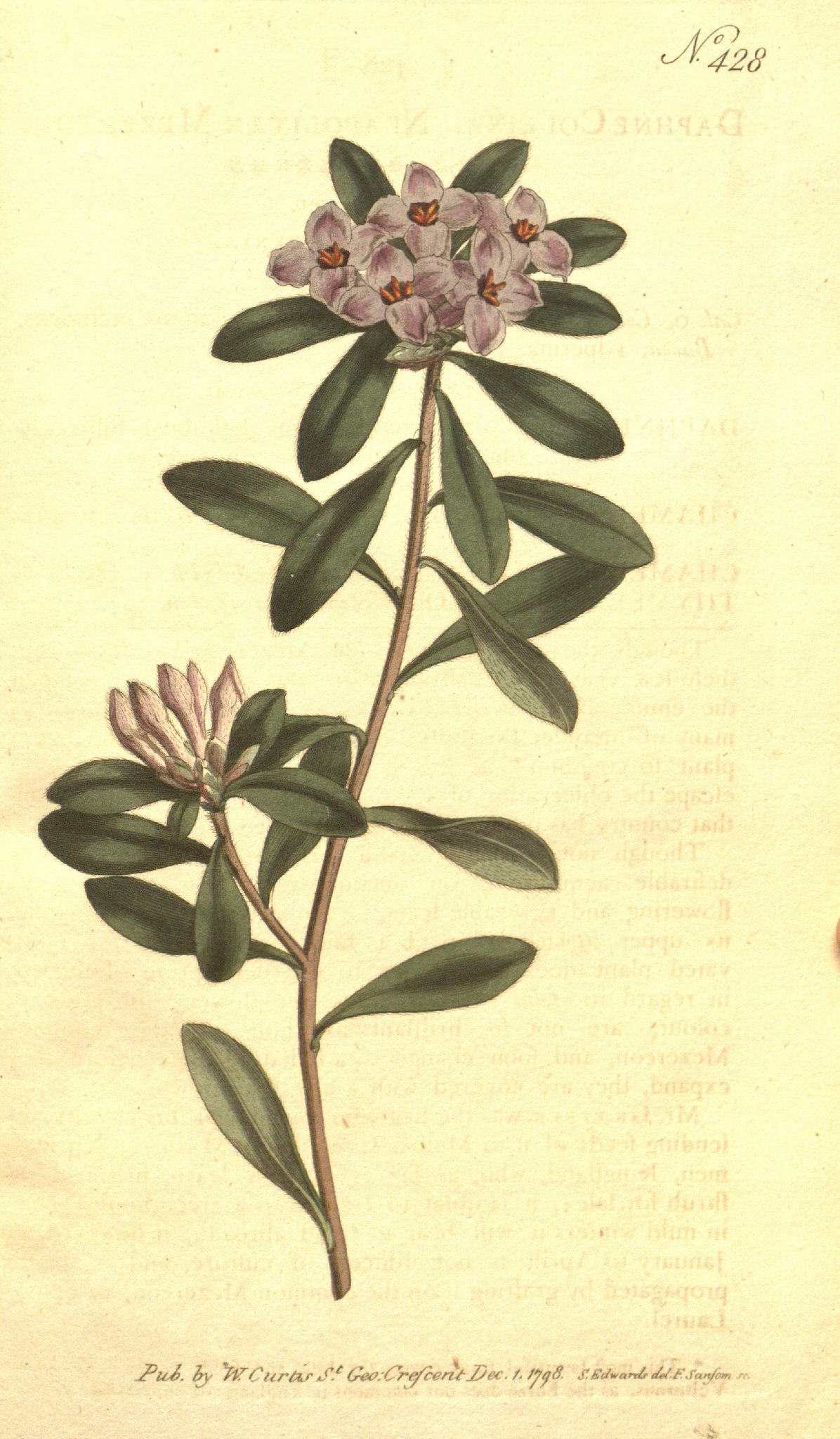
Illustration of flowers

“Daphne collina”. The Botanical Magazine, or, Flower-Garden Displayed. v. 11-12 (1797-98). Contributed in BHL from the Peter H. Raven Library of the Missouri Botanical Garden.

The Magazine was also an incredibly important resource to women naturalists of the eighteenth and nineteenth centuries. An affordable work with frequent rates of publication, it was often an excellent way to keep up-to-date with botanical developments, and to learn about the global world of plants from the comfort of home. Especially for women without access to prestigious physic gardens or botanical research centers like Kew, The Botanical Magazine could be a vital conduit to the enchanting world of botany.

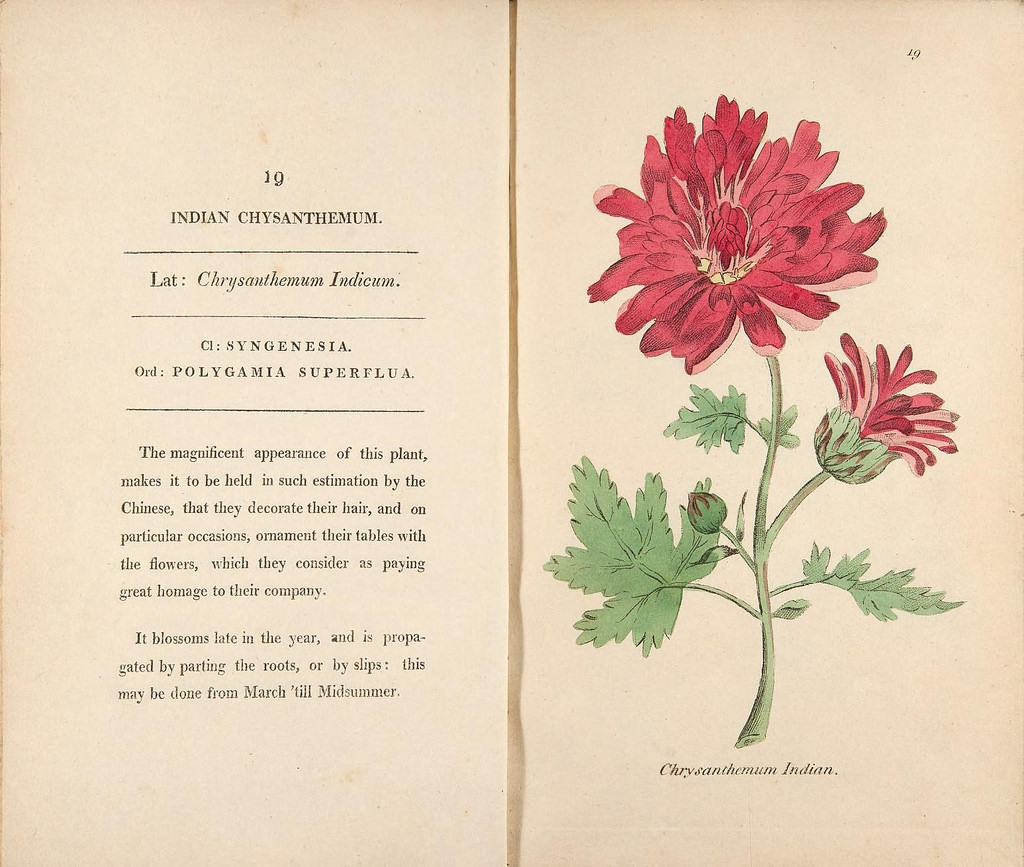
Illustration of a flower

“Indian Chrysanthemum”. Moriarty, Henrietta Maria. Fifty Plates of Green-House Plants, Drawn and Coloured from Nature. 1807. Contributed in BHL from the Lenhardt Library of the Chicago Botanic Garden.

The Botanical Magazine was also a crucial resource for Sagal’s research on another subject for her monograph project, Henrietta Maria Moriarty and her Fifty Plates of Green-House Plants, Drawn and Coloured from Nature.

Moriarty’s work was “intended for those who take delight in plants, but have not the advantage of a gardener who understands them”. Along with her fifty illustrations of plants selected for “their beauty, their odour, or some peculiarity in their economy”, Moriarty also included each plant’s Linnaean binomial and brief cultivation information. [2]  

Fifty Plates of Green-House Plants is central to Sagal’s research because of Moriarty’s unique artistic vision and her somewhat complicated legacy. Often accused of copying images from Curtis’s Botanical Magazine, Moriarty has long been dismissed from the history of botanical illustration. However, with the help of the BHL, Sagal has been able to compare plates of Moriarty’s work with the contemporary runs of Curtis’s publication to find several plates which she clearly drew from nature or another source, rather than mimicking the composition of a plate from the Botanical Magazine. This allows modern audiences to revisit the question of Moriarty’s artistic originality and to appreciate her work as a hybrid of both unique and sourced images.

As Sagal completes her research on Botanical Entanglements: Women, Plants, Literature, and Artwork in the Eighteenth Century, we are thrilled to know that BHL has been such an important asset for the project. We look forward to learning more about the role of women in Enlightenment science thanks to Sagal’s work.

[1] The British Library. 2018. “A Curious Herbal.” Collection Items. Accessed on September 27, 2018. https://www.bl.uk/collection-items/a-curious-herbal-dandelion.

[2] Oak Spring Garden Foundation. 2018. “Women Botanical Artists, Part 2.” Google Arts and Culture. Accessed on September 27, 2018. https://artsandculture.google.com/exhibit/oQIi52WKeTK5KA.

[3] Royal Botanic  Gardens, Kew. 2018. “Curtis’s Botanical Magazine.” Accessed on September 27, 2018. https://www.kew.org/science/who-we-are-and-what-we-do/publications/curtiss-botanical-magazine.

October 11, 2018by Grace Costantino
BHL News, Blog Reel

BHL at the Joint Society for the Preservation of Natural History Collections (SPNHC) and Biodiversity Information Standards (TDWG) Conference in Dunedin, New Zealand

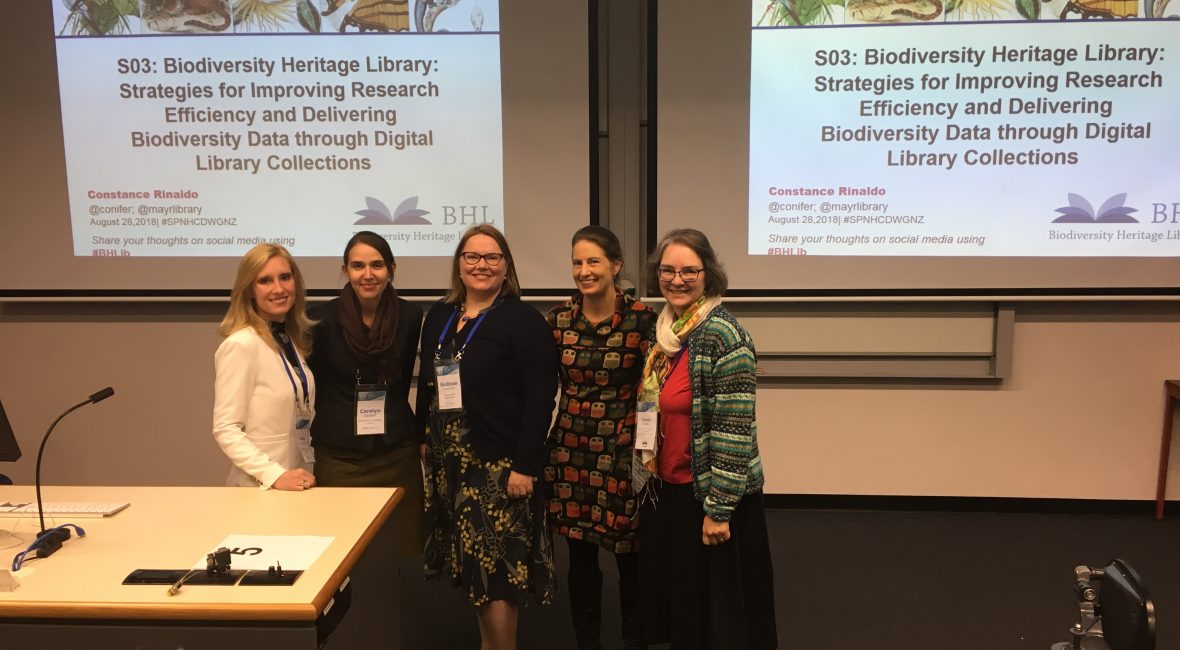
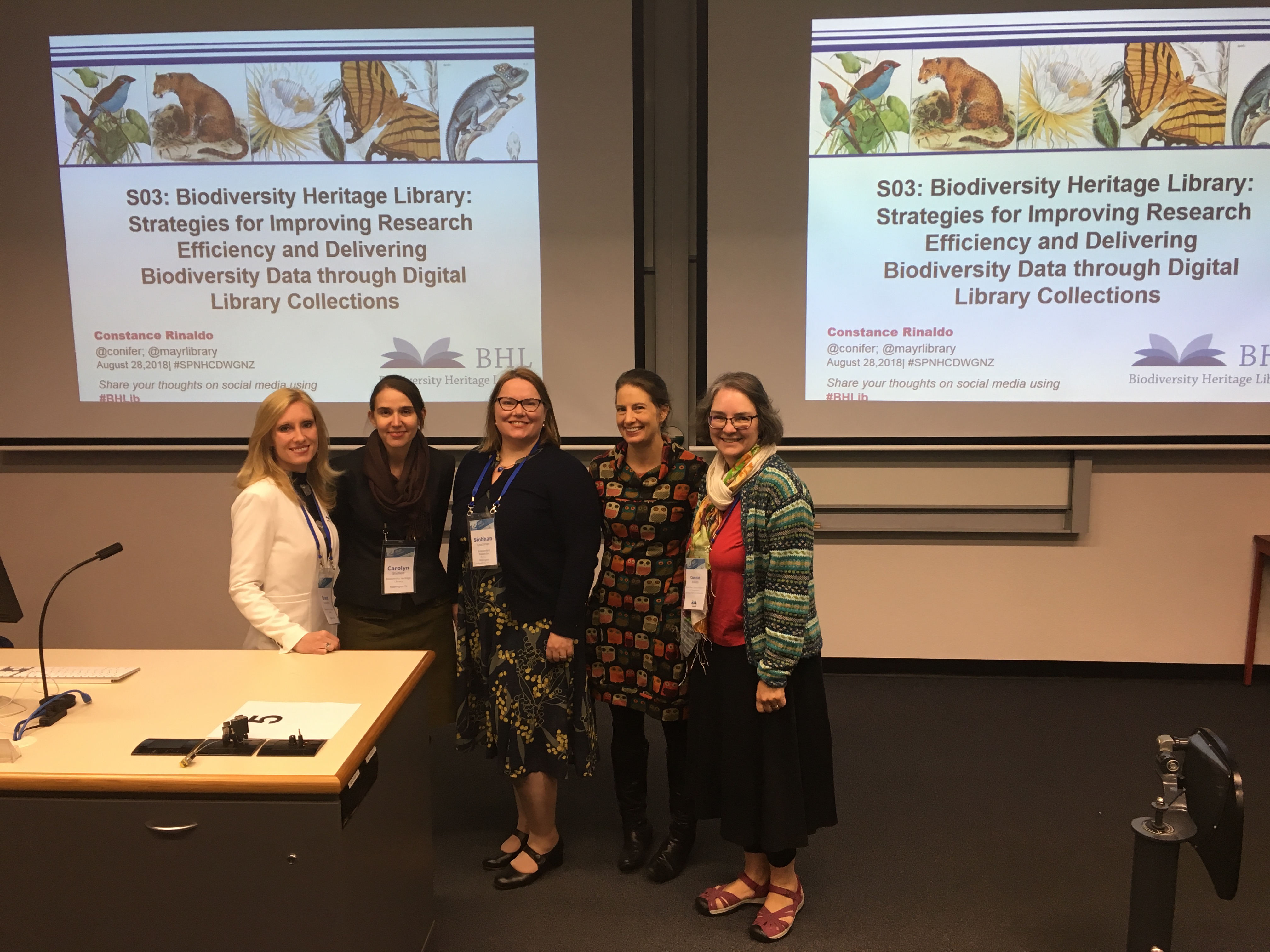
BHL representatives preparing to deliver talks as part of the BHL Symposium. Left to right: Grace Costantino, Carolyn Sheffield, Siobhan Leachman, Nicole Kearney, Constance Rinaldo.

logo for the joint TDWG/SPNHC conference

On 25 August – 1 September 2018, BHL representatives from around the world traveled to Dunedin, New Zealand to attend the joint Society for the Preservation of Natural History Collections (SPNHC) and Biodiversity Information Standards (TDWG) conference. Hosted by the Otago Museum and the University of Otago, the conference represented several firsts, including the first joint meeting of these two organizations plus the first SPNHC meeting in the Southern Hemisphere.

With the theme “Collections and Data in an Uncertain World”, the conference was an opportunity for bioinformatics and natural science collections professionals to exchange ideas and expertise as they explored the myriad intersections between collections and the data generated from them. BHL, an institutional member of TDWG, was proud to be a conference partner for this important event.

Explore the full conference program.

Keynotes

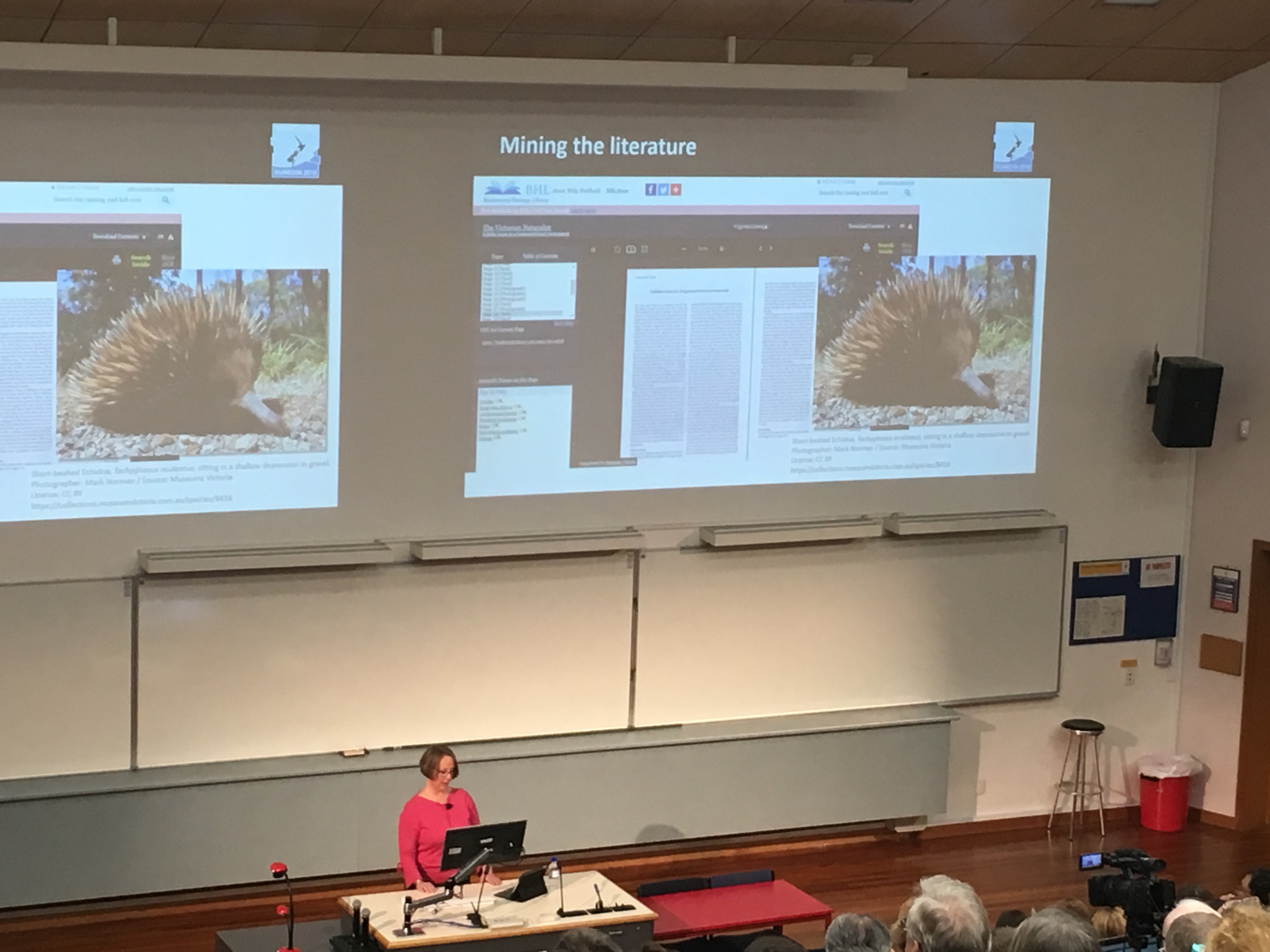
Dr. Elycia Wallis delivering a keynote address (with a highlight of BHL!) as part of the joint SPNHC/TDWG Conference.

Dr. Elycia Wallis delivering a keynote address (with a highlight of BHL!) as part of the joint SPNHC/TDWG Conference. Photo credit: Grace Costantino

In addition to over seventy sessions featuring multiple speakers in several concurrent tracks, the conference also included many fascinating keynote addresses (including one from Dr. Elycia Wallis, Member representative for BHL Australia).

Explore the abstracts for each keynote address below:

  • Building, Growing and Sustaining Global Collaborative Communities (Jonah Duckles, Director of Membership and Technology at The Carpentries)
  • The Change Imperative: Accelerating the pace of Biodiversity Discovery and Documentation (Dr. Elycia Wallis, Collections Community Engagement Manager for Atlas of Living Australia and project leader for the Australian Biodiversity Heritage Library project; Lee Belbin, geoscience graduate and IT postgraduate)
  • Promoting Public Engagement of Natural History Collections Through Science Communication (Dr. Bryan Lessard, entomologist at CSIRO’s Australian National Insect Collection)
  • Collections in an Uncertain World: The Impact of Earthquakes on Canterbury Museum (Anthony Wright, Director of Canterbury Museum)
  • If Only They Could Speak (Dr. Priscilla Wehi, conservation biologist and Rutherford Discovery Fellow at Manaaki Whenua Landcare Research in Dunedin)

BHL Symposium

BHL representatives preparing to deliver talks as part of the BHL Symposium. Left to right: Grace Costantino, Carolyn Sheffield, Siobhan Leachman, Nicole Kearney, Constance Rinaldo.

BHL representatives preparing to deliver talks as part of the BHL Symposium. Left to right: Grace Costantino, Carolyn Sheffield, Siobhan Leachman, Nicole Kearney, Constance Rinaldo.

BHL hosted a symposium at the conference, “Strategies for Improving Research Efficiency and Delivering Biodiversity Data through Digital Library Collections”, organized by Carolyn Sheffield (BHL Program Manager, Smithsonian Libraries) and moderated by Constance Rinaldo (Librarian of the Ernst Mayr Library, Harvard and Chair of the BHL Executive Committee).

The Symposium consisted of four talks, covering topics including citizen science, linking specimen records to literature, DOIs, and recent efforts to improve search efficiencies in BHL, from full text search to extracting georeference data. Explore the abstracts for each talk in the links below:

  • Outreach Strategies to Engage Citizen Scientists: Insights from the Biodiversity Heritage Library – Grace Costantino (BHL Secretariat, Smithsonian Libraries)
    • See slides
  • How A Citizen Scientist Can Reuse & Link Biodiversity Heritage Library Data – Siobhan Leachman (BHL Citizen Scientist)
    • See slides
  • What are we DOIng about the Missing Links? Connecting Taxonomic Names to the Linked Network of Scholarly Research – Nicole Kearney (BHL Australia, Museums Victoria)
    • See slides
  • Improving Search Efficiency in the Biodiversity Heritage Library Corpus – Carolyn A. Sheffield (BHL Secretariat, Smithsonian Libraries)
    • See slides

The Symposium was attended by about 100 people and was well-received. The session stimulated lively discussion regarding the lack of regulations around assigning DOIs to legacy literature, the ethics of publishers assigning DOIs to versions of out-of-copyright publications locked behind paywalls, and the need for museums to release collections-related data and images openly so that they may be reused for citizen science or on such platforms as Wikipedia (a point eloquently emphasized by Siobhan Leachman as part of a memorable Q&A exchange that was heralded and much-discussed throughout the remainder of the conference).

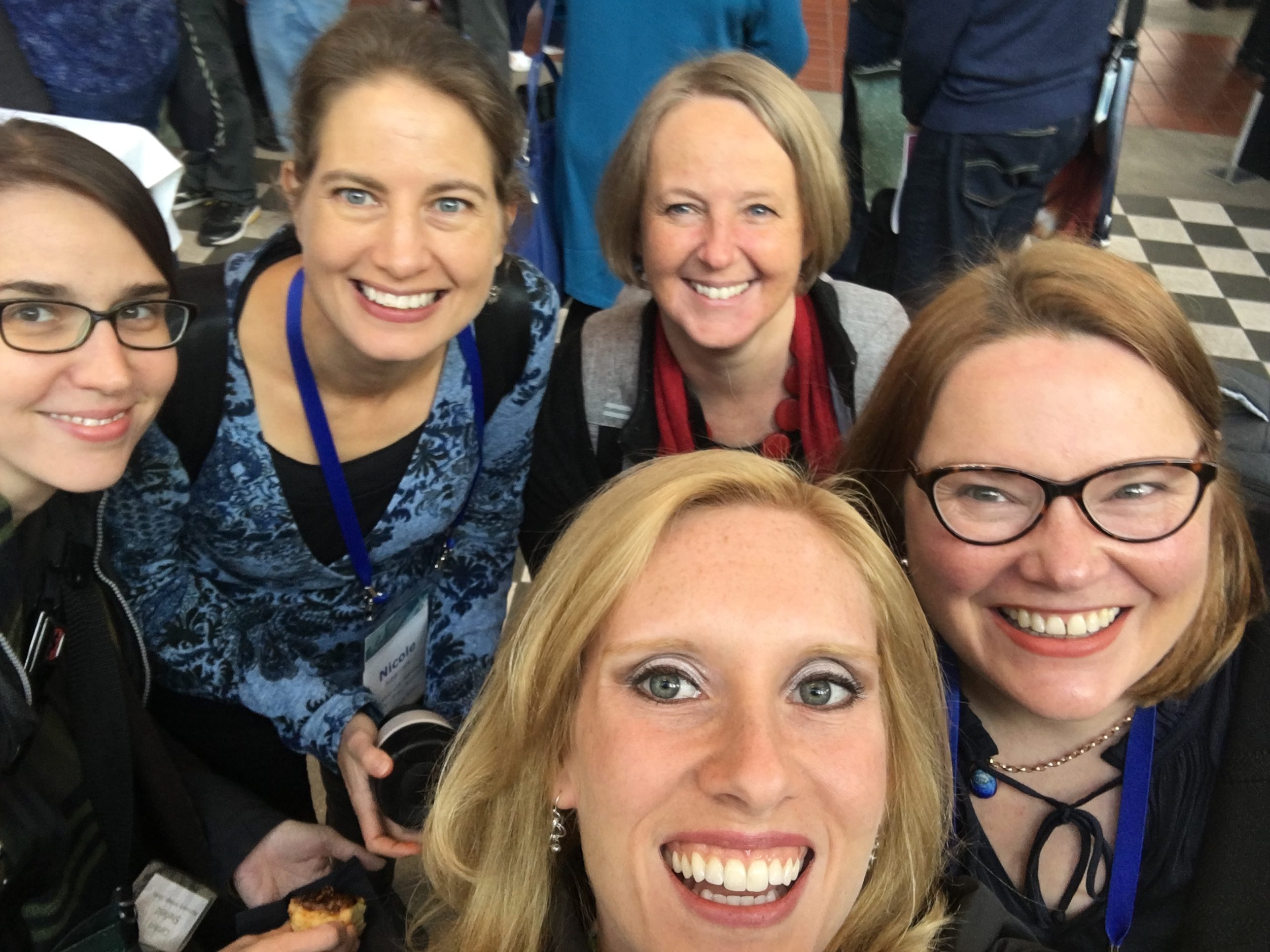
A group selfie with some of the excited BHL representatives! Left to right background: Carolyn Sheffield, Nicole Kearney, Elycia Wallis, Siobhan Leachman. Foreground: Grace Costantino

A group selfie with some of the excited BHL representatives! Left to right background: Carolyn Sheffield, Nicole Kearney, Elycia Wallis, Siobhan Leachman. Foreground: Grace Costantino. Photo credit: Grace Costantino

Conference Impact for BHL

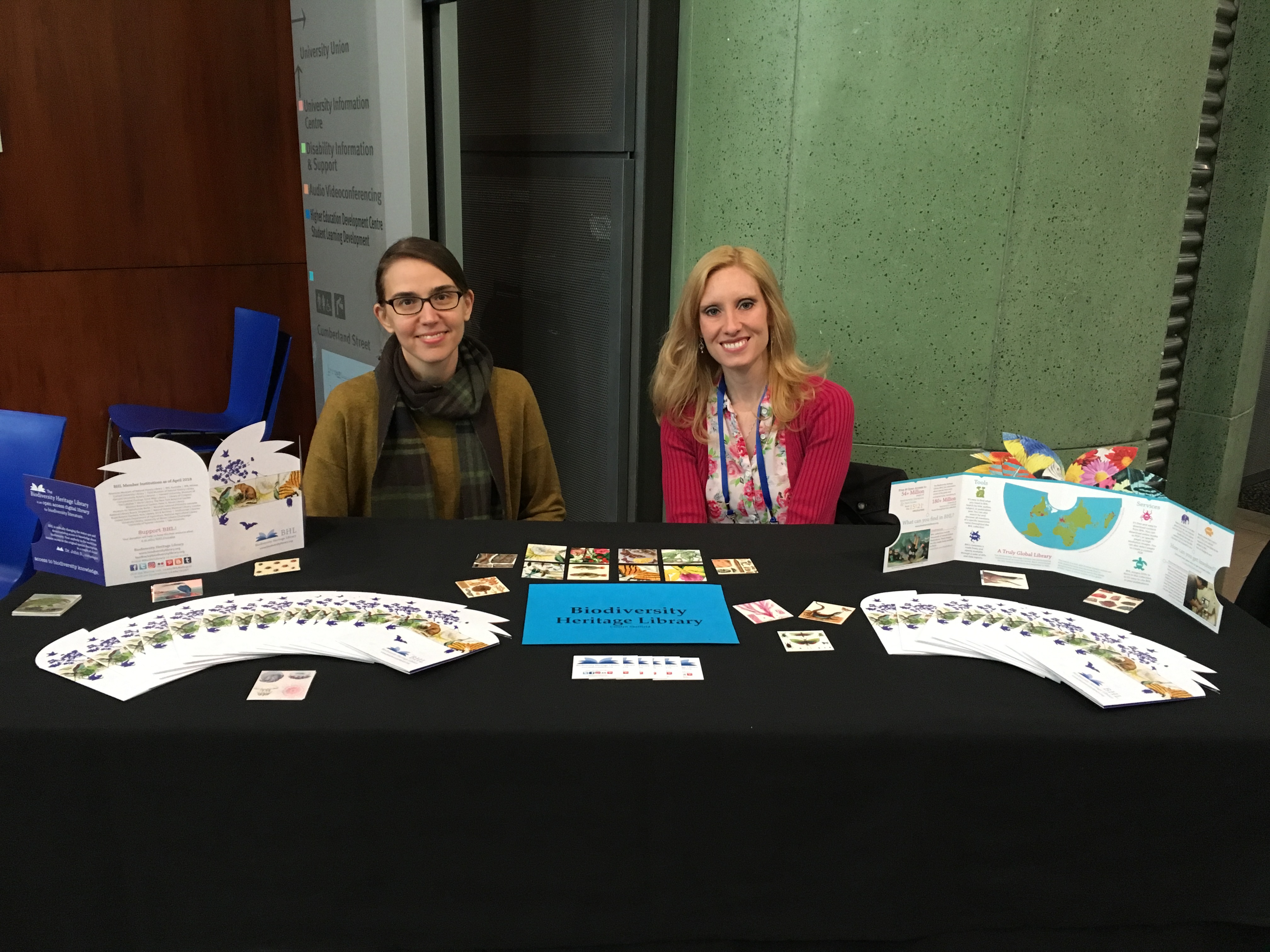
Carolyn Sheffield (left) and Grace Costantino (right) at the BHL table.

Carolyn Sheffield (left) and Grace Costantino (right) at the BHL table.

As a conference partner, BHL hosted a table during the event, which provided a valuable opportunity for representatives to talk with attendees. While most had already heard of BHL, the library was still new to some. The BHL brochure and cards were also very popular, with all supplies of each (including over 250 cards) being distributed by the end of the conference.

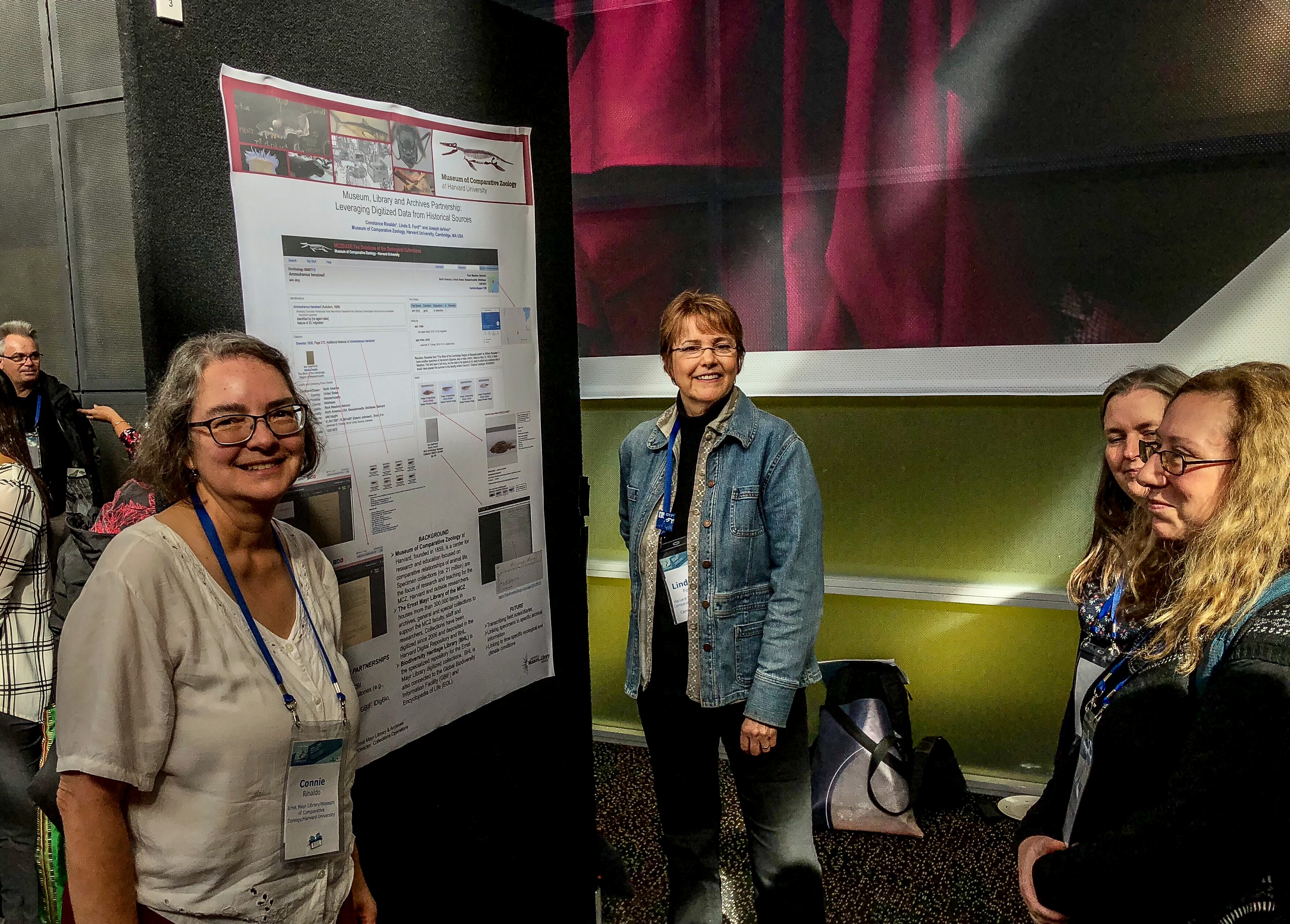
Rinaldo also presented a poster, “Museum, Library and Archives Partnership: Leveraging Digitized Data from Historical Sources”, with co-authors Linda S. Ford (Museum of Comparative Zoology, Harvard) and Joseph deVeer (Ernst Mayr Library, MCZ, Harvard) discussing projects to digitize specimen ledger pages/cards and field books and link them to relevant specimen records in order to enhance discoverability of hidden data and promote cross-discipline research with interrelated historical resources. In particular, the poster highlighted work to digitize ornithologist William Brewster’s notebooks and correspondence, make these available via BHL, and ultimately cross-link the data with the related specimen records. You can see the poster via Dropbox.

Constance Rinaldo (left) with Linda S. Ford (right) presenting their poster: “Museum, Library and Archives Partnership: Leveraging Digitized Data from Historical Sources”.

Constance Rinaldo (left) with Linda S. Ford (right) presenting their poster: “Museum, Library and Archives Partnership: Leveraging Digitized Data from Historical Sources”. Photo credit: Jeremiah Trimble.

The conference also enabled representatives to learn more about BHL’s impact on research. Many attendees shared examples of how BHL has empowered their own research, with several agreeing to share their experience as part of the BHL User series (so be sure to follow the series to learn more!).

Several attendees were also inspired to explore ways that they could contribute to BHL, such as by uploading field notes from their institution, working with the API to add literature links to collections databases, or encouraging their institutions to join BHL.

Excursions

BHL representatives had a chance to enjoy New Zealand’s amazing landscapes, culture, and wildlife through a variety of excursions.

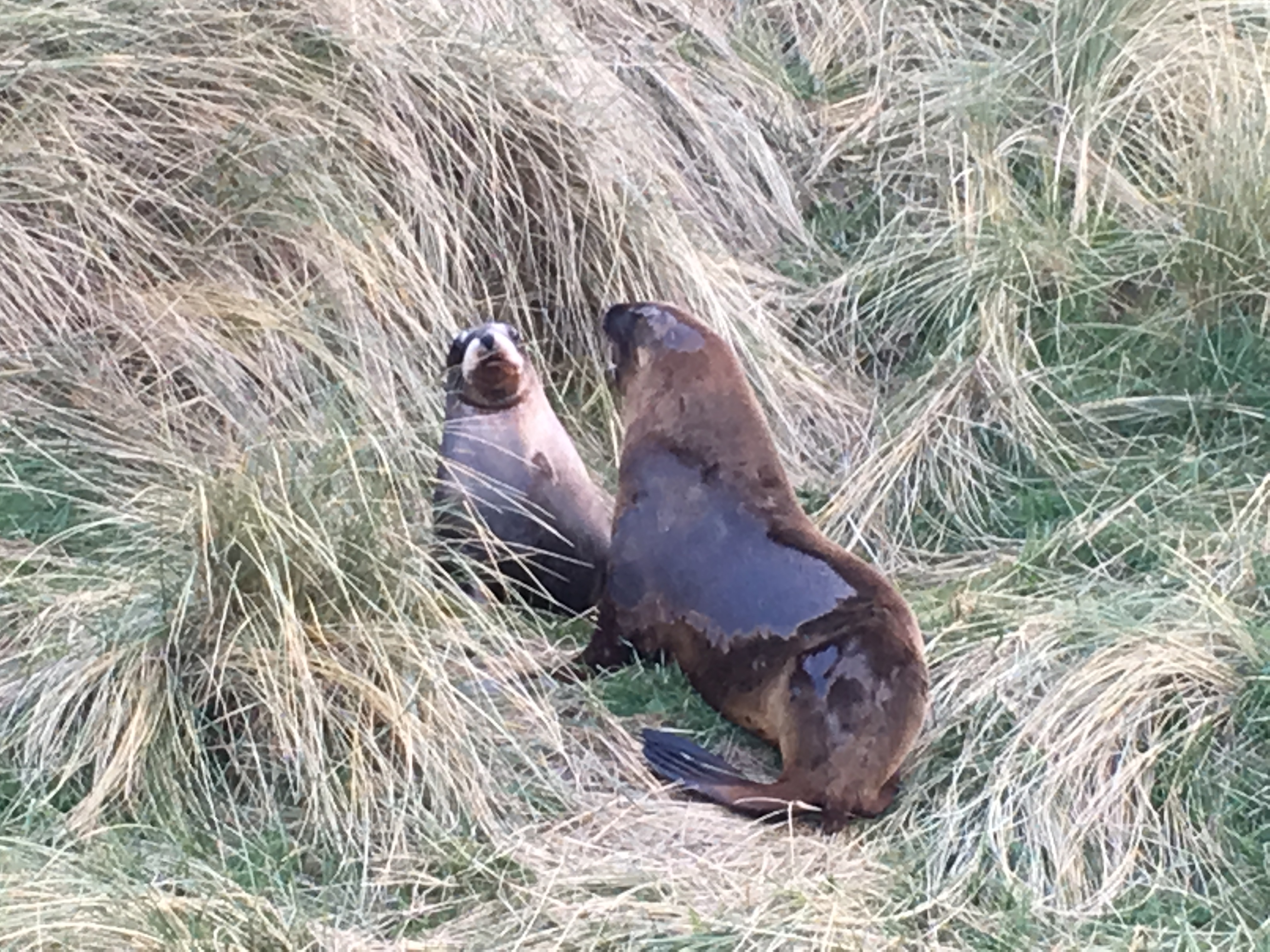
Costantino enjoyed a tour of the Otago Peninsula, where she saw New Zealand sea lions (Phocarctos hookeri), believed to be the world’s rarest sea lion, and yellow-eyed penguins (Megadyptes antipodes), an endangered species endemic to New Zealand.

Yellow-eyed penguin (Megadyptes antipodes).
Yellow-eyed penguin (Megadyptes antipodes). Photo credit: Grace Costantino

New Zealand sea lions (Phocarctos hookeri).

New Zealand sea lions (Phocarctos hookeri). Photo credit: Grace Costantino

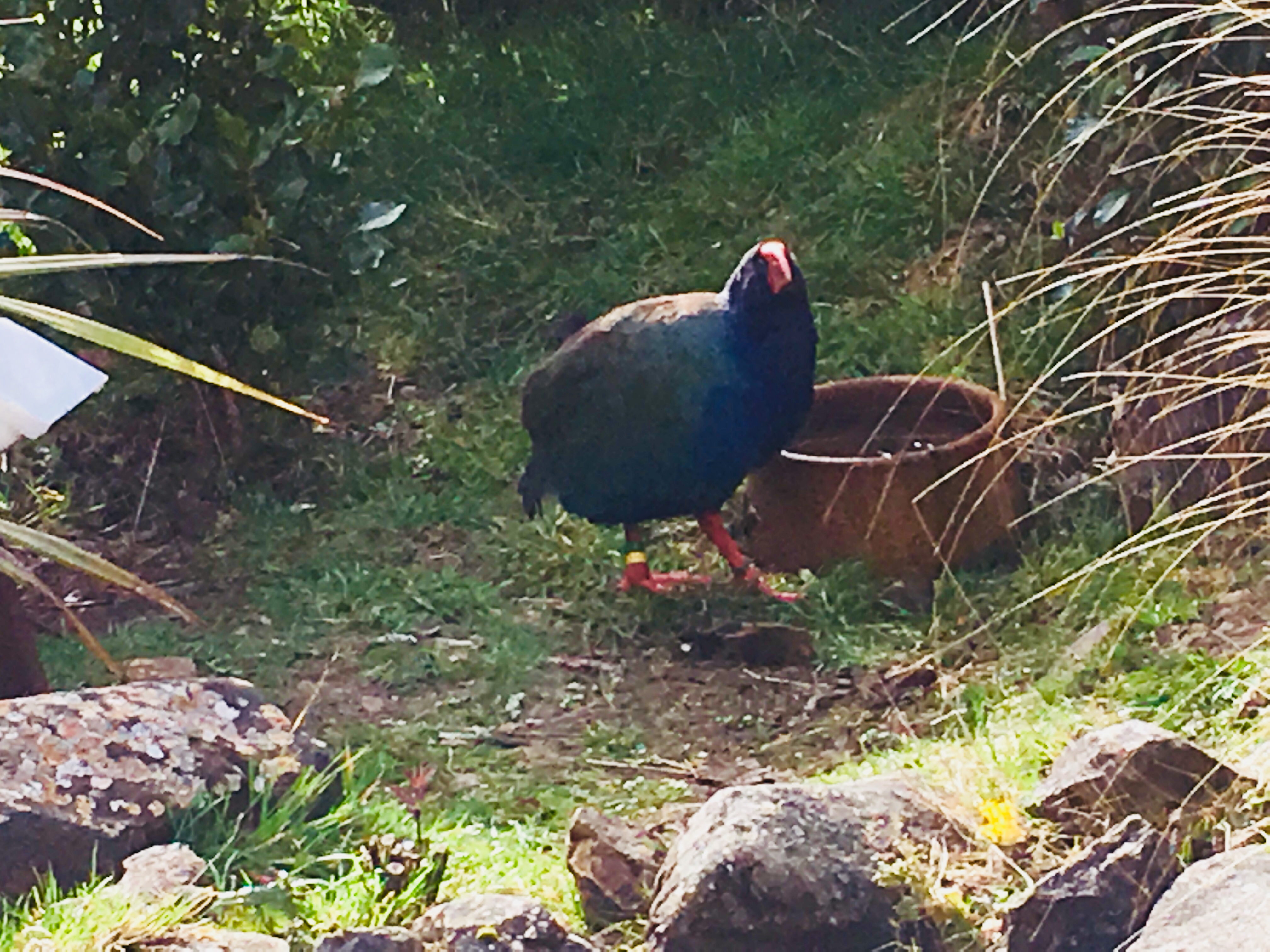
Several BHL representatives also enjoyed a visit to the Orokonui Ecosanctuary, which is home to a wide variety of New Zealand flora and fauna, including kiwis, jewelled geckos, fungi like stinkhorns, New Zealand pigeons (kererūs), kākās, tuataras, and takahēs.

Takahē (Porphyrio hochstetteri) observed at the Orokonui Ecosanctuary.

Takahē (Porphyrio hochstetteri) observed at the Orokonui Ecosanctuary. Photo credit: Constance Rinaldo.

About TDWG

Biodiversity Information Standards, also known as the Taxonomic Databases Working Group, is a not-for-profit scientific and educational association that is affiliated with the International Union of Biological Sciences. TDWG was formed to establish international collaboration among biological database projects. TDWG promoted the wider and more effective dissemination of information about the Earth’s heritage of biological organisms for the benefit of the world at large. Biodiversity Information Standards (TDWG) now focus on the development of standards for the exchange of biological/biodiversity data.

About SPNHC

The Society for the Preservation of Natural History Collections (SPNHC) is an international society whose mission is to improve the preservation, conservation and management of natural history collections to ensure their continuing value to society.

Post with contributions from Carolyn Sheffield, Constance Rinaldo, Siobhan Leachman, and Nicole Kearney.

September 20, 2018by Grace Costantino
BHL News, Blog Reel, Tech Updates

Announcing the New “About BHL” Site!

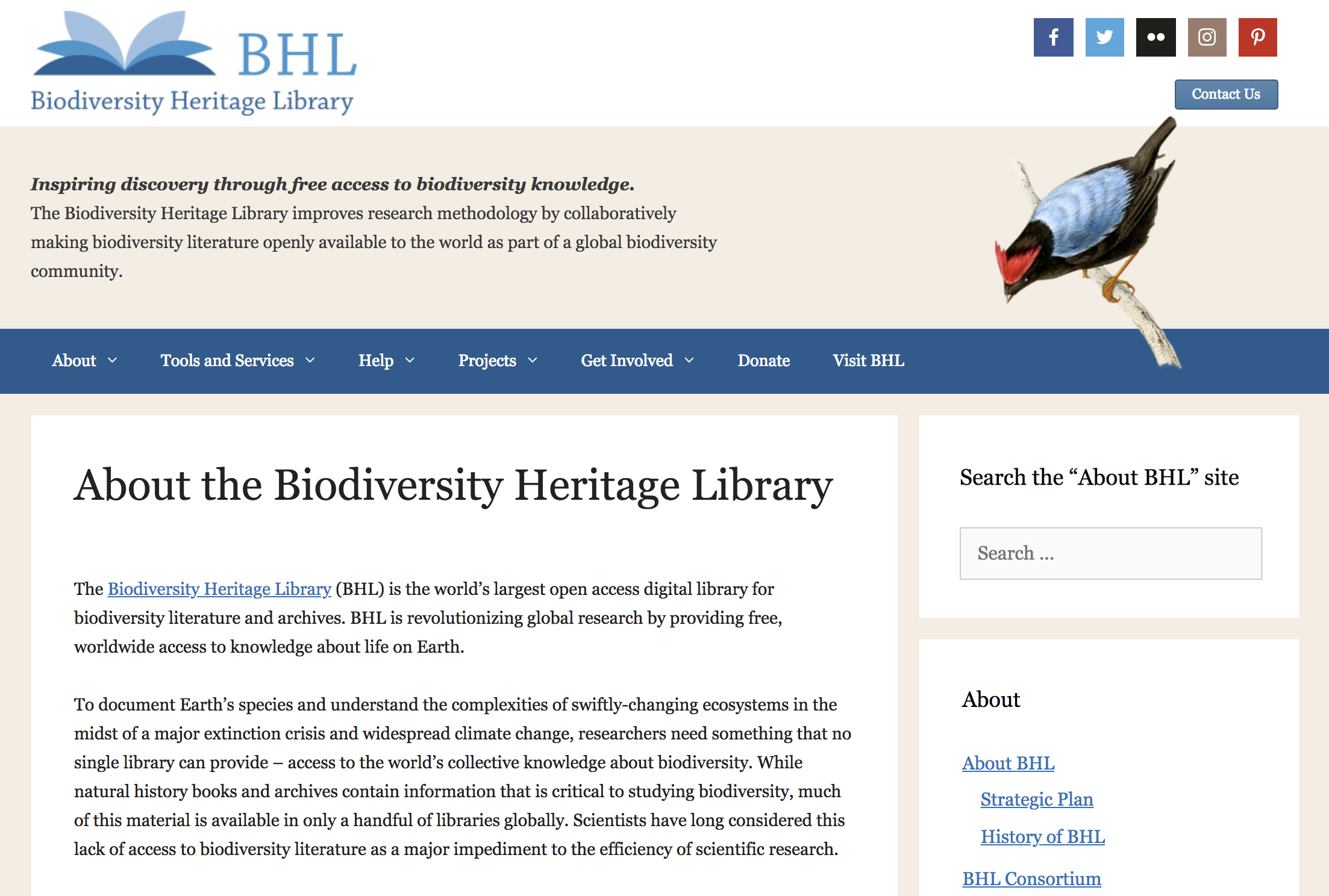
About BHL homepage

Homepage for the new “About BHL” site.

We’re excited to announce the launch of the new “About BHL” site!

What is BHL’s history? Who’s involved in the Library? What tools and services does BHL offer? How do you search, download content or access data and developer tools in BHL? How can you get involved in the Library? What projects has BHL engaged in?

Find the answers to these questions and much more information about the Biodiversity Heritage Library on our new “About BHL” site at about.biodiversitylibrary.org!

The new “About” site, which lives alongside and is linked from the BHL website at biodiversitylibrary.org, replaces our previous wiki-based “About BHL” pages and features several improved features and functionality. Read on to learn more about some of these new features.

New Look & Feel

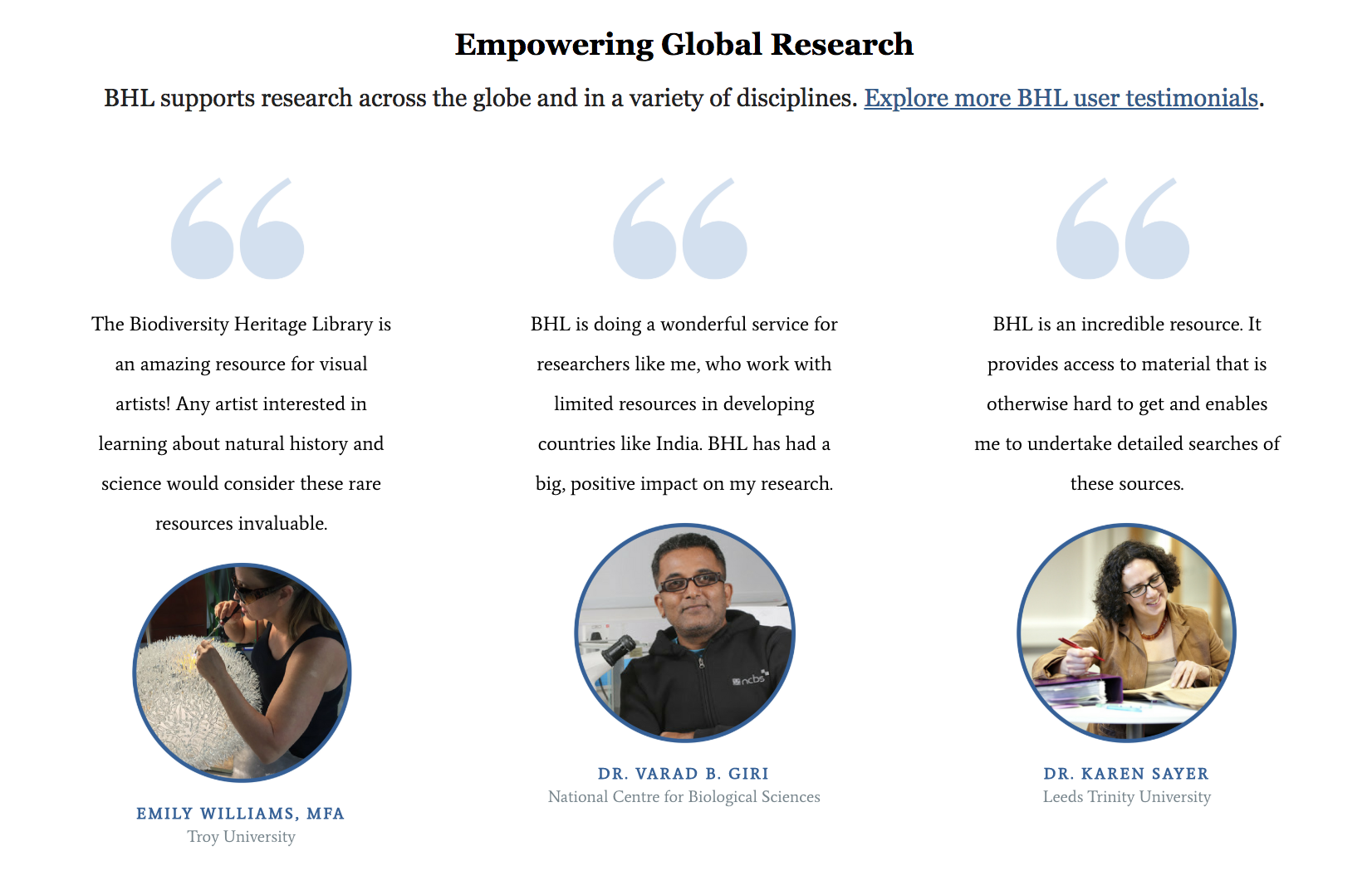
The site has been designed to mirror the look of the BHL website. We’ve also integrated our social accounts into the site with streams for our Instagram, Twitter and blog feeds in the right sidebar. Also, check out our testimonials feed above the footer to learn more about BHL’s impact on global research from real users!

testimonials feed on new About site

Testimonials feed on new “About BHL” site.

Improved Navigation

With our new top menu and category-specific sidebar menus, it’s now easier than ever to navigate through our “About” content and find exactly what you need. But just in case you still can’t find what you’re looking for, we’ve placed a prominent “Contact Us” button in the header.

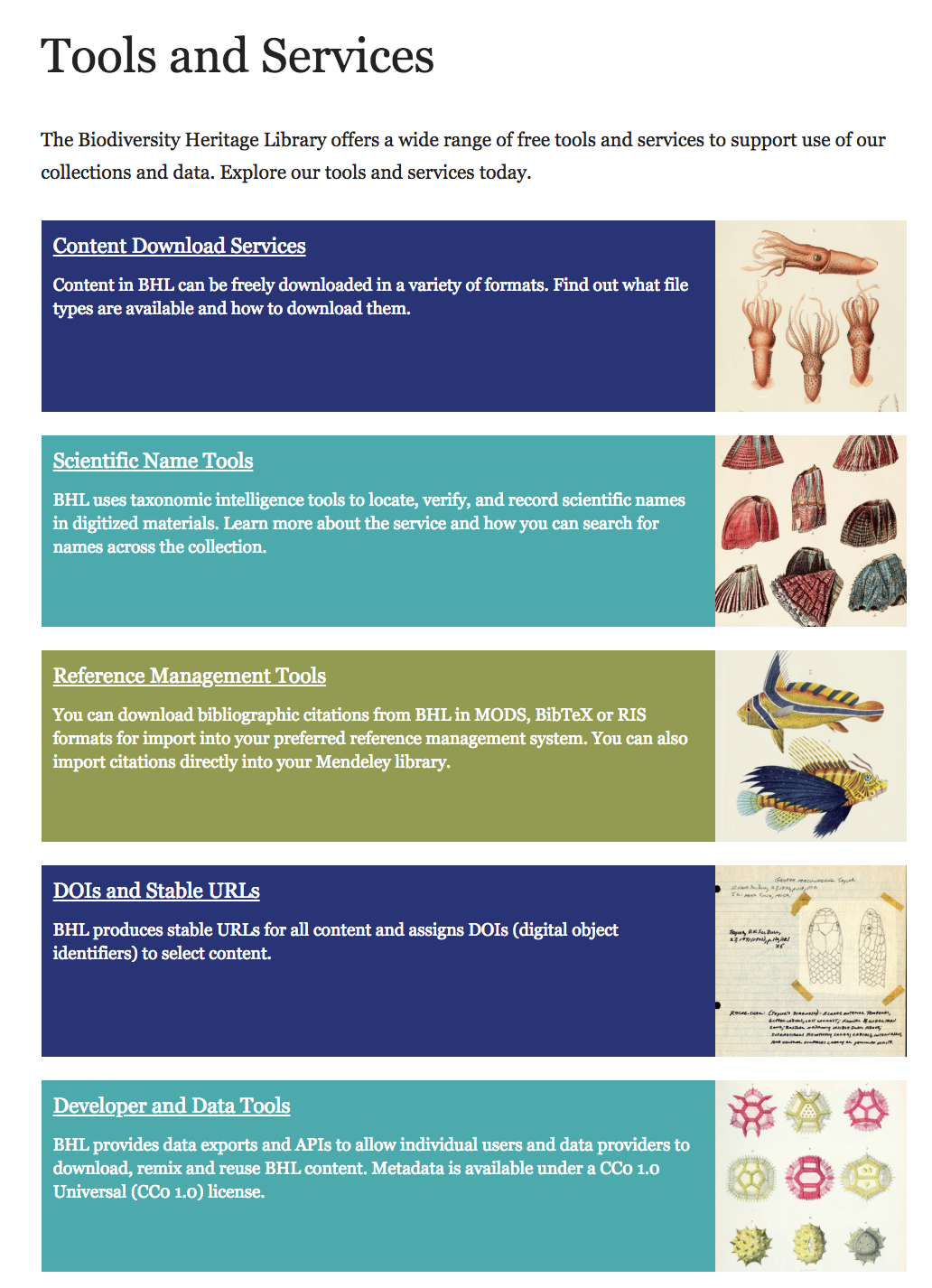
Consolidated Tools & Services

tools and services landing page on the new About site.

Tools and services landing page on the new “About BHL” site.

We consolidated links to information about our various tools and services into a single landing page to make it easier for you to explore what BHL has to offer and find the services you need.

New FAQ Center

We’ve created a new FAQ center to help answer some of the most frequent questions we receive. We’ll continue to add to this FAQ with new questions as appropriate. Have a question you don’t see listed? Send us feedback and we can add it!

Have questions or comments about the new “About BHL” site? Feel free to contact us or leave a comment on this post.

September 17, 2018by Grace Costantino
Blog Reel, User Stories

From the La Brea Tar Pits to the Biodiversity Heritage Library: Exploring Passenger Pigeon Populations in the Western United States

passenger pigeons sitting in a tree

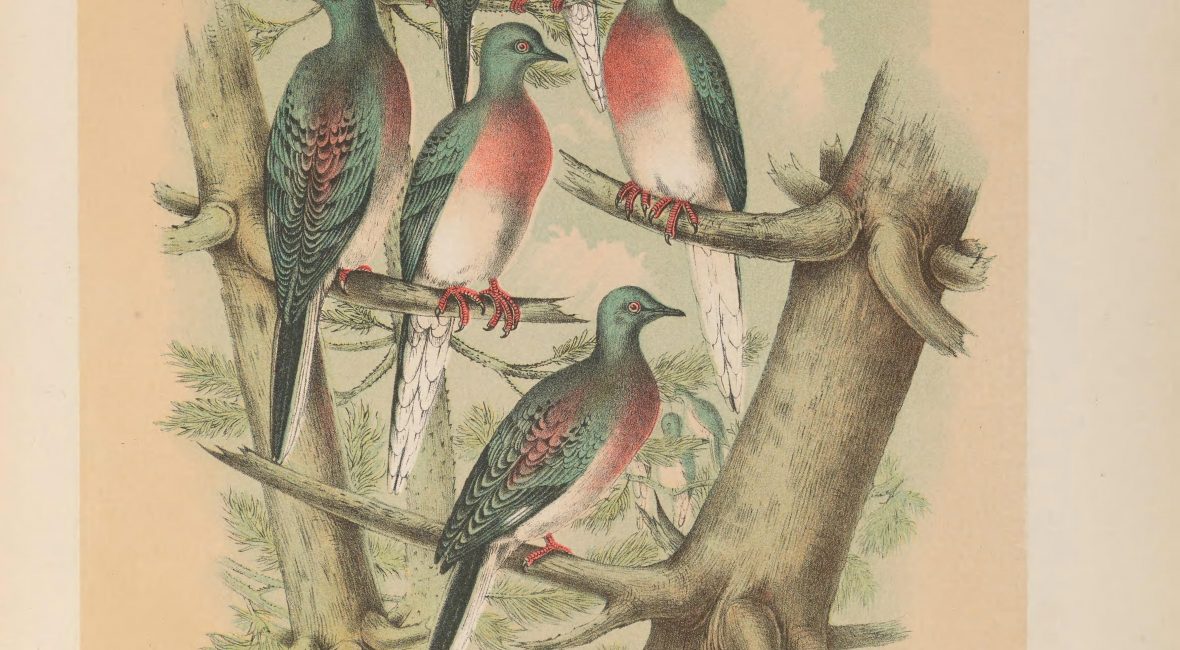
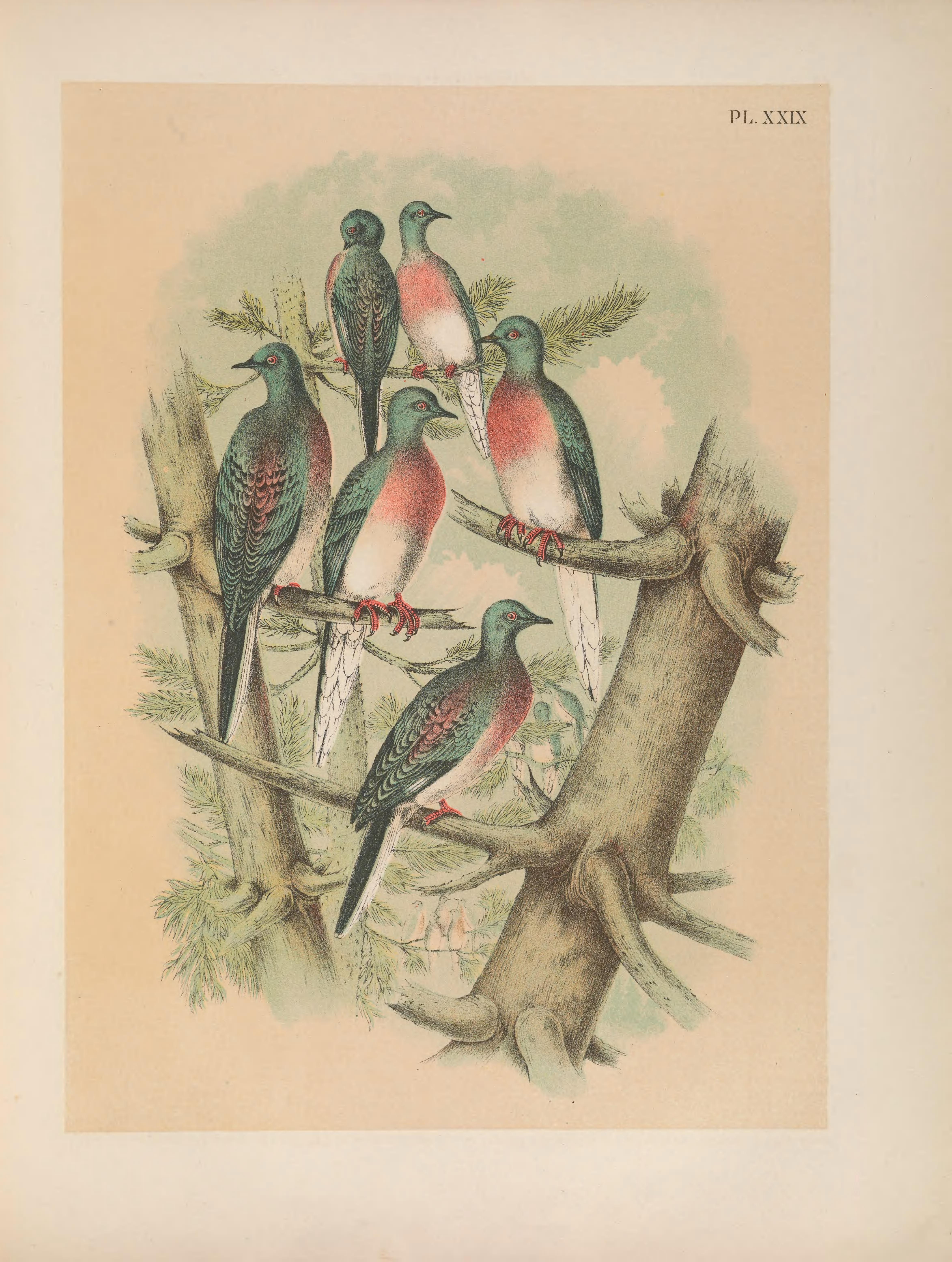
Passenger pigeon (Ectopistes migratorius). The Birds of North America. 1903. Contributed in BHL from Smithsonian Libraries.

The passenger pigeon’s demise is one of the most infamous examples of human-caused extinction. Once the most abundant bird species in North America, it was hunted relentlessly, with large-scale commercial hunting facilitated by railroad distribution placing excessive pressure on the species. The population declined from billions to none in less than one hundred years.

The last passenger pigeon, Martha, died at the Cincinnati Zoological Garden at about 1pm on September 1, 1914.

While stories of passenger pigeon flocks blackening the skies underscore the species’ once staggering abundance, its distribution was concentrated in the eastern United States. But could there have been resident populations in the western U.S.?

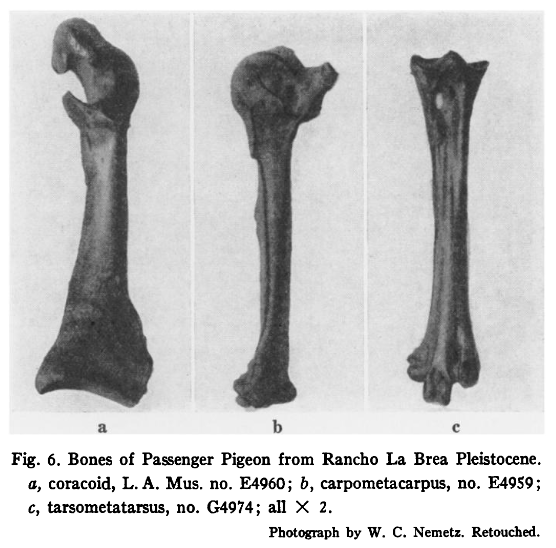
Passenger pigeon bones uncovered from the La Brea Tar Pits in Los Angeles, California inspired Dr. Libby Ellwood to ask this very question and embark on a research project empowered by the Biodiversity Heritage Library’s collections.

woman standing in front of photos of animals

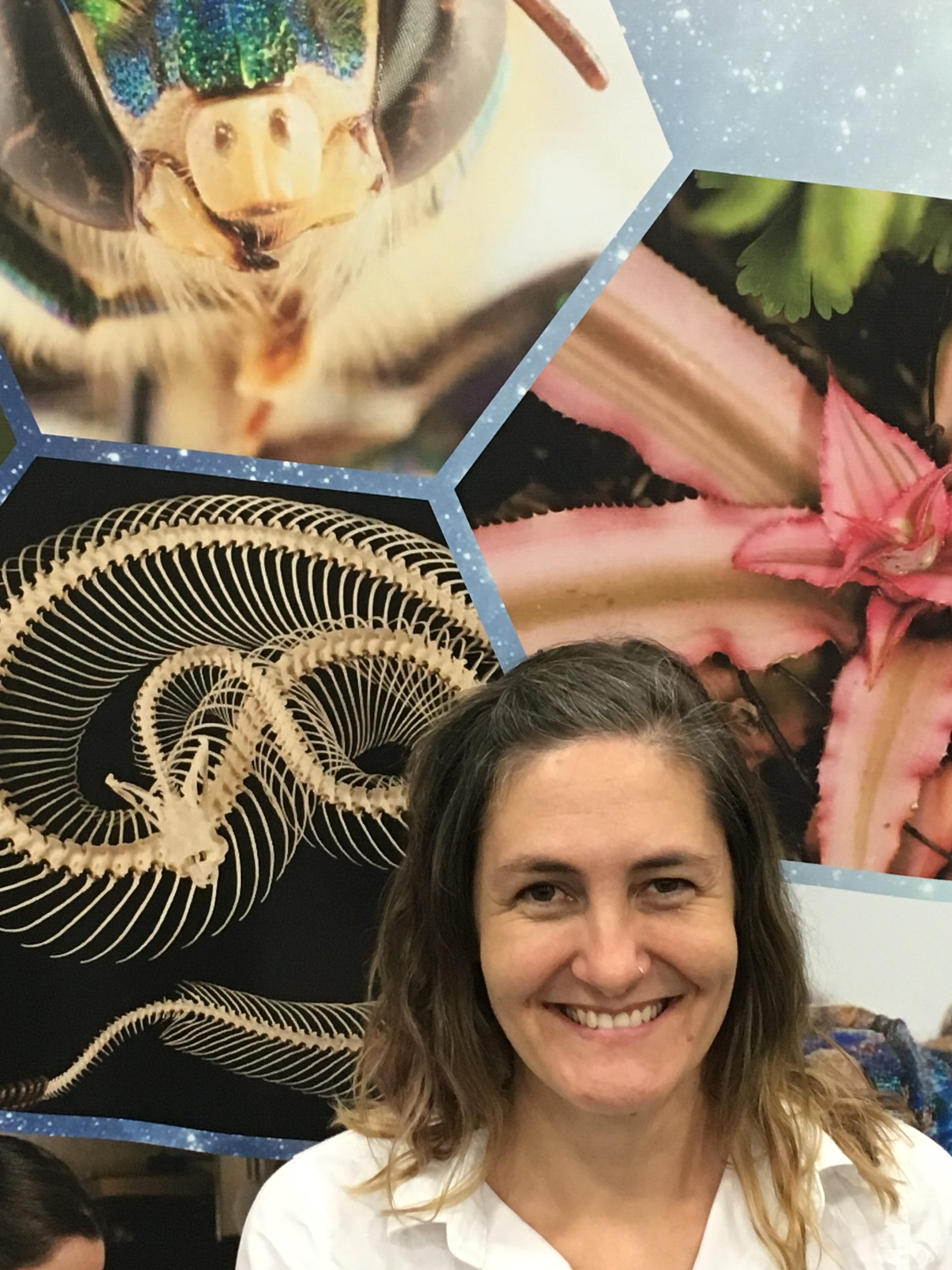
Dr. Libby Ellwood. Photo credit: Deborah Paul, Florida State University.

Ellwood has been studying ecology, and its intersection with climate change, conservation, and citizen science, for ten years. For the past year, she has been engaged as a Research Fellow at the La Brea Tar Pits & Museum. She first discovered BHL several years ago during her postdoc at iDigBio, a national resource for digitizing natural history collections and associated information. Since then, the Library has had a significant impact on her research.

“It may sound like hyperbole, but BHL truly is an invaluable resource,” lauds Ellwood. “I have used BHL to fill in datasets with historical data, to research foundational information, and, let’s be honest, just to look at the beautiful images. I have crossed paths with BHL staff and affiliates at conferences near and far and appreciate not only their digitization work, but equally their work to engage the online community in their efforts.”

When working on a research project, Ellwood sometimes accesses BHL daily for months at a time, reading publications online, taking notes and citation information as she goes, and downloading custom PDFs as needed. The Library has saved her precious time during these research projects.

“I know firsthand that weeks of travel to various libraries and special collections is resource and time-intensive,” shares Ellwood. “I have painstakingly used texts that have later been digitized by BHL. Had I to do it again, a good portion of that time and energy would be saved by using information available through BHL. All in all, I have a deep appreciation for BHL’s contributions to the digital landscape.”

Since BHL has proven to be such a valuable source of information for her research, it was the natural place for Ellwood to turn with questions surrounding the possibility of western passenger pigeon populations. In fact, as Ellwood shares, “In this particular case, the text and images in BHL have not only improved my research but have even driven it.”

Ellwood shared her preliminary research findings at the 2018 BHL Annual Meeting during an evening reception hosted by the Natural History Museum of Los Angeles County.

What did she find?

Read on to explore Ellwood’s account of her research to date and topics for further investigation.

Passenger pigeons of the western US – accident or resident?

By Dr. Libby Ellwood

Soon after starting my current position, I learned of the passenger pigeon bones we have in our collections at La Brea Tar Pits. While I might normally have considered this just another in a long list of cool fossils that we have in our collections, the relatively recent extinction of passenger pigeons got me thinking a little more deeply about it. More specifically, were there resident populations of passenger pigeons in southern California, or were these birds accidental visitors?

passenger pigeon bones

Three of the passenger pigeon bones found at La Brea Tar Pits, Howard, Hildegarde. “A Pleistocene record of the Passenger Pigeon in California.” The Condor 39.1 (1937): 12-14.

The La Brea Tar Pits fossils inform us that tens of thousands of years ago passenger pigeons were in what is now Los Angeles, California, though the extent of their range and population size at that time remain unknown. Passenger pigeons are a species that was so abundant in the eastern U.S. that their flocks would darken the skies…at least that was the case until we hunted them to extinction just over a hundred years ago.

While I might not be able to reconstruct tens of thousands of years of passenger pigeon abundance data in the western U.S., just how much information is out there about western populations of passenger pigeons? Is there information from the near historical past that could provide more information about this species’ distribution?

Enter BHL.

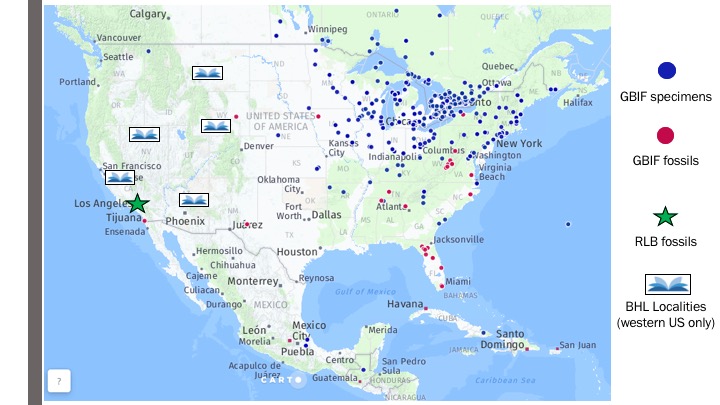
To cut to the chase, using documents accessed through BHL, I found numerous accounts of passenger pigeons west of the Rocky Mountains in the 1800s. Some accounts point to numerous birds, perhaps even resident populations of the species, while other accounts portray sightings of a lone individual, likely far from its intended route. My research using BHL has not yet been able to solidly answer whether or not passenger pigeons were ever residents of the western U.S., but it does open the possibility more widely.

map with locations of passenger pigeon localities

Map of passenger pigeon localities from a variety of sources. The western BHL points are the ones added through this current research. Image credit: Libby Ellwood.

With BHL, I added five additional points to the passenger pigeon range map. Where only one poor data point of modern-day western passenger pigeon sightings existed in the past, now there are six. And with this we now have an even more compelling reason to keep digging into this story. If in fact passenger pigeons lived in the western U.S. in some abundance, how far back do those populations go? Or, looking at it from the opposite direction, if there’s a possibility that the La Brea Tar Pits fossil specimens represent resident populations, for how long did those populations persist?

From here, I will continue this investigation by compiling more information about passenger pigeon fossil specimens as well as the more recent historical information to see if I can more deeply piece together a timeline of occurrence and abundance of this once common species.

————————————————-

Thank you, Dr. Ellwood, for sharing your research findings at our 2018 Annual Meeting and as part of our BHL User series! We look forward to learning more as your research progresses, and are thrilled to know that BHL is helping to paint a fuller picture of the passenger pigeon’s story.

May we learn from our past to make better decisions in the future and support a healthy, biodiverse planet.

September 13, 2018by Grace Costantino
Blog Reel, User Stories

Historic Literature Meets Modern Research: Discovering Octocorals in the Deep Sea of the Northeast Atlantic Ocean

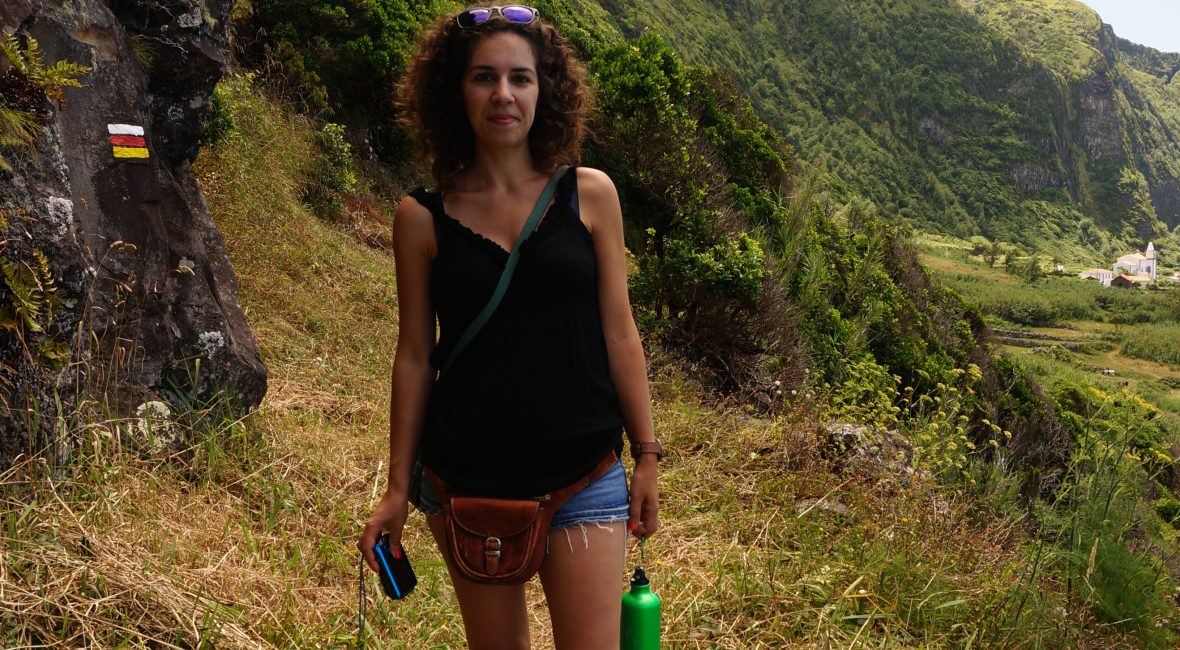
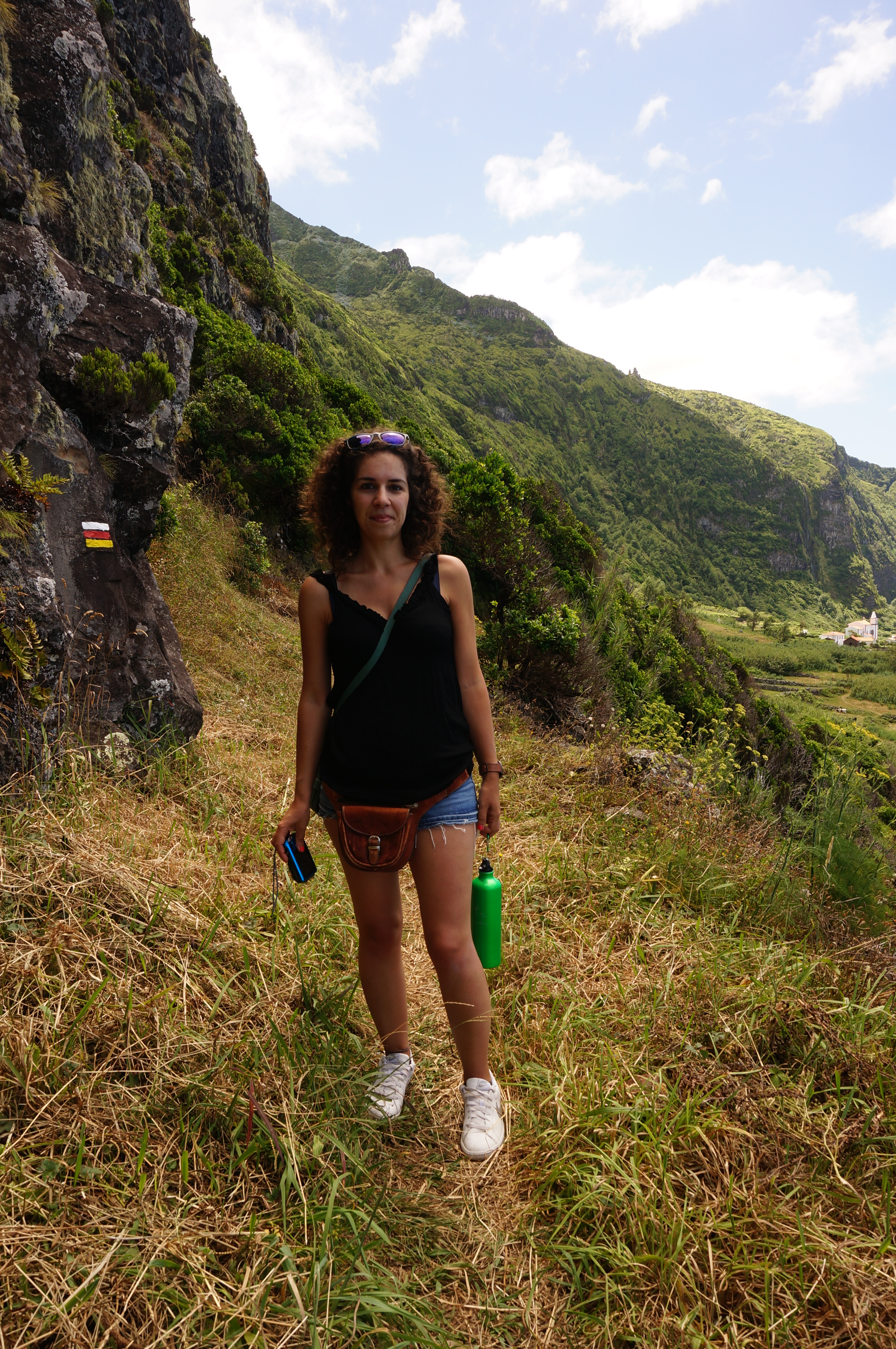
image of a woman standing next to a mountain

To say that Albert I, Prince of Monaco (1848-1922) had a passion for the sea is an understatement.

The Prince devoted much of his life to oceanography, contributing significantly to advances in the then relatively young discipline by sponsoring over two dozen oceanographic expeditions and founding the Institute Oceanographic in Monaco. The expeditions, conducted from the Azores to the Arctic, performed zoological and physics studies and resulted in the discovery of many new-to-science species [1].

Today, H.S.H. Prince Albert II of Monaco continues this passion, recently launching the Monaco Explorations campaign, a three-year transoceanic expedition to conduct scientific research in remote locations at sea [2].

The data and outcomes from the expeditions sponsored by Albert I were published in Résultats des campagnes scientifiques du prince de Monaco, which was produced in 110 issues between 1889-1950 [3].

octocorals

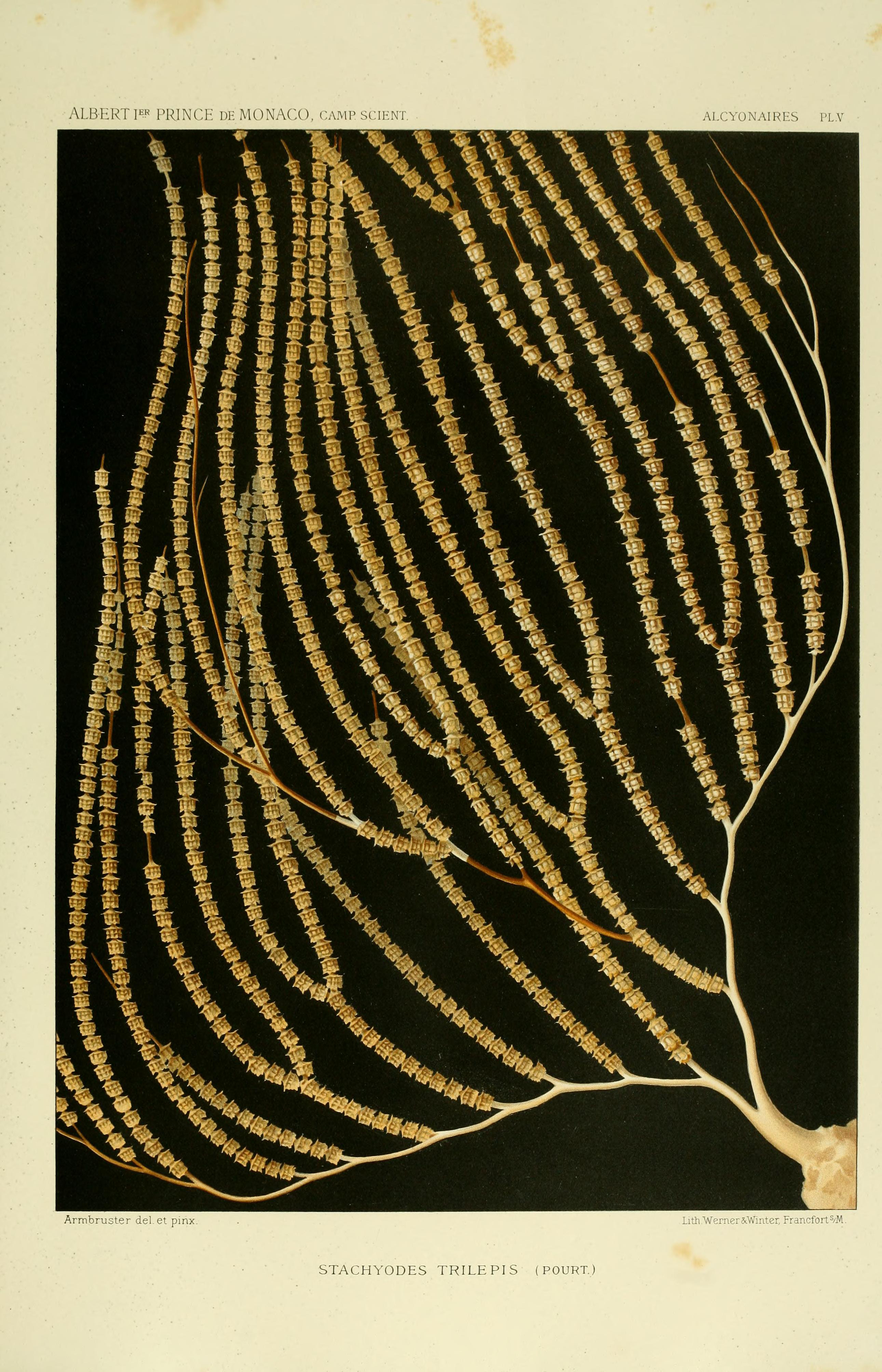
Primnoid octocoral caught in the Azores during the Prince Albert I of Monaco expeditions. Résultats des campagnes scientifiques du prince de Monaco. Studer, T. Fasc. 20 (1901). Contributed in BHL from MBLWHOI Library.

Among the organisms studied on the expeditions and detailed in the publications are Octocorallia, or octocorals, colonial organisms that include soft corals, blue corals, and sea pens in the orders Alcyonacea, Helioporacea, and Pennatulacea.

Íris Sampaio, a Ph.D. candidate in the Department of Oceanography and Fisheries at the University of the Azores & Senckenberg am Meer, Germany, has been studying octocoral taxonomy and ecology for eleven years. Résultats des campagnes has had a significant impact on Sampaio’s research, providing her with data on octocoral species collected in the Azores. Thanks to the Biodiversity Heritage Library, she now has easy access to the title’s public domain volumes [4].

“While my home university owns copies of these books, I lost much time scanning them at the beginning of my research,” recalls Sampaio. “Now they are available in BHL. I adore the coral drawings. They were my first contact with scientific art.”

image of a woman standing next to a mountain

Íris Sampaio in the Azores.

Sampaio first discovered BHL whilst looking for historic literature on Octocorallia species. The Library has since had a major impact on her work.

“BHL is an incredible project,” lauds Sampaio. “Historic literature is still a fundamental source for biological research. Without such a tool as BHL, it would take me much longer to access the old books, monographs and papers now available online.”

octocorals

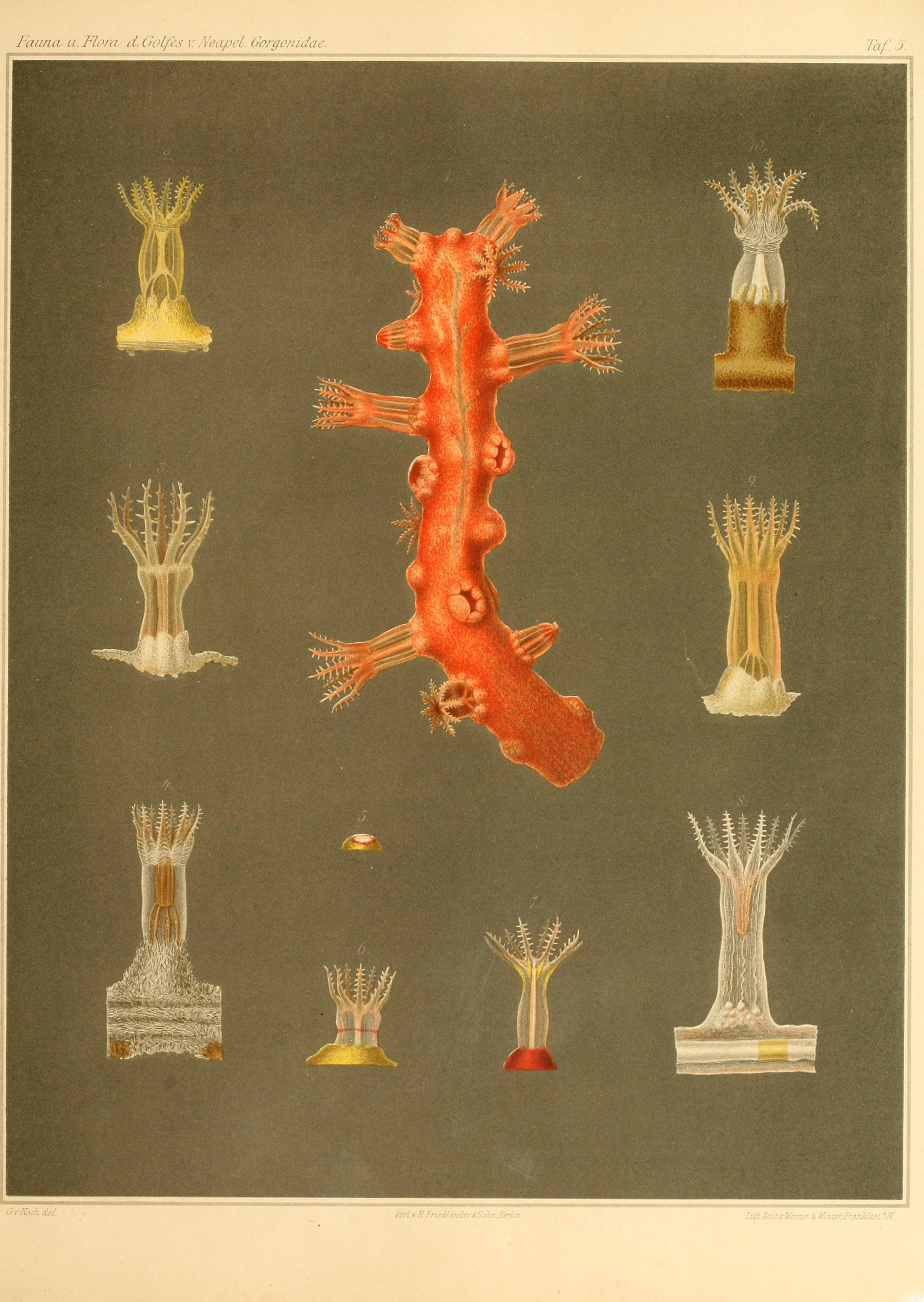
A plate of octocorals described from the Gulf of Naples with detailed illustrations of polyps. Koch, Gottlieb von. Die gorgoniden des golfes von Neapel, und der angrenzenden meeresabschnitte. Erster theil einer monographie der Anthozoa Alcyonaria. 1887. Contributed in BHL from Smithsonian Libraries.

Sampaio regularly uses BHL to locate descriptions and images of species, often downloading original descriptions as PDFs. These descriptions are essential when describing new species today.

“When describing a species, we have to be aware of what was already described and what names are available and valid under the rules of the International Code of Zoological Nomenclature,” explains Sampaio. “For that, a literature review must be done, even when the species were described in many languages in old works.”

octocorals

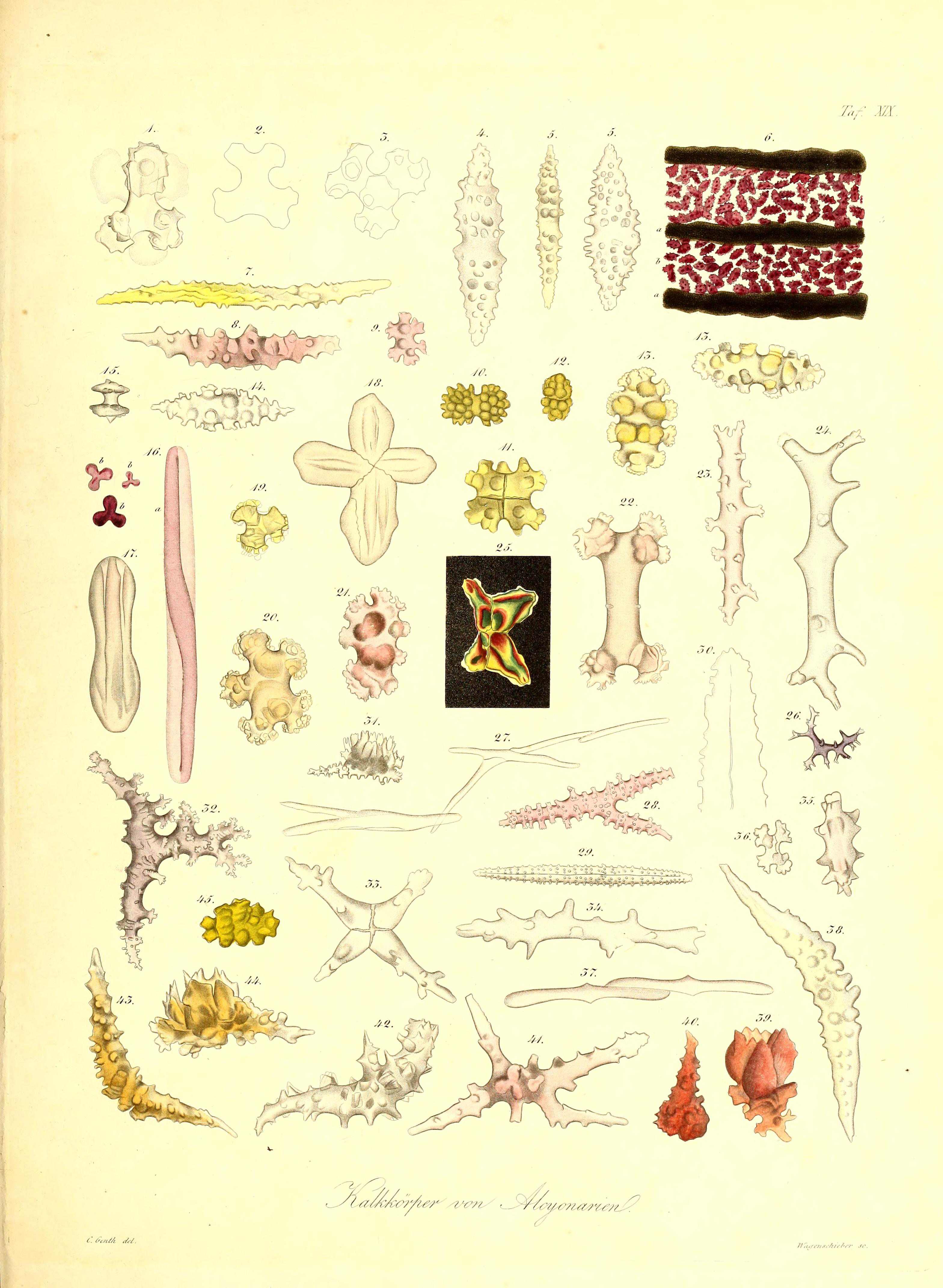
Plate revealing the diversity of forms of sclerites, needle-like skeletal structures, that are one of the most important characters analyzed in the discrimination of octocoral species. Kölliker, Albert. Icones histiologicae, oder, Atlas der vergleichendern Gewebelehre. 1864-65. Contributed in BHL from Smithsonian Libraries.

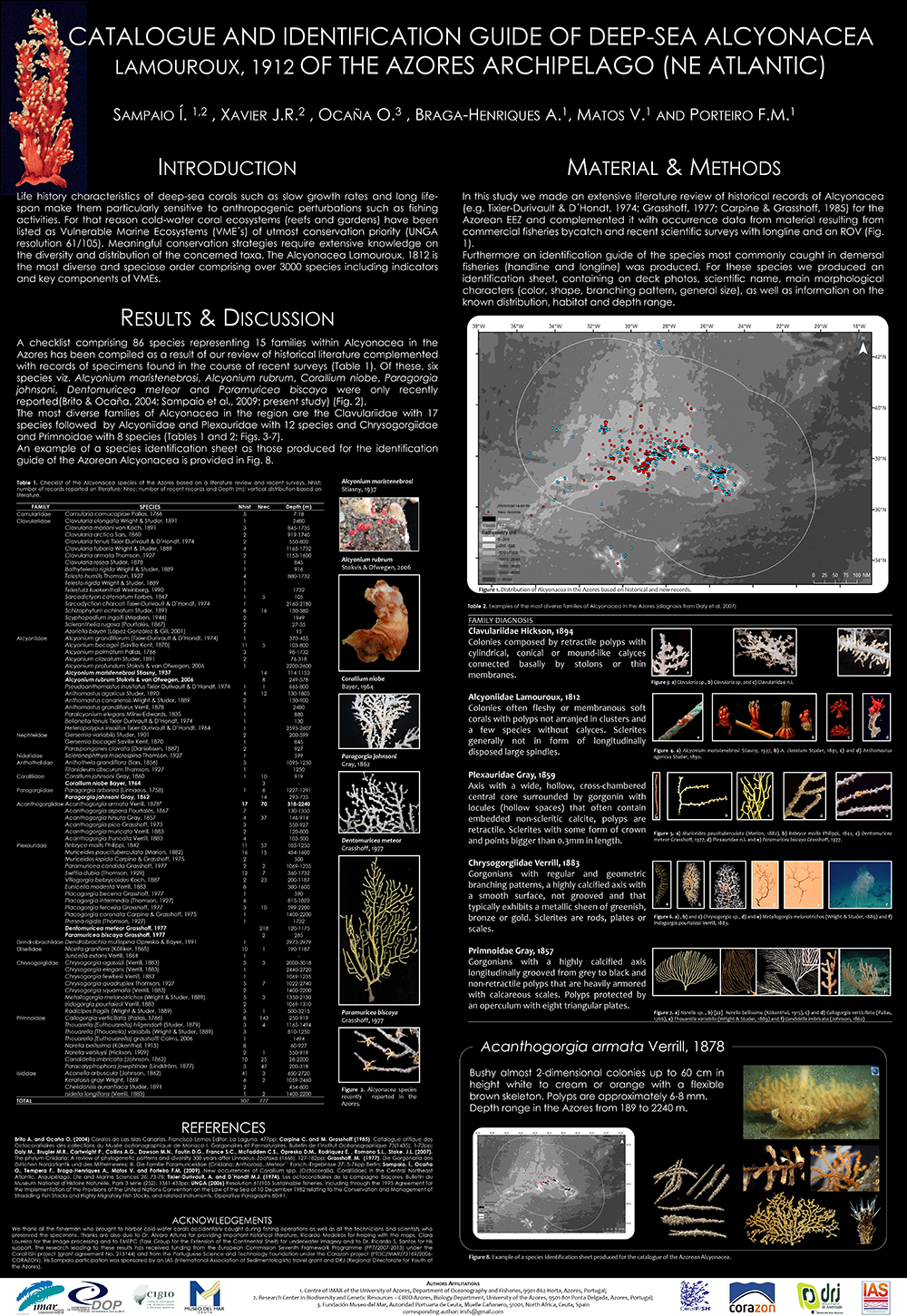
A literature review was an integral part of Sampaio’s work to produce a catalogue and, more recently, a census of the species and checklist of octocorals in the Azores Archipelago [5, 6]. For the catalogue, data was compiled through an extensive review of historic literature – much of it accessed through BHL – complemented with occurrence data from recent surveys, while the census was uniquely based on historic literature.

poster on octocoral catalogue

A catalogue of octocorals, a preliminary result derived from historical literature consultation and BHL use.

“I used BHL every day while I was researching the type localities and mode of designation of types of Octocorallia species inhabiting the Azores archipelago,” shares Sampaio. “As no centralized database provides literature on Octocorallia, BHL is a vital tool for their study.”

We are thrilled to know that BHL contributed to this important research, providing essential diversity and distribution data for deep-sea corals and therefore contributing to the conservation of species in Vulnerable Marine Ecosystems. As Sampaio’s testimonial demonstrates, free and open access biodiversity literature, including publications like Résultats des campagnes scientifiques du prince de Monaco, empowers science around the world, providing researchers with the information they need to study and conserve life on Earth.

Notes and References

Íris Sampaio would like to acknowledge her supervisors and the project for which her Ph.D. contributes in Europe: Íris Sampaio, PhD Candidate to Ocean Sciences, Marine Ecology at Department of Oceanography and Fisheries (DOP), University of the Azores and Senckenberg am Meer, Wilhelmshaven supervised by Dr. Marina Carreiro-Silva, Prof. Dr. André Freiwald and Dr. Gui Menezes and funded by the project EU H2020 ATLAS No 678760 and a FCT doctoral grant SFRH/BD/101113/2014.

[1] Monaco Explorations. 2018. “Monaco’s History with Science and the Sea.” About. Accessed on July 13. https://monacoexplorations.org/about/monaco-and-the-sea/.

[2] Monaco Explorations. 2017. “HSH Prince Albert Ii of Monaco Establishes Monaco Explorations: A Three-Year Campaign of Scientific Explorations at Sea – Press Release.” News, June 7. Accessed on July 13, 2018. https://monacoexplorations.org/hsh-prince-albert-ii-monaco-scientific-explorations-press-release/.

[3] OCLC. 2018. “Résultats des campagnes scientifiques accomplies sur son yacht par Albert Ier, prince souverain de Monaco.” WorldCat. Accessed on July 13. http://www.worldcat.org/oclc/14588383.

[4] The Octocorallia are treated in the Alcyonaires volumes of Résultats des campagnes scientifiques du prince de Monaco: no 20. Alcyonaires [1] / T. Studer. (1901) and no 73. Alcyonaires [2] / J.A. Thomson. (1927). As a public domain work, Studer’s volume is available in BHL.

[5] Sampaio, Íris & Xavier, Joana & Ocaña Vicente, Oscar & Braga Henriques, Andreia & de Matos, Valentina & Porteiro, Filipe. 2012. Catalogue and Identification Guide of Deep-Sea Alcyonacea Lamouroux, 1912 of the Azores Archipelago (NE Atlantic) [poster communication at the 5th ISDSC]. https://www.researchgate.net/publication/258440356_Catalogue_and_Identification_Guide_of_Deep-Sea_Alcyonacea_Lamouroux_1912_of_the_Azores_Archipelago_NE_Atlantic_poster_communication_at_the_5th_ISDSC.

[6] Sampaio Í, Freiwald A., Porteiro F. M., Menezes G. & Carreiro-Silva M (submitted) Census of Octocorallia (Cnidaria: Anthozoa) of the Azores (NE Atlantic): a nomenclature update. Zootaxa.

August 16, 2018by Grace Costantino
Blog Reel, Featured Books

An Illustrated Natural History of German Frogs: Rösel’s Historia Naturalis Ranarum Nostratium

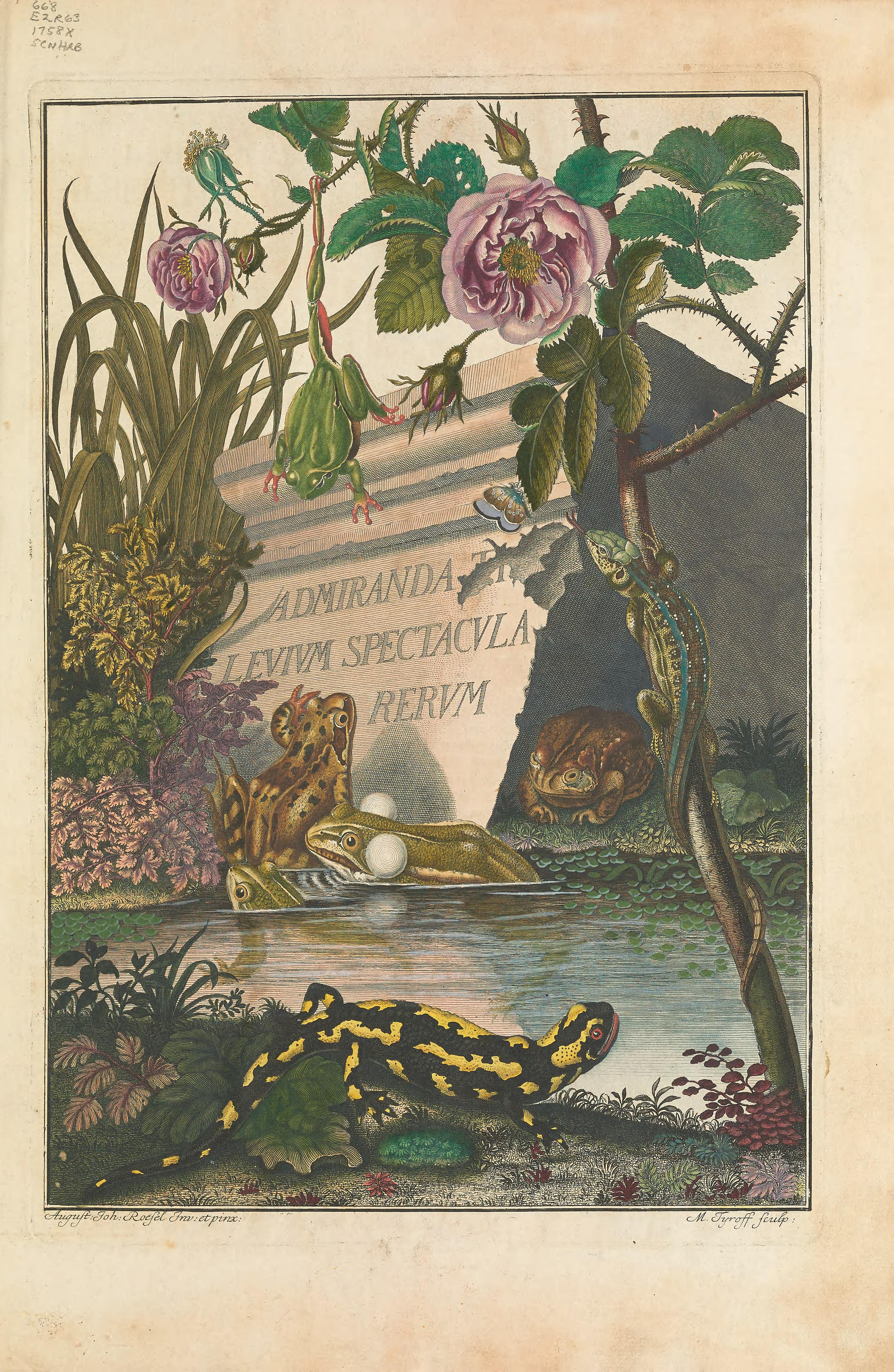
Historia naturalis ranarum nostratium frontispiece

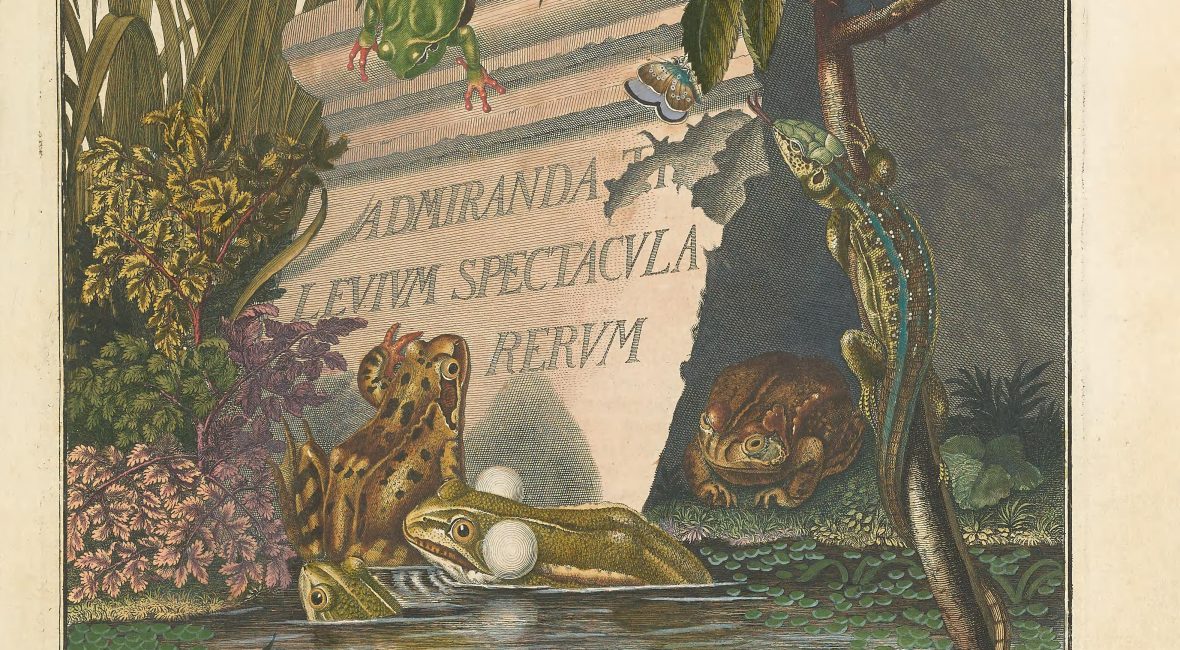
Rösel von Rosenhof, August Johann. Historia naturalis ranarum nostratium. 1758. Contributed in BHL from Smithsonian Libraries.

Historia naturalis ranarum nostratium has been described as one of the most beautiful works devoted to frogs and amphibians.

The work of German artist and naturalist August Johann Rösel von Rosenhof, Historia naturalis ranarum nostratium describes the natural history of all then-known frogs and toads indigenous to the Nuremberg region in Germany. The title is noteworthy first for the extensive, accurate information in the text, printed in two columns in both German and Latin. As Darrel Frost, a curator in the Herpetology Department in the Division of Vertebrate Zoology at the American Museum of Natural History, wrote in his essay on the book for Natural Histories, “Rösel’s volume on German frogs represents in a very real sense the beginning of accurate life-history observation in amphibians” (Frost 2012, 38).

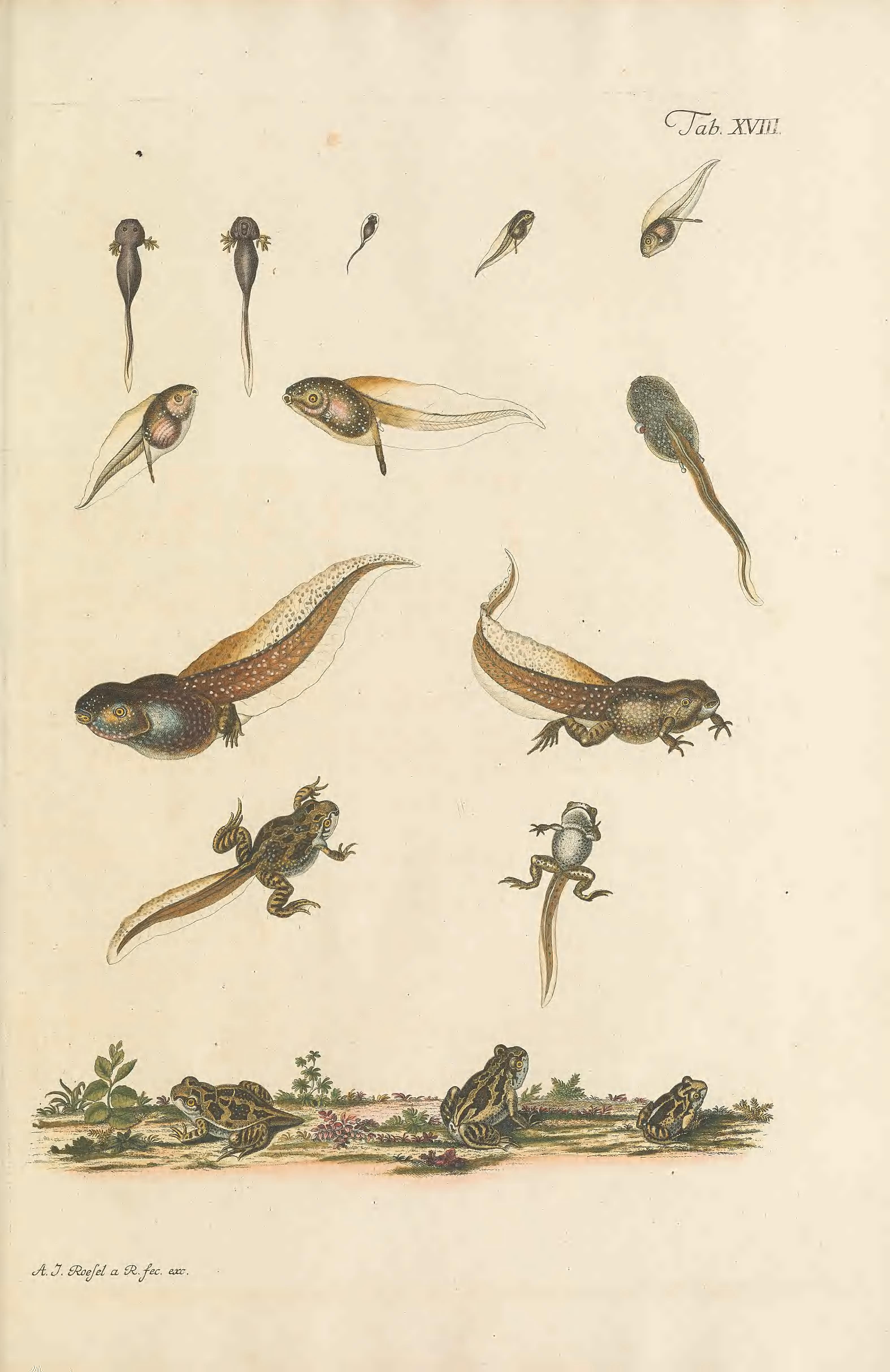
frog illustration

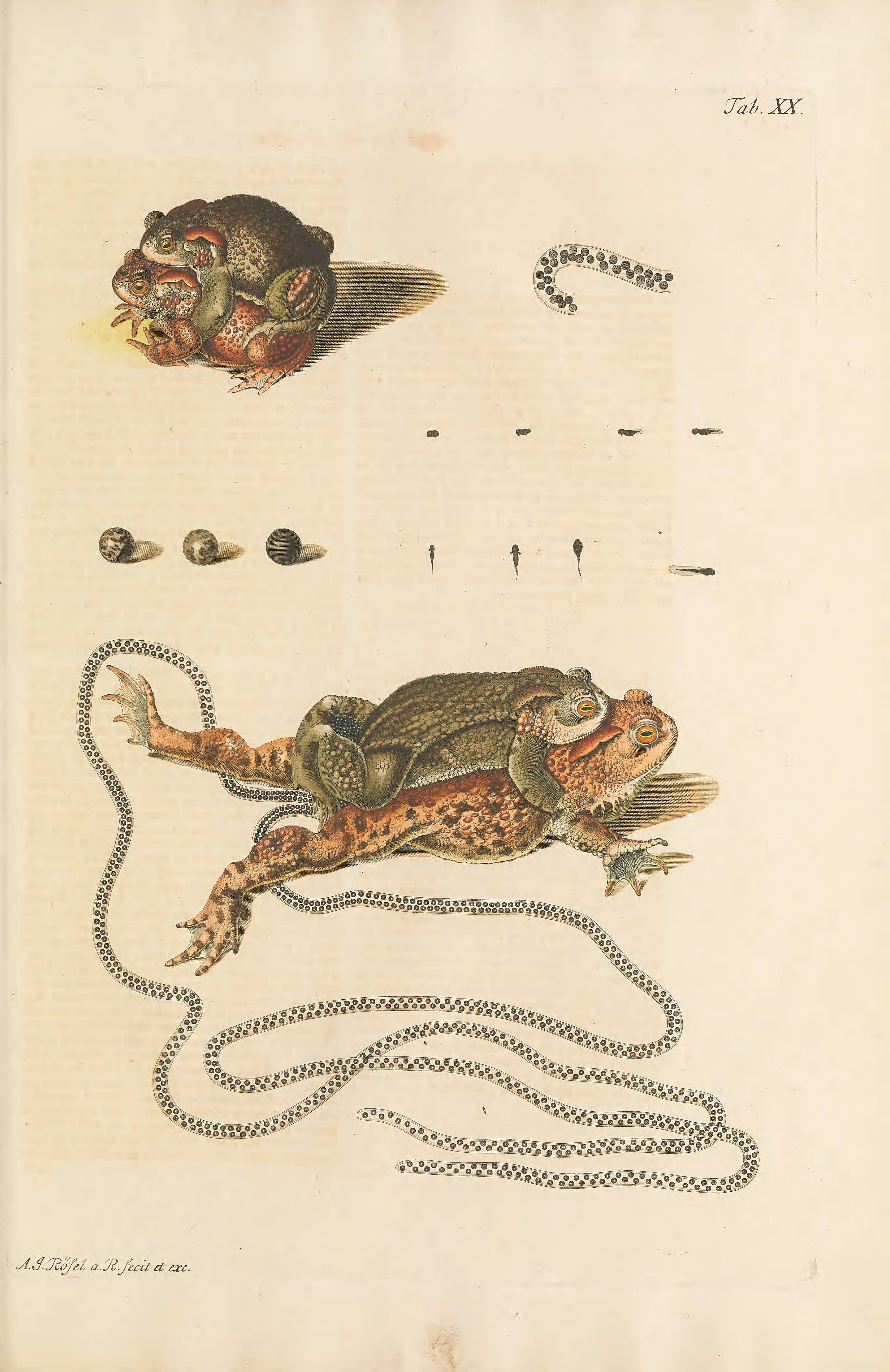
Rösel von Rosenhof, August Johann. Historia naturalis ranarum nostratium. 1758. Contributed in BHL from Smithsonian Libraries.

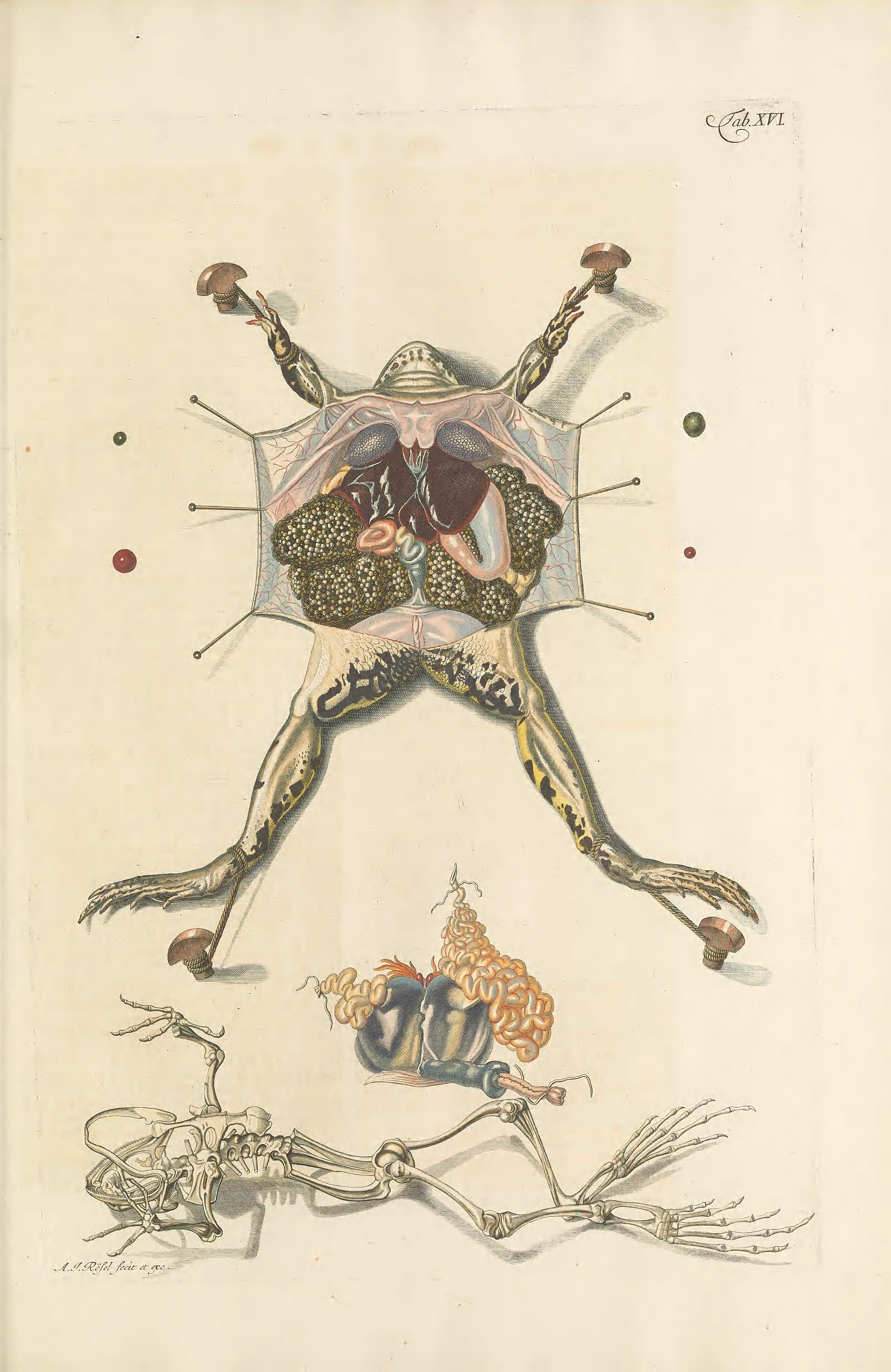
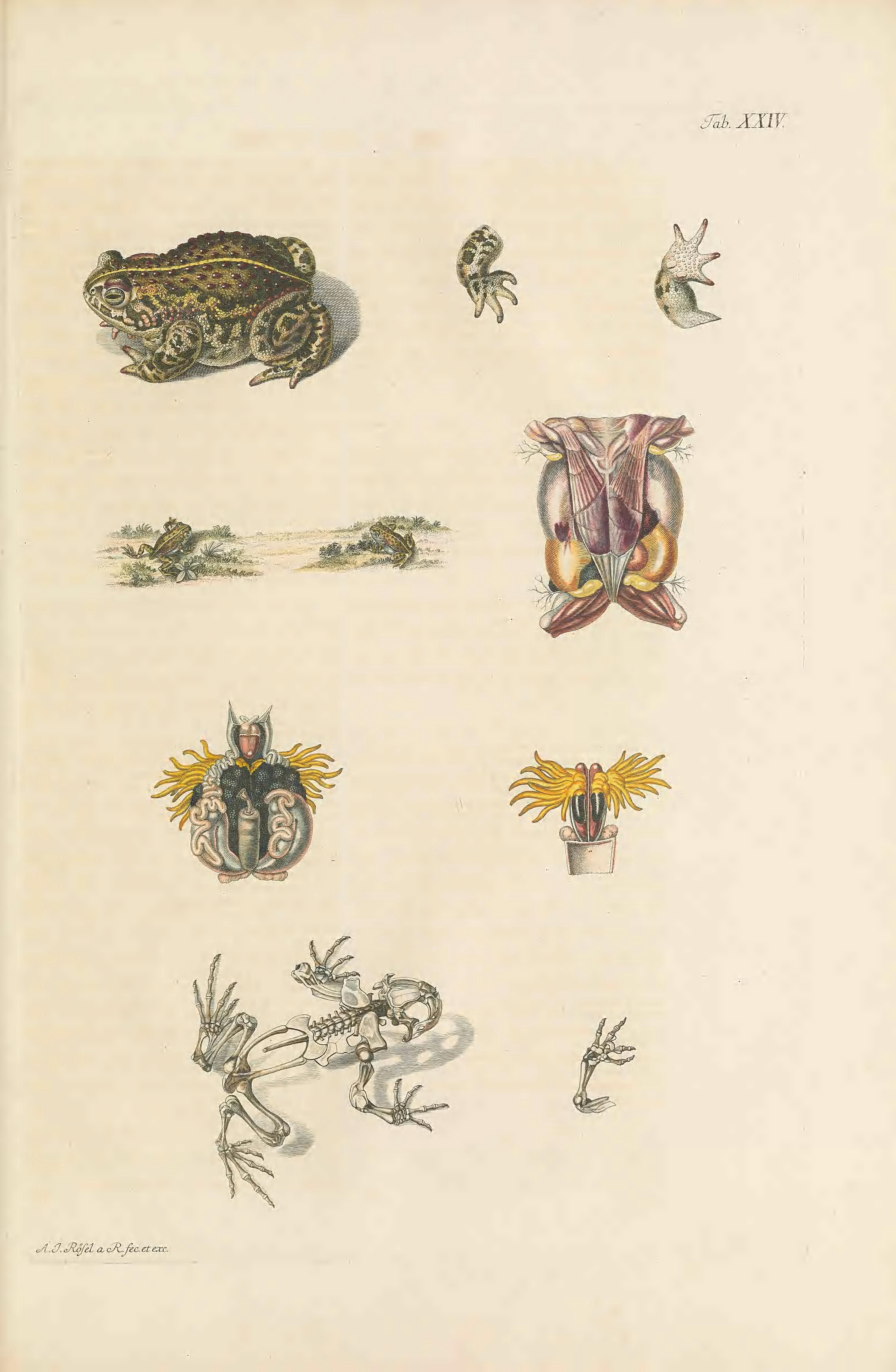
The work is equally (if not more) renowned for its illustrations. The twenty-four folio, hand-colored copper engravings portray habitats, anatomy, reproductive behavior, and larval development stages in intricate detail. The quality of the artwork is not surprising given Rösel’s artistic background.

Johann Rösel von Rosenhof was born in 1705 to a noble Austrian family near Arnstadt in the German principality of Arnstadt-Schwarzburg. Orphaned at a young age, Rösel was sent for training to his uncle, Wilhelm Rösel, an animal and landscape painter, after he showed artistic talent. He eventually became a painter of portraits and miniatures to the Danish Court in Copenhagen before returning to Nuremberg and earning his living as a painter.

frog illustration

Rösel von Rosenhof, August Johann. Historia naturalis ranarum nostratium. 1758. Contributed in BHL from Smithsonian Libraries.

Rösel’s passion for natural history was ignited by the work of Maria Sibylla Merian, a German-born naturalist and illustrator who is recognized as one of the most significant contributors to the field of entomology. Her Metamorphosis Insectorum Surinamensium (1705) depicted the full life cycles of many Suriname insects. Merian was able to portray this life history information because she drew her subjects from life in their natural environments. Most naturalists of the day illustrated species from dead, preserved specimens, which contributed to a lack of knowledge about the true life cycle and origin of insects. Maria also portrayed the host plant for the species she studied and even illustrated the damage the insects left on the plants.

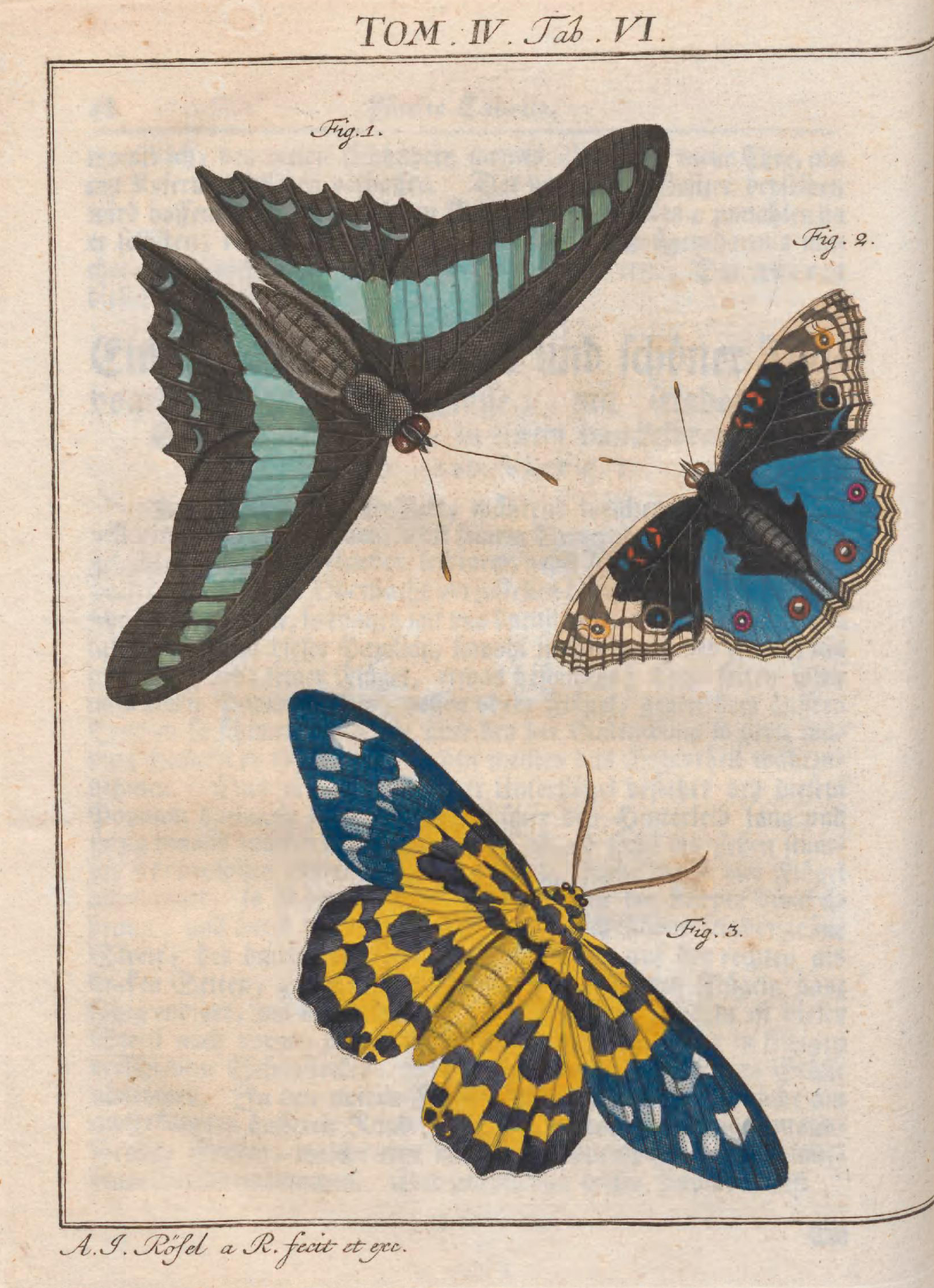
illustration of butterflies

Rösel von Rosenhof, August Johann. Der monathlich-herausgegebenen Insecten-Belustigung. v. 4 (1761). Contributed in BHL from the Naturalis Biodiversity Center.

Merian’s work inspired Rösel to study and produce a similar work on German insects. His interest in the natural world also grew to include amphibians and reptiles, and he used his leisure time to collect insect and amphibian eggs and larvae to observe their development. The first part of his first natural history publication, Der monatlich-herausgegebenen Insecten-Belustigung, was published in 1740. Four additional parts appeared over the years, with the final one being published posthumously in 1761. Because of this publication, a copy of which has been contributed in BHL from the Naturalis Biodiversity Center, Rösel is known as one of the fathers of German entomology.

frog illustration

This illustration became the type of Bufo calamita (now Epidalea calamita). Rösel von Rosenhof, August Johann. Historia naturalis ranarum nostratium. 1758. Contributed in BHL from Smithsonian Libraries.

In 1753, Rösel published the first part of his Historia naturalis ranarum nostratium. Completed in 1758, the work is a scientific and artistic marvel, and several of the illustrated frogs, such as Bufo calamita (now Epidalea calamita) and Bufo fuscus (now Pelobates fuscus), became the types for their species. Thanks to the Smithsonian Libraries, everyone in the world can appreciate Rösel’s scientific and artistic contributions to the natural history of German frogs. The Libraries’ copy of Historia naturalis ranarum nostratium, housed in its Joseph F. Cullman 3rd Library of rare books, has recently been digitized for BHL.

As Frost outlines in his essay, Rösel intended to produce a similar work for lizards and salamanders, but sadly was not able to complete it, as he died unexpectedly on March 27, 1759.

Through his natural history publications, Rösel’s scientific legacy lives on and is accessible to everyone through the Biodiversity Heritage Library thanks to the Naturalis Biodiversity Center and Smithsonian Libraries.

frog illustration

Rösel von Rosenhof, August Johann. Historia naturalis ranarum nostratium. 1758. Contributed in BHL from Smithsonian Libraries.

Reference

The information in this post was derived from:

Frost, Darrel. 2012. “Rösel von Rosenhof and His Natural History of Frogs.” In T. Baione (Ed.), Natural Histories: Extraordinary Rare Book Selections from the American Museum of Natural History Library (pp. 37-38). New York: Sterling Publishing.

August 2, 2018by Grace Costantino
Page 11 of 71« First...«10111213»203040...Last »

Help Support BHL

BHL's existence depends on the financial support of its patrons. Help us keep this free resource alive!

search

About BHL

The Biodiversity Heritage Library (BHL) is the world’s largest open access digital library for biodiversity literature and archives. BHL operates as a worldwide consortium of natural history, botanical, research, and national libraries working together to digitize the natural history literature held in their collections and make it freely available for open access as part of a global “biodiversity community.”

Join Our Mailing List

Sign up to receive the latest news, content highlights, and promotions.

Subscribe Now

Subscribe to Blog via Email

Enter your email address to subscribe to this blog and receive notifications of new posts by email.

Join 319 other subscribers

Subscribe to Blog Via RSS

Subscribe to the blog RSS feed to stay up-to-date on all the latest BHL posts.

Access RSS Feed

Inspiring Discovery through Free Access to Biodiversity Knowledge.

The Biodiversity Heritage Library makes it easier than ever for you to access the information you need to study and explore life on Earth…for free, anytime, anywhere.


64+ Million Pages of
Biodiversity Literature Online.

EXPLORE

Tools and Services
to Transform Research.

EXPLORE

300,000+
Illustrations on Flickr.

EXPLORE

ABOUT | HARMFUL CONTENT | PRIVACY | SITE MAP | TERMS OF USE