Biodiversity Heritage Library - Program news and collection highlights from BHL
  • Home
  • News
  • Featured Books
    • All Featured Books
    • Book of the Month Series
    • BHL at 20
  • User Stories
  • Campaigns
    • Fossil Stories
    • Garden Stories
    • Monsters Are Real
    • Page Frights
    • Her Natural History
    • Earth Optimism 2020
  • Tech Blog
  • Visit BHL
Home
News
Featured Books
    All Featured Books
    Book of the Month Series
    BHL at 20
User Stories
Campaigns
    Fossil Stories
    Garden Stories
    Monsters Are Real
    Page Frights
    Her Natural History
    Earth Optimism 2020
Tech Blog
Visit BHL
  • Home
  • News
  • Featured Books
    • All Featured Books
    • Book of the Month Series
    • BHL at 20
  • User Stories
  • Campaigns
    • Fossil Stories
    • Garden Stories
    • Monsters Are Real
    • Page Frights
    • Her Natural History
    • Earth Optimism 2020
  • Tech Blog
  • Visit BHL
Biodiversity Heritage Library - Program news and collection highlights from BHL
BHL News, Blog Reel, Tech Updates

Coming Soon to BHL: Full Text Search!

We’re excited to announce that we will soon be launching full text search on BHL!

With full text search, you’ll be able to search across the text in the BHL corpus. Search results will display hits for your term in both the bibliographic information (i.e. title, author, subject, publisher, related titles and series, etc.) as well as the full text of books in BHL.

Our full text search will include faceted browsing, making it easier for you to explore your search results by applying filters for content type, publication date, subject, and more. Additionally, we’re adding “search inside this book” functionality, allowing you to search for terms within a book you’re viewing.

We expect to launch full text search this month (May 2018). We look forward to enhancing the BHL interface with this new search functionality. Follow our blog and social media (@BioDivLibrary) for release announcements and #StayTuned!

May 1, 2018by Grace Costantino
Blog Reel, User Stories

On Fish, Color, and Social Behavior: Connecting Current Research to Historical Scientific Studies through Open Access Archives

photo of a blonde woman with sunglasses on her head standing in front of a lake

Social orders exist throughout the animal kingdom. Comprised of dominant and subordinate individuals, these orders dictate how members of a group interact, influencing everything from food access to mating privileges.

Sometimes, the behavior of the dominant individual is more extreme, and the “alpha” actively inhibits interactions between other members of the group. This sort of “monarchistic dominance” has been reported in male laboratory mice and African lions. The behavior is not restricted to mammals, however.

In a 1962 study published in the Bulletin of the Southern California Academy of Sciences, researchers observed this monarchistic behavior in captive male mosquitofish. In a series of controlled experiments, the study authors witnessed a range of aggressive behaviors being used to establish the dominant individual, who then suppressed interactions between the remaining fish (Caldwell and Caldwell 1962).

photo of a blonde woman with sunglasses on her head standing in front of a lake

Tanja Zerulla takes a moment to snap a selfie while catching Eastern Mosquitofish at Florida International University. Photo credit: Tanja Zerulla.

Tanja Zerulla, a Ph.D. candidate at Florida International University (FIU), is currently studying social behaviors in the Eastern Mosquitofish (Gambusia holbrooki). While her research is specifically looking at the role of color in social interactions, this 1962 study offered valuable insight into broader mosquitofish behavior. The Biodiversity Heritage Library (BHL) provided Zerulla with easy access to the publication.

“I’ve been working on defining the social behavior of male Eastern Mosquitofish color morphs,” explains Zerulla. “While reading, I found references to a few older articles about the genus (Gambusia) behavior. While looking on Google Scholar, I found the article ‘Monarchistic dominance in small groups of captive male mosquitofish, Gambusia affinis patruelis’ – and it linked me to BHL! I was able to read about how male fish interact with each other and now have a point of comparison for my own research.”
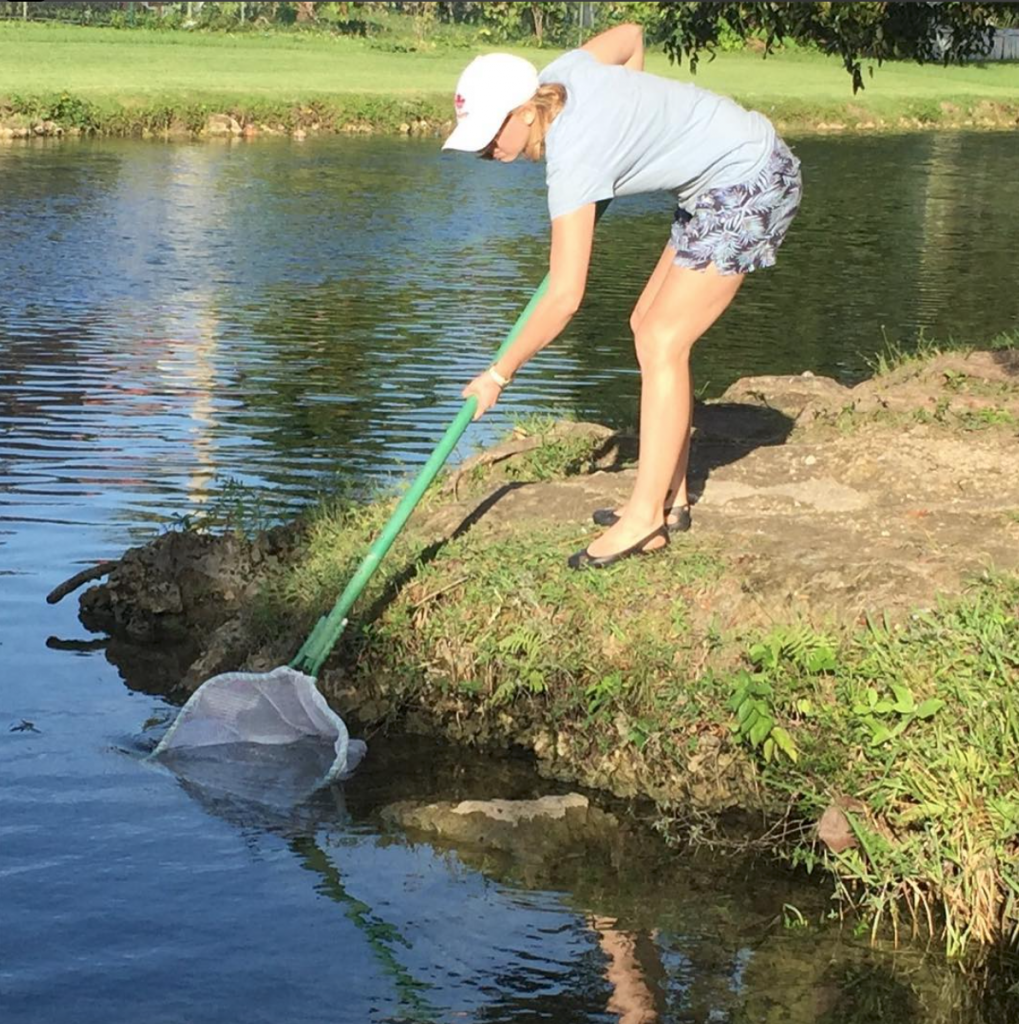
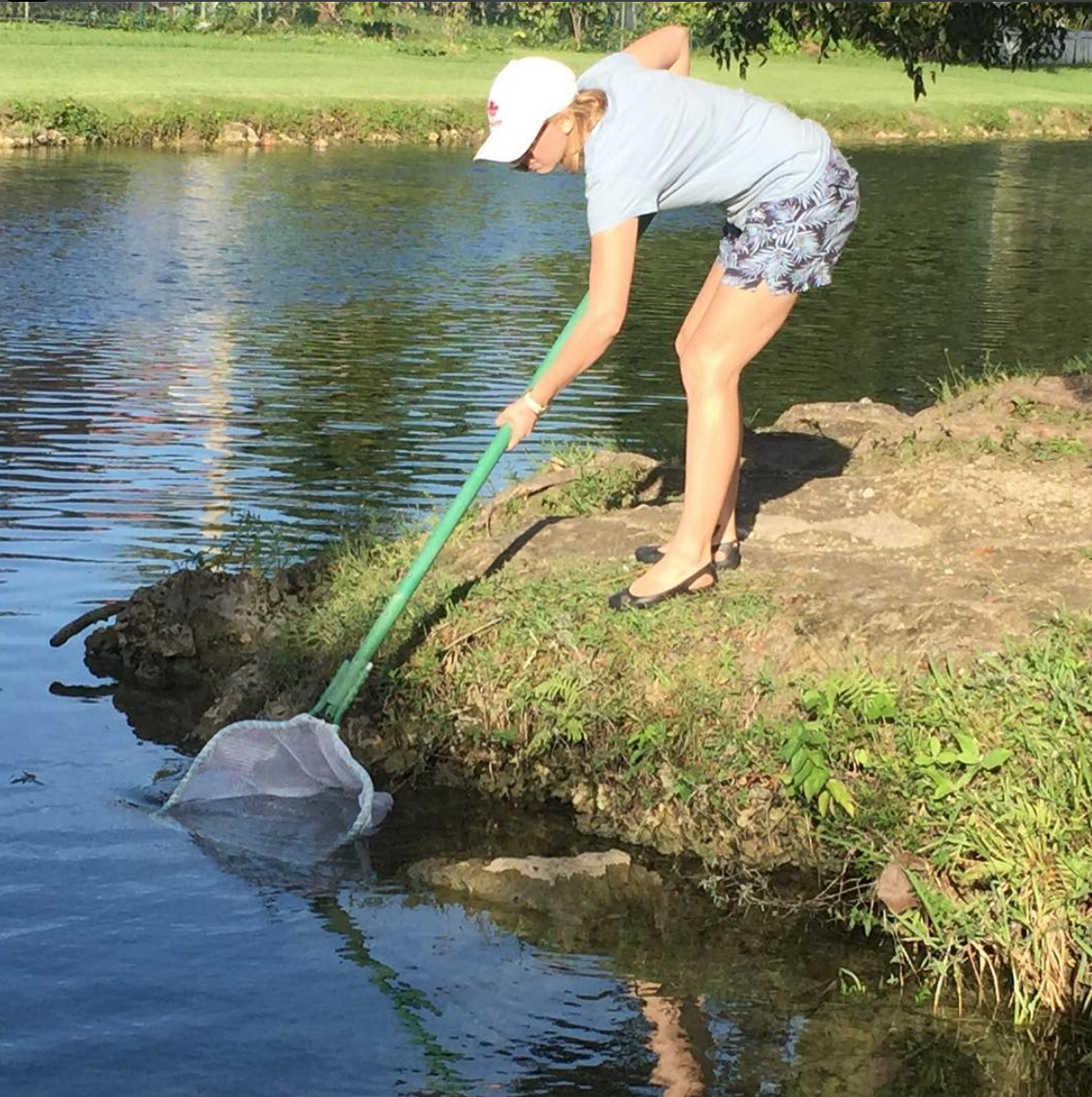
Blonde woman in shorts using a fishing net in a lake.

Tanja Zerulla catches mosquitofish using a dip net in Miami, Florida. Photo credit: Tanja Zerulla.

Zerulla has been studying fish biology for over six years. Her research passion is understanding the underlying causes of biological behavior. Zerulla’s undergraduate research included studies on the effects of chemicals and compounds in water systems on fish swimming behavior and the impact of nucleotides on fish feeding behavior. For her graduate work, Zerulla applied to several programs with leaders in the field of behavioral biology.

“In particular, I wanted to work with someone who studied behavior across biological levels – from genetics and physiology to ecology and evolution,” explains Zerulla. “I found my fit at Florida International University working for Dr. Philip Stoddard, where I now study how color pattern is linked to social behaviors in the Eastern Mosquitofish (Gambusia holbrooki).”
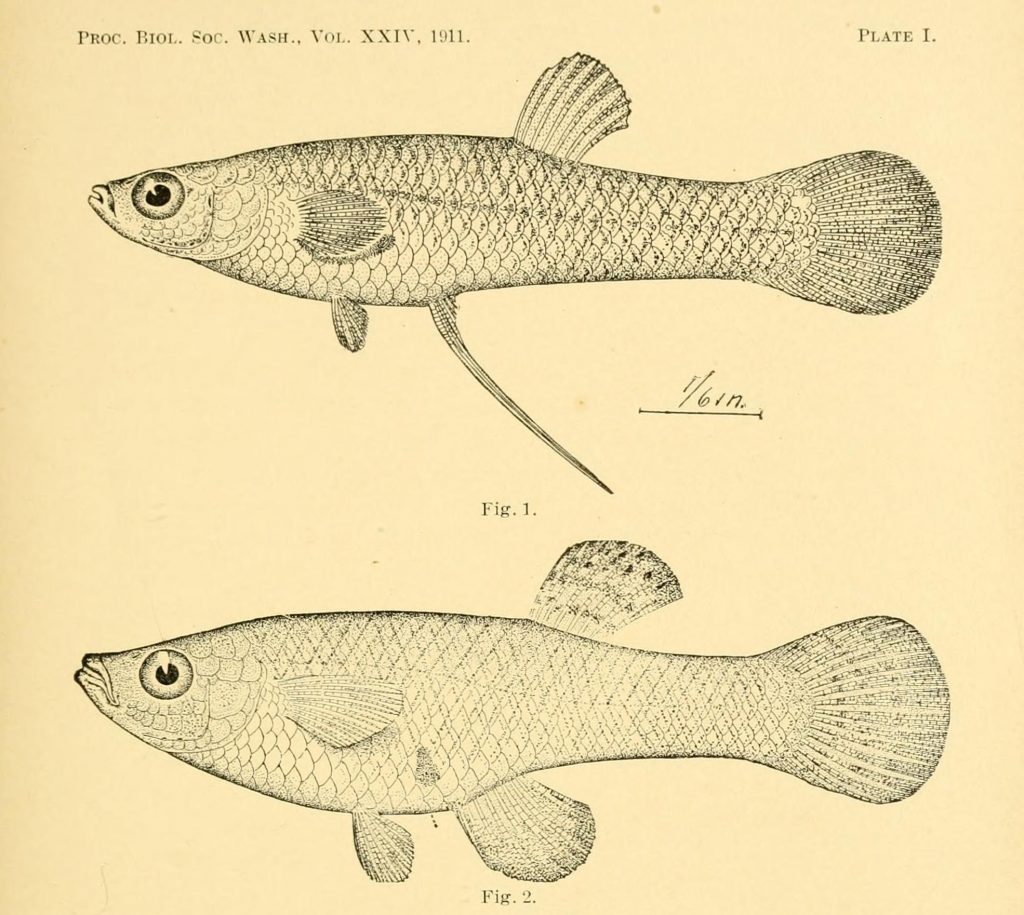
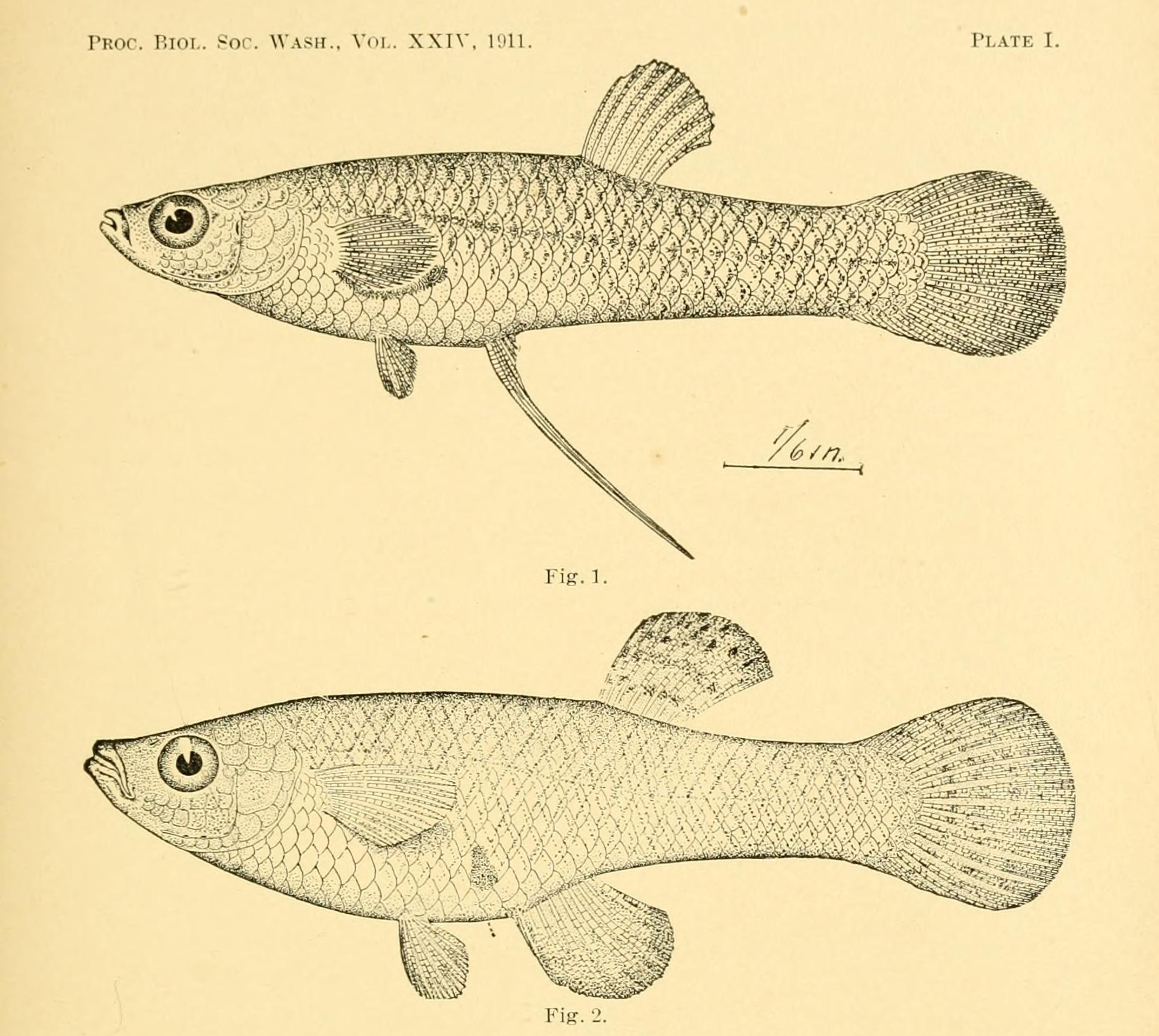
Black and white illustration of fish.

Male (Fig. 1) and female (Fig. 2) Eastern Mosquitofish (Gambusia holbrooki). Illustration from “Breeding habits of the viviparous fishes Gambusia holbrookii and Heterandria formosa” by William P. Seal. Published in Proceedings of the Biological Society of Washington, v. 24 (1911). https://s.si.edu/2JeW6PK.
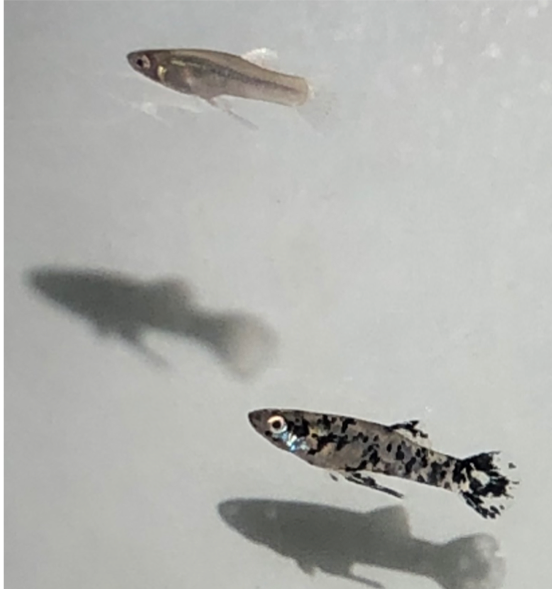
Two small fish swiming.

Eastern Mosquitofish (Gambusia holbrooki) males swim in a laboratory aquarium. A silver male swims at the top while a melanistic (spotted) male swims below. Photo credit: Tanja Zerulla.

Zerulla first discovered BHL through Twitter several years ago, when she began following scientists and other graduate students on the platform.

“Some of the graduate students were tweeting about their efforts to transcribe field journals and label taxonomic images for BHL,” recalls Zerulla. “One of my first major interactions was helping someone figure out that the image they were working on was a fetal Squalus squalus (dogfish shark) and translating German on an image of an Axolotl.”

While she has just recently begun exploring how BHL can support her current research, Zerulla’s primary interactions with the Library still occur through social media, where the publications – and particularly scientific illustrations – shared through BHL’s feeds serve as a valuable source of inspiration and motivation.

“I love seeing the historical drawings of animals and plants! Seeing beautiful images drawn by people who were curious about the world reminds me of my own love for science,” affirms Zerulla. “Grad school can be overwhelming, so little reminders of my passion for natural history and science renews my energy for research.”
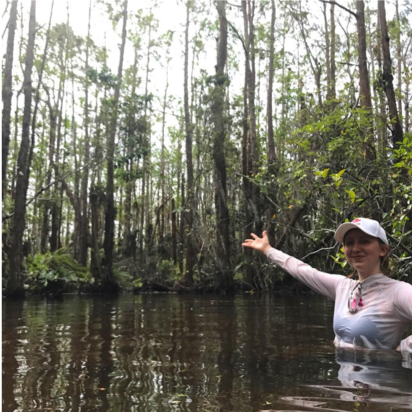
Blonde woman in a hat standing in a cypress dome.

Tanja Zerulla standing in a cypress dome in Everglades National Park where she teaches students about the natural history of Florida plants and animals. Photo credit: Tanja Zerulla.

She finds these drawings so inspiring that she would love to have them displayed as a tab in the search results on the BHL website to allow easier discovery. But while she thoroughly enjoys these illustrations, for Zerulla, the best thing about BHL is its vast, open access collection.

“I was surprised but really pleased to see so much scientific literature available for free to the public,” lauds Zerulla. “I personally have pushed for open access releases of my published papers because I think that everyone – whether a scientist in the US or Indonesia, or a person who’s just really interested in fish – should be able to access scientific literature.”

We couldn’t agree more. We are proud to know that our commitment to open access is helping to advance global scientific research and inspire discovery of the natural world.

Follow Tanja Zerulla on Twitter at @TalkstoFish.

Reference

Caldwell, Melba C. and David K. Caldwell. 1962. “Monarchistic dominance in small groups of captive male mosquitofish, Gambusia affinis patruelis.” Bulletin of the Southern California Academy of Sciences 61: 37-43.

April 12, 2018by Grace Costantino
BHL News, Blog Reel

BHL Welcomes the University Library Johann Christian Senckenberg

drawing and text in blue of logo for Universitätsbibliothek Johann Christian Senckenberg

drawing and text in blue of logo for Universitätsbibliothek Johann Christian Senckenberg

The Biodiversity Heritage Library (BHL) is pleased to welcome the University Library Johann Christian Senckenberg as a new Affiliate. The University Library is the first German library to join BHL as an Affiliate.

The University Library Johann Christian Senckenberg serves as the Central Library of the Goethe University of Frankfurt am Main and functions as an academic library for the City of Frankfurt, a university library with several state commitments for the Rhine-Main region and Hesse, and is a major participant in the national supply of literature.

The University Library’s Biology Collection comprises excellent holdings of historic and modern biodiversity literature, representing some 400,000 volumes on a wide range of biological subjects. The collection is constantly expanding thanks to the Library’s own acquisition efforts, co-funding by the German Research Council (DFG), and exchange activities with the Senckenberg Gesellschaft für Naturforschung. In 2007, the Virtual Library, comprised of catalog data and online resources including databases and e-journals, was launched to increase visibility of the Biology Collection.

The University Library has a long history of collection digitization and provides access to a large corpus of digitized literature through its “Digitale Sammlungen” portal, including a notable collection of German botanical journals from 1753-1914. In 2017, the Specialised Information Service Biodiversity Research project (co-funded by the German Research Council DFG) was established to enhance access to the Biology Collection. Through continued literature digitization and the development of new services including text mining tools to mobilize data within the literature, the project aims to build a bridge between historical holdings and modern biodiversity research.

As a publicly-funded organization, the University Library Johann Christian Senckenberg is committed to free and open access to research literature and the knowledge contained therein. As a BHL Affiliate, the University Library will expand BHL’s corpus by contributing content from its rich Biology Collection. By enabling free access to Central European biodiversity literature, the Library will significantly enhance discoverability of knowledge contained in a segment of literature which is not yet satisfactorily represented online.

Further Information

See the press release from Goethe-Universität Frankfurt am Main (German language).
See an English version of the press release on IDW.
Learn more about the University Library Johann Christian Senckenberg.
Learn more about the Specialised Information Service Biodiversity Research project.

April 3, 2018by Grace Costantino
Blog Reel, Featured Books

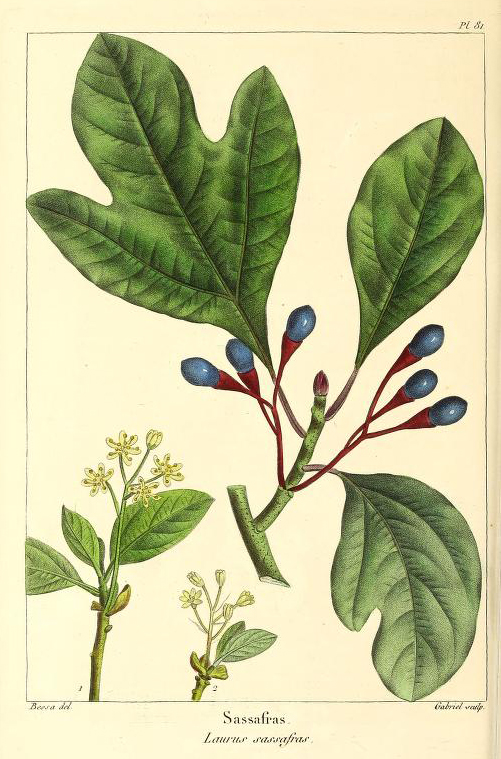
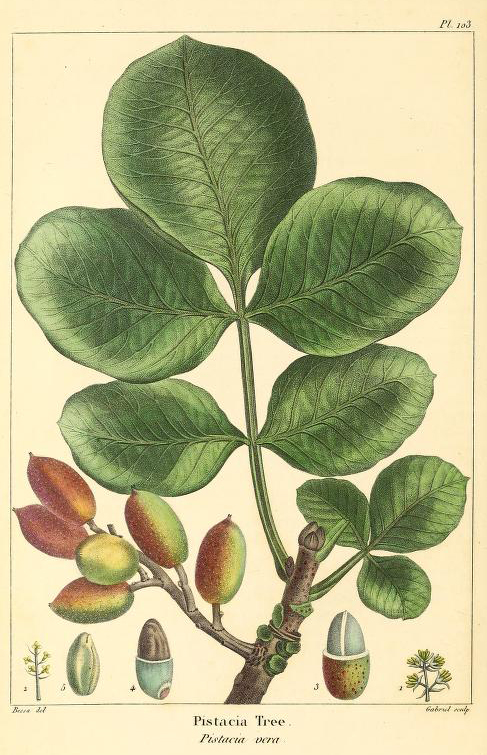
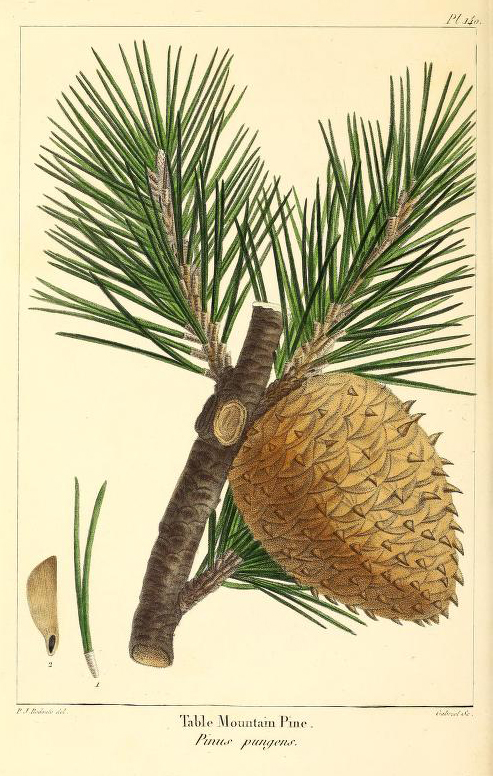
Exploring the First American Silva

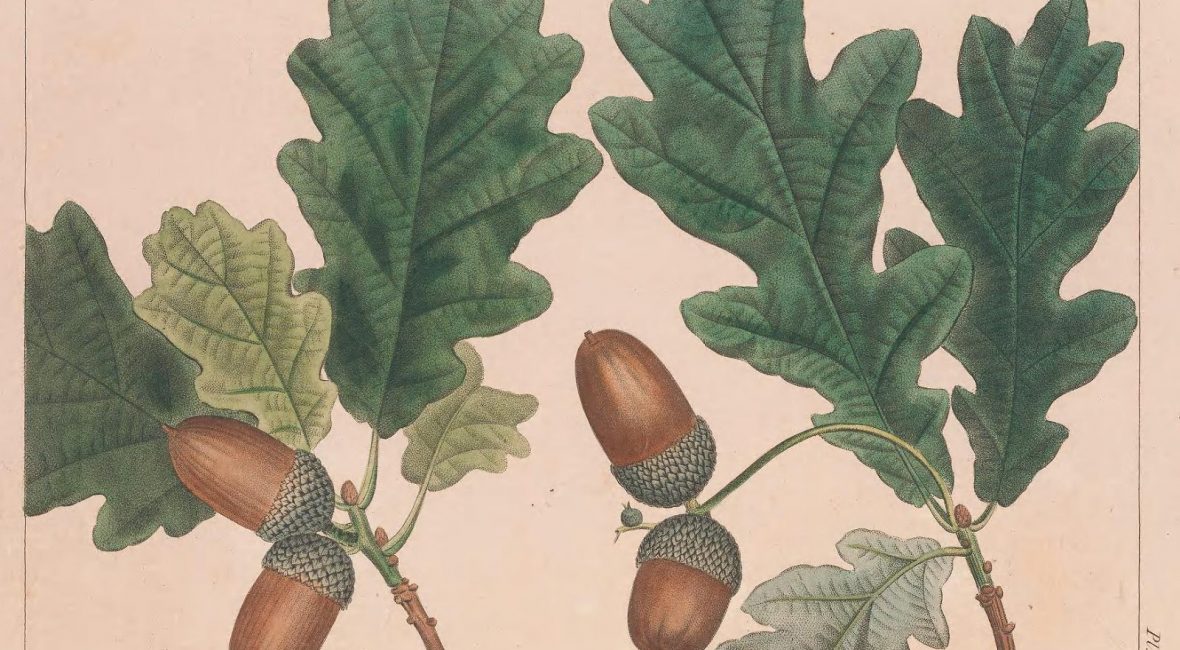
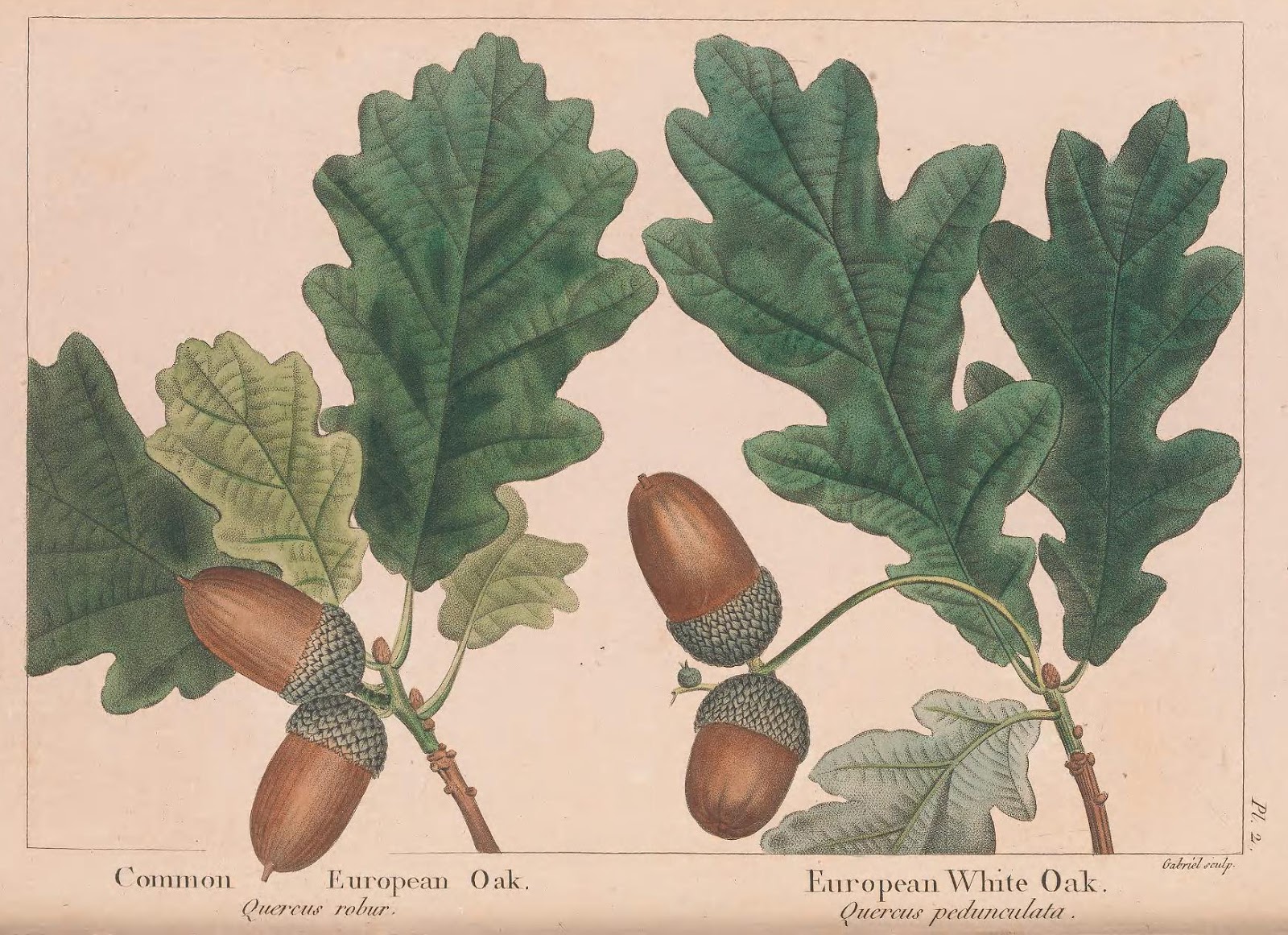
Michaux, François-André. The North American Sylva. v. 1 (1853). Digitized by Smithsonian Libraries. http://s.si.edu/2BeA2nl.

The North American Sylva is a beautiful scientifically and historically-significant work. Authored by François-André Michaux, it is the first American silva – a descriptive flora of forest trees. Published originally in French in 1810, the first English version appeared in 1817, and it was further enhanced with supplementary volumes by Thomas Nuttall in the 1840s.

As an important work in the history of North American botany, The North American Sylva is featured in the National Museum of American History’s Cultivating America’s Gardens exhibit, co-curated by Smithsonian Libraries, Smithsonian Gardens, and the Archives of American Gardens. On display in the exhibit is an 1853 edition of the work, published by Robert P. Smith of Philadelphia. The Smithsonian Libraries has digitized this copy and made it freely available in the Biodiversity Heritage Library.

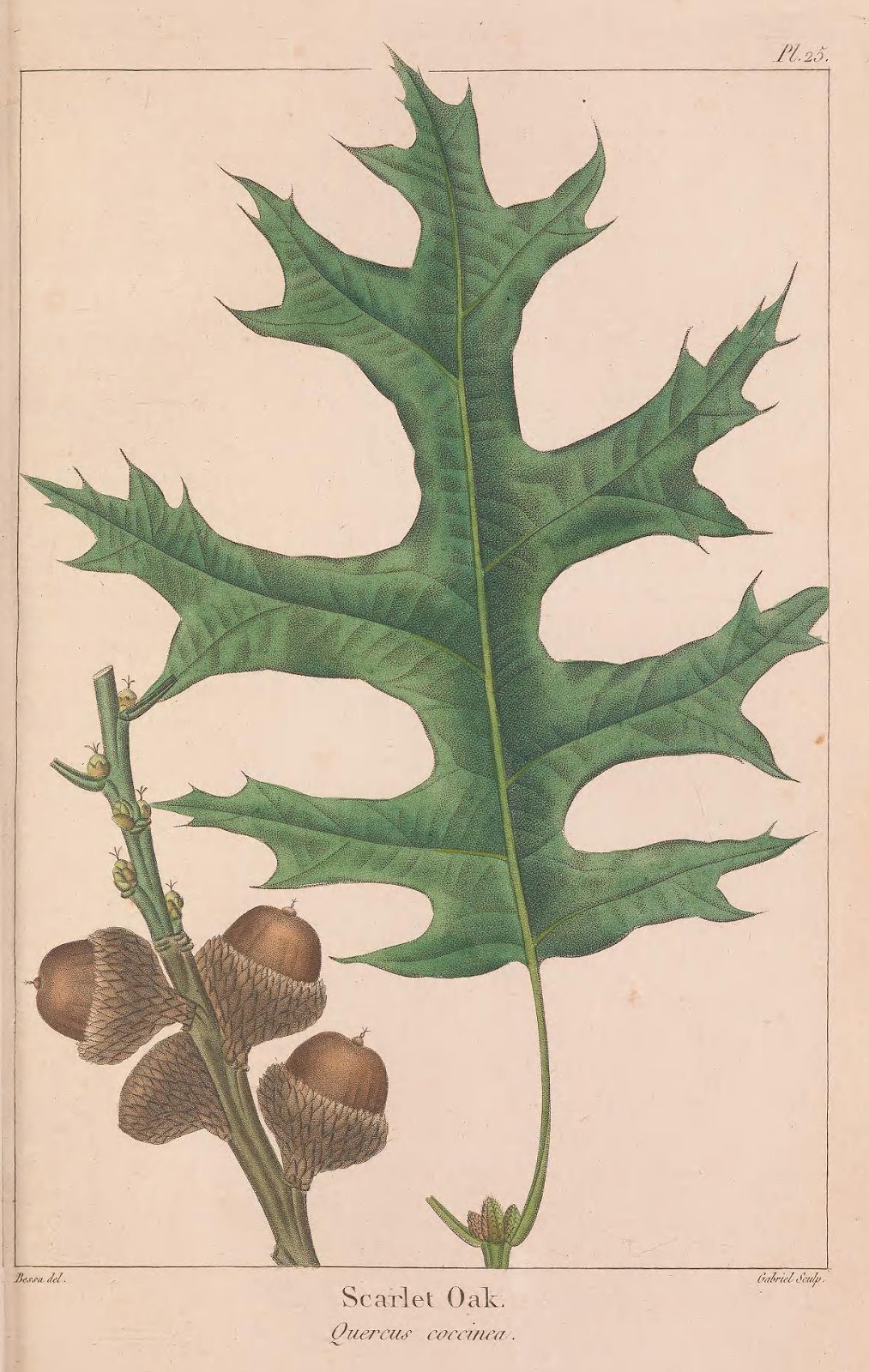
Michaux, François-André. The North American Sylva. v. 1 (1853). Digitized by Smithsonian Libraries. http://s.si.edu/2AmCYOY.

The Smithsonian Libraries’ copy is just one of many editions and printings of this title, which has a rather long and complicated history.

François-André Michaux was the son of André Michaux, also a famed botanist and explorer. In 1785, as the Royal Botanist to Louis XVI, André received a royal commission to travel to America to collect unique plants and identify useful tree species. François-André, then fifteen years old, accompanied his father, and together, the father-son team explored eastern North America, establishing two nursery gardens in New Jersey and South Carolina, and collected specimens, shipping plants and seeds back to France.

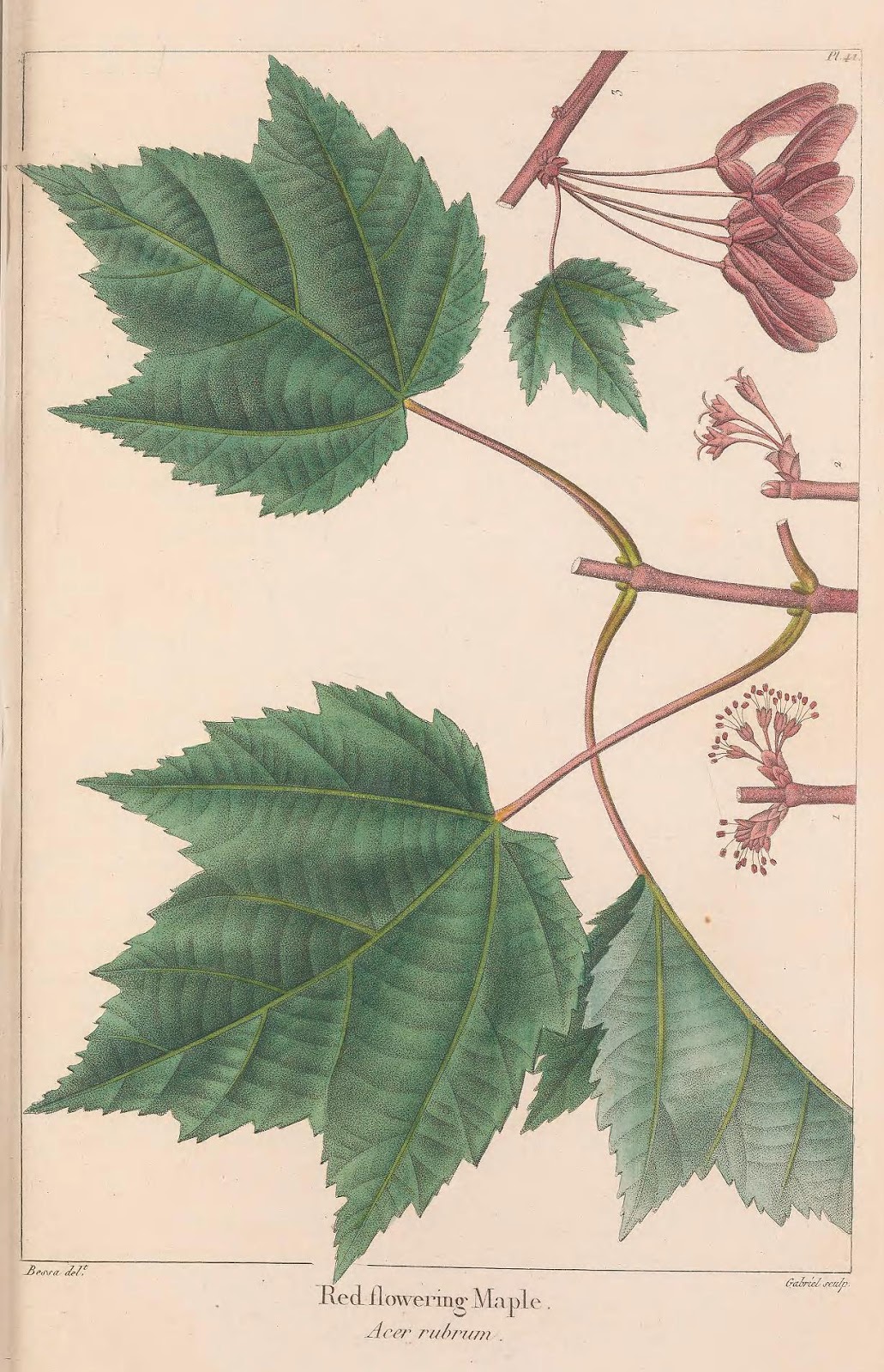
Michaux, François-André. The North American Sylva. v. 1 (1853). Digitized by Smithsonian Libraries. http://s.si.edu/2BcTfpH.

In 1789/90, François-André returned to France, and six years later, his father did the same. The duo then prepared André’s Histoire des chênes de l’Amérique (1801) on North American oaks. This work would later serve as the basis for The North American Sylva. François-André would return twice again to North America, in 1801-03 and again in 1806-08, where he continued to develop his passion for trees and forestry.

Eventually, François-André would channel this passion into the production of a magnificent work on the trees of eastern North America: Histoire des Arbres Forestiers de l’Amerique Septentrionale. While his father André would not live to see this publication, having died in 1802 during a scientific voyage bound for Australia, his influence on his son’s botanical career was profound.

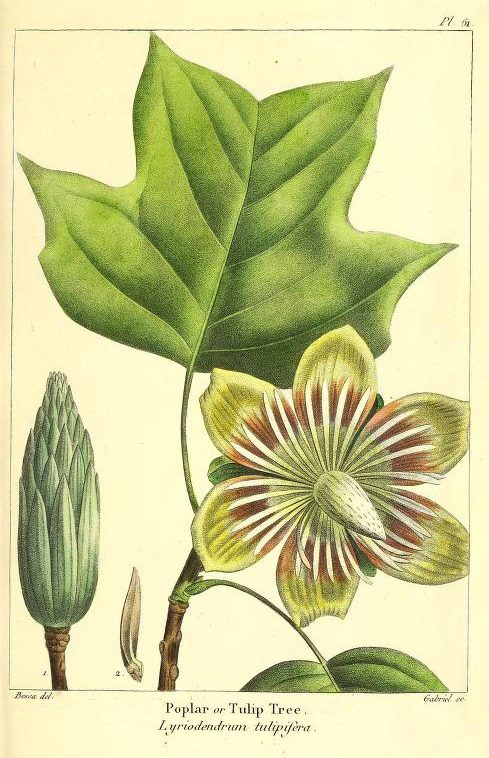
Michaux, François-André. The North American Sylva. v. 2 (1853). Digitized by Smithsonian Libraries. http://s.si.edu/2j4RbbW.

Originally published in Paris in 1810 and consisting of 3 French volumes, Histoire des Arbres Forestiers de l’Amerique Septentrionale was later translated into English by Michaux. Colleagues at the American Philosophical Society helped arrange the publication of the first translated edition, which was printed by C. d’Hautel in Paris in 1817 under the title The North American Sylva and sold by Thomas Dobson of Philadelphia. The translation was expected to be published in six half-volumes, but later printings included a seventh half volume, six additional plates, and a revised English text by Augustus L. Hillhouse.

The work was beautifully illustrated with 156 copper plate engravings executed from drawings by Pierre-Joseph Redouté (one of the most-celebrated flower painters in the whole history of botanical art), Pancrace Bessa, Adèle Riché, and Henri-Joseph and Antoine-Ferdinand Redouté. Each treated species is accompanied by an illustration printed in color and finished by hand depicting the tree’s branch, leaves, flowers, and fruit.

Michaux, François-André. The North American Sylva. v. 2 (1853). Digitized by Smithsonian Libraries. http://s.si.edu/2BdK4Fk.

In 1841, the first truly American edition of The North American Sylva was printed in New Harmony, Indiana by expert printer William Amphlett using the original engraved copper plates, which had been secured by philanthropist William Maclure during a trip to Paris with the intention of producing an American edition of Michaux’s work. The 1841 New Harmony edition was a reprint of an 1819 Paris edition which was the first to include Hillhouse’s revised English translation.

The New Harmony edition was also the first whose title page mentioned three supplemental volumes by Thomas Nuttall describing trees from the “Trans-Mississippi” region, the Rocky Mountains, and the western United States. Nuttall was an English naturalist who arrived in North America in 1808 and participated in a series of collecting trips throughout the United States under the auspices of some of America’s most pre-eminent botanists. This, together with the publication of his Genera of North American Plants in 1818, secured his reputation as America’s leading botanist.

Michaux, François-André. The North American Sylva. v. 3 (1853). Digitized by Smithsonian Libraries. http://s.si.edu/2k7s1FW.

Nuttall began work on a revised version of The North American Sylva in 1839. Over a seven-year period, he produced his three-volume supplement printed in Philadelphia, with volume one, parts one and two published by Judah Dobson in 1842 and 1843, volume two published by T. Ward in 1846, and volume three published by Smith and Wistar in 1849.

The volumes included 120 additional plates prepared and executed under Nuttall’s supervision by E.D. Long, G. Worley, G. West, J.T. French, and J.B. Butler based on drawings by several artists, including William Gambel. The original drawings are in the Archives of the Arnold Arboretum (Cambridge) at the Botany Libraries of Harvard University.

Michaux, François-André. The North American Sylva. v. 3 (1853). Digitized by Smithsonian Libraries. http://s.si.edu/2zXQFzt.

Following Maclure’s death, the original copper plates for The North American Sylva were acquired by Samuel George Morton of Philadelphia, after which another American edition was produced, augmented with notes by horticulturalist John Jay Smith, who served as editor of The Horticulturist from 1855 to 1860 and The American Gardener’s Calendar in 1857. The Smithsonian’s 1853 copy in BHL includes Smith’s notes.

More editions and printings followed, amounting to a total of more than a dozen known editions in multiple printings and formats. The long-running publication of the work is a testament to its impact and importance. Indeed, The North American Sylva served as a standard reference for North American woody plants throughout 19th century.

Thanks to the Smithsonian Libraries and many other BHL partners and contributors, you can freely explore several different editions and printings of The North American Sylva in the Biodiversity Heritage Library:

  • First French edition (1810) (Digitized by The New York Botanical Garden)
  • 1819 Paris edition with English translation by Hillhouse (Digitized by University of Pittsburgh Library System)
  • Nuttall’s supplements, 1842-49 (Digitized by The New York Botanical Garden)
  • 1853 edition (Digitized by Smithsonian Libraries)

If you’re in the Washington, D.C. area and would like to see a copy of The North American Sylva in person, be sure to visit the Cultivating America’s Gardens exhibit, on display at the National Museum of American History through August 2018.

Sources

Fraser, Susan M., Sally A Leone, Gregory Long, Marta McDowell, and David Sibley. 2017. The Trees of North America. New York: Abbeville Press.

Reviewed Work: The North American Sylva. 1858. The North American Review, vol. 86, No. 179, pp. 359-368).

March 29, 2018by Grace Costantino
BHL News, Blog Reel, Tech Updates

Introducing the New and Improved BHL Blog

screenshot of the bhl blog homepage

Welcome to the new and improved BHL blog!

To provide you with a better user experience, we’ve updated the design, navigation and functionality of the BHL blog. Continue reading to learn more about our new features.

Subscribe to the Blog

To stay up-to-date with all the latest posts, subscribe to our blog to receive each new post via email.

Improved Navigation

top menu for the bhl blog

Our new top menu makes it easy to navigate to different types of content, including news, featured books (including our popular Book of the Month series), user stories, campaigns (like Monsters are Real and Garden Stories), and technical updates.

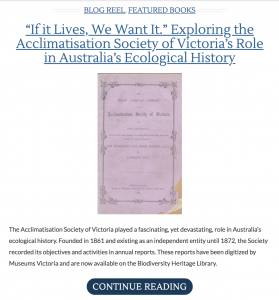
Additionally, to reduce scrolling and provide a cleaner interface, each post will display an excerpt with the option to “continue reading” to view the full post.

example of an excerpt from the bhl blog

Homepage Content Highlights

featured content block on the bhl blog homepage

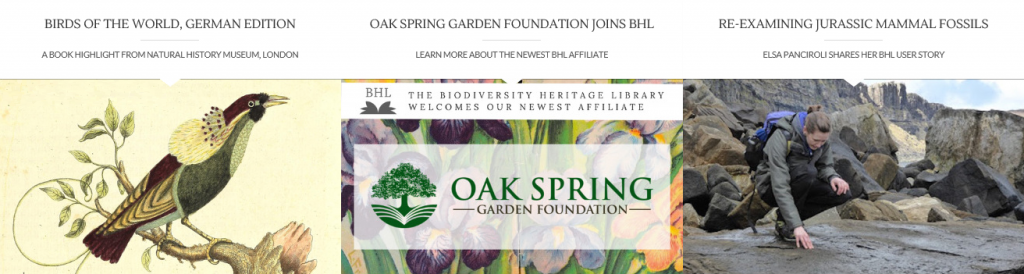
It’s easier than ever to stay up-to-date with our latest news, book highlights, and user stories thanks to our new featured highlights on the blog homepage. Check back regularly to see what’s new at BHL!

Subscribe to Your Favorite Topics

graphic showing how to subscribe to an rss feed on the bhl blog

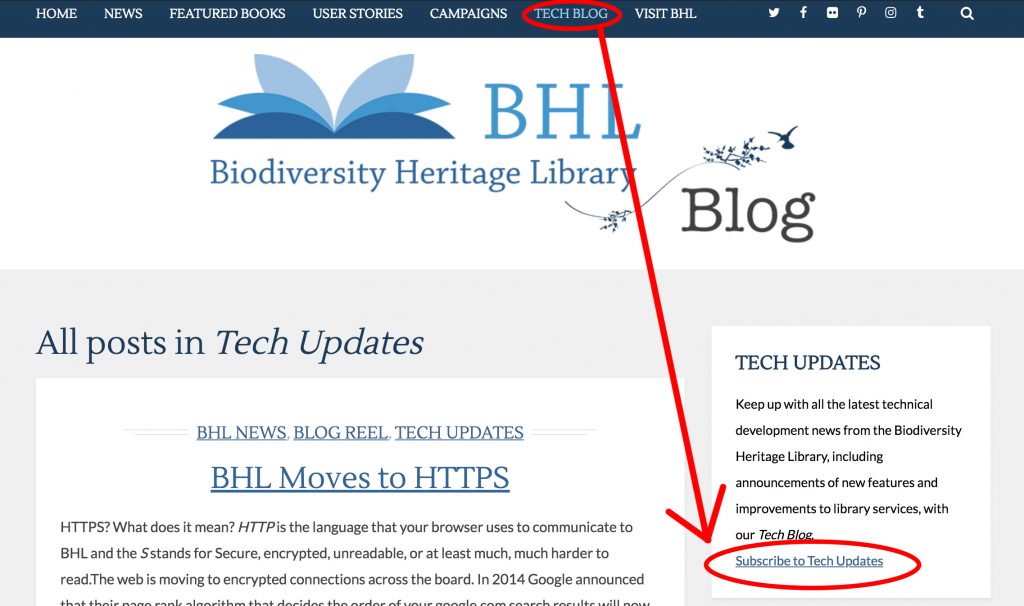
Interested in particular topics, like technical updates or book highlights? With our new RSS feeds, you can easily stay up-to-date with the content that matters to you.

Simply navigate to your favorite topics using the top menu and click the “subscribe” link on the right-hand side to subscribe to that topic’s RSS feed.

Note: You will need an “RSS feed reader” to use this service.

Share and Connect via Social Media

blue circle buttons with social media logos in white

With our new social sharing buttons, it’s easy to share any post via your favorite social platform.

blue circle buttons with social media logos in white

Plus, be sure to check out our social profiles and feeds in the sidebar to stay connected with BHL and explore treasures from our collections.

Questions or Comments?

We’re excited about these improvements to our blog, and we hope you are too! If you have any questions or comments, don’t hesitate to contact us.

March 22, 2018by Grace Costantino
Blog Reel

Planned BHL Downtime: 0900 GMT on 3/5/18

BHL will be unavailable due to network maintenance starting 0900 GMT on Monday March 5, 2018. This downtime may last up to a few hours. During this time you may access our collection via the Internet Archive.

Thank you for your patience.

March 2, 2018by Grace Costantino
BHL News, Blog Reel

BHL Internship Opportunity: Digital Content Internship

The Biodiversity Heritage Library is looking for a Digital Content Intern for Summer 2018.

Hosted through the Smithsonian Libraries, this is an unpaid, virtual internship. Interns will work remotely and should should have their own computer and internet access, as well as video conferencing capability.

Applications are open until 23 March 2018 or until filled.

Internship Description:

The BHL Digital Content Intern will work closely with the Digital Collections Manager to contribute digitized books and metadata to the BHL collection. Interns will learn various digitization workflow tools to track collection management and curation activities, enhance metadata, and process digital files for inclusion. Routine activities will include identifying key gaps in BHL’s collection, preparing digital books and catalog records for upload, adding descriptive item and page level metadata, ensuring copyright compliance and documenting workflow tasks.

Ideal candidates will possess great attention to detail and a demonstrated ability to communicate proactively and work independently. Preference given to students with metadata or cataloging experience. Students enthusiastic to learn about collection management and curation in digital libraries are strongly encouraged to apply.

How to Apply:

All applications must go through the Smithsonian Online Appointment System: https://solaa.si.edu. Select Smithsonian Institution Libraries as the unit, Smithsonian Institution Libraries Internship Program as the program and then the “Biodiversity Heritage Library Digital Content (VIRTUAL)” project.

Questions or comments? Send us feedback or write to [email protected].

February 13, 2018by Grace Costantino
Page 13 of 71« First...10«12131415»203040...Last »

Help Support BHL

BHL's existence depends on the financial support of its patrons. Help us keep this free resource alive!

search

About BHL

The Biodiversity Heritage Library (BHL) is the world’s largest open access digital library for biodiversity literature and archives. BHL operates as a worldwide consortium of natural history, botanical, research, and national libraries working together to digitize the natural history literature held in their collections and make it freely available for open access as part of a global “biodiversity community.”

Join Our Mailing List

Sign up to receive the latest news, content highlights, and promotions.

Subscribe Now

Subscribe to Blog via Email

Enter your email address to subscribe to this blog and receive notifications of new posts by email.

Join 319 other subscribers

Subscribe to Blog Via RSS

Subscribe to the blog RSS feed to stay up-to-date on all the latest BHL posts.

Access RSS Feed

Inspiring Discovery through Free Access to Biodiversity Knowledge.

The Biodiversity Heritage Library makes it easier than ever for you to access the information you need to study and explore life on Earth…for free, anytime, anywhere.


64+ Million Pages of
Biodiversity Literature Online.

EXPLORE

Tools and Services
to Transform Research.

EXPLORE

300,000+
Illustrations on Flickr.

EXPLORE

ABOUT | HARMFUL CONTENT | PRIVACY | SITE MAP | TERMS OF USE