Biodiversity Heritage Library - Program news and collection highlights from BHL
  • Home
  • News
  • Featured Books
    • All Featured Books
    • Book of the Month Series
    • BHL at 20
  • User Stories
  • Campaigns
    • Fossil Stories
    • Garden Stories
    • Monsters Are Real
    • Page Frights
    • Her Natural History
    • Earth Optimism 2020
  • Tech Blog
  • Visit BHL
Home
News
Featured Books
    All Featured Books
    Book of the Month Series
    BHL at 20
User Stories
Campaigns
    Fossil Stories
    Garden Stories
    Monsters Are Real
    Page Frights
    Her Natural History
    Earth Optimism 2020
Tech Blog
Visit BHL
  • Home
  • News
  • Featured Books
    • All Featured Books
    • Book of the Month Series
    • BHL at 20
  • User Stories
  • Campaigns
    • Fossil Stories
    • Garden Stories
    • Monsters Are Real
    • Page Frights
    • Her Natural History
    • Earth Optimism 2020
  • Tech Blog
  • Visit BHL
Biodiversity Heritage Library - Program news and collection highlights from BHL
Blog Reel, Featured Books

The National Park Service, Historic Surveys, and the Hunt for Documentation

View Full Size Image
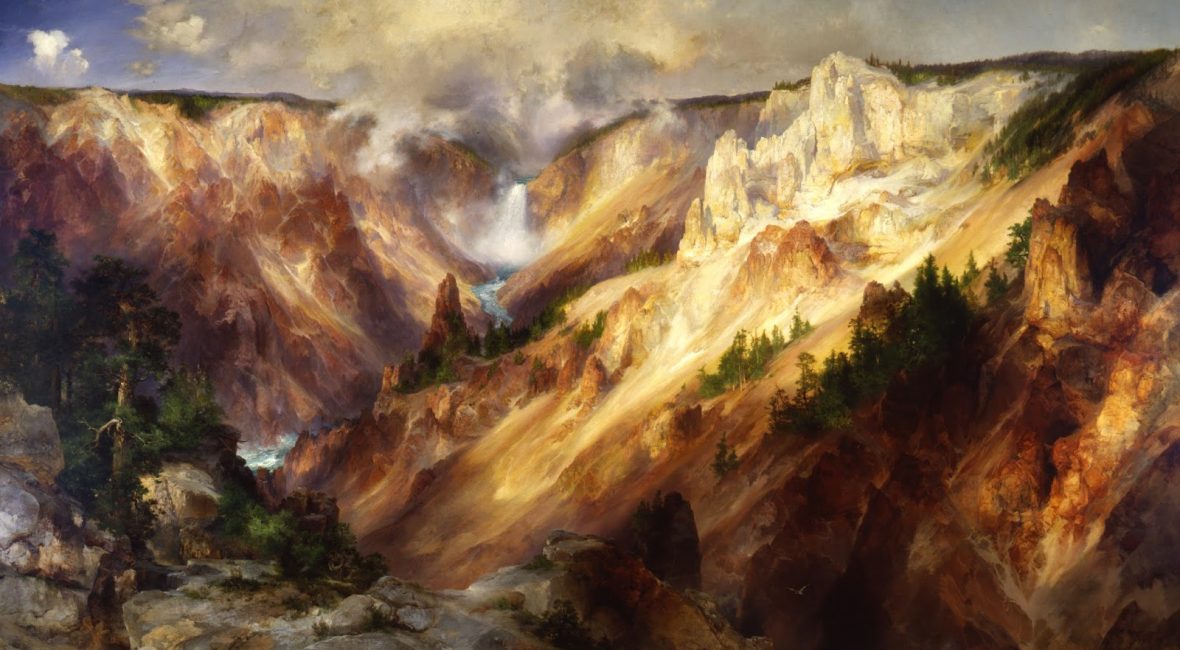
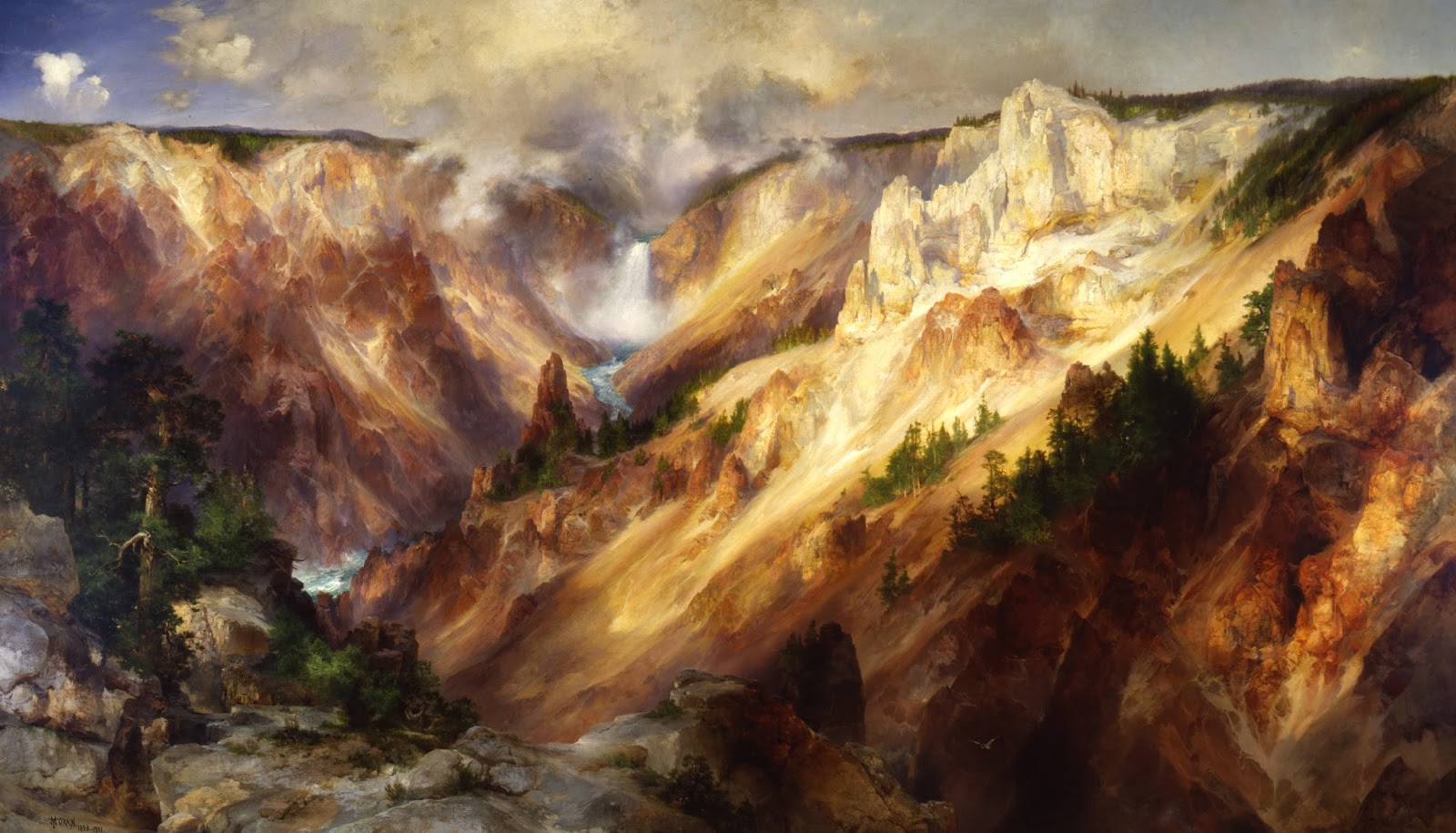
“The Grand Canyon of the Yellowstone” by Thomas Moran, artist for Hayden Survey 1871. Smithsonian American Art Museum, Gift of George D. Pratt. Courtesy of Wikipedia Commons.

This year is the National Park Service’s Centennial anniversary. In recognition, we thought we would take a look at one of the geological surveys that inspired the founding of Yellowstone National Park. In recent months, researchers in increasing numbers have looked for specimens and field documentation relating to Yellowstone, specifically from the Hayden Geological Survey of 1871. This survey is important for a number of reasons. It was the first federally funded survey, and was instrumental in introducing the American public to Yellowstone’s natural wonders. It inspired Congress to establish Yellowstone as the first national park in 1872.

Smithsonian is a repository for specimens and documentation from the Hayden Geological Survey and numerous others relating to the U.S. territories during the nineteenth century. However, it can be surprisingly challenging to find the documentation and specimens from these surveys. This challenge is not unique. Any researcher who has worked with historic material can attest to the challenges of locating materials as decades and centuries pass. Smithsonian Institution was the main repository for the Hayden Geological Survey, but field notes and specimens can end up in many other places. Expedition members may have taken specimens and documentation back to their home institutions, specimens may have been loaned to researchers, others may have been kept as personal mementoes.

The Hayden Survey of 1871 provides an example, because it not only demonstrates the importance of the primary documentation (these specimens and field notes provide a baseline of description for studying Yellowstone’s changing environment), but also how documentation scatter, even when it relates to such a well-known survey. The challenges discussed are prime reasons Natural Sciences institutions around the world are working diligently to make their materials and description available online, so that even if the materials are physically separated, they can be reconnected digitally.

Where are the specimens?

Leslie Hale, Curator at the Division of Mineral Sciences, National Museum of Natural History, shared some of her experience trying to locate these materials for researchers. “By all accounts, every rock they picked up on every Yellowstone expedition of the 1870’s allegedly came here. But I have only located a few drawers full…. I have been able to identify rocks collected in [subsequent Hayden surveys] ’72, ’73, and ’78, but none that I am certain are from that so-important first trip in 1871. There are specimen labels, but that’s it, no field notebooks or any other ancillary documentation.”
View Full Size Image
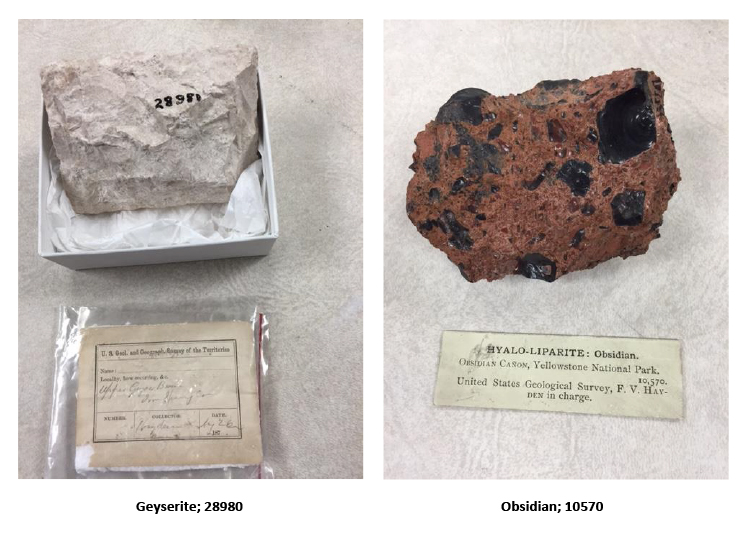
Geyserite (Catalog number 28980) from upper geyser basin and Obsidian (Catalog number 10570) collected at Yellowstone during the Hayden Geological Surveys. Specimens are part of the Volcanology and Petrology collection at the Department of Mineral Sciences, National Museum of Natural History.

It turns out that the specimens can have a pretty interesting journey of their own, due to changing norms in scientific disciplines and institutions over the decades. During much of the Smithsonian’s history, curator positions could be honorary and thus not always a paid position. Leslie shared, “It was not uncommon for them [curators] to remove specimens as payment. I believe that is what happened to most of these specimens.”

So where are these specimens now? Some went to other institutions, most likely with Survey participants. Some are now in private collections as some institutions have sold off portions of their rock and mineral collections (as did, for example, the Philadelphia Academy of Sciences in 2011).

Where are the field notes?

Hayden used his field notes to compose an extensive report that described the expedition work in the Yellowstone area during 1871. The notes were subsequently lost. This loss has been particularly troubling since other publications prepared from the field notes or Hayden’s personal recollections years later contain errors that cannot be checked against the original source.
 

View Full Size Image
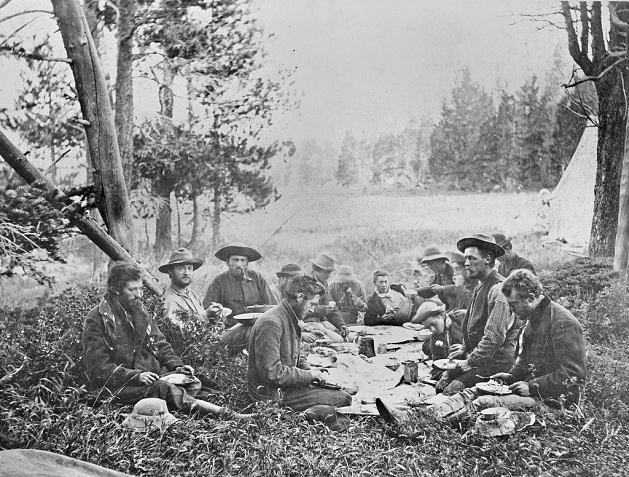
Hayden Survey participants at dinner during 1872. Includes West, Carrington, Taggart, William H. Jackson, Jay Cox, Clifford De V. Negley, and William Henry Holmes. Smithsonian Institution Archives. Record Unit 95, Box 56, Folder 2. 1872.

Luckily other field notes and letters from the expedition exist. However these cannot provide as full a picture as the expedition leader’s notes. In 1999, a book was published by University of Nebraska Press entitled Yellowstone and the Great West: Journals, Letters, and Images from the 1871 Hayden Expedition, which pieced together a description of the expedition from the diaries of George Nelson Allen (geologist) and Albert C. Peale (mineralogist) and correspondence by expedition members. In order to create a comprehensive narrative, Merrill (the book’s editor) relied on correspondence from expedition members found in numerous archives across the country, including the Library of Congress, U.S. Geological Survey Field Registry Library (Colorado), National Archives, Academy of Natural Sciences in Philadelphia, and Oberlin College Archives (Ohio) just to name a few.

This published work only serves to demonstrate how much was lost with Hayden’s notes. According to a review published during 2000 in ISIS, a journal of the history of science society, the selected diary entries and correspondence demonstrate that Hayden was significantly involved in the expedition’s scientific work, far more than initially believed. The fate of Hayden’s field notes was not unique for the survey. Journals from the survey in general are difficult to locate or were also lost. According to the book’s preface, Allen’s and Peale’s journals are the only known unpublished journals to still exist.

Where are the publications?

In 1872, Hayden used his field notes to compose a single report covering the 1871 survey, entitled Preliminary report of the United States Geological Survey of Montana, and portions of adjacent territories : being a fifth annual report of progress, which is available in Internet Archive and will shortly be available in BHL. His final report documented several years’ worth of his surveys in the field.
View Full Size Image
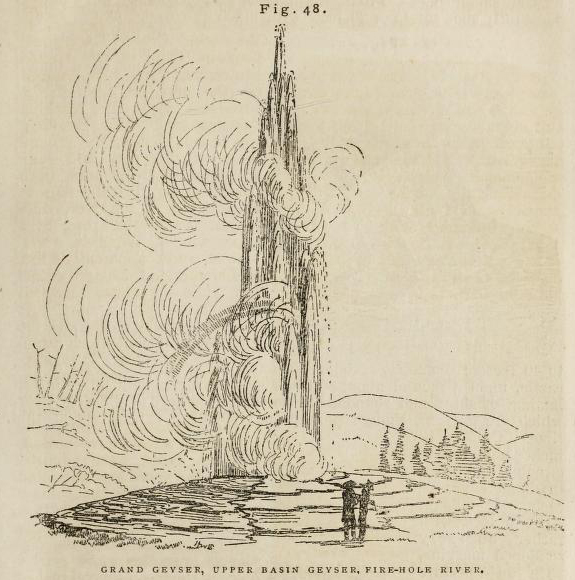
Illustration of the Grand Geyser, the tallest predictable geyser known. It was named by Dr. F.V. Hayden in 1871. Preliminary report of the United States Geological Survey of Montana, and portions of adjacent territories : being a fifth annual report of progress. (1872).

Also available through BHL is a Catalogue and index of the publications of the Hayden, King, Powell, and Wheeler surveys (1904), which provides a list of publications relating to the study of specimens in numerous fields collected during the Survey.

The rest of the story…

The survey of 1871 was one of several that Hayden directed as part of the U.S. Geological and Geographical Survey of the Territories during 1867-1879. He was one of four men, (Clarence King, George Wheeler, and John Wesley Powell) who defined exploration of the western U.S. territories during the 1860’s and 1870’s. Reports describing his explorations and those of Powell, Wheeler and King can be found on the Biodiversity Heritage Library.
View Full Size Image
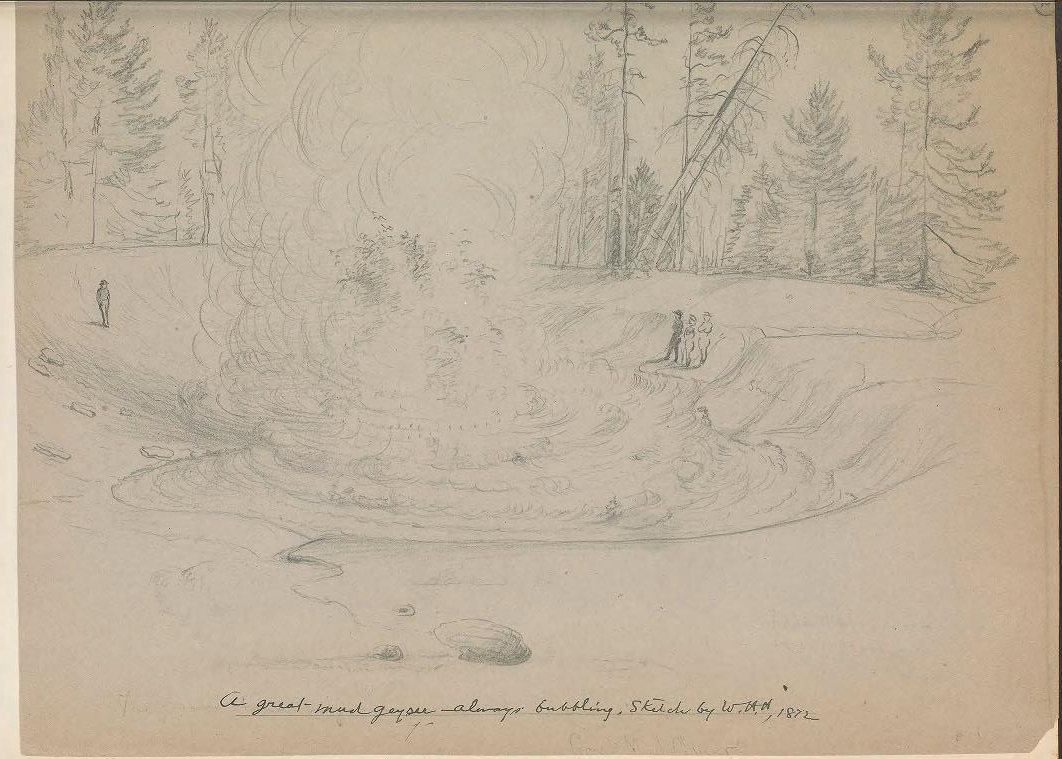
Sketch by William Henry Holmes, drawn during 1872 Hayden Geological Survey. Random records of a lifetime, 1846-1931 [actually 1932]. Digitized by Smithsonian Libraries for The Field Book Project.

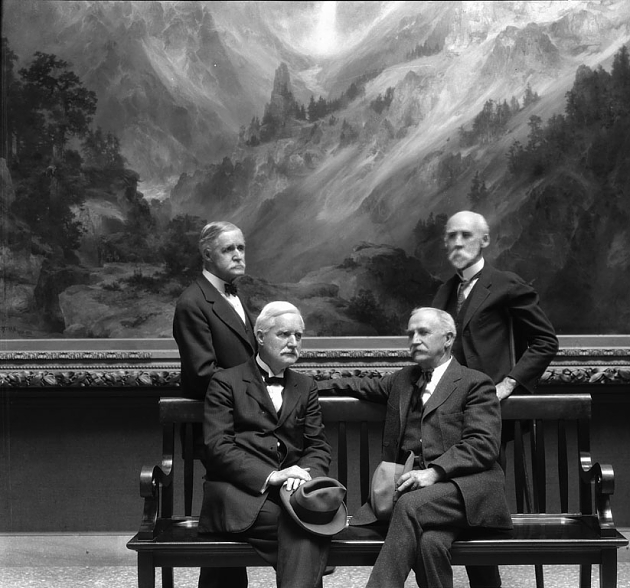
Primary source materials from later Hayden surveys to Yellowstone can be found in Smithsonian Institution holdings, including The William Henry Holmes autobiography (typewritten manuscripts detailing Holmes’ life and work), which are held by the American Art and Portrait Gallery Library. Holmes was appointed as the artist-topographer on the Hayden Survey in 1872. In 1874 he was appointed assistant geologist, and he served in this capacity during the 1878 Hayden Survey. Two of Holmes’ volumes have been digitized and are currently available in Internet Archive (vol. 2 | vol. 3). The third volume specifically deals with the 1872 and 1878 Hayden Surveys. Both volumes will be added to the BHL collection soon.
View Full Size Image
William Henry Holmes with other members of the Hayden Survey, at the U.S. National Museum, circa 1930. Smithsonian Institution Archives, Record Unit 311, Box 27, Folder 7.

The story of the 1871 survey highlights the risks to documentation, even from a historically important expedition that appealed to the public of its day and produced important changes in the nation, including our first national park. Documentation can end up in seemingly disparate locations; through online consortiums these materials are being made available in new ways, restoring important historic context, sometimes lost for decades.
August 25, 2016by ulib-libraryjobs
BHL News, Blog Reel

BHL Receives 2015 Digitizing Hidden Special Collections and Archives award for Field Notes Project

The Council on Library and Information Resources (CLIR) has selected the “Biodiversity Heritage Library Field Notes Project” for a 2015 Digitizing Hidden Special Collections and Archives award. The award of $491,713 will help support increased accessibility to original scientific documentation found in archival field notes in participating institution collections.

Field notes provide valuable, primary research data about species and ecosystems that is often unpublished or unavailable through other sources. They can also be extremely valuable for museum research, providing key specimen data related to study sites, collecting details, and ecology.

View Full Size Image
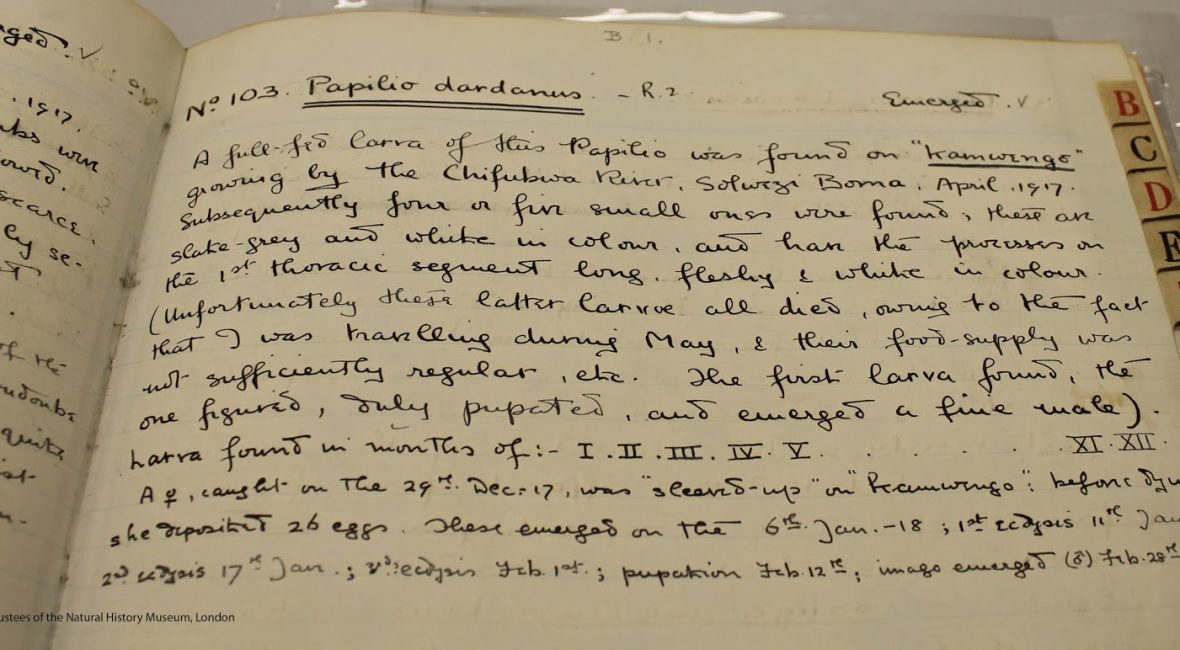
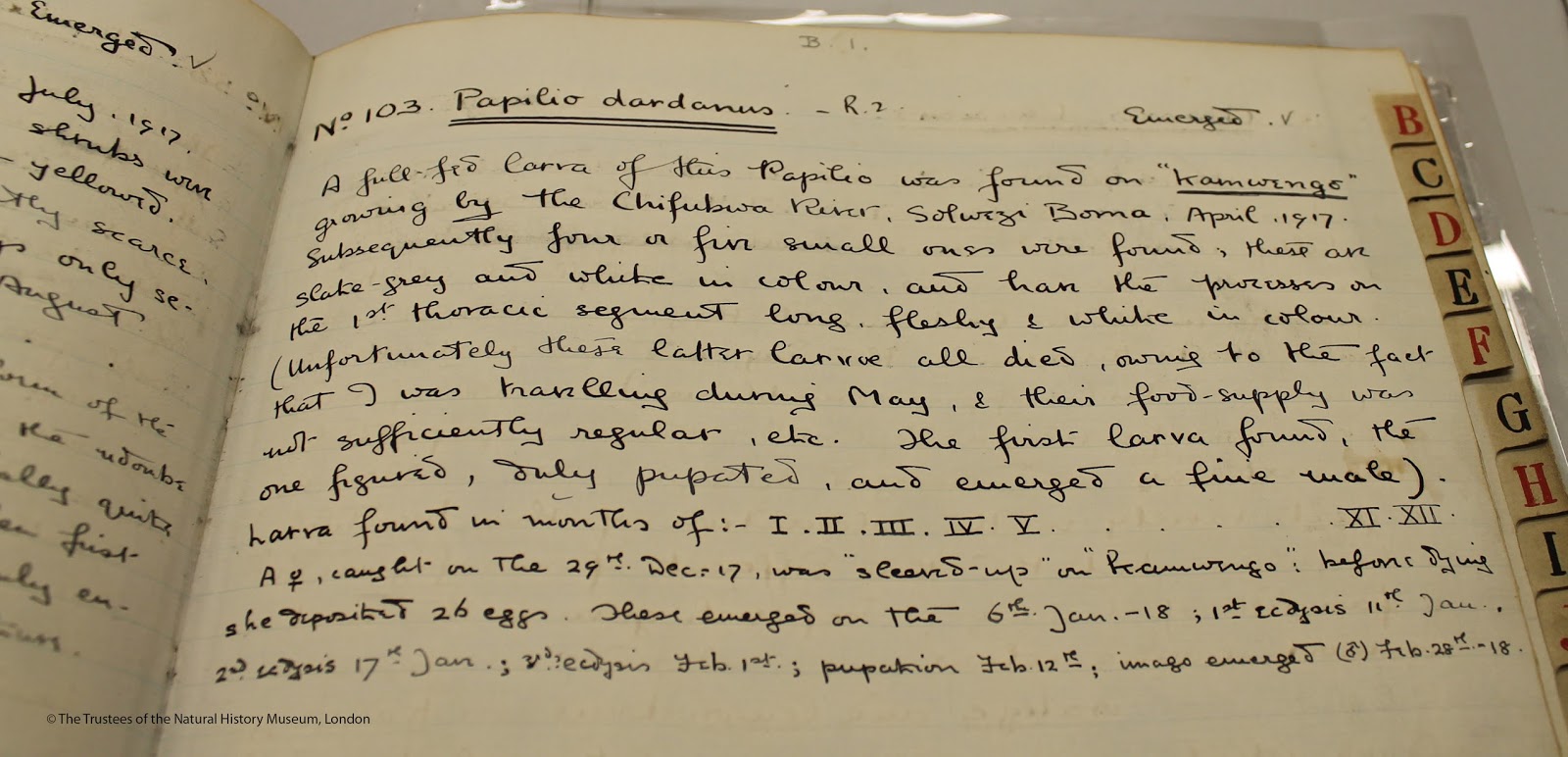
Hereward Chune Dollman’s scientific notes, held in the Natural History Museum, London, Library and Archives. Image © The Trustees of the Natural History Museum, London. Image credit: Natural History Museum, London, Library and Archives.

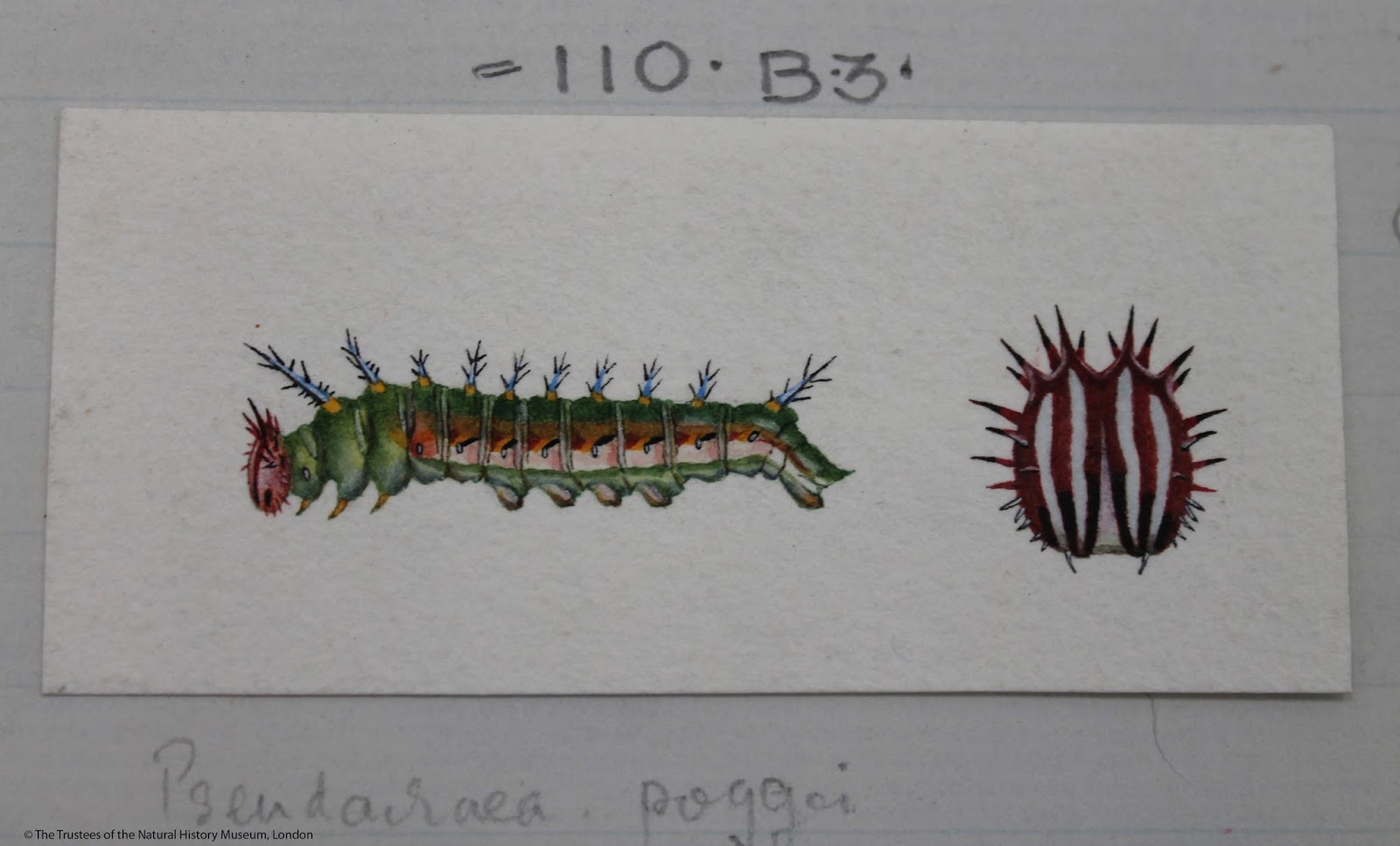
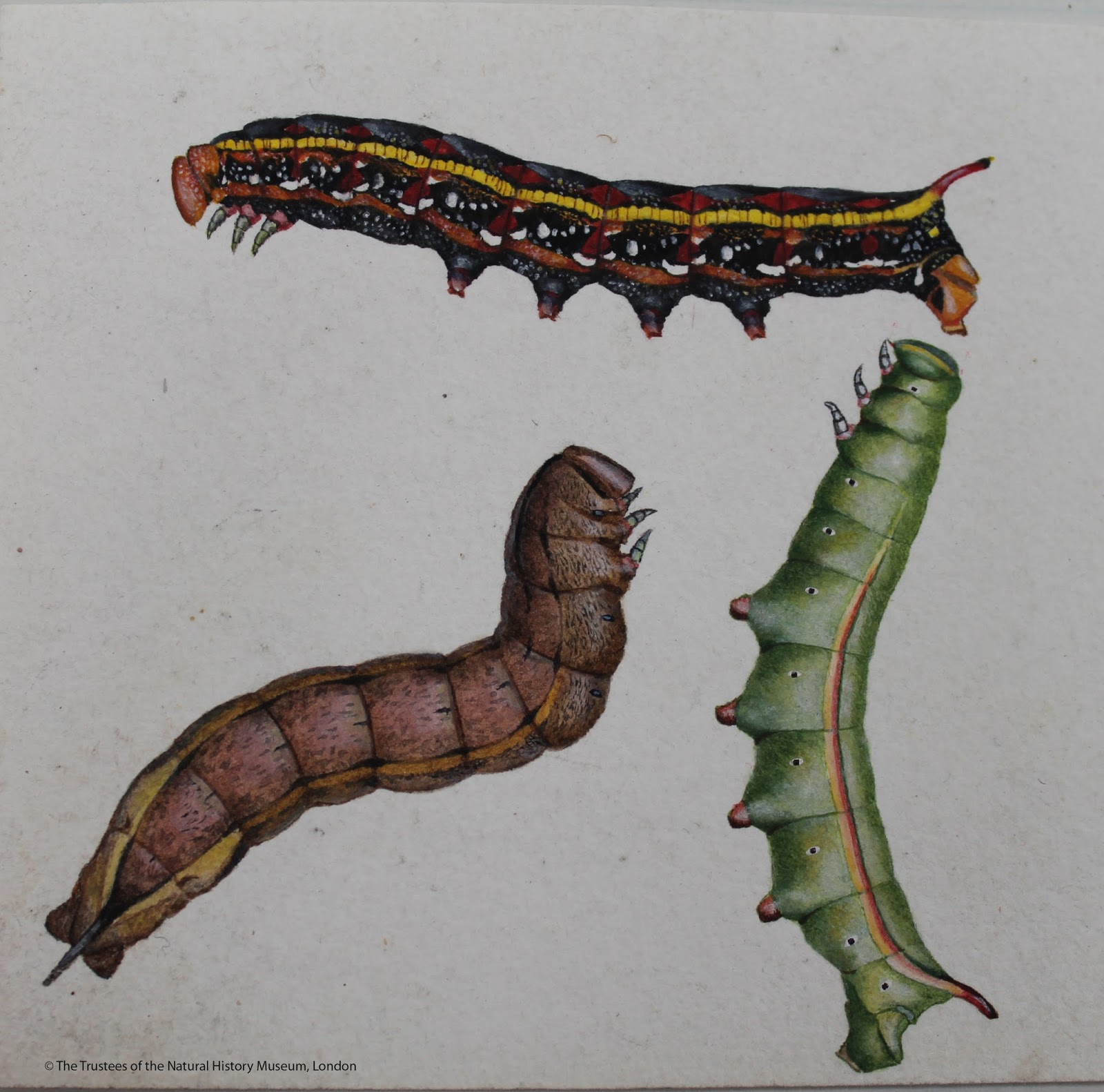
A recent article in The Linnean (VOL 31(2) OCT 2015) by Hellen Pethers (Reader Services Librarian, Library and Archives, Natural History Museum, London, UK) and Dr. Blanca Huertas (Senior Curator of Lepidoptera, Life Sciences Department, Natural History Museum, London, UK) illustrated the importance of field notes to museum research. The paper focuses on the collections of Hereward Chune Dollman, an entomologist who worked extensively on the natural history and identification of insects in Zambia. Dollman’s natural history collections, which were donated to the British Museum of Natural History (now the Natural History Museum, London) upon his death, include 3,500 butterfly specimens comprising 300 species, 157 watercolor drawings of caterpillars, and a notebook containing data related to his breeding and collecting. Dollman’s caterpillar illustrations link directly to his scientific notes through unique identification codes, thus allowing researchers to explore details of the caterpillars’ lives, their transformation to adult forms, and the study sites from which Dollman collected. The watercolors are the only record of the immature counterparts of the adult specimens that Dollman studied.

View Full Size Image
Watercolor from Hereward Chune Dollman’s collection at the Natural History Museum, London, Library and Archives. Image © The Trustees of the Natural History Museum, London. Image credit: Natural History Museum, London, Library and Archives.

Dollman’s collections were never consolidated with the main museum’s collection, and thus have been little studied even though they contain important specimens from remote locations in Africa that are not widely represented in other collections. Recent initiatives at the Natural History Museum are working to amalgamate and arrange collections by taxonomy, providing greater accessibility to researchers. Dollman’s notebook, held in the museum’s Library and Archives, provides researchers will invaluable information necessary to effectively and efficiently study these collections and articulates the importance of field notes to scientific research and the necessity of collaboration between library and specimen collections.

View Full Size Image
Watercolor from Hereward Chune Dollman’s collection at the Natural History Museum, London, Library and Archives. Image © The Trustees of the Natural History Museum, London. Image credit: Natural History Museum, London, Library and Archives.

While this case study at NHM provides an example of one attempt to bring together disparate specimen and related field note collections, the disassociation of these two types of collections is common within institutions. What’s more, field notes from related persons and expeditions are often scattered across institutions, inaccessible to any but the determined researcher. The “Biodiversity Heritage Library Field Notes Project” aims to enhance research methodology by improving access to these field notes, thus allowing researchers to more easily connect them to related specimens and other scientific work.

Over a two year period, the BHL Field Notes Project will coordinate work to digitize field notes, assign metadata, and publish the field notes online through the Biodiversity Heritage Library and Internet Archive, with an emphasis on quality, quantity, and closely related content. The Smithsonian Libraries and Smithsonian Institution Archives will serve as the lead institutions on the project. Additional project participants include Missouri Botanical Garden, Peter H. Raven Library; American Museum of Natural History; Yale Peabody Museum; Harvard University Herbaria, Botany Libraries; Harvard University, Museum of Comparative Zoology, Ernst Mayr Library; University of California, Berkeley Museum of Vertebrate Zoology; The New York Botanical Garden, The LuEsther T. Mertz Library; The Field Museum; and Internet Archive.

The Digitizing Hidden Special Collections and Archives awards program, funded by The Andrew W. Mellon Foundation, funds projects in which locally executed protocols contribute to a national good, using methods that are cost efficient and subject to wider adoption. It supports the creation of digital representations of unique content of high scholarly significance that will be discoverable and usable as elements of a coherent national collection. Eighteen projects were selected from among one hundred sixty-seven proposals submitted in 2015. This is the first group of projects supported by the Digitizing Hidden Special Collections and Archives awards program.

January 7, 2016by michelle.underhill
BHL News, Blog Reel

Historic Field Diaries from BHL Australia Now in BHL!

This post was originally published on the Museum Victoria Blog. See the original post here.

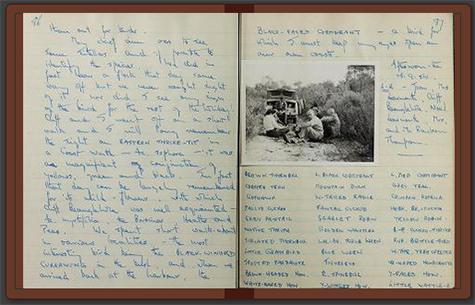
In November 2014, Museum Victoria started a project to digitize and transcribe the field diaries in our collection. These diaries, handwritten by Australia’s early field naturalists long before the days of electronic notetaking, are rich in scientific data and historic detail. They provide insights into past species distribution and abundance, as well as the trials and wonders experienced on historic expeditions.

View Full Size Image
Afternoon tea with Graham Brown (this diary, volume 4, is now viewable on the Biodiversity Heritage Library). Image: Museum Victoria. Source: Museum Victoria.

They are fascinating sources of information and yet very few people have ever read them. As handwritten documents, each was created as a single hard copy. They have been carefully stored in the museum’s archives for decades, protected from dust and light but inaccessible to anyone but the few curators who knew of their existence. Until now.

View Full Size Image
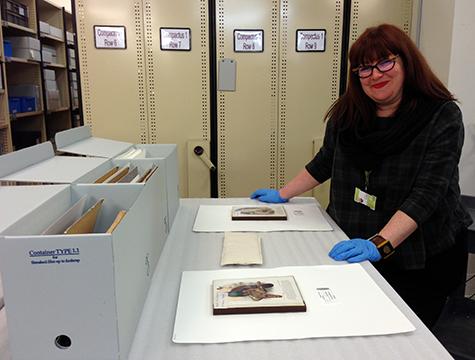
Rebecca Carland, Museum Victoria’s History of Collections Curator, with Graham Brown’s field diaries. Image: Nicole Kearney. Source: Museum Victoria.

Over the past nine months we have digitised 24 historic field diaries from our collection and have been steadily uploading them onto DigiVol, the online volunteer transcription portal developed by the Atlas of Living Australia and the Australian Museum. In DigiVol, the pages can be individually transcribed, with a verification process ensuring the quality of the result.

We are immensely grateful to the volunteers who have contributed their time and attention to transcribing our field diaries. Ten field diaries have been fully transcribed and the volunteers are now working on a diary written by notable ornithologist Frederick Lee Berney between 1898 and 1904.

The first collection of five field diaries to be run through the digitisation and transcription process was produced by Graham Brown between 1948 and 1958. Now that they have been transcribed, the contents of the diaries can be searched and the data extracted. When analysed, Brown’s diaries contained 5611 bird sightings, complete with dates and locations. This historic data will now be made available to scientists and can be used to inform climate change studies and species management plans.

View Full Size Image
A small fraction of the 5611 bird observations Graham Brown recorded in his diaries. Image: Nicole Kearney. Source: Museum Victoria.

The next step is to make the images of the field diaries available through a publicly accessible website. We have just uploaded four volumes of the Graham Brown field diaries and their transcriptions onto the Biodiversity Heritage Library, and we will continue to add more over time. Museum Victoria has already contributed over 500 rare books and historic journals to this global repository of historic literature (through a project funded by the Atlas of Living Australia). We are thrilled that our field diaries are now joining these other significant volumes.

Help us unlock the observations in our historic field diaries
If you would like to become a transcription volunteer, sign up on the DigiVol website.

August 18, 2015by ulib-libraryjobs
BHL News, Blog Reel

The Arcadia Fund Awards Grant to Support The Field Book Project

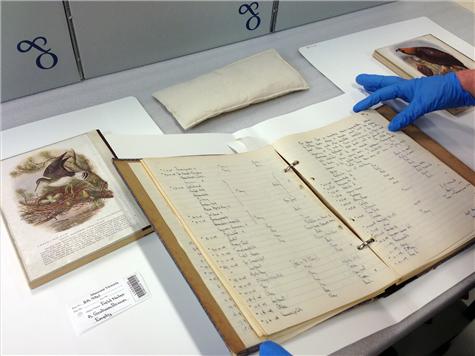
The Smithsonian Libraries received a $511,200 grant from the Arcadia Fund for The Field Book Project to provide free, online access to the Smithsonian’s field books on biodiversity research. Over a two-year period, the grant will support the cataloging of 2,000 field books and the digitization of 2,600 field books, which will be made openly available via multiple platforms, including the Smithsonian’s Collection Search Center and the Biodiversity Heritage Library (BHL).

The Smithsonian holds thousands of field books documenting the flora, fauna and ecosystems of the world. Launched in 2010, The Field Book Project is a collaboration to improve access to these field notes and other primary source documentation of field research related to biodiversity. As primary sources, field books are not only unique as material objects, but many also contain unique information on species and ecosystems – information that may be unpublished and unavailable through other sources.

View Full Size Image
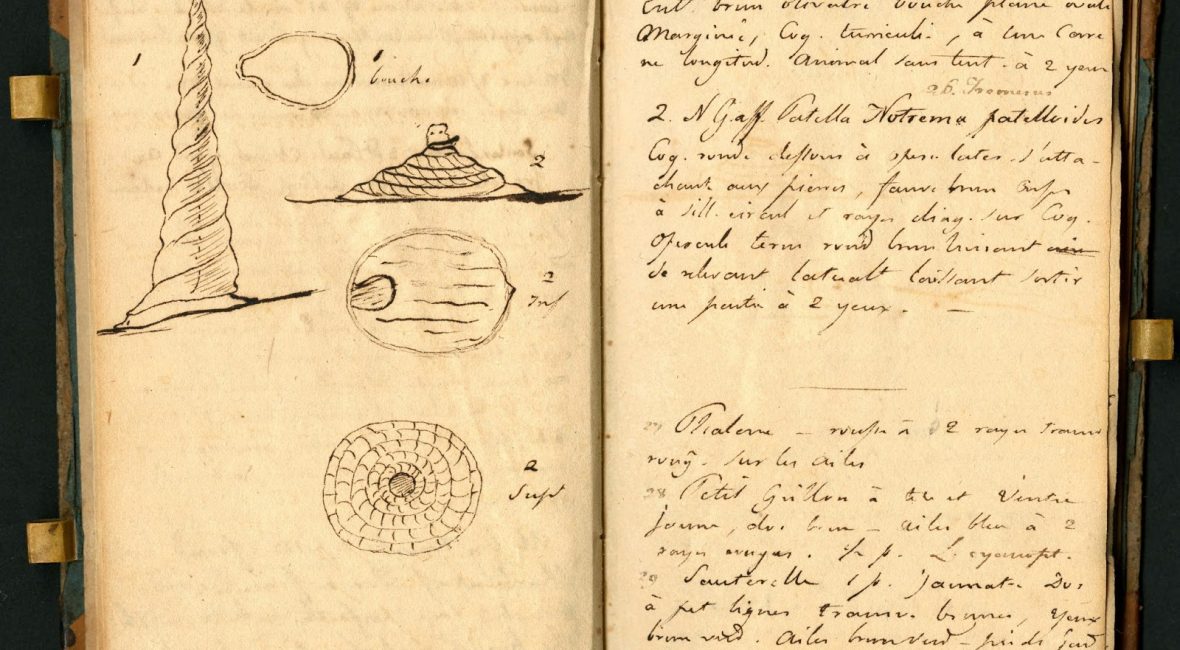
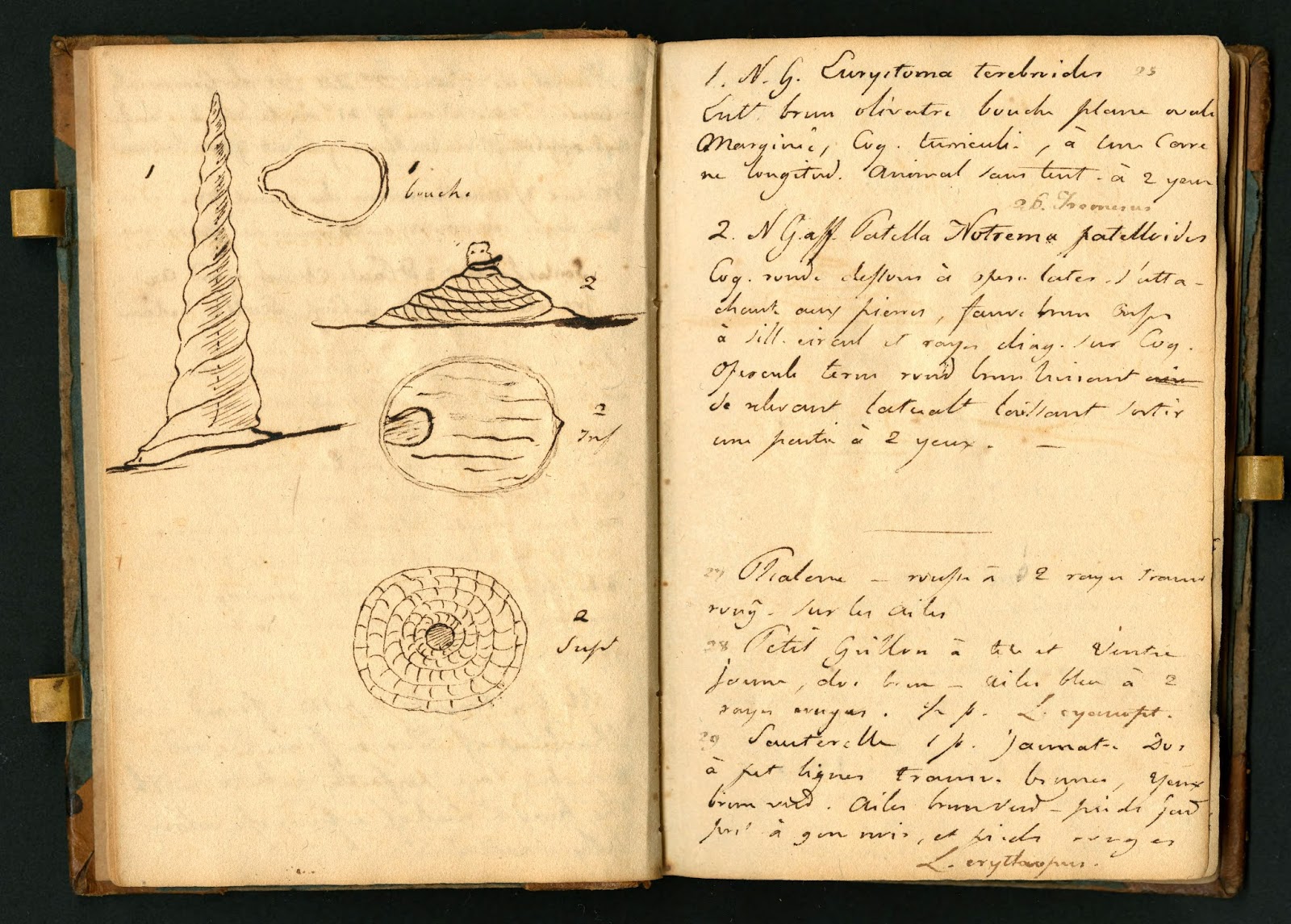
Rafinesque, C. S. (Constantine Samuel). Notebook kept by Rafinesque on a trip from Philadelphia to Kentucky, 1818. http://biodiversitylibrary.org/page/45995997. Made available in BHL as part of The Field Book Project.

The Smithsonian Libraries, the Smithsonian Institution Archives, BHL and the Smithsonian’s National Museum of Natural History will work closely together to conduct conservation reviews, catalog, digitize and provide open access to the natural history field books at the Smithsonian. “Bringing these works together with the published literature means we can begin to fill some of these information gaps to better understand ecosystem changes and the context behind the research. Such knowledge can empower scientists, regional and national leaders, and others to develop strategies for addressing biodiversity loss,” said Martin Kalfatovic, BHL program director.

View Full Size Image
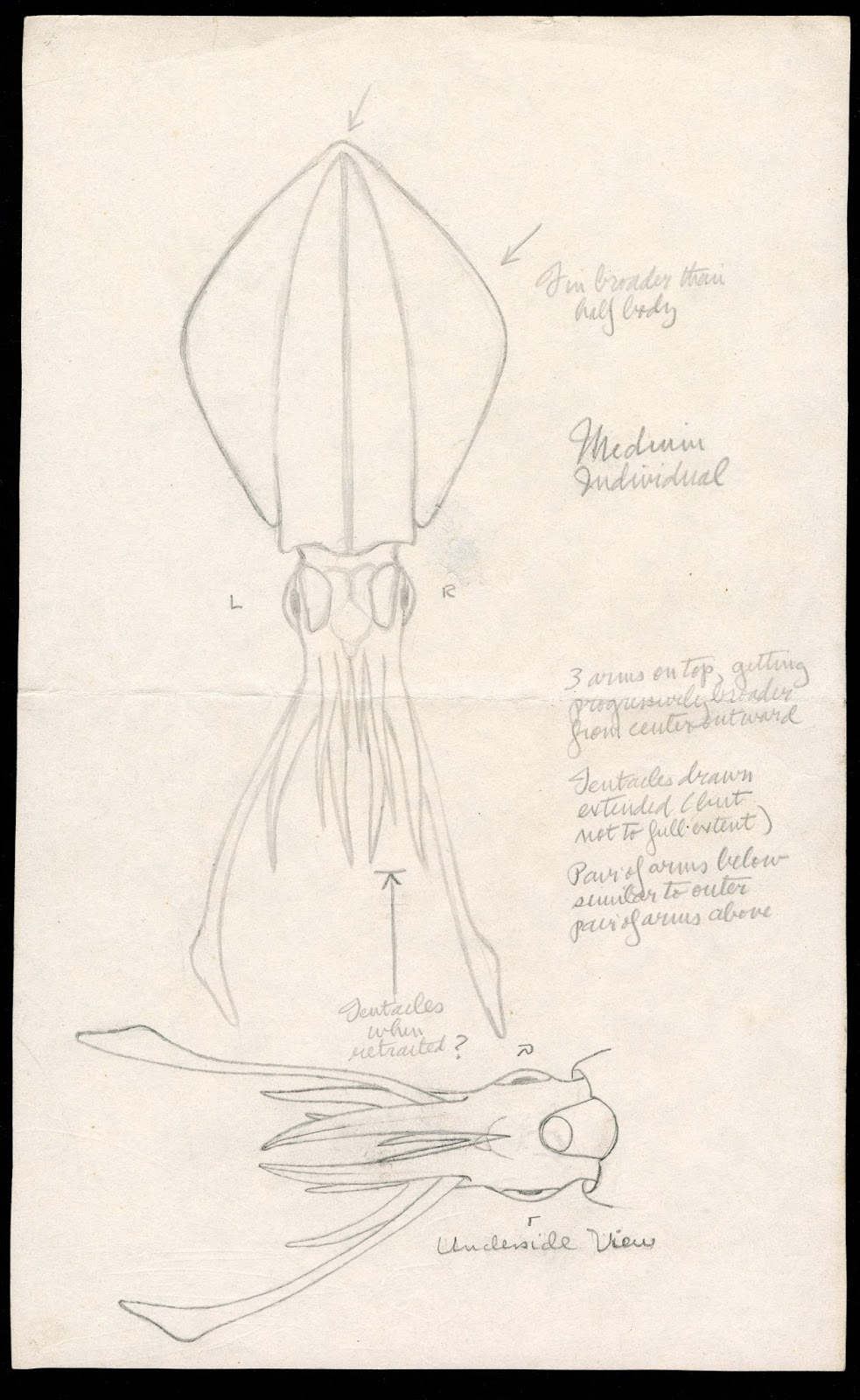
Moynihan, M. Cephalopoda (Squid) 1971-1973, 1975-1979, 1981-1982 (1 of 3). http://biodiversitylibrary.org/page/46283099. Made available in BHL as part of The Field Book Project.

The work of initiatives like The Field Book Project directly relates to the Smithsonian’s grand challenge of broadening access to collections. “Original field notes are often hidden in larger collections of archival material and are difficult to find,” explained Anne Van Camp, director of the Smithsonian Institution Archives. “Information contained in field books tells the stories of exploration, discovery and collecting events that have shaped our understanding of the natural world. The notes also provide deep insight into the personal nature of those individuals that first encountered the vast biodiversity across the Earth. Providing access to this information allows researchers to further understand the history of scientific exploration and to relate that past to the present.”

Browse over 500 field books from The Field Book Project in BHL. Stay tuned to our blog for future updates from The Field Book Project.

August 7, 2015by ulib-libraryjobs
Blog Reel, Featured Books

I spy something fowl…

Connecting Field Book Observations to Scientific Illustrations

Field books are important primary source materials for biodiversity research. Their pages are the first to document the thoughts, observations, musings, and raw data generated or gathered by a scientist while in the field. They are the foundation upon which published natural history literature is based.

The Field Book Project (FBP) is working to improve access to field books in the Smithsonian’s collections. Digitized versions of these field books are made available in the Biodiversity Heritage Library (BHL). There are currently over 500 field books from FBP in BHL.

One of these field books was written by Joshua F. B (Fry Bullitt) Camblos (1916-2012). Camblos was a medical doctor with a keen interest in ornithology, and his field books contain details about the birds, eggs, and nests he spied in the woods of Virginia. His field book available in BHL documents these observations from February-April 1934, including descriptions of nests, condition and appearance of eggs, area vegetation, and bird behavior.

Since there is such a strong correlation between field books and published literature, we thought it would be fun to expand on the theme and connect Camblos’ observations to published illustrations of some of the species he described. We turned our spyglass towards the BHL collection to uncover some of our favorite published illustrations. We then present Camblos’ description of the bird, nest, and eggs he found in Virginia in 1934 together with an illustration and a bit of information about the publication it came from.

We hope you enjoy our fowl-focused game of “I Spy” within the published and unpublished literature on BHL. Explore more field books from The Field Book Project in BHL and learn more about the program in this past post.

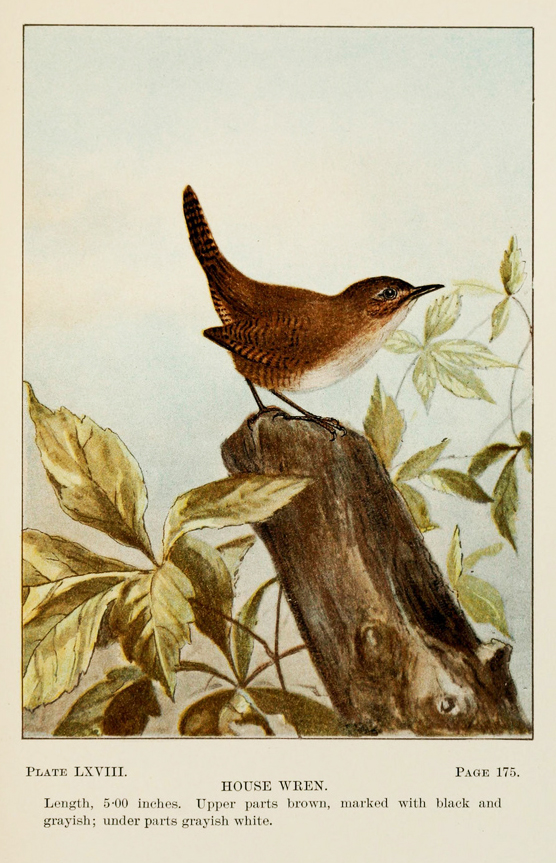
House Wren (Troglodytes aedon)

View Full Size Image

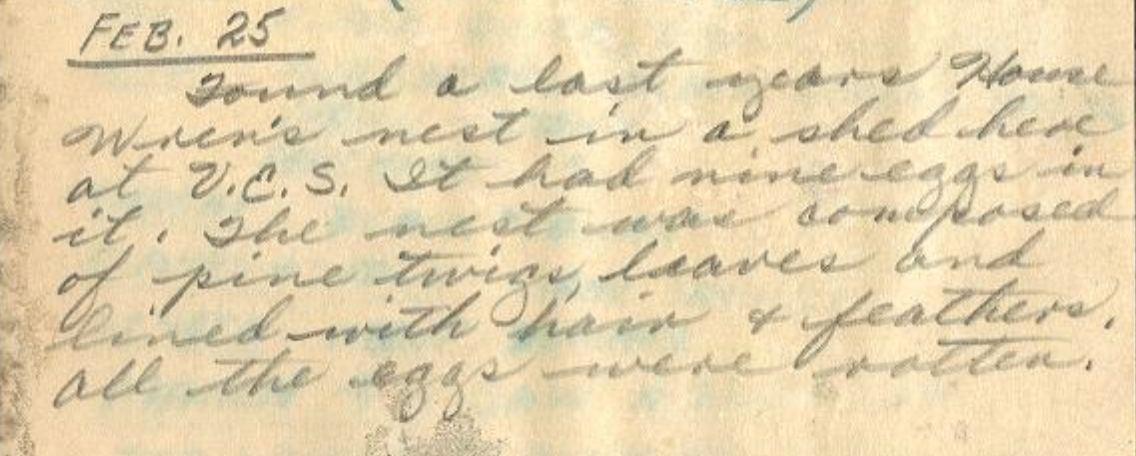
Camblos writes:
“Feb. 25
Found a last years House Wren’s nest in a shed here at V.E.S. It had nine eggs in it. The nest was composed of pine twigs, leaves and lined with hair and feathers. All the eggs were rotten.”

View Full Size Image
Chapman, Frank M. Bird-life: a guide to the study of our common birds. 1900. http://biodiversitylibrary.org/page/7855990.

Frank M. Chapman was an ornithologist, former Curator of Birds at the American Museum of Natural History, and founder of Bird-Lore, which became Audubon Magazine. In 1900 he proposed the idea of the Christmas Bird Count (CBC), an annual census of birds in the Western Hemisphere performed to this day and administered by the National Audubon Society. He also wrote many field guides, such as Bird-life: a guide to the study of our common birds, which was illustrated by wildlife artist Ernest Thompson Seton, who was also one of the founding pioneers of the Boy Scouts of America (BSA).

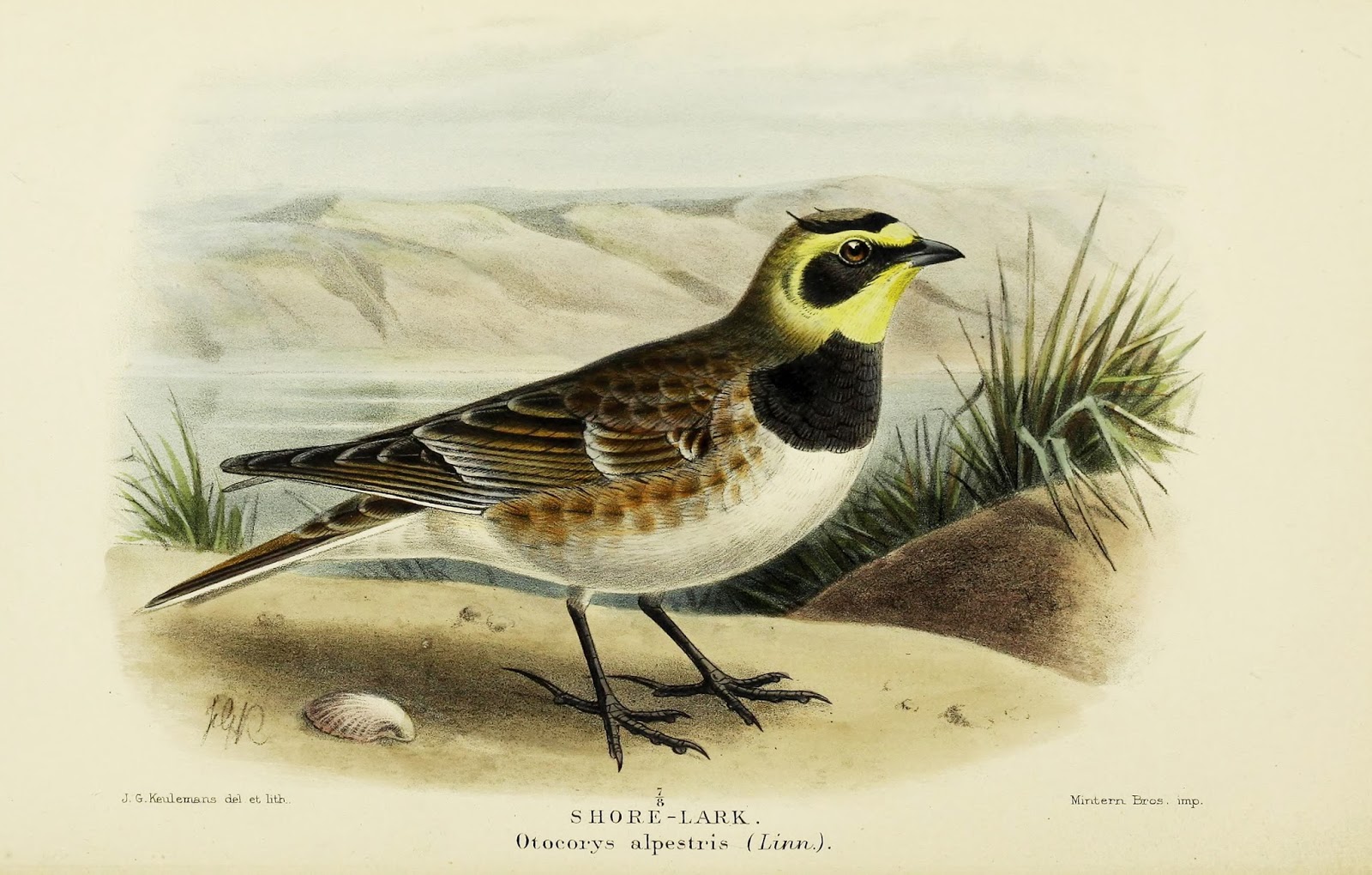
Horned Lark (called shore lark in Europe) (Eremophila alpestris)

View Full Size Image

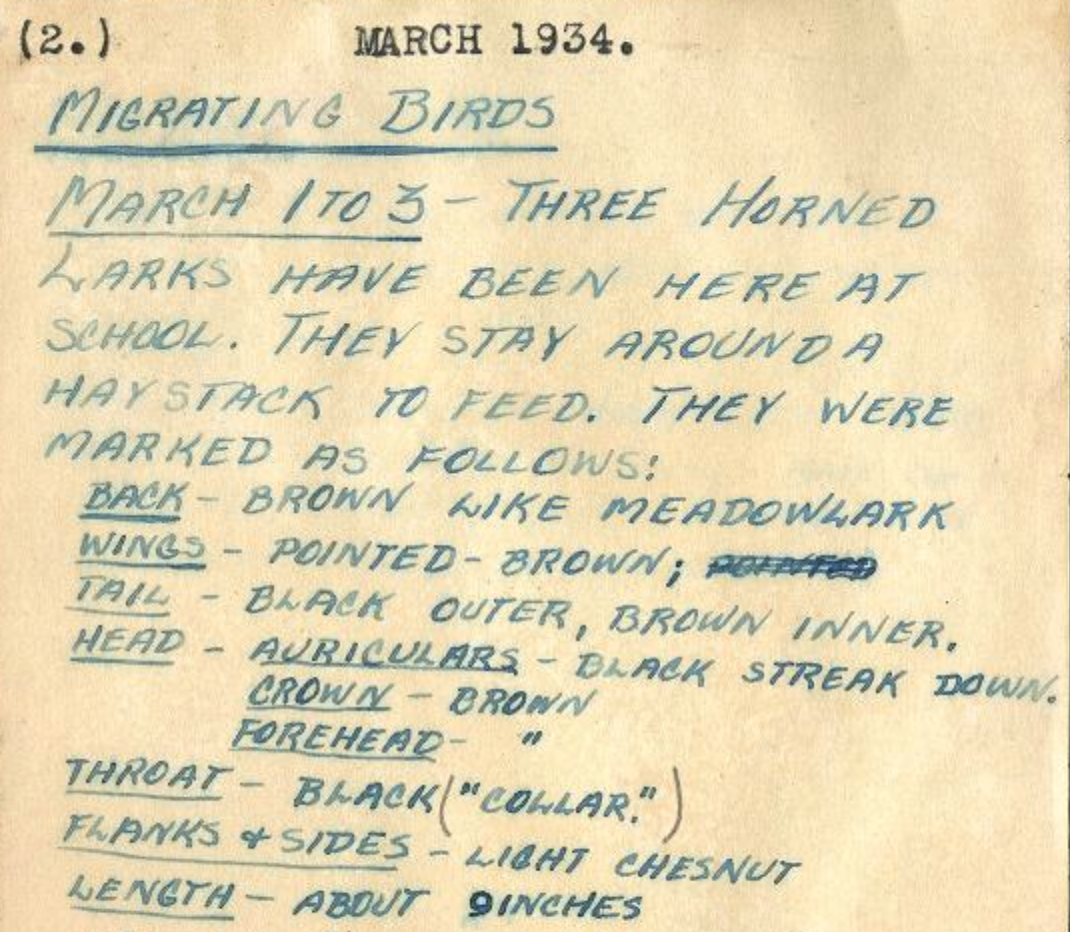
Camblos writes:
“March 1 to 3 – Three horned larks have been here at school. They stay around a haystack to feed. They were marked as follows:
Back – Brown like meadowlark
Wings – Pointed brown
Tail – Black outer, brown inner
Head – Auriculars – Black streak down.
Crown – Brown
Forehead – ”
Throat – Black (“collar.”)
Flanks and Sides – Light chesnut
Length – About 9 inches.”

View Full Size Image
Lord Lilford. Coloured figures of the birds of the British Islands. v. 4 (1885-97). http://biodiversitylibrary.org/page/43081338.

Thomas Littleton Powys, 4th Baron Lilford, was a British aristocrat and ornithologist. He was one of the eight founders of the British Ornithologists’ Union in 1858 and its President from 1867 until his death. His book Coloured Figures of the Birds of the British Islands, was completed by Osbert Salvin (best known for co-authoring Biologia Centrali-Americana) after his death, and was illustrated by the famous bird artist Johannes Gerardus Keulemans.

Great Horned Owl (Bubo virginianus)

View Full Size Image

Camblos writes:
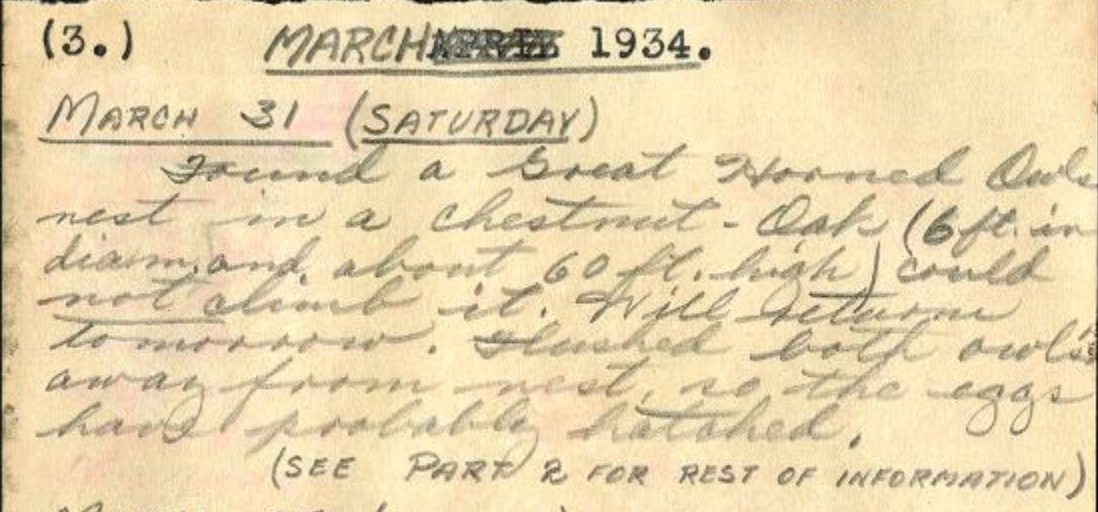
“March 31 (Saturday)
Found a Great Horned Owl’s nest in a chestnut-oak (6 ft. in diam. and about 60 ft. high) could not climb it. Will return tomorrow. Flushed both owls away from nest, so the eggs have probably hatched. (See part 2 for rest of information)”

True to his word, Camblos continues the narrative of the great horned owl the following day, with a story that involves chicks and skeletons. Check it out!

View Full Size Image
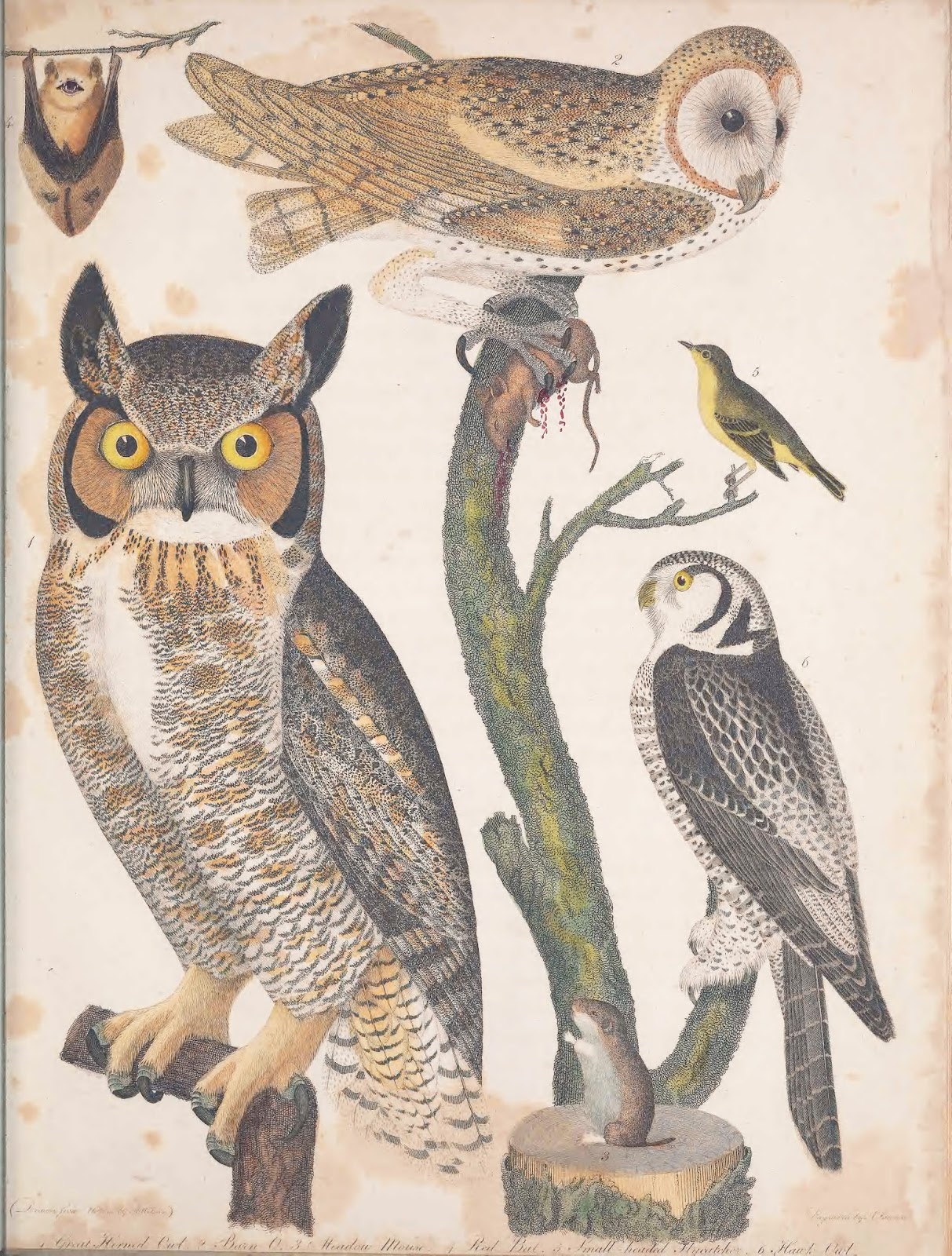
Wilson, Alexander. American Ornithology. v. 6 (1812). http://biodiversitylibrary.org/page/46331204.


Here we see the great horned owl (lower left) amongst some of his winged friends (ave and mammal alike!). This illustration hails from Alexander Wilson’s American Ornithology. Wilson, called the “Father of American Ornithology” by some, traveled over 10,000 miles across North America observing and collecting birds, which he chronicled and illustrated in American Ornithology. The publication included over 260 species, 48 of which were new to science, and was published in at least 10 editions over 70 years. Sadly, he died at the age of 47 from dysentery and exhaustion. Learn more about Wilson’s incredible travels, and his other love – poetry – in a past blog post.

Eastern Bluebird (Sialia sialis)

View Full Size Image

Camblos writes:
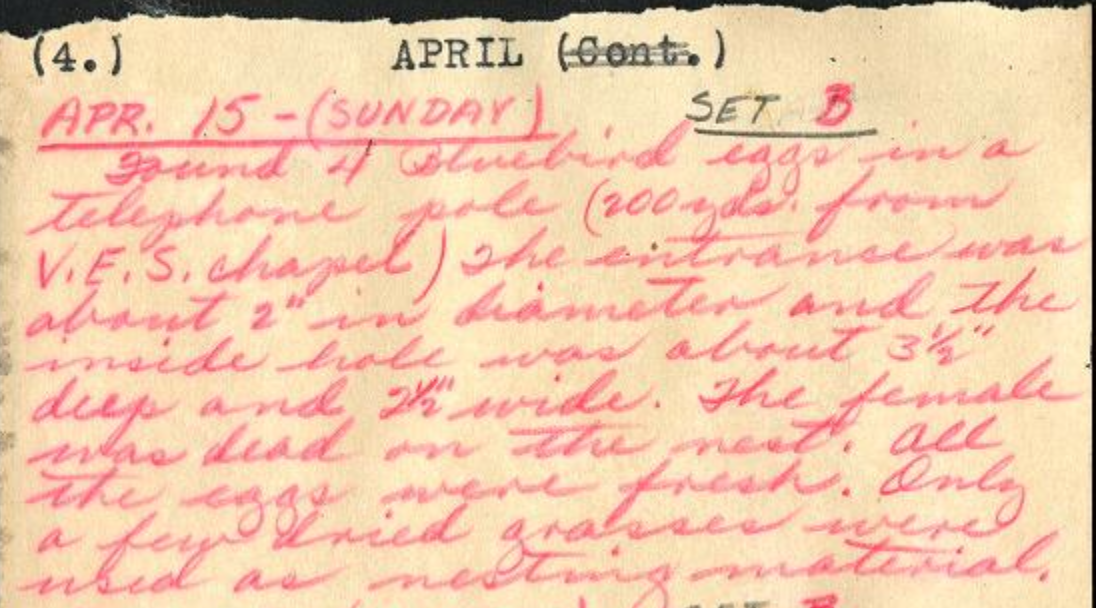
“April 15 – (Sunday)
Found 4 bluebird eggs in a telephone pole (200 yds. from V.E.S. chapel). The entrance was about 2″ in diameter and the inside hole was about 3 1/2″ deep and 2 1/2″ wide. The female was dead on the nest. All the eggs were fresh. Only a few dried grasses were used as nesting material.”

View Full Size Image
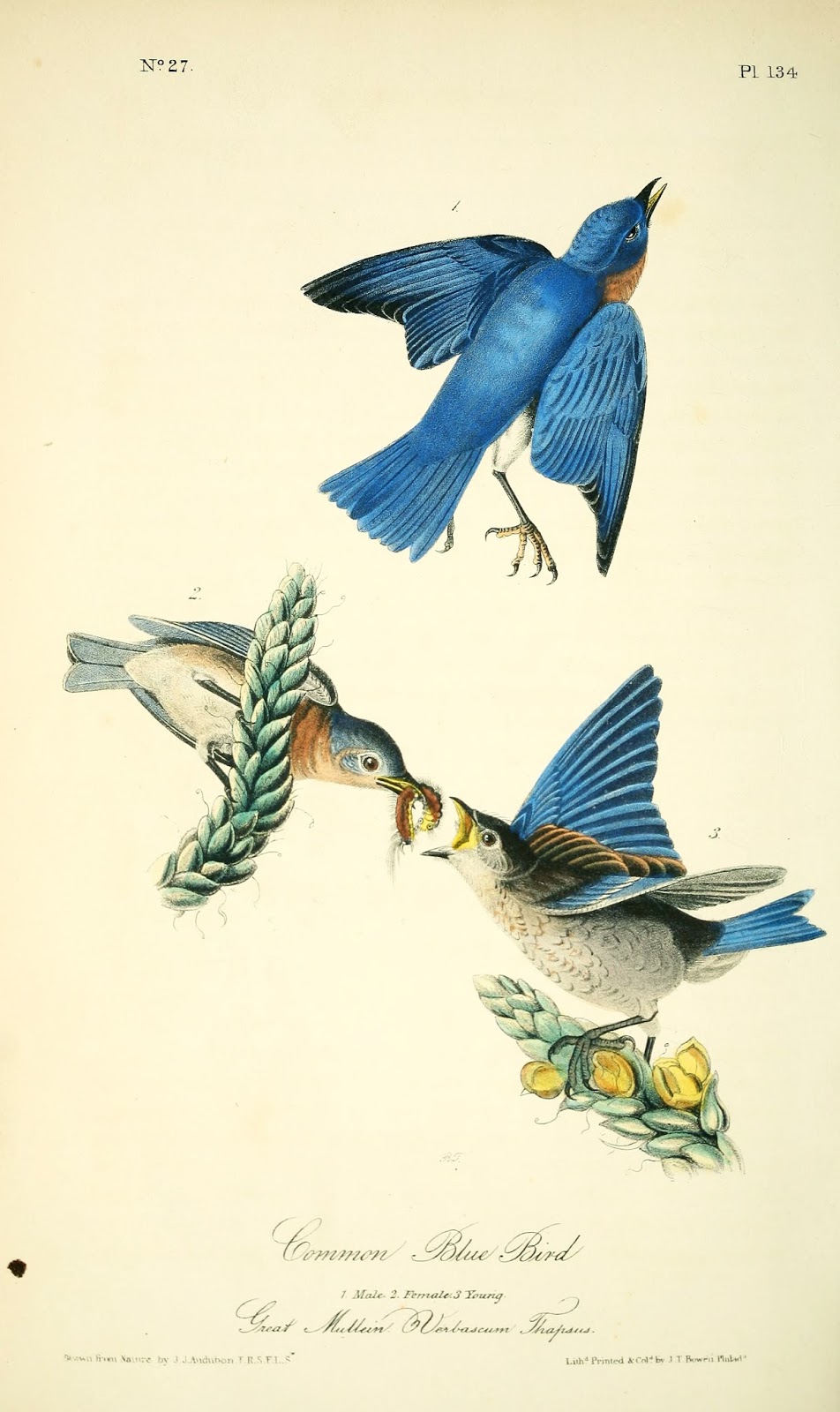
Audubon, John James. Birds of America. v. 2 (1841). http://biodiversitylibrary.org/page/40383680.

John James Audubon is pretty much a house-hold name. This French-American ornithologist, naturalist, and painter, was responsible for one of the most celebrated ornithological books ever published, Birds of America. After immigrating to the United States, Audubon undertook an expedition in 1820 up the Mississippi in an endeavor to paint all the birds of North America for eventual publication. This ambition later became Birds of America. The work represents more than 14 years of field observations and drawings by Audubon and contains 435 hand-colored, life-sized prints of 497 bird species and presents a total of more than 700 North American bird species. Learn more about the work and Audubon in a past blog post.

American Robin (Turdus migratorius)

View Full Size Image

Camblos writes:
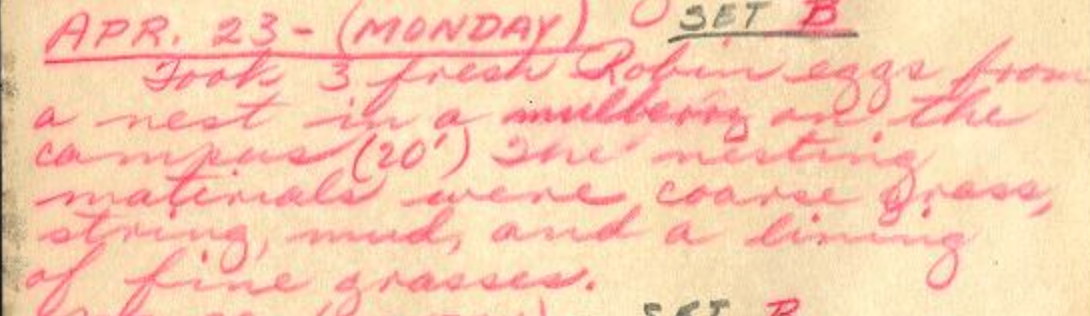
“Apr. 23 – (Monday)
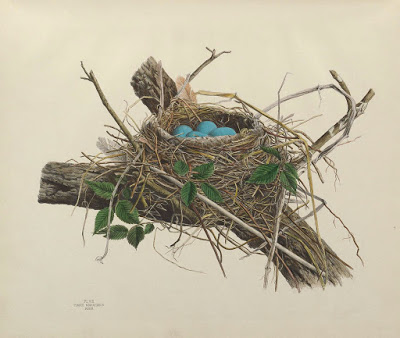
Took 3 fresh Robin eggs from a nest in a mulberry on the campus (20′). The nesting materials were coarse grass, string, mud, and a lining of fine grasses.”

View Full Size Image
Robin’s nest with eggs. Illustrations of the nests and eggs of birds of Ohio. 1886. http://biodiversitylibrary.org/page/34907621.

In 1877, Genevieve Jones decided to create a series of plates for a publication depicting the nests and eggs of Ohio birds. She enlisted the help of close friend Eliza Schulze, and together the two women, amateur artists with no formal training, embarked on the venture. The first three plates, along with the accompanying text by Howard Jones, were sent to publication in 1879. Unfortunately, on August 17th, 1879, Genevieve Jones died of typhoid fever. Desiring to continue the work, Miss Schulze enlisted the help of Genevieve’s mother, Mrs. N. E. Jones. Eventually, Miss Schulze relinquished all of her interests in the title to Mrs. Jones. Determined to move forward, Mrs. Jones undertook the responsibility for all of the illustrations herself, eventually employing three additional artists, Miss Nellie D. Jacob, Miss Josephine Klippart, and Miss Kate Gephart. The final work, entitled Illustrations of the nests and eggs of birds of Ohio, consists of two volumes and 68 plates. Learn more about the work in this past post.

August 6, 2015by ulib-libraryjobs
Blog Reel, Featured Books

Documenting the Flora of the Nation’s First Urban Park System

Did you know that the city of Boston is blessed with one of the largest and the oldest urban forest reservations in America?

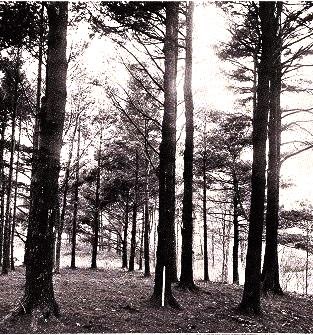
View Full Size Image
Photo: Charles Eliot, 1897

At the turn of the 20th century, Boston saw a rapid increase in human settlement and industrialization which quickly transformed the once pristine Commonwealth into a highly developed, unsightly, and unhealthy metropolis. The movement to preserve what was left of Greater Boston’s natural wonders was inspired by the writings by transcendental thinkers like Ralph Waldo Emerson and Henry David Thoreau, who were advocates of the idea to “keep the New World new.” Local activists for the cause included Wilson Flagg, Elizur Wright, Sylvester Baxter, and Charles Eliot. They envisioned a place where the citizens of Boston could escape the “noisy ugliness” of the overcrowded city and revitalize their spirits in the requiem of nature’s untamed beauty.

A Dream Comes to Pass 

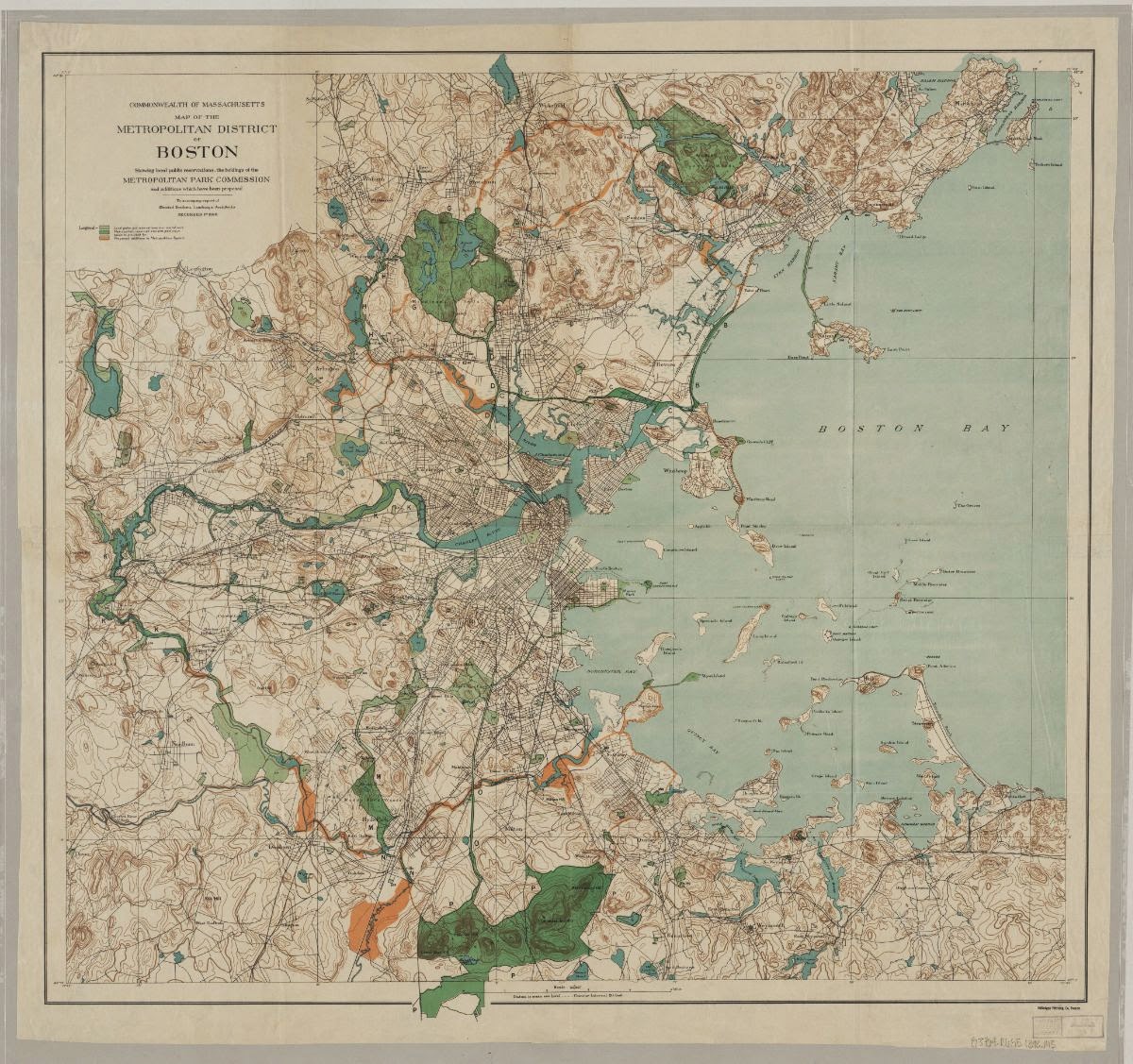
Boston’s budding conservation movement had the foresight to identify large tracts of Massachusetts wilderness for preservation in perpetuity. A four decade campaign ensued and resulted in the passage of the Acts of 1893, Chapter 407 which established the Metropolitan Park Commission. This legal entity was charged with restoring, preserving, and increasing the beauty of the undeveloped woodlands surrounding Boston and this landmark legislation would serve as a model for other American cities. The Metropolitan Park Commission’s first order of business was to hire the noted landscape architecture firm, Olmsted, Olmsted and Eliot, to survey the vegetation in the recently acquired woodland reservations, the Middlesex Fells, Beaver Brook, Stony Brook, and the Blue Hills.

View Full Size Image
Map of the original Metropolitan Park Reservations
Click here for an interactive version.

The firm appointed landscape designer Warren H. Manning who led a team of twenty volunteers to complete the fieldwork. Local botanist Walter Deane was hired to compile and edit the survey’s findings and in 1896, he published the results in this month’s book of the month, Flora of the Blue Hills, Middlesex Fells, Stony Brook and Beaver Brook Reservations, of the Metropolitan Park Commission, Massachusetts. While Deane is credited with the organization of the specimens and botanical observations for publication, the project would not have been possible without collaboration among many amateur and professional botanists. This collaboration was so successful that it led to the formation of the New England Botanical Club (NEBC), which still meets regularly and has amassed a collection of 250,000 specimens housed in the Harvard University Herbaria (HUH).

Announcing a New BHL Collection

This example of an early successful citizen-science project is highlighted in the launch of a new collection in the BHL: The Archives from the Boston Metropolitan Park. This collection is composed of approximately 8,000 pages of manuscript material documenting the progress of the survey. Readers can peruse Walter Deane’s field notes, diaries, datebooks, and correspondence. His diaries reveal fascinating insights into his work on compiling the Flora and the details of its publication, as well as how the formation of the NEBC resulted from the Metropolitan Flora survey. His diaries also give rich pictures of the botanists of his time and are highly useful to anyone writing about the history of the NEBC and its members. The collection is now freely available and opens up this fascinating slice of history to the public for the first time. As part of the Connecting Content project, the digitization of the archives and original specimens from the Metropolitan Park Reservation was made possible by an Institute of Museum and Library Services (IMLS) National Leadership Grant.

Collection Highlights

One of the most compelling aspects of the correspondence related to the Metropolitan Flora survey is learning about people and information not evident from Deane’s Flora or from the botanical specimens. One example is a letter from the tree expert Loren Dame to Manning in which he encloses a list of trees compiled by a “non-botanist”, George Perry. Perry states that “I have made it a point to crawl through the densest tangle of greenbrier and thicket… to become familiar with every rod of the section.” As a result of his efforts, his list of trees is very thorough. He also found some very rare plants not seen by other surveyors, including maidenhair fern. Unfortunately, because he wasn’t considered a reliable source, his data wasn’t included. In another letter to Manning, Dame reported three rare tree species found only in an area adjacent to the Fells, which was added to the reservation after Flora was published. All of these omissions are significant, and the knowledge revealed in these letters is highly valuable for understanding the full extent of the past flora of the area.

Surveying the Flora of Middlesex Fells: Yesterday and Today

Between 2003 and 2011 a new survey  very much like the original survey of the Fells flora was undertaken by a team of NEBC and HUH botanists. Using Deane’s Flora as a basis for comparison, the team found that most of the native species from the original survey persist, despite substantial increases in the number and frequency of non-native plants. These native species face several threats, including habitat disturbance, and loss due to construction and recreational use of the Fells, herbivory from increases in deer and insect populations, as well as environmental changes effected by climate change and afforestation. Sustaining populations of native species, some of which are rare and endangered, will require a more active management of the Fells.[1]

Urban forests purify the air that we breathe, provide a habitat for local flora and fauna, help reduce energy demands, provide recreational opportunities, reduce stress and crime rates—the list goes on. Since eighty percent of us live in urban areas most of us owe quite a bit of thanks to the astute conservationists who fought to keep the untamed wilderness close by. Now it’s our turn to preserve their legacy.

View Full Size Image

Spot Pond named by Governor John Winthrop in 1631.

Photo by Mike Ryan, Friends of the Fells

“Something like five miles northerly from Boston lies a great tract of country, all stony hills and table-lands, almost uninhabited, and of wonderful picturesqueness, and wild rugged beauty… and at its heart is that most beautiful of Boston’s suburban lakes, Spot Pond, which lies high up among the hills.” Sylvester Baxter, 1886.

Notes

[1] 2012. Hamlin, Bryan T., W. T. Kittredge, D. P. Lubin & E. B. Wright. Changes in the vascular flora of the Middlesex Fells Reservation, Middlesex County, Massachesetts, from 1895 to 2011. Rhodora 114(959): 229-308.

Learn More!

IMLS Grant Project Page
Walter Deane (1848-1930) Papers
NPS: Metropolitan Parks Commision
Friends of the Fells
Found in the Fells
The Middlesex Fells, a Flourishing Urban Forest by W. Kittredge
BHL Collection: Archives and Specimens from the Boston Metropolitan Park Flora 

February 26, 2015by [email protected]
BHL News, Blog Reel

We Need Books to Save Biodiversity

This month, we’re publishing a series of blog posts outlining the importance of biodiversity literature, made available for free and open access through the Biodiversity Heritage Library, to today’s scientific research and conservation initiatives. With your help, we can help save biodiversity. 

The Biodiversity Heritage Library (BHL) is revolutionizing the way scientific research is conducted by providing free and open access to biodiversity literature and archives representing over 500 years of scientific exploration, research, and discovery.

What’s so special about Historic Literature and Archives?

Historic literature and archival fieldbooks provide information that is critical to studying biodiversity. These documents are replete with data detailing the morphology, phylogeny and ethology of earth’s species. In many cases, this literature constitutes the only available knowledge for rare, endangered, and extinct species.

View Full Size Image
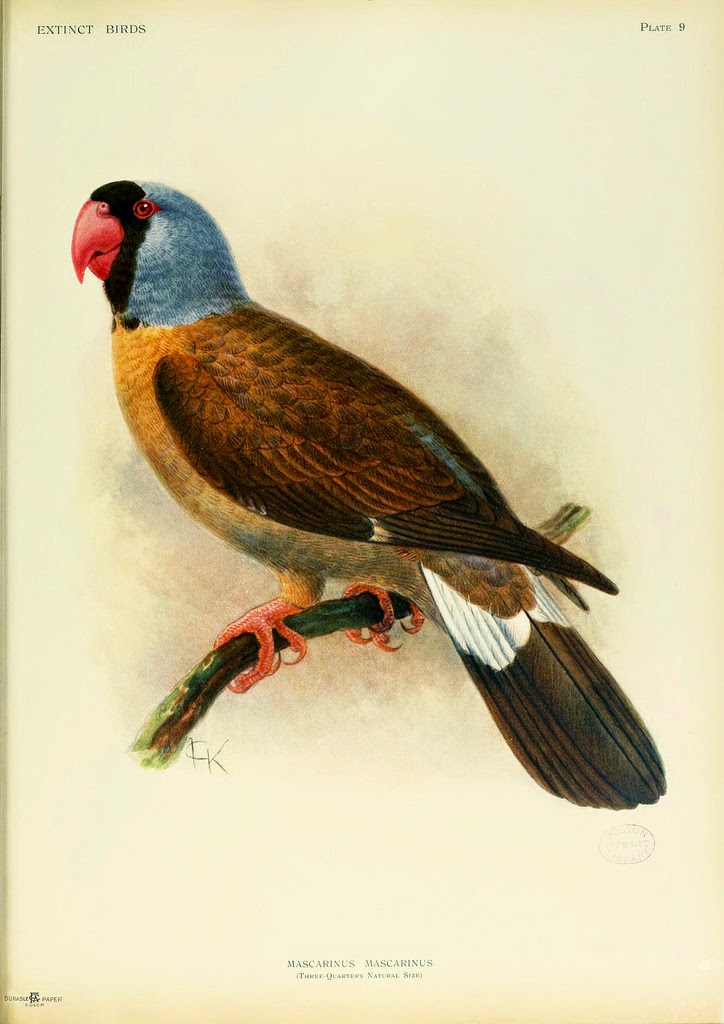
The Mascarene Parrot. Now Extinct. Rothschild, Lionel Walter Rothschild. Extinct Birds (1907). http://biodiversitylibrary.org/page/38665729.

In addition to species data, published books and fieldbooks capture ecosystem profiles, distribution maps, inter-dependency observations, and geological and climatic records. They also provide an historical perspective on species abundance, habitat alteration, and human exploration, culture and discovery.

This information has a multitude of applications in modern-day science. It is used to populate species databases and datasets that inform present-day research. It not only allows scientists to study biodiversity, but also to save it by enabling new species identification and facilitating the development of holistic conservation methods that integrate all of the factors necessary for a species’ wellbeing into its overall protection strategy. Furthermore, the discoveries captured in historic literature provide the foundations upon which contemporary models, theories and disciplines are based.

View Full Size Image
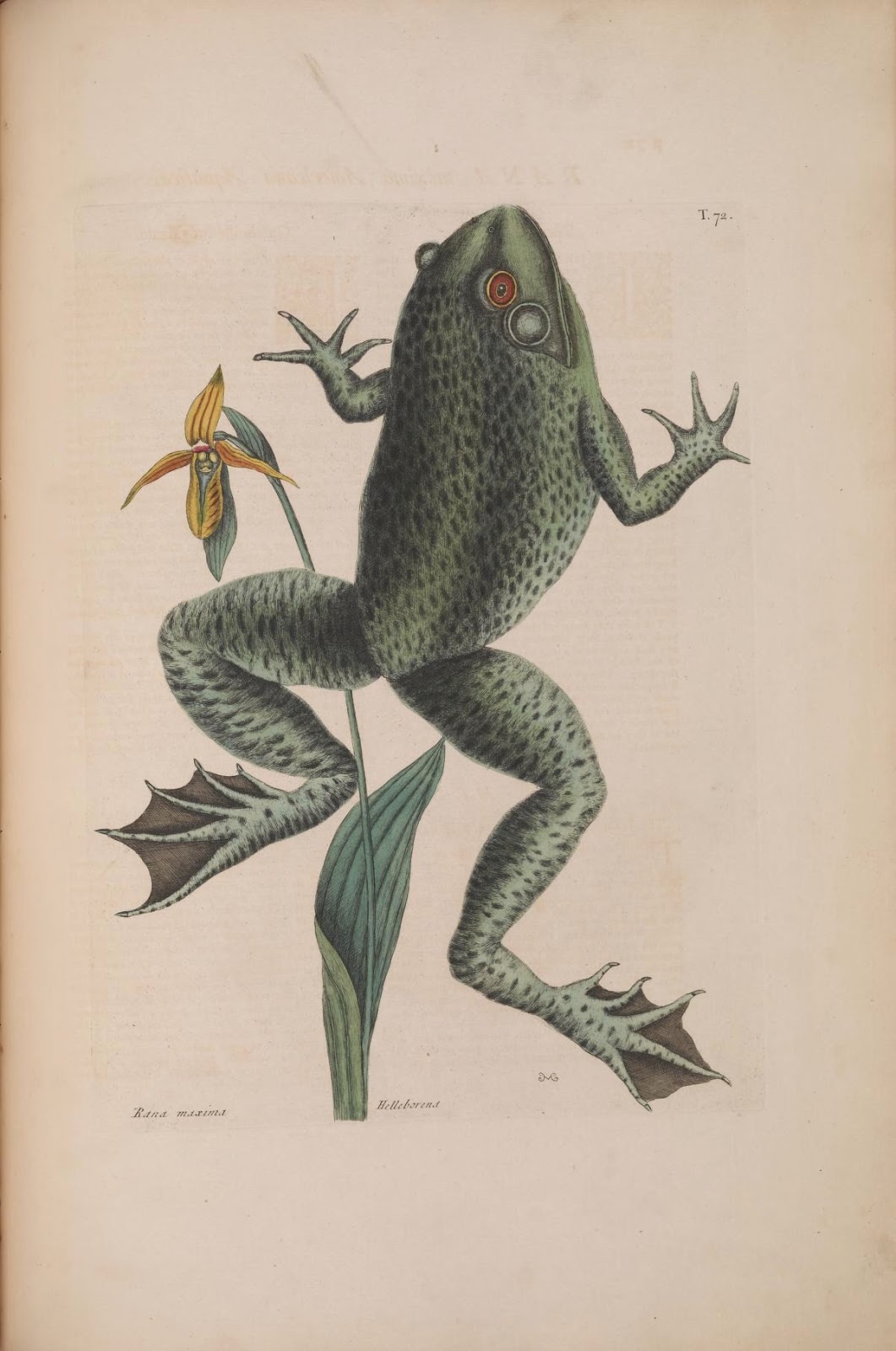
Cane Toad. From the first published account of the flora and fauna of North America: Catesby, Mark. Natural History of Carolina, Florida and the Bahama Islands (1729-47). http://biodiversitylibrary.org/page/38993574.

Sadly, much of these publications and archival content are available in only a few select libraries in the developed world.

“Science is all about disseminating knowledge and building upon what has come before, yet so much of our knowledge of plants and animals has remained inaccessible to those who could make use of it,” laments Dr. John Sullivan, an evolutionary biologist with the Academy of Natural Sciences, Philadelphia and Cornell University. “This has been a big part of the ‘taxonomic impediment.’”

The Biodiversity Heritage Library is Alleviating the Taxonomic Impediment

The Biodiversity Heritage Library boasts a collection of over 45 million pages from over 150,000 volumes and has served more than 3.5 million people in nearly every country since its launch in 2007. Additionally, BHL has made over 93,000 of the illustrations within its collection available in Flickr, which in turn have been viewed over 80 million times. Services such as taxonomic name finding tools, custom PDF downloads, and open APIs allow users to easily locate and reuse these resources.

“BHL is radically changing the status quo and democratizing access to knowledge about biodiversity,” lauds Dr. Sullivan. “Now anybody in the world has instant access to the original species description in a couple of clicks!”

View Full Size Image
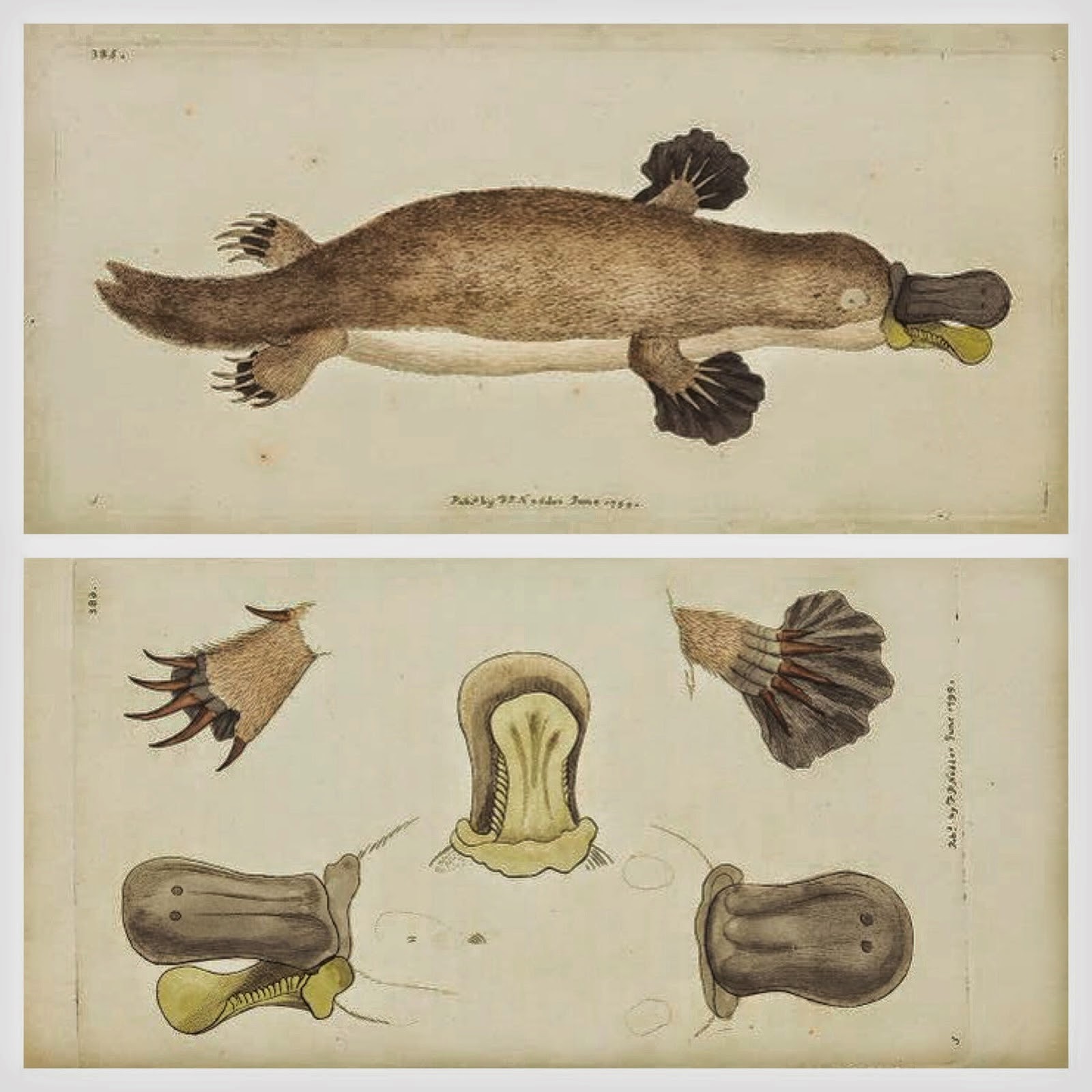
The first published illustration of the Duck-billed Platypus. Shaw, George. The Naturalist’s Miscellany, or Coloured figures of natural objects, Vol. 10 (1799). http://biodiversitylibrary.org/page/40321089.

Of Global Importance

Open access to biodiversity data is beneficial on a global scale, advancing scientific fields more quickly and connecting scientists and their research more efficiently than ever before, especially in developing countries with traditionally limited access to vital resources. “[The Biodiversity Heritage Library] has done an enormous amount to enhance the capacity of developing countries to undertake taxonomic research on their biota,” asserts Dr. Dai Herbert, a malacologist at the KwaZulu-Natal Museum in South Africa.

The repatriation of knowledge can also help countries better assess, monitor, and protect their native biodiversity. Recognizing that “identifying the factors that shape biodiversity locally helps to preserve them better in the future,” the United Nations, through the Convention on Biological Diversity, requires every signatory country to “identify and monitor the biodiversity of the organisms within its borders.” Thanks to BHL, countries now have access to information about and catalogs of the species within their boundaries, which can be used to form the basis of national biodiversity indexes and direct local conservation efforts.

View Full Size Image
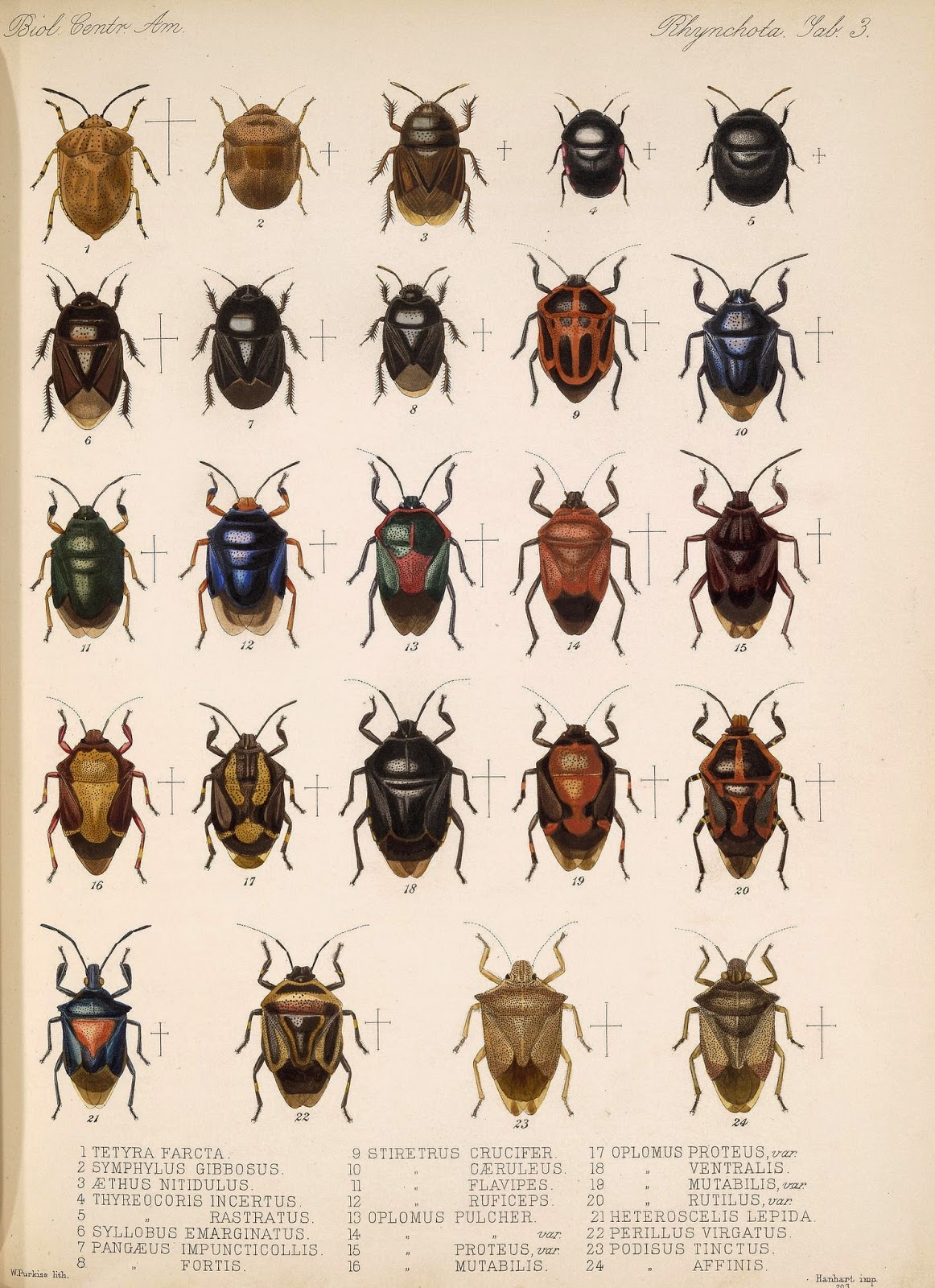
Insects. From Biologia Centrali-Americana. As this work contains all of the known information about the biodiversity of Mexico and Central America at the time of its publication, this title is still fundamental to the study of the biota of this region. http://biodiversitylibrary.org/page/594659.

Help Save Biodiversity

The Biodiversity Heritage Library is helping scientists save biodiversity, which in turn sustains our well-being as humans. “We need biodiversity to satisfy basic needs like food, drinking water, fuel, shelter, and medicine…Ecosystems provide services such as pollination, seed dispersal, climate regulation, water purification, nutrient cycling, control of agricultural pests” (Source: American Museum of Natural History website) and the “regulation and control of infectious diseases” (Convention on Biological Diversity).

View Full Size Image
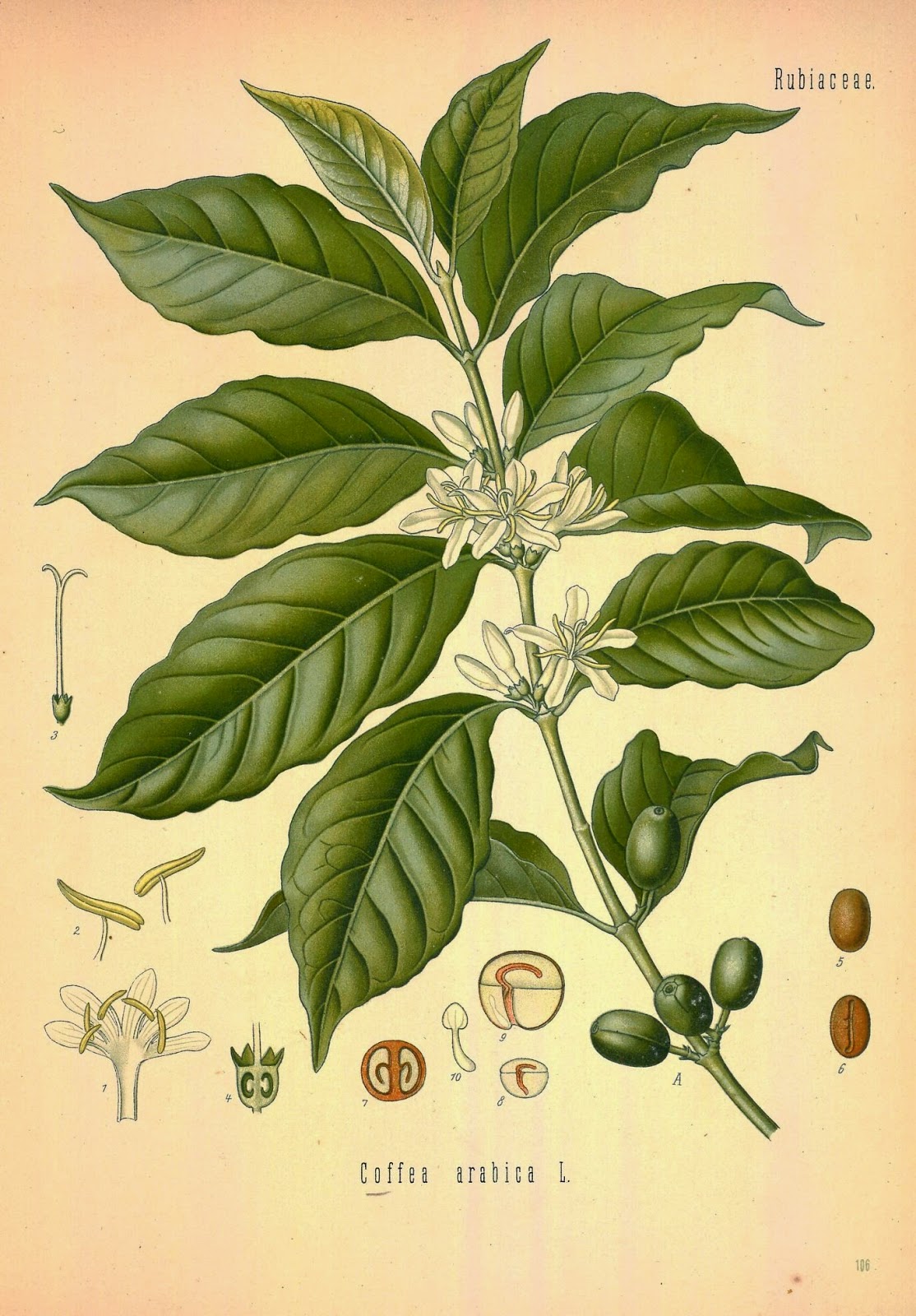
Coffea arabica, which accounts for 75–80 percent of the world’s coffee production. It is also believed to be the first species of coffee to be cultivated. Köhler’s Medizinal-Pflanzen (1883-1914). http://biodiversitylibrary.org/page/303146.

As we face a global biodiversity crisis that threatens the future of many species and habitats, unfettered access to biodiversity information has never been more important.

We rely on donations from users like you to help grow our library and keep it free and open. As you think about your holiday giving, we hope you’ll consider making a tax-deductible donation to help save biodiversity.

Learn more about the critical roles BHL and historic literature play in discovering new species, understanding past extinctions, and saving Earth’s biodiversity.

December 12, 2014by michelle.underhill
Page 3 of 3«123

Help Support BHL

BHL's existence depends on the financial support of its patrons. Help us keep this free resource alive!

search

About BHL

The Biodiversity Heritage Library (BHL) is the world’s largest open access digital library for biodiversity literature and archives. BHL operates as a worldwide consortium of natural history, botanical, research, and national libraries working together to digitize the natural history literature held in their collections and make it freely available for open access as part of a global “biodiversity community.”

Join Our Mailing List

Sign up to receive the latest news, content highlights, and promotions.

Subscribe Now

Subscribe to Blog via Email

Enter your email address to subscribe to this blog and receive notifications of new posts by email.

Join 319 other subscribers

Subscribe to Blog Via RSS

Subscribe to the blog RSS feed to stay up-to-date on all the latest BHL posts.

Access RSS Feed

Inspiring Discovery through Free Access to Biodiversity Knowledge.

The Biodiversity Heritage Library makes it easier than ever for you to access the information you need to study and explore life on Earth…for free, anytime, anywhere.


64+ Million Pages of
Biodiversity Literature Online.

EXPLORE

Tools and Services
to Transform Research.

EXPLORE

300,000+
Illustrations on Flickr.

EXPLORE

ABOUT | HARMFUL CONTENT | PRIVACY | SITE MAP | TERMS OF USE