Biodiversity Heritage Library - Program news and collection highlights from BHL
  • Home
  • News
  • Featured Books
    • All Featured Books
    • Book of the Month Series
    • BHL at 20
  • User Stories
  • Campaigns
    • Fossil Stories
    • Garden Stories
    • Monsters Are Real
    • Page Frights
    • Her Natural History
    • Earth Optimism 2020
  • Tech Blog
  • Visit BHL
Home
News
Featured Books
    All Featured Books
    Book of the Month Series
    BHL at 20
User Stories
Campaigns
    Fossil Stories
    Garden Stories
    Monsters Are Real
    Page Frights
    Her Natural History
    Earth Optimism 2020
Tech Blog
Visit BHL
  • Home
  • News
  • Featured Books
    • All Featured Books
    • Book of the Month Series
    • BHL at 20
  • User Stories
  • Campaigns
    • Fossil Stories
    • Garden Stories
    • Monsters Are Real
    • Page Frights
    • Her Natural History
    • Earth Optimism 2020
  • Tech Blog
  • Visit BHL
Biodiversity Heritage Library - Program news and collection highlights from BHL
Blog Reel, Featured Books

Is it Hoppy Hour yet?

For this week’s BHL Book of the Week, I’d like to highlight a book that is all about one of my favorite plant species, Humulus lupulus, better known as hops.

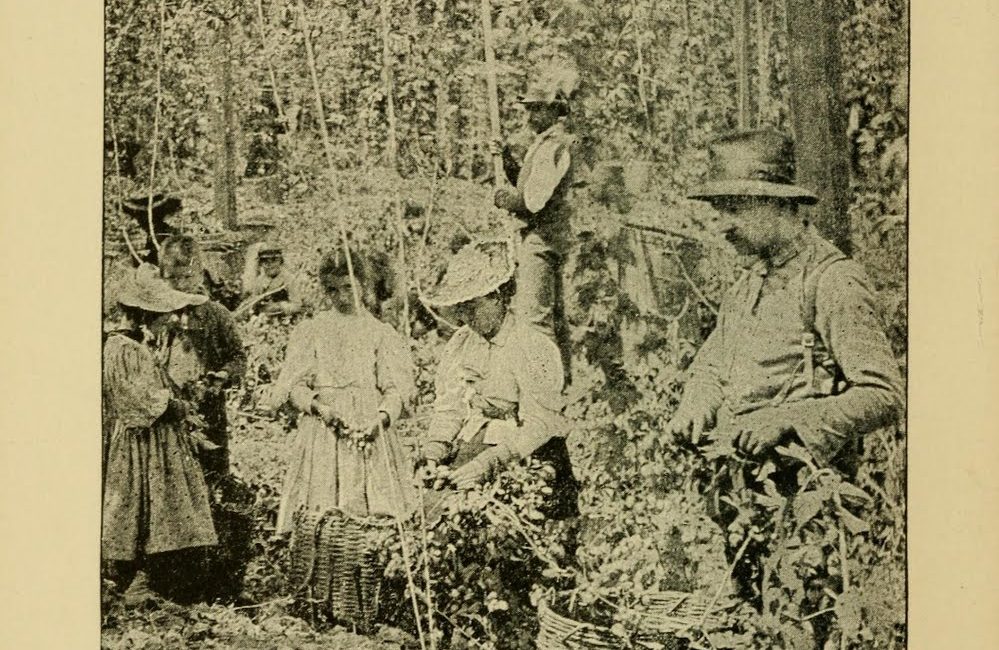
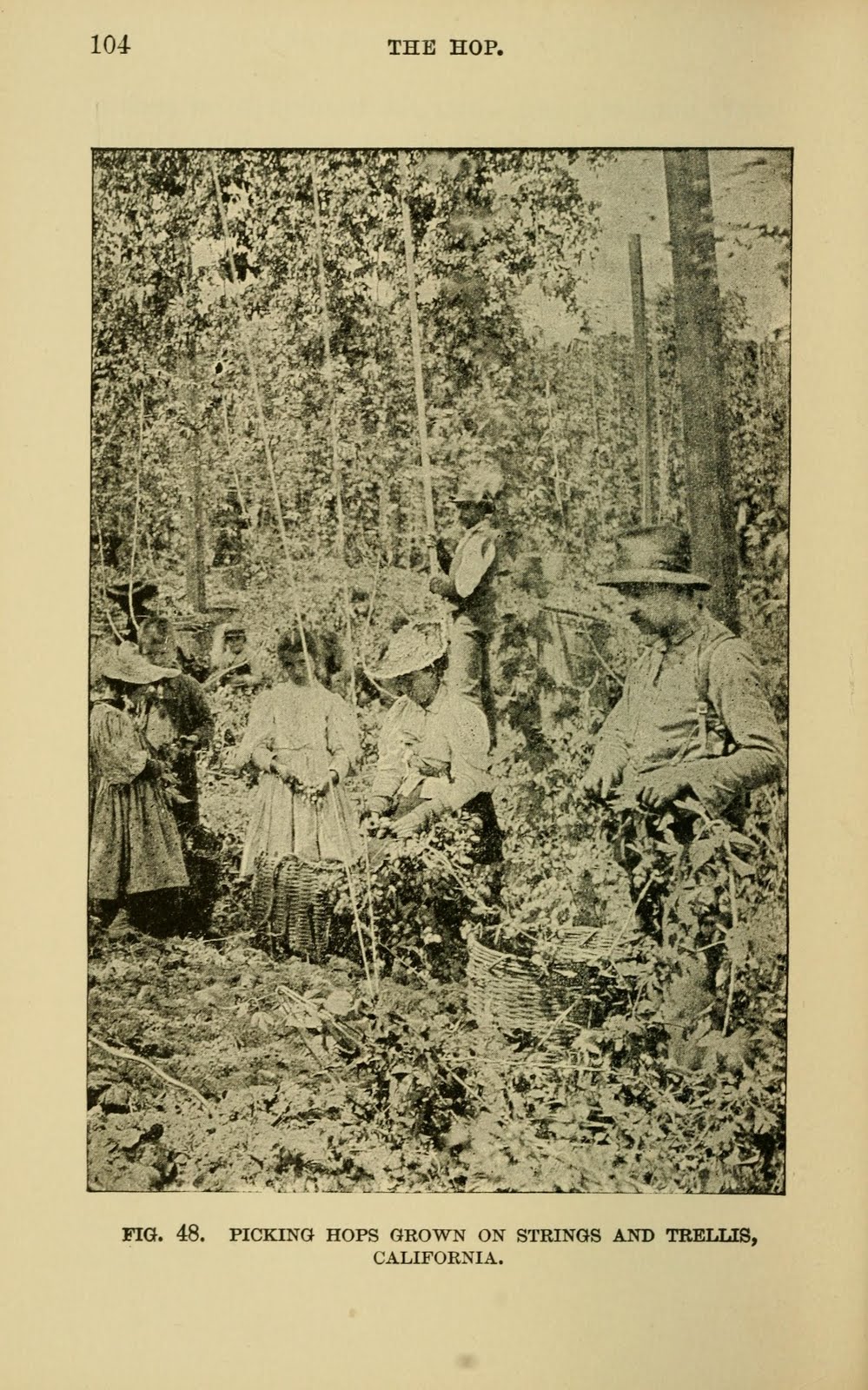
In 1909, Herbert Myrick published: The hop; its culture and cure, marketing and manufacture; a practical handbook on the most approved methods in growing, harvesting, curing and selling hops, and on the use and manufacture of hops. This treatise on hop culture provides a detailed account of the industry as it existed in the early 20th Century. In these pre-Prohibition days, the number of breweries in the United States was comparable to what it is today and the US was a significant contender in the global hops market alongside Great Britain and Germany [1]. Major hop growing states were New York, Washington, California, and Oregon. Just look at these happy hoppers pickin away in California:
View Full Size Image

And why do I love hops so much? Because I am a beer lover and an American and over the past few decades, the American craft beer revolution has carved out a beer style that is serious about its hops [2]. Even the American staple, Miller Lite, has jumped onto the hoppy band wagon touting itself as “triple hops brewed.” Please. Anyone who drinks that swill doesn’t understand the first thing about Humulus lupulus and the magical qualities of the lupulin glands which give real beer, real flavor.

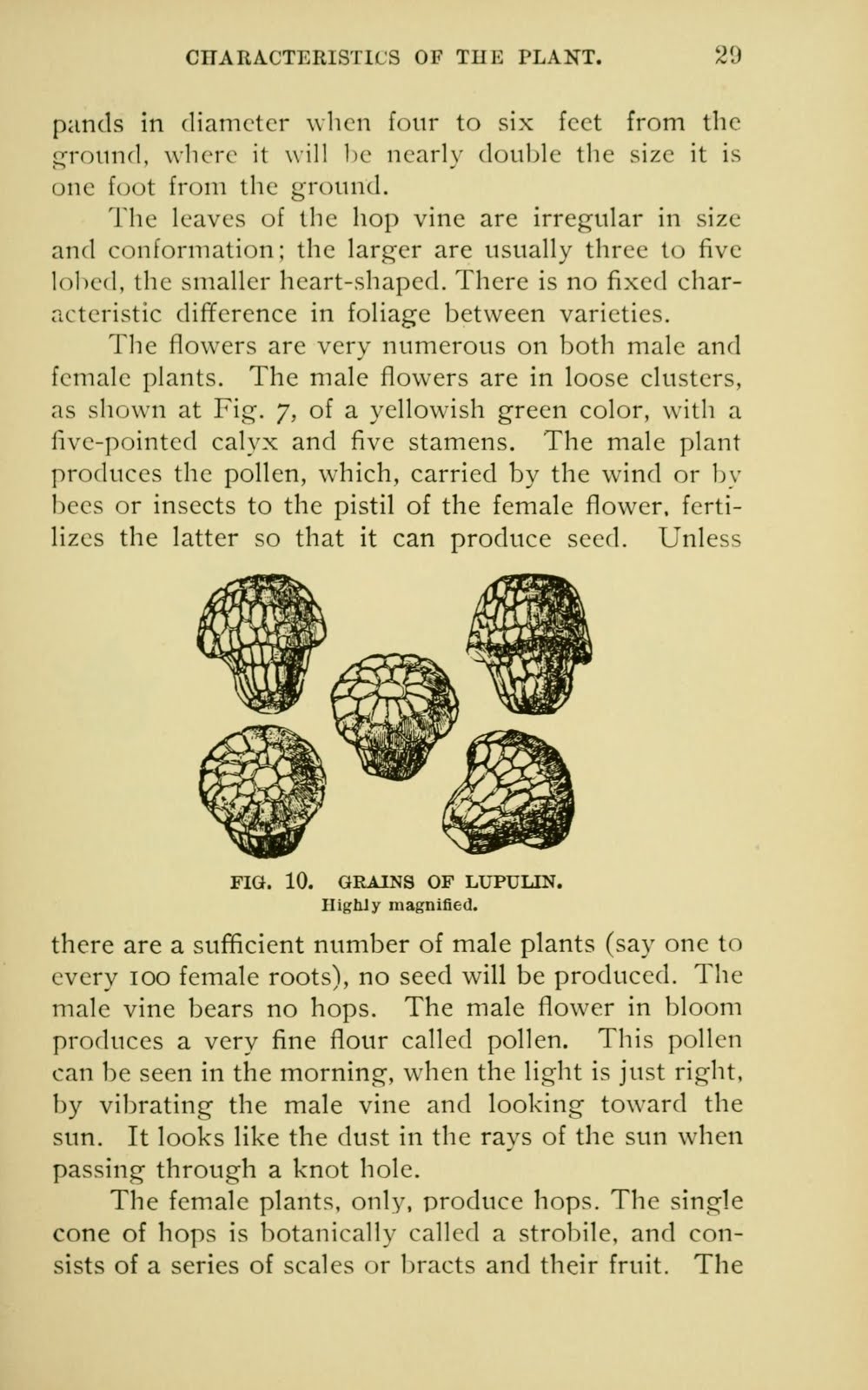
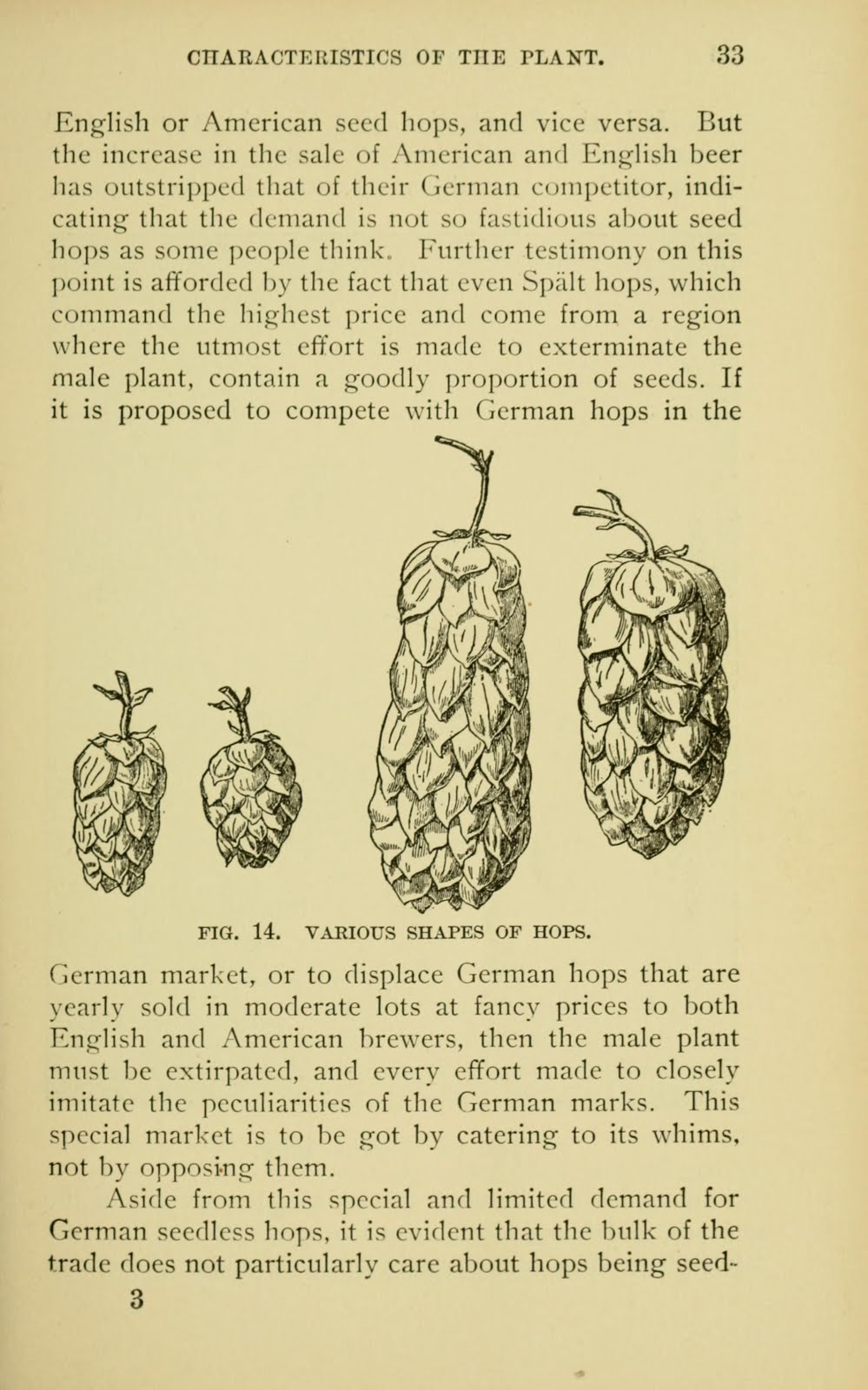
Lupulin glands contain the resins and oils which impart the distinctive flavor, aroma, and bitter qualities associated with beer. Only female plants produce the familiar cone-like hop flowers (aka catkins or strobiles) used in brewing and the lupulin glands are located at the base of the scales, or bracts, that make up the cones. The better the lupulin, the better the quality of the hop. See Myrick’s drawings of hop cone shapes and magnified lupulin “grains”:
View Full Size Image
Pg. 33 Fig. 14
View Full Size Image
Pg. 29 Fig. 10

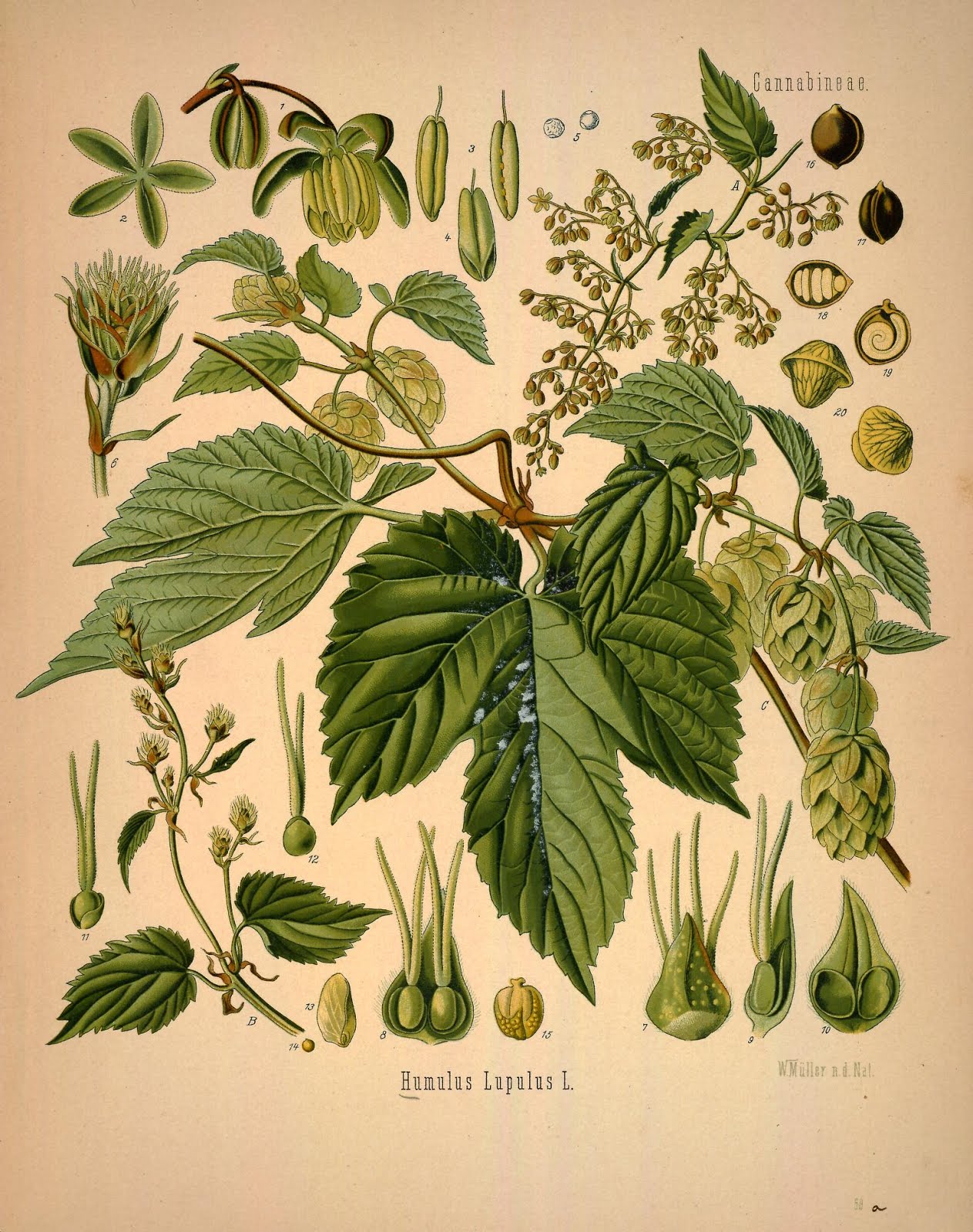
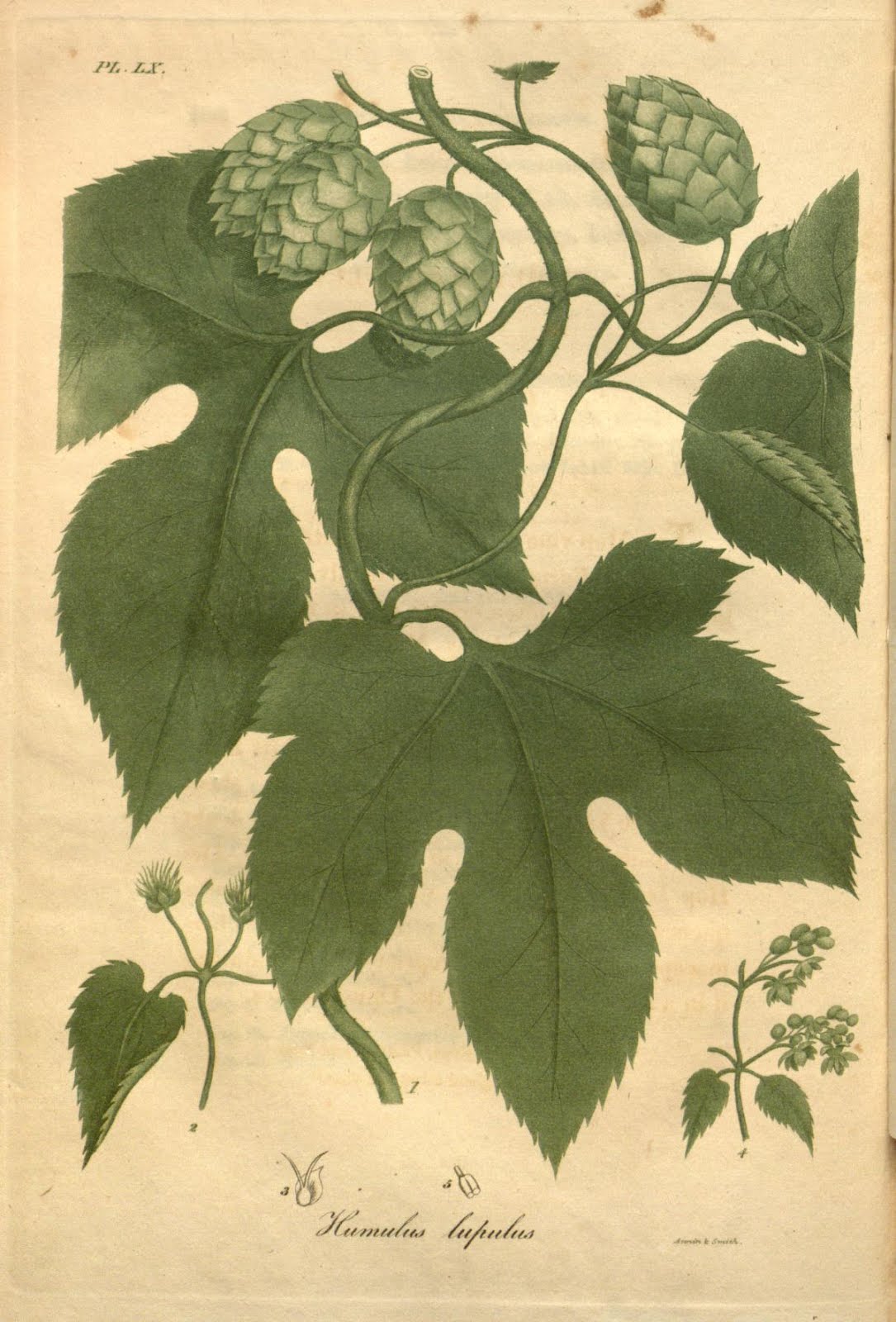
Carl Linnaeus lists Humulus lupulus in his quintessential 1753 Botany tome, Species Plantarum, vol. 2 pg. 1028. H. lupulus is a member of the Cannabaceae family best known for Cannabis sativa or marijuana plant. Unfortunately, there appears to be much debate over the speciation of the Humulus genus. According to The Plant List, H. lupulus is one of 5 species of hop plant with H. cordifolius, H. neomexicanus, H. scandens, and H. yunnanensis [3]. But the predominant species used to impart the flavor balance and antiseptic qualities civilization has come to know and love in its beer is Humulus lupulus.
View Full Size Image
H. lupulus from American Medical Botany vol. 3 (1820)
View Full Size Image
H. lupulus from Köhler’s Medizinal-Pflanzen vol. 1 (1887)

One species, but countless varieties (read cultivars, not taxonomic varieties) of tasty flowers with varying degrees of alpha acidity used for imparting flavor, aroma, and bitterness. Hops can be as mild as the delicate Saaz hops used in Pilsner Urquell at 3-5% avg. alpha acidity, all the way to the American Apollo hop packed with a walloping 16-20% avg. alpha acidity [4].

Myrick details the hop varieties on the market in the early 20th Century, pgs. 35-45. Today’s hop varieties include the old standards such as English Goldings and the German Hallertau, but also include a growing list of premium American hops clearly cultivated for a stronger bitterness character than their European counterparts. Relatively new to the hop variety show are players from Australia, New Zealand, and Japan [5].

It should be noted that hops are a more recent ingredient in beer’s long history since its first recorded evidence of being brewed back in 3500 BCE [6]. Prior to the wide use of hops, beer was flavored with a variety of herbs in an attempt to balance out the sweetness of the fermented grains. There are conflicting reports about the first use of hops in beer making but I found this rather thorough post, “A short history of hops” by Martyn Cornell with more information.

Yet hops are just one of beer’s 4 staple ingredients along with malted barley, yeast, and water. With so many varieties of hops and various impacts on the taste of a beer contributed by its other ingredients, it is impossible to truly capture the full cornucopia of beer flavor possibilities. Just as sophisticated and nuanced as fine wine, craft beer is a careful and creative expression of chemistry, biodiversity, and culture.

I recommend drinking your beer with the seasons. Enjoy yourself a roasty porter in the winter and a crisp pale ale in the summer. But no matter the weather there is always an opportunity to appreciate H. lupulus in your glass. Some of my favorite signature American hoppy brews, like Oskar Blues’ Dale’s Pale Ale and Laguanitas IPA showcase some of the best and most accessible floral citrus flavor with a refreshing pucker tinge that have come to signify American beer.

Care to help me further my “research”? It’s 5 o’clock in the world somewhere. Tell me about your favorite beers!

References

[1] http://www.craftbeer.com/beerology/history-of-beer/craft-beer-today

[2] http://www.craftbeer.com/styles/american-ales

[3] http://www.theplantlist.org/tpl/search?q=Humulus

[4] http://www.usahops.org/graphics/File/HGA%20BCI%20Reports/Variety%20Manual%207-24-12.pdf

[5] http://en.wikipedia.org/wiki/List_of_hop_varieties 

[6] http://www.craftbeer.com/beerology/history-of-beer/early-times
January 11, 2013by Bianca Crowley
Blog Reel

My Life as a BHL Staffer: Bianca Crowley

As Collections Coordinator for the Biodiversity Heritage Library, I am the point person for all things collections related. I lead and organize the work of the BHL Collections Committee, process all scanning requests, manage the acquisition of new materials and handle our permissions agreement workflow. In addition to my collections management work, I also…”coordinate”…things…namely the communications across our 14 member consortium, BHL Staff, and our Technical Development Team working out of the Missouri Botanical Garden. And then there’s also social media work, cataloging tasks, assisting the Tech Team to improve the BHL user experience, and answering the occasional reference question.
View Full Size Image
Content is King
The BHL collection holds nearly 54,000 titles, over 102,000 volumes, and continues to grow. The majority of the BHL digital corpus derives from the physical collections of the 14 member BHL consortium. In addition, we “ingest” biodiversity related materials from the corpus of texts held within the Internet Archive. In doing so, you will see content in BHL from the California Digital Library, Library of Congress, University of Toronto, North Carolina State University Libraries, and others.

The BHL Collections Committee developed the criteria for ingesting biodiversity relevant materials from the Internet Archive, and continues to tweak this criteria as new content is made available. We also put together the BHL Collection Development Policy and the BHL Deaccession Policy. It is not often that we decide to remove something from the BHL collection, but when we do it is only by unanimous vote. We meet regularly to discuss collections related decisions and tasks, such as developing new sub-collections of BHL content as well as new collections for iTunes U. If you have any suggestions for collections you would like to see in BHL or iTunes U, please let us know by submitting your comments to the BHL feedback form.

The Long and Winding Queue
Speaking of the feedback form…as you may know by now, we have a “scanning request” form that allows you to enter requests for content to be scanned. To date, nearly 1500 scanning requests have been submitted and it is my responsibility to process each one. We use an issue tracking system to manage all the requests that come through, from initial scanning assignment to availability of the title in the BHL web portal.

On average, we receive between 2-3 requests per day and approximately 25% of the requests we receive are for materials that require “special handling,” meaning that these materials are either rare, oversized, or in such a condition as to render them ineligible for scanning through our standard workflow with the Internet Archive. We take every measure to fulfill the requests that come in from our users, but requests for “special handling” materials are particularly difficult to fulfill as they are expensive, take additional time and resources to process, and may be so rare that only 1 BHL member library holds the title in their collection. Additionally, only a few BHL member libraries are equipped to digitize rare book materials.

One request at a time, books and missing volumes of a journal, aka “gap-fills,” are processed in the order they are received. At times a seemingly simple scanning request can take hours to investigate, require the work of 3 or more BHL member libraries to scan, and months may go by before the content is made available online. This is because processing scanning requests might require a good deal of bibliographic sleuthing before they can be appropriately assigned. Is the material requested already in BHL under a different title or series? Is the work available at a BHL member library for scanning? Is the book in the public domain? Is the volume requested bound with another volume or available under its monographic title? Will the bibliographic record in one library’s catalog match the record in another library’s catalog? Etc., etc., etc. I can easily find myself lost down a rabbit hole of bibliographic metadata, only to come out in a wonderland of biodiversity literature.

Pride & Permissions
I am proud to work for a digital library project that advocates for open access and open data. Not only am I living my dream of working for a digital library project at the Smithsonian Institution, but I am participating in what I see as a fundamental shift away from the library-as-information-silo to the library of the 21st Century. By putting our data out there (all the taxonomic names held within the pages of our corpus and all the bibliographic data about the books in our collection), the BHL is providing opportunities for biodiversity literature to be repurposed in new ways, ultimately connecting it back to the scholarly research cycle. Want to automatically link all the specimens in your database to the first publication of the scientific name? Be my guest. All I ask is that you let us know what cool things you’re doing with BHL data via @BioDivLibrary, BHL on Facebook, or through our feedback form.

This is why it is so important for the BHL to increase the amount of content it has in its collection beyond the United States public domain cut-off of 1922. As Collections Coordinator I manage the agreements with publishers and copyright holders who grant us permission to digitize in-copyright content. Thus far, I have not had the time to be proactive about pursuing permissions agreements but it is my goal for this year to ramp up BHL permissions activities. If you are a publisher or copyright holder that would like to see your content available via the BHL, please contact me at crowleyb[at]si.edu or visit our BHL Permissions page for more information.

Channeling the Hive Mind
I am privileged to work with an amazing team of librarians, techies, and biodiversity literature users. One of the most important aspects of my work has been to improve and uphold the free flow of communications among our BHL Staff, Technical Development Team, and our users. With staff scattered throughout the United States and United Kingdom, over 5 different time zones, with varying degrees of institutional resources, and differing digitization workflows, it is amazing to see how closely we work together. We use whatever tools we can to get things done, including but not limited to wikis, conference calls, email, video, issue tracking systems (one for scanning issues and one for tech stuff), skype, Google Docs, Twitter, quarterly reports, listservs, and our blog. As each BHL member institution works autonomously to select and scan what they can within their own digitization workflow, it is critical to maintain a balance between an institution’s independent needs as well as the collective requirements of the consortium. We do this by empowering ourselves to make decisions from the bottom-up and trusting each other to do what’s best for the project.

I received my MSLS from the Catholic University of America and a BA in Anthropology from the University of Maryland at College Park. My love of digital libraries largely grew out of my work in the Botany Department of the National Museum of Natural History as Project Manager for the Botany of the United States Exploring Expedition project. I love what I do for the Biodiversity Heritage Library. I have seen the project grow and mature in the 3 years that I have been working as Collections Coordinator and look forward to playing my part in the progress that BHL will make in the future.

March 5, 2012by Bianca Crowley
BHL News, Blog Reel

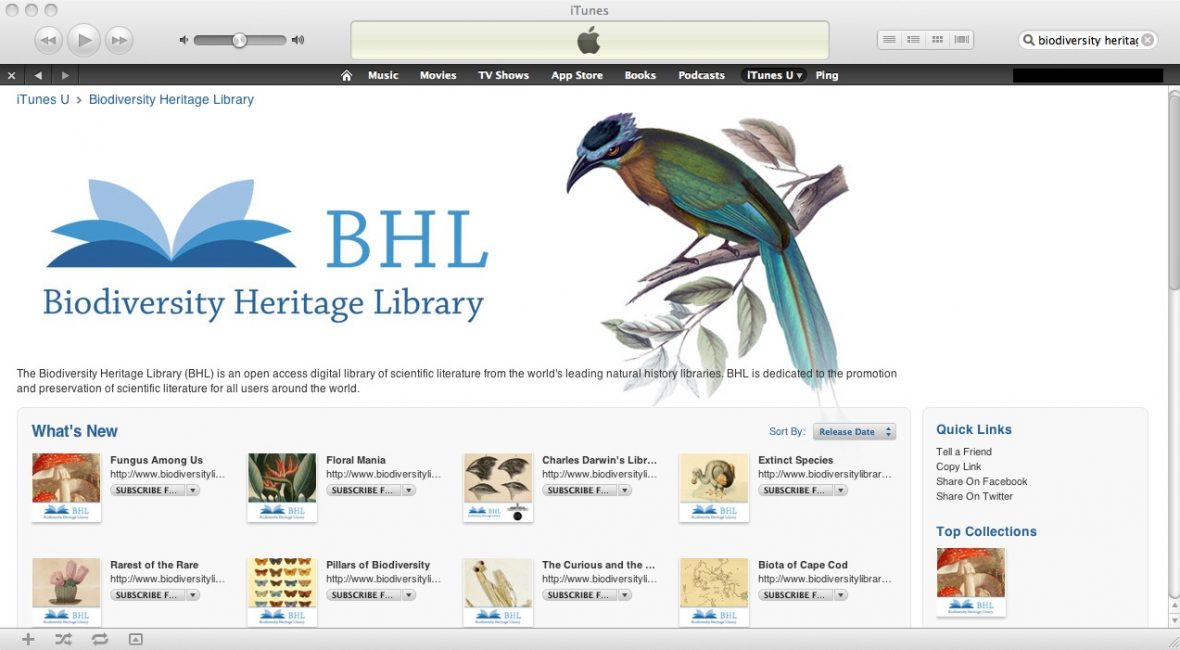
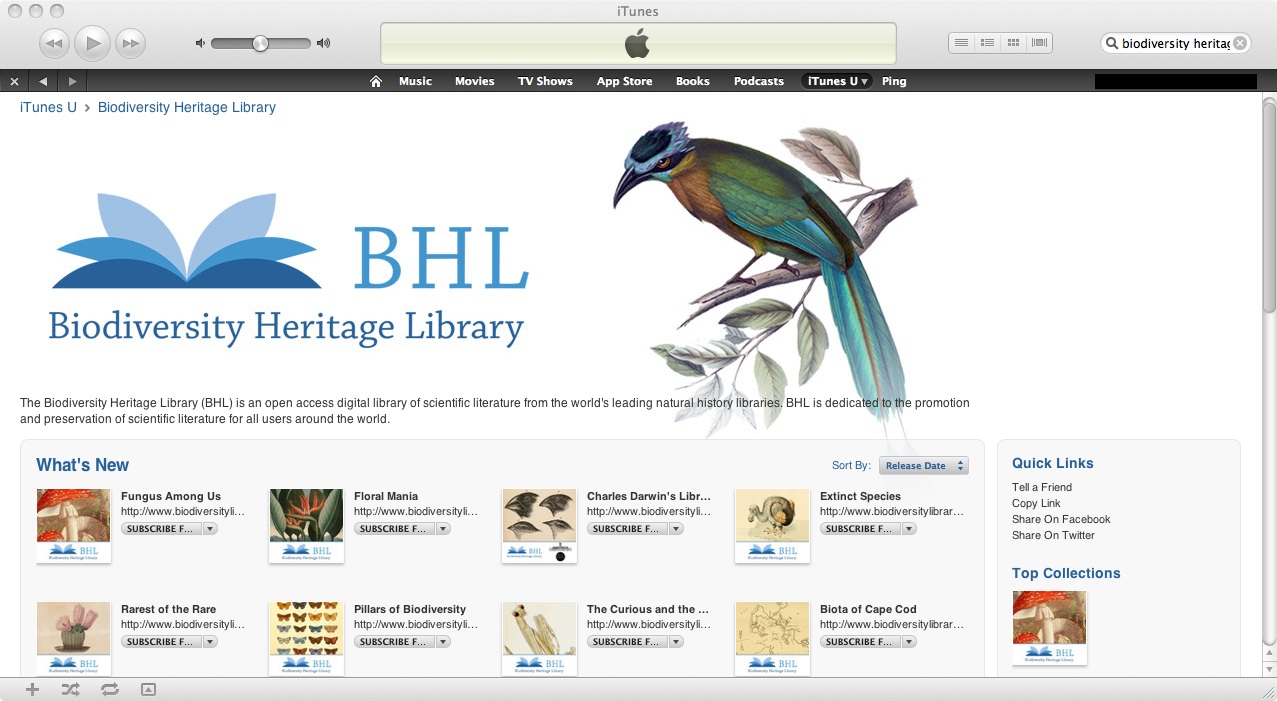
Biodiversity Heritage Library on iTunes U

We are thrilled to announce that selected collections of BHL content are now available on the new iTunes U! Visit our provider page at http://itunes.apple.com/us/institution/biodiversity-heritage-library/id467689660 to download PDFs of BHL books to your desktop, iPad, iPhone or iPod touch.

View Full Size Image

iTunes U is a dedicated area within iTunes that gives users public access to hundreds of thousands of free lectures, video books, podcasts, and courses from learning institutions all over the world. And with the new iTunes U app, users can download content directly onto their iPad, iPhone, and iPod touch. To learn more about how iTunes U works, please see this helpful video on Apple’s website.

Providing BHL content on iTunes U allows us to get our content out to folks in an exciting new way. By positioning BHL content alongside courses from major universities, there is the potential for new audiences to engage with our content in an educational context. And now it is easier than ever to take selected works from the BHL collection on the go with the new iTunes U app.

We are currently offering 8 collections of BHL materials around the following themes:

  • Fungus Among Us
  • Floral Mania
  • Charles Darwin’s Library: Selections*
  • Extinct Species
  • Rarest of the Rare
  • Pillars of Biodiversity
  • Biota of Cape Cod
  • The Curious and the Bizarre
These collections will continue to grow and new collections will be added in the future. Got an idea for a BHL collection you’d like to see in iTunes U? Please leave us a comment below.
*The Charles Darwin’s original library is held within Cambridge University Library
February 7, 2012by Bianca Crowley
BHL News, Blog Reel, Tech Updates

New Article Download Features

We first launched our article download functionality back in January of 2009, giving users the ability to create their own PDF of selected pages from an item in BHL. Since that time, over 79,000 articles have been created by our users. That’s an average of 80 articles created each day (thanks WolframAlpha.com)! Clearly the ability to create your own PDF of selected pages, rather than download the entire book or volume, is a useful service; something we have been working on to make improvements whenever possible.

Today we are releasing new features that will make it easier for you to create your own articles:

  1. We’ve simplified the start page for the PDF Generator to make the process more efficient.
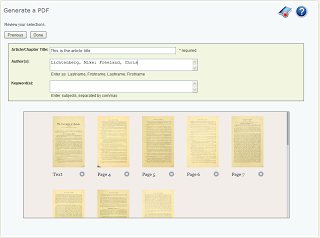
  2. We’ve added a Yes/No option, asking if users are interested in contributing the content they are creating to BHL’s citation repository, CiteBank http://www.citebank.org. CiteBank is a domain-specific repository of citations and content files about biodiversity. It evolved out of a need to access content from the BHL at a more granular level. CiteBank is a work in progress and continues to develop its collection and services. By contributing title, author and subject data to the PDF you are creating, you will allow other users to gain access to this content through CiteBank.
  3. Selecting “Yes” will allow you to enter the title, author and/or keyword data we need to index the content in our citation repository. Selecting “No” will skip over this step, eliminating any opportunity for other users to benefit from the content you’ve already taken the time to create (please say Yes!).
  4. Drawing from the functionality provided by our colleagues on the BHL-Australia web site, http://bhl.ala.org.au, we have added the ability for you to review your page selections before you generate your PDF. You will also have the opportunity to review the title, author and/or keyword data you’ve provided and make any necessary corrections/edits.

View Full Size Image

We surveyed some of our most active PDF creators and received positive feedback about these changes and many good ideas about changes that could be made for the future. As always, we welcome input from our users, especially regarding the changes we make in an effort to improve BHL functionality and services. If you have any questions/comments, please do not hesitate to send us your feedback or comment directly to this post.

September 29, 2011by Bianca Crowley
BHL News, Blog Reel, Tech Updates

New Features, New Logo

Portrait version of the Biodiversity Heritage Library logo.

BHL has made some big changes today. Our site now features a new logo, a new “Donate” button and enhanced social media functionality that significantly improves the way you can interact with and share BHL content.

New Opportunities to Support and Share

We know you love BHL, and from the plethora of feedback that we’ve received from users over the years, we know there are many of you that want to help support us. In light of this feedback, we’ve added new “Donate” functionality to the BHL. By clicking on the “Donate” button at the top of your screen, you have the opportunity to provide tax-deductible financial gifts to BHL that will help support continuing development and scanning. A very warm and heartfelt thanks goes out to our users in advance for checking out this new functionality and considering a gift of support.

You can also show your support of the BHL for free by liking us on Facebook or tweeting about us on Twitter! For some time now, we have been building a presence on a variety of social media platforms, including Facebook, Flickr, and Twitter (for a list of all of our social media accounts, visit our public wiki). We’ve now added new linked icons to each of our social media platforms on the left-hand navigation bar of the BHL website.

We love the way social media has allowed us to connect and interact with users in ways we couldn’t before, including sharing thousands of beautiful images with you, conducting daily trivia contests, and hearing from you about what you like about BHL and what you’d like to see improved or added to our site or collection. As great as this has been, we think we can do more. So, our technical development team has been busy providing you with even more ways to socially interact with BHL content.

With the new Facebook “like” button and the Twitter “tweet” buttons:

View Full Size Image
you now have the opportunity to “like” or “tweet” about specific titles, volumes, or pages you find in our collection. Go to your favorite title in the BHL and try clicking on one of the buttons shown above. You’ll have a new quick and easy way to share about BHL content via your preferred social media platform. More detailed information about our new social media features is forthcoming in a future blog post. Stay tuned.

The New Face of BHL

The new features we’ve added to our website do more to allow our users to interact directly with and support the BHL project. To highlight these changes we’ve adopted a new logo. Working together with our BHL-Australia colleagues, we decided to let go of our old image and adopt a sleeker, more compact one. With this new logo we are putting a fresh “face” forward to welcome the future of exciting new developments for the BHL. Expect more information on our new logo, its origins, and the process we went through to create it, in a later blog post.

As always, we want to hear from you!

If you have any thoughts or comments about today’s changes, or other ideas that you’d like to see implemented, don’t hesitate to send us some feedback or, better yet, tell us via Facebook or Twitter. Thank you for all your interest and support of the BHL. With your help, we will continue to grow and improve for the long road ahead.

September 1, 2011by Bianca Crowley
BHL News, Blog Reel, Tech Updates

A New Search Interface

Portrait version of the Biodiversity Heritage Library logo.

BHL has a new look and improved functionality. As a result of user feedback received from the BHL survey and through our feedback form we have improved the BHL interface. Gone are the days of the subject keyword tag-cloud on the BHL homepage. Today, the new interface provides a variety of tabs to facilitate simple or advanced search strategies.

Highlights of improvements

• Search is given more emphasis – search is now the central focus of the home page. Users can start with either a general search or more advanced search easily just by clicking additional tabs.

• more Advanced Search options – users can now search one or more fields within a book or journal (e.g. title, author, volume, language, etc)

• search by Series – series statements are now searched when searching a book or journal. These statements are also included in the search results when available.

• search by Citation – individual citations can now be searched via the Citation Finder tab. This feature uses the BHL’s OpenURL resolver to search for individual pages in books and journals.

• Browse and Search are now more consistent – browse and search pages and search results are now consistent in appearance and functionality. For example, users can now more easily sift through a long list of search results by sorting results either by title, author, or year

• CSV download option – Books/Journals search results are now downloadable as .csv format.

The BHL does its best to follow up on the suggestions of our users whenever possible. We welcome your feedback about the new user interface via our feedback form http://www.biodiversitylibrary.org/Feedback.aspx and will consider suggestions for further improvement as we continue to enhance the BHL.

February 1, 2011by Bianca Crowley
BHL News, Blog Reel, Tech Updates

Ingest Criteria Revised

Portrait version of the Biodiversity Heritage Library logo.

In November 2009, the BHL started ingesting biodiversity related content from the Internet Archive. Since then, the BHL collection has grown significantly. Each week, the BHL brings in new content from the Internet Archive based on a criteria of selected Library of Congress Subject Headings and call numbers, with the aim of bringing in content related to the literature of biological diversity.

As described by the Convention on Biodiversity,

Biological diversity – or biodiversity – is the term given to the variety of life on Earth and the natural patterns it forms.…This diversity is often understood in terms of the wide variety of plants, animals and microorganisms.…Biodiversity also includes genetic differences within each species – for example, between varieties of crops and breeds of livestock. Chromosomes, genes, and DNA-the building blocks of life-determine the uniqueness of each individual and each species. Yet another aspect of biodiversity is the variety of ecosystems such as those that occur in deserts, forests, wetlands, mountains, lakes, rivers, and agricultural landscapes. In each ecosystem, living creatures, including humans, form a community, interacting with one another and with the air, water, and soil around them. http://www.cbd.int/convention/guide/

The BHL collection reflects this wide interdisciplinary spectrum. When ingesting content from the Internet Archive, the criteria of LCSH and LC call numbers are used to target as much relevant biodiversity literature as possible, but it is not fool proof.

Recently, the Ingest Criteria was reviewed by the BHL Collections Committee to identify subject terms and call numbers that were missing the mark. We noticed books were being brought in that were clearly not relevant to the BHL mission such as books about human anatomy, taxation, and hockey. The Ingest Criteria have since been revised to better target biodiversity relevant materials and most of the irrelevant content has been removed from our collection. Users should not have to weed through irrelevant materials in the BHL collection when access to this content remains available via other open access digital collections. For example, access to Mary Louise Serafine’s Measure of meter conservation in music based on Piaget’s theory will be via the Internet Archive website rather than through the BHL.

For more information about BHL’s de-accession policy, please see our documentation on our wiki http://biodivlib.wikispaces.com/Deaccession+Policy. Should you feel that any content has been removed from BHL unnecessarily, please feel free to send us your comments to our feedback form.

July 30, 2010by Bianca Crowley
Page 4 of 5« First...«2345»

Help Support BHL

BHL's existence depends on the financial support of its patrons. Help us keep this free resource alive!

search

About BHL

The Biodiversity Heritage Library (BHL) is the world’s largest open access digital library for biodiversity literature and archives. BHL operates as a worldwide consortium of natural history, botanical, research, and national libraries working together to digitize the natural history literature held in their collections and make it freely available for open access as part of a global “biodiversity community.”

Join Our Mailing List

Sign up to receive the latest news, content highlights, and promotions.

Subscribe Now

Subscribe to Blog via Email

Enter your email address to subscribe to this blog and receive notifications of new posts by email.

Join 319 other subscribers

Subscribe to Blog Via RSS

Subscribe to the blog RSS feed to stay up-to-date on all the latest BHL posts.

Access RSS Feed

Inspiring Discovery through Free Access to Biodiversity Knowledge.

The Biodiversity Heritage Library makes it easier than ever for you to access the information you need to study and explore life on Earth…for free, anytime, anywhere.


64+ Million Pages of
Biodiversity Literature Online.

EXPLORE

Tools and Services
to Transform Research.

EXPLORE

300,000+
Illustrations on Flickr.

EXPLORE

ABOUT | HARMFUL CONTENT | PRIVACY | SITE MAP | TERMS OF USE