Biodiversity Heritage Library - Program news and collection highlights from BHL
  • Home
  • News
  • Featured Books
    • All Featured Books
    • Book of the Month Series
    • BHL at 20
  • User Stories
  • Campaigns
    • Fossil Stories
    • Garden Stories
    • Monsters Are Real
    • Page Frights
    • Her Natural History
    • Earth Optimism 2020
  • Tech Blog
  • Visit BHL
Home
News
Featured Books
    All Featured Books
    Book of the Month Series
    BHL at 20
User Stories
Campaigns
    Fossil Stories
    Garden Stories
    Monsters Are Real
    Page Frights
    Her Natural History
    Earth Optimism 2020
Tech Blog
Visit BHL
  • Home
  • News
  • Featured Books
    • All Featured Books
    • Book of the Month Series
    • BHL at 20
  • User Stories
  • Campaigns
    • Fossil Stories
    • Garden Stories
    • Monsters Are Real
    • Page Frights
    • Her Natural History
    • Earth Optimism 2020
  • Tech Blog
  • Visit BHL
Biodiversity Heritage Library - Program news and collection highlights from BHL
BHL News, Blog Reel

Register Today for the Virtual BHL Day 2021 on 14 April!

Graphic for BHL Day 2021.

Graphic for BHL Day 2021.

Registration is now open for our virtual BHL Day 2021 on 14 April, presented as part of our 2021 Annual Meeting! Themed “Reflections In Crises”, the program will include sessions reflecting on BHL’s roles in addressing the biodiversity crisis, challenges arising from COVID-19, and systemic racism in natural history collections.

Date and Time: 14 April 2021 (1200-1700 UTC)

Location: Online (via Zoom webinar)

Registration: The event is free but registration is required. Register.

Program Details:

BHL Day 2021: Reflections in Crises will include an opening keynote from Dr. Ian Owens (Deputy Director at the National Museum of Natural History, Smithsonian Institution) addressing the biodiversity crisis and a closing keynote from Lidia Ponce de la Vega (Doctoral Candidate in Hispanic Studies at McGill University) discussing how BHL can help decolonise biodiversity collections and archival practices. The program will also include a Partner Reflection Panel with representatives from BHL partner institutions focused on BHL’s impact during the COVID-19 pandemic.

Further program details and the registration link can be found on the BHL Day 2021 event page.

March 29, 2021by Grace Costantino
BHL News, Blog Reel

Save the Date for BHL Day 2021 on 14 April!

Save the Date graphic for BHL Day 2021: Reflections in Crises

Save the Date graphic for BHL Day 2021: Reflections in Crises

Save the date for a virtual BHL Day 2021 on 14 April, presented as part of our 2021 Annual Meeting! Themed “Reflections In Crises”, the program will include sessions reflecting on BHL’s roles in addressing the biodiversity crisis, challenges arising from COVID-19, and systemic racism in natural history collections.

Date and Time: 14 April 2021 (approx. 1200-1700 UTC, exact session times TBD)

Location: Online (via Zoom webinar)

Registration: The event is free but registration is required. Registration will go live on 29 March 2021 and will be shared via the BHL Day 2021 event page.

Program Details:

BHL Day 2021: Reflections in Crises will include an opening keynote from Dr. Ian Owens (Deputy Director at the Smithsonian’s National Museum of Natural History) addressing the biodiversity crisis and a closing keynote from Lidia Ponce de la Vega (Doctoral Candidate in Hispanic Studies at McGill University) discussing how BHL can help decolonise biodiversity collections and archival practices. The program will also include a Partner Reflection Panel with representatives from BHL partner institutions focused on BHL’s impact during the COVID-19 pandemic.

More Information can be found on the BHL Day 2021 event page. That event page will be updated with further program details over the coming weeks.

March 18, 2021by Grace Costantino
BHL News, Blog Reel

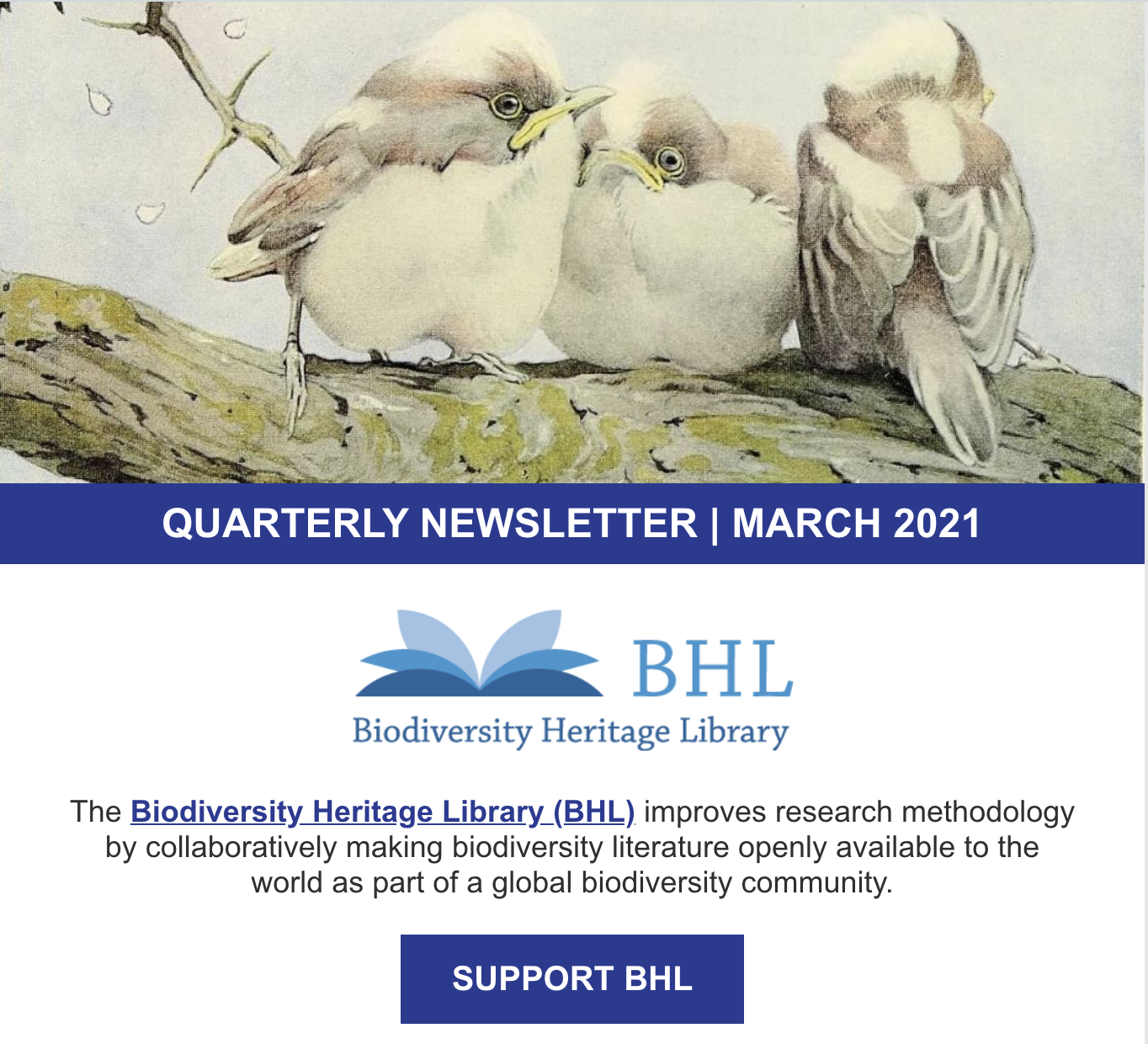
BHL Quarterly Newsletter (March 2021) Now Available!

Screenshot of the March 2021 BHL newsletter

Screenshot of the March 2021 BHL newsletter

Our latest quarterly newsletter is now available! From exciting news about our image collection in Flickr to an upcoming online Wikipedia Editing Workshop on women in science, don’t miss the latest news from the BHL community.

View our March 2021 Quarterly Newsletter.

Be sure to subscribe to our mailing list to keep up to date with all the latest BHL news.

March 9, 2021by Grace Costantino
BHL News, Blog Reel

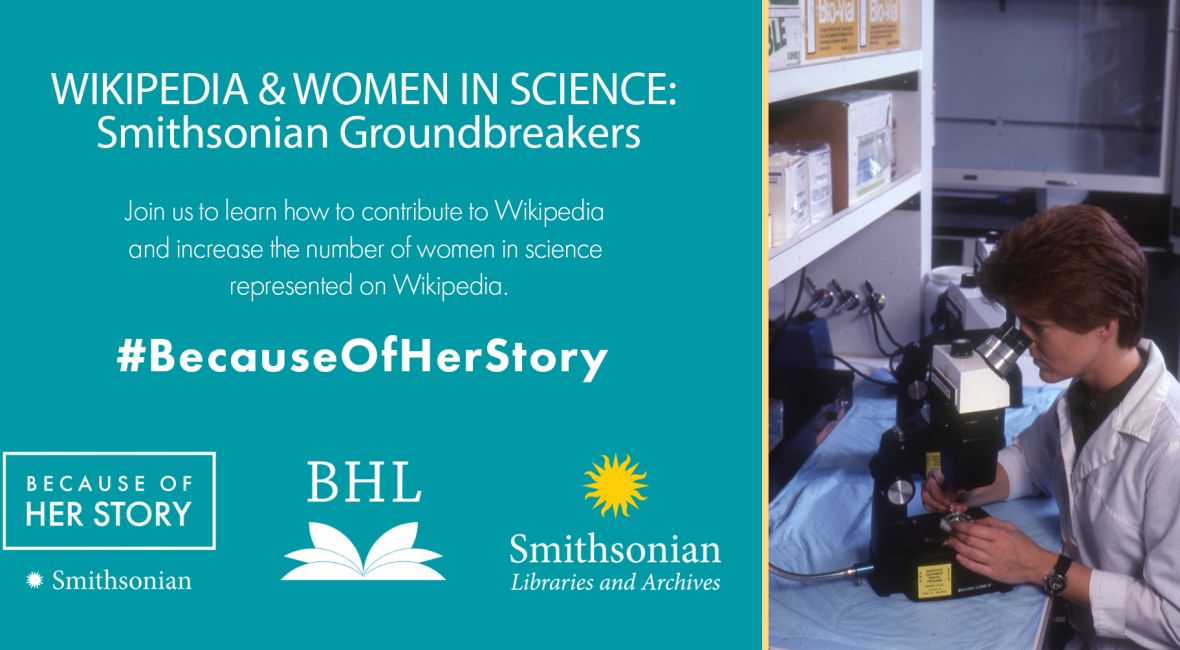
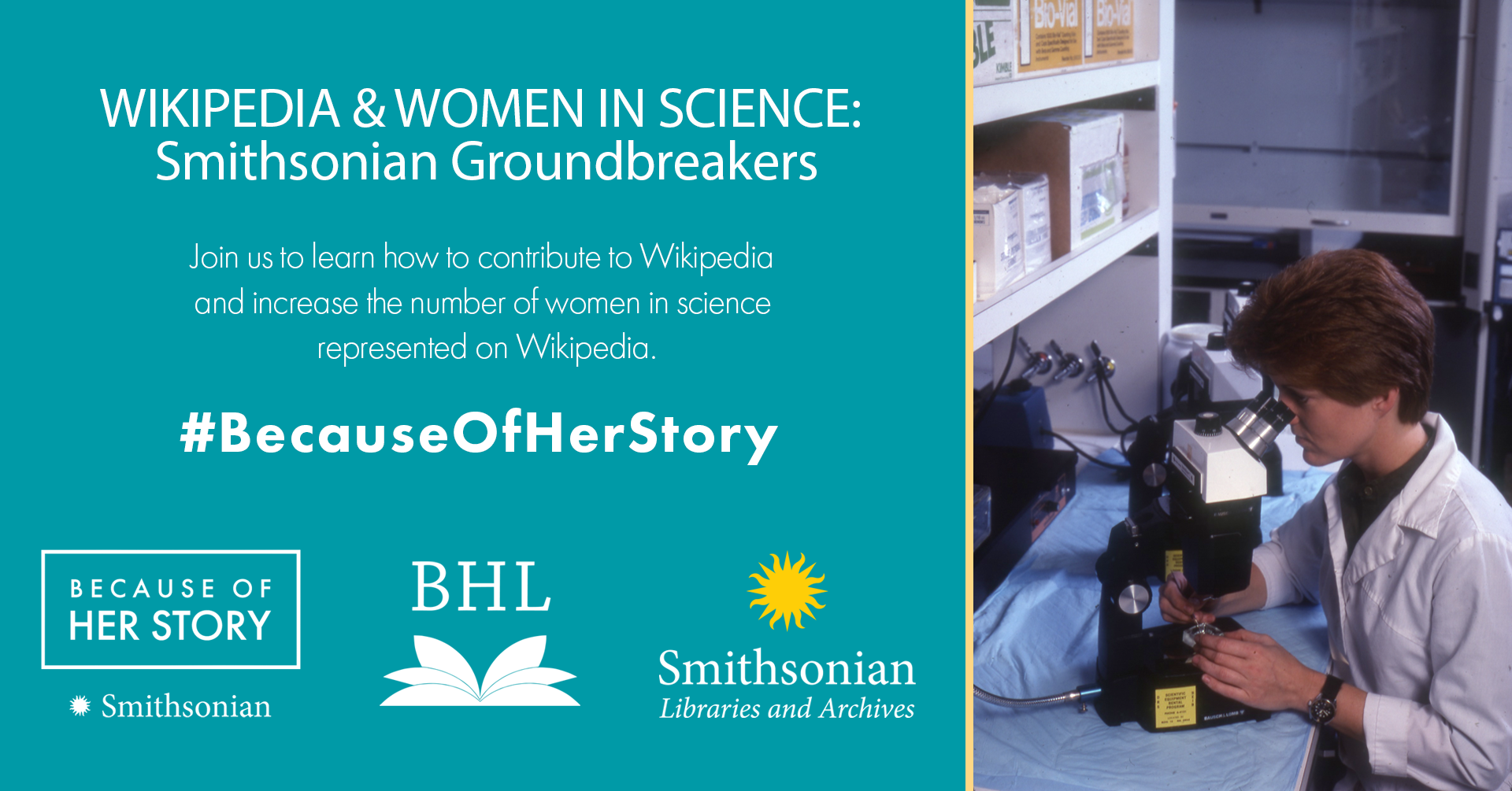
Wikipedia & Women in Science: Smithsonian Groundbreakers Edit-a-thon

graphic for women in science wikipedia workshop

Photo in graphic shows Dr. JoGayle Howard working with embryos from the National Institutes of Health at the dissecting microscope in 1982. Photo Credit: Smithsonian Institution Archives.

Join us on 25 March 2021 (1-3pm ET) for Wikipedia & Women in Science: Smithsonian Groundbreakers Edit-a-thon, an online Wikipedia editing workshop hosted in conjunction with the Smithsonian American Women’s History Initiative and the Smithsonian Institution Archives, part of Smithsonian Libraries and Archives.

When? 25 March 2021, 1-3pm ET

Where? Online

Register Today!

During this training, attendees of all experience levels will learn the basics of how to edit Wikipedia by updating articles related to the history of women in science at the Smithsonian Institution in connection with the Funk List. Presenters will share how editors might research the work of these women in the absence of personal papers and institutional records.

As one of the web’s most visited reference sites, Wikipedia serves as a starting point for many individuals looking to learn about art, history, and science. However, less than 19% of Wikipedia biographies in English represent women, and less than 10% of Wikipedia editors identify as women. By increasing representation of women scientists on the site, your impact can spark the curiosities of future generations who see themselves in these Smithsonian groundbreakers.

This event is planned in conjunction with the Smithsonian Institution Archives, the Biodiversity Heritage Library, and the Smithsonian American Women’s History Initiative, a multiyear undertaking to document, research, collect, display, and share the history of women in the United States.

March 8, 2021by Grace Costantino
BHL News, Blog Reel

More than 250,000 Free Nature Images Now Available in the BHL Flickr

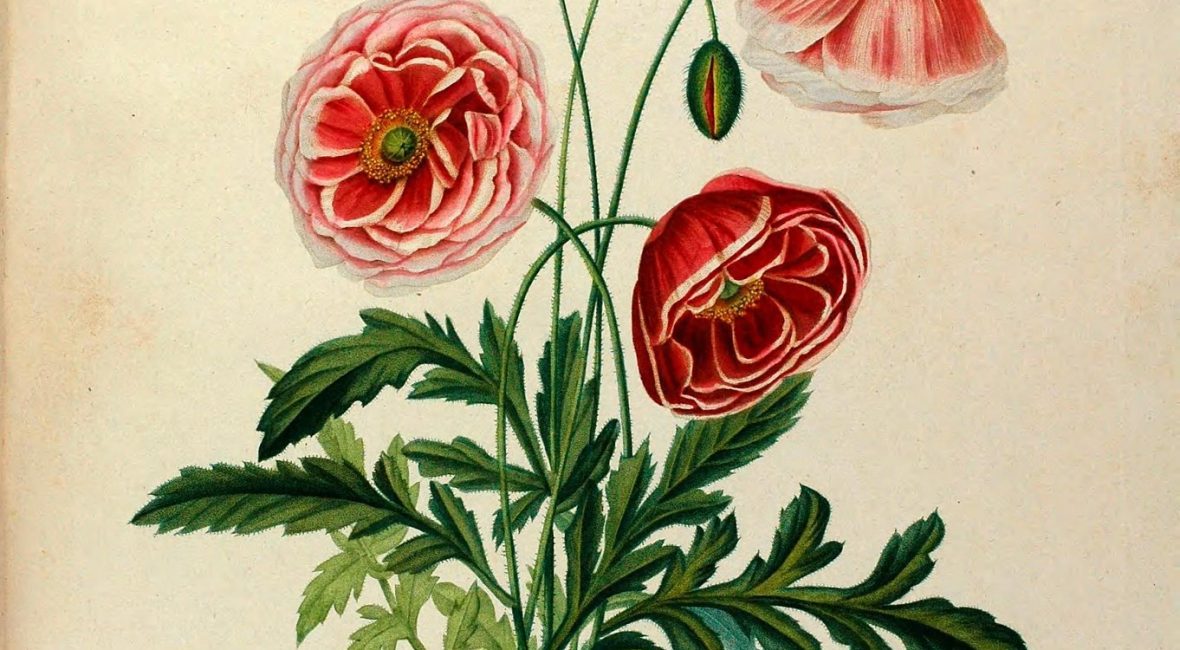
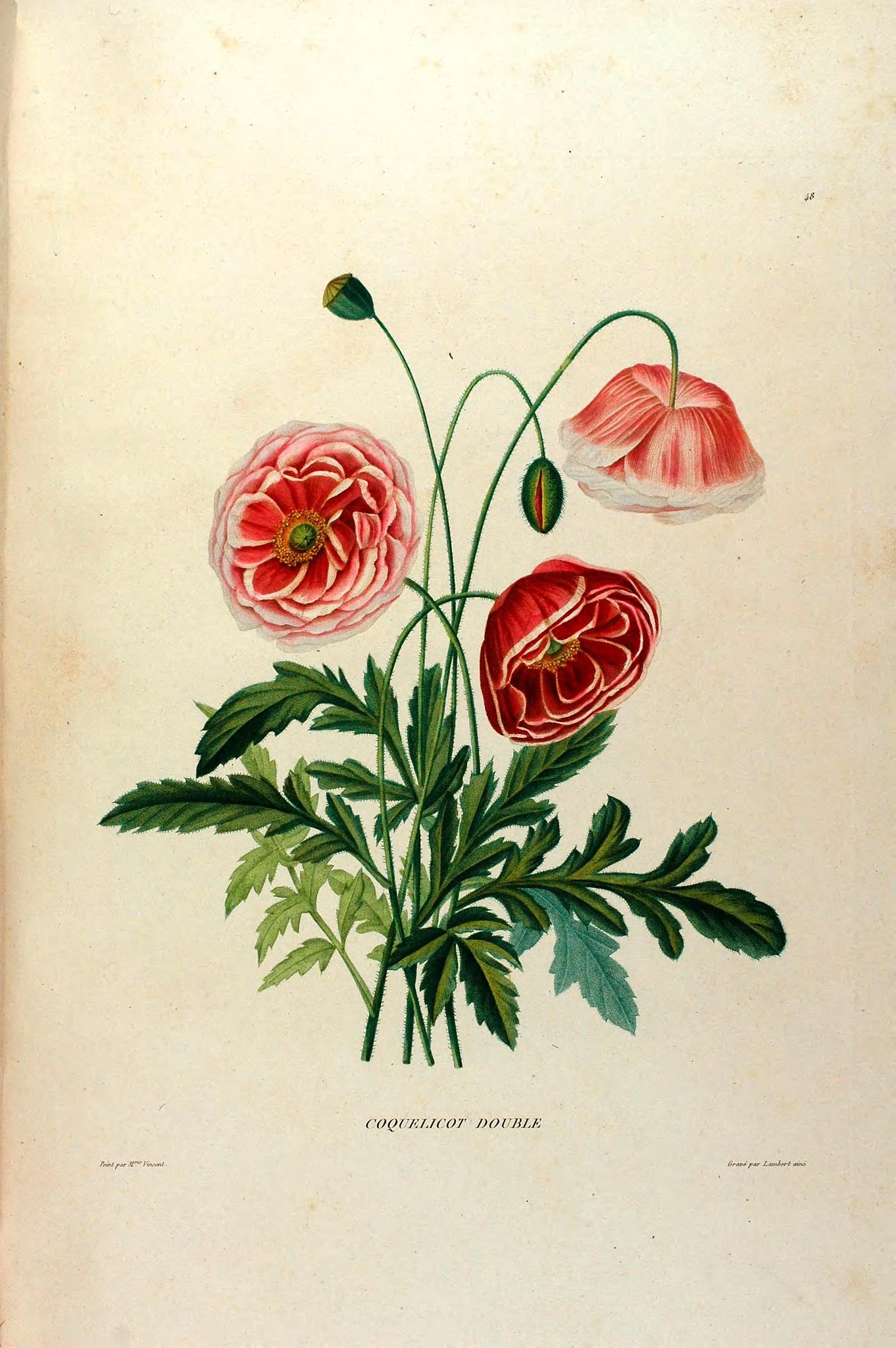
illustration of red flowers with green stems and leaves.

The most-viewed image in the BHL Flickr as of February 2021. Vincent, Henriette Antoinette. Études de fleurs et de fruits. c1820. Art by Vincent. Contributed in BHL from Chicago Botanic Garden, Lenhardt Library. Link in Flickr. Link in BHL.

Over a quarter of a million nature images are now freely available through the BHL Flickr!

Since 2011, we’ve been making many of the illustrations from BHL’s collection available via Flickr. While it has long been a community favorite amongst our audiences, in 2020 our Flickr’s popularity increased significantly when it received considerable media attention in outlets including Colossal, Laughing Squid, Český rozhlas, ZME Science, Cultura Inquieta, Hyperallergic, Graffica, Smithsonian Magazine, Open Culture, la Repubblica, Genbeta, My Modern Met (en Español), eCulture Greece, Daily Geek Show, Вокруг Света, Atlas Obscura, Shifter, Lifehacker, Indiehoy, Microsiervos, and Vice. As a result of this publicity in February 2020, we saw a 518% increase in daily views on Flickr images (2.5 million daily views compared to an average of 400,000) and an over 100% increase in visits and unique visitors to BHL. This popularity continued throughout the year, culminating in over 343 million views on images in 2020 alone—a 123% increase over 2019, bringing our all-time views to over 902 million!

Last year also offered a unique opportunity to substantially build our Flickr collection. With many of our partners working virtually in 2020 due to the COVID-19 pandemic, we focused on projects to improve our digital collections remotely. This work included uploading images to Flickr. In 2020, over 40 BHL partner staff and volunteers contributed to the upload of over 90,000 new images to Flickr—a nearly 200% increase in images uploaded compared to 2019.

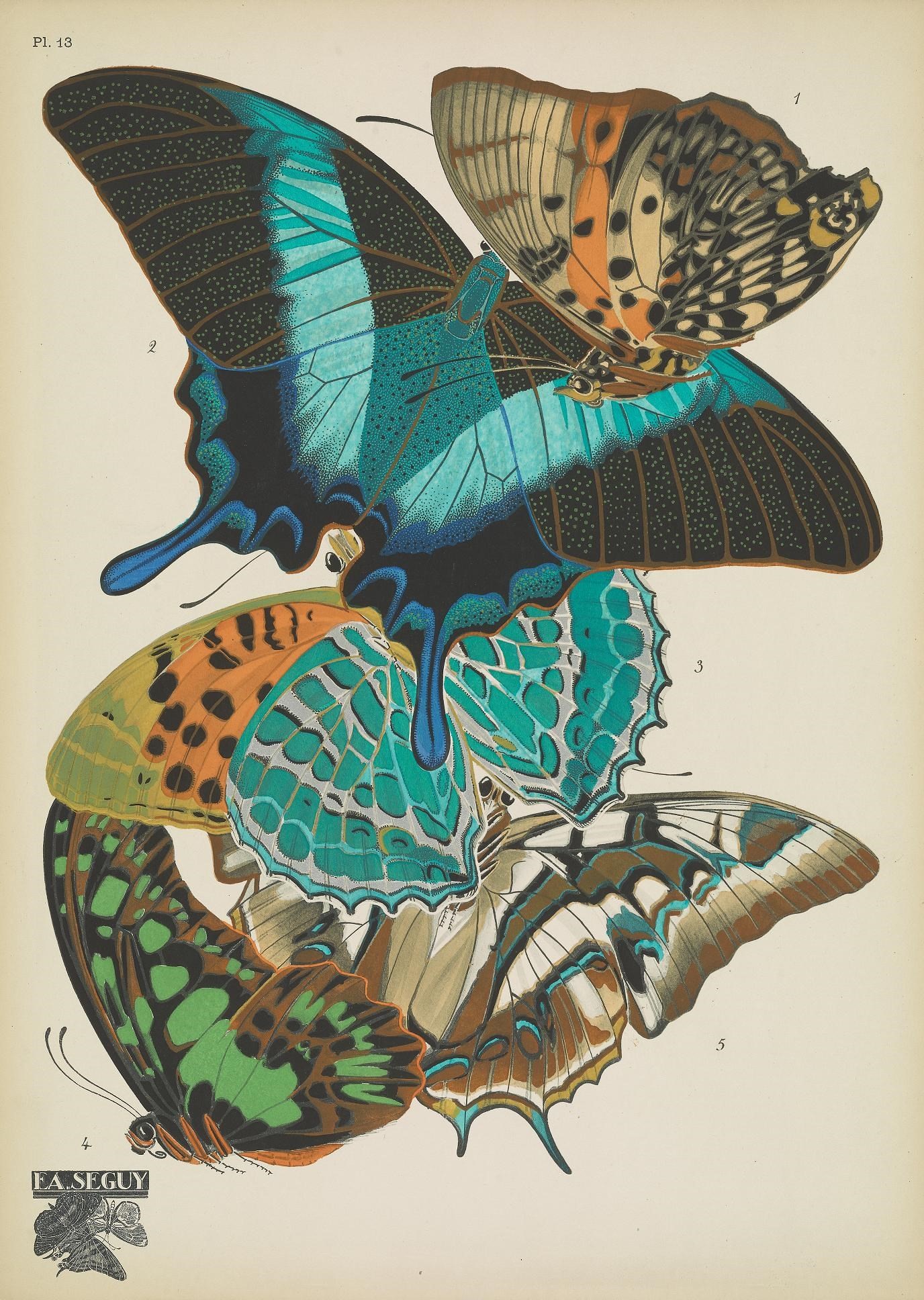
illustration of multiple butterflies positioned on top of one another.

The second most-viewed image in the BHL Flickr as of February 2021. Séguy, Emile-Allain. Papillons. 1925. Art by Séguy. Contributed in BHL from Smithsonian Libraries and Archives. Link in Flickr. Link in BHL.

Thanks to this impressive work, our Flickr collection now includes over 250,000 free images dating from the 16th-20th centuries and representing a range of biodiversity subjects, from plants and animals to fungi, microscopic organisms, and even artifacts like tools made from shells. All images in the BHL Flickr are free to browse, download, and reuse. You can learn more about reusing images from Flickr on the BHL About site.

This post features some of the most popular (by views) images in the BHL Flickr.

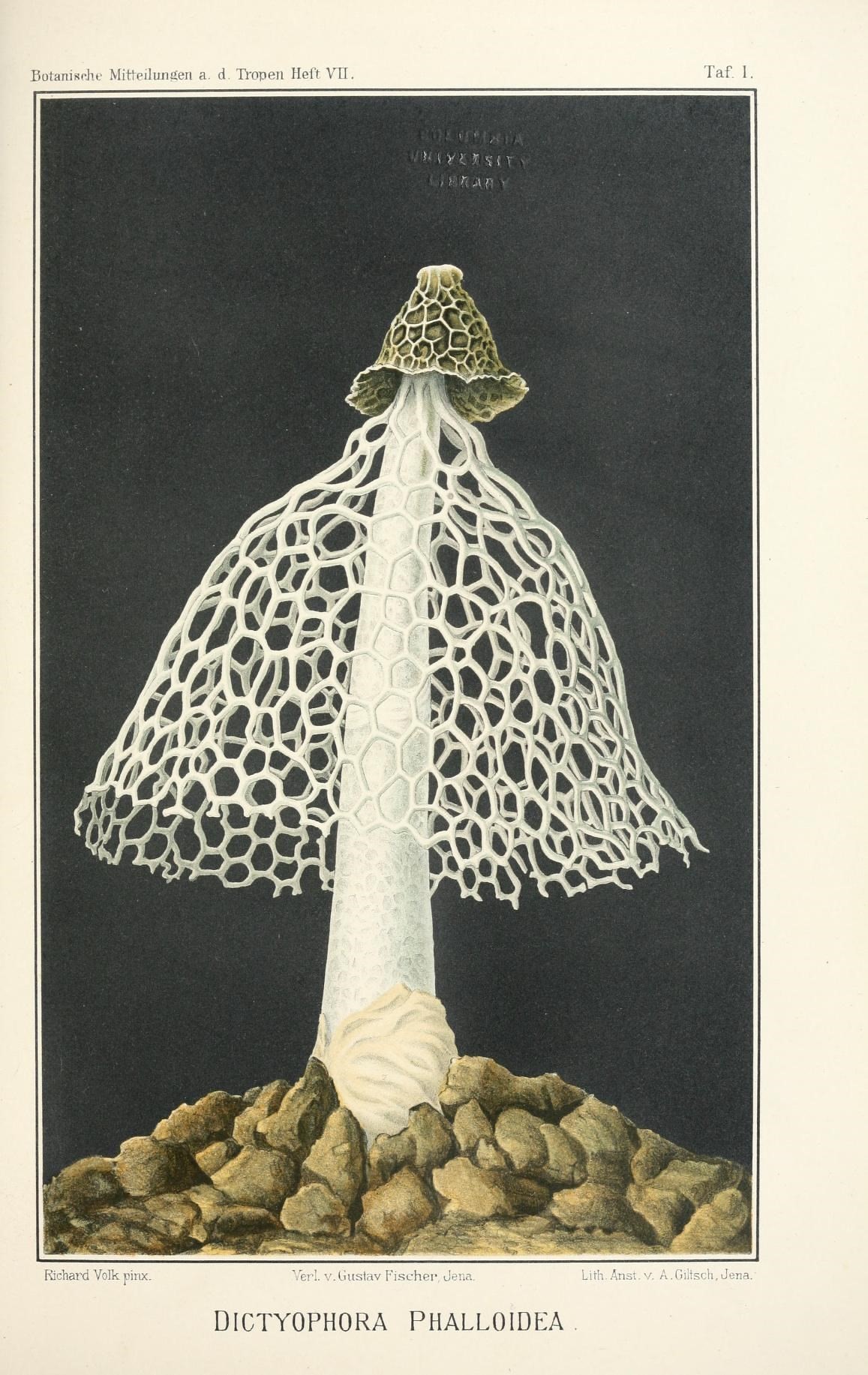
illustration of fungi with an indusium.

The third most-viewed image in the BHL Flickr as of February 2021. Möller, Alfred. Brasilische Pilzblumen. 1895. Art by Richard Volk. Contributed in BHL from The LuEsther T Mertz Library, the New York Botanical Garden. Link in Flickr. Link in BHL.

Images in Flickr are curated by album and collection. Each album corresponds to a particular volume in BHL and contains all of the full page images from that volume. Images and albums are further curated into collections on particular subjects, from botanical art to marine species, gardening, endangered species, and more. We also have collections associated with BHL’s various social media campaigns, including Her Natural History (featuring a collection of illustrations by women artists, each tagged with the name of the artist), Monsters Are Real (featuring images of mythical creatures like hydra, sea serpents, and kraken), Color Our Collections (featuring black and white illustrations perfect for printing and coloring), and Fossil Stories (featuring a wealth of historic paleontological art).

Flickr helps improve image discoverability for BHL, not only by making it easier to browse images from BHL’s collection of over 59 million pages, but also by providing an opportunity for the public to help enhance the metadata for these images through crowdsourcing, making it easier to search the images by species, artist, geographic location, and more! Visit our About site to learn more about how to search images in the BHL Flickr.

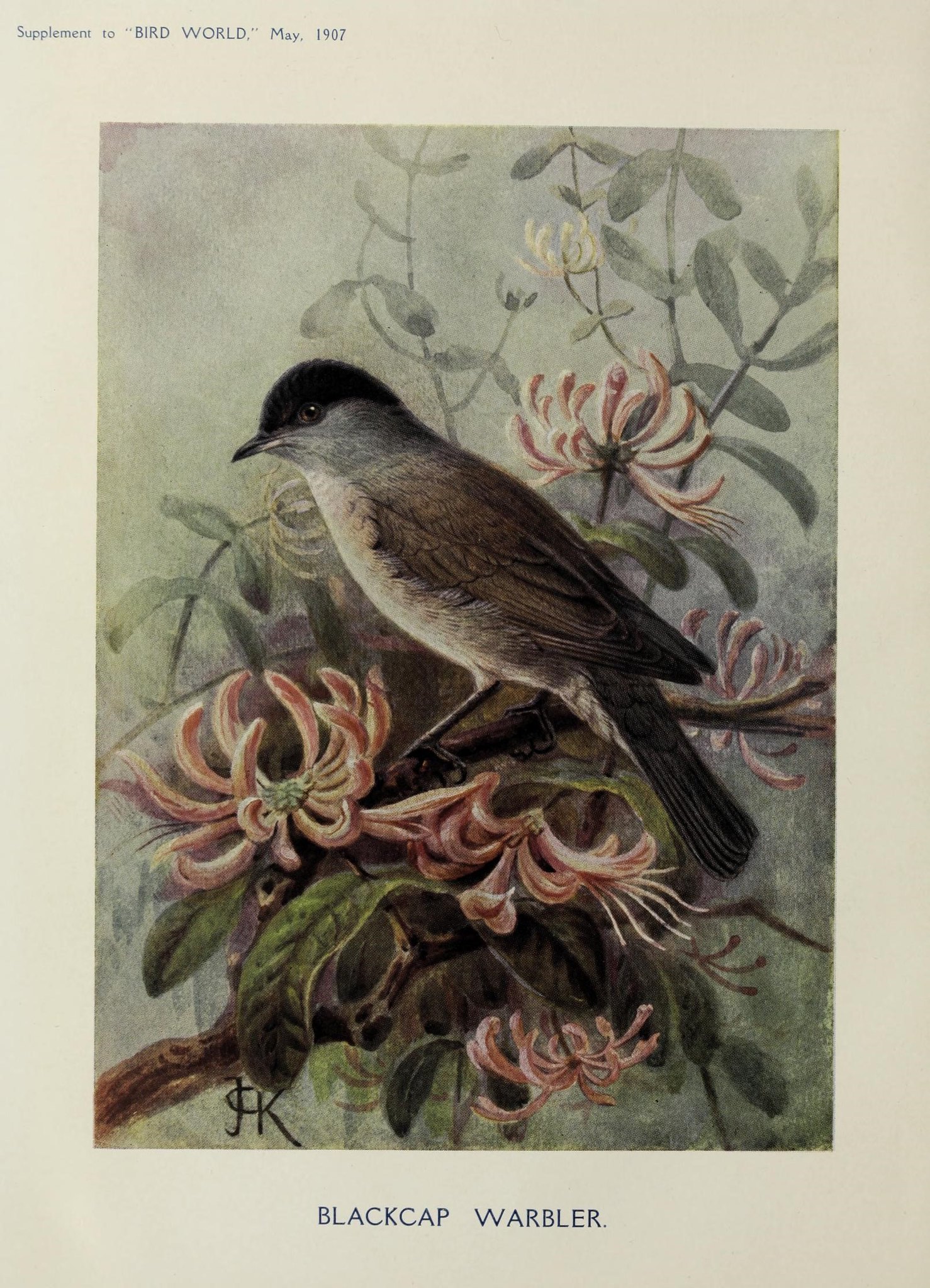
illustration of a bird sitting amongst pink flowers.

The fourth most-viewed image in the BHL Flickr as of February 2021. Bird World Magazine, v.1 (1906-1907). Art by John Gerrard Keulemans. Contributed in BHL from the University Library at the University of Illinois at Urbana-Champaign. Link in Flickr. Link in BHL.

Through our Flickr Tagging Crowdsourcing Project, we invite anyone to help add tags to Flickr images that describe the species depicted, identify the artist of the image, or indicate the geographic location in which the depicted species lives. To date, over 46,000 images, or about 18% of our Flickr collection, has been tagged by the public. This is an incredible accomplishment, but don’t worry—there’s still plenty of images in need of tags. And the best part? This is an educational activity that you can do from home!

We are so grateful to all of our volunteers who have helped tag our images. Thanks to you, these images are more accessible and discoverable for others to support their research and educational activities.

We welcome anyone to join us in tagging images in our Flickr. Learn how to get started with these detailed tagging instructions.

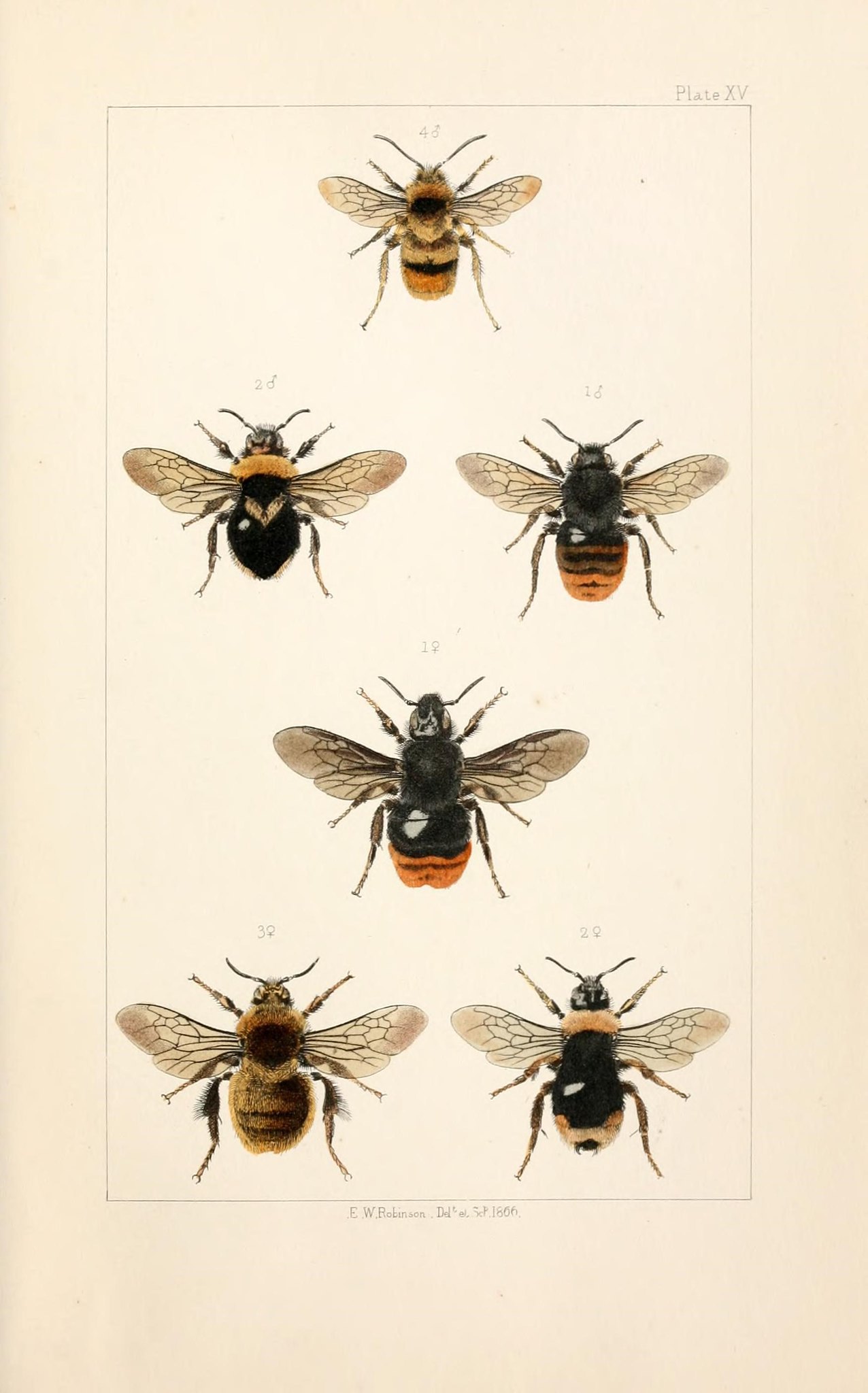
Illustration of bees.

The fifth most-viewed image in the BHL Flickr as of February 2021. Shuckard, William Edward. British Bees. 1866. Art by Edward William Robinson. Contributed in BHL from MBLWHOI Library. Link in Flickr. Link in BHL.

We invite you to explore our image collections on Flickr today. Thank you to all of our incredible partners who have helped build this amazing resource, and to all of our volunteers who have helped improve it through image tagging. We encourage you to download and reuse the images for your own educational, artistic, personal, and professional uses, and to help us improve the collections by participating in our tagging project.

Enjoy immersing yourself in the beauty of nature through art!

February 18, 2021by Grace Costantino
BHL News, Blog Reel, Tech Updates

Updates to Bibliography Pages in BHL

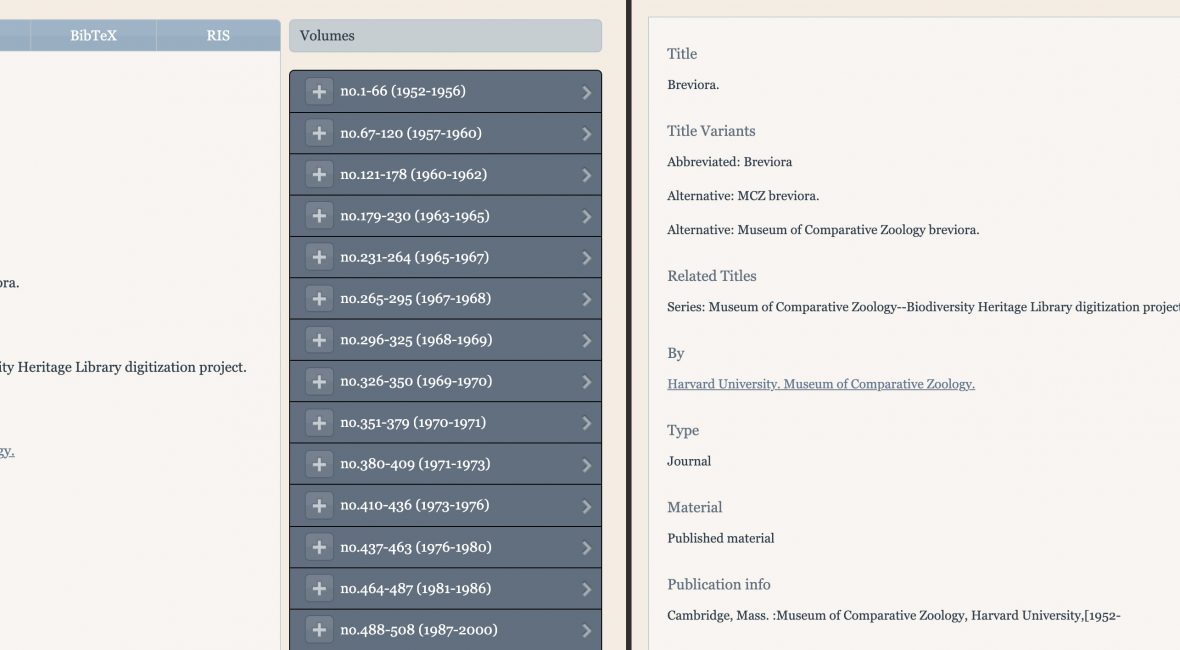
Screenshot of bibliography pages in BHL with and without tabs.

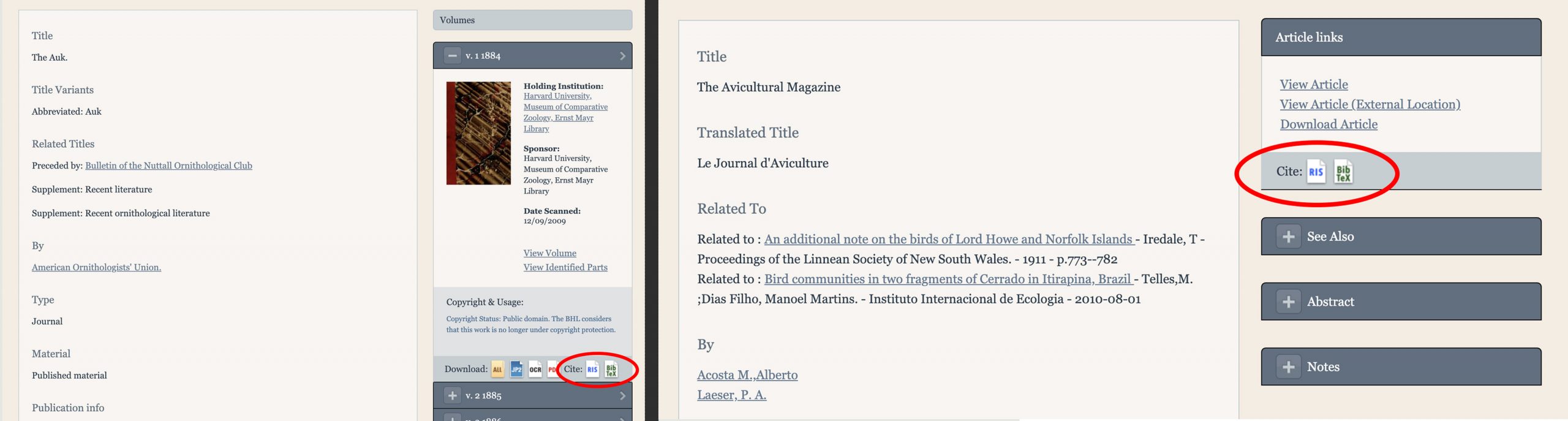
We have updated the bibliography pages in BHL to streamline the presentation of information about and metadata export options for content in the Library.

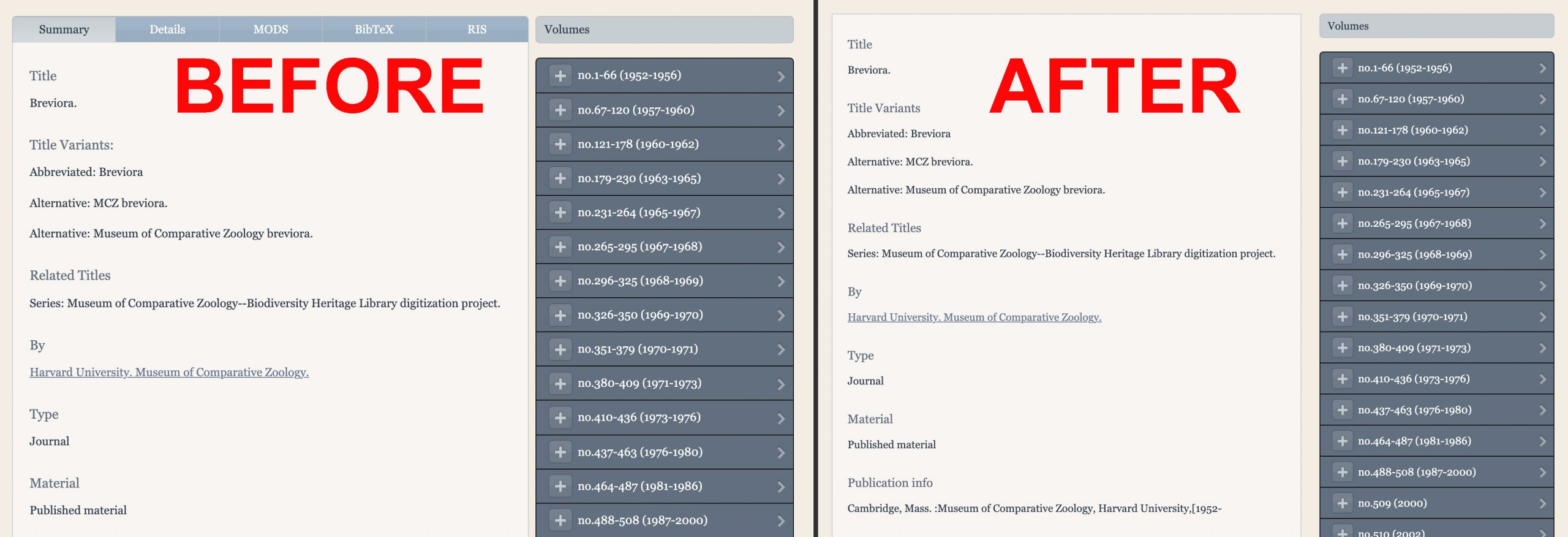
Previously, bibliographic details and export options were available through different tabs on title and part pages. These tabs have now been removed, and all bibliographic information is consolidated into a single display.

Screenshot showing BHL bibliography pages before and after.

The various tabs on title and part bibliography pages have now been consolidated into a single display.

BHL’s metadata export options have also been relocated. BHL offers metadata exports in MODS, BibTex, and RIS formats. MODS is an XML-based bibliographic description schema used in a variety of library applications. BibTex and RIS are bibliographic citation files that are compatible with a variety of citation management tools. The MODS file is a title-level download. The BibTex and RIS files are item-level downloads.

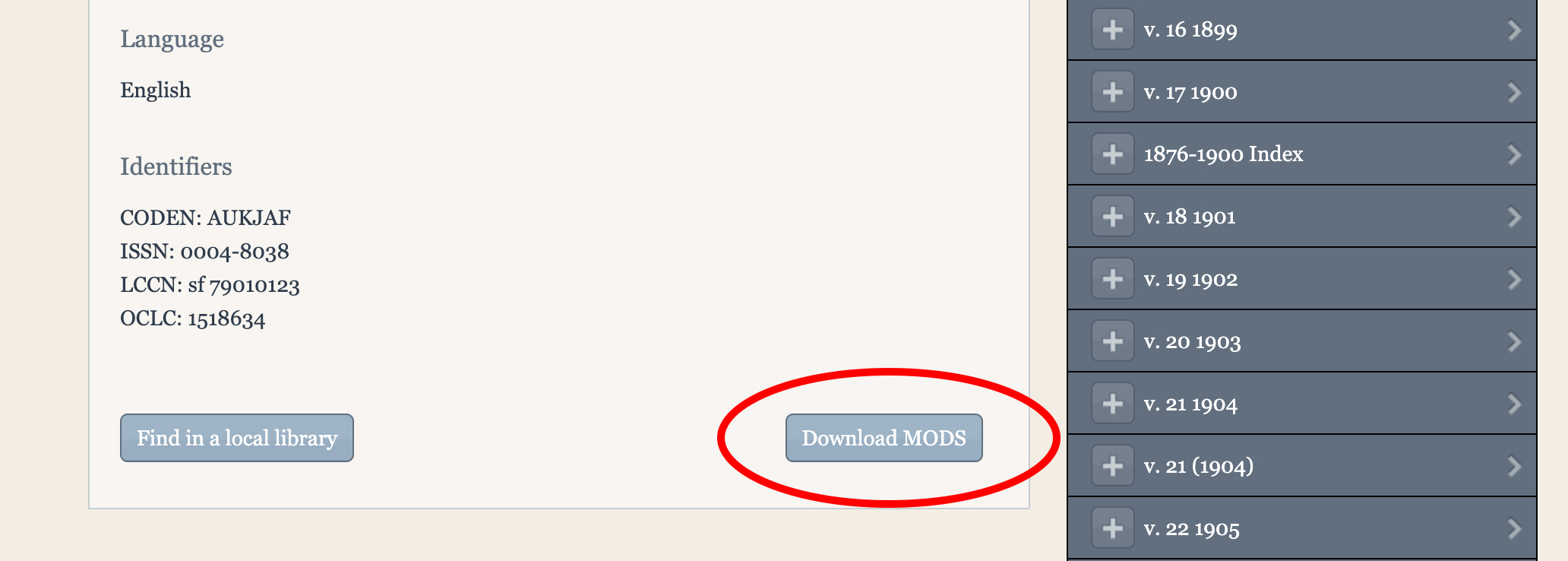
The MODS download is available at the bottom of the title and part bibliography pages.

Screenshot of a title page in BHL with the "Download MODS" button circled.

MODS download on the title and page bibliography pages.

The BibTex and RIS downloads are available in two places:

1) Under the volume or part details on bibliography pages.

Screenshot of the citation download options in the BHL website.

BibTex and RIS downloads on title (left) and part (right) bibliography pages.

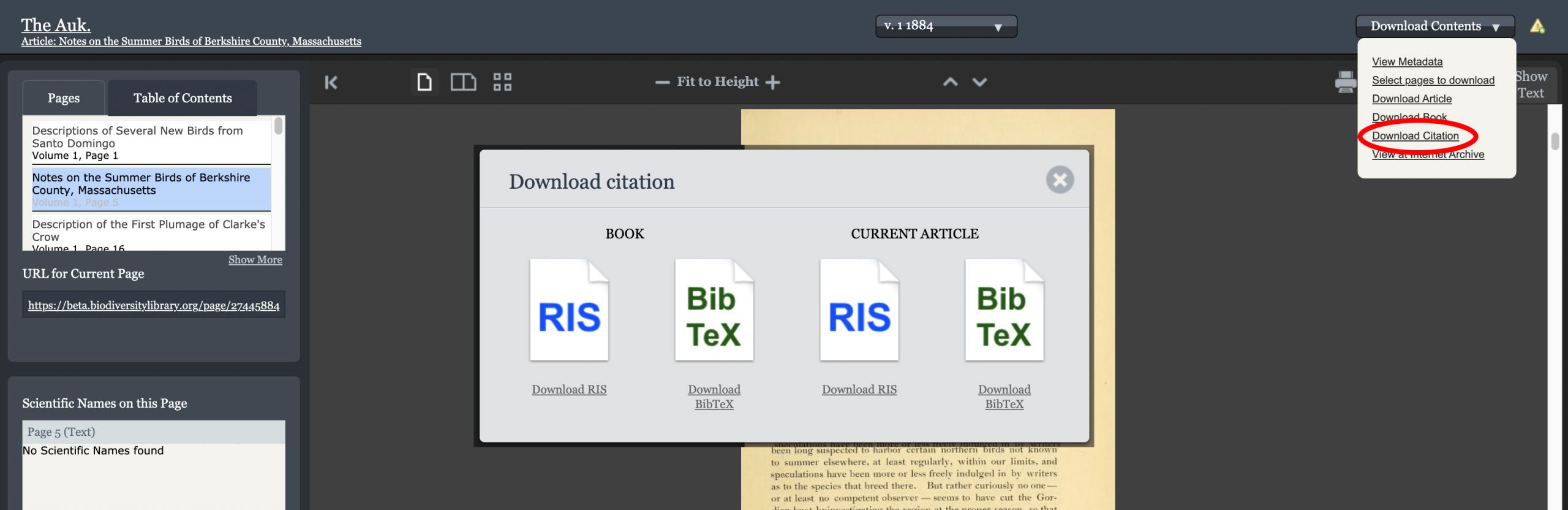
2) Under the “Download Contents” menu in the book viewer, via the “Download Citation” option.

Screenshot of the BHL book viewer with the citation download options displayed.

Download citation options in the BHL book viewer.

As part of this update, we have removed the direct Mendeley import from BHL, as the generic RIS and BibTex formats are compatible with a variety of citation management softwares including Mendeley.

Details about our metadata export services are also available in the FAQ on the BHL About site.

February 11, 2021by Grace Costantino
Blog Reel, User Stories

Finding Refuge in the Library: How BHL Inspired the Mycological Book Club

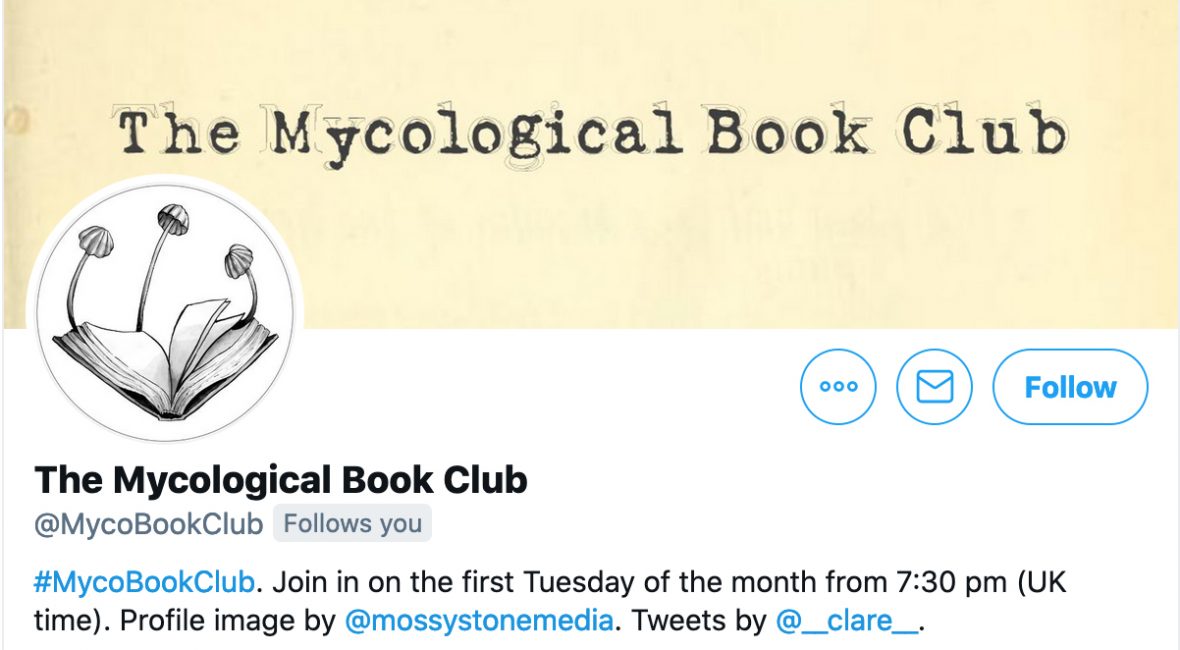
Screenshot of the Twitter profile of @MycoBookClub.

On 23 March 2020, the U.K. went into its first national lockdown in response to the COVID-19 pandemic. Social distancing and teleworking became the norm, and the walls of our homes became, in many ways, the boundaries of our individual worlds.

Amateur mycologist Clare Blencowe was eager to find a positive distraction from the realities of life during a pandemic. The Biodiversity Heritage Library’s open access collections, which for Blencowe had become a welcome refuge from the continuous onslaught of negative news articles, now became the inspiration for a new, socially distanced way to connect with other fungi lovers—in the form of “The Mycological Book Club”, an online, Twitter-based book club with a particular focus on open access literature.
#MycoBookClub logo fungi growing out of a book

#MycoBookClub logo, designed by illustrator Kelsey Sconberg of Mossy Stone Media.

“We were at the beginning of a national lockdown,” recalls Blencowe. “All social events were cancelled, and I found myself endlessly scrolling through increasingly doom-laden news, feeling increasingly doom-y. #MycoBookClub started as a simple distraction, an opportunity for a shared experience: people reading the same book and discussing it on Twitter at an allotted time.”

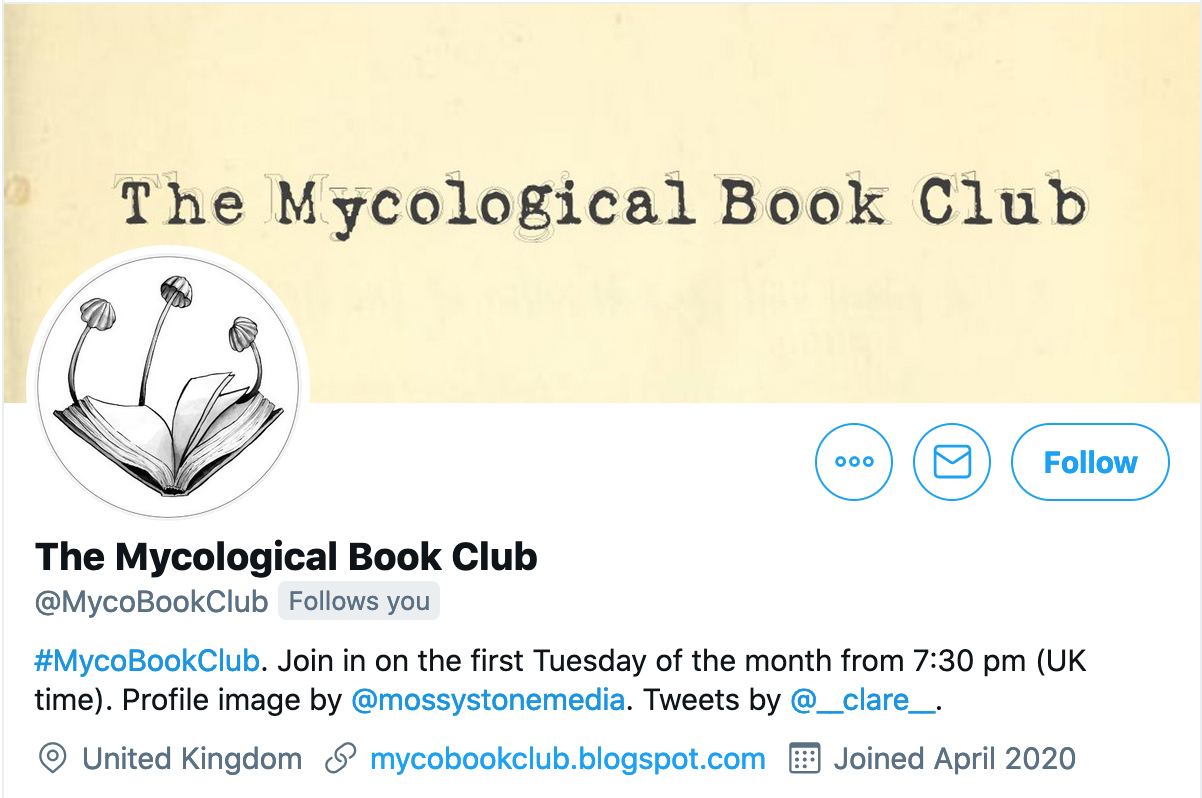
Screenshot of the Twitter profile of @MycoBookClub.

@MycoBookClub on Twitter.

Blencowe brought her idea to life by founding the @MycoBookClub Twitter account, establishing the #MycoBookClub hashtag to facilitate discussion, and setting a recurring date and time for book club meetings—the first Tuesday of the month at 7:30pm (GMT) on Twitter. She then scheduled the first #MycoBookClub meeting for 5 May 2020.

That first meeting, which brought together just a handful of followers, was dedicated to Mordecai Cubitt Cooke’s Rust, Smut, Mildew & Mould: An Introduction to the Study of Microscopic Fungi (Fifth ed. 1886), which club members accessed through BHL.

Welcome to #MycoBookClub, folks! It’s a pleasant evening here at @MycoBookClub headquarters in Sussex, England.

We’re talking about ‘MICROSCOPIC FUNGI: Rust, Smut, Mildew & Mould’ by M.C. Cooke (1886). You can find it at: https://t.co/7WO005ZS5Q pic.twitter.com/GxWzmYhnxg

— The Mycological Book Club (@MycoBookClub) May 5, 2020

With passages celebrating the beauty and wonder of the often unheeded nature in our own backyards and neighborhoods, the title was a fitting—and motivating—choice for an audience confined to their homes and local natural surroundings.

As Cooke writes,

“We might traverse the primeval forests of the new world, and explore the unknown regions of the old, and not encounter so much to excite our admiration, or cause our wonder, as lies about our feet at home; marvels which we tread beneath our feet, or kick from our path, because they appear to be only rotten sticks, withered grass, and decaying leaves.”

“Cooke’s writing provided inspiration for enjoying nature near home,” shares Blencowe. “I felt myself lifted by his soaring rhetoric.”
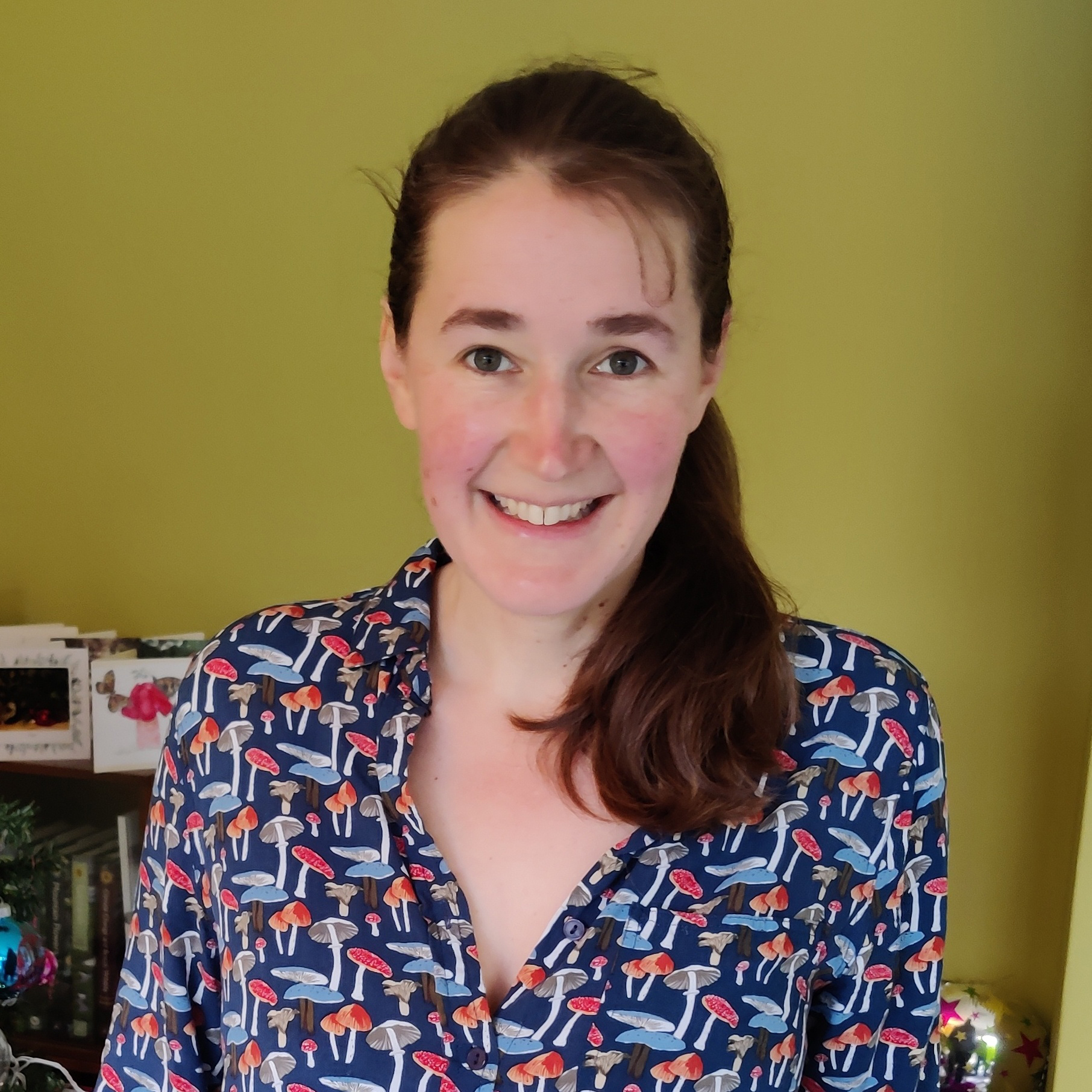
Photo of a human with long brown hair in a shirt with fungi images on it.

Amateur mycologist Clare Blencowe, founder of the #MycoBookClub. Photo courtesy of Clare Blencowe.

#MycoBookClub has allowed Blencowe to share and grow her interest in mycology—an interest that began in earnest about five years ago when a new job as manager of the Sussex Biodiversity Record Centre, and the much shorter commute that came with it, provided her with newfound time to pursue her interest in fungi. While she considers mycology a hobby, her involvement in the field has grown over the years through membership in the British Mycological Society, where she was recently elected to their Field Mycology and Conservation Committee.

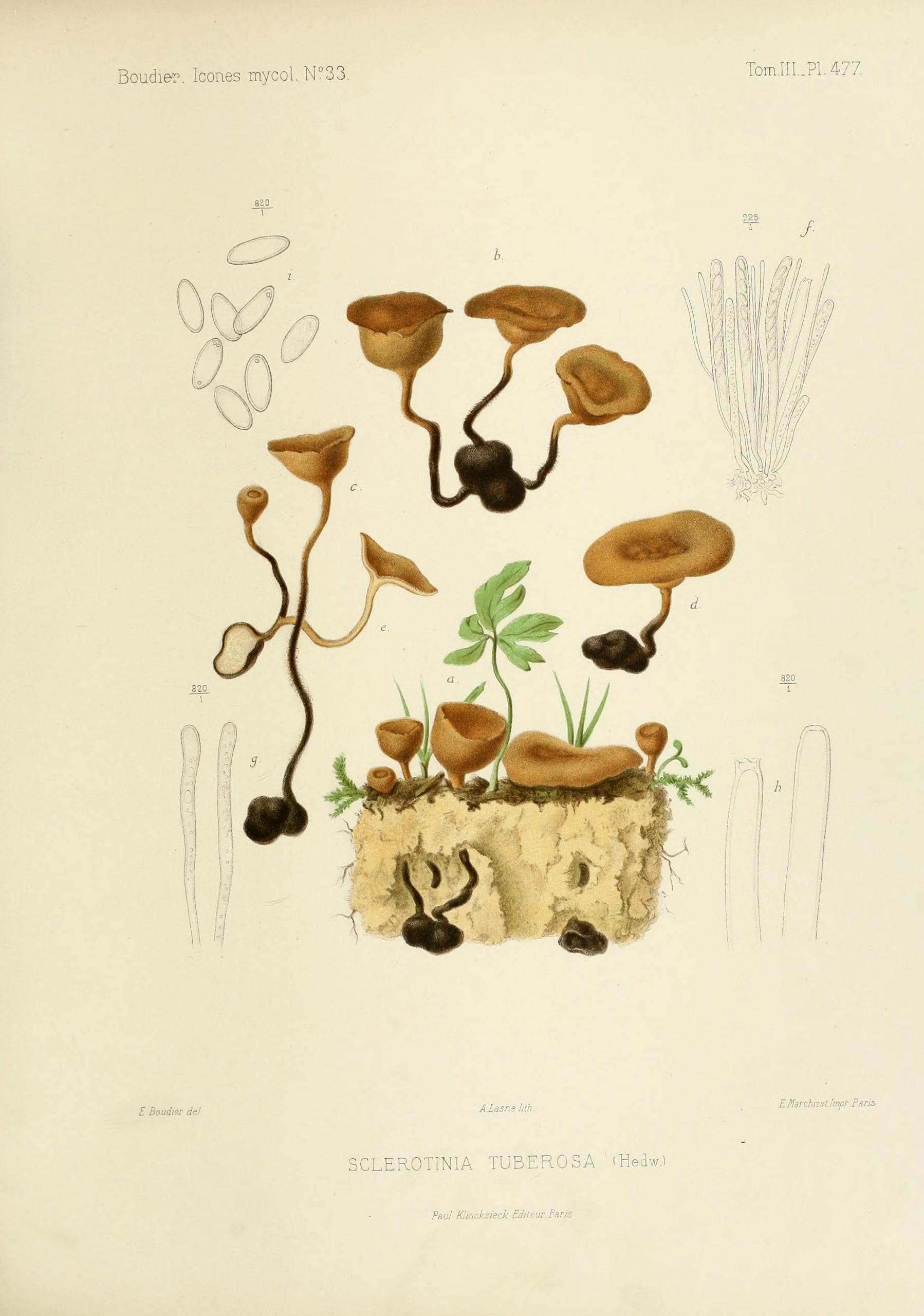
BHL helped nurture this love of mycology well before the birth of #MycoBookClub. Blencowe’s first in-depth interaction with the Library occurred in April 2019, when her discovery of a small brown fungus cup in the woods led her to seek confirmation of its identity—which she believed to be the Anemone Cup Dumontinia tuberosa—by posting to the British Mycological Society Facebook group. UK-based mycologist Lukas Large responded to her post with the link to a color plate for comparison from Émile Boudier’s Icones Mycologicæ (1905-1910) in BHL.

Illustration of fungi.

Illustration of Dumontinia tuberosa, plate 477. Boudier, Émile. Icones Mycologicæ (1905-1910), v.3. Art by Boudier. Contributed in BHL from the University Library, University of Illinois Urbana Champaign.

“The information contained in this beautiful colour plate far surpassed anything I had access to in my field guides at home,” shares Blencowe. “It helped me to understand the structure and features of this fungus I had in front of me, and spurred me on to take a closer look at it under the microscope. That experience really opened my eyes to what a useful resource the books in BHL can be: to inform observation and help identify species in a present day context. Sure, species concepts and nomenclature may have moved on, but the detail with which mycologists such as Boudier recorded their observations is a lesson in itself.”

Since that eye-opening experience, Blencowe continues to turn to BHL as a resource to support her interests in mycology, reading titles online and downloading select pages and images as needed. Some of her favorite aspects of the Library include a good search functionality, user-friendly online reading and content downloading, high quality scans, clear copyright information, easily-shareable direct page links, and the image collections in Flickr. Since founding #MycoBookClub, she uses BHL almost every week.

We’ve talked already here at #MycoBookClub about M.C. Cooke, but tonight we’re also feasting our eyes on ‘Selecta Fungorum Carpologia’ by The Brothers Tulasne.

You can find their illustrations in the Biodiversity Heritage Library: https://t.co/DN4Hi816XE pic.twitter.com/buaU9fMTa4

— The Mycological Book Club (@MycoBookClub) June 2, 2020

“I love the little bookish details that are preserved in BHL: the gilt decoration on a publication’s cover, ornate book plates, library stamps, barely-decipherable pencil marks and blank pages uniquely speckled with foxing,” shares Blencowe. “The scanned pages hold so much more than simply the words and the illustrations. They do your soul good.”

A reminder that it’s #MycoBookClub night tonight, from 7:30pm UK time.

We’re trying out a theme this evening: illustration ?https://t.co/Bvx0nDHY08

— The Mycological Book Club (@MycoBookClub) November 3, 2020

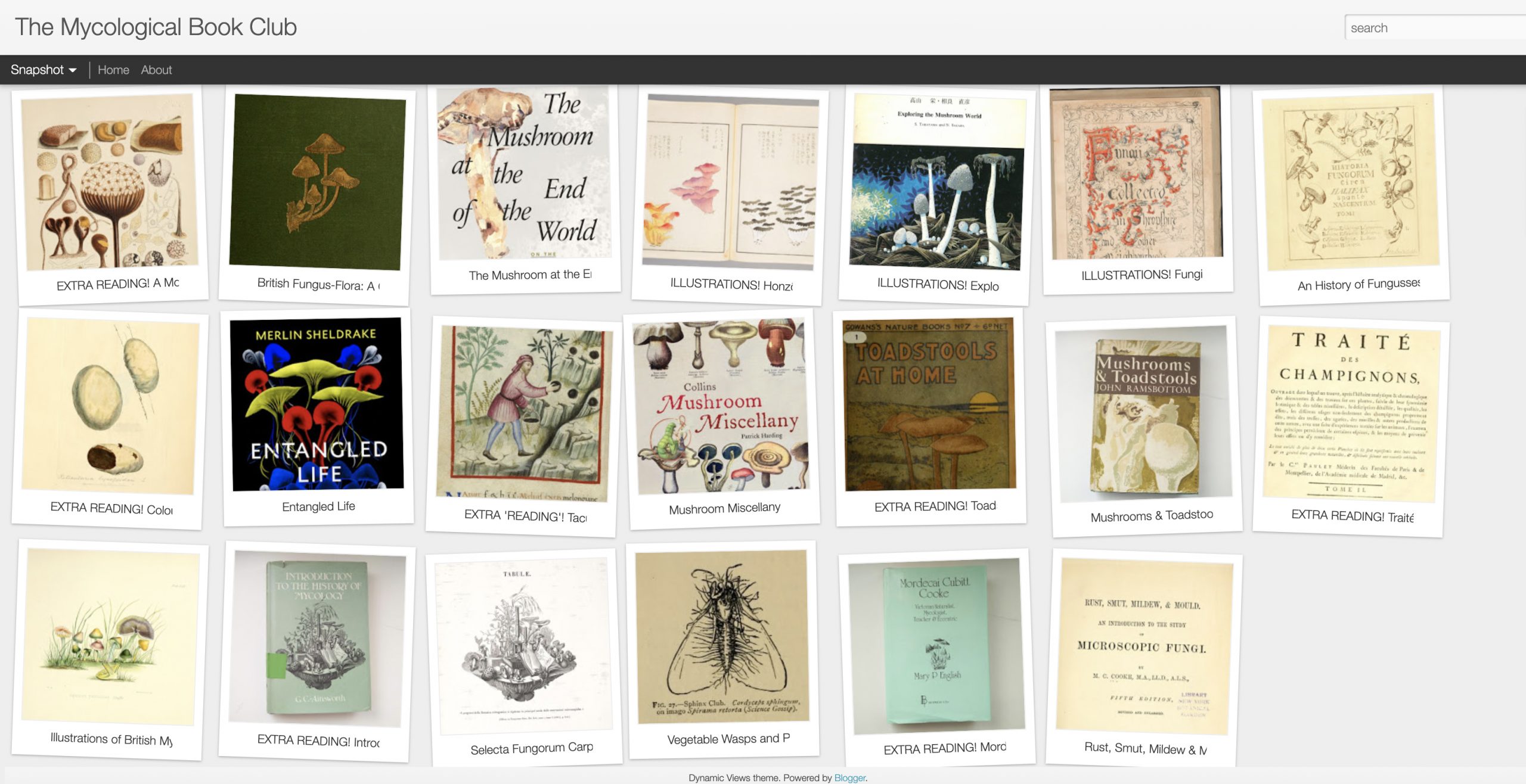
In the months following the club’s first meeting in May 2020, #MycoBookClub continued to grow, amassing more followers and receiving attention in outlets like The British Mycological Society Newsletter and IMA Fungus. Blencowe established a “virtual bookshelf” to maintain a list of all the books that #MycoBookClub had discussed—many of which were accessed through BHL.

Screenshot of a virtual bookshelf with thumbnails of book covers.

#MycoBookClub “virtual bookshelf.” Source: https://mycobookclub.blogspot.com

“The more time I spend in the Library, the more amazed I am by the vast amount of literature it contains—and the neat way it is organised and presented,” lauds Blencowe. “BHL also provides the opportunity to take a deep dive into the source material for a fascinating glimpse into the machinery of global science in the 19th century.”

While she’s enjoyed many titles in BHL, a recent favorite is Anna Maria Hussey’s Illustrations of British Mycology (1847-55), which was the subject of the July 2020 #MycoBookClub meeting. Published under the name Mrs. T.J. Hussey, the two-volume work illustrates and describes species collected by Hussey and her sister, Frances Reed.

#MycoBookClub returns Tues 7 July, 7:30pm (UK time).

Thought we could take a broader look at the fungal kingdom this month with ‘Illustrations of British Mycology’ by Anna Maria Hussey (1847).

You can read it in the @BioDivLibrary, here: https://t.co/4BPXfDyWhd pic.twitter.com/icBcIRd1xM

— The Mycological Book Club (@MycoBookClub) June 7, 2020

“Hussey writes from the perspective of an enthusiastic amateur which I found both highly relatable and genuinely inspiring,” affirms Blencowe. “She writes in a chatty, conversational style which is peppered with fascinating contemporary details (such as her observation that Boletus subtomentosus has ‘the texture of a Limerick glove’) and timeless wisdom (‘life passes in gaining experience for ourselves…till at last we have acquired the wisdom to guide us safely…’).”

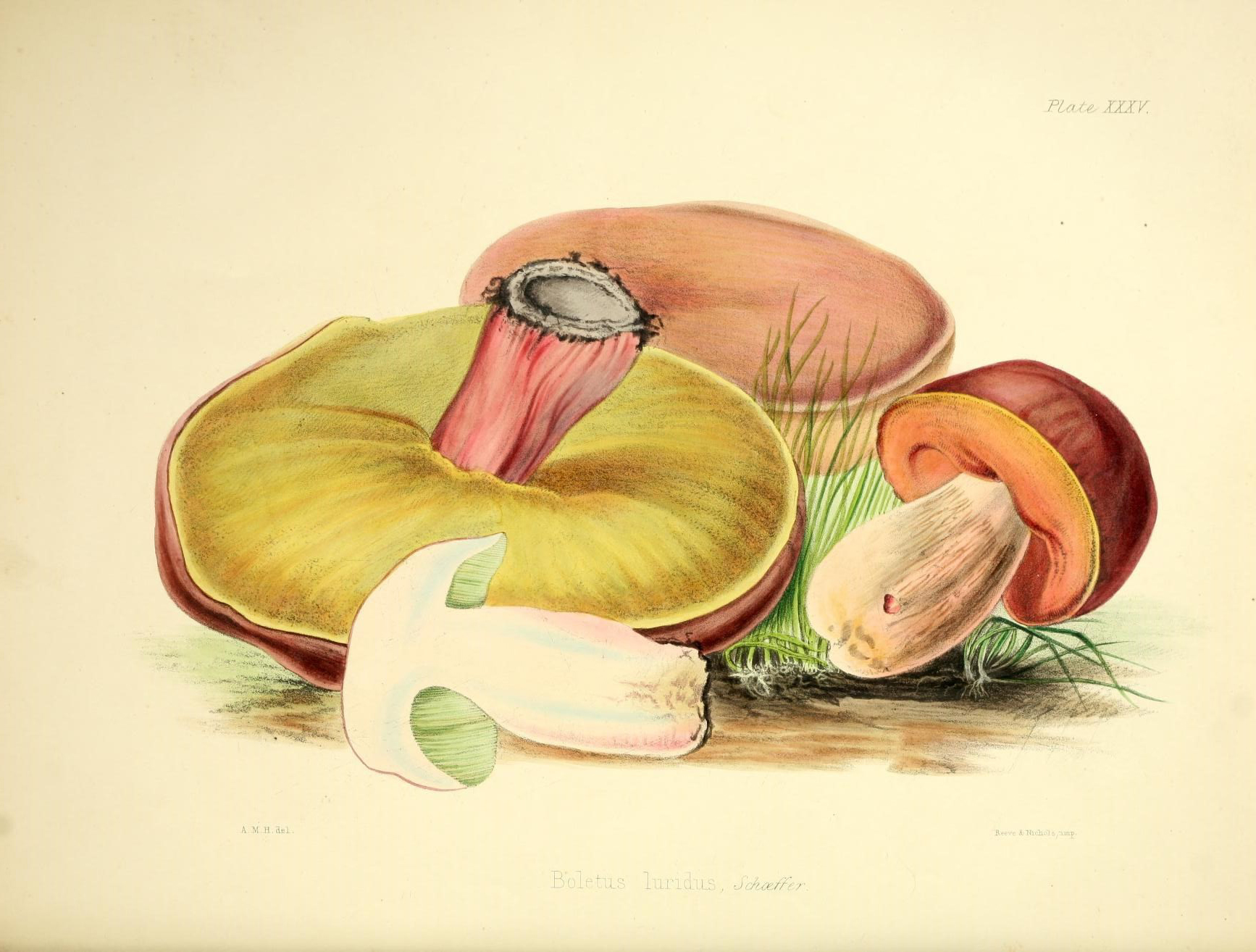
Illustration of fungi.

Illustration of Suillellus luridus, plate 35. Hussey, Anna Maria. Illustrations of British Mycology, ser.2 (1855). Art by Hussey. Contributed in BHL from The New York Botanical Garden, LuEsther T. Mertz Library. Explore all illustrations from Illustrations of British Mycology in the BHL Flickr.

Blencowe has gathered and shared via @MycoBookClub some of her favorite elements from Hussey’s work, including her approach to mycology, her discussion of fungus names, her commentary on fungi in nature, her descriptions of fungal habitats, and miscellaneous myco-chatter. Illustrations of British Mycologyis also noteworthy as a rare female-authored work in the bibliography of historic mycological literature.

“Browsing the historic biodiversity literature, it is very noticeable that certain perspectives predominate,” notes Blencowe. “The books are mostly written by men—white men. So it was a particular joy to come across Hussey’s book. I’m keen to explore ways that @MycoBookClub can provide a platform for different perspectives and respectfully champion Indigenous knowledge of fungi.”

While ours may still be a socially-distanced world, initiatives like #MycoBookClub remind us that there are still opportunities to connect with others, share our passions, and nurture a community. And while the news may still be filled with dire headlines, naturalists like Mordecai Cubitt Cooke and Anna Maria Hussey remind us that we can still find solace in nature close to home and in unexpected places, if we are just willing to look.

To quote Hussey: “The world is full of beauty that we pass by unheeded.”
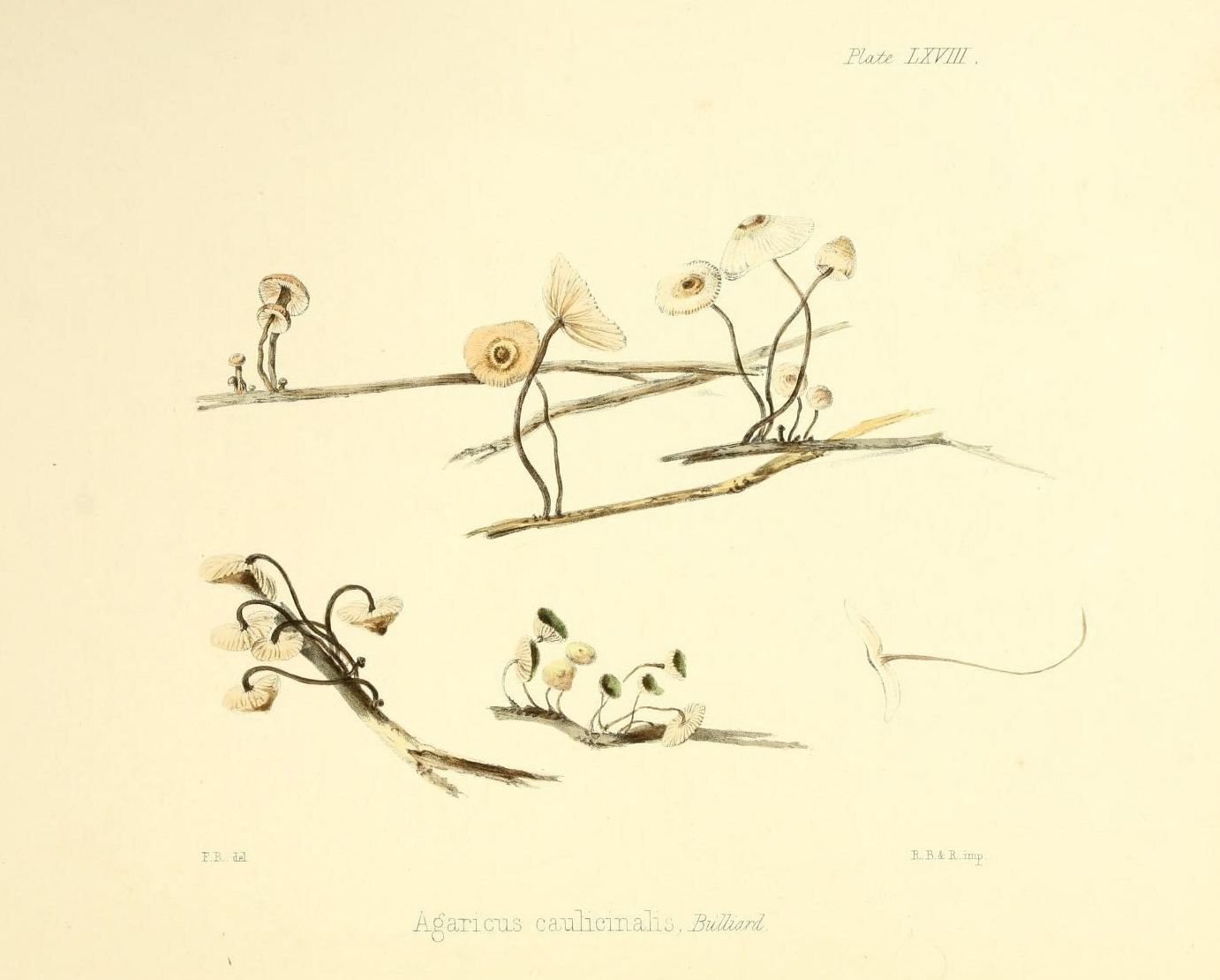
Illustration of fungi.

Illustration of Crinipellis scabella, plate 68. Hussey, Anna Maria. Illustrations of British Mycology, ser.1 (1847). Art by Frances Reed. Contributed in BHL from The New York Botanical Garden, LuEsther T. Mertz Library. This plate accompanies Hussey’s quote: “The world is full of beauty that we pass by unheeded.”

Everyone is welcome to join the #MycoBookClub. Follow @MycoBookClub for updates and meeting information, and join the discussion the first Tuesday of each month at 7:30pm (GMT) using the #MycoBookClub hashtag on Twitter.

February 1, 2021by Grace Costantino
Page 2 of 71«1234»102030...Last »

Help Support BHL

BHL's existence depends on the financial support of its patrons. Help us keep this free resource alive!

search

About BHL

The Biodiversity Heritage Library (BHL) is the world’s largest open access digital library for biodiversity literature and archives. BHL operates as a worldwide consortium of natural history, botanical, research, and national libraries working together to digitize the natural history literature held in their collections and make it freely available for open access as part of a global “biodiversity community.”

Join Our Mailing List

Sign up to receive the latest news, content highlights, and promotions.

Subscribe Now

Subscribe to Blog via Email

Enter your email address to subscribe to this blog and receive notifications of new posts by email.

Join 319 other subscribers

Subscribe to Blog Via RSS

Subscribe to the blog RSS feed to stay up-to-date on all the latest BHL posts.

Access RSS Feed

Inspiring Discovery through Free Access to Biodiversity Knowledge.

The Biodiversity Heritage Library makes it easier than ever for you to access the information you need to study and explore life on Earth…for free, anytime, anywhere.


64+ Million Pages of
Biodiversity Literature Online.

EXPLORE

Tools and Services
to Transform Research.

EXPLORE

300,000+
Illustrations on Flickr.

EXPLORE

ABOUT | HARMFUL CONTENT | PRIVACY | SITE MAP | TERMS OF USE