Biodiversity Heritage Library - Program news and collection highlights from BHL
  • Home
  • News
  • Featured Books
    • All Featured Books
    • Book of the Month Series
    • BHL at 20
  • User Stories
  • Campaigns
    • Fossil Stories
    • Garden Stories
    • Monsters Are Real
    • Page Frights
    • Her Natural History
    • Earth Optimism 2020
  • Tech Blog
  • Visit BHL
Home
News
Featured Books
    All Featured Books
    Book of the Month Series
    BHL at 20
User Stories
Campaigns
    Fossil Stories
    Garden Stories
    Monsters Are Real
    Page Frights
    Her Natural History
    Earth Optimism 2020
Tech Blog
Visit BHL
  • Home
  • News
  • Featured Books
    • All Featured Books
    • Book of the Month Series
    • BHL at 20
  • User Stories
  • Campaigns
    • Fossil Stories
    • Garden Stories
    • Monsters Are Real
    • Page Frights
    • Her Natural History
    • Earth Optimism 2020
  • Tech Blog
  • Visit BHL
Biodiversity Heritage Library - Program news and collection highlights from BHL
Blog Reel, Featured Books

Book of the Week: Welcome to the Orchid Family, Bulbophyllum nocturnum!

Portrait version of the Biodiversity Heritage Library logo.

View Full Size Image

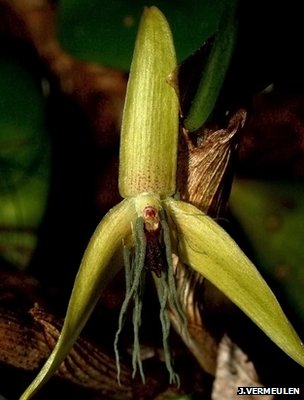
While there are many species of plants that flower at night, and among those are many orchids, scientists researching in New Britain just discovered the only orchid species that flowers exclusively at night. Meet Bulbophyllum nocturnum, discovered by Ed de Vogel during a field trip to the lowland rainforest of the island, which is located near Papua New Guinea.
 
Dr. de Vogel, after taking a specimen of the plant home to the Netherlands with him, discovered that it only flowers a few hours after dusk and closes a few hours after sunrise. While this is a remarkable discovery, the purpose for the flower’s nocturnal preference remains a mystery. According to Andre Schuiteman, a co-author of the paper detailing the find, which was published in the Botanical Journal of the Linnean Society, “related species are pollinated by tiny flies that think they are visiting fungi,” with the smell and physical appearance of the flower appearing like fungus in the eyes of the insect. The insects visit the flower searching for a place to lay their eggs and unwittingly pollinate it. There is a strong possibility that a night-foraging fly species may thus be the pollinator of B. nocturnum and the reason for its unique behavior.
 
The authors of the paper stipulate that it will take much more research before some of the questions surrounding this species are answered. These are questions best answered in the field. However, as the BBC article (from which this information comes) articulates, examining the flower in the wild may be difficult in the future. The orchid was discovered in a previously-inaccessible portion of the island, which, thanks to recent roads constructed for the purposes of logging, has only lately been opened up for scientific discovery. While the logging thus made the find itself possible, it also threatens the long-term survival of the species. Schuiteman affirmed that it is necessary for the local government to protect the habitat of the species from the potential damages caused by logging.
 
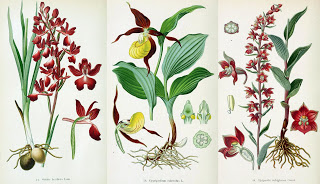
To celebrate the discovery of our new orchid friend, for this week’s book of the week we’re featuring a book full of stunning orchid illustrations. Abbildungen der in Deutschland und den Angrenzenden Gebieten Vorkommenden Grundformen der Orchideenarten (1904), by Friedrich Kränzlin, features 60 gorgeous plates by Walter Müller. While of course Bulbophyllum nocturnum is too new to science to be included in this work, we’re happy to know that future publications will highlight this species just as beautifully as this book does for the species included within its pages.
 
For our post, we’re featuring some of our favorite illustrations from the work. You can enjoy all of the images from this title on our Flickr site, which now has over 21,000 natural history images. Hopefully one day we’ll be able to pull in an illustration of Bulbophyllum nocturnum as well!
 
View Full Size Image
Left: Anacamptis laxiflora (Loose-Flowered Orchid; Green-winged Meadow Orchid)
Middle: Cypripedium calceolus (Lady’s Slipper Orchid)
Right: Epipactis atrorubens (Dark Red Helleborine; Royal Helleborine)
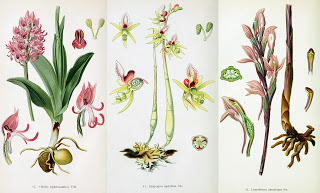
 
View Full Size Image
Left: Orchis italica
Middle: Epipogium aphyllum (Ghost Orchid)
Right: Limodorum abortivum (Violet Limodore)

Abbildungen der in Deutschland und den Angrenzenden Gebieten Vorkommenden Grundformen der Orchideenarten (1904), by Friedrich Kränzlin and Walter Müller, was contributed by the New York Botanical Garden, LuEsther T. Mertz Library.
 
Image Credit (Top): J. Vermeulen, http://www.bbc.co.uk/news/science-environment-15818662
December 8, 2011by Grace Costantino
BHL News, Blog Reel

BHL Staff Meeting Success

Portrait version of the Biodiversity Heritage Library logo.

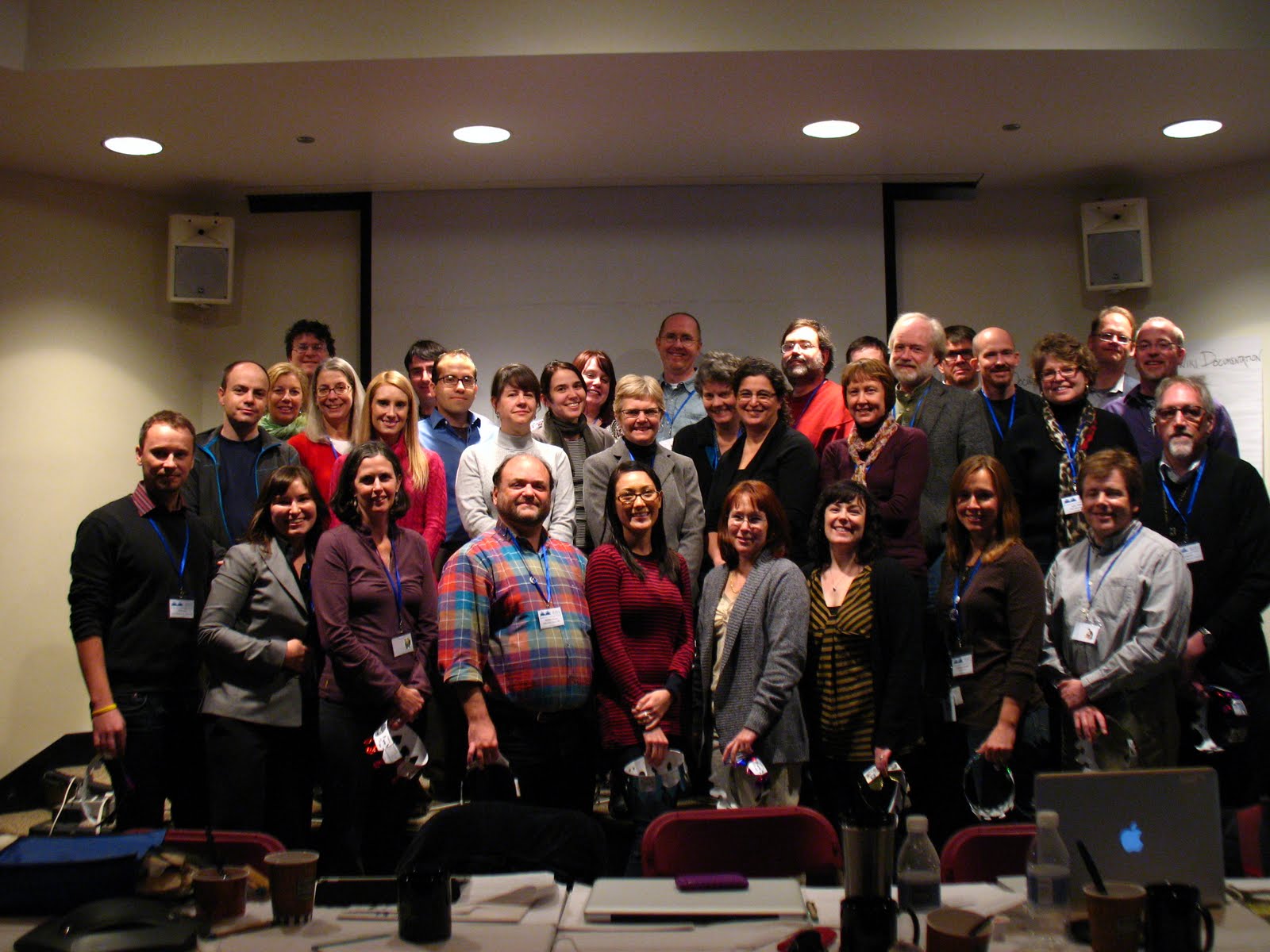
View Full Size ImageJust after the Life and Literature conference, on Wednesday November 16, members of the BHL Staff got together to talk about day-to-day BHL issues. It was a rare and wonderful opportunity for this highly distributed staff to meet in person. Staff members were present from most of the BHL Consortium Member Institutions, now 14 members strong!

If you missed the announcement from the Life and Literature Conference, BHL has welcomed two new members to its consortium, Cornell University Library and the United States Geological Survey (USGS) Libraries. More information about BHL’s newest members will be posted soon.

BHL Staff met to discuss the new ideas resulting from the Life and Literature conference as well as issues related to governance, social media, scanning workflow and technical development. Of note on the agenda was a discussion on how to solve the issue of integrating more “boutique” scanning projects into the current workflow. To date, the BHL has scanned and incorporated content into its collection mainly through two standard workflows, with scanning partners the Internet Archive and the Missouri Botanical Garden’s Botanicus Digital Library project. Staff shared with each other about new processes under development to help tackle the not-so-insignificant issue of incorporating content into the collection scanned through alternate workflows.

The BHL Staff welcomed colleagues from BHL-Europe and BHL-Australia at the meeting, as well as colleagues from partner projects, the Field Book Project and the Connecting Content Grant.

With new BHL members, new workflows and new ideas resulting from the Life and Literature conference, BHL Staff activities are entering some very exciting and dynamic times ahead. Stay tuned for more updates as 2012 unfolds. Onward and upward we go!

December 7, 2011by Grace Costantino
Blog Reel, User Stories

BHL and Our Users: Dr. Thomas Carefoot

View Full Size ImageAfter a short break during which we featured various posts related to the Life and Literature conference, we again resume our BHL and Our User series, kicking things off again with Dr. Thomas Carefoot, a marine biologist and the author of the delightful educational website on west-coast marine invertebrates, A Snail’s Odyssey.

What is your title, institutional affiliation, and area of interest?

I am retired from a 35-year teaching and research position in marine biology at the University of British Columbia, Canada. My research specialties include the study of a group of marine snails known as sea hares, and I have sought them out in many tropical areas of the world. I am well versed on invertebrate marine life, most notably on the Pacific west coast, but also throughout the Caribbean, Indo- Pacific, and other tropical areas. I enjoy talking and lecturing about marine invertebrates, and a few years before retirement was awarded the University’s prestigious Master Teacher Award. I have written 2 books on marine ecology, authored some 90 research papers, and have recently produced a large educational website on west-coast marine invertebrates called A Snail’s Odyssey. I am currently working on an equally large educational website called the Biology of Caribbean Coral Reefs.

How long have you been in your field of study?

For over 50 years, from commencement of an Honours BSc programme at the University of British Columbia (UBC), leading to an MSc degree at the same institution, and followed by a doctorate at the University of Wales, all in the field of marine biology. My first job was at the Marine Sciences Centre, McGill University, followed by an appointment to the Zoology Department at UBC in 1969. As part of the McGill experience was one year’s appointment as Director of the Bellairs Research Institute in Barbados. In total, I have spent about 3 years in the Caribbean, have visited all but a handful of the major islands, and have SCUBA-dived on most Caribbean reef systems.

When did you first discover BHL?

Several years ago when I first started researching scientific articles on west-coast marine invertebrates for my website A Snails’ Odyssey.

What is your opinion of BHL and how has it impacted your research?

BHL provides an excellent service for studies of marine and other biodiversity. However, as my research interests are not in biodiversity per se, I use the service only for accessing pertinent literature on west-coast and coral-reef marine invertebrates for inclusion in my educational websites.

How often do you use BHL?

About once a week.

How do you usually use BHL (read the titles online/download whole PDFs/Selecting Pages to Download for a custom PDF/etc.)

For downloading articles from journals.

What are your favorite features/services on BHL?

The only one that I have regularly used is the PDF downloading privilege.

If you could change one thing about BHL, what would it be, or what developmental aspect would you like the BHL team to focus on next?

I would streamline the system for downloading PDFs. It is currently time-consuming and “out of synch” with similar accessing systems for other scientific journals. For example, the journal I most access at BHL is the Journal of Shellfish Research (JSR), which is presently most easily “downloadable” as entire volumes. It would be a relatively easy job to split each volume into its component research papers, format these as PDFs, and have an accessing system along the lines of other journal publishers. I realize that JSR is just one of the many journals in the BHL, but it would be a start.

Thank you, Dr. Carefoot, for sharing your experience and resources with us! Be sure to check out A Snails’ Odyssey, which chronicles the whimsical story of an upper intertidal snail who, finding himself mistakenly cast into the deep waters of the ocean, slowly but steadily makes his way back home to shallower waters. Along the way he encounters many different marine species, which offer a plethora of opportunities for discovery for both the snail and the reader. For each species, there is a short cartoon animation meant to give a light-hearted introduction to the animal, and a scientific Learnabout, which offers more in-depth information, including summaries of a multitude of scientific papers written about the invertebrates. It’s a fun, educational site for all ages.
December 6, 2011by Grace Costantino
BHL News, Blog Reel, User Stories

Life and Literature Conference Attendee Interviews: Part 5

Portrait version of the Biodiversity Heritage Library logo.

Today we feature the last 4 of 17 conference attendee interviews from the Life and Literature conference. We hope you’ve enjoyed this opportunity to see what those present at the conference had to say about it and BHL. You can see these and all other interviews on the Life and Literature website.

Don’t forget to share your thoughts about Life and Literature via our Titan Pad discussion pages, and also take a look at conference notes and speaker presentations on the website.

We would like to extend a special thanks to Jennifer Rubin, Matthew Regan, and Bianca Crowley for conducting these interviews, and to all those who participated and shared their valuable thoughts with us.

Karen Baker:

Matthew Person:

Vladimir Blagoderov:

Mary Ochs:

December 2, 2011by Grace Costantino
BHL News, Blog Reel, User Stories

Life and Literature Conference Attendee Interviews: Part 4

Portrait version of the Biodiversity Heritage Library logo.

Continuing with our theme, here are the next 4 of 17 conference attendee interviews from the Life and Literature conference. The first three feature recipients of the JRS African digitization scholarship, which funded the expenses of nine visitors from Africa to both attend the conference and an additional meeting on Wednesday (Nov. 16th) with the express purpose of discussing biodiversity literature digitization in Africa (expect more information on this meeting in a future post). The fourth interview is that of Dr. Jinzhong Cui, the director of BHL-China. All interviews are available on the Life and Literature website.

Don’t forget to share your thoughts about Life and Literature via our Titan Pad discussion pages, and also take a look at conference notes and speaker presentations on the website.

We would like to extend a special thanks to Jennifer Rubin, Matthew Regan, and Bianca Crowley for conducting these interviews, and to all those who participated and shared their valuable thoughts with us.

Dorothy Wanja Nyingi:

Ashah Owano:

Willem Coetzer:

Dr. Jinzhong Cui:

December 1, 2011by Grace Costantino
BHL News, Blog Reel, User Stories

Life and Literature Conference Attendee Interviews: Part 3

Portrait version of the Biodiversity Heritage Library logo.

Now we present the next 3 of 17 conference attendee interviews from the Life and Literature conference. All of these interviews are available on the Life and Literature website.

Don’t forget to share your thoughts about Life and Literature via our Titan Pad discussion pages, and also take a look at conference notes and speaker presentations on the website. If you attended the Life and Literature conference, be sure to take the survey, which will be closing November 30th.

We would like to extend a special thanks to Jennifer Rubin, Matthew Regan, and Bianca Crowley for conducting these interviews, and to all those who participated and shared their valuable thoughts with us.

Natalia Zamora:

Alex Asase:

Marty Schlabach:

November 30, 2011by Grace Costantino
BHL News, Blog Reel, User Stories

Life and Literature Conference Attendee Interviews: Part 2

Portrait version of the Biodiversity Heritage Library logo.

Continuing with our posting of the Life and Literature conference attendee interviews, below you will find the next 3 out of the 17 interviews, all of which are available on the Life and Literature website.

Don’t forget to share your thoughts about Life and Literature via our Titan Pad discussion pages, and also take a look at conference notes and speaker presentations on the website. If you attended the Life and Literature conference, be sure to take the survey, which will be closing November 30th.

We would like to extend a special thanks to Jennifer Rubin, Matthew Regan, and Bianca Crowley for conducting these interviews, and to all those who participated and shared their valuable thoughts with us.

Ely Wallis:

Sue Ann Gardner:

Chris Wildrick:

November 29, 2011by Grace Costantino
Page 59 of 71« First...102030«58596061»70...Last »

Help Support BHL

BHL's existence depends on the financial support of its patrons. Help us keep this free resource alive!

search

About BHL

The Biodiversity Heritage Library (BHL) is the world’s largest open access digital library for biodiversity literature and archives. BHL operates as a worldwide consortium of natural history, botanical, research, and national libraries working together to digitize the natural history literature held in their collections and make it freely available for open access as part of a global “biodiversity community.”

Join Our Mailing List

Sign up to receive the latest news, content highlights, and promotions.

Subscribe Now

Subscribe to Blog via Email

Enter your email address to subscribe to this blog and receive notifications of new posts by email.

Join 319 other subscribers

Subscribe to Blog Via RSS

Subscribe to the blog RSS feed to stay up-to-date on all the latest BHL posts.

Access RSS Feed

Inspiring Discovery through Free Access to Biodiversity Knowledge.

The Biodiversity Heritage Library makes it easier than ever for you to access the information you need to study and explore life on Earth…for free, anytime, anywhere.


ABOUT | HARMFUL CONTENT | PRIVACY | SITE MAP | TERMS OF USE