Biodiversity Heritage Library - Program news and collection highlights from BHL
  • Home
  • News
  • Featured Books
    • All Featured Books
    • Book of the Month Series
    • BHL at 20
  • User Stories
  • Campaigns
    • Fossil Stories
    • Garden Stories
    • Monsters Are Real
    • Page Frights
    • Her Natural History
    • Earth Optimism 2020
  • Tech Blog
  • Visit BHL
Home
News
Featured Books
    All Featured Books
    Book of the Month Series
    BHL at 20
User Stories
Campaigns
    Fossil Stories
    Garden Stories
    Monsters Are Real
    Page Frights
    Her Natural History
    Earth Optimism 2020
Tech Blog
Visit BHL
  • Home
  • News
  • Featured Books
    • All Featured Books
    • Book of the Month Series
    • BHL at 20
  • User Stories
  • Campaigns
    • Fossil Stories
    • Garden Stories
    • Monsters Are Real
    • Page Frights
    • Her Natural History
    • Earth Optimism 2020
  • Tech Blog
  • Visit BHL
Biodiversity Heritage Library - Program news and collection highlights from BHL
Blog Reel, Featured Books

Book of the Week: A Study in Flies

View Full Size Image

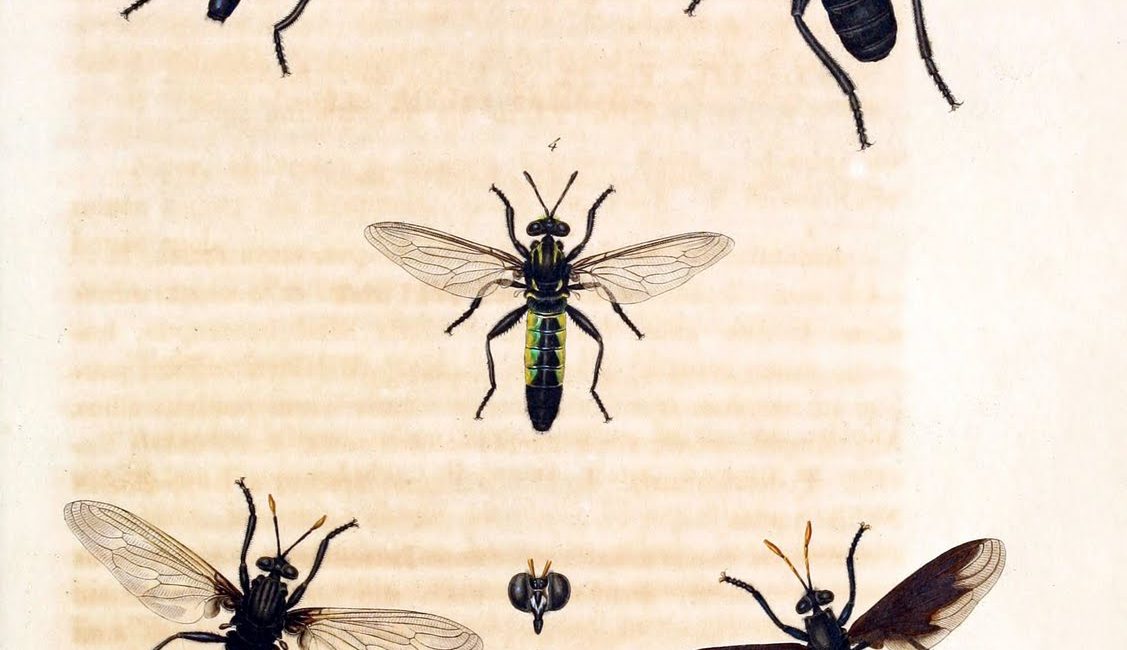
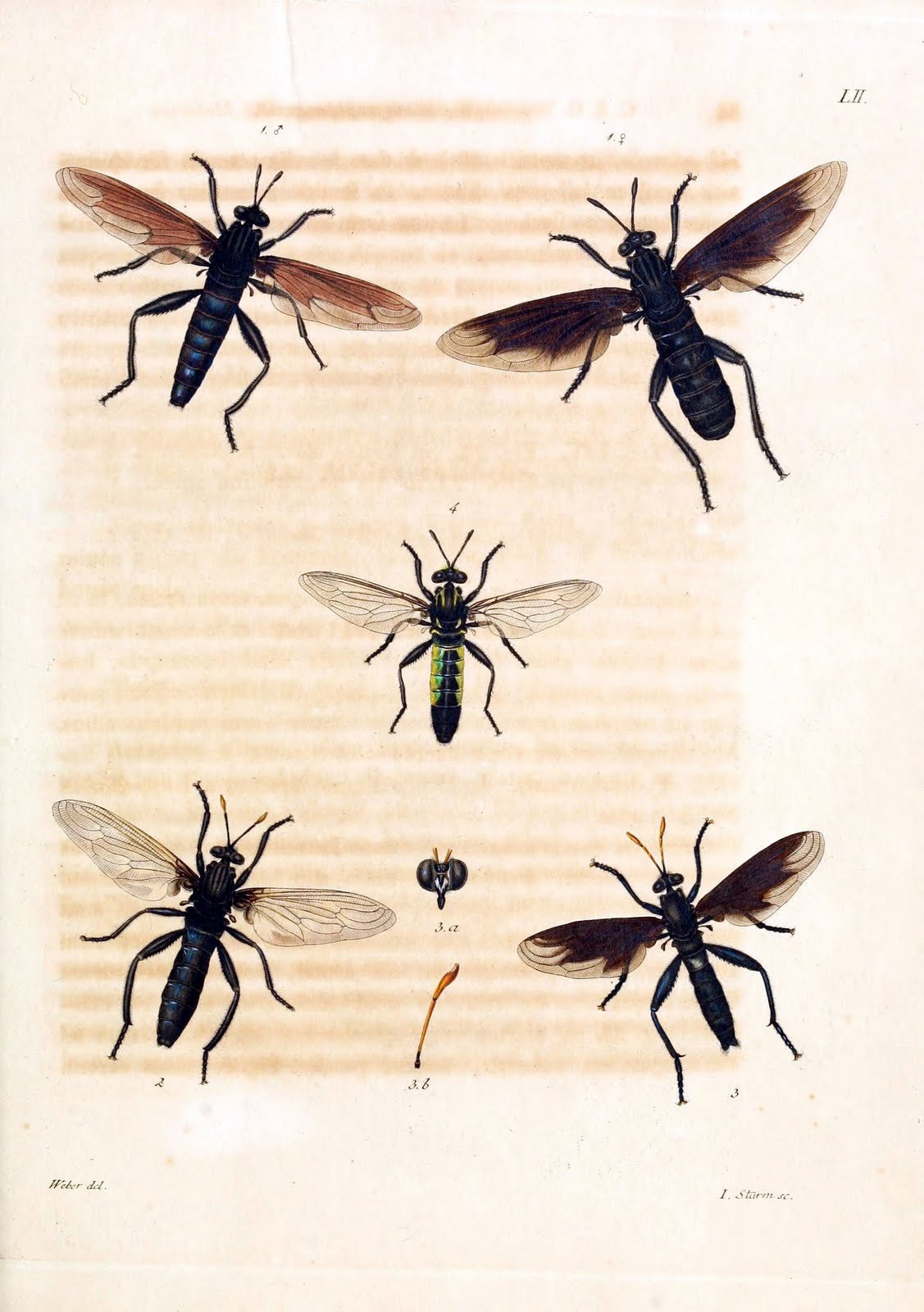
This week, we featured one of our BHL users, Dr. Torsten Dikow, in our regular blog series, BHL and our Users. With a focus on flies in his research, Dr. Dikow identified his favorite book in BHL, which we’re highlighting today as our book of the week. As Dr. Dikow stated when asked about his favorite item in BHL,

“Well, there are so many beautiful and scientifically important items on the BHL, but I would probably go with a study on flies from 1831: Monographia Generis Midarum by C.R.W. Wiedemann. Just look at the beautiful color drawings of these flies, including some of the largest known flies from South America. Only very few scientists would have access to this rare book and would be able to admire these color illustrations if it had not been digitized by BHL.”

To give you a little background on the author, Christian Rudolph Wilhelm Wiedemann, a German physician, historian, naturalist, and entomologist, is best known for his studies of world Diptera. The author of the first monographs on “exotic” or non-European Diptera, his descriptions of the species portray many advances over others working in his field, including “a brief Latin diagnosis, a fuller detailed description in German, the sex of the specimen, locality details, a reference to the collection in which the specimen was to be found and, sometimes, the name of the collector.” His work with Johann Christian Ludwig Hellwig and Johann Karl Wilhelm Illiger set “new standards for descriptions (uniform terminology for structures and colour) and for nomenclature, especially in regard to the avoidance of synonyms by proper research of pre-existing literature.” Of course, we can’t help but wonder how much easier their research would have been had BHL been around ;-).

Wiedemann’s collection of Diptera and Hymenoptera can now be found at the Natural History Museum (Vienna), Senckenberg Museum (Frankfurt), and the Zoological Museum at the University of Copenhagen. The portion of the collection at the University of Copenhagen is detailed online.

Our book of the week describes flies of the family Mydidae, which includes large flies, one of which is the largest known fly in the world, Gauromydas heros. Found mostly in arid regions, little is known of Mydidae biology as they are not often encountered due to the brevity of their adult life span. Recent classification changes in the family resulted in the inclusion of genera formerly in the family Apioceridae.

Thank you, Dr. Dikow, for highlighting this book. It truly is a masterpiece worthy of note! We encourage our users to take some time to view the beautiful illustrations of the rare Diptera found within Monographia Generis Midarum.

This week’s book of the week, Monographia Generis Midarum (1831), by Christian Rudolph Wilhelm Wiedemann, was contributed by the Smithsonian Institution.

May 12, 2011by Grace Costantino
Blog Reel, User Stories

BHL and Our Users: Torsten Dikow

View Full Size ImageMeet Torsten Dikow, a postdoc based in the BHL partner institution, the Field Museum, who not only uses BHL heavily for his own research on flies, but also works to help BHL acquire the rights to digitize in-copyright publications by encouraging smaller natural history museums and scientific societies to grant digitization permissions to BHL. We are so very thankful for his support and advocacy on our behalf!

Q: What is your title, institutional affiliation, and area of interest?
A: I am a postdoc at the Biodiversity Synthesis Center (BioSynC) based at the Field Museum of Natural History in Chicago, IL, USA. I am a revisionary systematist conducting phylogenetic, taxonomic, and biodiversity studies on a group of flies named Apioceridae (flower-loving flies), Asilidae (robber flies), and Mydidae (mydas flies).

Q: How long have you been in your field of study?
A: I started serious work and began writing publications on these flies in 1999 while studying biology.

Q: When did you first discover BHL?
A: As I am working for BioSynC, which is part of the Encyclopedia of Life with which the BHL is closely associated, I have been hearing about BHL from the early beginnings and started using the resources in the beginning of 2008.

Q: What is your opinion of BHL and how has it impacted your research?
A: The BHL is an outstanding source for biodiversity information particularly from older books/journals that are otherwise found in only a few libraries.

As a taxonomist who has to deal with numerous historical publications to decipher the identity of species and type specimens, my research relies heavily on old publications. Before 2008, I would copy or scan publications myself in order to have them available in my office for my research on flies. But when I visited another natural history museum to study specimens, I didn’t have access to these copies as I couldn’t bring my entire file cabinet with me. The high-quality scans produced by BHL in PDF format allow me now to have the vast majority of papers/books on my flies with me on my laptop and therefore I can always check a certain publication when traveling to other museums and being away from my desk.

In addition to my own research interest, I have encouraged smaller institutions like natural history museums or scientific societies who publish their own journals to consider digitization of their journal(s) by the BHL. Often these smaller institutions or societies don’t have the infrastructure to digitize or host electronic copies of their journals. So far I have initiated contact between journals from Argentina, Brazil, Bulgaria, Chile, Germany, Italy, and South Africa that are now available through the BHL portal. All of these journals waived the copyright so that the BHL can provide access from the first volume to a particular volume within the last 5 or 10 years, allowing the institutions/societies to keep access of the most recent volumes restricted to subscribers only. It would be nice if more institutions/societies follow this model to provide electronic access to biodiversity information published in their journal(s).

Q: How often do you use BHL?
A: I use the BHL weekly I would say.

Q: How do you usually use BHL (read titles online/download whole PDFs/Select Pages to Download/etc.)
A: I am employing two strategies when I use the BHL. For large books or very long papers I will download the entire volume, delete those pages/papers I am not interested in, and store it as a PDF on my hard-drive. For regular-sized taxonomic papers, I prefer to access the material with the “Select Pages to Download” option and to provide the bibliographic data on the following screens. This has two advantages: one is that I “only” get the pages I am really interested in, but the second, and much more important one, is that a PDF that now has associated bibliographic data is deposited in the BHL CiteBank, which allows other users to easily find this particular paper by searching for the title, for example. Furthemore, when I download the generated PDF I obtain a permanent link to this particular article on the BHL CiteBank, which I can now incorporate into my bibliographic manager as well as e-mail to colleagues instead of attaching large PDFs to e-mails directly. Itemizing the journal publications on BHL is a great service that researchers who have a bibliography covering a particular topic can provide to the scientific community at large.

Q: What are your favorite features/services on BHL?
A: I think the most amazing feature is the ability to search for genus or species names directly in BHL. The OCR-text recognition coupled with the identification of binomial names increases the value of the generated PDFs. Sure, any PDF with prior OCR-text recognition can be search directly, but that BHL instantly shows the scientific names on a particular page of a digitized document (“Names on this Page” in the lower left window) is just great.

Q: If you could change one thing about BHL, what would it be, or what developmental aspect would you like the BHL team to focus on next?
A: I have encountered inconsistencies in several instances where part of a journal is digitized by different BHL partner libraries. For example, if you search for “Stettiner” to find the Stettiner Entomologische Zeitung you get two search results, one item digitized by Ernst Mayr Library at Harvard University from 1840-1911 and one item digitized by the Smithsonian Institution Libraries from 1912-1923. Unfortunately, the title is slightly different in both items and a user need to look at both links to find the correct item of her/his interest. Also, the volumes are inconsistently numbered/itemized, which makes it sometimes difficult to find a particular volume in old journals.

Thank you, Torsten, for your detailed account of your use of the BHL, and the work you do on our behalf to help us establish contacts that result in permission to scan in-copyright material for our collection. Furthermore, thank you for your honestly in helping point out ways in which we can make our content more user-friendly, as by merging titles and standardizing itemization in BHL.

The particular title you refer to actually represents a data presentation model that we follow in BHL, which is maintaining separate pages for title changes of the same serial. So, the 1840-1911 entry in BHL is the first title change in this serial, while the 1912- entry is the succeeding title. These two titles are linked to each other via the “Related Titles” links on the left hand side of the bibliographic page.

However, while these two titles may not need to be merged, there are many instances in BHL where title merging does need to occur. This is, unfortunately, a manual process for BHL staff, and we need help identifying those titles and items that need this attention. Please do not hesitate to submit feedback on our website to let us know about titles and items that need our attention. We are a constantly growing and improving project, and we rely on the feedback of our users to make that happen!

Stay tuned for our next blog post, which will appear later this week, in which we highlight one of Torsten’s favorite books in BHL as our book of the week! And if you’d like to be featured on our blog, please don’t hesitate to send us feedback, leave us a message on our Facebook page, or send us a tweet to @BioDivLibrary!

May 10, 2011by Grace Costantino
Blog Reel, Featured Books

Book of the Week: The Illustrations of The Ibis

View Full Size Image

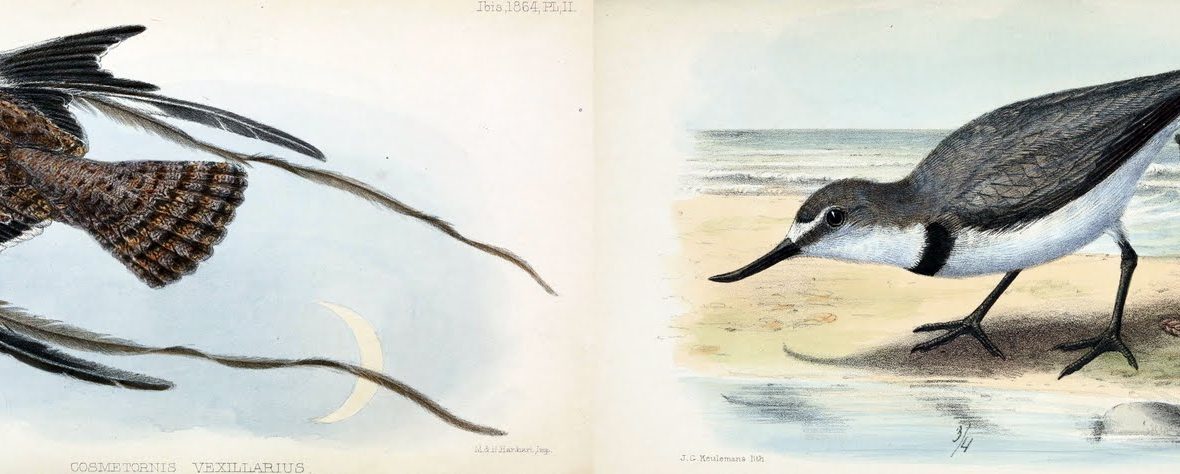
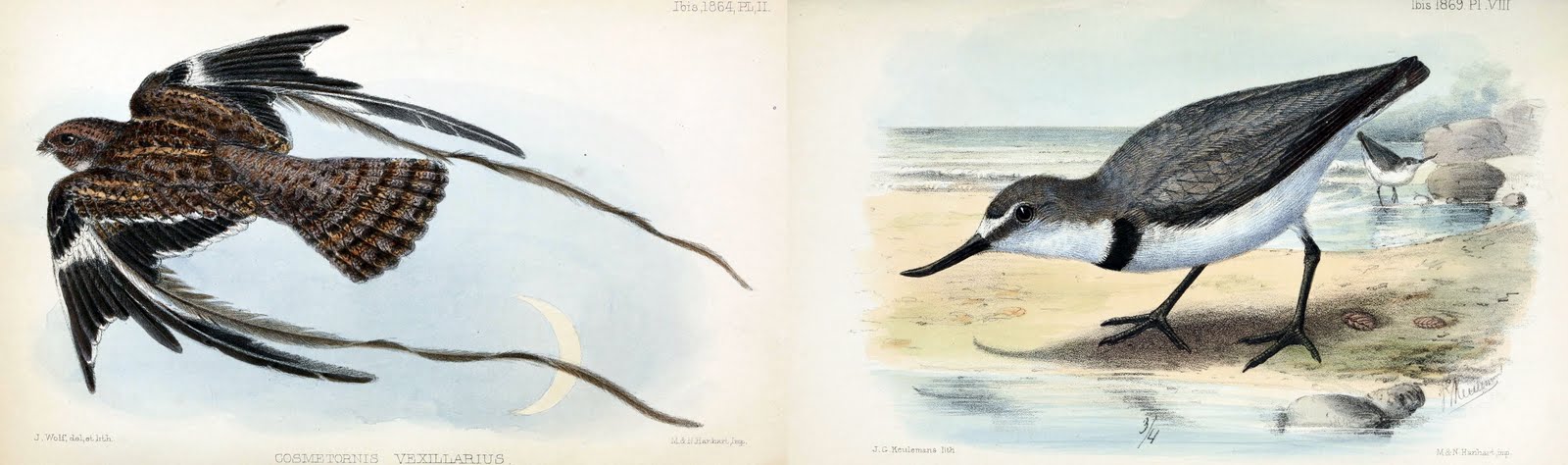
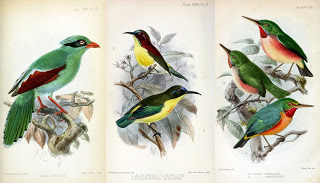
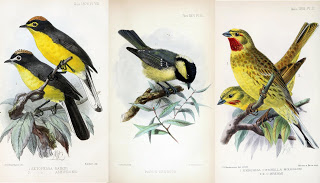
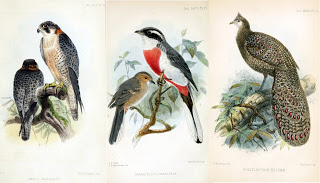
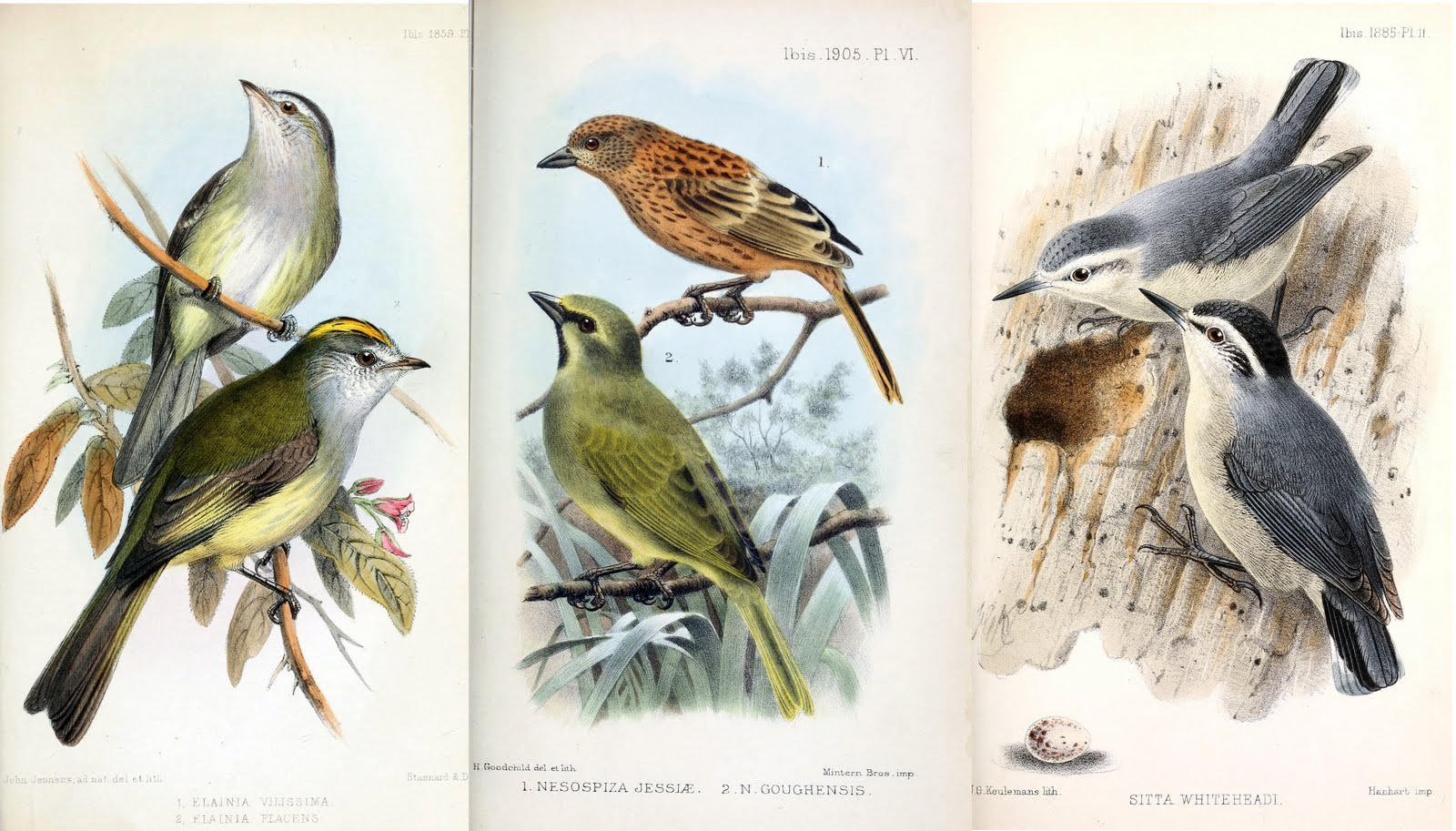
In our last post, our featured user Mathew Louis named The Ibis as his favorite title in BHL. Thus, we decided to feature this entire series as our “book of the week” this week. Not only is The Ibis full of valuable information on birds, it’s also loaded with beautiful illustrations, many of which are featured in Mathew Louis’ website: http://sites.google.com/site/mmslouisb/theibis.

The website also gives some interesting background on the publication, and on one of the artists involved in the work:

The Ibis is the organ of publication of the British Ornithologists’ Union. It was long issued as a small, octavo edition, but more recently, it has appeared in a larger format. Originally the volumes were numerated as a series, each of which being completed by six volumes for that many years, but this method was later abandoned in favor of numbering the volumes according to each consecutive year.Keulemans contributed to The Ibis every year from 1869–1909. In the 1869 edition (Second Series–Volume V) his name appeared as the lithographer, not as the colorist, on a number of plates.”

Slightly abandoning our usual book of the week structure, we’re spending the rest of this post featuring many of the beautiful illustrations in this work. Enjoy!

View Full Size Image of these green BirdsView Full Size Image of these Yellow BirdsView Full Size Image of these red birdsView Full Size Image of these blue birds

See more work by John Gerrard Keulemans in BHL.

April 28, 2011by Grace Costantino
Blog Reel, User Stories

BHL and Our Users: Mathew Louis & BHL Illustrations

View Full Size ImageThis week we feature one of our users that has taken a particular interest in BHL for the purpose of images, using BHL to strengthen the collection of scientific illustrations found on his website, http://sites.google.com/site/mmslouis/. As our users have long shown a specific interest in the images associated with BHL content, we expect that this post, and the work of our featured user, Mathew Louis, will prove to be particularly interesting to our user community.

Q: What is your title, institutional affiliation (or alternative place of employment), and area of interest?

A: Mine is a recreational interest in natural history studies and collection of image files from illustrations in natural history publications. I have a website which was originally begun as a collection of images by the illustrator John Gerrard Keulemans but has now expanded to include many other artists and natural history subjects: http://sites.google.com/site/mmslouis.

I also use the service (BHL) to review taxonomic information, such as the original citation or description of a name. For example, I have recently examined a synopsis of names relating to a genus of bats, Pteropus. BHL is useful in allowing me to trace resources which contain descriptions of more obscure names – information I could not have found elsewhere.

Q: How long have you been in your field of study?

A: The website was started in 2007, but I have always been an enthusiast of the subject in general.

Q: When did you first discover BHL?

A: About two-four years ago.

Q: What is your opinion of BHL and how has it impacted your research?

A: I could not have a better opinion of it and how it has been helpful. It is interesting to ask, because at the research library which I frequent, the staff made the decision, three years ago, to deselect and destroy all printed serial publications which were already available on the library catalogue’s database (and therefore unnecessary). The library’s database had a number of deficiencies: the quality of the images of illustrations, lack of indices/table of contents and other matter, incompleteness, and the database was inaccessible to me outside of the library. I was in the process of having scans made from one series in particular, and would have otherwise been out of luck if it were not for the same series being made available with this website, compared to a decade ago.

Q: How often do you use BHL?

A: I visit the library at the rate of once a week, and use BHL when I am using the computer. Thus, when I visit, I use it extensively.

Q: How do you usually use BHL (read the titles online/download whole PDFs/Downloading High Resolution Images/etc.)

A: I typically use BHL through Internet Archive. I use the online page view, which is excellent in how it allows for high resolution page view; this is an area where the Google Books service is deficient. I also download and save PDF files of texts.

Q: What are your favorite features/services on BHL?

A: The best aspects of the services are as follows: The ability to make requests to have scans of texts made; the efficiency of BHL when reporting problems or making queries; the high-resolution quality of the images of the pages.

Q: If you could change one thing about BHL, what would it be, or what developmental aspect would you like the BHL team to focus on next?

A: It would be helpful to receive email notification when a scan request has been carried through and the item becomes available online.

There are also some issues which might not actually apply to BHL, but rather to Internet Archive, which also provides texts from BHL. First, some of the texts are difficult to locate in a series. One example is Proceedings of the Zoological Society of London, where not all of the years (this series was not issued in numerated volumes) are clearly discernible on the list. Second, the format on Internet Archive for viewing texts was changed in the later part of 2010, and I think it would have been better to restore the previous format – it wasn’t broken. It would also be convenient if the scanned images of illustrations incorporated the entire plate, rather than in a number of cases where some have cropping.

Q: If you had to choose one title/item in BHL that has most impacted your research, or one item that you prefer above any other in BHL, what would it be and why?

A: I greatly appreciate the availability of The Ibis being made online.

Thank you, Mathew, for taking the time to share your experiences regarding BHL with us, and for sharing your website, which provides an invaluable presentation of many beautiful illustrations that might otherwise be difficult to locate.

In regards to your specific comment about providing email notification when scanning requests are completed, we hope to one day be able to provide this service. However, currently our resource limitations prevent the adoption of such a system. It may be helpful to subscribe to our rss feed of recent additions, which provides a list of all new inclusions to the BHL collection and is one method in which users can be provided with a notification of the completion of their scanning requests.

Visit Mathew Louis’ website here: http://sites.google.com/site/mmslouis.

April 26, 2011by Grace Costantino
Blog Reel, Featured Books

Book of the Week: User’s Choice – Snakes!

This week we decided to put the power of choosing the book of the week in the hands of our users. So, using the “Questions” app on our Facebook Page, we asked you which book out of the four options given you would like to see featured on our blog. The options were The Snakes of Australia, British Dragonflies, La Galerie des Oiseaux, and A Book of Whales. The winner?

The Snakes of Australia (1869), by Gerard Krefft!

The aim of this work was to provide a full account, with original descriptions retained wherever possible, of “nearly all the Australian Snakes discovered and recorded up to the year 1868.” The author points out that, by 1854, only “about twenty Australian Snakes were known.” In the succeeding five years, thirty were described, and, by the time of the writing of our book of the week, “seventy species were on record.”

For our post, we decided to highlight a few of the species presented in this book. So, sit back, relax, and read about Australian Snakes in the comfort of your own home (unless, of course, you’re not at home, in which case, the sitting back and relaxing part is completely up to you).

View Full Size Image
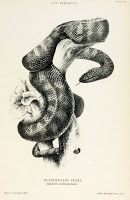
Black-Headed Python (Aspidiotes melanocephalus)

This non-venomous snake can grow up to 7’10”. It is typically “light brown, with a series of darker rings which become indistinct near the sides.” On the underbelly, the Black-Headed Python is “yellowish-white…with a few dark blotches,” while the head and neck are “jet-black above and below.” By the time that this publication was written, very little was known about the snake. “The first specimen which the Museum received was captured by Mr. Rainbird, the well-known collector at Port Denison.”

View Full Size Image
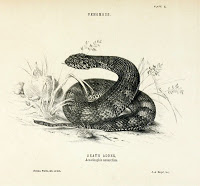
Common Death Adder (Acanthophis antarcticus)

The Common Death Adder is one of the most venomous land snakes in Australia and the world, with fangs longer than most of Australia’s venomous snakes. While a majority of Death Adders are gray with dark rings about the neck and tip of the tail, some members of the species may be red with dark spots. The species can be found in sandy locations, feeding on frogs, lizards, and small mammals. The author notes that, when threatened, the snake “flattens out its whole body, and darts right and left.” However, as previously thought, it “does not jump, and certainly never jumps backwards.”

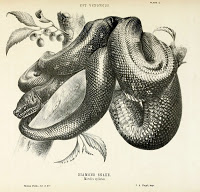
Diamond Snake (Morelia spilotes)
View Full Size Image

This non-venomous snakes has nearly every scale marked with a central single yellow dot. “The largest specimen captured near Sydney, correctly measured, without being stretched, was 10 feet 3 inches long,” though, the author is certain, that specimens measuring over 11 feet no doubt occur, though much more rarely. In nature, this species eats only living mammals, though in captivity it has been observed swallowing already-dead animals. At the time of publication, the author commented that “the species under review are generally infested by various kinds of intestinal worms, including tape-worms, clusters of which have frequently been taken from their stomachs.”

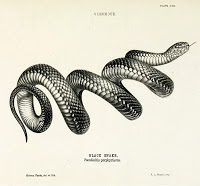
View Full Size ImageRedbellied Black Snake (Pseudechis porphyriacus)

This species is the most common of all of Australia’s venomous snakes. It is “found in low marshy places, is fond of water, dives and swims well, and subsists principally upon frogs, lizards, insects, and other smaller mammalia.” Its highly venous bite can kill “good sized dogs or goats within an hour.” This species rarely grows beyond six feet in length.

This week’s book of the week, The Snakes of Australia (1869), by Gerard Krefft, was contributed by Harvard University, MCZ, Ernst Mayr Library.

To see more Facebook Questions, visit our Questions Page. And be sure to visit us on Facebook or follow us on Twitter (@BioDivLibrary).

April 21, 2011by Grace Costantino
Blog Reel, Featured Books

Book of the Week: The Threat to the Arctic Fox

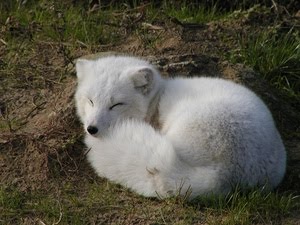
Arctic fox lies down in a earthy hollow with it's tail curled around it.

View Full Size ImageAs the planet warms, habitats for a myriad of species worldwide are changing, and perhaps those most affected are the species living in the arctic regions of the globe. These areas are seeing significant increases in average temperatures, changing the dynamics for the life found there. A poignant example of this is the Arctic Fox (Vulpes lagopus), a species whose habitat is being encroached upon by the Red Fox (Vulpes vulpes) as increasing temperatures make the arctic more habitable for the latter (see EOL’s “Threats” tab on the Arctic Fox page).

In recognition of this threat, we decided to feature the Arctic Fox in our book of the week post this week. In searching BHL for an item highlighting this species, we can across some interesting information regarding the food supply of the species in winter in Dogs, Jackals, Wolves and Foxes: A Monograph of the Canidae (1890), by St. George Mivart. This book, which contains abundant information on the species itself, also showcases the Arctic Fox’s unique food storage habits, which allow it to survive through the arctic’s prey-deficient winter months.
 
Scientists were long puzzled by the fox’s ability to survive through the long winter months without migrating, when a majority of its food sources had done so. As our book of the week relates, Professor Alfred Newton, in the 1863 expedition to Spitzbergen, wrote,
 
“What the Foxes do to get a living in winter when the birds have left the country, is one of the most curious questions that has presented itself to my mind for some time. The greater number of them are said to remain on the land, and to be as active during the long polar night as they are in summer; yet there are no berries by which they might eke out their existence, and there can be no open water, on the margin of which they might find food, within miles of their haunts. The most natural explanation which occurs to one is that they lay up a stock of provisions; but nobody, that I am aware of, has ever found such a store-closet.”
 
However, the supposition of “store-closets” was subsequently confirmed by H.W. Feilden during the Arctic Expedition of 1875 under Captain G.S. Nares. Feilden wrote, in reference to their discovery of Arctic Foxes during their expedition,
 
“…to our surprise, we discovered numerous deposits of dead Lemmings. In one out-of-the-way corner, under a rock, we pulled out a heap of over fifty dead Lemmings. We disturbed numerous ‘caches’ of twenty and thirty, and the ground was honeycombed with holes which each contained several bodies of these little animals, a small quantity of earth being placed over them. In one hole we found the major part of a hare carefully hidden away.”
 
The ingenuity of our Arctic Fox was thus established, revealing that, thanks to the thrifty habits of our little friend, the species is able to survive the cruel wrath of the arctic winter without having to migrate to warmer climates to follow their food sources. The competition for this food is now significantly increased, however, thanks to warming climates that allow the Arctic Fox’s competitor, the Red Fox, to encroach more and more upon their feeding grounds. We hope that through the increased availability of literature on both species through projects like BHL, and subsequently a better understanding of these animals and their natural habitats, scientists can help turn the tide for the Arctic Fox, saving this glamorous canine for future generations.
 
This week’s book of the week, Dogs, Jackals, Wolves and Foxes: A Monograph of the Canidae (1890), by St. George Mivart, was contributed by the University of California.
 
See the first description of the Arctic Fox in v. 1, pg. 40 of Systema Naturae per Regna Tria Naturae: Secundum Classes, Ordines, Genera, Species, Cum Characteribus, Differentiis, Synonymis, Locis (1758) by Carl von Linné.
April 14, 2011by Grace Costantino
Blog Reel, User Stories

BHL and Our Users: Dr. Petra Sierwald

Portrait version of the Biodiversity Heritage Library logo.

View Full Size Image

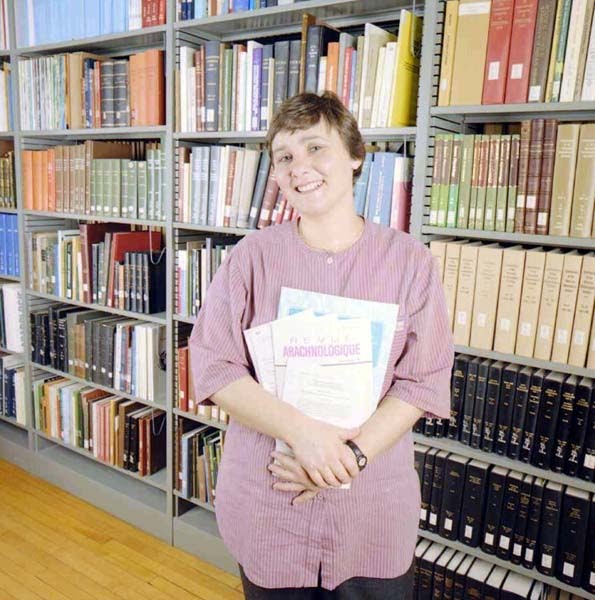
This week we feature a researcher from one of our partner institutions, the Field Museum in Chicago. So without further ado, meet Dr. Petra Sierwald, a woman with a passion for spreading biodiversity knowledge to ensure equal participation among researchers in all parts of the globe and educating the younger generation on the importance of biodiversity conservation.

Q: What is your title, institutional affiliation, and area of interest?
A: Associate Curator, Arachnida & Myriapoda, Zoology, at the Field Museum of Natural History, Chicago. Interests and Research include biodiversity and evolutionary research in spiders and millipedes. Currently, my special interests are: building scientific infrastructure. In my case (a) a global millipede species database with complete literature citations; and (b) teaching the next generation the importance of biodiversity for the health of our planet.

Q: How long have you been in your field of study?
A: Over thirty years.

Q: When did you first discover BHL?
A: At the beginning of BHL (2007) – the Field Museum library and Field Museum’s Biodiversity Synthesis Center are both closely involved with BHL.

Q: What is your opinion of BHL and how has it impacted your research?
A: Libraries are the stewards of the knowledge on which all human civilization is based. BHL is the modern virtual library we desperately need right now and must expand: by capturing the literature digitally, the original paper books can be preserved to last through the coming centuries (in case something should happen to digital storage). Making the biodiversity data, which were initially accumulated within the Western European tradition, available to the rest of the world is our duty and responsibility, as it will allow equal participation of everbody in biodiversity research and thus invite new young talented people from every corner of the world. Finally, the participation of a diverse group of new researchers will benefit all of us, as more students study the biodiversity of their region and protect habitats important for the environmental health of the planet.

Q: How often do you use BHL?
A: Currently almost daily, together with other digital online libraries. All my students (in courses and at the Museum) have to work on species pages and search for literature. BHL is one of the first sources they search in. I always check whether they properly searched in BHL.

Q: How do you usually use BHL (read the titles online/download whole PDFs/Select Pages to Download/Download High Resolution Images/etc.)
A: At the current pace I am using BHL, I read online. Since BHL is always available, I do not need to download, print or store articles and volumes electronically. I save that step. I use BHL the same way I use Field Museum’s excellent library. I find the book or volume, check what needs to be checked and put the volume back (or close the window in BHL). I know BHL rather well; I always find what I need. This saves me the work of organizing a separate library on my computer.

Q: What are your favorite features/services on BHL?
A: That I can read entire articles, cross check bibliographic information (title, publication dates), and that I can search in many articles for key words. The scanning quality is very good.

Q: If you could change one thing about BHL, what would it be, or what developmental aspect would you like the BHL team to focus on next?
A: Filling gaps in journal runs and the author list must be cleaned up. For example, Snodgrass is in BHL twice, as Snodgrass R.E. and as Snodgrass, Robert Evans. Both author entries (referring to the same person) are linked to different publications. Since I am using BHL heavily as a bibliographic reference tool, I would greatly appreciate to have clean author lists. BHL needs support and the scientific community must help in this endeavor.

Q: If you had to choose one title/item in BHL that has most impacted your research, or one item that you prefer above any other in BHL, what would it be and why?
A: My co-authors and I were able to determine that the species Euzonus zonatus does not exist, but that the name is based on a misinterpretation by Giebel. The original publication: Giebel, C.G. (1856) Die Insecten und Spinnen der Vorwelt mit Berücksichtigung der Lebenden, monograph. dargestellt. 2. Bd. Gliederthiere. 1. Abth. Insecten und Spinnen, is available in BHL.

Resulting Publication: Brewer, M.S., Sierwald, P. and Bond, J.E., 2011. A Generichomonym Concerning Chordeumatid Millipedes (Arthopoda: Diplopoda) and Opheliid Worms (Annelida: Polychaeta). Zootaxa 2744: 65-68.

Thank you all at BHL.

And thank, you Dr. Sierwald, for taking the time to share your thoughts and experiences with us. We have, per your notification, merged the duplicate author entires for Snodgrass in BHL. De-duplicating author lists is definitely of concern for BHL (and indeed for any collaborative digital library project where multiple contributors submit data in various formats), but we need the support of our users, as Dr. Sierwald points out. If you notice multiple entries for the same author in BHL, send us a message via our feedback form and we’ll take care of it. As we continue to explore options for author de-duplication en mass, we highly appreciate the eyes of our users to take care of this issue one author at a time.

For more information on Dr. Sierwald, visit the Insects page on the Field Museum’s website.

Photo Credit:© The Field Museum, Z94083_1c, Photographer John Weinstein.

April 12, 2011by Grace Costantino
Page 65 of 71« First...102030«64656667»70...Last »

Help Support BHL

BHL's existence depends on the financial support of its patrons. Help us keep this free resource alive!

search

About BHL

The Biodiversity Heritage Library (BHL) is the world’s largest open access digital library for biodiversity literature and archives. BHL operates as a worldwide consortium of natural history, botanical, research, and national libraries working together to digitize the natural history literature held in their collections and make it freely available for open access as part of a global “biodiversity community.”

Join Our Mailing List

Sign up to receive the latest news, content highlights, and promotions.

Subscribe Now

Subscribe to Blog via Email

Enter your email address to subscribe to this blog and receive notifications of new posts by email.

Join 319 other subscribers

Subscribe to Blog Via RSS

Subscribe to the blog RSS feed to stay up-to-date on all the latest BHL posts.

Access RSS Feed

Inspiring Discovery through Free Access to Biodiversity Knowledge.

The Biodiversity Heritage Library makes it easier than ever for you to access the information you need to study and explore life on Earth…for free, anytime, anywhere.


ABOUT | HARMFUL CONTENT | PRIVACY | SITE MAP | TERMS OF USE