
Biodiversity Heritage Library - Program news and collection highlights from BHL
  • Home
  • News
  • Featured Books
    • All Featured Books
    • Book of the Month Series
    • BHL at 20
  • User Stories
  • Campaigns
    • Fossil Stories
    • Garden Stories
    • Monsters Are Real
    • Page Frights
    • Her Natural History
    • Earth Optimism 2020
  • Tech Blog
  • Visit BHL
Home
News
Featured Books
    All Featured Books
    Book of the Month Series
    BHL at 20
User Stories
Campaigns
    Fossil Stories
    Garden Stories
    Monsters Are Real
    Page Frights
    Her Natural History
    Earth Optimism 2020
Tech Blog
Visit BHL
  • Home
  • News
  • Featured Books
    • All Featured Books
    • Book of the Month Series
    • BHL at 20
  • User Stories
  • Campaigns
    • Fossil Stories
    • Garden Stories
    • Monsters Are Real
    • Page Frights
    • Her Natural History
    • Earth Optimism 2020
  • Tech Blog
  • Visit BHL
Biodiversity Heritage Library - Program news and collection highlights from BHL
Blog Reel, Featured Books

Book of the Week: 1000 Hints in Gardening

View Full Size ImageSummer is in full swing and that means all the gardeners have already started coming out of the woodwork to get their hands dirty. We came across this book in BHL and thought it would be an appropriate book of the week for all of our garden-loving friends: 1000 Hints on Flowers and Birds (1917), by Mae Savell Croy.

In case you had any doubts as to whether you should believe anything that Ms. Croy has to tell you in this book, the title page carefully points out that she is the author of “1000 Shorter Ways About the House,” “1000 Things a Mother Should Know,” and “1000 Hints on Vegetable Gardening.” Her obsession with the number 1000 is sure to provide the reader with plenty of tips and ideas for application in their own gardens.

And these tips range in subject from general topics like “The Art of Growing Flowers” and “Essentials in Gardening” to more specific discussions of fertilization, rock gardens, weeds, and house plants. She even includes an entire chapter entitled “The Plea for the Birds,” which discusses bird houses, food and water, and a cryptic “Bits of Information” section. For our post, we’re going to highlight some of our favorite tips that we gleaned from this title, but there are many more that you can find yourself if you dig a little deeper into the 1000 hints provided.

Tip # 1: Plan the Garden on the Spot

“While to put it down on paper will be most helpful, the paper design should be made in the garden itself, otherwise there is likely to be confusion when it comes to working out the plan with actual plants. The size of the plants to be grown should always be taken into consideration when setting aside a certain space.”

Tip # 2: In Planning a Garden, Quadruled Paper Should be Procured

“Draftsmen use a paper ruled in quarter-inch squares, and in using this, each quarter-inch square should represent a foot of ground.”

Tip # 3: In Every Garden, However Small, There Should be a Seat

“In a small garden, the seat should be small, but where there is plenty of space, a large seat or a group of seats, a summerhouse or a pergola with seats can be placed to advantage. Let a garden look as if it had human beings taking a personal interest in it.”

Tip # 4: Plant Plenty of White Flowers in the Garden

“They are not only beautiful in themselves but they tend to emphasize the color of the other flowers near. No other one color aids so in emphasizing the color scheme in the garden.”

Tip # 5: Barnyard Fertilizer is Among the Most Valuable of Fertilizers

“It should be six months old and be well worked into the soil.”

Tip # 6: Deal Only with a Reliable Seedsman

“A seed house which has built up a reputation on the produce from its seed is not going to keep in stock old seed which will tend to endanger its reputation. It pays to purchase the best of seeds.”

Tip # 7: House Plants Often Fail to Thrive from No Apparent Reason

“House plants often fail to thrive from no apparent reason when what they really need is repotting. Having eaten all the food from the old soil, they require entirely new soil and the addition of fertilizer alone will not answer the problem.”

Tip # 8: A Pit is Simply a Large Hotbed

“A pit is simply a large hotbed and is constructed along the same principles, except that as it is in the form of a greenhouse buried under ground, there need be no layers of manure. It should, however, have good drainage and should have a sash covering. It may be made of either concrete or wood, though concrete is highly recommended as it will not permit any water to ooze through the earth surrounding the walls. The depth of excavation depends upon the needs of the individual who is to use it, but it should always be deep enough to give good standing room.”

Tip # 9: A Unique Bird House Can be Constructed Out of a Number of Cigar Boxes

“The strips taken from the boxes should be nicked and the other pieces slid into them, and few tacks will be necessary.”

Tip # 10: Crows, Blackbirds, Magpies and Bluejays are Doubtful Benefits to a Neighborhood

We hope you enjoyed our top 10 favorite tips, a collection of both useful and entertaining tidbits, from our book of the week. Find your own favorite hints from the book and be sure to let us know what they are! We’re dying to know what else a pit might be.

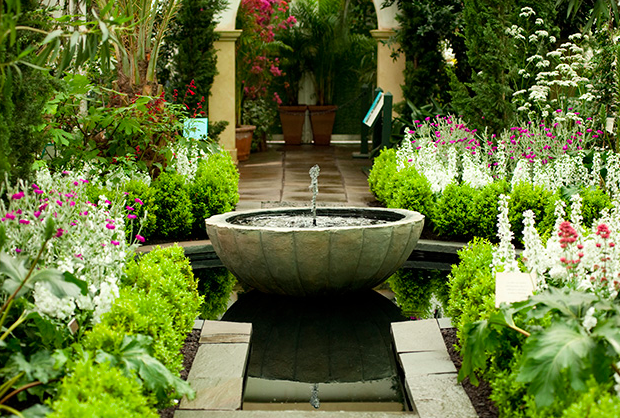
Picture from BHL Partner Institution, New York Botanical Garden’s Spanish Paradise: Gardens of the Alhambra exhibit.
June 9, 2011by Grace Costantino
Blog Reel, Featured Books

Book of the Week: Cabinet of Oriental Entomology

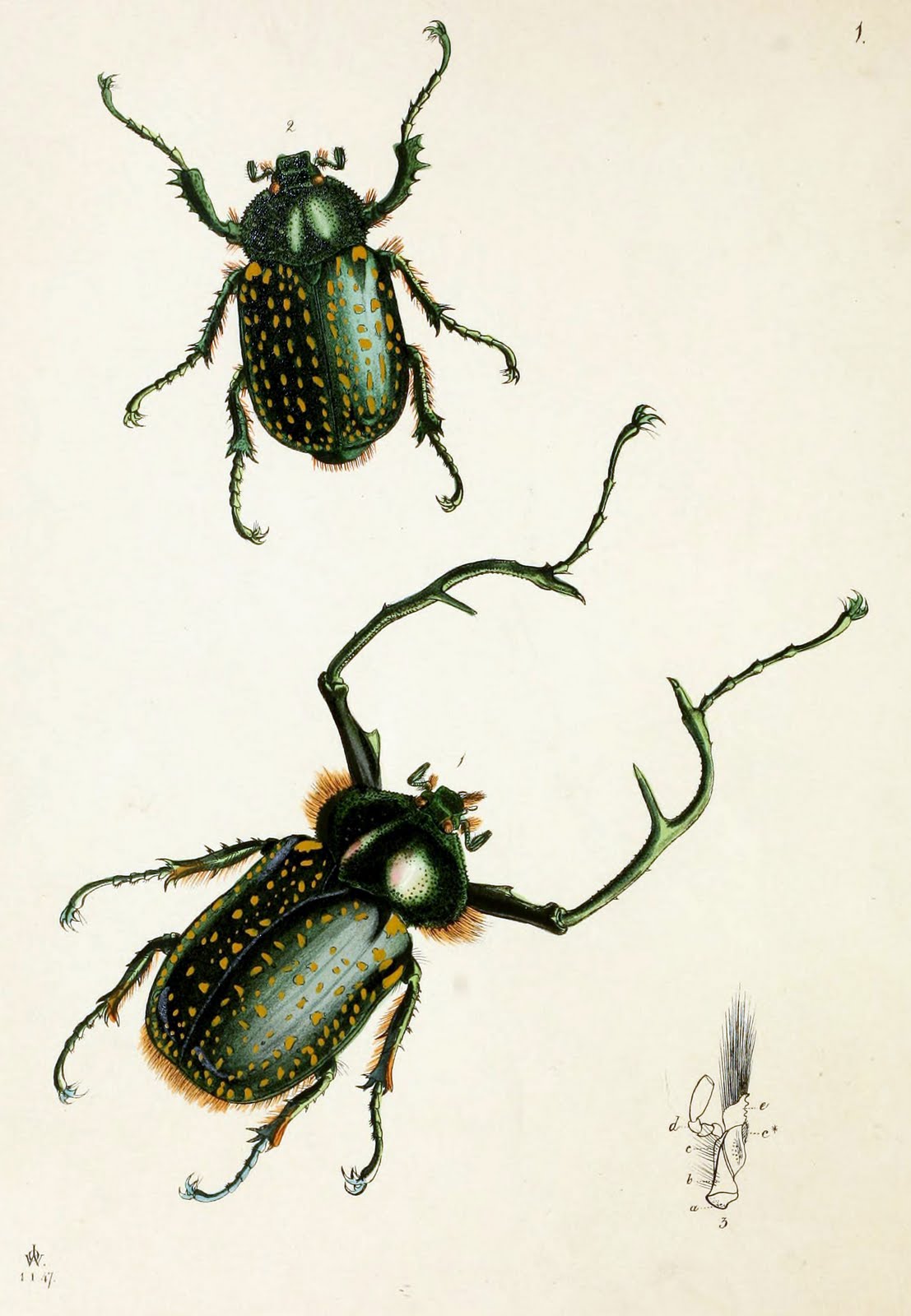
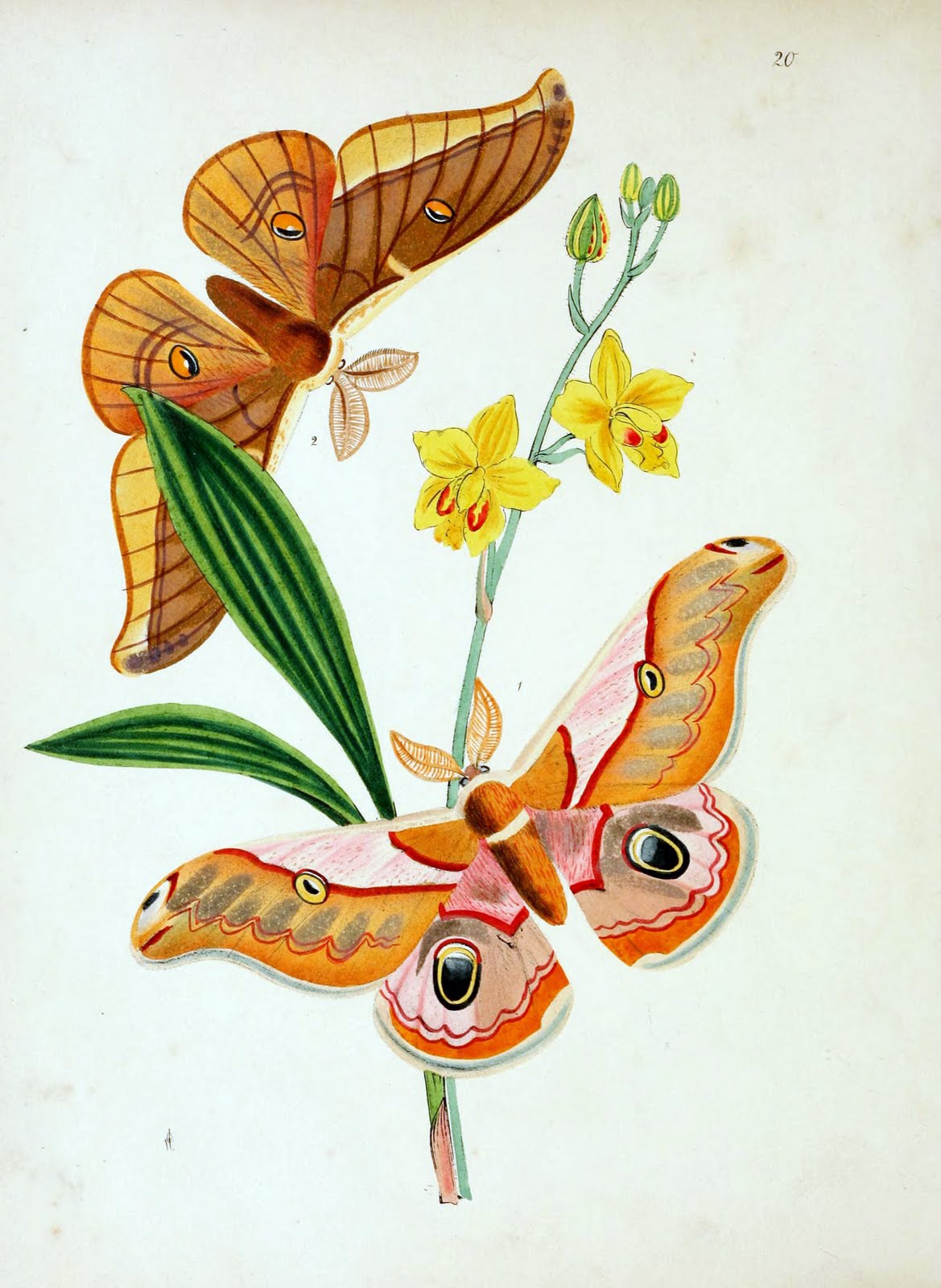
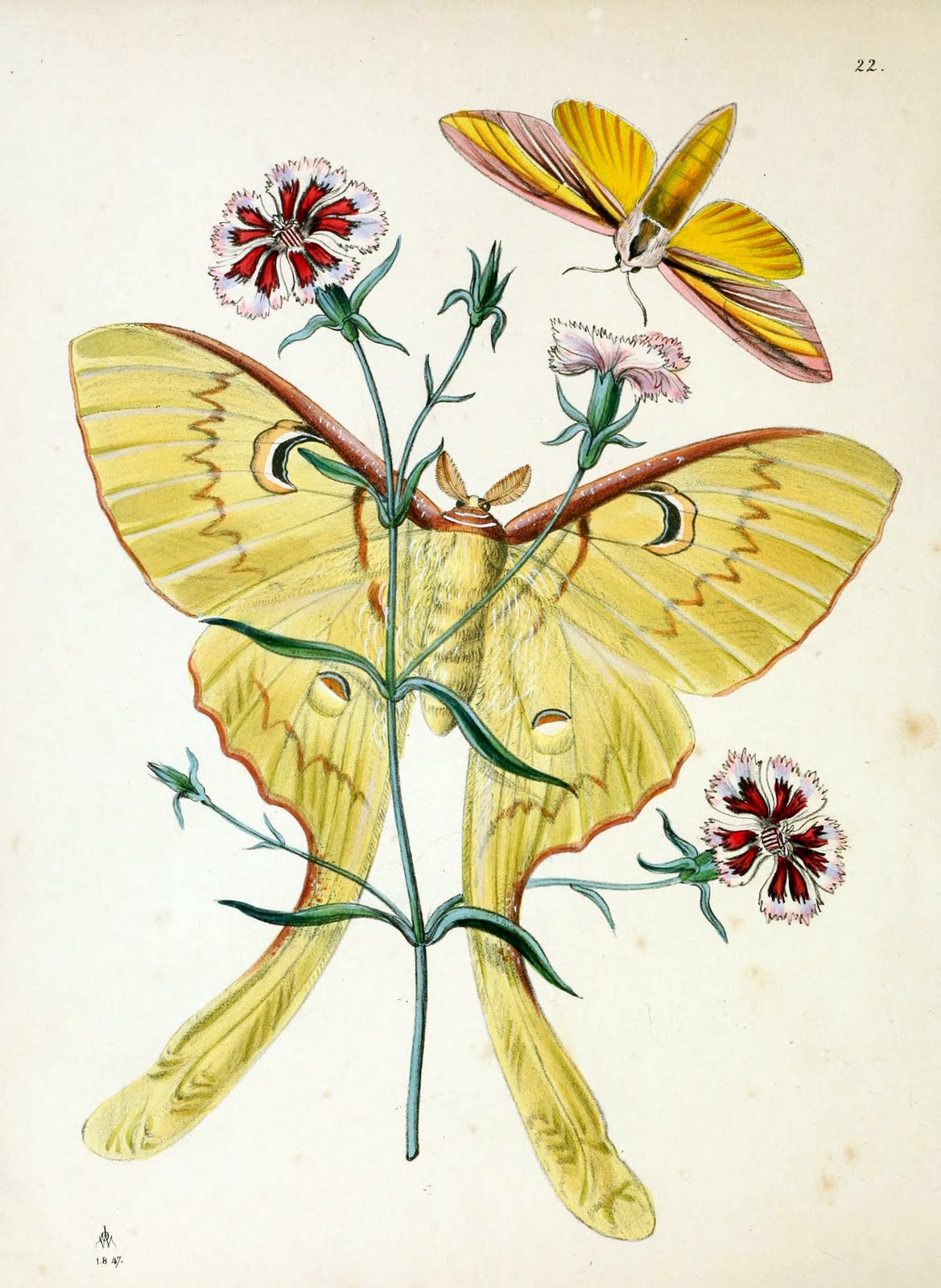
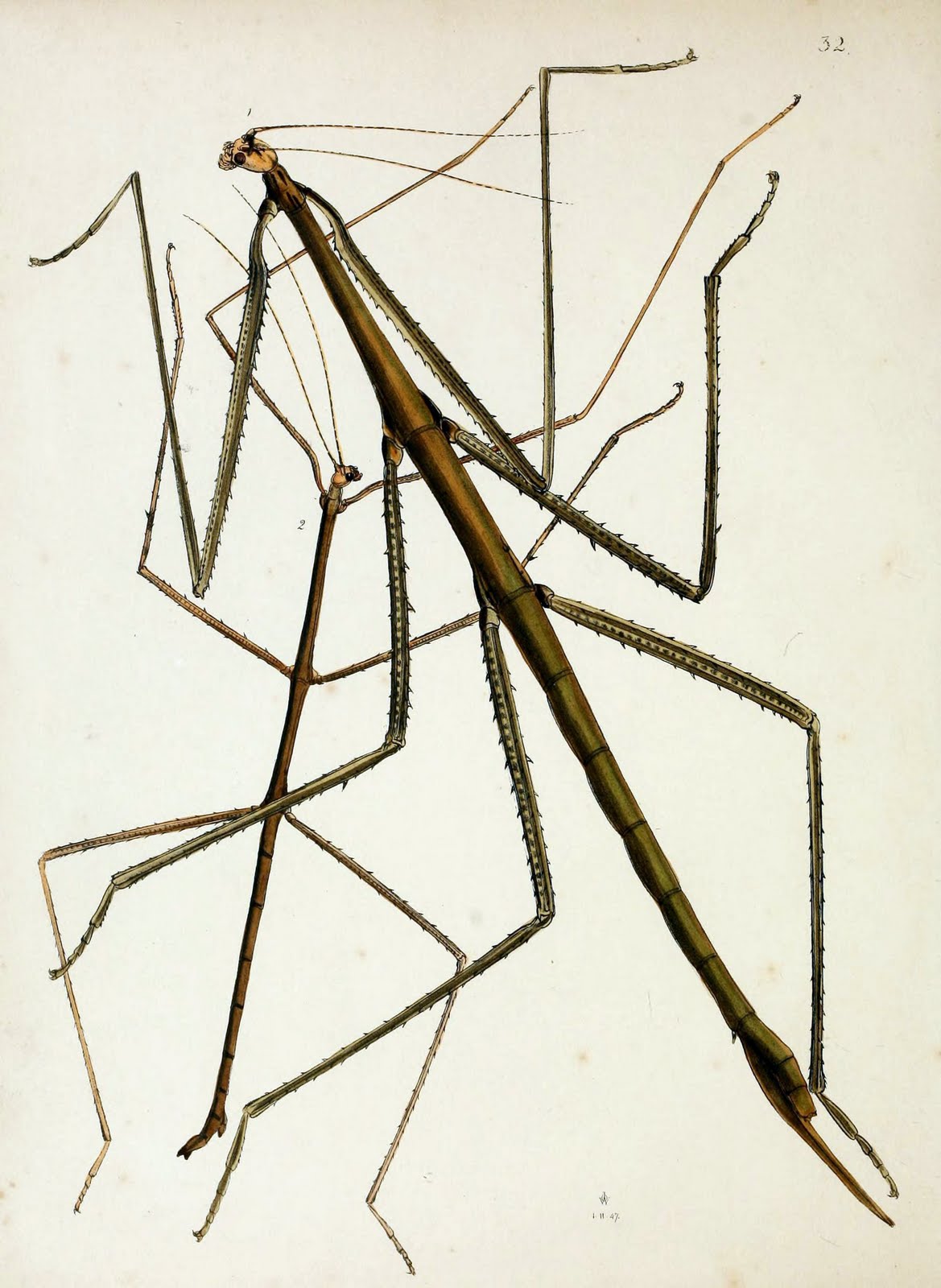
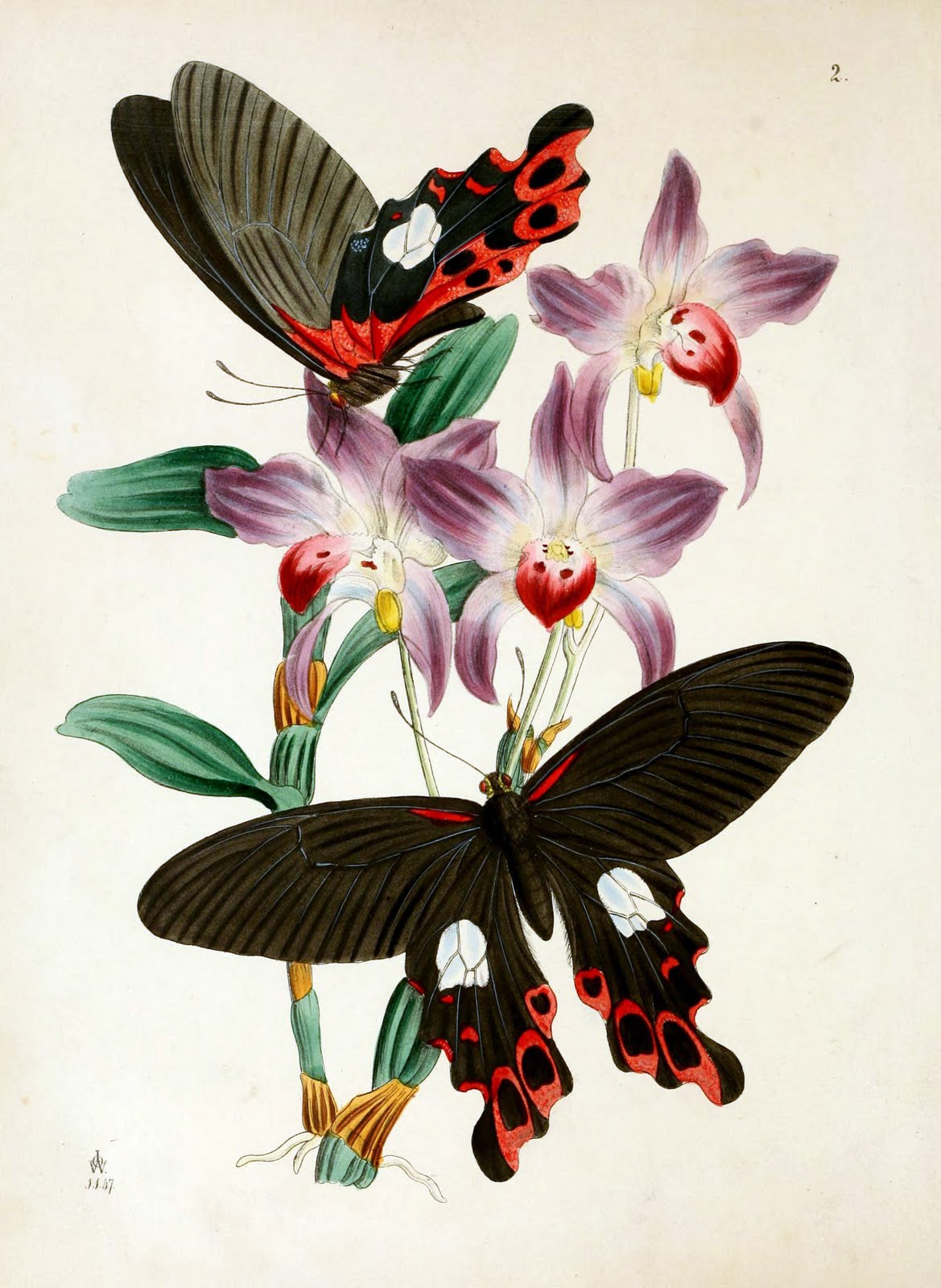
It’s bugs galore today as we feature the book The Cabinet of Oriental Entomology (1848), by J.O. Westwood. This delightful book is full of gorgeous illustrations of exotic insects. We’re picking out some of the illustrations that we particularly love and providing you with an excerpt of what the author had to say about the creatures shown. Enjoy!

View Full Size Image1) Papilio icarius

“Assam appears to be pre-eminently rich in the species of Papilio. A number of new species, from this region and the neighboring district of Sylhet, were figured in my ‘Arcana Entomologica,’ but none of them will bear comparison with the present insect, either for size or singularity of form, owing to the extraordinary elongation of the hind wings and the short dilated tails…Adopting the excellent system of nomenclature proposed with so much taste by Linnaeus, whereby the species of the modern genus Papilio were distinguished by the name of the famous heroes of antiquity, the present species…is named after Icarius, the son of Ebalus and Erigone; who, having been killed by some peasants of Greece, whose companions he had made drunk with wine, (a liquor till then unknown to them, and which from its effects they thought to be poison,) was transformed by Jupiter into a star, which was supposed by some persons to be identical with the celestial Bootes.”

2) Eucheirus macleaiiView Full Size Image
(Figure One: Male; Figure Two: Female)

“India and the adjacent islands offer to us a striking peculiarity in respect to the geographical distribution of the gigantic species of Lamellicorn beetles. Whilst the New World is inhabited by a great number of these fine insects…the tropical oriental regions can boast but of few; these however, are distinguished by their metallic or variegated appearance, of which their American brethren are destitute.”

View Full Size Image

3) Figure One: Saturnia simla

“The female of this fine species has the fore wings comparatively larger and less hooked than in the males…I trust that, in consequence of Captain Boys’ arrival in England, I shall be enabled, in a subsequent article, to communicate an account of the early states of this insect.”

Figure Two: Saturnia assama

View Full Size Image

4) Lower Figure: Actias maenae

“The accompanying figure of this very fine insect is copied from a specimen kindly communicated for representation by W.W. Saunders, Esq., F.L.S., which differs in some respects from Mr. Doubleday’s description of the species, recently published…This is certainly one of the finest of the recent additions to the list of oriental Lepidoptera; but I am informed that Dr. Boisduval possesses a species of this genus from Madagascar with much longer tails to the hind wings.”

Upper Figure: Leucophlebia lineata

“This beautiful insect appears to possess the characters of a distinct genus, in the classification of the exotic Nocturnal Heterocerous Lepidoptera; its elongated body and wings give it an analogy with some of the Sphingidae, as well as to some of the prominent moths, especially to Leiocampa Dictoea.”

View Full Size Image5) Figure One: Bacteria sarmentosa

“This species of walking-stick insect is longer than any which I have yet seen. It is represented of the natural size, but its full extent is here decreased by unnaturally bending back the fore legs (in order to bring them into the plates) which in the living insect are directed straight forwards…The insect described above is a female; I possess also another female, which I consider to belong to the same species, which is only 7 1/2 inches long, and agrees with it in all its characters, except that the 6th ventral segment has only a minute oval sulcated tubercule at its extremity.”

Figure Two: Bacteria virgea

“The proportions and general appearance of this insect indicate that it is most probably the male of the preceding. It is on this account that I have represented them both on one plate.”

Take some time to explore the other beautiful plates in this book. The insect world is certainly nothing if not colorful!

June 2, 2011by Grace Costantino
Blog Reel, Featured Books

Book of the Week: Dating Fossils

View Full Size Image

“How old is that fossil and how do you know it?”

This is the introductory sentence, and the question addressed, in this week’s book of the week, How Old are Fossils (1927), by Sharat Kumar Roy. According to the author, this is a question that is often asked by visitors to a museum, but it is also a question that is particularly time-consuming to answer. As the author writes,

“A precise answer to such a question is impossible and an adequate one demands a longer time than can usually be afforded. The consequences of inadequate explanation often proved to be unsatisfactory. The visitor becomes skeptical and instead of taking interest in the subject, he seems to be confirmed in his doubts.

In this leaflet is given a condensed, general statement of methods of determining the age of ancient life…It is intended for those who are interested in the age of past life and yet do not intend an exhaustive study of the subject…”

The author begins by discussing previous methods of determining age, including the rate of land erosion and the rate of salt derivation. These methods, however, are flawed. The rate of sedimentation varies according to the “character of the sediments deposited,” whether the river terminates in the sea, thus depositing sediment in the ocean, and severe weather conditions that may affect shallow water sediments. Similar uncertainties exist when using the rate of salt derivation, including an uncertainty about how much salt from shorelines or ocean beds was dissolved into the oceans in the past, or how much salt has been taken from the oceans into rock salt beds on the earth.

Using methods such as trying to determine the earth’s age by considering “the rate of life transformation in successive periods” is challenged by certain species, such as the brachiopods, which have resisted evolutionary change since as long as we have record of them. Similarly, the evolution of other species is extremely accelerated, such as the evolution of fish to amphibians to reptiles to birds to mammals. If we rely on dating methods that take into account how species have changed over time, but know that these changes are directly influenced by shifting environmental factors and not all species encounter changes that require an evolutionary response while others encounter conditions that require a much more rapid response, we quickly learn that this method of calculating age is also unreliable.

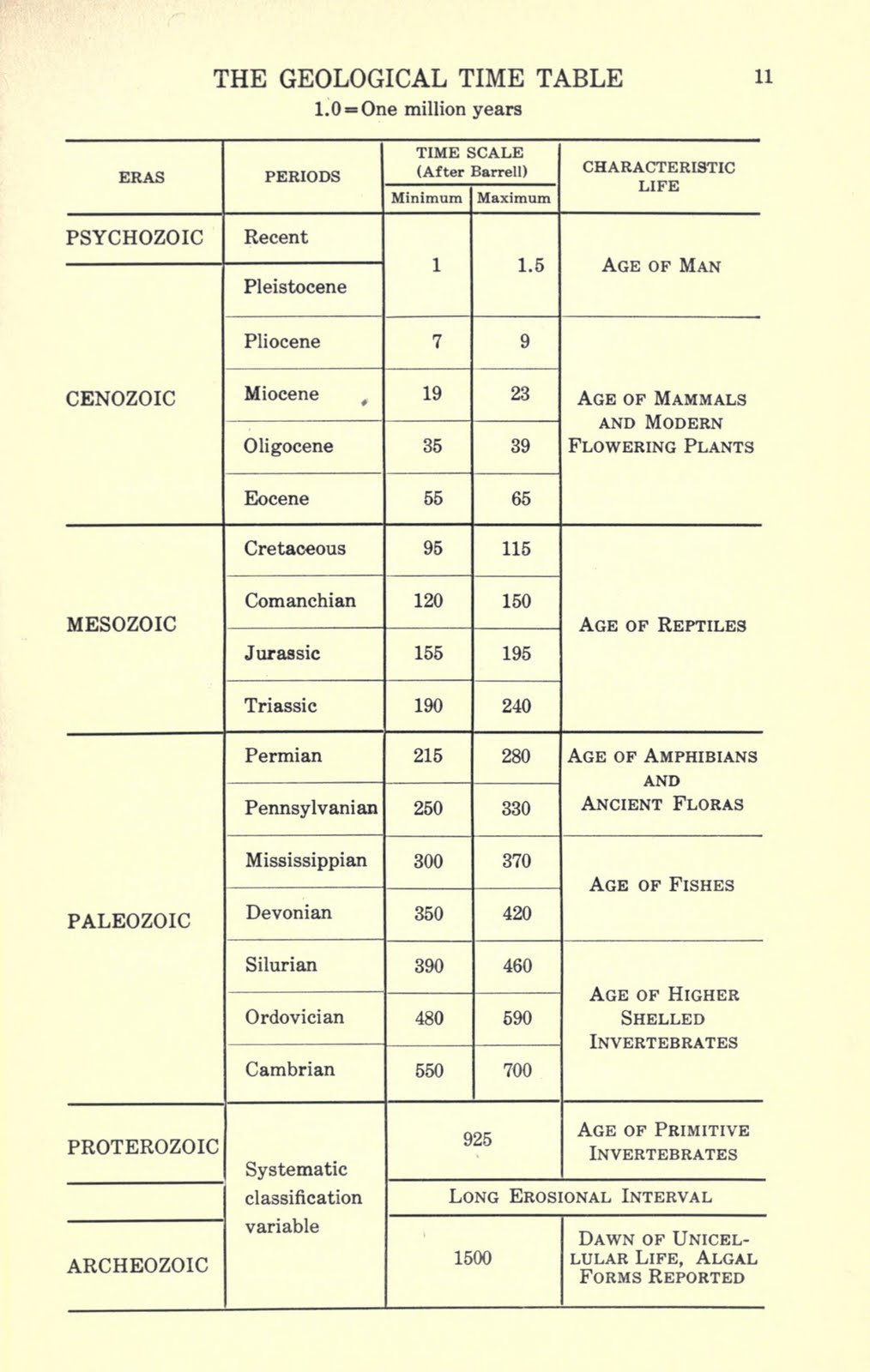
The ability to calculate the number of radioactive changes in certain chemicals, however, has changed the game. The star player in the game is uranium, which undergoes a transformation over time, ultimately breaking down into the metal lead and the gas helium. This transformation is unaltered by any external process. Therefore, “Since the rate of transformation is known, data for calculating the age of the mineral and with it the rock formation of which it is a part, can be obtained by measuring the quantity of helium and lead in the rock and comparing it with the quantity of uranium in the same volume of material.” While this method may be somewhat flawed, as helium, being a gas, may partially leak out of its rock home over time, “estimates based on the lead ratios of radio-active minerals offer results consistent among themselves.” With these known factors, 8,000* million years are required for the formation of one gram of lead from uranium.

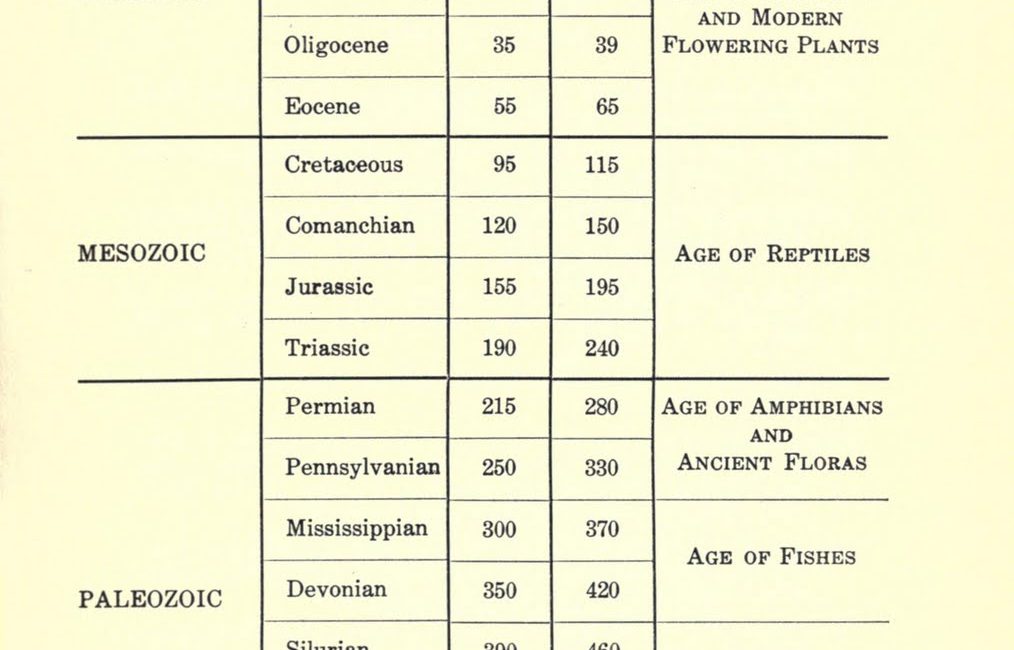
As a result of these studies, “the earliest life of which we have fossil records is about 1,500,000,000 years old. From this, it could be safely concluded that the inception of life on earth must have taken place much earlier.” Referring to the geological time chart included with the text (and pictured in this post), the author writes, “As we climb higher in the geological column, life becomes more and more complex and specialized. From the one-celled life of the Archeozoic it passes through the invertebrates – fishes – amphibians – reptiles – birds and mammals to man of the Recent time.”

We hope you’ve enjoyed this quick crash course on dating fossils, courtesy of our book of the week, How Old are Fossils (1927), by Sharat Kumar Roy (contributed by the Field Museum). Now go out and find your own fossils and think about the magnitude of time they represent.

May 26, 2011by Grace Costantino
BHL News, Blog Reel

BHL is Awarded the 2010 John Thackray Medal!

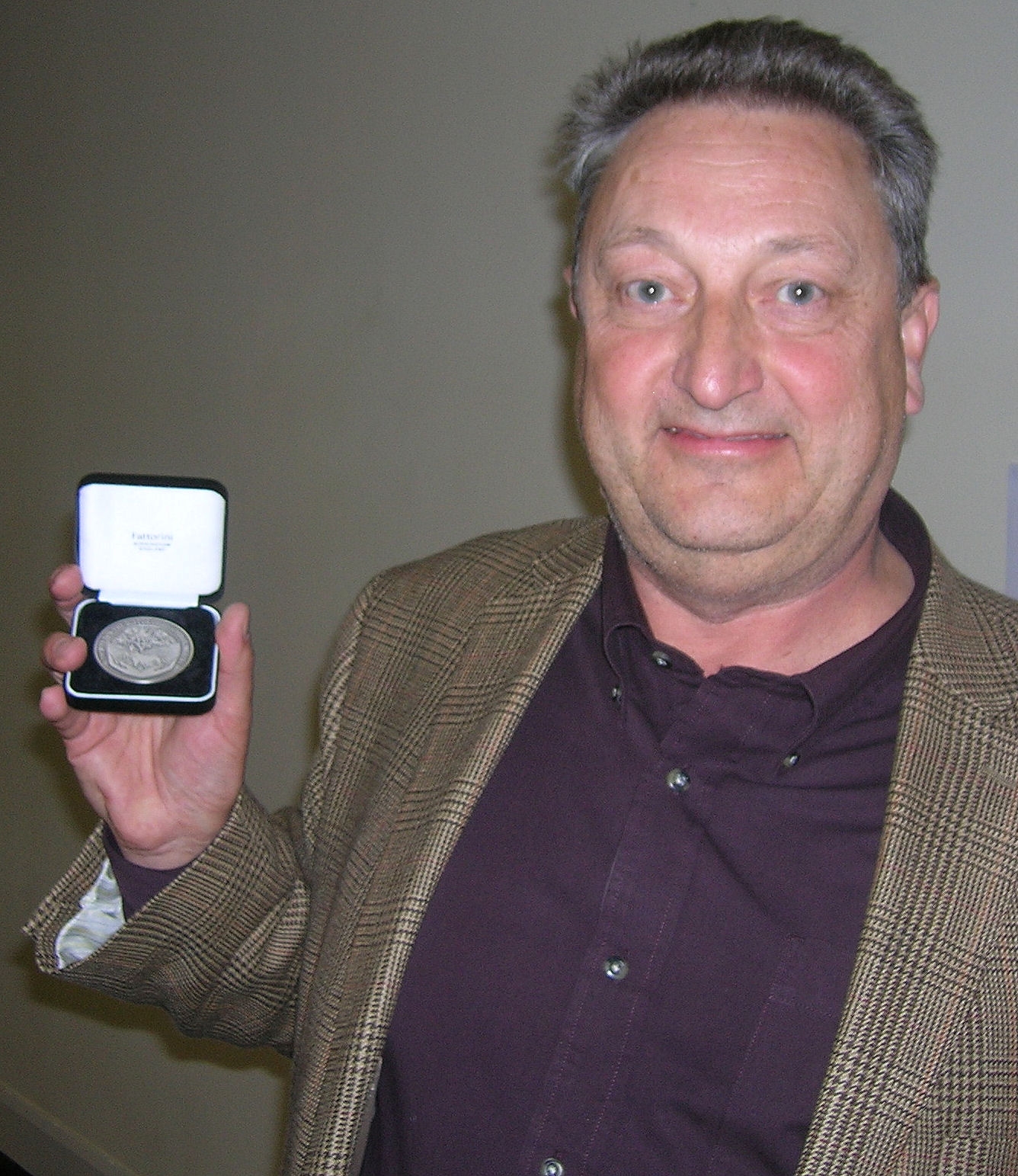
View Full Size ImageOn May 20th, Graham Higley, head of library and information services at the Natural History Museum in London, accepted the 2010 John Thackray medal, which was awarded to the BHL in recognition of our past three years of work building our digital library. Mr. Higley (pictured left) accepted this award on behalf of Tom Garnett, Director of the BHL.

The John Thackray medal “recognizes significant achievements in the history or bibliography of natural history.” According to the website for The Society for the History of Natural History, which awards this medal, “significant achievements” specifically include “making available … collections and/or information in new and novel ways.” While the 34 million + pages of literature that BHL has now made available for open access use, in addition to several of our special features, such as species name finding, the ability to generate your own custom PDF, and the opportunity to nominate titles for scanning, is a great start, this award serves as an encouragement to all of us at BHL to continue pushing the envelope and developing new ways to provide meaningful information and services to our users.

When asked to comment about the significance of this award for BHL, Mr. Higley responded,

“John Thackray was a past President of The Society for the History of Natural History (SHNH) and also the Archivist at the Natural History Museum, London (NHM) for several decades. It is particularly fitting that the BHL should be recognized by this award, since John and his colleagues in the SHNH made avid use of the historic collections at the NHM. It is now possible for their successors to look at or obtain copies of these rare early texts directly from the BHL, which is a truly global resource for historians as well as current scientists.”

We send a special thanks to The Society for the History of Natural History for honoring us with this award. We plan to continue to provide rare, important, and relevant biodiversity information to our users, and promise to continue developing novel ways for our users to interact with and use this content.

For more information on the John Thackray Medal, see our previous blog post regarding the award and visit The Society for the History of Natural History website to see their official announcement of the award.

May 25, 2011by Grace Costantino
Blog Reel, User Stories

BHL and Our Users: Dr. F. Christian Thompson

View Full Size ImageThis week we feature a user that has been active in BHL development since the beginning of the project, helping to see it go from a single digitization instance to an incredible digital library with over 34 million pages of digitized literature. An adjunct research scientist in the Entomology Department at the Smithsonian Institution, we are proud to highlight Dr. F. Christian Thompson.

Q: What is your title, institutional affiliation, and area of interest?

A: Adjunct Research Scientist, Emeritus; Department of Entomology, Smithsonian Institution. My interests include flower flies and others; their diversity; cybertaxonomy; and better ways to do things today.

Q: How long have you been in your field of study?

A: My first paper was published in 1965, so I have been working on flower flies for about a half-century.

Q: When did you first discover BHL?

A: I did not discover BHL, but helped create it. Back in 1996 when the Smithsonian was preparing for its 150th celebration, there was a desire to go online in order to share the event with the widest possible audience. So, the Smithsonian Libraries did a demo project and put online Weber (1796) that summer, a rare book from its collections which highlighted another collection two hundred years earlier! Thus began the endeavor of digitizing scientific works, an idea that eventually became BHL.

Q: What is your opinion of BHL and how has it impacted your research?

A: I have only the highest opinion of BHL. The key question is NOT how it has impacted my research but how it impacts and will continue to impact the research of my students and the younger generation. My generation built libraries of reprints and xerox copies. Today workers build digital files of critical works, and the BHL is the best source for these old works.

Q: How often do you use BHL?

A: At least a couple of times a week and sometimes multiple times in a day. If I am in the final process of finishing a research manuscript, I will repeatedly go online to check references and sometimes include the appropriate URL in my manuscript.

Q: How do you usually use BHL (read the titles online/download whole PDFs/Selecting Pages to Download/etc.)

A: On occasions, when I need something in PDF format to share with colleagues, I go first to BHL to see whether they have done the work. If so, then I download the pages we need. Naturally, over my years of work, I have developed a very large personal library, so most things I already have in the traditional printed format. HOWEVER, because my library has become so large, I frequently go to the BHL as it can be faster than getting up from my computer and looking for something in my library!

Q: What are your favorite features/services on BHL?

A: Obviously, my favorite service is simply having RARE natural history books available to all.

Q: If you could change one thing about BHL, what would it be, or what developmental aspect would you like the BHL team to focus on next?

A: BHL is growing. Hence, there are various things that can be improved. Unfortunately with only limited resources, what is the most important? Pragmatically I feel the first priority remains scanning MORE PAGES. Later given more funding, etc., BHL can go back and clean up its metadata, etc.

Q: If you had to choose one title/item in BHL that has most impacted your research, or one item that you prefer above any other in BHL, what would it be and why?

A: My favorite item remains the first item that the Smithsonian Libraries put online years ago. That is, the Sturm (1796) Verzeichniss Meiner Insecten-Sammlung, as that was the beginning of the BHL.

Thank you, Dr. Thompson, for your influence over the development of the project and your continued feedback provided for our development. To learn more about Dr. Thompson, visit his page on the Smithsonian’s Natural History website.

If you would like to be featured on our blog, do not hesitate to send us feedback, post on our Facebook page, or send us a tweet to @BioDivLibrary.

May 24, 2011by Grace Costantino
Blog Reel, Featured Books

Book of the Week: Natural History According to Shakespeare & His Contemporaries

View Full Size Image

Ever wonder what people believed about natural history in Shakespeare’s time? Well, even if you haven’t, we’re going to tell you. One of our BHL colleagues at Harvard brought the book Natural History in Shakespeare’s Time (1896), by H.W. Seager, to our attention, and we knew we just had to highlight it.

According to the Preface,

“This book presents in a convenient form for reference a collection of the quaint theories about Natural History accepted by Shakespeare and his contemporaries…The plan of the book is to give some illustration of each word mentioned by Shakespeare when there is anything remarkable to be noted about it…It is certain that Shakespeare believed some of the strange ideas here mentioned, especially about those animals which he had no opportunity of observing in their wild state; but on the other hand, Shakespeare’s knowledge of Natural History (in so far as his own observation extended) was far greater than that of his contemporaries as here illustrated.”

In our post this week, we thought we’d highlight some of the more interesting ideas held by Shakespeare and his contemporaries regarding the natural world. For each animal, we present, as does our book of the week, Shakespeare’s reference to the creature, as well as what his contemporaries were saying about them. Enjoy looking at Shakespeare in a whole new light!

Barnacles:

“We shall lose our time,
And all be turn’d to barnacles”
– Tempest, iv. I, 248-50

“In the island of Ireland, and Orcades, in certain places there, there be certain trees, much like unto willow-trees, out of which come forth certain hairs, increasing by little and little into birds, having shape of ducks, hanging upon the bough by their nebs or bills, and when they are come to full perfectness, they fly away of themselves, or fall into the next seas, which birds we call Barnacles. This is related by the people that dwell there.”
– Lupton’s Notable Things, bk. vii

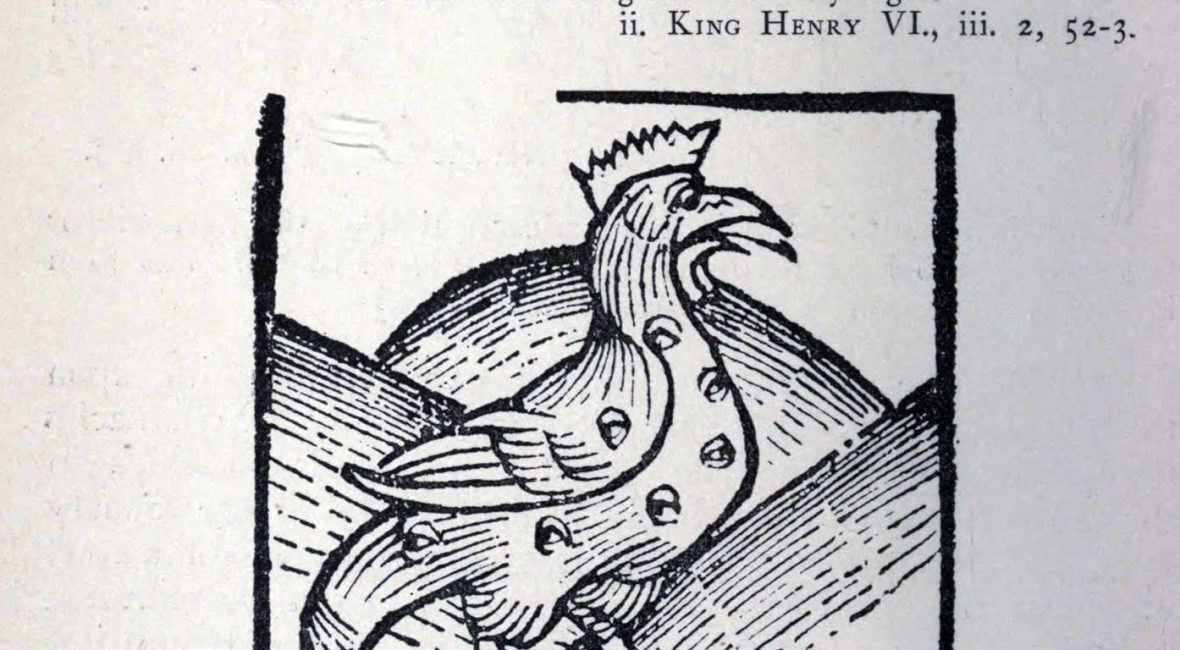
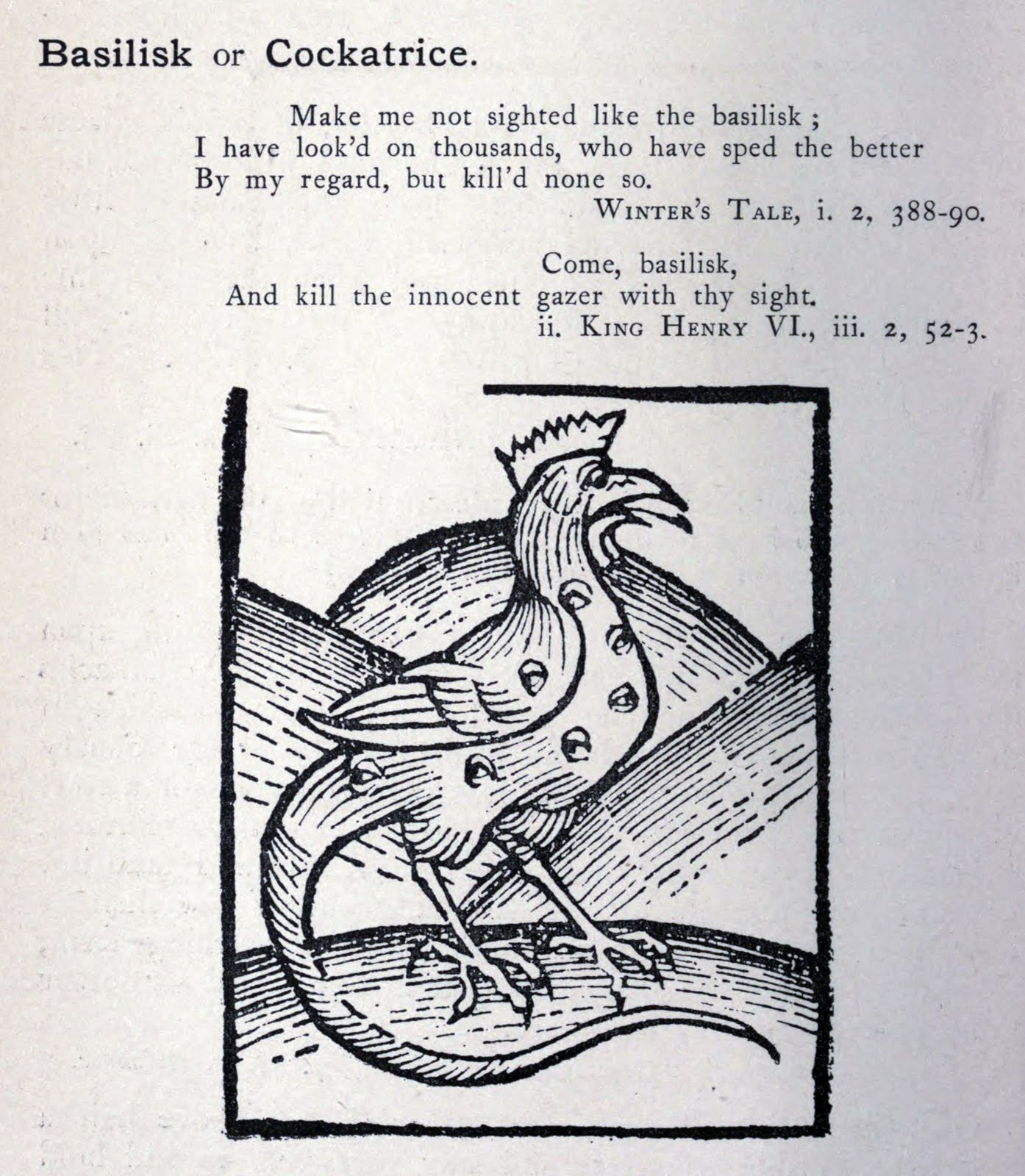
Basilisk or Cockatrice

“Come, basilisk,
And kill the innocent gazer with thy sight.”
– ii. King Henry VI., iii, 2, 52-3

“The Cockatrice is a king of serpents, and they be afeard and flee when they see him. For he slayeth them with his smell and with his teeth; and slayeth also all things that have life, with breath and with sight…But he is overcome of the weasel; and men bring the weasel to the Cockatrice’s den where he lurketh and is hid.”
– Bartholomew (Berthelet), bk, xviii.

“Its head is very pointed, its eyes red, its colour inclining to black and yellow; it has a tail like a viper, but the rest of its body is like a cock. The Basilisk is sometimes gendered from a cock; for towards the end of summer the cock lays an egg from which the Basilisk is hatched. But many things must concur to this gendering, for it lays the egg in much warm dung, and there sits on it. And those who have seen its creation say that there is no shell to the egg, but a very strong skin which can resist the hardest blows. Also the opinion of some is that a viper or toad sits on the cock’s egg – but this is doubtful.”
– Hortus Sanitatis, part iii (“Of Birds”) ch. xiii

Beans

“Peas and beans are as dank here as a dog, and that is the next way to give poor jades the bots.”
– I King Henry IV., ii, I, 9-10

“The Bean is a manner of codware, and serveth to pottage, and in old time men used to eat thereof. Beans cause vain dreams and dreadful. Many meddle beans with breadcorn, to make the bread the more heavy. By oft use thereof the wits be dulled. Or else, dead men’s souls be therein. Therefore the bishop should not eat beans. Beans grow in Egypt with sharp pricks, therefore crocodiles flee from them, and dread lest their eyes should be hurt with the sharp pricks of them. Such a bean is x cubits long, with a head as a poppy, and therein Beans be closed, and that head is red as a rose. And those beans grow not on stalks nor in cods.”
– Bartholomew, (Berthelet), bk. xvii.

Bees

“So work the honey bees,
Creatures that by a rule in nature teach
The act of order to a peopled kingdom.
They have a king and officers of sorts;
Where some, like magistrates, correct at home.”
– King Henry V., i, 2, 187-204

“Bees be cunning and busy in office of making honey, and they dwell in their own places that are assigned to them, and challenge no place but their own…They have a host and a king, and move war and battle, and fly and void smoke and wind, and make them hardy and sharp to battle with great noise…Bees make among them a king, and ordain among them common people. And though they be put and set under a king, yet they be free and love their king that they make by kind love; and defend him with full great defence…And bees choose to their king him that is most worthy and noble in highness and fairness, and most clear in mildness, for that is chief virtue in a king.”
– Bartholomew (Berthelet), bk. xii

And that’s just what they had to say about creatures beginning with “B”! Keep reading to find out more about what our ancestors used to think about the world we live in. Of course, chances are that five hundred years from now, our descendants will be reading some of the things we think we know about the world and laughing as well. Just something to consider…

May 19, 2011by Grace Costantino
BHL News, Blog Reel

BHL and Culturomics

On December 16, 2010 Science released a paper, “Quantitative Analysis of Culture Using Millions of Digitized Books” that describes data mining research using a vast textual archive created by the Google Books. The abstract reads, “We constructed a corpus of digitized texts containing about 4% of all books ever printed. Analysis of this corpus enables us to investigate cultural trends quantitatively. We survey the vast terrain of “culturomics”, focusing on linguistic and cultural phenomena that were reflected in the English language between 1800 and 2000. We show how this approach can provide insights about fields as diverse as lexicography, the evolution of grammar, collective memory, the adoption of technology, the pursuit of fame, censorship, and historical epidemiology. ‘Culturomics’ extends the boundaries of rigorous quantitative inquiry to a wide array of new phenomena spanning the social sciences and the humanities.”

The paper and subsequent commentary has accelerated nascent efforts at macroscopic, algorithmic questioning of large historical textual data sets. Can similar methods be applied fruitfully to the BHL corpus?

Already, Rod Page, bioinformatician and developer of BioStor, has demonstrated suggestive evidence in the affirmative by tracking a small sample of species names for the same organism in BHL texts through time and plotting the number of citations. The graph may be a visual representation of scientific debate and usage. Many other uses are possible, including:

  • Co-occurrence of place names with species
  • Frequency of co-occurrence of species names esp. with key words such as host, prey, predator, symbiont etc.
  • Tracking trends in zoological and botanical research by tracking methodological terminology through time.
  • Identification of taxonomically significant “events” in the literature based on textual cues.

Much of the follow-on activity to the Science paper is occurring in the “Digging into the Data” program. Thus, on May 9, the BHL made its data available for researchers in the Digging into the Data program.

View Full Size Image

BHL Director, Tom Garnett, will be attending the conference, “Digging into the Data” in June where speakers, including the authors of the Science article, will address issues of and opportunities in data mining of large textual corpora. With suitable partners, it is possible that we can seek NSF or Google funding for the unique use case our increasing text corpus presents. The framework for a proposal would be a team of biologists and a team of computer scientists posing research questions for the BHL corpus that would be amenable to algorithmic investigation. Even if funding is not forthcoming, if third party researchers use the BHL corpus to produce scientifically or historically salient results, it will enhance the value and use of the BHL, which can lead to further collaborations.

May 16, 2011by Grace Costantino
Page 64 of 71« First...102030«63646566»70...Last »

Help Support BHL

BHL's existence depends on the financial support of its patrons. Help us keep this free resource alive!

search

About BHL

The Biodiversity Heritage Library (BHL) is the world’s largest open access digital library for biodiversity literature and archives. BHL operates as a worldwide consortium of natural history, botanical, research, and national libraries working together to digitize the natural history literature held in their collections and make it freely available for open access as part of a global “biodiversity community.”

Join Our Mailing List

Sign up to receive the latest news, content highlights, and promotions.

Subscribe Now

Subscribe to Blog via Email

Enter your email address to subscribe to this blog and receive notifications of new posts by email.

Join 319 other subscribers

Subscribe to Blog Via RSS

Subscribe to the blog RSS feed to stay up-to-date on all the latest BHL posts.

Access RSS Feed

Inspiring Discovery through Free Access to Biodiversity Knowledge.

The Biodiversity Heritage Library makes it easier than ever for you to access the information you need to study and explore life on Earth…for free, anytime, anywhere.


ABOUT | HARMFUL CONTENT | PRIVACY | SITE MAP | TERMS OF USE