Biodiversity Heritage Library - Program news and collection highlights from BHL
  • Home
  • News
  • Featured Books
    • All Featured Books
    • Book of the Month Series
    • BHL at 20
  • User Stories
  • Campaigns
    • Fossil Stories
    • Garden Stories
    • Monsters Are Real
    • Page Frights
    • Her Natural History
    • Earth Optimism 2020
  • Tech Blog
  • Visit BHL
Home
News
Featured Books
    All Featured Books
    Book of the Month Series
    BHL at 20
User Stories
Campaigns
    Fossil Stories
    Garden Stories
    Monsters Are Real
    Page Frights
    Her Natural History
    Earth Optimism 2020
Tech Blog
Visit BHL
  • Home
  • News
  • Featured Books
    • All Featured Books
    • Book of the Month Series
    • BHL at 20
  • User Stories
  • Campaigns
    • Fossil Stories
    • Garden Stories
    • Monsters Are Real
    • Page Frights
    • Her Natural History
    • Earth Optimism 2020
  • Tech Blog
  • Visit BHL
Biodiversity Heritage Library - Program news and collection highlights from BHL
BHL News, Blog Reel, Campaigns, Her Natural History

#HerNaturalHistory: Campaign Report and Outcomes

Her Natural History Campaign Report

Her Natural History Campaign Report

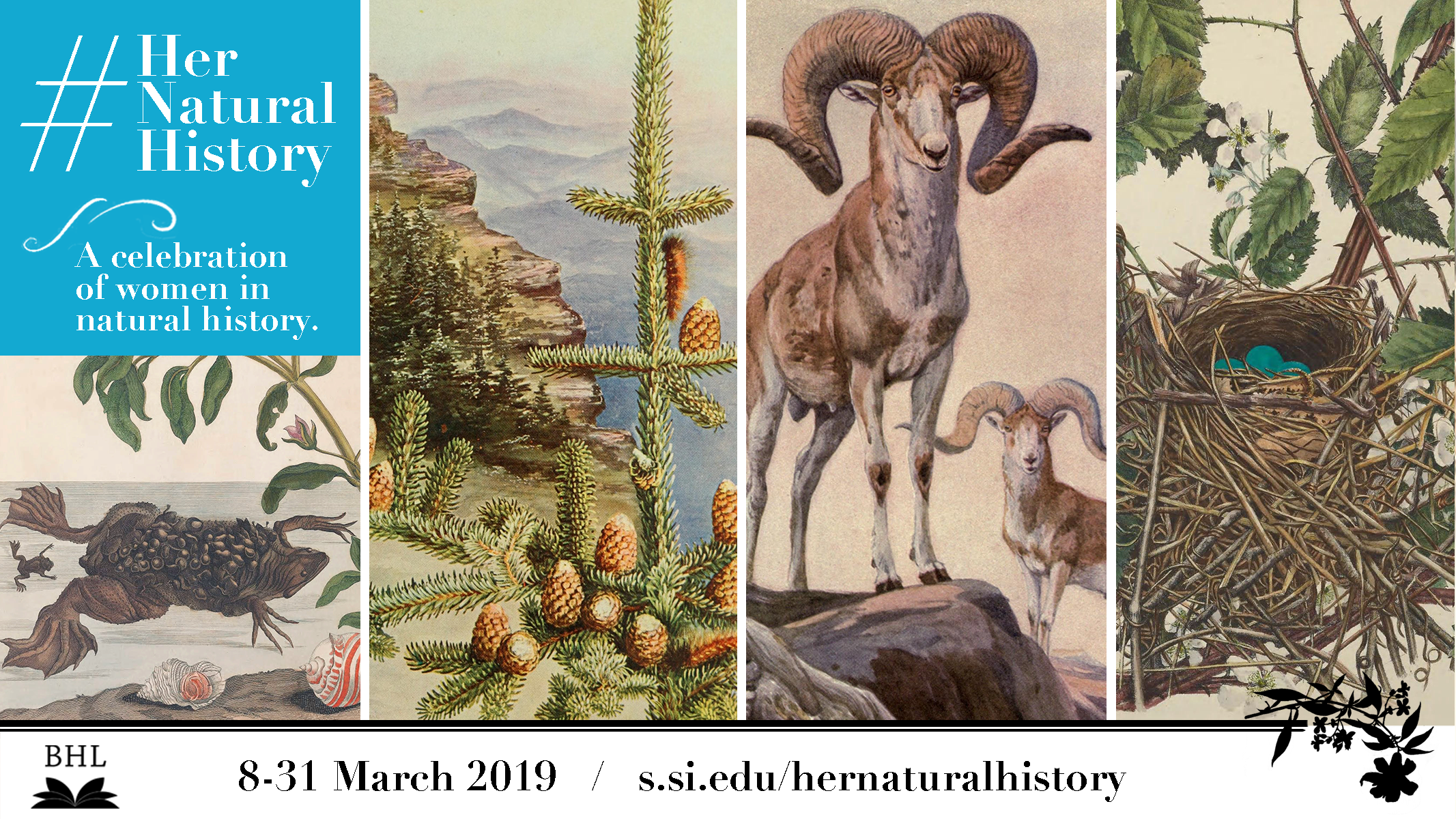
This year, the Biodiversity Heritage Library (BHL) and our global partners celebrated Women’s History Month with an international social media campaign: Her Natural History: A Celebration of Women in Natural History.

Kicking-off with an all-day social media blitz on International Women’s Day (8 March) and continuing throughout the month with social media and blog posts, Facebook Live events, and citizen science opportunities, Her Natural History aimed to increase awareness of and information about women in the biodiversity sciences. BHL partners also collaborated to curate the Women in Natural History Book and Female Illustrators in Natural History Flickr Collections for the campaign, featuring publications, archival materials, and illustrations by female naturalists and artists. Audiences could further engage with the work of female illustrators through the Her Natural History Coloring Book.

Extending beyond the BHL consortium, the wider community was invited to participate in the campaign by using #HerNaturalHistory to share stories, collections, publications, artworks, archival materials, exhibits, and other resources highlighting women and their contributions to natural history throughout the month. #HerNaturalHistory was also the #LibrariesOfInstagram challenge topic for March.

We were delighted with the outcomes and impact of the campaign. #HerNaturalHistory reached over 7.5 million people, with over 52 million impressions on content and over 3,100 accounts participating on social media. The campaign allowed BHL to expand its reach and engagement with existing and new audiences in notable ways, resulting in a 35% average increase in overall social reach and a 41% increase in overall social engagements compared to 2018 averages. #HerNaturalHistory also encouraged increased engagement with the works of women in BHL, fostering a 122% increase in views on books in the Women in Natural History Book Collection compared to 2018 monthly averages.

From engaging with worldwide audiences to tell the stories of so many remarkable women in science to working with our community to improve information online about the contributions of women to natural history, Her Natural History was a great example of how collaborative social media campaigns can be used to engage global audiences around important cultural and scientific topics while increasing engagement with library and archival collections.

We invite you to explore the results of the campaign in-depth within the Her Natural History campaign report.

Thank you to everyone who participated in and contributed to #HerNaturalHistory. And thank you to all of the women in science — past, present, and future — who have made such incredible contributions to biodiversity research. Thank you for giving us so many wonderful stories and accomplishments to celebrate!

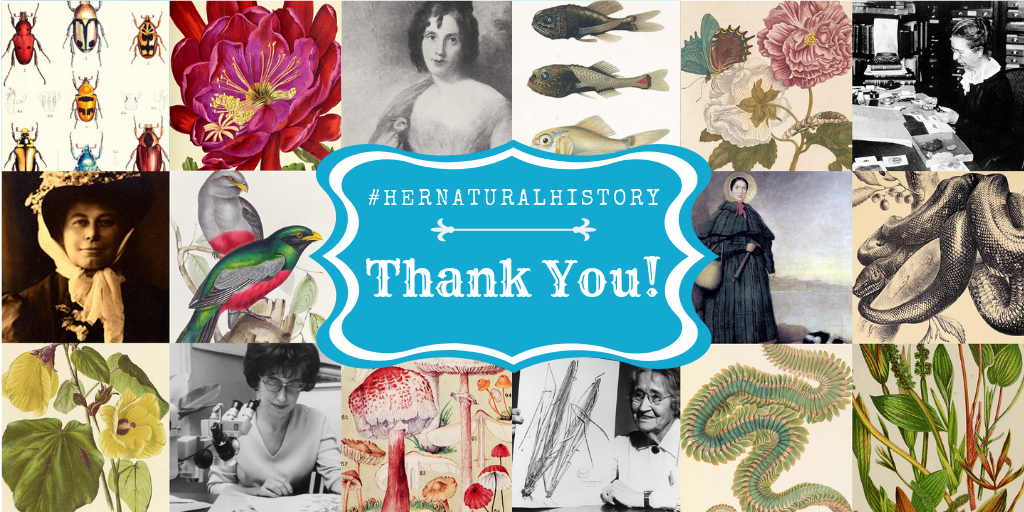
Thank you graphic for #HerNaturalHistory

May 2, 2019by Grace Costantino
Blog Reel, User Stories

How the BHL Makes Little Brown Beetle Species Discovery Easier

There are more described species of beetles (order Coleoptera) than any other group of organisms on the planet. With over 350,000 described extant and extinct species and subspecies, beetles represent about 40% of all described arthropods and about 25% of all described species [1,2].

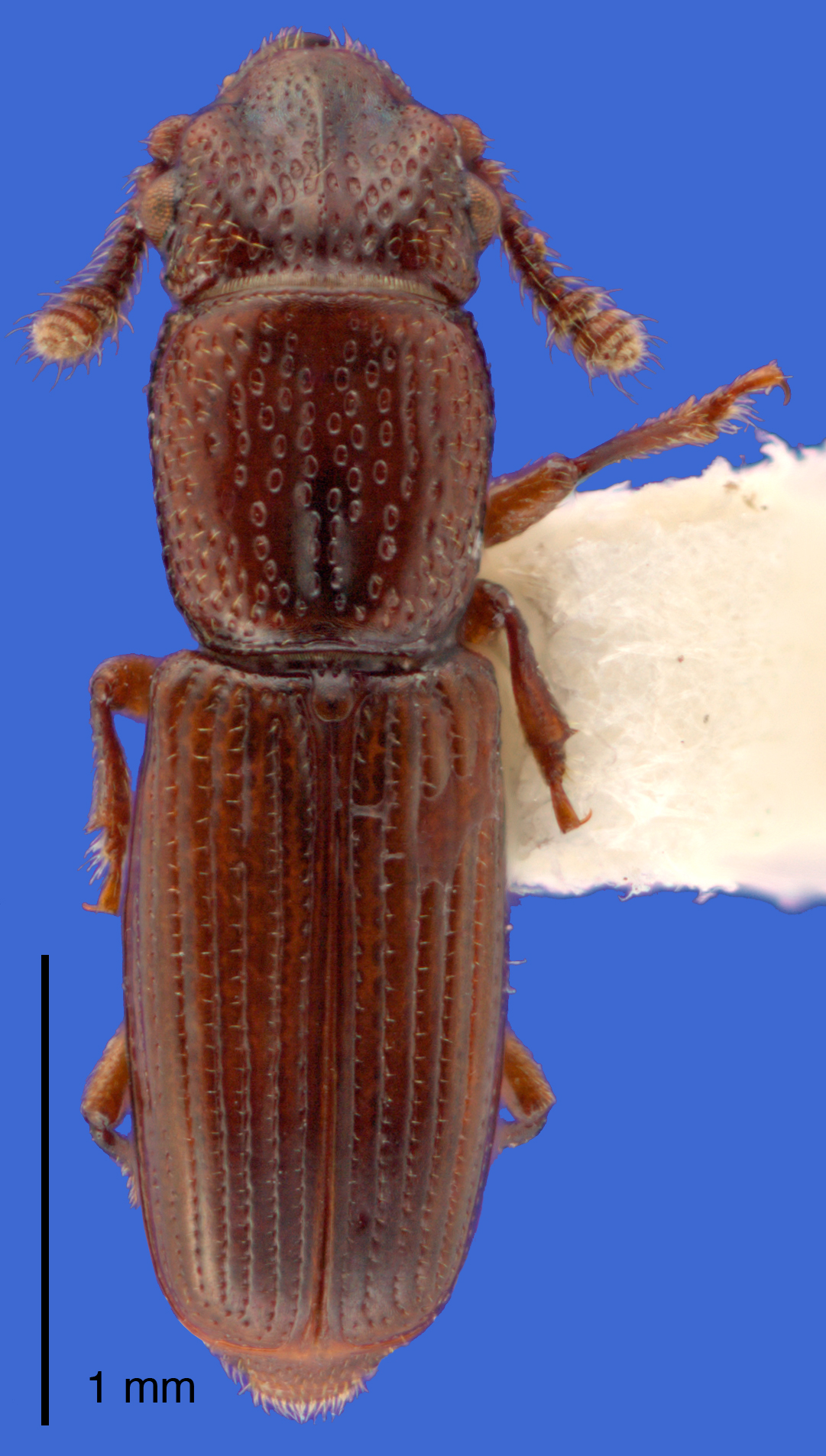
Europs frontalis (Grouvelle, 1896), a monotomid beetle from Chile described by Antoine Henri Grouvelle in the Annales de la Société entomologique de France. Photo by TC McElrath.

One of the myriad families of beetles is Monotomidae, with over 250 described species [3]. Commonly called minute clubbed beetles, the family includes such species as Europs frontalis (found only in south temperate forests of Argentina and Chile) and Pycnotomina cavicolle (found exclusively in forested regions of eastern North America).

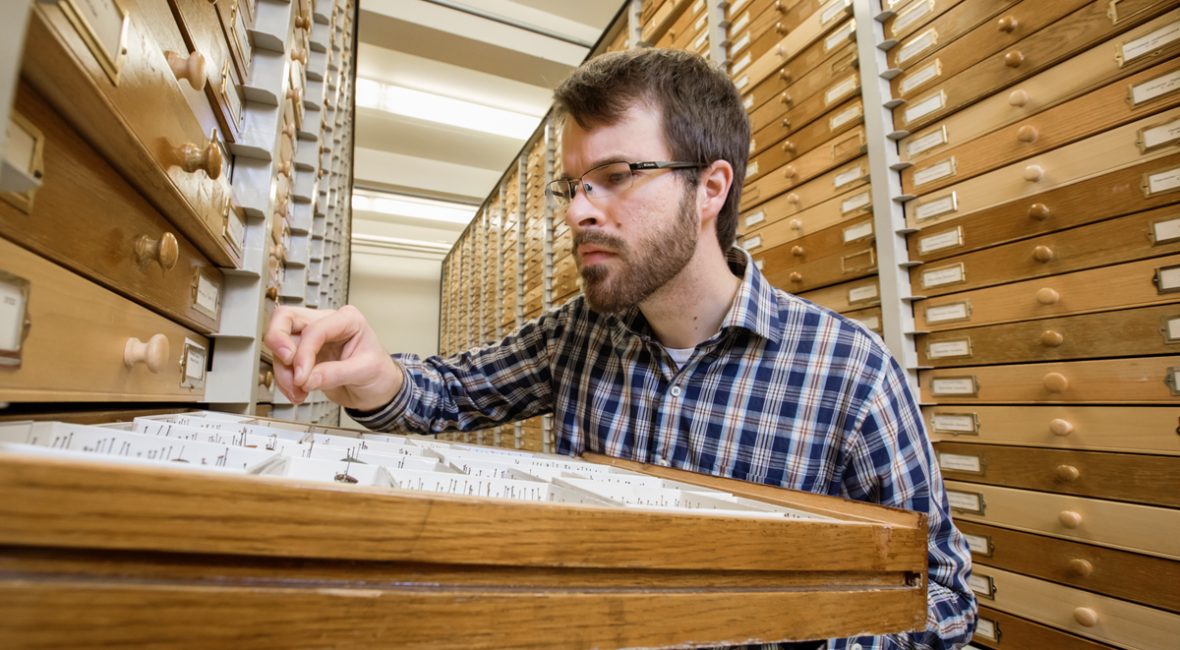
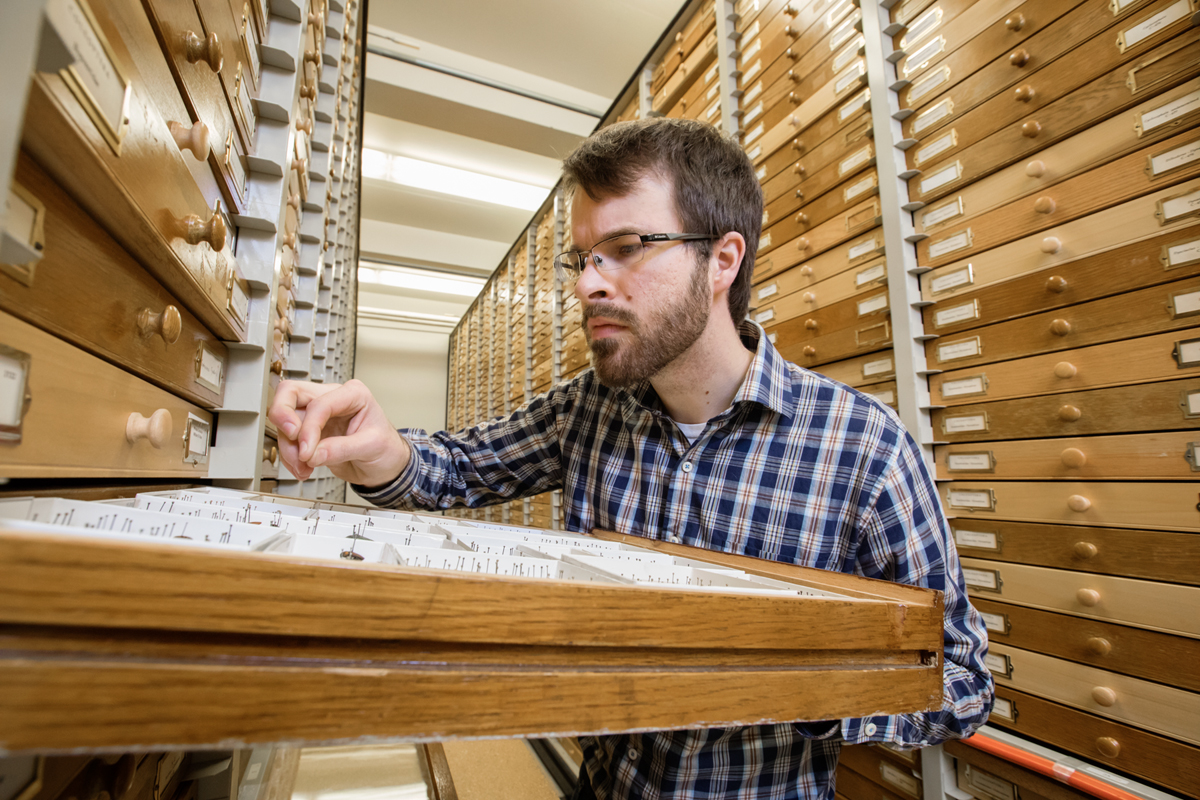
Dr. Thomas McElrath, Insect Collections Manager at the Illinois Natural History Survey, has been studying the systematics of Coleoptera for nine years. He is currently working on compiling a worldwide checklist of the Monotomidae. The Biodiversity Heritage Library is a crucial resource for his research on this project.

“The BHL is an integral research tool for beetle systematists like me. I absolutely love it. It has saved me time, money, and resources,” lauds McElrath. “Most of the older, obscure literature I need to reference to study the taxonomy of beetles is now available from the BHL. Soon, I hope to have a worldwide checklist available for the Monotomidae, thanks, in part, to the resources available on the BHL.”
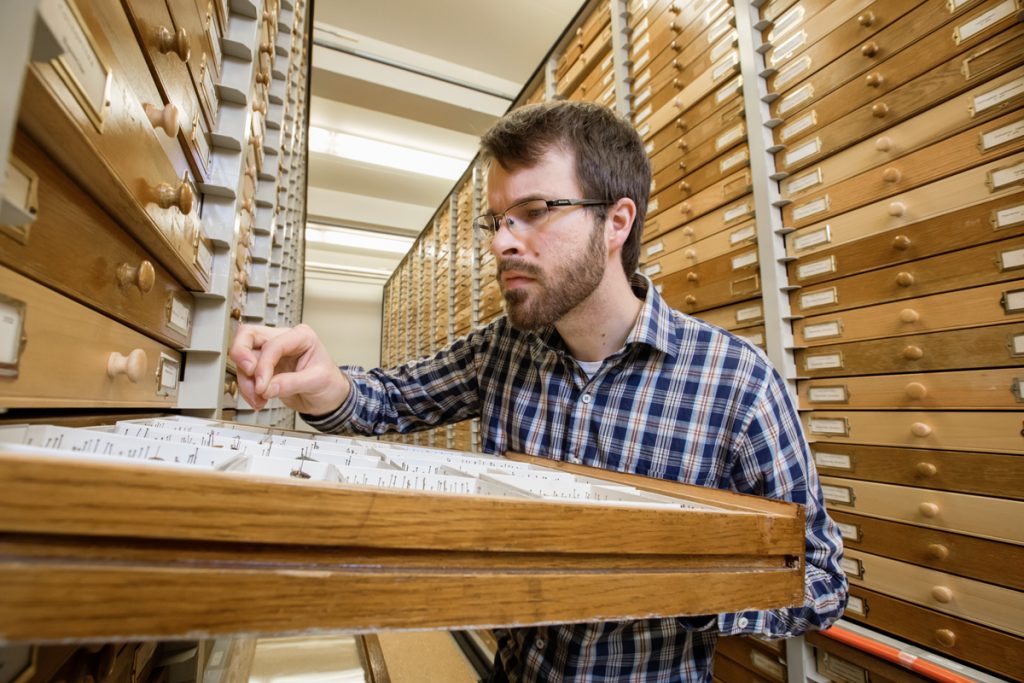
Dr. Thomas McElrath in the Illinois Natural History Survey Coleoptera Collection. Photo by L. Brian Stauffer.

McElrath first discovered BHL around 2011, and it soon became an essential research tool, particularly during his PhD, when it was not uncommon for him to use the Library multiple times a day in search of older publications and species descriptions.

“Without BHL, my PhD would have taken much longer, and I wouldn’t have been able to do as much as I did within the time period available to me,” explains McElrath. “It saved me hundreds of hours of library research, interlibrary loan requests, and scanning.”

Today, McElrath still uses BHL daily to weekly, typically downloading whole or custom PDFs to support his research on the Monotomidae. The Library allows him to access relevant materials in a variety of languages quickly and easily.

“Without BHL, finding all the the species descriptions in American, German, French, and Italian taxonomic journals would have been much harder,” affirms McElrath. “My advisor always told me I had it ‘too easy’ with BHL, and that in his day they would have to beg for reprints from colleagues all around the world, which sometimes took months to arrive. Now, I just log onto BHL and download a high quality scan for free. It’s really amazing.”

McElrath also views BHL as a great way for institutions to share collections-related information. To that end, the Illinois Natural History Survey (INHS), in collaboration with BHL Member the University of Illinois at Urbana-Champaign (UIUC), has started uploading accession logs related to collections in the INHS to BHL.

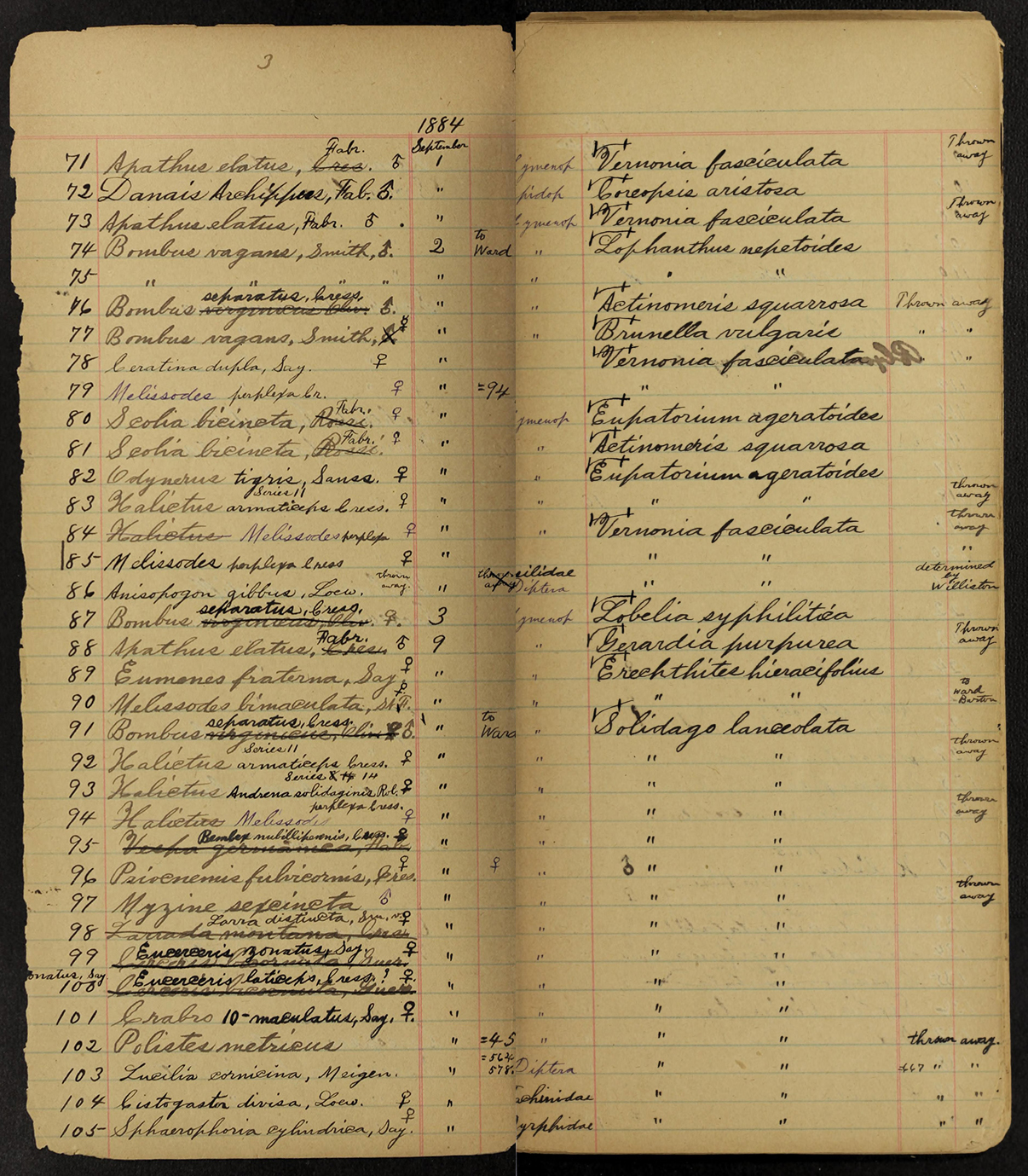
Page from Specimen Collection Logs of Charles Robertson. Contributed in BHL from University Library, University of Illinois Urbana Champaign.

For example, the Specimen Collection Logs of Charles Robertson document insect specimens collected by Robertson, providing information such as specimen number, scientific names, sex of specimen, date of collection, locality, insect order, host plant scientific name, and notes. The logs, now available on BHL, are held in the Archives of UIUC, while the corresponding specimens are held by INHS.

“My museum and institutional library have used BHL to host scans of our accession logs so that researchers can access them from around the world, alongside our already digitized specimens,” explains McElrath. “I would love to see more institutions and individuals put their field notes and accession logs on the BHL for others to access.”

Thanks to recent initiatives such as the BHL Field Notes Project and the Smithsonian Field Book Project, over 6,000 field notes, correspondence, and related archival materials have been made available in BHL, with more being added regularly. These materials serve as unique primary source documents and provide valuable context for and data around specimens, collecting events, and the activities, observations, and personal notes of individual researchers. Thanks to their availability on BHL, researchers across the globe can easily access this valuable information.
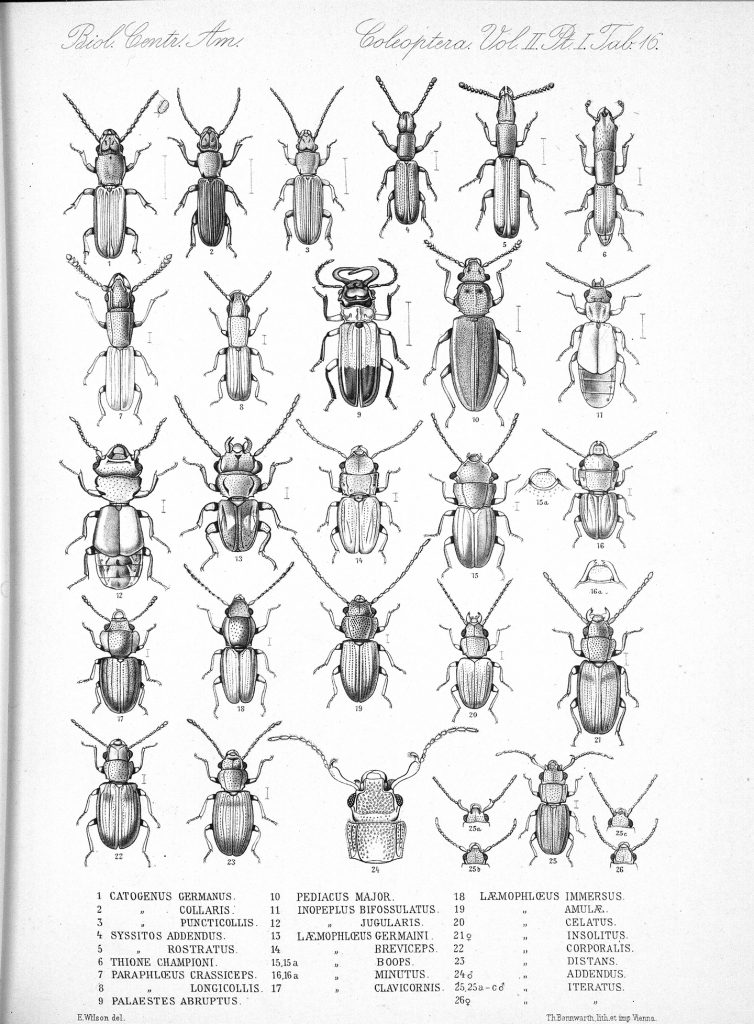
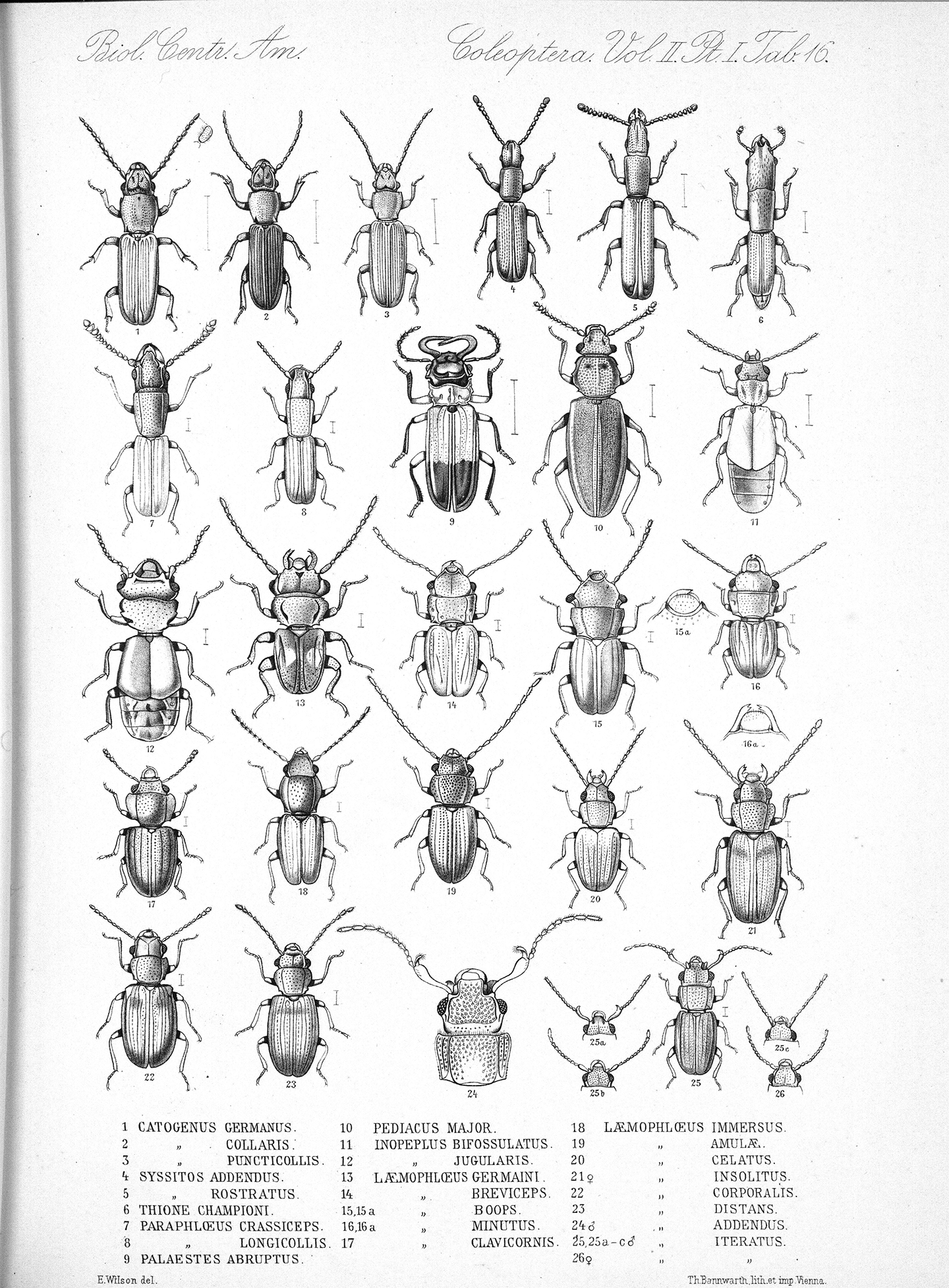
The Biologia Centrali-Americana was published around the turn of the century and describes several unique monotomids, including Thione championi, figured at top right of this page. Contributed in BHL from Smithsonian Libraries.

Beyond supporting research activities, McElrath also appreciates the wealth of illustrations available from BHL. Since 2011, BHL has been uploading the scientific illustrations found within the collection to Flickr, making it easier for anyone to explore and download these images, which are valuable both as scientific documents and works of art.

“My wife and I also download high resolution plates of cool biodiversity (insects, plants, etc.) from the BHL Flickr page and use them to make prints for decorating our house,” shares McElrath.
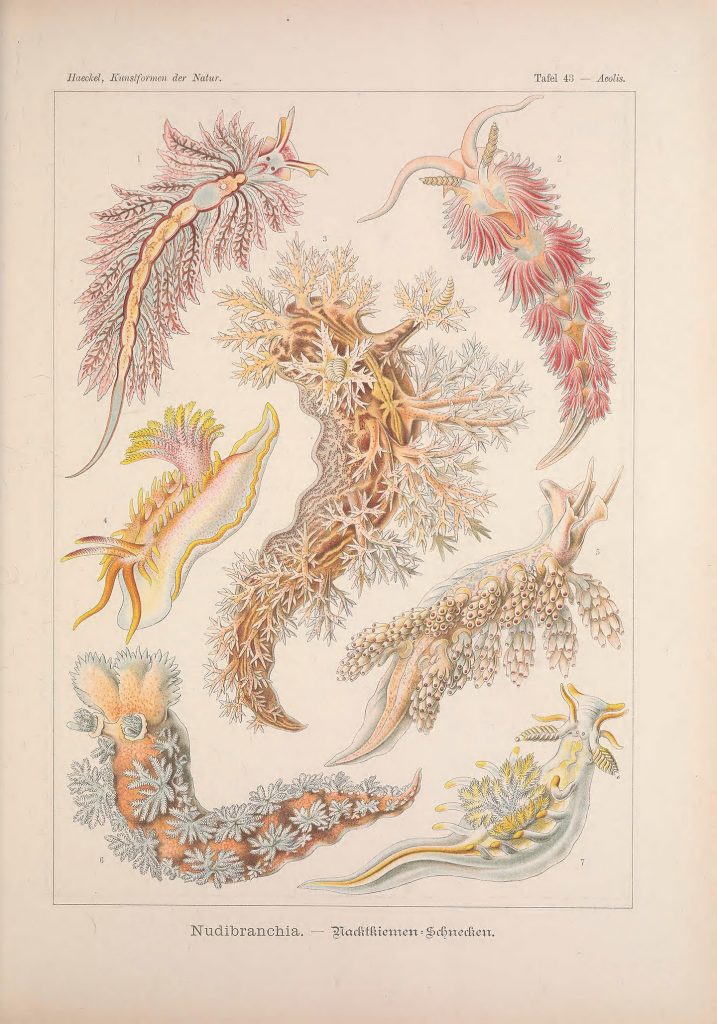
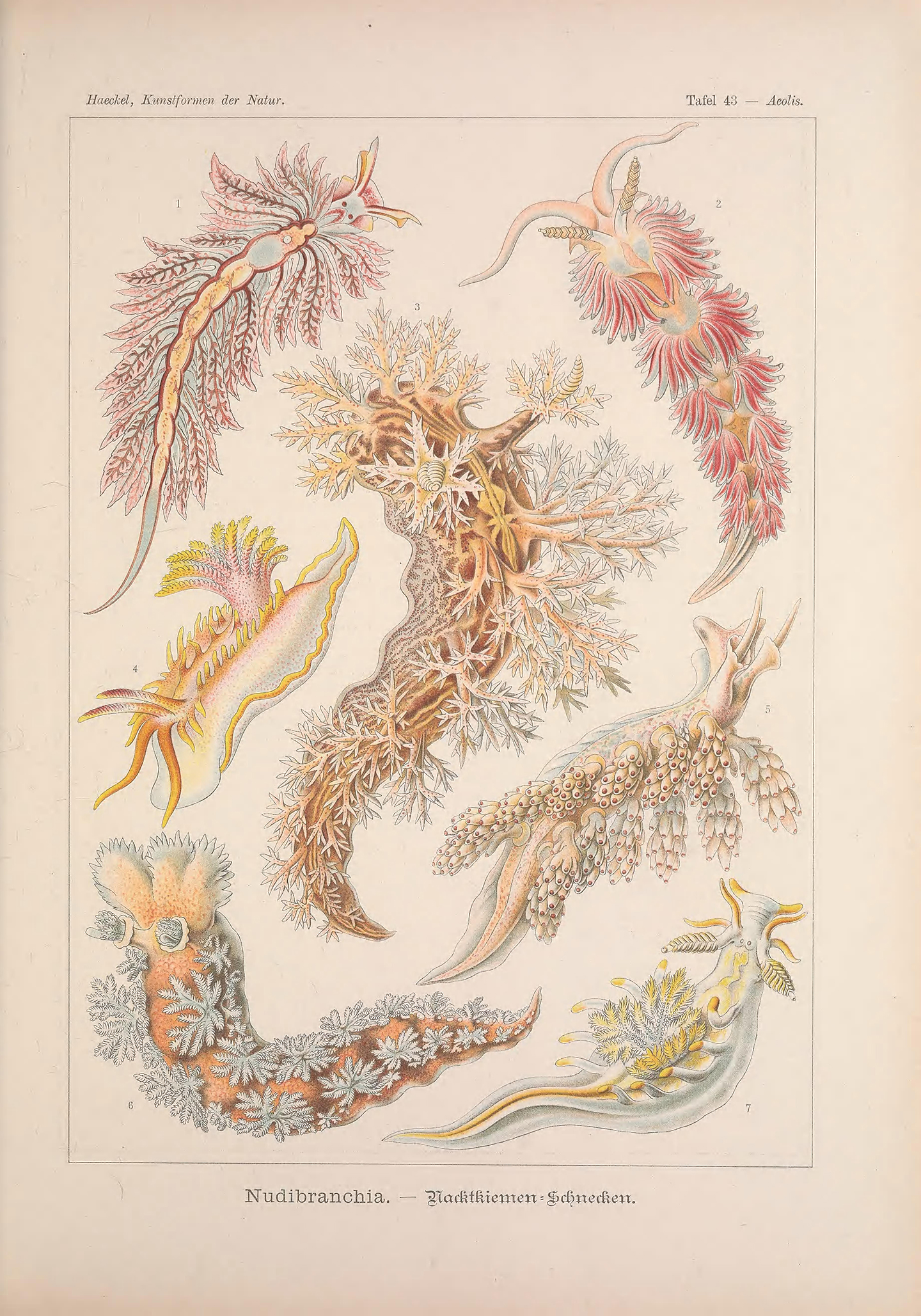
Nudibranchs by Ernst Haeckel, one of the images McElrath and his wife have printed for their “natural history wall” at home. Kunstformen der Natur. 1905. Contributed in BHL from Smithsonian Libraries.

Whether it be supporting research on clubbed beetles or as a source of beautiful home decor, the Biodiversity Heritage Library is making it easier for everyone to explore, study, and appreciate the natural world.

For McElrath, BHL has been a game-changer. In short: “Its existence is extraordinary.”

References

[1] Catalogue of Life. 2019. “Coleoptera.” Accessed 26 March 2019. http://www.catalogueoflife.org/col/browse/classification/kingdom/Animalia/phylum/Arthropoda/class/Insecta/order/Coleoptera/fossil/1/match/1.

[2] Stork, Nigel E, James McBroom, Claire Gely, and Andrew J. Hamilton. 2015. “New Approaches Narrow Global Species Estimates for Beetles, Insects, and Terrestrial Arthropods.” PNAS 112 (24) 7519-7523. Accessed 26 March 2019. https://www.pnas.org/content/112/24/7519.

[3] McElrath, Thomas, Olivia Boyd and Joseph V. McHugh. 2016. “Overview.” MonotomidGen. Accessed 26 March 2019. http://www.monotomidae.com/index.html.

April 11, 2019by Grace Costantino
BHL News, Blog Reel, Tech Updates

Changes Coming to the BHL Data Exports Files on 10 April 2019

On 10 April 2019, we will implement additions and changes to the export files available from the Biodiversity Heritage Library.

The updates involve the following:

  1. A new set of exports will be created alongside the existing exports. The new set will contain only data for material that is hosted by BHL. No externally-hosted content will be included in these files. Because these files are added in addition to the existing export files, no existing users should be affected.
  2. The BHL author Identifiers will be added to the creator.txt and partcreator.txt tab-delimited files. The format of these files will change to accommodate the additional data; the author identifier will now be the second “column” in each file. Because of this, anyone regularly harvesting from these files may be affected.

Additional detailed information about these updates will be reflected on the Data Exports: Developer and Data Tools webpage, effective 10 April 2019.

If you have questions, please feel free to submit feedback via this form.

April 3, 2019by Grace Costantino
BHL News, Blog Reel, Campaigns, Her Natural History

#HerNaturalHistory: Open Data, BHL, and Wiki Projects

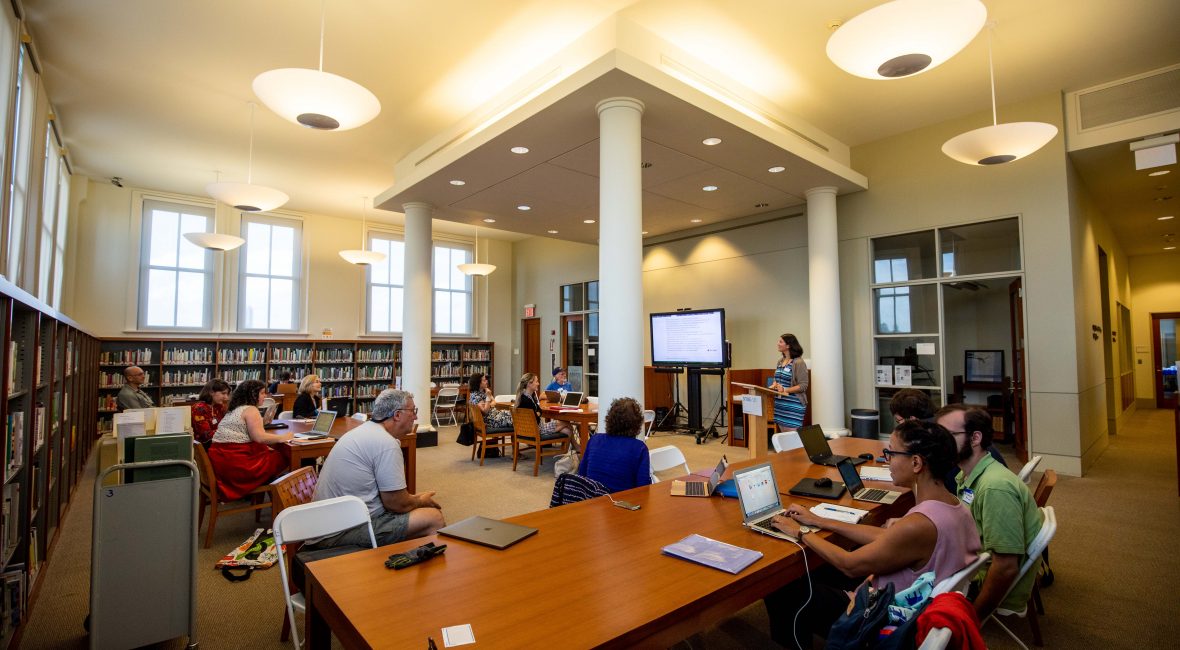
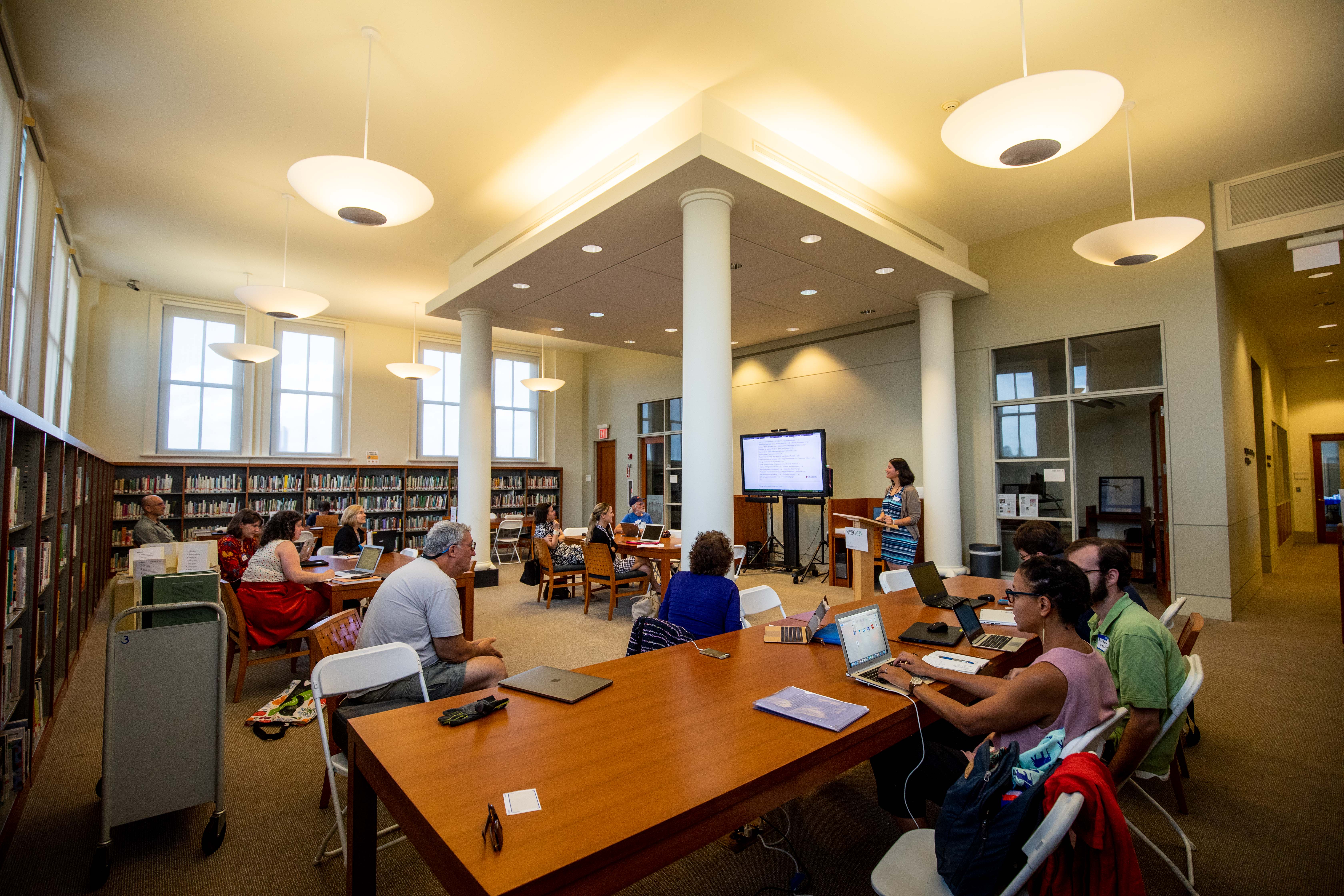
Attendees edit Wiki content at the LuEsther T. Mertz Library of the New York Botanical Garden. Photo by Marlon Co.

Wiki projects, including Wikipedia, Wikimedia Commons, and Wikidata, contain the information that powers the web. Wikipedia is the fifth most-visited website in the world. To edit a Wiki project is to contribute content that could potentially be viewed by thousands or even millions of people over time, both on Wiki sites and on sites like Google and Facebook, which harvest data, including media, from Wiki sites.

Like Wiki editors, BHL contributors are passionate about having their content accessible to and used by the most people possible. The information that we provide through BHL is intended for global audiences. We hope that the special things and unique data in our collections have a life beyond our walls and our institutions.

This similarity in missions and goals is what makes projects involving both BHL and Wiki* a great fit. To this end, for the #HerNaturalHistory campaign, the LuEsther T. Mertz Library of the New York Botanical Garden and the Smithsonian Libraries held three crowd-sourcing citizen science/citizen humanities events in March of 2019. These events were intended to bring new editors to Wiki projects, have editors add information about female scientists to Wikipedia, and have editors add information to BHL collections on Flickr and in Wikimedia Commons utilizing the Wikidata knowledge base/database/catalog.

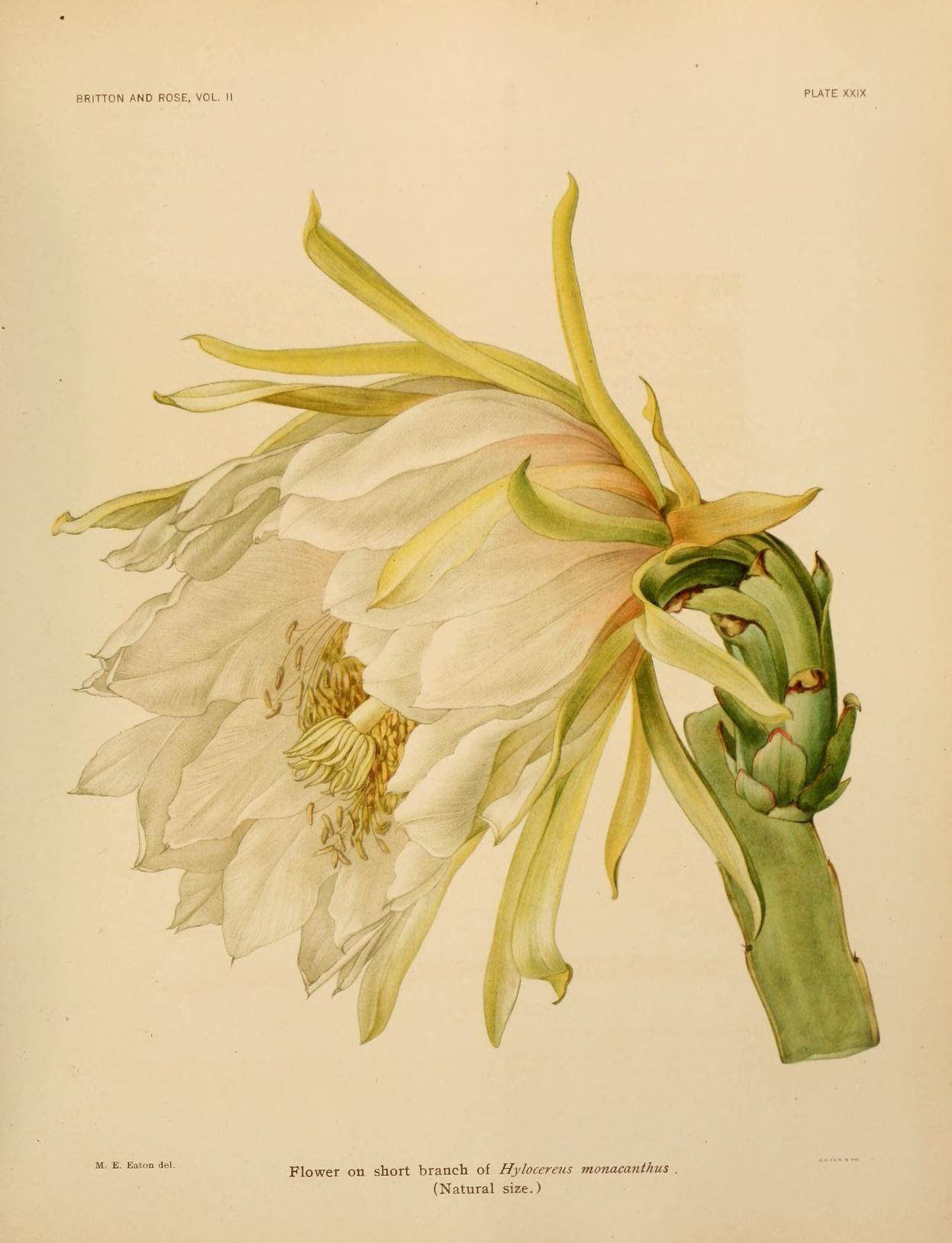
Illustration of Hylocereus monacanthus by Mary Eaton, The Cactaceae, . Contributed in BHL from The New York Botanical Garden.

At the New York Botanical Garden on 12 and 13 March, attendees had the opportunity to add data to images in Flickr, add data and categories for images in Wikimedia Commons, and add data to items in Wikidata. (The task list can be found here.) Over the span of two days, attendees edited 22 files on Flickr, adding 84 taxonomy:binomial and 34 taxonomy:common machine tags. 206 edits were made to Wikimedia Commons files, categories, and other content, adding 16,748 bytes of data and five new images to the repository. On Wikidata, four new items were created and 24 items were edited 114 times, for a total of 30,700 bytes added.

The event was offered in collaboration with Wikimedia NYC, the regional Wikimedia chapter serving the New York metropolitan area. WM NYC promotes free access to the world’s knowledge and supports Wiki projects in the greater New York City region; the attendance of WM NYC members provided the other attendees with a great deal of expertise on the finer points of Wiki projects and editing.

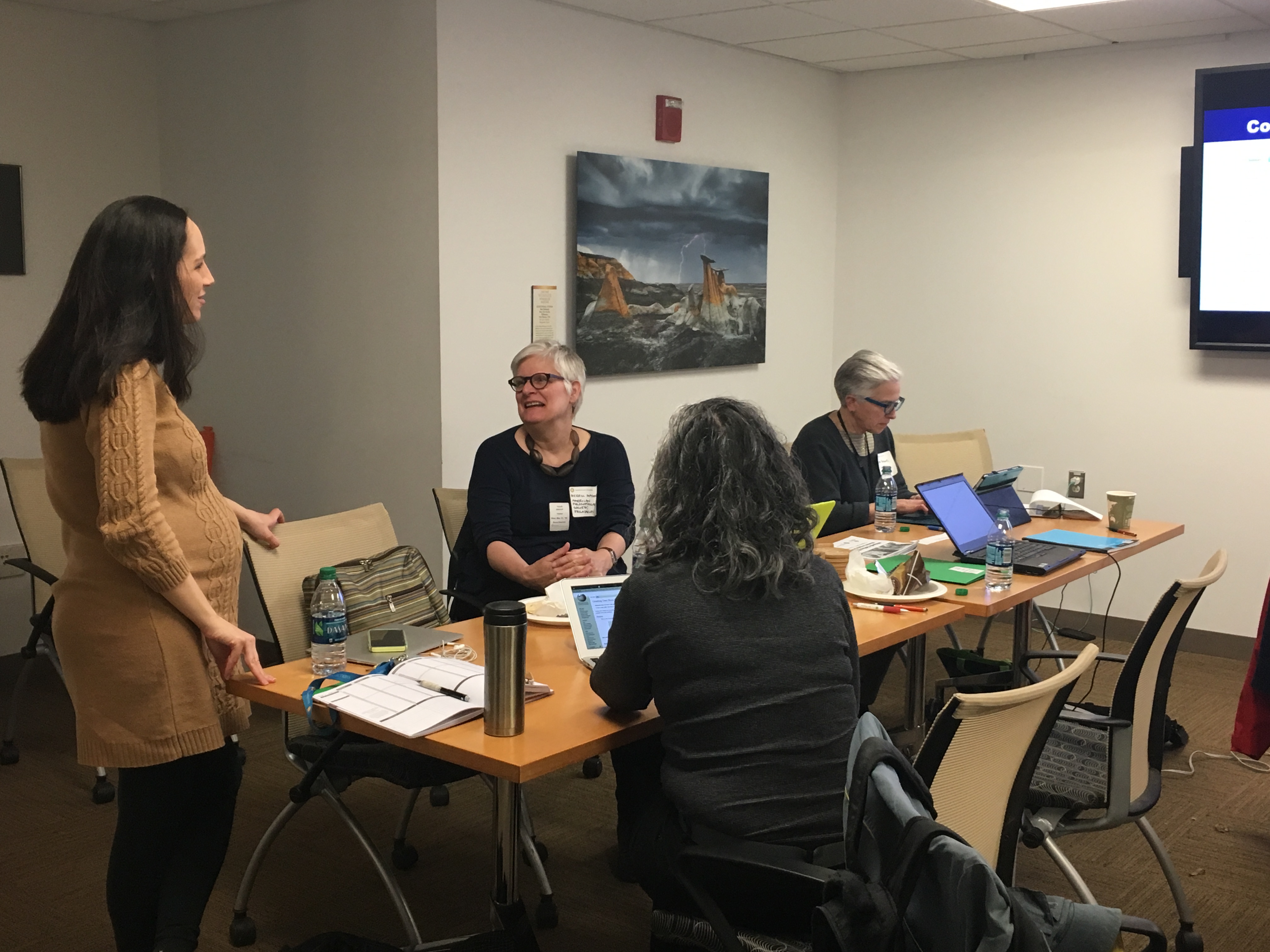
During the Smithsonian Libraries Workshop on 13 March, in-person participants at the Natural History Museum Library and virtual participants from around the world focused on editing the Wikipedia pages of female contributors to natural history using resources from BHL. Attendees focused their edits on women included in the Workshop’s Suggested Article Work List, comprised of over 100 women represented in the BHL collection. The Work List was compiled based on research and suggestions predominantly from BHL citizen scientists Michelle Marshall and Siobhan Leachman, as well as colleagues from the New York Botanical Garden, Smithsonian Institution Archives, and the BHL Cataloging Group.

Attendees editing at the Smithsonian Libraries Wikipedia Editing Workshop, hosted in the Natural History Museum Library and sponsored by Wikimedia DC. Photo by Grace Costantino.

The Smithsonian Libraries Workshop was sponsored by Wikimedia DC, with representative Ariel Cetrone facilitating the meeting. Two other representatives from Wikimedia DC, Jim Hayes and Andrew Lih, were also in attendance to provide support to participants. To facilitate virtual attendance, the Workshop was live-streamed via YouTube Live. A copy of the presentation used during the Workshop is also available online.

In total, over 70 people attended the Smithsonian Libraries Workshop, representing 20 in-person and over 50 virtual attendees. All told, as a result of the Workshop, 50 articles were edited, 5 new articles were created, and 14 images were uploaded to Wikimedia Commons, representing a total of 140 edits. Additionally, 36 new “editors” (first-time Wikipedia editors) participated in the Workshop.

The Suggested Work List will remain active indefinitely, and we welcome anyone to continue editing the Wikipedia pages for these women.

Although metrics are important, and offer a glimpse into one aspect of these events, the more impactful takeaways from these collaborations were the discussions that attendees had on topics ranging from open content, to information architecture, data storage, content curation, and more. In a sense, these crowd-sourcing edit-a-thons were a salon of sorts, where curious people who are passionate about open information were able to discuss strategies for how to make data more accessible and useful to the public, and work together to find and implement these solutions.

March 19, 2019by Grace Costantino
Blog Reel, Campaigns, Her Natural History

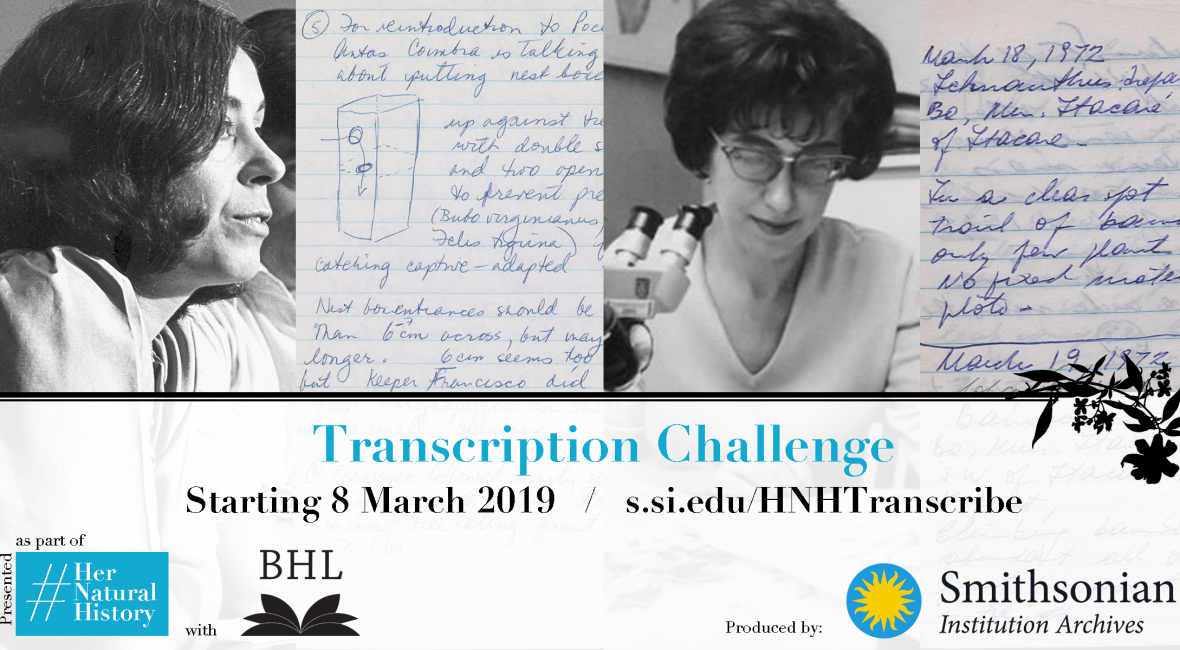
Transcribe Field Notes by Female Naturalists with the #HerNaturalHistory Transcription Challenge

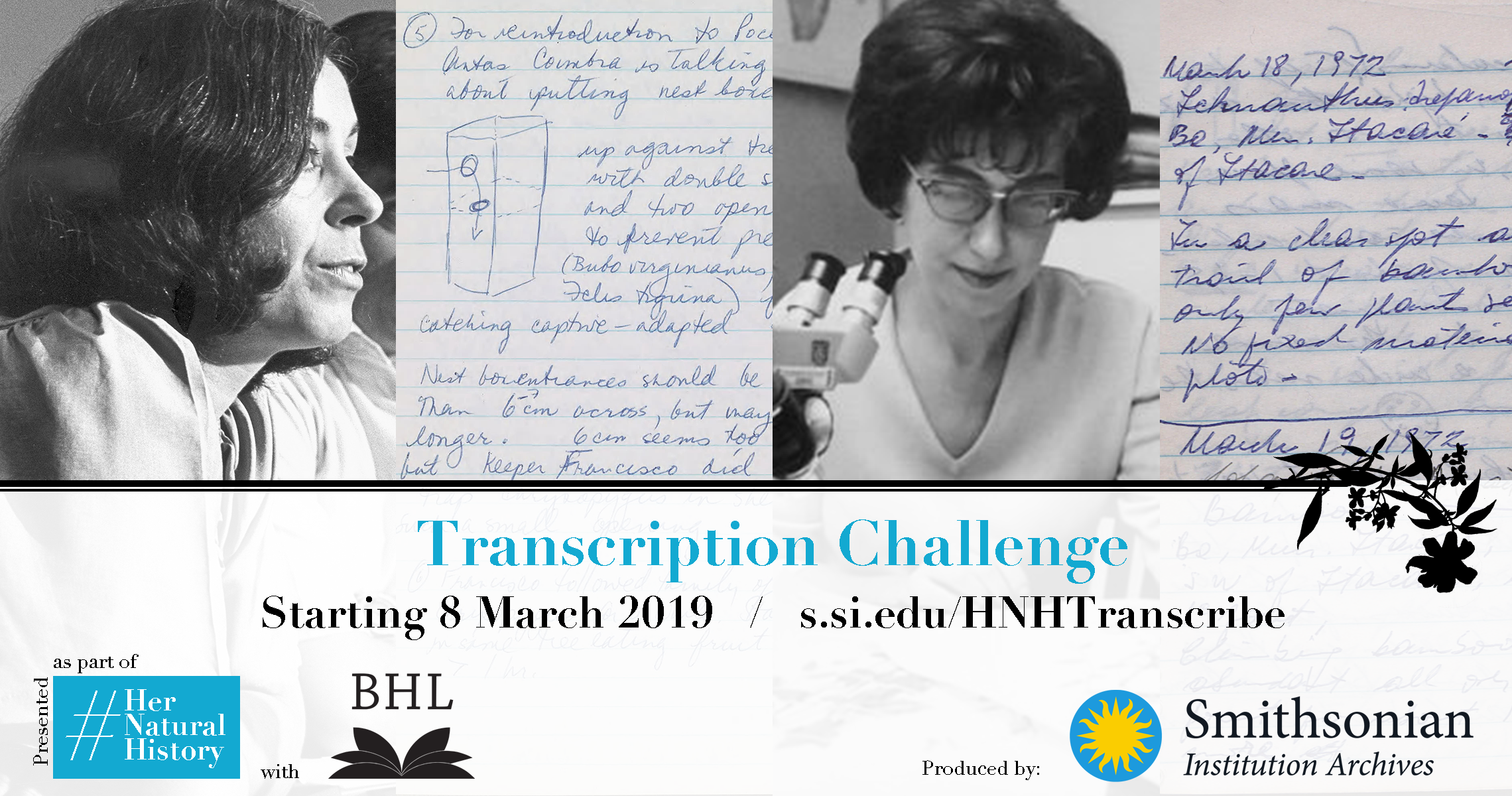
L to R: Photo of Devra Kleiman by Hirshfeld, Max, 1978, Smithsonian Archives – History Div, 94-8340; Page from Kleiman field book (Brazil notebook, 1975-1982); Photo of Cleofé E. Calderón, Smithsonian Institution Archives, SIA Acc. 11-008, Box 02, Image No. OPA-90; Page from Calderón field book (Brasil 1972, 1).

Looking for a challenge? The Smithsonian Institution Archives and the Smithsonian Transcription Center are teaming up for a #HerNaturalHistory-themed transcription challenge. Starting today (8 March), help a team of #volunpeers transcribe field notes from conservation biologist Devra Kleiman and botanist Cleofé Calderón. Dive into observations of golden lion tamarins with Kleiman, who worked at Smithsonian’s National Zoological Park from 1972 to 2001. And head to South America with Calderón to collect grasses for Smithsonian’s Department of Botany.

When? Starting TODAY, 8 March 2019
Where? Smithsonian Transcription Center. The field notes are available on the Smithsonian Institution Archives project page.

The Smithsonian Institution Archives has launched 11 field books on the Smithsonian Transcription Center. Throughout the month, additional field books will be added as others are completed. Our goal is to fully transcribe 18 field books in total (9 from each woman) by the end of March.

These transcriptions will also make the corresponding digitized field books in the Biodiversity Heritage Library more discoverable, as they can be uploaded in place of the automatically-generated OCR text in BHL to allow the field books to be full-text searchable. This will make it easier for researchers and the public to explore these valuable primary source materials and access specific information from their pages.

We hope you’ll join our #HerNaturalHistory transcription challenge to help improve access to and discoverability of the primary research of two female naturalists. Continue reading to learn more about Kleiman and Calderón.

This challenge is presented as part of the #HerNaturalHistory campaign — an international social media campaign produced in collaboration with BHL partners to celebrate women in natural history. Visit the Her Natural History webpage to learn more about this and other events and programming occurring all month long.

Devra Kleiman

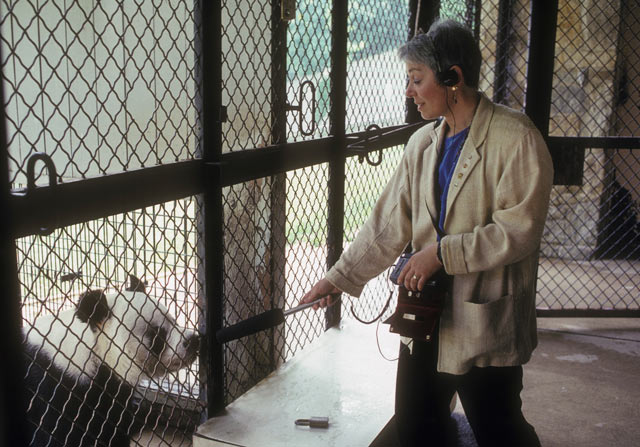
Giant Panda researcher Devra Kleiman records Hsing-Hsing’s vocalizations during breeding season, 1991, by Jessie Cohen, C-type print, National Zoo, Image ID: 614-95JC.

Conservation biologist Devra G. Kleiman (1942-2010) was the first female scientist at the National Zoological Park (NZP). She was hired by NZP in 1972 to manage the zoo’s captive breeding program. Much of her research focused on the captive breeding of giant pandas and the reintroduction of golden lion tamarins to the wild. Over her career at the zoo, she served as Assistant Director for Animal Programs, Assistant Director of Zoological Research and Education, Assistant Director of Research, Assistant Director of Zoological Research, and Senior Scientist. She authored approximately 150 manuscripts and two books.[1]

Smithsonian Institution Archives holds a large collection of archival materials documenting Kleiman’s research and professional activities. Many of her field books have been digitized in the Biodiversity Heritage Library as part of the Smithsonian Field Book Project.

Cleofé Calderón

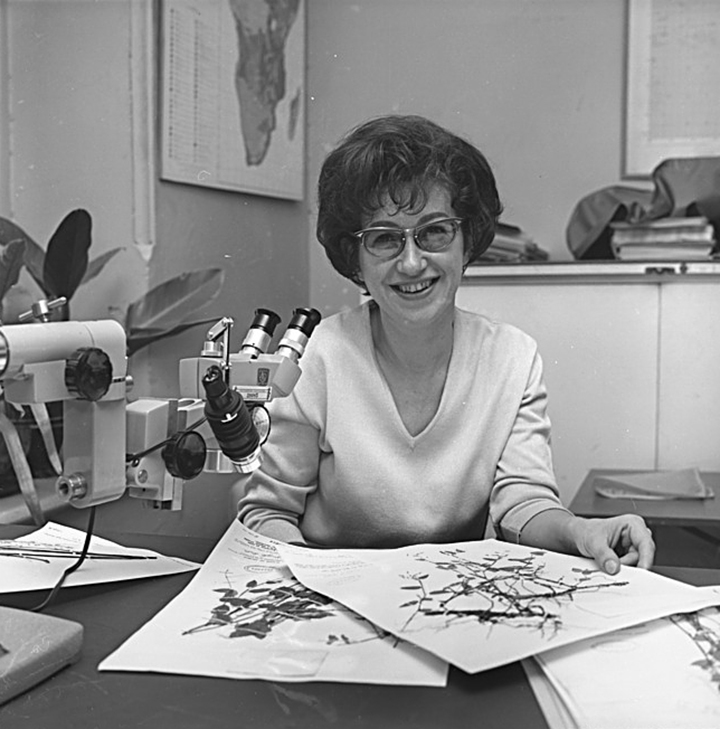
Visiting Argentine botanist Cleo Calderón with plant specimens and microscope. 1965.
From 120mm black and white negative. Smithsonian Institution Archives, SIA Acc. 11-008, Box 02, Image No. OPA-90.

Botanist Cleofé Calderón (1929-2007), born in Buenos Aires, Argentina, studied with renowned agrostologist Prof. Ing. Lorenzo Parodi at the University of Buenos Aires. She was introduced to Dr. Thomas R. Soderstrom, Curator of Grasses in the Department of Botany at the U.S. National Herbarium at the Smithsonian, during a trip to Washington, D.C. in 1961-62. The two began a close collaboration, and Calderón became a prominent botanist specializing in bamboo. With support from the Smithsonian, the Office of Scientific Affairs of the Organization of American States, and the National Geographic Society, Calderón conducted extensive field work in Central and South America, collecting plant specimens in Panama, Costa Rica, Ecuador, Colombia, and Brazil between 1966 and 1982. One of her most significant finds was the “re-discovery” of Anomochloa marantoidea, a small species of bamboo last seen in the late 1840s.[2]

Smithsonian Institution Archives holds a collection of field books documenting Calderón’s botanical research in Brazil, Panama, and Colombia between 1967 and 1981. Many of these have been digitized in the Biodiversity Heritage Library as part of the Smithsonian Field Book Project.

References

[1] Smithsonian Institution Archives. 2018. “Kleiman, Devra G.” Finding Aid, November 5. Accessed on February 28, 2019. https://siarchives.si.edu/collections/siris_arc_302446.

[2] Smithsonian Institution Archives. 2019. “Calderón, Cleofé E.” Collections. Accessed on February 28, 2019. https://siarchives.si.edu/collections/auth_per_fbr_eacp248.

March 8, 2019by Grace Costantino
BHL News, Blog Reel, Campaigns, Her Natural History

Her Natural History: A Celebration of Women in Natural History

Her Natural History
Her Natural History

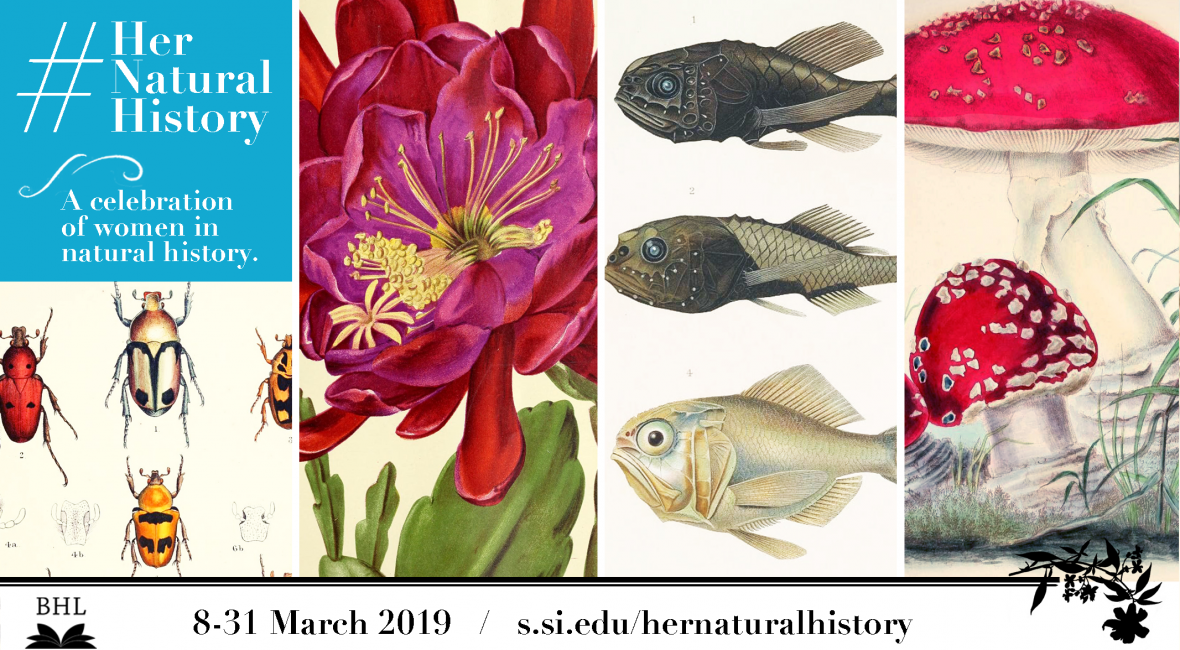
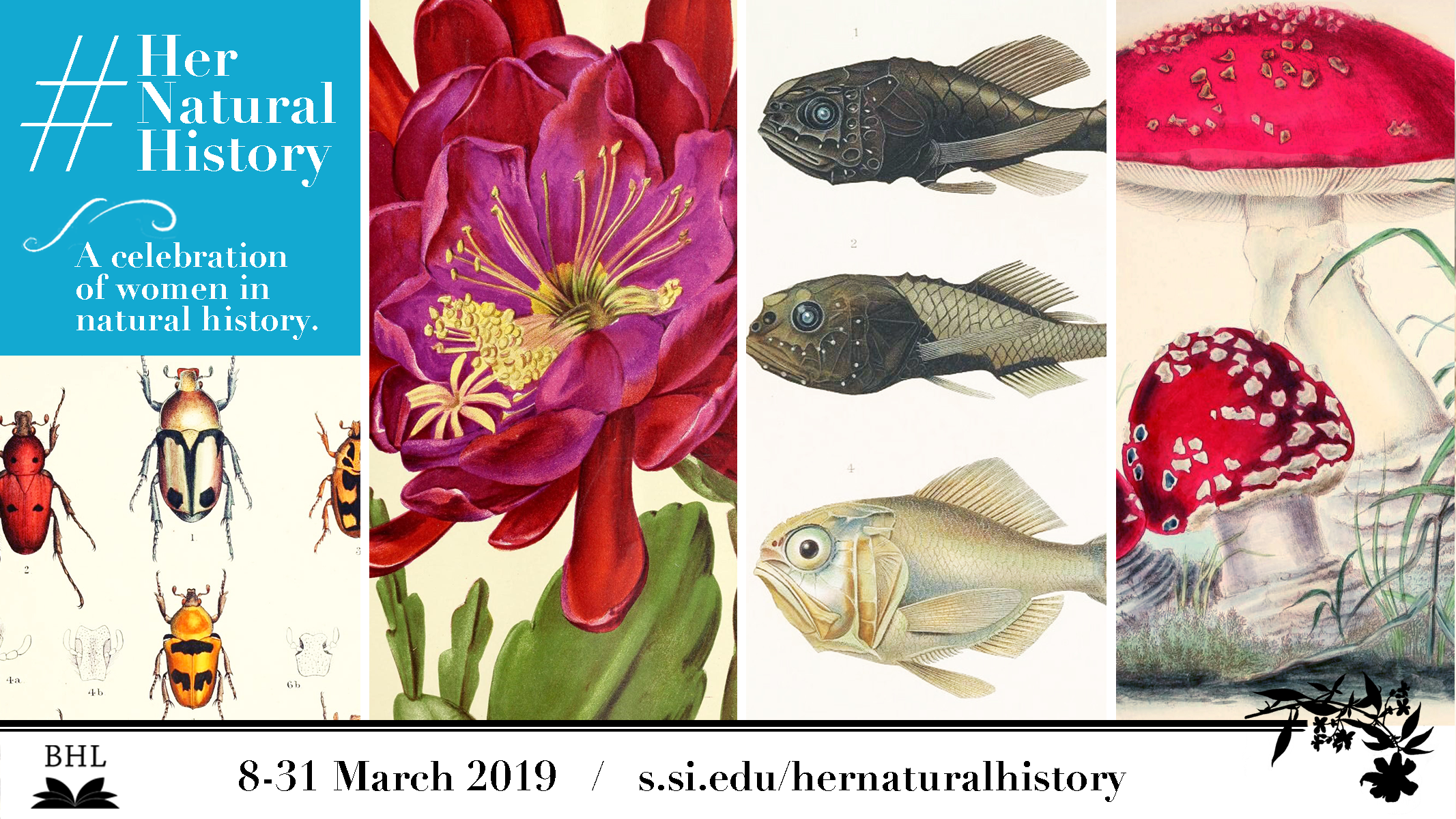
Illustrations in this graphic by female scientific illustrators. Left to right: Maud Horman Fisher (Aid to the Identification of Insects, v. 2, 1882-90); Louise-Cécile Descamps-Sabouret (Revue Horticole, 1899); Emma Kissling (Poissons provenant des campagnes du yacht Princesse-Alice, 1911); Frances Reed (Illustrations of British mycology, ser. 1, 1847).

Women have made remarkable contributions to biodiversity research. From collecting specimens and serving as scientific illustrators to conducting and publishing research, authoring natural history books, and more, women have overcome many social and cultural obstacles and gender barriers to help further our understanding of the natural world. While the work of many remained unacknowledged or under-appreciated during their lifetimes, mounting initiatives to encourage and support women in the sciences have facilitated a growing recognition of the achievements of women in natural history — both past and present.

This Women’s History Month, we are excited to recognize and celebrate the contributions of women to natural history through an international social media campaign produced in collaboration with our partners — Her Natural History: A Celebration of Women in Natural History.

Kicking-off with an all-day social media blitz today, 8 March 2019 (International Women’s Day,) and continuing throughout the month, Her Natural History aims to increase awareness of and information about women in the biodiversity sciences.

Join the campaign by following #HerNaturalHistory on social media (Twitter, Facebook, and Instagram) and using the hashtag to share stories, collections, publications, artworks, archival materials, exhibits, and other resources highlighting women and their contributions to natural history. #HerNaturalHistory is also the #LibrariesOfInstagram challenge topic for March.

In addition to social media posts, BHL and our partners will be producing a series of blog posts, Facebook Live events, and citizen science opportunities throughout the month. We’ll also be highlighting women in the BHL collection with our Women in Natural History Book and Female Illustrators Flickr Collections, featuring publications, archival materials, and illustrations by female naturalists and artists.

Learn more about women in natural history and explore our campaign content and programming in the sections below. Visit the Her Natural History webpage for more information. We look forward to celebrating #HerNaturalHistory with you this month!

Her Natural History: Campaign Content and Programming


Social Media and Blog Posts

  • Follow and join the campaign on Twitter, Facebook, and Instagram using #HerNaturalHistory.
  • #HerNaturalHistory is also the #LibrariesOfInstagram challenge topic for March.
  • Follow the campaign feed on the BHL blog to explore women in natural history in depth with posts contributed by our global partners.

Women in Natural History Book and Image Collections

  • Explore publications and archival materials by female naturalists in BHL’s Women in Natural History Book Collection.
  • Enjoy biodiversity illustrations by female artists in BHL’s Flickr Collection.
  • Color a selection of these illustrations with our free Female Illustrators in Natural History coloring book.

Facebook Live Events

Facebook Live: Maria Martin.
Presented by Field Museum.
Join Chief Curiosity Correspondent Emily Graslie in the Rare Books Room at the Field Museum with Field Librarians Gretchen Rings and Diana Duncan to explore the work of Maria Martin, one of the background painters for Audubon’s Bird’s of America.
When? Friday, 8 March 2019 at 11:00am ET
Where? Event Recording

A Curious Herbal Facebook Live.
Presented by Oak Spring Garden Foundation.
Go behind-the-scenes at Oak Spring Garden Library to explore Elizabeth Blackwell’s groundbreaking illustrated work on medical plants, A Curious Herbal. The Library has several printed editions of the work as well as 73 of the original manuscript paintings Blackwell did for the book.
When? Friday, 8 March 2019 at 2:00pm ET
Where? Event Recording

NYBG #HerNaturalHistory Live.
Presented by The New York Botanical Garden.
Get a behind-the-scenes look at some original botanical art, herbarium specimens, published works, manuscripts, and photographs by women in the natural sciences when The New York Botanical Garden goes behind-the-scenes in their Library & Herbarium.
When? Tuesday, 12 March 2019 at 12:30pm ET
Where? Event Recording

The Art & Life of Elizabeth Gould.
Presented by Smithsonian Libraries.
Get a behind-the-scenes look at the Natural History Rare Book Library at the Smithsonian Libraries as staff explore a selection of works by natural history illustrator Elizabeth Gould.
When? Friday, 22 March 2019 at 1:00pm ET
Where? Event Recording

NYBG’s #HerNaturalHistory in the Lab.
Presented by The New York Botanical Garden.
Join NYBG staff on Facebook to explore the work of some of the women scientists who devoted their lives to the study of plants. Viewers will have the chance to see scientific tools, microscope slides, preserved specimens, and published works shared in the Biodiversity Heritage Library by these outstanding women in botany.
When? Thursday, 28 March 2019 at 12:30pm ET
Where? Event Recording

Maria Sibylla Merian Facebook Live.
Presented by Oak Spring Garden Foundation.
April 2nd is 17th Century artist and naturalist Maria Sibylla Merian’s birthday! Join the Oak Spring Garden Library by Facebook Live for a talk with Merian scholar Kay Etheridge about Merian’s work, influences, and the intersection of art and science.
When? Tuesday, 2 April 2019 at 1pm ET
Where? Event Recording

Citizen Science Opportunities

Women in Natural History Wikipedia Editing Workshop
Join us for the Women in Natural History Wikipedia Editing Workshop hosted by the Biodiversity Heritage Library and Smithsonian Libraries with support from Wikimedia DC. With the help of experienced Wikipedians, attendees will learn to edit Wikipedia and improve or create Wikipedia articles related to women in natural history, drawing on the Biodiversity Heritage Library’s free and extensive online collections as source materials. No editing experience is necessary.

When? 13 March 2019, 10am – 2pm ET
Where? In-person at Smithsonian Libraries (National Museum of Natural History Library, Washington, D.C.) and remotely

Registration Required:

  • Register to attend in-person
  • Register to attend remotely

More Information: Wikipedia Event Page

Attending in person? Laptops are required. Please bring your own. Wikimedia has two laptops to loan. Reserve one by emailing [email protected]. This event is free and open to the public, but space is limited, so register today. Lunch will be provided.

Attending remotely? There will be an option to participate in the editing workshop remotely. For remote participants, the workshop will be live-streamed via YouTube Live here: https://s.si.edu/NHWomenWikiLive. Be sure to register to attend remotely

Transcription Challenge
Looking for a challenge? The Smithsonian Institution Archives and the Smithsonian Transcription Center are teaming up for a #HerNaturalHistory-themed transcription challenge. Beginning on 8 March, help a team of #volunpeers transcribe field notes from conservation biologist Devra Kleiman and botanist Cleofé Calderón. Dive into observations of golden lion tamarins with Kleiman, who worked at Smithsonian’s National Zoological Park from 1972 to 2001. And head to South America with Calderón to collect grasses for Smithsonian’s Department of Botany.

  • When? Beginning 8 March 2019
  • Where? Smithsonian Transcription Center. The field notes will be released on the Smithsonian Institution Archives project page.

Citizen Science at The New York Botanical Garden
The New York Botanical Garden will be hosting two citizen science events around #HerNaturalHistory.

  • #HerNaturalHistory Flickr Workshop
    • When? 12 March, 2-4pm ET
    • Where? The LuEsther T. Mertz Library of the New York Botanical Garden
    • What? Would you like to make information about female artists and scientific illustrators more open and accessible to the world? Come to this workshop in the NYBG Library to transcribe text from illustrations that the Mertz Library has contributed to the Biodiversity Heritage Library’s collection.
    • RSVP here
  • #HerNaturalHistory — Editing Wikidata and Wikimedia Commons
    • When? 13 March, 11am-5pm ET
    • Where? The LuEsther T. Mertz Library of the New York Botanical Garden
    • What? Help create and enhance information in Wikidata and Wikimedia Commons related to the theme of Women in Natural History.
    • More information

References

Data USA. 2016. “Gender Composition.” Biological Scientists. Accessed on 12 February 2019. https://datausa.io/profile/soc/191020/#demographics.

Hart, Andrea. 2014. Images of Nature: Women Artists. London: Natural History Museum.

International Day of Women and Girls in Science. 2019. “About.” https://womeninscienceday.org/WISID_WP/about/.

S. L. Eddy, S. E. Brownell, M. P. Wenderoth. Gender Gaps in Achievement and Participation in Multiple Introductory Biology Classrooms. Cell Biology Education, 2014; 13 (3): 478 DOI: 10.1187/cbe.13-10-0204

Yong, Ed. 2019. The Women Who Contributed to Science but Were Buried in Footnotes. The Atlantic, February 11. Accessed on 12 February 2019. https://www.theatlantic.com/science/archive/2019/02/womens-history-in-science-hidden-footnotes/582472/.

March 8, 2019by Grace Costantino
Blog Reel, Campaigns, Her Natural History

Happy Women’s History Month! Join Us For #HerNaturalHistory Starting 8 March 2019

Her Natural History
Her Natural History

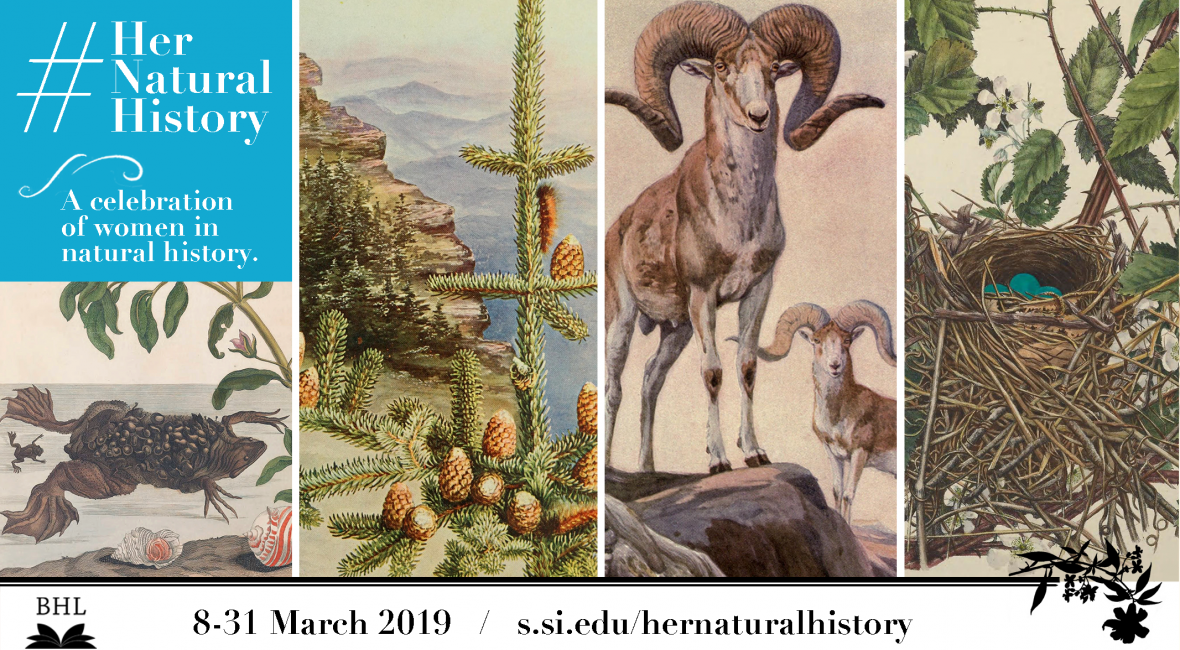
Illustrations in this graphic created by female artists who will be featured during #HerNaturalHistory. L to R: Maria Sibylla Merian, Metamorphosis insectorum surinamensium (1705); Marian Ellis Rowan, Southern Wild Flowers and Trees (1901); Winifred Austen, The Wild Beasts of the World, v. 2 (1909); Virginia Smith Jones, Illustrations of the Nests and Eggs of Birds of Ohio, v. 1 (1886). Illustrations digitized by Smithsonian Libraries, University of Toronto, and North Carolina State University Libraries.

March is Women’s History Month, and we’re celebrating with an international social media campaign produced in collaboration with our partners highlighting women and their contributions to natural history — Her Natural History: A Celebration of Women in Natural History.

Kicking-off with an all-day social media blitz on Friday, 8 March 2019 (International Women’s Day) and continuing throughout the month, Her Natural History aims to increase awareness of and information about women in the biodiversity sciences.

Women have made remarkable contributions to biodiversity research. From collecting specimens and serving as scientific illustrators to conducting and publishing research, authoring natural history books, and more, women have overcome many social and cultural obstacles and gender barriers to help further our understanding of the natural world.

As part of the campaign, we’ll be highlighting women in the BHL collection with our Women in Natural History Book and Female Illustrators Flickr Collections, featuring publications, archival materials, and illustrations by female naturalists and artists. We’ll be sharing these collections and the stories of the women who created them through our blog and on social media using the hashtag #HerNaturalHistory. You can color a selection of illustrations by female artists from BHL’s collection with our free coloring book. #HerNaturalHistory is also the #LibrariesOfInstagram challenge topic for March.

Additionally, there will be citizen science opportunities (including a Wikipedia Editing Workshop and transcription challenge) and a series of Facebook Live events from BHL partners throughout the month. See the sections below for more information about these activities.

We hope you’ll join us for the social media blitz on Friday (8 March) and throughout the month by following #HerNaturalHistory on Twitter, Facebook, and Instagram and using the hashtag to share stories, collections, publications, artworks, archival materials, exhibits, and other resources highlighting women and their contributions to natural history.

Learn more about the campaign on the Her Natural History webpage.

Her Natural History: A Celebration of Women in Natural History

When? 8-31 March, 2019
Where? Social Media (Twitter, Facebook, Instagram)
What? Join us in celebrating women in natural history this Women’s History Month! Follow along and join the campaign using #HerNaturalHistory.
More Information: s.si.edu/hernaturalhistory

Her Natural History Facebook Live Events

Facebook Live: Maria Martin.
Presented by Field Museum.
Join Chief Curiosity Correspondent Emily Graslie in the Rare Books Room at the Field Museum with Field Librarians Gretchen Rings and Diana Duncan to explore the work of Maria Martin, one of the background painters for Audubon’s Bird’s of America.
When? Friday, 8 March 2019 at 11:00am ET
Where? https://www.facebook.com/fieldmuseum

A Curious Herbal Facebook Live.
Presented by Oak Spring Garden Foundation.
Go behind-the-scenes at Oak Spring Garden Library to explore Elizabeth Blackwell’s groundbreaking illustrated work on medical plants, A Curious Herbal. The Library has several printed editions of the work as well as 73 of the original manuscript paintings Blackwell did for the book.
When? Friday, 8 March 2019 at 2:00pm ET
Where? https://www.facebook.com/OakSpringGardenFoundation

NYBG #HerNaturalHistory Live.
Presented by The New York Botanical Garden.
Get a behind-the-scenes look at some original botanical art, herbarium specimens, published works, manuscripts, and photographs by women in the natural sciences when The New York Botanical Garden goes behind-the-scenes in their Library & Herbarium.
When? Tuesday, 12 March 2019 at 12:30pm ET
Where? https://www.facebook.com/NYBotanicalGarden/

The Art & Life of Elizabeth Gould.
Presented by Smithsonian Libraries.
Get a behind-the-scenes look at the Natural History Rare Book Library at the Smithsonian Libraries as staff explore a selection of works by natural history illustrator Elizabeth Gould.
When? Friday, 22 March 2019 at 1:00pm ET
Where? https://www.facebook.com/SmithsonianLibraries

Her Natural History Citizen Science Opportunities

Women in Natural History Wikipedia Editing Workshop
Join us for the Women in Natural History Wikipedia Editing Workshop hosted by the Biodiversity Heritage Library and Smithsonian Libraries with support from Wikimedia DC. With the help of experienced Wikipedians, attendees will learn to edit Wikipedia and improve or create Wikipedia articles related to women in natural history, drawing on the Biodiversity Heritage Library’s free and extensive online collections as source materials. No editing experience is necessary.

When? 13 March 2019, 10am – 2pm ET
Where? In-person at Smithsonian Libraries (Washington, D.C.) and remotely via s.si.edu/NHWomenWikiLive
More Information: Wikipedia event page

Registration is Required:

  • Register to attend in-person
  • Register to attend remotely

Attending in person? Laptops are required. Please bring your own. Wikimedia has two laptops to loan. Reserve one by emailing [email protected]. This event is free and open to the public, but space is limited, so register today. Lunch will be provided.

Attending remotely? There will be an option to participate in the editing workshop remotely. For remote participants, the workshop will be live-streamed via YouTube Live here: https://s.si.edu/NHWomenWikiLive. Be sure to register to attend remotely

Transcription Challenge
Looking for a challenge? The Smithsonian Institution Archives and the Smithsonian Transcription Center are teaming up for a #HerNaturalHistory-themed transcription challenge. Beginning on 8 March, help a team of #volunpeers transcribe field notes from conservation biologist Devra Kleiman and botanist Cleofé Calderón. Dive into observations of golden lion tamarins with Kleiman, who worked at Smithsonian’s National Zoological Park from 1972 to 2001. And head to South America with Calderón to collect grasses for Smithsonian’s Department of Botany.

  • When? Beginning 8 March 2019
  • Where? Smithsonian Transcription Center. The field notes will be released on the Smithsonian Institution Archives project page.
March 1, 2019by Grace Costantino
Page 9 of 71« First...«891011»203040...Last »

Help Support BHL

BHL's existence depends on the financial support of its patrons. Help us keep this free resource alive!

search

About BHL

The Biodiversity Heritage Library (BHL) is the world’s largest open access digital library for biodiversity literature and archives. BHL operates as a worldwide consortium of natural history, botanical, research, and national libraries working together to digitize the natural history literature held in their collections and make it freely available for open access as part of a global “biodiversity community.”

Join Our Mailing List

Sign up to receive the latest news, content highlights, and promotions.

Subscribe Now

Subscribe to Blog via Email

Enter your email address to subscribe to this blog and receive notifications of new posts by email.

Join 319 other subscribers

Subscribe to Blog Via RSS

Subscribe to the blog RSS feed to stay up-to-date on all the latest BHL posts.

Access RSS Feed

Inspiring Discovery through Free Access to Biodiversity Knowledge.

The Biodiversity Heritage Library makes it easier than ever for you to access the information you need to study and explore life on Earth…for free, anytime, anywhere.


64+ Million Pages of
Biodiversity Literature Online.

EXPLORE

Tools and Services
to Transform Research.

EXPLORE

300,000+
Illustrations on Flickr.

EXPLORE

ABOUT | HARMFUL CONTENT | PRIVACY | SITE MAP | TERMS OF USE