Biodiversity Heritage Library - Program news and collection highlights from BHL
  • Home
  • News
  • Featured Books
    • All Featured Books
    • Book of the Month Series
    • BHL at 20
  • User Stories
  • Campaigns
    • Fossil Stories
    • Garden Stories
    • Monsters Are Real
    • Page Frights
    • Her Natural History
    • Earth Optimism 2020
  • Tech Blog
  • Visit BHL
Home
News
Featured Books
    All Featured Books
    Book of the Month Series
    BHL at 20
User Stories
Campaigns
    Fossil Stories
    Garden Stories
    Monsters Are Real
    Page Frights
    Her Natural History
    Earth Optimism 2020
Tech Blog
Visit BHL
  • Home
  • News
  • Featured Books
    • All Featured Books
    • Book of the Month Series
    • BHL at 20
  • User Stories
  • Campaigns
    • Fossil Stories
    • Garden Stories
    • Monsters Are Real
    • Page Frights
    • Her Natural History
    • Earth Optimism 2020
  • Tech Blog
  • Visit BHL
Biodiversity Heritage Library - Program news and collection highlights from BHL
Blog Reel, User Stories

Sharks and More: Discovering Animals in the Sixteenth Century and Today

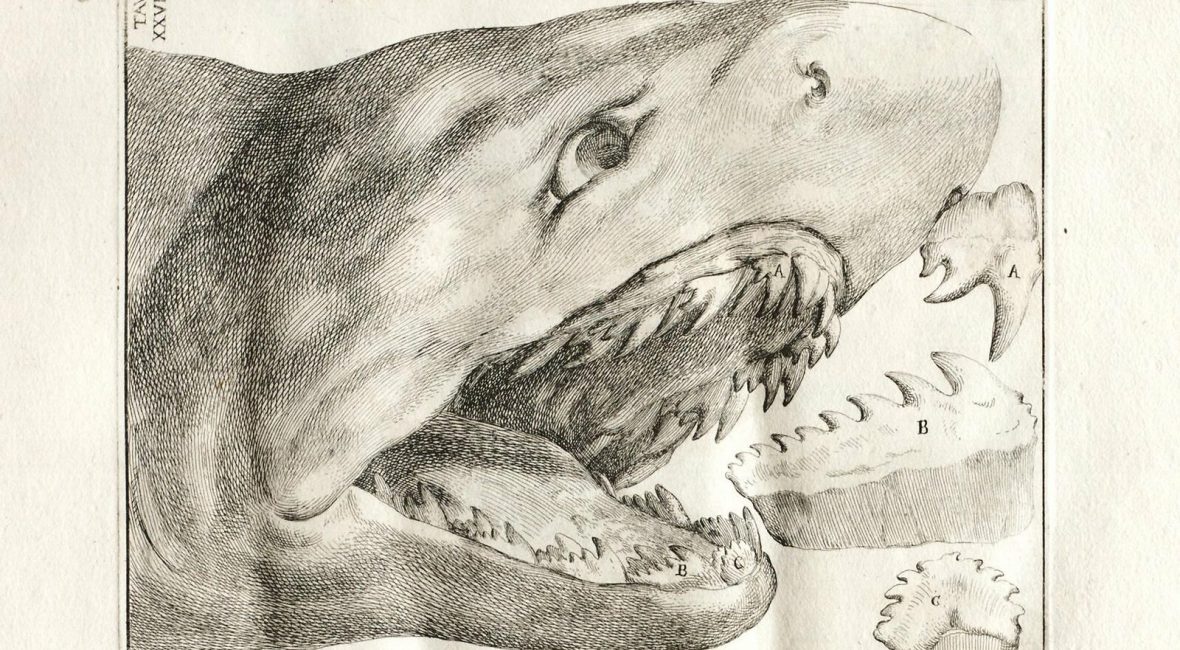
Illustration of a shark

Each year, audiences around the world are gripped with “shark mania”. Since its premier in 1988, the annual Shark Week celebrations have resulted in countless hours of programming devoted to all things sharks.

During Shark Week 2017, Vox posted a story with a video explaining why you don’t see Great White Sharks in aquariums. At the end (beginning 5:17), video co-creator Joss Fong highlighted the Biodiversity Heritage Library (BHL) as a “great resource” for historic literature on biodiversity — and gave a shout-out to BHL’s Flickr collection: “Sharks, Skates & Rays!”. The collection includes illustrations dating back to the sixteenth and seventeenth centuries.

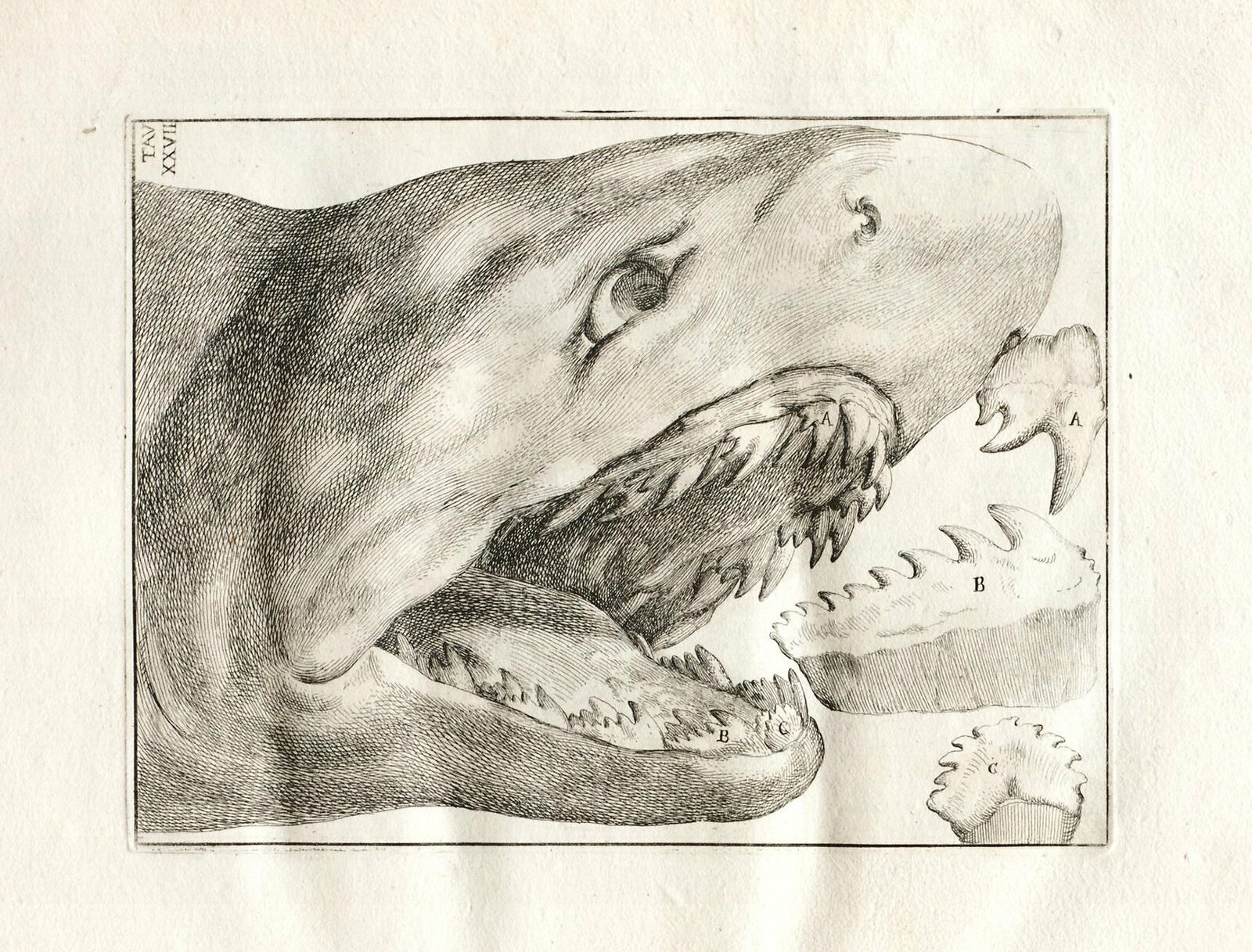
Illustration of a shark

Illustration from the Sharks, Skates & Rays! Flickr collection. Scilla, Agostino. De corporibus marinis lapidescentibus quæ defossa reperiuntur. 1752. Contributed in BHL from the United States Geological Survey Libraries Program.

Danielle Alesi, a PhD candidate at the University of Nebraska-Lincoln (UNL), stumbled upon the video one night last summer while taking a break from studying for her comprehensive exams. She was introduced to BHL for the first time.

That serendipitous discovery had a profound impact on her research, which focuses on early modern European and Atlantic world history with an interest in animal studies.

“I was overcome by excitement, realizing that much of the research I required for my dissertation was digitized on the site,” recalls Alesi. “The moment still stands out as one of my ‘breakthrough’ moments early in the dissertation writing process.”

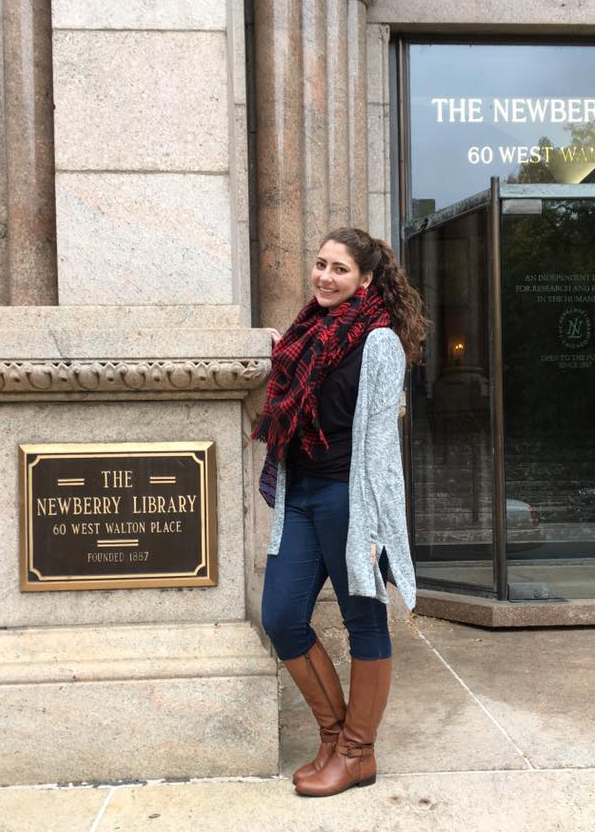
Photograph of a woman standing in front of a glass door.

Danielle Alesi, PhD candidate at the University of Nebraska-Lincoln (UNL).

Alesi is currently entering the fourth year of her PhD program at UNL. Her dissertation explores the interactions of sixteenth- and seventeenth-century European travelers with the people and animals of the Americas. BHL has been a valuable source of information on these encounters.

“BHL is an amazing resource that scholars from many fields are lucky to have available to us,” praises Alesi. “It allows me to access many of the travel narratives and early accounts of animals native to the Americas that I am using in my research. Since I am located in Nebraska and generally have a full teaching schedule, this is an excellent resource that allows me to see many of my sources without having to travel to a library that holds them.”

Alesi generally uses BHL weekly, downloading PDFs of these early narratives to print and translate as needed. The availability of multiple editions of titles in BHL is particularly useful, allowing Alesi to compare changes to the texts over time.

“I love that I can search for authors or texts, see multiple editions, and download a full scan of a book that includes paratexts and marginalia, which is better than other digital library services,” lauds Alesi. “BHL allows me to do much of my research at home without having to travel to various libraries throughout the country or the world.”

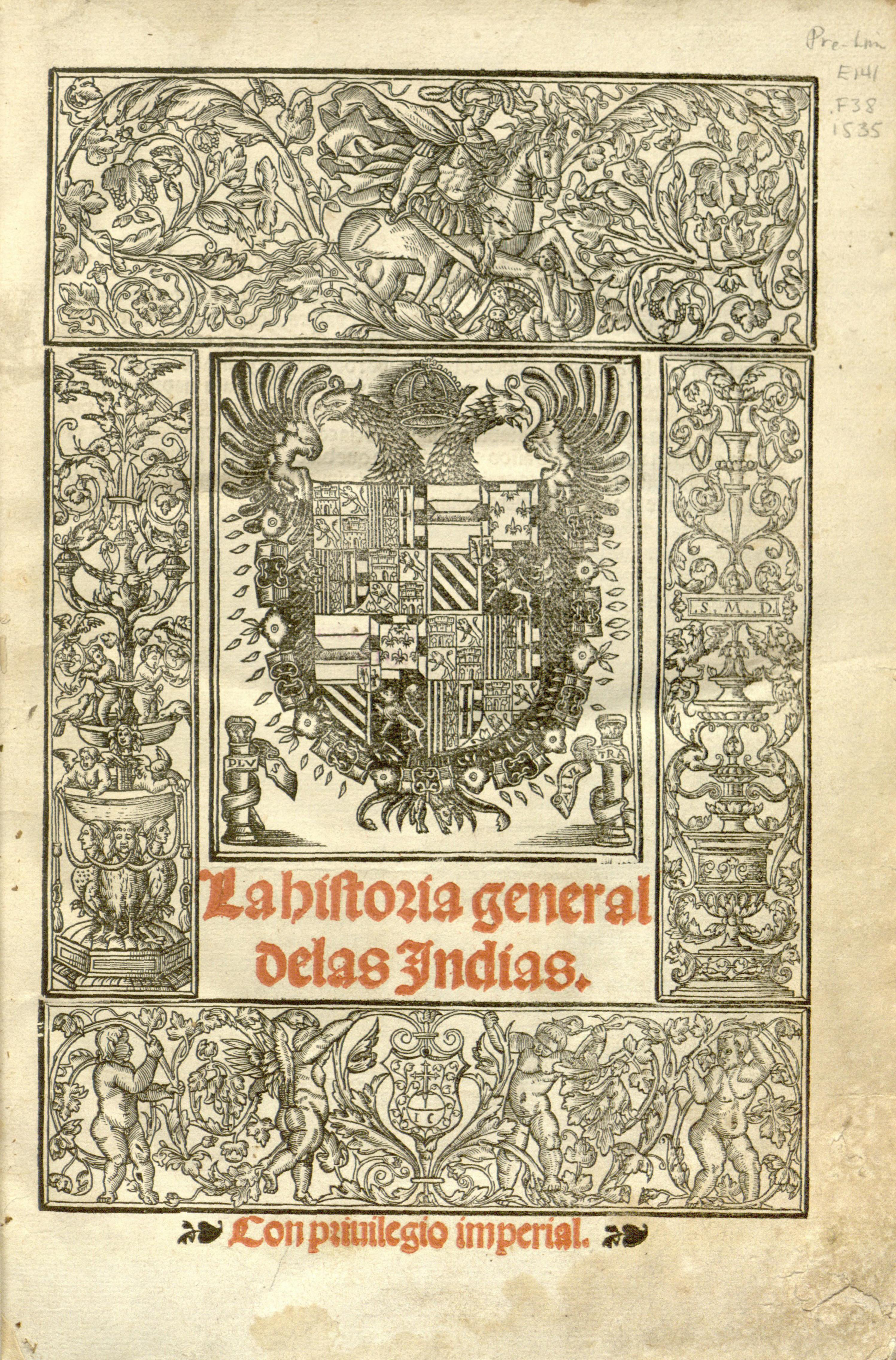
Currently, Alesi’s favorite book in BHL is Gonzalo Fernandez de Oviedo’s La Historia General Y Natural De Las Indias (1535, complete work published posthumously 1851–55). Within it, Spanish captain Oviedo provides a wealth of valuable descriptions of the animals and natural environments that he encountered on his travels.

“Oviedo spends much of his narrative describing the new animals and trying to compare them to, or reconcile them with, animals Europeans would already recognize,” explains Alesi. “This text also influenced many of the writers in Europe that wanted to publish on the ‘New World’ but had not gone there themselves.”

Illustrated title page of "Historia general de las Indias"

Title page of 1535 edition. Fernández de Oviedo y Valdés, Gonzalo. Historia general de las Indias. Contributed in BHL from Missouri Botanical Garden, Peter H. Raven Library.

Whether it be sixteenth century travel narratives by Spanish explorers or early depictions of “sea dogs” (i.e. sharks), BHL is a treasure trove of historic (and modern!) biodiversity literature for a wide array of researchers, from scientists to historians, educators, archivists, and beyond.

Of course, the real moral of this story is, don’t be afraid to take a break for sharks. You never know where it might lead you.

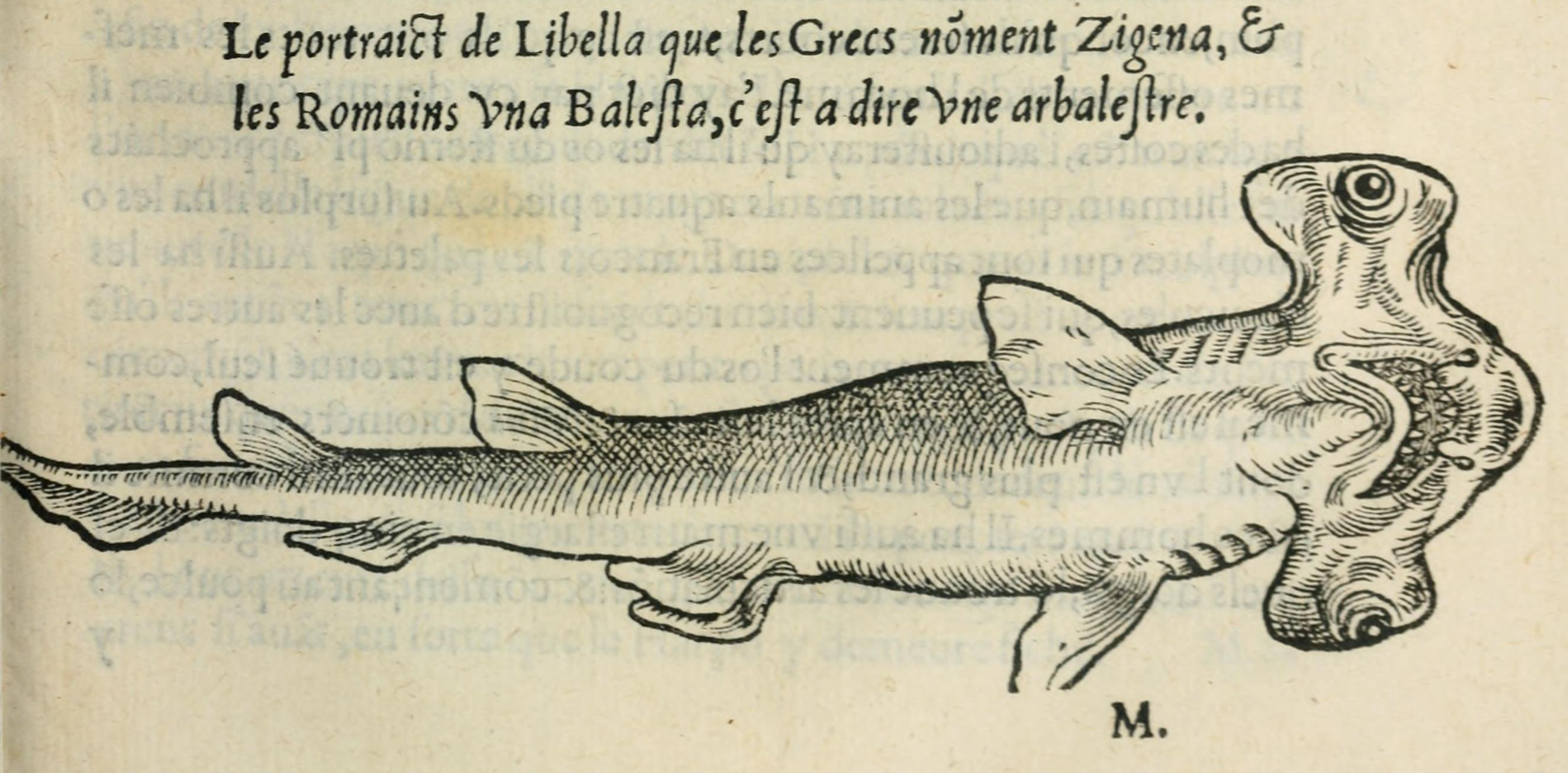
Illustration of a hammerhead shark.

Hammerhead shark. Belon, Pierre. L’histoire naturelle des estranges poissons marins. 1551. Contributed in BHL from University of Toronto – Thomas Fisher Rare Book Library.

July 11, 2019by Grace Costantino
BHL News, Blog Reel

We’ve Expanded the BHL FAQ!

BHL FAQ now expanded

BHL FAQ now expanded

We’ve expanded the BHL FAQ, providing answers to the most common questions we receive from our users. For example…

Do you need help searching BHL? There’s an FAQ for that.

Do you want to know how to download content from BHL? The FAQ has you covered.

Wondering if you can reuse material from BHL? Learn more about reuse in our FAQ.

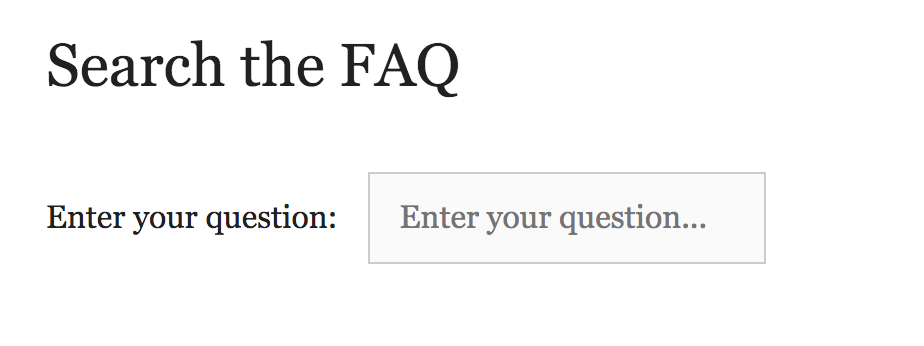
The FAQ is the best place to find answers to your questions about BHL, our collection, and our services. The best way to find an answer for a specific question is to use the FAQ search box. You can also browse by topics using the FAQ categories (e.g. Download, Search, Scientific Names, etc.).

Search box for the BHL FAQ.

Use the FAQ search box to find an answer to a specific question.

The week of 15 July 2019, we’ll be updating the BHL website to replace the links to our Feedback form with links to the FAQ. BHL is voluntarily staffed by our Partner Libraries, and we are limited in our ability to personally respond to individual feedback submitted by our patrons. We encourage you to consult the FAQ first if you need help and to find answers to your questions. We will continue to expand this resource over time. The FAQ also provides information on how to contact us if needed.

Thank you for using the FAQ as your first stop for any BHL-related questions!

July 8, 2019by Grace Costantino
BHL News, Blog Reel, Tech Updates

BHL Adds New, Easier Article Download Feature

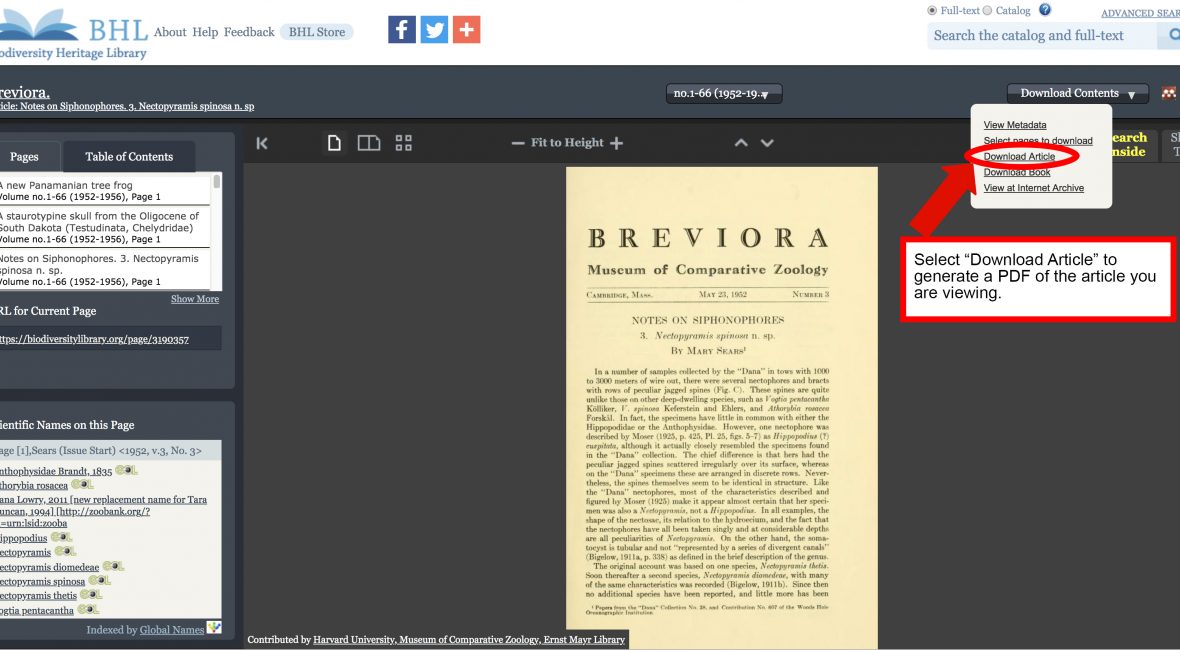
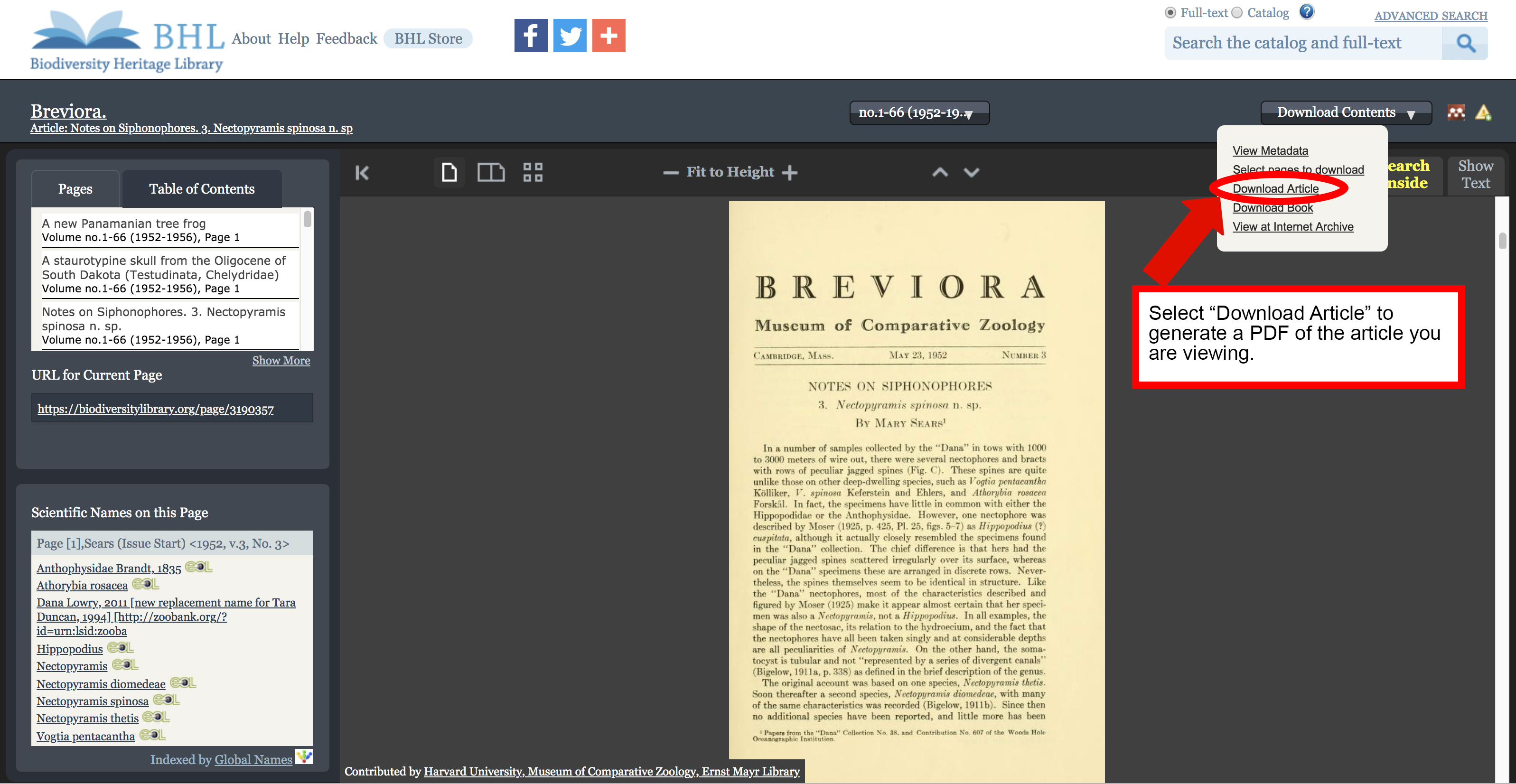
Screenshot of the book viewer in the Biodiversity Heritage Library with the "download article" option highlighted in the download contents menu.

We’ve added functionality to the BHL book viewer that makes it easier to generate a PDF for an article.

When you are viewing an article that has been defined in BHL, you can now quickly and easily generate a PDF of that article using our new “Download Article” option in the “Download Contents” dropdown menu.

Screenshot of the book viewer in the Biodiversity Heritage Library with the "download article" option highlighted in the download contents menu.

“Download Article” option in the “Download Contents” dropdown menu.

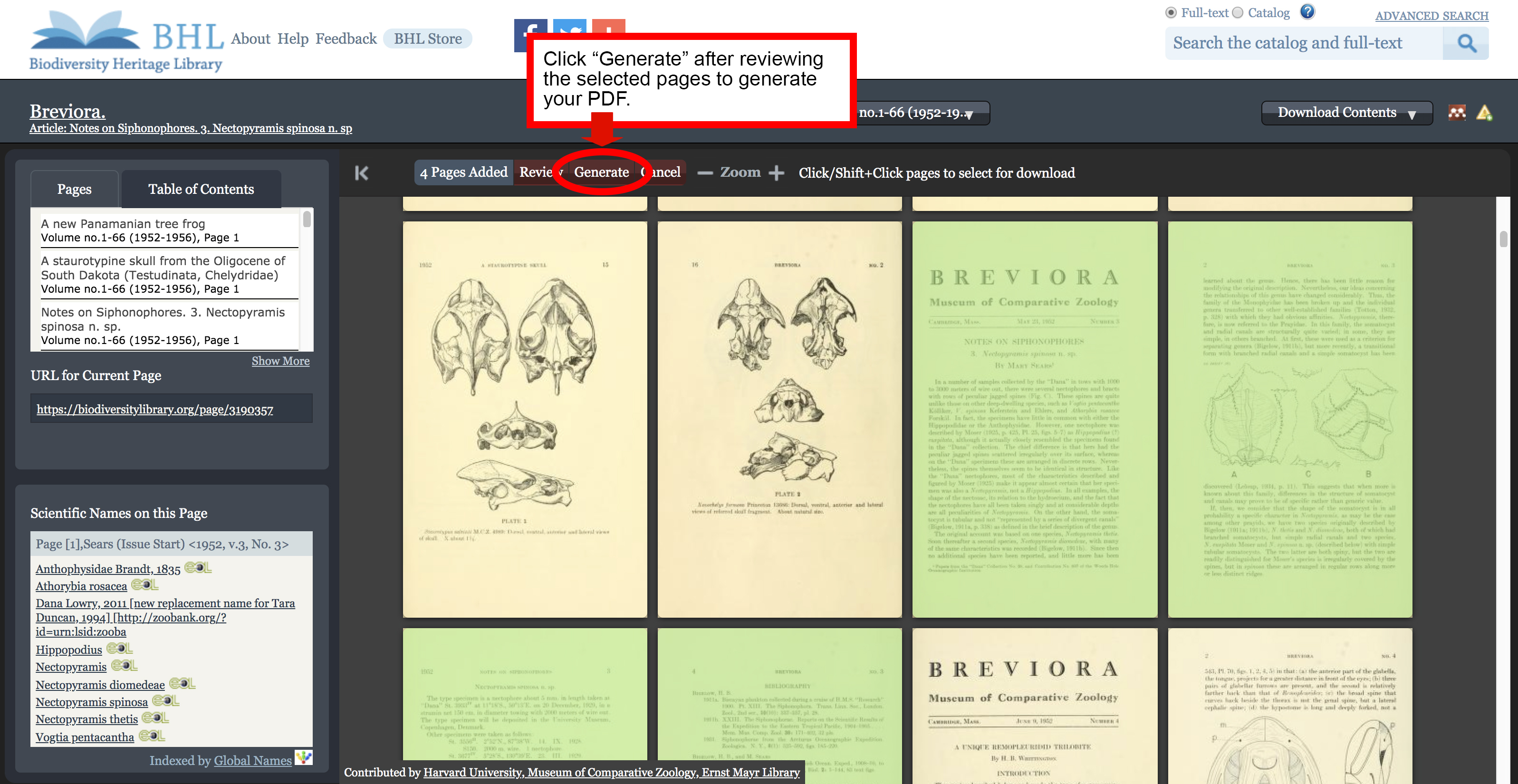
Selecting the “Download Article” option will launch BHL’s custom PDF generation functionality, with all pages in the article pre-selected. Be sure to review the selected pages to ensure all relevant pages are highlighted. Select additional pages or unselect unwanted pages by clicking on the page images. Once your selection is finalized, click “generate” to complete the process.

Screenshot of the book viewer in the Biodiversity Heritage Library with the "generate" button in the PDF selection process highlighted.

The pages of your article will be pre-selected. Review to ensure all desired pages are included.

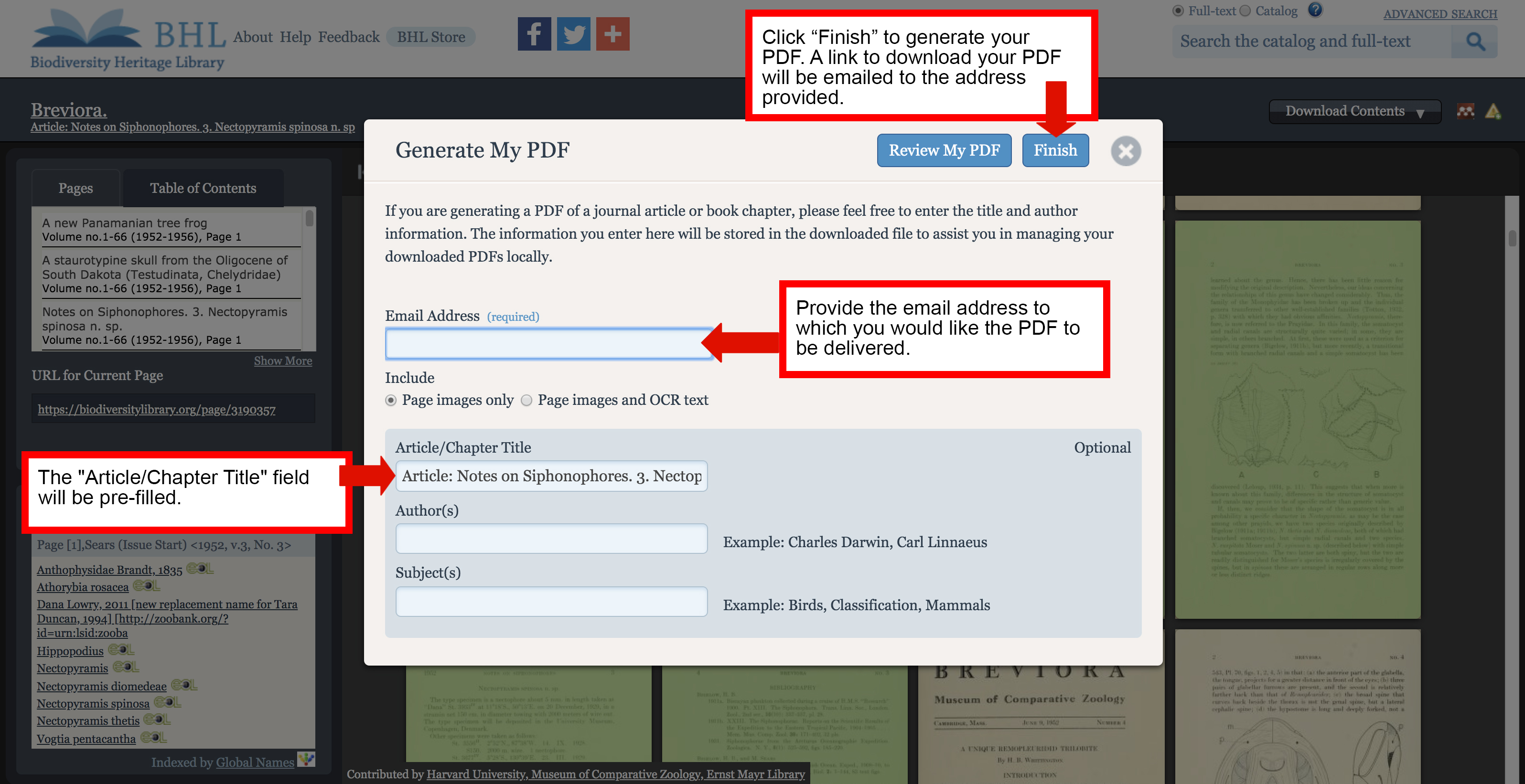
The “Generate My PDF” screen will appear, with the “Article/Chapter Title” field pre-filled. Provide the email address to which you would like the PDF to be delivered and click “Finish”. A link to download your PDF will be emailed to the address provided.

Screenshot of the "generate PDF" form in the Biodiversity Heritage Library book viewer.

A link to download your PDF will be emailed to the address provided in the “Generate My PDF” form.

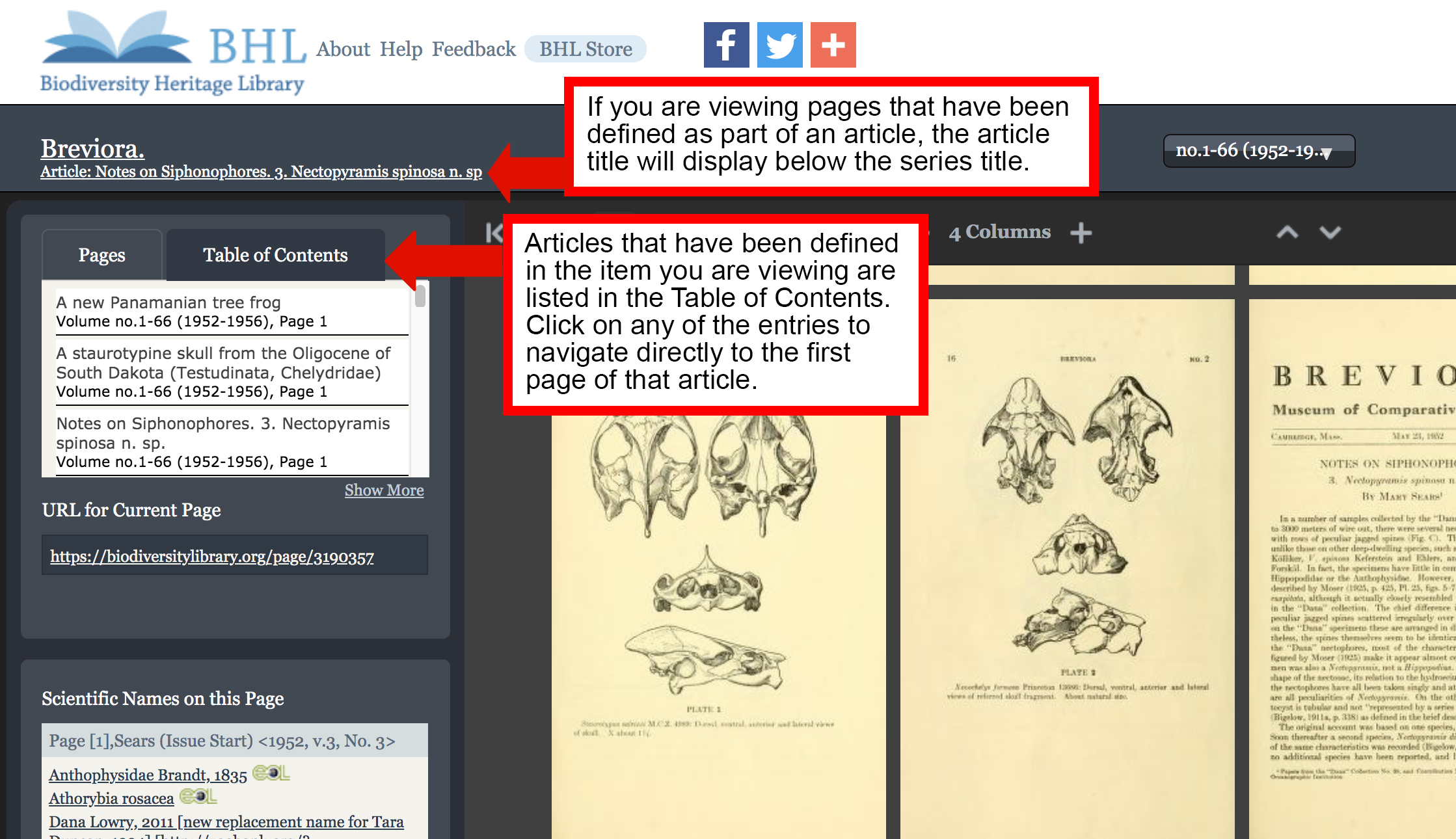
The “Download Article” option will only be available if you are viewing content that has been defined as part of an article. Articles that have been defined for the item you are viewing are listed in the Table of Contents in the book viewer. Click on any of the entries to navigate directly to the first page of that article. If you are viewing pages that have been defined as part of an article, the article title will display below the series title in the book viewer.

Screenshot of the book viewer in the Biodiversity Heritage Library with the table of contents and article title features highlighted.

Use the Table of Contents to navigate to articles defined in the book you are viewing. If you are viewing pages that have been defined as part of an article, the article title will display below the series title in the book viewer.

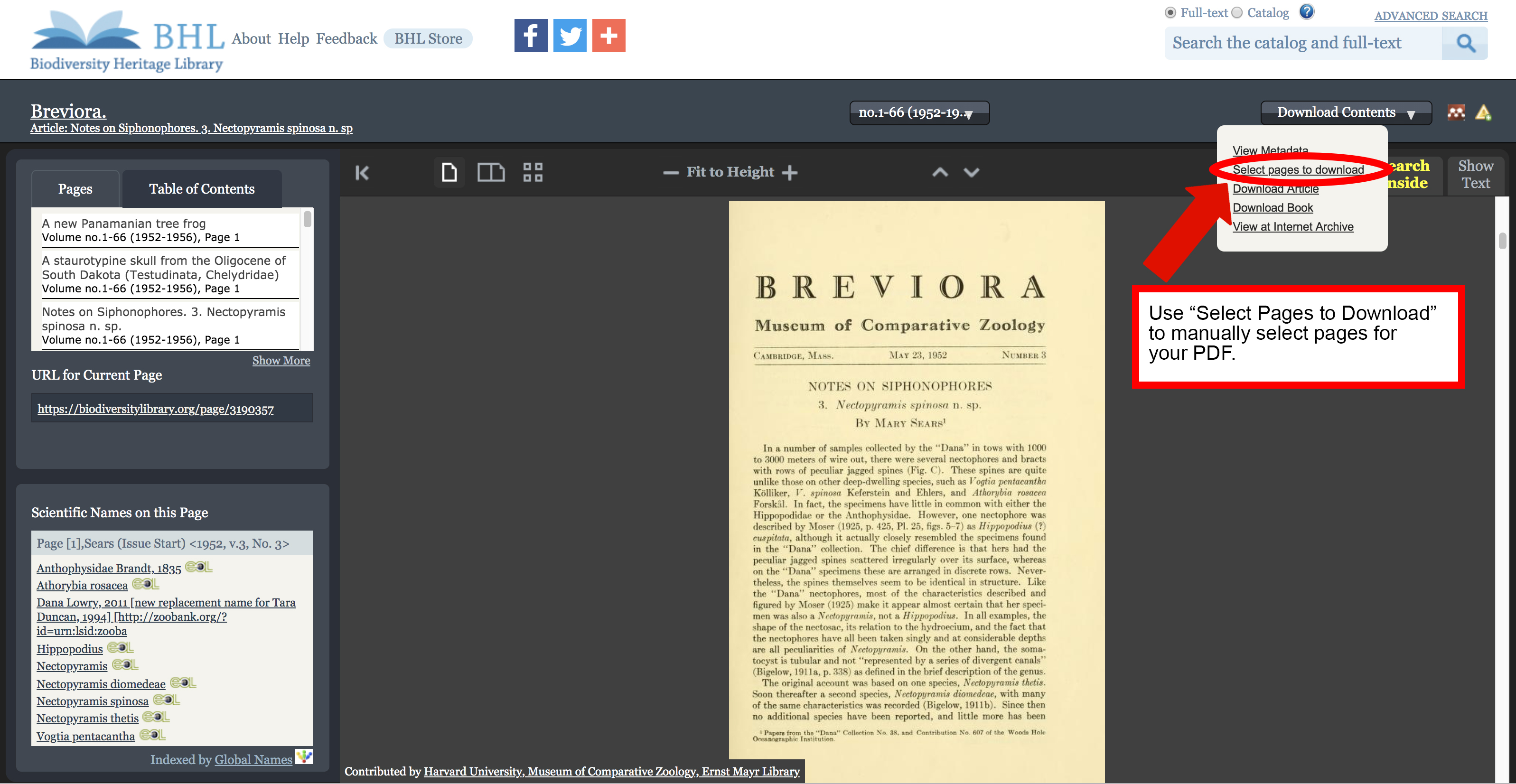
Please note that defining articles in BHL is an ongoing process, and not all articles in the Library have been indexed. If the article you need has not yet been indexed, you can still use our “Select Pages to Download” feature to manually select the article pages and generate a PDF. Learn more about the “Select Pages to Download” feature in our FAQ.

Screenshot of the book viewer in the Biodiversity Heritage Library with the "select pages to download" option highlighted in the "download contents" menu.

Use the “Select Pages to Download” feature if “Download Article” is not available.

June 20, 2019by Grace Costantino
Blog Reel, Campaigns, Earth Optimism 2020, User Stories

BHL: A Window into the Past, Present, and Future of Caribbean Mammals

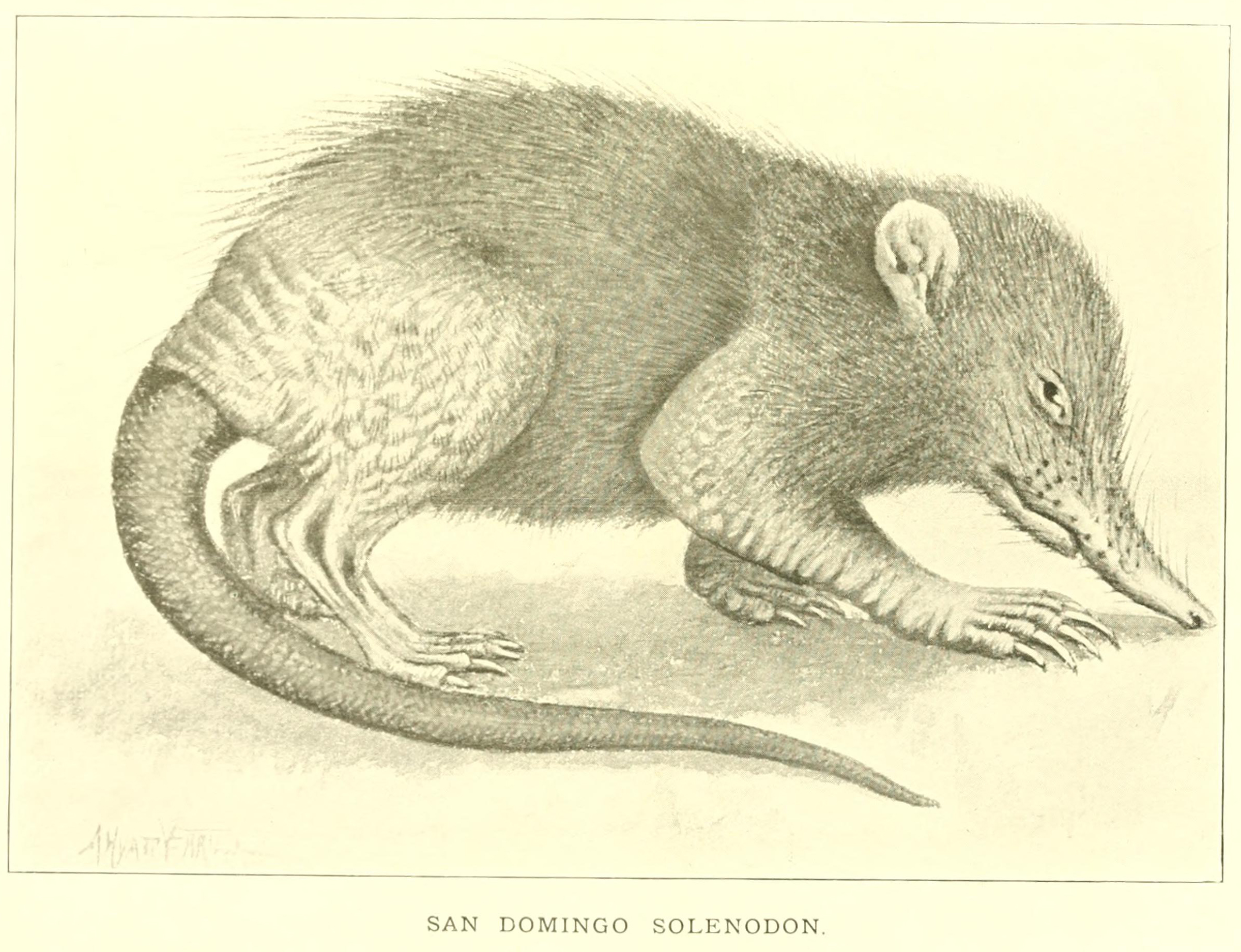
Illustration of the Hispaniolan solenodon (Solenodon paradoxus).

Hispaniolan solenodon (Solenodon paradoxus). Illustration from “XIII. Notes on the habits and external characters of the Solenodon of San Domingo (Solenodon paradoxus)” by Alpheus Hyatt. The Annals and Magazine of Natural History. Ser. 7, v. 20 (1907). Contributed in BHL from Smithsonian Libraries.

The Hispaniolan solenodon is a unique, and at first glance somewhat peculiar, animal. Even its scientific name conveys the unusualness of the species — Solenodon paradoxus.

One of two extant solenodon species (the other being the Cuban solenodon), the Hispaniolan solenodon is found only in Haiti and the Dominican Republic. It, like its Cuban counterpart, is endangered.

As members of the mammalian Order Eulipotyphla, which includes insectivores such as shrews, hedgehogs, and moles, solenodons diverged from all other living mammals over 70 million years ago. They are only found in the Caribbean, making them an important priority for the conservation of evolutionary diversity. This long history means that they have survived countless extinction events and only today are threatened.

Dr. Alexis Mychajliw (Postdoctoral Research Fellow at the La Brea Tar Pits & Museum of the Natural History Museum of Los Angeles County) has been studying the Hispaniolan solenodon as part of her research on Caribbean mammals for more than five years. Much of her work has focused on flipping the narrative of the Hispaniolan solenodon from endangered weirdo to resilient survivor.
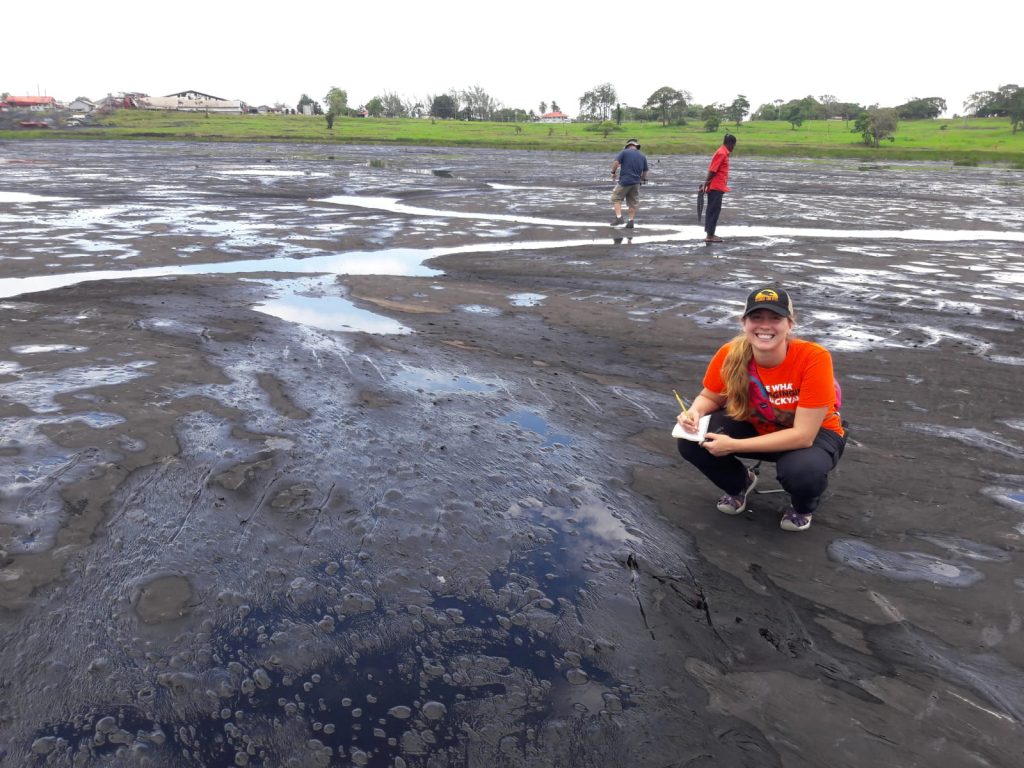
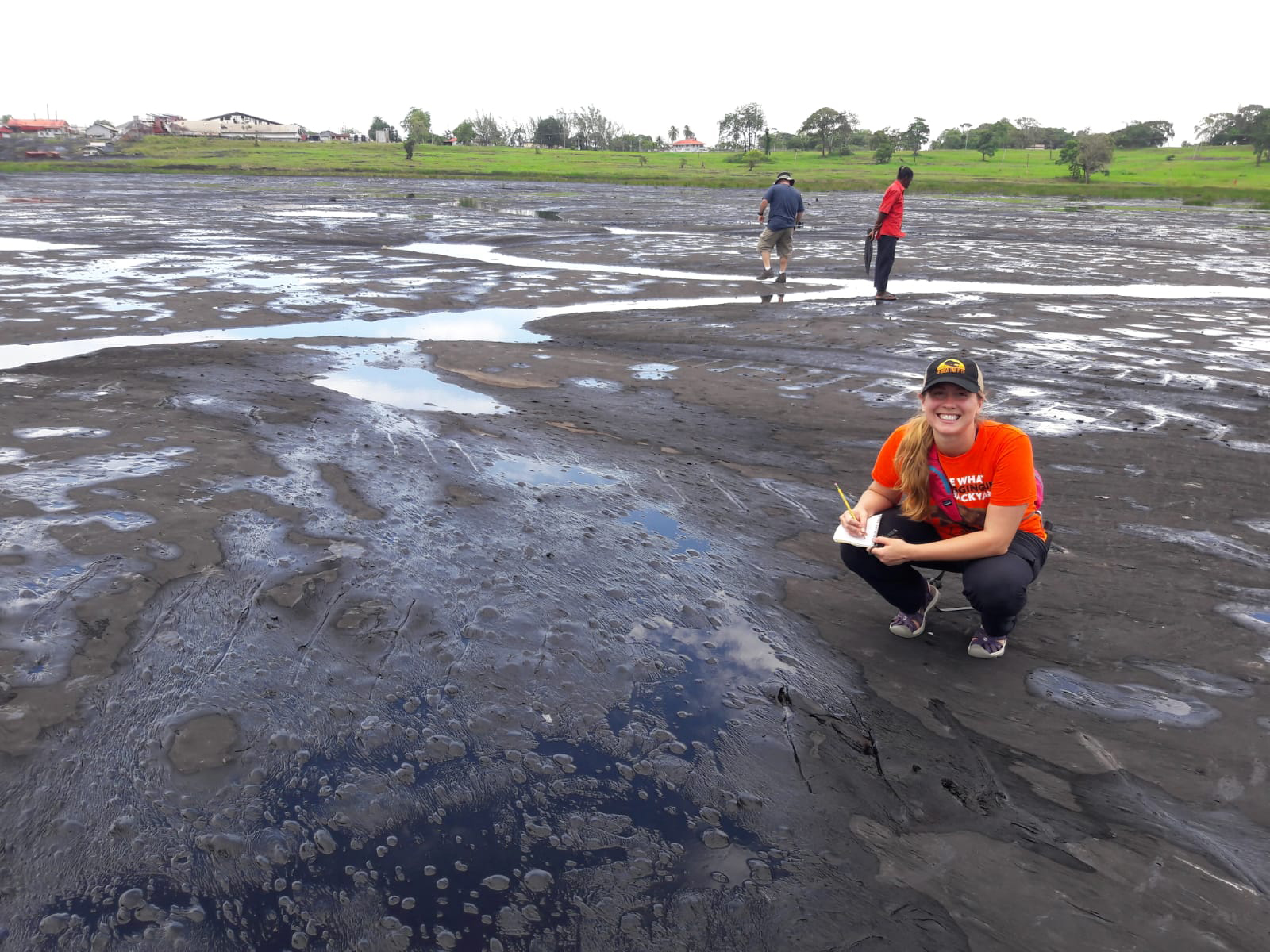
Photo of a woman kneeling by a tar pit.

Dr. Alexis Mychajliw exploring potential asphaltic (“tar pit”) fossil localities on the Caribbean island of Trinidad. Photo by A Farrell.

In partnership with the National Museum of Natural History in Santo Domingo and the conservation group Grupo Jaragua, Mychajliw and her colleagues have taken a “conservation paleobiology” approach to understanding the long-term drivers of decline and resilience for the Hispaniolan solenodon and Hispaniolan hutia (Plagiodontia aedium) — the two remaining nonvolant mammals in Hispaniola.

Together with her colleagues Lauren Gibson, Ernst Rupp, and Yolanda Leon, Mychajliw worked to better understand the determinants of the decline of solenodons across Hispaniola. Specifically, is this decline a recent trend linked to introduced predators like dogs, is it linked to the first arrival of humans, or part of a larger arc of decline linked to millennial scale climate change? They addressed these questions by compiling data on solenodon occurrences over time from numerous sources — including some historic documents from the Biodiversity Heritage Library (BHL).
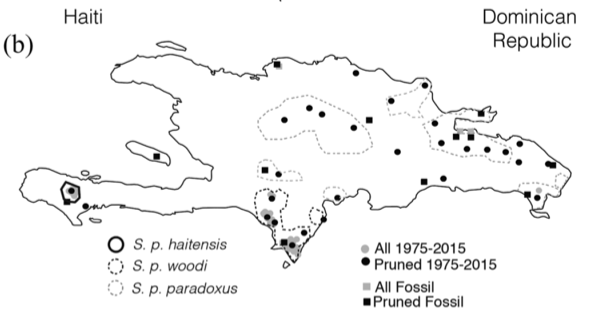
An illustration of a map in the Caribbean Islands.

A map showing the localities used in the study on S. paradoxus published in Conservation Biology in 2019, including some taken from BHL documents (Gibson et al 2019).

“XIII. Notes on the habits and external characters of the Solenodon of San Domingo (Solenodon paradoxus)” by Alpheus Hyatt, published in 1907, was a particularly informative source for this research.

“I would never have found this document without BHL,” shares Mychajliw. It is now one of her favorite publications in the Library.

The article begins: “Although Solenodon paradoxus of San Domingo and Haiti was discovered and imperfectly described as early as 1839, several years before the Cuban species (Solenodon cubanus) was known to science, it is still practically unknown to recent zoologists. The published descriptions of this rare and interesting mammal are vague and unsatisfactory.”

Hyatt then proceeds to discuss the species’ rarity — even as early as 1900, it was already in decline: “And when, in December 1906, I undertook a collecting-trip to San Domingo with the avowed intention of obtaining the Solenodon, prominent zoologists stated that the quest was hopeless, one of them saying I would be as likely to secure specimens of ghosts as of Solenodon paradoxus” [emphasis added].
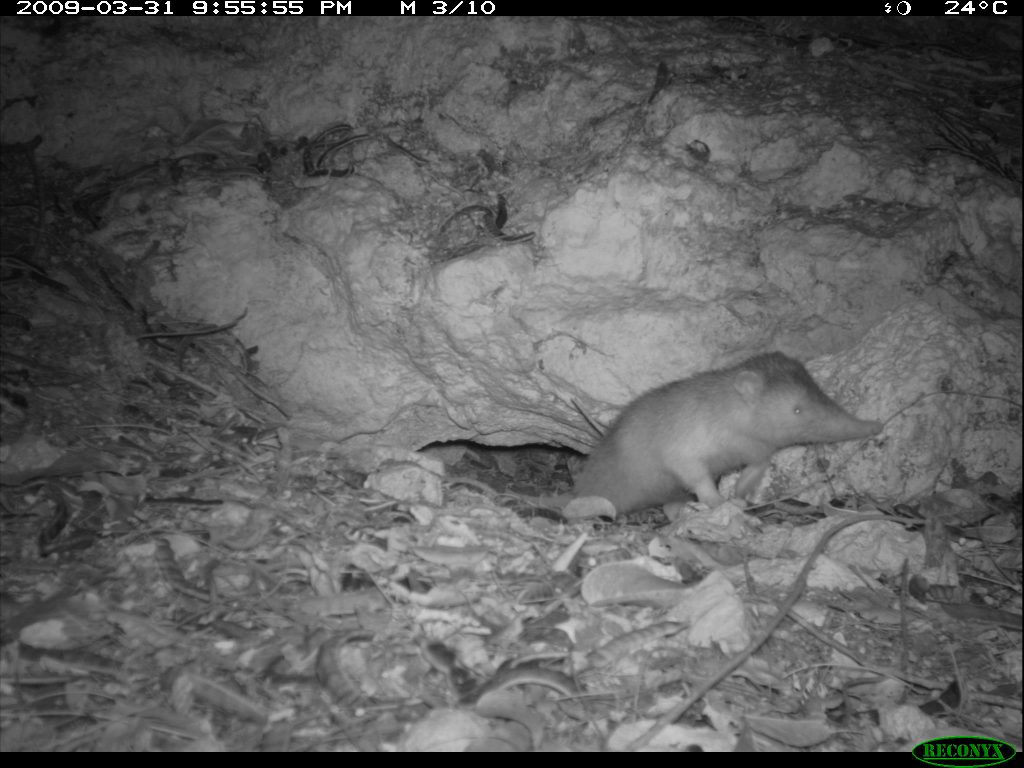
A black and white photo of an Hispaniolan Solenodon.

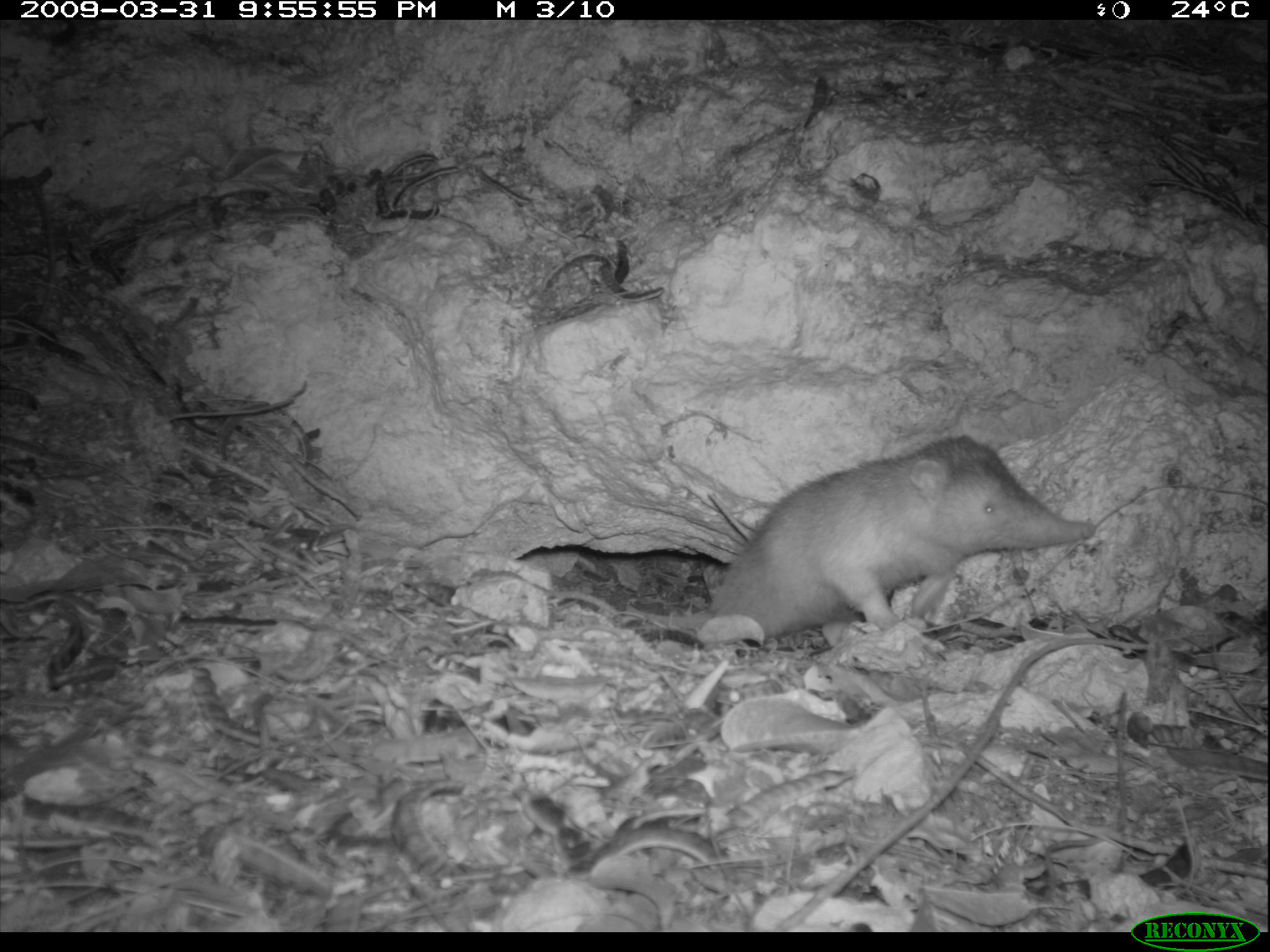
A ghost, according to Alpheus Hyatt’s colleague – a photo of the Hispaniolan Solenodon (S. paradoxus) as it emerges from its den in the Dominican Republic. Mychajliw and her colleagues combined BHL literature searches with camera trap surveys conducted by Grupo Jaragua to understand how their distribution has changed over time. Photo by E Rupp of Grupo Jaragua.

Hyatt also provides clues to the threats facing solenodons, writing that dogs are effective predators (unfortunately, a trend that has only increased): “They also claim that when pursued it frequently trips itself and tumbles heels over head. When hunted with dogs, it thrusts its head into the nearest hole or shelter, and allows itself to be captured without resistance.”

Ultimately, Mychajliw and her colleagues found that humans, and in particular their dogs, are a recent and significantly urgent threat for solenodons. While solenodons survived past climate change and the arrival of humans, the last hundred years have provided an unprecedented challenge for this wonderful and weird species.

Mychajliw’s work on Caribbean mammals is part of her larger research speciality working at the intersection of paleoecology and conservation biology. In addition to her work in Hispaniola, she also studies collections excavated from asphaltic fossil deposits in Los Angeles at the La Brea Tar Pits and Trinidad as part of the La Brea Tar Pits & Museum international “BREAS” initiative (Bridging Research and Education in Asphaltic Sites) to help create pictures of these regions’ ecosystems throughout history.

Using fossils, historic data extracted from the literature, and modern-day observations of living mammals, Mychajliw reconstructs population trends and the environmental and anthropogenic perturbations that may shape their trajectories over time. These ecological experiments can help guide conservation planning and inform specific management decisions.

BHL has been an important source of literature for Mychajliw’s research since she first discovered it as a PhD student. Her research into the drivers of Caribbean mammal extinction over the past 10,000 years required developing species lists for each island, a general understanding of extinction timing, and reconstructing the species’ body sizes — a task that seemed likely to require many museum visits to take measurements of teeth and bones.

“Luckily, I found BHL!” lauds Mychajliw. “As an early graduate student, I didn’t have the time or funds to travel to so many different museums. Instead, through BHL, I found many historic documents of the earliest excavations in the Caribbean.”

Using documents like “A second collection of Mammals from caves near St. Michel, Haiti” (Miller 1929), Mychajliw was able to obtain locality information and measurements on specimens collected from the Caribbean. She compiled this information into a database, which she could use to populate body size equations and make estimates of extinct vs. extant species body sizes.

Through this work, Mychajliw identified two waves of size-biased extinctions in the Caribbean, with large mammals disappearing at a similar time as human arrival, followed by smaller species disappearing with the arrival of European commensals such as rats and cats. This finding was communicated in a 2017 publication in the Annual Review of Ecology, Evolution, and Systematics (Cooke et al 2017).
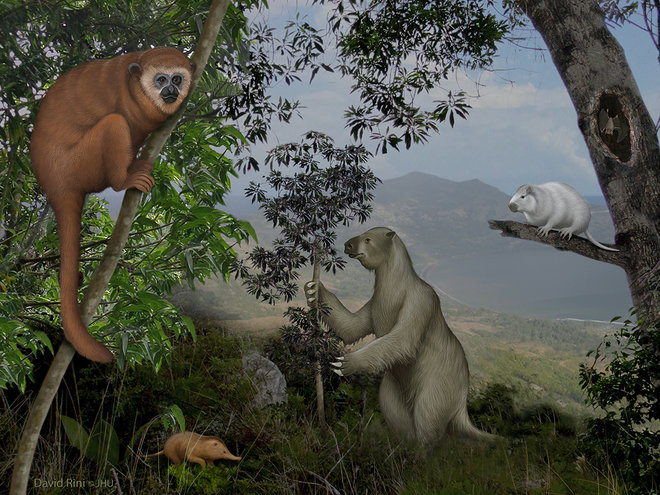
Digital illustration of several mammals in a rainforest.

A view of the Caribbean island of Hispaniola, approximately 5,000 years ago. This community would have included enigmatic monkeys, pygmy ground sloths, giant rodents, and venomous insectivores. Today, only 2 of 25 nonvolant mammals survive. Illustration by D Rini.

“BHL is an incredible resource that is particularly helpful for early career researchers who may not have the funds or connections to visit multiple museums or institutions to collect data,” affirms Mychajliw.

As Mychajliw’s testimonial demonstrates, historic literature like that available at BHL helps researchers incorporate centuries of knowledge into modern research. This can inform studies on everything from paleoecology to conservation, taxonomy, and even the history of science.

“The documents held in BHL inform not just my science itself, but also bring an historical perspective on those who did science before me and how the practice of science has evolved,” explains Mychajliw. “For example, in reading many of the early accounts of scientists who collected samples in the Caribbean, I can see how our societal attitudes on the importance of local knowledge has (hopefully!) changed and become more inclusive in the present day. All of the references I make to early Caribbean authors are male (a “Mr.” so and so receiving this specimen or that) – and I am happy to see more diversity in the present day.”

As Earth’s biodiversity continues to decline at a rate unprecedented in human history, an understanding of the past — from the forces that shape ecosystems to the responses of species to various stressors over time — can help inform strategies and policies to address and combat modern-day threats. By providing open access to global literature collections and the valuable data they contain, BHL will continue to provide researchers with the information they need to study and conserve life on Earth.

June 13, 2019by Grace Costantino
BHL News, Blog Reel

2019 Spring BHL Newsletter Now Available!

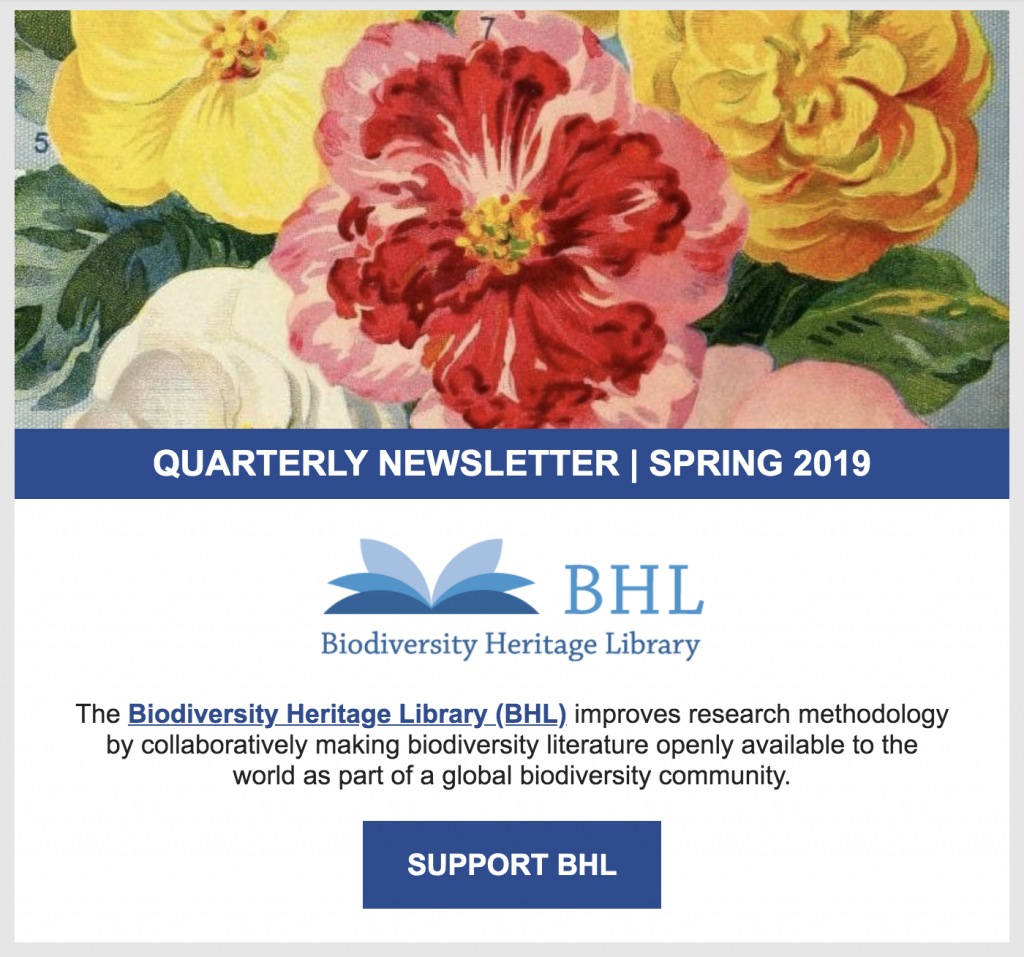
screenshot of the 2019 spring BHL newsletter

screenshot of the 2019 spring BHL newsletter

Spring is in the air…and we’ve been busy at BHL. From our 2019 Annual Meeting to the Her Natural History campaign celebrating women in natural history and updates to our metadata export services, check out all of the latest program news in the 2019 Spring Newsletter.

Be sure to subscribe to our mailing list to keep up to date with all the latest BHL news.

May 21, 2019by Grace Costantino
BHL News, Blog Reel

2019 BHL Annual Meeting at Cornell University

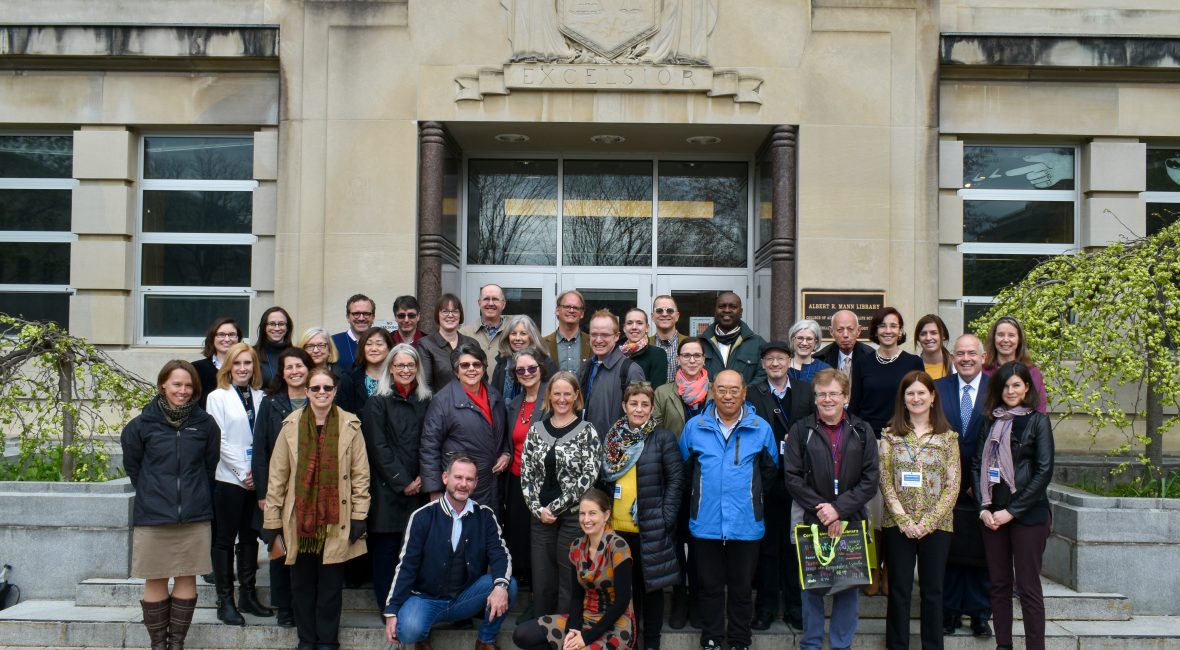
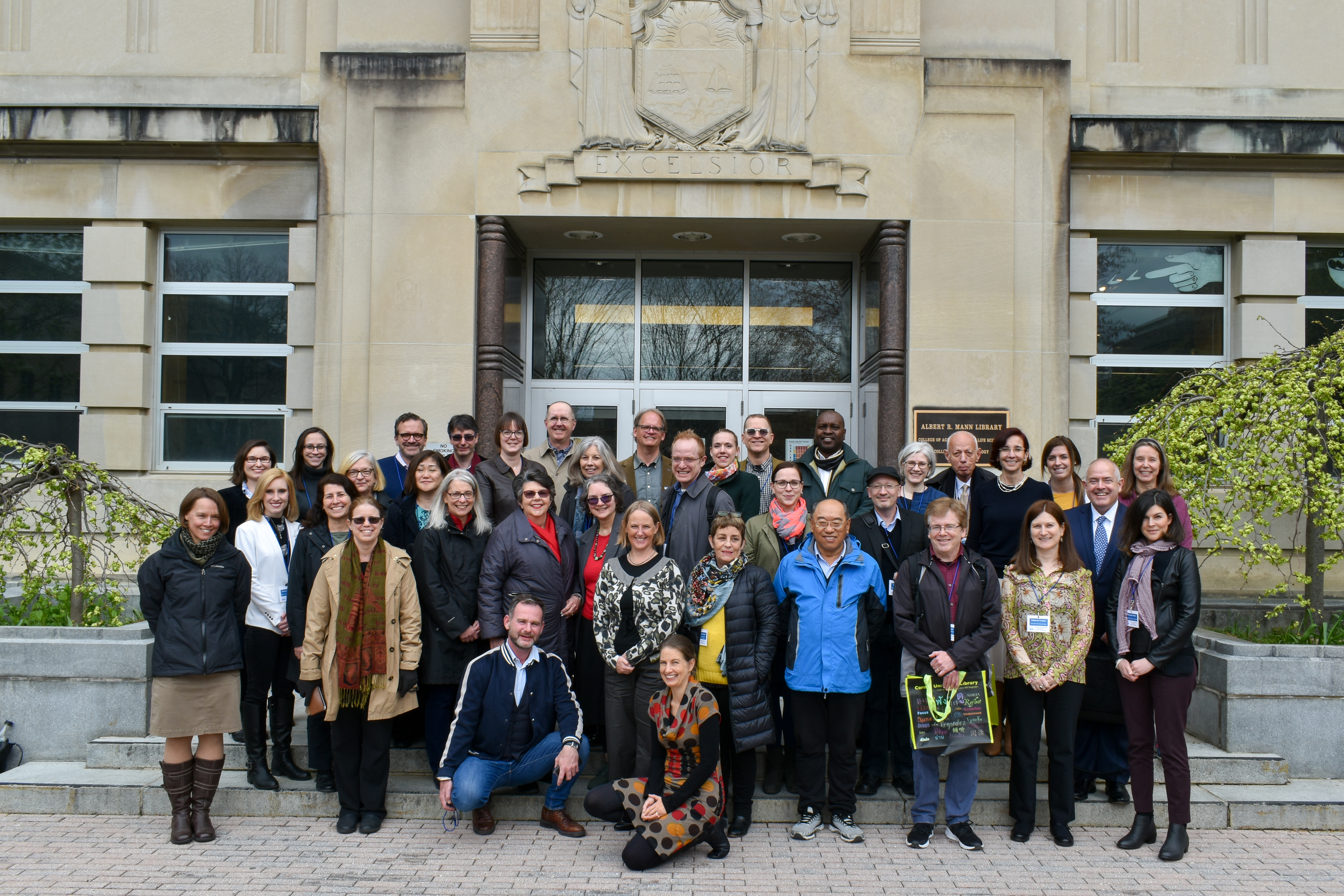
Group of men and women standing in front of doors at a stone building.

BHL representatives at the 2019 BHL Annual Meeting, hosted by the Albert R. Mann Library of Cornell University. Photo by: Jenny Leijonhufvud.

The 2019 BHL Annual Meeting was held 29 April – 3 May in Ithaca, New York. Hosted by the Albert R. Mann Library of Cornell University, the Meeting brought together 34 participants from 23 institutions, representing 9 countries.

As BHL Program Director Martin Kalfatovic noted: “The BHL Annual meeting is an opportunity for the partners, from all over the world, to come together to chart the course of the BHL for the coming year. The conversations, both formal and informal, are key to keeping the Library relevant to both its global user community and the partners that sustain the BHL.”

The meeting agenda included reports on the state of the consortium, facilitated discussions around key program areas, a strategic planning session, a panel session with BHL partner representatives, a public event with a panel of Cornell scientists, and many amazing tours and excursions.

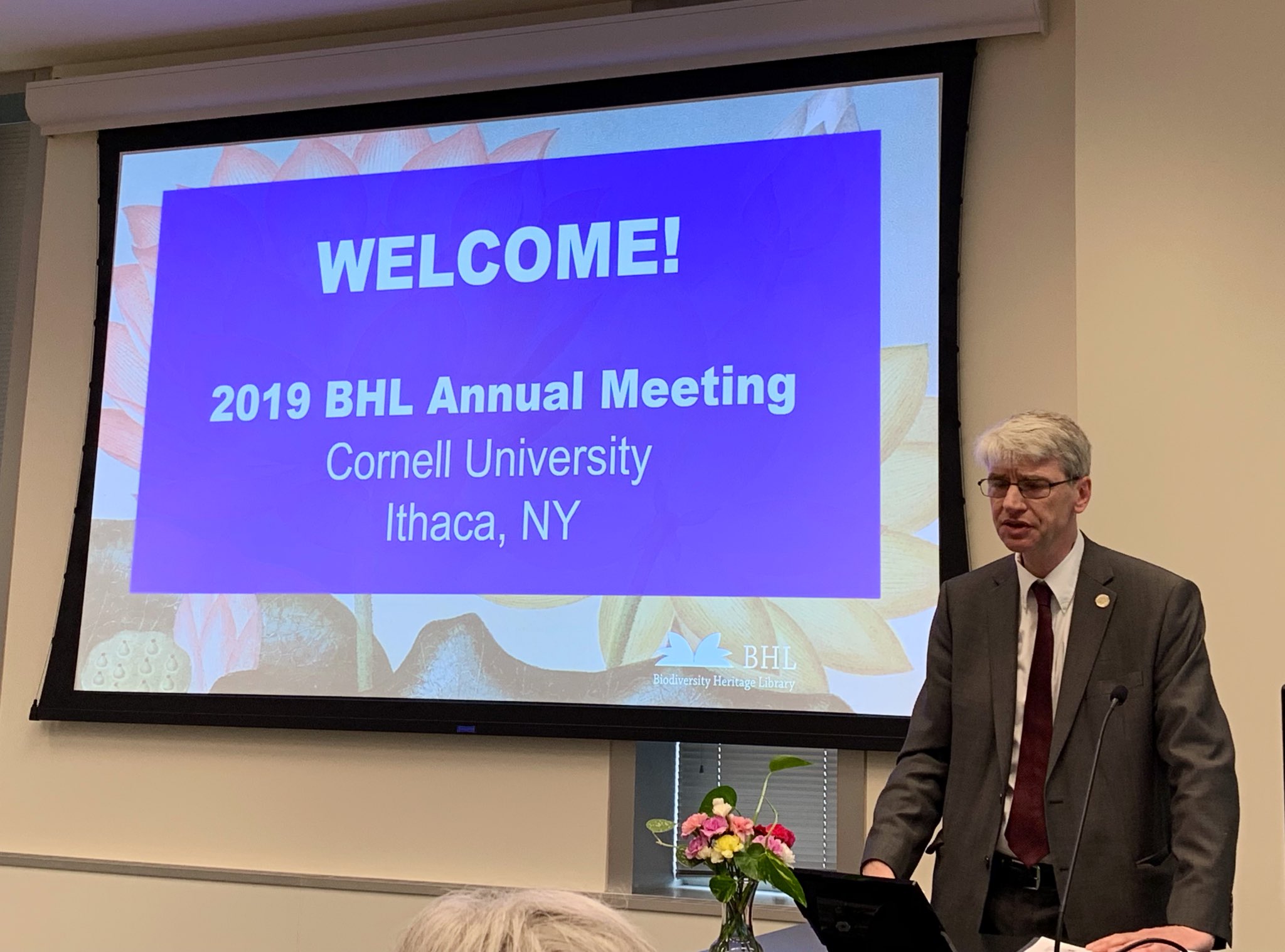
Man in suit standing in front of a slide that reads "Welcome! 2019 BHL Annual Meeting, Cornell University, Ithaca, NY"

Gerald Beasley (University Librarian, Cornell University) welcoming attendees to the 2019 BHL Annual Meeting at the Albert R. Mann Library. Photo by: Nicole Kearney.

The business portion of the meeting opened with a presentation by Constance Rinaldo (Chair, BHL Members’ Council) on a vision for the next generation of BHL (The State of the BHL: Future Thoughts). Martin Kalfatovic (BHL Program Director) followed with a report covering BHL’s 2018 program activities, a financial update, anticipated projects in 2019, and thoughts on future directions and priorities for BHL (BHL: Past>Present>Future). BHL Secretariat staff Bianca Crowley (BHL Collections Manager) and Grace Costantino (BHL Outreach and Communication Manager) wrapped up the business meeting with a BHL Collection Management Update and BHL Outreach Highlights from 2018.

Following the business sessions, a series of facilitated discussions provided partner representatives with opportunities to help inform strategies around key program topics including content development methods, partnerships, and BHL’s relationship with science communities.

BHL has also begun the process of drafting our next strategic plan, effective for 2020-2025. During a strategic planning session at the meeting, partner representatives shared their thoughts on the relevance of the goals in BHL’s current plan, identifying areas in need of changes or further consideration, and working committees to address each goal for the new plan were established.

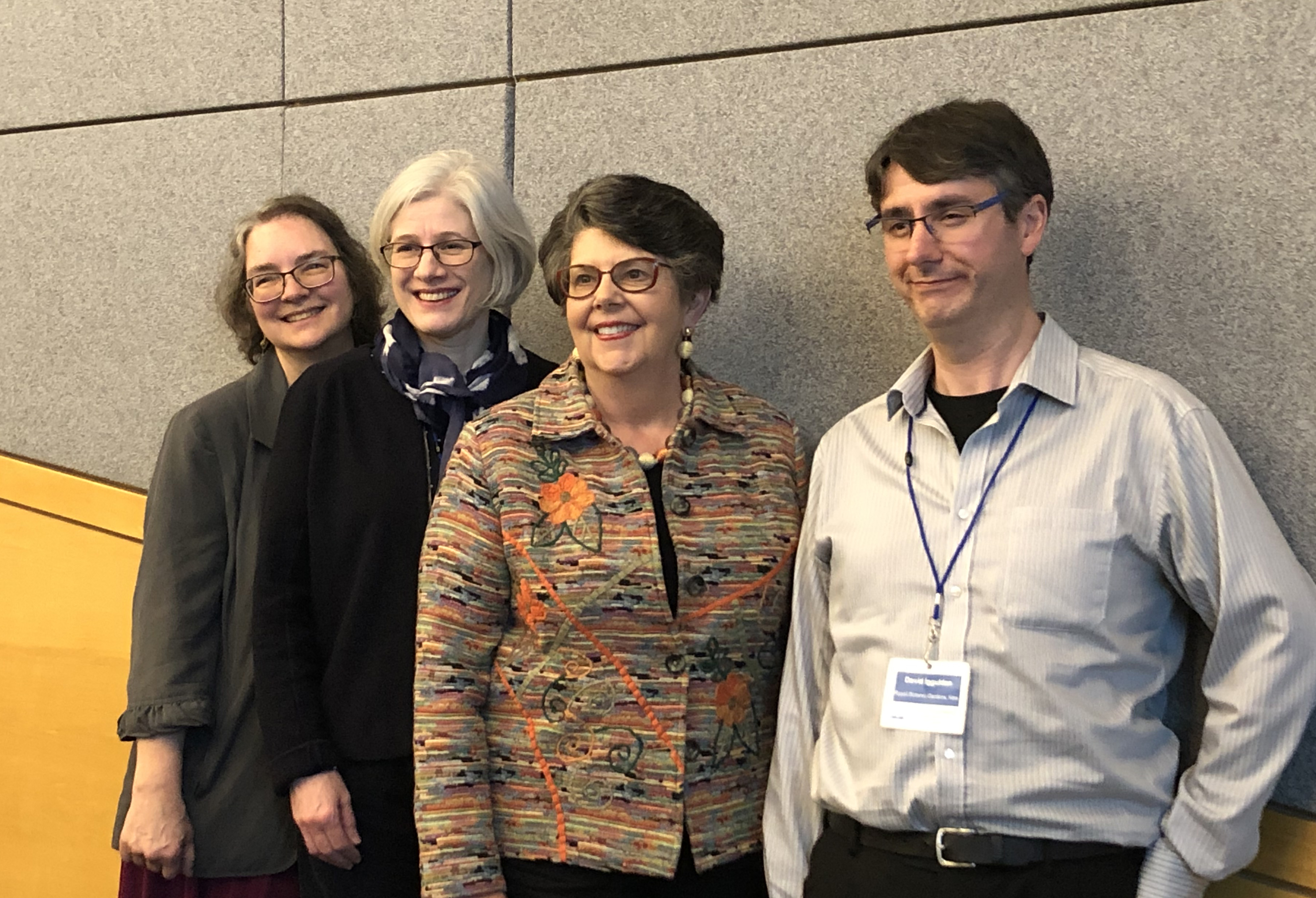
Group of three women and a man standing in front of a brown wall.

2019-2021 BHL Executive Committee (L to R): Constance Rinaldo (Chair); Jane Smith (Vice-Chair); Nancy Gwinn (Immediate Past Chair); David Iggulden (Secretary). Photo by: Bianca Crowley.

A key item of business at the meeting was the election of the BHL Executive Committee for the 2019-2021 term. The Executive Committee provides strategic leadership and governance decisions for BHL. Officers are elected for two-year terms by the BHL Members’ Council, which is comprised of one representative from each BHL Member institution.

The results of the election include:

  • Constance Rinaldo (Ernst Mayr Library, Museum of Comparative Zoology, Harvard University), Chair;
  • Jane Smith (Natural History Museum Library, London), Vice-Chair;
  • David Iggulden (Library, Art & Archives at the Royal Botanic Gardens, Kew), Secretary.

Nancy Gwinn (Smithsonian Libraries) also serves on the committee as the Immediate Past Chair.

In addition to the business portions of the meeting, the program also included two panel sessions, one with BHL partner representatives and another as part of a public event with Cornell scientists.

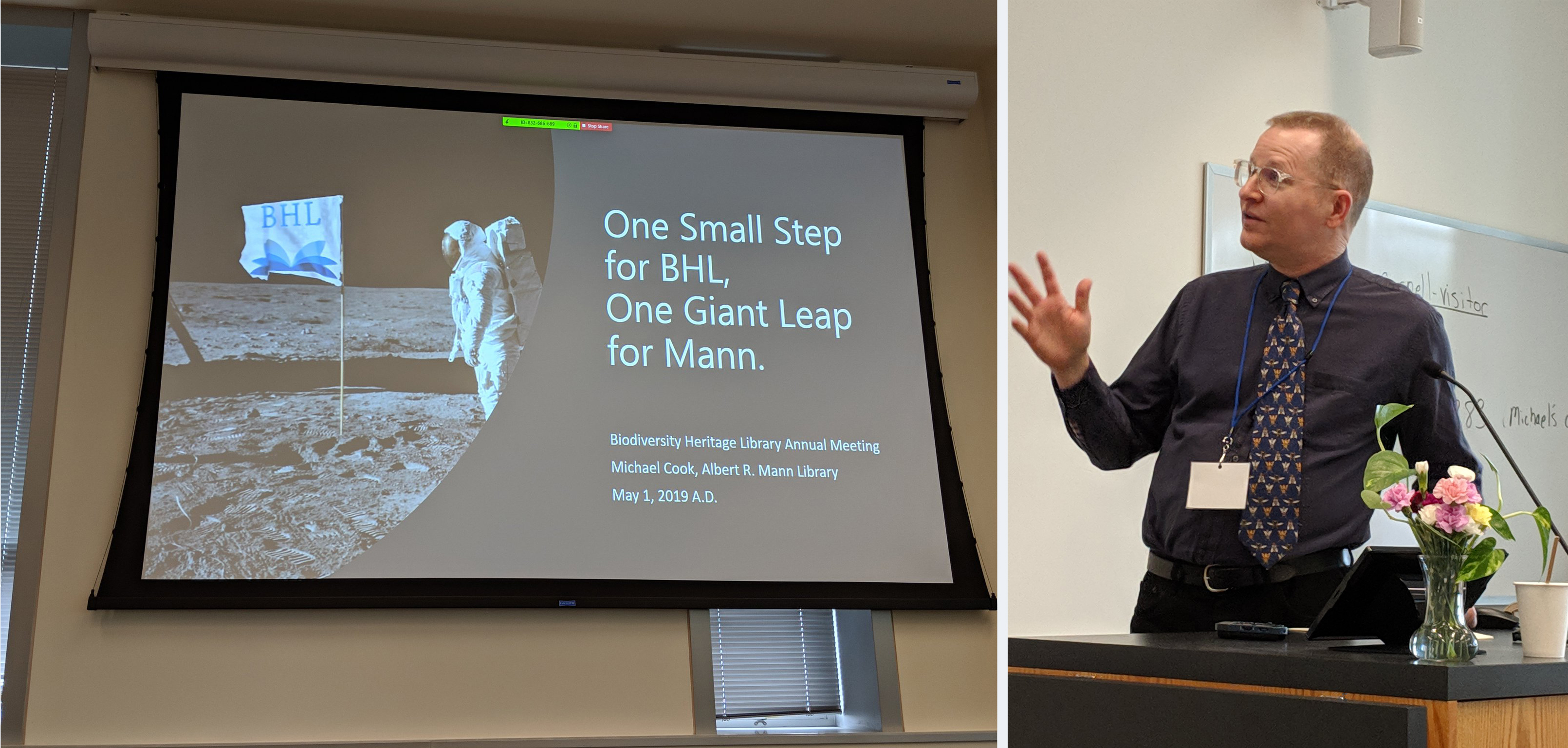
Man standing by a slide that reads "One small step for BHL, one giant leap for Mann"

Michael Cook (Cornell University, Albert R. Mann Library) presenting on the BHL Partners Reflection Panel. Photo by: Martin Kalfatovic.

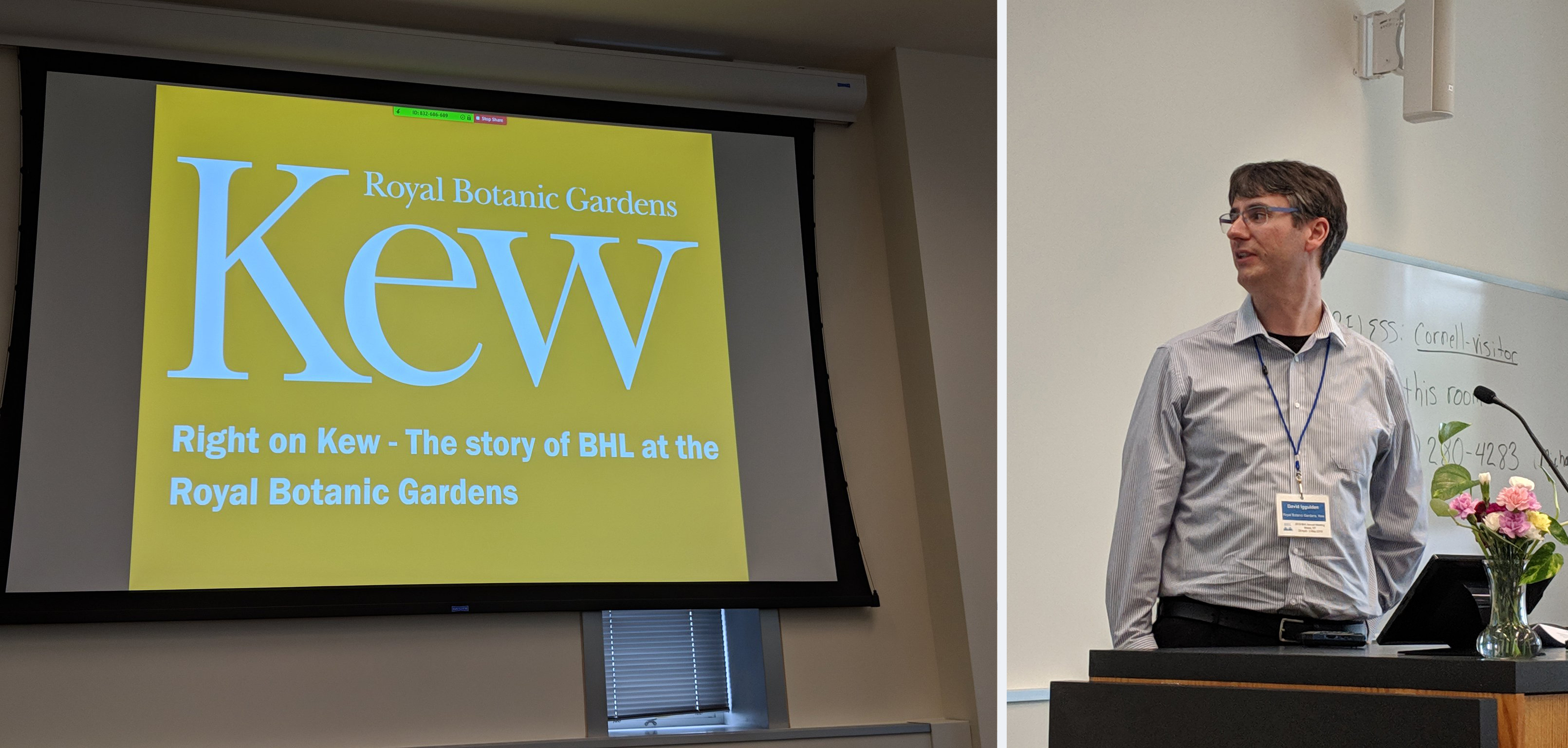
Man standing by a slide that reads "Right on Kew: The Story of BHL at the Royal Botanic Gardens"

David Iggulden (Kew Gardens) presenting on the BHL Partners Reflection Panel. Photo by: Martin Kalfatovic.

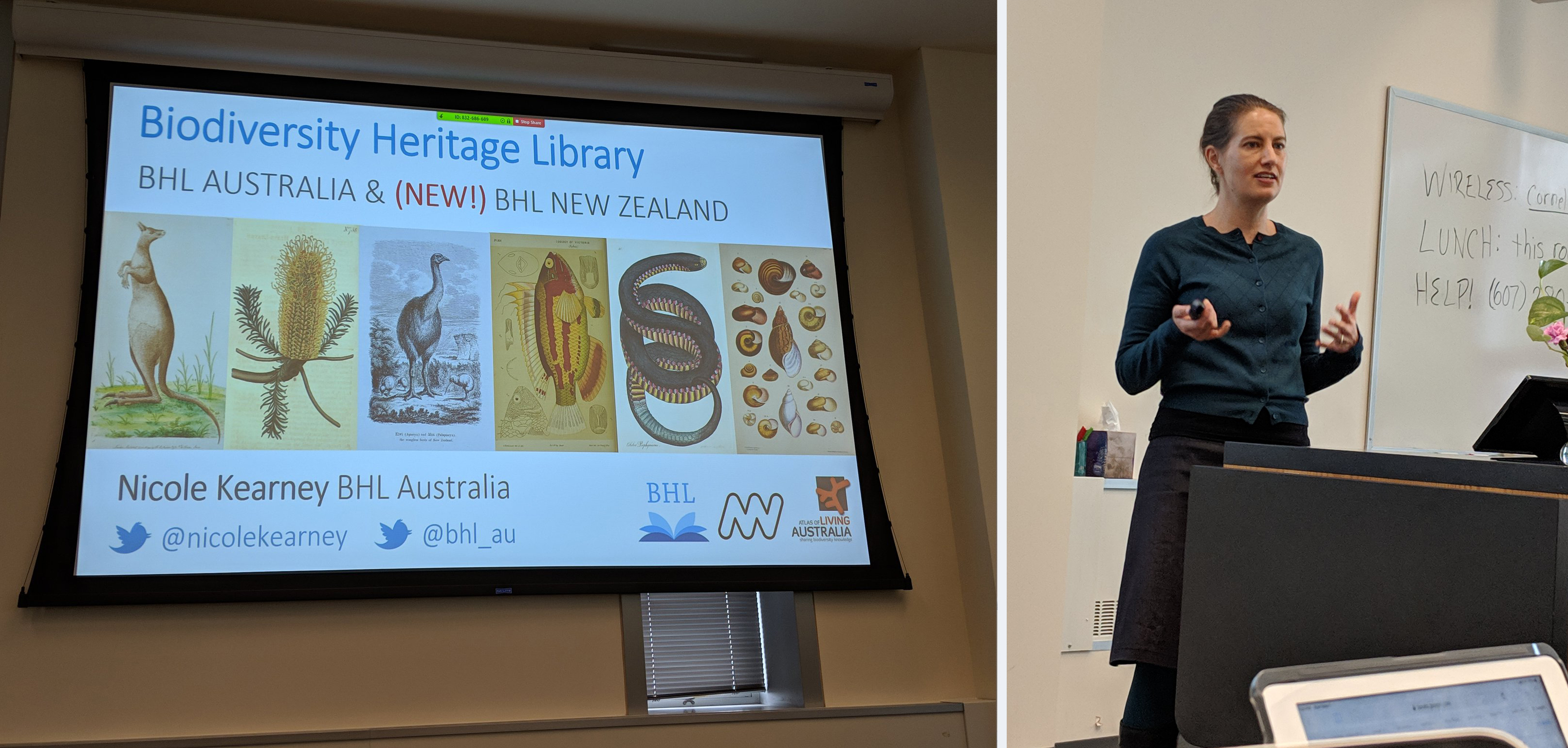
A woman standing next to a slide that reads "BHL Australia and the (NEW) BHL New Zealand"

Nicole Kearney (Museums Victoria / BHL Australia) presenting on the BHL Partners Reflection Panel. Photo by: Martin Kalfatovic.

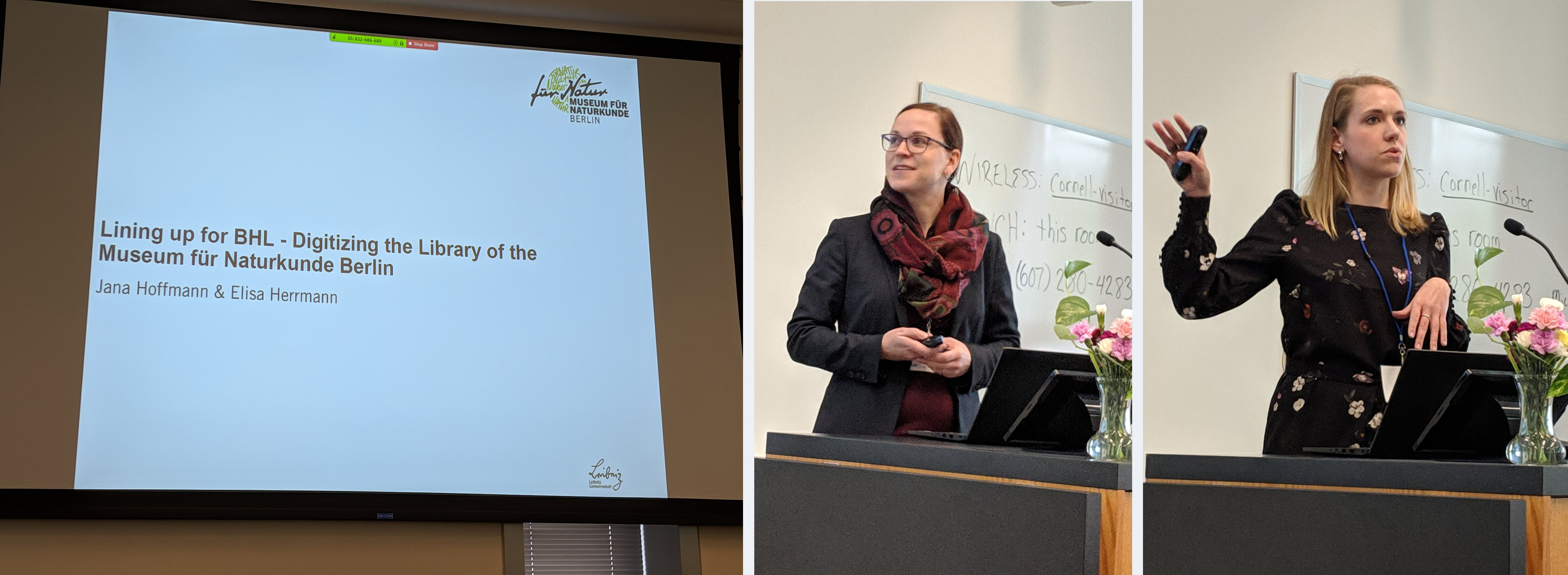
Two women standing next to a slide that reads Lining up for BHL: Digitizing the Library of the MfN Berlin"

Jana Hoffmann and Elisa Herrmann (Museum für Naturkunde (MfN) Berlin) presenting on the BHL Partners Reflection Panel. Photo by: Martin Kalfatovic.

During the BHL Partners Reflection Panel on 1 May, representatives from Cornell University, Kew Gardens, BHL Australia, and MfN Berlin reflected on their experiences as members of the BHL consortium. Follow the links below to view each presentation:

  • One Small Step for BHL, One Giant Leap for Mann. Michael Cook, Cornell University;
  • Right on Kew – The Story of BHL at the Royal Botanic Gardens. David Iggulden, Kew Gardens;
  • BHL Australia and (the Newly Launched) BHL New Zealand. Nicole Kearney, Museums Victoria / BHL Australia;
  • Lining up for BHL – Digitizing the Library of the Museum für Naturkunde Berlin. Jana Hoffmann and Elisa Herrmann, MfN Berlin.
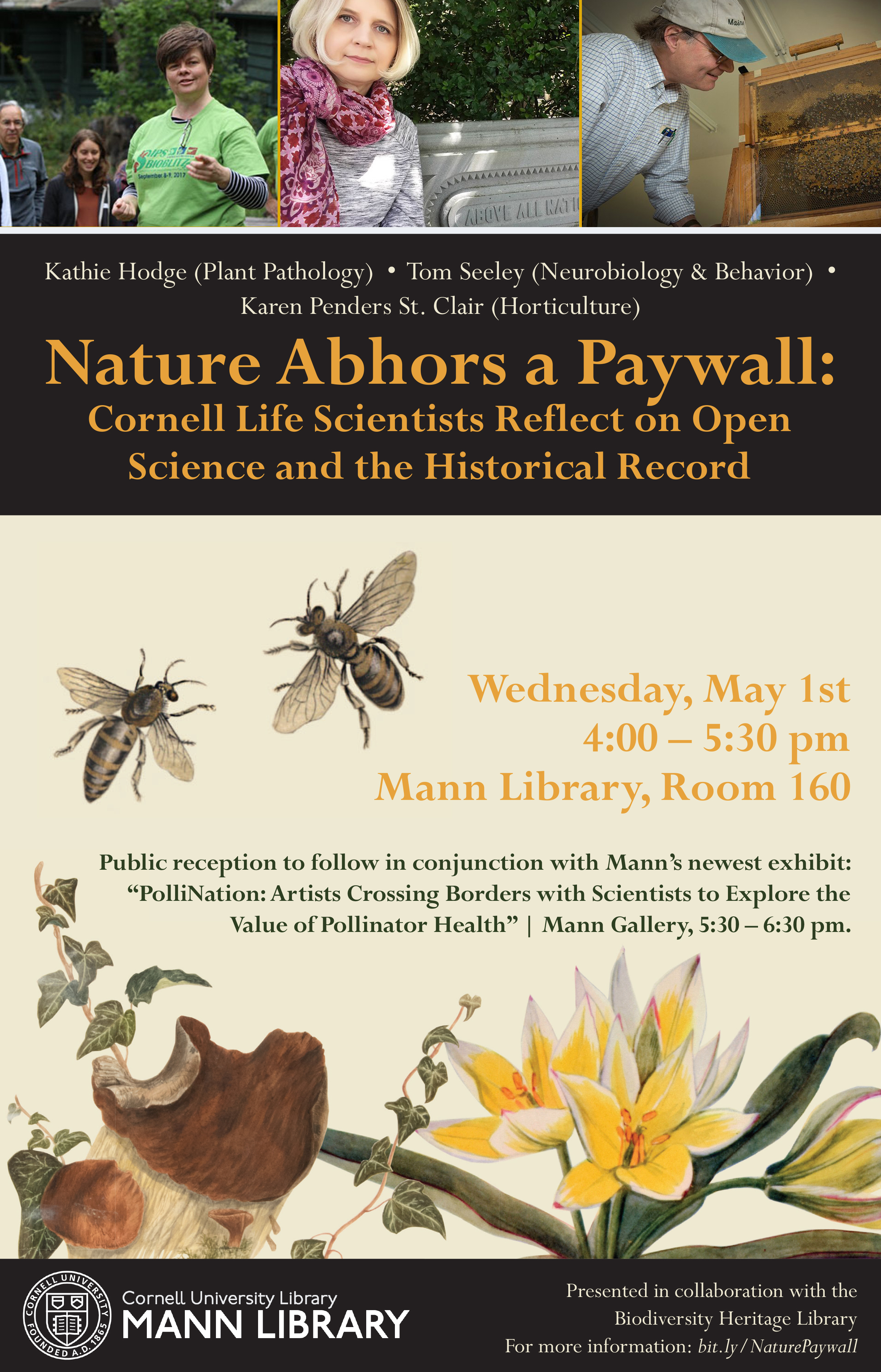
Flyer for the event "Nature Abhors a Paywall"

Top: Speakers at the BHL Public Day Panel Session, L to R: Prof. Kathie Hodge; Dr. Karen Penders St. Clair; Prof. Tom Seeley. Below: Promotional Flyer for the public event. Photos and graphic courtesy of Mann Library.

On the evening of 1 May, Mann Library and BHL presented a special public program entitled Nature Abhors a Paywall: Cornell Life Scientists Reflect on Open Science and the Historical Record. During the event, three Cornell scientists — neurobiologist Tom Seeley, mycologist Kathie Hodge, and science historian Karen Penders St. Clair — highlighted the role that the historical scientific record has played in their own research. The session was followed by a public reception in the Mann Gallery in conjunction with Mann’s newest exhibit: PolliNation: Artists Crossing Borders with Scientists to Explore the Value of Pollinator Health. Follow the links below to view each speaker’s presentation:
  • Dr. Karen Penders St. Clair
  • Prof. Kathie Hodge
  • Prof. Tom Seeley

A recording of the public event will be made available via Cornell’s system in the future.

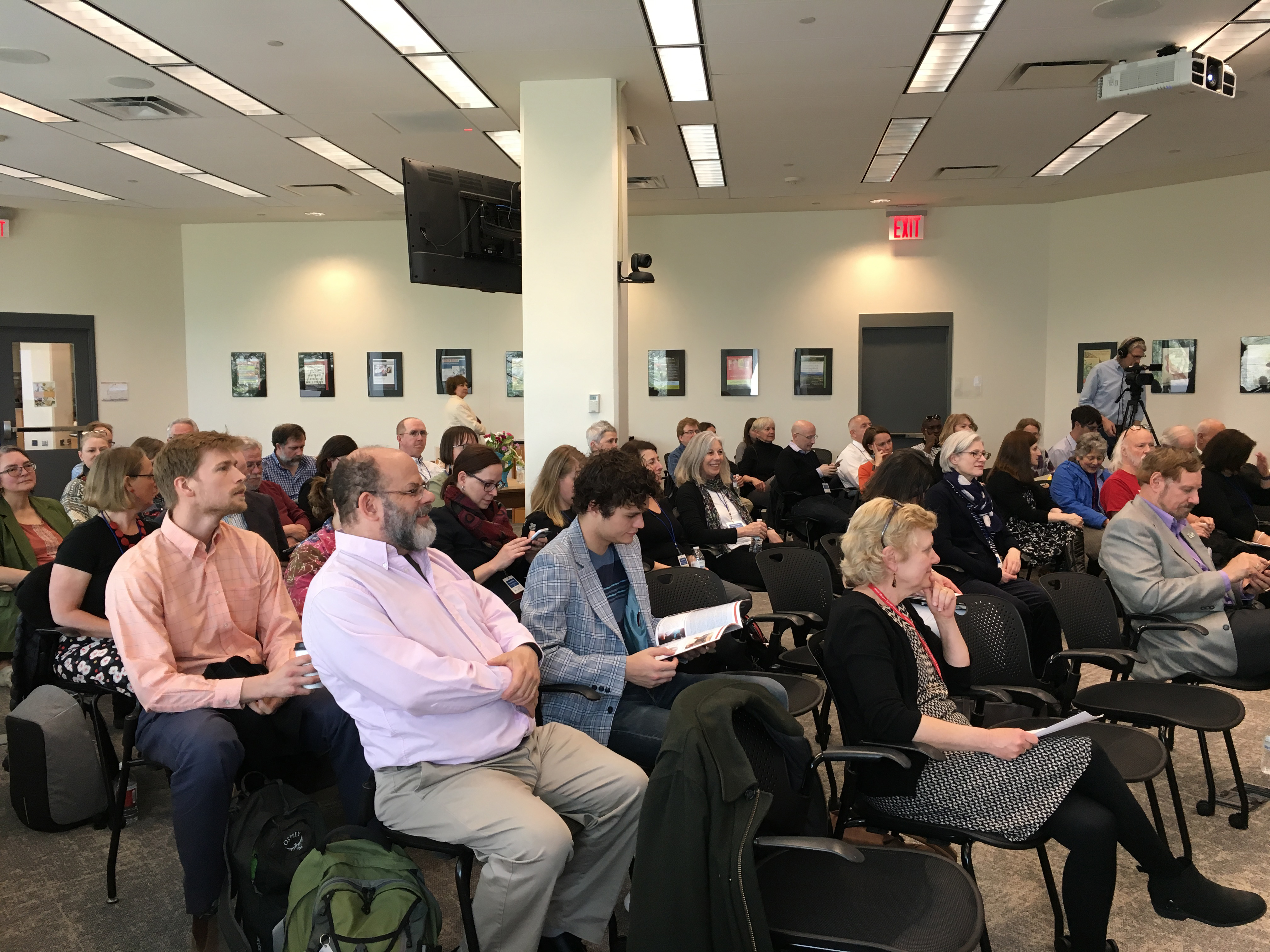
Room full of people sitting.

Attendees at the BHL Public Day Panel Session: Nature Abhors a Paywall. Photo by: Grace Costantino.

Attendees at the meeting also had the opportunity to participate in some wonderful tours and social events.

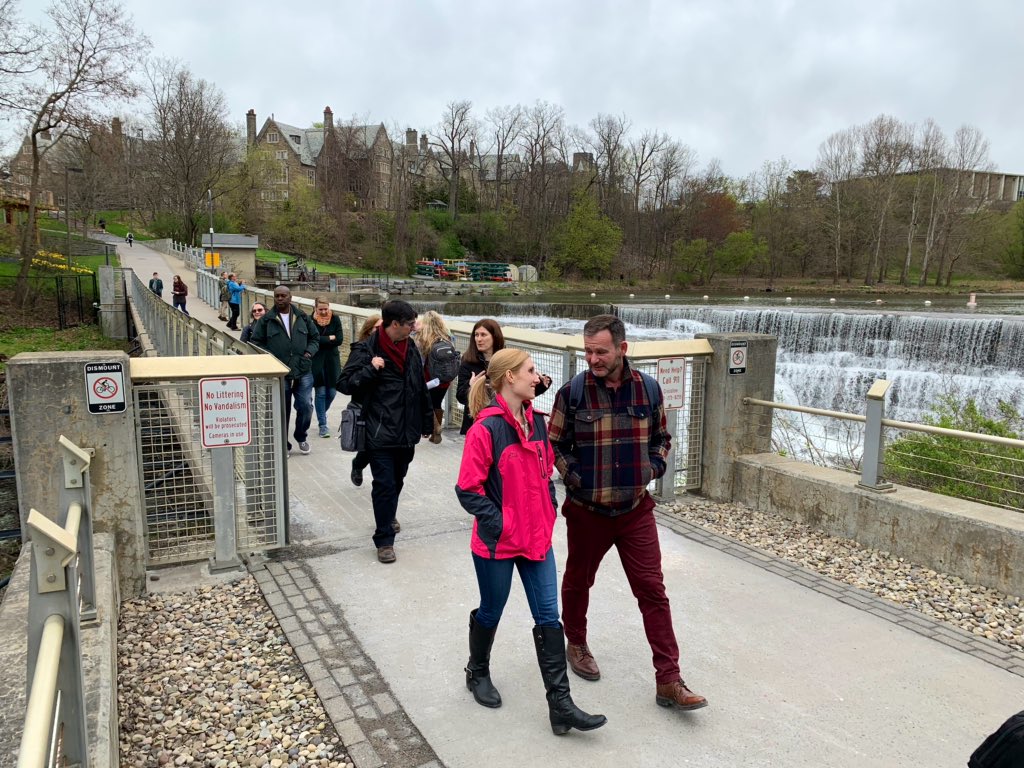
Group of people crossing a bridge.

BHL representatives on the Cascadilla Gorge tour. Photo by: Nicole Kearney.

“Ithaca was an ideal location for the 2019 BHL Annual Meeting,” noted Constance Rinaldo, Chair of the BHL Members’ Council. “Those attending the meeting were treated to amazing excursions that exposed them to the unique biodiversity of the Finger Lakes region as well as the bibliographic treasures held by the libraries at Cornell University.”

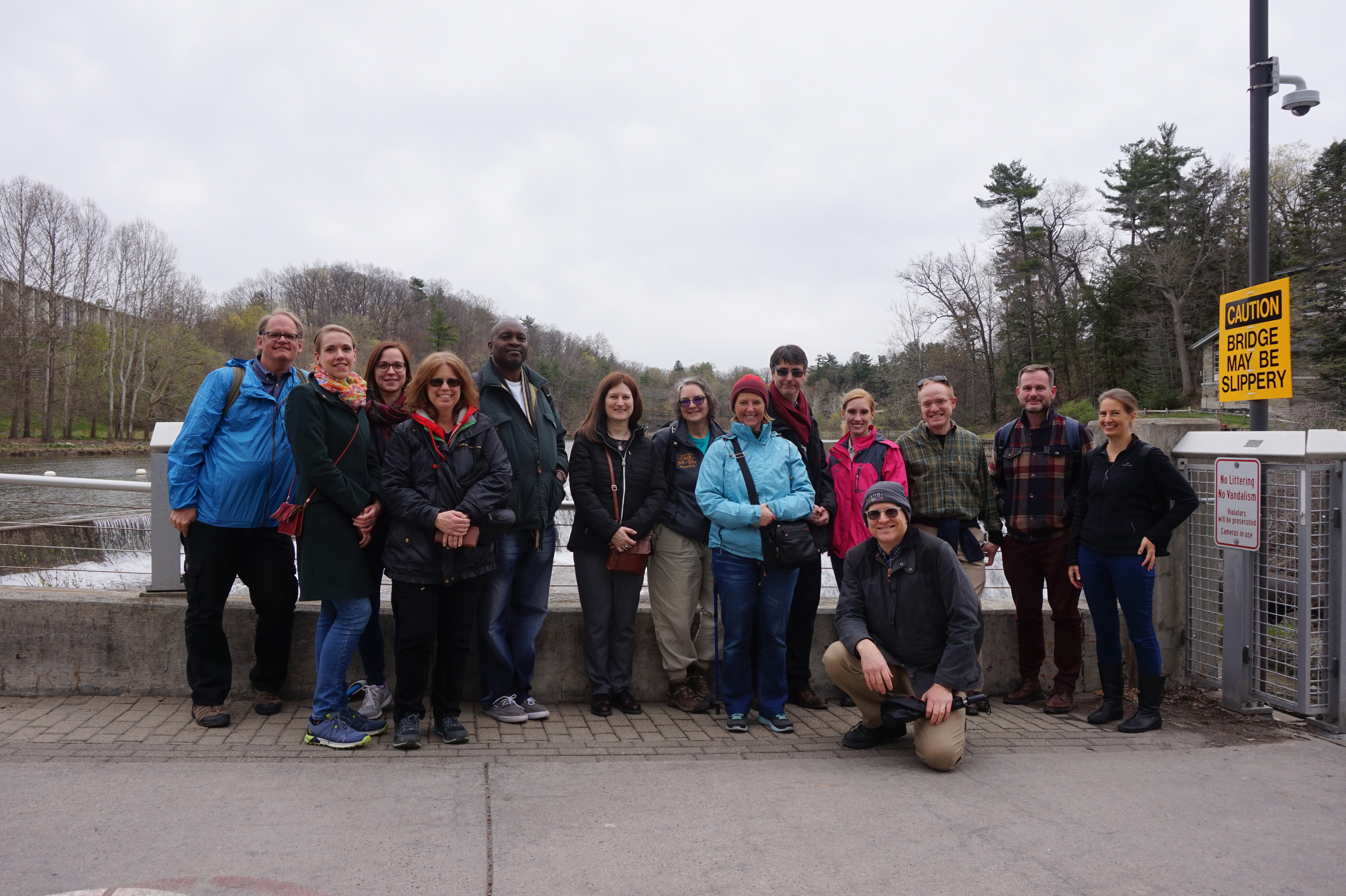
On 29 April, attendees had the option of participating in a trail hike of Cascadilla Gorge or a tour of Mann Library collections related to female botanical illustrations. An informal get-together at the historic Argos Inn provided attendees with a chance to gather and chat with fellow BHL colleagues before the business meetings began the following day.

Group of people standing on a bridge.

Group photo of meeting attendees during the Cascadilla Gorge tour. Photo credit: Martin Kalfatovic.

Throughout the meeting days, the Mann Library staff arranged for a variety of fascinating tours across the campus, including a visit to the Cornell Lab of Ornithology, a behind-the-scenes tour of the Rare and Manuscript Collections at Kroch Library, and tours of the Bailey Conservatory and Hortorium.

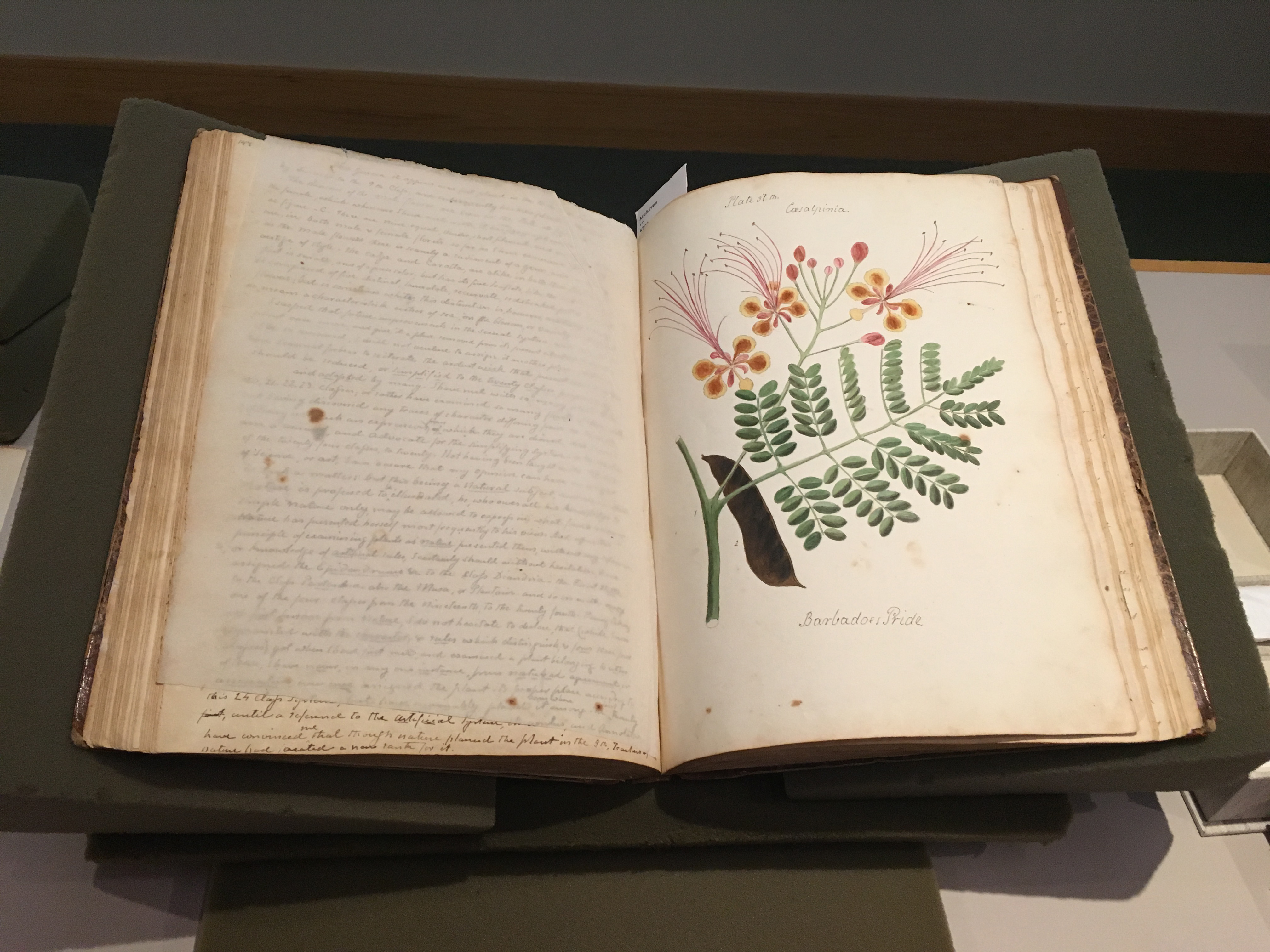
Photo of a manuscript open to a page with a drawing of a plant.

Anne Wollstonecraft’s manuscript, Specimens of the Plants & Fruits of the Island of Cuba, on display during the tour of the Rare Book and Manuscripts Collection at Kroch Library. Photo by: Grace Costantino.

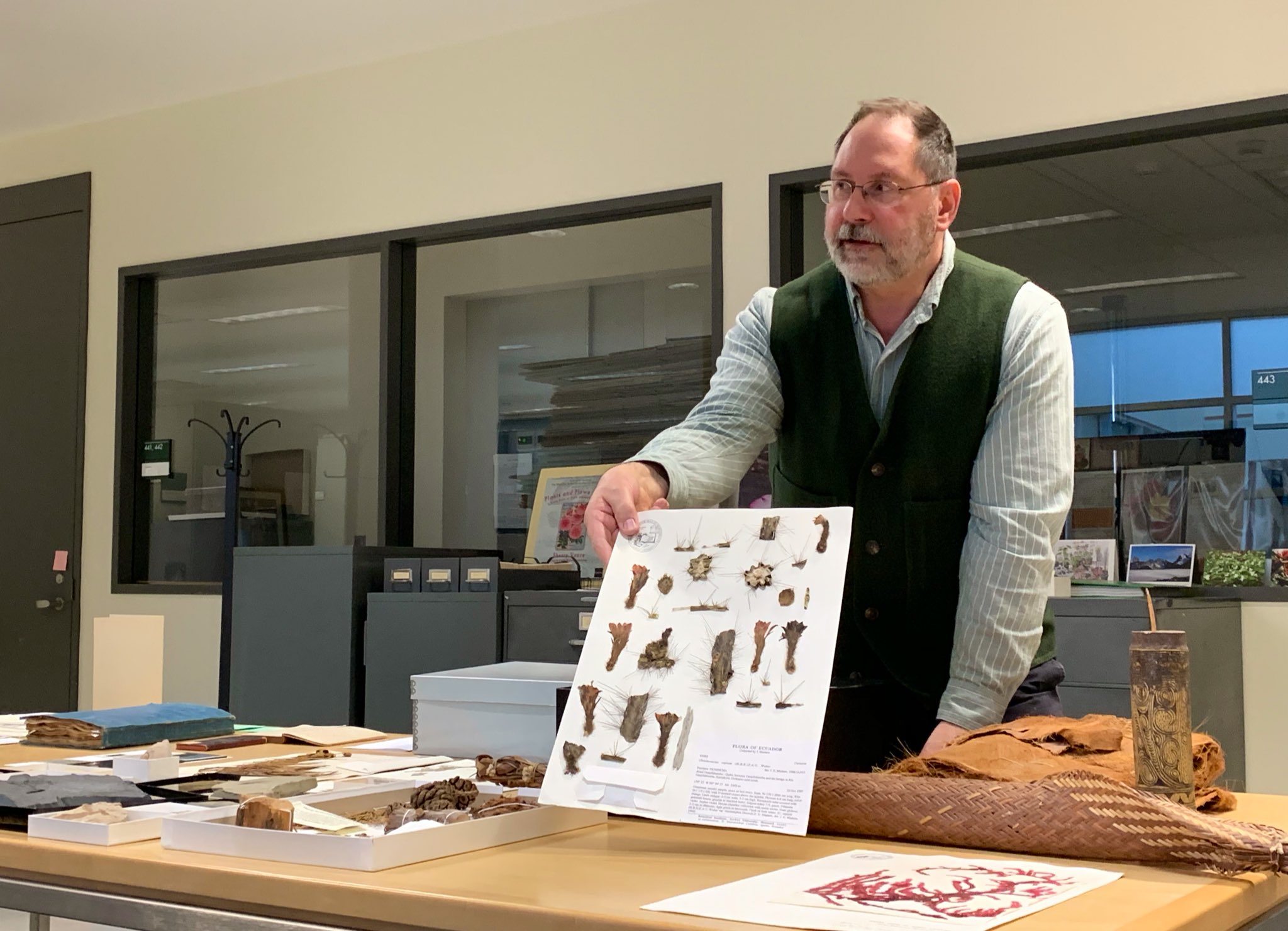
Holding holding a sheet of dried herbarium specimens.

Librarian Peter Fraissinet highlighting collections from the Liberty Hyde Bailey Hortorium during a tour for Annual Meeting attendees. Photo by: Nicole Kearney.

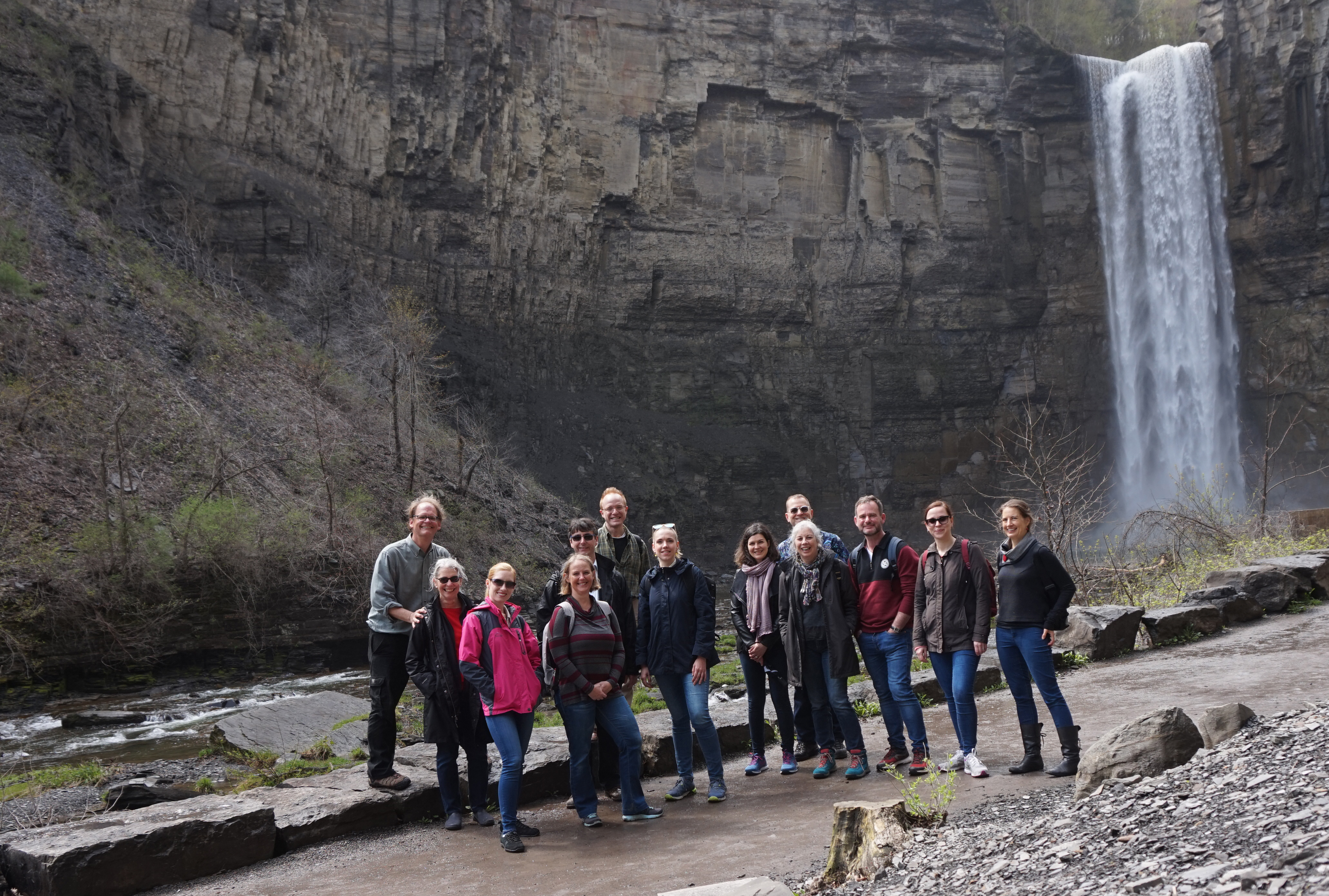
On the Friday following the meetings (3 May), a group of attendees enjoyed an excursion to Taughannock Falls State Park followed by visits to a local cidery and winery, complete with tastings!

Group of people standing in front of a waterfall.

Group photo of meeting attendees at Taughannock Falls State Park during the Friday, 3 May excursion. Photo credit: Martin Kalfatovic.

The meeting culminated with the reveal of the 2020 BHL Annual Meeting host: the Muséum national d’histoire naturelle (MNHN) in Paris! Gildas Illien (Director of Libraries and Documentation at MNHN and the MNHN Member representative to BHL) presented an overview of the wonderful facilities and accommodations planned for the meeting and delighted attendees with previews of some of the activities, tours, and events being planned.

Man on left being handed gift of framed tiles by a woman, with another man standing to her left.

Host appreciation ceremony during the closing reception at the 2019 BHL Annual Meeting. Michael Cook (Albert R. Mann Library, Cornell University, left) being thanked by Constance Rinaldo (BHL Executive Committee Chair, center) and Martin Kalfatovic (BHL Program Director, right). Photo by: Grace Costantino.

We look forward to gathering again in Paris for the 2020 meeting, and extend our sincere thanks to Cornell staff for hosting and organizing such a fantastic meeting. In particular, thanks to Michael Cook (Head of Collections at the Albert R. Mann Library and the Cornell Member representative to BHL) for leading the planning activities at Cornell, as well as the many other Cornell staff members who provided planning and meeting support, including: Gerald Beasley (University Librarian), Mary Ochs (Director of Mann Library), Deborah Cooper (Digital & Special Collections Librarian), Lianna May (Administrative Coordinator), Betsy Elswit (Collections Specialist), and Sarah Kennedy (Collection Development Librarian).

May 16, 2019by Grace Costantino
Blog Reel, User Stories

Insects in Amber: Empowering Research on Ancient — and Modern — Insects

photos of Cyrtinella flavinigra

Insects trapped in amber.

For anyone who has seen Jurassic Park, this description immediately conjures up familiar imagery. In the movie, such a fortuitously-preserved mosquito provided the means to bring dinosaurs back to life. While that may be the realm of science fiction, in the realm of science, such amber time capsules are still a valuable window into the past, allowing scientists today to examine ancient specimens and, sometimes, discover new species.

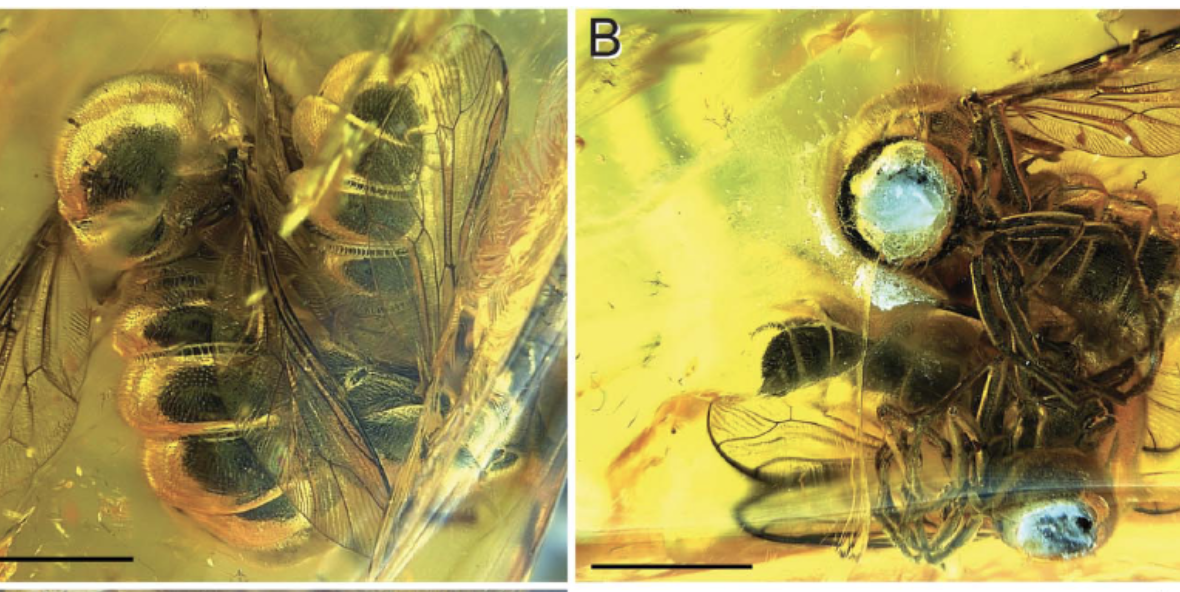
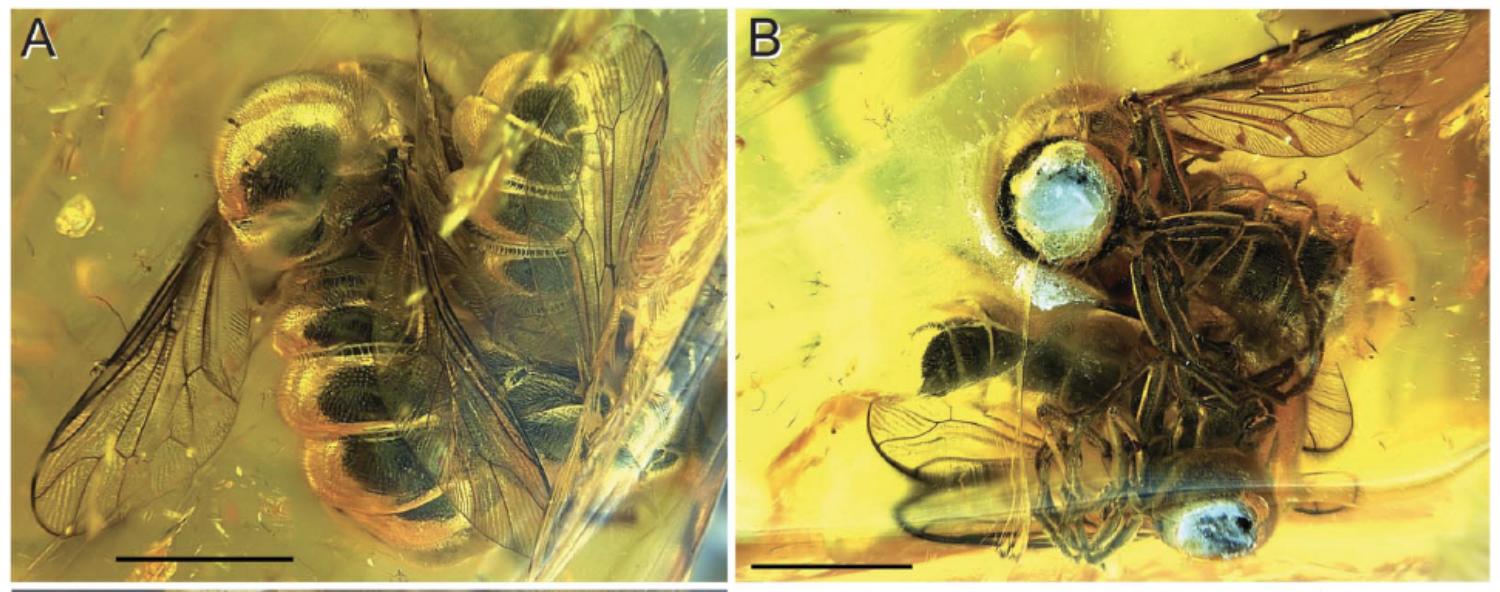
Take, for example, Cyrtinella flavinigra.

photos of Cyrtinella flavinigra

Cyrtinella flavinigra gen. et sp. nov. A, male (right) and female (left) paratypes (SMF Be 1267a and 1267b), dorsal view, photo: John Martin; B, male (bottom) and female (top) paratypes (SMF Be 1267a and 1267b), ventral view, photo: John Martin. Images from: Jessica P. Gillung & Shaun L. Winterton (2018) A review of fossil spider flies (Diptera: Acroceridae) with descriptions of new genera and species from Baltic Amber, Journal of Systematic Palaeontology, 16:4, 325-350, DOI: 10.1080/14772019.2017.1289566.

This species of spider fly lived during the Eocene Epoch, a major division of the geological timescale that lasted from 56 to 33.9 million years ago. Several specimens of this species were recovered from amber deposits in the Prussian Formation of the Baltic region.

These specimens were used by Drs. Jessica P. Gillung and Shaun L. Winterton to describe a new genus and species with the designation Cyrtinella flavinigra. This was one of three new species described by the duo from specimens preserved in Baltic amber within their review of fossil spider flies (Diptera: Acroceridae) published within the Journal of Systematic Palaeontology in 2017.

Cyrtinella flavinigra is also just one of 30 new insect species described by Gillung, a Postdoctoral Associate at the Danforth Lab at Cornell University. As an evolutionary biologist with a specialization in entomology, Gillung’s research focuses on biodiversity discovery and cataloging and the processes that originate and maintain biodiversity. A major aspect of her work is describing new species.

The Biodiversity Heritage Library (BHL) provides critical resources for this taxonomic work.

“For species discovery and cataloging, I need to be able to track down and understand the species that have already been described,” explains Gillung. “If it wasn’t for BHL, I would not have been able to access many original species descriptions and compare them to the specimens I had at hand. Through those comparisons, mainly, I was able to recognize a new species or identify a previously described one.”

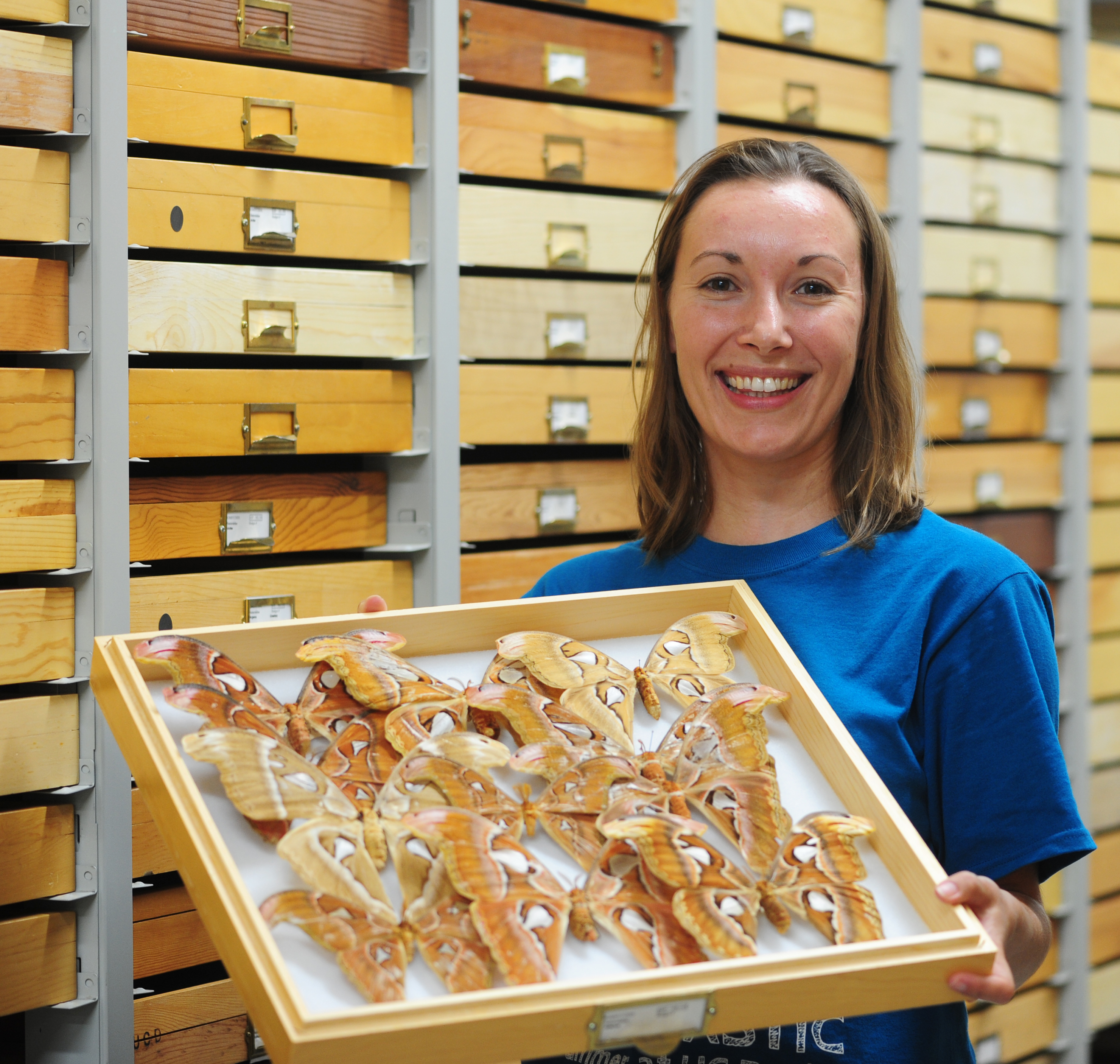
Photo of a woman holding a tray of moths

Jessica Gillung holding Atlas Moths at the Bohart Museum of Entomology. Photo courtesy: Kathy Garvey.

Gillung has been studying evolutionary biology since 2006. As a Master’s student in Brazil, her research focused on the family Acroceridae, or spider flies, which develop almost exclusively as endoparasitoids of spiders, their maggots living within a host spider while feeding on its internal fluids until they metamorphosize into adults, leaving a dead, dry host behind.

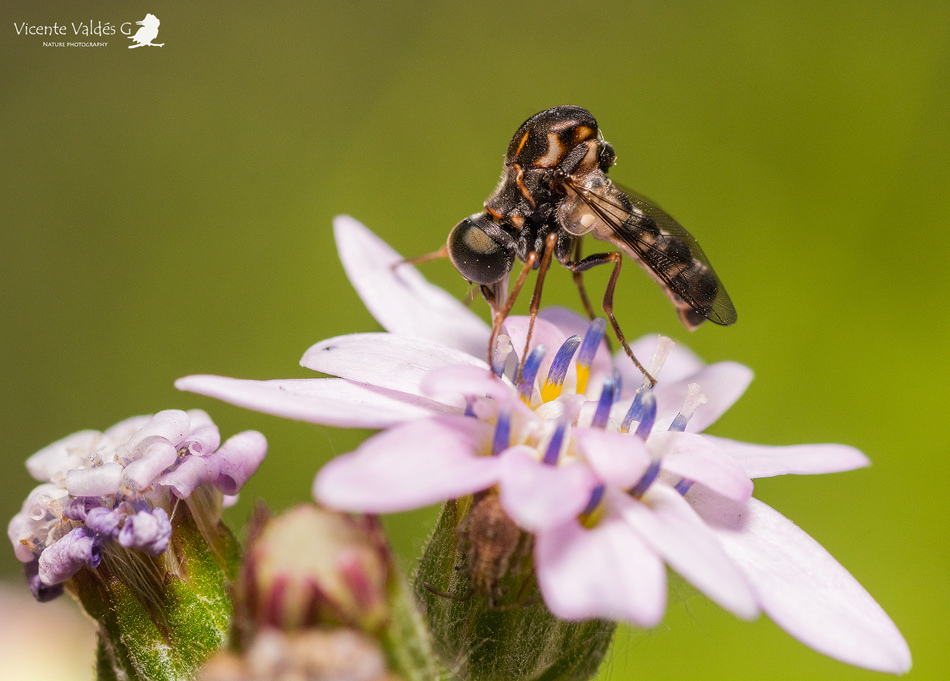
Photo of a spider fly on a flower.

A spider fly with a very hunchbacked appearance (species: Megalybus pictus). Photo courtesy: Vicente Valdés Guzmán.

It was during her time as a Master’s student ten years ago that Gillung first discovered BHL.

“I was looking for some ancient, specialized papers on spider flies, and a colleague sent me the link to the website. It changed my life! I was able to find pretty much EVERY single research paper I ever wanted, and I was able to study that literature very easily.”

Following the completion of her Master’s, Gillung moved to California to begin her PhD in the Department of Entomology & Nematology at University of California – Davis, where she also worked at the Bohart Museum of Entomology, one of the largest and most important natural history collections in the United States. She used BHL almost daily during this period, downloading whole and later custom PDFs of relevant publications and pages to her external hard drive, building a personal library of invaluable reference materials.

As she confided, “I downloaded pretty much EVERY work that has ever been published about the insect group I study.”

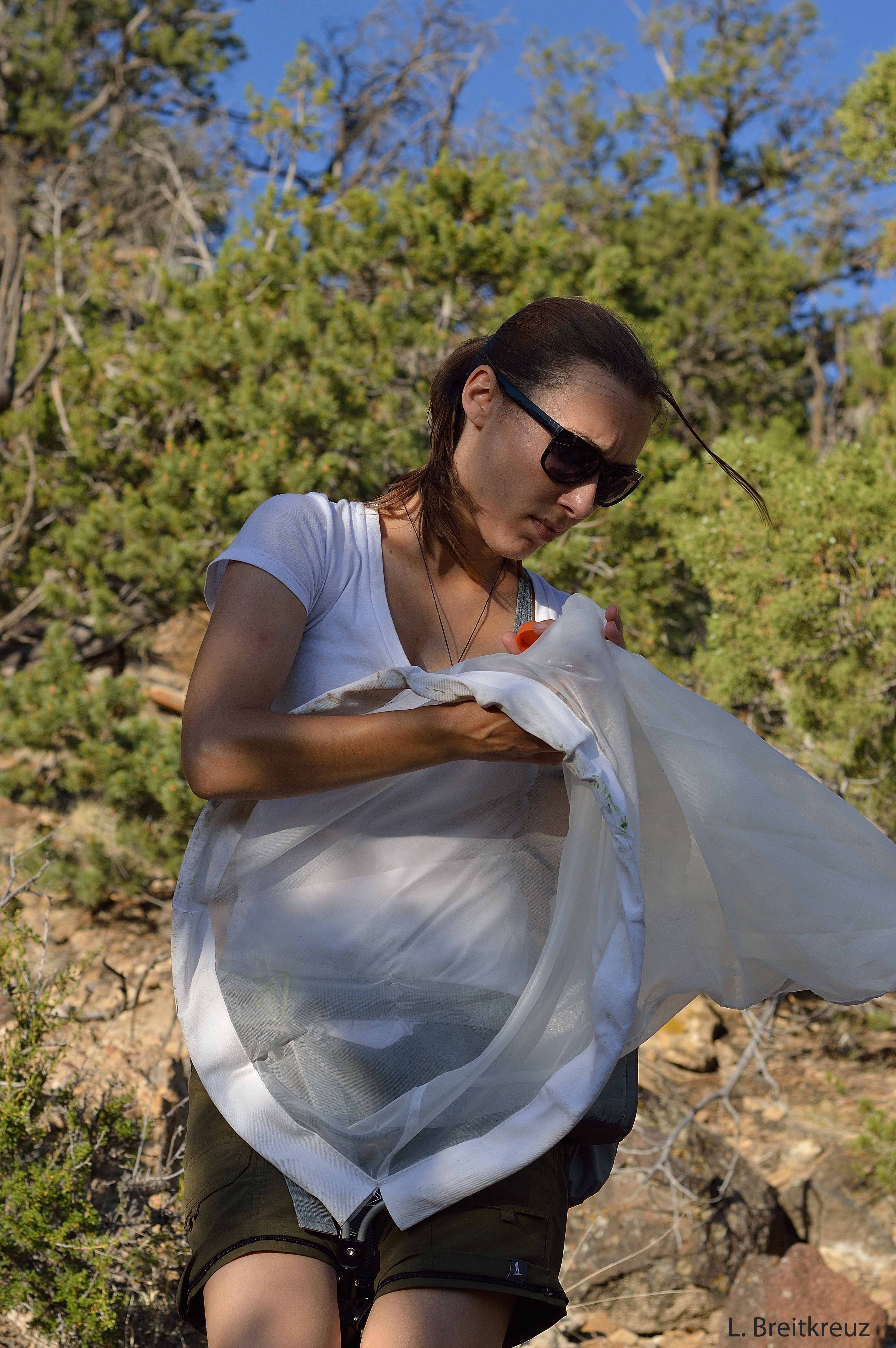
Photo of a woman collecting insects with a net.

Jessica Gillung collecting insects in the field. Photo courtesy: Laura Breitkreuz.

The ability to download PDFs from BHL has allowed Gillung to continue her research anytime, anywhere — even when Internet access is unavailable.

“I specifically remember one time I was stuck at the airport on my way to visit my family in Brazil,” recalls Gillung. “My flights were delayed, and I had long layovers. So, I started working on one of my scientific publications, and I was able to get plenty of work done because I had saved the PDFs beforehand. Had BHL not existed, that would not have been possible.”

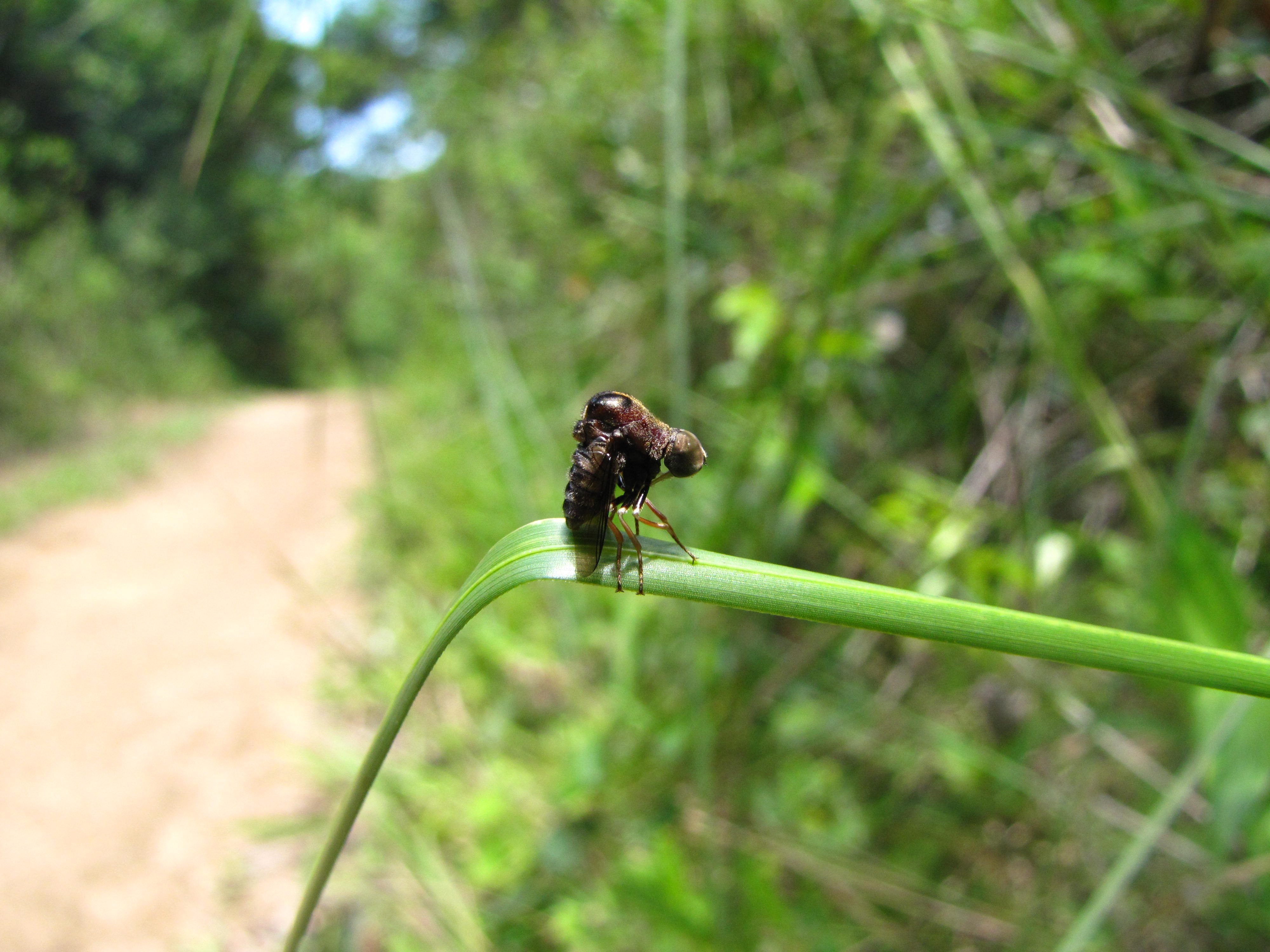
A photo of a spider fly on a blade of grass.

A specimen of Philopota tuberculata. Photo courtesy: Ricardo Kawada.

Of the over 240,000 volumes available in BHL, Gillung’s favorite is Wiedemann’s 1830 monograph on the “Flies from Outside of Europe” (Aussereuropäische Zweiflügelige Insekten). A German historian, physician, naturalist, and entomologist, Wiedemann described many new insect species, including the fly genus Philopota, which Gillung studied for her Master’s, during which she completed a revision of the genus. As part of the revision, Gillung re-described the known species, provided photographs and drawings for their identification, and described 13 new species from throughout Latin America.

“The library at my university did not have a copy of Wiedemann’s monograph,” recalls Gillung. “My progress was hindered until I was able to download the whole PDF from BHL. I fell in love with the website!”

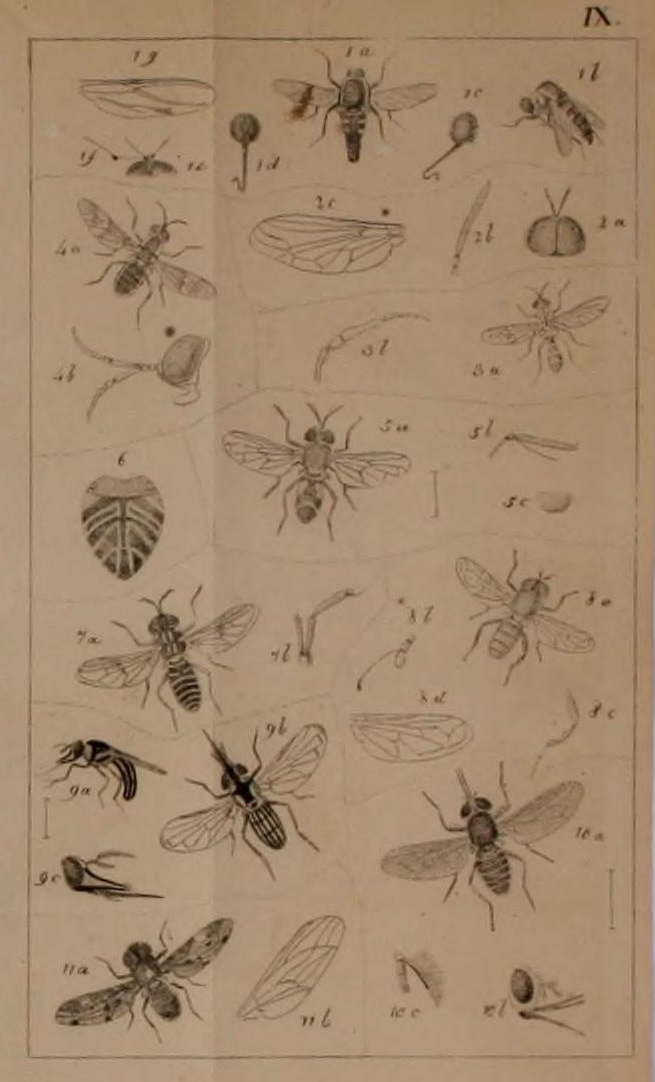
Illustration of flies.

Illustration from Wiedemann’s Aussereuropäische Zweiflügelige Insekten v. 2 (1830). Contributed in BHL from Smithsonian Libraries.

By providing free and open access to critical biodiversity literature, the Biodiversity Heritage Library is empowering global research. From enabling the description of new species to providing access to beautiful scientific illustrations (Gillung confides that one of her favorite pastimes is exploring the plates in the PDFs she’s downloaded), BHL has become an invaluable resource for researchers around the world.
To quote Dr. Gillung: “BHL has made my research possible.”

May 9, 2019by Grace Costantino
Page 8 of 71« First...«78910»203040...Last »

Help Support BHL

BHL's existence depends on the financial support of its patrons. Help us keep this free resource alive!

search

About BHL

The Biodiversity Heritage Library (BHL) is the world’s largest open access digital library for biodiversity literature and archives. BHL operates as a worldwide consortium of natural history, botanical, research, and national libraries working together to digitize the natural history literature held in their collections and make it freely available for open access as part of a global “biodiversity community.”

Join Our Mailing List

Sign up to receive the latest news, content highlights, and promotions.

Subscribe Now

Subscribe to Blog via Email

Enter your email address to subscribe to this blog and receive notifications of new posts by email.

Join 319 other subscribers

Subscribe to Blog Via RSS

Subscribe to the blog RSS feed to stay up-to-date on all the latest BHL posts.

Access RSS Feed

Inspiring Discovery through Free Access to Biodiversity Knowledge.

The Biodiversity Heritage Library makes it easier than ever for you to access the information you need to study and explore life on Earth…for free, anytime, anywhere.


64+ Million Pages of
Biodiversity Literature Online.

EXPLORE

Tools and Services
to Transform Research.

EXPLORE

300,000+
Illustrations on Flickr.

EXPLORE

ABOUT | HARMFUL CONTENT | PRIVACY | SITE MAP | TERMS OF USE