Biodiversity Heritage Library - Program news and collection highlights from BHL
  • Home
  • News
  • Featured Books
    • All Featured Books
    • Book of the Month Series
    • BHL at 20
  • User Stories
  • Campaigns
    • Fossil Stories
    • Garden Stories
    • Monsters Are Real
    • Page Frights
    • Her Natural History
    • Earth Optimism 2020
  • Tech Blog
  • Visit BHL
Home
News
Featured Books
    All Featured Books
    Book of the Month Series
    BHL at 20
User Stories
Campaigns
    Fossil Stories
    Garden Stories
    Monsters Are Real
    Page Frights
    Her Natural History
    Earth Optimism 2020
Tech Blog
Visit BHL
  • Home
  • News
  • Featured Books
    • All Featured Books
    • Book of the Month Series
    • BHL at 20
  • User Stories
  • Campaigns
    • Fossil Stories
    • Garden Stories
    • Monsters Are Real
    • Page Frights
    • Her Natural History
    • Earth Optimism 2020
  • Tech Blog
  • Visit BHL
Biodiversity Heritage Library - Program news and collection highlights from BHL
Blog Reel, User Stories

Unearthing Precambrian Protistan Taxonomy with BHL

Amoebozoans are believed to have existed for hundreds of millions of years. These ancient protists are characterized by the presence of pseudopodia, cytoplasm-filled projections that are used for locomotion and feeding.

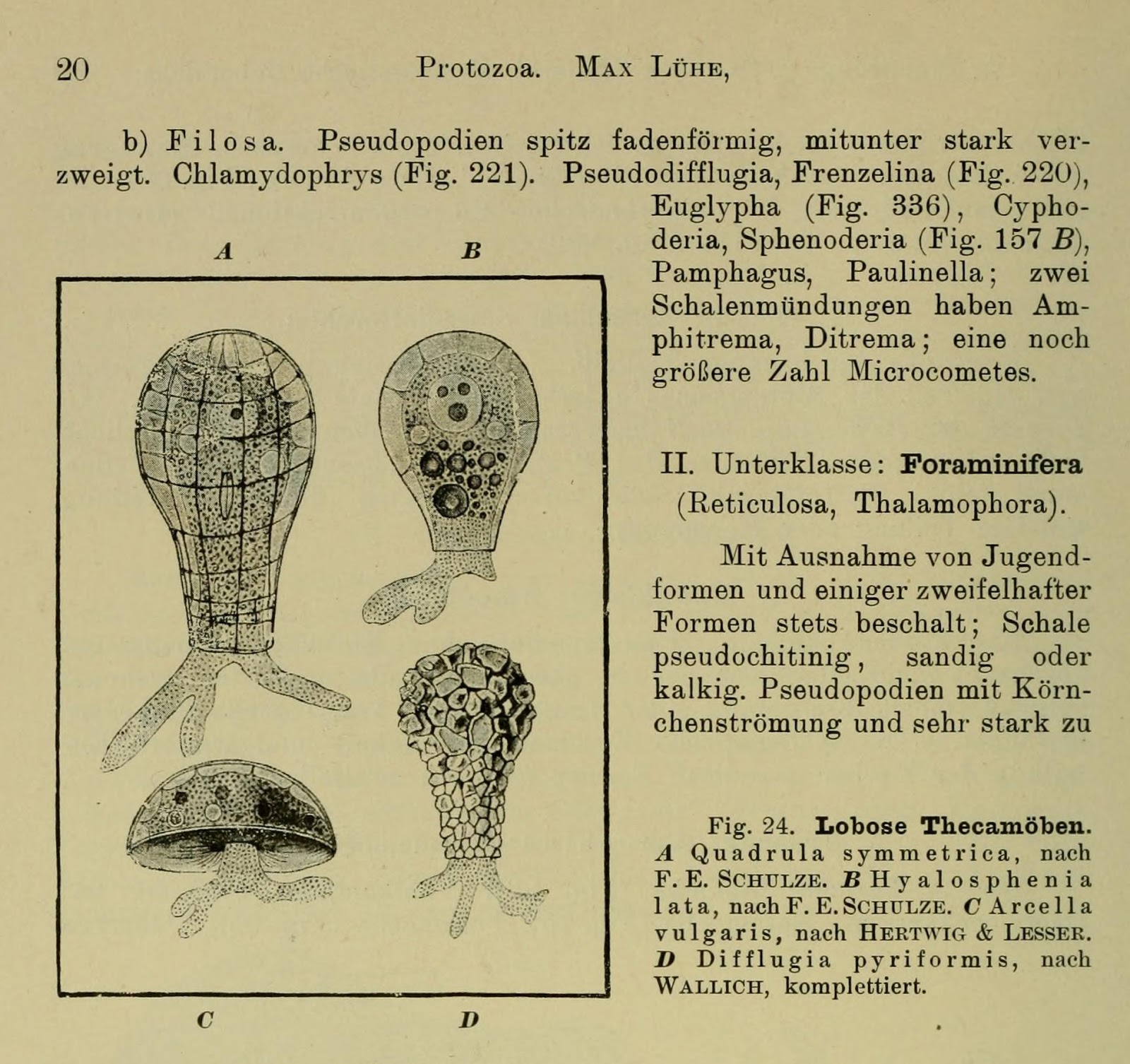
Today, over 2,000 species of Amoebozoa are recognized. The phylum itself was first scientifically described by Max Lühe, a professor at the University of Königsberg (Germany), in 1913.

Dr. Leigh Anne Riedman, a NASA Astrobiology Postdoctoral Fellow at Harvard University (Department of Earth and Planetary Sciences), specializes in Precambrian paleontology. Her research involves fossils similar to the testate amoebae described and illustrated by Lühe in 1913. However, Riedman quickly discovered that tracking down the reference for Lühe’s paper to support her studies was more challenging than anticipated.

“Many authors working on Amoebozoa would mention Lühe’s name, but I never found a single full reference for this paper,” recalls Riedman.
View Full Size Image
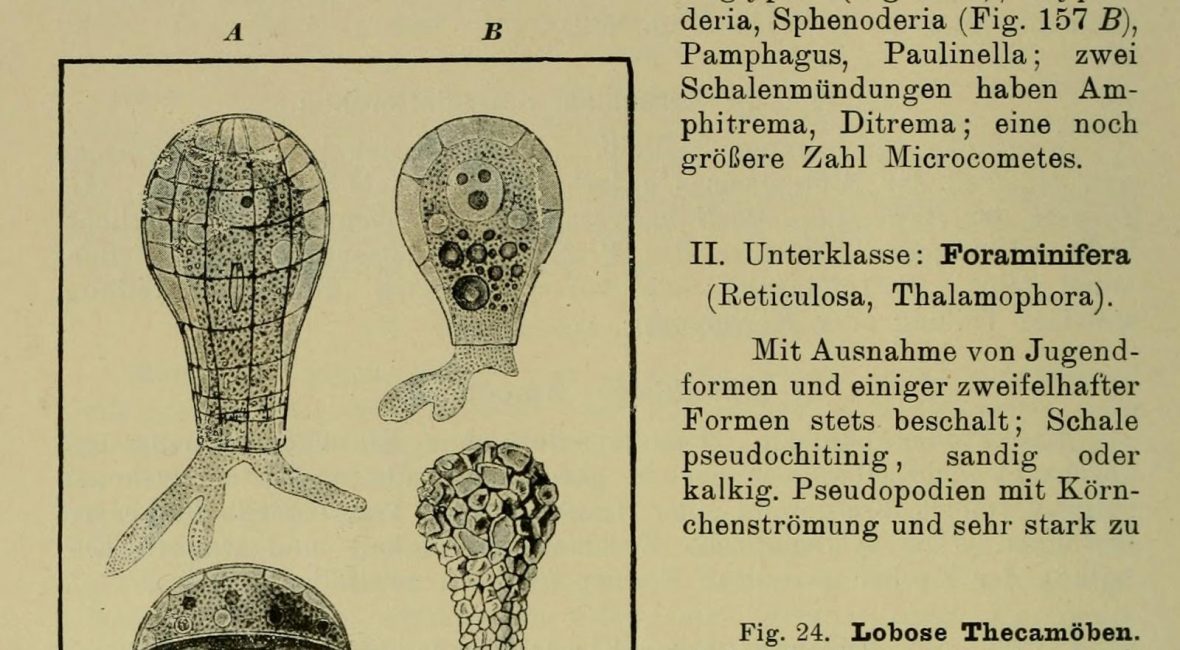
Testate amoebae described and illustrated by Max Lühe. Handbuch der Morphologie der wirbellosen Tiere. Bd. 1 (1913). Digitized by the American Museum of Natural History. http://s.si.edu/2tiM3BF.

Fortunately, with help of the Biodiversity Heritage Library, Riedman was able to unearth this crucial publication.

“Armed with only an author name and year, Lühe, 1913, and the keyword ‘amoeboa,’ I found it!” exclaims Riedman. “BHL was the only place I was able to track down this reference.”

Riedman cites this reference in her upcoming paper, “Vase-Shaped Microfossil Biostratigraphy with New Data from Tasmania, Svalbard, Greenland, Sweden and the Yukon”, which will be published in Precambrian Research later this year.
View Full Size Image
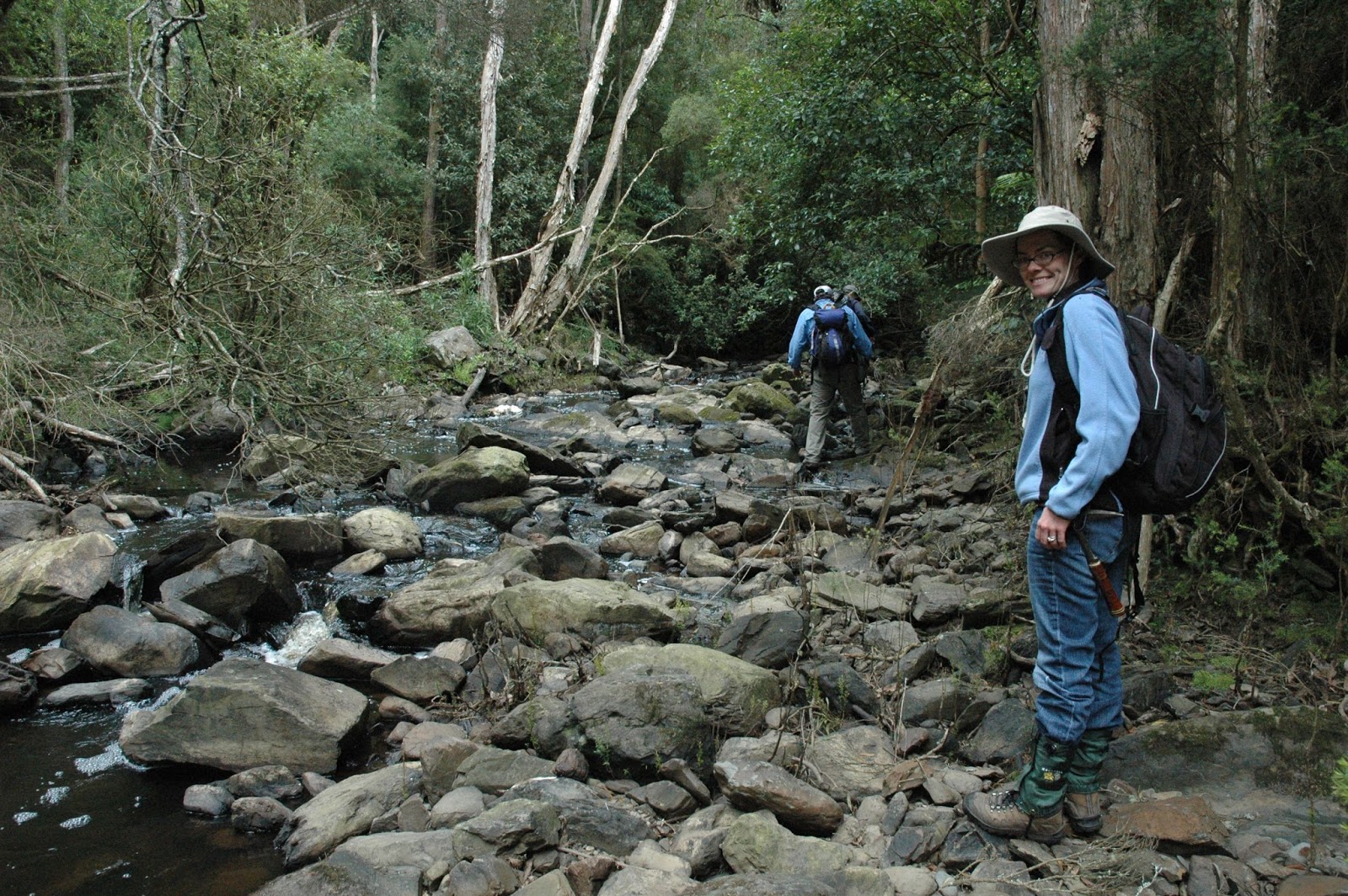
Dr. Riedman on a sampling trip to King Island, Tasmania in 2010. She and her colleagues collected materials for study of acritarchs from the Sturtian glaciation and the interglacial interval of the Neoproterozoic Snowball Earth as well as older fossils called vase-shaped microfossils that are thought to be fossil testate amoebae.

Riedman has been studying Precambrian paleontology for nearly two decades. Her work deals with a group of fossils called the acritarchs, organic microfossils that first appeared approximately 1,400 to 3,200 million years ago. Since first discovering BHL while searching for early taxonomic works on this group, the Library has become a vital part of Riedman’s research process.

“BHL is fantastic!” lauds Riedman. “It has made a huge difference in my work- sometimes providing access to texts I wouldn’t otherwise be able to get, sometimes by giving me the gift of my own time, as I don’t have to spend hours or days tracking down a resource, waiting on interlibrary loan, and then either scanning it for text recognition and translation or typing it into a translator piece-meal.”
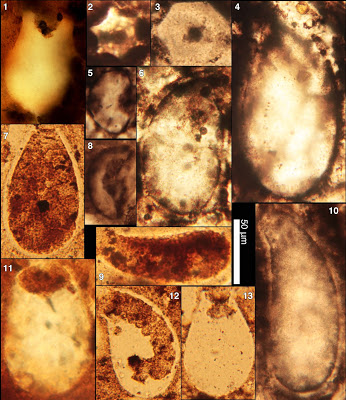
View Full Size Image
Vase-shaped microfossils from Tasmania. Likely about 760 million years old.

Using BHL several times per month, Riedman downloads PDFs of articles or books for use in fossil identification and synonymy lists. The ability to view the whole journal volume within BHL not only gives Riedman context for the article she is seeking, but also helps her find additional relevant articles in the process, thereby increasing the quality and efficiency of her research.

“There have been several times that I’ve used BHL to track down references listed in taxonomic synonymy sections that weren’t available anywhere else,” shares Riedman. “I am paranoid about citing a reference I’ve never read, so without getting access to those texts through BHL, I might have had to cut sections from research papers or sell my soul and cite a paper sight unseen gasp!”
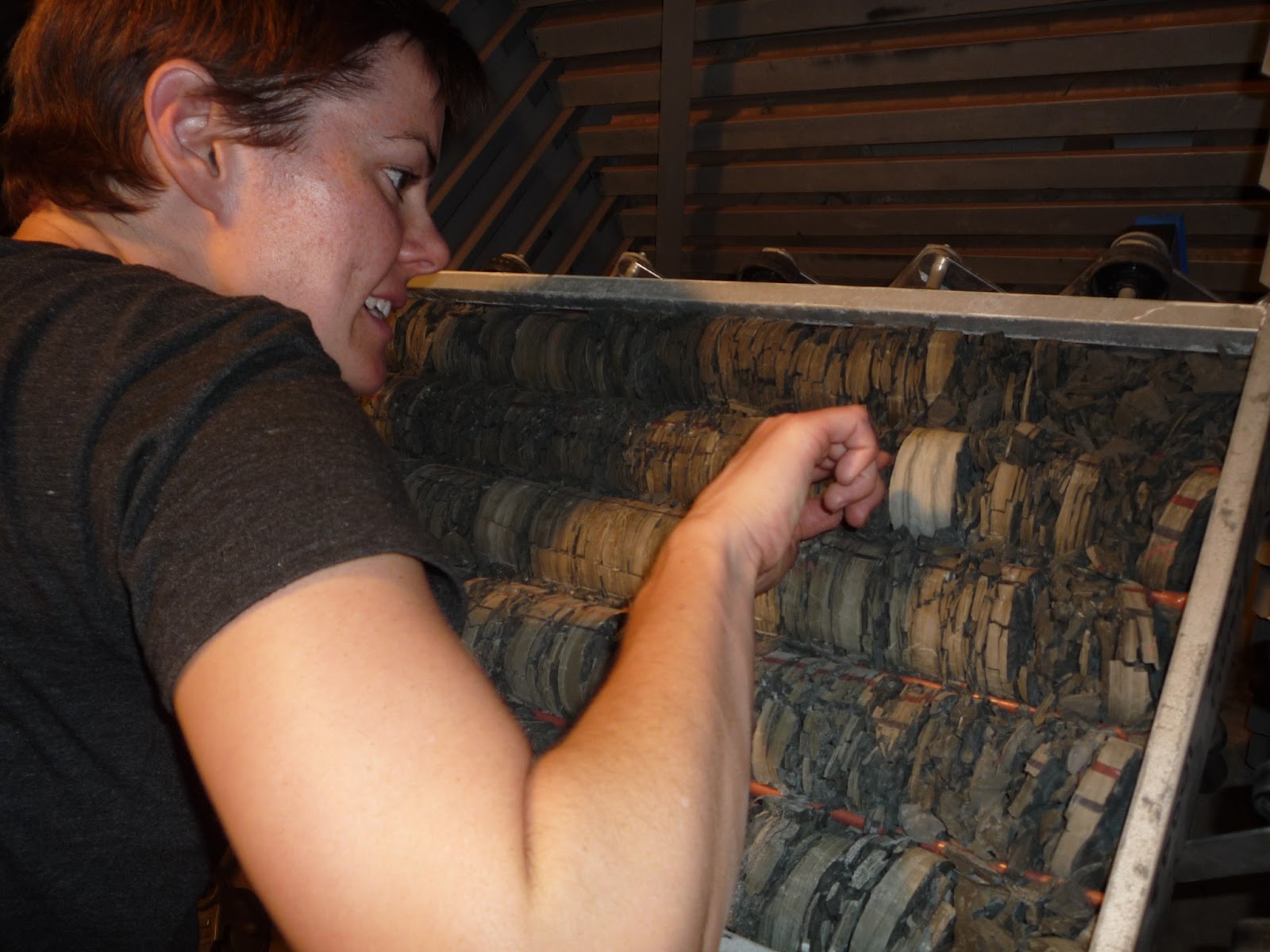
View Full Size Image
Dr. Riedman sampling drillcore in Alice Springs, Australia. These shale samples were placed into hydrofluoric acid to dissolve the rock- this process leaves the organic-walled fossils intact. Those are then studied by transmitted light microscope and scanning electron microscope.

In Riedman’s opinion, BHL is important not only for supporting modern scientific research, but also for ensuring that the work of past scientists is not forgotten.

“Many of the articles I’ve been able to access through BHL were written by pioneers in this field, like Tadas Jankauskas and Boris Timofeev, and their work deserves recognition (even if it is in a language other than English!),” emphasizes Riedman. “Our field is too young to be forgetting its past already. I am so glad to be able to gain access to more and more of these publications online.”
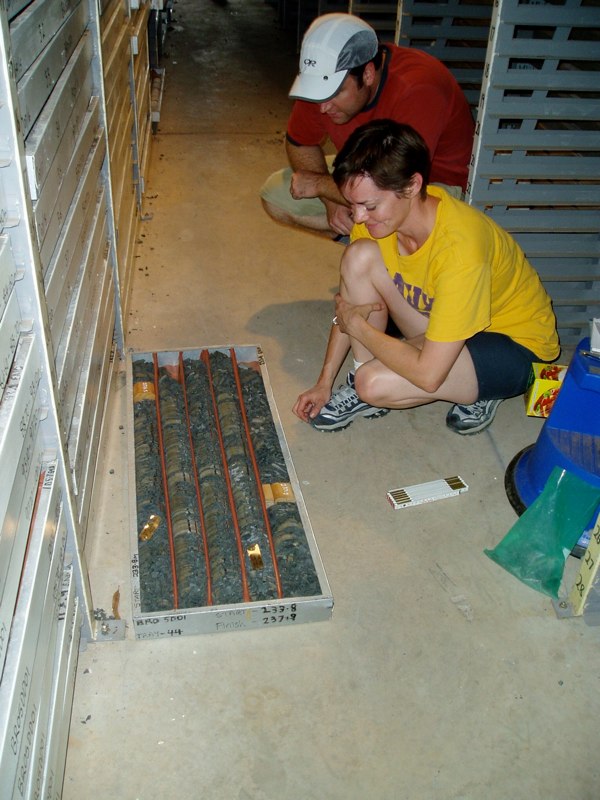
View Full Size Image
Dr. Riedman sampling drillcore in Darwin, Australia.

Through its worldwide consortium of natural history and botanical libraries, the Biodiversity Heritage Library is working to ensure that the published record of biodiversity knowledge is freely available to researchers across the globe. By making this content globally accessible to anyone with an Internet connection, BHL is helping to advance scientific research and inspire discovery of the natural world.

You can help support global research through a tax-deductible donation to BHL. With your help, we can continue to democratize access to information about biodiversity and empower scientific research on a global scale.

______________________________________

This post may contain the personal opinions of BHL users or affiliated staff and does not necessarily represent the official Biodiversity Heritage Library (BHL) position on these matters.
July 13, 2017by michelle.underhill
Blog Reel, User Stories

Old Literature, New Discoveries: BHL Supports Cutting Edge Whale Research

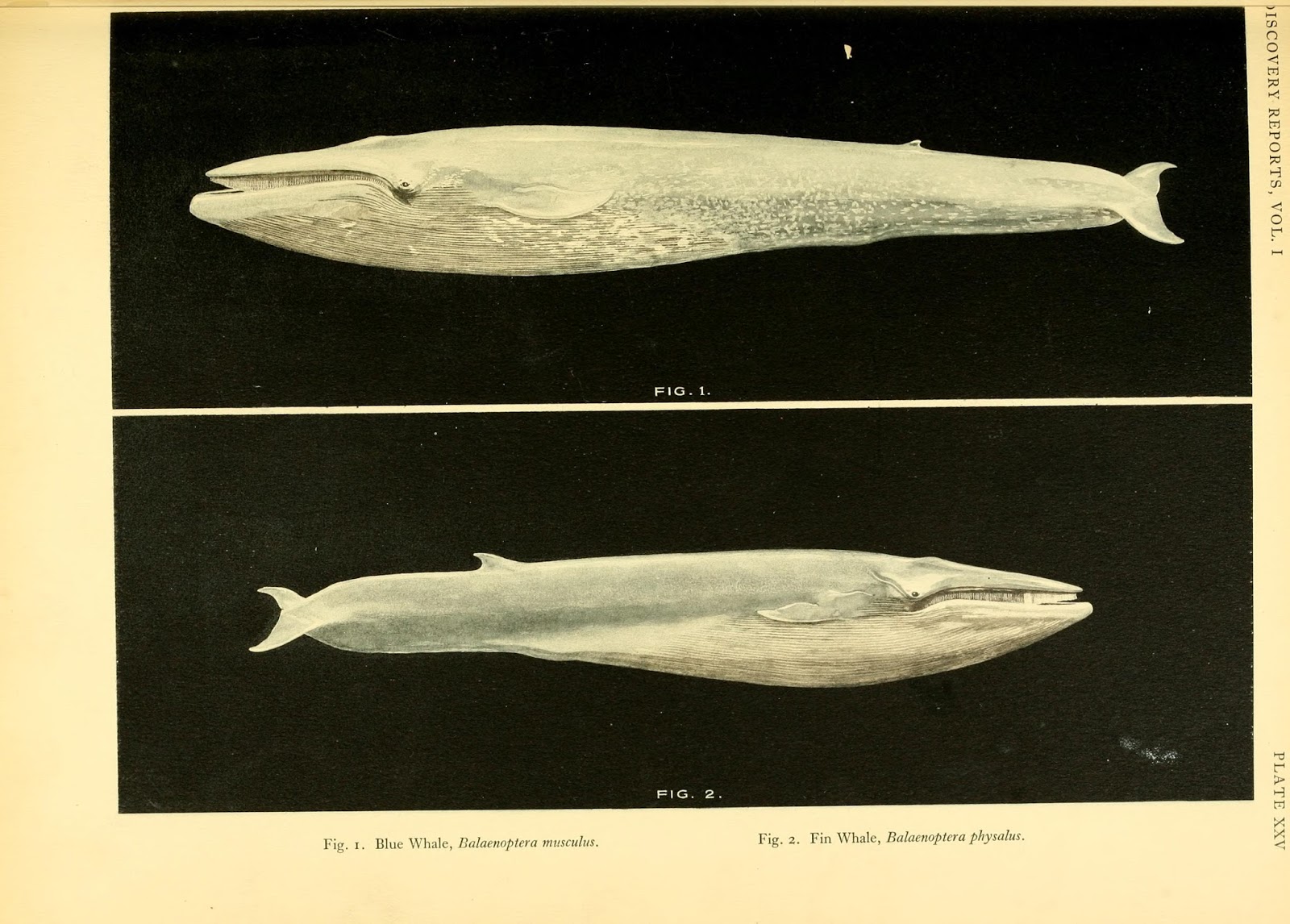
In the early 20th century, the British Colonial Office and the Discovery Committee of the British Government undertook a series of major investigations into the biology of whales in the Southern Hemisphere. Using ship- and shore-based equipment (including whaling stations on South Georgia Island operated by the UK and other nations), these Discovery Investigations, as they were called, significantly advanced human knowledge of whale morphology and ecology.

The results of the Investigations were presented within the 37 volume series entitled the Discovery Reports. Groundbreaking for their time, these Reports are still important for cetacean research today.

“The data collected and published in the Reports were unique because they represented, in every case, a one-time, time-stamped opportunity to record the precise dimensions, weights, gut contents and many other details gathered as part of whaling activities,” explains Dr. Nicholas Pyenson, Curator of Fossil Marine Mammals at the Smithsonian’s National Museum of Natural History (NMNH).

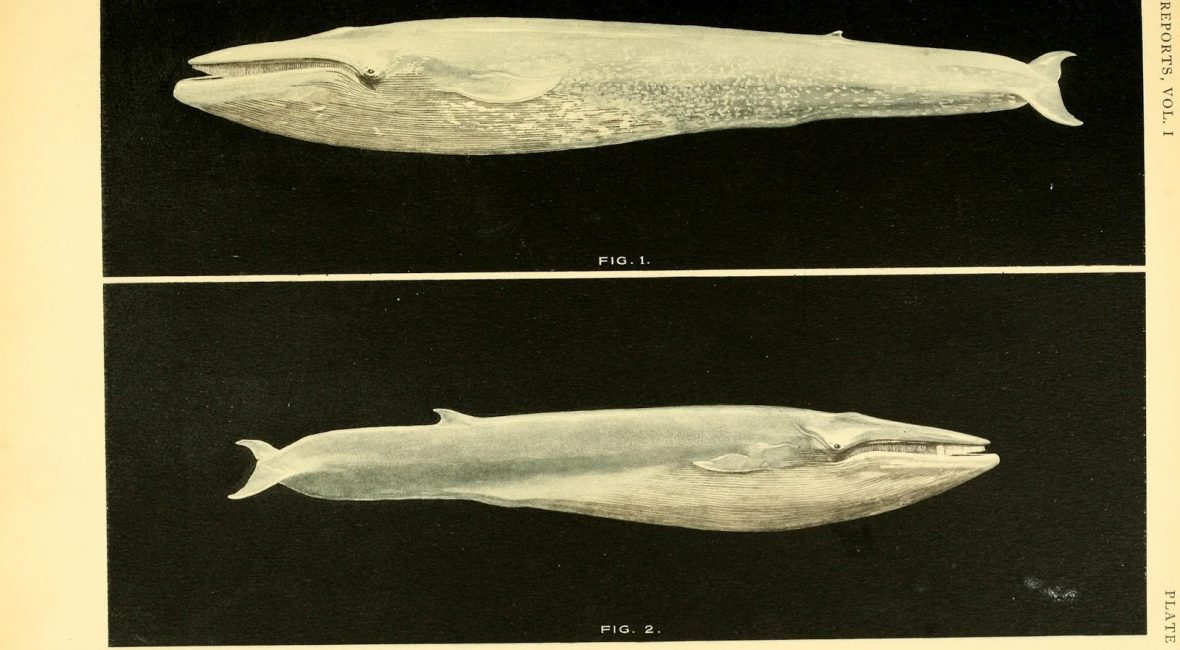
View Full Size Image
Mackintosh NA, Wheeler JFG (1929) Southern blue and fin whales. Discovery Reports 1:257—510. http://www.biodiversitylibrary.org/page/15917732. Digitized by Smithsonian Libraries.

Pyenson has used the data in the Reports to inform several recent studies. For example, he and colleague Simon Sponberg used data on total length and adult body mass for Southern blue and fin whales, published in 1929 as part of the Discovery Reports, to help develop and test regression methods for reconstructing the body size of extinct whales. Their findings, published in 2011 in the Journal of Mammalian Evolution, provided major insight into studying the evolution of cetacean body size.

View Full Size Image
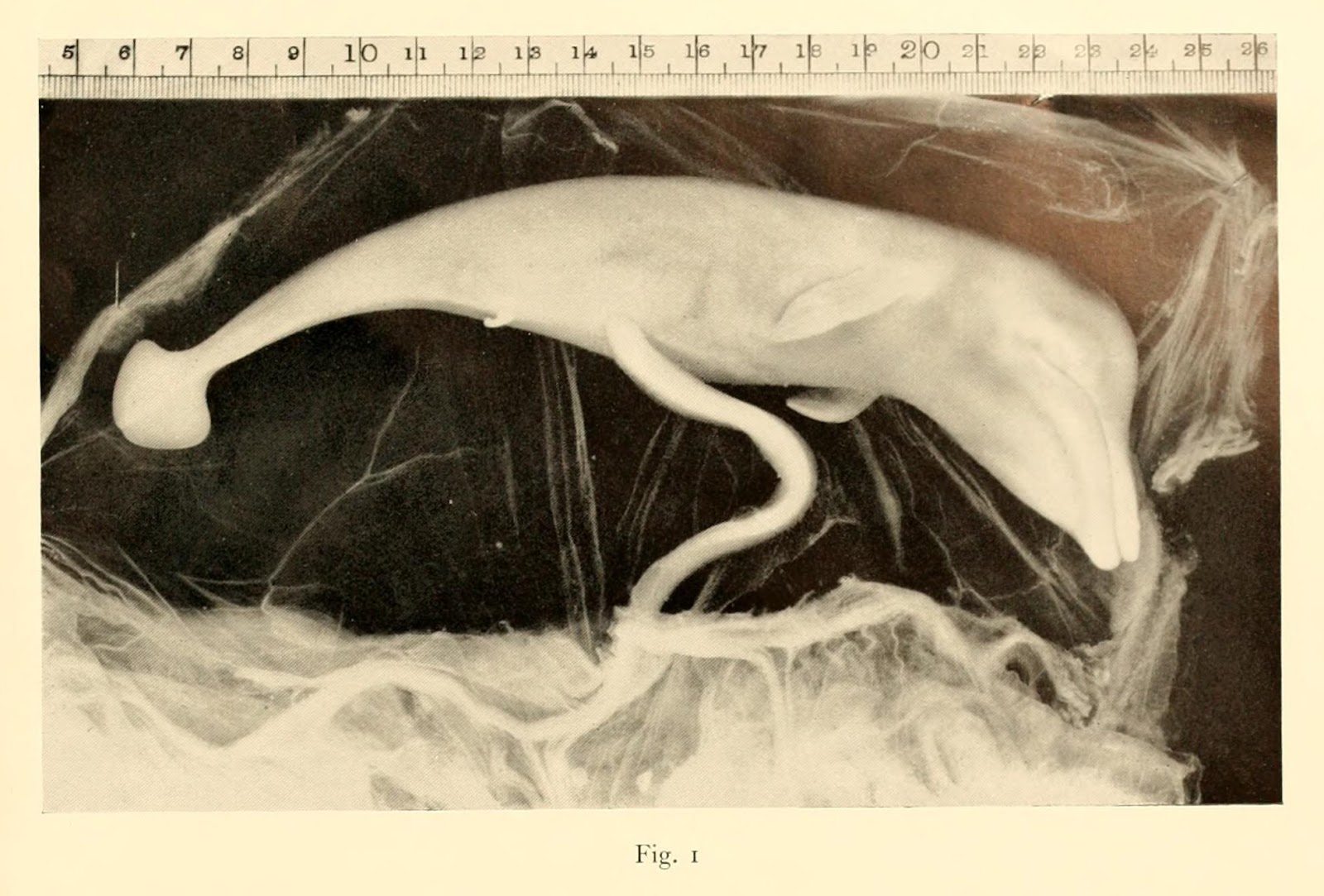
Fin whale fetus. Laws RM (1959) The foetal growth rates of whales with special reference to the fin whale Balaenoptera physalus Linn. Discovery Reports 29: 281–308. http://www.biodiversitylibrary.org/page/5569026. Digitized by MBLWHOI Library.

More recently, while researching the evolution of whale hearing, Maya Yamato and Pyenson used data on the fetal growth rates of whales, published in 1959 as part of the Discovery Reports, to gain insight into the maturation of the ear in baleen and toothed whales. Their research, published in 2015 in PLOS ONE, traces the development of an evolutionarily novel feature in cetaceans – the use of an acoustic funnel, rather than an ear canal, for hearing.

“The historic information in the Reports is so valuable for a variety of questions about the evolution, anatomy, and ecology of large whales,” asserts Pyenson.

View Full Size Image
Dr. Nicholas Pyenson. Selfie from a seakayak in Sitka Sound, Alaska.

Pyenson has been studying marine mammals and other marine vertebrates for over 15 years. He’s published pioneering research on the evolution and diversification of marine mammalian lineages and has used revolutionary techniques like 3D modeling to uncover new insights into the anatomy and transformation of this group. He’s even shared some of his research during past BHL-related events, including live webcasts for the #FWTrueLove and #FossilStories campaigns.

Pyenson’s scientific achievements, including the use of emerging digital tools to expand public access to fossils, earned him the coveted Presidential Early Career Award for Scientists and Engineers (PECASE). He is the first NMNH scientist to receive this award, which is the “highest honor bestowed by the United States Government on science and engineering professionals in the early stages of their independent research careers.”

While Pyenson has embraced many novel research techniques, the historic data found in publications like the Discovery Reports underpins much of his work. Thanks to the digital open access provided by the Biodiversity Heritage Library (BHL), it’s easier than ever to integrate these resources into modern research processes.

“As a free, mobile archive for natural history literature, BHL is ideal for 21st century research, which can happen on the field, in a museum, or at a coffee shop, as long as there’s internet connectivity,” lauds Pyenson.

Pyenson began using BHL nearly ten years ago, and over the past decade, it has had a major impact on his – and his colleagues’ – research.

“BHL supercharges the speed and efficiency of scholarly research, especially in the natural sciences where old literature sometimes contains the only information on a topic, taxon, geographic locality or collector,” says Pyenson. “And because BHL is open-access, I know firsthand that many of my international colleagues have dramatically better access to the literature covered in its database than more recent journals locked behind pay-walls.”

Pyenson uses BHL at least once a week, obtaining descriptions, measurements, and detailed views of morphology on fossil or modern specimens. The usability of the website, and the fidelity and quality of the scans, allow him to access and download information that is critical to his work.

“I think BHL’s interface is really wonderful. The links are crisp and easy to find and share. I especially enjoy the selectivity of being able to download just a few pages or only a specific article from an issue.”

View Full Size Image
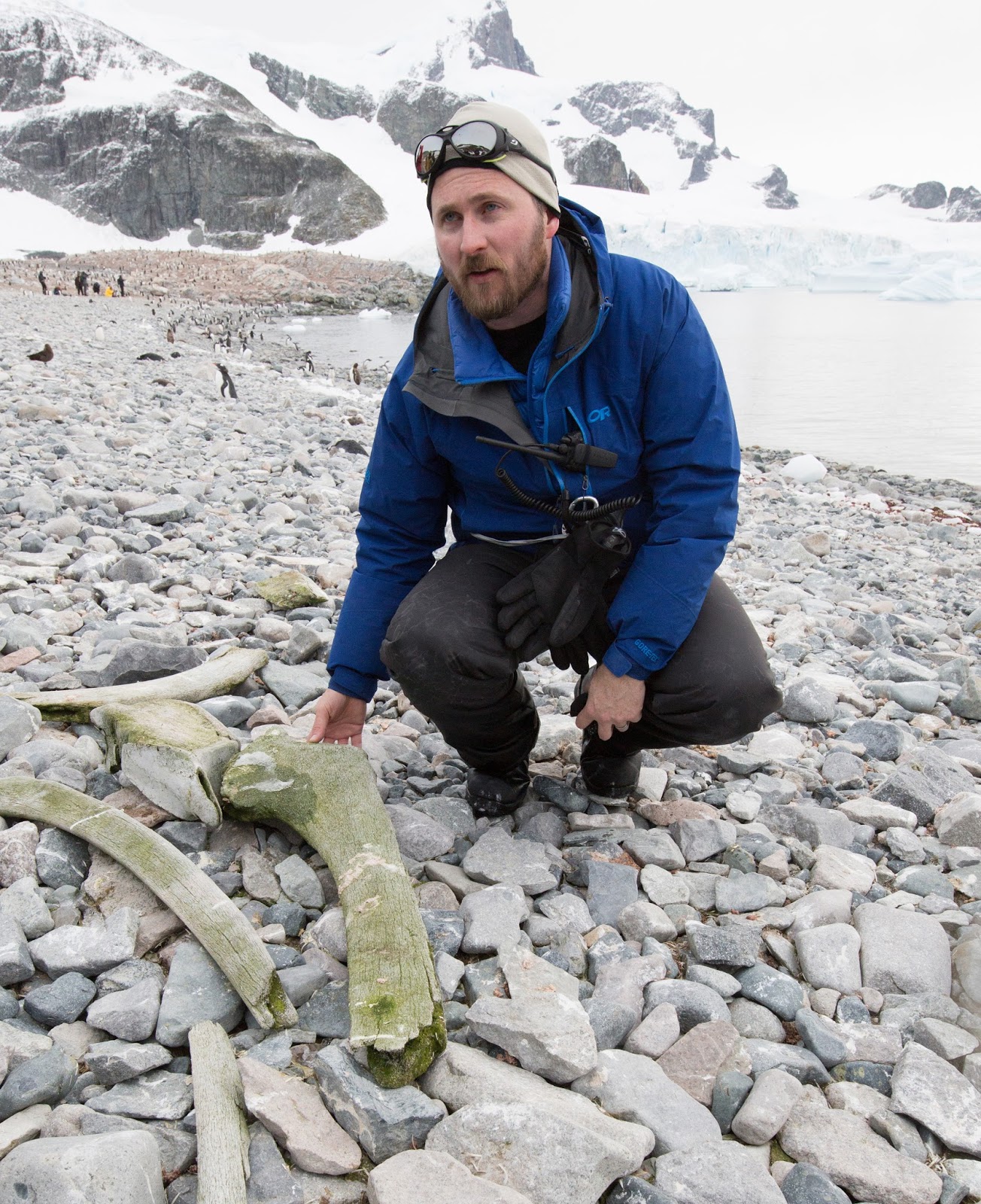
Dr. Nicholas Pyenson at Cuverville Island, Antarctica. Photo credit: Martha Stewart.

Given the significant impact that BHL has had on Pyenson’s work, he is anxious that more people be made aware of the vast abundance – and importance – of this free and open access collection.

“We need to get the word out. Old literature matters,” asserts Pyenson.

And matter it does. As Dr. Pyenson’s experience demonstrates, by providing a wealth of data on species morphology, phylogeny, and ecology, historic literature forms the foundation for the investigation of modern and ancient biodiversity. By making this content globally accessible to anyone with an Internet connection, BHL is helping to advance scientific research and inspire discovery of the natural world.

You can help support global research through a tax-deductible donation to BHL. With your help, we can continue to democratize access to information about biodiversity and empower scientific research on a global scale.

______________________________________

This post may contain the personal opinions of BHL users or affiliated staff and does not necessarily represent the official Biodiversity Heritage Library (BHL) position on these matters.
May 11, 2017by ulib-libraryjobs
Blog Reel, Featured Books

Ferrante Imperato: Step Into His Cabinet of Wonders!

Cabinets of Wonder: What Are They and Why Were They Created?

The term, “cabinet of wonder”, comes from the term “wunderkammer” (literally meaning “wonder chamber”).  The tradition of creating cabinets of wonder began during the Renaissance, the period of time between the 14th and 17th centuries.

In England and France, these cabinet of wonder collections were called “cabinets” or “curiosity cabinets”.  German speaking countries called the collections a variety of more specific terms: kunstkammer (“art cabinets”), schatzkammer (“treasure cabinets”), rüstkammer (history cabinets), and eventually wunderkammer (“marvel or curiosity cabinets”).  People during the Renaissance referred to these collections generically using the terms “wunderkammer” or “curiosity cabinet” interchangeably.

View Full Size Image
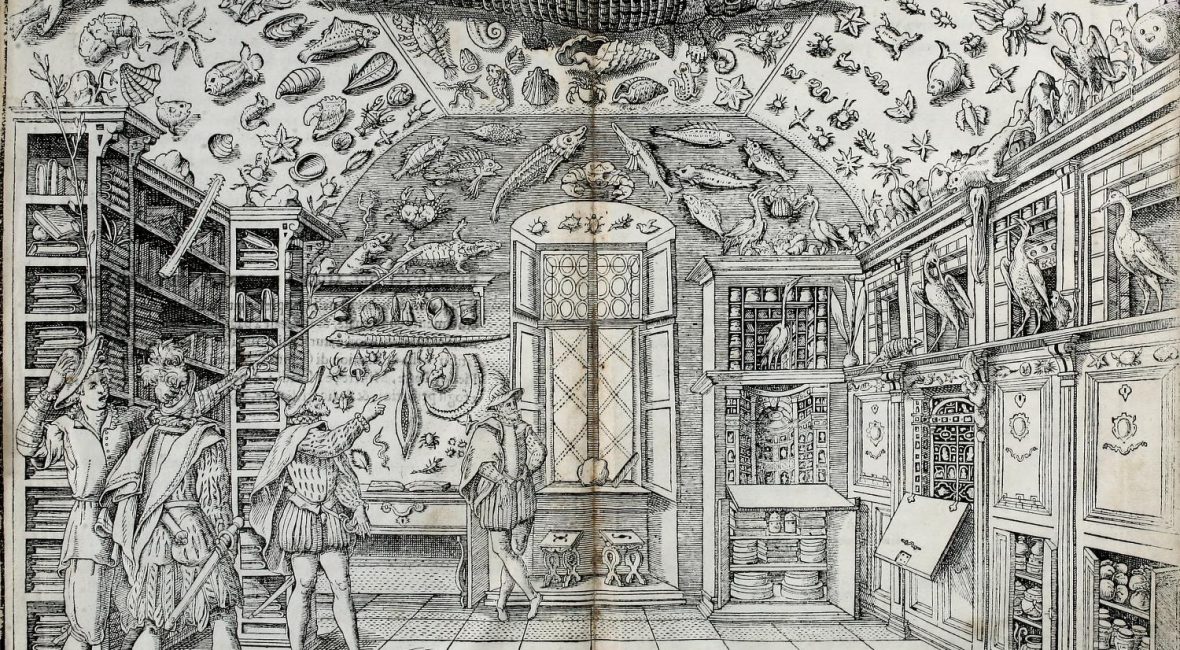
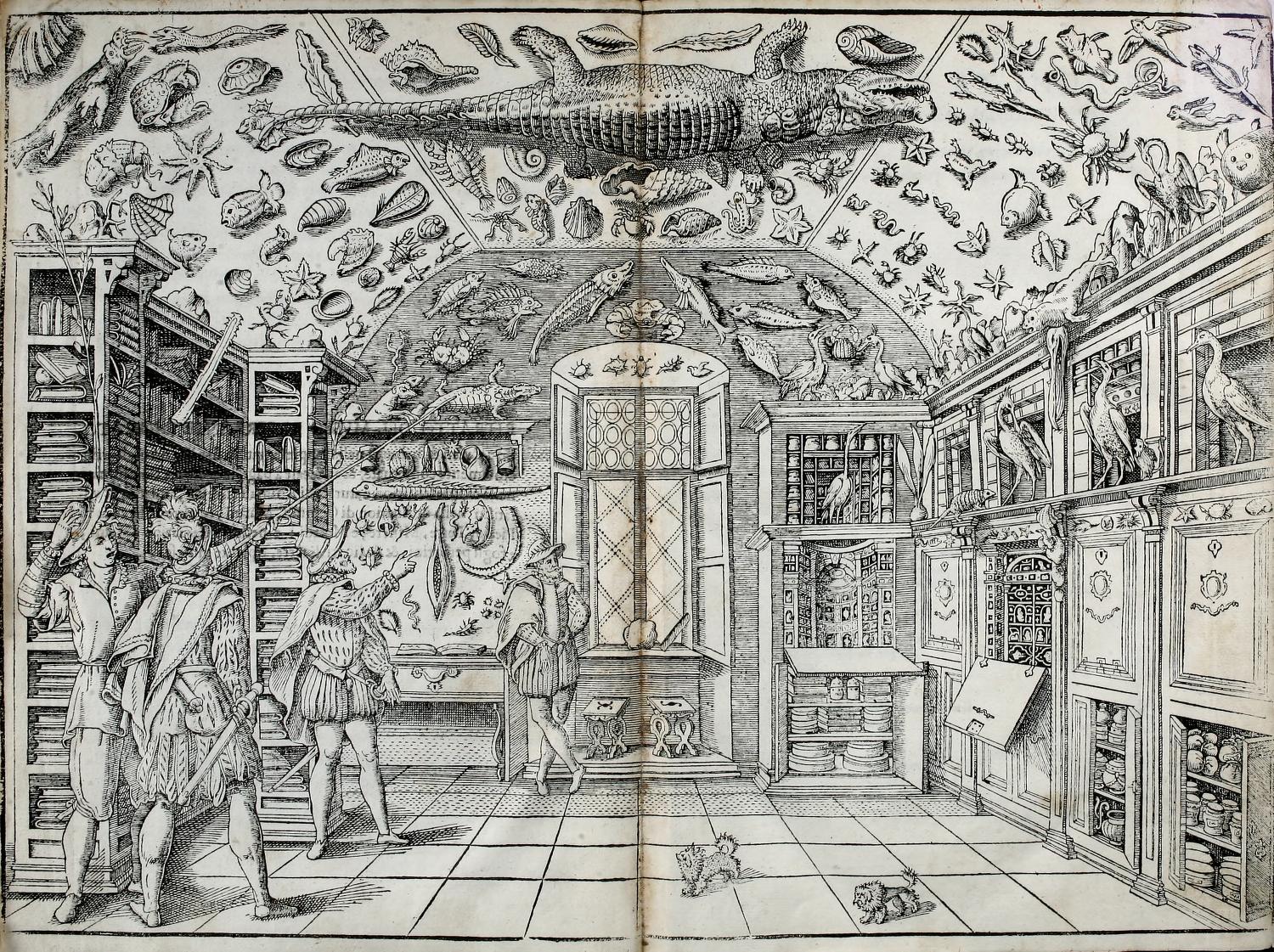
The first published pictorial representation of a Renaissance cabinet of curiosity in Ferrante Imperato’s Dell’historia Naturale. (Image digitized by Smithsonian Libraries.)

The Renaissance idea of creating a collection of (formerly) animate, inanimate, and botanical objects, and even odd specimens, came from a human desire to place mankind somewhere within the larger scheme of things.  Formerly, European princes built their own private studiolo or cabinets, which contained rare natural objects and books, and acted as status symbols to impress others.  Then the cabinets came to be used for scientific observation and contained more humble–but important–natural objects and specimens.  During the Renaissance, theorists from all fields of academia were making new scientific and philosophical discoveries, and realized that all of this new knowledge sometimes challenged previous beliefs about existence and mankind’s place within it.

View Full Size Image
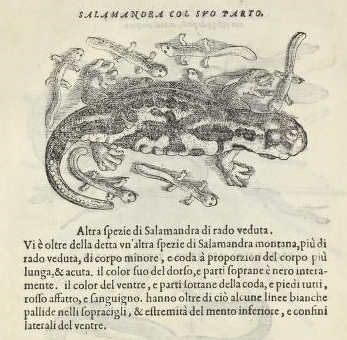
Salamander, from Ferrante Imperato’s Dell’historia Naturale (1599). Digitized by Smithsonian Libraries.

Different from modern museums, wunderkammer were generally created by a single scholar: in our example, Ferrante Imperato (1550-1625), an apothecary and scholar living in Naples.  In addition, the objects were believed to be interconnected by some singular purpose that could shed light on man’s place within existence.

Humanism was one of the most predominant movements in Italy during the Renaissance, and some humanists believed, among other things, in a notion of universalism–the idea that all things and all people were connected by some shared visible and/or invisible similarities, and all created by the divine.

The Renaissance humanists endeavored to use reasoning to explain unknown aspects of nature, which developed into the study of natural history: empirical observations and experimentation were used to make conclusions about the physical world.  Thus the Renaissance, and the creators of cabinets of wonder, were important in setting the stage for extraordinary advances in scientific knowledge in the decades following.

View Full Size Image
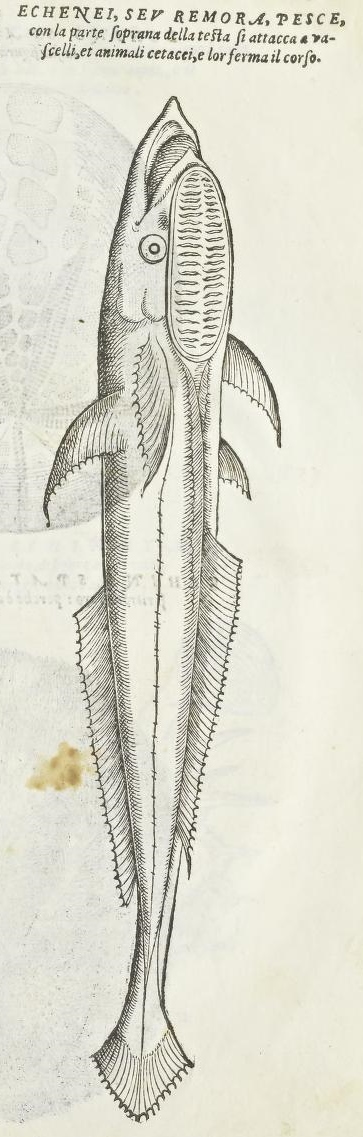
Remora fish, from Ferrante Imperato’s Dell’historia Naturale (1599). Digitized by Smithsonian Libraries.

What Were the Beliefs of Some Creators of Cabinets of Wonder, and Why Was Ferrante Imperato So Important?

Some creators of cabinets of wonder used for scientific observation and experimentation were pietistic, and stressed living a good and helpful life.  For this reason, the cabinets’ creators often wrote of their collections and made them open to the public to make people aware of the beauty of nature and the usefulness of natural objects.  The creators would also observe and experiment on items in their collections in an endeavor to increase knowledge of all aspects of the world.  Additionally, creators of cabinets of wonder often corresponded with, and visited, one another and discussed their collections and findings to increase the collective knowledge about the natural world and existence.

In this vein of sharing knowledge, Ferrante Imperato was convinced by his son, Francesco, and by his own friends, to produce a written account of his cabinet of wonder, in the form of the 28 books which comprise his work Dell’historia Naturale.  The majority of the work’s books are concerned with stones, minerals, gems and earth (i.e., minerology and related fields).  The last two books deal with living organisms: plants and animals.  Imperato especially featured and worked with herbs used to create medicines as an apothecary.

The first version of Dell’historia Naturale, printed in 1599, totaled 791 pages between the 28 books that comprised it, with 119 woodcut illustrations interspersed throughout the text.  One of the first European natural history research collections, Imperato’s cabinet may have contained as many as 35,000 plant, animal and mineral specimens.  Imperato quoted other authors at the beginning of his subject sections and discussed what he thought of the authors’ ideas, and then launched into his own beliefs about the subjects based on his experimentation on, and observation of, specimens in his cabinet of wonder.

View Full Size Image
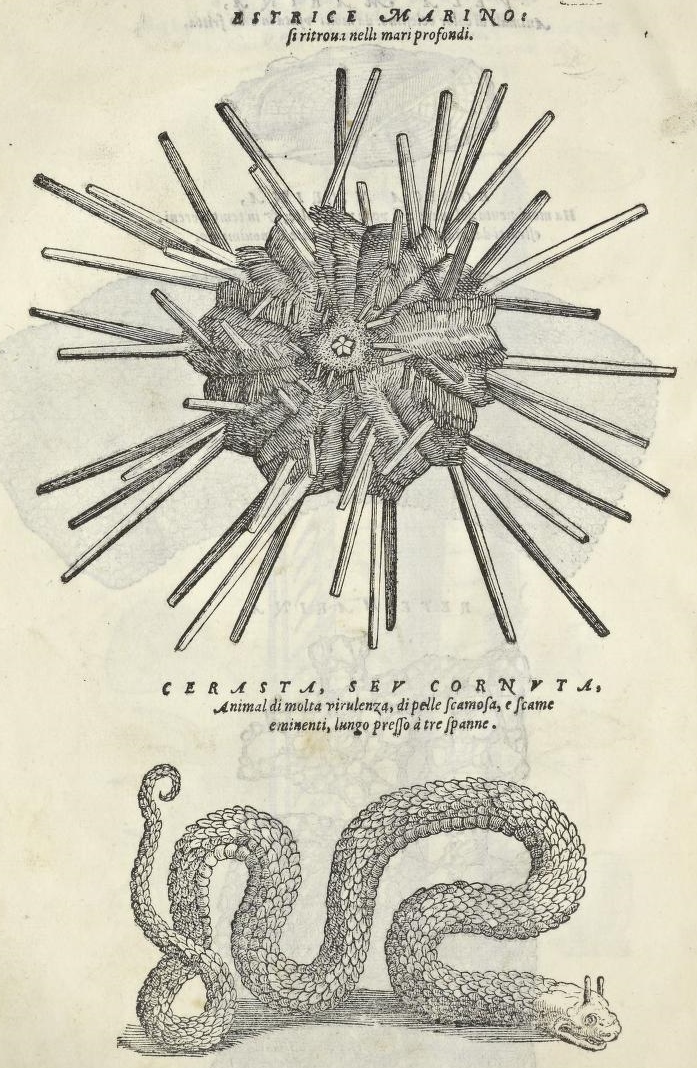
Marine creature and Horned Viper, from Ferrante Imperato’s Dell’historia Naturale (1599). Digitized by Smithsonian Libraries.

Many creators of these cabinets were drawn to collecting specimens in an endeavor to make life more comfortable for people in acts of piety, either by collecting herbs and natural materials like Imperato did in order to create medicines, or by collecting natural materials believed to be alchemical or metallurgical in order to experiment with new recipes (“segreti”, or “secrets”) to ease human ailments. Sometimes piety, however, was considered heretical by the Catholic Church in Italy at this time due to pietism’s emphasis on individual religious devotion (which leaves room for the idea that the Church may not be needed).

Imperato’s friend and scientific rival, Giovanni Battista Della Porta, who practiced pietism, created the Academia Secretorum Naturae (“Accademia dei Segreti”), which translates to “The Academy of the Mysteries of Nature”, in order to study and share information about natural science with like-minded scholars.  In 1579, Della Porta’s Accademia was accused of sorcery and disbanded by the Pope.

View Full Size Image
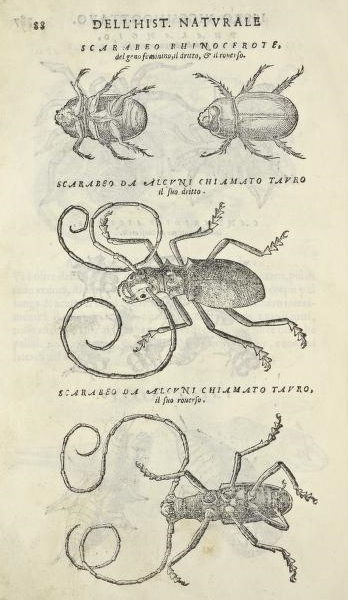
Insects from Ferrante Imperato’s Dell’historia Naturale (1599). Digitized by Smithsonian Libraries.
View Full Size Image
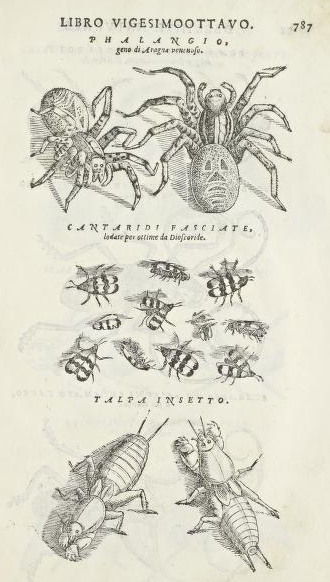
Arachnids and other insects from Ferrante Imperato’s Dell’historia Naturale (1599). Digitized by Smithsonian Libraries.

Some humanist scholars did, in fact, possess objects in their cabinets of wonder believed to have magical properties based on arcane knowledge, and these items included magical lanterns, speaking tubes, and distorting mirrors.  So the humanist sharing of “secrets of nature” did include, for some, secret of a magical (heretical) sort.

Imperato saw his cabinet of wonder as a place to derive knowledge directly from the artifacts before him, rather than trying to apply secret knowledge from arcane ancient and contemporary manuscripts to the objects in order to try and produce a result, like other scholars of his time, such as Girolamo Ruscelli (who had his own Accademia Segreta).

When Imperato’s Dell’historia Naturale was being printed in 1599, and more people knew about the pietism, and beliefs in magical properties of some items in some cabinets of wonder, Imperato’s son, Francesco, feared his father’s text might lead to heresy charges.  Francesco thus quickly printed another shorter version of his father’s text with many references to saints and Christian writers.

Imperato was not charged by the Church with heresy or sorcery when his full text, in all 28 books, came out, and this text became the first to feature an illustration of a cabinet of wonder, and the first work on natural history completely written in Italian (rather than scholarly Latin).

View Full Size Image
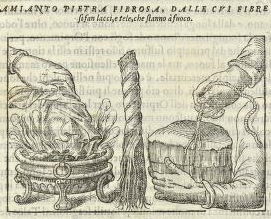
An experiment with asbestos, from Ferranto Imperato’s Dell’historia Naturale (1599). Digitized by Smithsonian Libraries.

Interesting Facts:

Some of the scholars and knowledgeable men with whom Ferrante Imperato corresponded included: Ulisse Aldovrandi, Gaspard Bauhin, Pierandrea Mattioli, and Fabio Colona.

Imperato was amazed by asbestos, which was a relatively new substance at the time, with paradoxical and malleable qualities.  Imperato experimented with asbestos and included an illustration of one of his experiments with it in Dell’historia Naturale (fig. 18)–the only experiment depicted in the work.

In order to argue that a toad’s skull was actually a stone unlike any other natural stones, Imperato captured a pregnant viper and gathered many toads to prove that the viper could not penetrate the toad’s skull, and called the toad’s skull “toadstone” (pietra di rospo).

In 1611, Galileo demonstrated for other scholars the luminescent nature of a stone called the “Bologna stone” (lapis Bononiensis), or the “solar sponge”.  When Imperato heard about this stone, he was fascinated but thought it qualified as natural magic and claimed: “I believe that it is not natural but artificial”.

Cabinets of wonder often included fossils–Imperato had many–and humanist debate in Italy in the early fifteenth century led to subsequent discussions about what the existence of fossils meant; European students visiting Italy spread this debate throughout many regions when they returned to their home towns.

Ferrante Imperato’s Dell’historia Naturale contains medical folklore such as the ideas that wearing amethyst in the navel prevents drunkenness, sapphire cleans the eyes in such a way as to prevent lust, and jasper worn as an amulet can stop bleeding.

References:

Dion, M. (n.d.). History of the wunderkammern (cabinet of curiosities). Mark Dion: Tate Thames Dig. Retrieved from http://www.tate.org.uk/learn/online-resources/mark-dion-tate-thames-dig/wunderkammen

Duffin, C.J., Moody, R.T.J., & Gardner-Thorpe, C. (Eds.). (2013). A history of geology and medicine. Geological Society: Special Publication, 375, 23-24.

Findlen, P. (1994). Possessing nature: Museums, collecting, and scientific culture in Early Modern Italy. Berkeley, C.A.: University of California Press.

Grice, G. (2015). Cabinet of curiosities: Collecting and understanding the wonders of the natural world. New York, N.Y.: Workman Publishing.

Guitard, E. (1937). Ferrante Imperato. Revue d’histoire de la pharmacie, 25(100), 196.

Mottana, A. (n.d). The first modern translation of Theophrastus’ “On Stones” (pi epsilon rho Anot sign lambda AI omega I1/2; De lapidibus): Ferrante Imperato (1599). Rendiconti Lincei-Scienze Fisiche E Naturali, 21(1), 1-25.

Philippe, J. (2003). Les curiosités de trois apothicaires. Revue d’histoire de la pharmacie, 91(340), 603-610.

Rosenberg, G.D. (Ed.). (2009). The revolution in geology from the Renaissance to the Enlightenment. GSA Memoir Series, 203, 84.

Vai, G. B., & Cavazza, W. (2006). Ulisse Aldrovandi and the origin of geology and science. The origins of geology in Italy: GSA special papers, 411, 43-63.

March 13, 2017by micahv
Blog Reel, User Stories

Supporting Historical Paleontological Research

View Full Size Image
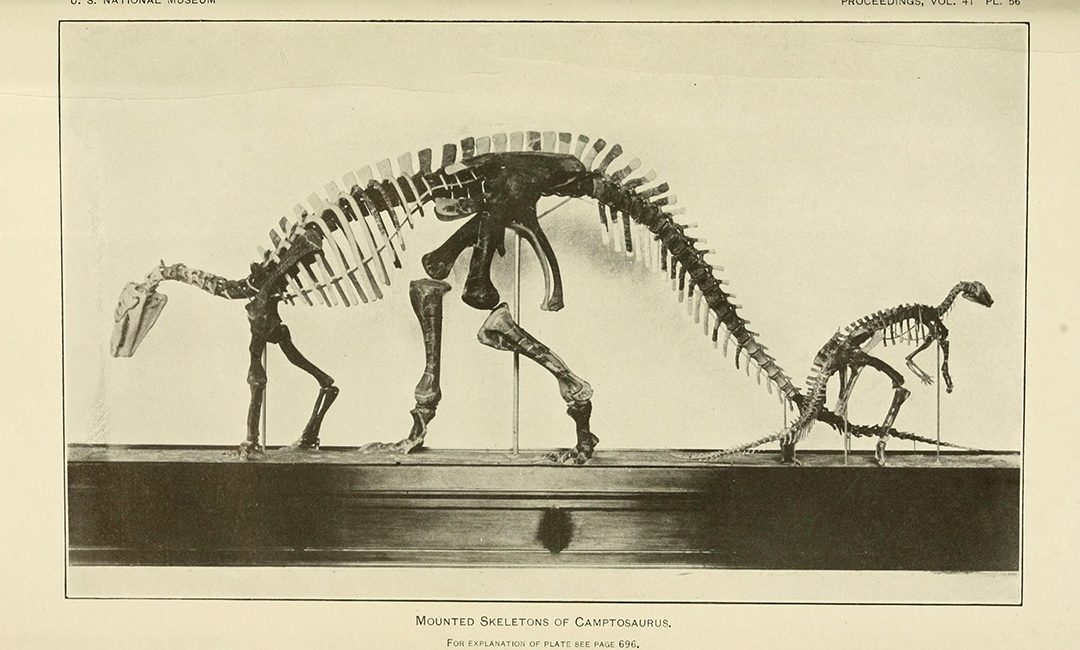
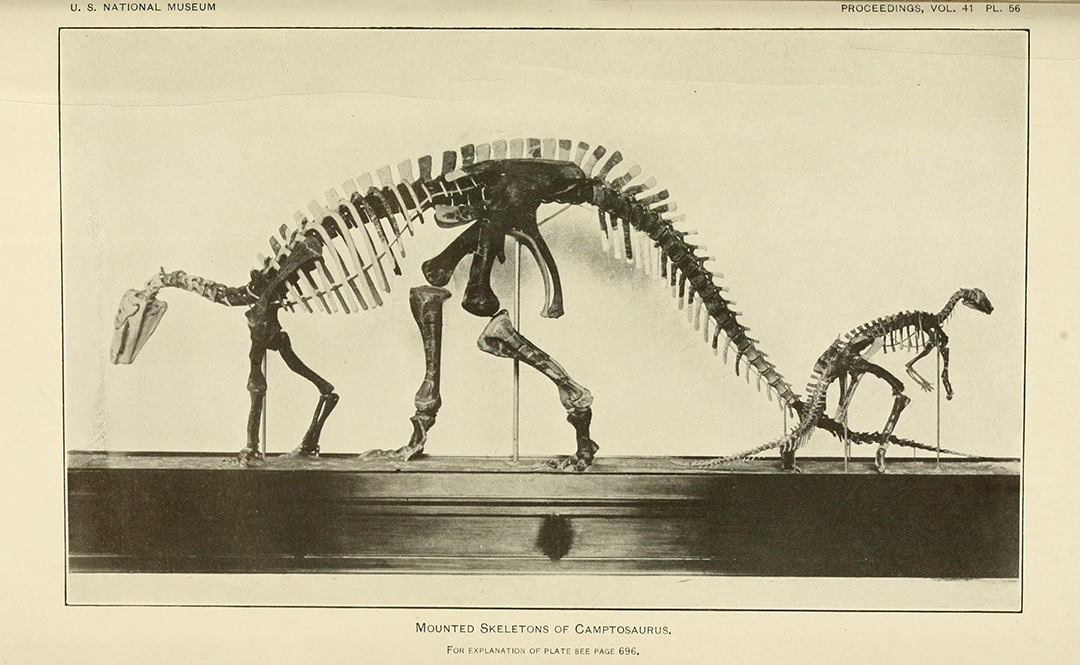
World’s first large mounted Camptosaurus skeleton at the National Museum of Natural History. Proceedings of the United States National Museum. v. 41 (1912). Digitized by Smithsonian Libraries. http://biodiversitylibrary.org/page/29866417.

In 1911, the Smithsonian Institution debuted the world’s first large mounted Camptosaurus skeleton at its newly-opened Natural History building. The display featured two specimens erected side-by-side, one identified as Camptosaurus nanus and the other as Camptosaurus browni.

Camptosaurus, whose name means “flexible lizard,” was a plant-eating, beaked dinosaur that lived during the Late Jurassic period. Both Smithsonian specimens were uncovered at a quarry near Como Bluff, Wyoming. The smaller of the specimens, dubbed C. nanus, was collected in 1882 by William Reed as part of a collecting expedition funded by the United States Geological Survey and under the technical direction of famous paleontologist Othniel Charles Marsh.

Marsh is well-renowned for his many contributions to the field of paleontology, which include discovering a plethora of fossil animals and naming a multitude of dinosaur genera including Camptosaurus. He is also notoriously remembered for his longstanding conflict with fellow paleontologist Edward Drinker Cope – a conflict that came to be known as the Bone Wars. The intense rivalry between the two men spanned decades as each undermined, ridiculed, and even sabotaged the work of the other in a struggle for scientific dominance.

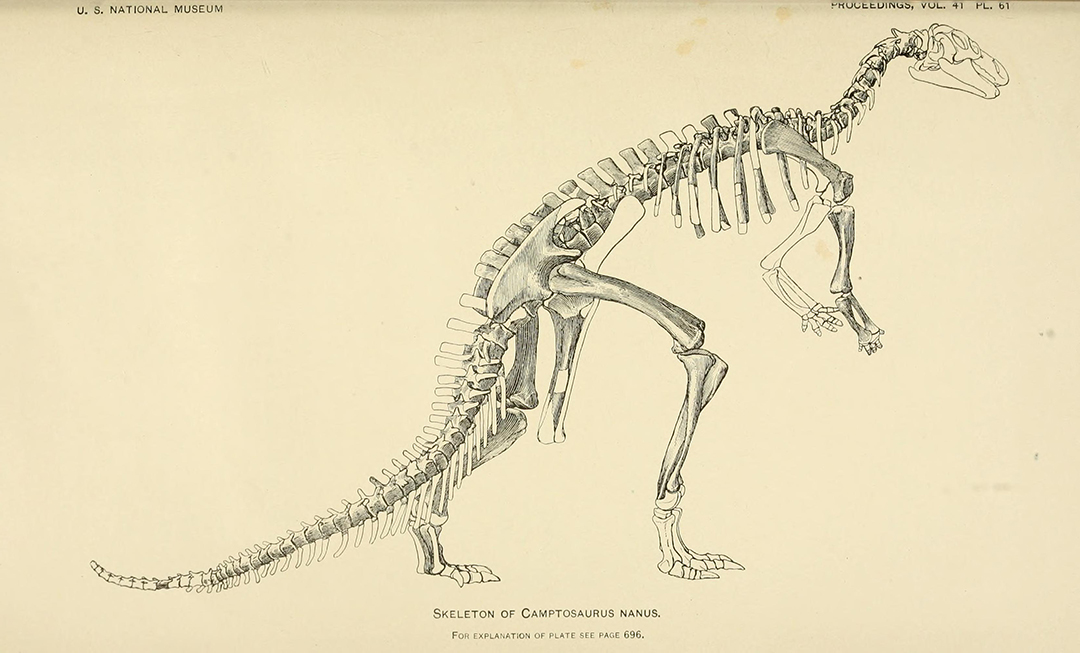
The C. nanus fossil was originally accessioned into the collection of the Yale Peabody Natural History Museum, where Marsh was the Curator of Paleontology, until, after Marsh’s death in 1899, it was transferred to the Smithsonian in compliance with legislation regarding objects collected for, or whose collection was funded by, the US government. The fossil, which was cataloged as USNM 2210, was then prepared and mounted by Norman H. Boss in 1911 alongside the larger C. browni specimen. The mounts are detailed in a 1912 publication by Charles W. Gilmore. Interestingly, the specimens are now known to represent the juvenile (previously C. nanus) and mature (previously C. browni) stages of a single species, C. disbar.

View Full Size Image
C. nanus, as mounted at the National Museum of Natural History. Proceedings of the United States National Museum. v. 41 (1912). Digitized by Smithsonian Libraries. http://biodiversitylibrary.org/page/29866427.

Between 2004 and 2008, the Camptosaurus fossils were taken off display to allow for repairs and the creation of casts that may be re-exhibited with the reopening of the Smithsonian’s Deep Time Hall in 2019. The authentic fossils will be placed in the museum’s collections for research and conservation reasons.

The fascinating history of USNM 2210’s journey from rock to museum is detailed by National Museum of Natural History (NMNH) volunteer Mark Lay in the article A Brief History of Camptosaurus, U.S. National Museum Specimen 2210.

View Full Size Image
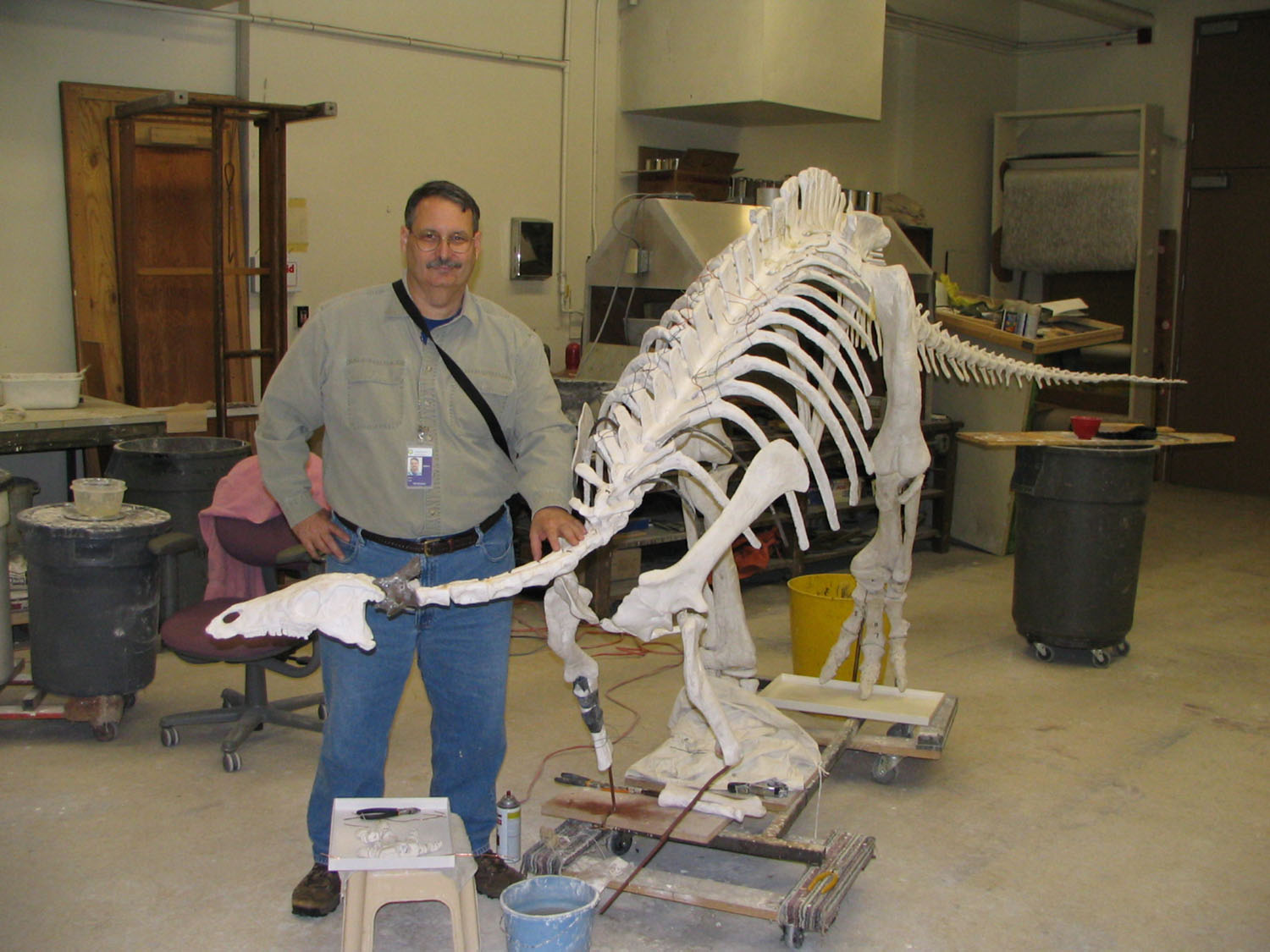
Mark Lay with Camptosaurus cast at the National Museum of Natural History.

Trained as a physicist and nuclear engineer, Mark began volunteering in the Vertebrate Paleontology Preparation Lab at NMNH in 2007 after retirement provided him more time to pursue personal interests like paleontology.

Mark’s early volunteer activities in the Preparation Lab involved making molds and casts, primarily of USNM 2210. Since then, after moving to work with Department of Paleobiology Information Officer Tom Jorstad, he has transitioned to providing research support for requests from the public and outside researchers, as well as organizing and developing “who, what, when, where” metadata for paleontology-related photographic images in both Department and Smithsonian Institution Archives files. He also writes articles on various aspects of the Department’s history and currently is researching the first 100 years of vertebrate fossil preparation in the Smithsonian.

The Biodiversity Heritage Library has proven to be an important resource for Mark’s research, providing information both about items in the collection and historical documents regarding the history of the NMNH and other natural history museums around the US.

“I am a big fan of BHL,” lauds Mark, who uses BHL up to 4-5 times a week. “I am able to spend only roughly one day per week in the NMNH. This means I can spend only a limited amount of time examining actual hard copy documents in the museum libraries. The fact that I can access many of the same documents via BHL means that I can also work from home – greatly increasing the amount of time that I can devote to my volunteer research. In addition, BHL’s inclusion of documents from other museums and universities enables me to access documents that otherwise would be extremely difficult for me to obtain. BHL doesn’t have everything I want, but I would be hard-pressed to do my research without it.”

View Full Size Image
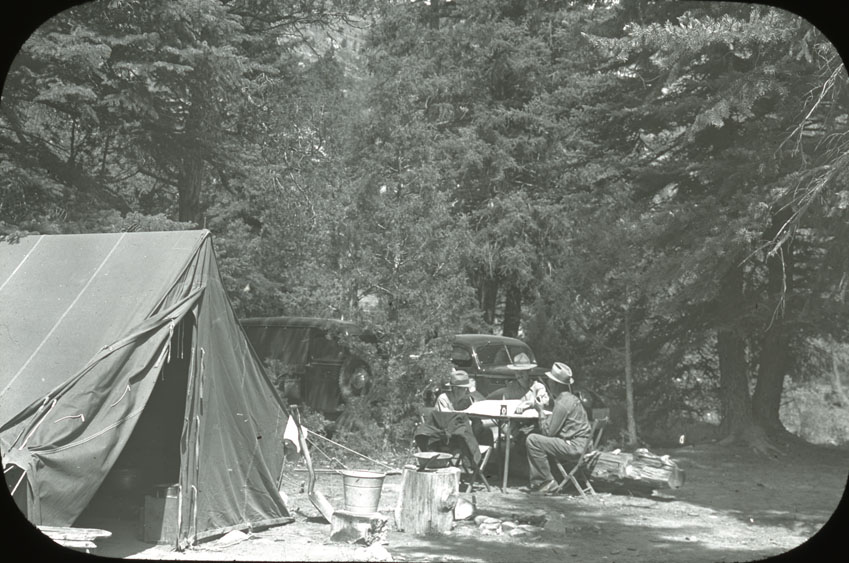
This image, SIA 2011-1418, shows USNM Curator of Vertebrate Paleontology Charles Gilmore’s camp site near North Horn Mountain, Utah during his 1937 expedition. It appears as Figure 1 in Gilmore’s 1938 publication, “Fossil Hunting in Utah and Arizona”, Explorations and Field-work of the Smithsonian Institution in 1937, pp 1-4, available in BHL here: http://biodiversitylibrary.org/page/40734134 (Digitized by Smithsonian Libraries).

Currently, Mark is working on a series of glass lantern slides dating from the mid-1890s through the late 1930s, now being digitized by the Archives and possessing limited metadata. BHL has been a valuable resource for obtaining more information about the slides.

“Some of these slide images were originally used in various Smithsonian publications from that era, making positive identification of the people, fossil localities, and dates much easier,” explains Mark. “More challenging have been the slides sent to the Smithsonian from a variety of museums around the U.S. So, our identification process has first concentrated on determining an initial ‘guesstimate’ of the curator, specimen, or collecting locality involved, then backtracking through relevant Smithsonian publications to see if the image appears. If not, we backtrack our guesstimate to publications from other ‘most likely’ museums. If all that fails, we dig deeper into the view or geology portrayed to see if we can find something similar and broaden the search to include relevant publications from other sources. Having so many of the Smithsonian and other museum publications from that time period in BHL has greatly sped up this process.”

Before using BHL, Mark scoured the physical copies of these publications to find this information – a time consuming and sometimes frustrating process. This all changed when Martha Rosen, a librarian in the NMNH Smithsonian Libraries, introduced him to BHL.

“I discovered BHL 5 or 6 years ago when I was sitting in the museum reference collection reading through some old United States National Museum annual reports, and complaining that my eyes were getting ready to drop out from going through so much text all at once,” recalls Mark. “Martha mentioned that I could get the documents on-line and gave me the BHL link. I downloaded a searchable PDF of the documents and went through them that evening, actually finding relevant information faster than I could with the hard copy.”

View Full Size Image
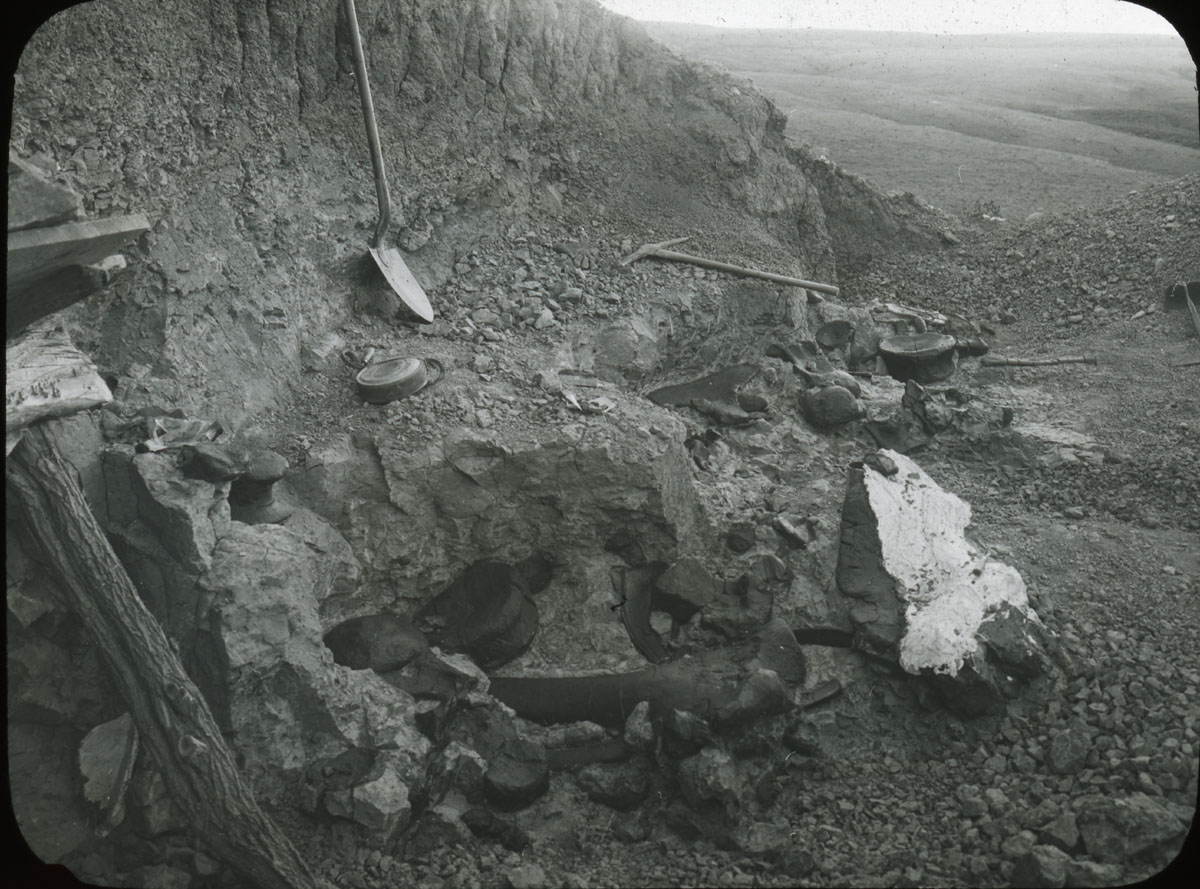
This image, SIA 2011-1429, shows Quarry 6 in the Freezeout Mountains of Wyoming, as worked by the Field Columbian Museum expedition of 1899. It was used as Plate XXX in the Field Columbian Reports, Volume 1, October 1899, included in the Annual Report of the Director to the Board of Trustees for the Years 1894-1900, available in BHL here: http://biodiversitylibrary.org/page/45723188 (Digitized by Smithsonian Libraries).

Mark’s volunteer work with the Smithsonian has allowed him to pursue his passions, enhance collection information, and share wonderful insights into the history of the museum and fossil preparation.

“Paleontology has been a long-standing interest,” Mark asserts. “To me, there is a fascination with bringing a fossil out of the rock encasing it and learning more about it. My interest in paleontological history is more recent, but the research has turned out to be no less rewarding.”

Mark’s articles, published through the Department of Paleobiology’s website, provide him a means to share the wonderful knowledge and history he is uncovering. For instance, Mark’s Camptosaurus article highlights the sometimes tangled path of a fossil from field to museum and provides insight into the changing philosophy of fossil preparation.

As Mark explains in his article, in the early 1900s, “preparators mounted a specimen and expected it to stay mounted forever – no provision was made for repair or reconstruction.” So when preparing USNM 2210 back in 1911, “heavy copper wire and iron strapping were used as a support armature, with thinner copper wire used to secure the manus and pes elements. In general, these supports have held up well, with only slight corrosion damage, but some of the bolts and rivets securing the skeleton were drilled through real bone and secured with glue. As we have dismantled the specimen, this mounting technique has occasionally necessitated our cracking bones in order to remove them from the armature, and then making appropriate repairs.”

Modern techniques accommodate the possible future need to dismantle specimens and allow for a more-realistic presentation of specimens. “The hard plaster we have used for the casts allows for support connections to be made through the simulated bone, reducing the amount of armature seen by the public and providing a more natural looking display. The philosophy is to make all changes reversible, while also ensuring repairs are both state of the art and long lasting,” explains Mark in his article.

We’re excited to see the ways that BHL has helped support Mark’s valuable work at the Smithsonian. It’s a great example of one of the many ways that BHL inspires discovery through free access to biodiversity knowledge.

__________________________

This post may contain the personal opinions of BHL users or affiliated staff and does not necessarily represent the official Biodiversity Heritage Library (BHL) position on these matters.

August 11, 2016by ulib-libraryjobs
Blog Reel, User Stories

BHL Isn’t Just For Biologists

Portrait version of the Biodiversity Heritage Library logo.

Charles Darwin is famous for the theory of evolution by means of natural selection. The theory hinges on the mutability of species, whereby the propagation of certain favorable traits within members of a species may gradually result in the evolution of that species. The question of when Darwin first came to believe in the mutability of species – when he became a “convinced transmutationist” – has long been a point of contention among historians of science.

There are two prevailing theories on the topic. The early conversion hypothesis states that Darwin developed a belief in the transmutation of species while on the Beagle voyage based on observed similarities between the fossils he was collecting and extant species in the area. The second theory, the late conversion hypothesis, holds that Darwin did not start believing that species were mutable until after the Beagle voyage, once experts in England had studied the specimens he collected. Today, most historians of science support the latter theory.

Dr. Paul D. Brinkman, Head of the History of Science Research Lab and Curator of Special Collections at the North Carolina Museum of Natural Sciences, finds the late conversion theory flawed.

View Full Size Image
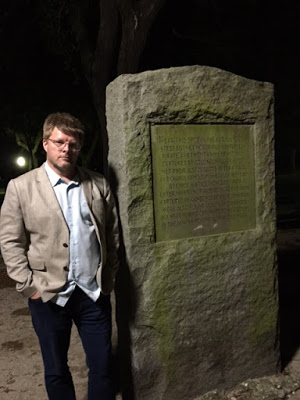
Paul D. Brinkman consorting with known pirates in Charleston, SC.

Brinkman has been studying the history of science for nearly twenty years. He specializes in late nineteenth- and early twentieth-century geology and vertebrate paleontology, especially in the American West, and is also interested in the spread of science from Europe to the New World and the trans-Atlantic exchanges of specimens and ideas. The question of when Darwin adopted a transmutationist viewpoint is of particular interest to Dr. Brinkman.

In a 2010 paper published in the Journal of the History of Biology entitled “Charles Darwin’s Beagle Voyage, Fossil Vertebrate Succession, and the ‘Gradual Birth & Death of Species,'” Brinkman argues that Darwin’s own journals from the Beagle voyage (which include discussions of the similarities between some of the fossils he was collecting and extant species – notably Glyptodontidae fossils and living armadillos – and reflections regarding fossil vertebrate succession – which Darwin himself later identified as a key element in his contemplation on the origin of species) suggest that Darwin’s adoption of transmutationism happened gradually but certainly during, and not after, the Beagle voyage.

Darwin’s journals and publications, as well as the books that Darwin was known to have in his Beagle library, provide key information that Brinkman used to support his arguments. As such, access to these materials is crucial to Brinkman’s research. Thanks to BHL, it’s easier than ever for him to obtain these resources.

Dr. Brinkman was introduced to BHL many years ago by Christine Giannoni, Museum Librarian at The Field Museum. Christine is a star promoter of BHL, having been involved with the program for many years; she currently serves as the Museum’s Member Representative to BHL. Thanks to her introduction, Brinkman is now a regular user of BHL.

“BHL is a wonderful resource,” lauds Brinkman. “I use a lot of old and obscure resources in my line of work, and BHL makes getting access to these sources a lot easier.”

View Full Size Image
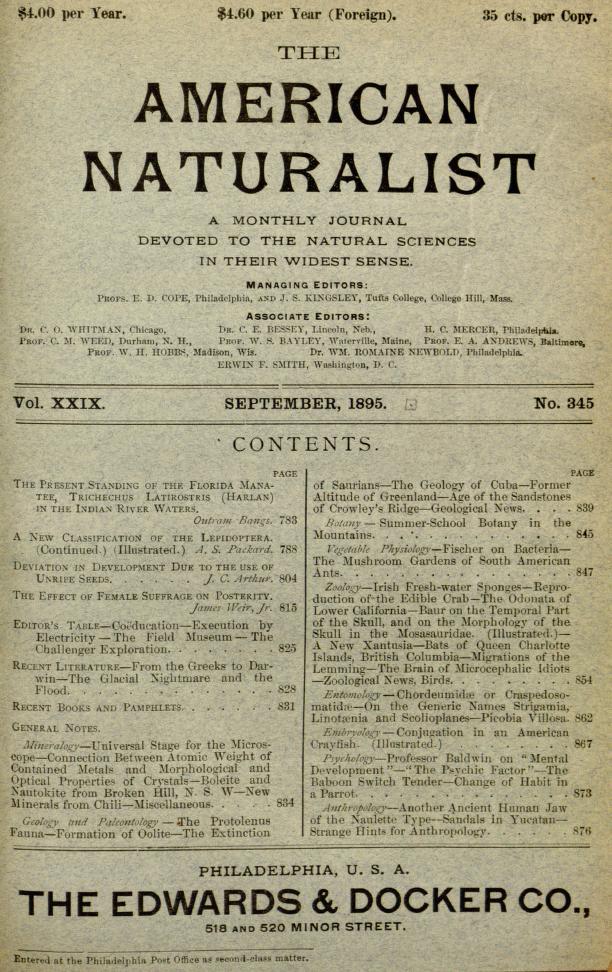
The cover of the American Naturalist of September, 1895, which Brinkman downloaded from BHL for a recent project entitled “Edward Drinker Cope’s final feud.” http://biodiversitylibrary.org/item/129692.

When conducting research, Brinkman often refers to BHL 8-10 times a day, reading articles online or downloading relevant pages as PDFs. He also downloads title pages and significant figures for use in lecture slides. And while he may refer to specialized material when conducting specific research, the most-common type of material that he consults on BHL may surprise you.

“I probably use old museum annual reports more than any other single resource on BHL,” explains Brinkman. “This is especially useful, as a lot of these old reports have been relegated to offsite storage at many university libraries, which can sometimes mean long delays. BHL, however, provides them at the click of a button!”

So, whether it’s helping a scientist confirm the identity of a specimen collected in the field or providing primary source evidence to support the work of historians of science, it’s clear that BHL greatly increases the efficiency of research for those working in a variety of disciplines. We think Darwin would approve.

December 17, 2015by ulib-libraryjobs
Blog Reel, Featured Books

In Search of the White Whale: A Legend, a Fossil, a Living Mammal

Portrait version of the Biodiversity Heritage Library logo.
View Full Size Image
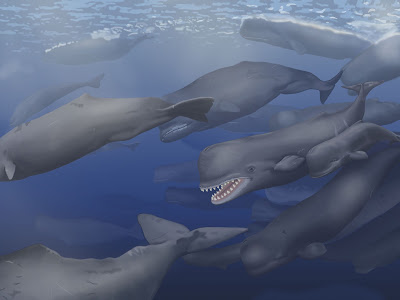
In this reconstruction, a pod of Albicetus travel together through the Miocene Pacific Ocean, surfacing occasionally to breathe. Modern sperm whales are also known for forming these tight-knit groups, composed mainly of females and their calves. Art by A. Boersma for the Smithsonian.

1820. Far west of the Galapagos Islands in the Pacific Ocean. A whaleship pursues a pod of sperm whales. Suddenly, an eighty-five foot long giant charges the ship, ramming it with its head not once, but twice, caving in the bows and sending the ship to a watery grave.

This is the story of the sinking of the Essex, the subject of Ron Howard’s movie adaptation of Nathaniel Philbrick’s novel In the Heart of the Sea, opening this Friday. The sperm whale that sank the Essex also served as one source of inspiration for another literary icon – the infamous white whale Moby Dick.

In addition to the big screen, another “white whale” hits the spotlight on a different stage this week – the scientific stage. Scientists from the Smithsonian Institution have just published new research on an extinct sperm whale that roamed the seas millions of years ago, which they’ve named Albicetus (“white whale”).

Today’s modern sperm whale was first scientifically described by Carl Linnaeus in the tenth edition of his 1758 Systema Naturae, a pivotal work that laid the foundation for our modern system of zoological nomenclature. Within this work, Linnaeus initially described the sperm whale as four separate species: Physeter catodon, Physeter macrocephalus, Physeter microps, and Physeter tursio. Today, we recognize that Linnaeus was actually describing only one species, which is now known by the binomial Physeter macrocephalus.

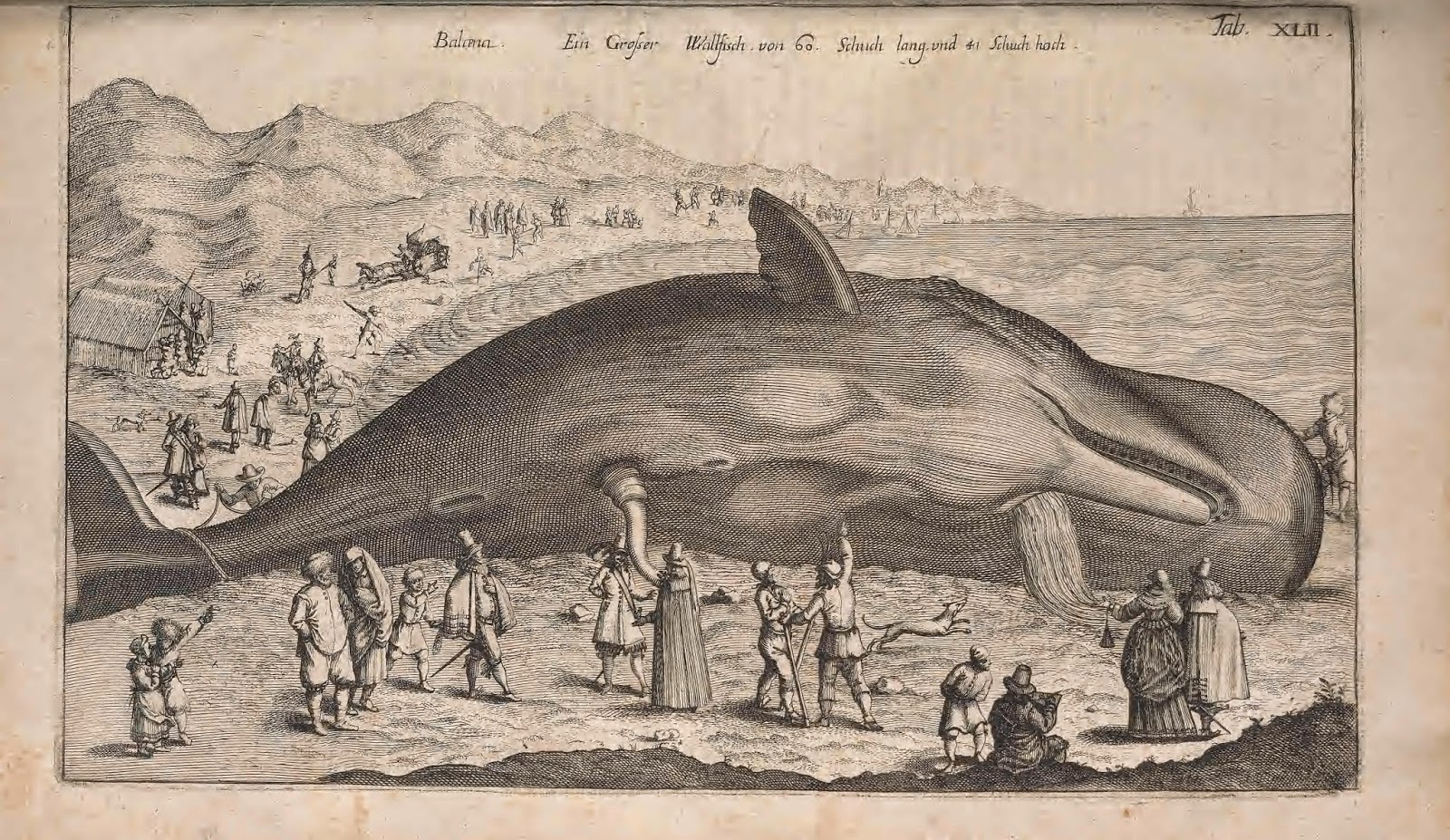
In the years following Linnaeus’ naming of the species, mystery and confusion surrounded the sperm whale, and over a dozen species names and multiple genera were published for the whale by the mid-1800s. Most of what information could be gleaned about the animal came from specimens that washed ashore, such as that depicted in Johann Jonstonus’ 17th century work Historiae naturalis de quadrupetibus libri, and from whaling expeditions.

View Full Size Image
Sperm Whale stranding. Jonstonus, Joannes. Historiae naturalis de quadrupetibus libri. pt. 2-6. 1650. http://biodiversitylibrary.org/page/44040300.

In the 18th, 19th, and early 20th centuries, whaling was an important industry, and the sperm whale, with its spermaceti organ full of valuable sperm oil, was a primary target for whalers.  Despite the threats posed by the industry to whale populations, whalers were perhaps in the best position to learn more about the species they hunted. These expeditions also offered naturalists excellent opportunities to study these cetaceans.

One such individual was Thomas Beale (1807-1849), a British surgeon who, in 1830, joined the London whaling ship Kent as the physician on an expedition to the South Seas. Through his keen observations during the expedition, Beale gathered much information about the sperm whale, and, upon his return to England, published a fifty-eight page booklet for subscribers in 1835 entitled A Few Observations on the Natural History of the Sperm Whale, with an account of the Rise and Progress of the Fishery, and of the Modes of Pursuing, Killing, and “Cutting In” that Animal, with a List of its Favourite Places of Resort. The booklet was so well received that Beale revised, expanded, and republished it in 1839 as The Natural History of the Sperm Whale. This work served as the primary source of what was known about sperm whales at the time, and the Penny Cyclopedia hailed “Mr. Beale…in his excellent work on the ‘Natural History of the Sperm Whale,’ has done more to elucidate its habits and form than any other writer.”

View Full Size Image
Beale, Thomas. The Natural History of the Sperm Whale. 1839. http://biodiversitylibrary.org/page/48976761.

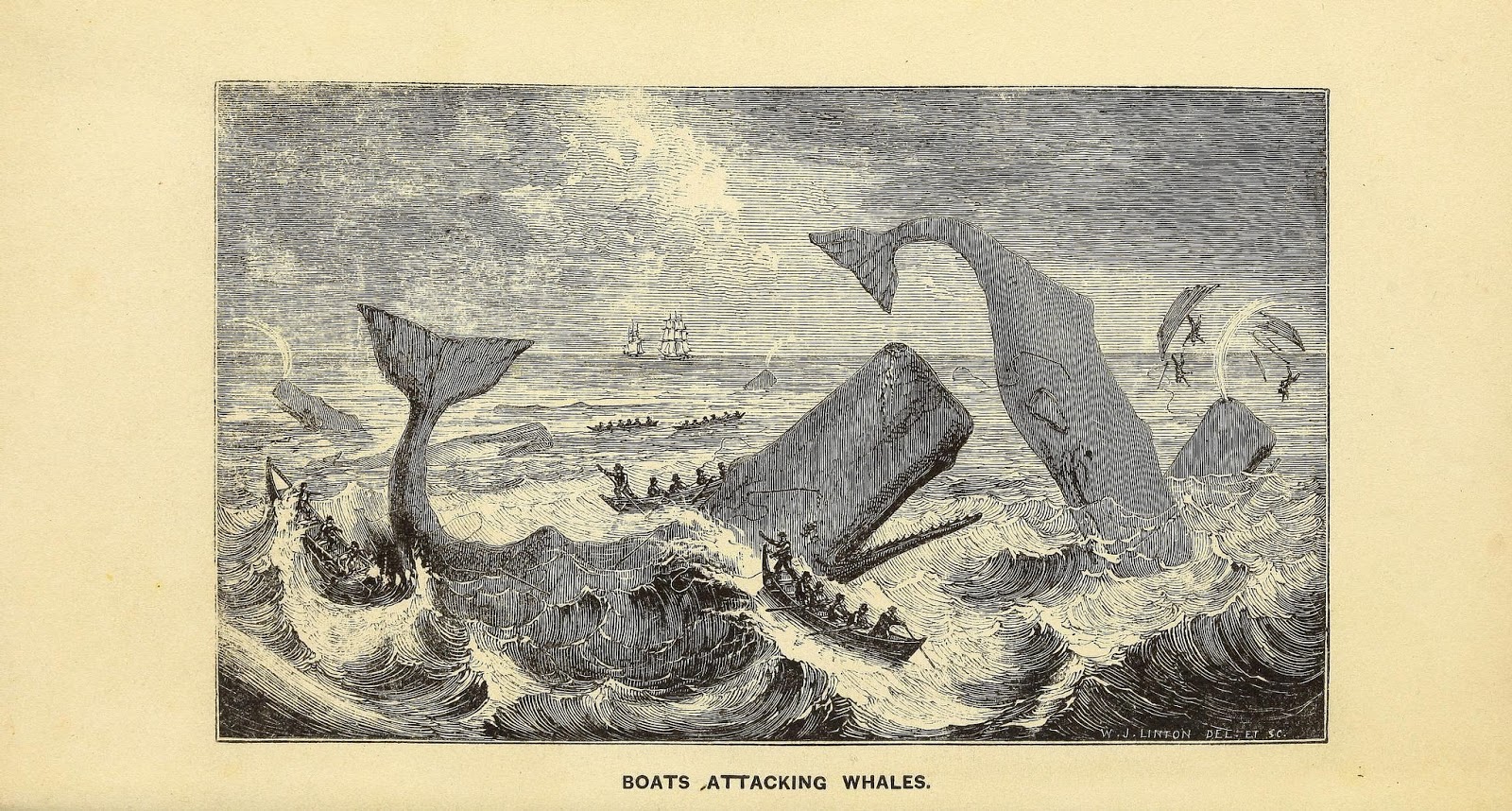
Beale’s work was an important reference for Herman Melville, who acknowledged the book as a primary source of information for the cetological section of Moby-Dick; or, The Whale. Whaling provided additional inspiration for this work; the climax of Melville’s novel is based on the same events recounted within In the Heart of the Sea – the sinking of the Nantucket whaleship Essex. The crew that escaped the sinking of this ship spent three months at sea, covered 4,500 miles, and resorted to tragic lengths to stay alive. Of the 20 men who left the Essex, only 5 survived. Owen Chase, chief mate of the Essex, kept a journal of the events, which was later published as Narrative of the Most Extraordinary Shipwreck of the Whale-ship Essex, of Nantucket; which was Attacked and Finally Destroyed by a Large Spermaceti-whale, in the Pacific Ocean. Melville read Chase’s account of the event, and acknowledged its impact on his writing. The events were circulated within many natural history books, such as in this account within Johnson’s Household Book of Nature (1880).

While today there are only three extant species in the sperm whale family (the sperm whale and its relatives, the pygmy and dwarf sperm whales), their evolutionary history has seen many additional members. One of these, Albicetus oxymycterus, lived around 15 million years ago in the North Pacific Ocean, and now, thanks to research conducted by Dr. Nick Pyenson, curator of fossil marine mammals at the Smithsonian’s National Museum of Natural History, and Smithsonian research student Alex Boersma, we have a better understanding of this animal’s place in its family’s evolutionary history.

View Full Size Image
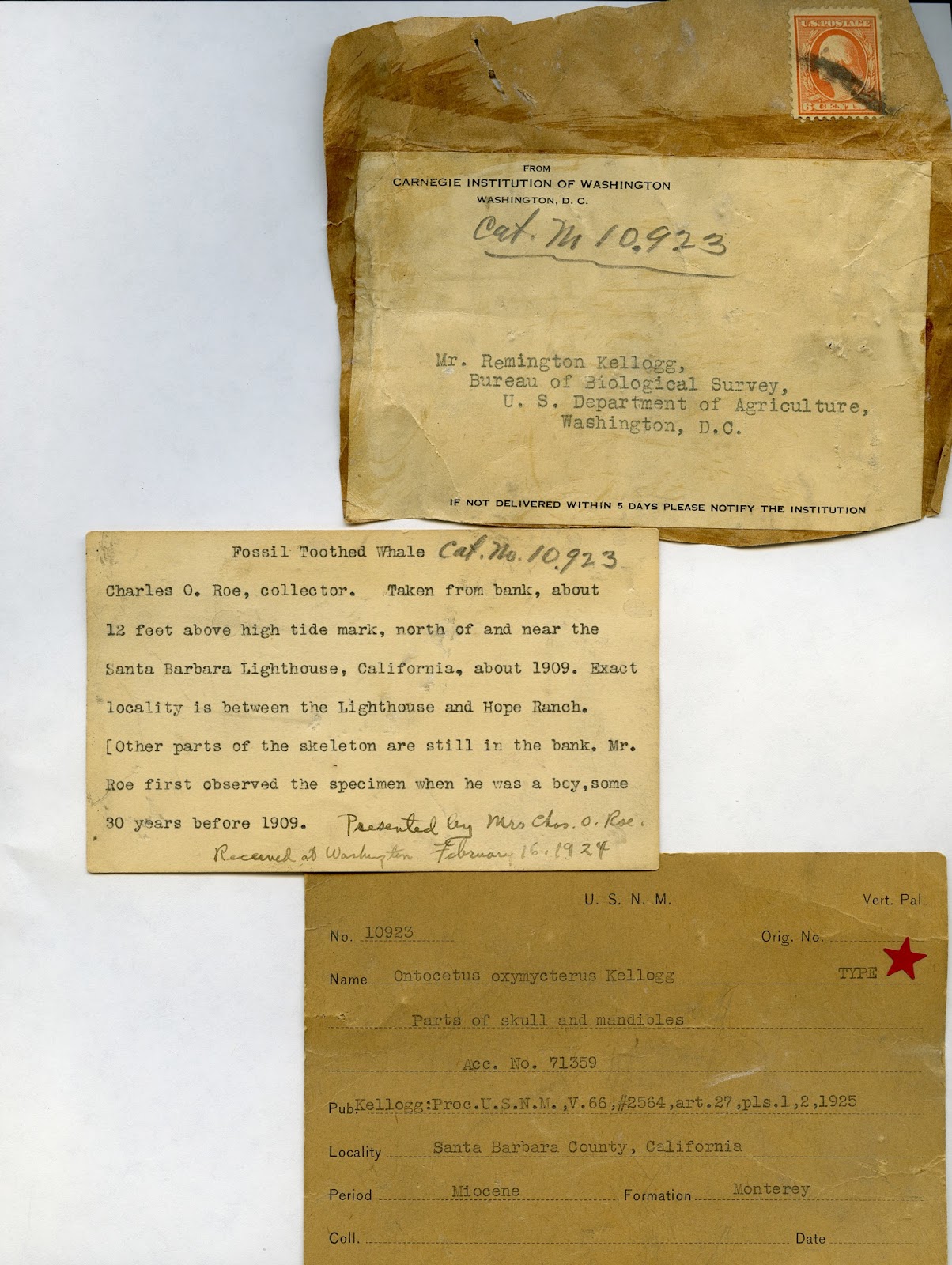
Archival specimen notes for type specimen for Albicetus oxymycterus.

Mr. Charles A. Roe collected the type specimen for Albicetus oxymycterus from the sea cliffs near the original Santa Barbara Lighthouse (known as the Santa Barbara Light) sometime around 1909. Archival typewritten notes at USNM indicate that Mr. Roe had “first observed the specimen when he was a boy, some 30 years before.” After Mr. Roe’s death, his wife presented the National Museum of Natural History (then the United States National Museum) with the specimen in 1924.

View Full Size Image
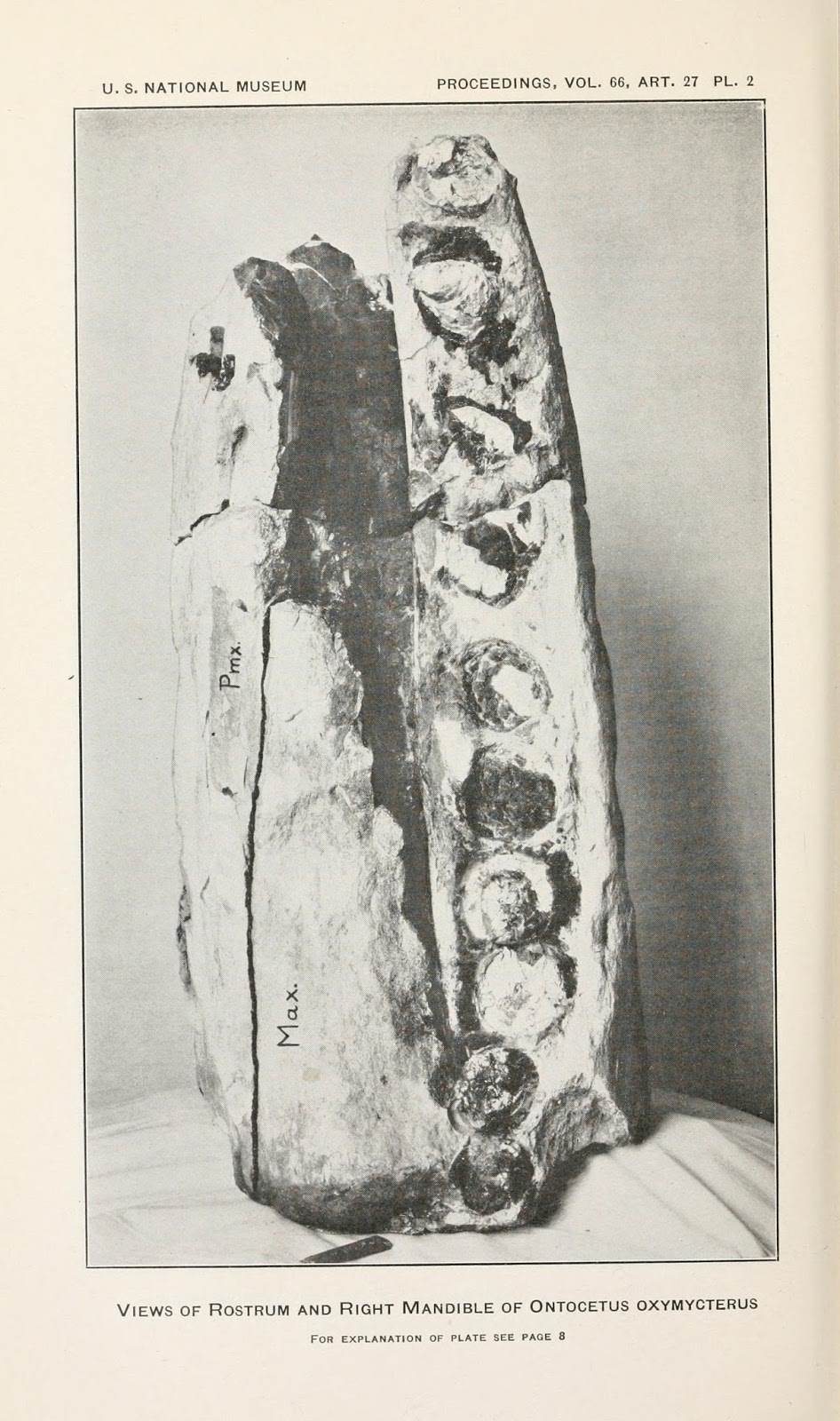
Albicetus oxymycterus specimen. Kellogg, Remington. Proceedings of the United States National Museum. v. 66 (1926). http://biodiversitylibrary.org/page/7739240.

At the time, well-known naturalist and paleontologist Remington Kellogg had an avid interest in this material (Kellogg would later become curator of vertebrate paleontology at USNM and make extensive contributions to the study of fossil marine mammals). Kellogg took it upon himself to describe the Santa Barbara specimen, and published his findings in 1925. He assigned the specimen to the genus Ontocetus, which was first named by Joseph Leidy on the basis on a large tooth found in the 19th century, which he thought belonged to a large marine mammal, and likely a sperm whale. Kellogg also thought this tooth, Ontocetus emmonsi, resembled the large dentition of his sperm whale specimen, which led him to place the Santa Barbara fossil as a new species in the genus Ontocetus. However, recent authors, weighing in favor of dissenting opinions about Ontocetus since the 19th century, have argued that the original tooth of Ontocetus emmonsi belongs not to a sperm whale, but to an ancient walrus.

In light of our improved understanding of the Ontocetus genus, Pyenson and Boersma re-evaluated the specimen and erected a new genus for it, Albicetus, or “white whale,” in homage to Melville’s Moby Dick.

“Since our specimen is most definitely an ancient sperm whale, we needed to give it a new and more appropriate genus name,” explained Pyenson. “While we don’t know what its skin color in life actually looked like, the color of the fossil is an ashen white. It only seemed appropriate to evoke Melville’s white sperm whale Moby Dick.”

View Full Size Image
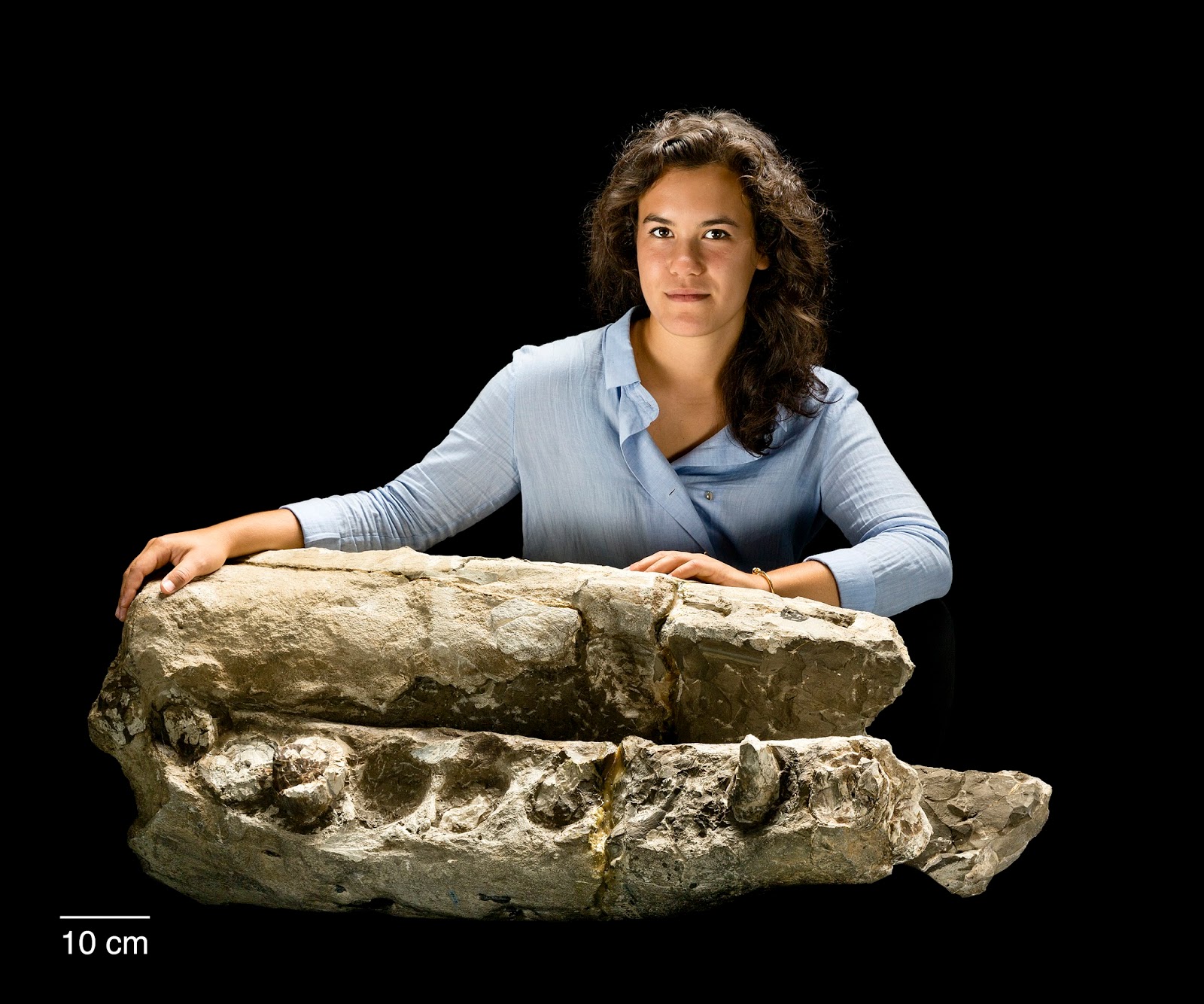
Alex Boersma with the NMNH Albicetus oxymycterus specimen. Photo Credit: James Di Loreto, NMNH Imaging.

Boersma and Pyenson published the name and their accompanying research about the fossil, which includes an estimation of the size of the whale and its place in the sperm whale evolutionary tree, today in the PLOS ONE article “Albicetus oxymycterus, a new generic name and redescription of a basal physeteroid (Mammalia, Cetacea) from the Miocene of California, and the evolution of body size in sperm whales.” The paper helps to resolve questions about how sperm whales have evolved into the singular creatures they are today, with insights on the increase in body size and changes in feeding strategies.

To accompany the redescription, Boersma and Pyenson created a 3-dimensional model of the specimen, available on the Smithsonian X 3D website (http://3d.si.edu). “In addition to making the specimen available for public viewing, the model was also necessary just for us to describe the specimen fully,” confesses Pyenson. “It weighs well over 300 pounds, taking four people just to slowly roll it over. Having the model was crucial for easy examination of the specimen from all angles for description and comparison.”

3D model of Albicetus oxymycterus from Smithsonian X 3D.

Thanks to Herman Melville, the White Whale is arguably one of the most recognizable figures in literary history. It is a figure with many identities. It is a harbinger of death; the personification of evil. It is a symbol of unattainable glory. But today, it is also something more. Today, the white whale is also Albicetus, a majestic, ancient, and complex creature that swam in the heart of the sea millions of years ago.

  • You can browse historic illustrations of the sperm whale in the BHL Flickr.
  • Browse publications about the sperm whale in our White Whale collection on BHL.

With Contributions By:

Nick Pyenson
Curator of Fossil Marine Mammals
Smithsonian National Museum of Natural History

Alex Boersma
Smithsonian Research Student
Smithsonian National Museum of Natural History

December 9, 2015by michelle.underhill
Blog Reel, Campaigns, Featured Books, Fossil Stories, User Stories

From the Experts: Recommended Fossil Books!

We hope you’ve been enjoying the fossil-mania this week with Fossil Stories! We’ve been exploring the fascinating history of paleontology, learning some great fossil facts, and hearing from experts (via a series of live webcasts) about current fossil research.

Our posts have demonstrated the important role that natural history publications have played in the history of paleontology. These works disseminated new research and ideas, documented the evolution of human knowledge about fossils and their origins, and recorded the first scientific descriptions of many ancient creatures.

But this literature is important not just for the historical information it provides. It is also highly relevant to modern paleontological research.

“Traditional ways of knowing about the fossil record are still relevant for modern questions in paleontology because specimens matter,” explains Dr. Nicholas D. Pyenson, Curator of Fossil Marine Mammals at the Smithsonian National Museum of Natural History. “Many important fossils were intially described and published in monographic, folio formats, and in many cases, those descriptions can be still be used 100-150 years later. I use them all the time.”

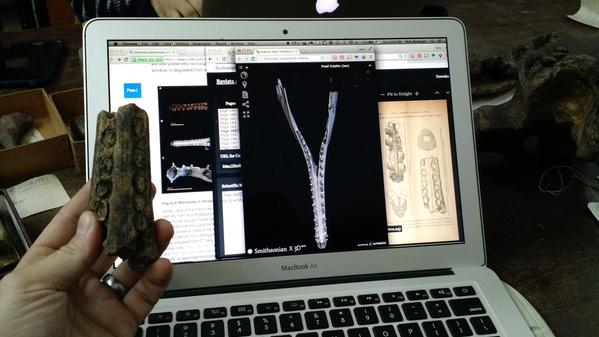
And indeed he does. During a recent trip to Argentina, Dr. Pyenson was able to compare specimens in the Museo Argentino de Ciencias Naturales with illustrations of those specimens in BHL alongside 3D scans of the related cetacean.

View Full Size Image
Comparing specimens to digitized literature and 3D scans. Dr. Nicholas D. Pyenson conducting research at the Museo Argentino de Ciencias Naturales. Photo by Nicholas D. Pyenson, via Twitter: https://twitter.com/PyensonLab/status/647111438222389248.

The importance of historic literature to modern fossil research is echoed by those in the field of paleobotany as well.

“Just as in research on living plant and animal biodiversity, research on the fossil record of plants and animals depends crucially on the published literature,” emphasizes Dr. Patrick Herendeen, Director of Systematics and Evolutionary Biology at the Chicago Botanic Garden. “Plant systematics literature goes back hundreds of years, and having access to this literature is essential for ongoing research in plant taxonomy and systematics. This is equally true for paleobotany.”

Knowing that historic literature is so important to modern paleontological work, we asked paleontologists at several BHL partner institutions to share some of their favorite historic publications with us. We think the results constitute a pretty awesome Recommended Reading List for Paleontology Enthusiasts!

Dr. Hans-Dieter Sues 
Chair, Department of Paleobiology. Curator of Fossil Vertebrates.
Smithsonian National Museum of Natural History

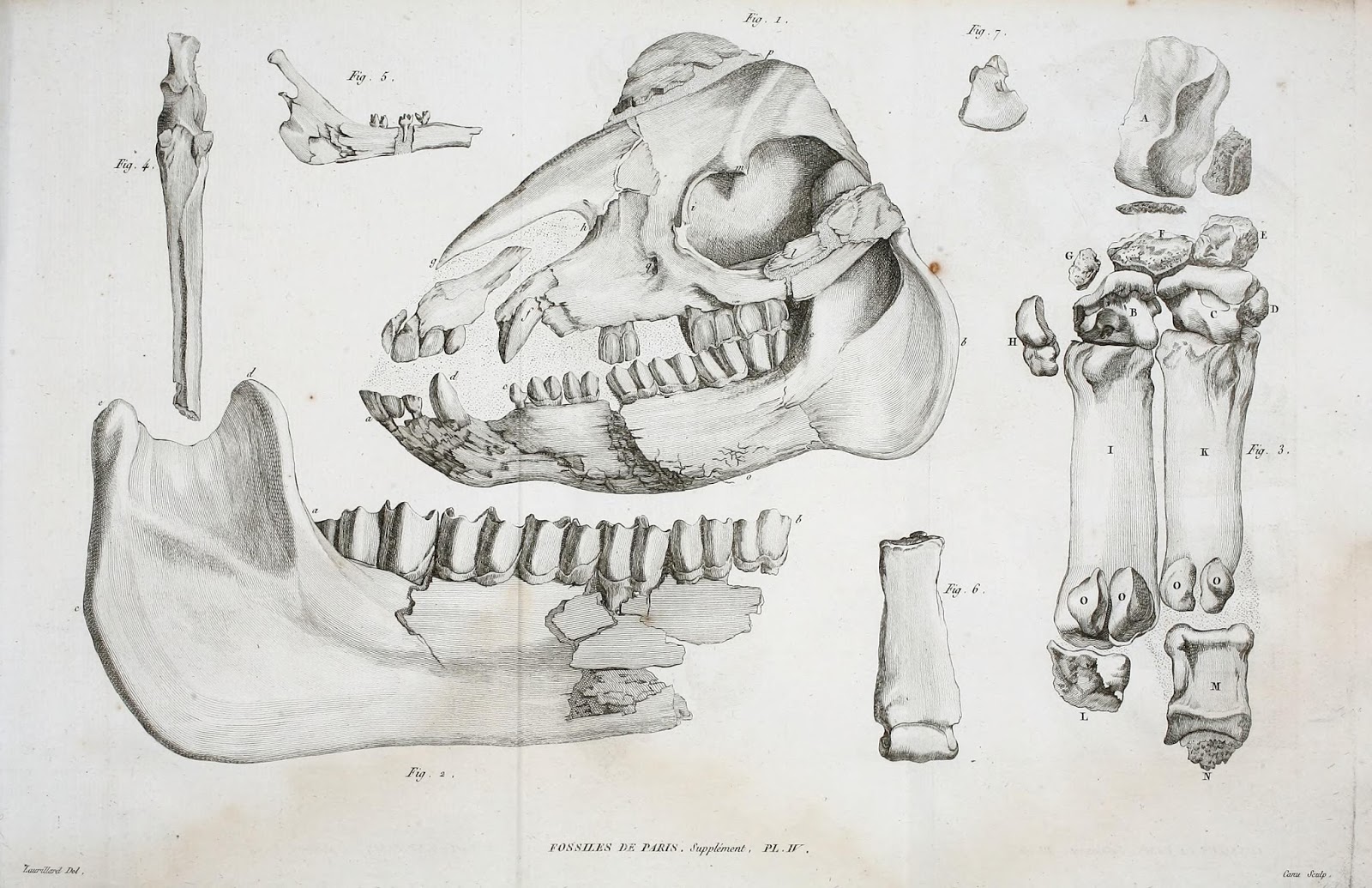
“Not surprisingly, my favorite early book on paleontology is Recherches sur les ossemens fossiles de quadrupèdes by G. Cuvier (first published in 1812, with three later editions). Not only did it found the scientific study of fossil vertebrates but it is written in a clear yet elegant style but that makes it a pleasure to read. Cuvier did not just describe fossils but tried to interpret their anatomy in functional terms. As a foundational work in the field, it will always be relevant to researchers interested in the fossil record of backboned animals.”

View Full Size Image
Cuvier, Georges. Recherches sur les ossemens fossiles de quadrupèdes. v. 3 (1812). http://biodiversitylibrary.org/page/40078532. Digitized by Smithsonian Libraries.

Dr. Maria A. Gandolfo 
Senior Researcher, L.H. Bailey Hortorium, Plant Biology Section 
School of Integrative Plant Science, Cornell University

Dr. Gandolfo’s favorite early paleobotany book is Ancient Plants, written by Mary C. Stopes in 1910. When asked why it is her favorite, Dr. Gandolfo referred to a quote from the book: “The lore of the plants which have successively clothed this ancient earth during the thousands of centuries before men appeared is generally ignored or tossed on one side with a contemptuous comment on the dullness and ‘dryness’ of fossil botany.” According to Dr. Gandolfo, “This book was written in 1910 and even after 105 years of incredible advances in the field of Paleobotany, this sentence still reflects what people feels about Paleobotany.”

Dr. Peter J. Makovicky
Department Chair and Associate Curator, Department of Geology
The Field Museum

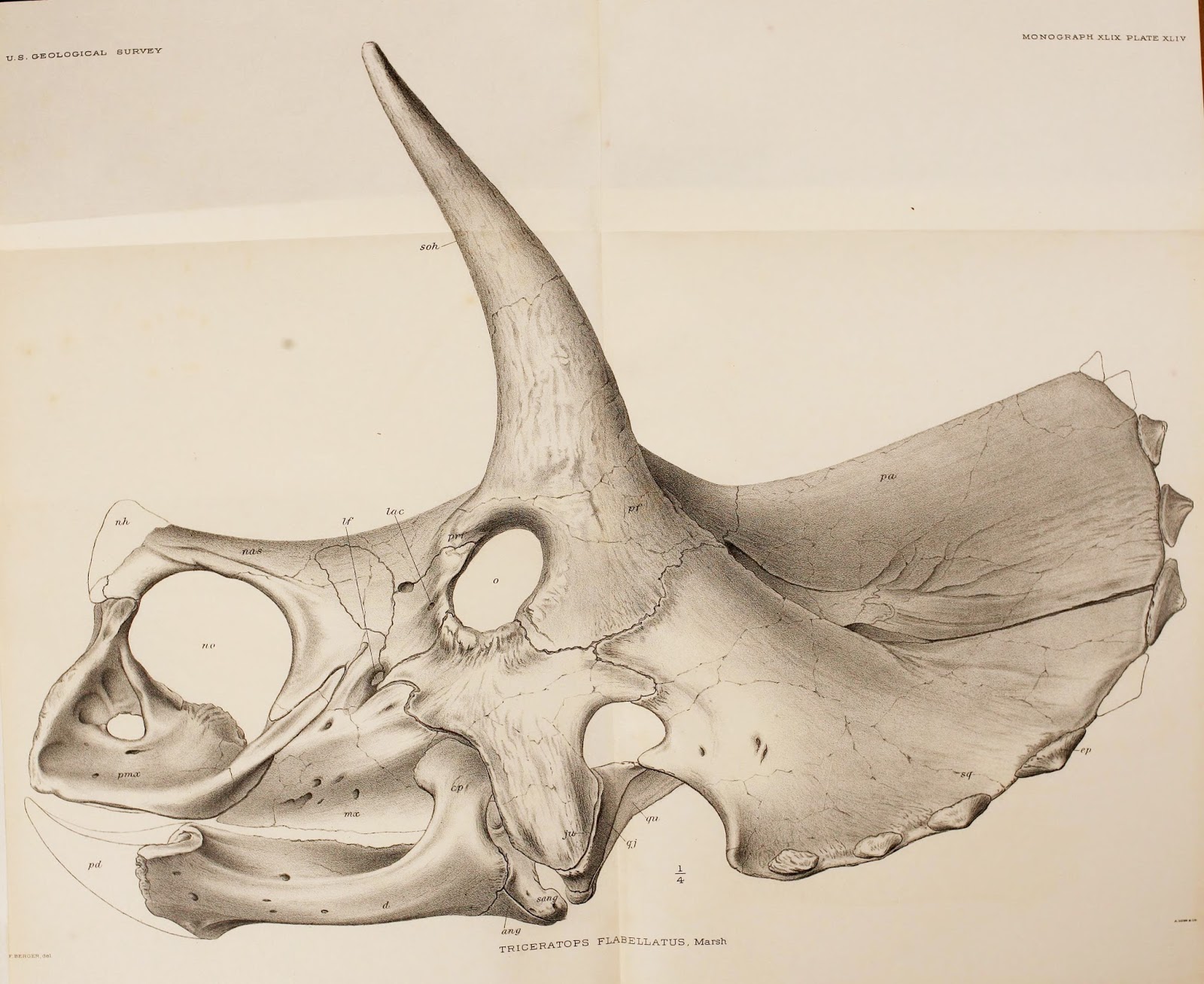
The Ceratopsia are a group of herbivorous, beaked dinosaurs that thrived during the Cretaceous Period. They include such iconic genera as Triceratops and Montanoceratops. The name Ceratopsia was coined by Othniel Charles Marsh in 1890, and in 1907 he, along with John B. Hatcher and Richard S. Lull, published a monograph on the group, entitled The Ceratopsia. According to Dr. Makovicky, this work is one of his favorites and a classic amongst the pre-1923 published materials.

View Full Size Image
The Ceratopsia. 1907. http://biodiversitylibrary.org/page/39875988. Digitized by Smithsonian Libraries.

Dr. William A. DiMichele 
Research Paleontologist and Curator 
Smithsonian National Museum of Natural History

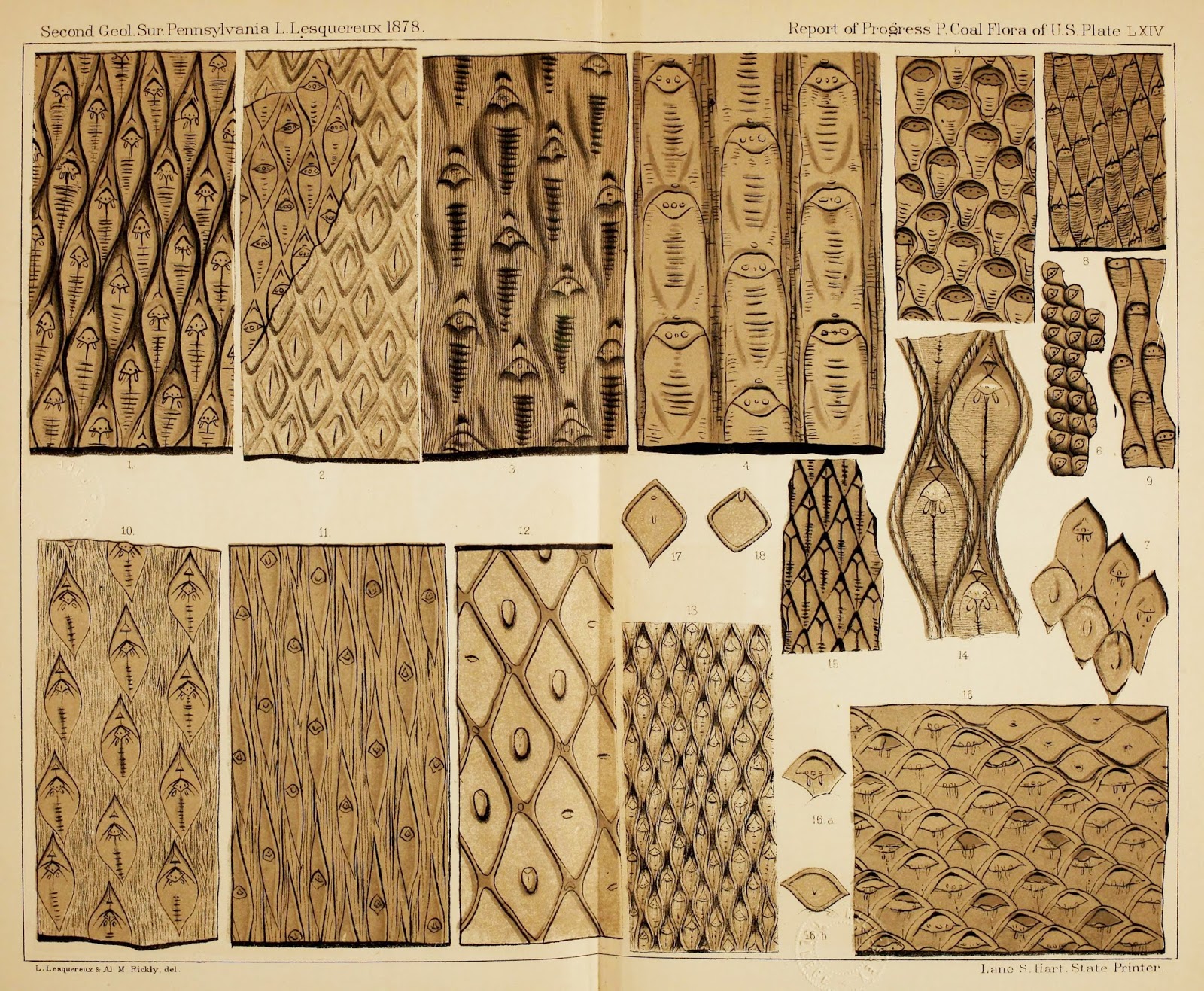
Dr. DiMichele’s favorite historic paleontology work is Description of the Coal Flora of the Carboniferous Formation in Pennsylvania and Throughout the United States, by Leo Lesquereux (1879-80). According to Dr. DiMichele, “This is the foundational book/atlas on American Carboniferous (coal age) floras and contains detailed descriptions and illustrations of many of the species that occur commonly in coal fields of the eastern and midwestern US. Many of the species that occur in the rocks I study were first described in this set of volumes, so the books remain a primary source of information to which I turn regularly.”

View Full Size Image
Lesquereux, Leo. Description of the coal flora of the Carboniferous formation in Pennsylvania and throughout the United States. Atlas (1879). http://biodiversitylibrary.org/page/46854192. Digitized by Wellesley College Library.

Dr. Karl J. Niklas 
The Liberty Hyde Bailey Professor of Plant Biology 
Cornell University

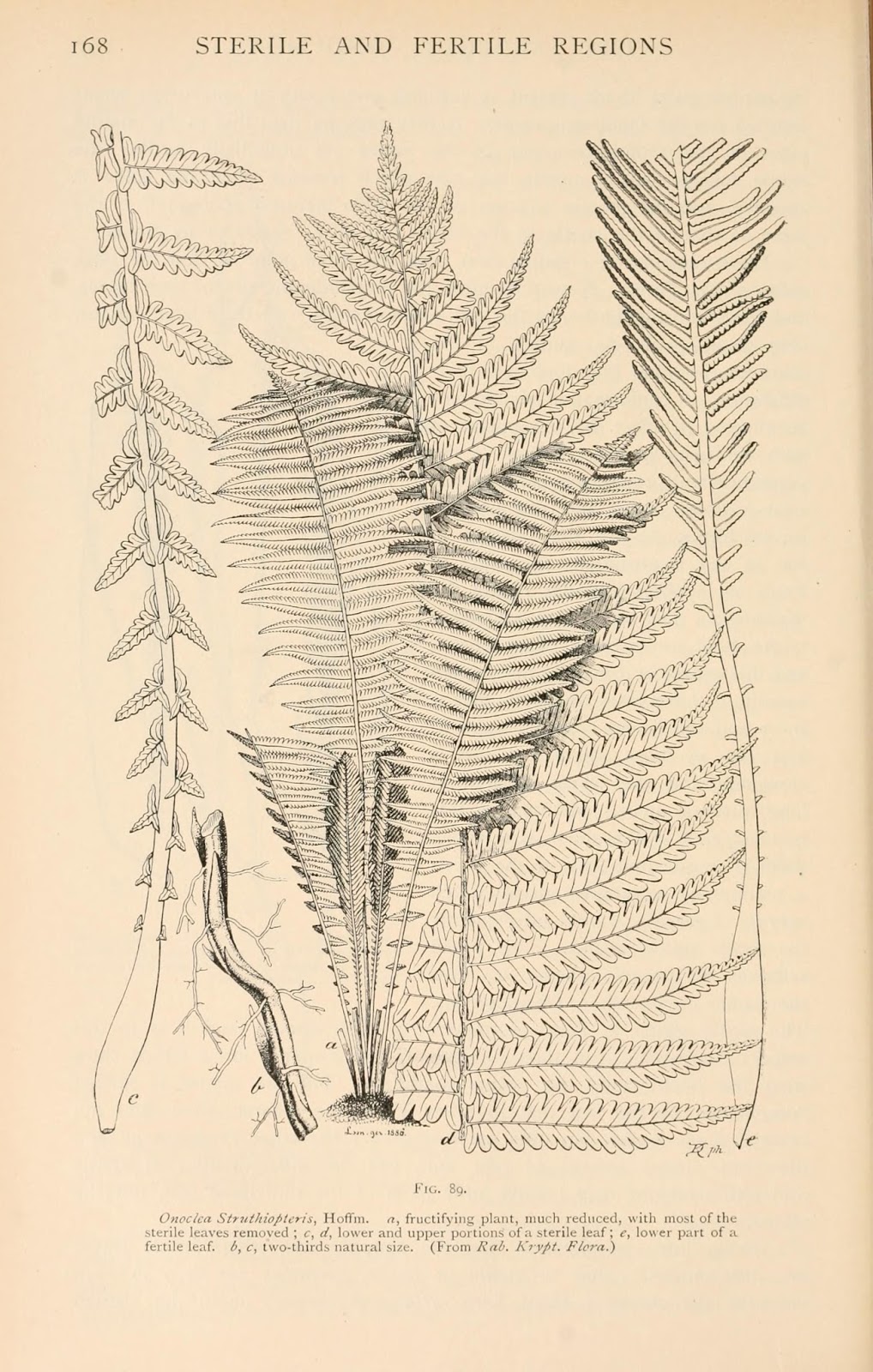
Dr. Niklas’ favorite historic paleontological work is The Origin of a Land Flora (1908) written by F. O. Bower. According to Dr. Niklas, “This book presents the first conceptualization of the evolution of ‘The Alternation of Generations’ in the land plants. I have worked on the evolution of plant body plans and the evolution of plant life cycles,” thus making this work particularly relevant to Dr. Niklas’ research.

View Full Size Image
Bower, F.O. The Origin of Land Flora. (1908). http://biodiversitylibrary.org/page/1312200. Digitized by the MBLWHOI Library.

Dr. Nicholas D. Pyenson
Curator of Fossil Marine Mammals
Smithsonian National Museum of Natural History

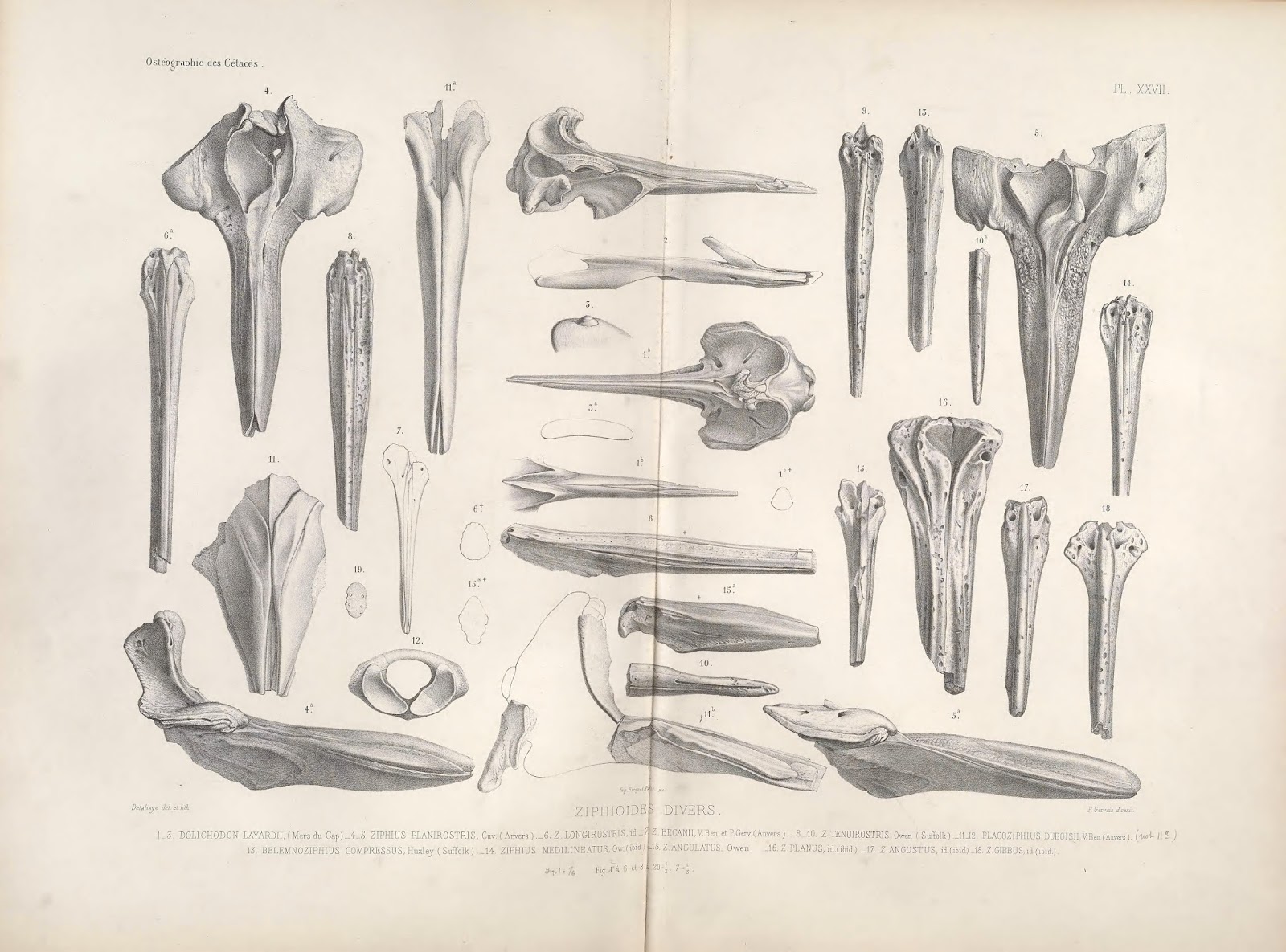
Dr. Pyenson’s favorite historic paleontology book is Ostéographie des cétacés vivants et fossiles (1868-79), by Pierre Joseph Beneden and Paul Gervais. “This work showcased specimens and species that no one had really seen outside of the areas where the specimens were collected,” explains Dr. Pyenson. “It’s a catalog of the world’s whales, and the authors didn’t discriminate between fossil and modern species. It’s cool that these were integrated together into one work this early on, before it was fashionable to do so.”

View Full Size Image
Modern whale skulls alongside fossil skulls. “You can tell which are the fossil skulls by the condition of the specimens,” explains Dr. Pyenson. Ostéographie des cétacés vivants et fossiles. (1869-79). http://biodiversitylibrary.org/page/41066967. Digitized by Smithsonian Libraries.

Thanks to all of our experts for sharing their favorite historic publications with us! We hope you’ve enjoyed our series of blog posts this week highlighting key works in the history of paleontology. Can’t get enough of the fossil publications? Then check out other great works in the BHL Fossil Stories digital book collection.

October 16, 2015by michelle.underhill
Page 2 of 7«1234»...Last »

Help Support BHL

BHL's existence depends on the financial support of its patrons. Help us keep this free resource alive!

search

About BHL

The Biodiversity Heritage Library (BHL) is the world’s largest open access digital library for biodiversity literature and archives. BHL operates as a worldwide consortium of natural history, botanical, research, and national libraries working together to digitize the natural history literature held in their collections and make it freely available for open access as part of a global “biodiversity community.”

Join Our Mailing List

Sign up to receive the latest news, content highlights, and promotions.

Subscribe Now

Subscribe to Blog via Email

Enter your email address to subscribe to this blog and receive notifications of new posts by email.

Join 319 other subscribers

Subscribe to Blog Via RSS

Subscribe to the blog RSS feed to stay up-to-date on all the latest BHL posts.

Access RSS Feed

Inspiring Discovery through Free Access to Biodiversity Knowledge.

The Biodiversity Heritage Library makes it easier than ever for you to access the information you need to study and explore life on Earth…for free, anytime, anywhere.


64+ Million Pages of
Biodiversity Literature Online.

EXPLORE

Tools and Services
to Transform Research.

EXPLORE

300,000+
Illustrations on Flickr.

EXPLORE

ABOUT | HARMFUL CONTENT | PRIVACY | SITE MAP | TERMS OF USE