Biodiversity Heritage Library - Program news and collection highlights from BHL
  • Home
  • News
  • Featured Books
    • All Featured Books
    • Book of the Month Series
    • BHL at 20
  • User Stories
  • Campaigns
    • Fossil Stories
    • Garden Stories
    • Monsters Are Real
    • Page Frights
    • Her Natural History
    • Earth Optimism 2020
  • Tech Blog
  • Visit BHL
Home
News
Featured Books
    All Featured Books
    Book of the Month Series
    BHL at 20
User Stories
Campaigns
    Fossil Stories
    Garden Stories
    Monsters Are Real
    Page Frights
    Her Natural History
    Earth Optimism 2020
Tech Blog
Visit BHL
  • Home
  • News
  • Featured Books
    • All Featured Books
    • Book of the Month Series
    • BHL at 20
  • User Stories
  • Campaigns
    • Fossil Stories
    • Garden Stories
    • Monsters Are Real
    • Page Frights
    • Her Natural History
    • Earth Optimism 2020
  • Tech Blog
  • Visit BHL
Biodiversity Heritage Library - Program news and collection highlights from BHL
Blog Reel, User Stories

“BHL is a Game Changer for Scholars”: BHL Empowers Research on Landscape Gardening History

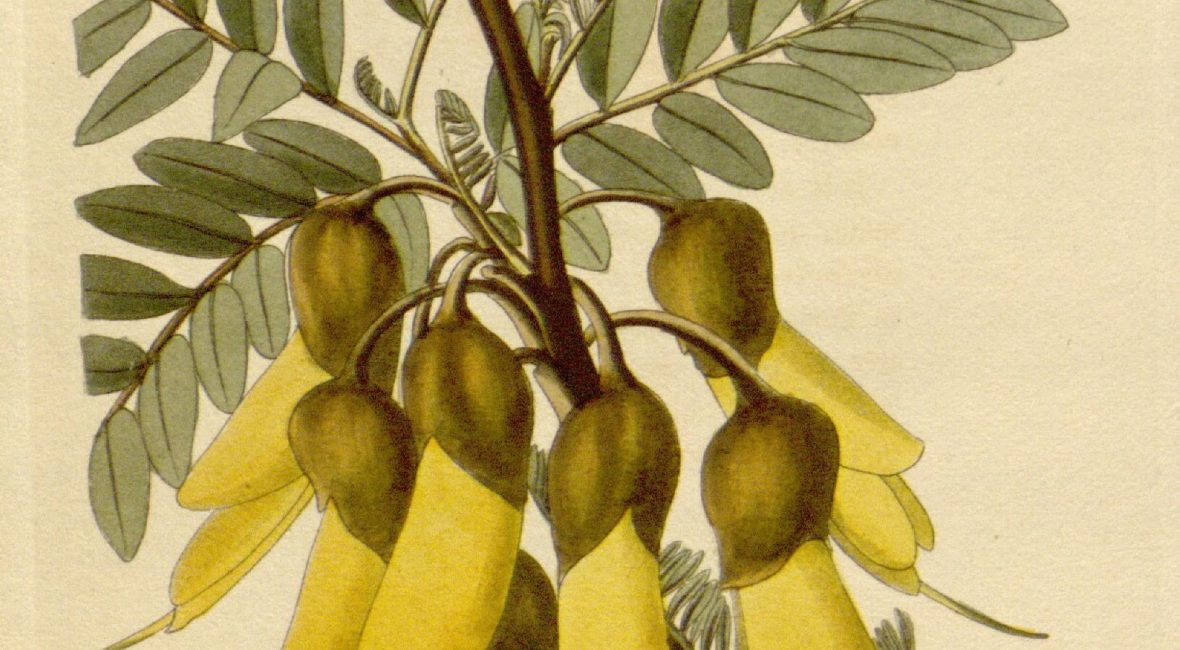
A branch with yellow flowers, Sophora tetraptera, and green leaves

The large-leaved kōwhai (Sophora tetraptera) is native to the North Island of Aotearoa New Zealand, where it is widespread and common. While it grows naturally only in Aotearoa, it has been cultivated extensively outside of this range, including as one of a number of New Zealand plants historically introduced into English gardens.[1]

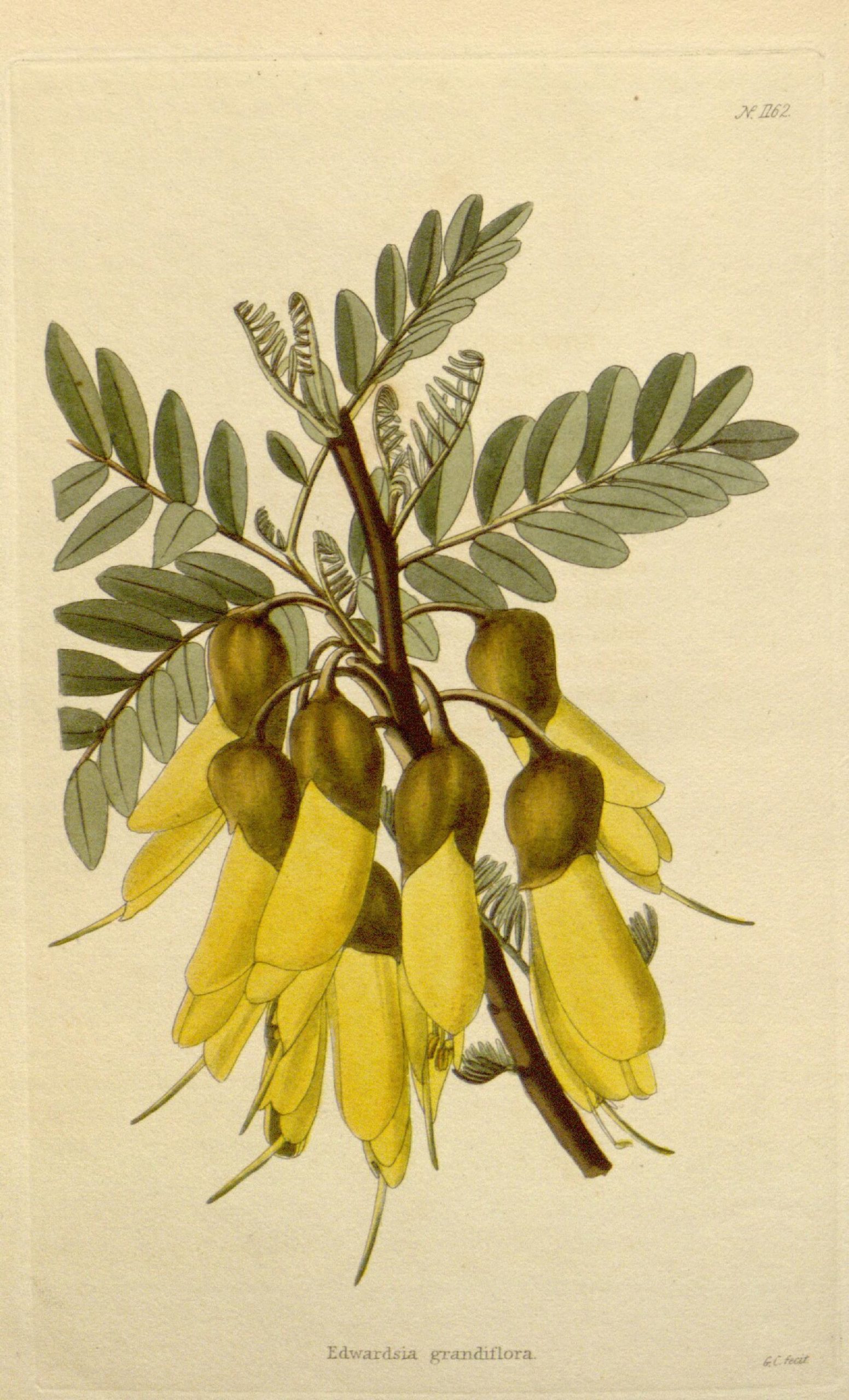
Natural history literature provides a record of such introductions, with many authors remarking on the suitability of Sophora tetraptera—often referring to it under the synonym Edwardsia grandiflora—to the English climate. For example George Loddiges, within his The Botanical Cabinet (1826), remarked that it was “sufficiently hardy to bear our climate, planted against a wall; in very severe frost, a mat should be hung over it.”[2] Two decades later, British writer and botanical authority Jane Wells Webb Loudon included the plant in her The Ladies’ Flower-Garden of Ornamental Greenhouse Plants (1848), where she noted that the original plant could still be found growing in Chelsea Garden in 1848.[3]

A branch with yellow flowers, Sophora tetraptera, and green leaves

Sophora tetraptera, under the synonym Edwardsia grandiflora. Plate 1162. The Botanical Cabinet. v. 12 (1826). Art by George Cooke. Contributed in BHL from the Missouri Botanical Garden, Peter H. Raven Library.

Loddiges’ and Loudon’s references are just two of many sources related to the history of Sophora tetraptera that Mark Laird (Professor, John H. Daniels Faculty of Architecture, Landscape, and Design, University of Toronto) identified thanks to the Biodiversity Heritage Library (BHL) whilst conducting research for a prospective book. One of the book’s chapters explores a variety of New Zealand plants introduced into English gardens from the 1770s to 1840s, in the context of both Kew’s colonial collecting and Māori heritage. BHL was an invaluable resource for this research—especially during the COVID-19 related lockdowns of 2020.

“I am a huge fan of BHL, and my admiration increases every year,” lauds Laird. “Last year, under Covid, I discovered I could research a large topic through online access to the BHL. The search engine allowed me to find all the collected references to many plant species, including illustrations of those species.”

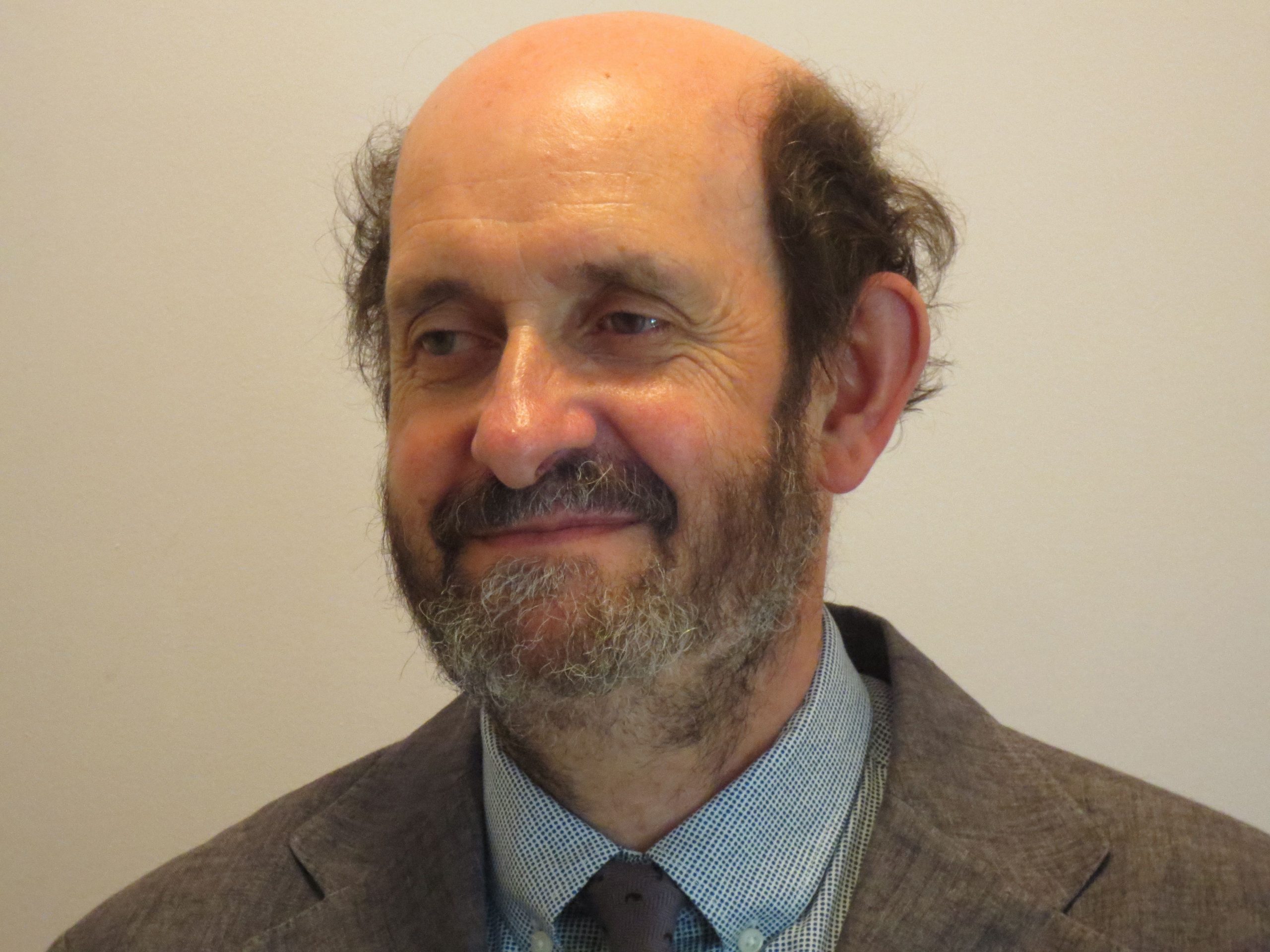
A man with a short beard wearing a brown suit jacket and blue shirt

Mark Laird (Professor, John H. Daniels Faculty of Architecture, Landscape, and Design, University of Toronto). Image courtesy of Mark Laird.

Laird’s expertise in historic landscape architecture is rooted in four decades of research. Over his career, he’s held fellowships at Chelsea Physic Garden, London, and Dumbarton Oaks, Washington, DC, and, prior to his appointment at the University of Toronto, was a Senior Lecturer in the Graduate School of Design at Harvard University for fifteen years. Laird has also authored many publications on historic landscape gardening.

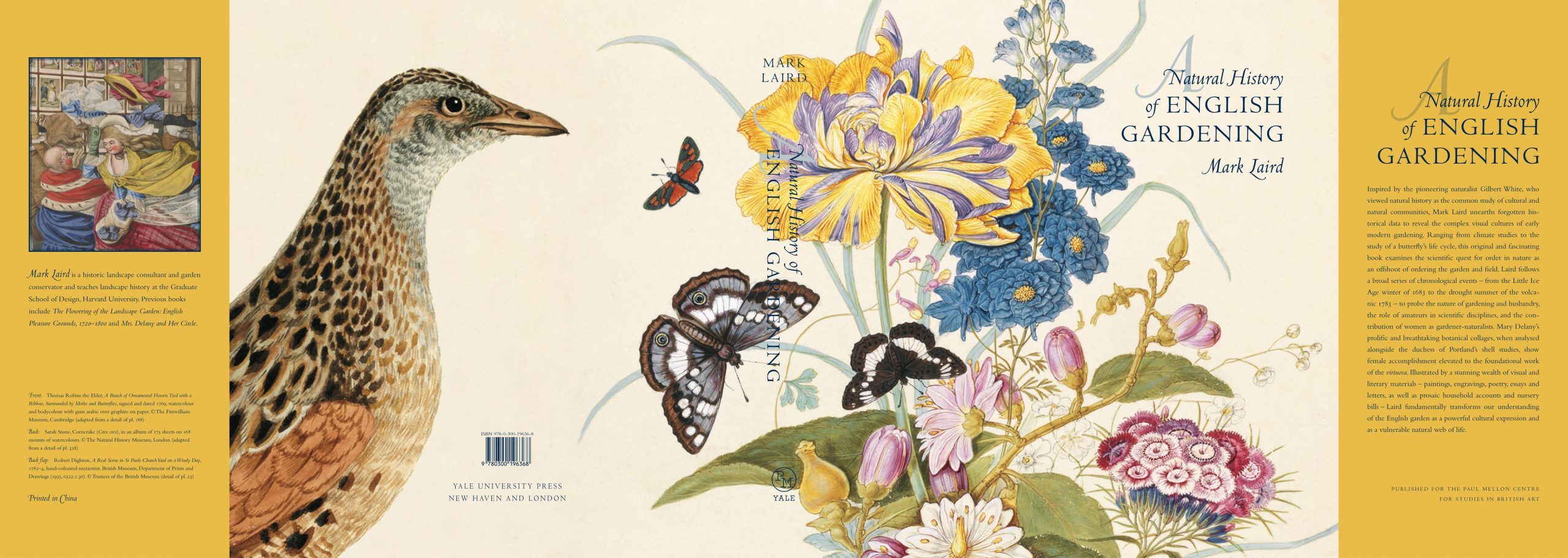
Dust jacket for the book, A Natural History of English Gardening (2015) by Mark Laird

Dust jacket for A Natural History of English Gardening (2015) by Mark Laird. Laird sourced many of the illustrations used within the publication from the Biodiversity Heritage Library (BHL). Image courtesy of Mark Laird.

It was whilst working on his most recent publication, A Natural History of English Gardening (2015), that Laird first discovered BHL. Within the work, which was awarded the 2019 Elisabeth Blair MacDougall Book Award from the Society of Architectural Historians, Laird draws on historic documents to help chronicle and illustrate the history of early modern gardening and its cultural and scientific intersections. Jacqueline Dearborn (née Ford), then a Digital Projects Librarian at Harvard Botany Libraries, introduced Laird to BHL, who made enthusiastic use of the Library as a resource for many of the illustrations included in his Natural History.

“When sourcing images for my publications twenty-five years ago, many institutions were charging exorbitant reproduction fees,” recalls Laird. “It was a game changer to find that a good number of those institutions have now made their collections accessible online with a simple cost-free download of a High Resolution Image. BHL, as part of that shift in ‘intellectual commons,’ has changed the game for me.”

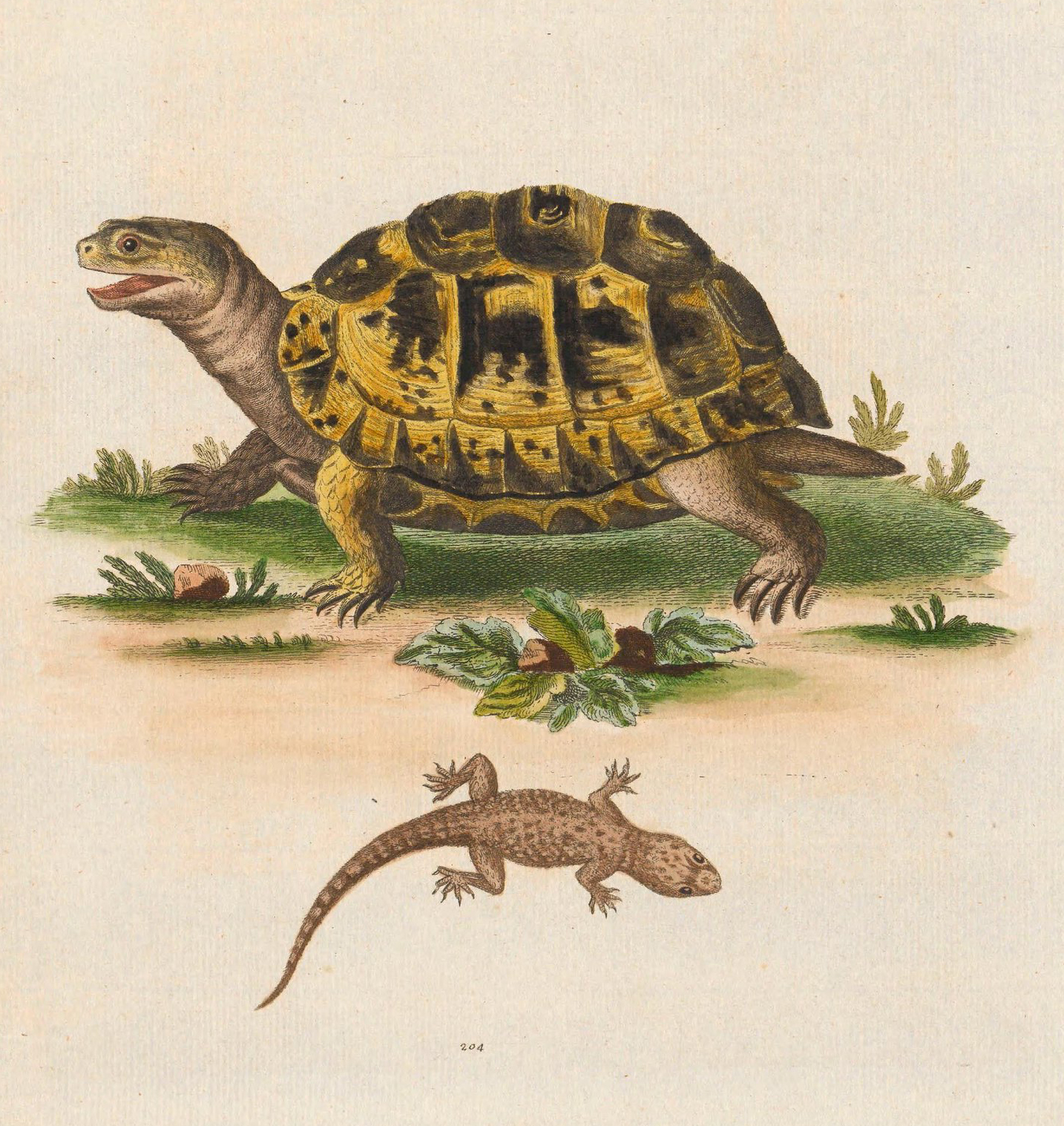
A turtle with a brown and yellow shell, illustrated above a brown lizard

The African Land-Tortoise (Testudo graeca) by George Edwards from his A Natural History of Uncommon Birds, v.4 (1751). Contributed in BHL from National Library Singapore. Edwards’ illustration appears within Laird’s A Natural History of English Gardening (2015), where he shares that naturalist George White likened his aunt’s tortoise, Timothy—of the same species as Edwards’ Testudo graeca, to “a snail with a shell on its back.” White’s work represents a major theme in Laird’s Natural History.

BHL is now Laird’s go-to resource for natural history literature, particularly when it comes to accessing high quality illustrations. While he appreciates the access BHL provides, he does hope to see the Library implement a more streamlined high resolution image download process in the future, as the current method involves multiple steps.

Laird isn’t alone in his love of BHL’s illustration collections, as evidenced by the popularity of the BHL Flickr, which provides access to over a quarter of a million images from the Library. As BHL further develops its tools and services, staff will continue to explore ways to improve access to and features around scientific artworks.

As for Laird, BHL has opened up a whole new world of possibilities when it comes to online research, and he intends to make the most of these opportunities. “This summer, I expect to continue ‘remote’ research thanks to BHL, which is a game-changer in how a scholar can work from home and at any hour of the day,” affirms Laird.

As researchers continue to adapt to and evolve within increasingly dispersed, asynchronous working environments, BHL will be there to support them wherever and whenever their work takes them.

References

[1] New Zealand Plant Conservation Network. 2021. “Sophora tetraptera.” Accessed on 17 June 2021. https://www.nzpcn.org.nz/flora/species/sophora-tetraptera/

[2] Conrad Loddiges & Sons. 1826. The Botanical Cabinet. 12: pp. 1162. https://www.biodiversitylibrary.org/page/28891039.

[3] Loudon, Jane Wells Webb. 1848. The Ladies’ Flower-Garden of Ornamental Greenhouse Plants. pp. 85. https://www.biodiversitylibrary.org/page/54351293.

August 12, 2021by Grace Costantino
Blog Reel, User Stories

Backswimmers vs. Mosquitos: BHL Informs Research on Controlling Yellow Fever Mosquito Populations

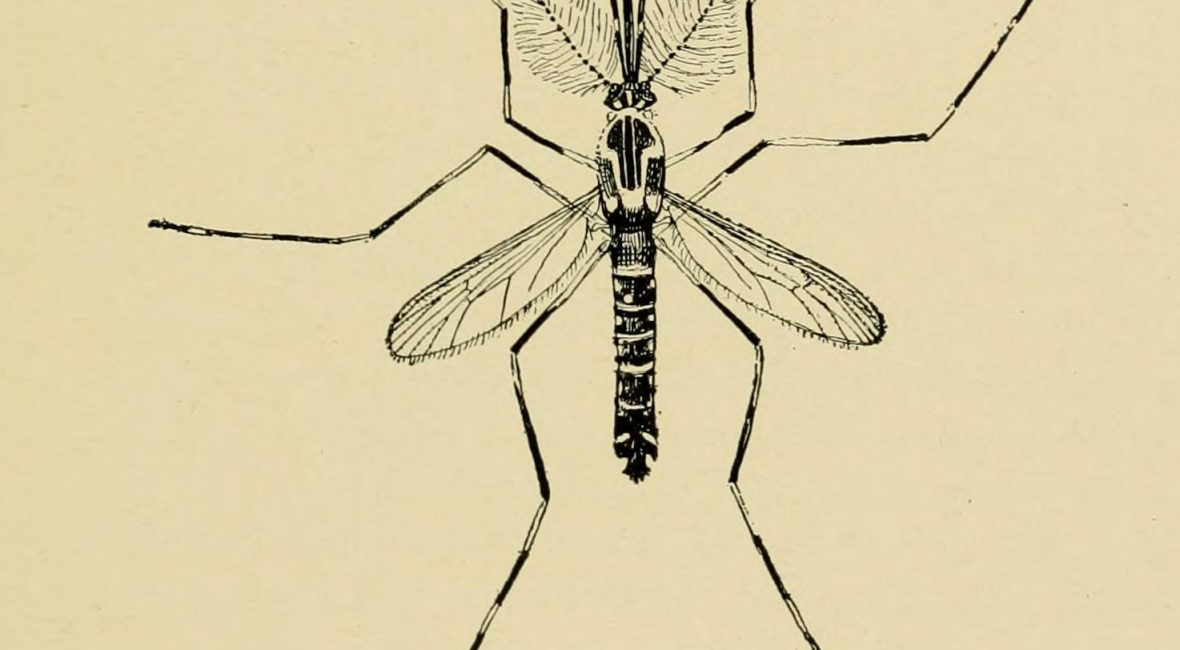
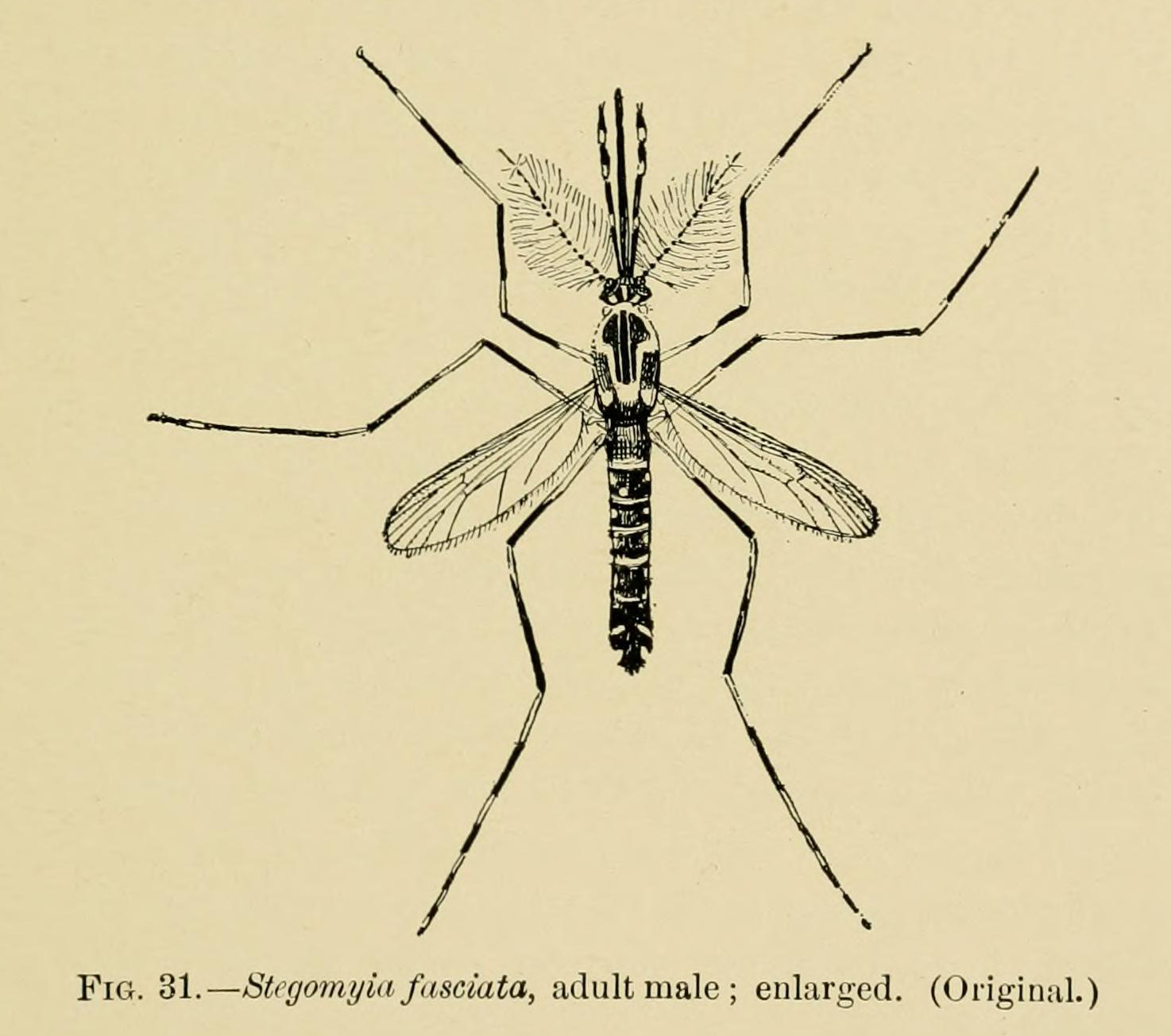
Black and White drawing of a mosquito (yellow fever mosquito (Aedes aegypti))

The yellow fever mosquito (Aedes aegypti), under the synonym Stegomyia fasciata. Source: Howard, L. O. (Leland Ossian). Mosquitoes; how they live; how they carry disease; how they are classified; how they may be destroyed. 1901. Contributed in BHL from Smithsonian Libraries and Archives.

Aedes aegypti, dubbed the yellow fever mosquito, is a globally invasive, pervasive threat to human health. As the common name suggests, the species can carry a range of diseases, including not only yellow fever but also dengue, the Zika virus, and the chikungunya virus. It is responsible for an estimated 400 million infections each year.[1]

Originating in Africa, Aedes aegypti has spread across the globe, initially transported via ships carrying enslaved people to the Americas. Soon after, trade ships bearing goods like sugar from the Americas brought the species to Europe, and from there it eventually made its way to Asia by way of the Suez Canal. Aedes aegypti’s success is secured by its ability to survive in a range of tropical, subtropical and temperate regions and its threat is exacerbated by its ability to breed in clean water supplies and propensity to bite during the day, rendering protective bed nets ineffective. The effects of climate change are expected to increase A. aegypti’s potential range significantly, escalating the urgency of implementing effective species control methods.[1,2]

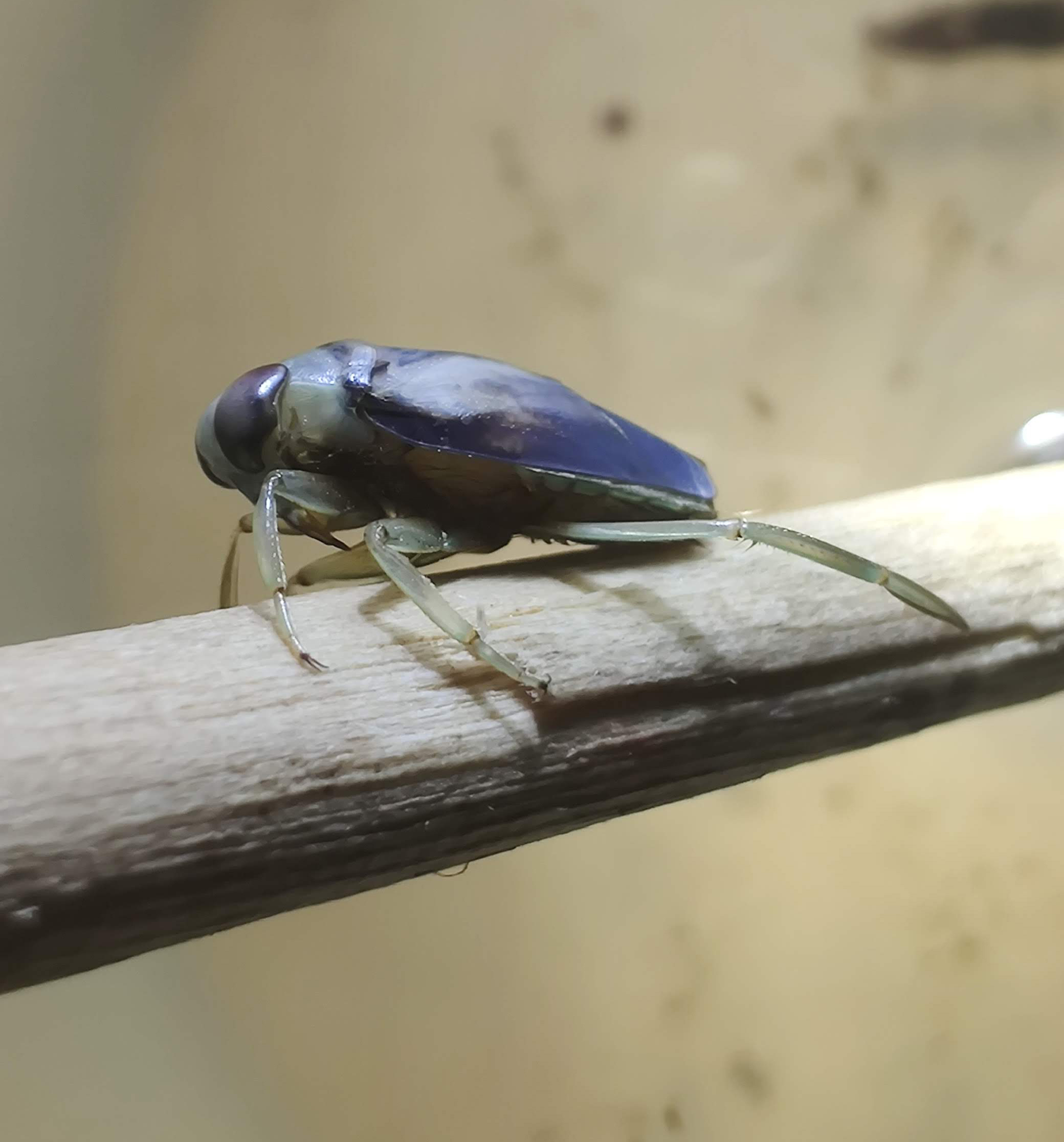
A blue insect with transparent legs perched on a light brown branch.

Notonecta indica perched on a piece of wood. Photo courtesy of: Gavin Campbell.

The aquatic insect Notonecta indica—a species in the family Notonectidae, commonly called backswimmers because they swim on their backs—preys on Aedes aegypti mosquitoes in the Americas. Gavin Campbell, a PhD candidate at the University of the West Indies in Jamaica, is researching this predator / prey relationship as part of his PhD. Specifically, Campbell hopes to quantify the control of Aedes aegypti by Notonecta indica by determining how many mosquitoes each adult predator can consume daily and throughout their lifetimes.

The Biodiversity Heritage Library (BHL) has been an invaluable resource for this research.

“Thanks to the articles from BHL, I was able to substantiate my data with the foundational data to prove that other researchers have found similar things,” shares Campbell. “Before I found the BHL resources, I was only able to find a single paper from 2020 that was able to offer anything close to my research. I am very grateful for these and other documents I have come across since then.”

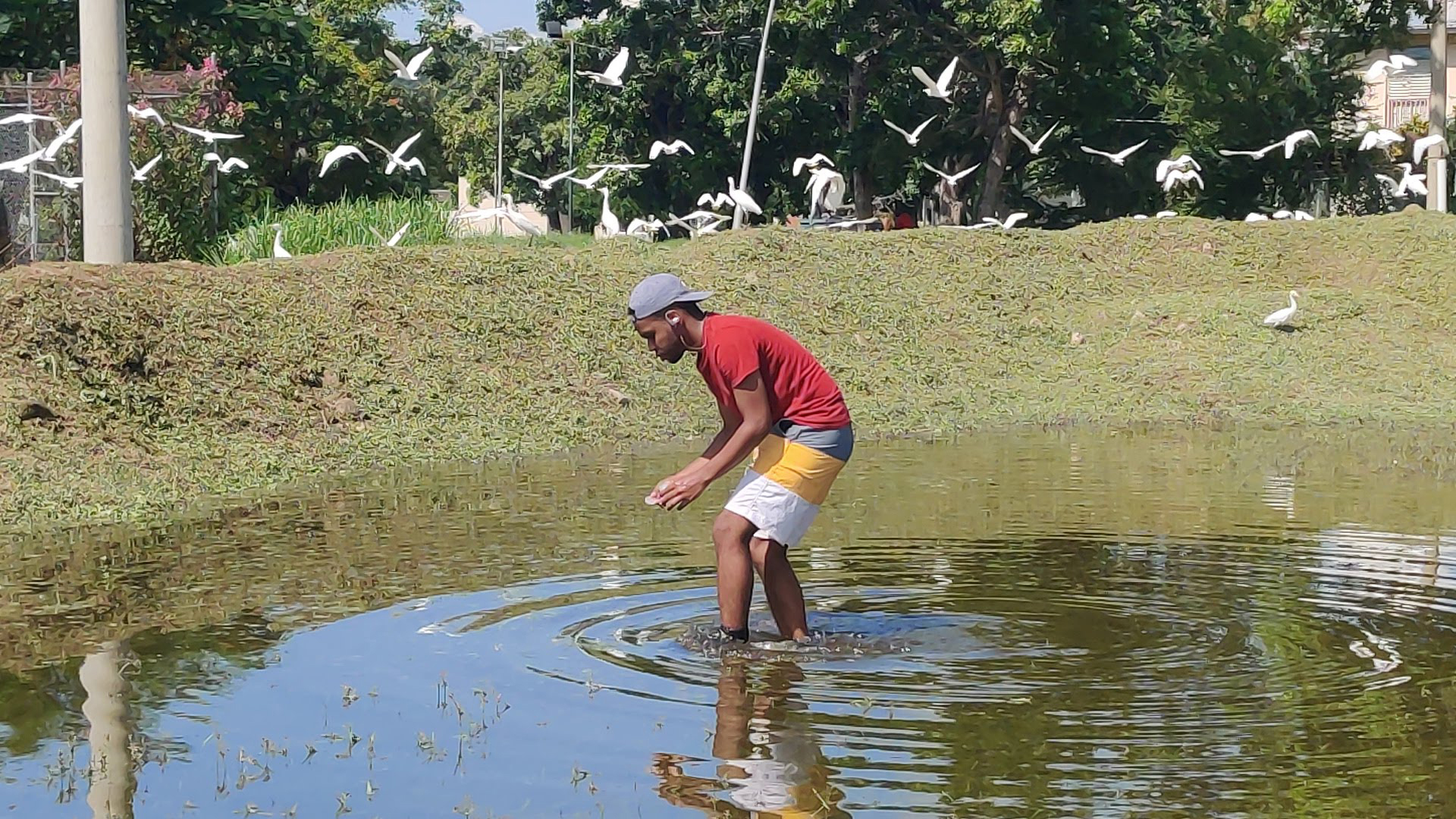
Black man in a red shirt and white, gray, and yellow shorts standing in a pond with birds flying in the background.

Gavin Campbell, a PhD candidate at the University of the West Indies in Jamaica, collecting water samples from a pond as egrets fly around. Photo courtesy of Gavin Campbell.

Campbell has been studying the aquatic and terrestrial phases of temporary ponds since 2017, with the life history of Notonecta indica and its impact on mosquito populations being a major component of that research. As Campbell explains on his website, “temporary waters are bodies of water which recurrently dry”, ranging from the minute—”water inside a snail shell”—to the massive—”the sizes of lakes and rivers”. As these bodies may be “freshwater, brackish, saline and even hypersaline (saltier than the sea)”, a wide variety of species are adapted to live in these diverse ecosystems.[3]

Campbell regularly uses BHL to access historic documents related to his research, typically downloading selected pages as PDF files to read offline.

“BHL has been critical in providing me with baseline information for my research as the documents in question were difficult to find,” asserts Campbell.

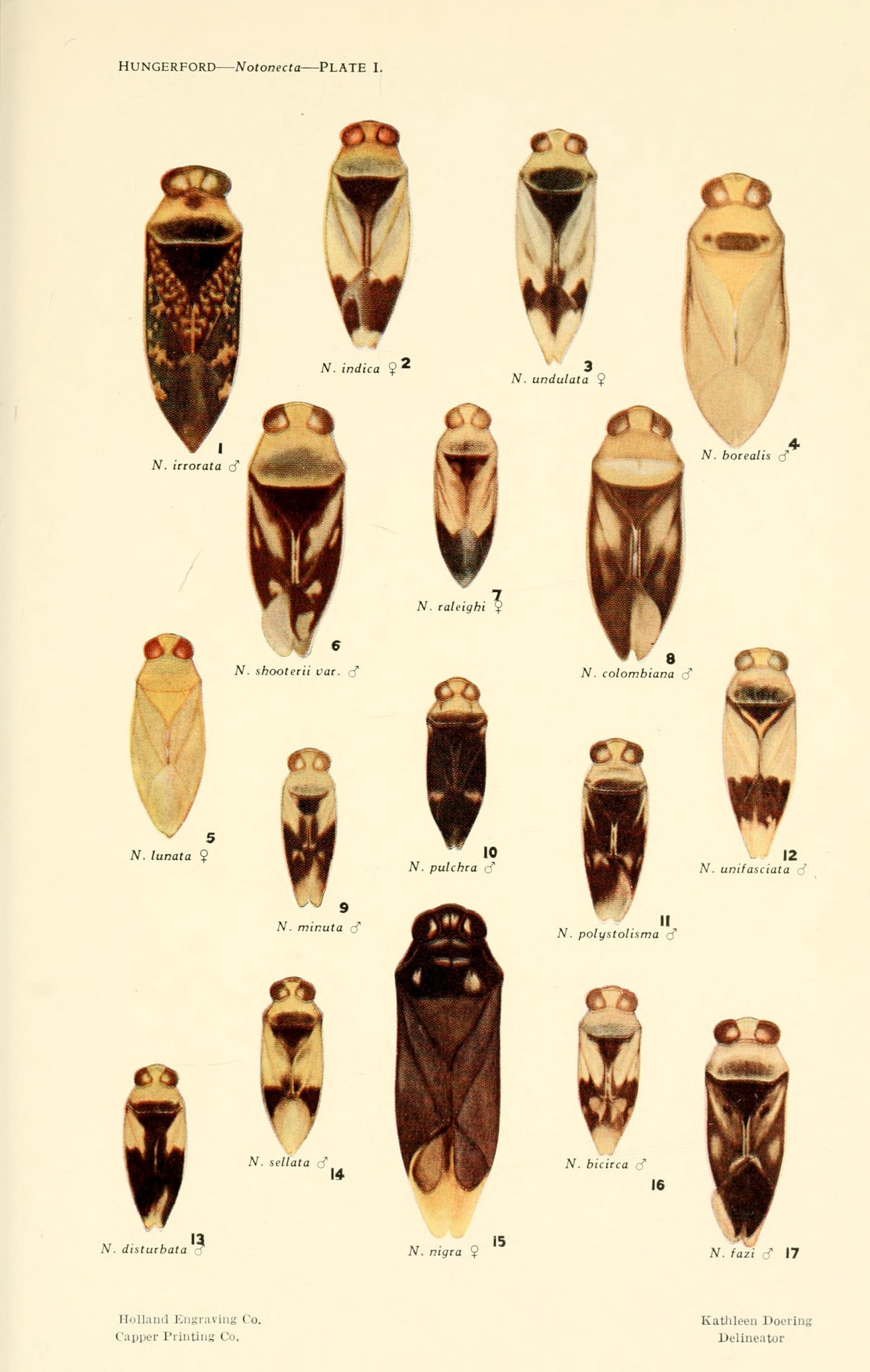
Various species of illustrated insects (Notonecta species)

A variety of Notonecta species, including Notonecta indica (fig. 2). Source: Hungerford, H. B. The Genus Notonecta of the World. 1933. Contributed in BHL from Harvard University, Museum of Comparative Zoology, Ernst Mayr Library.

Of all of the titles in BHL’s collection, The Genus Notonecta of the World (1933) by H. B. Hungerford has had the greatest impact on Campbell’s research. Published in The University of Kansas Science Bulletin, the work attempted to assemble all available information about the Notonecta genus, noting that more than thirty years had passed since the last comprehensive account of the genus was published. The publication represented twelve years of research, during which Hungerford consulted both the original descriptions and the types in museums throughout North America and Europe in an effort to “account for every named species”. The work was illustrated in color by Kathleen Doering.[4]

The Genus Notonecta of the World helped Campbell perform species identifications and capitalize on various behavioral aspects. For example, Hungerford notes that eggs are deposited on hard surfaces. Campbell applied this knowledge to his own work by placing a mesh within his rearing container, which facilitated easy removal of eggs each day. Hungerford also provides useful details about Notonecta behaviour in natural environments. For example, in a pond which N. indica frequents during the rainy season, a large number of branchiopods are present, which Hungerford notes are a food source for N. indica’s younger stages. This thus serves as a contributing factor in their dispersal and biology.

The illustrations in The Genus Notonecta of the World were also useful for Campbell’s research, helping him identify organs and structures within individuals and distinguish males and females for successful mating and to help determine differences in mosquito consumption between males and females.

“The BHL was key to providing access to the valuable information in this publication, as few papers at present go into such detail on the family,” affirms Campbell. “Without the BHL providing access to this foundational article, I would have been set back and hindered in my research.”

With Aedes aegypti expected to pose continued, significant threats to human health, we are proud to know that BHL is empowering important research that can help scientists better-understand the species and implement effective control methods. As Campbell shares, “With a better understanding of the role of N. indica in mosquito control, I aim to create and support more habitats for these natural predators to suppress mosquito populations, using nature-based solutions to address the extensive effects of climate change.”

As Campbell’s testimonial demonstrates, immediate, online access to biodiversity literature is ever-more important, allowing research to proceed more quickly and efficiently and improving our ability to respond to the many crises facing our planet and our species today. We look forward to continuing to provide researchers like Gavin Campbell with the essential literature they need to empower their work—anytime, anywhere.

Thank you @BioDivLibrary for this and so many other treasures pic.twitter.com/qDkfTH0kSc

— ?️‍?Gavin Campbell ?️‍? (@dragonecology) July 1, 2020

https://platform.twitter.com/widgets.js

References

[1] Sokol, Joshua. “The Worst Animal in the World.” The Atlantic. 20 August 2020. Accessed on 3 June 2021. https://www.theatlantic.com/health/archive/2020/08/how-aedes-aegypti-mosquito-took-over-world/615328/

[2] European Centre for Disease Prevention and Control. “Aedes aegypti – Factsheet for experts.” 20 December 2016. Accessed on 3 June 2021. https://www.ecdc.europa.eu/en/disease-vectors/facts/mosquito-factsheets/aedes-aegypti

[3] Campbell, Gavin. “Ph.D.” Dragon in Flight. Accessed on 3 June 2021. https://www.dragoninflight.com/phd

[4] Hungerford, H. B. “Preface.” The Genus Notonecta of the World. 1933. pp.6-9. https://www.biodiversitylibrary.org/part/38865

July 8, 2021by Grace Costantino
Blog Reel, User Stories

Chronicling the History of the Former Squires of Coulsdon: Rare Book Digitization Informs Research on the Byron Family

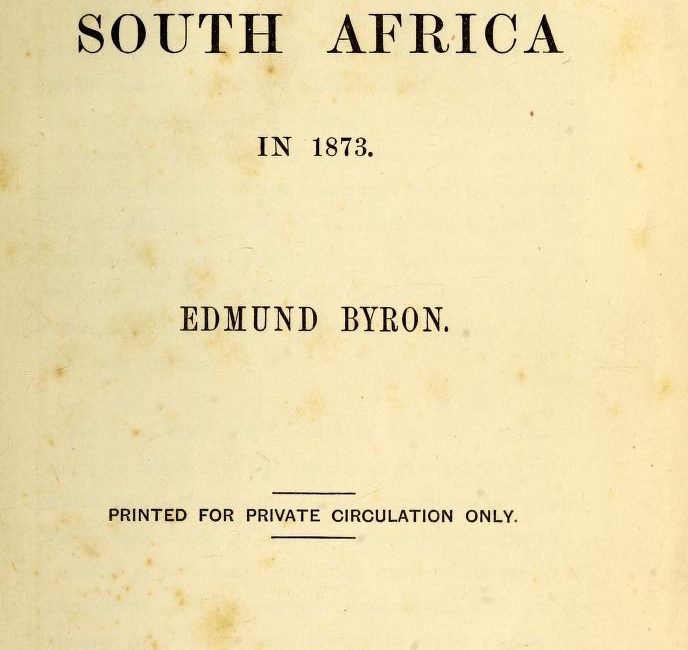
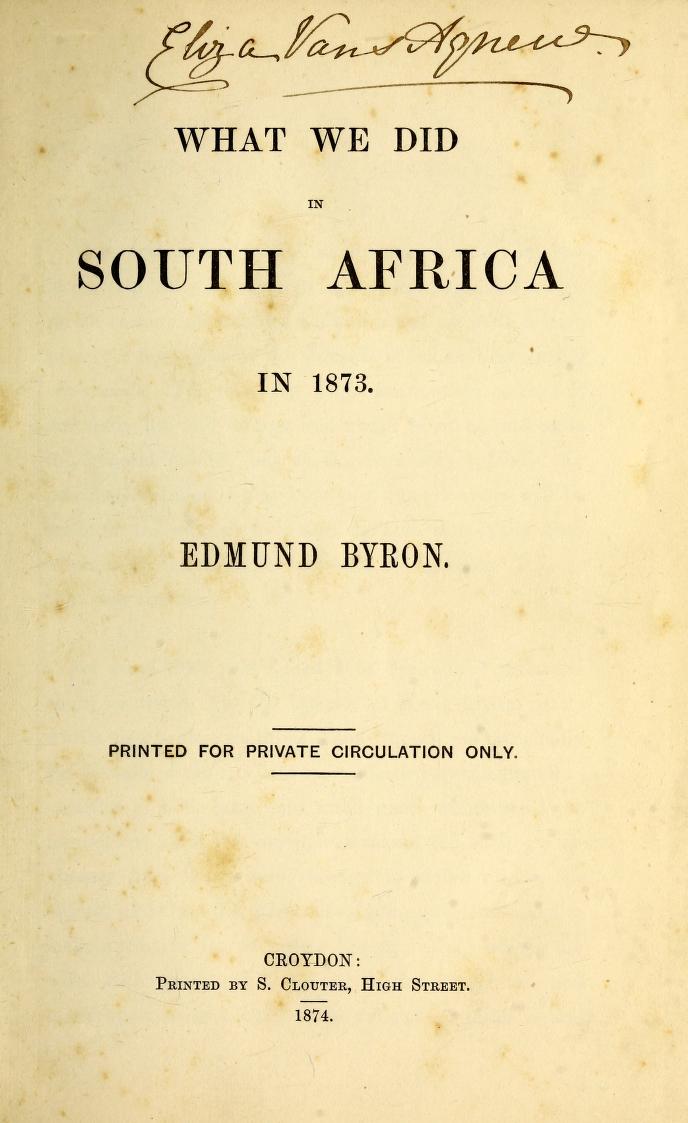
Title page of "What we did in South Africa in 1873".

The Joseph F. Cullman 3rd Library of Natural History at the Smithsonian Libraries and Archives in Washington, D.C. is home to many rare and special books. Amongst the approximately 20,000 volumes in the library’s collection is a particularly rare item—one of only six known copies in public and institutional libraries worldwide.

Title page of "What we did in South Africa in 1873".

Title Page. Byron, Edmund. What we did in South Africa in 1873 (1874). Digitized copy from the Joseph F. Cullman 3rd Library of Natural History at the Smithsonian Libraries and Archives. Freely available in the Biodiversity Heritage Library.

The book is a privately printed journal by Edmund Byron entitled What we did in South Africa in 1873, which details Byron and his wife Charlotte’s 1873 exploratory and hunting expedition to South Africa. In 2015, at the request of a researcher, the Smithsonian digitized its copy of the journal and made it freely available online in the Biodiversity Heritage Library (BHL), where it was discovered by Dr. Nigel Elliott, who was conducting research on the Byron family.

“My research was prompted by a donation to the Museum of Croydon, UK, of an archive of family papers relating to the Byrons, who were Lords of the Manor and Squires of the village of Coulsdon from 1782 to 1921,” explains Elliott. “Since the archive’s acquisition in 2012, a team from the Bourne Society has been working on cataloguing the archive, with a view to online publication. The archive provides a rich resource for exploring the domestic, social, business and farming history of the family, their role and relationship as local squires within the wider village community of Coulsdon, and the extensive foreign travels undertaken over the years by members of the family.”

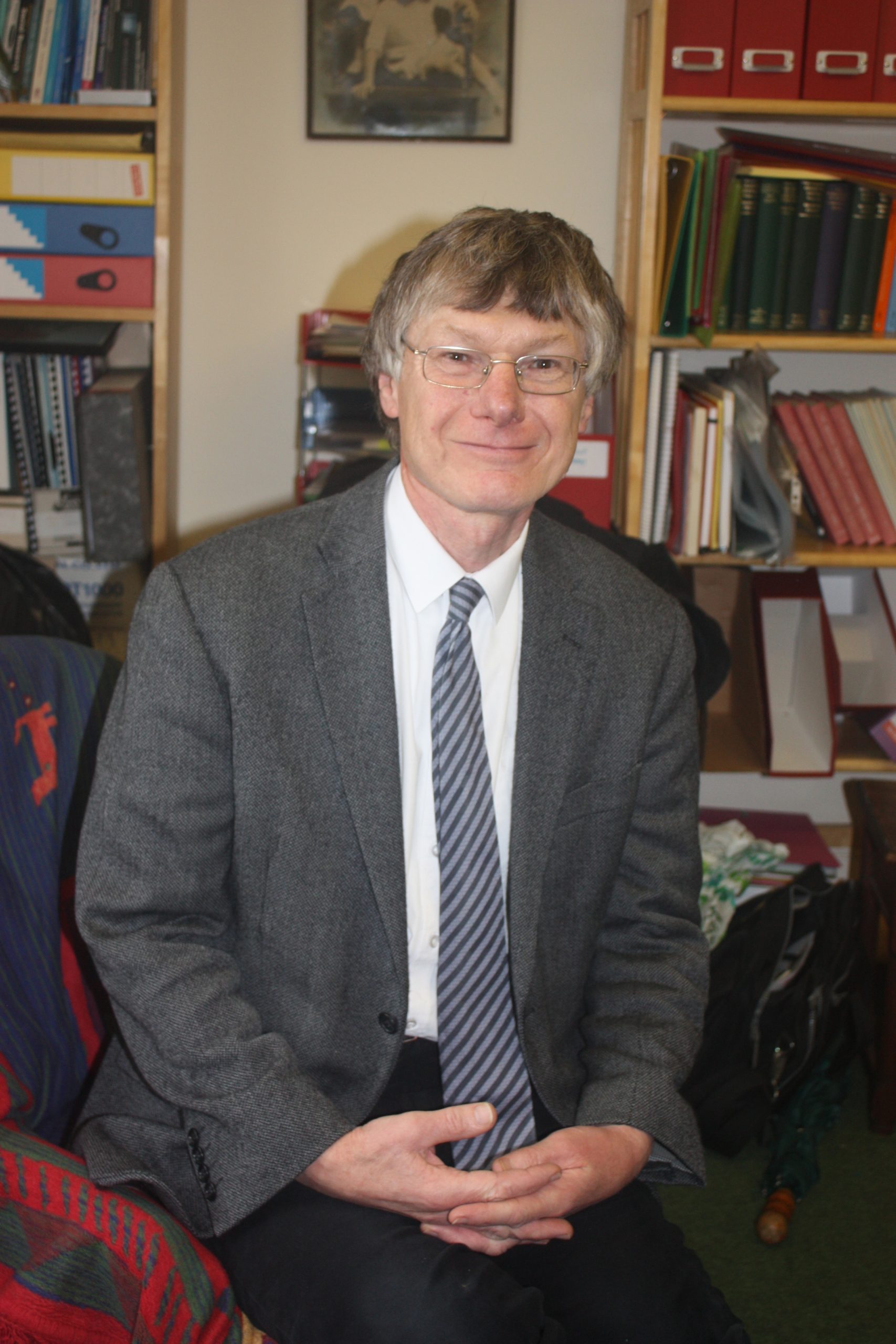
A man with white hair in a gray suit, white shirt, and blue tie.

Dr. Nigel Elliott. Photo courtesy of Dr. Elliot.

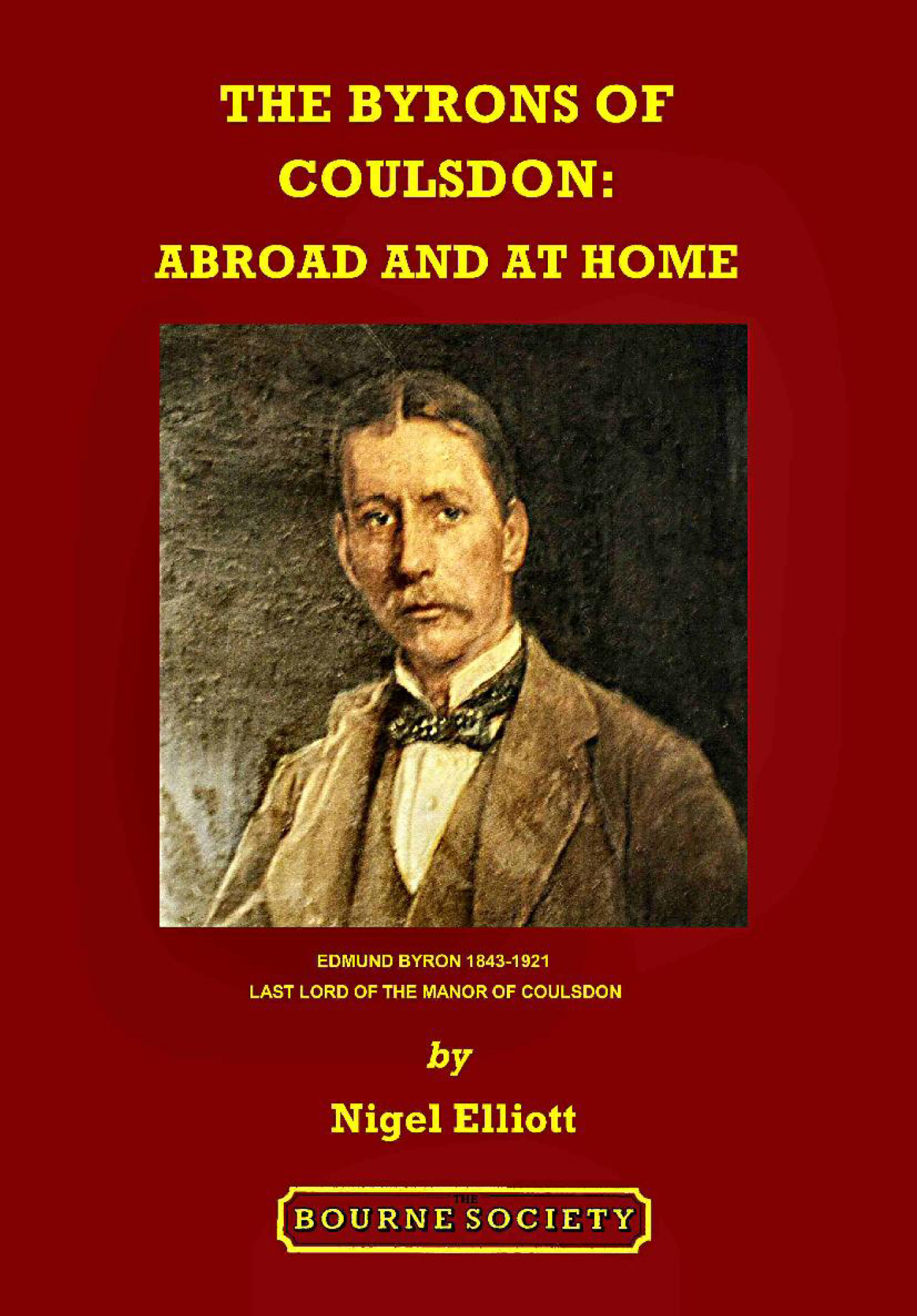
Inspired by his work with the Bourne Society cataloging these archives—and the intensive research that it required—Elliott authored a book on the family, published by the Society: The Byrons of Coulsdon: Abroad and at Home (2020). The book itself covers three generations, with a particular focus on Edmund Byron.

Red book cover with title in yellow, The Byrons of Coulsdon: Abroad and at Home.

Cover: The Byrons of Coulsdon: Abroad and at Home (2020) by Dr. Nigel Elliott. Image courtesy of Dr. Elliott.

One of Elliott’s chapters is devoted to Edmund and Charlotte’s South African expedition—as detailed in Edmund’s journal—during which the pair, accompanied by Edmund’s manservant Mr. Kemp, traveled via a combination of coaster (a shallow-hulled ship used for trade) and ox wagon from Cape Town to present-day Kruger National Park and Great LimpopoTransfrontier Park, where, faced with the remote and challenging terrain of that area in 1873, they travelled and hunted wholly on foot. The Byrons employed a team of local Black staff—on whose hunting skills the Byrons were particularly dependent—as well as a White employee, Mr. Dubois, to manage the expedition.

“In the chapter, I follow Edmund’s journal closely and in detail,” shares Elliott. “I have attempted to place their visit in the context of South Africa at the time. My background reading revealed to me the extent to which the 1870s were critical in the country’s history, and I have attempted to set this decade within the wider trajectory of South African history.”

Online access to Edmund’s journal was indispensable for Elliott’s research and the publication of his book.

“From Edmund’s journal, which I accessed online via a PDF download of the Smithsonian’s copy on BHL, I was able to construct a detailed narrative of the tour,” affirms Elliott. “This easy access to the journal was critical in providing a thorough history of the family and in meeting the research objectives set out in the book.”

According to Elliott, the journal provides valuable perspective on the dualities of the Byrons’ lives as both a gentry family deeply rooted in a small English community and intrepid world travelers eager to experience different places and cultures. The journal also reveals a duality within Edmund himself as he—a privileged White male—interacts with new cultures and people. When referring to the Black men and women they encountered, Edmund sometimes uses derogatory terms reflective of the White supremacist culture so pervasive during the European colonial period. At the same time, and unlike many of his compatriots, Edmund strove to act with integrity towards his Black staff and others and even, when faced with a direct appeal for help, enabled one woman to escape enslavement by providing her with protection and employment.

“The journal provides a fine opportunity to deepen the character study of Edmund, a truly patriarchal man in the context of his home life in Coulsdon, that comprises one of the central themes to my book,” shares Elliott.

The Smithsonian’s copy of Edmund’s journal was originally owned by Eliza Vans Agnew, who had connections to Edmund through his wife, Charlotte, whose mother was a Vans Agnew. Today, the volume is part of the Russell E. Train Africana Collection of the Smithsonian Libraries and Archives, which contains manuscript and printed materials, photographic prints and negatives, slides, audio tapes, film, original and reproduction artwork, maps, scrapbooks, and historical and natural artifacts related to the history of African exploration and natural history. The collection was originally assembled by the Honorable Russell E. Train, a former judge, top administrator of the Environmental Protection Agency, and a past president of the World Wildlife Fund. It was acquired by the Smithsonian in 2004.

The circumstances surrounding the digitization of Edmund’s journal was a fortuitous coincidence for Elliott. The Smithsonian Libraries and Archives digitized the volume—unbeknownst to Elliott—at the request of one of his colleagues, who was conducting tangential research with possible connections to the Byrons’ South African expedition.

“My colleague was impressed by the courtesy of the Smithsonian staff, who responded quickly to his expression of interest by digitizing Edmund’s journal,” shares Elliott. “As it turned out, the book was of no direct use to him but, as this story reveals, there was a serendipitous consequence of the Smithsonian’s helpful response and the digitized journal proved invaluable for my research.”

When Edmund Byron decided to “have printed a few copies of the Journal which we kept during our travels”, he did so with the expectation that it “would be of no interest to the general public.” Would he be surprised to know that, nearly 150 years later, researchers would view this journal as an informative historical document useful for modern-day research? Thanks to the Smithsonian Libraries and Archives and the Biodiversity Heritage Library, this volume—once available only to a few select readers—is now freely accessible to researchers everywhere.

June 10, 2021by Grace Costantino
BHL News, Blog Reel

BHL Quarterly Newsletter (May 2021) Now Available!

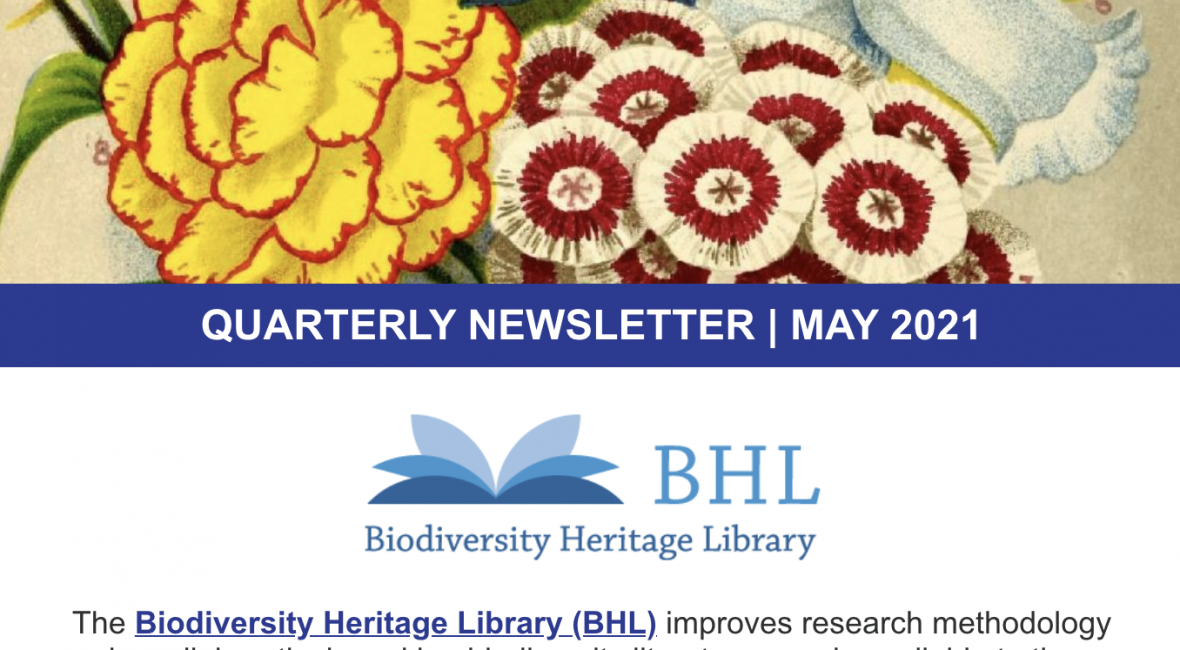
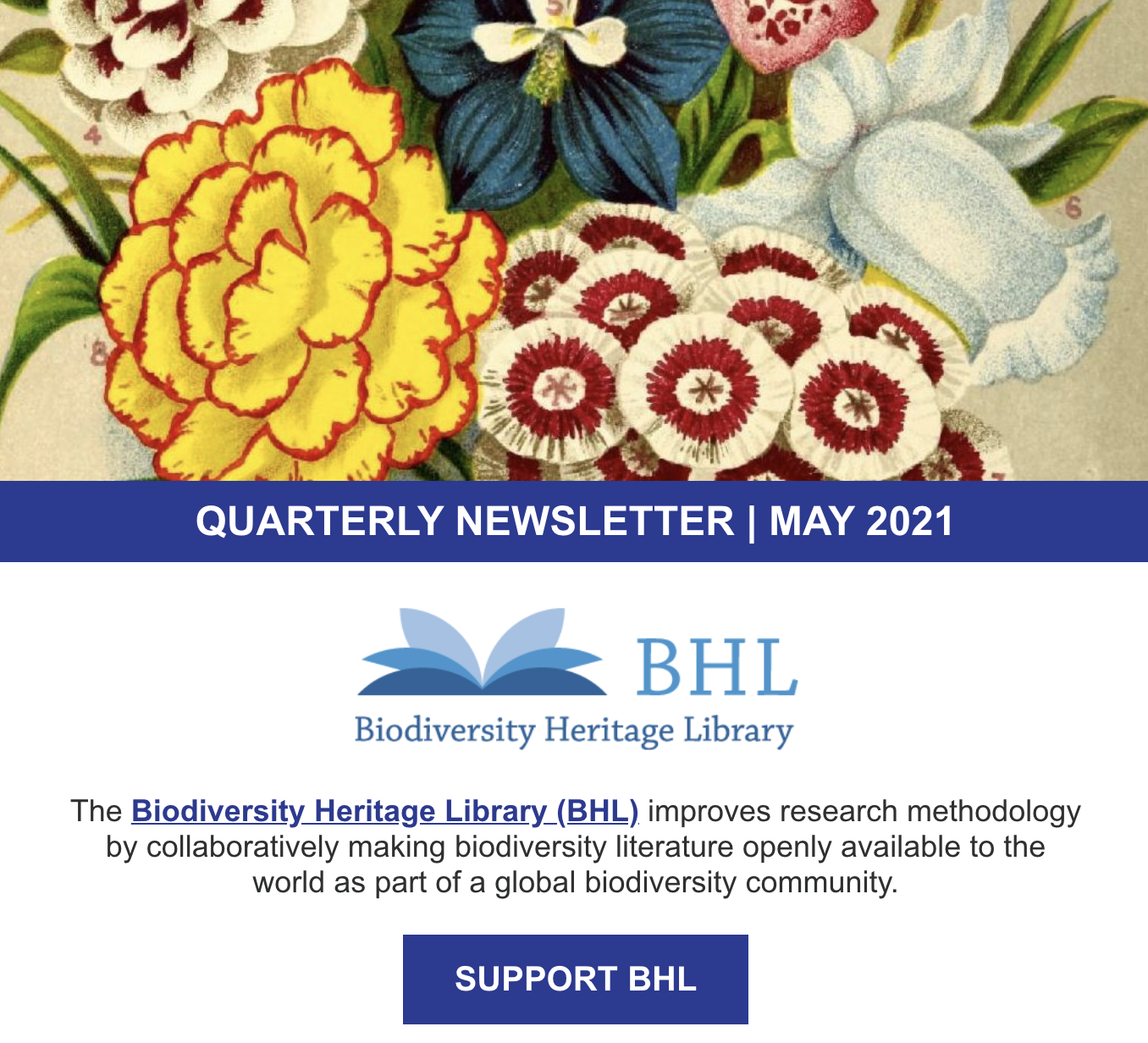
Screenshot of the May 2021 BHL qaurterly newsletter

Screenshot of the May 2021 BHL qaurterly newsletter

Our latest quarterly newsletter is now available! From a recap of the 2021 BHL Annual Meeting to recordings from BHL Day 2021 and an introduction to our new Persistent Identifier Working Group, don’t miss the latest news from the BHL community.

View our May 2021 Quarterly Newsletter.

May 17, 2021by Grace Costantino
BHL News, Blog Reel

Language of Flowers Virtual Symposium on 30 April 2021

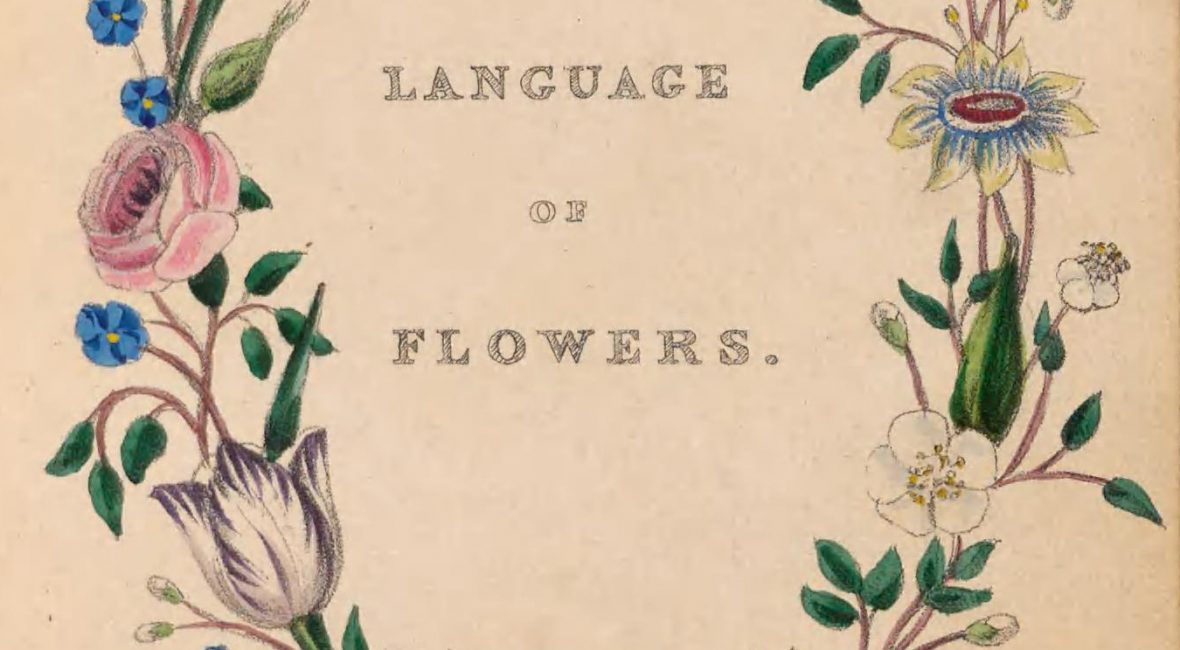
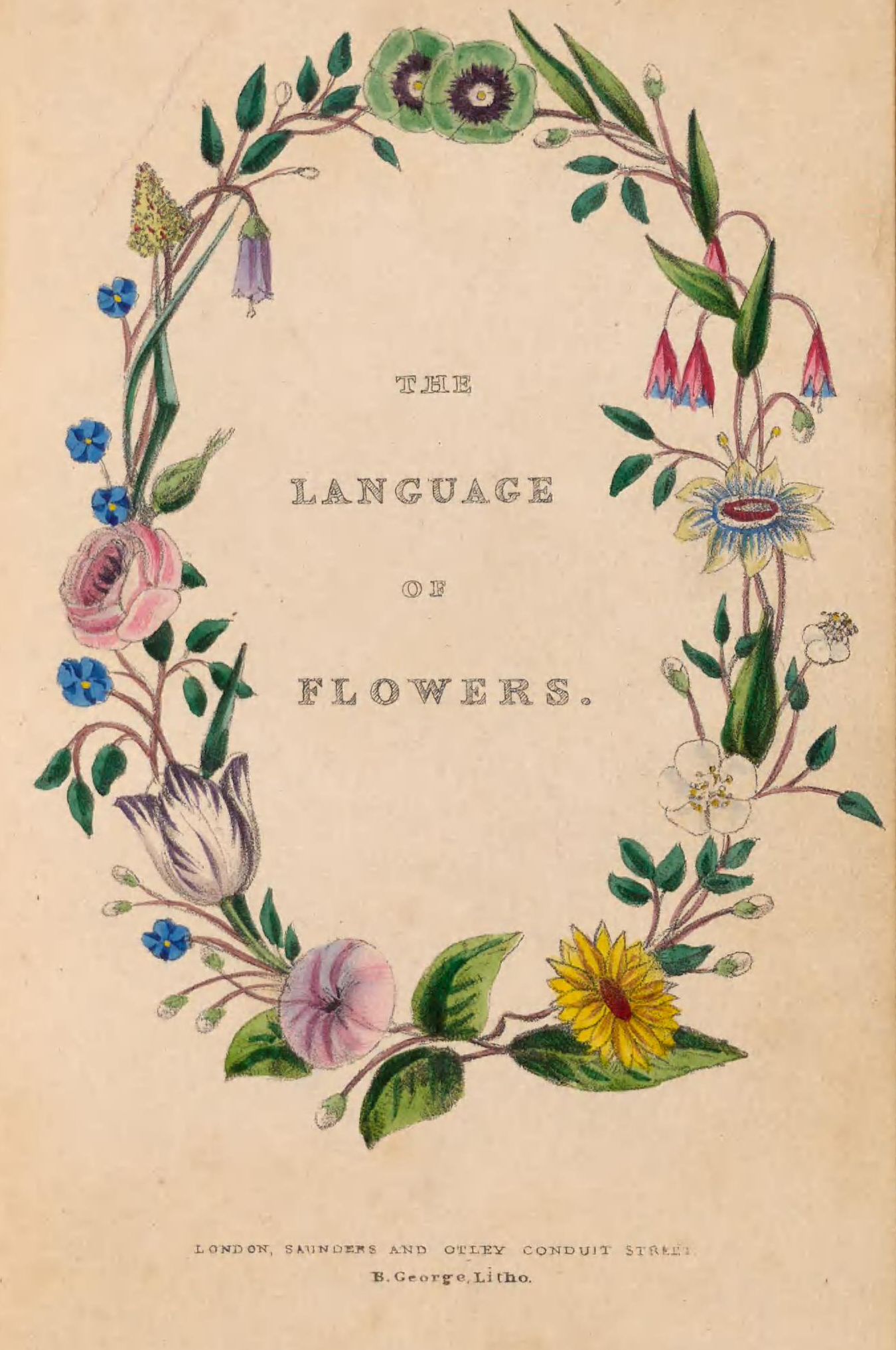
Book title page with title" The Language of Flowers" encircled in a wreath of flowers.

Title page. The language of flowers, with illustrative poetry. (1841). Contributed in BHL from Chicago Botanic Garden, Lenhardt Library. Digitization sponsored by the National Endowment for the Humanities (NEH).

On 30 April 2021, join the Chicago Botanic Garden’s Lenhardt Library and the Caxton Club for a free, virtual symposium celebrating the Language of Flowers—a popular literary trend in the 19th century that presented the world of botany through dictionaries of flowers and associated meanings, floral poetry and prose, offering a sentimental view of natural history.

Language of Flowers Virtual Symposium
When? Friday, 30 April 2021, 10am-2pm CT
Where? Online (via Zoom webinar)

Learn more and register for the event.

The Chicago Botanic Garden’s Lenhardt Library, a BHL Affiliate, presents this symposium in collaboration with the Caxton Club as the capstone event for a grant awarded by the National Endowment for the Humanities to conserve and digitize language of flower genre editions. Over the three-year grant period, 62 rare and unique language of flowers volumes published in the 19th century are being conserved and digitized by expert staff at the Northeast Document Conservation Center, with the volumes being made available in the Biodiversity Heritage Library (BHL).

You can explore volumes digitized as part of this grant as well as other titles from the genre in the Language of Flowers collection in BHL.

April 8, 2021by Grace Costantino
Blog Reel, User Stories

Hidden Biodiversity: Exploring Neotropical Fungus Weevils With the Help of BHL

Leer en español

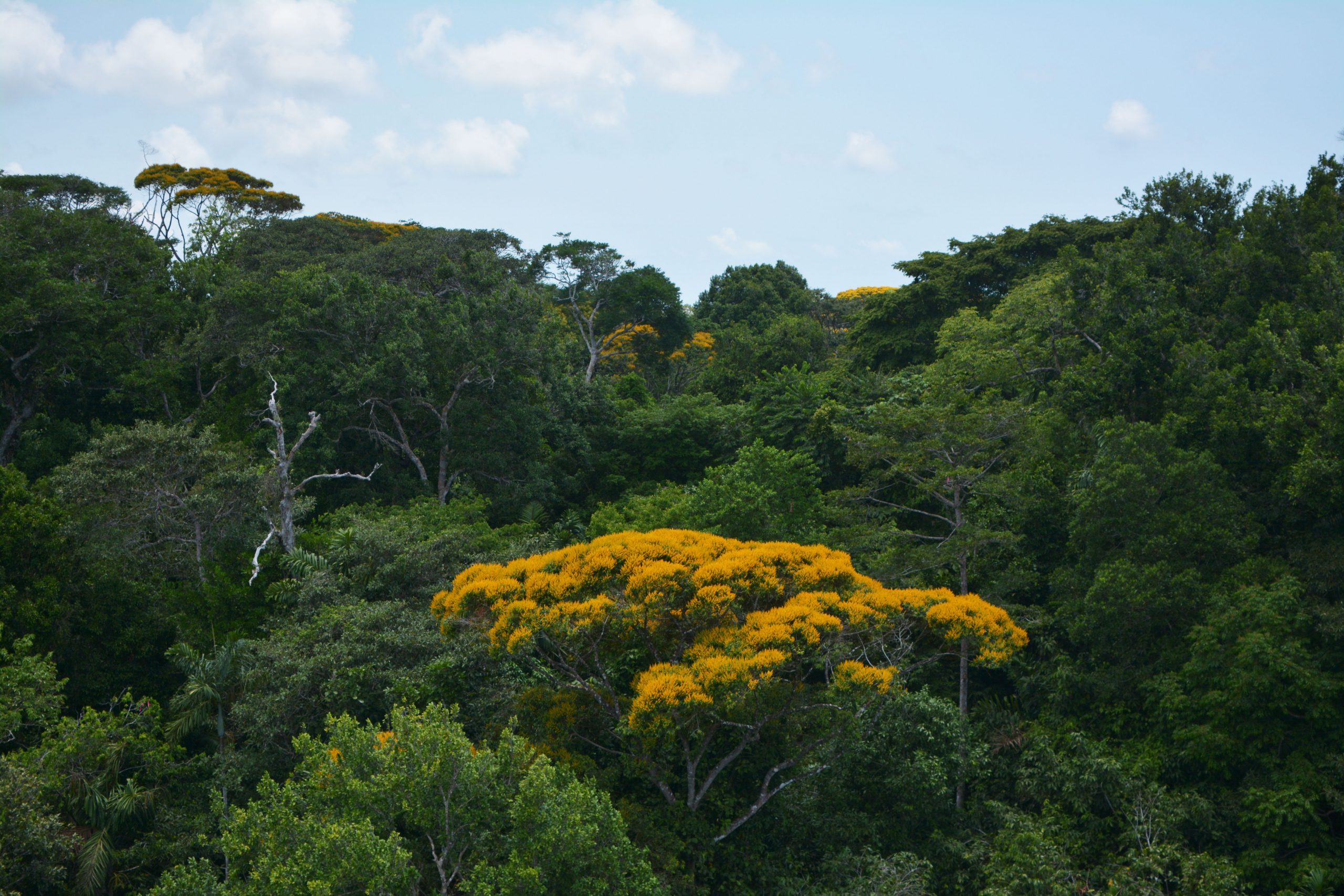
Photo of a lush tropical rainforest.

A view of the Panamanian tropical rainforest in Colón Province. Photo by Samanta Orellana.

In the last decades of the 19th century, a monumental publication on the biodiversity of Mexico and Central America began publication—Biologia Centrali-Americana. Published in 215 parts from 1879 to 1915 by the editors Frederick DuCane Godman and Osbert Salvin, the work describes over 50,000 species and is illustrated with over 1,600 lithographic plates depicting over 18,000 species. Remarkable for its time, the title is still vitally important for the study of Neotropical biodiversity today, as it contained virtually all known information at the time about Mexican and Central American flora and fauna.

Biologia Centrali-Americana is a particularly important resource for entomologist Samanta Orellana, a PhD student in evolutionary biology at the Dr. Nico Franz Lab of Arizona State University (ASU) and a research assistant in the ASU Biocollections of the Biodiversity Knowledge Integration Center. Orellana began studying insects and working with entomological collections more than a decade ago, during her undergraduate studies in her home country of Guatemala.

“For many insect groups in Guatemala and the rest of Central America, Biologia Centrali-Americana still represents the only source of information available for the region,” states Orellana.
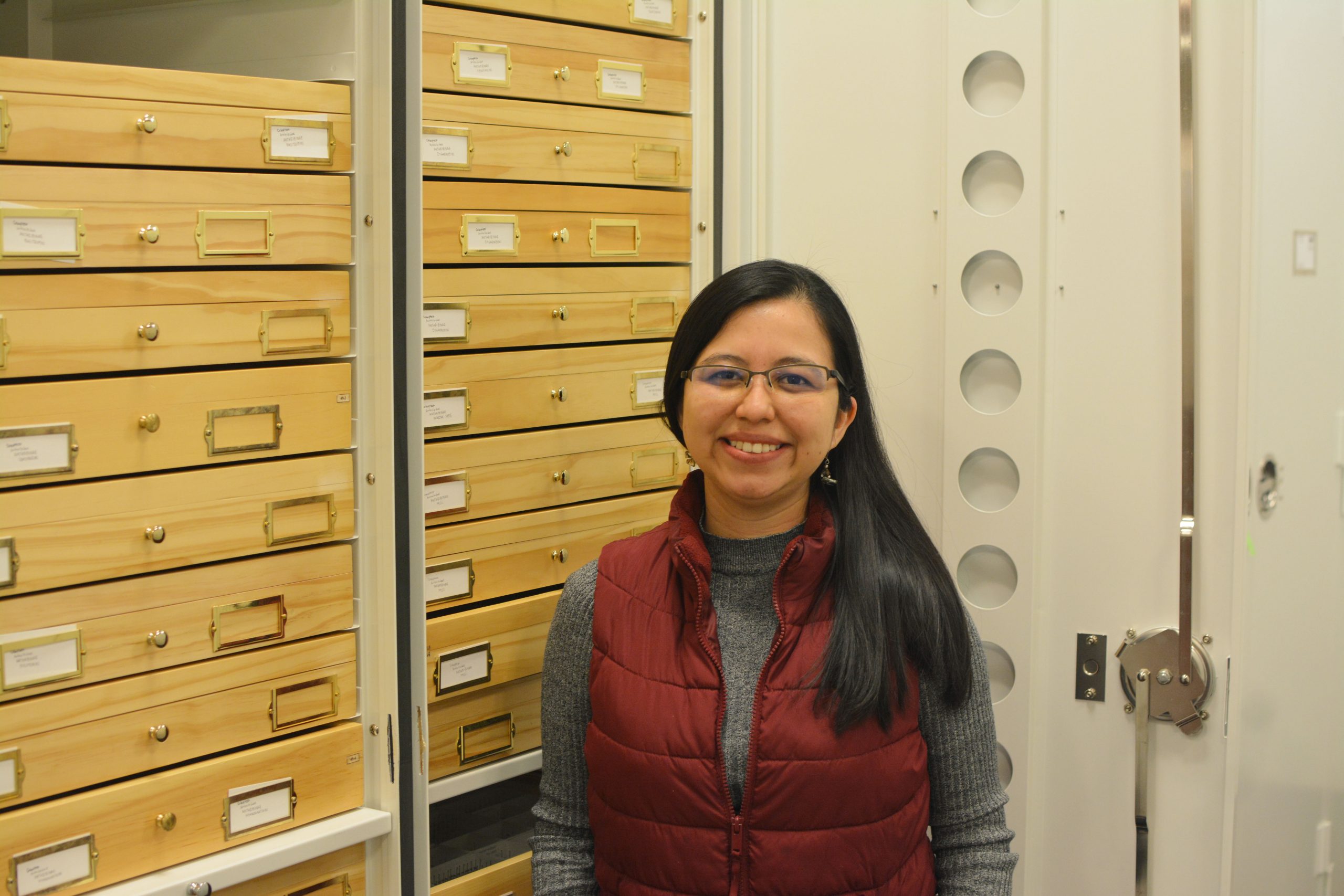
A person with dark hair in a red vest and gray shirt standing in front of collection specimen drawers.

Samanta Orellana in the Arizona State University Biocollections. Photo by Kevin Cortés.

Biologia Centrali-Americana is also meaningful to Orellana because it led her to the Biodiversity Heritage Library (BHL). In 2010, whilst identifying Guatemalan insects as part of her undergraduate studies, Orellana started using the “Electronic Biologia Centrali-Americana,” available from the Smithsonian Libraries and Archives, which directed her to BHL. She hasn’t stopped using BHL since.

“BHL is simply wonderful,” lauds Orellana. “I think it is an amazing tool for entomologists all around the world, especially for those of us who work or have worked in collections in developing countries, usually without access to specialized libraries or journals, but with a lot of material to identify.”

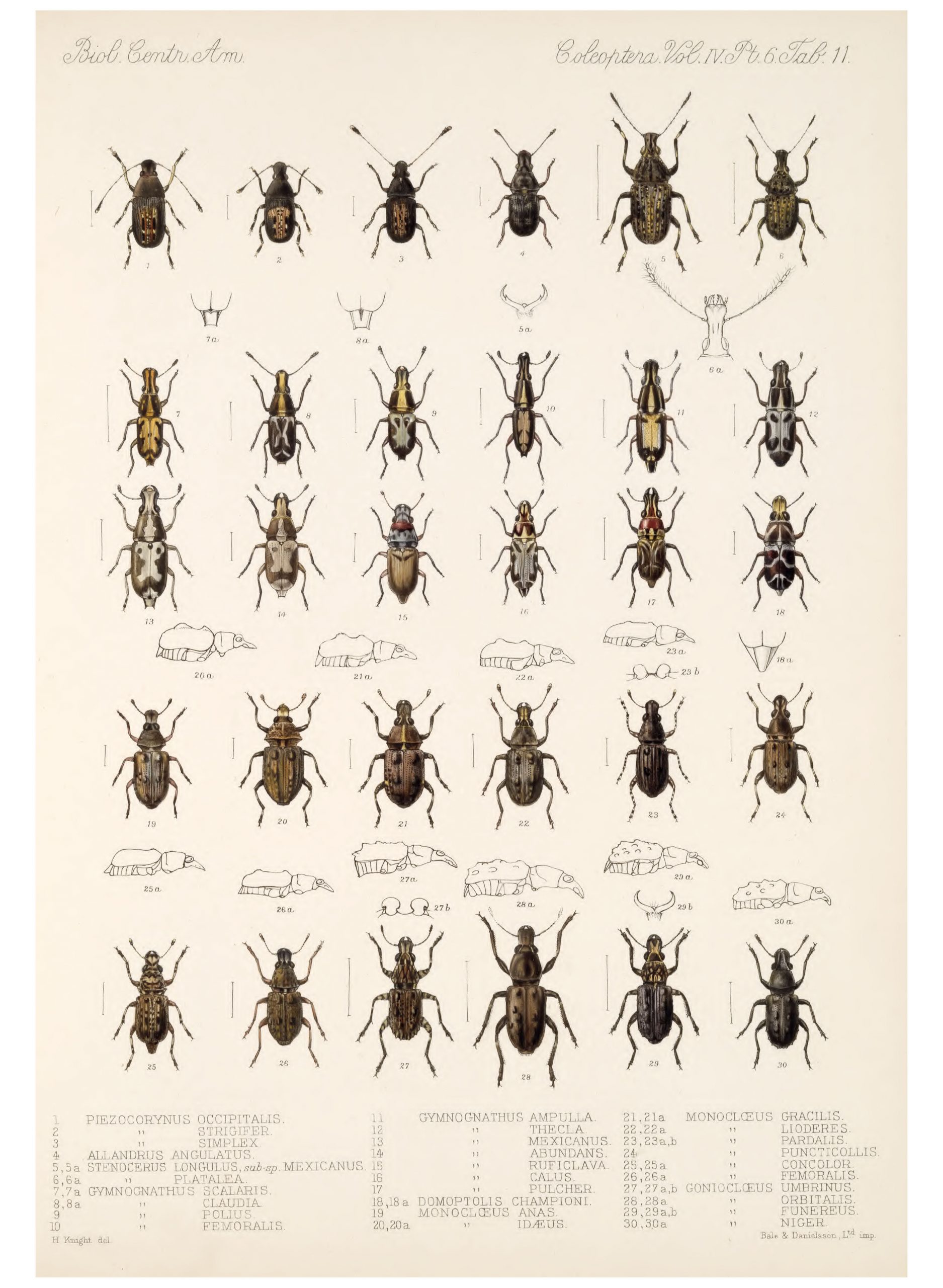
A variety of weevils illustrated on a page.

One of the plates of Central American anthribids, included in the chapter written by Karl Jordan in the Biologia Centrali-Americana (Insecta. Coleoptera. v.4, pt.6, 1895-1907). Contributed in BHL from Smithsonian Libraries and Archives.

Orellana specializes in the family Anthribidae (Coleoptera), commonly known as fungus weevils. Her research on these insects began during her studies at the Universidad de Panamá, where she completed an M.Sc. in entomology, and continues through her PhD work, with her dissertation focused on the family’s diversity and evolution. As part of this research, Orellana recently published a catalogue of the Anthribidae species from Panama.

BHL’s collections have been instrumental in enabling Orellana to pursue her work on the family.

“BHL was essential to complete my first published work on Anthribidae, a catalogue of the species from Panama,” shares Orellana. “This group of weevils has been poorly studied in the Neotropics, so identifying specimens is always challenging due to the lack of taxonomic keys. I had to rely mostly on original descriptions available through BHL to identify the specimens I examined, both in Panamanian and American collections. The catalogue ended up with 44 new records for the country, most of them identified thanks to the literature available in BHL.”

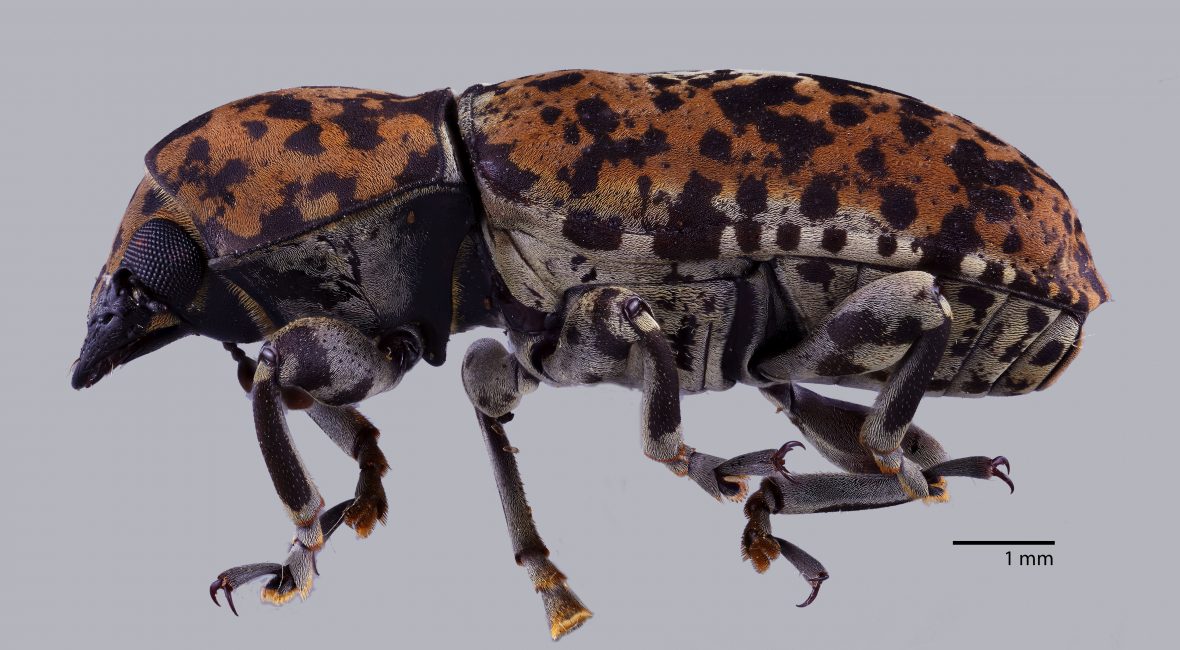
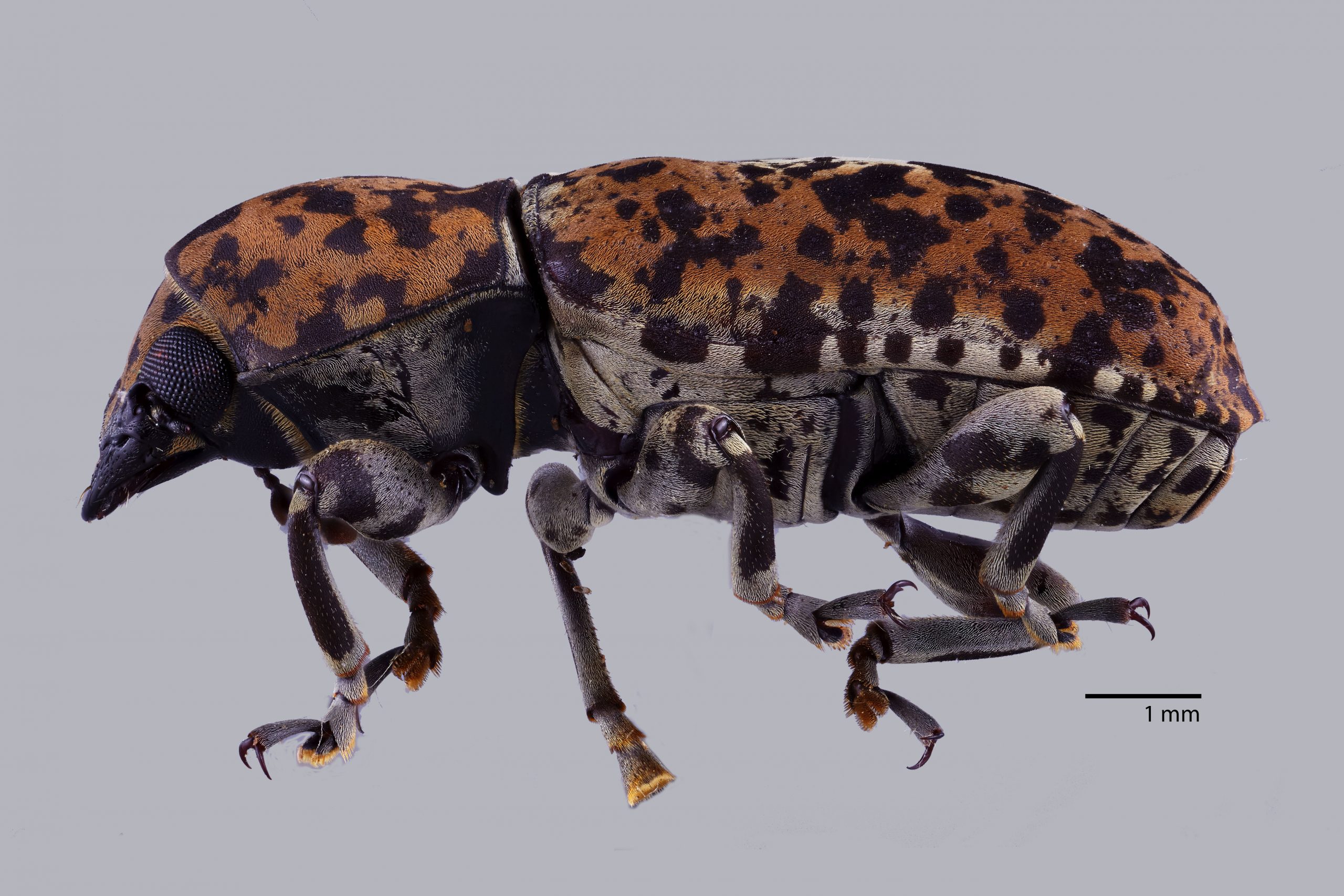
A weevil with orange body and black spots.

Eugonus robustus Jordan, 1904 (Coleoptera: Anthribidae), from Panama. Photo by Samanta Orellana.

BHL has now become a core part of Orellana’s research process. She uses the Library at least several times a week, reading content online or downloading material via BHL’s custom PDF generator to build her own local collection of Anthribidae literature. Her favorite feature is BHL’s full text search service, which allows her to easily find scientific names or specific localities within sources.

“I use BHL all the time,” affirms Orellana. “I continue using it for my PhD studies to identify collection specimens, as taxonomy is an important component of my research with this group of weevils. I also maintain a website in Spanish about insects of Guatemala and constantly consult BHL to obtain and share information about the diversity of this group in my country.”

When asked what improvements she would like to see in BHL, Orellana replies, “This is a difficult question, because I love BHL so much. There is nothing I can think of that I would change. I can always find what I am looking for with the features already included on the website.”

Orellana’s experience testifies to the importance of open access for scientific research, whether you are a researcher working with limited resources or even if you have the benefit of a large, institutional library. For researchers everywhere, BHL’s collections offer free, easy access to centuries of scientific literature and sources that may otherwise have been inaccessible.

“Even now that I am working at a larger collection, and I have access to specialized literature, there are older works that can only be obtained through BHL,” confirms Orellana.

We are proud to know that BHL is empowering biodiversity research globally. As we face unprecedented biodiversity declines—with more than a million species threatened with extinction—immediate, online access to essential literature is ever-more important, allowing scientists to conduct research more quickly and efficiently and improving our ability to respond to today’s biodiversity crisis. We look forward to continuing to work with our global community of partners to ensure that researchers like Samanta Orellana have the resources they need to study and conserve biodiversity, from the smallest weevil to the largest sequoia and everything in between.

———————

Biodiversidad Oculta: Explorando los Gorgojos Neotropicales con la ayuda de BHL

Foto de una exuberante selva tropical.

Una vista del bosque tropical de Panamá en la Provincia de Colón. Fotografía por Samanta Orellana.

En las últimas décadas del siglo XIX, una publicación monumental acerca de la biodiversidad de México y Centroamérica inició su difusión –la Biología Centrali-Americana. Publicada en 215 partes de 1879 a 1915, por los editores Frederick DuCane Godman y Osbert Salvin, el trabajo describe más de 50,000 especies y está ilustrada con más de 1,600 láminas litográficas que contienen más de 18,000 especies. Muy notoria en su tiempo, la obra aún es sumamente importante para el estudio de la biodiversidad neotropical en la actualidad, ya que contiene prácticamente toda la información conocida, hasta el momento, acerca de la flora y fauna de México y Centroamérica.

La Biologia Centrali-Americana es un recurso particularmente importante para la entomóloga Samanta Orellana, estudiante de Doctorado en Biología Evolutiva, en el laboratorio del Dr. Nico Franz, en Arizona State University (ASU) y asistente de investigación en las Colecciones Biológicas del Centro de Integración para el Conocimiento de la Biodiversidad en ASU. Orellana empezó a estudiar insectos y a trabajar en colecciones entomológicas hace más de una década, durante sus estudios de pregrado en su país natal, Guatemala.

“Para muchos grupos de insectos de Guatemala y el resto de Centroamérica, la Biología Centrali-Americana aún representa la única fuente de información disponible en la región”, asegura Orellana.

Una persona de cabello oscuro con un chaleco rojo y una camisa gris de pie frente a los cajones de muestras de la colección.

Samanta Orellana en las Colecciones Biológicas de Arizona State University. Fotografía por Kevin Cortés.

La Biologia Centrali-Americana también es importante para Orellana, ya que la llevó a descubrirBiodiversity Heritage Library (BHL), que en español podría denominarse como “Biblioteca del Patrimonio de Biodiversidad”. En 2010, mientras identificaba insectos de Guatemala, como parte de sus estudios de pregrado, Orellana empezó a utilizar la versión electrónica de la Biología Centrali-Americana,disponible en el sitio de las Bibliotecas y Archivos del Instituto Smithsonian, lo cual la dirigió hacia BHL, y no ha dejado de usarla desde entonces.

“BHL es simplemente maravillosa”, asegura Orellana. “Pienso que es una herramienta increíble para los entomólogos alrededor del mundo, especialmente para aquellos que trabajamos en colecciones de países en vías de desarrollo, usualmente sin acceso a bibliotecas o revistas especializadas, pero con mucho material por identificar”.

Una variedad de gorgojos ilustrados en una página.

Una de las láminas de antríbidos de Centroamérica, incluidas en el capítulo escrito por Karl Jordan en la Biología Centrali-Americana (Insecta. Coleoptera. v.4, pt.6, 1895-1907). Compartido en BHL por las Bibliotecas y Archivos del Instituto Smithsonian.

Orellana se especializa en la familia Anthribidae (Coleoptera), comúnmente conocidos como “gorgojos de los hongos”. Sus investigaciones con estos insectos iniciaron durante sus estudios en la Universidad de Panamá, donde completó su maestría en entomología, y continúan durante su doctorado, con su tesis enfocada en la diversidad y evolución de la familia. Como parte de su investigación, Orellana recientemente publicó un catálogo de las especies de Anthribidae de Panamá.

Las colecciones de literatura de BHL han sido indispensables para permitir que Orellana trabaje con esta familia.

“BHL fue esencial para completar mi primer trabajo publicado acerca de Anthribidae, un catálogo de especies de Panamá”, comparte Orellana. “Este grupo de gorgojos ha sido pobremente estudiado en la región Neotropical, por lo que identificar las especies siempre es un reto debido a la falta de claves taxonómicas. Yo tuve que basarme mayormente en descripciones originales, disponibles en BHL, para identificar las especies que estudié, tanto en colecciones panameñas como norteamericanas. El catálogo finalizó 44 nuevos registros para el país, muchos de los cuales fue posible identificar gracias a la literatura disponible en BHL.”
Gorgojo de cuerpo anaranjado y manchas negras.

Eugonus robustus Jordan, 1904 (Coleoptera: Anthribidae), de Panamá. Fotografía por Samanta Orellana.

BHL se ha vuelto una parte esencial en el proceso de investigación de Orellana, ya que utiliza este recurso al menos varias veces por semana, leyendo el contenido en línea o descargando material, por medio del generador de archivos PDF de BHL, para construir su propia colección de literatura de Anthribidae. Su característica favorita de BHL es el servicio de búsqueda de texto, que le permite encontrar nombres científicos y localidades de una manera fácil dentro de los archivos disponibles.

“Uso BHL todo el tiempo”, afirma Orellana. “Durante mis estudios de doctorado, uso BHL constantemente para identificar especímenes de colecciones, ya que la taxonomía es un componente importante de mi investigación con este grupo de gorgojos. Como una actividad adicional, administro un sitio web enfocado en insectos de Guatemala, y consulto BHL constantemente para obtener y compartir información acerca de la diversidad de este grupo en mi país.”

Al consultarle acerca de las mejoras que le gustaría ver en BHL, Orellana responde, “Esta es una pregunta difícil, porque BHL me gusta demasiado. No puedo pensar en nada que me gustaría cambiar. Siempre puedo encontrar lo que estoy buscando con las características ya incluidas en el sitio web”.

Las experiencias de Orellana son un testimonio de la importancia de libre acceso a las investigaciones científicas, así sea para científicos trabajando con recursos limitados, o para aquellos que cuentan con acceso a bibliotecas institucionales. Para investigadores de todas partes, la colección de BHL ofrece acceso gratuito y fácil, a siglos de literatura y recursos científicos que, de otra manera, serían inaccesibles.

“Aún ahora, que me encuentro trabajando en una colección grande y tengo acceso a literatura especializada, existen trabajos muy antiguos a los que puedo acceder únicamente a través de BHL,” confirma Orellana.

Estamos orgullosos de saber que BHL empodera la investigación de biodiversidad a nivel global. Mientras nos enfrentamos a la desaparición sin precedentes de la biodiversidad —con más de un millón de especies amenazadas con la extinción— el acceso inmediato a literatura en línea es más importante que nunca, permitiendo que los científicos conduzcan sus investigaciones de una manera más rápida y eficiente, mejorando la habilidad de responder a la crisis de biodiversidad actual. Esperamos continuar trabajando con nuestra comunidad de socios para asegurar que los investigadores como Samanta Orellana tengan a la mano los recursos que necesitan para estudiar y conservar la biodiversidad, desde el gorgojo más pequeño a la secoya más grande.

April 6, 2021by Grace Costantino
BHL News, Blog Reel

Join Us on 16 April 2021 for Notes from Nature: The Biodiversity Heritage Collections

graphic for "Notes from Nature"

Background image in graphic: Rhopalocera Malayana: a description of the Butterflies of the Malay Peninsula. By William Lucas Distant (1845-1922). Illustrations by Horace Knight (1857-1920). Collection of National Library, Singapore.

Join us for a special closing event presented as part of the 2021 BHL Annual Meeting!

Notes from Nature: The Biodiversity Heritage Collections
Date and Time: Friday, 16 April 2021 @ 1130-1230 UTC
Location: Online (via Zoom webinar)

Discover the natural world through a vast collection of biodiversity knowledge online. Find out how Singapore and France have worked together across boundaries to advance biodiversity literature, digitisation and public outreach efforts.

This discussion is organised by the National Library Singapore and Muséum national d’Histoire naturelle, France in partnership with the Biodiversity Heritage Library, the world’s largest open access online repository of biodiversity knowledge.

Presenters:
Ms Tan Huism, Senior Director, National Library, Singapore
Dr Clément Oury, Head of Conservation, Restauration and Digitization Service, Library of the Muséum national d’Histoire naturelle

This session will be chaired by Ms Constance Rinaldo, Chair of the Biodiversity Heritage Library Executive Committee.

Register today!

Graphic for BHL Day 2021.

In addition to this special closing event on 16 April, we hope you’ll also join us for BHL Day 2021: Reflections in Crises on 14 April (1200-1700 UTC), another virtual, public event offered as part of the 2021 BHL Annual Meeting.

Learn more and register for BHL Day 2021.

March 30, 2021by Grace Costantino
Page 1 of 711234»102030...Last »

Help Support BHL

BHL's existence depends on the financial support of its patrons. Help us keep this free resource alive!

search

About BHL

The Biodiversity Heritage Library (BHL) is the world’s largest open access digital library for biodiversity literature and archives. BHL operates as a worldwide consortium of natural history, botanical, research, and national libraries working together to digitize the natural history literature held in their collections and make it freely available for open access as part of a global “biodiversity community.”

Join Our Mailing List

Sign up to receive the latest news, content highlights, and promotions.

Subscribe Now

Subscribe to Blog via Email

Enter your email address to subscribe to this blog and receive notifications of new posts by email.

Join 319 other subscribers

Subscribe to Blog Via RSS

Subscribe to the blog RSS feed to stay up-to-date on all the latest BHL posts.

Access RSS Feed

Inspiring Discovery through Free Access to Biodiversity Knowledge.

The Biodiversity Heritage Library makes it easier than ever for you to access the information you need to study and explore life on Earth…for free, anytime, anywhere.


64+ Million Pages of
Biodiversity Literature Online.

EXPLORE

Tools and Services
to Transform Research.

EXPLORE

300,000+
Illustrations on Flickr.

EXPLORE

ABOUT | HARMFUL CONTENT | PRIVACY | SITE MAP | TERMS OF USE