
Biodiversity Heritage Library - Program news and collection highlights from BHL
  • Home
  • News
  • Featured Books
    • All Featured Books
    • Book of the Month Series
    • BHL at 20
  • User Stories
  • Campaigns
    • Fossil Stories
    • Garden Stories
    • Monsters Are Real
    • Page Frights
    • Her Natural History
    • Earth Optimism 2020
  • Tech Blog
  • Visit BHL
Home
News
Featured Books
    All Featured Books
    Book of the Month Series
    BHL at 20
User Stories
Campaigns
    Fossil Stories
    Garden Stories
    Monsters Are Real
    Page Frights
    Her Natural History
    Earth Optimism 2020
Tech Blog
Visit BHL
  • Home
  • News
  • Featured Books
    • All Featured Books
    • Book of the Month Series
    • BHL at 20
  • User Stories
  • Campaigns
    • Fossil Stories
    • Garden Stories
    • Monsters Are Real
    • Page Frights
    • Her Natural History
    • Earth Optimism 2020
  • Tech Blog
  • Visit BHL
Biodiversity Heritage Library - Program news and collection highlights from BHL
Blog Reel, Campaigns, Featured Books

Color Our Collections: The Art of Woodcuts

View Full Size Image

This year for Color Our Collections, we’ve produced a coloring book with illustrations from books that represent the evolution of the art of printing. This week on our blog, we’ll explore the books featured in the coloring book and the printing techniques used for the illustrations.

You can download our 2017 Color Our Collections coloring book here.

Learn more about Color Our Collections here.

The Art of Woodcuts

In the woodcut printing technique, the image (and sometimes text) is carved into the surface of a wood block. A knife and/or chisel is used to remove the wood surrounding the image, so that only the image lines remain raised or flush with the wood block surface. The block is then inked and pressed against paper to transfer the image. The resulting image is a reverse of that on the wood block.

The earliest known complete and dated printed book, the Diamond Sūtra dated 868 AD, was produced using wood block printing. The work, a Chinese translation of a Buddhist text, can be viewed online thanks to the British Library.

This video from the Victoria and Albert Museum demonstrates the woodcut printing process:

The Woodcuts of Pierre Belon
View Full Size Image
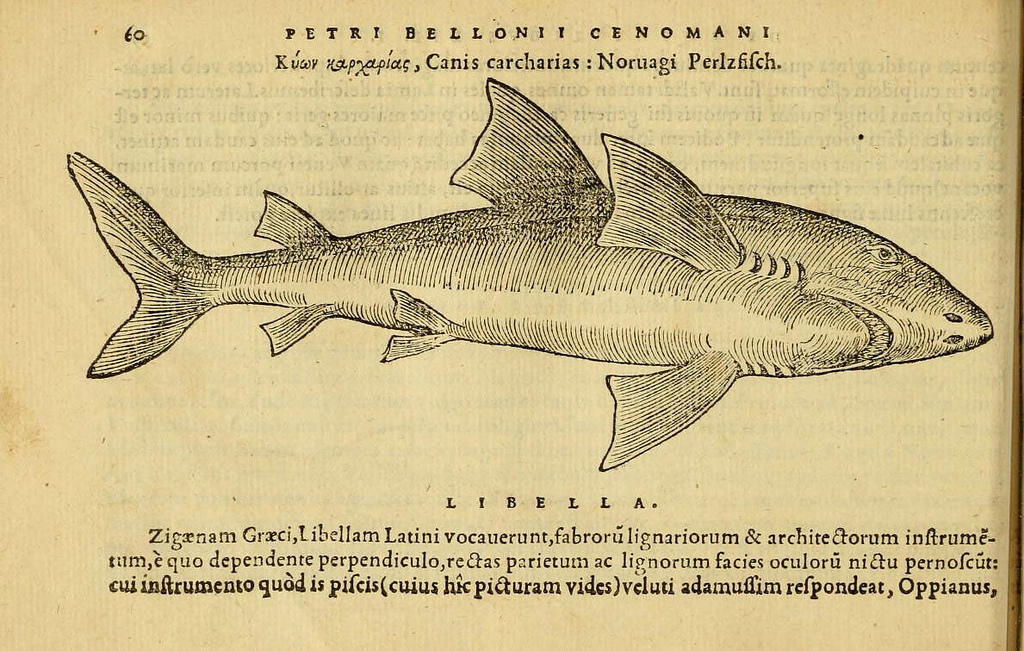
Earliest known published illustration of a great white shark. Illustrated by woodcut. Belon, Pierre. De aquatilibus. 1553. http://biodiversitylibrary.org/page/4770204. Digitized by Harvard University, Ernst Mayr Library, Museum of Comparative Zoology.

Pierre Belon was a French naturalist who started practice as an apothecary, studied medicine, and later undertook many travels that fueled his interest in natural history. In 1553, he published De aquatilibus, describing over 100 fish, sharks, and rays, as well as many marine mammals. The work is illustrated with woodcuts, and some copies are also hand colored.

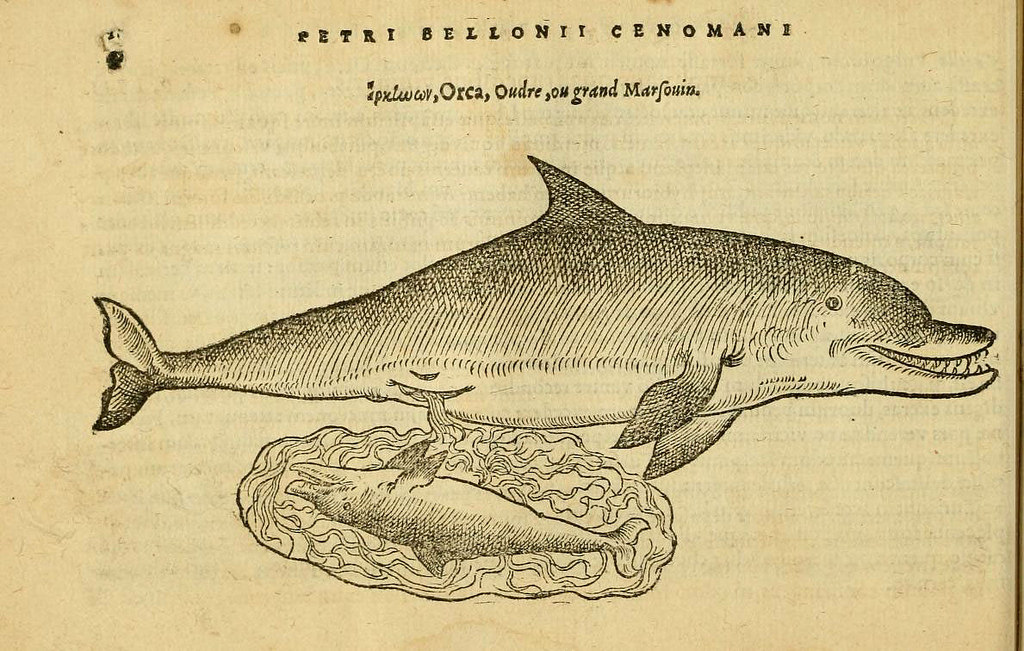
Belon details the outward characteristics of the species he depicts and classifies his divisions of aquatic animals by size, skeletal structure, mode of propagation, number of limbs, form of the body, and habitat. As such, De aquatilibus is considered by many to be the beginning of modern ichthyology. The work also includes detailed descriptions of dolphins and their embryos and reproductive anatomy, and thus it is also considered the start of modern embryology.
View Full Size Image
Belon portrayed many dolphins, their embryos, and reproductive anatomy within De aquatilibus, marking the beginning of modern embryology. Illustrated by woodcut. Belon, Pierre. De aquatilibus. 1553. http://www.biodiversitylibrary.org/page/4770162. Digitized by Harvard University, Ernst Mayr Library, Museum of Comparative Zoology.

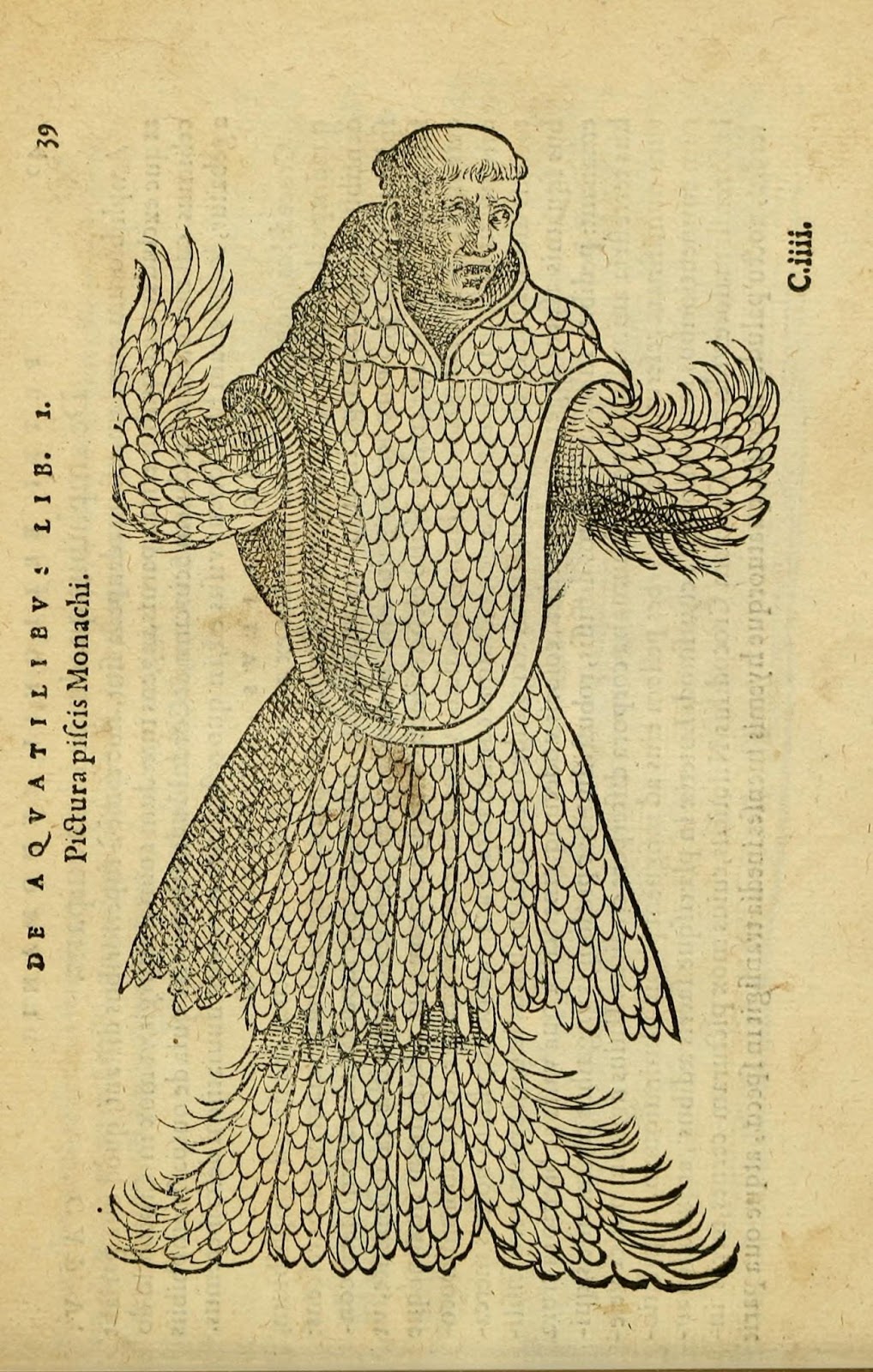
Belon stressed the importance of observation in scientific study and communication, chastising those who simply relied on and proliferated historic accounts stemming from the titans of antiquity. However, despite this charge, Belon does include some fantastical creatures within his book, including the “sea monk” and “web-footed horse of Neptune.”
View Full Size Image
Mythical “sea-monk,” possibly based on a stranded squid. Illustrated by woodcut. Belon, Pierre. De aquatilibus. 1553. http://biodiversitylibrary.org/page/4770183. Digitized by Harvard University, Ernst Mayr Library, Museum of Comparative Zoology.

Sadly, Belon’s life was cut tragically short. He was murdered by unknown assailants in the Bois de Boulogne in 1564 at the age of 47.

De aquatilibus was digitized in BHL by Harvard University, Ernst Mayr Library, Museum of Comparative Zoology.

References

Steins, John. Woodblock Printing. http://www.johnsteins.com/woodblock-printing.html.
Stiassny, Melanie. Natural Histories: Opulent Oceans. New York: Sterling Publishing, 2014. Print.


February 6, 2017by Grace Costantino
BHL News, Blog Reel

BHL Adds University of Toronto Libraries as a New Member

View Full Size Image

The Biodiversity Heritage Library is pleased to welcome the University of Toronto Libraries (UTL) as a new Member. UTL is the first Canadian library to join the Biodiversity Heritage Library as a Member.

The University of Toronto Libraries system is the largest academic library in Canada. Ranked fourth among North American peer institutions by the Association of Research Libraries, the UTL system is particularly strong in the sciences and includes 10 dedicated science libraries. Among these is the Gerstein Science Information Centre, Canada’s largest standalone science and health library. Additionally, the Thomas Fisher Rare Book Library holds rich collections on the history of science and medicine, including an exhaustive collection of original works by Charles Darwin.

“The University of Toronto Libraries is thrilled to become a Member of the Biodiversity Heritage Library,” asserts Neil Romanosky, UTL’s Associate Chief Librarian for Science Research and Information and Director of the Gerstein Science Information Centre. “Given the rapid rate of extinction of species across the globe, we see membership in BHL as an important opportunity to support the search for knowledge by preserving our wealth of historic biodiversity materials and sharing them more widely.”

View Full Size Image
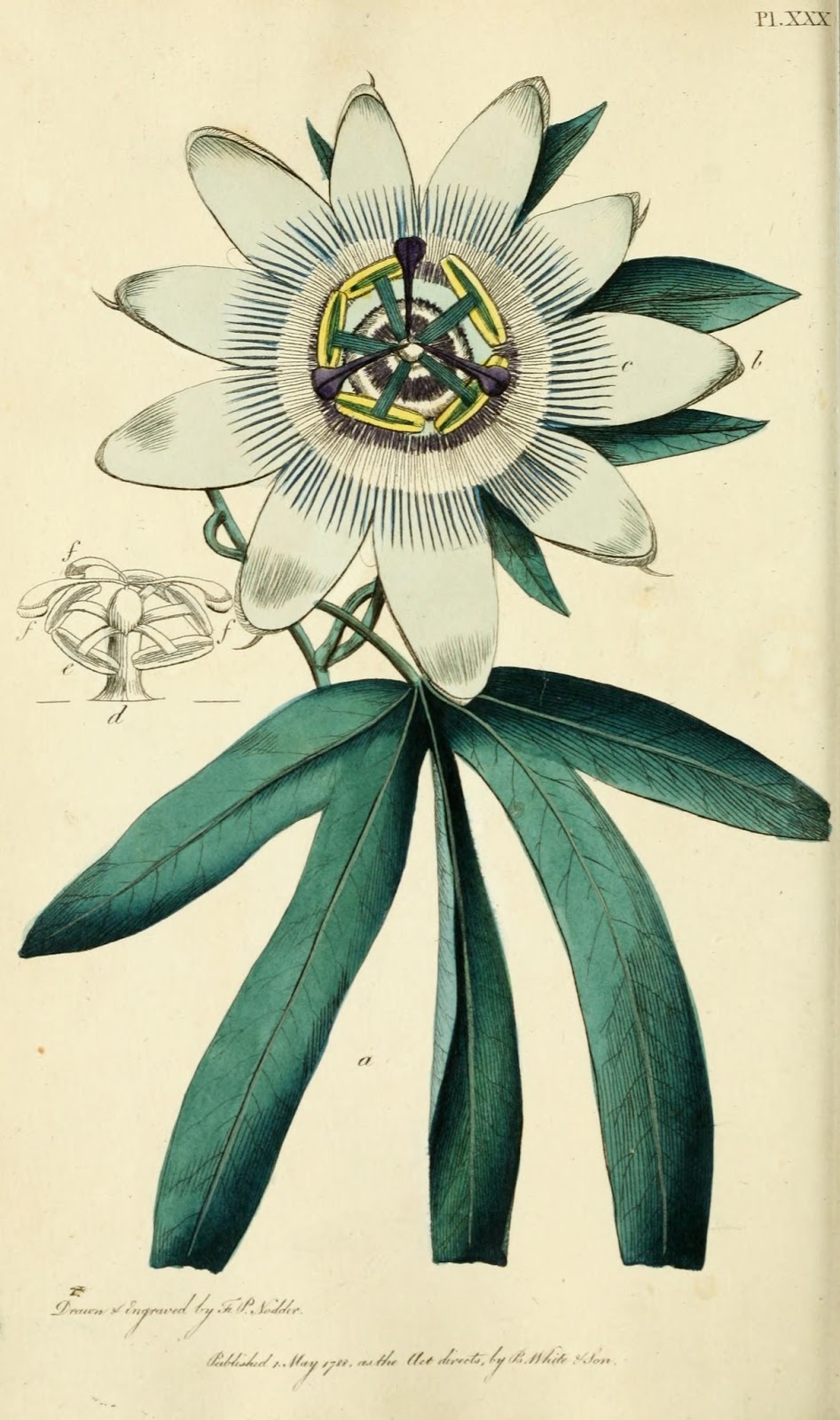
Martyn, Thomas. Thirty-eight plates, with explanations; intended to illustrate Linnaeus’s System of vegetables, and particularly adapted to the Letters on the elements of botany [by J.J. Rousseau] By Thomas Martyn. (1799). Art by Frederick Polydore Nodder. http://www.biodiversitylibrary.org/page/32193301. Digitized by University of Toronto Libraries from the Thomas Fisher Rare Book Library.

As a BHL Member, the University of Toronto Libraries will enhance BHL’s collection by contributing rare and unique material from its holdings of over 12 million print volumes. As the host of an Internet Archive (IA) scanning center, the Libraries has already digitized a large portion of its collection. Over 3.3 million pages of natural history literature from UTL are currently available in BHL.

“The University of Toronto Libraries and BHL share a commitment to open access and the promotion of digital scholarship through global partnerships and the development of innovative tools and technology,” affirms BHL Program Director Martin R. Kalfatovic. “We look forward to the expertise and leadership that UTL will bring to the BHL consortium as we work together to build our online collection, enhance our services, and empower researchers around the world through free access to biodiversity knowledge.”

The BHL consortium now consists of 18 Members and 15 Affiliates.

January 23, 2017by Grace Costantino
Blog Reel, User Stories

Catesby in the Classroom: Students Explore the Intersection of Art and Science

Portrait version of the Biodiversity Heritage Library logo.

In the early eighteenth century, English naturalist Mark Catesby set foot in a New World. After spending the better part of ten years, spread across two separate trips, exploring and documenting North America’s rich biodiversity, he would eventually publish his research and original artworks as the first fully illustrated book on the flora and fauna of North America.

View Full Size Image
Catesby, Mark. The Natural History of Carolina, Florida, and the Bahama Islands. v. 1, ed. 1. pl. 19. Digitized by Smithsonian Libraries. http://www.biodiversitylibrary.org/page/40753174.

Published over eighteen years between 1729-1747, The Natural History of Carolina, Florida, and the Bahama Islands contains 220 plates based mostly upon Catesby’s own watercolors, which he worked up based on sketches he made in the field.

The success of Catesby’s work was based largely on his emphasis on personal observation and use of art to convey a visual record of his research.

Over 250 years later, students in South Carolina are following Catesby’s example.

As part of a collaboration with the Catesby Commemorative Trust, Dr. Tracey Hunter-Doniger used illustrations from The Natural History of Carolina, Florida, and the Bahama Islands as the foundation for lesson plans designed to help students learn more about the importance of observation and the relationship between art and science.

“Before photography, scientists used drawings to record what they saw. Scientists also had to be artists. These lessons are an opportunity for students to see how art and science are connected while also understanding the importance of Catesby’s work and his role in natural history,” emphasizes Tracey.

View Full Size Image
Dr. Tracey Hunter-Doniger. Image Credit: College of Charleston website http://teachered.cofc.edu/faculty-staff-listing/hunter-doniger-tracey.php.

A fifteen year K-8 visual art education veteran, Tracey has spent the last five years at the College of Charleston as an Assistant Professor of Creativity and Creative Arts in Education. In the fall of 2016, Tracey teamed up with her friend Erin Russell, the art teacher at Memminger Elementary School in Charleston, SC, to implement a trial run of her lesson plans in the 1st, 3rd, and 5th grade art classes at Memminger.

All three classes were challenged to use their powers of observation to record what they saw, just as Catesby had done centuries before. Students were given copies of Catesby’s illustrations, which Tracey downloaded and printed from the Biodiversity Heritage Library. The first edition copy of Catesby’s masterpiece in BHL, digitized from the Joseph F. Cullman Rare Book Library at Smithsonian Libraries, is one of the few known perfect copies of this edition in existence.

“Having access to this resource through BHL is a treasure,” praises Tracey. “Being able to show the students the prints of the original artworks and use them to explain that these represent what Catesby saw and what he wanted to convey speaks volumes to the students.”

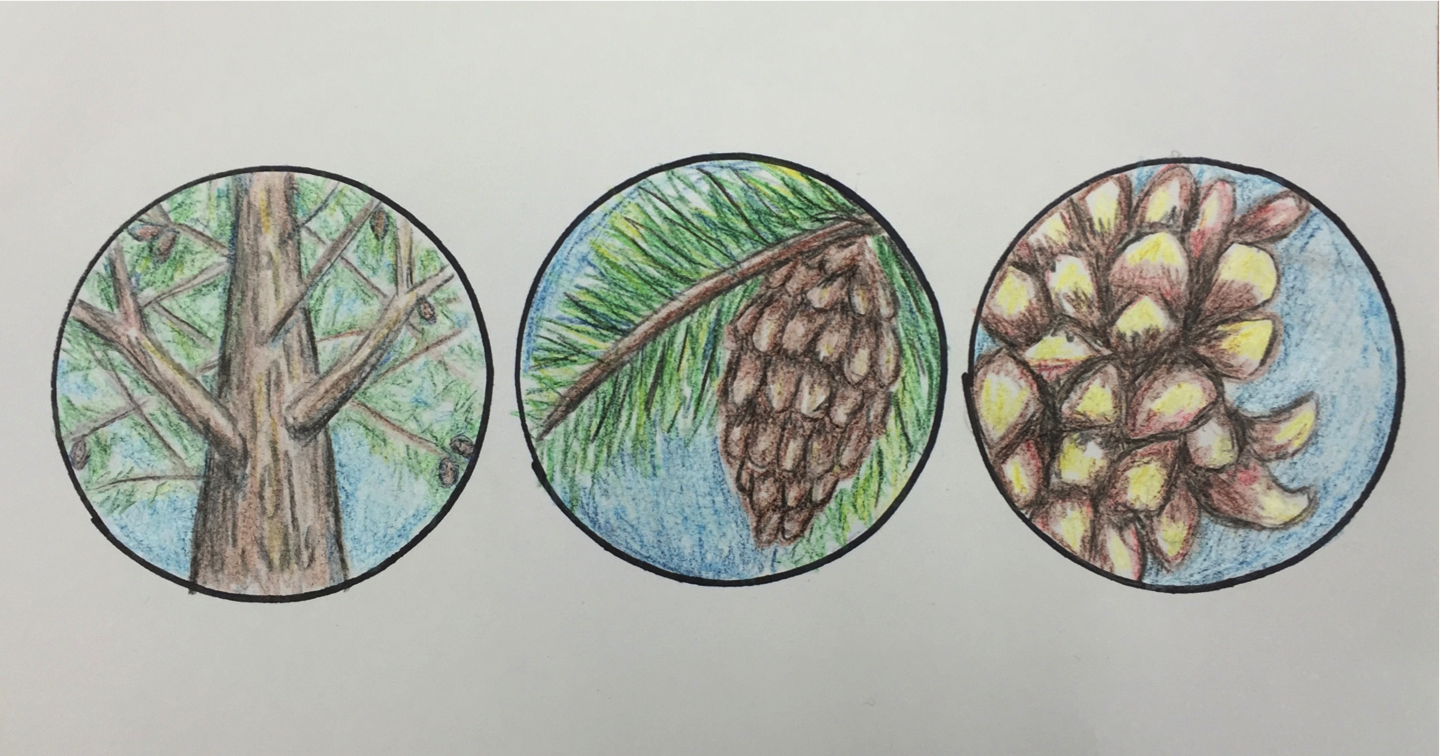
The first grade students were instructed to use the illustrations as a reference to draw their own copy of the specimens. The third and fifth graders were asked to flex their observational skills even further by not only copying the illustration as they saw it, but also homing in on a specific section of the image and creating a more detailed depiction of that area, as though they were looking at it through the lens of a microscope.

View Full Size Image
Example of the 3rd and 5th grade Catesby lesson, whereby students “zoom” in on details in the specimen being observed. Example by Dr. Tracey Hunter-Doniger.

While the trial runs of each class were limited to one, 45-minute session, Tracey believes that the lessons helped the students understand how art can be a scientific tool. For future iterations, she hopes to run the classes as three-week lessons where students start by observing and copying Catesby’s art in the classroom and then extend their learning to the outdoors by taking nature walks and drawing in the field, as Catesby did. She would also love the students to have the opportunity to explore Catesby’s publication in full through the BHL website.

“Access is key,” stresses Tracey. “In an ideal scenario, we would go into the website, we would do research, and then we would practice the skills we learn by going into the field. We would ‘do’ as Catesby did. We would ‘be’ Catesby in the field.”

The lessons that Tracey created are just two of several that are being developed as part of a collaboration with the Catesby Commemorative Trust and the College of Charleston. For example, a science lesson, written by William Veal, Cyndi Hall, and Rodney Moore, uses Catesby’s art to help students assess how adaptations contribute to a species’ ability to survive in a given environment. Lesson activities include drawing a bird inspired by a Catesby illustration, noting characteristics (such as beak shape), and performing experiments to see how various adaptations might help that species survive.

The lessons plans resulting from this collaboration are being made available to teachers in South Carolina through the LearningWhy site created by South Carolina ETV. The plans are also available to teachers across the country through PBS LearningMedia.

View Full Size Image
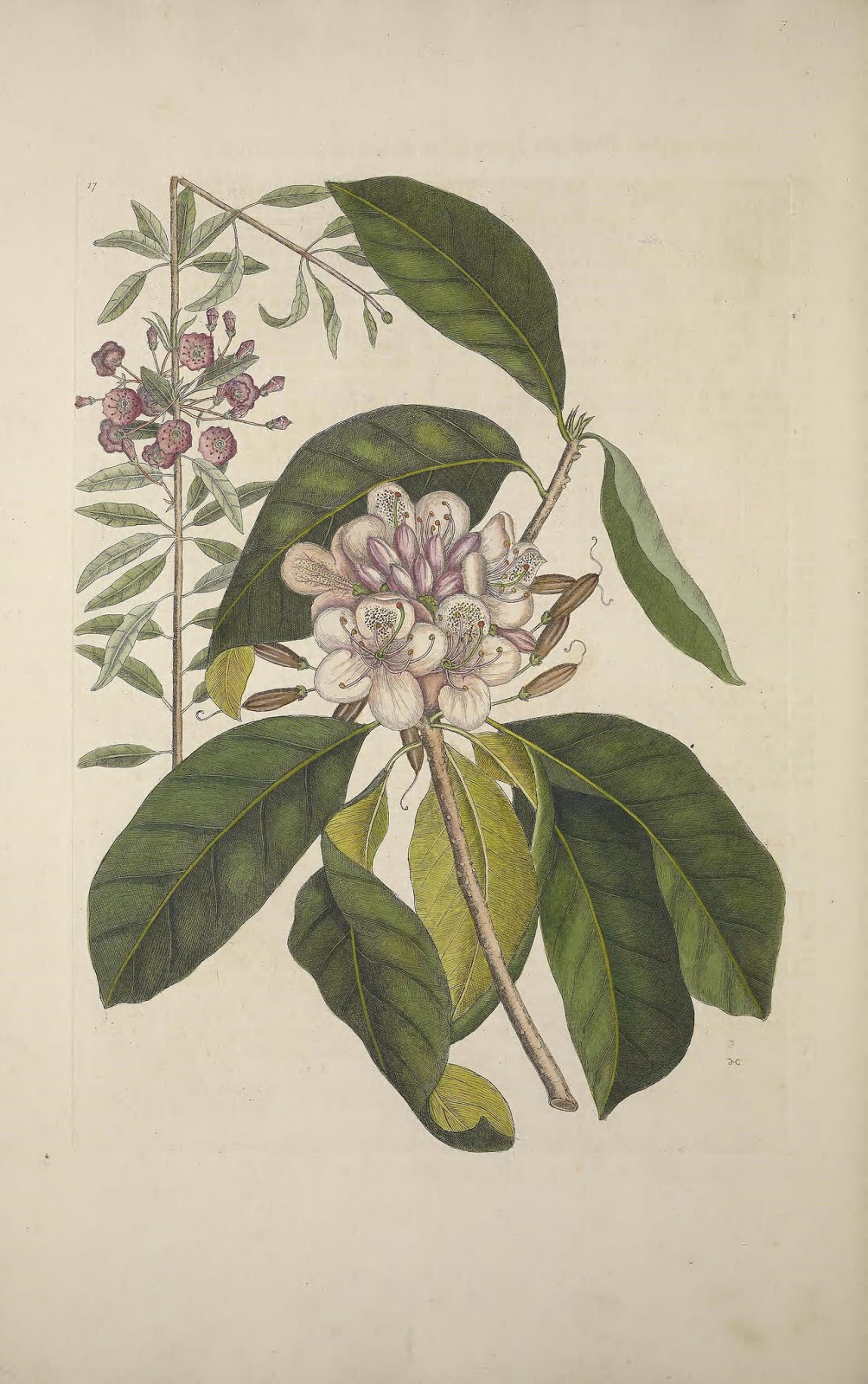
Catesby, Mark. The Natural History of Carolina, Florida, and the Bahama Islands. v. 2, ed. 1, pl. 17. Digitized by Smithsonian Libraries. http://www.biodiversitylibrary.org/page/40680449.

From Tracey’s perspective, the use of Catesby’s material in these lesson plans is a powerful way to integrate primary source material that is not only historically significant but also highly relevant to the area where she and her students live.

“Living in an area that’s so rich in history, it’s very impactful to be able to show the students how Catesby’s story fits into that history,” says Tracey. “The art is the visual side of that narrative. It helps explain who Catesby was, what he did, and why he was important. If you’re telling the Catesby story, the art is a critical part of that story.”

Thanks to the Biodiversity Heritage Library and Smithsonian Libraries, students in South Carolina and others around the world can freely and easily access Catesby’s work and countless other natural history treasures, no matter where their classroom journeys take them.

______________________________________

This post may contain the personal opinions of BHL users or affiliated staff and does not necessarily represent the official Biodiversity Heritage Library (BHL) position on these matters.

January 12, 2017by Grace Costantino
Blog Reel

BHL Welcomes the Arboretum Library at the LA County Arboretum and Botanic Garden

Portrait version of the Biodiversity Heritage Library logo.
View Full Size Image

This quarter, the Biodiversity Heritage Library was pleased to welcome The Arboretum Library at the Los Angeles County Arboretum and Botanic Garden as its newest Affiliate. The BHL consortium, which has grown substantially over the past year, now consists of 17 Members and 16 Affiliates.

The Arboretum Library holds an extensive collection of books, magazines, government documents, pamphlets, and audio-visual materials covering a wide range of topics, including gardening and garden design, plant lore, medical botany, botanical art, ethnobotany, California native plant life, and Mediterranean-climate botany.

Twenty-four magazine titles published by the Los Angeles County Arboretum and Botanic Garden are already available through BHL as a result of The Arboretum Library Good Family Foundation Digitization Project, a collaboration between the Arboretum, BHL, and the Missouri Botanical Garden. The publications, dating back to the 1950s, include information about the institution’s history, Los Angeles area horticulture, and research conducted by Arboretum staff. The articles have been indexed for author, title, date, and subjects (including people and plant names), all of which are searchable.

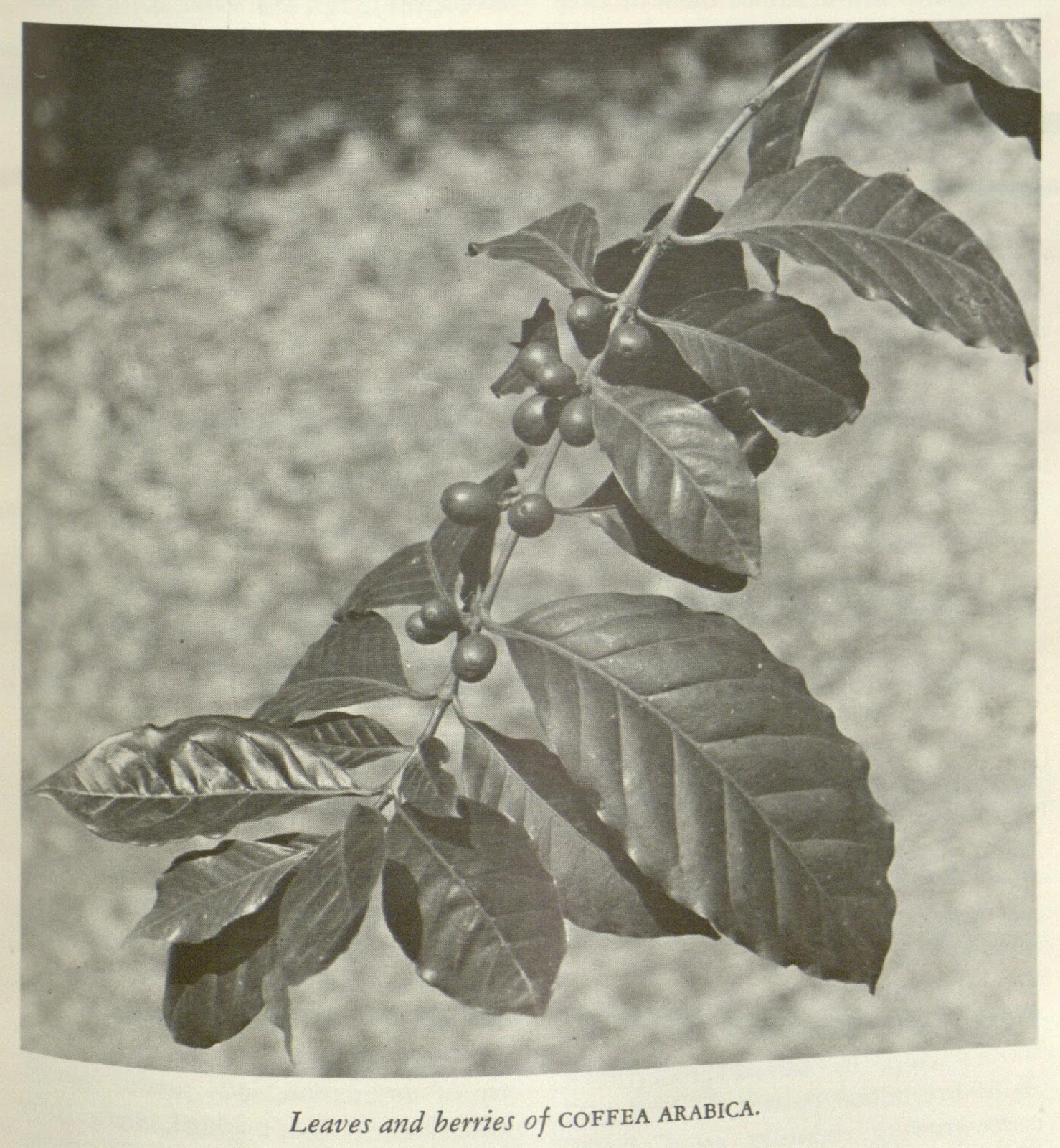
The articles in the Arboretum publications have both a scientific and popular appeal. For example, among the many interesting topics covered is the history of coffee, which Leonid Enari explores in the June 1976 issue of Lasca Leaves.

According to the article, coffee was used as food at least by 800 AD, but the “habit of coffee drinking seems to have started in Arabia in the 15th century” (Enari 1976). The first beverages created from the berries of the coffee plant were likely alcoholic, made from the pulp of the berries. It is unknown when the practice of roasting the seeds (beans) and using them to prepare today’s familiar coffee beverage was discovered, but its consumption in Europe was popularized through coffeehouses that were often regarded, particularly in England, by the church and state as “centers of political agitation.”

View Full Size Image
Leaves and berries of Coffea arabica. Enari, Leonid. “Coffee.” Lasca Leaves. v. 26 (1976). http://www.biodiversitylibrary.org/page/41846781. Digitized by the Missouri Botanical Garden. CC-BY-NC-SA.

The Arabian coffee tree (Coffea arabica) is used for the majority of the world’s commercial coffee production. The all-important coffee beans are the seeds of the coffee plant (found inside the plant’s fruit) which have been dried and roasted. After being roasted and ground, coffee will lose most of its aroma and flavor within 10 days. You can learn more about the history of coffee and its commercial production in the Lasca Leaves article.

The existing and future contributions from the Arboretum Library will provide valuable access to information about the history of botany and horticulture, botany in Southern California, and the Arboretum’s impact on these research areas. We look forward to working with our newest Affiliate to enhance BHL’s collections and expand our service to the global botanical, horticultural, and wider research communities.

January 11, 2017by Grace Costantino
Blog Reel, User Stories

Poetic Botany: A Digital Exhibition Celebrating the History of Botany

View Full Size Image
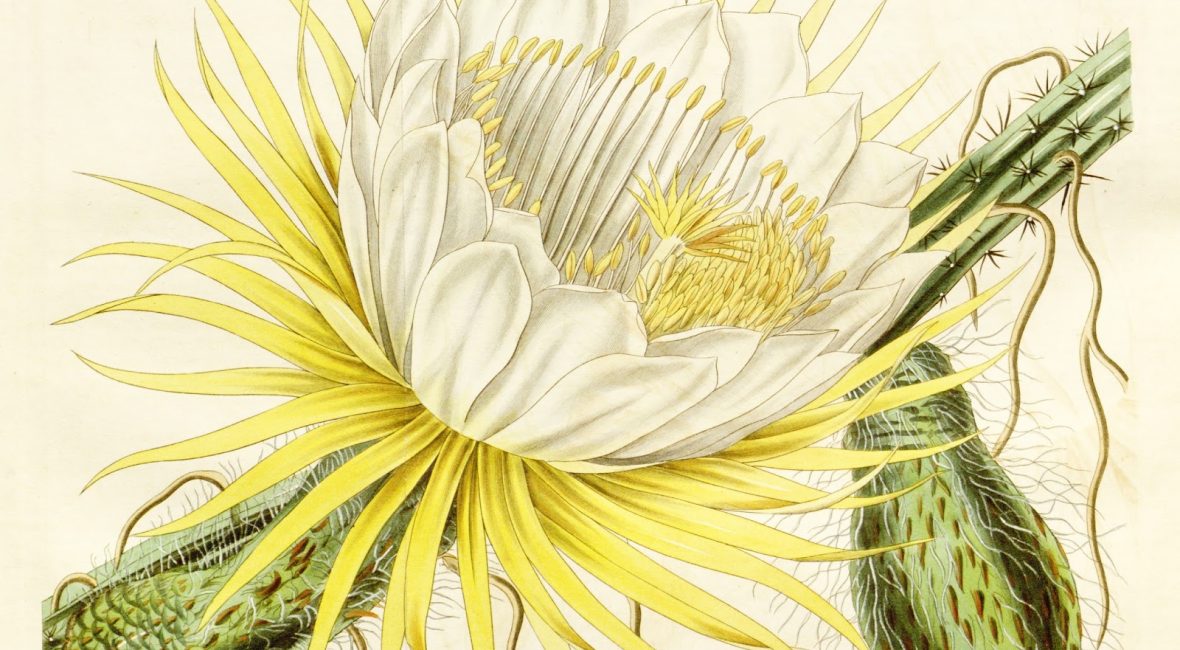
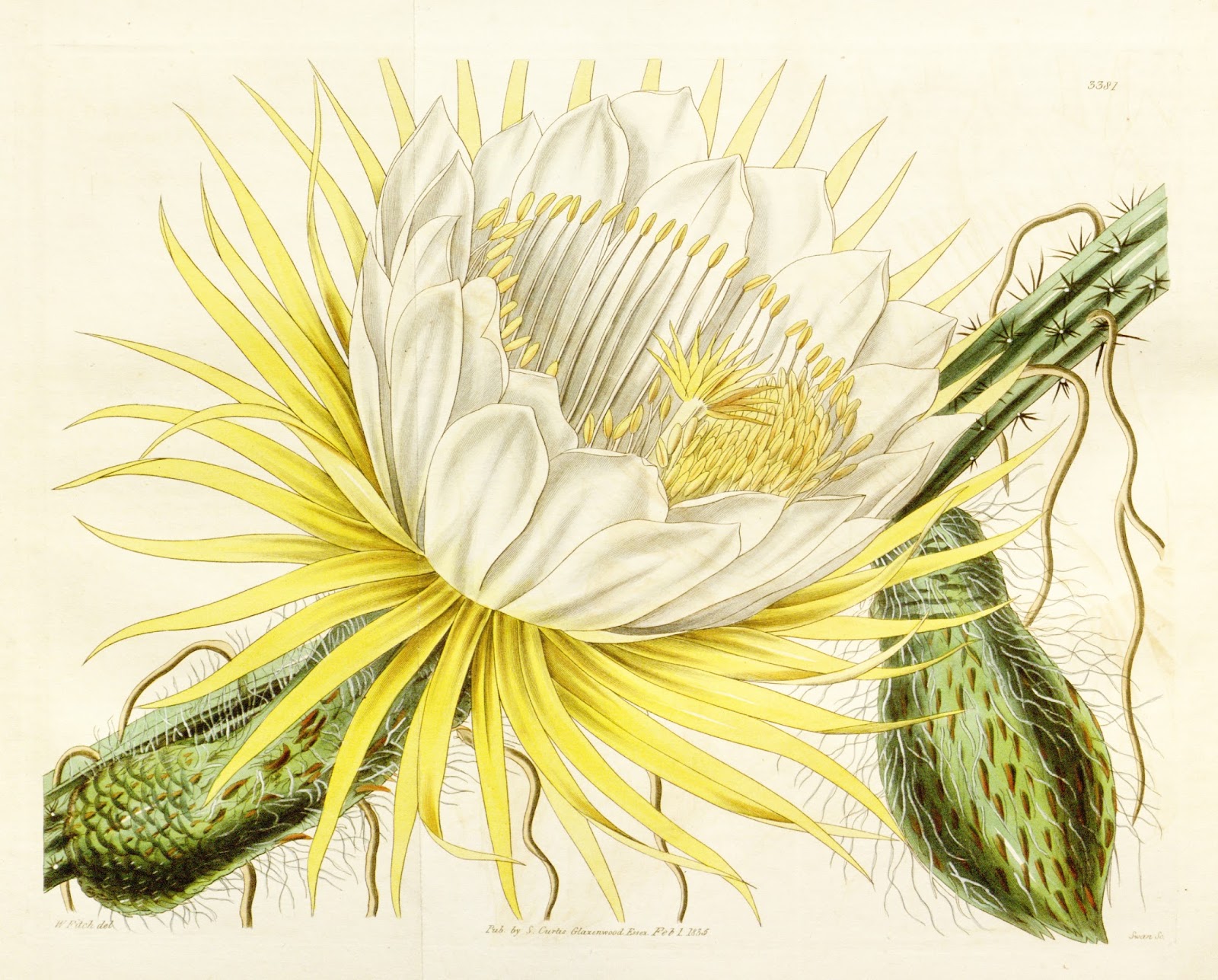
Night-blowing (Blooming) Cereus (Selenicereus grandiflorus). Curtis’s Botanical Magazine. v. 62 (1835). http://www.biodiversitylibrary.org/page/465887. Digitized by the Missouri Botanical Garden, Peter H. Raven Library.

‘Queen of the dark, whose tender glories fade
In the gay radiance of the noon-tide hours.’

‘That flower, supreme in loveliness, and pure
As the pale Cynthia’s beams, through which unveiled
It blooms, as if unwilling to endure
The gaze, by which such beauties are assailed.’

These elegant lines are quoted in Curtis’s Botanical Magazine (v. 62, 1835) as part of the description for the Night-blowing (Blooming) Cereus (Selenicereus grandiflorus) and serve as an artful conveyance of the species’ nocturnal blooming. But these lines represent more than just a whimsical representation of plant behavior. They are a reflection of the eighteenth century Poetic Botany movement that saw botany become the subject of poetry.

The Poetic Botany movement began with Erasmus Darwin, grandfather of Charles Darwin, who, in 1789, published The Loves of the Plants, a poem that in essence was a versification of Linnaean botany, where each plant in the garden is personified as a Greek god or goddess whose characteristics and interactions are meant to elucidate the Linnaean sexual system of plant classification. This highly successful poem was eventually republished along with a second poem by E. Darwin, The Economy of Vegetation, in 1791 as The Botanic Garden, A Poem in Two Parts, thus launching a movement that was proliferated by such authors as Frances Arabella Rowden, Charlotte Smith, and Robert John Thornton.

View Full Size Image
Frontispiece for the Digital Exhibition Poetic Botany: Art and Science of the Eighteenth-Century Vegetable World (2016). Credit: Ryan Feigenbaum.

Selenicereus grandiflorus is one of nine species featured in the online exhibition Poetic Botany. Using these plants as a lens through which to highlight the Poetic Botany movement, the exhibition introduces the botanists and works that constituted this period. These botanists were concerned with not just the art of their verse but also with the scientific study of their plant subjects, and thus the Poetic Botany movement reflects a beautiful union of art and science.

View Full Size Image
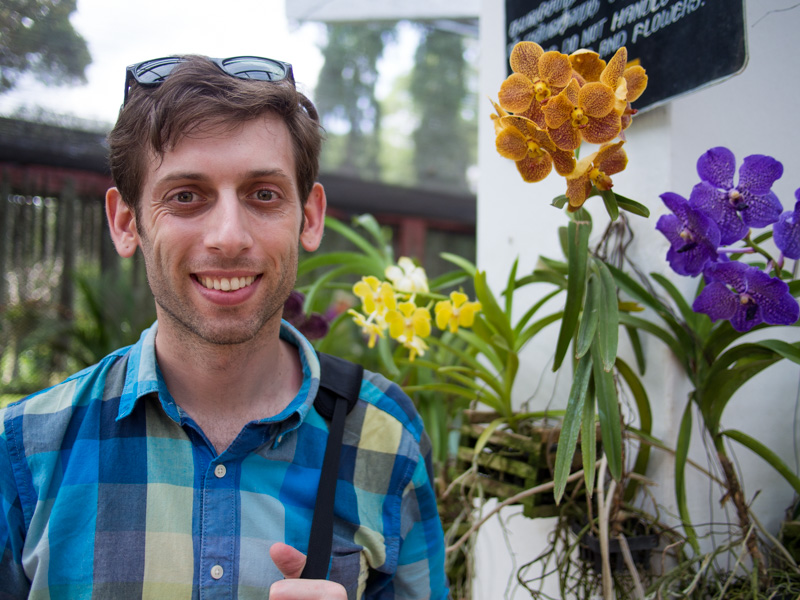
Ryan Feigenbaum at the Royal Botanical Gardens in Peradeniya, Sri Lanka. Credit: Madeline Chera, 2016.

The Poetic Botany exhibition was created by Ryan Feigenbaum as part of a 2015-2016 Andrew W. Mellon Fellowship at the Humanities Institute of the LuEsther T. Mertz Library of The New York Botanical Garden. NYBG, a founding BHL Member who has contributed over 3.9 million pages to the BHL collection, hosts the exhibit.

Feigenbaum, who has a BA in philosophy from DePaul University in Chicago, an MA in philosophy from Villanova University, and is currently completing a PhD in philosophy at Villanova University, researches the history and philosophy of biology. As evidenced through Poetic Botany, this research eventually led him down a botanical path.

“My dissertation, ‘The Epistemic Foundations of German Biology, 1790–1802,’ analyzes the emergence of biology as a science by tracing the genealogy of the organism concept,” explains Feigenbaum. “I came to the history of botany as an offshoot of this project; specifically, I was interested in the eighteenth-century opinion of plants, i.e., their ontological status. Whereas plants had long been regarded as devoid of intelligence, sensitivity, and locomotion, naturalists like Erasmus Darwin began to challenge these views, spurred on by the ‘discovery’ of plants like the Drosera and Mimosa pudica that challenged longstanding prejudices.”

Feigenbaum’s interest in the “life sciences” and the history of botany grew naturally out of his research on philosophy, for these two subjects have historically been intimately connected.

“The separation of philosophy and science is a relatively recent phenomenon,” affirms Feigenbaum. “Descartes, for instance, contributed to mathematics and physics beyond his cogito ergo sum, and much of Aristotle’s corpus focuses not on metaphysics or ethics but natural science. In this vein, I’ve been committed to studying not only eighteenth-century philosophy, but also its life science for the past five years or so. I say ‘life science’ because biology did not yet exist; the word ‘biology,’ in fact, was not used in its modern meaning until 1802. The how and why of biology’s emergence at this time is one focus of my dissertation.”

It was this extension into the ‘life sciences’ that eventually brought Feigenbaum to BHL.

“As my study of the history of philosophy incorporated more and more of the study of the history of science, BHL became a resource I relied on time and again,” asserts Feigenbaum. “At first I would search via Google for a particular eighteenth-century text, but I found it so often on BHL that I ended up using its website portal directly, sparing me the trouble of having to sift through Google results.”

BHL played an important role in the development of Poetic Botany, allowing Feigenbaum to discover and access relevant texts, many of which are linked from the exhibit.

“BHL provides smart access to knowledge that wouldn’t be otherwise available,” lauds Feigenbaum. “My favorite feature is the ability search by species. Since the digital exhibition is organized around species, this ability revealed new sources of which I’d been unaware. It is quite amazing that you can instantly see in which texts a species like Canna indica appeared according to date and then be taken to the exact pages of the reference. Without this resource, my workflow would have been much slower; it would’ve required me to visit multiple archives and search through texts one by one. While such an approach isn’t without its benefits, it inevitably limits what the researcher can do and extends the time required to do it.”

View Full Size Image
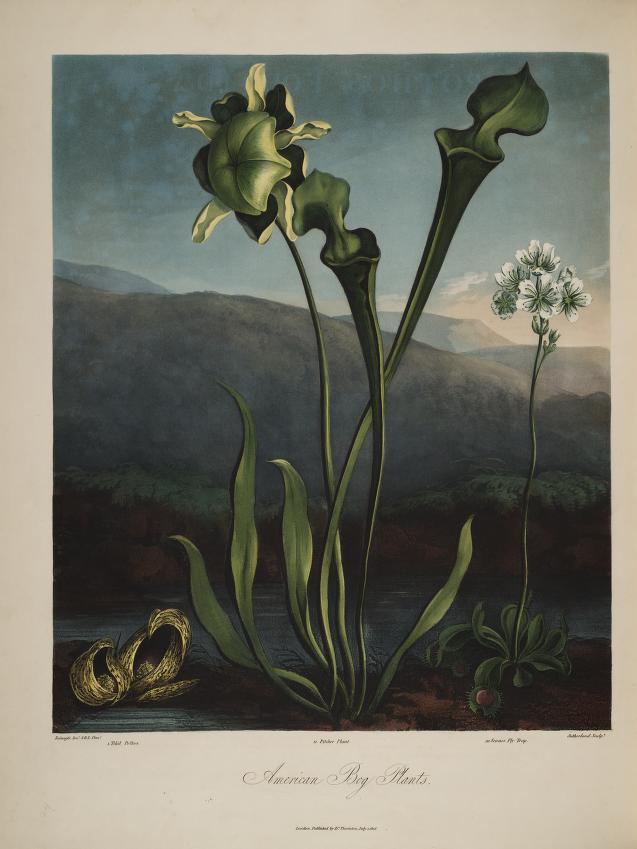
American bog plants: eastern skunk cabbage (Symplocarpus foetidus), yellow pitcherplant (Sarracenia flava), and Venus flytrap (Dionaea muscipula). Thornton, Robert John. New illustration of the sexual system of Carolus von Linnaeus. (1807) http://biodiversitylibrary.org/page/307056. Digitized by the Missouri Botanical Garden, Peter H. Raven Library.

While there are many texts featured in Poetic Botany, one of Feigenbaum’s favorites is John Thornton’s New Illustration of the Sexual System. According to Feigenbaum,

“This perennial favorite is often acclaimed for its indisputably beautiful illustrations, perhaps some of the most iconic in existence. However, the accompanying text is also marvelous, giving the reader insights into eighteenth-century botany, snippets of poetry, and whole disquisitions on culture, religion, and other topics.”

This title is also consistently a favorite among BHL’s online audiences. Thanks to the citizen science efforts of Michelle Marshall, this entire work has also been taxon tagged in Flickr, making it easy for you to identify and search for the species contained within it.

We encourage you to take some time to explore Poetic Botany and marvel at the elegant and profound union of art and science represented in the exhibit and texts. Who would have thought that poetry and science could fit together so naturally?

______________________________________

This post may contain the personal opinions of BHL users or affiliated staff and does not necessarily represent the official Biodiversity Heritage Library (BHL) position on these matters.

December 8, 2016by Grace Costantino
BHL News, Blog Reel

Biodiversity Heritage Library Welcomes Muséum national d’Histoire naturelle as a New Member

View Full Size Image

The Biodiversity Heritage Library is pleased to welcome the Muséum national d’Histoire naturelle (MNHN) as a new Member. As BHL’s 17th Member, MNHN will expand the breadth of BHL’s collection and service to the global scientific community.

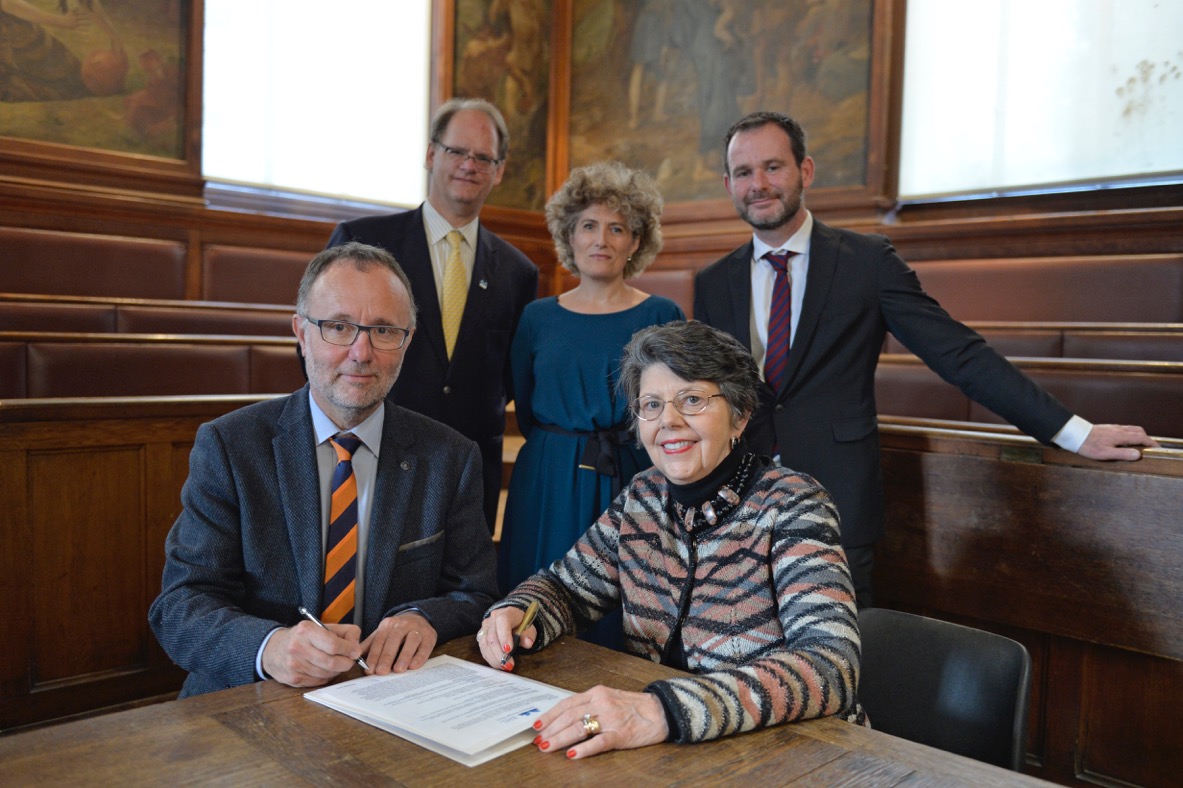
The Muséum’s membership came into effect at a ceremony in Paris at the Muséum national d’Histoire naturelle on 2 December 2016. During the ceremony, Dr. Bruno David, President of the Muséum, signed a certificate of membership on behalf of MNHN, and Dr. Nancy E. Gwinn, Chair of the BHL Members’ Council and Director of Smithsonian Libraries, co-signed the certificate on behalf of the BHL consortium.

View Full Size Image
Ceremony and Certificate of Membership Signing at the Muséum national d’Histoire naturelle on 2 December 2016. From left to right: Dr. Bruno David (President of the Muséum), Martin R. Kalfatovic (BHL Program Director), Laurence Bénichou (Head and Publications Manager, Museum Science Press, MNHN), Dr. Nancy E. Gwinn (Chair of the BHL Members’ Council and Director of Smithsonian Libraries), Gildas Illien (Director of Libraries and Documentation, MNHN). Image copyright: MNHN – JC Domenech.

Established in 1793, “le Muséum” – as it is simply known in France – is the national natural history Museum of France. The MNHN Library holds more than 2 million items reflecting the vast spectrum of the Muséum’s research activities. The library has been digitizing its collections for well over a decade, often in connection with European and international digital collaborations including BHL Europe. Over 500,000 pages of primarily natural science literature have been digitized to date.

“The Muséum is committed to facilitating its global service to research by developing international partnerships and enhancing its digital strategies. It has invested significant effort and resources into developing a comprehensive digitization program,” asserts Dr. Bruno David, President of the MNHN. “BHL has become a standard resource for natural scientists around the world and it provides services that are extremely popular within our own research communities in France. Participation in BHL will allow us to increase the visibility of our collections, contribute to the international dissemination of taxonomic research, and participate in a global effort to promote open access, open science, and open data.”

As a BHL Member, MNHN will enhance BHL’s collection by contributing rare and unique material from the Muséum’s library, including the entire collection of MNHN scientific publications from 1802 to 2000. (Materials published after 2000 are available through other portals.) The library will also contribute to the expansion of global collection development strategies and facilitate partnerships with other institutions in France and throughout Europe.

“We have had a relationship with Muséum national d’Histoire naturelle for many years through BHL Europe, and this year we are excited to see that relationship expand through membership,” affirms BHL Program Director Martin R. Kalfatovic. “For the past decade, we have been working diligently to build global partnerships that allow us to enhance the comprehensiveness of our collections and support research across the globe. We look forward to working with our MNHN colleagues to increase our impact on the European and international research communities.”

Explore the full BHL consortium here.

December 5, 2016by Grace Costantino
BHL News, Blog Reel

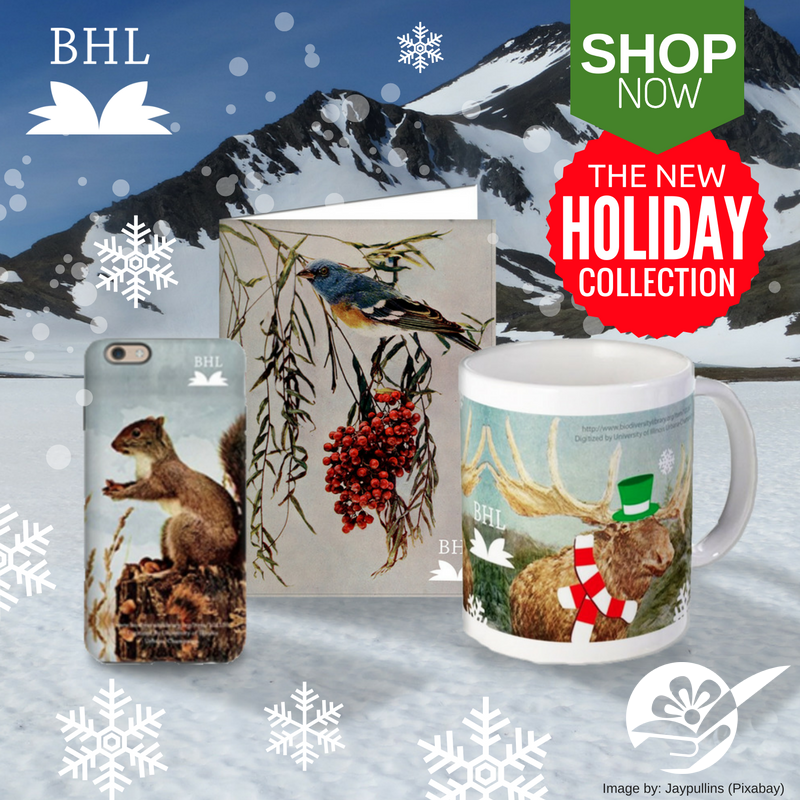
Announcing the New Holiday Collection in the BHL Store!

Get ready for the holidays with the new Holiday Collection in the BHL store!

View Full Size Image
Shop the new Holiday Collection in the BHL store today and help support biodiversity research around the world. 100% of the proceeds will be used to digitize more books for BHL. SHOP NOW!

The collection includes greeting cards, ornaments, mugs, and gifts featuring fun holiday-themed art from the Biodiversity Heritage Library.

Shop the BHL Holiday Collection today!

Not only are these products perfect for the holidays, but (just like with all of the products in the BHL store), 100% of the proceeds will be used to help us digitize more books for BHL. Researchers around the world rely on the information contained in books and archival materials to study and conserve biodiversity. Learn more about how BHL helps save biodiversity and how your purchase can have a lasting, positive impact on our planet.

View Full Size Image
You’ll find this badge in our store and on our marketing materials. It means that your purchase will help support research around the world. SHOP TODAY and help save biodiversity!

Visit the BHL Holiday Collection today to do some shopping that’s good for the planet.

December 1, 2016by Grace Costantino
Page 19 of 71« First...10«18192021»304050...Last »

Help Support BHL

BHL's existence depends on the financial support of its patrons. Help us keep this free resource alive!

search

About BHL

The Biodiversity Heritage Library (BHL) is the world’s largest open access digital library for biodiversity literature and archives. BHL operates as a worldwide consortium of natural history, botanical, research, and national libraries working together to digitize the natural history literature held in their collections and make it freely available for open access as part of a global “biodiversity community.”

Join Our Mailing List

Sign up to receive the latest news, content highlights, and promotions.

Subscribe Now

Subscribe to Blog via Email

Enter your email address to subscribe to this blog and receive notifications of new posts by email.

Join 319 other subscribers

Subscribe to Blog Via RSS

Subscribe to the blog RSS feed to stay up-to-date on all the latest BHL posts.

Access RSS Feed

Inspiring Discovery through Free Access to Biodiversity Knowledge.

The Biodiversity Heritage Library makes it easier than ever for you to access the information you need to study and explore life on Earth…for free, anytime, anywhere.


64+ Million Pages of
Biodiversity Literature Online.

EXPLORE

Tools and Services
to Transform Research.

EXPLORE

300,000+
Illustrations on Flickr.

EXPLORE

ABOUT | HARMFUL CONTENT | PRIVACY | SITE MAP | TERMS OF USE