Biodiversity Heritage Library - Program news and collection highlights from BHL
  • Home
  • News
  • Featured Books
    • All Featured Books
    • Book of the Month Series
    • BHL at 20
  • User Stories
  • Campaigns
    • Fossil Stories
    • Garden Stories
    • Monsters Are Real
    • Page Frights
    • Her Natural History
    • Earth Optimism 2020
  • Tech Blog
  • Visit BHL
Home
News
Featured Books
    All Featured Books
    Book of the Month Series
    BHL at 20
User Stories
Campaigns
    Fossil Stories
    Garden Stories
    Monsters Are Real
    Page Frights
    Her Natural History
    Earth Optimism 2020
Tech Blog
Visit BHL
  • Home
  • News
  • Featured Books
    • All Featured Books
    • Book of the Month Series
    • BHL at 20
  • User Stories
  • Campaigns
    • Fossil Stories
    • Garden Stories
    • Monsters Are Real
    • Page Frights
    • Her Natural History
    • Earth Optimism 2020
  • Tech Blog
  • Visit BHL
Biodiversity Heritage Library - Program news and collection highlights from BHL
Blog Reel, User Stories

The Case of the Mistaken Manakin

Since the end of the twentieth century, the genus name Dixiphia has been associated with the white-crowned manakin. A recent investigation, made possible in part thanks to BHL, demonstrated that Dixiphia did not refer to a manakin at all, but was in fact a junior synonym of the white-headed marsh tyrant (genus Arundinicola).

The white-crowned manakin was in need of its own, new genus-group name.

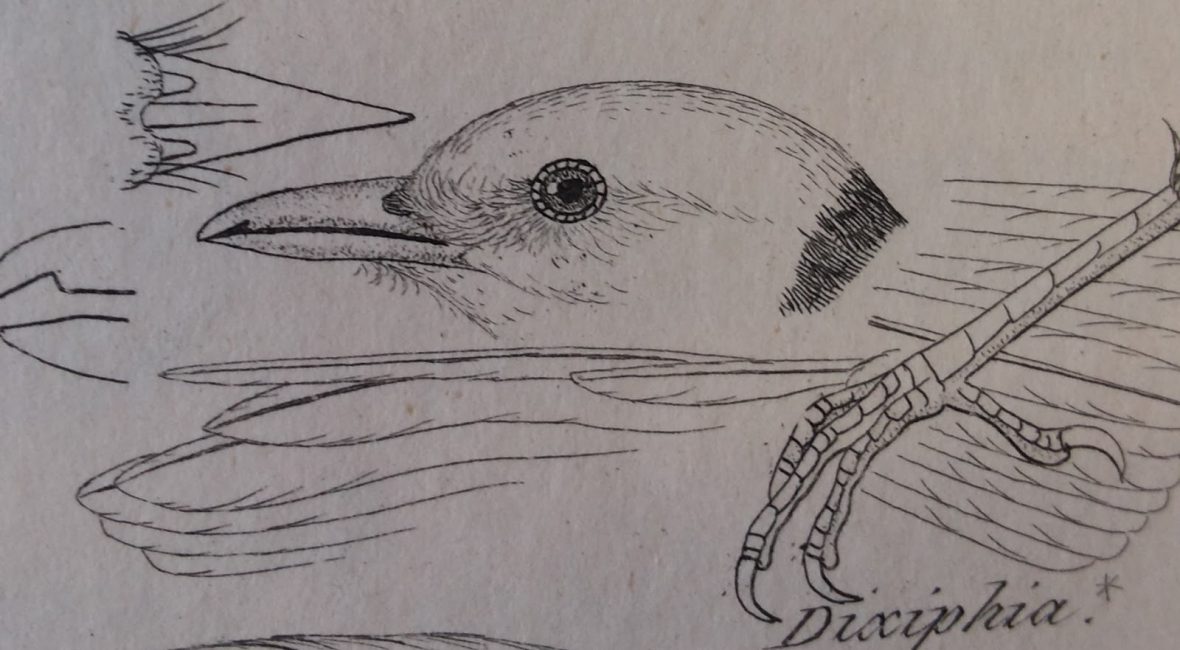
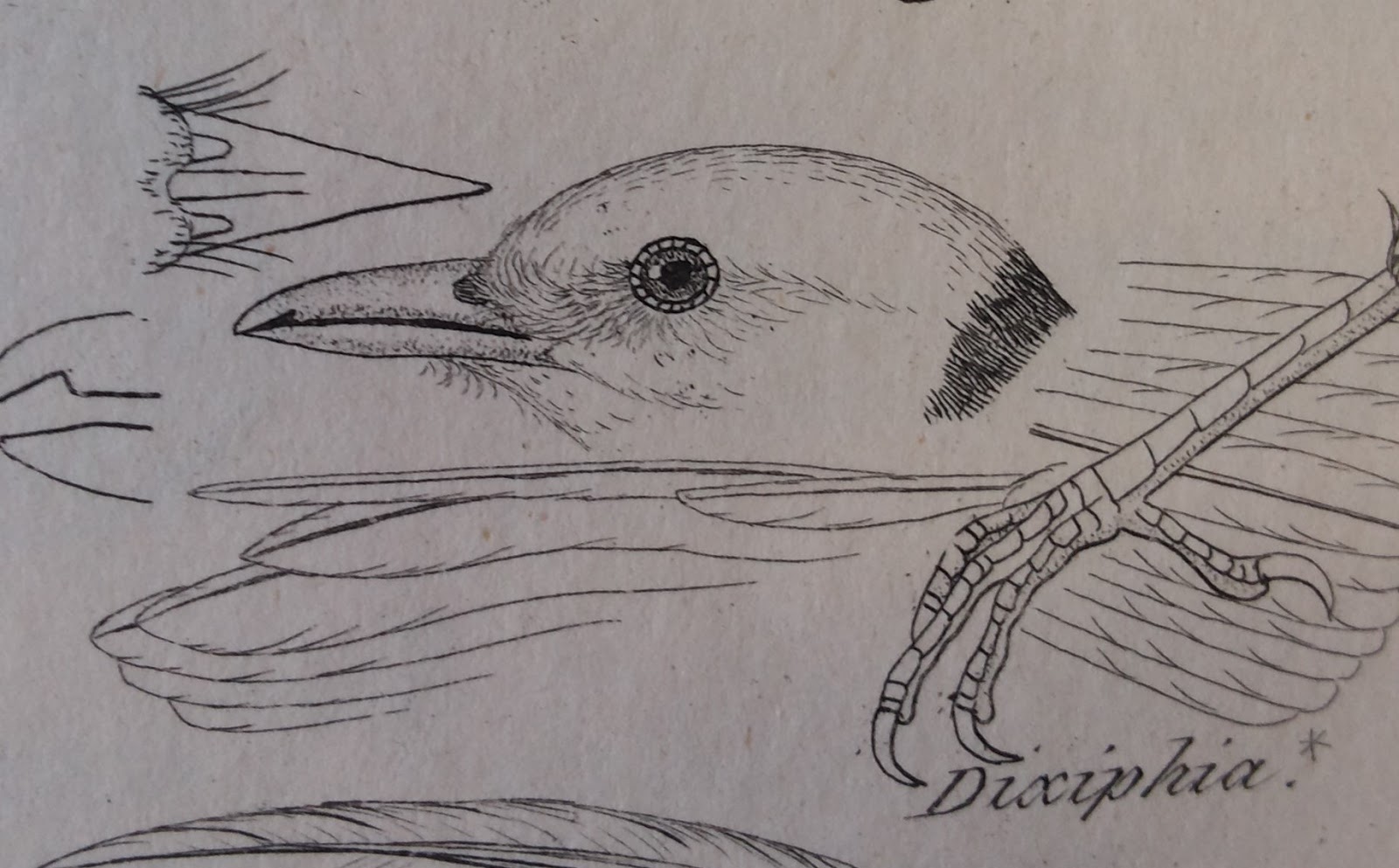
The manakin mystery was first discovered by researchers Guilherme Renzo Rocha Brito and Guy M. Kirwan. Following the publication of a book on Cotingas and Manakins, Brito and Kirwan received an inquiry from James A. Jobling about the absence of any mention in the publication of modified wing feathers in the white-crowned manakin (then called Dixiphia pipra), which were so clearly displayed in Reichenbach’s (1850) Dixiphia illustration. Brito and Kirwan were perplexed by the inquiry, because not only does Reichenbach’s illustration show a bird with an all-white head (which the white-crowned manakin does not have), but the white-crowned manakin also does not have modified wing feathers.

View Full Size Image
Detail from Plate LXIII of Reichenbach (1850) showing the bird that he named Dixiphia; all visible features are those of a male white-headed marsh tyrant Arundinicola leucocephala. Reichenbach, H. G. Ludwig (Heinrich Gottlieb Ludwig). Die vollstèandigste Naturgeschichte der Vèogel. Abt. 2, Bd. 1. (1836-62).http://biodiversitylibrary.org/page/47618489. Digitized by Smithsonian Libraries.

The genus name Dixiphia was first published by Reichenbach in 1850. In 1992, Richard O. Prum assigned the white-headed manakin to the Dixiphia genus after demonstrating that it had long been erroneously attributed to the Pipra genus.

After examining Reichenbach’s illustration following the inquiry regarding modified wing feathers, Brito and Kirwan came to the conclusion that Reichenbach’s illustration was actually that of the white-headed marsh tyrant (Arundinicola leucocephala). They examined specimens in the Museum Nacional’s ornithological collection as well as descriptions in historic publications, many made available to them thanks to the Biodiversity Heritage Library.

View Full Size Image
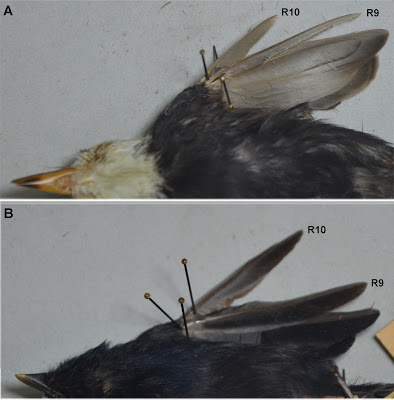
Pinned museum specimens showing the wing feathers (9th and 10th remige – R9 and R10). A – male White-headed Marsh Tyrant B – male White-crowned Manakin.

All of this research culminated in the conclusion that Reichenbach’s illustration was indeed of the white-headed march tyrant, that Dixiphia was actually a junior synonym of Arundinicola (a fact that had first been suggested over a century ago), and that a new genus-group name for the white-crowned manakin was needed.

Brito and Kirwan, along with co-authors Normand David, Steven M.S. Gregory, James A. Jobling, and Frank D. Steinheimer, summarized this research and proposed a new genus name, Pseudopipra, for the white-crowned manakin in the 2016 Zootaxa article “The mistaken manakin: a new genus-group name for Parus pipra Linnaeus, 1758(Aves: Passeriformes: Pipridae)“.

View Full Size Image
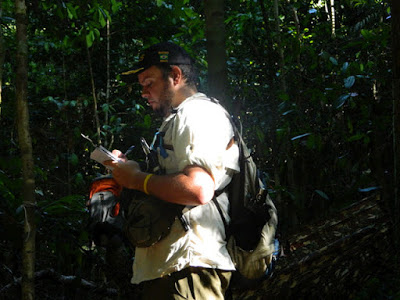
Guilherme R. R. Brito doing field work on the Brazilian Amazon.

Guilherme R.R. Brito, a substitute professor at the Universidade Federal do Rio de Janeiro, is quick to emphasize the role that BHL played in solving this taxonomic mystery – a role that is also highlighted in the acknowledgments section of the Zootaxa article.

“BHL is one of the most important databases for several [subject] areas within the biological sciences,” lauds Brito. “For historical taxonomic purposes, it’s now essential.”

Brito, who has been studying bird anatomy, natural history, taxonomy, and systematics for fifteen years, first discovered BHL shortly after the online portal launched nearly a decade ago. Since then, he has used BHL to access many important and historical publications that were previously very difficult to obtain in Brazil.

“Thanks to BHL, several very rare works are now readily available to any researcher in the world,” explains Brito. “I remember not so long ago that we researchers in Brazil had to wait for colleagues to visit museums and institutions abroad to ask them for some copies of works not available here. These were more difficult times.”

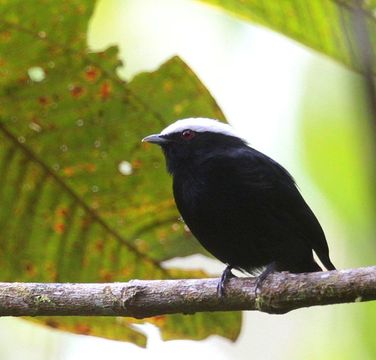
The digital open access provided by the Biodiversity Heritage Library allows scientists to easily access the information they need to study life on Earth and solve taxonomic enigmas like the Dixiphia mystery. No doubt Pseudopipra pipra is grateful to have a name to call its own.

View Full Size Image
White-crowned manakin (Pseudopipra pipra). Image by Carmelo López Abad. Licensed under a Creative Commons Attribution-NonCommercial License license: http://creativecommons.org/licenses/by-nc/4.0/. Image source: Encyclopedia of Life http://eol.org/data_objects/33609559.
______________________________________

This post may contain the personal opinions of BHL users or affiliated staff and does not necessarily represent the official Biodiversity Heritage Library (BHL) position on these matters.
October 13, 2016by Grace Costantino
BHL News, Blog Reel

BHL Adds Two New European Affiliates

Over the past three months, BHL has welcomed two new European Affiliates: Bibliothèque cantonale et universitaire – Lausanne in Switzerland and the Mendel Museum of Masaryk University in the Czech Republic. The BHL consortium now consists of sixteen Members and fifteen Affiliates.

Bibliothèque cantonale et universitaire – Lausanne

View Full Size Image

Founded in the 16th century, the Bibliothèque cantonale et universitaire – Lausanne is one of the largest public and university libraries in Switzerland. The library contains approximately 2.5 million printed documents, representing academic, cultural heritage, general and special collections. The library also engages in a variety of digital initiatives, including a large-scale newspaper digitization project, various on-demand digitization services, and collaborative projects with regional libraries. Furthermore, in collaboration with Google Books, BCU Lausanne digitized over 106,000 volumes from its collection.

Through participation in BHL, BCU Lausanne will build upon current digitization efforts and further its commitment to providing free access to its library collections. The institution also hopes to leverage its existing partnerships within the regional library network in order to facilitate the inclusion of library collections from other institutions within Switzerland.

Mendel Museum of Masaryk University

View Full Size Image

Mendel Museum, which has been a department of Masaryk University in Brno (in the Czech Republic) since 2007, is dedicated to spreading the scientific legacy of the Augustinian abbot Gregor Johann Mendel. Mendel is renowned as the founder of the modern science of genetics. Additionally, the museum also promotes the wide range of scientific disciplines that Masaryk University students may encounter. Through interactive exhibits on Mendel’s legacy to internationally-recognized Mendel Lectures, the museum provides a place for the public to appreciate the connection of science with practice.

Mendel Museum holds a collection of Gregor Johann Mendel’s manuscripts, which are owned by the Augustinians in Brno and have never before been available online. These documents represent important scientific and cultural heritage materials and provide a unique perspective into the foundations of modern genetics. Participation in BHL will allow Mendel Museum to provide free and open access to this incredibly rich and valuable collection.

October 6, 2016by Grace Costantino
Blog Reel, Campaigns, Featured Books, Page Frights

Sea Monks and Other Page Frights: Celebrate Halloween, Library and Archives Style!

View Full Size Image

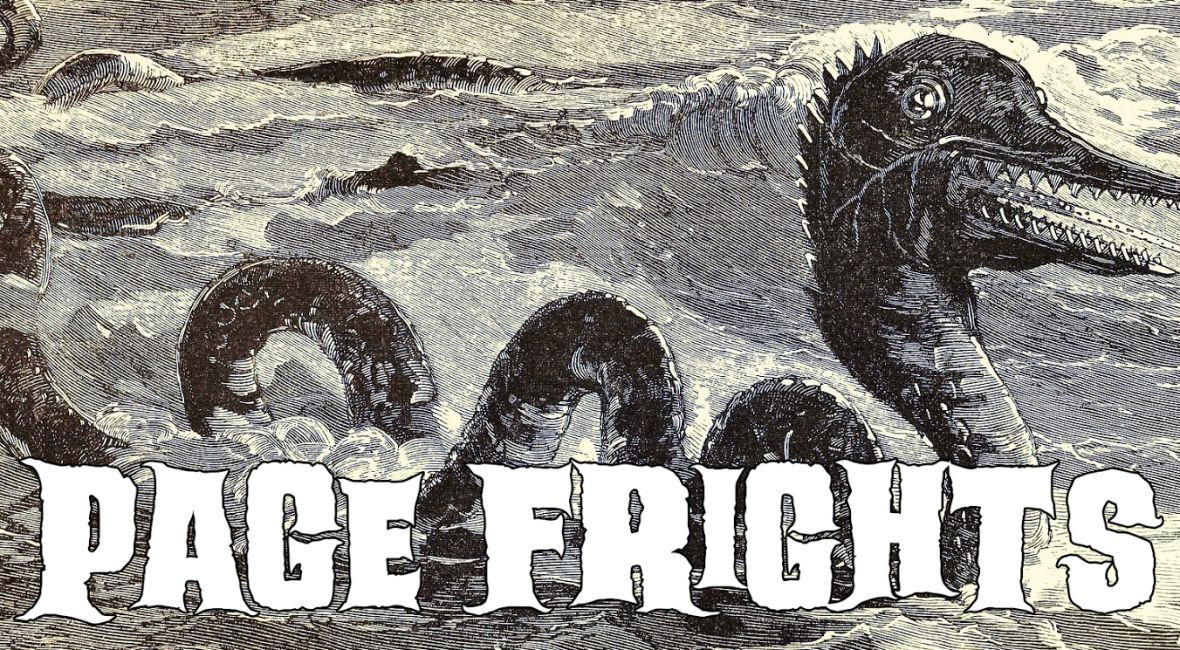
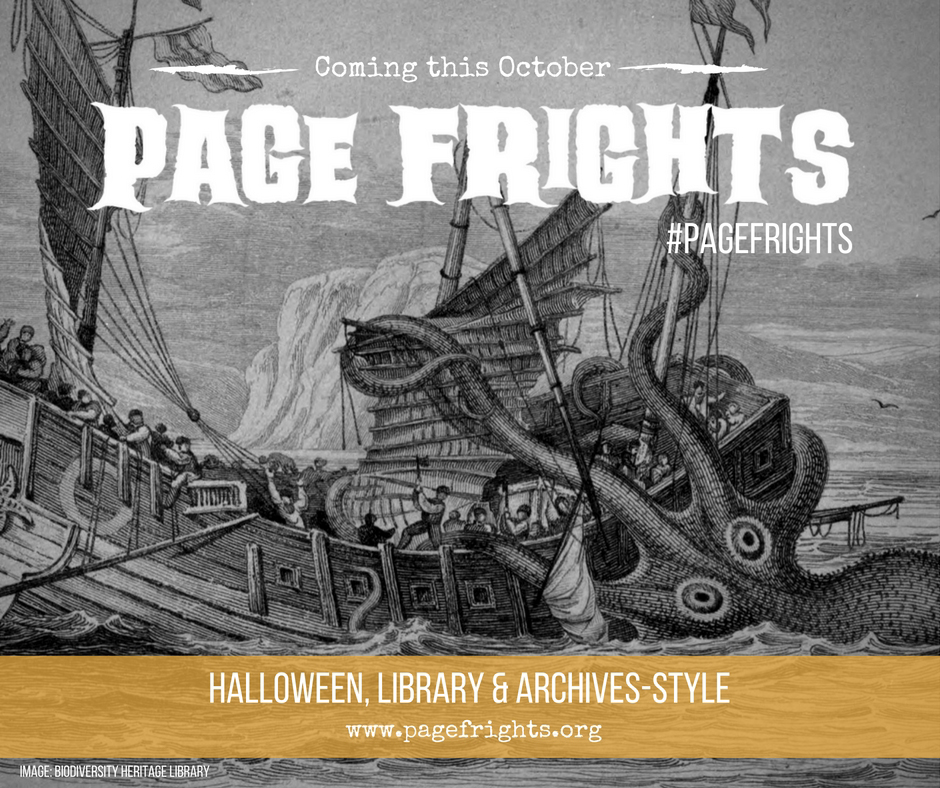
Welcome to Page Frights, a month-long social media celebration of Halloween!

All this month (1-31 October), libraries and archives around the world will be sharing spooky, creepy, frightening, and otherwise Halloween-related books and images from their collections on social media with the hashtag #PageFrights.

Follow along and join the conversation on Twitter, Instagram, Facebook, Tumblr, and other social media sites and visit the Page Frights website to learn more.

We have lots of great content planned for BHL this month as part of Page Frights. Would you like a taste of what you can expect? If so, please allow us to introduce the sea monk!

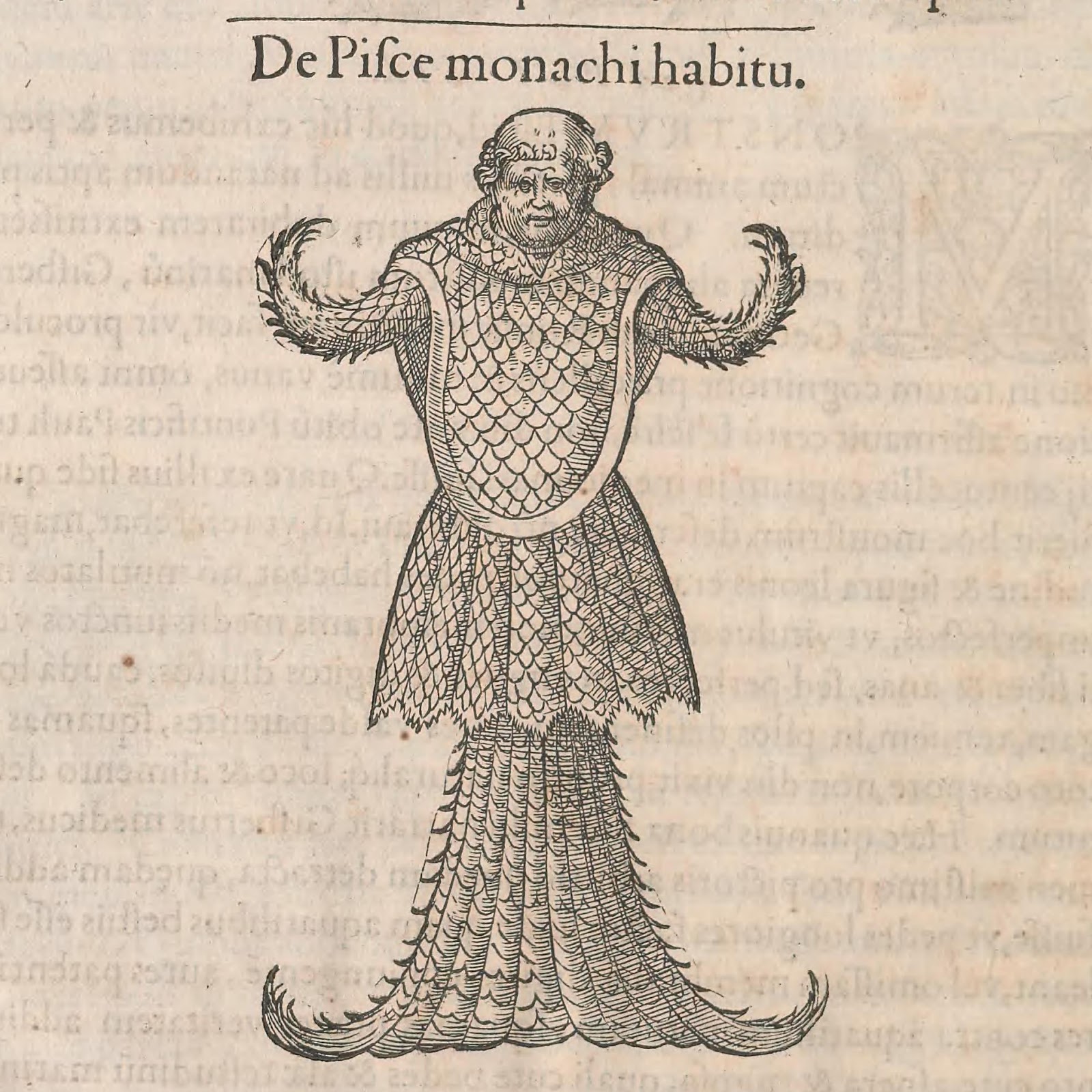
Piscis monachi habitu, “Fish with the habit of a monk”

In the 1540s (probably in 1546), a mysterious creature was caught in the Øresund, the strait between the island of Sjælland (Denmark) and Sweden. The creature was described as a sea monk (or monk fish) with “a human head and face, resembling in appearance the men with shorn heads, whom we call monks because of their solitary life; but the appearance of its lower parts, bearing a coating of scales, barely indicated the torn and severed limbs and joints of the human body” (Paxton & Holland, 39).

View Full Size Image
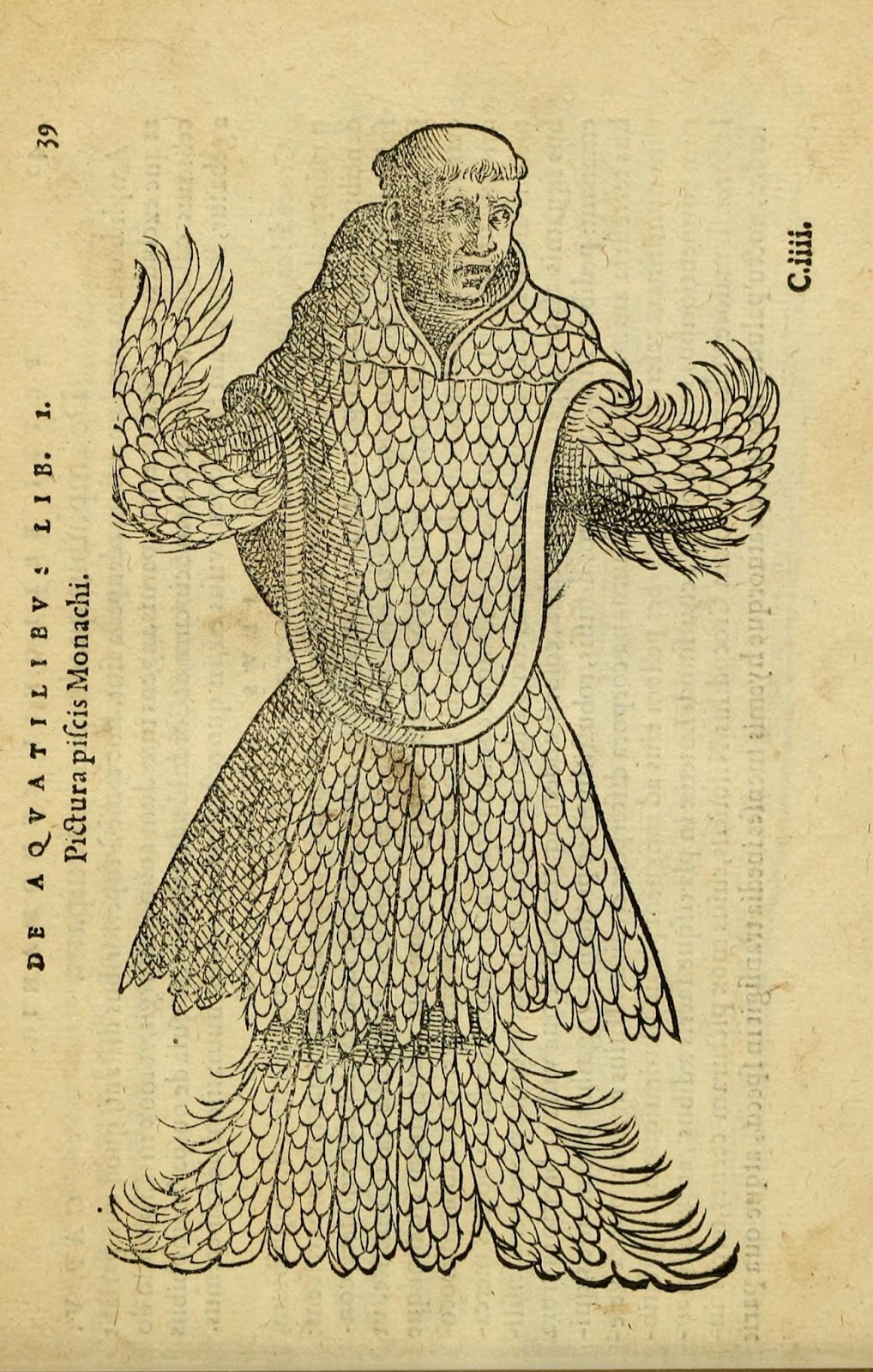
The monk fish, pisces monachus. Belon, Pierre. De Aquatilibus. 1553. http://biodiversitylibrary.org/page/4770183.  Digitized by the Ernst Mayr Library, Museum of Comparative Zoology, Harvard University.

The discovery was described by several naturalists of the day, including Pierre Belon (who described it as the monk fish, pisces monachus, in his 1553 publication De Aquatilibus), Guillaume Rondelet (who described it as piscis monachi habitu, “fish with the habit of a monk”, in his 1554 publication Libri de Piscibus Marinis), and Conrad Gesner (who summarized Rondelet and Belon’s accounts and referenced additional drawings by Georg Fabricius and a Hector Mythobius in his 1558 Historia Animalium). None of these men had actually seen the specimen that they described, and Belon and Rondelet’s accounts were obtained from as yet unidentified German source material (Paxton & Holland, 40, 46).

View Full Size Image
Piscis monachi habitu, “fish with the habit of a monk”. Rondelet, Guillaume. Libri de Piscibus Marinis. 1554. http://biodiversitylibrary.org/page/42089971. Digitized by Smithsonian Libraries.

While these publications were clearly linked to a 16th century encounter with a mysterious zoological specimen, they are not the earliest known references to a sea monk. Sea monks were referenced as early as the late 12th or early 13th centuries, such as in Alexander Neckham’s De Naturis Rerum (which includes the statement “other fish resemble monks”) and in Albertus Magnus’ De Animalibus (which references Monachus maris, “the sea monk…a fish occasionally seen in the British sea…[which] entices those travelling on the sea until it lures them in. It then seeks to the bottom and takes its fill of their flesh”) (Paxton & Holland, 43).

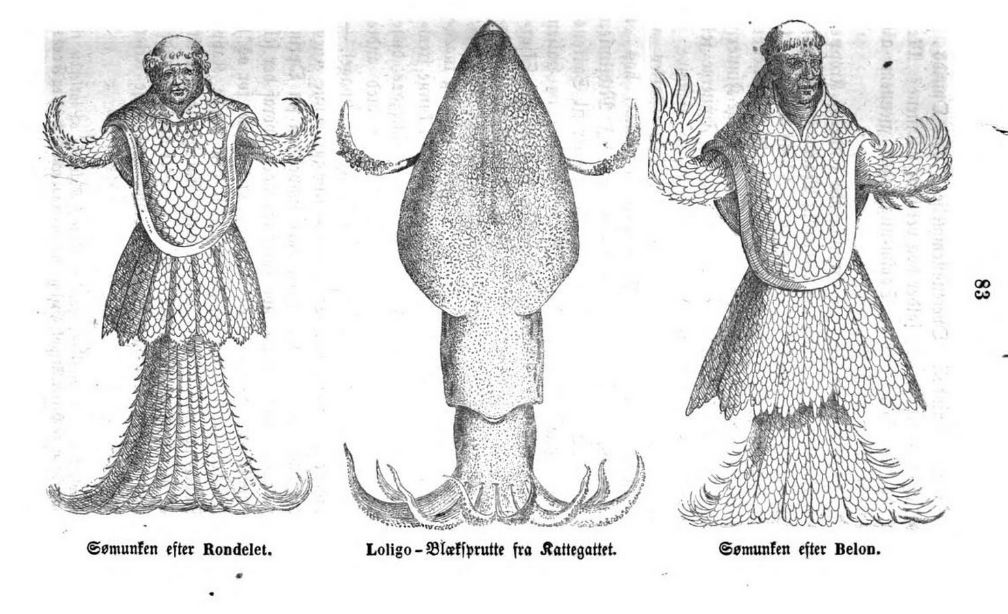
What species could have been the inspiration for such a mysterious creature? Many theories have been proposed. Danish zoologist Japetus Steenstrup proposed in his 1855 publication ‘Om den i Kong Christian IIIs tid i Øresundet fanget Havmund (Sømunken kaldet)‘ that the Øresund specimen was a giant squid (Paxton & Holland, 42). Other suggestions include various seal species or even a walrus. More recently, it was suggested that the Øresund monkfish was actually an angelshark species, possibly Squatina squatina (Paxton & Holland, 43).

View Full Size Image
Comparison of Rondelet and Belon’s sea monks with a giant squid. Steenstrup, Japetus. Om den i Kong Christian IIIs tid i Øresundet fanget Havmund (Sømunken kaldet). Dansk Maanedsskrift. v. 1 (1855). Obtained via Google Books.

Identifying an origin species for the monkfish is further complicated by the fact that these representations were also possibly influenced by religious tensions of the period. The association between clerical figures and monsters may be seen as a commentary on these tensions, with religious elements being imposed on natural entities.

Since the original Øresund specimen is lost, pisces monachus will likely forever remain shrouded in mystery – a frightening entry in the chronicles of natural history.

Celebrate Halloween, Library & Archives Style with Page Frights

We invite you to join us for Page Frights this month as we highlight other fascinating, frightening, and/or Halloween-related natural history images and publications. BHL content will include:

  • Social media posts on Twitter, Facebook, and Instagram
  • Blog posts
  • Page Frights image collections in Flickr and Pinterest
  • A collection of “monster” natural history books in our Monsters Are Real BHL collection
  • Pumpking carving patterns inspired by BHL images in the Page Frights Pumpkin Pattern Gallery

Also as part of Page Frights, joining this year’s GIF IT UP fun by encouraging you to create creepy GIFs inspired by #PageFrights images. Learn more.

View Full Size Image
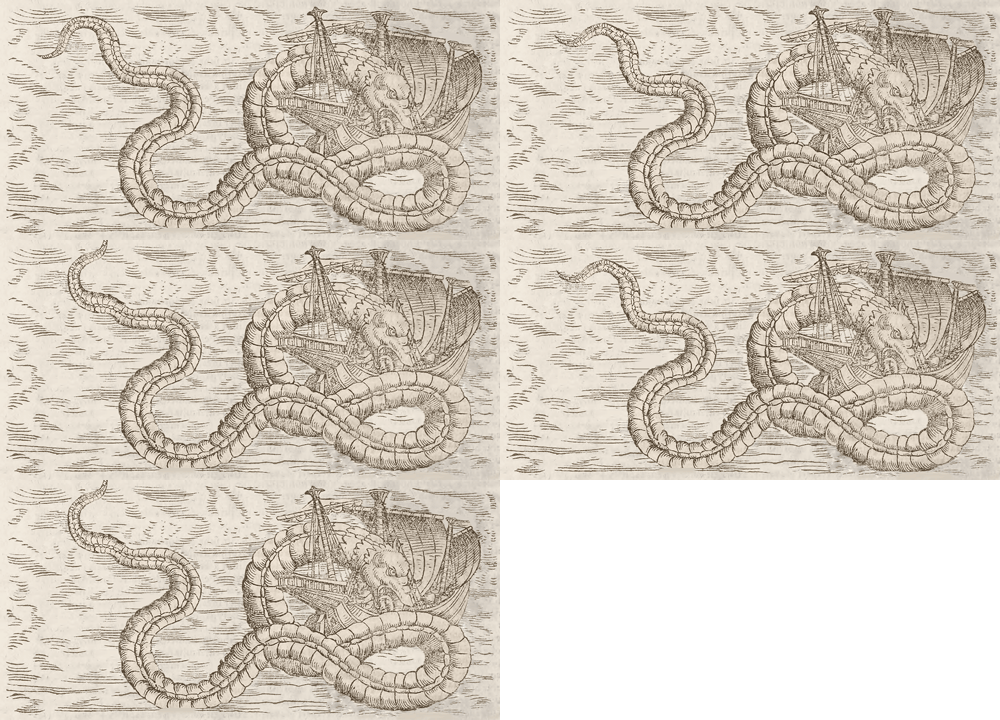
“Attack of the Sea Monster!” In 1555, Olaus Magnus published an image and description of the Soe Orm, which he claimed was a giant sea serpent 200 feet in length that lived near the shore or Bergen and came out at night to eat the farmers’ livestock. His image and description was republished for centuries. See more fantastic images come to life as part of GIF IT UP. GIF created by Richard Naples (Smithsonian Libraries), based on Gessner, Conrad. Historia Animalium. 2nd ed. 1604. http://biodiversitylibrary.org/page/42166517.

Get Your Own Sea Monster & Support Biodiversity Research

View Full Size Image
Shop the BHL Page Frights CafePress Collection today!

With our Page Frights CafePress collection, you can purchase your very own piece of the Page Frights fun and help support scientific research at the same time! 100% of the proceeds from product sales will be used to digitize more books for BHL.

Start shopping today!

Learn more about how free and open access to natural history publications on BHL can help save biodiversity and transform research.

Reference

Paxton, C. G. M. & R. Holland. Was Steenstrup Right? A New Interpretation of the 16th Century Sea Monk of the Øresund. – Steenstrupia 29 (1): 39–47. Copenhagen, Denmark. November 2005. ISSN 0375-2909.

October 1, 2016by Grace Costantino
BHL News, Blog Reel, User Stories

Rod Page Talks Bioinformatics, Linked Data, and Primary Literature at the Smithsonian

Portrait version of the Biodiversity Heritage Library logo.

On 22 September, Dr. Rod Page, Professor at the University of Glasgow and creator of BioStor, gave a presentation at the Smithsonian’s National Museum of Natural History Library about ideas for extracting and linking data across biodiversity repositories and primary literature.

The talk, entitled “The Sam Adams Talk,” covered topics including phylogenetics, geophylogeny visualizations, linking article and specimen data across repositories, annotations, the biodiversity knowledge graph, and data as source code. A lively Q&A; session between Rod and the audience followed the presentation.

You can view a recording of the presentation on YouTube.

Rod’s talk at the Smithsonian followed the Scientific Collections International Food Security Symposium at the National Agricultural Library, 19-21 September. At the invitation of BHL, Rod gave a presentation at the symposium about using publication data to support food security research. You can view Rod’s Food Security Symposium presentation, entitled “Unknown Knowns, Long Tails, and Long Data“, on his Slideshare.

Visit Rod’s blog iPhylo and follow him on Twitter at @rdmpage to see more of his thoughts on bioinformatics, linked data, and primary literature.

September 29, 2016by Grace Costantino
BHL News, Blog Reel, Campaigns, Page Frights

Page Frights Is Coming This October!

View Full Size Image

Get ready for a ghoulishly good time this October…Page Frights is coming!

From 1-31 October, libraries, archives, and other cultural institutions around the world will be gearing up for Halloween by sharing spooky, creepy, or otherwise frightening books and images from their collections on social media using the hashtag #PageFrights. Follow along and join the conversation on Twitter, Instagram, Facebook, Tumblr, and other social media sites. Visit pagefrights.org to learn more.

We’ll also be inviting you to carve pumpkins using patterns inspired by #PageFrights content. Participating institutions will create pumpkin carving patterns based on images from their collections, and these patterns will be freely available to download from the Page Frights website starting in October. We encourage you to share your carved pumpkins on social media using the #PageFrights hashtag.

View Full Size Image
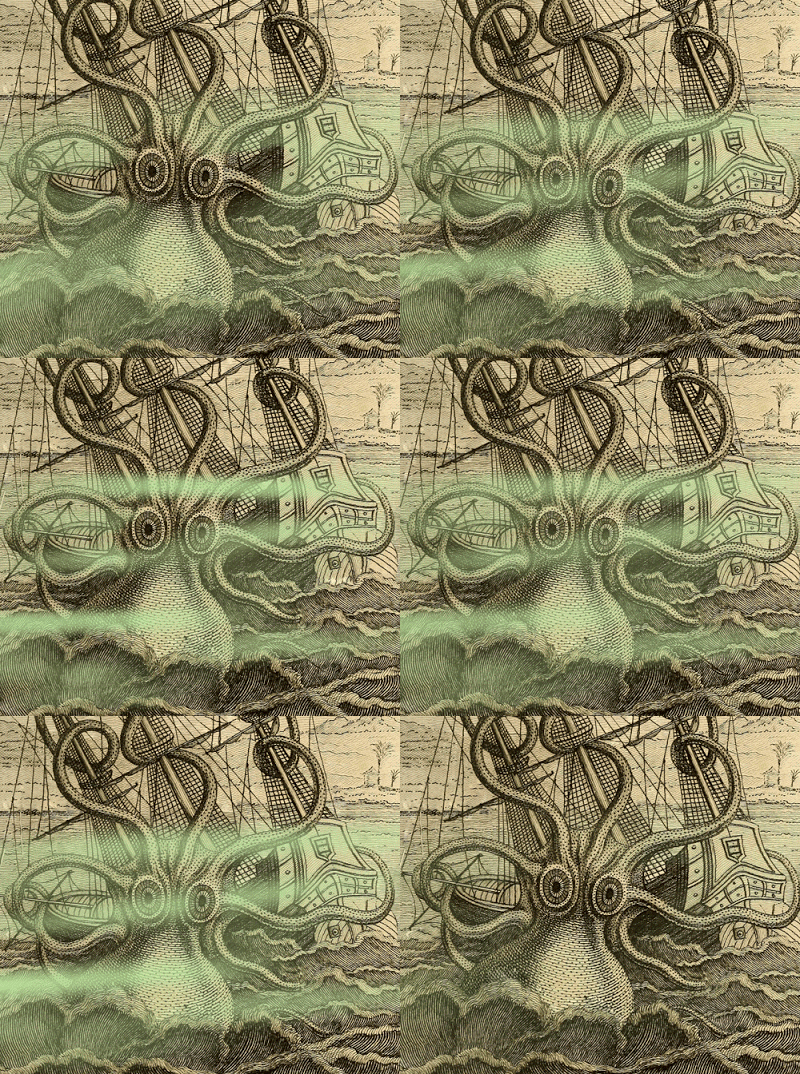
Image from: Denys de Montfort, Pierre. Histoire naturelle, générale et particulière des mollusques. t. 2 (1801). http://biodiversitylibrary.org/page/35755564. GIF created by Richard Naples of Smithsonian Libraries.

Finally, we’re joining the Digital Public Library of America (DPLA) GIF IT UP fun and encouraging you to create GIFs based on #PageFrights images. GIF IT UP is a challenge to find the best GIFs created from copyright-free heritage materials found in DPLA, DigitalNZ, Trove, or Europeana. BHL serves as a digital content hub for DPLA. Learn more on the Page Frights website.

Page Frights was inspired by the 2015 #creepyarchives campaign launched by the Medical Historical Library at Yale University. #PageFrights is spearheaded by the Biodiversity Heritage Library, The New York Academy of Medicine, the Medical Historical Library at Yale University, and Smithsonian Libraries. Visit the website to see a full list of participating institutions to date.

If you’re an institution interested in participating in Page Frights, we’d love for you to join us! Find out how you can join the Page Frights fun.

So be sure to follow #PageFrights on social media starting this October and visit the website for more great content…if you dare!!

September 19, 2016by Grace Costantino
Blog Reel, User Stories

Beyond Tunnels & Bigamy: The Scientific Contributions of the Infamous Harrison Dyar

View Full Size Image
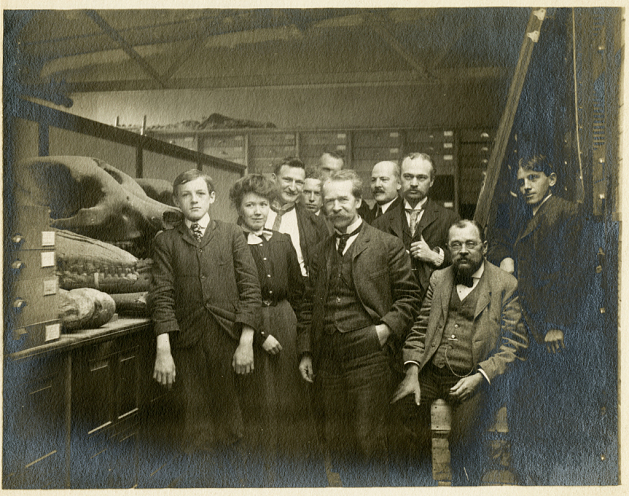
Harrison G. Dyar, Jr., third from right, with Entomology staff of the U.S. National Museum in 1905. Courtesy of Smithsonian Institution Archives.

If you have ever heard of entomologist Harrison Dyar, there’s a good chance that it was in relation to a series of tunnels that he dug beneath Washington, D.C. Or it may have been in relation to his bigamy. But if that’s all you know about Dyar, then you only know the tabloid tales.

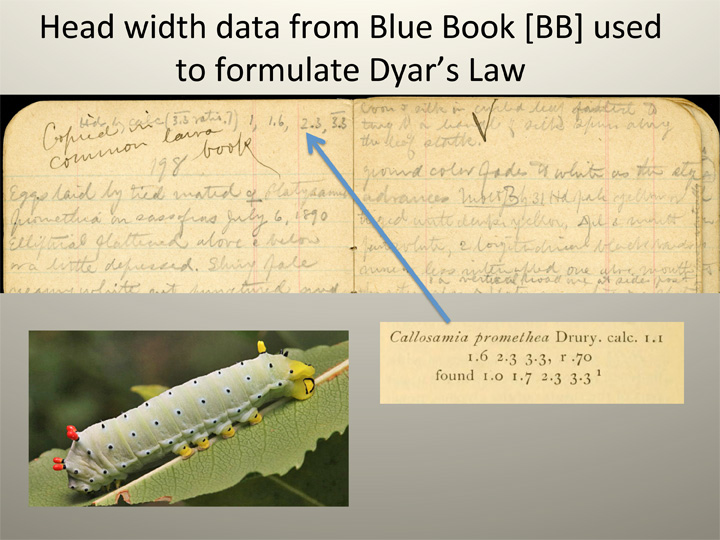
Harrison Dyar was Honorary Custodian of Lepidoptera at the United States National Museum for over 30 years. He studied sawflies, moths, butterflies and mosquitos and described hundreds of species and genera. He also contributed significantly to the study of insect development by formulating Dyar’s Law of Geometric Growth. By observing that the width of caterpillar heads was fixed within each stage of development, Dyar realized that he could use a ratio to predict the width of the head at various stages of development, and that this ratio could in turn be used to differentiate insect instars. By using this law, entomologists can identify the developmental stage of an immature insect.

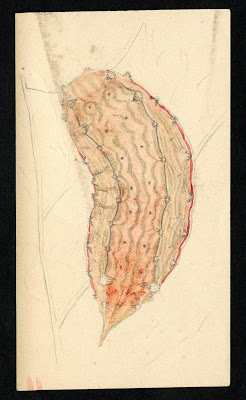
Dyar’s field notebooks, including his “blue books” and “catalogue” as they’re called, contain valuable information both on Dyar’s scientific research and aspects of his personal life. For instance, they include his scientific observations made while rearing specimens, head width data used to formulate Dyar’s Law, and, on a more personal note, the identity of relatives who helped Dyar collect and rear insects.

View Full Size Image
Image Source: Smithsonian Libraries.

Dyar’s field notebooks, which are held by the Smithsonian Institution Archives, have been digitized as part of The Field Book Project and are available in BHL, making it much easier for researchers around the world to access and study Dyar’s work.

View Full Size Image
Drawing from a Dyar blue book. H. G. Dyar bluebook 575 – 625. 1896-1898. Digitized by Smithsonian Institution Archives. http://biodiversitylibrary.org/page/46194051.

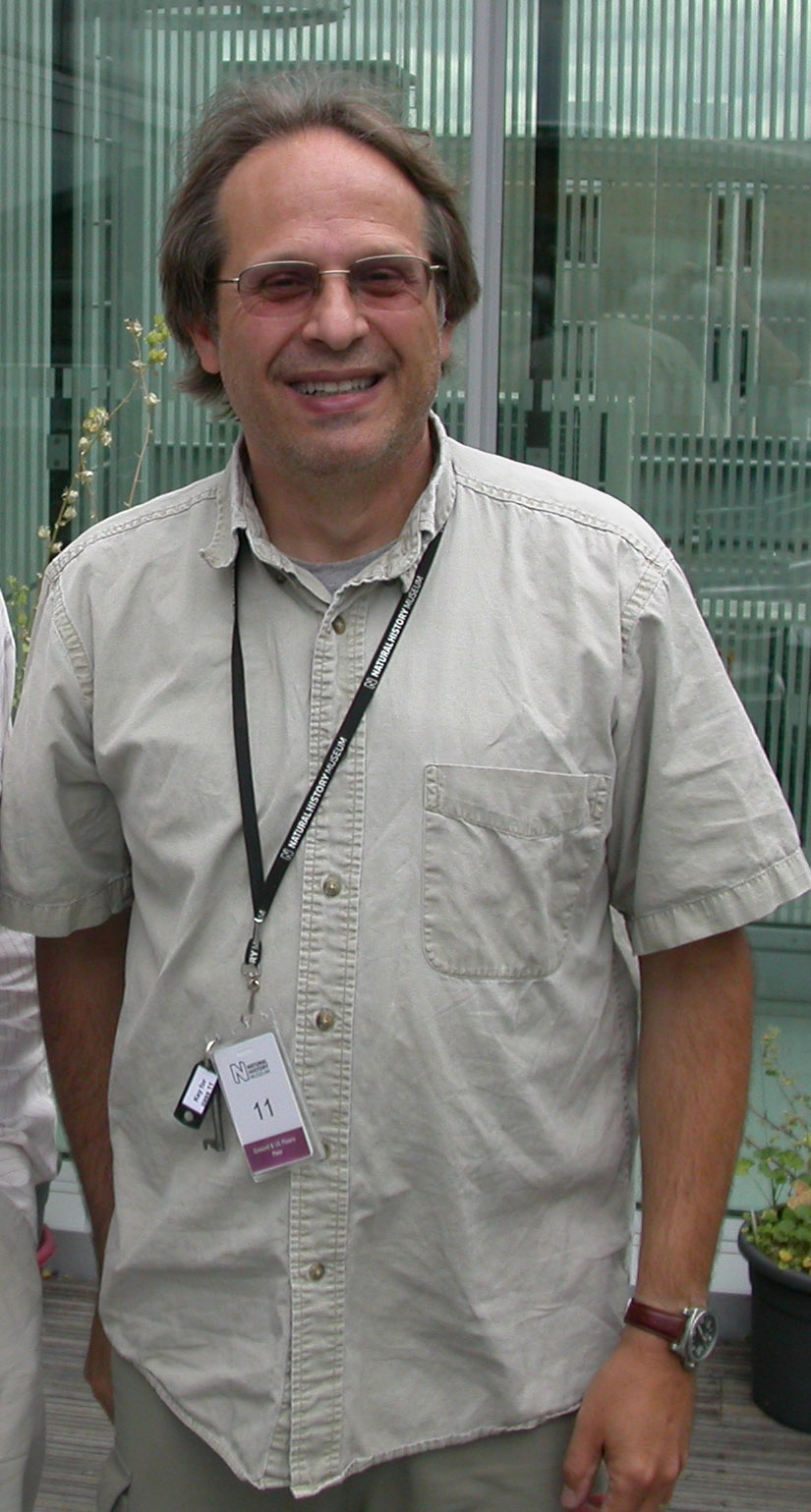
One such researcher that has benefited from online access to this materials is Dr. Marc Epstein, Research Associate at the National Museum of Natural History and Senior Insect Biosystematist (Lepidoptera) at the Plant Pest Diagnostics Center of the California Department of Food and Agriculture. Dr. Epstein has studied Dyar’s work and legacy extensively and has authored a biography on this remarkable entomologist entitled Moths, Myths and Mosquitos:The Eccentric Life of Harrison G. Dyar, Jr.. Marc discovered BHL, thanks to recommendations from his colleagues, around the time that our online library launched. Since then, BHL’s collections have had an immense impact on Marc’s research.

View Full Size Image
Dr. Marc Epstein. Image Source: California Department of Food and Agriculture.

“Even though I’m fortunate to have a good entomology library at the Plant Pest Diagnostics Center in Sacramento, CA, BHL has provided me access to so many journals that I haven’t had easy access to in California since with my move here in 2003,” asserts Marc. “In fact BHL has often provided me with the very copies I used to refer to in the Smithsonian National Museum of Natural History (NMNH) libraries!”

BHL has greatly facilitated Marc’s research on Lepidoptera and more specifically on Harrison Dyar.

“Day to day BHL has helped me do my job to identify Lepidoptera that threaten California agriculture, while providing a tremendous boost to my research projects,” explains Marc. “These have included the completion of Moths, Myths, and Mosquitoes: the Eccentric Life of Harrison G. Dyar, Jr. as well as studies on Costa Rican moths and the evolution of Lepidoptera and their caterpillars.

“Related to the Moths, Myths, and Mosquitoes, it enabled me to much more efficiently transcribe portions of Dyar’s hand-written notebooks, once in my office at NMNH. Prior to the availability of these notebooks on BHL, The Field Book Project at the Smithsonian provided me with electronic files of all of the notebooks, which are now becoming available along with transcriptions made by a corps of volunteers. Having both BHL and the notebooks on my [computer] desktop in Sacramento has enabled me to transcribe portions needed for my research while in Sacramento and saved me valuable time to focus on specimens during my visits to the NMNH entomology collections.”

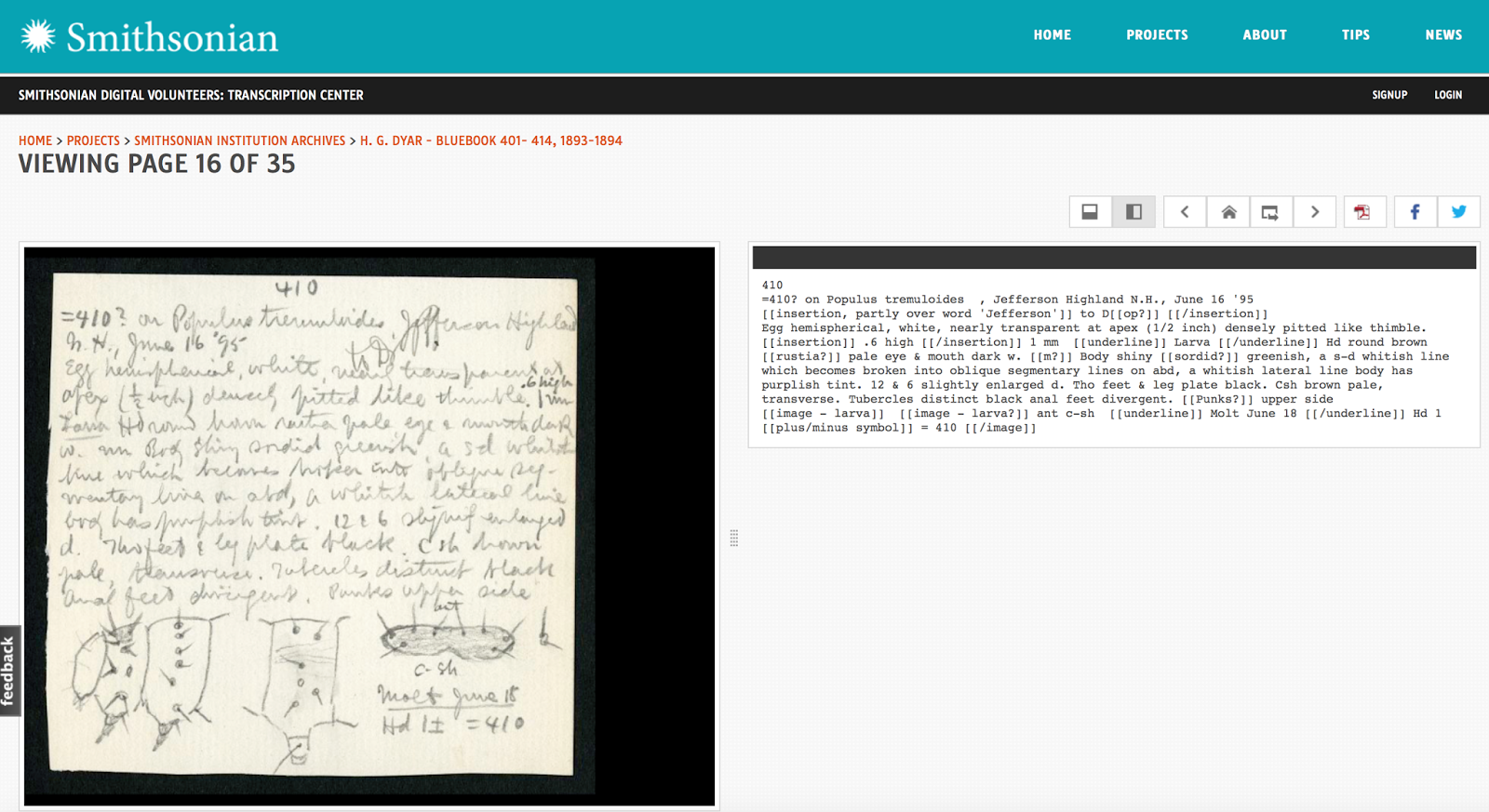
The volunteer transcriptions that Marc refers to were the result of the May 2016 #DigIntoDyar campaign, which challenged volunteers to help transcribe five of Dyar’s blue books within the Smithsonian Transcription Center. The five blue books constituted a total of 169 pages, 60% of which were fully transcribed by over 60 volunteers by the end of May. Today, all 169 pages have been fully transcribed (thank you, citizen science volunteers!). You can browse the transcriptions in the Smithsonian Transcription Center at the links below:

H. G. Dyar – Bluebook 401- 414, 1893-1894 | https://transcription.si.edu/project/8144
H. G. Dyar – Bluebook 415-435, 1893-1894 | https://transcription.si.edu/project/8145
H. G. Dyar – Bluebook 436-450, 1893-1894 | https://transcription.si.edu/project/8146
H. G. Dyar – Bluebook 451-473, 1894 | https://transcription.si.edu/project/8147
H. G. Dyar, Bluebook 474-491, 1894-1897 | https://transcription.si.edu/project/8148

View Full Size Image
A page from H. G. Dyar bluebook 401 – 414 (1893-94), transcribed in the Smithsonian Transcription Center.

Interested in learning more about Harrison Dyar’s work and contributions? Then check out this Google Hangout from Smithsonian Libraries with Dr. Epstein. You can also learn more in this series of blog posts that Dr. Epstein wrote for Smithsonian Libraries as part of #DigIntoDyar.

Harrison Dyar’s contributions to science may often be overshadowed by his intriguing personal life, but hopefully the efforts of Dr. Epstein and others will ensure that his entire legacy is appreciated and remembered. We’re proud to be able to provide free, online access to materials, like the “blue books” and “catalogue,” that make it easier for researchers to study Dyar’s work.

______________________________________

This post may contain the personal opinions of BHL users or affiliated staff and does not necessarily represent the official Biodiversity Heritage Library (BHL) position on these matters.

September 8, 2016by Grace Costantino
Blog Reel, Featured Books

Catesby’s Magnificent Natural History, In Three Editions

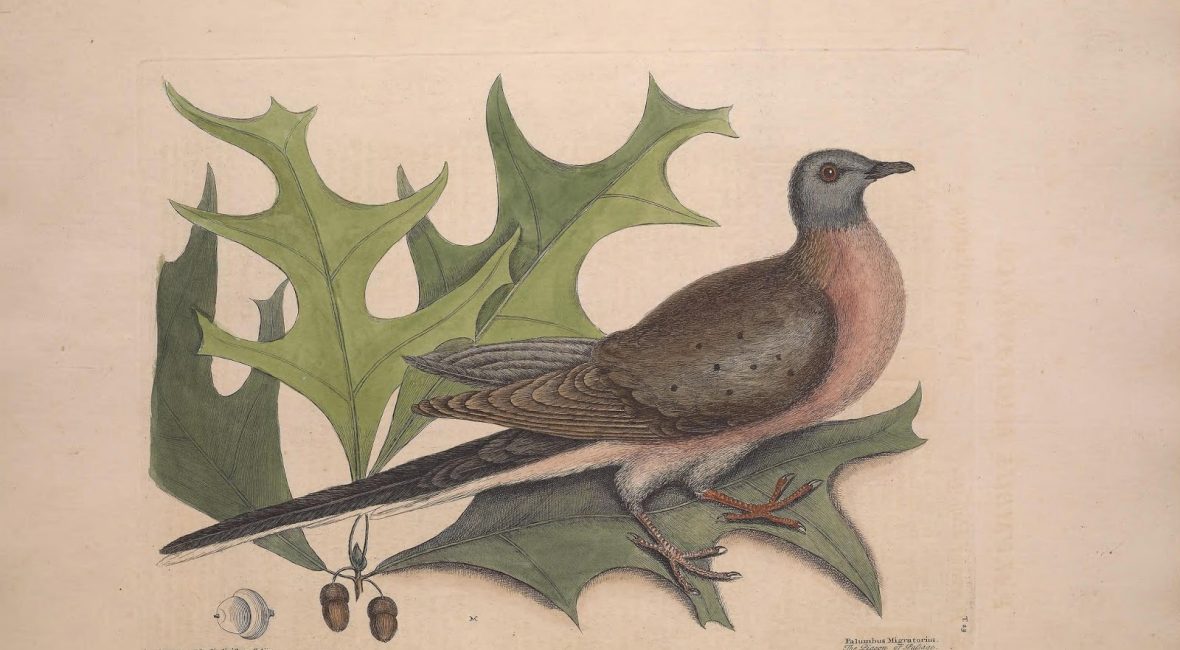
View Full Size Image
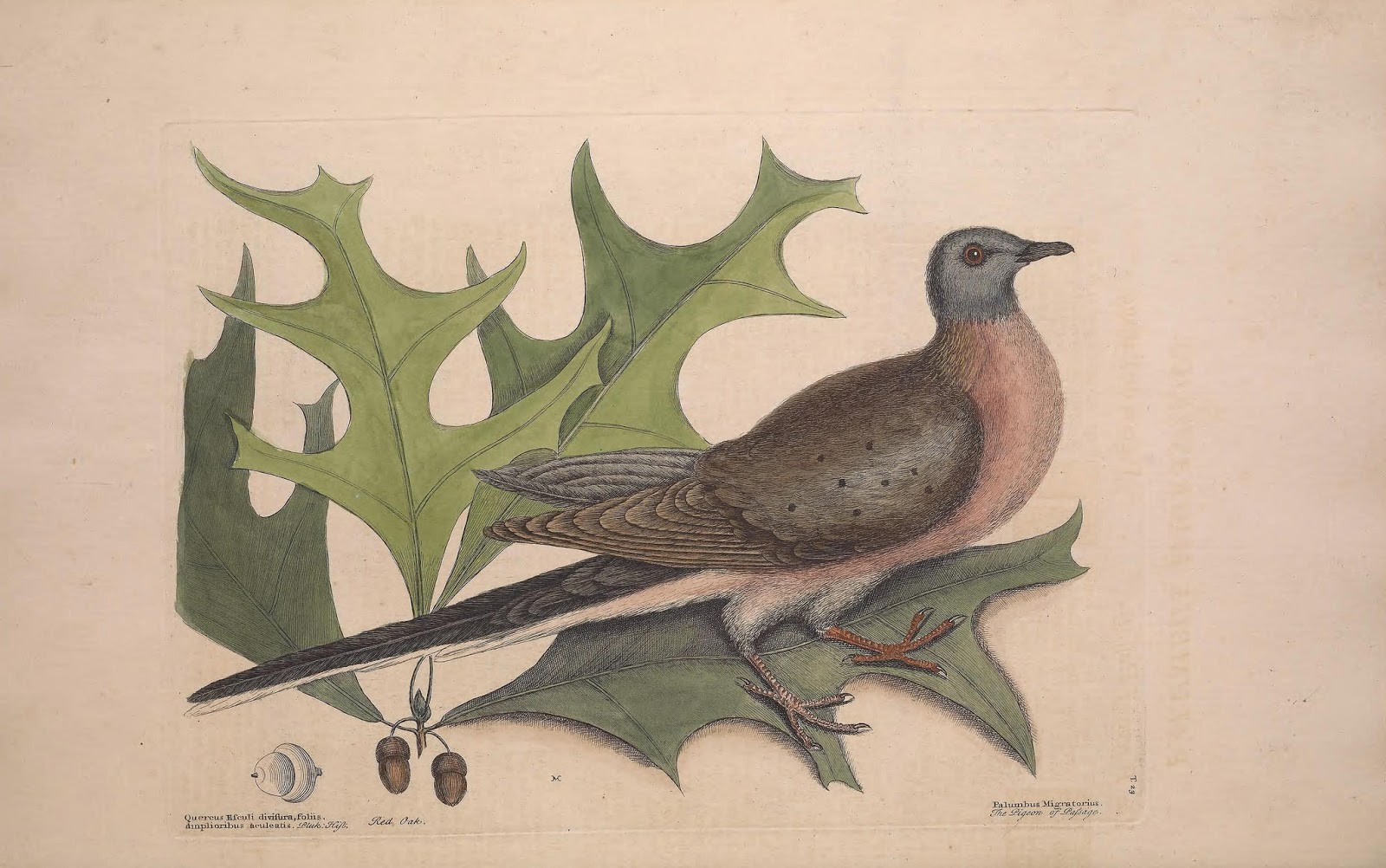
First published illustration of a passenger pigeon (Ectopistes migratorius). Pictured with American turkey oak (Quercus laevis). Catesby, Mark. The Natural History of Carolina, Florida, and the Bahama Islands. v. 1, ed. 1, pl. 23. Digitized by Smithsonian Libraries. http://biodiversitylibrary.org/page/40753186. Taxon tagged in Flickr by Michelle Marshall: https://www.flickr.com/photos/biodivlibrary/26918652441.

In May of 1729, the first part of the first fully illustrated book on the flora and fauna of North America was presented to the Royal Society. Upon the conclusion of the work, Royal Society Secretary Cromwell Mortimer praised it as “the most magnificent Work I know of, since the Art of Printing has been discovered” (Nelson and Elliott, 165).

The work was The Natural History of Carolina, Florida, and the Bahama Islands, and all told it was issued in eleven parts (including an appendix) over an eighteen year period (from 1729-1747). It included 220 plates and accompanying pages of text, a map and account of North America, two indices, a preface, a dedication, and a list of subscribers.

The author of the work was Mark Catesby.

An expansive account of Catesby’s life and work is captured in The Curious Mister Catesby, edited by E. Charles Nelson and David J. Elliott, which received the 2016 CBHL (The Council on Botanical and Horticultural Libraries) Annual Literature Award for Overall Significant Contribution to the Literature of Botany or Horticulture. This work allows us to appreciate the extent of Catesby’s contribution to the study of North American biodiversity.

Mark Catesby was born on 24 March 1682/83 in England (probably in Castle Hedingham, Essex), the (probably) fifth son of John Catesby, a gentleman who became mayor of Sudbury in 1673. When John died in 1703, Mark received a substantial inheritance that included property in Sudbury and London, providing him with a level of security that would allow him to pursue his interest in natural history (Nelson and Elliott, 3-4, hereafter referred to as “N&E;”).

View Full Size Image
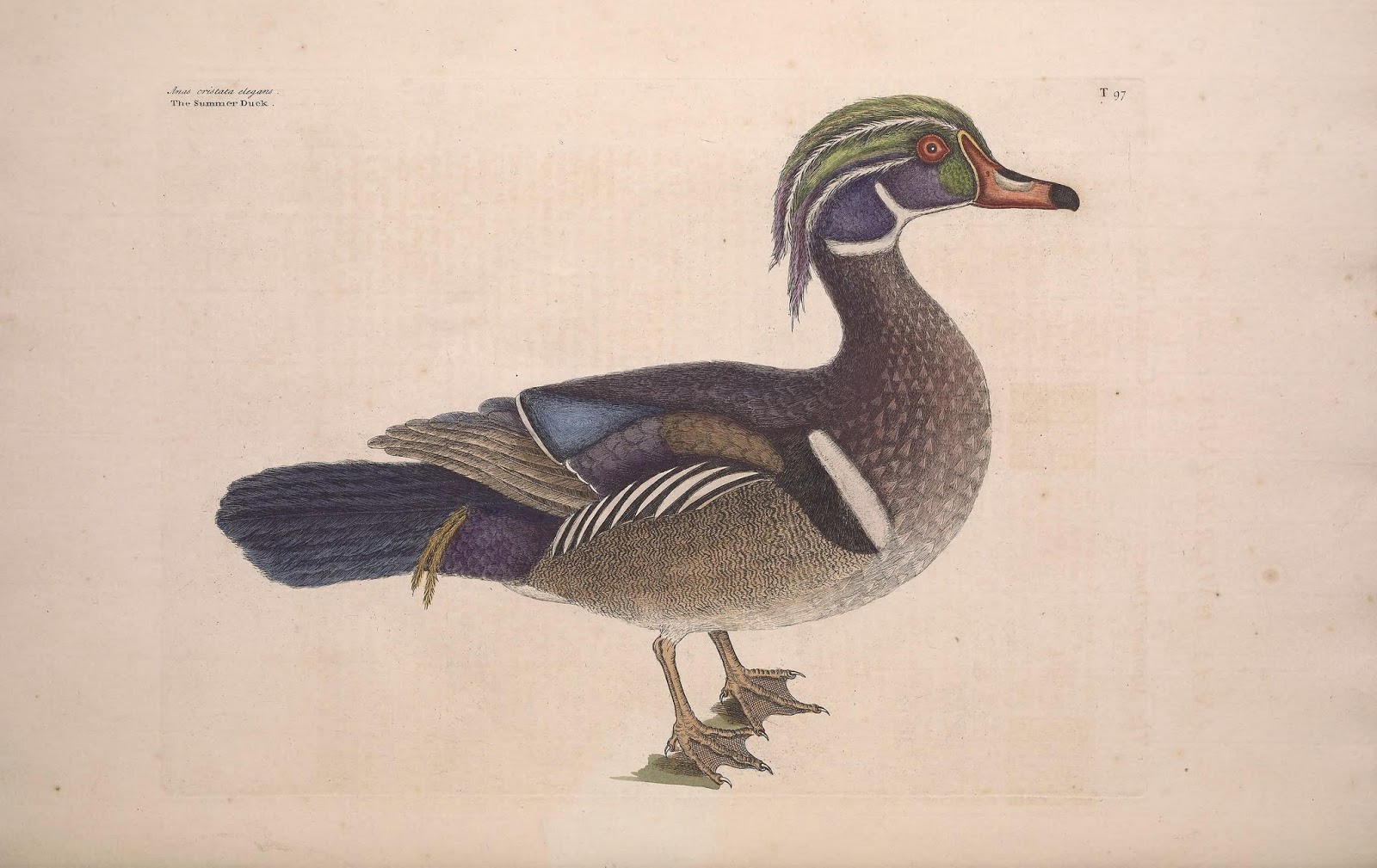
Wood duck (Aix sponsa). Catesby, Mark. The Natural History of Carolina, Florida, and the Bahama Islands. v. 1, ed. 1. pl. 97. Digitized by Smithsonian Libraries. http://biodiversitylibrary.org/page/40753408. Taxon tagged in Flickr by Michelle Marshall: https://www.flickr.com/photos/biodivlibrary/26987327575.

Catesby first set foot in North America in 1712. Serving as chaperone for his sister Elizabeth, whose husband Dr. William Cocke had arrived in Virginia some two years earlier, Catesby was hosted principally by prominent Virginian citizen William Byrd II during this first visit. Shortly after his arrival, Catesby began collecting plants, specimens of which he sent across the Atlantic to Samuel Dale and Dr. Henry Compton (Bishop of London). During these first several years in America, Catesby also visited Jamaica, Bermuda, Hispaniola, and Puerto Rico (N&E;, 8).

Catesby returned to England in 1719, possibly in response to his brother’s death two years earlier (N&E;, 9). He was, however, determined to return to North America and continue his study of the land’s rich flora and fauna. In 1722, he got his wish. This time, his trip was sponsored by members of the Royal Society, who hoped that he would collect specimens from and generally enhance natural history knowledge about this New World. From 1722-early 1725, Catesby explored and collected in South Carolina. The following year, from 1725-26, Catesby ventured to the Bahamas to continue his research (N&E;, 12-13).
View Full Size Image
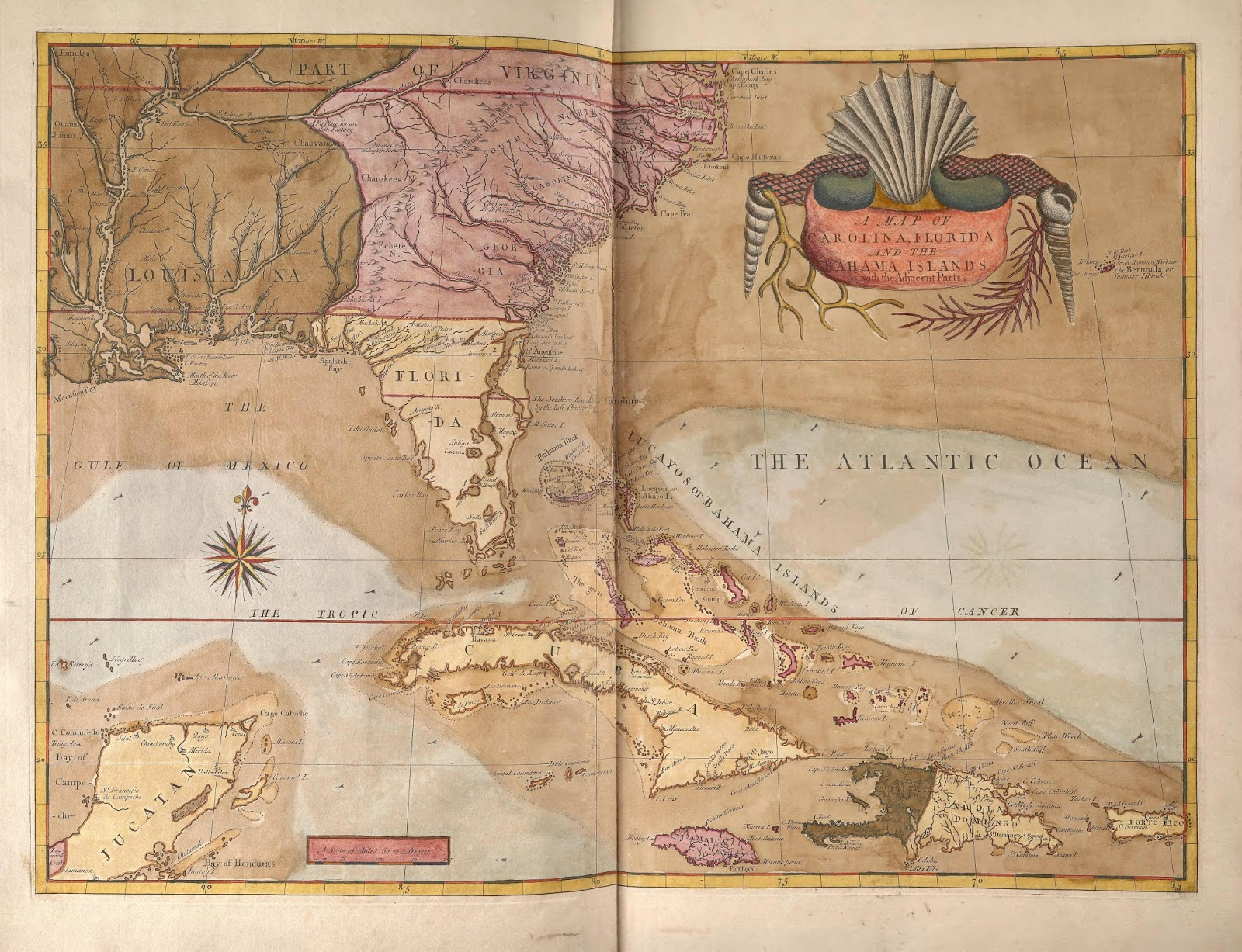
Catesby’s map of Carolina, Florida and the Bahama Islands with the Adjacent Parts.  Catesby, Mark. The Natural History of Carolina, Florida, and the Bahama Islands. v. 1, ed. 1. Digitized by Smithsonian Libraries. http://biodiversitylibrary.org/page/40753095.

During his time in America, Catesby not only collected specimens, many of which he sent back to England, but he also produced sketches and watercolors of the species he encountered. According to Henrietta McBurney, who wrote a chapter for The Curious Mister Catesby on Mark’s preparatory drawings for Natural History, the challenges of transporting the necessary art equipment into the field probably meant that Catesby made field drawings in pen and ink while traveling through the country and then worked up folio-sized watercolors, which would later be translated to etched plates for his publication, back at his lodgings (N&E;, 143). At all times, Catesby placed great emphasis on portraying each species in as life-like a manner as possible, working from live animals when possible and obtaining fresh supplies of specimens, like fish, whose color and appearance change rapidly after death (N&E;, 145).

View Full Size Image
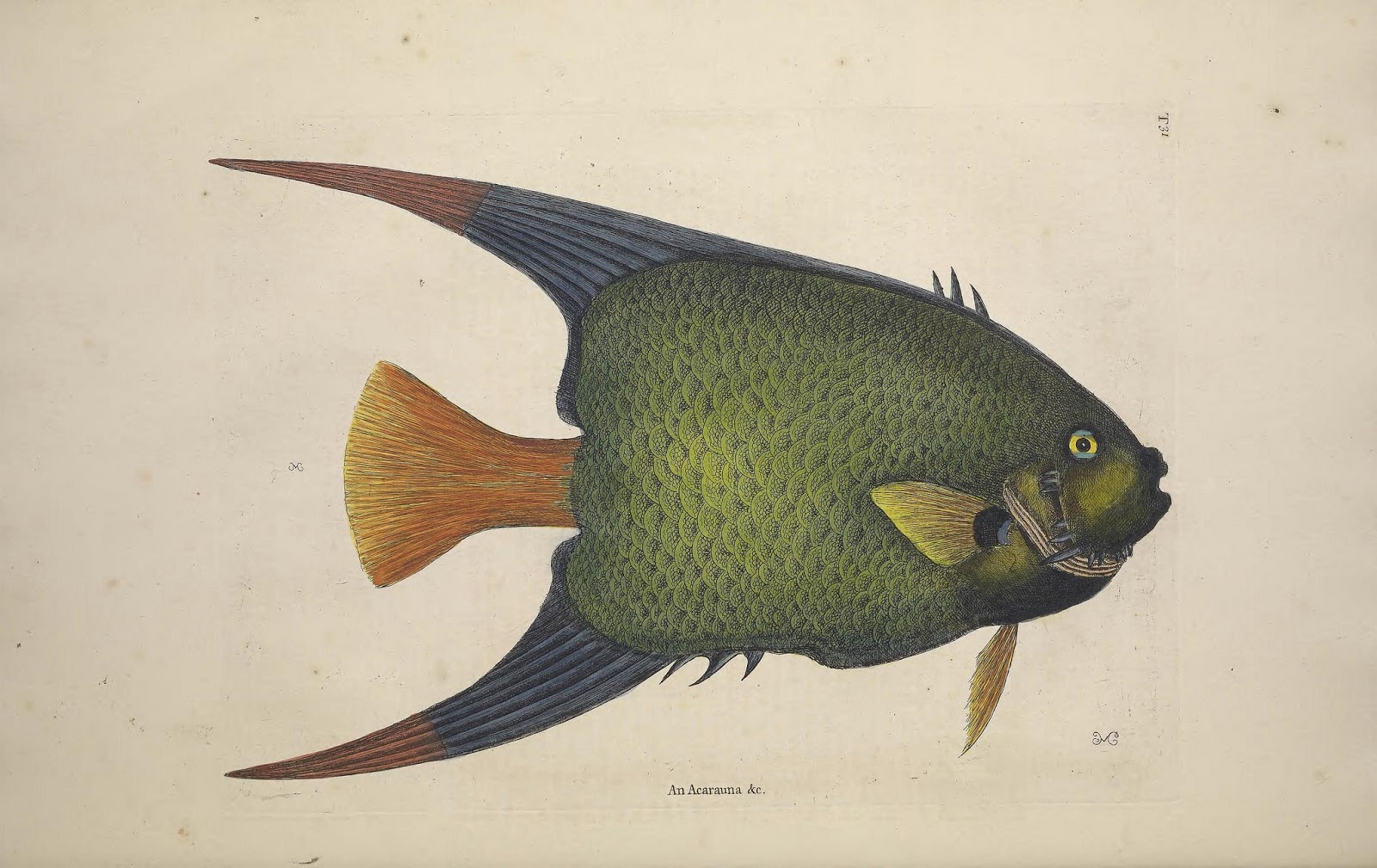
Queen angelfish (Holacanthus ciliaris). Catesby, Mark. The Natural History of Carolina, Florida, and the Bahama Islands. v. 2, ed. 1, pl. 31. Digitized by Smithsonian Libraries. http://biodiversitylibrary.org/page/40680191. Taxon tagged in Flickr by Michelle Marshall: https://www.flickr.com/photos/biodivlibrary/26364199924.

In 1726, Catesby left the Bahamas and returned to England with the intention of publishing his accounts and illustrations in “a large folio on a grand, almost unprecedented scale” (N&E;, 155). Leslie K. Overstreet, Curator of Natural History Rare Books at the Smithsonian Libraries, provides an extensive examination of Catesby’s publication within the twelfth chapter of The Curious Mister Catesby.

According to Ms. Overstreet, Catesby opted to print the work at his own expense. Fortunately, his friend Peter Collinson, a Quaker merchant and Fellow of the Royal Society, agreed to lend Catesby funds to support the publication. These funds were not sufficient to cover the cost of expert engravers, so Catesby hired professional artist Joseph Goupy to teach him how to etch so that Catesby could work up the plates for his publication himself (N&E;, 155).
View Full Size Image
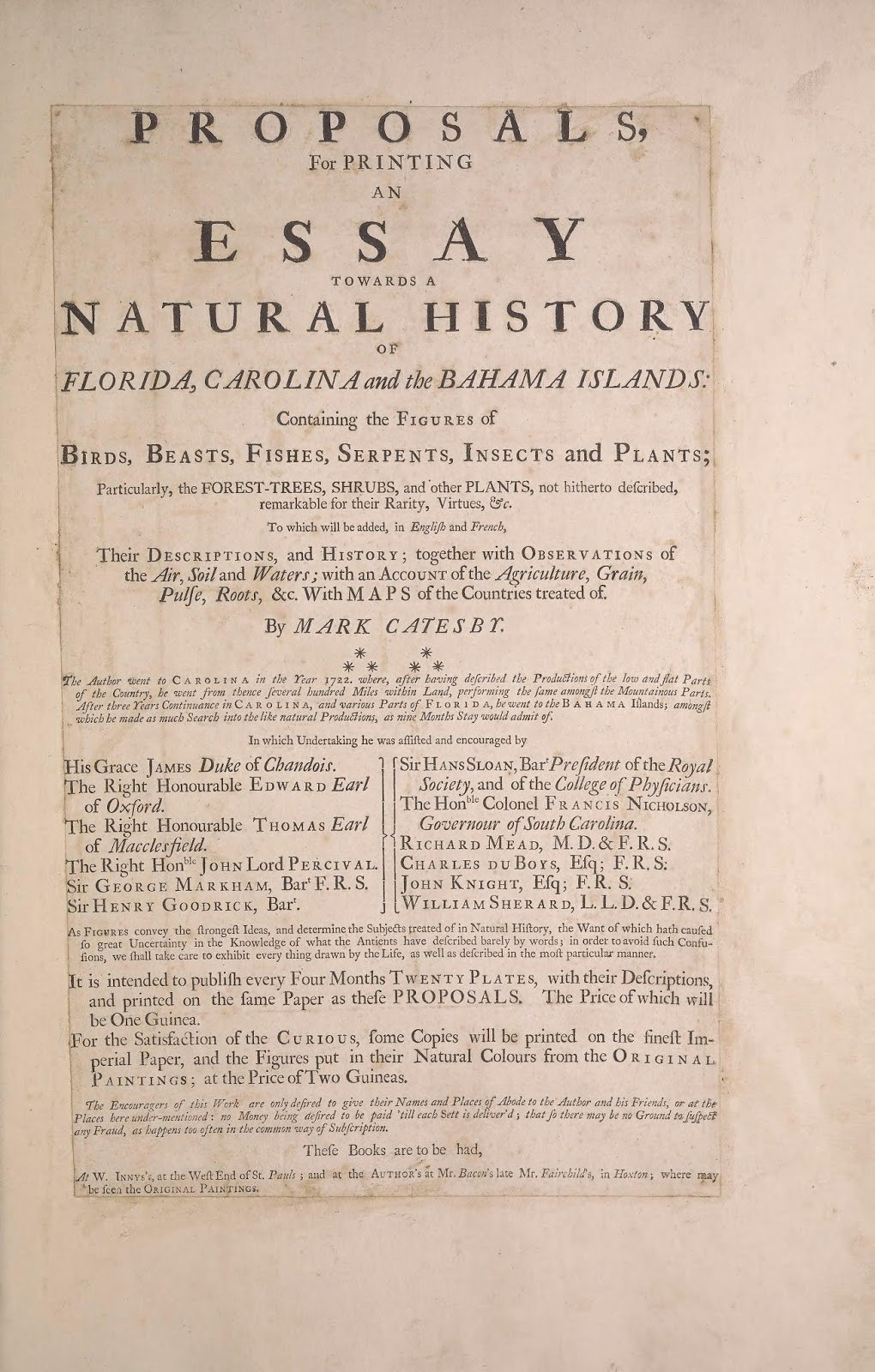
Proposal or prospectus soliciting subscribers for Natural History. Dating from late 1729. Catesby, Mark. The natural history of Carolina, Florida and the Bahama Islands. v. 1, ed. 1. Digitized by Smithsonian Libraries. http://biodiversitylibrary.org/page/40753109.

In order to ensure that enough copies of the work would be sold to justify the cost of its production, Catesby solicited subscribers for Natural History. He distributed a prospectus instructing people who wished to obtain a copy of the work to sign up as subscribers (N&E;, 156). The prospectus indicated that he intended to publish the book in parts of 20 plates and accompanying text issued every four months. Subscribers could elect to receive colored plates for two guineas a part or uncolored plates for one guinea per part (N&E;, 159). The prospectus also directed potential subscribers to view his original artwork, which would be featured in the publication, at Thomas Fairchild’s nursery in Hoxton (N&E;, 147).

All told, Catesby’s final version of the “List of the Encouragers” (a list of the work’s subscribers, which, as was customary at this time, are listed within the publication) includes 155 names (N&E;, 159).

Assured that the book would sell, Catesby set about producing the publication, which included not only etching the copper plates and writing the text, but also hand-coloring (maybe not all) the prints as well (N&E;, 158).  Catesby also enlisted a friend, who requested to remain unnamed, to translate the text into French. The final publication included a column of English text alongside a column of French text (N&E;, 13).

View Full Size Image
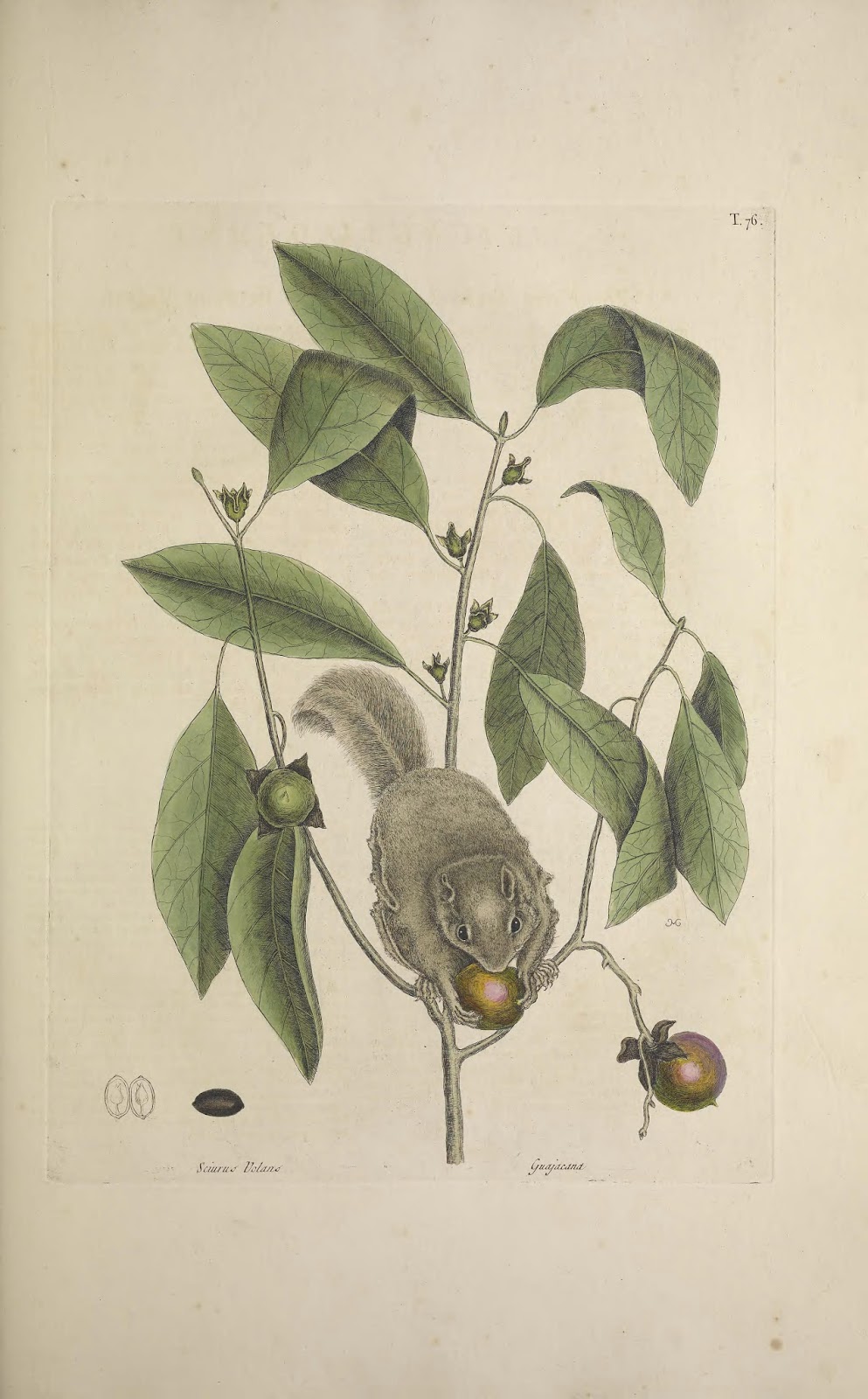
Southern flying squirrel (Glaucomys volans) and American persimmon (Diospyros virginiana). Catesby’s squirrel borrowed from drawing by Everhard Kick. Catesby, Mark. The Natural History of Carolina, Florida, and the Bahama Islands. v. 2, ed. 1. pl. 76. Digitized by Smithsonian Libraries. http://biodiversitylibrary.org/page/40680326. Taxon tagged in Flickr by Michelle Marshall: https://www.flickr.com/photos/biodivlibrary/26696533570.

For the plates, Catesby used his own watercolors and also borrowed and included illustrations from other artists. For example, Catesby’s depiction of the southern flying squirrel in plate 76 was borrowed from Dutch artist Everhard Kick (N&E;, 150-151). Artists Georg Dionysius Ehret and George Edwards also contributed drawings to the work (N&E;, 152-153).

View Full Size Image
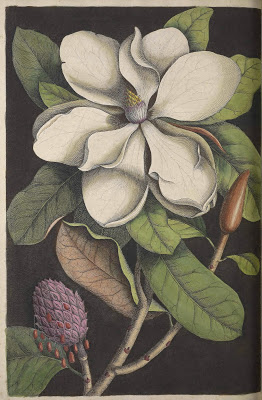
Southern magnolia (Magnolia grandiflora). Illustration etched for Catesby by Georg Dionysius Ehret after Ehret’s own watercolor painting. Catesby, Mark. The Natural History of Carolina, Florida, and the Bahama Islands. v. 2, ed. 1. pl. 61. Digitized by Smithsonian Libraries. http://biodiversitylibrary.org/page/40680281. Taxon tagged in Flickr by Michelle Marshall: https://www.flickr.com/photos/biodivlibrary/26901263141

Due to the amount of work required for the publication, Catesby was not able to adhere to his one part every four months plan. However, he continued to steadily produce new parts, which were sent to his subscribers. The first four parts of the work were issued in numerous typesettings, as Catesby was apparently cautious about ordering too many copies of each part (many subscribers signed up over the life of the publication, so Catesby was not working with a fixed number of “Encouragers”), which in turn required him to order additional copies of the early parts as new subscribers signed on. By the fifth part, however, we see only one typesetting, indicating that Catesby was confident enough in his sales that he ordered sufficient quantities to meet demand (N&E;, 160-163).

In 1743, the last part of volume 2 was presented to the Royal Society. Four years later, in 1747, the appendix, consisting of an additional twenty plates and text, was presented, bringing the first edition to completion (N&E;, 158). Approximately 180-200 copies were produced, only about 100 of which survive. There are only a few known perfect copies of this first edition, and of these, only the Smithsonian Libraries’ copy (which is freely available in BHL) contains “all three pieces of ephemera relating to the production of the work” (N&E;, 165).

View Full Size Image
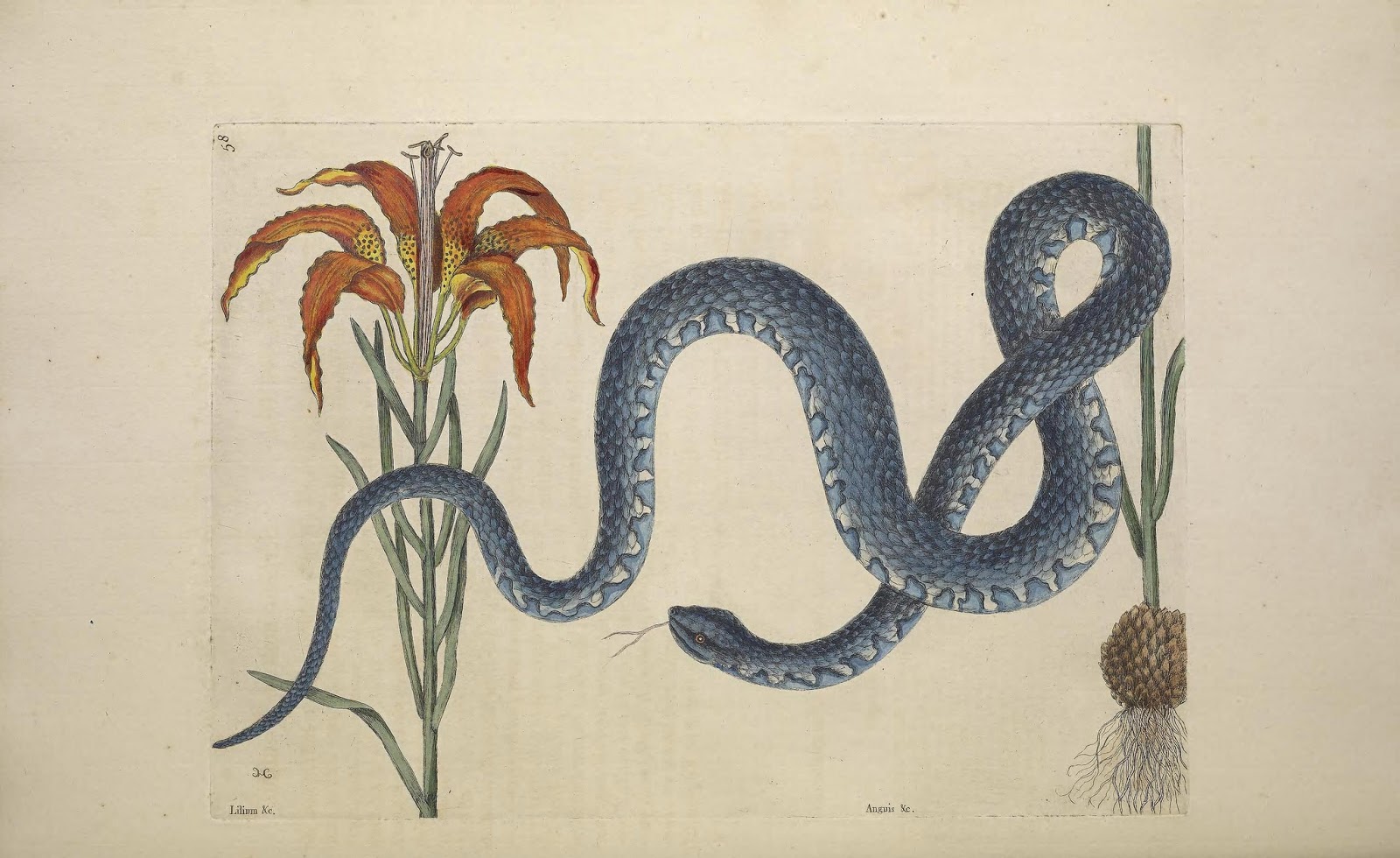
Eastern mudsnake (Farancia abacura) and pine lily (Lilium catesbaei). Catesby, Mark. The Natural History of Carolina, Florida, and the Bahama Islands. v. 2, ed. 1. pl. 58. Digitized by Smithsonian Libraries. http://biodiversitylibrary.org/page/40680272. Taxon tagged in Flickr by Michelle Marshall: https://www.flickr.com/photos/biodivlibrary/26875557812.

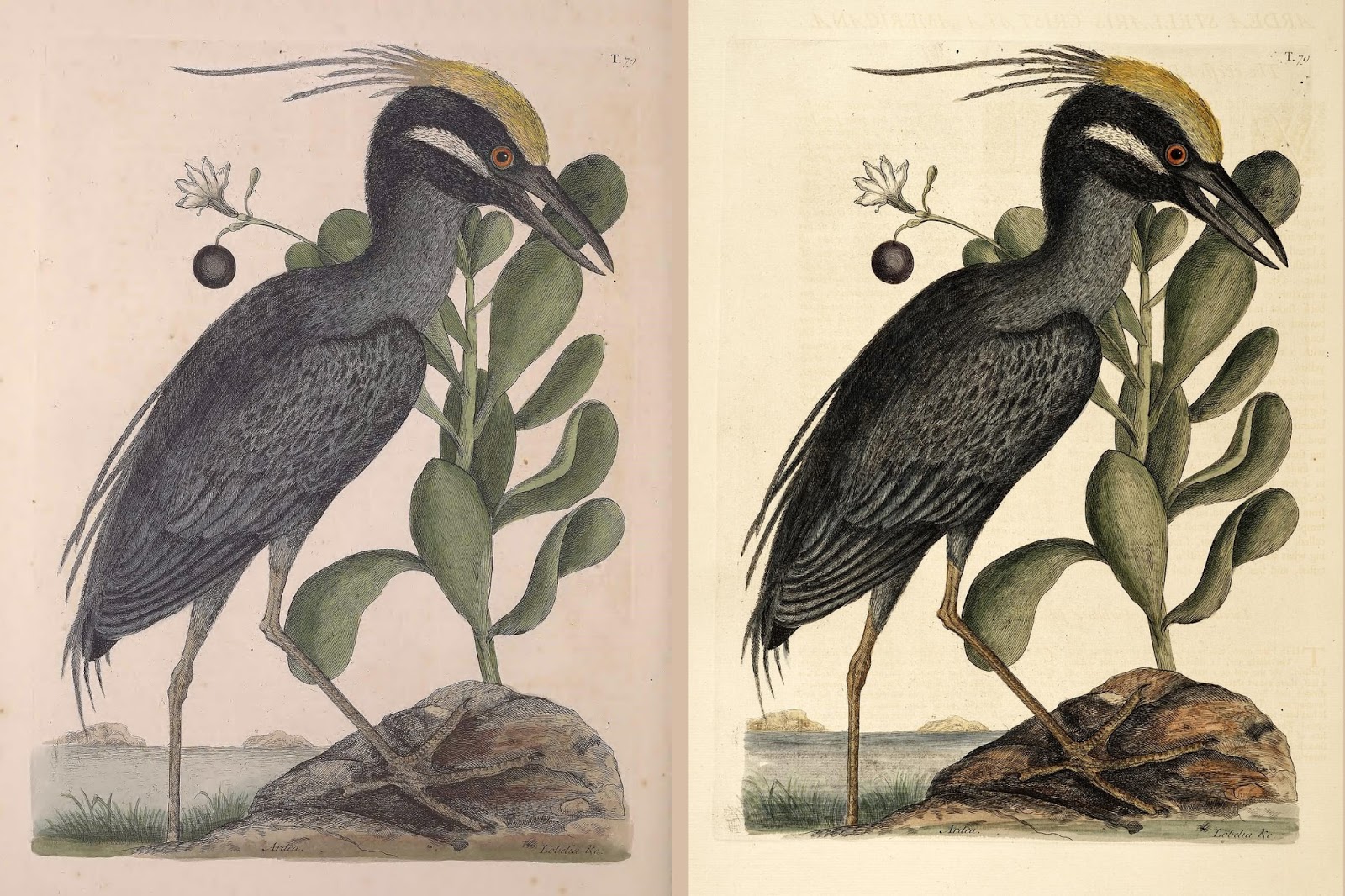
A second edition of Natural History was produced by George Edwards in 1754, five years after Catesby’s death in 1749. This edition is identical to the first, and many copies even include leftover printed sheets from the first edition. The plates for the 2nd edition were produced using Catesby’s original copper plates, but the coloring tends to be brighter than those completed by Catesby himself (N&E;, 166-168). The 2nd edition is freely available in BHL thanks to the Missouri Botanical Garden.

View Full Size Image
Yellow-crowned night heron (Nyctanassa violacea) and gullfeed (Scaevola plumieri). Comparing plate from edition 1 (left) with plate from edition 2 (right). Left: v. 1, ed. 1, pl. 79. Digitized by Smithsonian Libraries. http://biodiversitylibrary.org/page/40753354. Taxon tagged in Flickr by Michelle Marshall: https://www.flickr.com/photos/biodivlibrary/26713640390. Right: v. 1, ed. 2, pl. 79. Digitized by Missouri Botanical Garden. http://biodiversitylibrary.org/page/10900266. Taxon tagged in Flickr by Michelle Marshall: https://www.flickr.com/photos/biodivlibrary/7874637134.

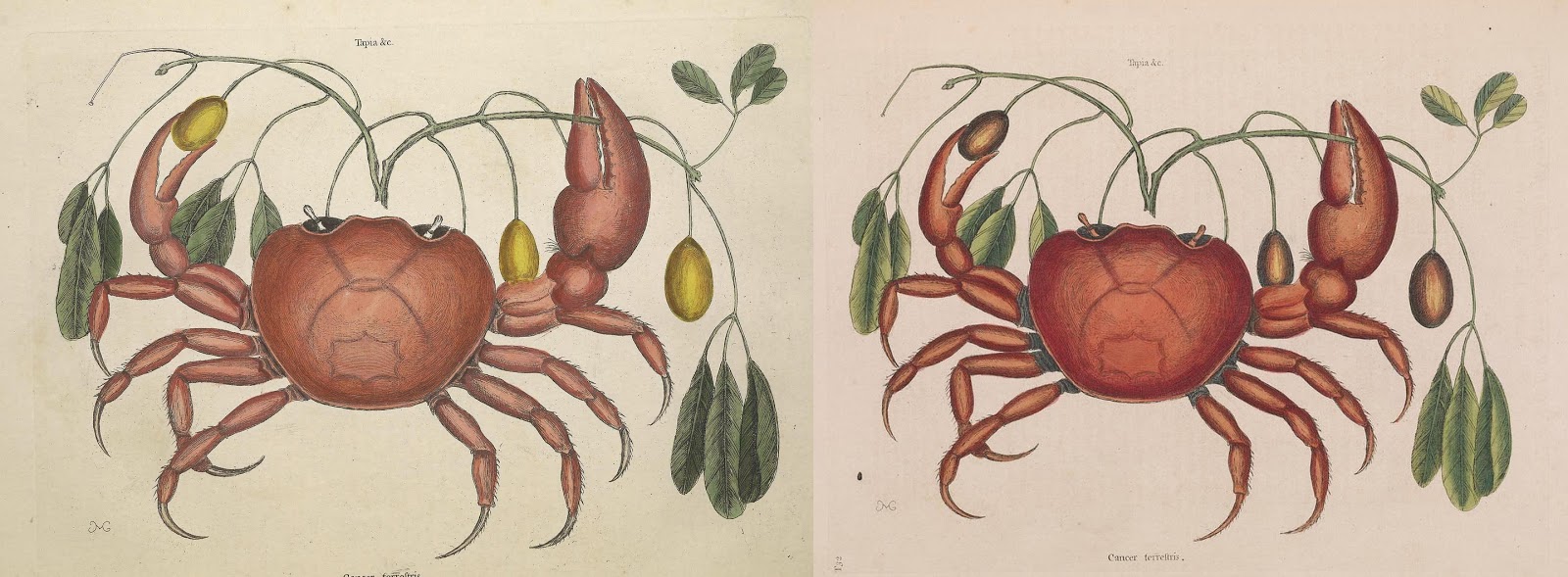
A 3rd edition was published in 1771 by bookseller Benjamin White. This edition is made up of completely reset text and the Linnaean binomials have been added where available. While the edition did use Catesby’s original copper plates, the plates from the 3rd edition are significantly more brightly colored than those of the first edition (N&E;, 168-169). The 3rd edition is freely available in BHL thanks to the University Library at the University of North Carolina, Chapel Hill.

View Full Size Image
Purple land crab (Gecarcinus ruricola) and blackwood (Picrodendron baccatum). Comparing plate from edition 1 (left) with plate from edition 3 (right). Left: v. 2, ed. 1, pl. 32. Digitized by Smithsonian Libraries. http://biodiversitylibrary.org/page/40680194. Taxon tagged in Flickr by Michelle Marshall: https://www.flickr.com/photos/biodivlibrary/26936128596. Right: v. 2, ed. 3, pl. 32. Digitized by University Library, University of North Carolina at Chapel Hill. http://biodiversitylibrary.org/page/38993454. Taxon tagged in Flickr by Michelle Marshall: https://www.flickr.com/photos/biodivlibrary/6829772164.


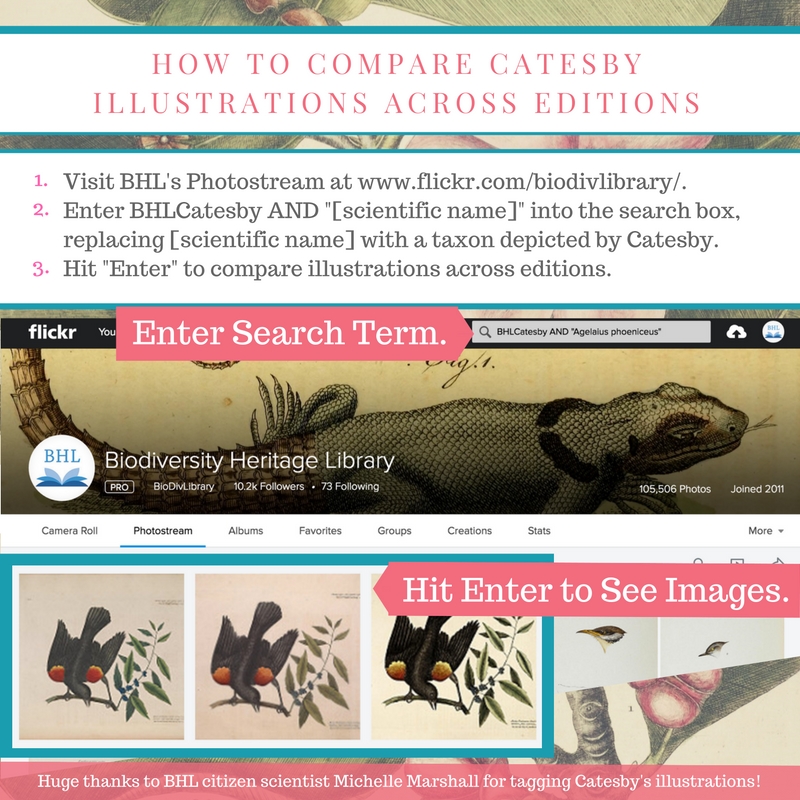
All of the plates from all three editions are available in the BHL Flickr. Thanks to BHL citizen scientist Michelle Marshall (also the curator of BHL’s Instagram), all plates from all editions have been tagged with the common, given and currently accepted scientific names for each species. The Curious Mister Catesby, which includes a species list by James L. Reveal in the book’s appendix (N&E;, 331-341), was used to verify the current accepted name for each species. This not only allows you to search Catesby’s illustrations by taxonomic name, but it also allows us to compare the differences in the illustrations across editions. To compare illustrations across editions, search BHL’s Flickr photostream by BHLCatesby AND “[scientific name]”, inserting the scientific name of a species depicted by Catesby in the brackets where indicated.
View Full Size Image

Catesby’s work, and particularly his illustrations, are significant for a variety of reasons. As the first fully illustrated book on the flora and fauna of North America, this book was the first introduction for many Europeans to much of the biodiversity of the New World. Beyond this, Catesby’s work was a significant resource for Carl Linnaeus, whose binomial system for naming plants (which he introduced in print with his Species Plantarum in 1753) and animals (applied in his Systema Naturae, 1758) is still used today (N&E;, 189).

View Full Size Image
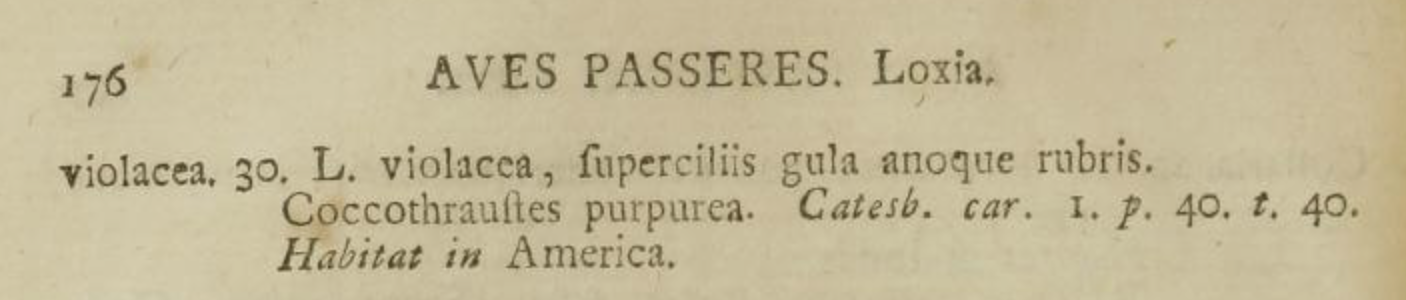
Species description for Greater Antillean bullfinch (Loxigilla violacea, previously Loxia violacea) in Systema Naturae, v. 1 (1758). Catesby is the only reference that Linnaeus cites for this species name. Digitized by the Missouri Botanical Garden. http://biodiversitylibrary.org/page/727083.

Linnaeus cited Catesby extensively in Species Plantarum and Systema Naturae, showing that Natural History enhanced Linnaeus’ understanding of many species. 131 of the 187 plants depicted by Catesby were cited by Linnaeus in Species Plantarum (N&E;, 201). Additionally, Linnaeus referenced Catesby 139 times in Systema Naturae (N&E;, 254-255). For some of these references, Catesby was the sole source of information for Linnaeus on a given species, and Catesby’s illustrations serve as the type for several of Linnaeus’ species names. In Species Plantarum, for example, 17 of Linnaeus’ species entries cite only Catesby, while Catesby’s plates serve as the type for 34 of the species in that work (N&E;, 201). For 52 of the species entries in Systema Naturae, Catesby was Linnaeus’ only reference (N&E;, 255).

View Full Size Image
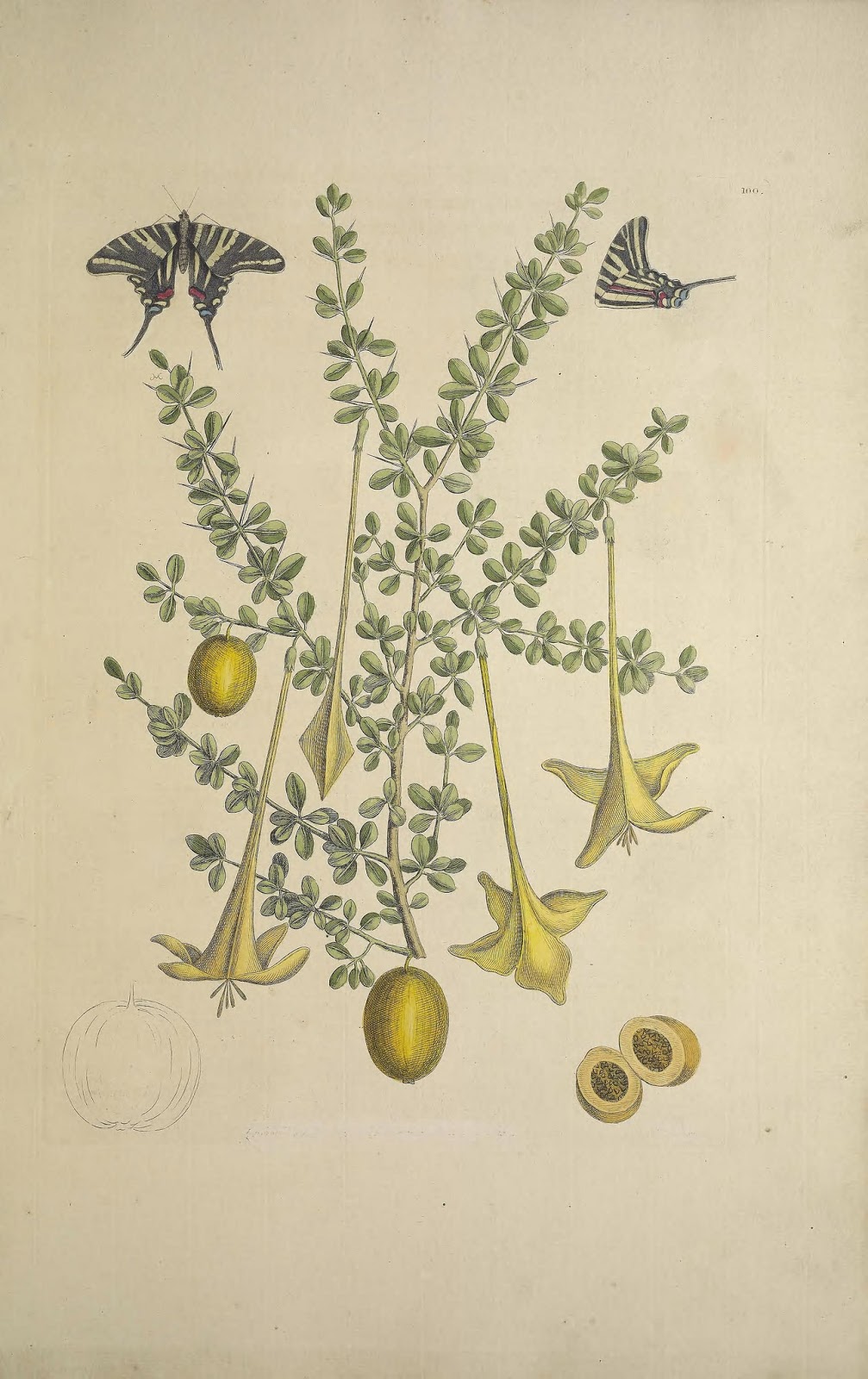
Lily thorn (Catesbaea spinosa). Pictured with zebra swallowtail (Protographium marcellus). Catesby is the only source that Linnaeus cited when naming Catesbaea spinosa in Species Plantarum (1753). This engraving serves as the type for this name. Catesby, Mark. The Natural History of Carolina, Florida, and the Bahama Islands. v. 2, ed. 1. pl. 100. Digitized by Smithsonian Libraries.  http://biodiversitylibrary.org/page/40680398. Taxon tagged in Flickr by Michelle Marshall: https://www.flickr.com/photos/biodivlibrary/26936345516.

The Natural History of Carolina, Florida, and the Bahama Islands represents a milestone in the cultivation of natural history knowledge. We are indebted to this “ingenious” naturalist Mark Catesby who dedicated his life to capturing and describing the biodiverse wonders of the New World. What a wondrously beautiful and curious world we live in.

REFERENCE 
Nelson, E C, and David J. Elliott. The Curious Mister Catesby: A “truly Ingenious” Naturalist Explores New Worlds., 2015. Print.

September 1, 2016by Grace Costantino
Page 21 of 71« First...10«20212223»304050...Last »

Help Support BHL

BHL's existence depends on the financial support of its patrons. Help us keep this free resource alive!

search

About BHL

The Biodiversity Heritage Library (BHL) is the world’s largest open access digital library for biodiversity literature and archives. BHL operates as a worldwide consortium of natural history, botanical, research, and national libraries working together to digitize the natural history literature held in their collections and make it freely available for open access as part of a global “biodiversity community.”

Join Our Mailing List

Sign up to receive the latest news, content highlights, and promotions.

Subscribe Now

Subscribe to Blog via Email

Enter your email address to subscribe to this blog and receive notifications of new posts by email.

Join 319 other subscribers

Subscribe to Blog Via RSS

Subscribe to the blog RSS feed to stay up-to-date on all the latest BHL posts.

Access RSS Feed

Inspiring Discovery through Free Access to Biodiversity Knowledge.

The Biodiversity Heritage Library makes it easier than ever for you to access the information you need to study and explore life on Earth…for free, anytime, anywhere.


64+ Million Pages of
Biodiversity Literature Online.

EXPLORE

Tools and Services
to Transform Research.

EXPLORE

300,000+
Illustrations on Flickr.

EXPLORE

ABOUT | HARMFUL CONTENT | PRIVACY | SITE MAP | TERMS OF USE