Biodiversity Heritage Library - Program news and collection highlights from BHL
  • Home
  • News
  • Featured Books
    • All Featured Books
    • Book of the Month Series
    • BHL at 20
  • User Stories
  • Campaigns
    • Fossil Stories
    • Garden Stories
    • Monsters Are Real
    • Page Frights
    • Her Natural History
    • Earth Optimism 2020
  • Tech Blog
  • Visit BHL
Home
News
Featured Books
    All Featured Books
    Book of the Month Series
    BHL at 20
User Stories
Campaigns
    Fossil Stories
    Garden Stories
    Monsters Are Real
    Page Frights
    Her Natural History
    Earth Optimism 2020
Tech Blog
Visit BHL
  • Home
  • News
  • Featured Books
    • All Featured Books
    • Book of the Month Series
    • BHL at 20
  • User Stories
  • Campaigns
    • Fossil Stories
    • Garden Stories
    • Monsters Are Real
    • Page Frights
    • Her Natural History
    • Earth Optimism 2020
  • Tech Blog
  • Visit BHL
Biodiversity Heritage Library - Program news and collection highlights from BHL
BHL News, Blog Reel

An International Outlook: Celebrating BHL-Europe

View Full Size Image

On April 30, 2012, the BHL-Europe project officially came to an end. Through the development of a multi-lingual portal and associated tools, BHL-Europe strives to make European biodiversity knowledge available to everyone. To celebrate the project, BHL-E hosted a variety of workshops and meetings June 4-8, 2012, in Berlin, Germany. The events included a Symposium on Communicating Biological Diversity (June 4), a BHL-Europe Demonstration and Training Workshop (June 5), a closed official review with European Commission representatives (BHL-Europe is an Eu-funded project), and a 2-day BHL-Global meeting (June 7-8). Representatives from around the globe, including twelve members of the BHL-US/UK project, attended the events.
View Full Size Image
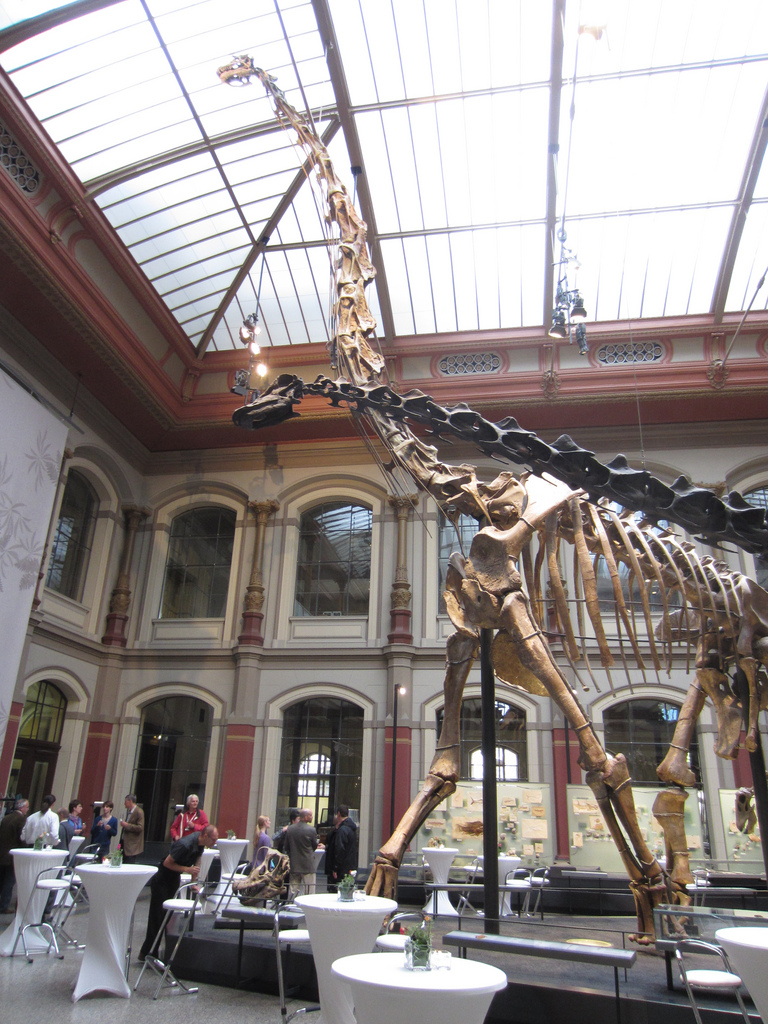
BHL-Europe Celebratory Dinner, Dinosaur Hall, 
Museum für Naturkunde

The Communicating Biological Diversity event was a joint symposium with GTI and NeFo celebrating the 20 year anniversary of the Convention on Biological Diversity (CBD). One of the driving forces behind the BHL-Europe project, the CBD is “an international treaty to sustain the rich diversity of life on earth.” Held at the Jerusalem Church in Berlin, the symposium aimed to inspire discussions among interested stakeholders regarding the current biodiversity and taxonomic knowledge environment and biological diversity education. Topics included identification and monitoring of biological diversity, biodiversity research and training, and exchanging biodiversity information. Following the symposium, BHL-Europe hosted a celebratory dinner at the Museum für Naturkunde. Held within the museum’s dinosaur hall, attendees enjoyed cocktails and an elegant dinner spread within the shadows of the hall’s colossal residents.
View Full Size Image
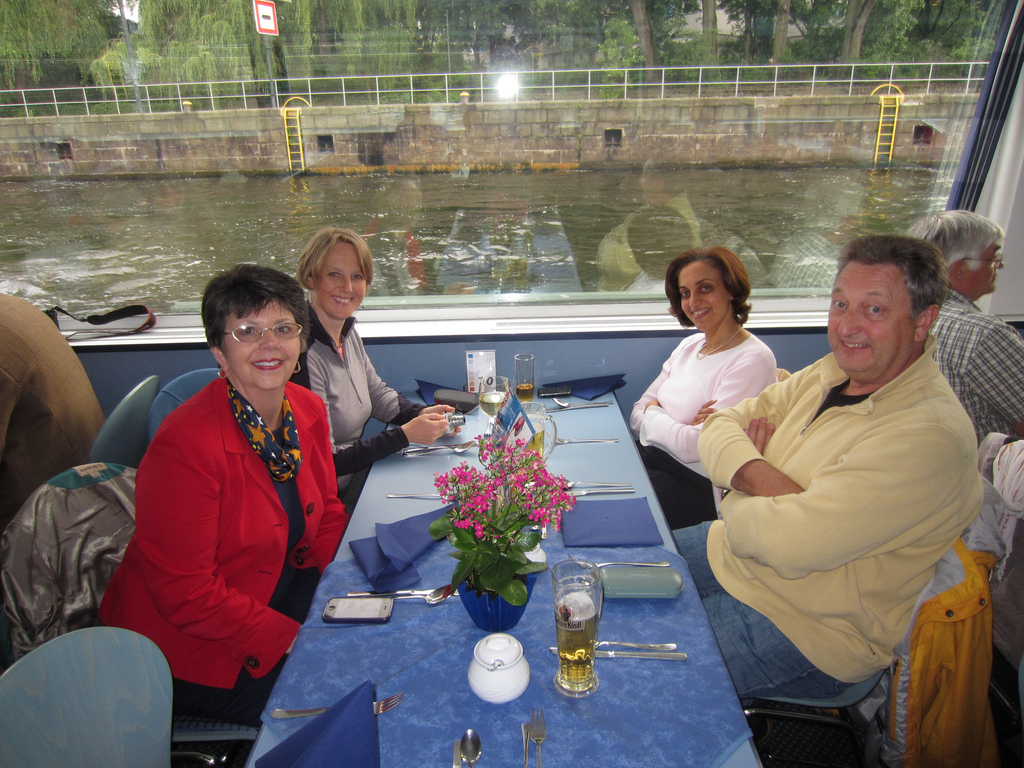
Dinner Cruise. Left Front: Nancy Gwinn; Left Back: Ely Wallis;
Right Front: Graham Higley; Right Back: Noha Adly

On June 5, BHL-Europe members presented a demonstration, also held at the Jerusalem Church, of the BHL-Europe’s accomplishments and features and provided training for content contributors. The BHL-Europe portal, soon-to-be officially launched, provides multi-lingual access to content scanned by European and global BHL partners. Incorporating many of the features present in the BHL-US/UK portal, BHL-E will also support common name searching, search within text, faceted searching, and alternative search term recommendations. As most of the content scanned by European partners is already available within Europeana, BHL-Europe has developed an ingest tool which allows contributors to upload their existing content directly to the BHL-E portal. Staff also demonstrated the Global Reference Index to Biodiversity (GRIB), which will serve as a biodiversity-literature focused European library (and eventually global BHL partners) union catalog and workflow management tool, and additional applications like the Biodiversity Library Exhibitions website, a virtual exhibition platform providing themed tours within natural history literature (presenting content via collections like Spices and Expeditions). After the workshop, attendees savored Berlin’s charm via a dinner cruise along the Spree canal.
View Full Size Image
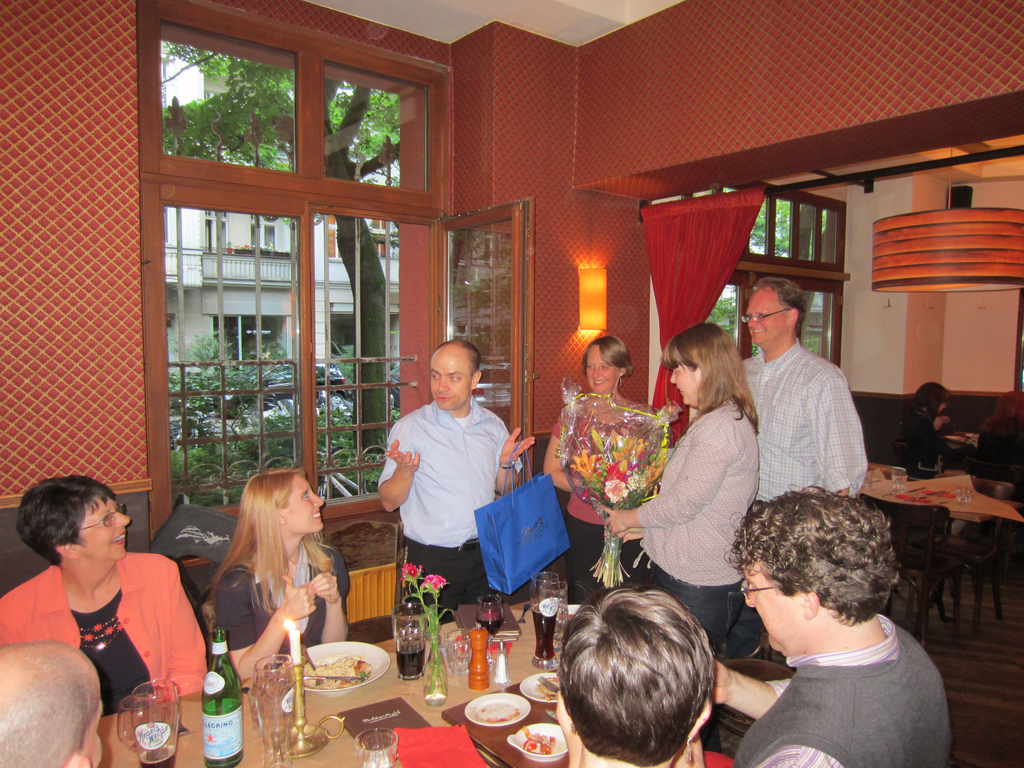
June 8, Tapas Dinner. Presenting gifts to Henning Scholz
(BHL-Europe node leader; meeting organizer) and
Annemarie Scholz (BHL-Europe Program Assistant)

Following the June 6 European Commission’s closed final review of the BHL-E project, the Museum für Naturkunde hosted the third BHL-Global Meeting. Representatives from nearly all BHL-Global (gBHL) nodes participated, including Europe, the US, Australia, Brazil, and Egypt. Partners provided project updates and engaged in crucial discussions regarding project sustainability, content synchronization and replication, communication and outreach collaboration, and workflow, scanning, and licensing cooperation. Stay tuned for an upcoming gBHL post for further details. And, since no BHL meeting would be complete without food, attendees finished each day with dinner at a beer garden (June 7) and sampled a variety of German cuisine, tapas-style (June 8).
View Full Size Image
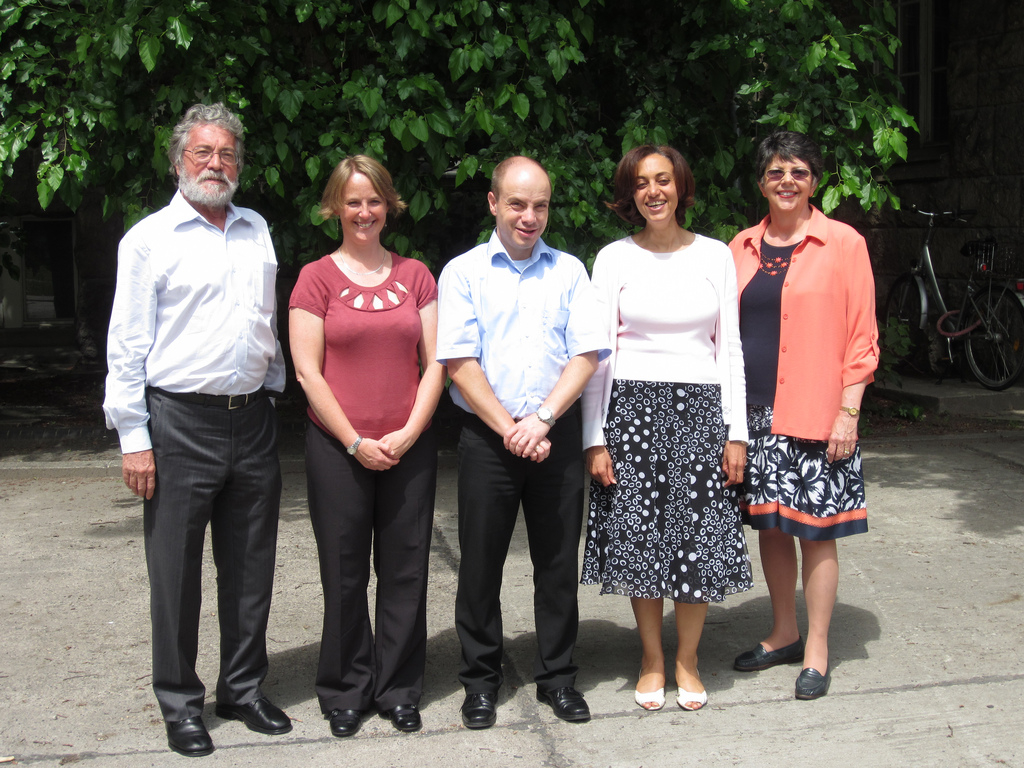
gBHL Node Leaders: From Left: Abel Packer (BHL-Brazil);
Ely Wallis (BHL-Australia); Henning Scholz (BHL-Europe);
Noha Adly (BHL-Egypt); Nancy Gwinn (BHL-US/UK)

Though the initial round of Eu funding for BHL-Europe has ended, staff intend to continue the project and explore additional funding opportunities. As we celebrate the accomplishments of our global partners, we look towards future collaborative opportunities, particularly in Africa. Several of the BHL-Europe meeting participants have traveled on to Cape Town, South Africa, where, in collaboration with SANBI (South African National Biodiversity Institute), staff will host a BHL-Africa meeting aimed at developing a portal for sub-Saharan Africa. Stay tuned for upcoming posts for more information about these meetings. We believe it is critical to liberate biodiversity knowledge in all parts of the world for the global community. One BHL project at a time, we’re working towards achieving that goal.


June 11, 2012by Grace Costantino
Blog Reel

My Life as a BHL Staffer: Michelle Abeln

View Full Size Image

Hello from St. Louis. My name is Michelle Abeln, and I’m a metadata librarian at the Missouri Botanical Garden Library. I’ve been working as our BHL “liaison” for almost five years. My main focus is to make sure that our in-house scanning efforts correlate with the bigger BHL mission.

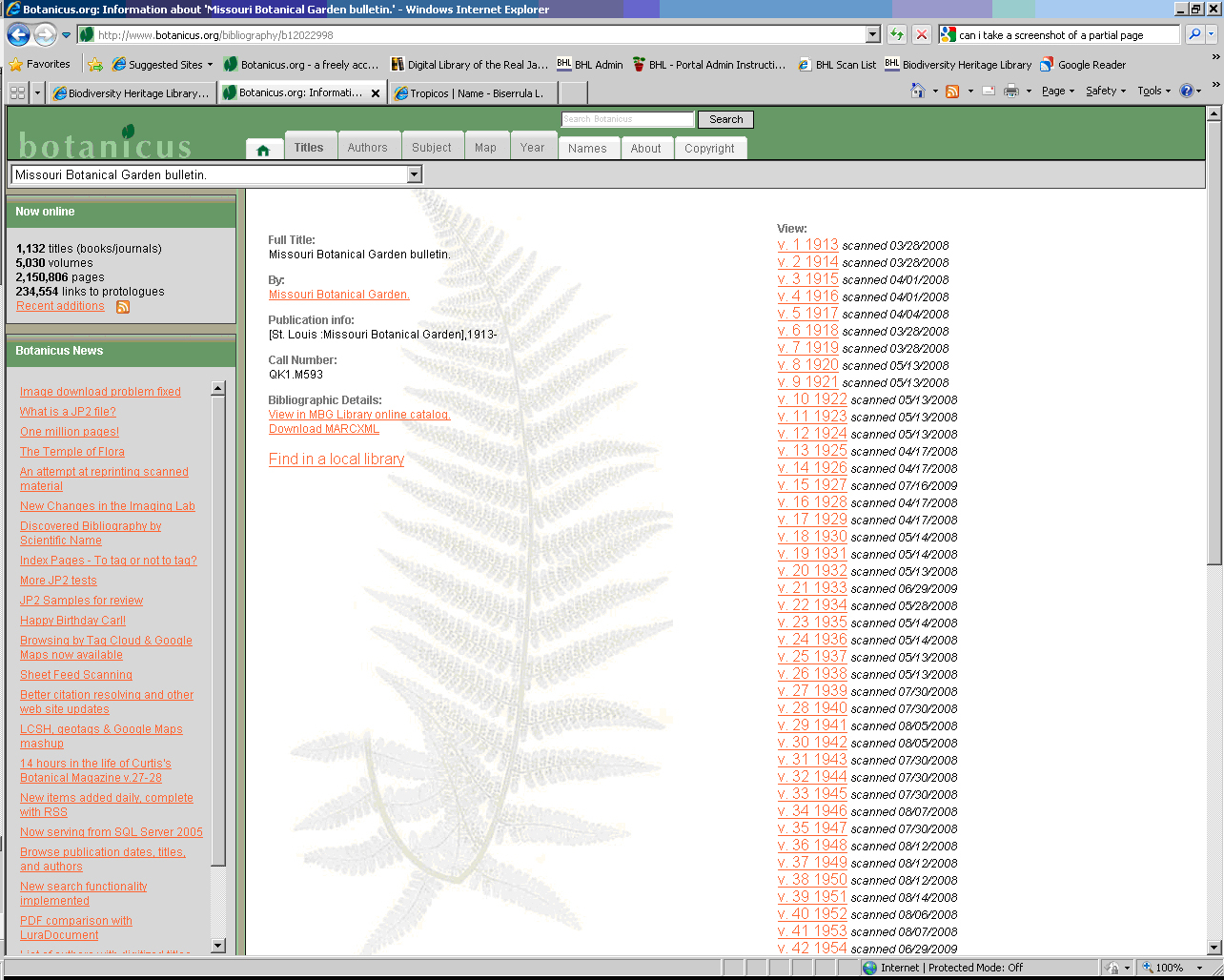
BOTANICUS
The Missouri Botanical Garden has been a leader in the digitization of scientific literature since 1995, initially focusing on illustrated volumes from the Library’s rare book collection. Working with the Garden’s Bioinformatics department, and its leader Chris Freeland, the Botanicus website was developed early on as a freely accessible web-based encyclopedia for botanical literature. While Botanicus was initially developed to house only the Garden’s holdings, the technologies and ideals behind it eventually led to the development of the BHL portal. Even though BHL is the ultimate repository for our digitized holdings, Botanicus is still very much a part of our workflow. Everything we scan goes through Botanicus first before it turns up in BHL or the Internet Archive.

View Full Size Image
Botanicus Display
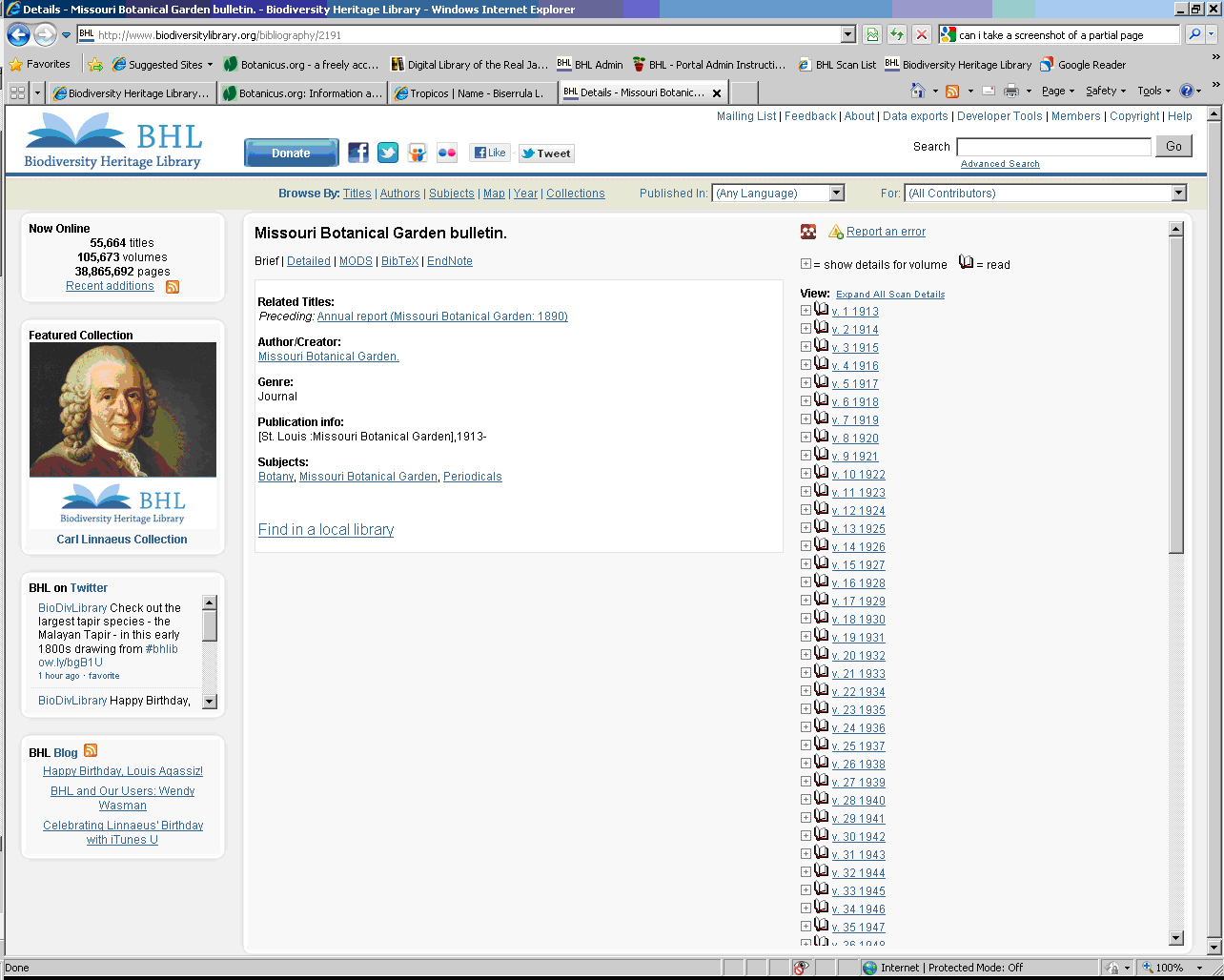
View Full Size Image
BHL Display – See the Similarities?

We’re lucky here in Missouri to have our own staff of scanners in-house, which means our workflow is quite different from other BHL institutions. We don’t need to send carts of books off site; instead we’re able to take them just down the hall. While this means that our scanning volume might be lower than other institutions, having our scanning staff on site does mean we’re able to deal with quality control issues, such as missing pages and display problems, faster. We also have things a bit easier in terms of pagination. Both Gilbert and JJ discussed the trials and tribulations (and importance!) of paginating in their blogs. At MoBot, our scanners paginate each item before it goes online. We also have the ability to scan extremely rare folios and oversized books on our “Leaf” scanner, an instant capture camera used for archival material and larger fold-outs (such as maps and plates).

Most of what we scan is monographs and journals assigned by BHL coordinators, and are received from BHL users via the online feedback form. Most are “gap-fills,” to complete serial runs, and post-copyright journal titles. We try to balance fulfilling BHL requests while still making sure that the needs of the Garden’s own research staff are met. The library shares scanning staff with the Garden’s Herbarium, so I work closely with our imaging lab coordinator, Mike Blomberg, to organize the scanners.

METADATA
One of the main focuses of my day to day work is metadata! I am forever editing, correcting, adding or subtracting data from both Garden library records and BHL records. I like to be sure that our contributions to BHL are both correct and consistent. This means that all library records are checked for corrections and edited before being parsed through (via XML conversion software) to the Botanicus database. After titles are scanned, the records are checked again once they’re online, just to make sure everything displays properly. If we’re completing a serial run started by another institution, records need to be merged so that all volumes display under one title. I also check to make sure all volumes are labeled the same (I’m a bit on the overly fastidious side when it comes to display-it’s something I know I spend way too much time on. But I do enjoy when everything lines up just so).
After scanning is complete, I return to the library catalogue and create links out to both Botanicus and BHL.

I also check the BHL RSS feed weekly for titles held by MoBot, but scanned by other institutions, so I can create links for these titles in our catalogue as well. I’ve found that these links help both research and library staff.

TROPICOS
Tropicos is a botanical database created and maintained by the Bioinformatics Department here at MoBot, which organizes over 4,000,000 plant specimens and images. Tropicos contains all of the specimen data that has been accumulated in the Gardens’ electronic databases over the past 25 years, and is now available to the public. In Tropicos, you’re able to search by both specimen name and publication name (depending on what information you have available in your citation).
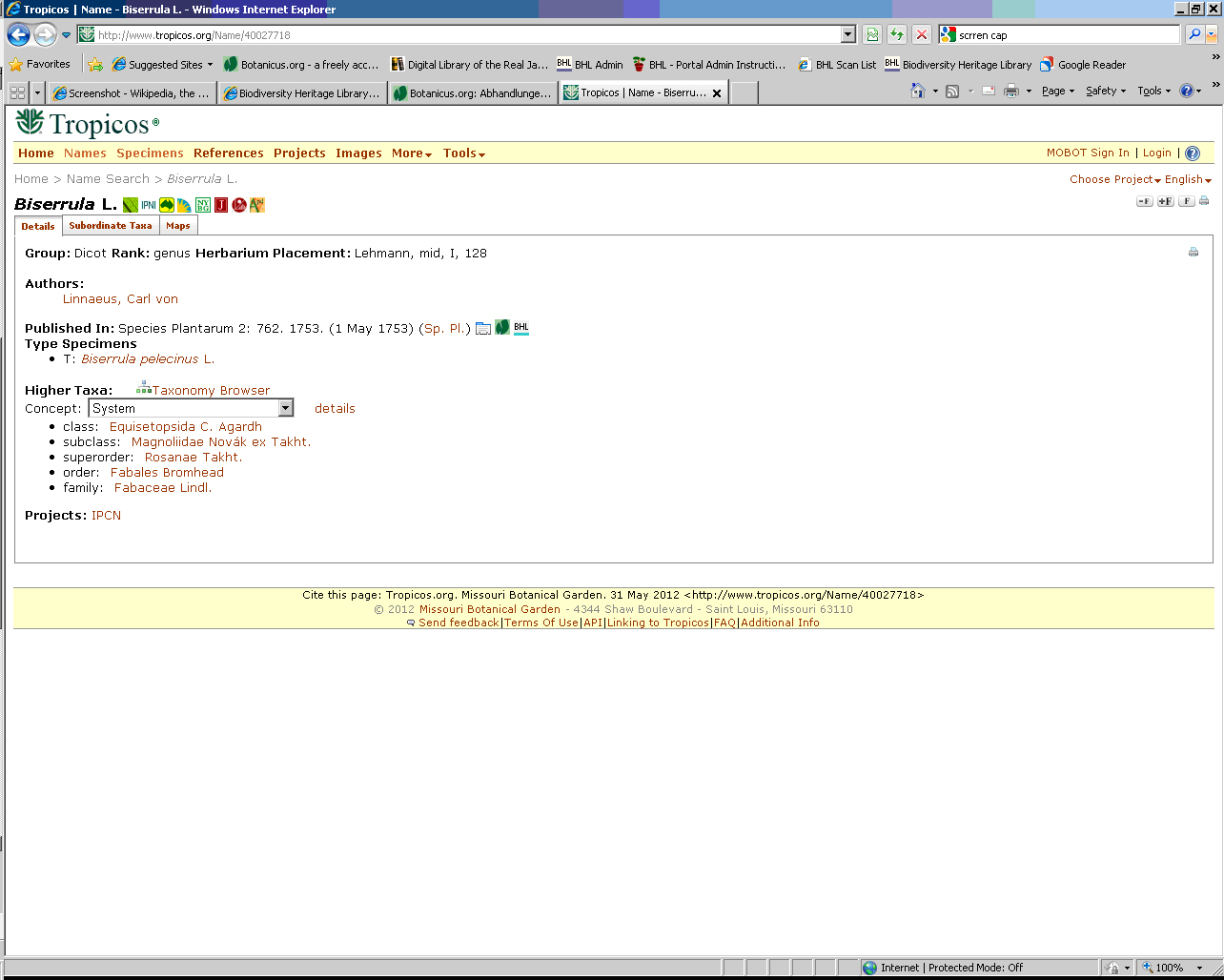
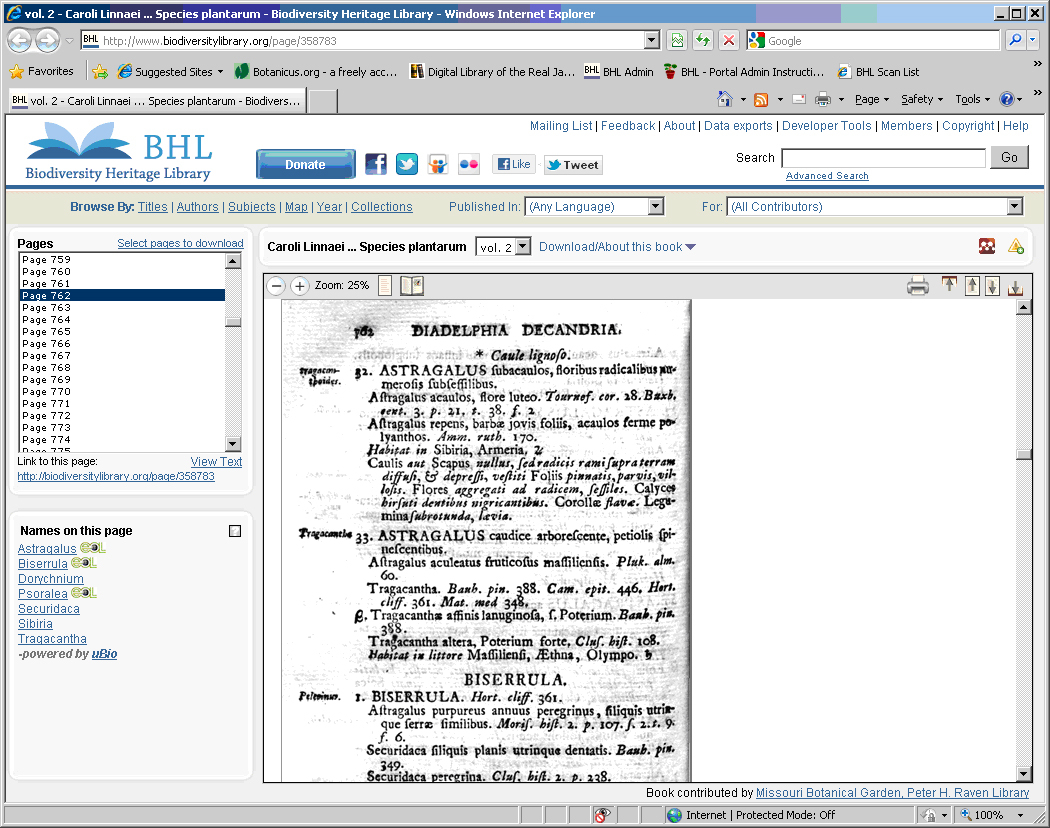
Tropicos and BHL are intimately linked: the OCR that helps identify species names in BHL “reports back” to Tropicos through an automatic data resolver, so ideally, when you look up specimens or citations in Tropicos, there should be a link out to BHL, directly to the page where the specimen is named.

View Full Size Image
Tropicos Citation Page
View Full Size Image
Citation Page in BHL, linked out from Tropicos

Unfortunately, BHL has gotten so big in recent years the automatic resolver doesn’t always work, and the links don’t always get made. I’m able to go in and add links to both Botanicus and BHL from both specific citations and publication pages. I don’t use Tropicos very often, so I rely on the Garden’s research staff to let me know when links are missing (and they do!).

I’ve been working with BHL almost since its inception, and it’s been a wonderful experience, and a lot of fun, seeing how it’s evolved and grown, not to mention meeting all the wonderful people who’ve worked on the project. I’m proud to work on such a project, knowing that we’re able to provide rare and necessary material to people who might otherwise not have a chance to study it.

June 4, 2012by Grace Costantino
BHL News, Blog Reel

Announcing BHL on Pinterest

We know you love our BHL images, and we love coming up with new ways for you to interact with them. That’s why we’re announcing BHL on Pinterest!

View Full Size Image
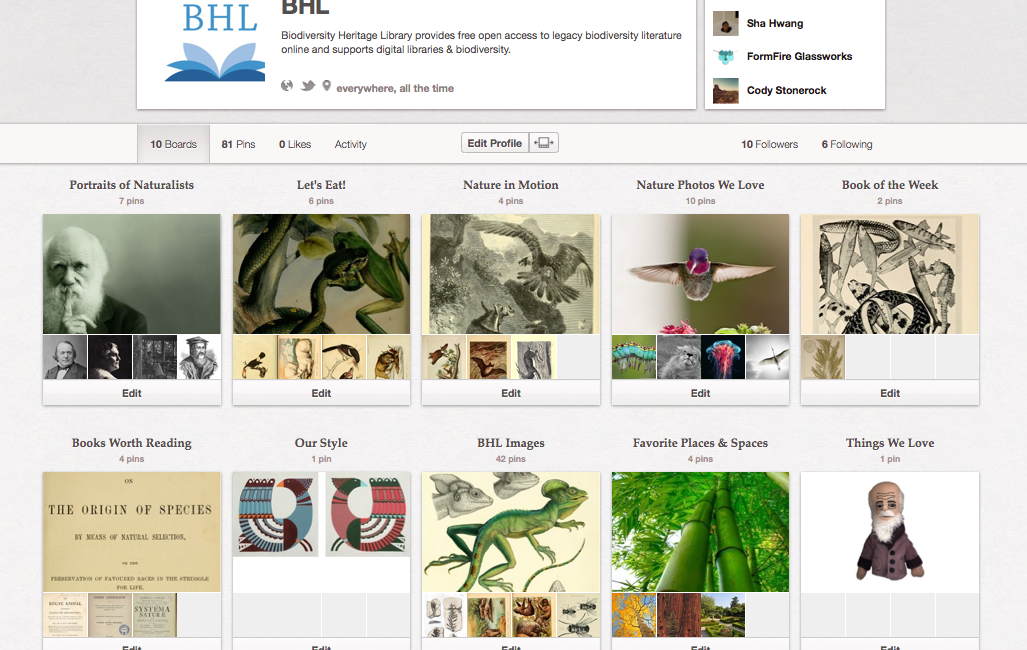
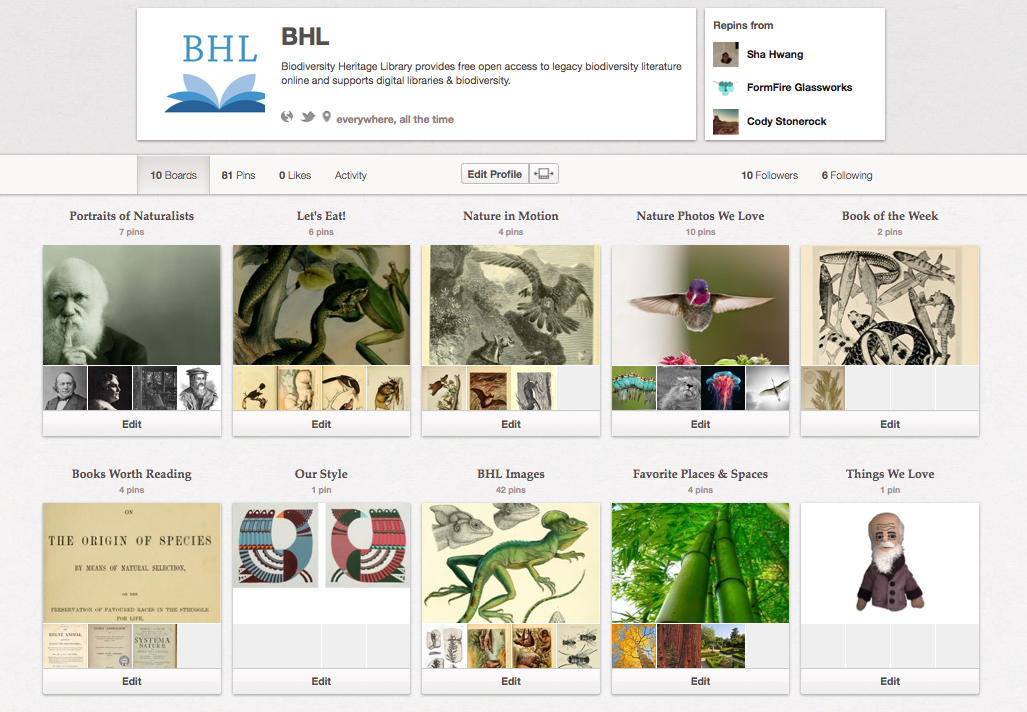
BHL Pinterest Profile

Pinterest is an application that allows you to organize and share images from the web by “pinning” them to your personal Pinterest account. Pinning an image basically means grabbing it from its original website and posting a copy of it to your profile on Pinterest. When you sign up for Pinterest, your computer will automatically download an app that you can use to pin any image on the web to your profile. The source URL stays with the image, so you always know where the original came from. You can organize your “pins” (i.e. images) into “boards” (i.e. collections) within your profile. Anyone who views your profile in Pinterest will see all of the images you’ve pinned, organized according to the collections you’ve grouped them in.

View Full Size Image
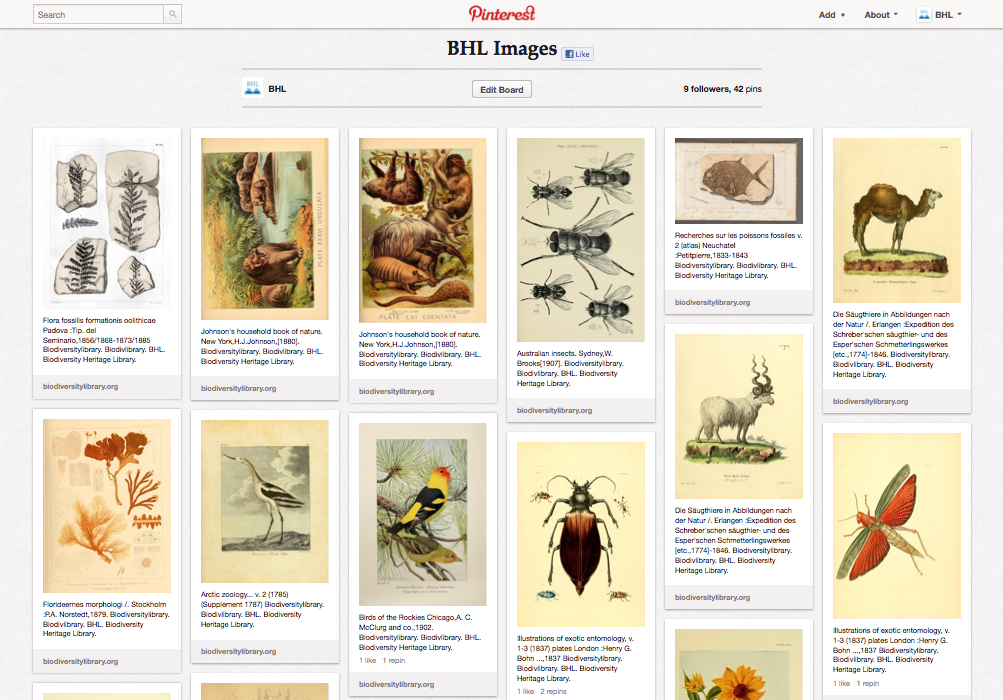
Example of a “Board” or Collection in the BHL Pinterest

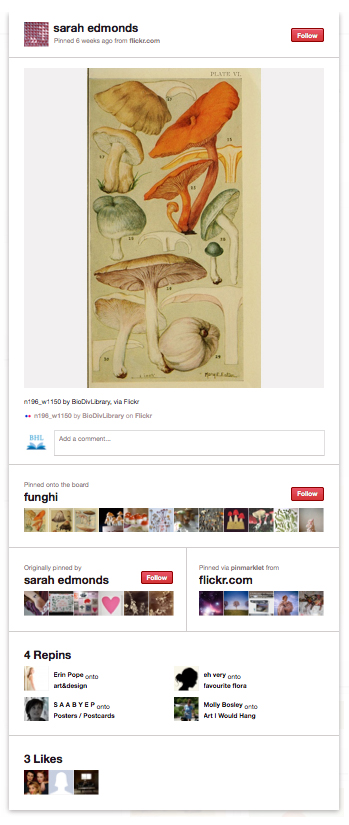
As a Pinterest user, you can repin other people’s images (i.e. post a copy of another person’s image on your own profile), and comment on or like images. Whenever you repin an image from another person’s profile, the source URL, as well as the identity of the person who originally pinned the image, remains associated with it. You can also follow people or boards (collections) so that you receive notifications when new images are pinned by that user or added to that board. Pinterest is best utilized if you have an account, as you can only interact with images if you have one. However, even without an account you can still browse Pinterest.

View Full Size Image
BHL image, pinned by a user, with repins & likes

We’ve created a BHL Pinterest account, where we’re pinning some of our favorite images from BHL. Our images are organized within a variety of boards, including “Portraits of Naturalists” (portraits of famous natural historians and botanists), “Let’s Eat!” (dinner dates with members of the animal kingdom), “Nature in Motion” (images of the animal kingdom on the move), “Book of the Week” (images from our Book of the Week series), “Books Worth Reading” (title pages from some of our favorite titles in BHL), and “BHL Images” (a myriad of our favorites from BHL). We’re particularly excited about the fact that, not only have we begun pinning our own images, but hundreds of other users have also been pinning BHL images to their accounts! You can find BHL images by searching Pinterest for “BHL,” “Biodiversity Heritage Library,” or “BioDivLibrary.” If you don’t have the URL, you can find our profile by doing a “people” search for “BioDivLibrary.”

Our Pinterest account is a great way to highlight some of the most incredible images from the 30,000+ currently available in Flickr. We encourage you to browse our account, or create one of your own and repin, comment on, or like our images. Be sure to pin your own favorites from BHL as well. Follow our account or a specific board to stay updated on new additions to our collection. If you have suggestions for boards you’d like us to create, let us know! We’re excited about this new opportunity to connect with our user community and showcase the fantastic assets in our collection.

June 1, 2012by Grace Costantino
Blog Reel, Featured Books

Happy Birthday, Louis Agassiz!

View Full Size Image

Monday, May 28, marked Jean Louis Rodolphe Agassiz’s 205th birthday. Louis Agassiz was a famous Swiss paleontologist, glaciologist, and geologist who made critical advances in the fields of ichthyology and glaciology. During his lifetime, he received the Wollaston medal, was named a member of the Royal Society, the Royal Swedish Academy of Sciences, and the American Academy of Arts and Sciences, and served as the head of the Lawrence Scientific School at Harvard University. And last, but certainly not least, Agassiz founded the Museum of Comparative Zoology at Harvard University.

Born in Môtier, Switzerland, in 1807, Agassiz’s original interests laid in medicine, but he developed an affinity for zoology, particularly ichthyology, after meeting Georges Cuvier, renowned French naturalist and zoologist. In 1826, Carl Friedrich Philipp von Martius asked Agassiz to study a collection of fish brought back from an 1819-20 expedition to Brazil. The endeavor marked the launch of Agassiz’s work in ichthyology. The project was completed in 1829, and by 1830, Agassiz, fully engrossed in the subject, issued a prospectus of a History of the Freshwater Fish of Central Europe, which was finally published from 1839-42.

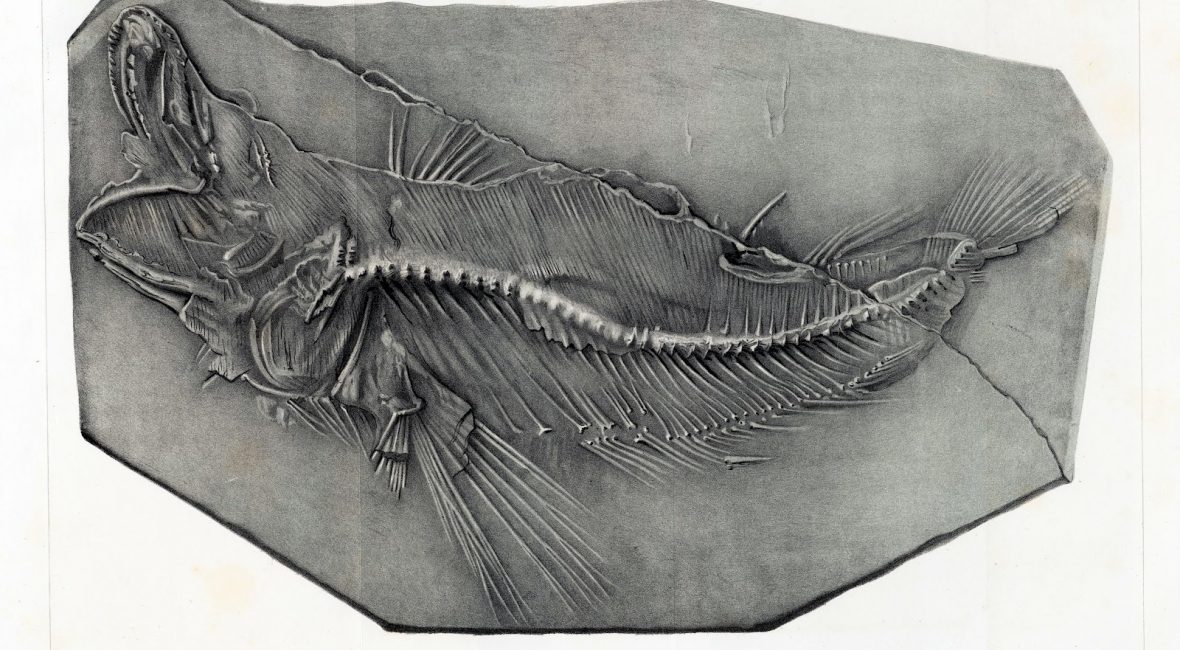
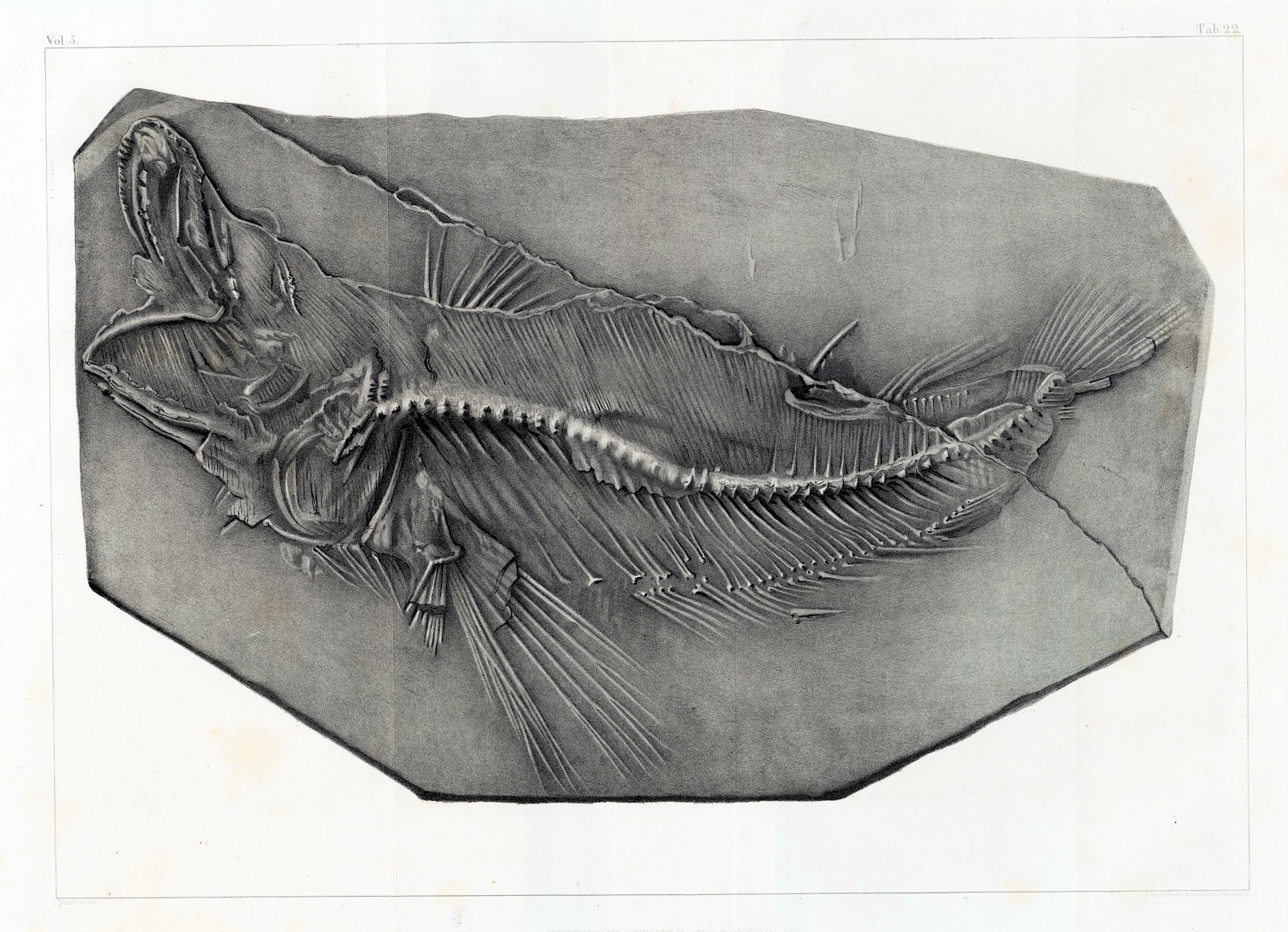
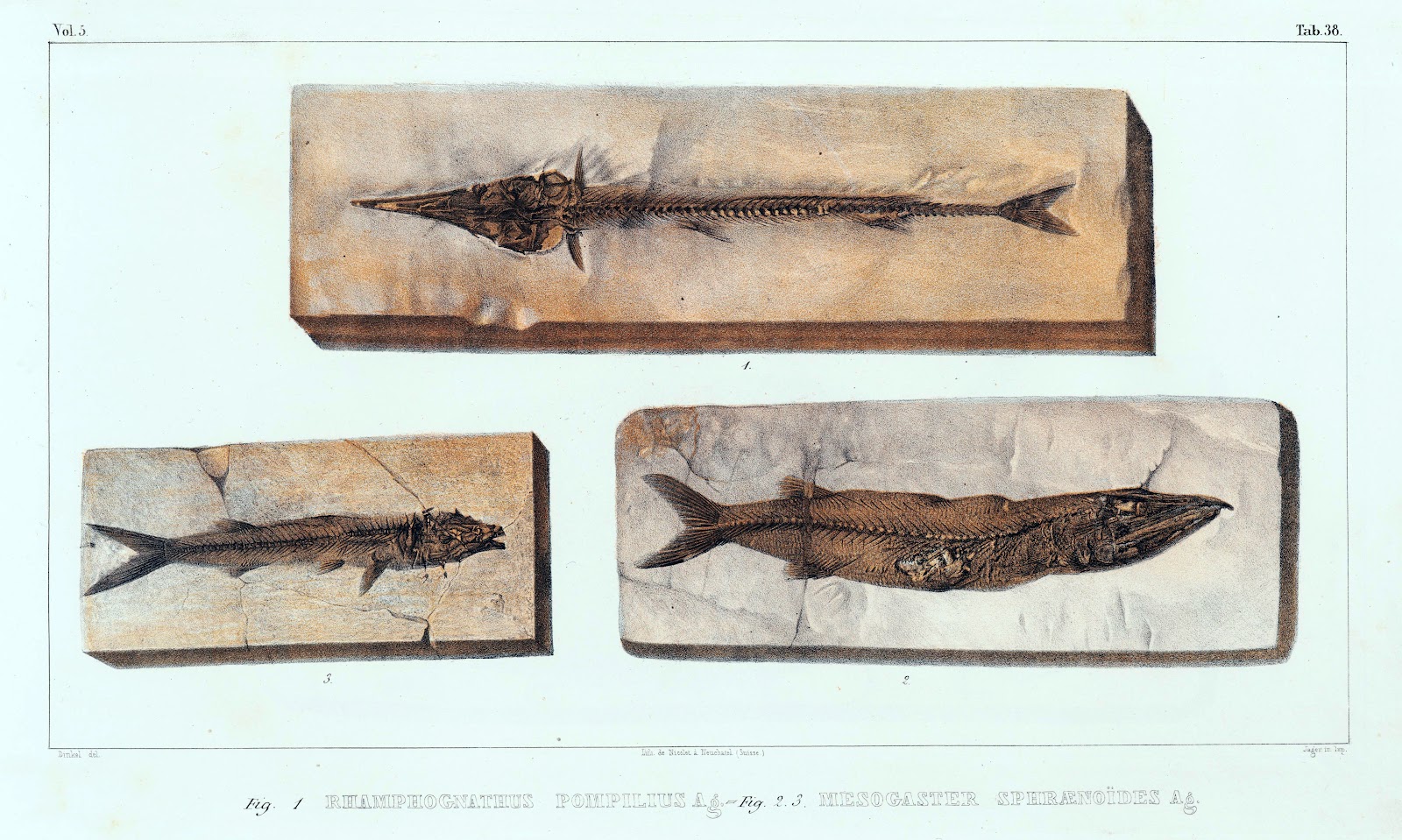
Agassiz achieved worldwide fame with the publication of Recherches sur les poissons fossiles, a five volume, gorgeously-illustrated set, published from 1833-43. The work described the fossil fish housed at the University of Neuchâtel, where Agassiz taught as a professor. The stones containing the fossils came from the slates of Glarus and the limestones of Monte Bolca.

View Full Size Image

Agassiz’s research for Recherches prompted him to develop a new classification system for fish, dividing them into the four groups Ganoids, Placoids, Cycloids and Ctenoids. The division was based on the scales and dermal appendages exhibited by each specimen, as these characteristics were often the only traits preserved in fossils. Though no longer in use, Agassiz’s system served as an important advancement in the study of fossil fish.

Recherches contains 402 lithographic plates, 318 of which are hand-colored. It describes more than 1,700 ancient fish species. To support the continued development of the project, the Earl of Ellesmere purchased Agassiz’s 1,290 original drawings for the work, which were ultimately presented to the Geological Society of London. A complete copy of the work sold at Christie’s Auction House in 2003 for $8,537.

During his lifetime, Agassiz published material about echinoderms, fossil mollusks, embryology, and glaciers. He was the first to advocate scientifically for the advent of an ice age in earth’s history, which resulted in his two-volume work Etudes sur les Glaciers. Agassiz ultimately settled in the United States, and, perhaps most importantly for BHL, founded the Museum of Comparative Zoology at Harvard University in 1859. The museum’s library is one of the founding members of BHL and the contributor of our copy of Recherches sur les poissons fossiles. By the time of his death, Agassiz was one of the best-known scientists in the world.

You can see a selection of the illustrations from volumes 2 and 3 in Flickr and browse the entire work in BHL. We’re proud to have our own history so intricately interwoven with this great man and send a heartfelt birthday wish his way. Happy birthday, Louis Agassiz!

May 31, 2012by Grace Costantino
Blog Reel, User Stories

BHL and Our Users: Wendy Wasman

View Full Size Image

When most people think of BHL’s users, they think of scientists accessing literature for research. However, one of our largest user communities is librarians, which use BHL to fulfill requests from patrons, saving their libraries time and resources by having immediate, free, online access to our material. One such librarian is Wendy Wasman, a librarian at the Cleveland Museum of Natural History, who graciously agreed to give us a peek at the way she uses BHL to support her work activities.

What is your title and institutional affiliation?

Librarian, Cleveland Museum of Natural History

How long have you worked in a library environment?

I’ve been a professional librarian since 1988, but I have worked in libraries since I was 16! I started as a page in my public library, and then I worked in my college library (Oberlin) for 4 years. I’m on my second ‘tour of duty’ at CMNH – I was the Librarian from 1988-1994, and then moved to Philadelphia, where I was the Science Librarian at Haverford College from 1995-1999. I moved back to Cleveland in 2000, and have been back at the Museum since 2008. I tell people I’m the “renewed librarian.”

When did you first discover BHL?

I first heard about BHL back in 2008 from the listserv of the Natural History Caucus of the Special Libraries Association, and I followed its progress by reading various articles and blogs.

What is your opinion of BHL and what impact has it had on your duties as a librarian?

I can more easily meet the research needs of the Museum curators by using BHL to find articles. One of the curators was doing research on a specific salamander and needed old taxonomic literature. I was able to use BHL to find every article he needed for his research.

How often do you use BHL?

It really depends on the project. Sometimes I use it several times a week, and sometimes just once a month.

How do you usually use BHL (read the titles online/download whole PDFs/Selecting Pages to Download for a custom PDF/Downloading High Resolution Images/Generating Taxonomic Bibliographies/etc.)

I usually select pages to download for a custom PDF. I also downloaded a lot of high resolution images for a recent presentation I did on scientists and artists of the 19th century. It was a real treat being able to find and download images from the old Transactions of the Zoological Society of London, and it saved my library’s set from the wear and tear of scanning the pages I needed.

What are your favorite features/services on BHL?

Being able to select and download pages for a custom PDF is a wonderful feature.

If you could change one thing about BHL, what would it be, or what developmental aspect would you like the BHL team to focus on next?

I would love to be able to search for individual images; I know that is something that BHL is focusing on now.

Is there a specific item on BHL that is most often requested by your patrons/that you use more than any other to fulfill ILL requests?

Not really, since my use of BHL is very project-dependent right now.
____________________________________________________

Thank you, Wendy, for sharing your experiences with BHL with us! As you indicated, BHL is currently working on improving access to BHL images through work supported by our recent NEH grant. You can find out more about the grant and our project progress on our wiki. In the meantime, enjoy the thousands of BHL images freely available on the BHL Flickr!

As a final note, a recent addition to the Biodiversity Heritage Library is volumes from the Scientific Publications of the Cleveland Museum of Natural History! Be sure to check them out in BHL.


May 29, 2012by Grace Costantino
BHL News, Blog Reel

Celebrating Linnaeus’ Birthday with iTunes U

View Full Size Image

He has been dubbed “The Father of Modern Taxonomy,” “The Father of Modern Ecology,” Princeps botanicorum (Prince of Botanists), “The Pliny of the North,” and “The Second Adam.” He is credited with creating the classification schema known as binomial nomenclature, and today, he turns 305 years old. Of course, we’re talking about Carl Linnaeus, and we’re celebrating his birthday with the release of our latest iTunes U collection dedicated to him.

Carl Linnaeus was born May 23rd, 1707, in Småland, Sweden. As evidenced by his later publications, his first and primary passion was botany. At an early age, he took an interest in plants, eventually coming under the tutelage of Johan Rothman, the state doctor of Småland. Linnaeus first learned to classify plants under Rothman’s direction, using the system developed by Joseph Pitton de Tournefort, which, though based on artificial similarities between organisms, nevertheless was the first system to make a clear distinction between genus and species.

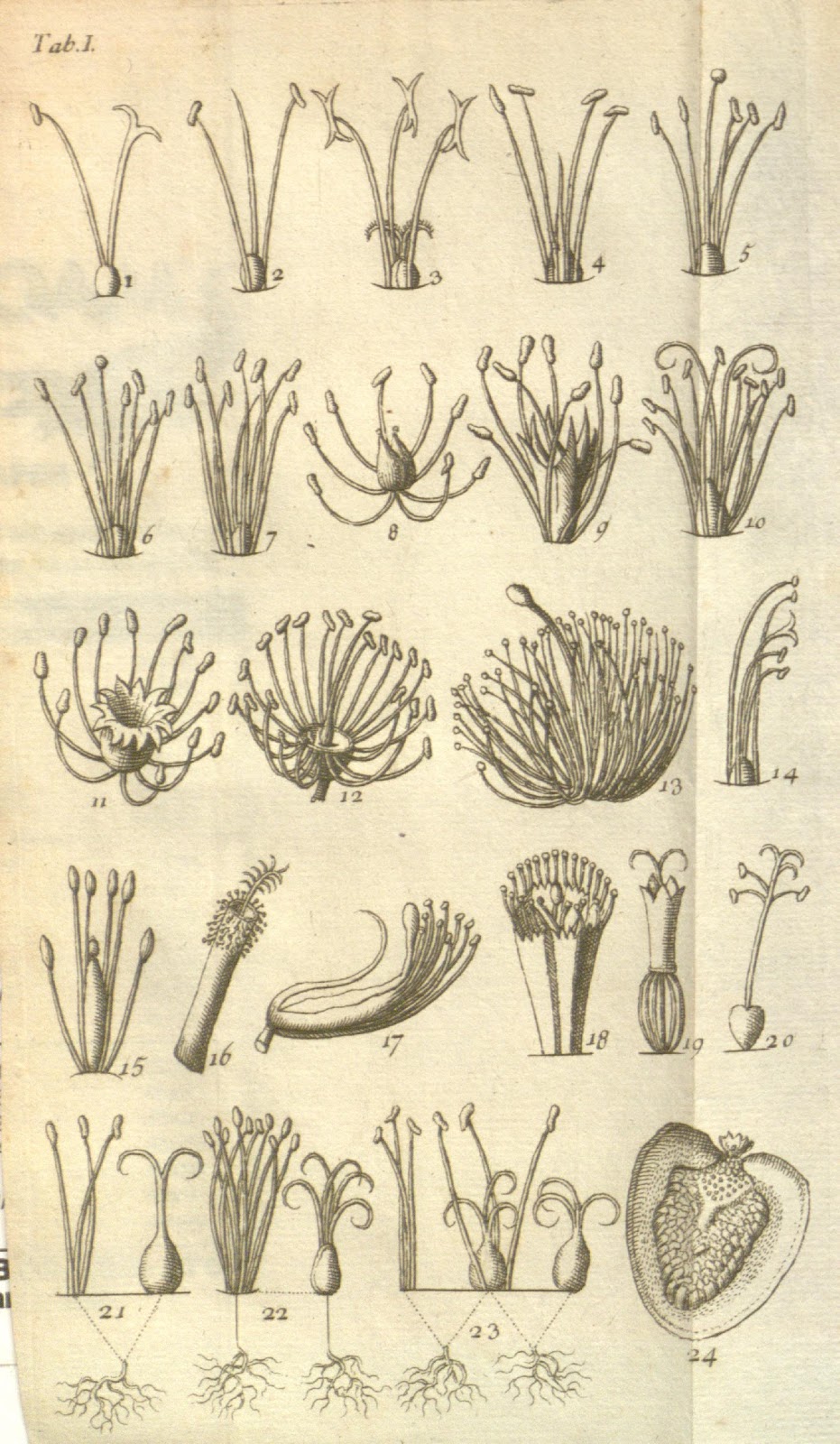
In 1728, Linnaeus enrolled at Uppsala University, where he made quick progress in the field of botany and, by only his second year, was himself giving lectures. During these years, Linnaeus began to question Tournefort’s classification system, and thus decided to develop his own. Linnaeus’ system arranged plants according to the number of stamens and pistils each possessed. This new system formed the basis of his work in the critical publication Genera Plantarum (first edition published 1737). A young German botanical draughtsman named Georg Dionys Ehret crafted a visual representation of this system, which Linnaeus included in Genera Plantarum (though without acknowledgement to Ehret). The image represents the earliest illustration of Linnaeus’ classification system for plants.

View Full Size Image
Ehret’s illustration of Linnaeus’ classification system

Linnaeus continued to revise Genera Plantarum, publishing a total of five editions (fifth edition published 1754). During the years between the publication of the first and fifth editions of this work, Linnaeus also published Species Plantarum (first edition published 1753), which arranged all plants known to him into orders, classes, and genera according to the Genera sexual system. Species Plantarum provided formal, multiple word descriptions in Latin of each species, as well as an additional epithet for easy reference. The combination of the genus and epithet quickly became a popular method by which to refer to a plant species. Species Plantarum is considered the inception of botanical nomenclature, and the use of a consistent naming structure based on the methods presented in Species and Genera was a vital step in the maturation of Linnaeus’ binomial schema.

In 1735, even before the publication of the first edition of Genera Plantarum, Linnaeus published the first edition of Systema Naturae. This first edition outlined Linnaeus’ ideas for the hierarchical arrangement of the natural world, dividing it into the animal, plant, and mineral kingdoms. His classification of the plant kingdom followed the sexual system he presented in Genera. However, it was not until the tenth edition of Systema Naturae that the binomial classification system we so readily associate with Linnaeus came into its own. While Species Plantarum had already established a binomial naming system for plants, the tenth edition of Systema Naturae (published in 1758) organized, for the first time, the animal kingdom according to this system – Kingdom, Class, Order, Genera, and Species. Thus, it represents the beginning of zoological nomenclature and, together with the first edition of Species Plantarum, is considered the starting point of binomial nomenclature.

Today, we highlight Linnaeus’ contributions to science with the release of our newest iTunes U Collection: The Carl Linnaeus Collection. The collection features 13 of Linnaeus’ publications (including the first edition of Species Plantarum, the tenth edition of Systema Naturae, and the fifth edition of Genera Plantarum), as well as two additional items about Carl Linnaeus and his sexual classification system (Carolvs Linnaevs by Edward Lee Greene and New illustration of the sexual system of Carolus von Linnaeus by Robert John Thonrton). You can download all of these titles directly onto your iPad, iPhone, or iPod Touch for free through iTunes. And, of course, you can download them directly to your computer through the BHL interface.

So Happy Birthday, Carl Linnaeus! Our present to you: Your very own iTunes U collection!

May 23, 2012by Grace Costantino
Blog Reel, User Stories

BHL and Our Users: Dr. Chris Mah

View Full Size Image

Meet Dr. Chris Mah, Research Collaborator at the Smithsonian’s National Museum of Natural History. His specialty is starfish, and he’s been using BHL in combination with Google Translate to efficiently conduct research involving foreign monographs.

What is your title, institutional affiliation, and area of interest?

Greetings! I am a Research Collaborator in the Invertebrate Zoology Dept. at the Smithsonian’s National Museum of Natural History. I am one of the world’s only experts in the evolution and classification of starfish (aka sea stars). As a consequence I study a hybrid of taxonomy, paleontology, deep-sea biology and macroevolution as they pertain to asteroids.

How long have you been in your field of study?

Although I received my PhD in 2005, I have been working on starfishes since the late 90s. My first publications were in 1996 and 1998 but most of my pubs came in the early 2000s.

When did you first discover BHL?

I first discovered the BHL when I began my first post-doc at the Smithsonian’s NMNH. Honestly, I think I may have met some of the BHL staff before I actually began using the data from the website.

What is your opinion of BHL and how has it impacted your research?

BHL is an awesomely useful resource! As a person who works from a lot of classical taxonomic literature from before the 20th Century, the accessibility of these resources as online PDFs just amazes me. While rooting through old libraries trying to find 200 year old books can be fun, it’s often just easier and more time efficient to be able to pull up the document or monograph, download it to my desktop and get to it.

It can also be very helpful to have the BHL when I’m traveling away from “home base.” No need to carry around a rare 120 year old book if you can just open a scanned file of it on your computer. Lots of different situations where this has been a life-saver. Sometimes it happens overseas and sometimes simply at a university or school without a very large library.

How often do you use BHL?

Using BHL is often dictated by need, so sometimes I’m using it every day and other times there are weeks without using it – but if I were to average it out? Maybe once every week or two?

How do you usually use BHL (read the titles online/download whole PDFs/Selecting Pages to Download for a custom PDF/Downloading High Resolution Images/Generating Taxonomic Bibliographies/etc.)

While I haven’t completely explored all of BHL’s tools, I am pretty happy with downloading PDFs of monographs and papers that are either hard to find or just convenient to look up online. Again, as a tool for “taxonomy on the go,” it’s nice to be able to access the plates and figures without having to carry along a friable old book on a long trip.

What are your favorite features/services on BHL?

One of my favorite features works best with foreign monographs! You can use the BHL to download content as text, which you can then throw into translation software, such as Google Translate! While this does not always “cleanly” translate it does save a substantial amount of work from having to transcribe the whole thing word by word!

If you could change one thing about BHL, what would it be, or what developmental aspect would you like the BHL team to focus on next?

I guess the most important aspect about BHL other than more coverage of older, useful content is a more powerful or at least, smarter search engine. I usually have to take at least two approaches to locating papers among the many journals archived on the BHL. If its not listed under “asteroidea” or some subject word, I usually have to then find the exact citation and track it down.

I realize cross-indexing to that degree is rather difficult and will be imperfect, but sometimes I think that it can be better emphasized when individual monographs are entered into the BHL.

Might also be useful to emphasize how individual citations or pages can be linked with other major biodiversity websites such as the World Asteroidea Database, part of www.marinespecies.org, and so on..

If you had to choose one title/item in BHL that has most impacted your research, or one item that you prefer above any other in BHL, what would it be and why?

Scans of the older content in the BHL are probably the most meaningful to my research. These often represent rarely circulated monographs and books that I often don’t find outside of the main “hub” libraries. It is my hope that more of these rarities can be scanned and made available to everyone…and that they can be better advertised so that researchers around the world can tap into them.

_____________________________________________________

Thank you so much, Dr. Mah, for taking the time to share your experiences with BHL with us! We’re pleased to announce that recently BHL implemented new search functionality, allowing for more Google-like, fuzzy search matching. Rather than having to enter exact citations, users can now submit keyword combinations (and even title abbreviations!) to retrieve results from BHL. Hopefully, this will make your research much more efficient, and we look forward to continually improving these features in the months to come.


May 15, 2012by Grace Costantino
Page 53 of 71« First...102030«52535455»6070...Last »

Help Support BHL

BHL's existence depends on the financial support of its patrons. Help us keep this free resource alive!

search

About BHL

The Biodiversity Heritage Library (BHL) is the world’s largest open access digital library for biodiversity literature and archives. BHL operates as a worldwide consortium of natural history, botanical, research, and national libraries working together to digitize the natural history literature held in their collections and make it freely available for open access as part of a global “biodiversity community.”

Join Our Mailing List

Sign up to receive the latest news, content highlights, and promotions.

Subscribe Now

Subscribe to Blog via Email

Enter your email address to subscribe to this blog and receive notifications of new posts by email.

Join 319 other subscribers

Subscribe to Blog Via RSS

Subscribe to the blog RSS feed to stay up-to-date on all the latest BHL posts.

Access RSS Feed

Inspiring Discovery through Free Access to Biodiversity Knowledge.

The Biodiversity Heritage Library makes it easier than ever for you to access the information you need to study and explore life on Earth…for free, anytime, anywhere.


ABOUT | HARMFUL CONTENT | PRIVACY | SITE MAP | TERMS OF USE