Biodiversity Heritage Library - Program news and collection highlights from BHL
  • Home
  • News
  • Featured Books
    • All Featured Books
    • Book of the Month Series
    • BHL at 20
  • User Stories
  • Campaigns
    • Fossil Stories
    • Garden Stories
    • Monsters Are Real
    • Page Frights
    • Her Natural History
    • Earth Optimism 2020
  • Tech Blog
  • Visit BHL
Home
News
Featured Books
    All Featured Books
    Book of the Month Series
    BHL at 20
User Stories
Campaigns
    Fossil Stories
    Garden Stories
    Monsters Are Real
    Page Frights
    Her Natural History
    Earth Optimism 2020
Tech Blog
Visit BHL
  • Home
  • News
  • Featured Books
    • All Featured Books
    • Book of the Month Series
    • BHL at 20
  • User Stories
  • Campaigns
    • Fossil Stories
    • Garden Stories
    • Monsters Are Real
    • Page Frights
    • Her Natural History
    • Earth Optimism 2020
  • Tech Blog
  • Visit BHL
Biodiversity Heritage Library - Program news and collection highlights from BHL
BHL News, Blog Reel

JSTOR Early Journal Content in BHL

View Full Size Image

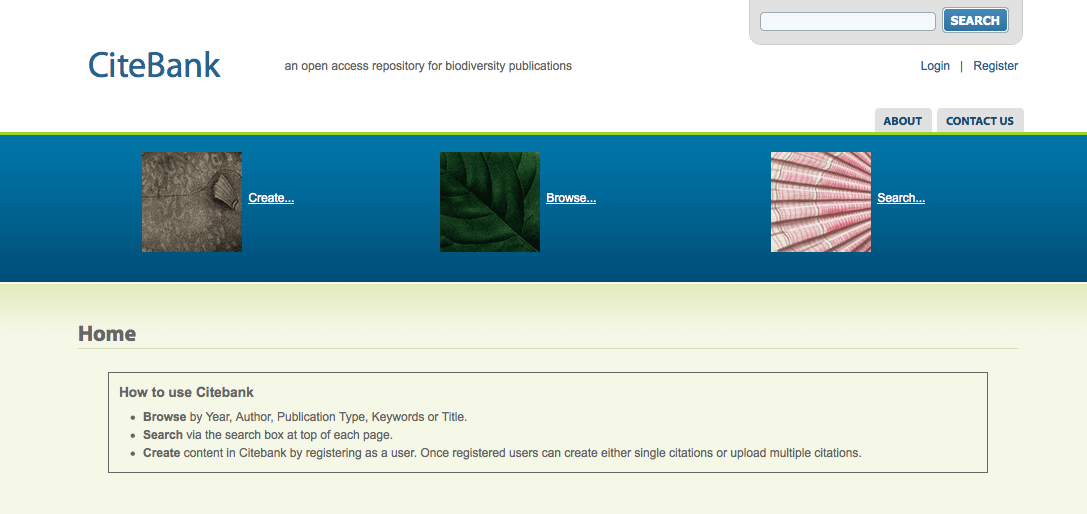
BHL is pleased to announce that a selection of JSTOR’s Early Journal Content (EJC) relevant to biodiversity is now available in BHL’s citation repository, Citebank.

In the fall of 2011, JSTOR announced they were making their journal content published prior to 1923 in the United States and prior to 1870 elsewhere freely available to anyone, anywhere in the world. This spring BHL has worked to ingest nearly 30,000 articles from JSTOR’s EJC into Citebank so that they may be searched alongside other biodiversity-related materials. Once a citation is retrieved, users will be taken to the JSTOR website where they can view the original content files.

The presence of JSTOR’s EJC greatly increases the value of the Citebank repository by providing access to articles from significant biodiversity materials published during this period.


May 14, 2012by Grace Costantino
BHL News, Blog Reel

Happy Birthday BHL!

View Full Size Image
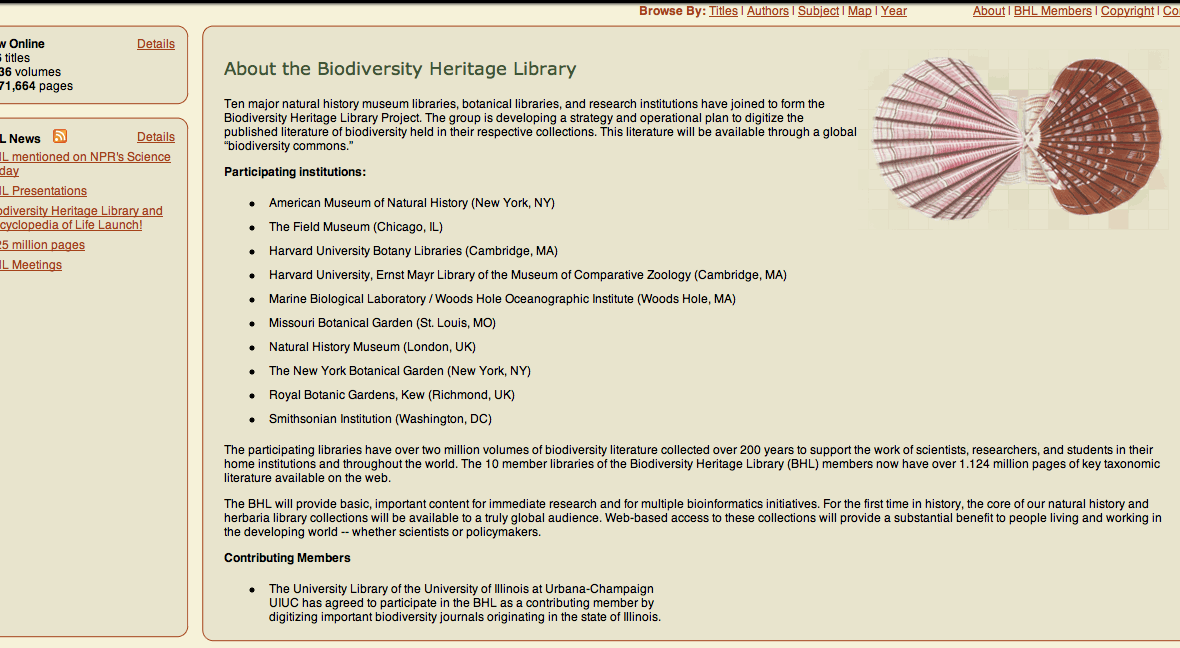
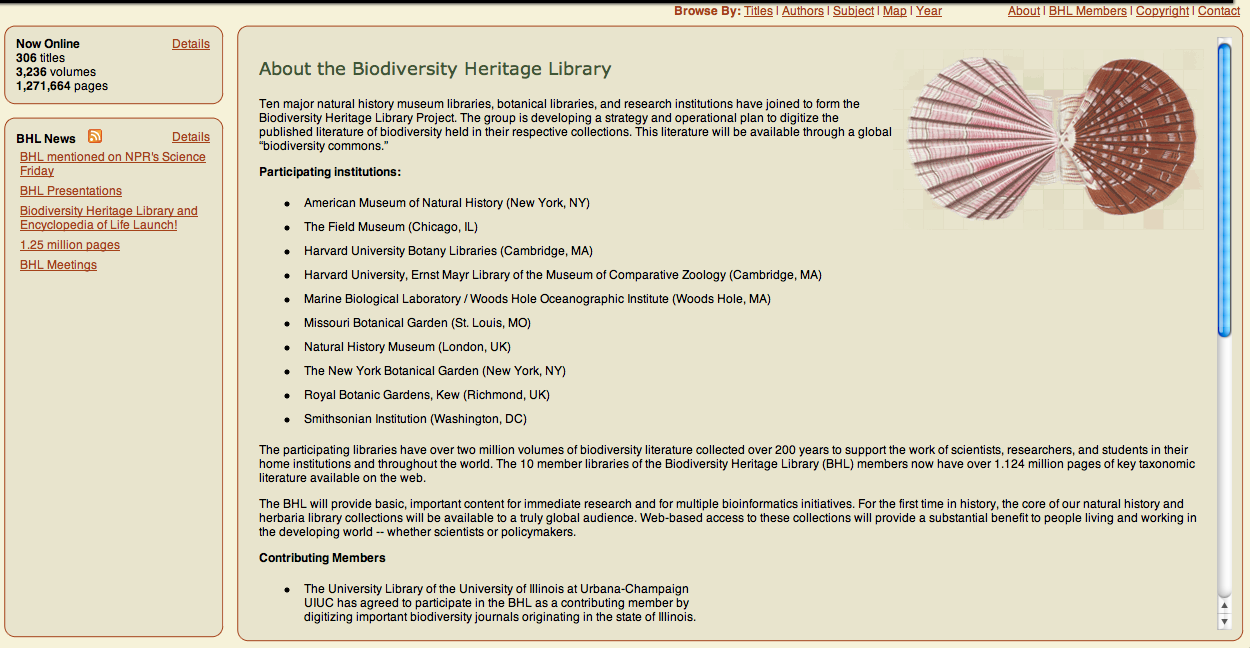
BHL at launch in May, 2007

Like proud parents, we’re excited to announce that today BHL turns 5 years old! In 2007, the Biodiversity Heritage Library portal was launched with 306 titles, 3,236 volumes, and 1,271,664 pages of taxonomic literature, presented via a simple portal bathed in earthy tones. What began as a consortium of just 10 natural history and botanical libraries has today grown into a global project, with 14 US/UK consortium members as well as BHL nodes on every continent in the world except Antarctica.

Today, BHL includes:

  • Over 55,000 titles, 105,000 volumes, and 38.6 million pages
  • New and improved portal with updated colors, enhanced user-interface, and more Google-like, user-friendly searching
  • New logo
  • The ability to create your own PDF and download high-resolution images of BHL content
  • The ability to generate bibliographies for specific species
  • 13,048,166 BHL pages linking to EOL species pages, as well as 1,284,930 EOL species pages linking to BHL
  • An advanced feedback system allowing staff to collect and promptly respond to user-submitted comments about content in BHL
  • Scanning Request process to allow users to nominate material to be scanned for BHL
  • Improved communication with users, including an active presence on our blog, Twitter, and Facebook
  • Our spectacular Flickr account, featuring over 30,000 amazing natural history illustrations and projects in place to improve access to BHL images through the BHL portal
  • Integration of our social media outreach into our portal, including the ability to tweet or post to Facebook directly within BHL
  • Specialized collections of content within BHL, allowing users to explore our materials in a curated manner, including our extremely popular Charles Darwin’s Library collection
  • The ability to add BHL titles directly to a Mendeley account
  • The Biodiversity Heritage Library on iTunes U, allowing users to access select BHL content within iTunes and download to their iPod Touch, iPad, or iPhone
  • The BHL public wiki – a one-stop shop for information about our project, FAQs, copyright policies, tutorials, and more
  • New BHL Newsletter
  • New BHL Quarterly Reports to keep users informed about project progress
  • Active staff that regularly present about BHL at conferences and publish papers about our project
  • BHL nodes in Australia, Europe, China, Egypt, and Brazil, with discussions underway to create a BHL for Sub-Saharan Africa
  • Recognition as one of the top twelve free reference tools of 2011 by Library Journal
These are just a few of the improvements we’ve made to BHL since it was born in 2007. Take a look at what BHL used to look like through the Internet Archive’s Way Back Machine. We’re proud of the progress we’ve made and look forward to the next five years. We’re expecting big things!
May 12, 2012by Grace Costantino
Blog Reel

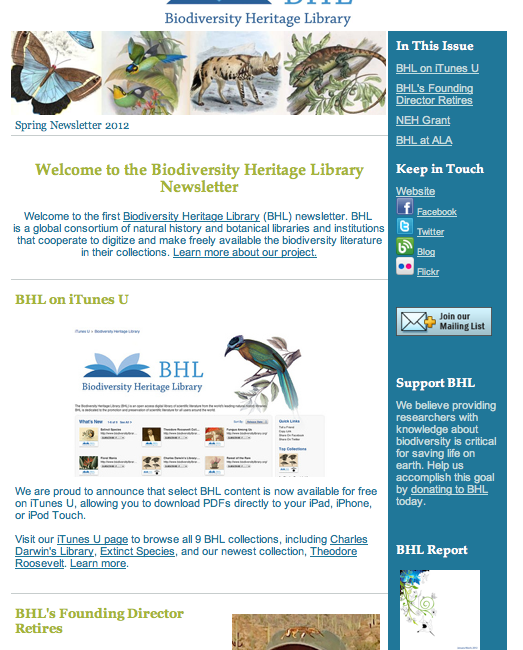
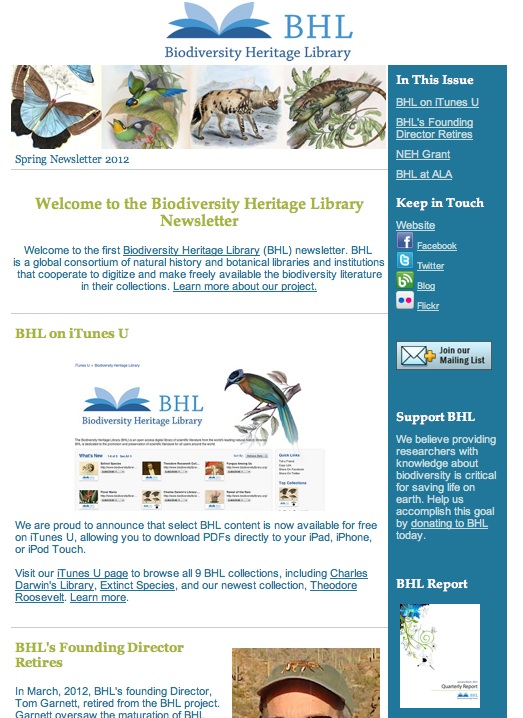
Announcing the BHL Newsletter!

Want to keep up with all the latest BHL project updates? Then subscribe to our quarterly newsletter! It’s full of great information about all the fun things BHL is doing. The Spring 2012 newsletter (excerpt below) highlights the retirement of BHL’s founding director, Tom Garnett, our recent iTunes U collections, our NEH grant to support improved access to BHL images, and our shared booth with EOL at the American Libraries Association midwinter meeting.

Click here to subscribe to the BHL Newsletter.

Newsletters will be archived on our public wiki.

View Full Size Image


May 9, 2012by Grace Costantino
Blog Reel

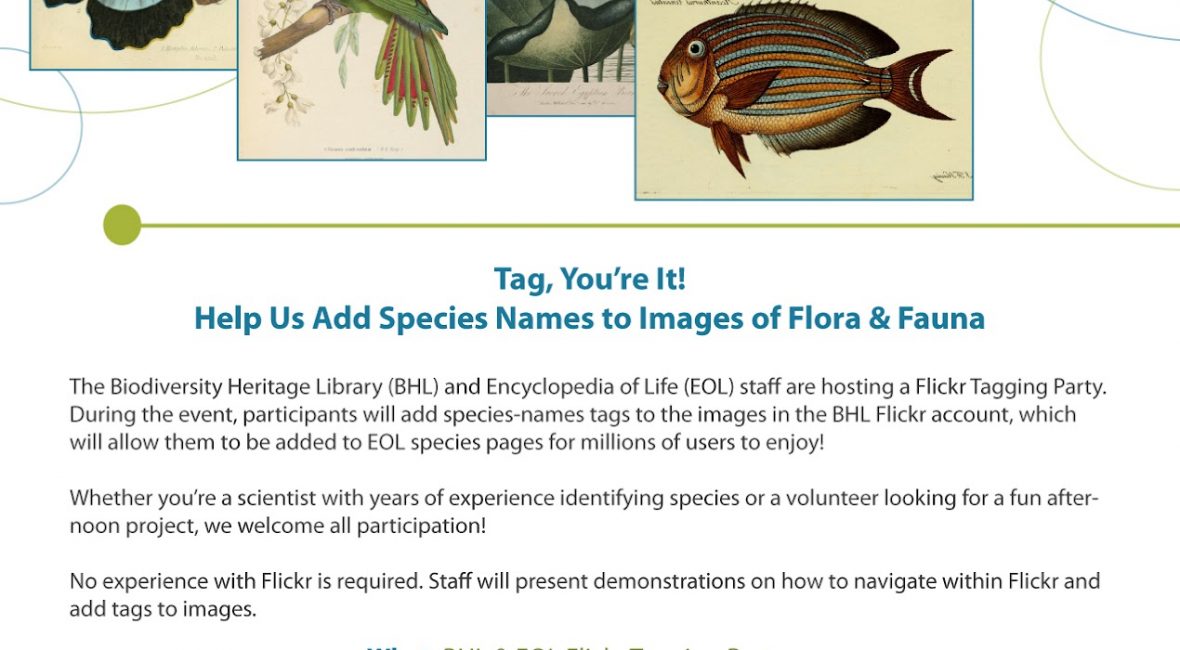
Partying with BHL: Tagging Flickr Images for EOL

View Full Size Image

BHL has over 49 million pages of taxonomic literature, freely available worldwide to anyone with an Internet connection. But if you think BHL is just about text, you’ll be pleasantly surprised. BHL books also contain thousands of gorgeous natural history illustrations from the past 500 years. We wanted to provide better access to these images, and thus the BHL Flickr was born. BHL’s Flickr currently contains more than 100,000 images.

The Encyclopedia of Life, with which BHL is closely associated, is an online encyclopedia dedicated to creating a web page for every species on earth. These pages contain information about each species, links to mentions of those species in BHL, distribution maps, and a myriad of media, including images. EOL harvests many of their images from Flickr, including BHL images that are tagged with a species name machine tag. See an example of an EOL species page with a BHL image here.

Machine tags are tags specially formatted to allow machines to read and understand them. For EOL, these tags tell machines which species (or other taxonomic designations) are depicted in each image. The format for EOL machine tags is “taxonomy:binomial=Genus species”. You can replace “binomial” with another taxonomic tag, such as “genus” or “family”, if you can only identify the organism at that level. Learn more about the Flickr tagging process and machine tag formats in our previous blog post.

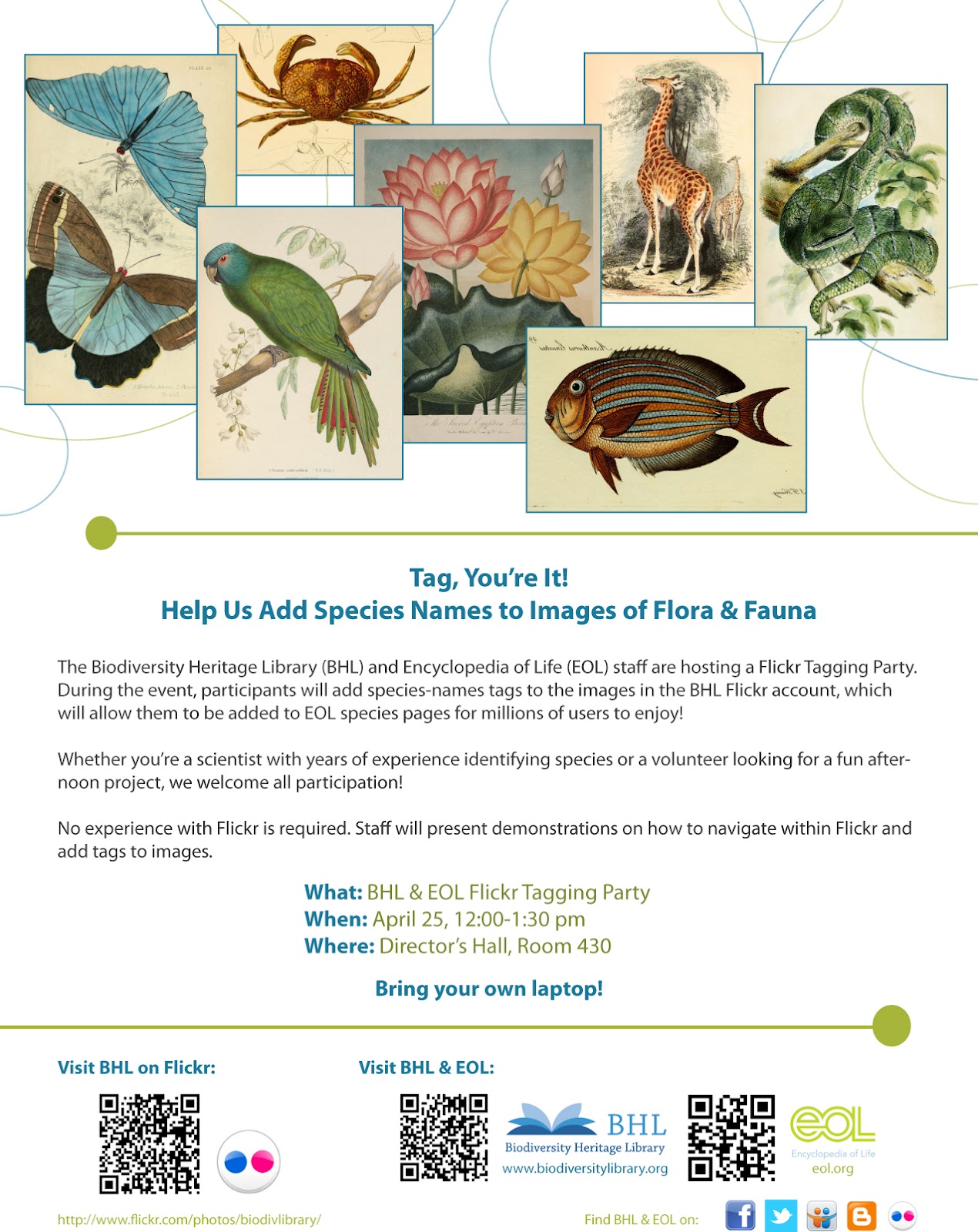
While BHL is working on ways to automatically add species tags to images in Flickr (learn more in the post about our recent NEH grant), the process is currently a manual one, requiring users to identify the species in each image with a taxonomic machine tag so that it can be ingested into EOL and associated with the correct species page. With over 100,000 images in the BHL Flickr, staff need help to get these images tagged. To facilitate this process, staff decided to call on the power of the masses and host a Flickr tagging party at the Smithsonian Institution.

View Full Size Image
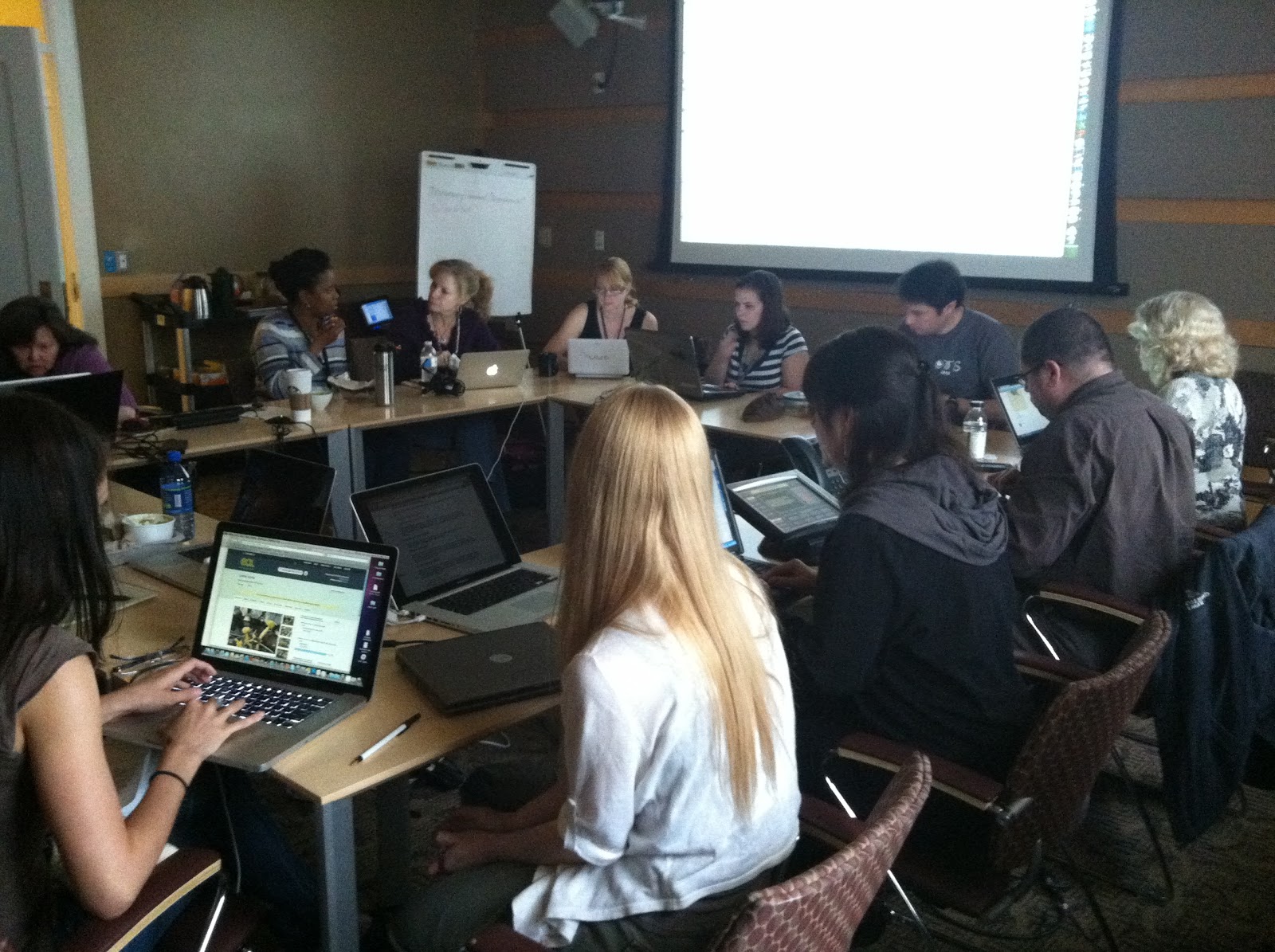
The Flickr Tagging Party at the Smithsonian Institution.

Smithsonian employees were invited to gather on April 25th, 2012, for a 1 1/2 hour meeting at which BHL and EOL staff gave overviews of their respective projects and instructions on how to add taxonomic machine tags to BHL images. After a brief tutorial (see the tutorial on the EOL Flickr page), guests were encouraged to begin tagging images from a prepared list of books. Users run into a variety of challenges when tagging images, including outdated species names (users are encouraged to tag images with more modern names), plates without species names, and names in foreign languages or in fonts that are difficult to read, among other things. While the books identified on the prepared list were selected to minimize these difficulties, attendees nevertheless unavoidably encountered many of these issues. Thus, BHL and EOL staff were positioned throughout the room to provide assistance when needed.

The tagging party was an overall success and excellent learning opportunity for both guests and staff. Approximately 170 images were tagged by the 23 attendees. A slightly high tag error rate has prompted staff to refine instructions and develop a simpler format for future events. Additionally, a survey was sent to attendees to allow staff to identify further areas for improvement.

See our updated Flickr Tagging Tutorial here.

Staff hope to host many more of these events. Incorporating changes based on lessons learned during this first attempt, several more staff parties are planned for the coming months. Later this summer, staff plan to host an event for a natural history society in the Washington, D.C. area before finally hosting the first public tagging party, most likely stationed at the Smithsonian Institution. If you’re interested in learning more about tagging Flickr images or perhaps participating in future public events, send us feedback. Be sure to check back on our blog regularly for more information about Flickr, EOL, and machine tags!

Visit the BHL Flickr page here: http://www.flickr.com/photos/biodivlibrary/sets/


May 8, 2012by Grace Costantino
Blog Reel, User Stories

BHL and Our Users: Christine Giannoni

View Full Size Image

Today, we feature another of our own: Museum Librarian Christine Giannoni at the Field Museum in Chicago, IL. Christine is an active member of the BHL consortium, managing the workflow to scan Field books for BHL, as well as participating in a variety of BHL groups and committees, including the BHL Institutional Council. She is an avid fan and proponent of the BHL project, tirelessly promoting it among her researchers and patrons. We are very thankful for her valuable contributions to the project.

What is your title, institutional affiliation, and area of interest?

I am the Museum Librarian at the Field Museum of Natural History in Chicago. I am responsible for the overall operation of the Library, focused upon ensuring access to collections, providing excellent service to our patrons & promotion of the variety of resources in our collections.

How long have you been working in a library environment?

I have worked in several different types of libraries for the last 17 years. While completing my undergraduate degree in Anthropology at the University of Illinois at Chicago, I got a job shelving books in a local public library, and I was hooked. I was also able to volunteer at The Field Museum during my undergrad years, so that helped a lot when it came to the first big challenge of working at The Field Museum – finding your way around the building!

When did you first discover BHL?

I discovered BHL around 2007 when The Field Museum Library first started digitizing FMNH publications in partnership with the scanning center at the University of Illinois at Urbana-Champaign. At the time I was Reference & Circulation Librarian, with supervisory responsibility for Interlibrary Loan. Having digital access to the Fieldiana series as well as the Museum’s early News and Annual Report series was (and remains) a fantastic resource.

What is your current level of involvement in BHL?

I devote several hours per week to various BHL activities. Our participation in regards to scanning is primarily related to user requests for filling in “missing” issues within the BHL corpus. We were also fortunate in late 2011 to receive funding for scanning from the Museum’s Africa Council. With these funds, we were able to scan literature related to African Biodiversity, several volumes of which came from our rare collection. Furthermore, I am actively working on training volunteers and interns to paginate BHL scanned materials – a very satisfying activity for them as they can immediately see the results of their work on BHL.

What is your opinion of BHL and what impact has it had on your duties as a librarian?

I feel that working on the BHL project is one of most rewarding aspects of my job. For many years, I have interacted with researchers from all over the world who come to use The Field’s specimen and object collections. When they inevitably come to the Library during their visit, I often hear things such as, “these books are nowhere in my country” or “I have needed to see this item for my research for years.” The fact that we can now make these materials freely available to researchers worldwide is incredibly satisfying.

How often do you use BHL?

Everyday. I remain a primary reference and interlibrary loan contact for internal and external users. I rarely have a day where I do not direct users to the BHL to fulfill a request.

What has been the reaction of your patrons to BHL?

Reaction to the BHL is overwhelmingly positive. As people grow more accustomed to the convenience of electronic publications, they are extremely grateful for its existence. I recall earlier in my career when individuals felt that you could digitize materials and put it into deep storage. In my experience, users view BHL content and then sometimes contact me in order to see “the real thing.” This isn’t necessarily because they distrust the content, but are interested in some other aspect of the work (the item as a physical artifact, for instance). I also have users concerned about conservation/condition of print, so they like the alternative.

What services/features do you like the most about BHL and which do you most like to point out to your patrons? Which services/features are your patrons most excited about/use most often?

For me, I like that the URL’s are easy to copy and send along…From the researcher perspective, they like being able to generate PDFs.

If you could change one thing about BHL, what would it be, or what developmental aspect would you like the BHL team to focus on next?

Full-text searching is mentioned all the time.

Is there a specific item on BHL that is most often requested by your patrons/that you use more than any other to fulfill ILL requests?

Our FM publications for sure!

May 1, 2012by Grace Costantino
Blog Reel, Featured Books

Happy Birthday John James Audubon

View Full Size Image
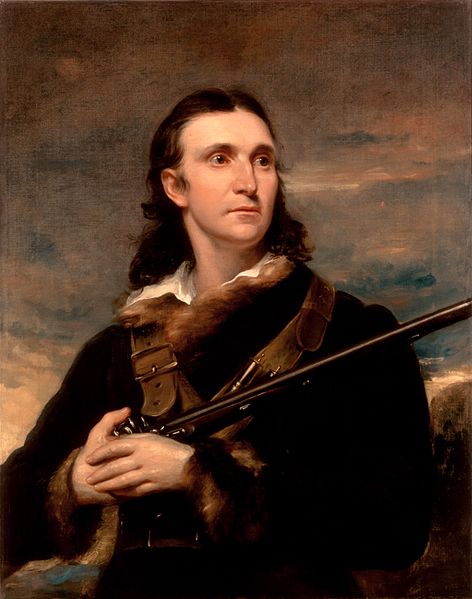
John James Audubon, by John Syme, 1826

Today in 1785, John James Audubon was born. A famous French-American ornithologist, naturalist, and painter, Audubon is responsible for one of the most celebrated ornithological books ever published, Birds of America. Baron Cuvier praised this work as “the most splendid monuments which art has erected in honor of ornithology.”

Audubon was born Jean Rabin, the illegitimate son of French naval officer Lieutenant Jean Audubon, in Les Cayes, Saint-Domingue on his father’s sugar plantation. In 1803, after living in France with his father for his youth, Audubon immigrated to the United States, changing his name to John James Audubon. During his early years in America, though pursuing several business ventures with his father and other partners, Audubon continuously honed his natural history skills, painstakingly studying nature and drawing his observations, with a particular affinity for birds. Though his business success was tumultuous (he even landed in debtor’s prison in 1819 and earned barely enough money to support his family through his sketches), in 1820 Audubon finally started an expedition up the Mississippi in an endeavor to paint all the birds of North America for eventual publication. This ambition later became Birds of America.

Birds of America represents more than 14 years of field observations and drawings by Audubon. In 1826, unable to gain support for publication in America, Audubon traveled to England, where his work was a great success, and he was able to raise enough funds to begin publication. Birds of America contains 435 hand-colored, life-sized prints of 497 bird species and presents a total of more than 700 North American bird species. The cost of printing the entire work was $115,640, the equivalent of more than $2,000,000 today. Published in sections from 1827-38, it includes illustrations of 6 now-extinct birds species, including the Passenger Pigeon and Great Auk. 119 copies of the work are known to survive, and The Economist estimates that 5 of the 10 highest prices ever paid for printed works were paid for copies of this title. The most recent sale of a complete set occurred in 2010 for approximately $11.5 million.

Several titles by Audubon or based on his journals can be found in BHL. One of our favorites, and our book of the week, is The Life of John James Audubon, the Naturalist, a biography of his life, edited by his widow, Lucy Bakewell Audubon. Audubon’s memoir, the title consists largely of abstracts from his journals. Today, a century and a half after this great man’s death, we salute his accomplishments and the contributions he made to natural history. We hope you’ll enjoy learning about him in our book of the week as much as we have. 

You can see digital versions of the 435 elephant folios and the accompanying text in Birds of America from the University of Pittsburgh. Explore the 1840-44 edition of the work, digitized by Smithsonian Libraries, in BHL.

April 26, 2012by Grace Costantino
BHL News, Blog Reel

A New & Improved BHL Search & Interface

In October, 2011, BHL Staff conducted a usability test of the BHL US/UK portal, assessing its functionality and comparing it with that of the BHL-Australia portal. While several recommendations arose from that exercise, two of the most emphatic were a need to improve the BHL search functionality and a desire to make the BHL US/UK portal more aesthetically pleasing.

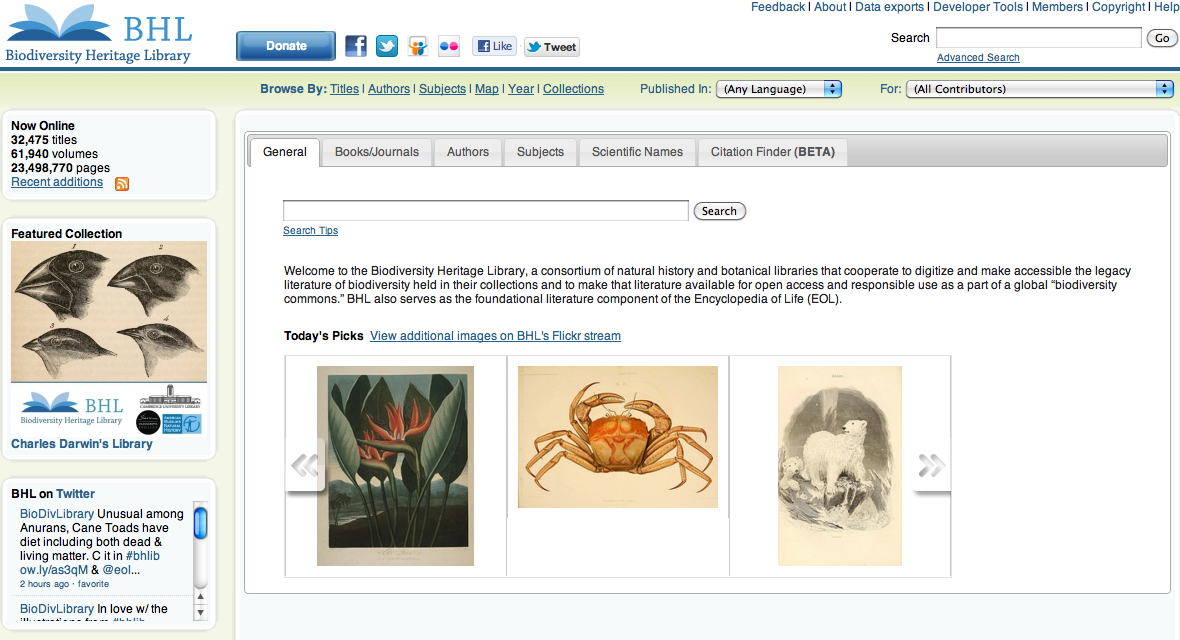
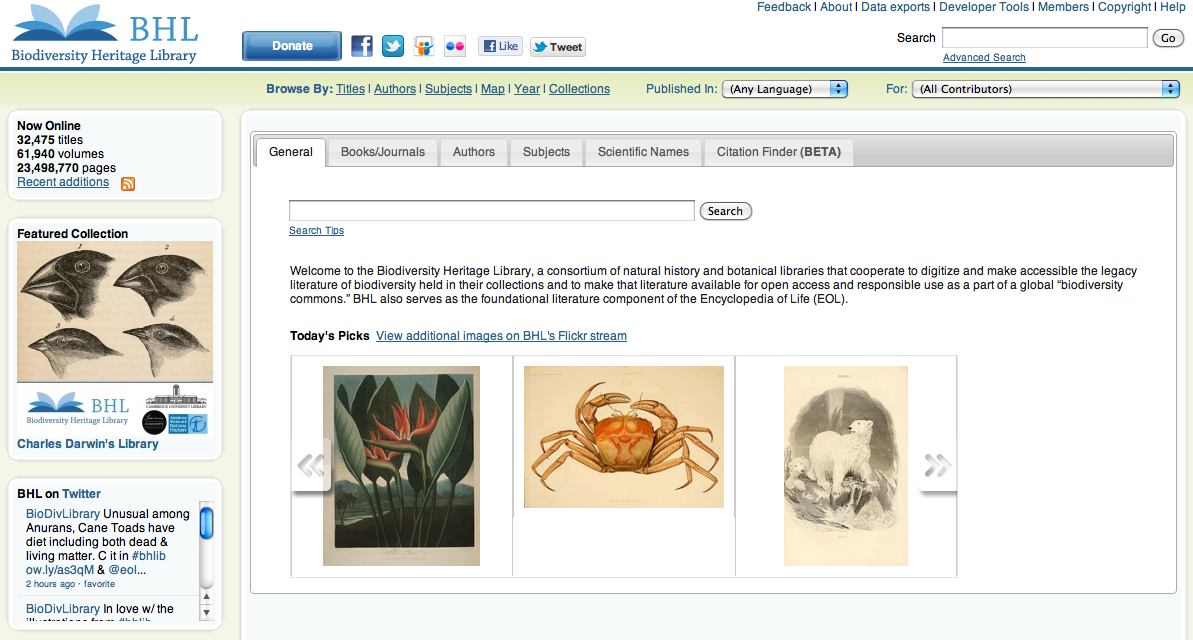
You spoke, and we listened. Today, we’re excited to announce the release of a new and improved BHL interface and search capability! 

View Full Size Image

As far as improving the aesthetics of our site go, we couldn’t think of a better approach than incorporating some of the amazing Flickr images our users have grown to love. On the new BHL homepage, you’ll now see a selection of the over 29,000 illustrations in the BHL Flickr, with the option to view more of the collection in Flickr (by clicking on the “View Additional Images” link) or the specific image within BHL (by clicking on the actual image).

We’ve also updated the social aspect of the site by including our @BioDivLibrary Twitter stream and relocating our social media buttons for Twitter, Facebook, Slideshare, and Flickr to the homepage header for better accessibility. You’ll also find a new and improved Featured Collections box, which will highlight special collections of BHL materials, particularly those included in the BHL iTunes U.

Search Improvements

While we know aesthetics are important, we also know that the meat and potatoes of the recommendations from our usability test center around a need to improve the BHL search.

The new enhanced search addresses metadata only, not OCR text within a book or scientific names.  Think of this as a better search across library metadata.  The search function is a Google-like search that provides fuzzier searching across titles, authors, subjects and dates, while still allowing the exact searches that many of our users have come to love, as indicated in user surveys. Search results are returned according to a relevance ranking, and can be sorted by that ranking, by year, by author, or by date published.

Some example searches now enabled include:

  • Keyword searches:
    • annals missouri
  • Exact search:
    • “annals of the missouri botanical garden” (include quotes)
  • Complex searches:
    • annals or missouri (note the use of “or”)
    • “Charles Darwin” letters (combination of exact phrase and keywords)
    • darwin descent 1871 (author, title keywords, year published)
  • Abbreviations:
    • proc boston soc nat hist
    • sys nat 1758 (abbreviation and year published)

You can also do more complicated searches by clicking on the “Books/Journals” search tab to include volume information and editions into your search criteria.

These search improvements have also been made to BHL’s APIs, including its OpenURL resolver, enabling developers easier access to BHL’s data for inclusion in third party applications.

Spend some time with our new site and feel free to give us your feedback by commenting on this post, sending us website feedback, or sending messages to us on Twitter or Facebook! We know you’ll be as excited about these improvements as we are.

April 23, 2012by Grace Costantino
Page 54 of 71« First...102030«53545556»6070...Last »

Help Support BHL

BHL's existence depends on the financial support of its patrons. Help us keep this free resource alive!

search

About BHL

The Biodiversity Heritage Library (BHL) is the world’s largest open access digital library for biodiversity literature and archives. BHL operates as a worldwide consortium of natural history, botanical, research, and national libraries working together to digitize the natural history literature held in their collections and make it freely available for open access as part of a global “biodiversity community.”

Join Our Mailing List

Sign up to receive the latest news, content highlights, and promotions.

Subscribe Now

Subscribe to Blog via Email

Enter your email address to subscribe to this blog and receive notifications of new posts by email.

Join 319 other subscribers

Subscribe to Blog Via RSS

Subscribe to the blog RSS feed to stay up-to-date on all the latest BHL posts.

Access RSS Feed

Inspiring Discovery through Free Access to Biodiversity Knowledge.

The Biodiversity Heritage Library makes it easier than ever for you to access the information you need to study and explore life on Earth…for free, anytime, anywhere.


ABOUT | HARMFUL CONTENT | PRIVACY | SITE MAP | TERMS OF USE