Biodiversity Heritage Library - Program news and collection highlights from BHL
  • Home
  • News
  • Featured Books
    • All Featured Books
    • Book of the Month Series
    • BHL at 20
  • User Stories
  • Campaigns
    • Fossil Stories
    • Garden Stories
    • Monsters Are Real
    • Page Frights
    • Her Natural History
    • Earth Optimism 2020
  • Tech Blog
  • Visit BHL
Home
News
Featured Books
    All Featured Books
    Book of the Month Series
    BHL at 20
User Stories
Campaigns
    Fossil Stories
    Garden Stories
    Monsters Are Real
    Page Frights
    Her Natural History
    Earth Optimism 2020
Tech Blog
Visit BHL
  • Home
  • News
  • Featured Books
    • All Featured Books
    • Book of the Month Series
    • BHL at 20
  • User Stories
  • Campaigns
    • Fossil Stories
    • Garden Stories
    • Monsters Are Real
    • Page Frights
    • Her Natural History
    • Earth Optimism 2020
  • Tech Blog
  • Visit BHL
Biodiversity Heritage Library - Program news and collection highlights from BHL
Blog Reel, Campaigns, Featured Books

Sir Joseph Dalton Hooker’s Antarctic Journal

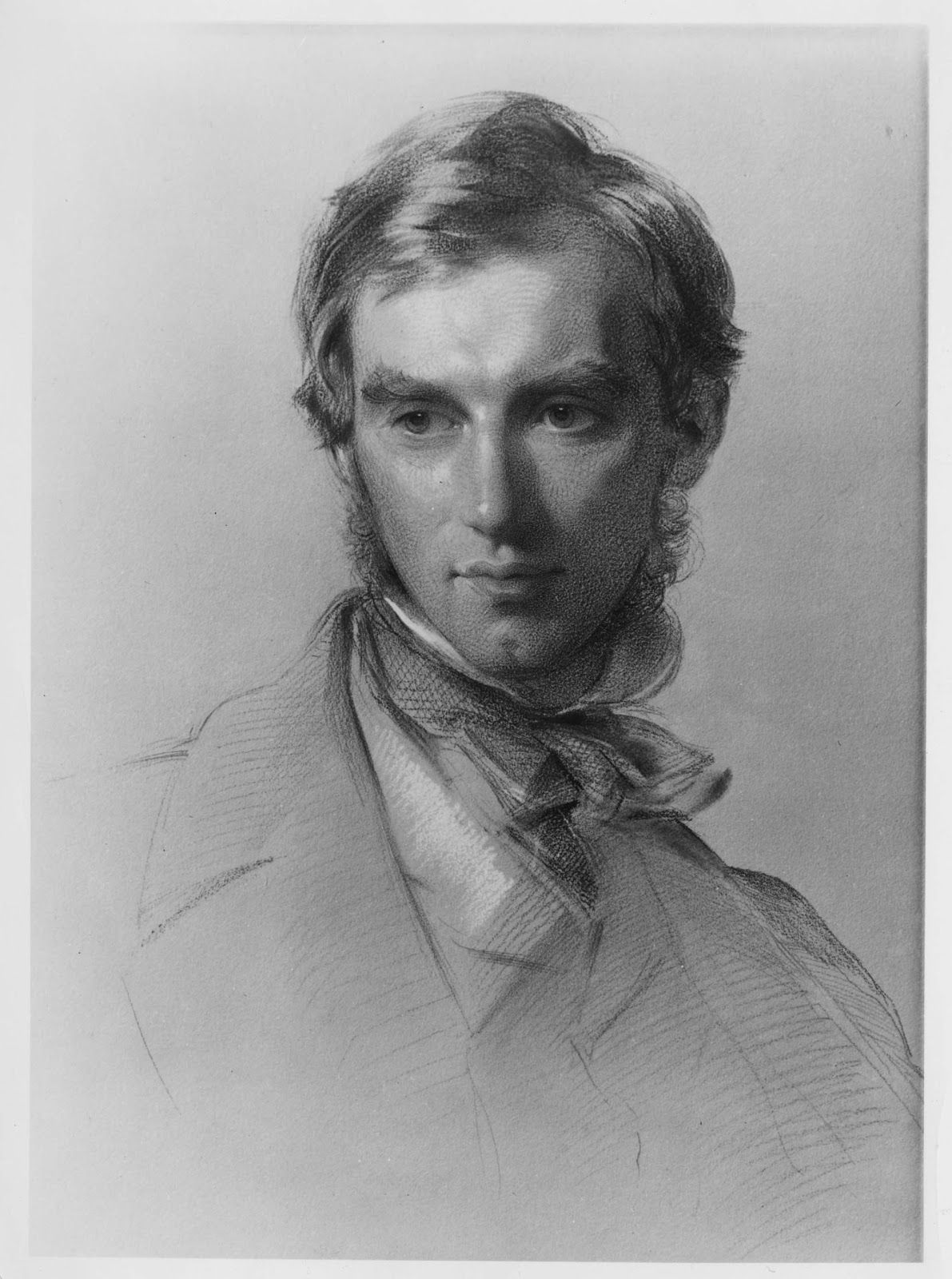
2017 marks the bicentenary of Sir Joseph Dalton Hooker’s birth in the town of Halesworth in Suffolk, UK. During the course of his life (1817-1911), Hooker would become one of the most distinguished and lauded scientists of his day and would hold the position of Director of the Royal Botanic Gardens, Kew for 20 years (1865-1885).

View Full Size Image
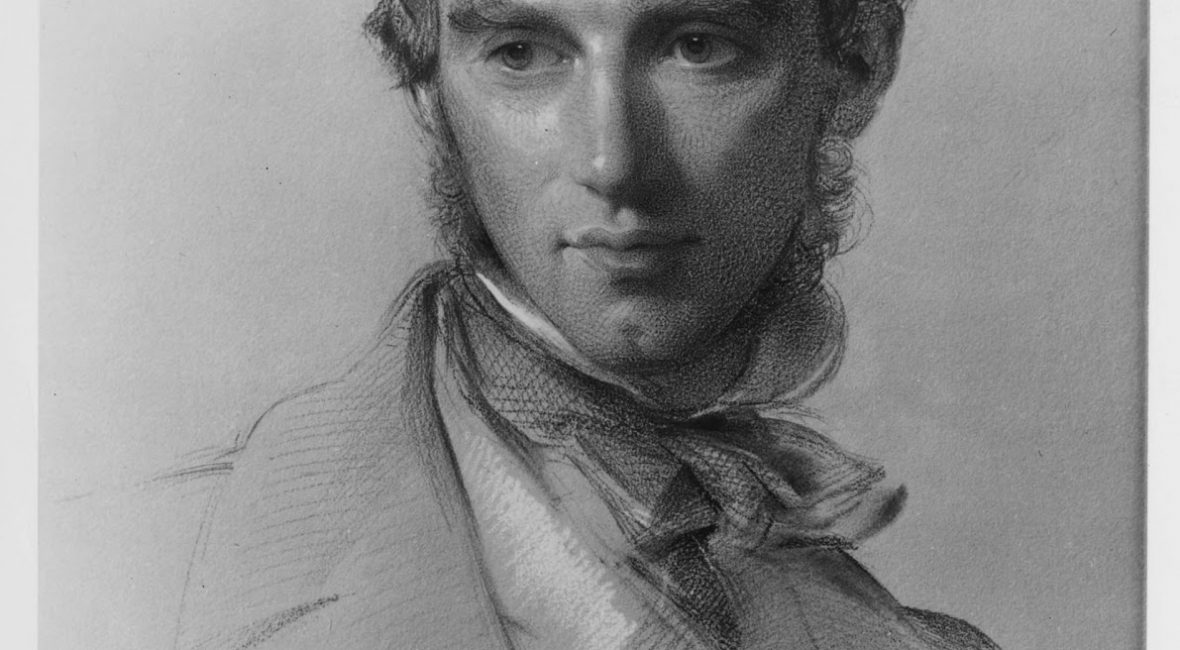
Sir Joseph Dalton Hooker as a young man. Chalk portrait by George Richmond, 1855.

As part of Kew’s celebration of this important event, the Joseph Hooker Correspondence Project is pleased to announce that Hooker’s Antarctic Journal, the unpublished manuscript documenting his first major expedition, is now available online through our partner Biodiversity Heritage Library.

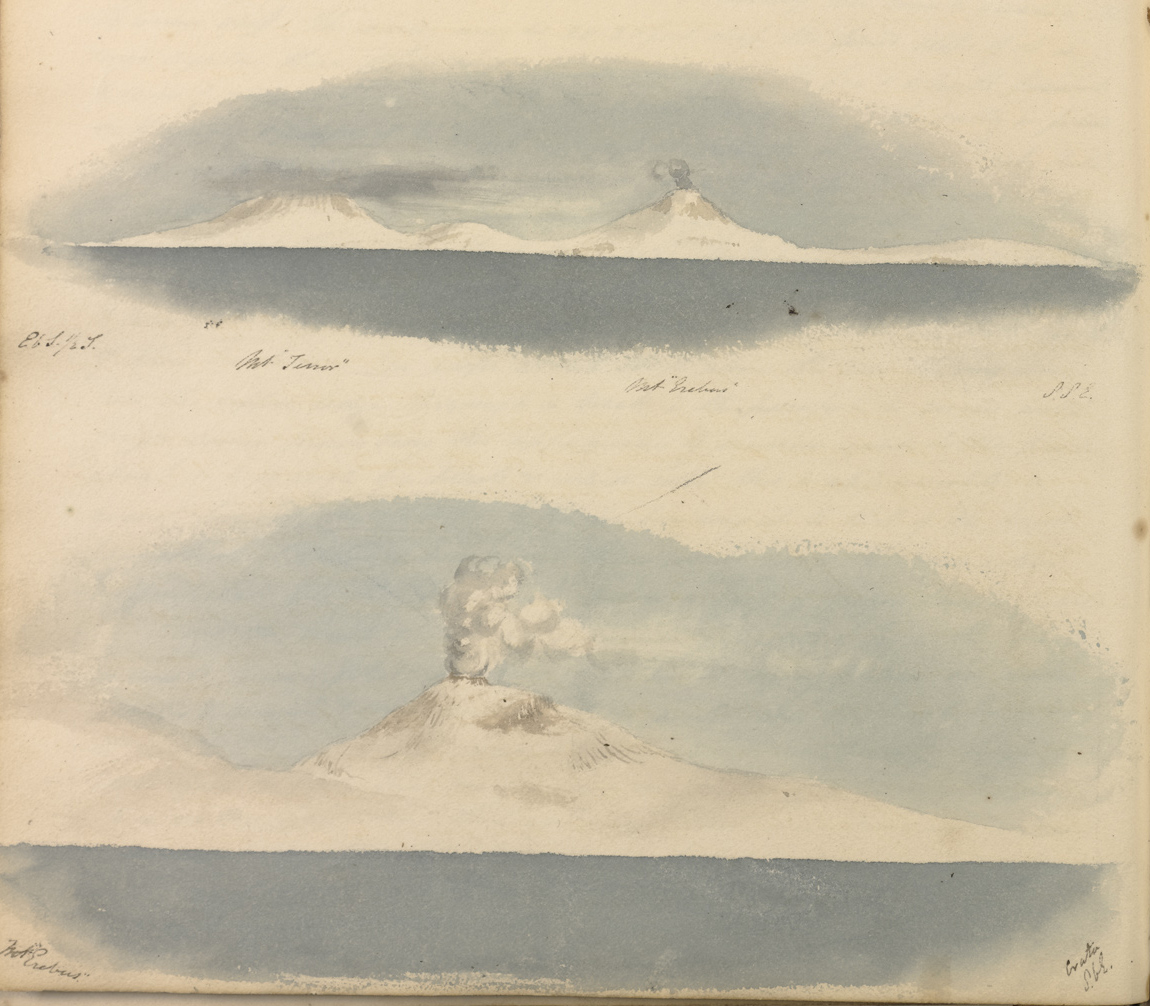
Hand written, the Journal is over 200 pages long and provides a detailed account of Hooker’s time as Assistant Surgeon on the HMS Erebus as part of Ross’s expedition to the Antarctic (1839-1843). The Journal also contains numerous pencil and watercolor sketches of the sights Joseph Hooker encountered during his 4 year adventure and provides important evidence for Hooker’s earlier interest in botanical science.

The voyage to the Antarctic was Hooker’s first botanical expedition and he was aged just 22 on departure. The expedition lasted for four years, spending the winter months in New Zealand and Tasmania and then voyaging around the Antarctic continent during the summer months. The observations Hooker recorded in this journal and numerous other notebooks formed the basis of a flora of Antarctica and also of the wider regions visited.

View Full Size Image
Watercolour sketches of Mount Erebus and Mount Terror, names for the two ships that were part of the Ross expedition. The volcanos were first sighted on the 28th January 1841.

The Journal records much of the detail of Hooker’s time during the voyage and provides valuable insight into his scientific practices on board but also the day to day routine of the journey from the mundane to the hazardous. It also records Joseph’s feeling about the unique land and seascape of the region and the botanical discoveries he was making, which often left him awestruck. On a more whimsical note he also records the necessity for acquiring a taste for penguin soup, as the animals were the only source of fresh meat and were kept live on ship.

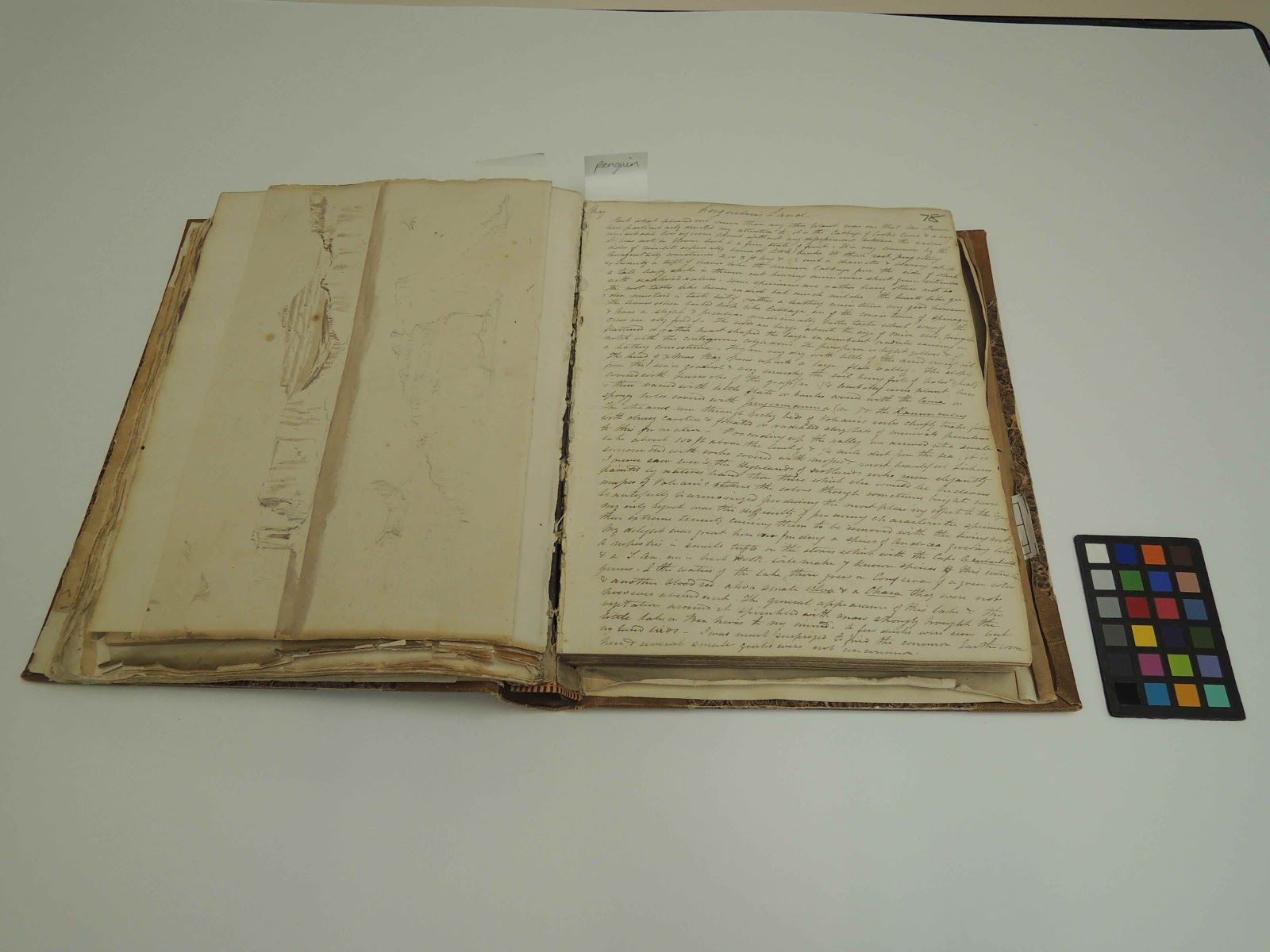
As part of the project to digitize the Journal, we have also assessed its conservation needs and undertaken necessary repairs and rehousing to ensure the long-time safety of this invaluable item. Prior to digitization, it was agreed that the early 20th century binding that housed the journal was not suitable and should be removed.

View Full Size Image
The Antarctic Journal during its assessment of what conservation it would need.

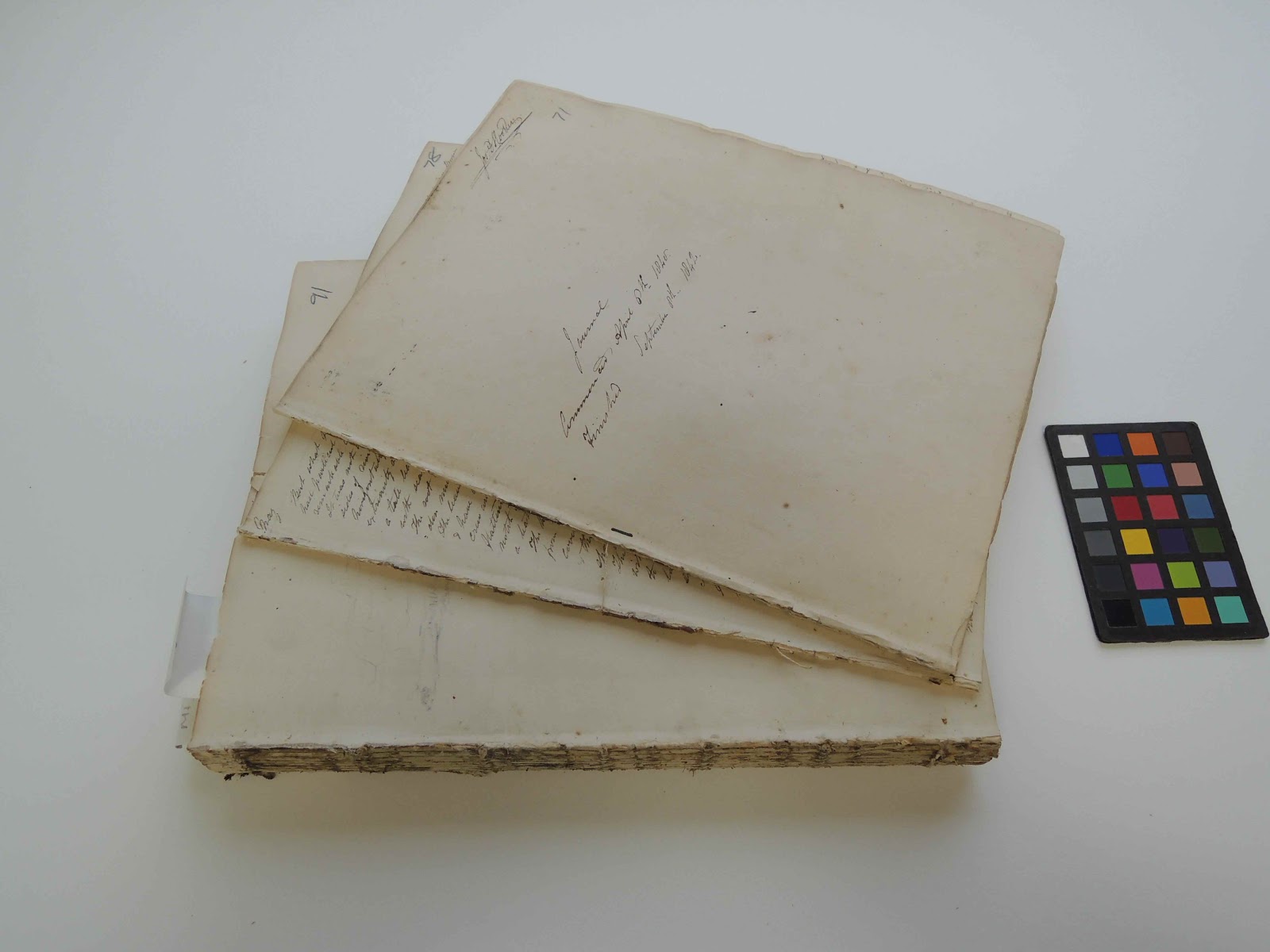
Once the binding was removed, it was discovered that the Journal was actually made up of a number of ‘volumes’ and certain pages had become loose.

View Full Size Image
The Journal unbound showing the different ‘volumes’ or ‘parts’ contained within the 20th century binding.

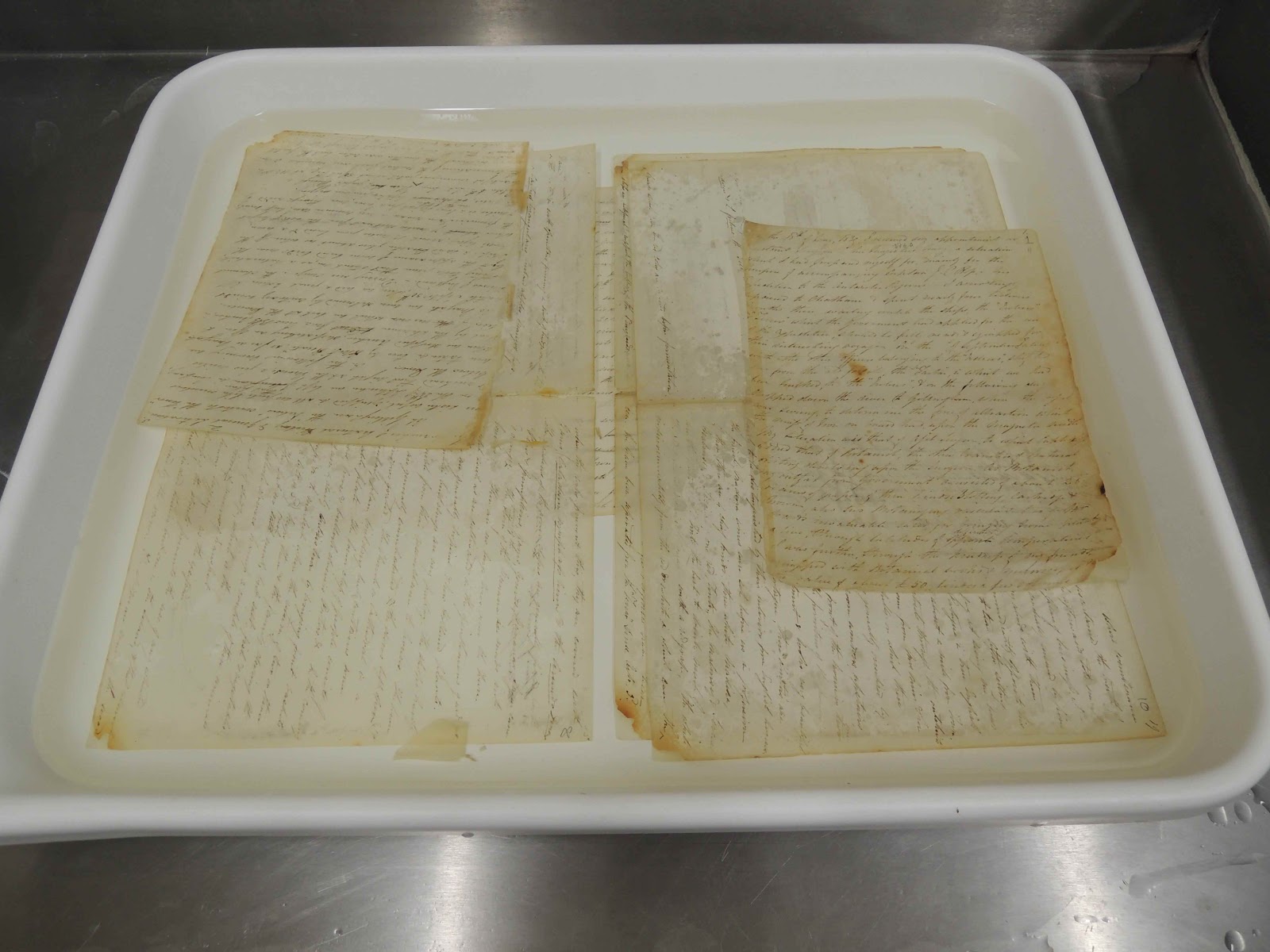
A number of the pages were also treated to stabilize the ink in a ‘bath’ to allow for more extensive repair work to be undertaken.

View Full Size Image
Pages from the Journal being treated to stabilize the ink.

Following this initial stage of the conservation, the Journal was digitized in preparation for its inclusion in the BHL online catalogue. It is hoped that by making the Journal freely available, a wider audience will be able to appreciate the important and valuable information contained in this unique item. This also speaks directly to the aims of the Joseph Hooker Correspondence Project, which is working to make Joseph Hooker’s correspondence freely available through the Project’s online portal.

We are now organizing for the Journal to be rebound sympathetically to its needs and in light of it being one of our most referenced Archival items here at the Royal Botanic Gardens, Kew.

We would like to thank Frederik Paulsen for supporting the conservation and digitization of Joseph Hooker’s Antarctic Journal and for helping to make it publicly available through the Biodiversity Heritage Library.

Related Links 

Joseph Hooker’s Antarctic Journal
View Joseph Hooker’s correspondence online
Kew Library, Art and Archives department
Joseph Hooker Correspondence Project

June 28, 2017by ulib-libraryjobs
Blog Reel, Featured Books

A Pot of Basil in Every Household

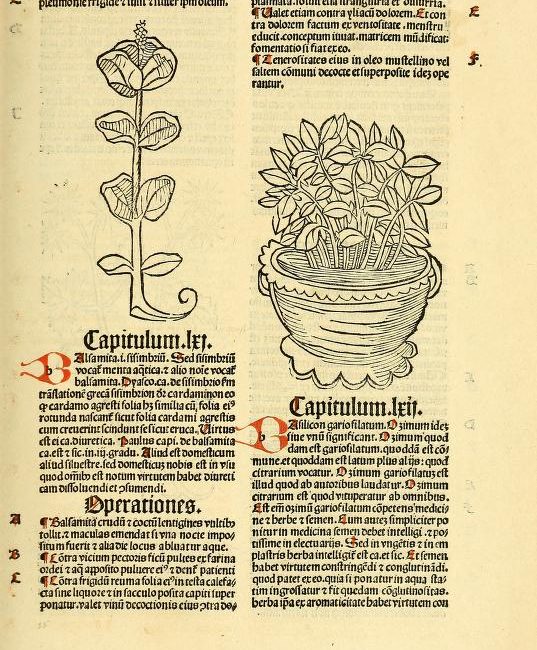
In Johann Prüss’ late 15th-century herbal, Ortus Sanitatis (Garden of Health), a bushy basil plant is portrayed growing in a decorative container. The book, a popular pharmacopoeia of various remedies drawn from ancient and medieval authors, was intended to be practical. The woodcuts are somewhat stylized and simple, meant to be easily identifiable to readers such as a doctor, apothecary, spice merchant, monk, or household member.

This was a manual for ready reference at a time when literacy was not common and earlier written descriptions alone were found to be inadequate. For instance, the all-important roots of the peony, used for infantile epileptic seizure, jaundice, stomach-aches, and kidney and bladder problems, are emphasized rather than its beautiful, fragrant blossoms.

At the time, basil was applied to a number of ailments, including convulsion, deafness, diarrhea and constipation, gout, impotency, colic, and nausea. So is it significant that basil was illustrated in a pot? Medieval and Renaissance art is full of plant symbolism. Or is this portrayal simply a charmingly unexpected domestic detail?
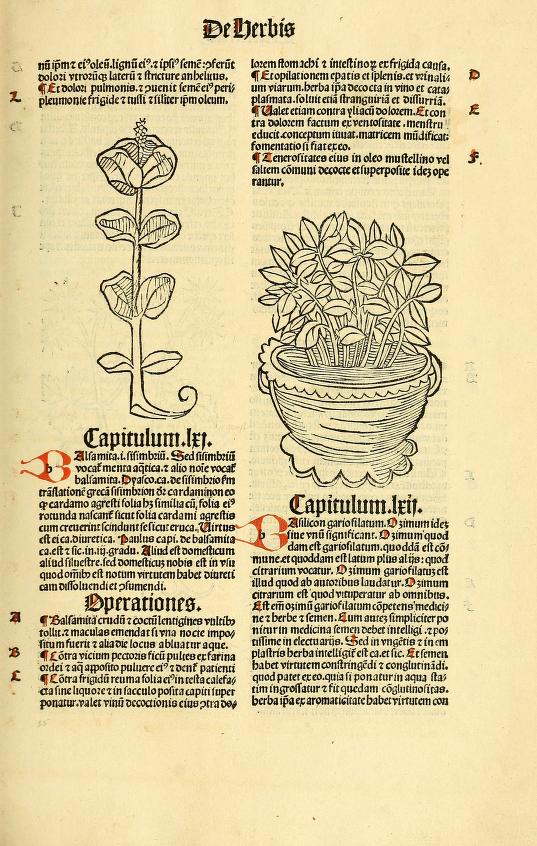
View Full Size Image
Ortus Sanitatis. 1497. Digitized by Smithsonian Libraries. http://www.biodiversitylibrary.org/page/40535862.
Medieval herbals ascribed healing or poisonous ‘virtues,’ the natural properties of plants. Basil is one plant of the garden full of associations, both good and bad, sometimes contradictory. And a pot of basil has a long and colorful history.

Sweet basil (Ocimum basilicum) is an herb of the mint family Lamiaceae. It is native to parts of Asia and Africa. The name may be derived from the Greek βασιλικόν φυτόν (basilikón phutón)—royal or kingly plant. While many culinary authors and cooks consider basil the “king of herbs” for its versatility and dominance in the kitchen (particularly in Italian, Thai, Vietnamese and Laotian cuisines), it long has had royal and religious associations. Ocimum sanctum(holy basil or tulasi) is sacred in the Hindu religion, though not used much in Indian dishes. In Christianity, the herb came to be associated with the Feast of the Cross, celebrating the finding by St. Helena, mother of Emperor Constantine, of the True Cross in a patch of basil.

Ancient Greeks believed basil must be sowed with words of abuse in order to thrive. In both Eastern and Western societies the herb has been associated with death. In ancient Egypt it was applied in embalming rituals. It is also an herb much connected with love and fertility rites, and has been seen as a source of erotic powers. Or, conversely, a sprig of basil would whither in the hands of the impure.

In late Medieval and Renaissance Italy, basil in a pot was a sexy thing: on a windowsill alerts a lover that the lady of the house is available to be entertained. Or, in some accounts, such as in the early 15th-century risqué tales of Sienese Gentile Sermini, its sudden removal was the signal it was safe to come on in. Apparently in some parts of present-day Southern Italy, a family notes the presence of an eligible, virginal daughter by a basil pot in the window.
View Full Size Image
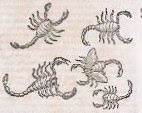
Scorpions. Woodcut from Conrad Gessner, Historia animalium. Liber 2, 1586 (BHL link here)
View Full Size Image
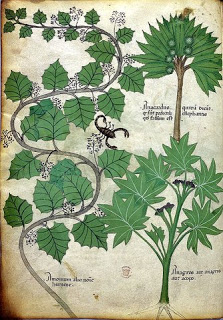
Plants and a Scorpion, in “Herbal” Manuscript folio 3v (Lombardy, Italy, around 1440). British Library Sloane 4016. This illustration indicates that a sting from a scorpion may be soothed by plants.

The Latin basiliskmeans dragon, mythical deadly reptile or serpent, sprouting legends of basil with scorpions. The arachnid with the venomous stinger was said to be bred out of mishandling the cultivated species of Ocimum. Scorpions were believed to favor hiding under a pot of basil, or that a spring of basil under a pot would turn into a scorpion. The Smithsonian’s Floyd W. Shockley, Collections Manager (and scorpion expert) in the Department of Entomology of the National Museum of Natural History, points out that the cool dark underside of the pot is a natural place for scorpions to rest, accounting for their presence and not a particular attraction to the basil.

In the pharmacopoeia on herbal medicine from the surviving writings of the ancient Greek physician and botanist Dioscorides, De Materia Medica, basil is prescribed for application to bites of the sea dragon or stings of the scorpion. Dr. Shockley notes there is some evidence that basil is effective in soothing scorpion stings and that the essential oil in the plant is anti-inflammatory and has pain-relieving enzymes. The plant would work to soothe the bites and stings of many arthropods, but ancient medicinal practitioners really focused on the scorpion relief aspect. Dioscorides observed that Africans would ingest the herb as a preventive measure against the pain of a sting. John Gerard in his famous 16th-century herbal repeated this belief but reported that, as did the 2nd-century physician Galen, basil should not be eaten.

Gerard in the Herball, or Generall Historie of Plantes of 1597, declared “The smell of Basil is good for the heart … it taketh away sorrowfulnesse which commeth of melancholy and maketh a man merry and glad.” Nicholas Culpeper in the 17th century wrote: “And away to Dr. Reason went I, who told me it was an herb of Mars, and under the scorpion, and, perhaps therefore called basilican, and it is no marvel if it carry a kind of virulent quality with it.” And, noting the differing portrayals of the plant: “This is the herb which all authors are together by the ears about and rail at one another (like lawyers).”
View Full Size Image
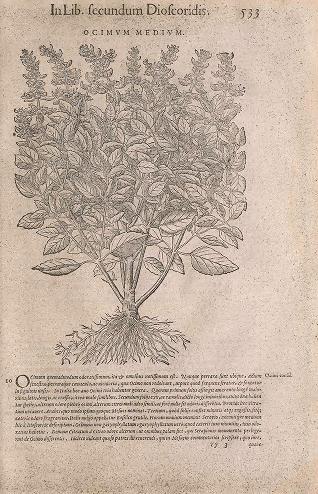
Illustration of one type of basil in the Smithsonian Libraries’ 1565 edition of Mattioli (BHL scan here)

Much of ancient plant folklore was dismissed by Pier Andrea Mattioli (1501-1577) in his commentaries on Dioscorides, Di Pedacio Dioscoride Anazarbeo Libri cinque Della historia, et materia medicinale. The work first appeared in 1544, with illustrations in the 1554 edition, and became the most influential Italian herbal of the 16th century.

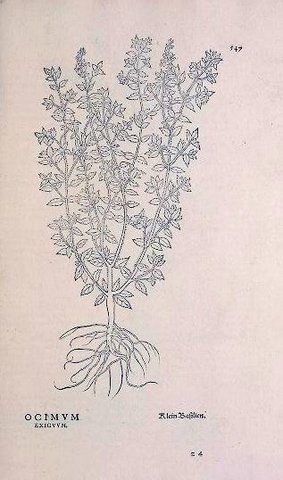
A medical doctor and botanist, born in Siena, the perennially grumpy Mattioli provides the delightful contemporary observation that basil was found to be growing in every Italian household, often in a pot placed by a window or in the garden. However, the finely cut illustrations in his herbal are without any whimsy such as a container. Likewise, Leonhart Fuchs’ splendid De Historia Stirpium (1542) notes this domestic element and illustrates different types of basil, including the roots, leaves, stems, and flowers. These publications are products of the Renaissance, knowledge drawn from direct observation and not legend, although much of the texts still rely on Dioscorides.
View Full Size Image
Fuchs: “Women everywhere raise Ocimun in clay pots on windowsills of their homes, also in gardens.” Smithsonian Libraries’ copy scanned by BHL (link here)
Fuchs wrote that ozimumis Greek for fragrant. Basil has highly aromatic leaves and placed in a pot would serve to sweeten the air. Royal apothecary and botanist John Parkinson in Paradisi is Sole Paradisus Terrestris(1629) wrote that basil was sometimes used in nosegays and made “sweet or washing waters.” (Boston Public Library copy). In the home, the herb acted to keep flies out. Basil is, of course, sensitive to cold temperatures and planted (in Northern Europe) in a container would allow for easy moving to a warm shelter.

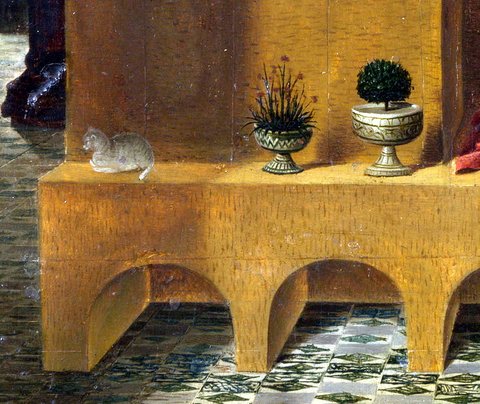
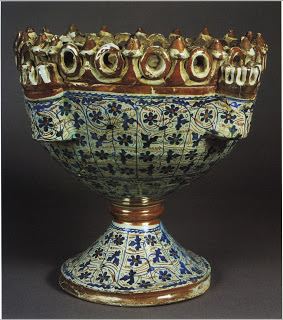
There are surviving examples of actual 15th-century basil pots, known as alfabeguer (derived from the Arabic word for sweet basil). These decorative containers were imported from Valencia, supplying a demand for this luxury item throughout Europe. In the Rothschild collection at Waddesdon Manor is a beautiful one, decorated in lustre and blue, dating from 1440 to 1470.
 

View Full Size Image
The Rothschild Alfabeguer (this and other illustrations of basil pots here).


View Full Size Image
Detail of Antonello da Messina’s “St. Jerome in his Study,” of alfabeguers (and kitten) approximately 1475 (National Gallery, London)
There is an earlier recording of basil pots used as decoration or furnishing in a home, and readers of Prüss’ herbals may have picked up on the allusion. In Giovanni Boccaccio’s The Decameron (Day IV, Novella 5) of approximately 1353, is the story of Lisabetta and Lorenzo. The lady’s three brothers murdered the lowly born Lorenzo to thwart the forbidden love between the servant and their sister. They buried the corpse in a location that came to her in a dream. Lisabetta dug up the grave, decapitated the head, and, returning home:
There she shut herself up in her room with the head, and kissed it a thousand times in every part, and wept long and bitterly over it, till she had bathed it in her tears. She then wrapped it in a piece of fine cloth, and set it in a large and beautiful pot of the sort in which marjoram or basil is planted, and covered it with earth, and therein planted some roots of the goodliest basil of Salerno, and drenched them only with her tears, or water perfumed with roses or orange-blossoms. And ‘twas her wont ever to sit beside this pot, and, all her soul one yearning, to pore upon it, as that which enshrined her Lorenzo, and when long time she had so done, she would bend over it, and weep a great while, until the basil was quite bathed in her tears.”

The basil thrived with this fertilization and watering, but the distraught Lisabetta did not: the evil brothers discovered poor Lorenzo’s head in the flowerpot and stole it away. She died from further grief.
View Full Size Image
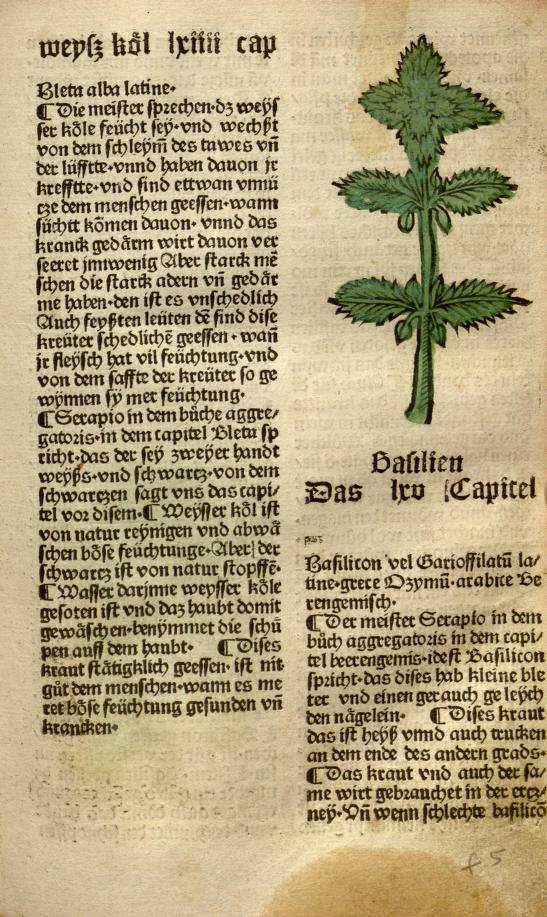
A more typical illustration of basil from an earlier period, showing the plant truncated. The Smithsonian Libraries‘ Gart der Gesundheit [Ulm?: Konrad Dinckmut?, 1487?], often attributed to Johannes von Cuba. The Missouri Botanical Garden’s copy has been scanned by BHL (link here).


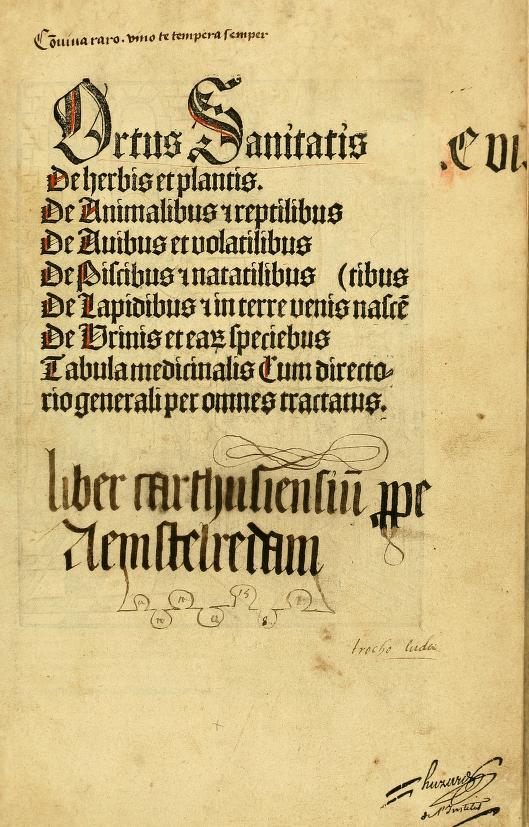
A version of Peter Schöffer’s Ortus ([H]ortus) Sanitatis(1485) was published in 1491 by Jacob Meydenbach of Mainz. Some of the more than a thousand small illustrations were copied rather crudely from Der Gart der Gesundheit (also of 1485), which itself was based on the Latin Herbariusof 1484 (Missouri Botanical Garden copy in BHL). Although there is an occasional genre scene (such as laborers) and landscape setting sprinkled throughout these early printed herbals, most of the plants are simply shown cut off at the stem. The first of Prüss’ editions of Meydenbach’s Ortus Sanitatis, printed in Strasbourg in 1497, is the Smithsonian Libraries’ copy which has been scanned for the Biodiversity Heritage Library.

View Full Size Image

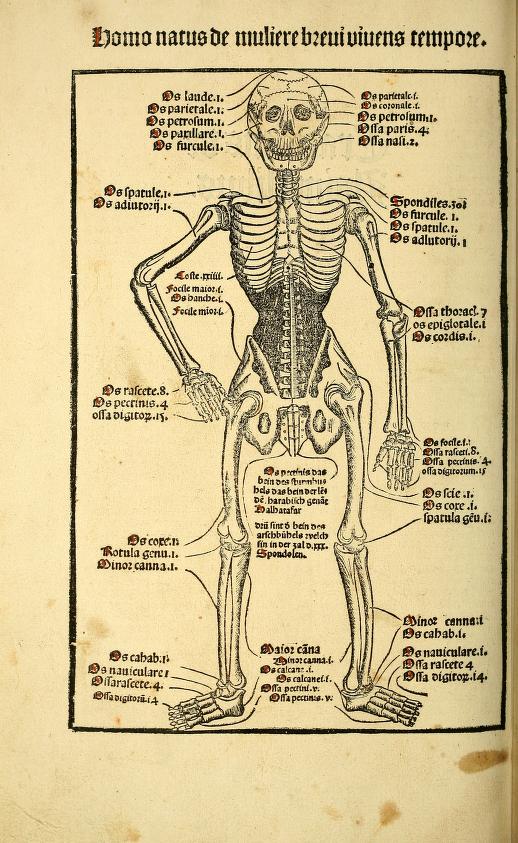
A pot of basil: may this be symbolic or practical, whether signifying divine or earthly love, used as a culinary ingredient or insect repellent, to soothe a sad soul, or just a convenient place to store a lover’s severed head. The iconography of the image in printed books, manuscripts and paintings is yet to be fully explored. The bibliography of early printed herbals—endless editions, translations, fragments, versions, and reuse and copying of woodcuts—is a complex and difficult task to sort out. But the increasing number of scanned early herbals in the Biodiversity Heritage Library allows for easy exploration of these extremely rare works. Perhaps Prüss’ Ortus Sanitatis has a unique basil pot because of an inventive author/illustrator. The book does contain a woodcut of the human skeleton, the first appearance of one in an herbal.

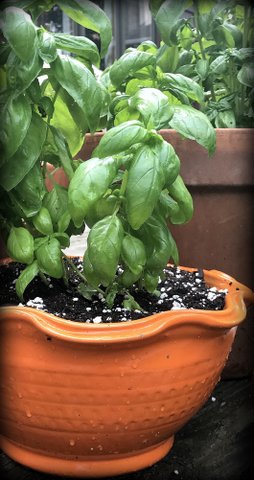
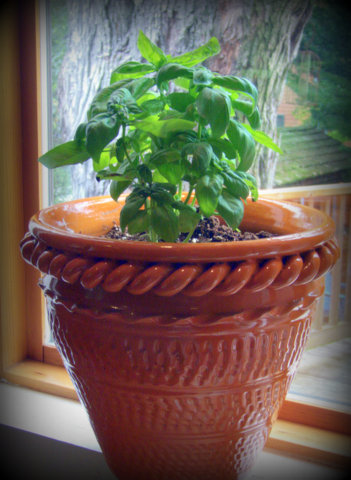
Should you happen upon any, please send me your finds of illustrations of basil in a pot. Or, a picture of the herb growing in a container on your windowsill.
View Full Size ImageView Full Size Image


View Full Size Image

Notes

View Full Size Image
What is old is new again: basil oil from the local grocery store.
The first printed herbal to have illustrations is Macer Floridus’ De Viribus Herbarum (Milan, 1482).
Di Pedacio Dioscoride Anazarbeo Libri cinque Della historia, et materia medicinale first appeared in 1544. It was soon reprinted many times in a variety of languages; there are several of these editions in the Smithsonian Libraries and many digitized versions in the Biodiversity Heritage Library (link to one here).
Blunt, Wilfrid and Sandra Raphael. The Illustrated Herbal. New York: Thames and Hudson, 1994.

Ray, Anthony. “The Rothschild ‘Alfabeguer’ and Other Fifteenth-Century Spanish Lustred ‘Basil-Pots’,” The Burlington Magazine, vol. 142, no. 1167 (June 2000), pages 371-375 (link here).

Poet John Keats picked up the narrative in “Isabella or, the Pot of Basil” (1818). In turn, British painters of the 19th century, most notably by the Pre-Raphaelite William Holman Hunt, were greatly inspired by the story.
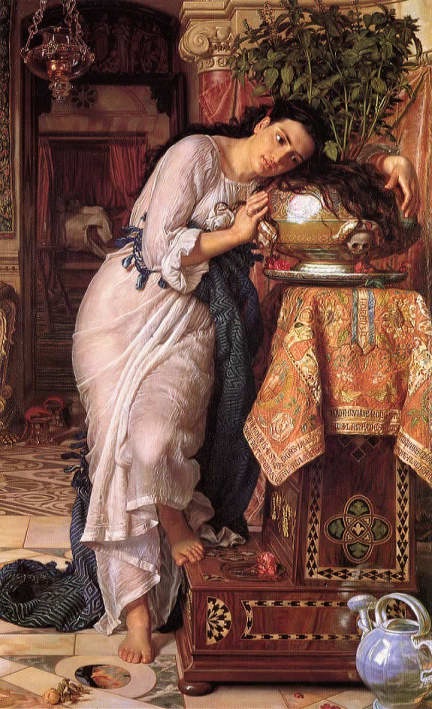
View Full Size Image
Painting of 1867, by William Holman Hunt. Laing Art Gallery, Newcastle upon Tyne, England (image from Wikimedia Commons)


She wrapp’d it up; and for its tomb did choose
A garden-pot, wherein she laid it by,
And cover’d it with mould, and o’er it set
Sweet Basil, which her tears kept ever wet.
…
And so she ever fed it with thin tears,
Whence thick, and green, and beautiful it grew,
So that it smelt more balmy than its peers
Of Basil-tufts in Florence; for it drew
Nurture besides, and life, from human fears,
From the fast mouldering head there shut from view:
So that the jewel, safely casketed,
Came forth, and in perfumed leafits spread.
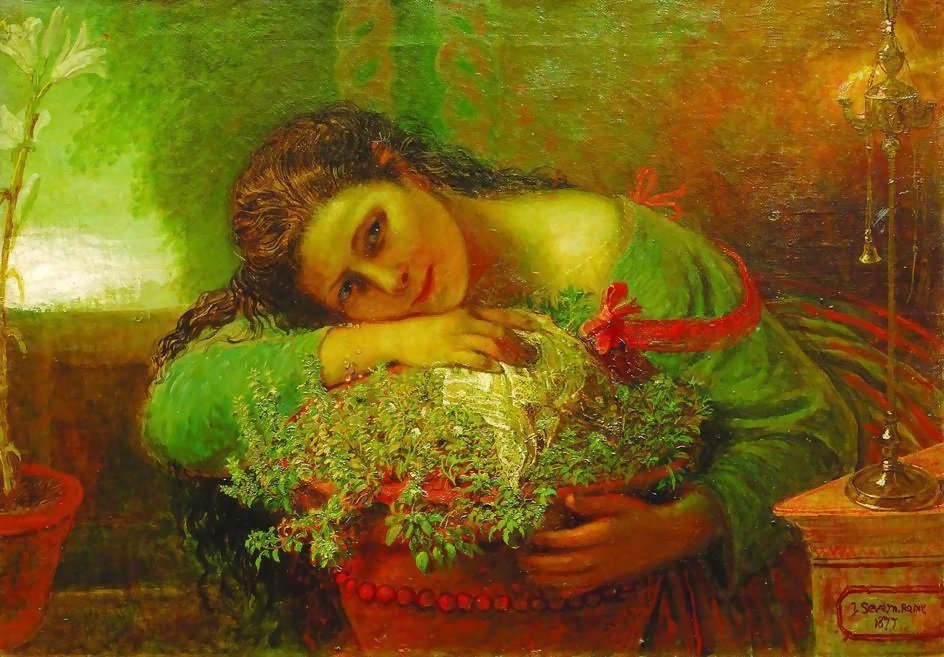
View Full Size Image
“Isabella, or the Pot of Basil,” painting by Joseph Severn (1793-1879), a close friend of Keats (image from Wikimedia Commons). Guildhall Art Gallery, London.
View Full Size Image
Ocimum basilicum ‘Genovese Verde Migliorato’. The only variety for proper pesto.


June 27, 2017by khage
Blog Reel, Campaigns, Featured Books

Celebrating Sir Joseph Dalton Hooker at 200

View Full Size Image

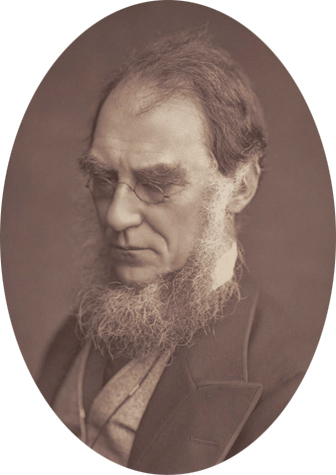
On the 30th June 1817, Joseph Dalton Hooker was born in Halesworth, Suffolk. The second child of William Jackson Hooker, Joseph would, during the course of his life, become a ‘botanical trailblazer’ – traveling across the globe to collect plants and theorizing on plant species diversity and geography. Joseph Hooker would also become Kew Gardens’ second and most illustrious Director, overseeing the establishment of the first dedicated botanical Laboratory at Kew, the Marianne North Gallery and the expansion of the Gardens’ herbarium and economic botany collections.

To celebrate the bicentenary of his birth this year, BHL is joining the Royal Botanic Gardens, Kew to highlight Hooker’s works and contributions to science. Follow #JDHooker2017 on social media this week (26-30 June) to learn more about J.D. Hooker and explore his publications and archival materials. You can browse his publications in the BHL book collection and see related artworks from those publications in our Flickr collection. Learn more about the BHL content here.

A special aspect of the campaign is Hooker’s archival material, which is being made available online thanks to Kew Gardens. Hooker was a prolific correspondent – writing to family, friends and colleagues up until his death in 1911. We are fortunate at Kew to hold an extensive archival collection reflecting both his personal papers – such as his letters to his family during his travels in India – and those created during his tenure as Assistant Director and then Director of Kew.

View Full Size Image

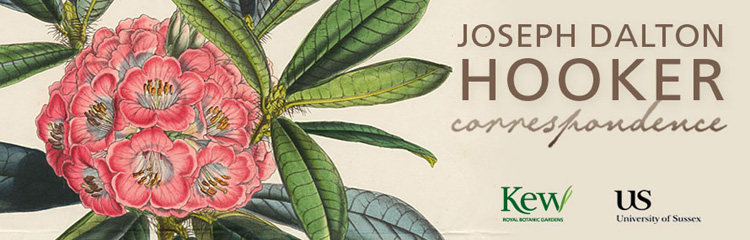
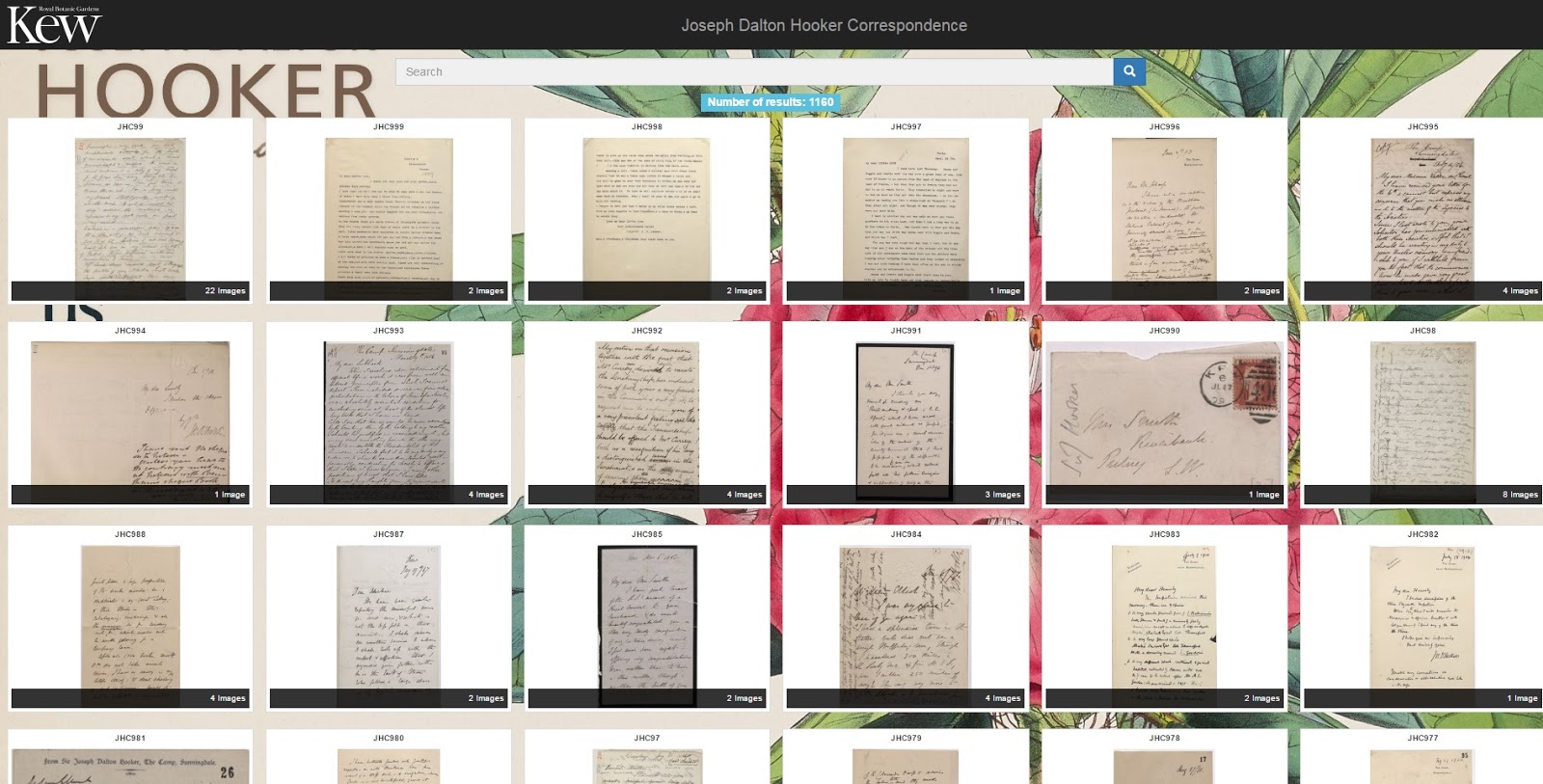
The Joseph Hooker Correspondence Project is currently working on digitizing and transcribing a large selection of Joseph Hooker’s correspondence, and we are delighted to announce that over 1,000 of his letters are now available to view online. This portal allows visitors to search the letters and, where available, read the summaries and transcripts of the letters. We also plan to release further letters and data in the coming months – so watch this space.

View Full Size Image
Joseph Dalton Hooker’s correspondence online.

Highlights of the current online collection are the letters written by Hooker to Charles Darwin, a long-time friend and confidant, as well as those to his family during his adventures in Antarctica and India. These letters provide wonderful insights into the hardships of botanical collecting and the trials of travel during the first half of the nineteenth century.

2017 is an important year for Kew as it marks the 200th Anniversary of Joseph Hooker’s birth. Not only is the correspondence project continuing to scan, transcribe and make publicly available the previously unpublished letters written by Joseph Hooker, but we are also working with colleagues from across the gardens and beyond with our partners such as BHL to further raise awareness of Hooker and his important work.

View Full Size Image

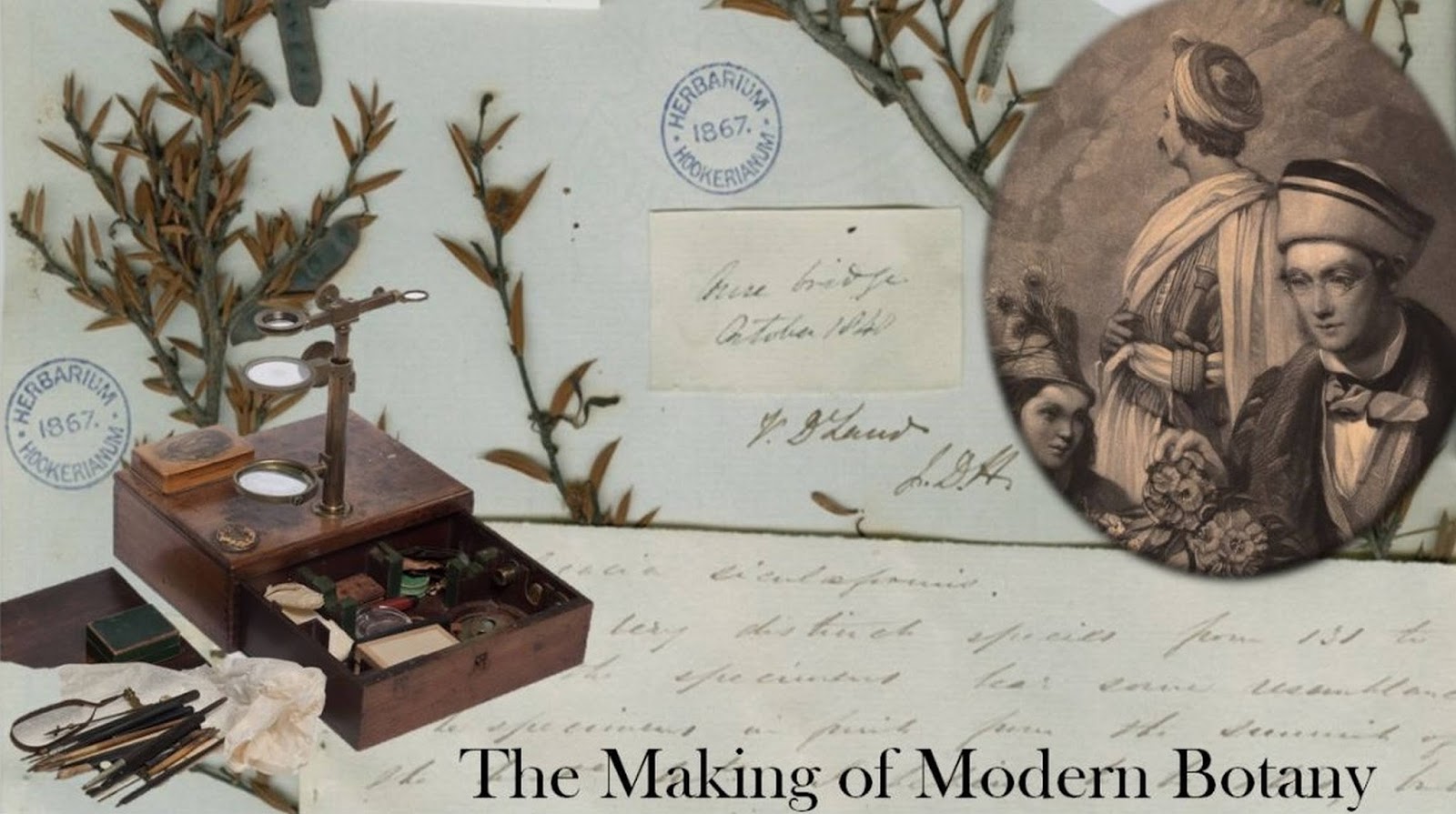
Kew will be hosting a conference celebrating the ongoing impact Joseph Hooker has had on modern botanical science. The ‘Joseph Dalton Hooker Bicentenary Meeting: The Making of Modern Botany’ will be held on the 30th June at the Royal Botanic Gardens, Kew and will bring together experts on subjects such as botanical illustration, Antarctic flora and botanical classification.

In addition to this conference, currently on display at the Shirley Sherwood gallery is the exhibition ‘Joseph Hooker: Putting plants in their place’, which brings together archival, three dimensional and illustrative material from the Kew collections to explore Joseph Hooker’s life and work. The exhibition will be open until the 17th September 2017 and various tours and talks are also being held.

View Full Size Image
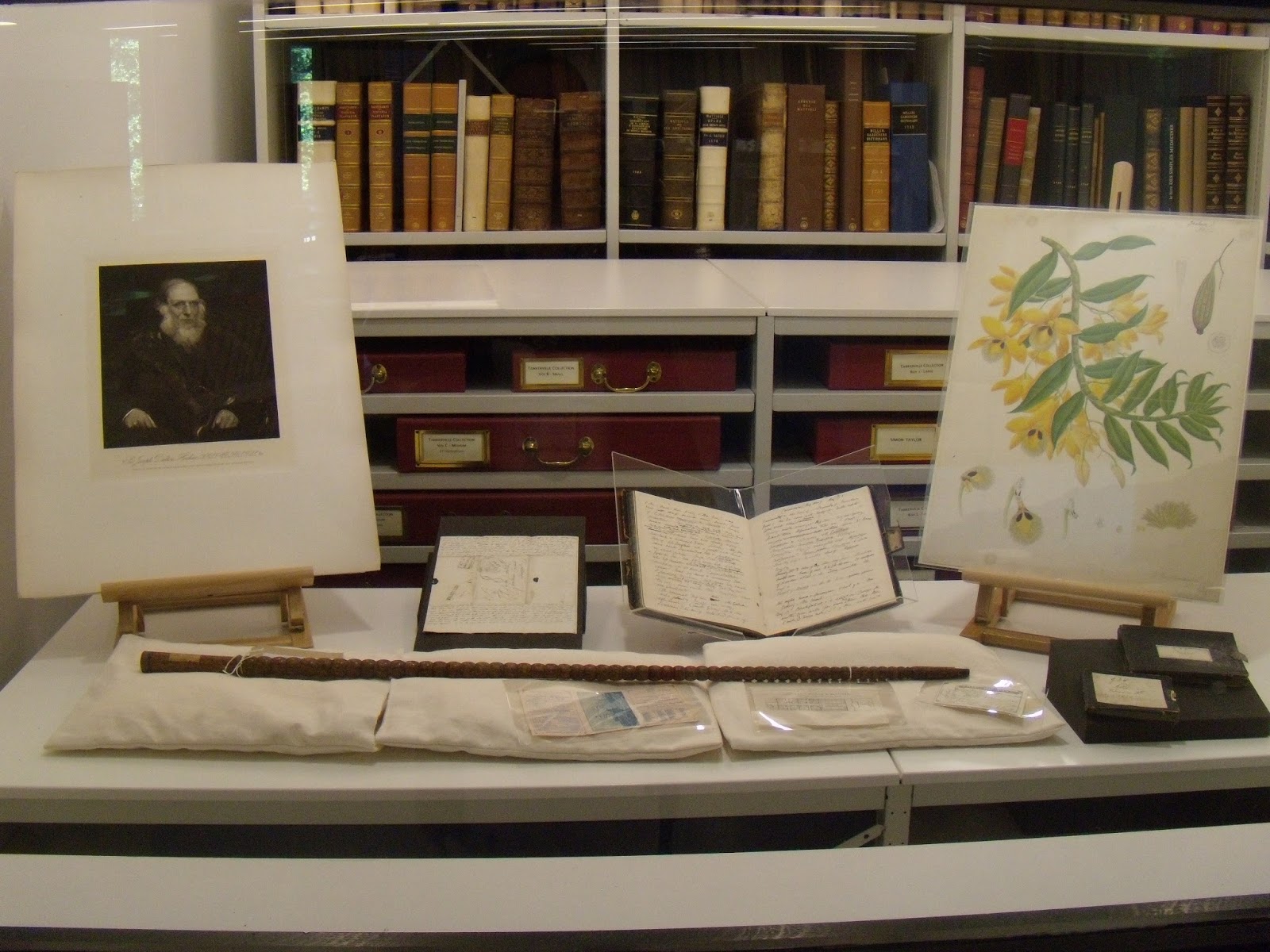
Selection of material on display on the Wolfson Reading Room at the Royal Botanic Gardens, Kew.

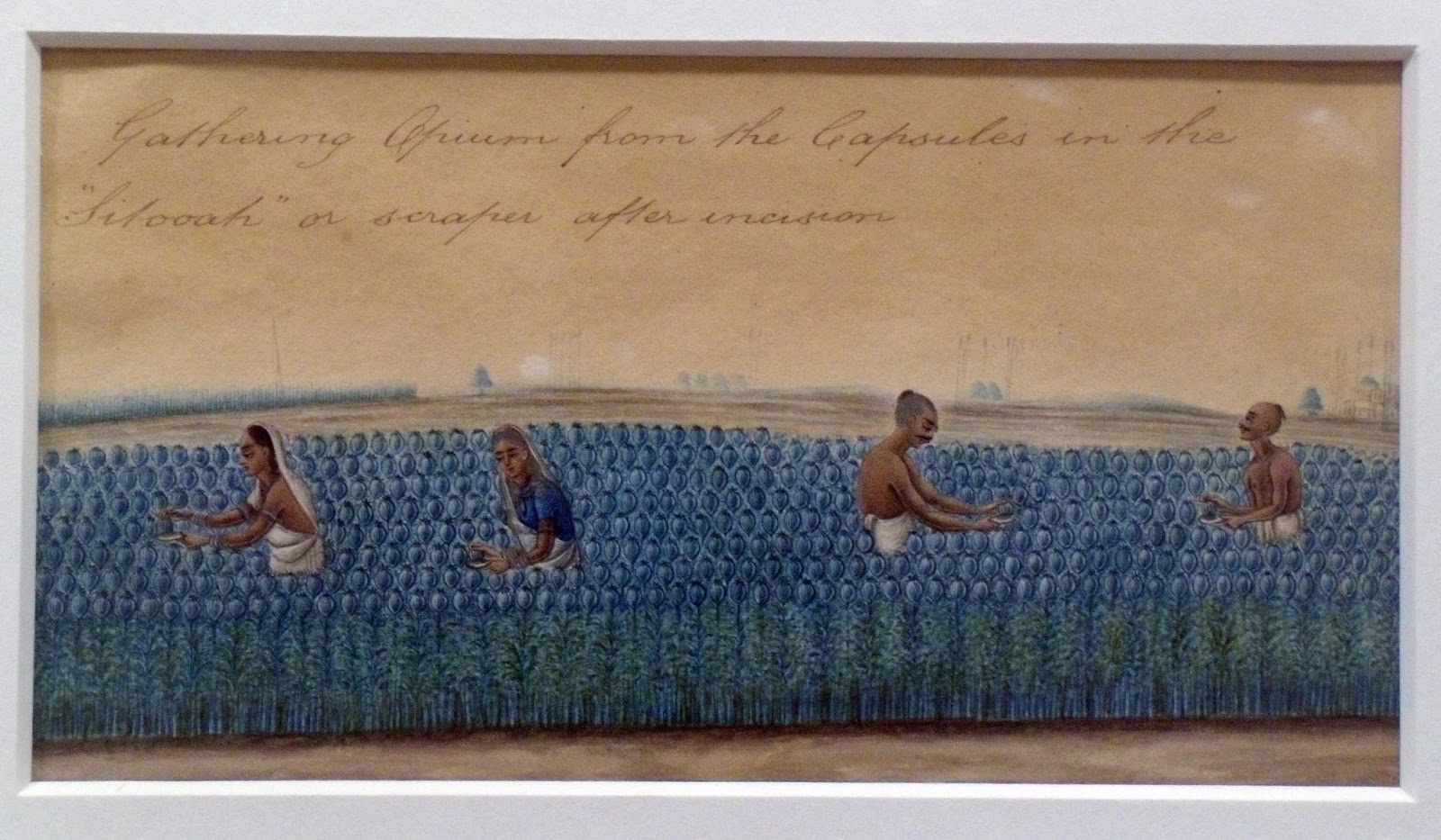
The Library, Art & Archives department has also prepared a display in the Wolfson Reading Room in the Herbarium, Library, Art & Archives building, which has just opened and is free to view. Drop in Monday-Friday 10am-4pm to see more material from our Historic Joseph Hooker collections, including material relating to his (entirely scientific!) interest in opium.

View Full Size Image
One of a series of illustrations depicting the cultivation and manufacture of opium. Collected by Joseph Hooker during his visit to the Patna opium manufactory in India in 1848.

In the gardens, the Kew volunteer guides will be providing walking tours, allowing visitors to find out how instrumental Joseph Hooker was in shaping botany and the landscape at Kew. On the weekend of the 1st and 2nd of July, the gardens will host a Joseph Hooker Bicentenary celebration with family activities, explorer’s camp and talks. The Shirley Sherwood Gallery will also be hosting a ‘Kew After Hours’ event on the evening of the 29th June. Further details of these events and others related to Joseph Hooker can be found on the main Kew website.

Further afield, the Botanic Survey of India has been hosting an exhibition on Joseph Hooker’s legacy in Indian botany. The exhibit is curated jointly with Kew staff and will shortly go on tour to other locations in India.

Visit the BHL website to learn more about the #JDHooker2017 campaign, and follow the hashtag all this week for more great highlights.

Related Links

Joseph Hooker Correspondence Project
View the Joseph Hooker letters online
Joseph Dalton Hooker Bicentenary Meeting: The Making of Modern Botany
Joseph Hooker: Putting plants in their place 
Walking tours around the gardens

June 26, 2017by ulib-libraryjobs
Blog Reel

The Serendipitous Discovery of Susan Fereday: A Story about the Impact of Citizen Science

View Full Size Image
Self Portrait, Susan Fereday. National Library of Australia. Source: WikiCommons.

I love volunteering for the Biodiversity Heritage Library. I taxo tag images in the BHL Flickr account. This assists the use of these images by BHL as well as other institutions that use BHL content. It is also my favorite way of exploring BHL. I get a real thrill out of the serendipitous discoveries I make while tagging.

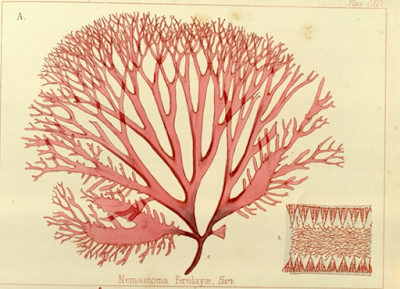
My most recent BHL adventure resulted from tagging an album of images from the boringly named but absolutely fabulous Botany of the Antarctic voyage of H. M. discovery ships Erebus and Terror in the years 1839-1843. Amongst the many images in this album was one of a particular species of seaweed – Nemastoma feredayae.

View Full Size Image
Nemastoma feredayae. Art by William Henry Harvey. The botany of the Antarctic voyage of H.M. discovery ships Erebus and Terror in the Years 1839-1843. http://biodiversitylibrary.org/page/28467702. Digitized by the Missouri Botanical Garden.

I tagged the image with the species name given, and then I attempted to confirm the current name of the seaweed. In doing so, I stumbled across the fact that the seaweed was named in honor of Mrs. Susan Fereday. Who was this mystery woman?

Unable to resist going down that rabbit hole, I googled her. I discovered that Susan Fereday emigrated to Tasmania, Australia from England in 1846. She was a talented artist. So talented, her artwork is now in the collection of the National Library of Australia. She concentrated on painting beautiful images of fauna and flora in and around the area where she lived.

View Full Size Image
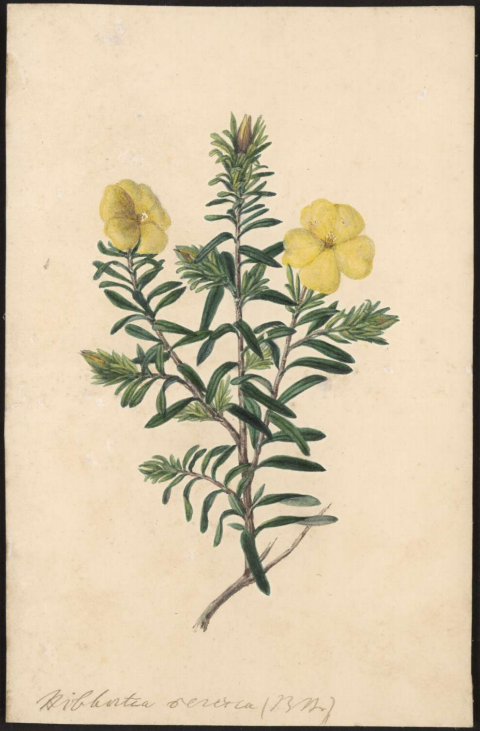
Hibbertia sericea by Susan Fereday. National Library of Australia. Source: WikiCommons.

She was also a keen collector of seaweed specimens. She corresponded with and sent specimens to one of the foremost experts in algae of the day, William Henry Harvey. Harvey in turn honored Fereday’s contribution to the study of algae by naming two species after her. It was the image of one of those species drawn by Harvey that I had tagged in the BHL Flickr feed.

View Full Size Image
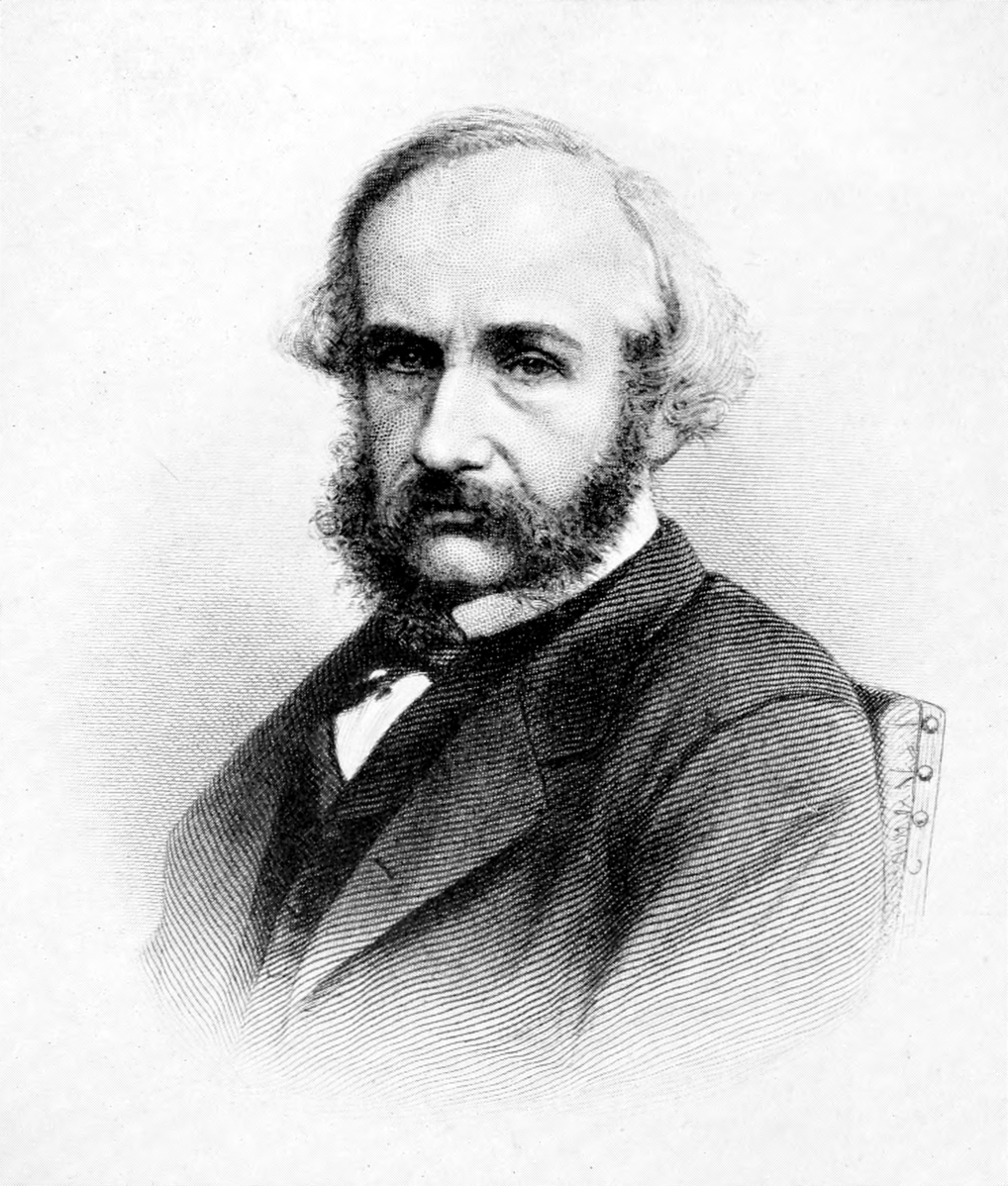
Portrait of William Henry Harvey. Oliver, F. W. (Francis Wall). Makers of British botany. (1913). http://www.biodiversitylibrary.org/page/1073575. Digitized by MBLWHOI Library.

While researching Fereday, I was disappointed to see she did not have Wikipedia page. Being a keen Wikipedian, I decided to rectify this. While drafting her article, I realized that several sources had different dates as her birth date. I emailed the National Library of Australia via their “Ask a Librarian” service to ask them to help me confirm that their records were correct.

I received a fabulously researched reply from Damien Cole, one of their librarians. He discovered that the birth date confusion was due to Susan Fereday having a sister of the same name, who had died prior to our Susan being born. Fereday was actually born in 1815! As a result of this research, the National Library subsequently edited their records to give Susan Fereday her birth date, and I obtained a reputable citation supporting that information for Fereday’s Wikipedia article.

The National Library of Australia has also shared the changes they made to their database with the Australian National Herbarium as well as Design and Art Australia Online. The Library even went so far as to contact the Encyclopedia of Australian Science to inform them of the Wikipedia article in the hope that that organization might also consider including Fereday in their website.

All of this resulted because the MBLWHOI Library (the Marine Biological Laboratory and the Woods Hole Oceanographic Institution Library) scanned the volumes on the Antarctic voyage of H. M. discovery ships Erebus and Terror and made them available to BHL. Because BHL added the images from those volumes to Flickr, I was able to tag them.

It just goes to show that when you mix citizen science with digitization and the ability to freely reuse content, everyone benefits.

I would love it if people joined me in taxotagging BHL Flickr images. Instructions can be found here.

Anyone can create or improve Wikipedia. For a beginner’s guide, see this article.

And if you think you can add to and improve Susan Fereday’s article, go for it!

May 23, 2017by ulib-libraryjobs
Blog Reel, Featured Books

George Engelmann’s Botanical Notes Can Now Be Seen!

The Missouri Botanical Garden (MBG), a partner in the Biodiversity Heritage Library Field Notes Project, has spent the last year digitizing the notebooks of George Engelmann.

George Engelmann assisted Henry Shaw, MBG’s founder, in establishing the Garden’s research arm and corresponding library. He arrived in Belleville, Illinois, sometime in the 1830s but soon moved to St. Louis where he set up practice as a physician. In the 1840s, Engelmann began corresponding with—and became a close friend and colleague of—Asa Gray at Harvard University, one of the best known botanists in the United States. This relationship, combined with his passion for plants of the newly opened American west, would lead to Engelmann becoming the principle coordinator for botanical collecting west of the Mississippi River.

View Full Size Image
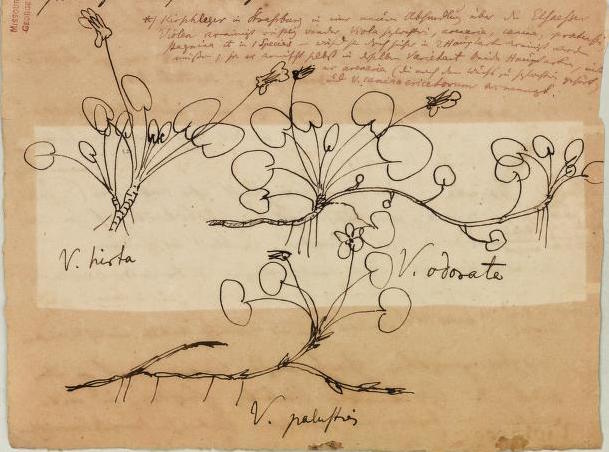
Figure 1 from notebook 1, folder 1. George Engelmann : botanical notebook 1. Cistaceae, Violaceae. [Undated].

Setting up a trifecta of American botanical exploration with Gray at Harvard and John Torrey at the Smithsonian, Engelmann became an avid and knowledgeable botanist as he corresponded with Gray and Torrey to direct various westward explorers. He collected over 98,000 botanical specimens which were donated to MBG upon his death. Combined with 62,000 botanical specimens purchased in 1857 for Shaw from the Bernhardi Herbarium, originally in Germany, these two collections formed the foundation of the MBG herbarium. Engelmann also helped establish the St. Louis Academy of Sciences.

The BHL Field Notes Project is the third time George Engelmann’s collection has been accessed for scanning. In 2010, MBG received a grant to complete a project called Digitizing Engelmann’s Legacy, and another in 2013 to digitize Engelmann’s correspondence. With this latest project, MBG is able to provide access to much of Engelmann’s botanical notebooks.

View Full Size Image
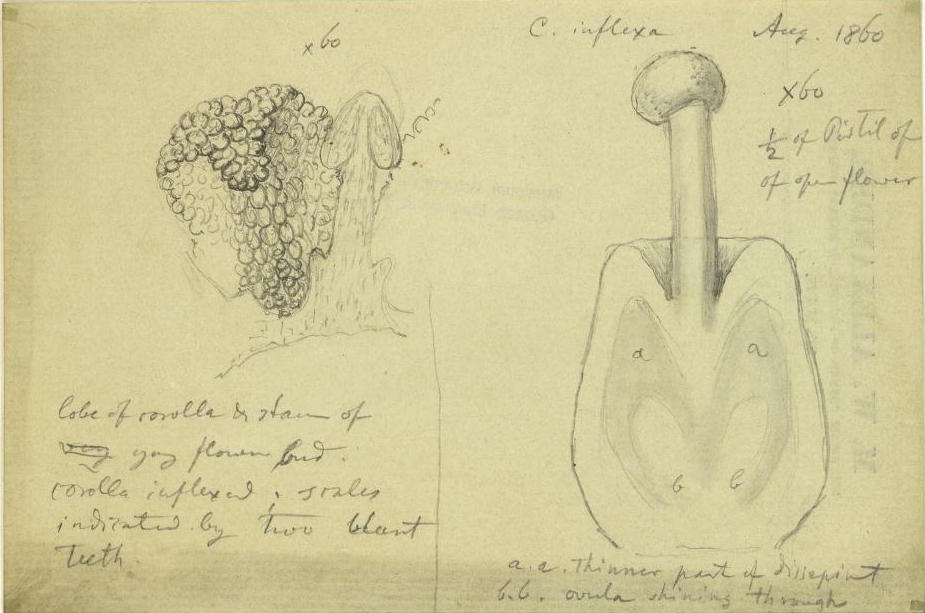
Figure 2 from notebook 25, folder 9. George Engelmann : botanical notebook 25 : Cuscuta. Box 11: Folder 9: Cuscuta. (1860-1875).

The notebooks were dismantled sometime in the past and housed within folders placed in boxes. His 58 notebooks are spread out over 27 boxes and comprise over 14,000 individual items. Not wanting to waste paper, Engelmann often wrote his notes on the back of correspondences, prescription slips, official documents, etc. Among his copious note taking are many botanical drawings likely depicting the specimens as he saw them.

Please feel free to browse Engelmann’s notebooks as they continue to be digitized and uploaded to the Biodiversity Heritage Library and Botanicus.

The BHL Field Notes Project is funded by the Council on Library and Information Resources (CLIR).

May 4, 2017by lmyrick
Blog Reel, Featured Books

We All Remember the Hessian Mercenaries….

View Full Size Image
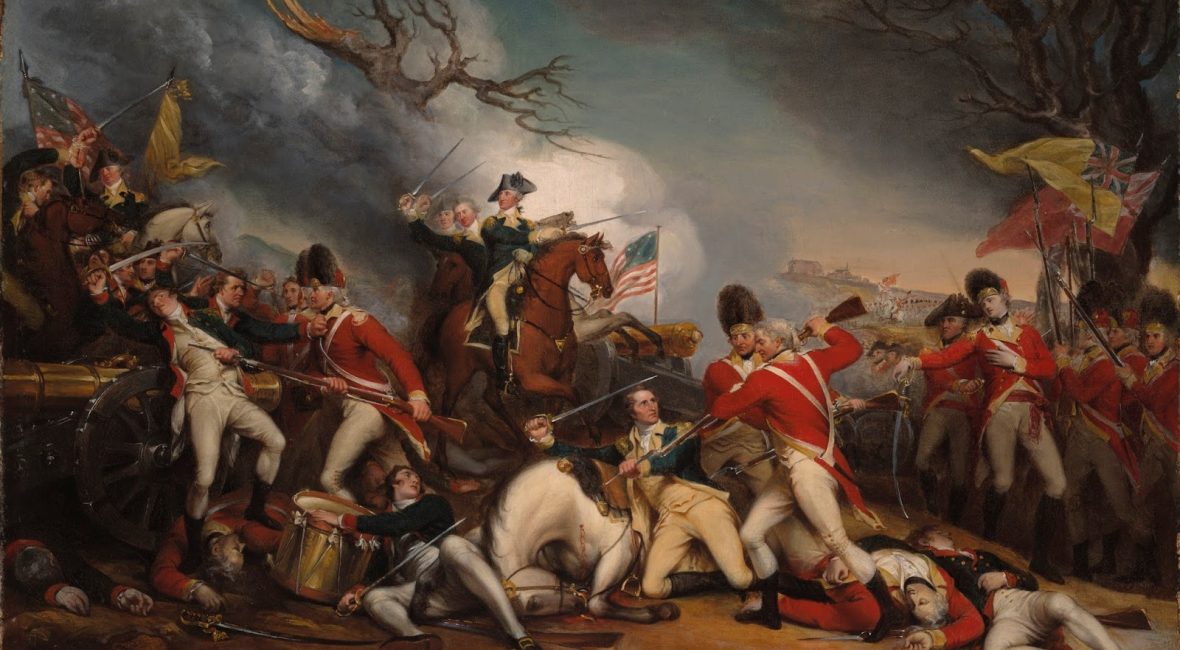
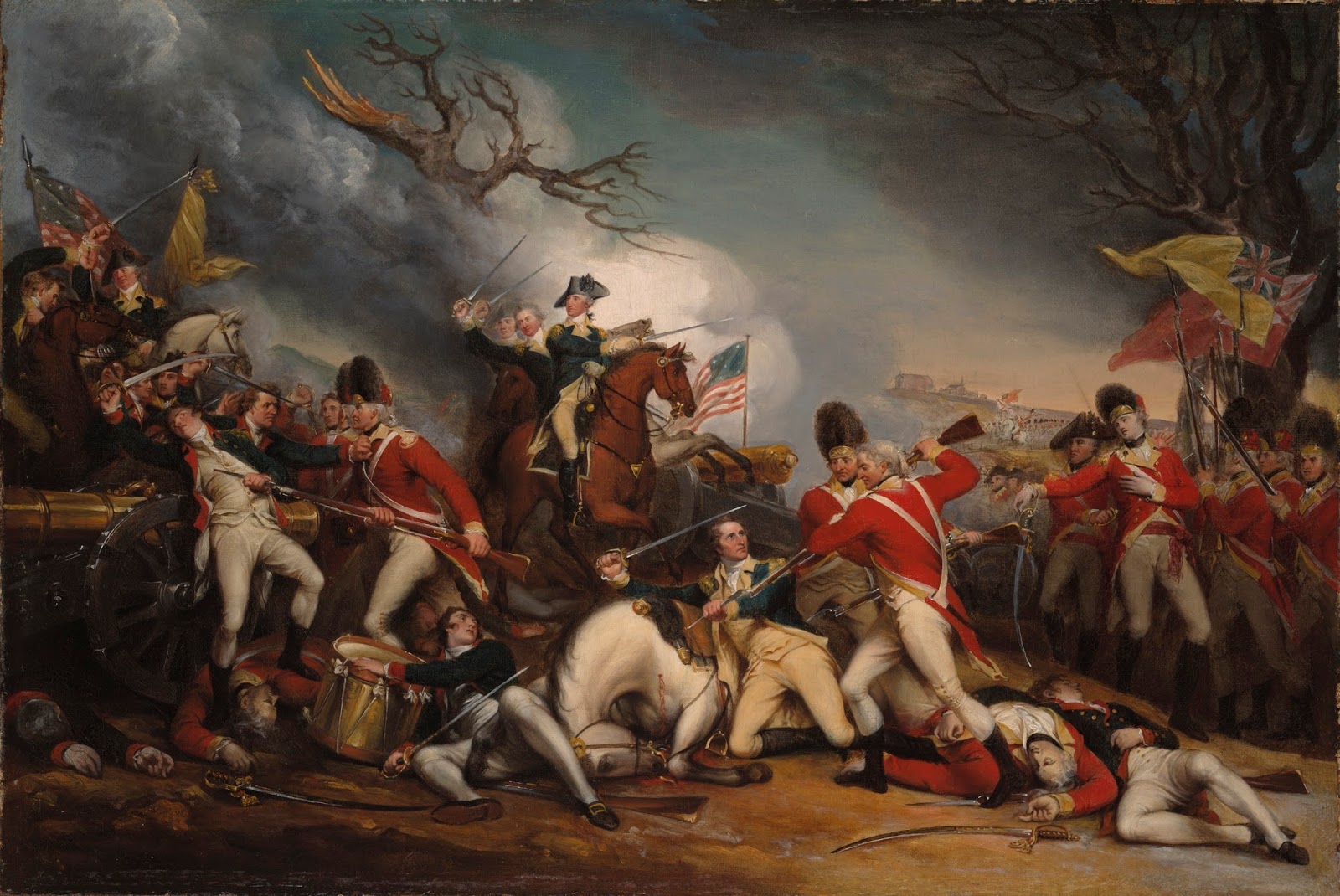
The Death of General Mercer at the Battle of Princeton, January 3, 1777. By John Trumbull. Depicting the death of the American General Hugh Mercer at the Battle of Princeton on January 3, 1777 during the American Revolutionary War. Source: Wikimedia Commons.

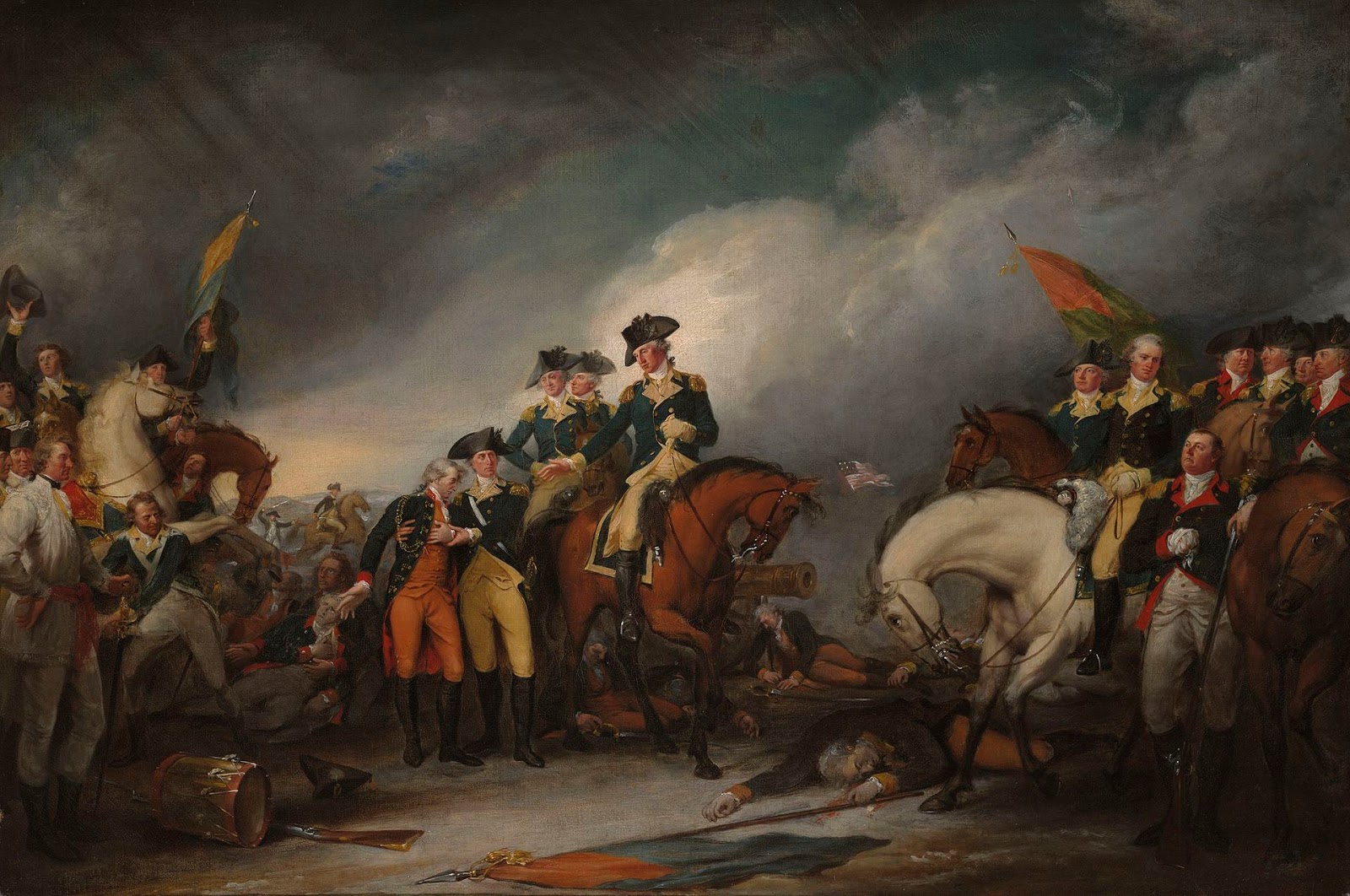
We all remember the Hessian mercenaries, those drunken, bayonet-wielding louts hired by George the Third to put down his rebellious American colonies. Every American schoolchild learns about these monsters, and how they suffered their come-uppance in Trenton in 1776, when their Christmas debauch came to an abrupt and bloody end in a battle their rum-blurred eyes never even saw coming.

View Full Size Image
The Capture of the Hessians at Trenton, December 26, 1776. By John Trumbull. Depicting the capture of the Hessian soldiers at the Battle of Trenton on the morning of December 26, 1776 during the American Revolutionary War. Source: Wikimedia Commons.

For over 200 years, we’ve painted the German soldiers in America with a mighty broad brush. I’m sure that there were barbarians among them, but there were also educated men who spent their time on this side of the Atlantic studying this exotic continent and its inhabitants—when they weren’t drinking and fighting and skewering patriot children, that is.

View Full Size Image
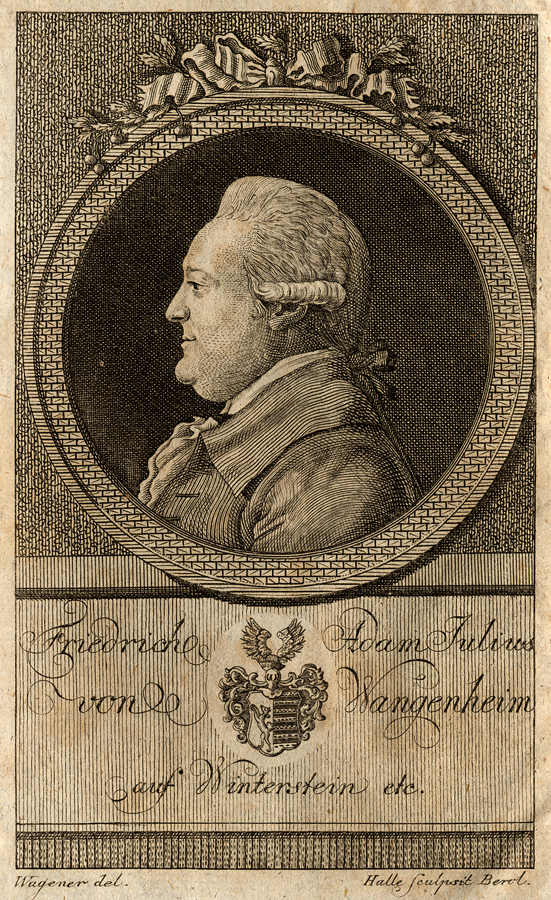
Portrait of Baron Friedrich Adam Julius von Wangenheim. Frontispiece of volume 39 of the Öconomische Enzyklopädie of 1787. Source: http://www.kruenitz1.uni-trier.de/.

The botanists among these scholarly soldiers are the best known today. Baron Friedrich Adam Julius von Wangenheim (1747/1749-1800), educated in forestry science in his native Saxony, arrived in New York in June 1777, and would eventually see combat on the British side at Brandywine and Charleston. When he wasn’t in battle, though, he wrote that:

“without neglecting my official duties, I spent every leisure hour in acquiring both a theoretical and a practical knowledge of the woody plants growing in that temperate region of North America.”

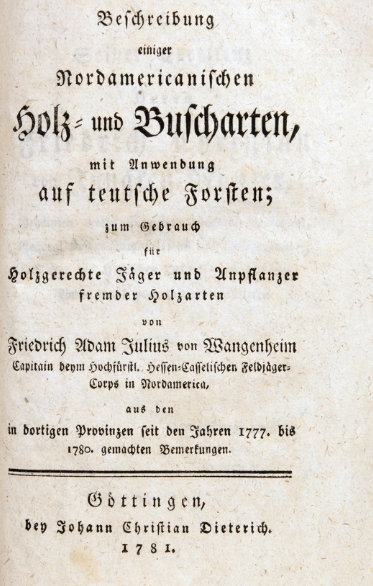
In May 1780, stationed in northern Manhattan, he completed his first book, A Description of Certain North American Trees and Shrubs, which appeared in print in 1781.

View Full Size Image
Title page, A Description of Certain North American Trees and Shrubs by Baron Friedrich Adam Julius von Wangenheim.

On returning to Europe in 1784, von Wangenheim expanded that work, which had covered 72 species, into a comprehensive treatise on the woody plants of North America and the possibility of transplanting them into German forests for timber and fuel.

View Full Size Image
Title page, Beytrag zur teutschen holzgerechten Forstwissenschaft, die Anpflanzung Nordamericanischer Holzarten mit Anwendung auf teutsche Forste. By Baron Friedrich Adam Julius von Wangenheim.

These publications and a mass of articles and essays made von Wangenheim a name and earned him an appointment as chief forester of East Prussia. There he made his most important contribution to zoology, a thorough study of the European elk in Lithuania.

View Full Size Image
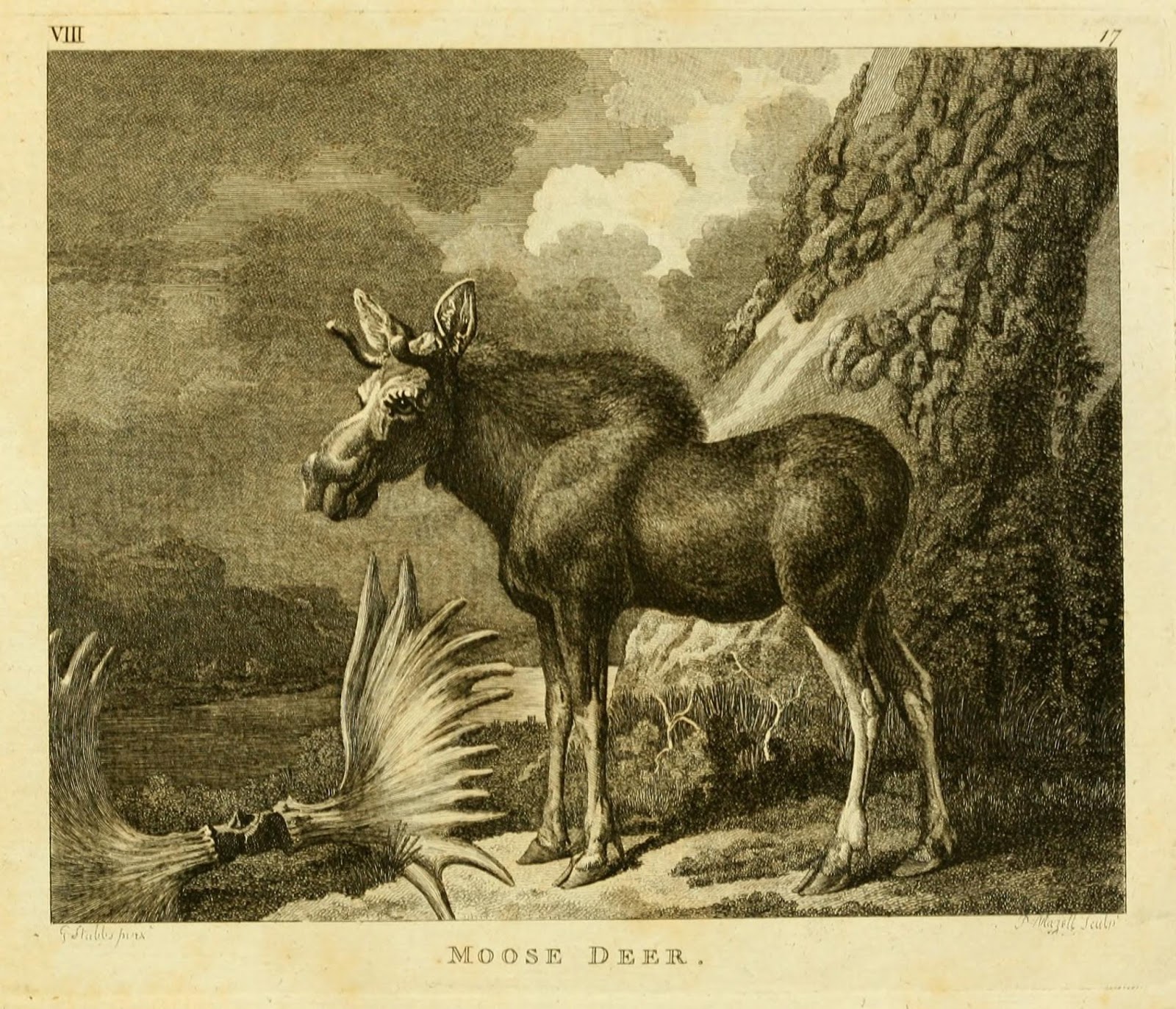
The “moose deer” or European elk (Cervus alces). From Pennant, Thomas. Arctic zoology. v. 1 (1874). http://www.biodiversitylibrary.org/page/29568042. Digitized by Smithsonian Libraries.

Von Wangenheim brought his American experience to bear in his account, noting in his practical way that the species is called the “moose deer” in the New World, where native Americans use its skin for clothing, gloves, moccasins, blankets, and tents.

View Full Size Image
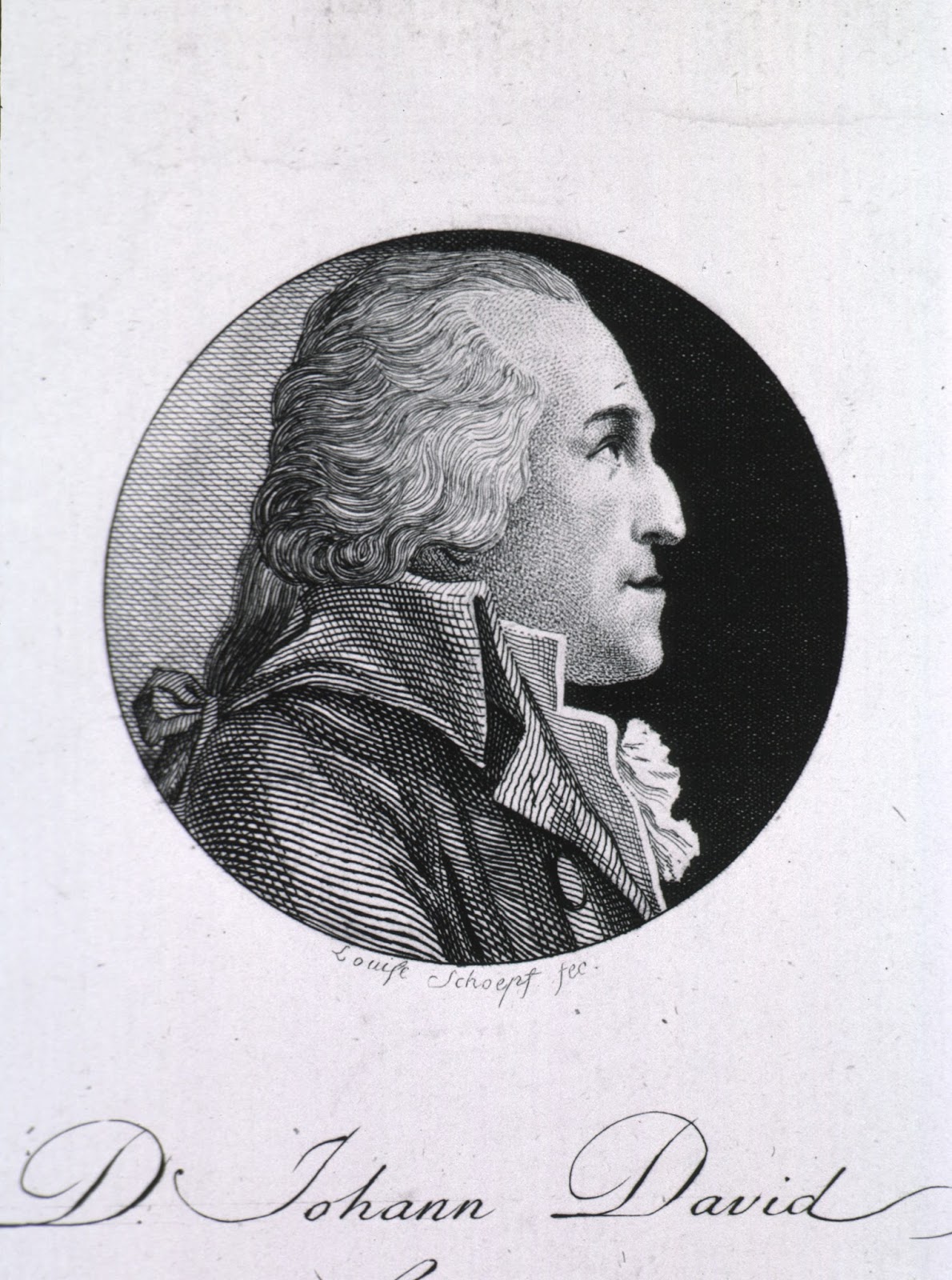
Portrait of Johann David Schoepf. Source: U.S. National Library of Medicine. https://collections.nlm.nih.gov/catalog/nlm:nlmuid-101428527-img.

More ambitious still, and less intensely focused on the economic use of the plants and animals around him, was Johann David Schoepf (1752-1800), field surgeon to one of the most notoriously bloodthirsty of the German regiments. Like von Wangenheim, Schoepf arrived in New York in June 1777. Once the war was over, inspired by the famous tours of Bartram and Catesby, Schoepf spent a year traveling west to Kentucky and south eventually to the Bahamas. Trained, like so many physicians of his day, in botany, Schoepf was naturally most interested in American plants and their medical uses; among the professional colleagues he most eagerly sought out were William Bartram and Henry Melchior Mühlenberg, but he also collected plant lore from native Americans, country doctors, and “old wives.”

View Full Size Image
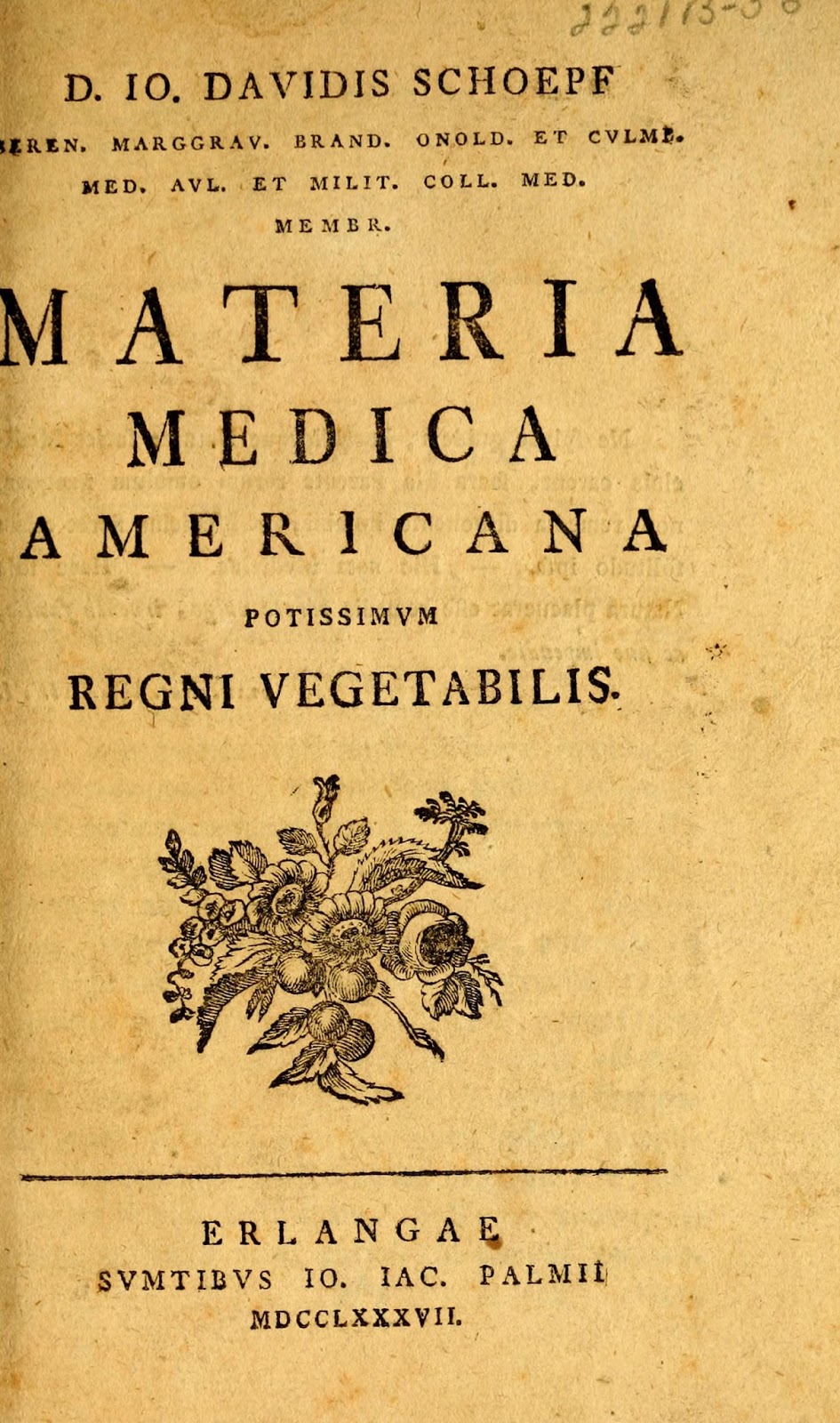
Title page of Materia medica americana potissimvm regni vegetabilis. (1787). By Johann David Schöpf. http://www.biodiversitylibrary.org/page/16502307. Digitized by University of Pittsburgh Library System .

Schoepf published his observations in 1787, in a comprehensive manual of the New World’s medicinal resources. Schoepf lists more than 350 plants, fungi, and lichens used in medicine, and ends his compendium with remarks on remedies derived from animal and mineral materials, ranging from human fat (an “obsolete, superstitious” practice) and dried rattlesnake flesh to amber and coal.

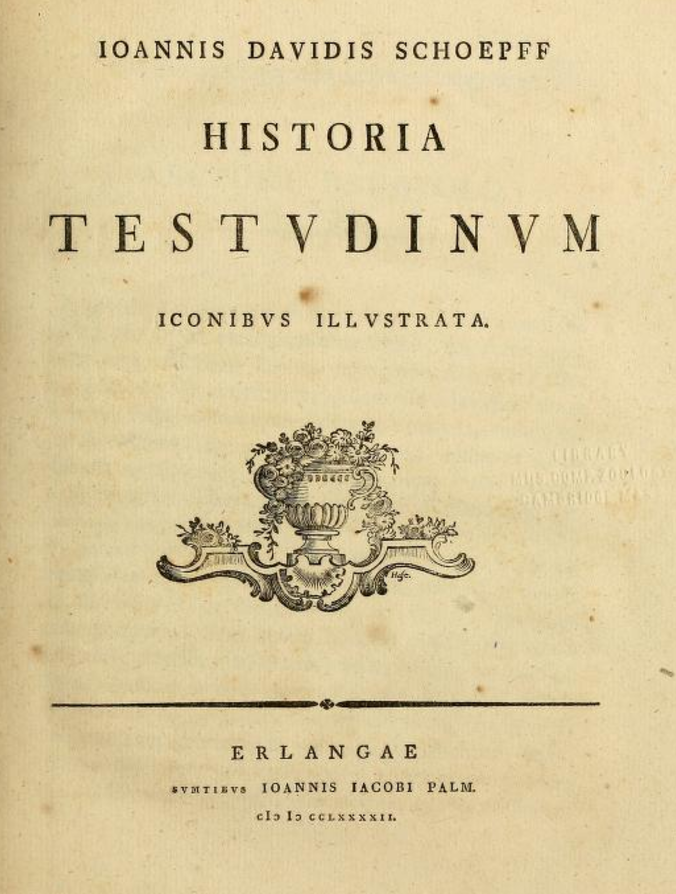
Today, Schoepf is most famous not for his pharmacopeia but for another book, the last he published before his early death in 1800. On his return to Europe in the summer of 1784, Schoepf took with him 64 live turtles, specimens that provided the basis for his Illustrated Natural History of the Turtles, published in Erlangen in 1792.

View Full Size Image
Title page of Ioannis Davidis Schoepff Historia testvdinvm iconibvs illvstrata. (1792) (“Illustrated Natural History of Turtles”). By Johann David Schöpf. http://www.biodiversitylibrary.org/page/32540981. Digitized by Harvard University, Museum of Comparative Zoology, Ernst Mayr Library.

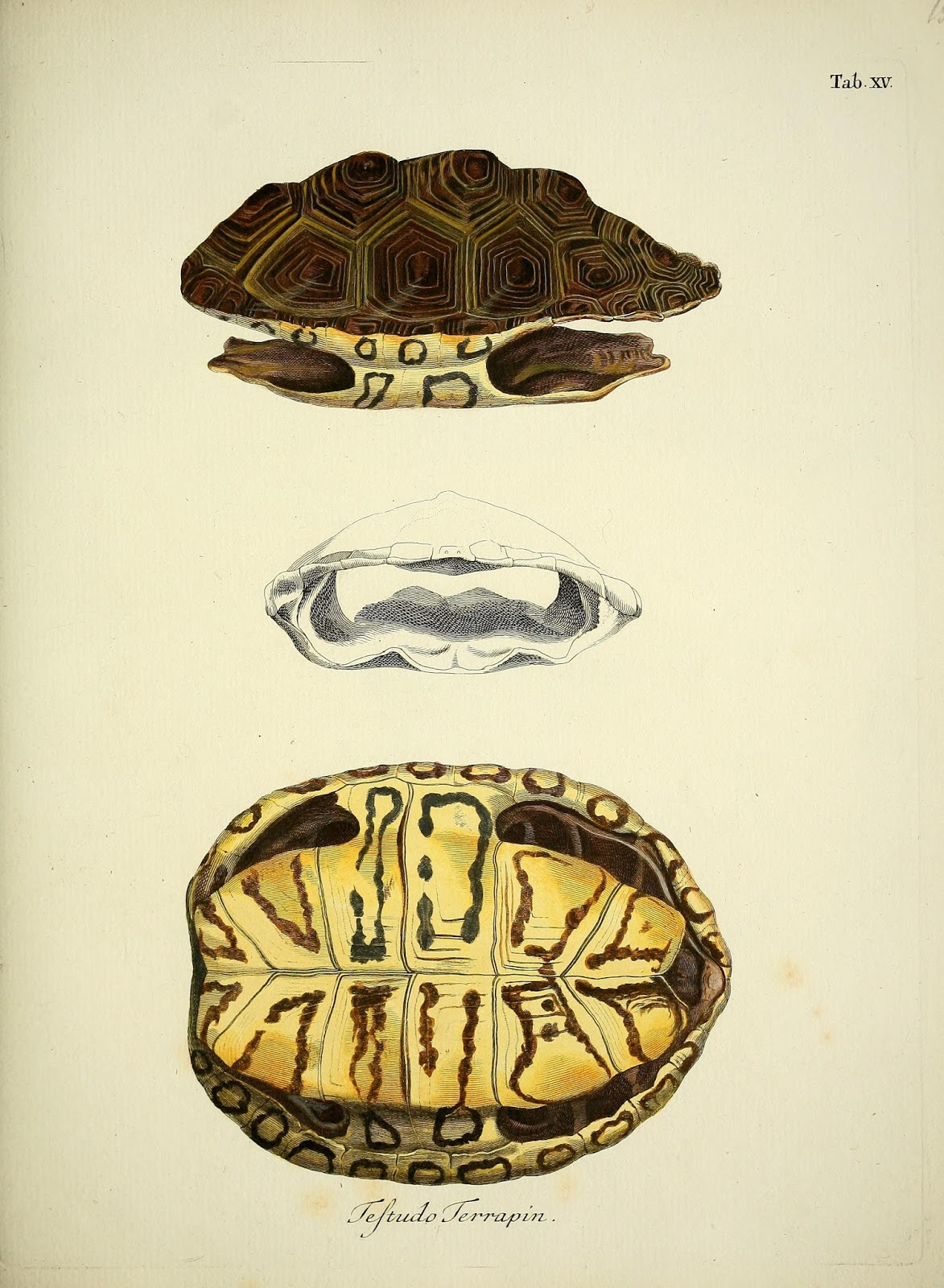
Among the species he treated there was one he named Testudo terrapin; Schoepf based his description and plate on two shells he had collected on Long Island and on two others sent him by Mühlenberg (perhaps from the market in Philadelphia).

View Full Size Image
Testudo terrapin. Naturgeschichte der Schildkröten. (1792-1801). By Johann David Schöpf. http://www.biodiversitylibrary.org/page/38925513. Digitized by Smithsonian Libraries.

This was the first scientific description of the handsome species now known as the diamondback terrapin.

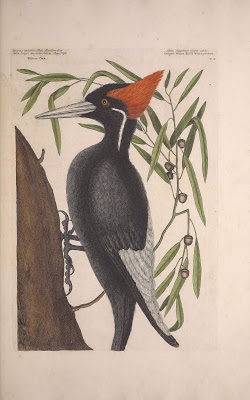
While von Wangenheim barely mentioned birds in his accounts of North American nature, Schoepf was more interested in things feathered. He found northern cardinals and blue grosbeaks in the Carolinas, and appears to have made close observations of turkey vultures, pointing out that the large, moist nostrils suggest that though “not proved, it is nevertheless likely” that they locate their aromatic prey by smell. Less credible is Schoepf’s claim that he and his companions encountered ivory-billed woodpeckers in eastern Pennsylvania.

View Full Size Image
Ivory-billed woodpecker (Campephilus principalis). Catesby, Mark. The Natural History of Carolina, Florida, and the Bahama Islands. Ed. 1, v. 1 (1729-1747). http://www.biodiversitylibrary.org/page/40753165. Digitized by Smithsonian Libraries.

The occasional misidentification aside, early American ornithology suffered a significant loss when Schoepf entrusted to Jacob Rubsamen his manuscript containing “numerous and precisely written descriptions of almost all the birds” he had seen in America. Rubsamen, a German immigrant whose Virginia gunpowder mill had been destroyed by the British at the end of the war, was to have sent those pages on to Schoepf in Charleston, but they never arrived.

One “Hessian” soldier who did make a significant contribution to American ornithology will probably remain forever anonymous.

View Full Size Image
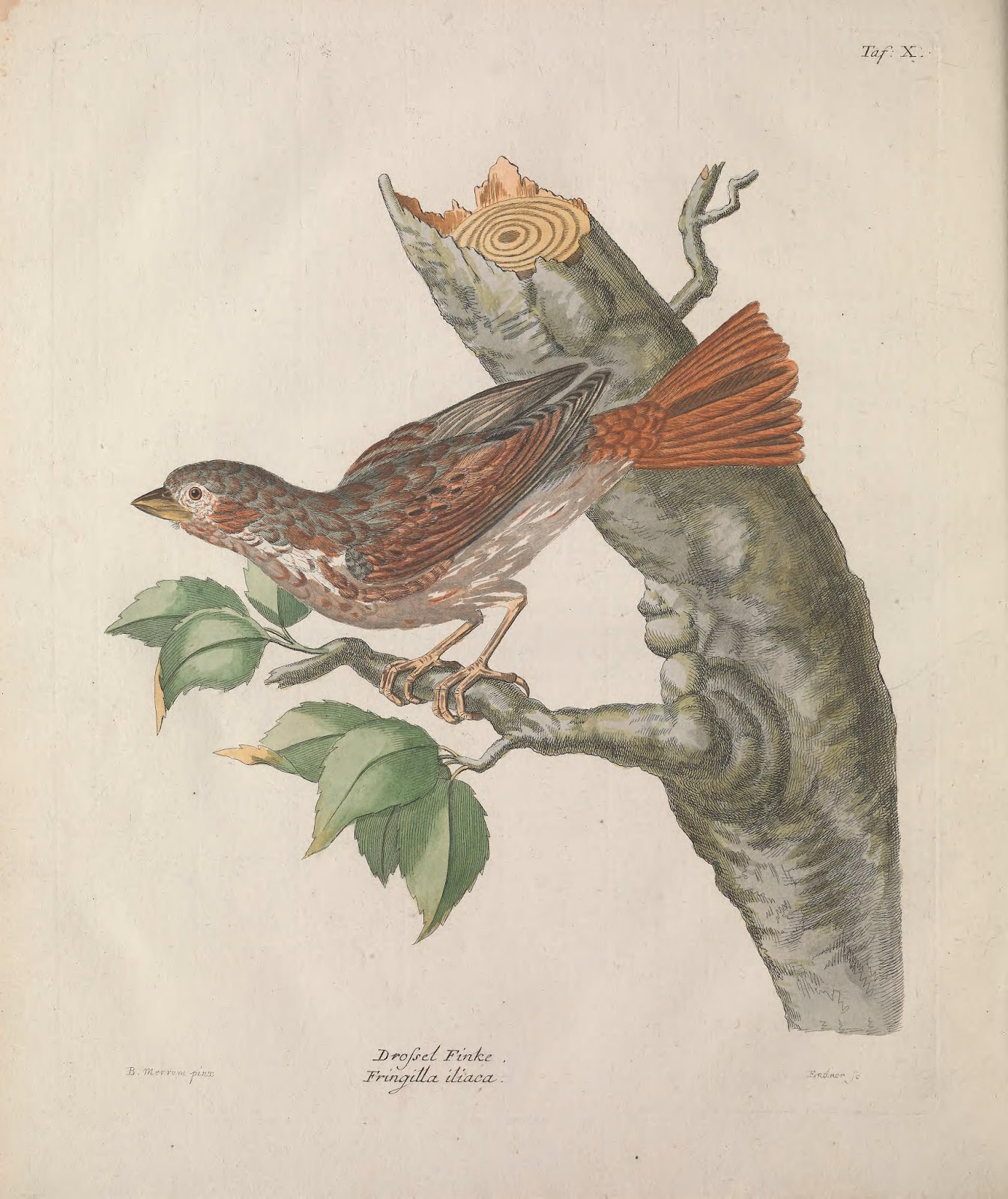
Fringilla iliaca. Avium rariorum et minus cognitarum. (1786). By Merrem, Blasius. http://www.biodiversitylibrary.org/page/46489269. Digitized by Smithsonian Libraries.

Sometime before 1786, this unknown naturalist shipped the preserved skin of a large and colorful bunting to Blasius Merrem, the first professor of zoology at the university of Marburg. Merrem recognized the specimen as the representative of a new species, which he named Fringilla iliaca for the heavy reddish chevrons marking its breast and side. Who knows how long science might have had to wait for a description of the red fox sparrow had George the Third not leaned on his teutonic cousins for help?

In February 1784, five months after the treaty ending the American Revolution was signed in Paris, the great Welsh litterateur Thomas Pennant regretted that the “fatal and humiliating hour” had not only “deprived Britain of power, strength, and glory,” but had “mortified” him into abruptly stopping work on what was to have been a new Natural History of North America. Horrified as he was at the historic turn of events, Pennant was nevertheless confident that “some native Naturalist” in the New World would complete the work that he had begun. Little did he know that some German soldiers fighting in America had been working alongside him all along.

March 31, 2017by ulib-libraryjobs
BHL News, Blog Reel

Celebrating Sir Joseph Dalton Hooker with Royal Botanic Gardens, Kew

View Full Size Image

Sir Joseph Dalton Hooker was one of the most important botanists of the 19th century and Kew Gardens’ most illustrious Director (1865-1885). To celebrate the bicentenary of his birth this year, BHL is joining the Royal Botanic Gardens, Kew to highlight Hooker’s works and contributions as part of the #JDHooker2017 campaign.

To coincide with the opening of a new exhibit at Kew’s Shirley Sherwood Gallery, BHL is featuring Hooker’s publications and related artworks in our online book collection and Flickr albums. Learn more about the BHL collections here.

Learn more about Kew’s exhibit, which opened on 25 March, in the post below. Then, be sure to follow #JDHooker2017 on social media as we celebrate Hooker’s life and works.

We hope you’ll also join us again the week of 26-30 June 2017 as we continue our celebrations as part of a larger campaign in conjunction with The Making of Modern Botany conference at Kew Gardens, hosted on 30 June 2017.

Joseph Hooker the ‘King of Kew’


By Rebecca Carter 
Gallery Assistant, The Shirley Sherwood Gallery of Botanical Art 
Royal Botanic Gardens, Kew

View Full Size Image
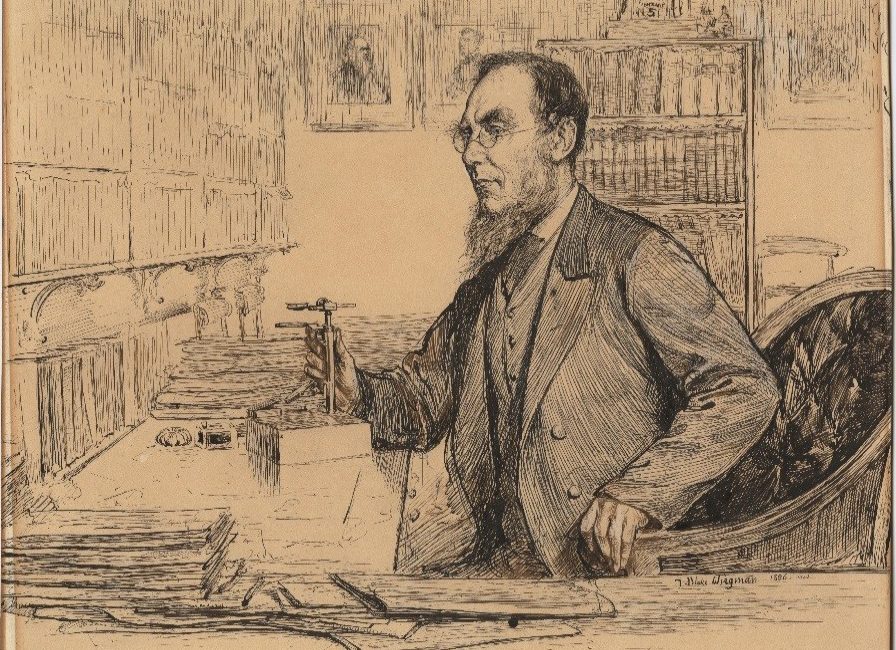
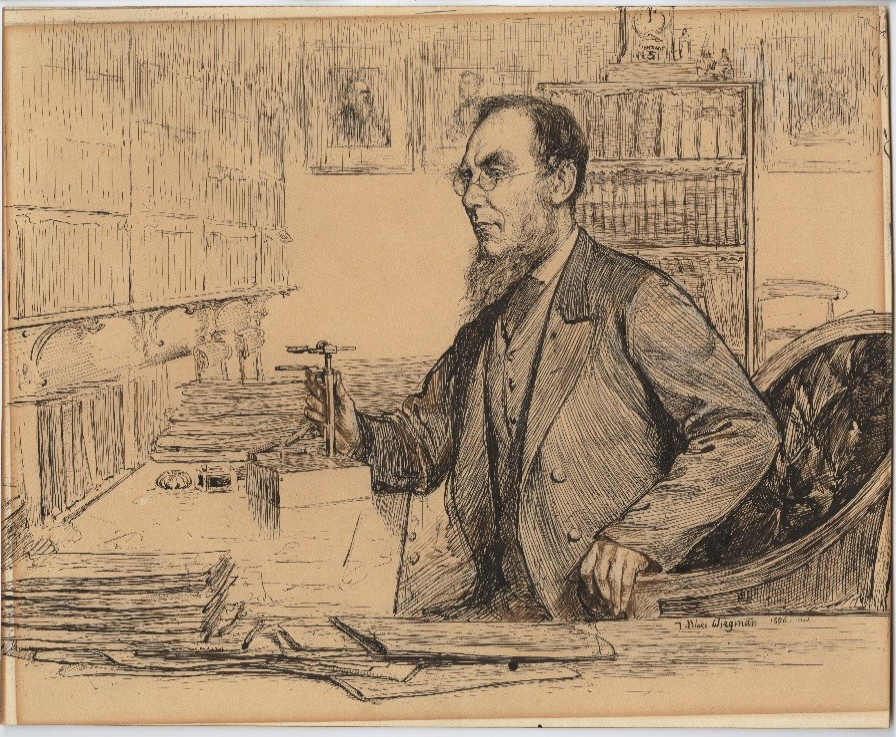
Sir Joseph Dalton Hooker, pen and ink on paper (1886) by Theodore Blake Wirgman.

Sir Joseph Dalton Hooker (1817-1911) was a highly respected botanist and relentless explorer, who is regarded as the founder of modern botanical classification. He held the position of Director at the Royal Botanic Gardens, Kew, for twenty years, adding thousands of specimens to its collection.

To mark the bicentenary of his birth, the Shirley Sherwood Gallery has curated an exhibition exploring his extensive travels and contribution to the field of botany. The collection at Kew contains numerous artifacts, sketches and paintings relating to Hooker’s incredible life and professional journey, of which a proportion is showcased in this exhibition. By showing a diverse selection of work, the exhibition looks to uncover the impact Hooker had on the botanical world, as well as discovering what made Joseph Hooker the ‘King of Kew’.

The title of the exhibition, Joseph Hooker: Putting plants in their place, refers to Hooker’s belief that specimens should be collected and then classified scientifically. He also proposed that plant’s habitats should be better understood and that there should be a place and opportunity to elevate the scientific status of botany to the same scholarly status as other sciences such as physics.

Kew was at the very heart of Hooker’s career and through his travels and publications he transformed Kew from a rather run-down royal pleasure garden into the world-class scientific establishment it is recognized as today.

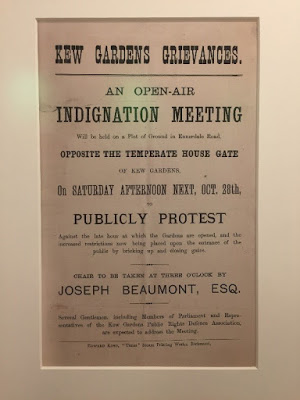
The public at the time met with Hooker’s desire to protect Kew’s role as a serious scientific institution with apparent antipathy; it was reported in newspapers that Londoners were outraged to find the gates to the Gardens locked in the mornings on bank holidays. This public outcry led to Hooker clashing with politicians and the public several times and ended with him conceding to early openings. On display in the exhibition are cartoons and notices from contemporary newspapers, exploring this fascinating history whilst Hooker was Director of Kew.

View Full Size Image
Kew Gardens Grievances notice from The Times, published October 1879, facsimile print.

Today, Kew is a leading centre for scientific botanical research and it is partly down to Hooker’s explorations that this foundation was set. On 30 September 1839 when he was 22 years old, Hooker set off on his first voyage. He was the youngest crew member on Her Majesty’s Discovery Ship Erebus, serving as the ship’s assistant surgeon and the expedition’s botanist.

On his many travels he drew and collected plants, naming many previously unknown-to-science plants and trees. Hooker named many plants after botanists and friends as a way of thanking and acknowledging fellow scientists. For example, Hooker named the Tasmanian gum tree Eucalyptus gunnii after his friend the collector Ronald Campbell Gunn. Hooker also had plants named after himself, such as the New Zealand ‘golden wand’ Bulbinella hookeri which was named by his friend and New Zealand missionary William Colenso.

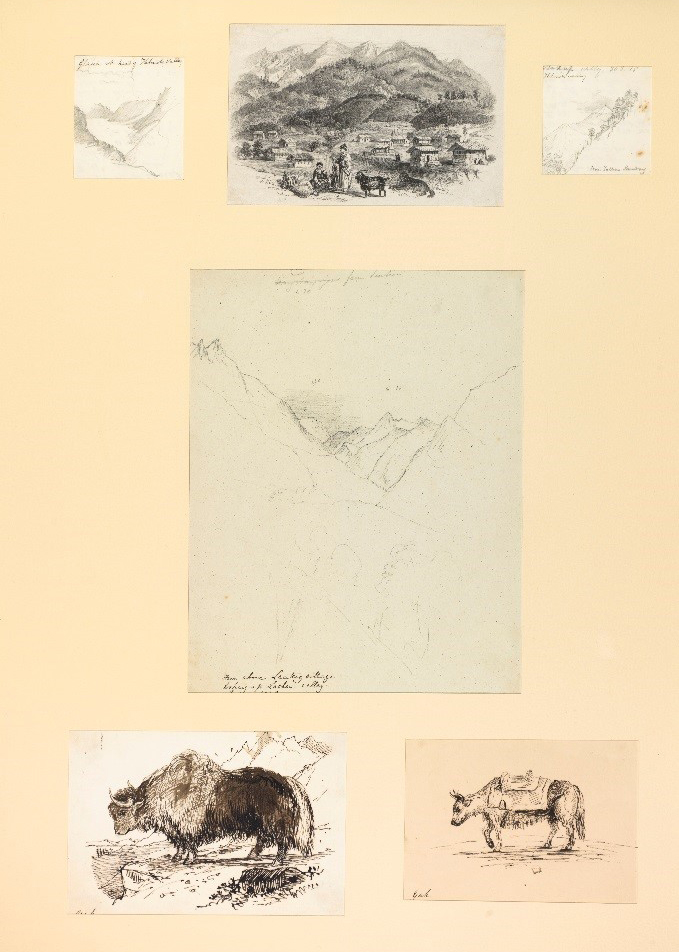
Hooker didn’t confine his drawings to plants. He also sketched houses, animals and landscapes. Our favourite pieces on display in this exhibition depict his time in the Himalayas. The selection of sketches below reveals detailed drawings of a variety of views of Lacham valley and Lamteng village.

Hooker’s good friend and talented artist Walter Hood Fitch drew the middle sketch at the top, which is a re-work of Hooker’s original drawing. Fitch often sketched Hooker’s drawings, preparing lithographs for botanical books such as his Rhododendrons of Sikkim Himalaya (1849-51).

The intricate sketch of the village and landscape shows that Hooker was also thinking about the habitat and the environment the native plants were exposed to. His drawing of a Yak also demonstrates an understanding of local culture and way of life. Yaks were the most important domesticated animal in the Himalaya and the detail in this sketch is exquisite.

View Full Size Image
From above Lamteng village looking up Lachem valley, (1848) Joseph Dalton Hooker, pencil, pen and watercolour on paper, with lithograph.

The galleries at Kew have more than one reason to be grateful for Hooker’s influence as Director of Kew. In 1879, Marianne North wrote to Hooker offering to build a gallery in which to display her botanical artwork. Hooker gave North permission, and the Marianne North Gallery was duly built in a mixture of classical and colonial style, finally opening in its finished form in 1886. Without Hooker’s permission, Kew would not have this significant collection of Victorian botanical art, which serves as an important catalogue of the world’s plants. Alongside the 833 paintings on display, North also collected samples of wood from the countries she visited. The unusual way in which the gallery was curated is unique to Kew, and it is always a breath-taking experience.

In summary, Joseph Hooker: Putting plants in their place looks at a range of fascinating artifacts and paintings to explore the professional journey of Joseph Hooker as second Director of Kew. It primarily looks at how Hooker revolutionized botany to a scientific status and examines his influence on Kew’s transformation from a simple pleasure garden to the scientific centre of research it is known for today.

March 27, 2017by ulib-libraryjobs
Page 8 of 15« First...«78910»...Last »

Help Support BHL

BHL's existence depends on the financial support of its patrons. Help us keep this free resource alive!

search

About BHL

The Biodiversity Heritage Library (BHL) is the world’s largest open access digital library for biodiversity literature and archives. BHL operates as a worldwide consortium of natural history, botanical, research, and national libraries working together to digitize the natural history literature held in their collections and make it freely available for open access as part of a global “biodiversity community.”

Join Our Mailing List

Sign up to receive the latest news, content highlights, and promotions.

Subscribe Now

Subscribe to Blog via Email

Enter your email address to subscribe to this blog and receive notifications of new posts by email.

Join 319 other subscribers

Subscribe to Blog Via RSS

Subscribe to the blog RSS feed to stay up-to-date on all the latest BHL posts.

Access RSS Feed

Inspiring Discovery through Free Access to Biodiversity Knowledge.

The Biodiversity Heritage Library makes it easier than ever for you to access the information you need to study and explore life on Earth…for free, anytime, anywhere.


64+ Million Pages of
Biodiversity Literature Online.

EXPLORE

Tools and Services
to Transform Research.

EXPLORE

300,000+
Illustrations on Flickr.

EXPLORE

ABOUT | HARMFUL CONTENT | PRIVACY | SITE MAP | TERMS OF USE