Biodiversity Heritage Library - Program news and collection highlights from BHL
  • Home
  • News
  • Featured Books
    • All Featured Books
    • Book of the Month Series
    • BHL at 20
  • User Stories
  • Campaigns
    • Fossil Stories
    • Garden Stories
    • Monsters Are Real
    • Page Frights
    • Her Natural History
    • Earth Optimism 2020
  • Tech Blog
  • Visit BHL
Home
News
Featured Books
    All Featured Books
    Book of the Month Series
    BHL at 20
User Stories
Campaigns
    Fossil Stories
    Garden Stories
    Monsters Are Real
    Page Frights
    Her Natural History
    Earth Optimism 2020
Tech Blog
Visit BHL
  • Home
  • News
  • Featured Books
    • All Featured Books
    • Book of the Month Series
    • BHL at 20
  • User Stories
  • Campaigns
    • Fossil Stories
    • Garden Stories
    • Monsters Are Real
    • Page Frights
    • Her Natural History
    • Earth Optimism 2020
  • Tech Blog
  • Visit BHL
Biodiversity Heritage Library - Program news and collection highlights from BHL
Blog Reel, Featured Books

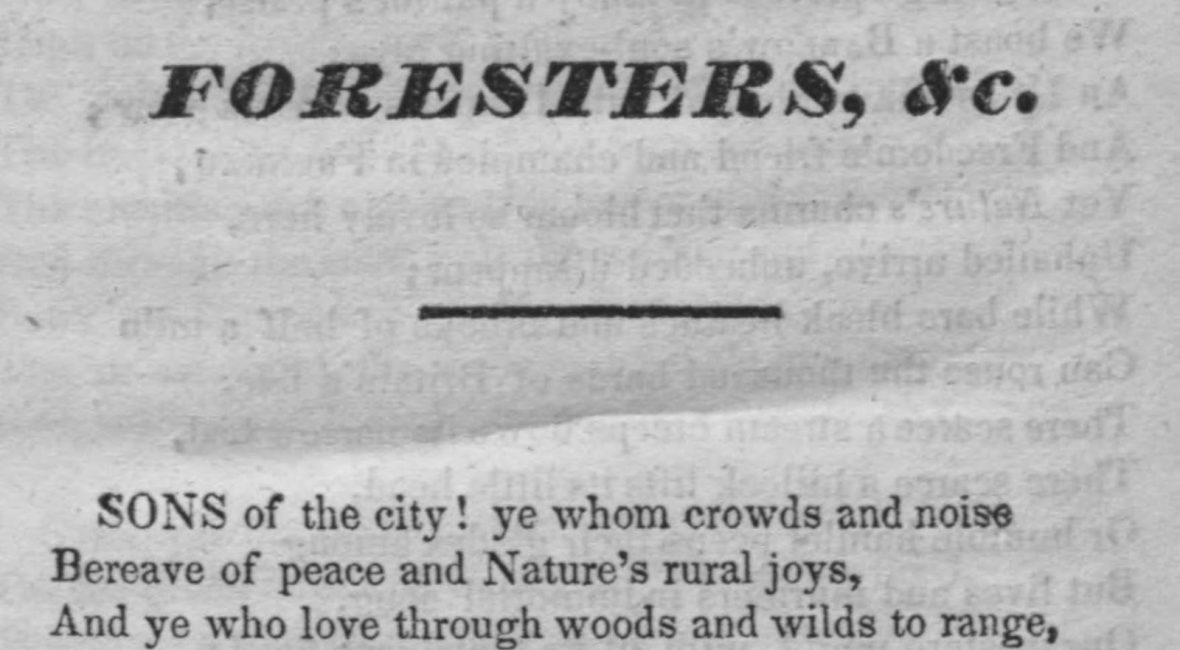
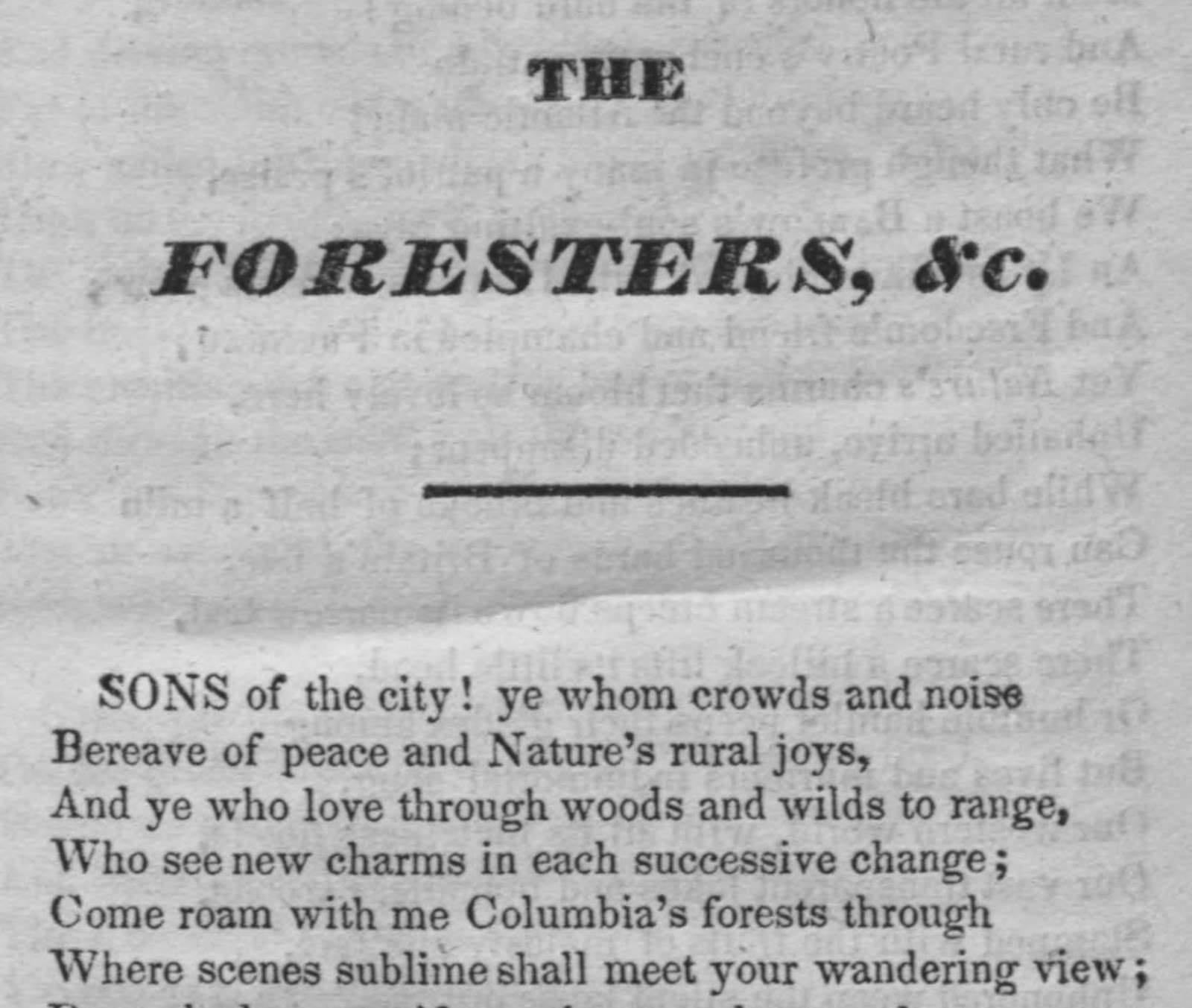
Of Birds and Poetry: Alexander Wilson and The Foresters

View Full Size Image
Wilson, Alexander. The Foresters. 1838. http://biodiversitylibrary.org/page/42435615.

210 years ago, in an autumn not unlike our own today, Alexander Wilson set out with two companions on a 1,300 mile trek, mostly on foot, from Philadelphia to Niagara Falls. Enchanted by the natural beauty of his adopted homeland, Wilson, Scottish by birth, detailed his two-month-long adventure in an epic 2,219 line poem entitled The Foresters: A Poem Descriptive of a Pedestrian Journey to the Falls of Niagara in the Autumn of 1804.
View Full Size Image
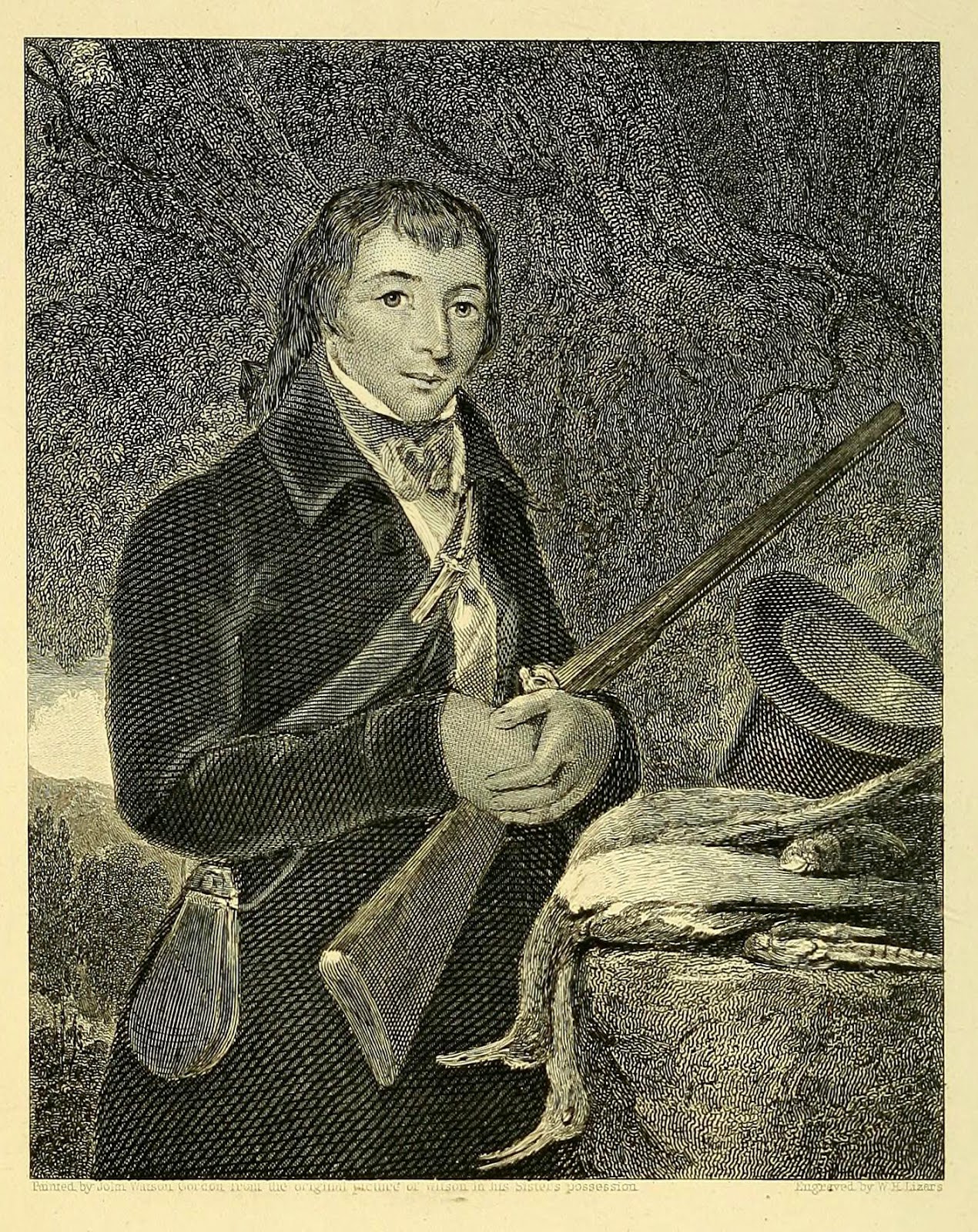
Portrait of Alexander Wilson. American Ornithology. http://biodiversitylibrary.org/page/41411265.

Wilson was born in Paisley, Scotland in 1766, but he emigrated to the United States in 1794 with his nephew, William Duncan. Although today known as one of the greatest ornithologists America has ever seen, Wilson’s interest in poetry was deeply rooted in his youth. During his time in Scotland, he wrote a great deal of poetry, much of which was satirical. In fact, it was after his arrest and imprisonment for writing a severely satirical poem against a local mill owner that Wilson decided to move to America.

Poetry and ornithology were not the only hats Wilson wore throughout his life. He was somewhat of a jack-of-all-trades. He earned his living as a weaver in Scotland, and upon moving to America he worked as a schoolteacher, peddler, engraver, surveyor, and editor. Nature, birds, and poetry, however, were his true passion.

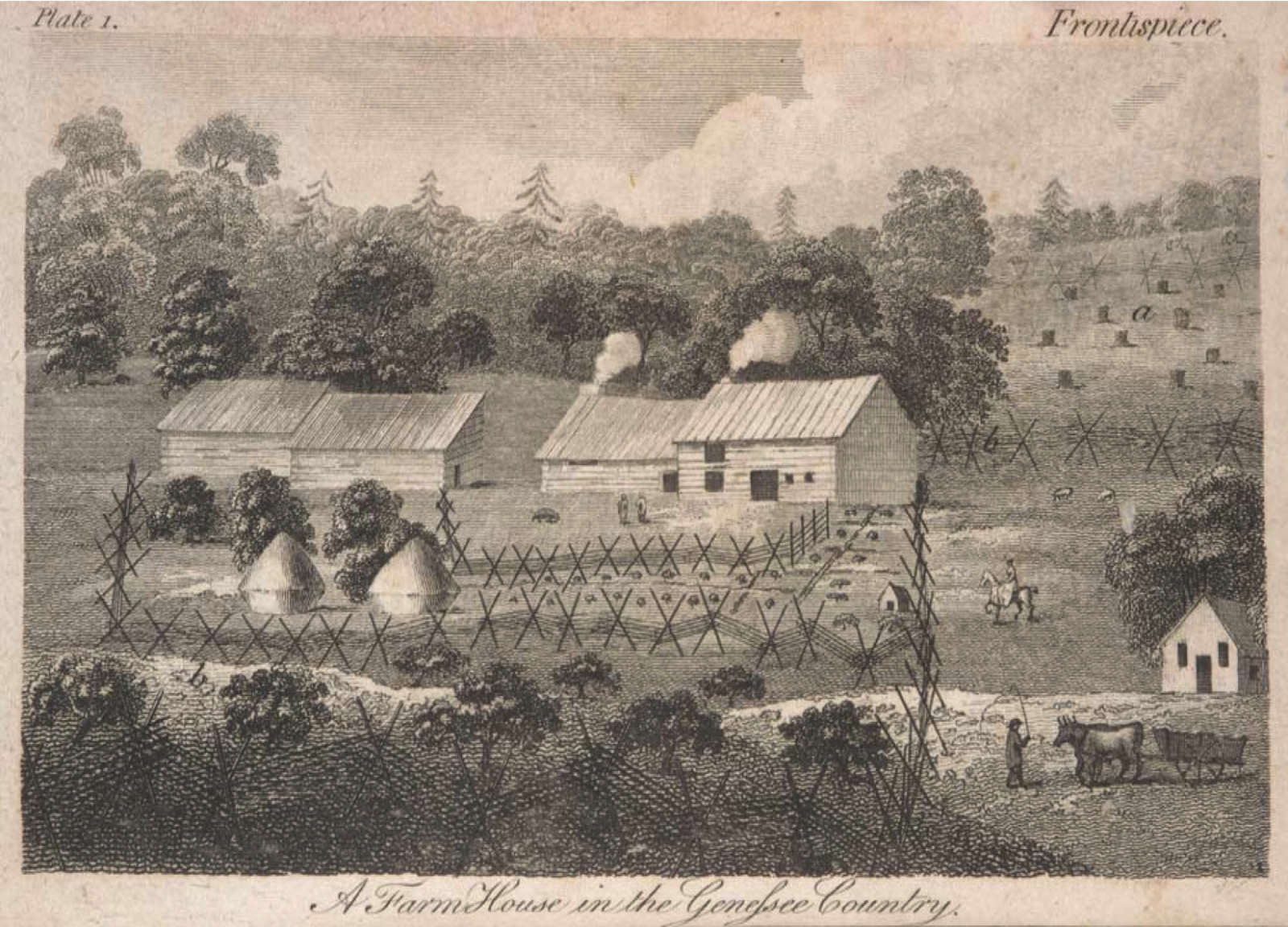
In 1798, four years after they had moved to America, Wilson and his nephew William Duncan, purchased a farm in Ovid between Seneca and Cayuga Lakes, New York, securing 150 acres of uncleared land for $750. Wide-spread outbreaks of yellow fever in Philadelphia, where they had been living, and family ties in upstate New York, prompted their relocation to this rich, largely untapped land in the Finger Lakes region. After the purchase, Duncan began clearing the land for farming while Wilson resumed his teaching activities in a school in Milestown near Philadelphia and accepted odd jobs such as surveying to raise money for the farm.
View Full Size Image
A farmhouse in Genesee Country, perhaps like what Wilson and Duncan would have had. Sutcliff, Robert. Travels In Some Parts of North America, In the Years 1804, 1805 and 1806. York [England]: Printed by C. Peacock … for W. Alexander, and sold by him, 1811.

In late October, 1804, Wilson, Duncan, and one of Wilson’s students, Isaac Leech, embarked on their great adventure through the Western Frontier, leaving from Philadelphia and heading west through Pennsylvania towards Niagara Falls.

The journey was an ambitious, enlightening, and multi-faceted one. Within his Foresters poem, Wilson provides descriptions of the homes, taverns, and inns they stayed in, reflects upon the virtues of teaching (a profession he clearly believes is under-valued), and describes in vivid narrative the natural beauty and wildlife they encounter. His writings also reveal the progression of human settlement and land development along the Susquehanna, with Wilson remarking on how changed the wilderness was since last he visited it.
View Full Size Image
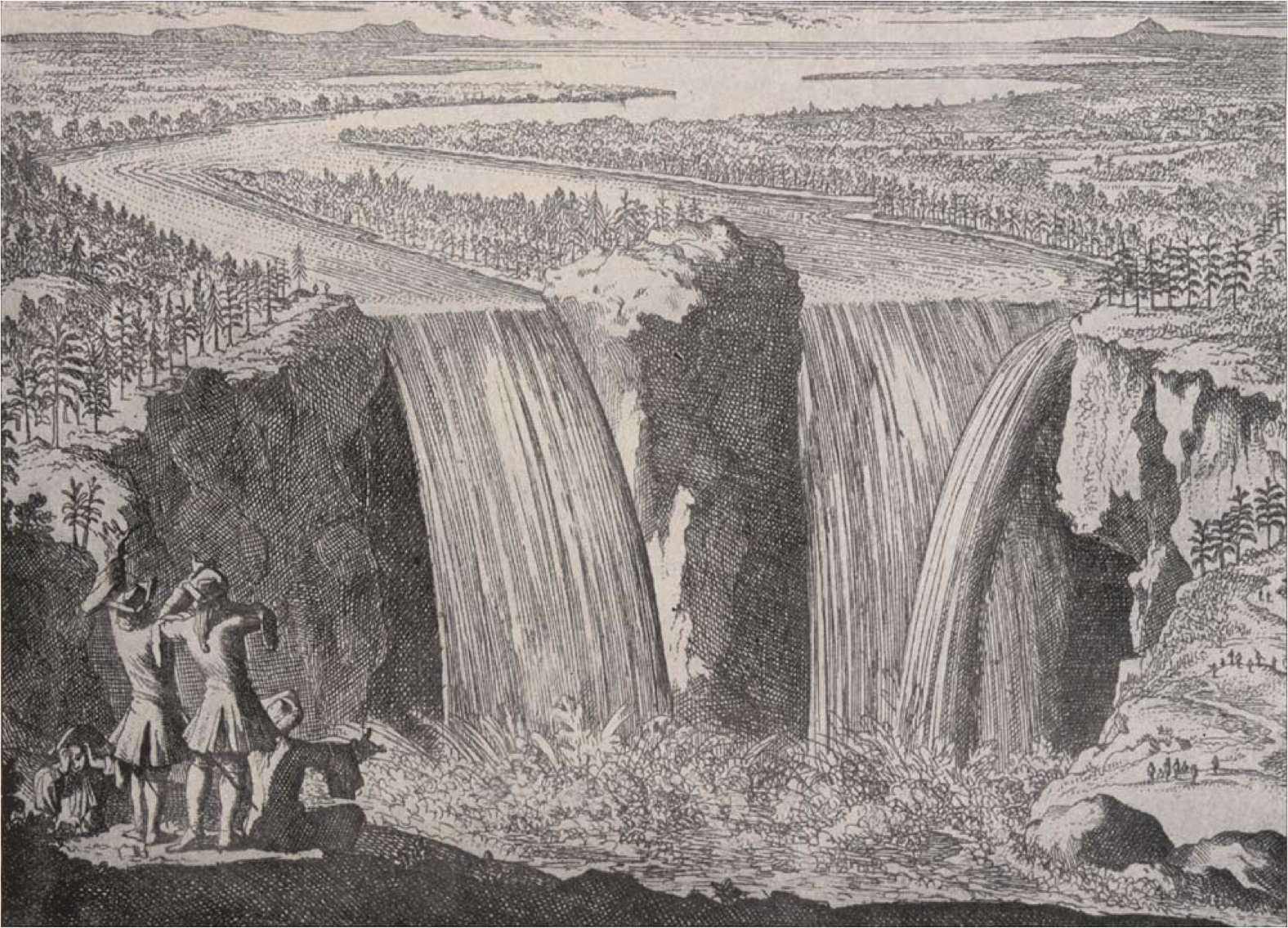
Niagara Falls. Dow, Charles M. Anthology and Bibliography of Niagara Falls. Albany [N.Y.]: State of New York, 1921. Vol 1. http://biodiversitylibrary.org/page/39062520.

Finally, in late November, the travelers reach the climax of their expedition: Niagara Falls. The Falls, a nearly inaccessible wonder of the New World in the early 1800s, is a thing of matchless beauty in Wilson’s mind.

“Fixed to the rock, like monuments we stood,
On its flat face, above th’ outrageous flood,
There, while our eyes th’ amazing whole explored,
The Deep loud roar our loudest voice devoured.
 
High o’er the wat’ry uproar, silent seen,
Sailing sedate, in majesty serene,
Now ‘midst the pillard spray sublimely lost,
And now, emerging, down the rapids tost,
Swept the gray eagles, grazing calm and slow,
On all the horrors of the gulf below;” (pg. 75-76)

With their purpose accomplished, Wilson, Duncan, and Leech set their sights homeward. On December 7, 1804, Wilson returned once again to Philadelphia, penniless but enthused by his adventure. Wilson published his poem in serial form in 10 issues of “The Port Folio,” a leading literary magazine in Philadelphia, from 1809-10. The poem was first published in book format in 1818 and again in 1838, with little difference between the editions. The 1838 edition of The Foresters is available in BHL from Cornell University Library.

The adventure represented not only an important literary venture for Wilson, but solidified in him the desire to pursue his dream to classify, describe, and illustrate all bird species in the United States. Wilson, in fact, viewed this trip as an opportunity to collect and observe American birds. Early on in the poem, Wilson indicates that he came prepared to sketch, bringing along “colors, paper, and pencils.” What’s more, he frequently describes hunting various birds, including ducks, egrets, herons, eagles and geese, which he would later use as reference for his great masterpiece, American Ornithology.
View Full Size Image
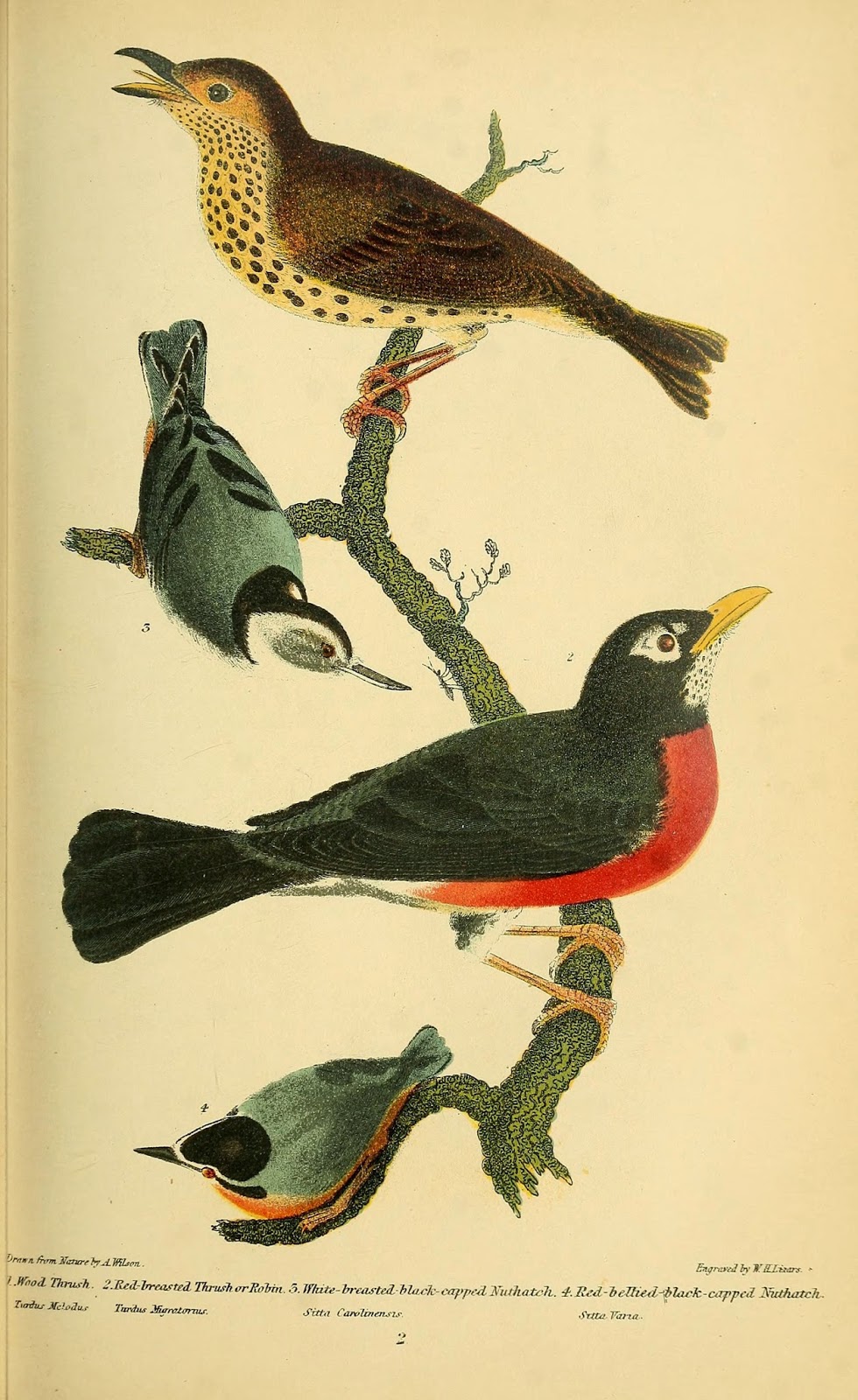
Wood Thrush, Robin and Nuthatches. Wilson, Alexander. American Ornithology. http://biodiversitylibrary.org/page/41411340.

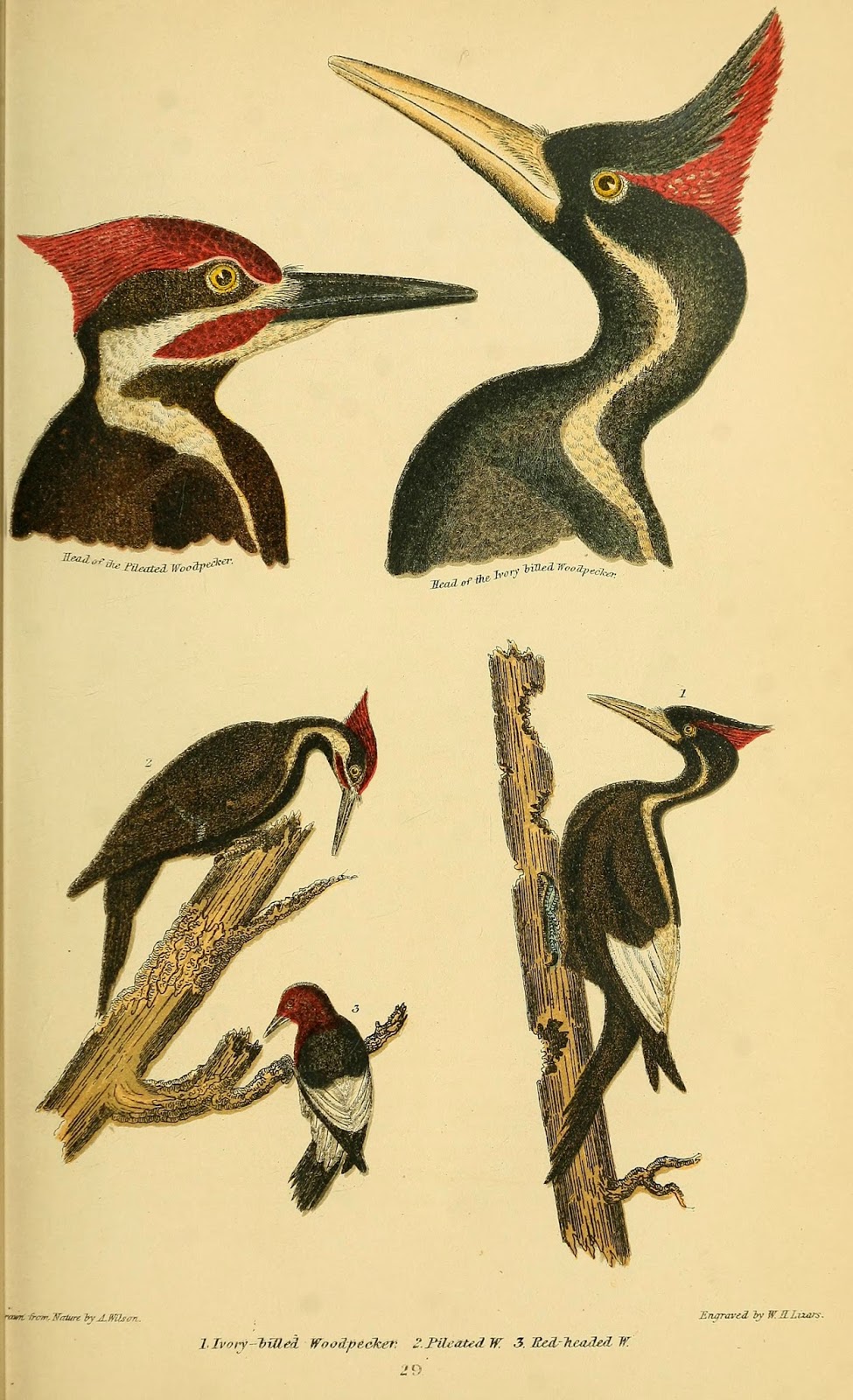
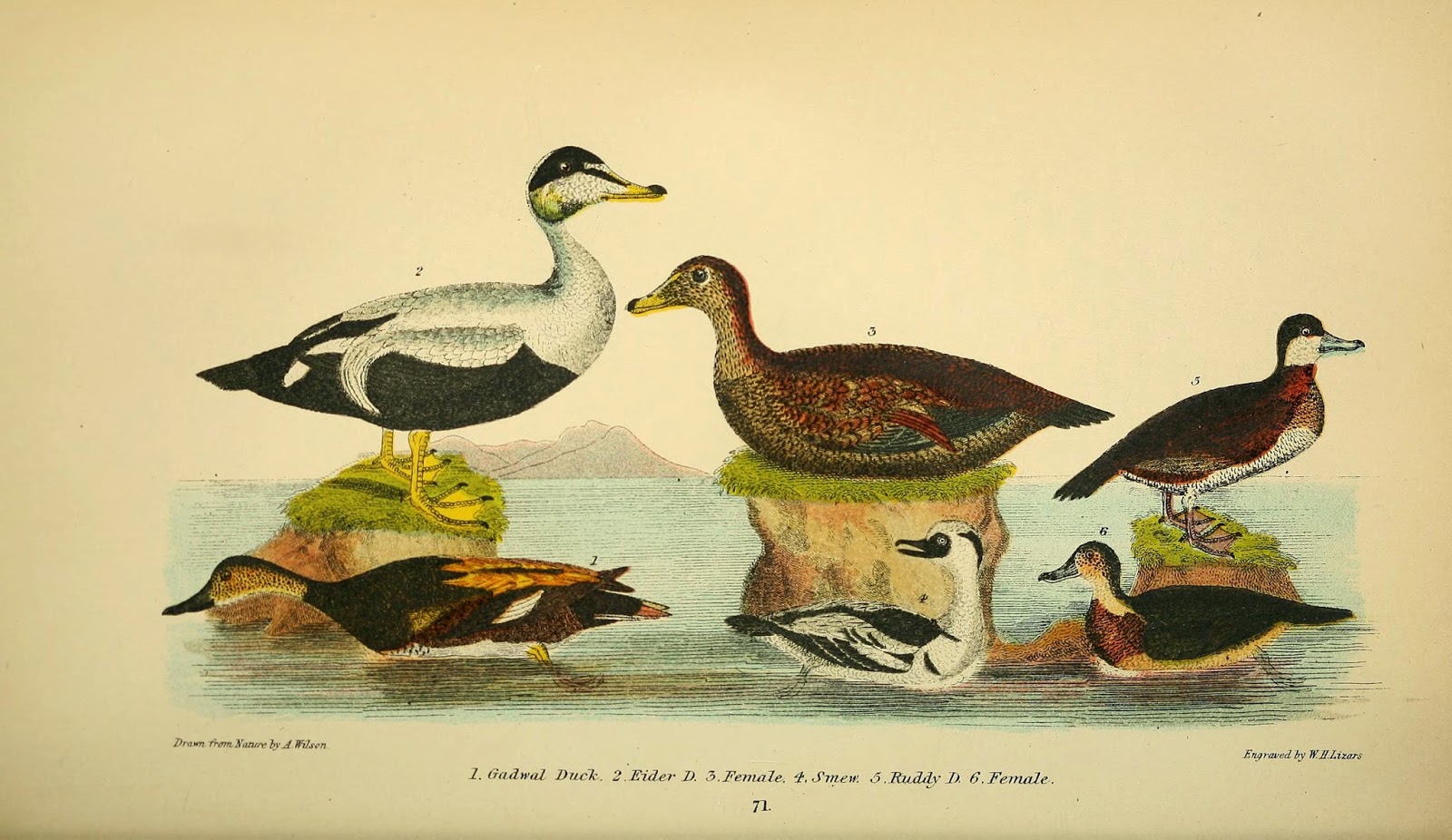
At the age of 40, just seven years before he died of dysentery and exhaustion, Wilson left teaching and spent the rest of his life traveling over 10,000 miles observing and collecting birds, which he chronicled and illustrated in American Ornithology. The publication included over 260 species, 48 of which were new to science, and was published in at least 10 editions over 70 years.
View Full Size Image
Ivory-Billed, Red-Headed, and Pileated Woodpeckers. Wilson, Alexander. American Ornithology. http://biodiversitylibrary.org/page/41424289.

Alexander Wilson was a remarkable man who laid the foundations for American ornithology. Though his formal education ended at the age of thirteen, his natural intelligence, creativity, and curiosity propelled him to explore his natural world and fueled a thirst for knowledge that rivaled the greatest intellectuals of the day. His wonderful poetic descriptions within The Foresters offer a unique opportunity to experience Wilson at a personal level and appreciate the awestruck wonder he felt within the wilds of America.

Far spreading forests from its shores ascend;
And tow’ring headlands o’er the flood impend;
These, deep below, in softened tints are seen,
Where Nature smiles upon herself serene,
O lovely scenes! In ecstasy I cried,
That sink to nothing all the work of pride! (pg. 52)

Learn more about Alexander Wilson, his Niagara adventure, and ornithological contributions in Cornell University Library’s Majesty Sublime exhibition.
View Full Size Image
Ducks. Wilson, Alexander. American Ornithology. http://biodiversitylibrary.org/page/41423704.

This post by Grace Costantino based on a presentation by Marty Schlabach (Food and Agriculture Librarian, Mann Library, Cornell University) entitled “Of Birds and Poetry: Alexander Wilson’s 1804 Expedition to Niagara Falls,” presented to the Buffalo Ornithological Society on November 9, 2005. Additional information obtained from the Majesty Sublime exhibition by Ashley Miller (Mann Library, Cornell University).
November 25, 2014by Grace Costantino
BHL News, Blog Reel

The Latest News from BHL

Sharks, Passenger Pigeons, Scientific Illustrations, Crowdsourcing, National Agricultural Library, GBIF, and Semantic Metadata. What do all these things have in common? They’re all BHL news stories from the past few months!

Get the latest BHL project news in our latest quarterly report and newsletter! Don’t get our newsletter? Sign up today!

View Full Size Image


November 21, 2014by Grace Costantino
Blog Reel, User Stories

Rejuvenating Centuries’ Old Botany with Phytogeography

Here’s a word of the day for you: Phytogeography.

Phytogeography is a branch of biogeography that investigates the geographic distribution of plants and the effect that the earth’s surface has on that distribution. To go further down the rabbit hole, biogeography studies the distribution of species and organisms now and throughout time. This research reveals important interdependencies between geology, climate, dispersal and evolution.

View Full Size Image
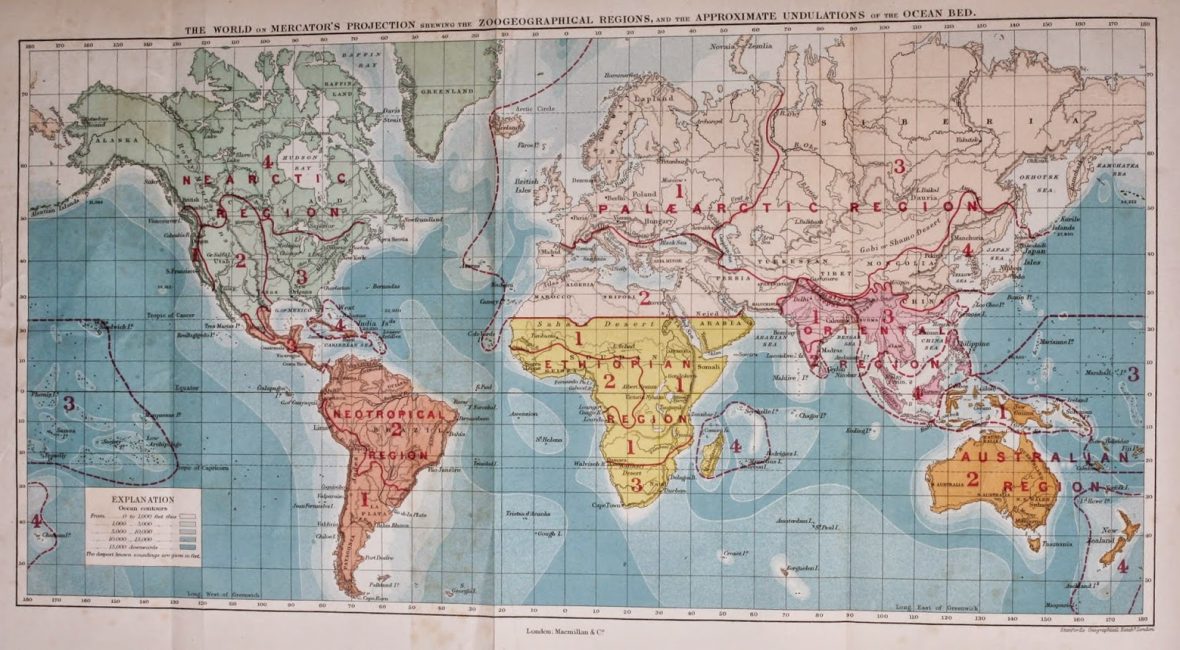
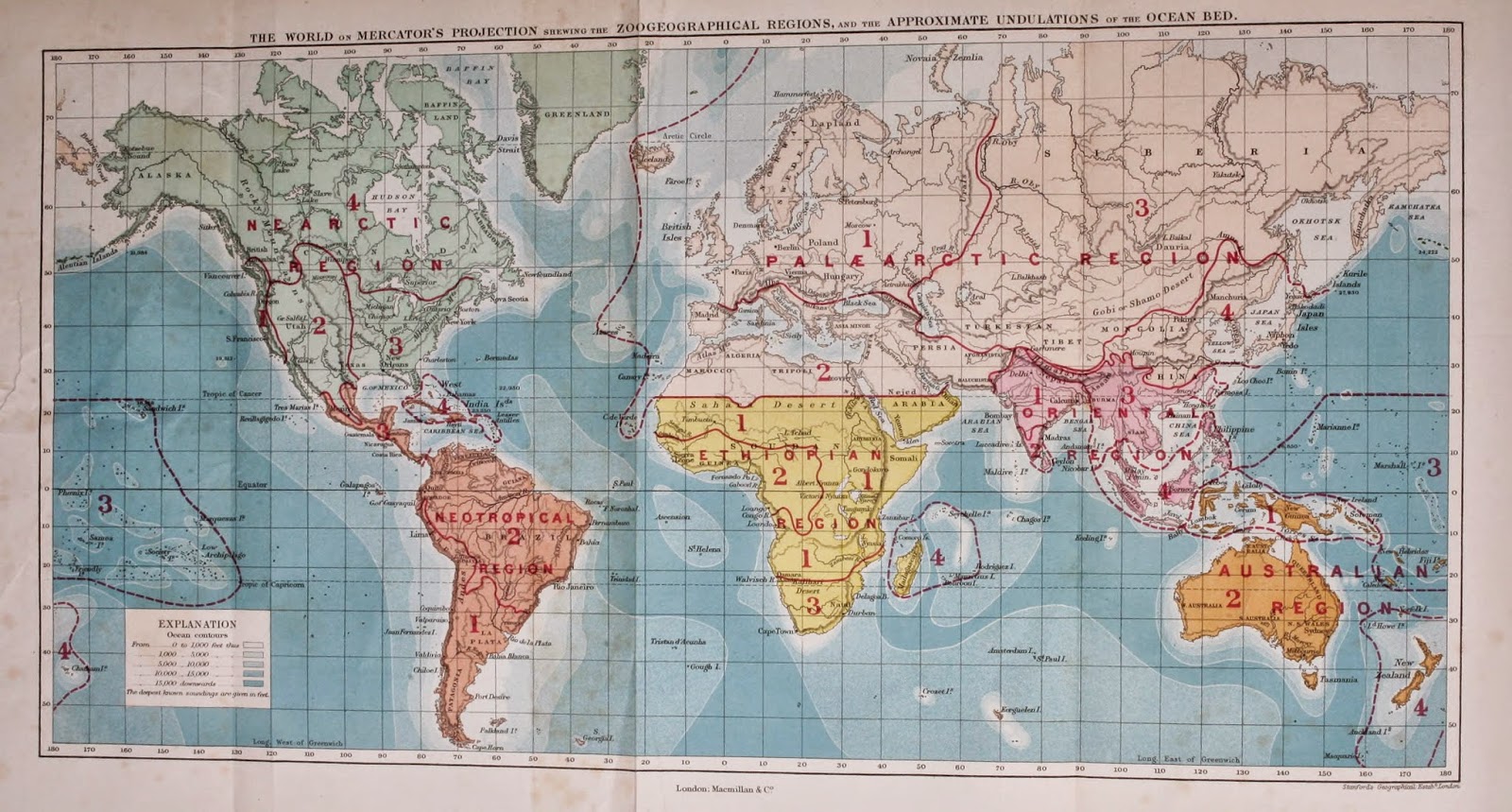
Wallace’s map, showing the zoogeographical regions of the world. The Geographical Distribution of Animals. v.1 (1876). http://biodiversitylibrary.org/page/30228507.
Alfred Russel Wallace is commonly known as the “Father of Biogeography.” Although not as famously recognized as Charles Darwin, Wallace actually came up with the theory of evolution by means of natural selection independent of and simultaneous to Darwin. Wallace spent a great part of his career in South America and the Malay Archipelago. During this time, his observations on distribution, breeding, and migration tendencies helped him develop a theory of evolution incorporating the influence of geological barriers on speciation. He also argued that species abundance was directly related to food availability.

Today, biogeographers are largely interested in how environmental factors and human activities influence species distribution. Biogeographic change and insight offered by historical data are a long-time passion of Dr. Quentin Groom, research assistant at the Botanic Garden Meise, Belgium. His particular interest is phytogeography, especially as it relates to the interaction between humans and plants.

View Full Size Image
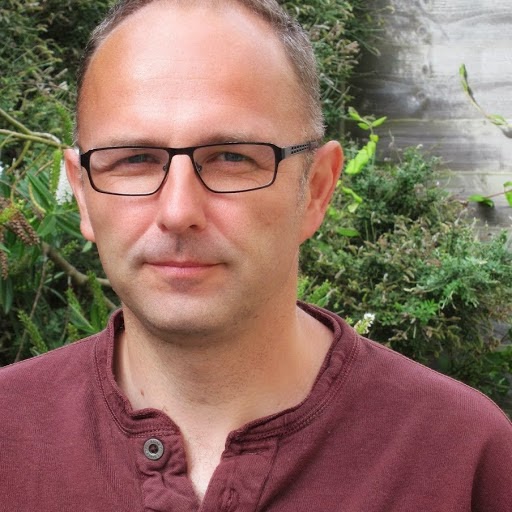
Dr. Quentin Groom, research assistant at the Botanic Garden Meise, Belgium.

Groom’s interest in phytogeography began ten years ago, but more recently, his discovery of BHL expanded his research possibilities. “[BHL] is a fantastic resource, making research possible that would never have been considered in the past. I use it to find information on particular species and also to find source documents for further analysis. The ability to search by taxon name is invaluable, but having stable URLs for each page is [also] a great feature.”

The ability to access this digitized literature is only part of the greater picture of facilitating efficient science and discovery. Intuitive search capabilities and the opportunity to augment existing files are other features Groom would like to see within BHL and the larger bioinformatics community.

“I feel [BHL] is just one step in the full digitization and semantic annotation of biodiversity literature. I’d like to be able to add annotations [to BHL]. [The ability to] search by location name and taxon name would be useful, even if the location names were only countries. It might [also] be useful to have the ability to add internal links within BHL to connect citations within one document to their source in BHL,” mused Dr. Groom.

The Mining Biodiversity project, funded by an IMLS Digging Into Data grant, is currently working to address some of these requests. The project aims to create a next-generation digital library by enriching BHL with semantic metadata through deployment of advanced text-mining techniques. This data will be used to support a semantic search system enhanced with clustering and visualization tools. The idea is that a user will be able to search not only for species, but also filter the results for references to habitat, diet, predation, and related facets. The result will be fully interlinked and indexed access to the full content of BHL library documents, allowing users to locate precisely the information of interest to them in an easy and efficient manner.

Furthermore, the project is exploring ways to make BHL more “social”, allowing for collaborative curation where users can easily share and discuss our collections. This will not only facilitate expanded reuse and discovery of our material, but will also allow us to evaluate how our content is being used around the globe and by whom, and better measure its impact on biodiversity awareness.

The Mining Biodiversity project runs through December, 2015. As we continue to improve our collections and services, you can explore our collection of over 44.8 million pages of biodiversity literature spanning over 500 years of research and discovery.

View Full Size Image
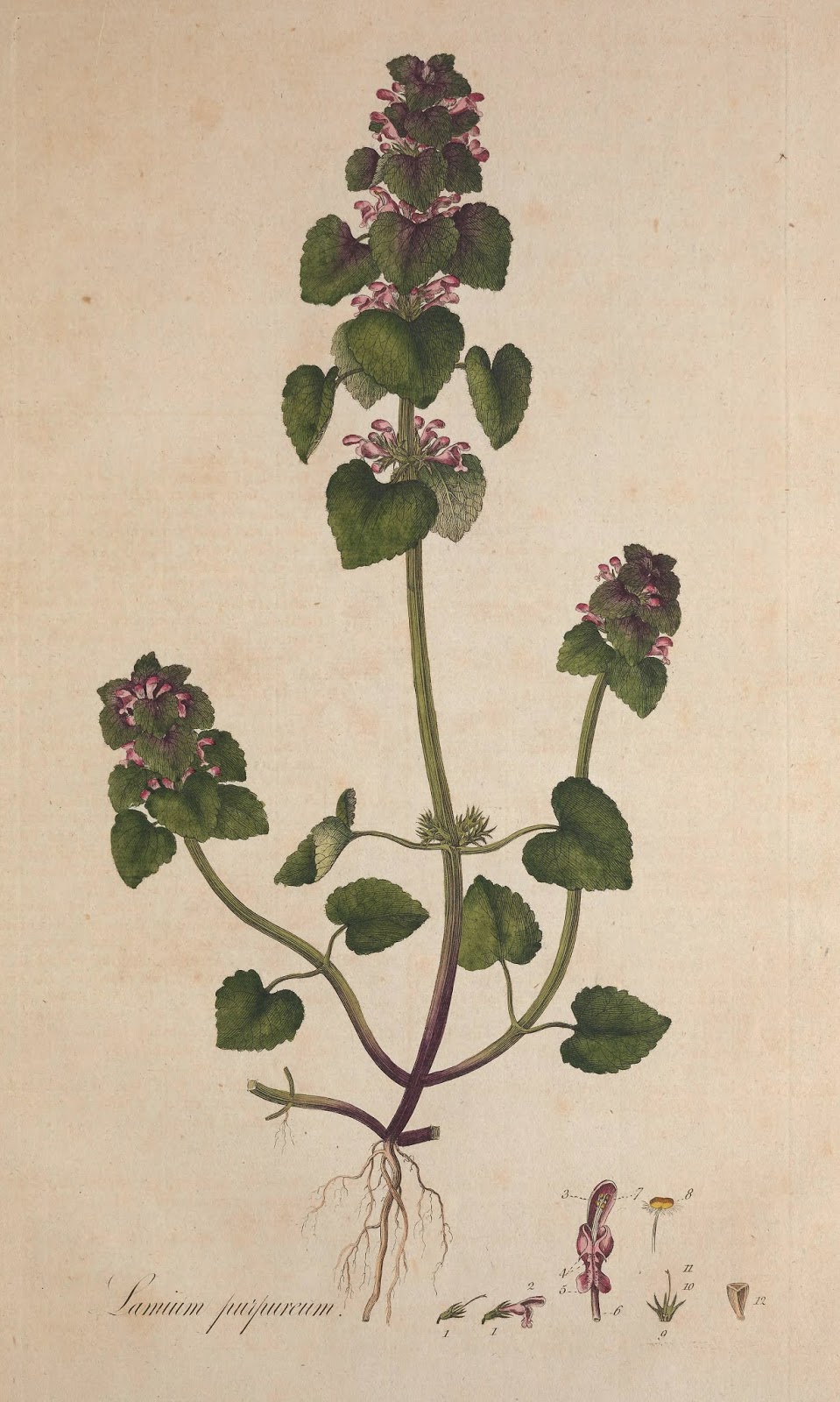
Red Deadnettle (Lamium purpureum) from one of Dr. Groom’s favorite BHL books, Flora Londinensis, v. 1 (1777). http://biodiversitylibrary.org/page/40966493.

Amongst all that content, what would a phytogeographer choose as his favorite items in the collection? “Linnaeus’ Species Plantarum is an inspiring work. Flora Londinensis by William Curtis makes common weeds special with its illustrations. I also have a soft spot for literature from Northumberland where I used to live,” mused Quentin.

Indeed, Dr. Groom recently republished the Flora of Northumberland and Durham (Winch 1831) as an online, semantically enhanced Pensoft “Advanced Book” using the scan originally taken from BHL. The Flora provides valuable insight into how biodiversity in North-east England has changed over time.

“Historic biodiversity literature is not just of cultural interest, it can be used to chart biogeographic change and help us understand the impacts of environmental change on biodiversity,” explains Quentin in an EU BON review of his republication. “Even if we are trying to predict future scenarios for biodiversity, understanding the changes of the past will help understand the changes we should expect in the future.”

Dr. Groom recently submitted another paper using data gathered from BHL, entitled “Piecing together the biogeographic history of Chenopodium vulvaria L. using botanical literature and collections”. The paper charts the distribution of Chenopodium vulvaria over more than 200 years and uses old literature to understand how its habitat may have changed. All of the observations extracted from the literature were georeferenced and are available on GBIF. You can view a preprint of the paper in PeerJ.

The digitization of historic literature, and its enhancement using semantic and linked data, is revolutionizing scientific research, connecting scientists to relevant information more efficiently than ever before. Through continued dedication to open access, BHL and like-minded projects will continue to inspire discovery through free access to biodiversity knowledge.

We extend a special thanks to Quentin for not only describing how BHL is currently impacting his work, but also for revealing important ways that we can improve our library. Do you have ideas about how you would like to see BHL improve? Would you like to tell us about how BHL has impacted your own research? Then send us some feedback!

November 13, 2014by Grace Costantino
BHL News, Blog Reel

Crowdsourcing and BHL: Current Projects that Allow Users to Help Us Improve Our Library!

Recent crowdsourcing initiatives are revolutionizing scientific research, allowing the public to help scientists and researchers document, identify, and better understand biodiversity.

For example, the Atlas of Living Australia’s FieldData program allows anyone to contribute sightings, photos and observational data to help researchers and natural resource management groups collect and manage biodiversity data. Birds Australia is using this data to help record sightings of Carnaby’s Black-Cockatoo to inform conservation initiatives for this endangered species.

As another example, in 2013 a new mammal species, the olinguito (Bassaricyon neblina), was discovered in South America, the first carnivore species to be discovered in the Americas in 35 years. Scientists at the Smithsonian’s National Museum of Natural History are using citizen science-contributed observational data and photos to learn more about the new species.

BHL has taken advantage of crowdsourcing’s potential, implementing several initiatives to improve access to BHL images, support OCR correction and transcription, and generate semantic metadata for the BHL portal.

Art of Life: Improving Access to Images

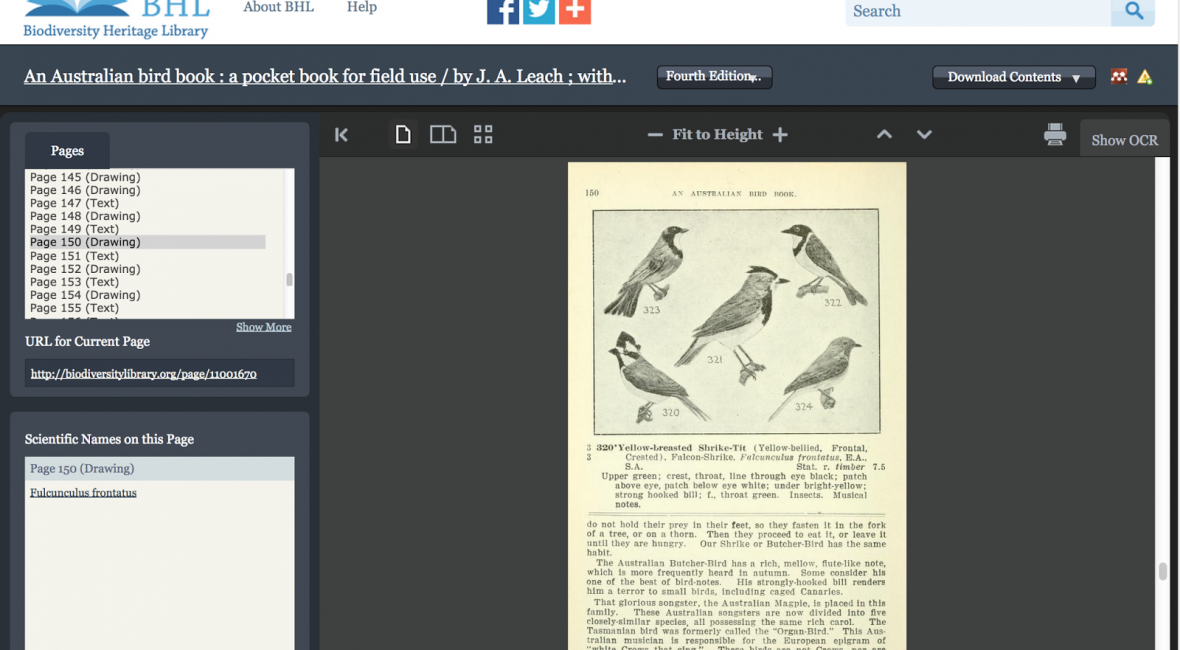
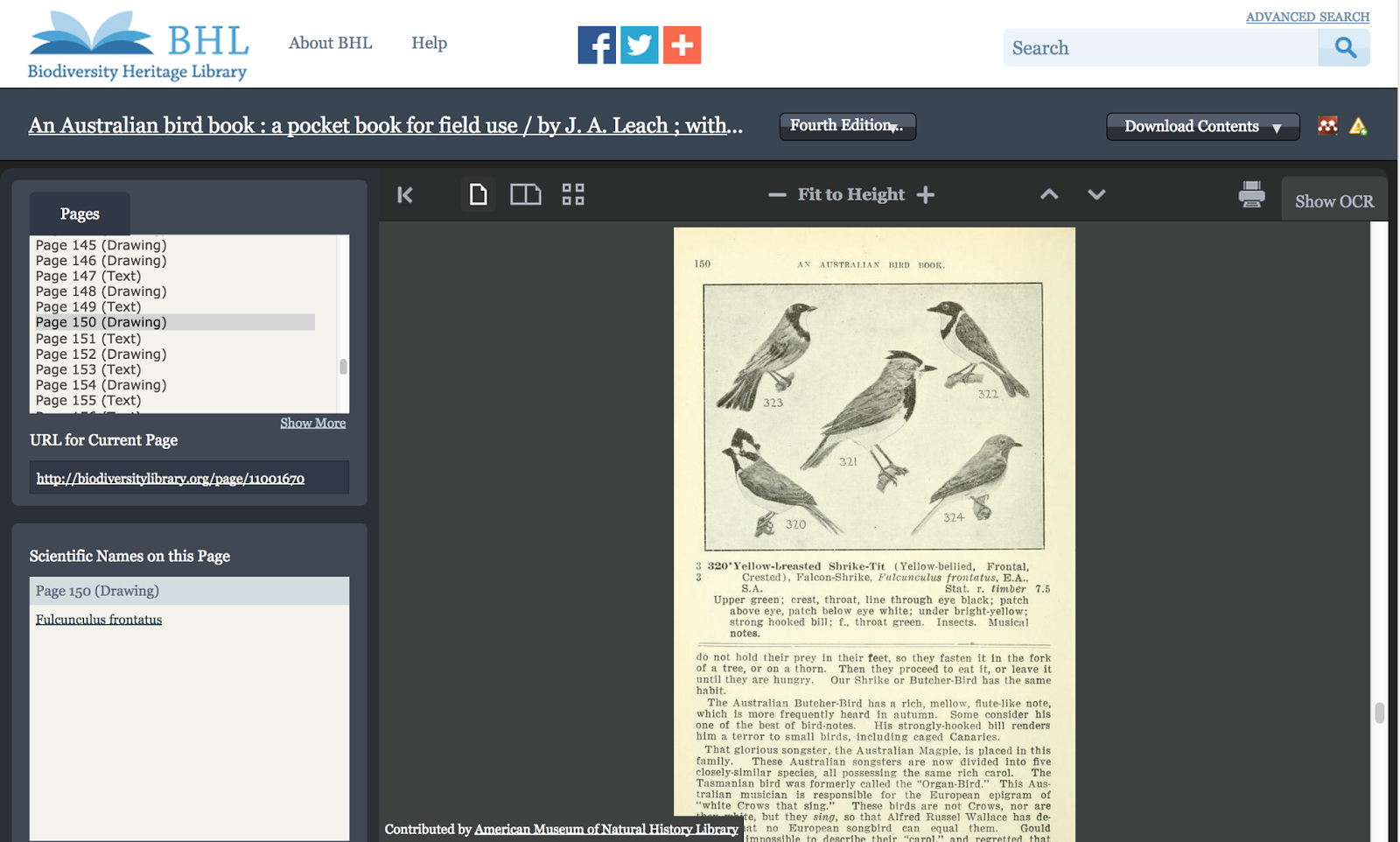
The Art of Life project, funded by NEH and based at the Missouri Botanical Garden, has been making active progress on its objective of improving access to the natural history illustrations within BHL. The image-finding algorithms developed by the Indianapolis Museum of Art Lab have been run across 18 million BHL pages and you’ll now notice a significant increase in the number of pages tagged as having illustrations within the BHL portal. Pages with illustrations are currently being manually classified by volunteers as belonging to one or more image types: drawing, table, photograph, map, and/or bookplate. A few examples in the BHL portal include:

  • http://www.biodiversitylibrary.org/page/11001670
  • http://biodiversitylibrary.org/page/11001551
  • http://www.biodiversitylibrary.org/page/3601565
  • http://biodiversitylibrary.org/page/12284099
View Full Size Image
Example of how metadata now displays descriptive information about the types of images found within BHL pages.

Next steps for the project are to crowdsource descriptions for the image’s content (e.g. subjects, dates, illustrator) through platforms such as Flickr and Wikimedia Commons. Learn more about the Art of Life project, which runs through April of 2015.

Learn how you can help tag BHL’s illustrations in Flickr.

On a related note, we will also be crowdsourcing BHL image descriptions through another platform, Zooniverse, the premier host for citizen science projects. This opportunity came about through a partnership with Constructing Scientific Communities (aka ConSciCom). More details will be forthcoming in a future blog post but expect to see BHL content available in Zooniverse in late spring or early summer of 2015.

Purposeful Gaming and BHL: Playing at OCR Correction and Transcriptions

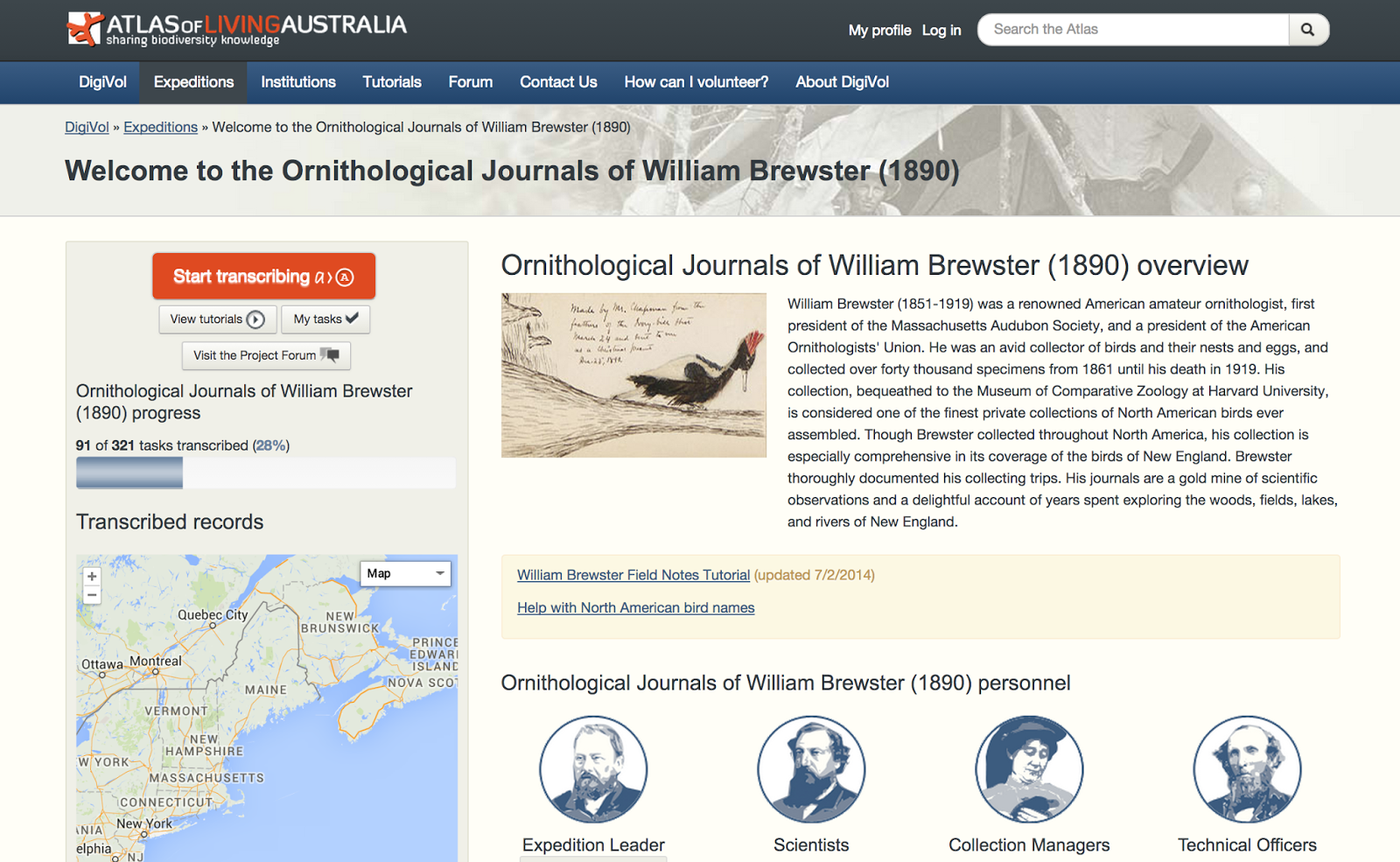
Another crowdsourcing BHL project called Purposeful Gaming and BHL, funded by IMLS and based at the Missouri Botanical Garden, has been making significant strides in its objective to improve access to BHL texts through gamifying the text correction process. Digital outputs of BHL text are created both through automated (OCR of published text) and manual means (transcription of hand-written text from ornithologist William Brewster). Multiple outputs of the same page are then compared and differences incorporated into an online digital game in which the public will help verify the accuracy of individual words. Those corrections will then be incorporated back into the BHL portal for viewing by users and to enable full text searching. The project’s game designer, Tiltfactor, has recently completed and beta-tested 2 initial prototypes for both gaming and non-gaming audiences. The final games are expected to go live in May 2015. Learn more about the Purposeful Gaming project, which runs through November of 2015.

View Full Size Image
William Brewster’s journals available for transcription in the ALA/Australian Museum Biodiversity Volunteer Portal.

Help us transcribe William Brewster’s journals and diaries in the ALA/Australian Museum Biodiversity Volunteer Portal (click on any of the William Brewster projects listed) and FromThePage! Find guidelines for transcribing the documents here.

Mining Biodiversity: Semantics and the Crowd

In the near future, the Mining Biodiversity Project, whose USA partners’ participation is also funded by IMLS, will be crowdsourcing the creation of a gold standard annotated set of pages to train the mining algorithms that will search for named entities (ie. concepts like taxa, places, people, habitat, traits). After that, a bigger group of volunteers will help validating the pre-annotated relations through time (events) automatically discovered from our BHL corpus. Learn more about the Mining Biodiversity Project, which runs through December 2015.

The Field Book Project: Improving Access to Researchers’ Fieldnotes

The Smithsonian Field Book Project has been hard at work discovering and making accessible field book materials through cataloging, digitization, and online publication. Thanks to dedicated staff and volunteers, the Project has made huge strides in that direction. To date, 90 fieldbooks digitized by The Field Book Project have been ingested into BHL.

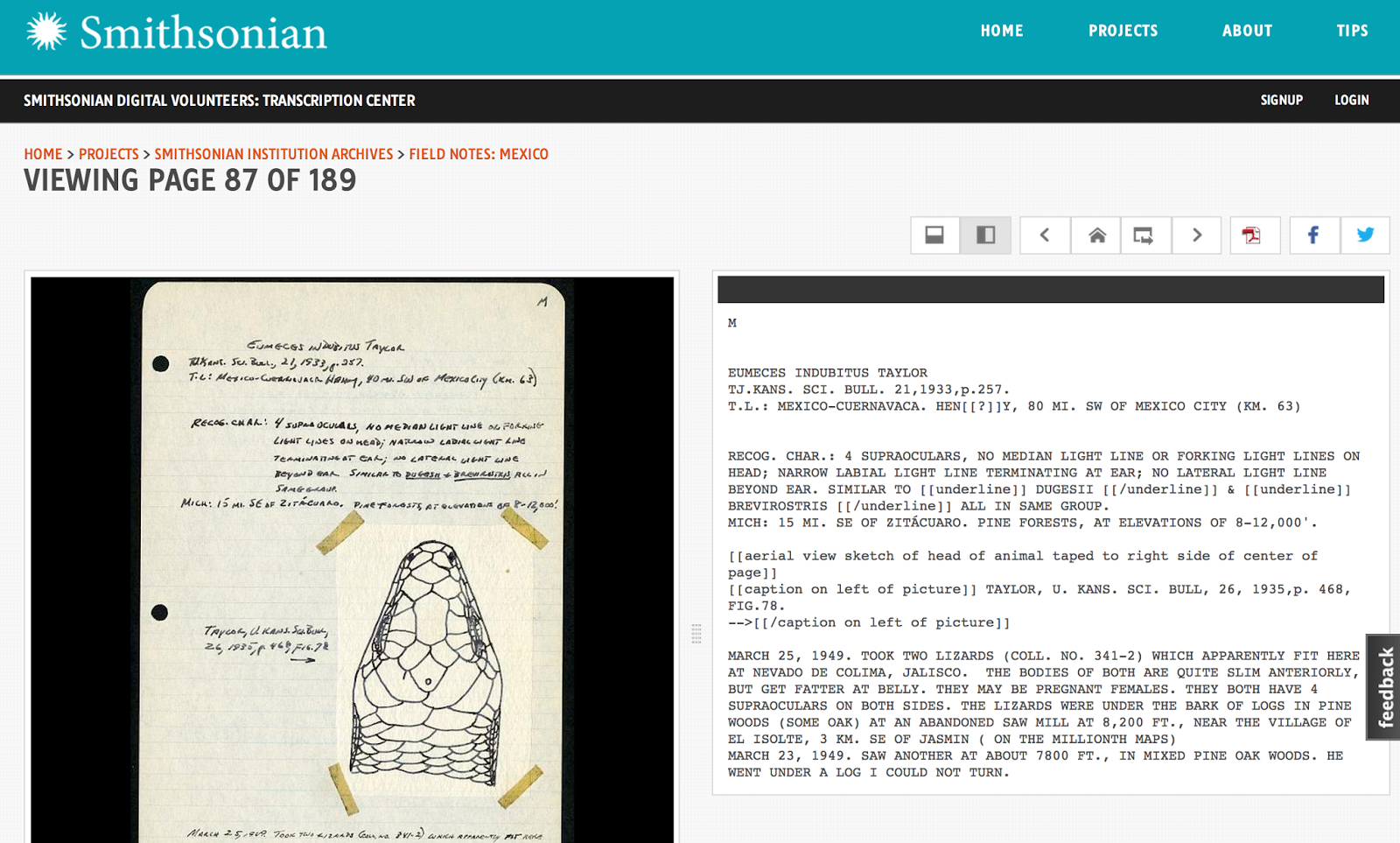
However, no celebration of success would be complete without a mention of the passionate “volunpeers” of the Smithsonian Transcription Center. Field books are often difficult to search and read due to their age and generally hand-written entries; pages may be faded and smudged, handwriting may be cramped or scribbled or stained by exposure to the elements, and the author may have used symbols and index marks that are foreign to modern readers. Unless a researcher knows exactly what they are looking for, they may be discouraged by the time and effort it takes to parse the archival text. Thankfully, the Smithsonian Transcription Center, which opened to the public on August 12th, has included the Field Book Project as one of its partners since the very beginning, allowing us to ask the crowd for assistance in conducting detailed readings and transcribing of field book content.

View Full Size Image
James Peter’s fieldnotes from Mexico (1949-50), transcribed for The Field Book Project in the Smithsonian Transcription Center.

Each item that goes into the Transcription Center must first be transcribed and then reviewed by a volunpeer, who must create an account and can then access both the training documents on the site and also the rich community on the Center and on related social media platforms for questions and answers. Several of the volunpeers have become “super users,” transcribing and reviewing a large volume of material, and also serving as rich information sources for new transcribers on how to document tricky situations such as foreign characters, symbols, marginalia, and in field books in particular, the scientific names for observed flora and fauna.

At last count there were 84 items in the Transcription Center, 69 of which had been fully transcribed, an incredible resource for researchers and reference archivists alike! More fieldbooks are being added continuously and the eventual goal is to place those completed transcriptions into BHL alongside the original field books. The crowd of volunpeers has and is enabling the Field Book Project to offer more and better access to everyone from professional researchers to curious onlookers, and sometimes even leads researchers to information that may never have been discovered without the dedicated assistance of the volunpeers on the Smithsonian Transcription Center.

Become a volunpeer today and help us transcribe field notes to improve access to these valuable primary-source documents!

We Love Our Users!

With over 44 million pages of biodiversity literature, several million images, and a desire to continuously improve access to and discovery of these materials, leveraging the power of the crowd is a match made in heaven for BHL. With contributions from our users, we can ensure that our wealth of biodiversity information can continue to inspire discovery of the natural world. Thank you for your contributions, and if you’d like to know more about how you can contribute, send us feedback.

Trish Rose-Sandler, BHL Data Analyst, Missouri Botanical Garden
Julia Blase, Project Manager, The Field Book Project
Grace Costantino, BHL Outreach and Communication Manager

View Full Size Image

The Art of Life project is funded by the National Endowment for the Humanities (Grant number PW-51041-12).

View Full Size Image

Mining Biodiversity is funded in part by the Institute of Museum and Library Services (Grant number LG-00-14-0032-14).

Purposeful Gaming is funded by the Institute of Museum and Library Services (Grant number LG-05-13-0352-13).

November 6, 2014by Grace Costantino
Blog Reel, Campaigns, Featured Books, Monsters Are Real

The Beautiful Monster: Mermaids

In 1492, Christopher Columbus sailed out from Spain with a mission to find a western trade route to Asia. Instead, he found a whole “New World”…and something altogether more mysterious.

On January 9, 1493, near the Dominican Republic, Columbus spotted three “mermaids.” How did he describe them? “They are not as beautiful as they are painted, since in some ways they have a face like a man” (History.com).

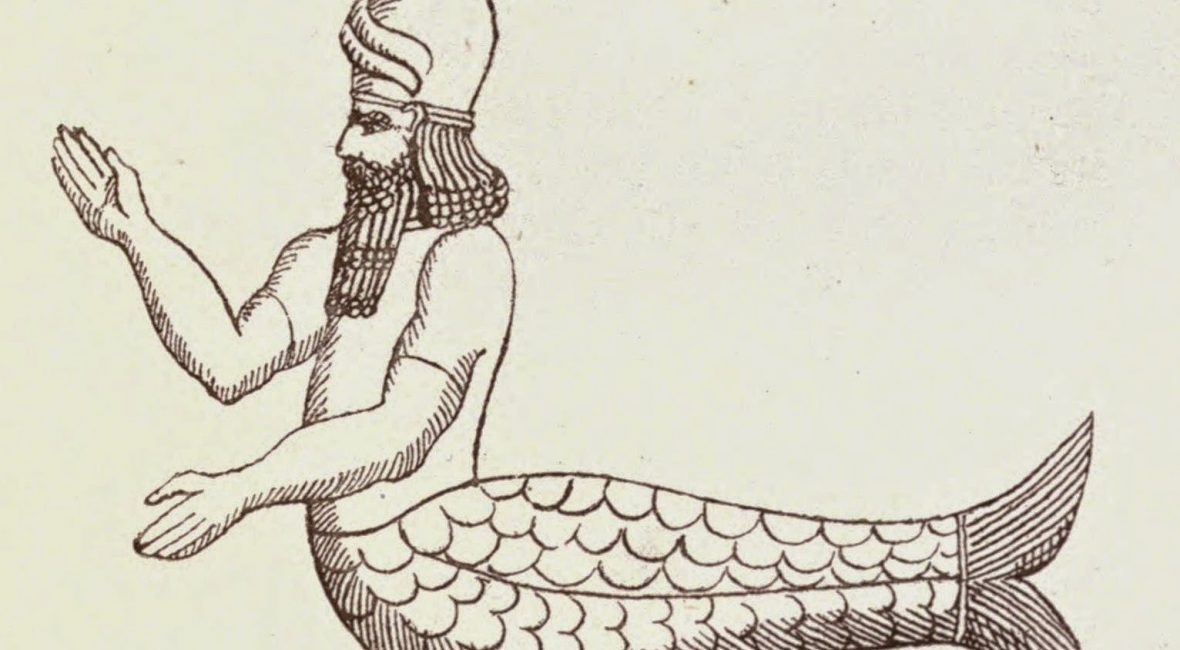
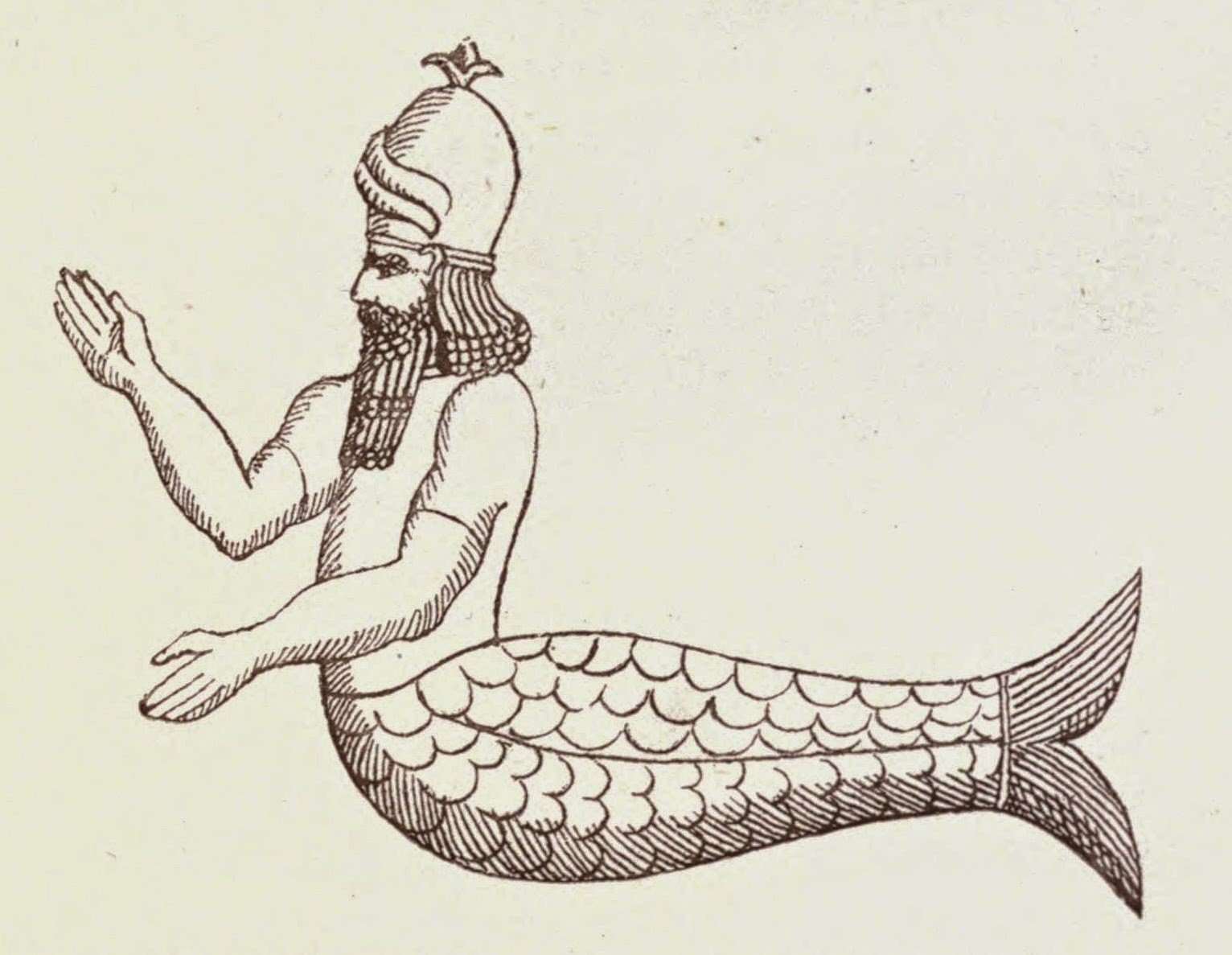
The myth of a marine human extends as far back as 5,000 BCE, when the Babylonians worshipped a fish-tailed god named Oannes. John Ashton, author of Curious Creatures in Zoology, proposes that this is the first depiction of a merman. Also in classical antiquity, the goddess Atargatis, chief goddess of northern Syria, was depicted as a fish-bodied human, thus constituting the first known representation of a mermaid.

View Full Size Image
Ancient god Oannes, perhaps first representation of a merman. Ashton, John. Curious Creatures in Zoology. 1890. http://biodiversitylibrary.org/page/23574964.

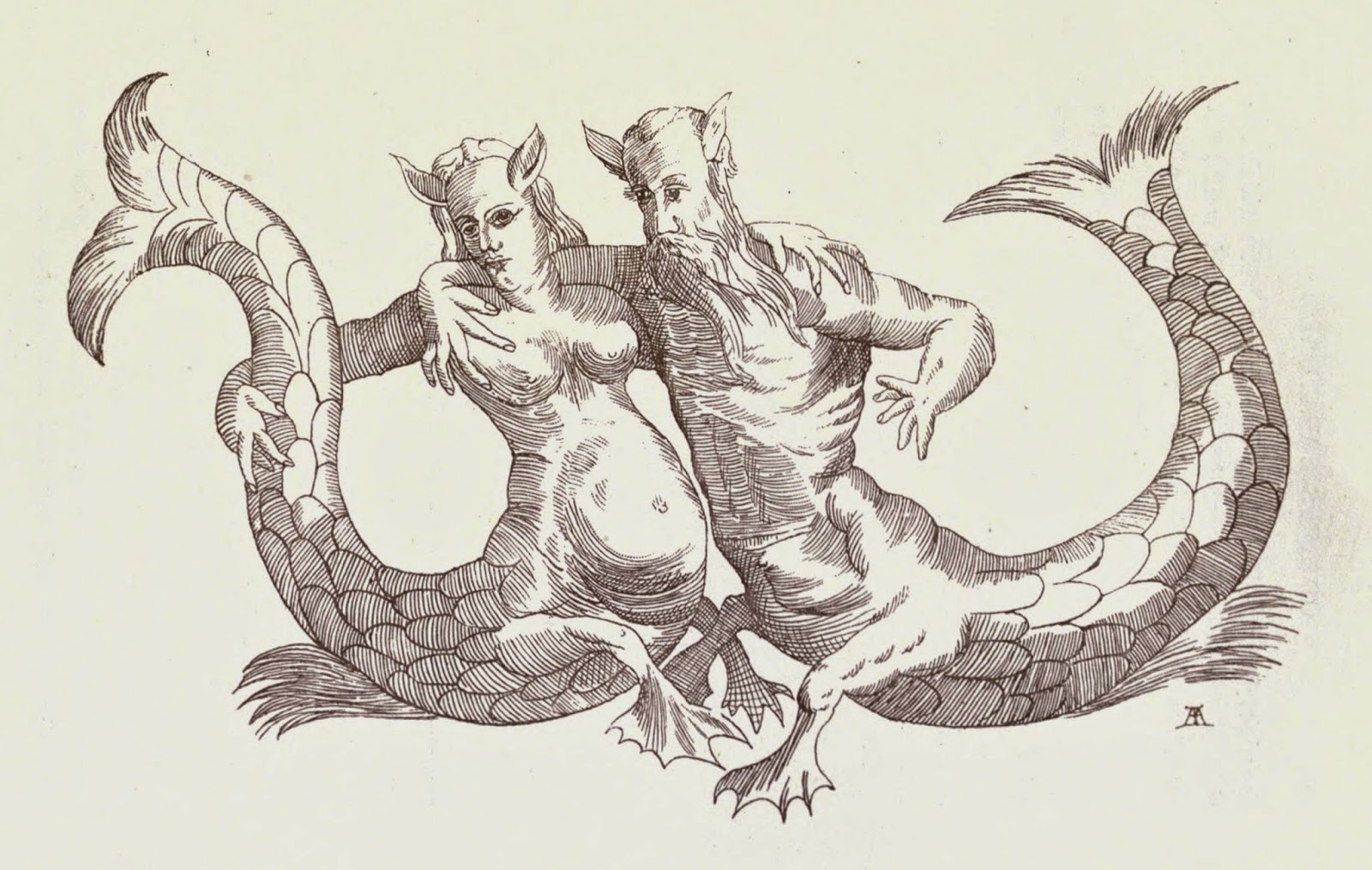
By the Common Era, mermen and mermaids had made their way into the accepted zoological canon. Pliny the Elder, who lived in the first century CE and had quite a lot to contribute to the discussion of mythical beasts, asserted that mermaids were real. According to Philemon Hollands’s 1601 translation (1634 edition in BHL), Pliny stated,

“And as for the Mermaids called Nereides, it is no fabulous tale that goeth of them: for looke how painters draw them, so they are indeed: only their body is rough and scaled all over, even in those parts where they resemble a woman.”


View Full Size Image
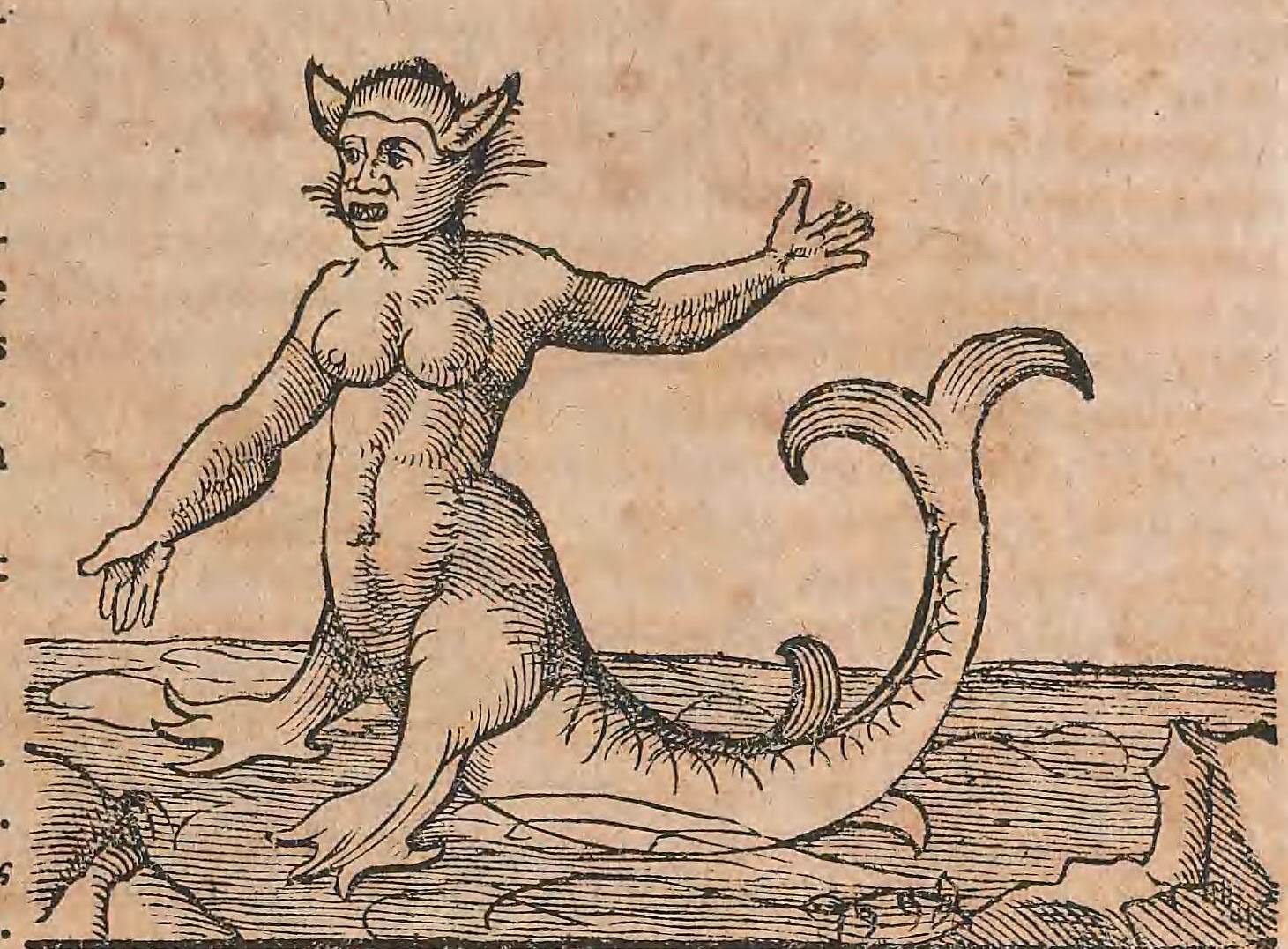
Tritons, or Nereids, the merpeople of the Greeks and Romans. Ashton, John. Curious Creatures in Zoology. 1890. http://biodiversitylibrary.org/page/23574966.

In the centuries that followed, many people claimed to actually see mermaids. In 1608, during an expedition to discover the Northwest Passage, Henry Hudson claimed that several crewmembers spotted a mermaid. From the naval upwards, she was like a woman, with long, black hair, but she had a tail like a porpoise.

View Full Size Image
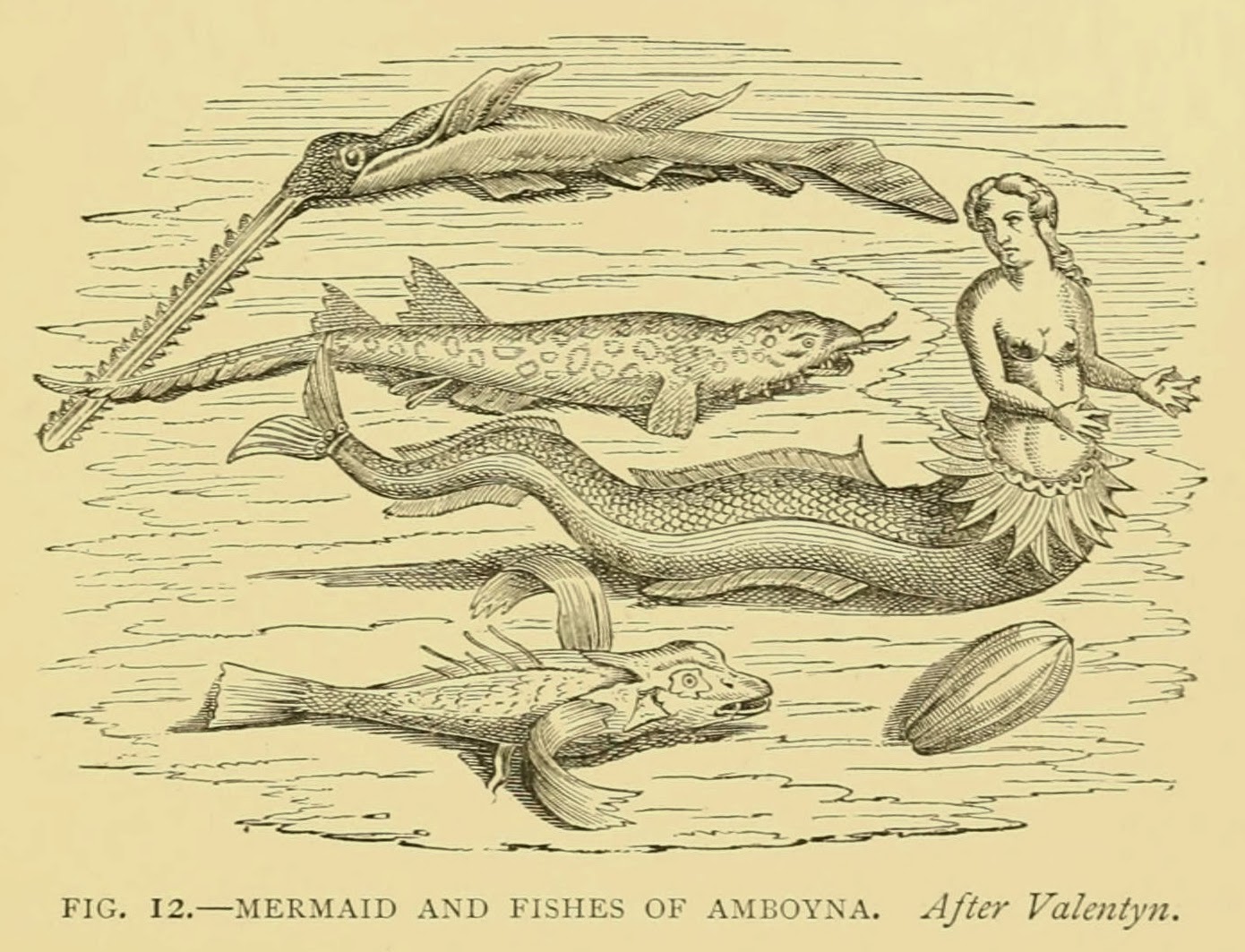
Mermaid of the type inhabiting the Dutch East Indies. Valentijn’s mermaid, after Fallours. Lee, Henry. Sea Fables Explained. 1883. http://biodiversitylibrary.org/page/10985600.

By the eighteenth century, many believed that mermaids inhabited the seas surrounding the Dutch East Indies. The official painter of the Dutch East India Company, Samuel Fallours, included a tantalizing mermaid within his 1718 drawing depicting the assortment of exotic biodiversity found around the islands. Francois Valentijn included a copy of Fallours’ mermaid in his publication on the East Indies, entitled Natural History of Amboina (1727). He claims that this “monster resembling a siren” was captured on the coast of Borneo.

Mermaid as Monster

Valentijn’s “monster” title alludes to the fact that merpeople were not always represented in a sensual light. Sometimes, they were just plain monsters. Within the 13th century Norwegian manuscript Konungs skuggsjá (linked: English translation by Laurence Larson), we read of the merman:

“The monster is tall and of great size and rises straight out of the water…It has shoulders like a man but no hands…No one has ever observed it closely enough to determine whether its body has scales like a fish or skin like a man. Whenever the monster has shown itself, men have always been sure that a storm would follow.”


View Full Size Image
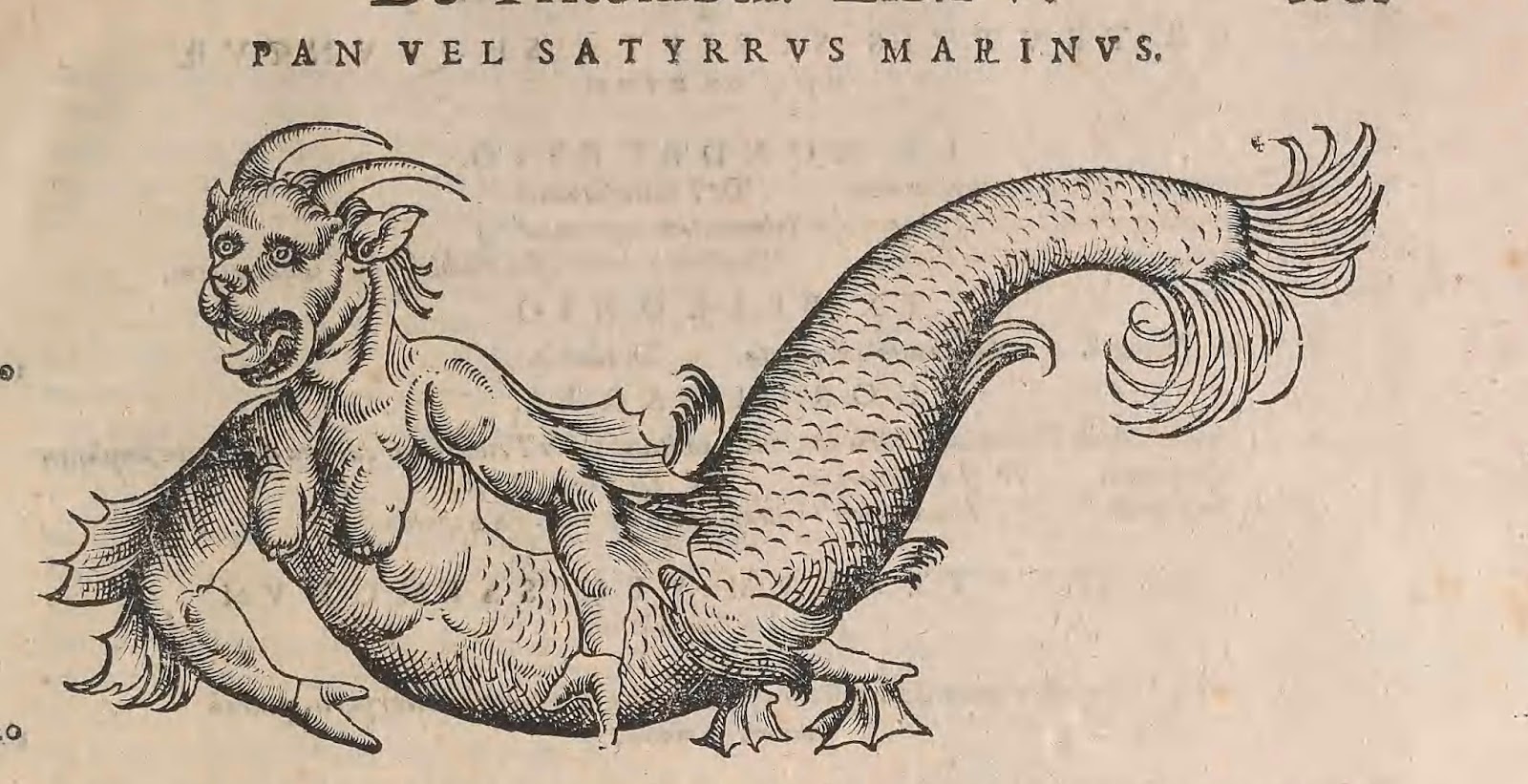
Sea Satyr, or Sea Demon. Gessner, Conrad. Historia Animalium. 2nd Ed. 1604. http://biodiversitylibrary.org/page/42166652.

And of course, we can’t omit Conrad Gessner from our discussion. His 16th century book Historia Animalium depicts the Sea Satyr, also calling it a sea demon. According to John Ashton, Gessner “tries to pass it off as a veritable merman.” Gessner also claims that, on November 3, 1523, a man-fish, about the size of a five year old boy, was seen at Rome.

View Full Size Image
Man-fish, about the size of a boy, seen at Rome. Gessner, Conrad. Historia Animalium. 2nd Ed. 1604. http://biodiversitylibrary.org/page/42166072.

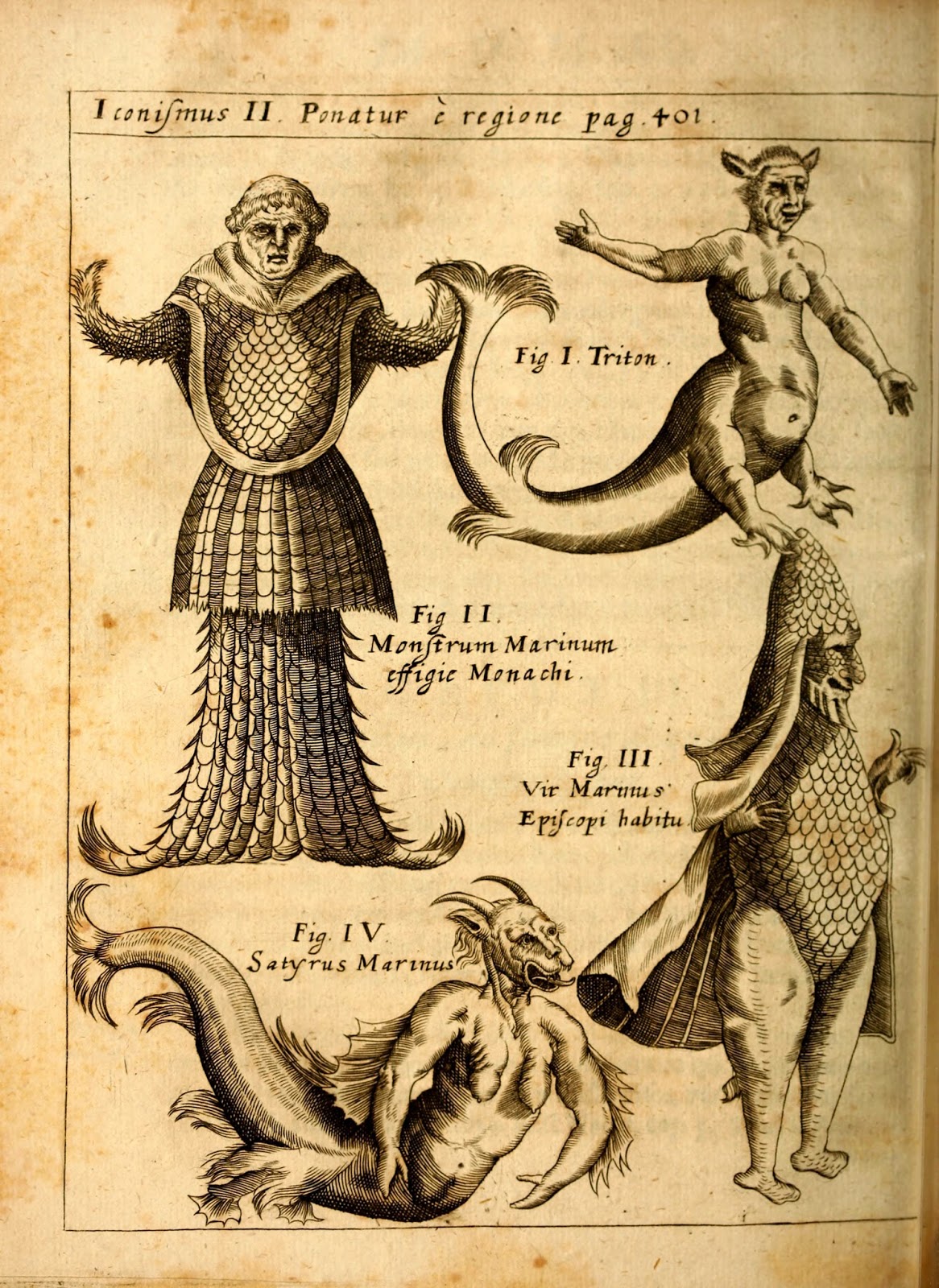
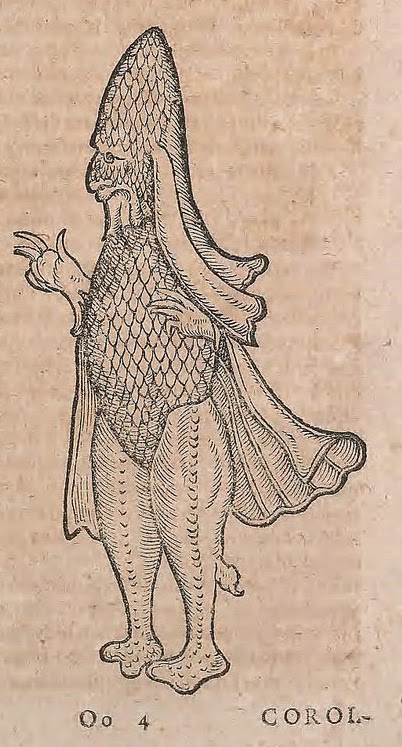
Two other curious, merman-esque monsters include the Monk and Bishop Fish. Gessner, and later others including Guillaume Rondelet, Ulisse Aldrovandi, and Gaspar Schott, portray these beasts, claiming that a Monk-fish was caught off Norway, in a troubled sea, and that the Bishop-fish was seen off the coast of Poland in 1531. Despite such observational reports, these monsters were likely a commentary on the religious tension of the day, resulting in an association between cleric figures and monsters.

View Full Size Image
Monk and Bishop Fish, as republished by Schott. Not all historians accepted the full veracity of these beasts. Guillaume Rondelet, who included a picture of the bishop fish in his 1554-55 book, stated, “I think that certain details beyond the truth of the matter have been added by the painter to make the thing seem more marvelous.” (Ellis, pg. 85). Schott, Gaspar. Physica Curiosa. 1662. http://biodiversitylibrary.org/page/41531037.


Mermaids Through Misidentification

If an exploration of historic monsters has taught us anything, it’s that most were not fabricated out of pure myth. Usually, they proceed from an attempt to categorize an unknown animal sighting.

Bernard Heuvelmans, considered the father of cryptozoology, studied the process by which unknown animals become monsters and monsters are identified as known animals. Of this transformation, he wrote, “The mythifying process can sometimes be carried to the point of altering its object beyond recognition” (Heuvelmans, 1990).

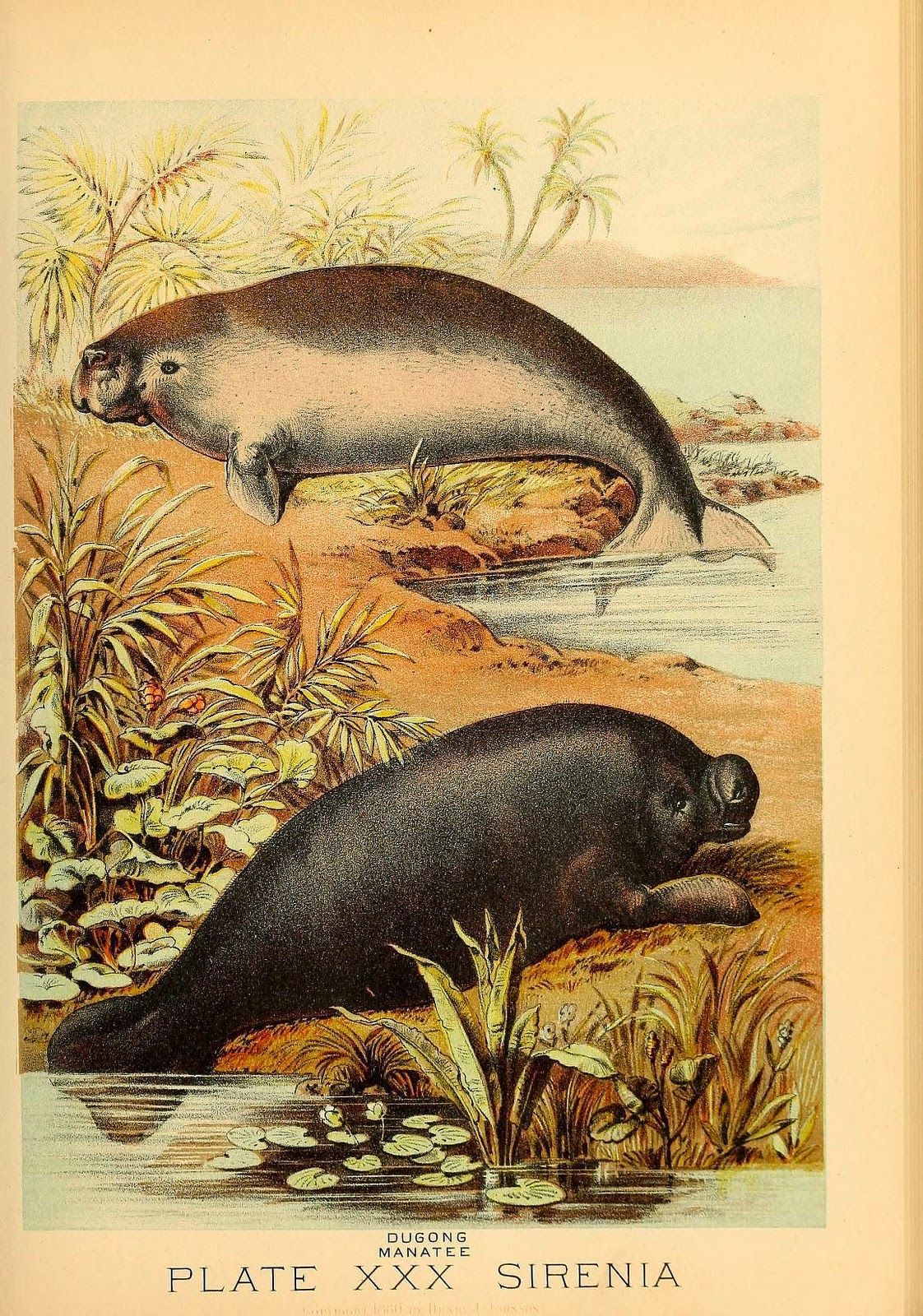
Case in point: The Manatee.

View Full Size Image
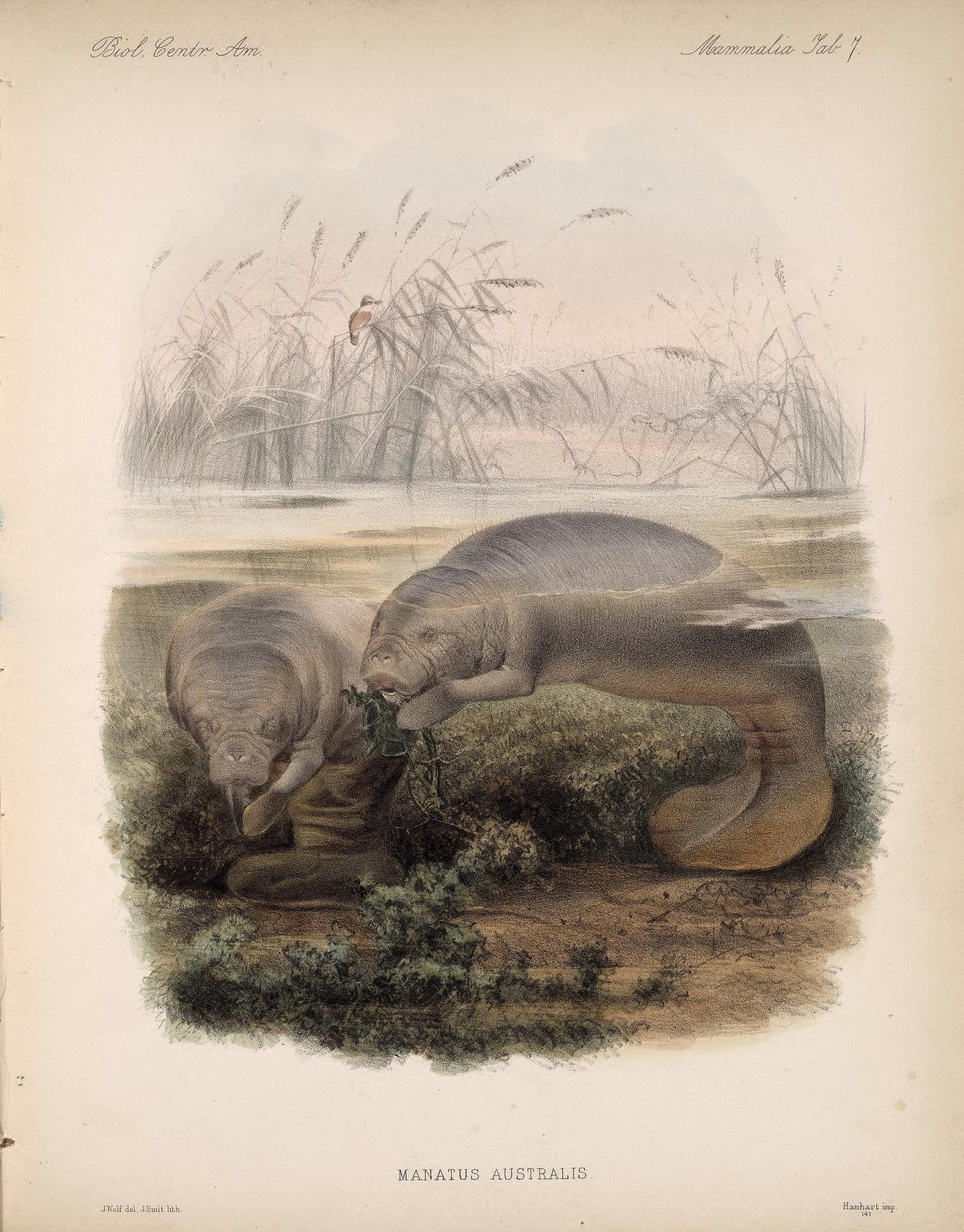
Manatees. Biologia Centrali-Americana. Mammalia. 1879-82. http://biodiversitylibrary.org/page/570882. Read a manatee dissection in this 1941 fieldbook by Edward Chapin from The Field Book Project.

As Heuvelmans explained,

“Since the manatee has pectoral mammae…and a body that tapers to a fishlike tail, it has always been identified, on both side of the Atlantic, with the fascinating mermaid, despite its (to our eyes) ugly face…” (Heuvelmans, 1990)

The three mermaids that Columbus spotted in 1493 (or sirens as he called them), were undoubtedly manatees. He, and many explorers after him, determined that these aquatic mammals were mermaids in flesh and blood. Sightings of dugongs, a member of the manatee’s order, have also been associated with mermaids throughout history. Indeed, the order containing manatees and dugongs to this day is called “Sirenia.”

View Full Size Image
Dugong and Manatee. Craig, Hugh. Johnson’s Household Book of Nature. 1880. http://biodiversitylibrary.org/page/39742211.

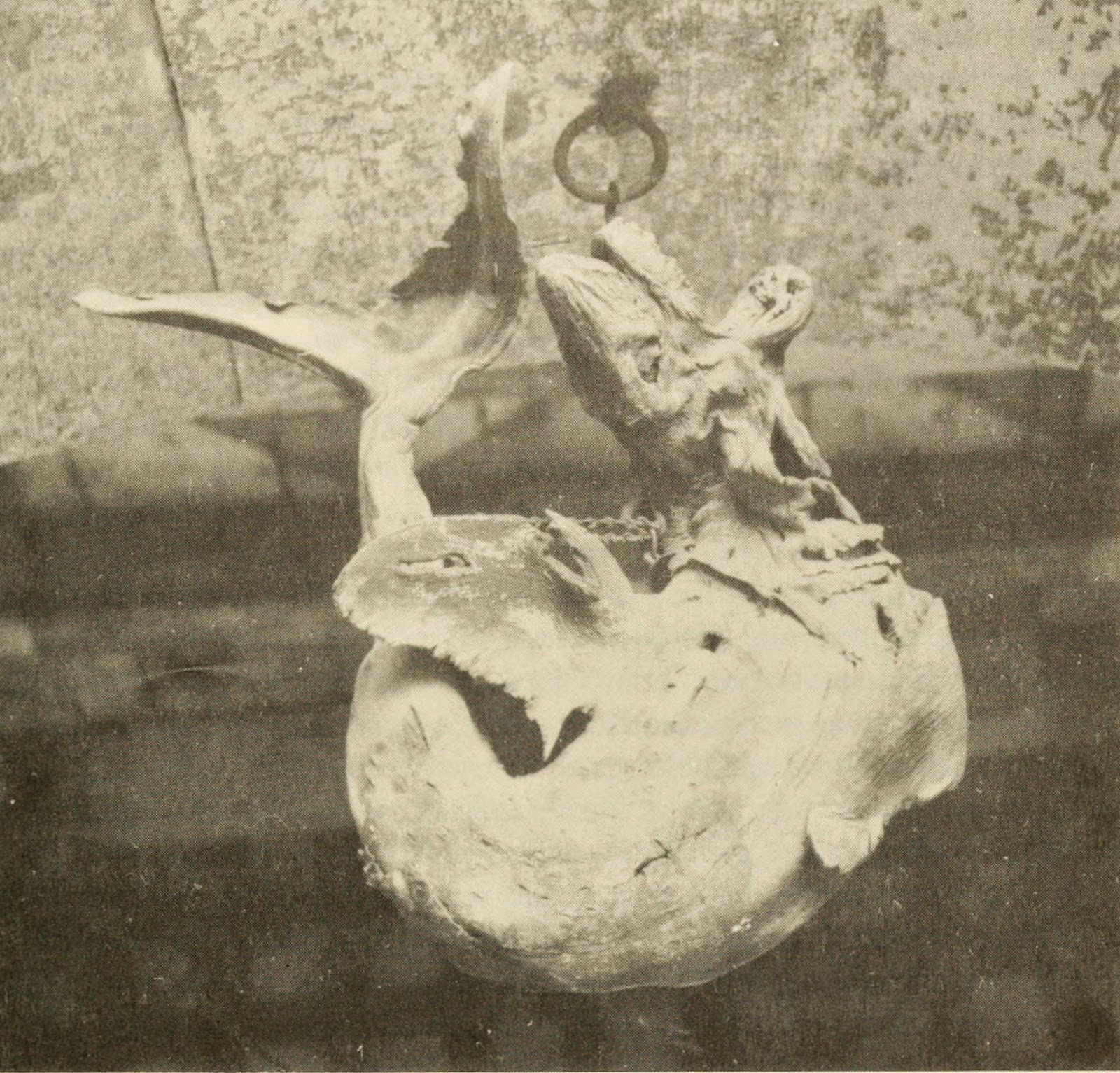
Manatees aren’t the only animals that have played the part of a mermaid. In the thirteenth century, a fisherman in Lake Constance, outside Bregenz, Austria, found a mermaid (Shadows in the Sea, 1963). He heard a voice call to him from the sea, saying, “Take my daughter and hang her in the Arch of Martinster. She is begat of a land woman and is of no use here.” He followed the voice’s command and hung the mermaid in the archway, after which it died in a contorted shape. The true identity of the creature? A shark, possibly a Porbeagle. The original mummified shark was replaced with a stone replica so that it could always stand guard over the city.

View Full Size Image
Bregenz Mermaid, actually a mummified shark. McCormick, Harold. Shadows in the Sea. 1963. http://biodiversitylibrary.org/page/10741173.

Of course, mistaking a manatee or a shark for a mermaid with breasts and flowing locks, which so many sailors vehemently claimed to have seen, seems impossible. It’s clear that some good old exaggeration (and blatant lies) contributed to the mermaid myth.

Mermaids Through Fabrication

The lies associated with the mermaid’s history are more tangible than exaggerating manatees as beautiful women. “Unlike most other monsters, which, almost by definition are very large” explains Richard Ellis in his book Monsters of the Sea, “’mermaids’ are small enough to tempt people to manufacture them.” (pg. 80). And that’s exactly what they did.

Mermaid Fabrication falls into two general categories: “Monkey” Mermaids and Jenny Hanivers.

View Full Size Image
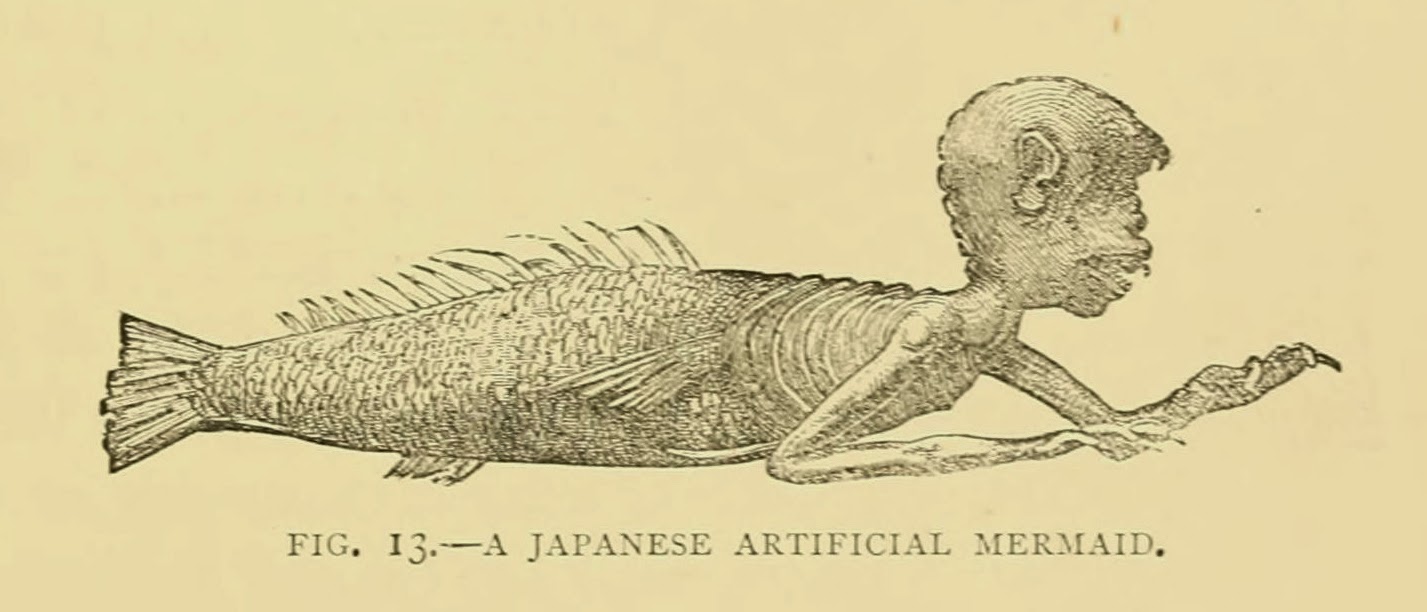
“Monkey” Mermaid. Lee, Henry. Sea Fables Explained. 1883. http://biodiversitylibrary.org/page/10985610.

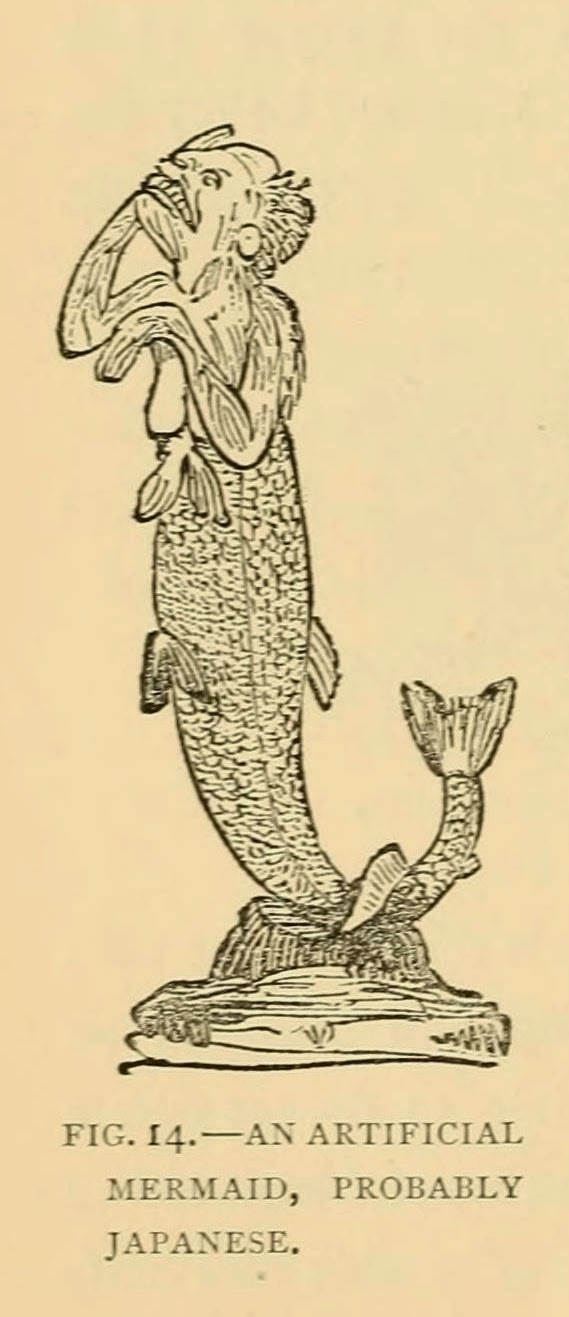
“Monkey” Mermaids made their way into western mermaid lore in the nineteenth century. Apparently manufactured in Japan, these twisted mermaid interpretations were created by combining a small monkey’s head and torso with a dehydrated fish. In the 1840s, P.T. Barnum made a fortune by exhibiting what he claimed, and successfully convinced many people, were the remains of a mermaid. Today it is famously known as the Feejee Mermaid.

View Full Size Image
Barnum’s Feejee Mermaid. Lee, Henry. Sea Fables Explained. 1883. http://biodiversitylibrary.org/page/10985611.

Over time the Jenny Haniver also came to be associated with mermaids. The first known illustration of a Jenny Haniver appears in Gessner’s Historia Animalium in the mid-1500s.

View Full Size Image
A ray, mutilated to look mermaid-esque. This image is the first known depiction of a Jenny Haniver-style specimen. Gessner, Conrad. Historia Animalium. 2nd Ed. 1604. http://biodiversitylibrary.org/page/42166434.

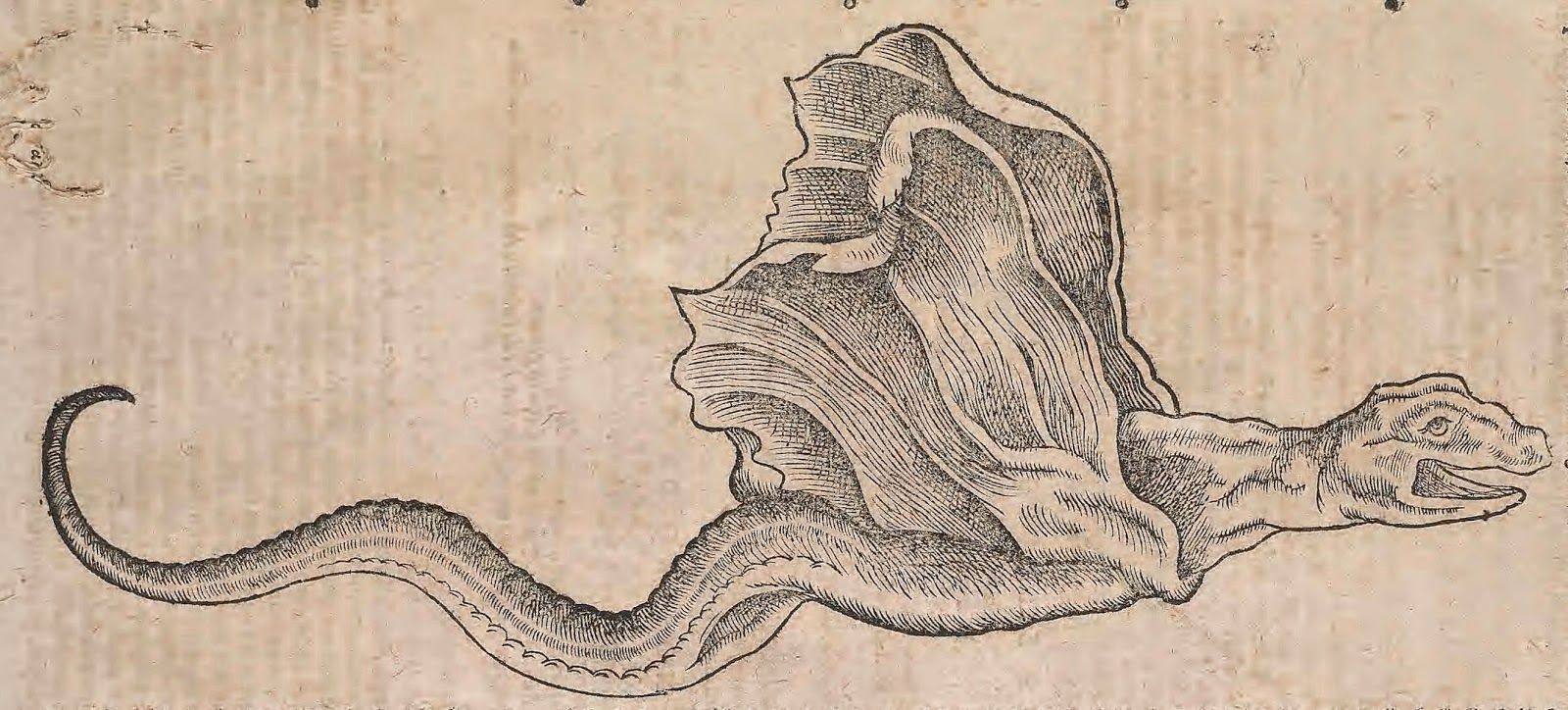
What exactly are these disturbing specimens? They are mutilated elasmobranchs – either a ray, skate, or guitarfish. The fins are cut so that they resemble wings, a string is tied around the “neck” area to give it a human appearance, and the tail is twisted into a suitable mermaid-esque form. The charade is then allowed to dry in the sun and varnished for preservation.

View Full Size Image
“basilicus ex raia,” another Jenny Haniver-style farce. These specimens were also sometimes associated with dragons. Aldrovandi, Ulisse. Serpentum, et draconum historiæ libri duo. 1640. http://biodiversitylibrary.org/page/41765368.

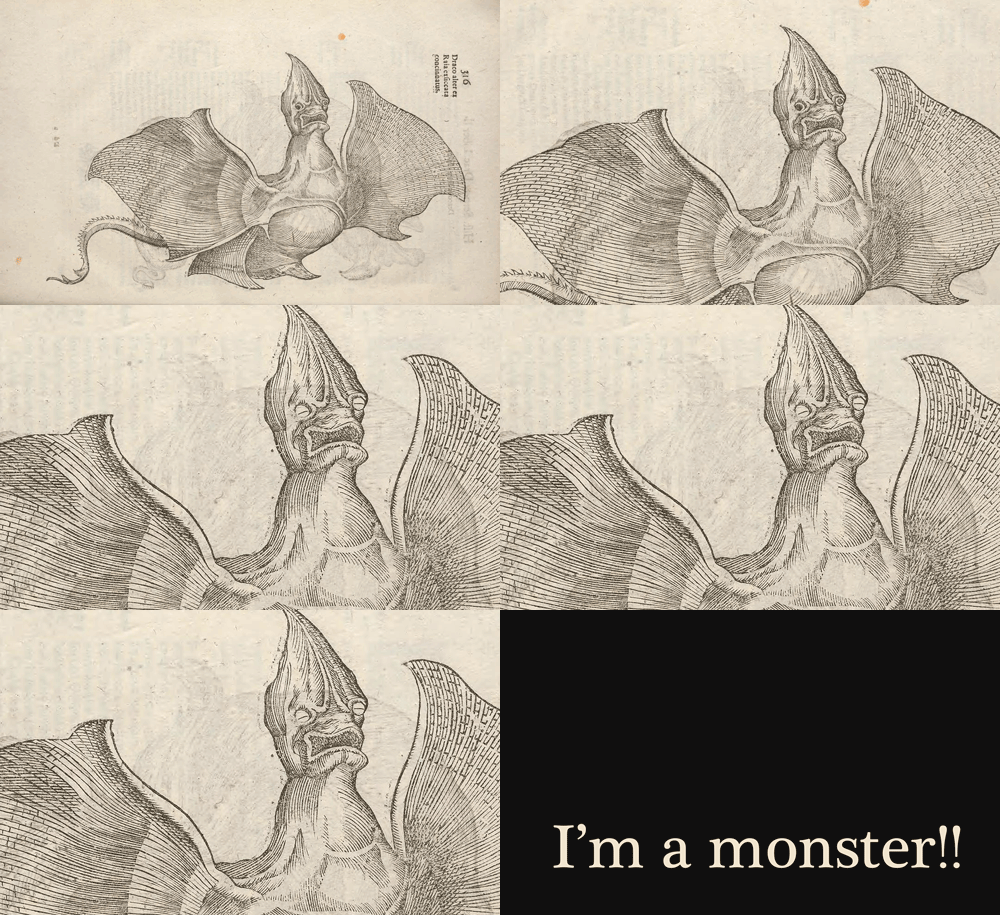
In the mid-1600s, Ulisse Aldrovandi published what he called a basilisk but which was created in the same fashion as Gessner’s Jenny Haniver. He includes a caption with his illustrations reading “basilicus ex raia,” indicating his awareness of the illegitimacy of the monster. Both Gessner and Aldrovandi classify these strange beasts as rays, but provide no further information.

View Full Size Image
Over time, rays mutilated to resemble human-fish hybrids came to be associated with mermaids under the term Jenny Hanivers. Ulisse Aldrovandi, who published this image in 1640, described it as “basilicus ex raia,” indicating an awareness of the illegitimacy of the creature. See more fantastic historic monsters come to life on the Smithsonian Libraries’ Tumblr. GIF created by Richard Naples (Smithsonian Libraries), based on Aldrovandi, Ulisse. Serpentum, et draconum historiæ libri duo. 1640. http://biodiversitylibrary.org/page/41765369.

Of course, by Gessner and Aldrovandi’s time, the term Jenny Haniver was not yet in use. The name does not appear in published form until 1928, when Gilbert Whitley wrote about these monsters in an Australian Museum Magazine article. The origin of the name is unknown, though it has been suggested that it is a derivative of ‘Anvers,’ the French name for Antwerp and a possible place of origin for the deception.

The Case for the Mermaid

So, does the mermaid exist? Obviously not in the form of a half man or woman, half fish, but, to quote Dr. Ellis in Monsters of the Sea, “The sirens are still with us, however, in the form of the manatees and dugongs. They may not have the sex appeal of their namesake, and they certainly are not as beautiful as the mermaid, but they differ from their historic and literary ancestors in one irrefutable respect: they exist.” (pg. 98).

  • Follow our blog and #bhlMonstersRreal on Twitter and Facebook all week to learn more about monsters and the animals that inspired them.
  • Browse historic illustrations of mermaids and the animals that inspired them in Flickr.
  • Browse the books that portray these historic monsters in BHL.
  • Carve a merman in your Halloween Pumpkin this year! Share your carvings with us on Facebook and Twitter!
  • See some of our favorite monsters come to life on the Smithsonian Libraries’ Tumblr!


Reference:

  • Ellis, Richard. Monsters of the Sea. New York: Alfred A. Knopp, Inc., 1994. Print.
  • Heuvelmans, Bernard. The Metamorphosis of Unknown Animals into Fabulous Beasts and of Fabulous Beasts into Known Animals. Cryptozoology 9 (1990) 1-12.
October 31, 2014by Grace Costantino
Blog Reel, Campaigns, Featured Books, Monsters Are Real

The Octopus…The Monster that Isn’t

“…A very formidable animal, and possess[ing] such a degree of strength as to make it dangerous to attack it without great precaution. Such is the ferocity and violence with which it defends itself, that even the strongest Mastiff can hardly subdue it without a long and doubtful contest. It has even been known to attack a person while swimming, and to fasten itself with dangerous force round the body and limbs.”

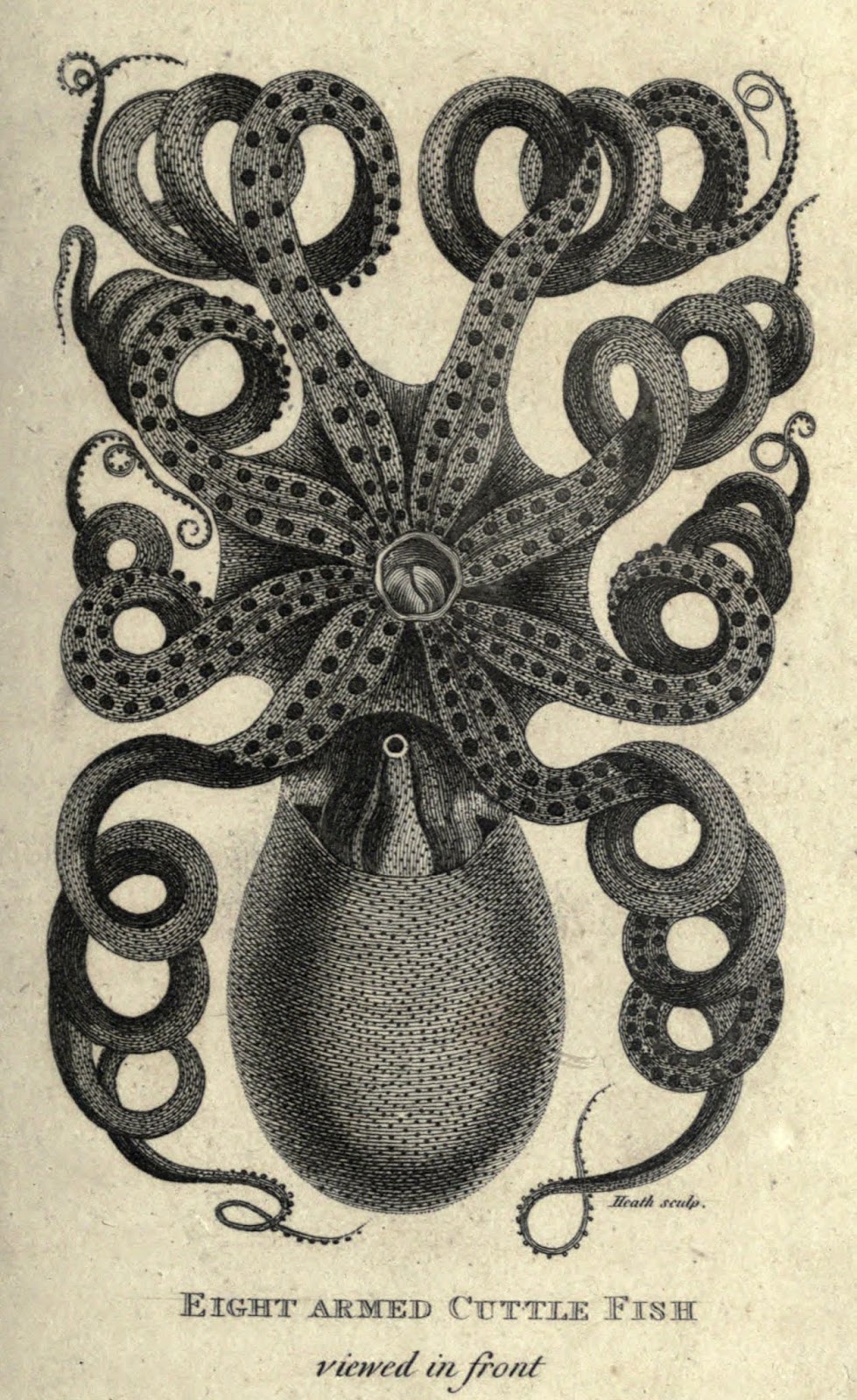
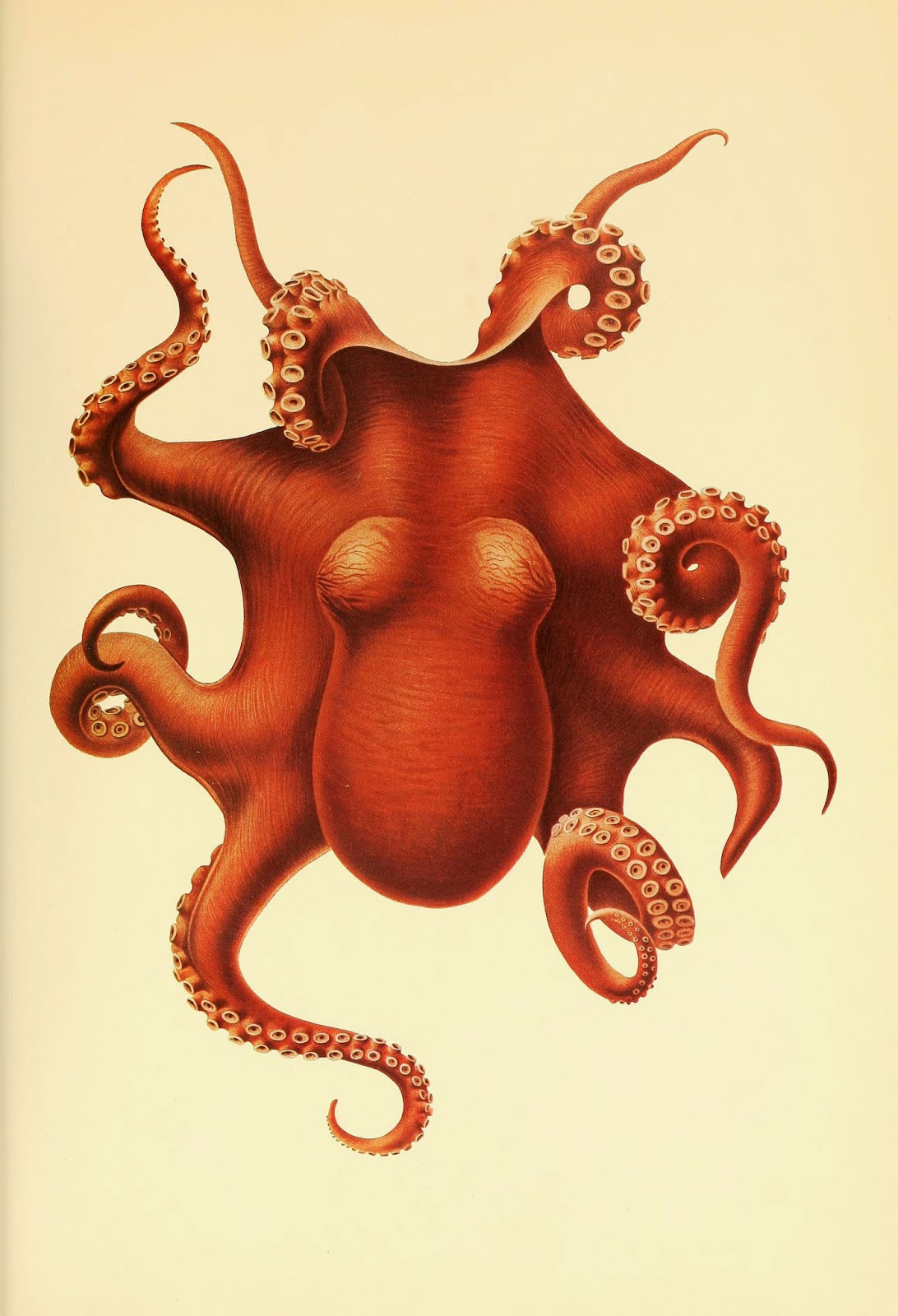
Such a description conjures up images of a great behemoth, perhaps with sharp fangs, great talons, and fiery red eyes. It was given by George Shaw in a lecture to the Royal Institute and published in 1809.

It is a description of the Curled Octopus (Eledone cirrhosa), reaching a total size of 5-15 inches. Not quite the beast the description implies…

View Full Size Image
“Eight Armed Cuttle Fish” aka Curled Octopus. Shaw, George. Zoological Lectures Delivered at the Royal Institution by George Shaw. v. 2. 1809. http://biodiversitylibrary.org/page/21511926.

The octopus, like the squid (aka kraken), has long held an unwarranted reputation as a monster. “Their strangely repulsive appearance, and the fictional stories of their attacks, have built up in the popular mind a picture of the ‘devil fish’ which no amount of accurate description is ever likely to cut down to authentic size,” mused Frank W. Lane in Kingdom of the Octopus (1962).

“Ever since people started writing about such things – and probably when they only talked about them – they have never been content simply to name and describe the octopus, but have insisted on passing judgment upon it,” wrote James Artz of the American Museum of Natural History (Ellis, pg. 257).

View Full Size Image
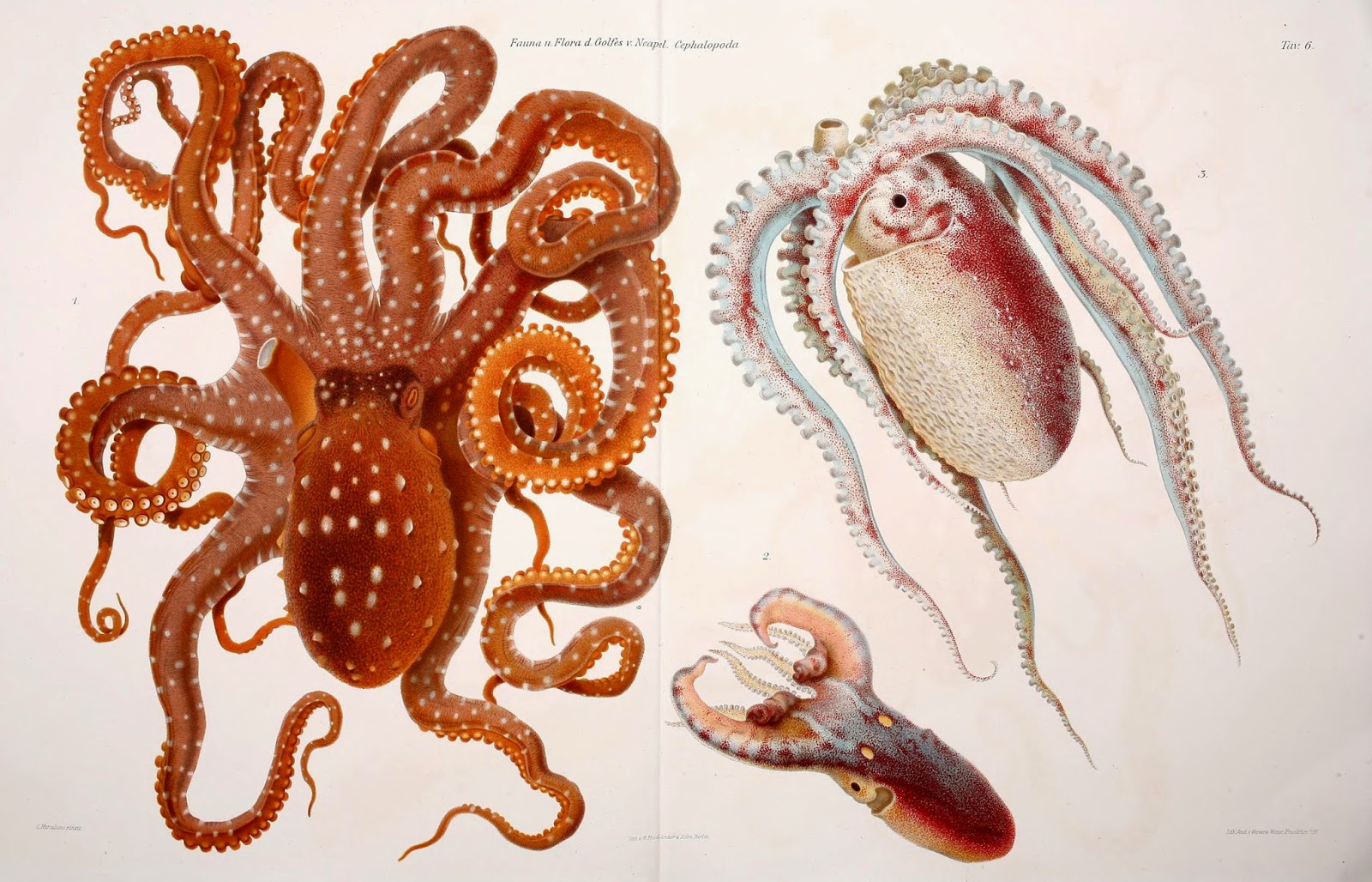
Amazing Mollusca from the Gulf of Naples: Octopus macropus, Tremoctopus violaceus, and Ocythoe tuberculata. Jatta, Giuseppe. I Cefalopodi viventi nel Golfo di Napoli (sistematica) : monografia. 1896. http://biodiversitylibrary.org/page/35424286.

Accounts of the Octopus’ “vile” personality can be found throughout hundreds of years’ worth of literature, even well into the twentieth century and by respected scientists.

The Octopus as Monster

In the first century AD, Pliny the Elder positions the octopus (which he labels a polyp, along with squids) as a gruesome monster, writing, “no animal is more savage in causing the death of a man in the water; for it struggles with him by coiling round him and it swallows him with its sucker-cups and drags him asunder by its multiple suction” (Ellis, pg. 261).

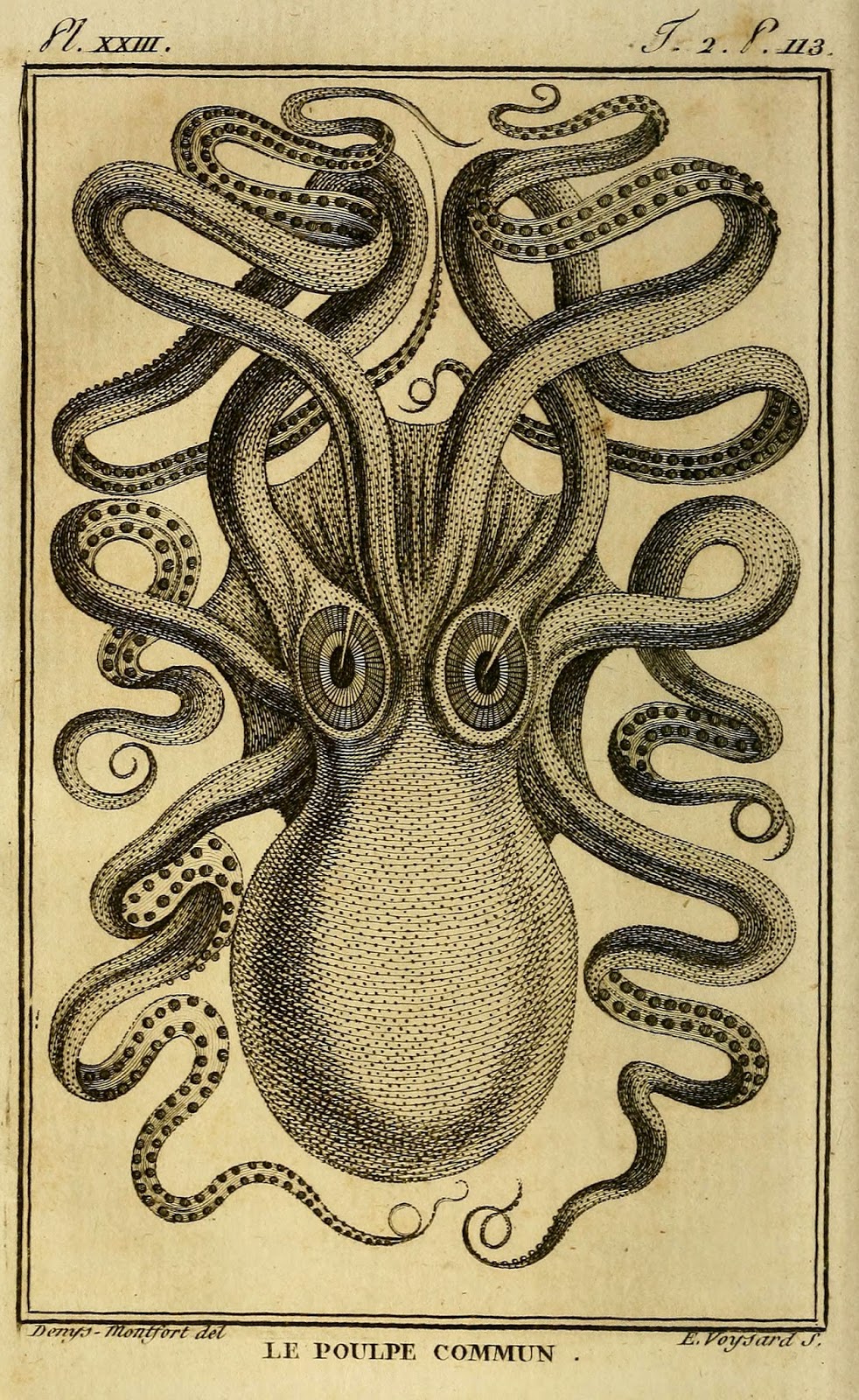
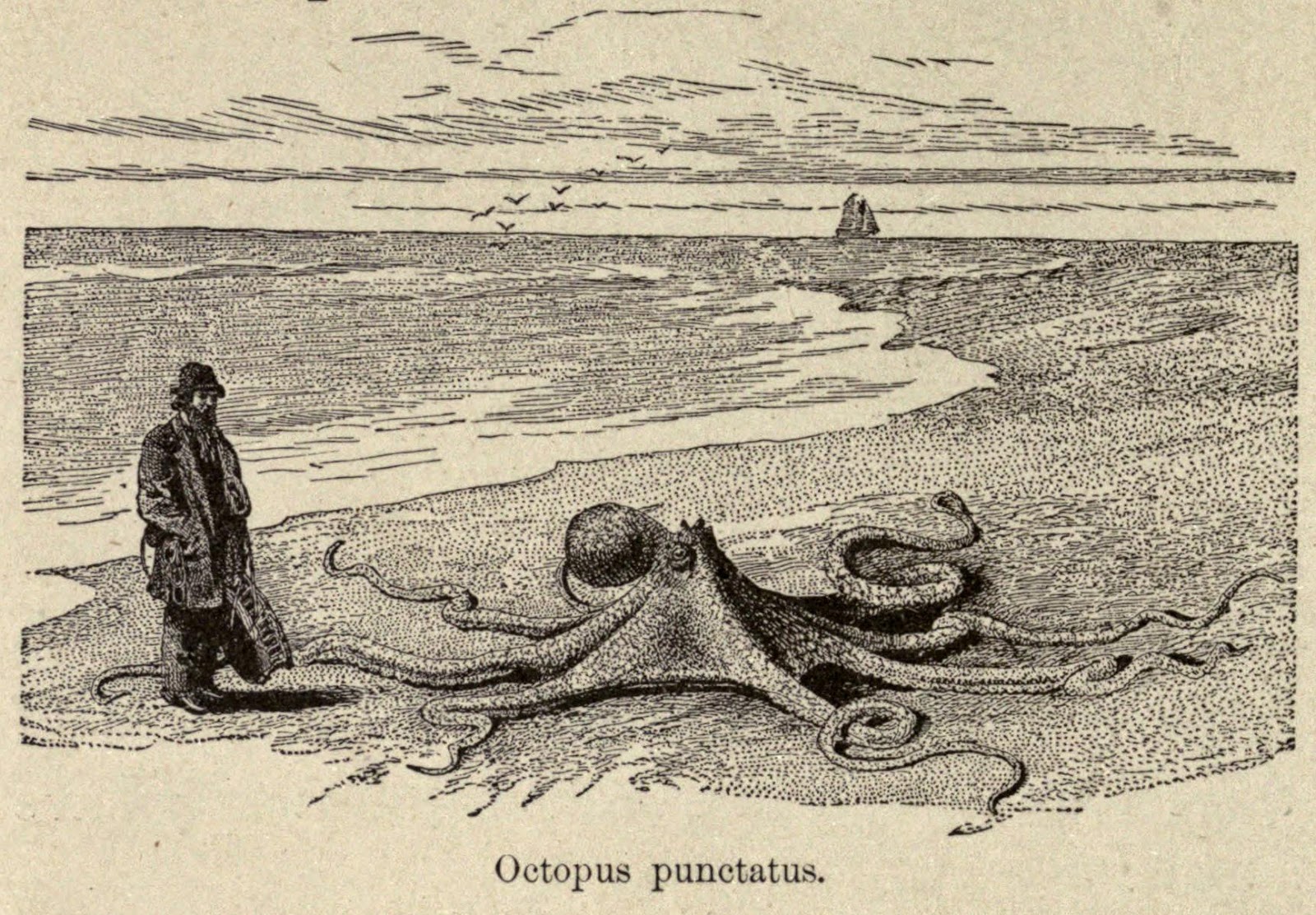
Not surprisingly, Denys de Montfort, the personality behind the legendary kraken image, could not resist the opportunity to contribute to the growing octopus lore in the early nineteenth century. Within Histoire Naturelle Générale et Particulière des Mollusques, he describes an episode where an octopus attacked and nearly succeeded in drowning his dog on the beach. He and his dog were finally able to subdue the monster by tearing off its arms…Given Montfort’s demonstrated history of untruths, his account is hardly to be believed.

View Full Size Image
“The Common Octopus.” Montfort, Denys. Histoire naturelle, générale et particulière des mollusques : animaux sans vertèbres et a sang blanc. v. 2. 1801. http://biodiversitylibrary.org/page/35755415.

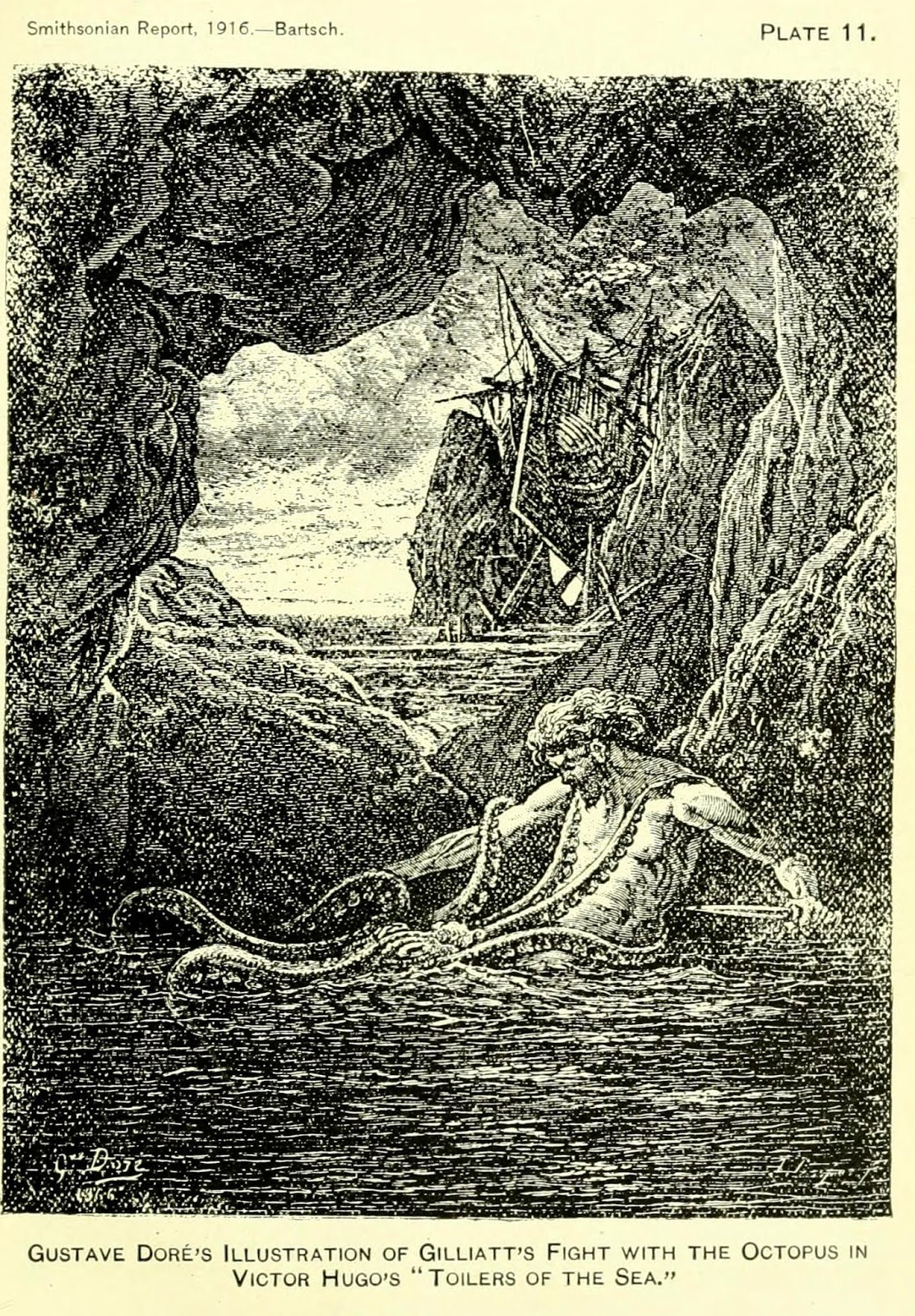
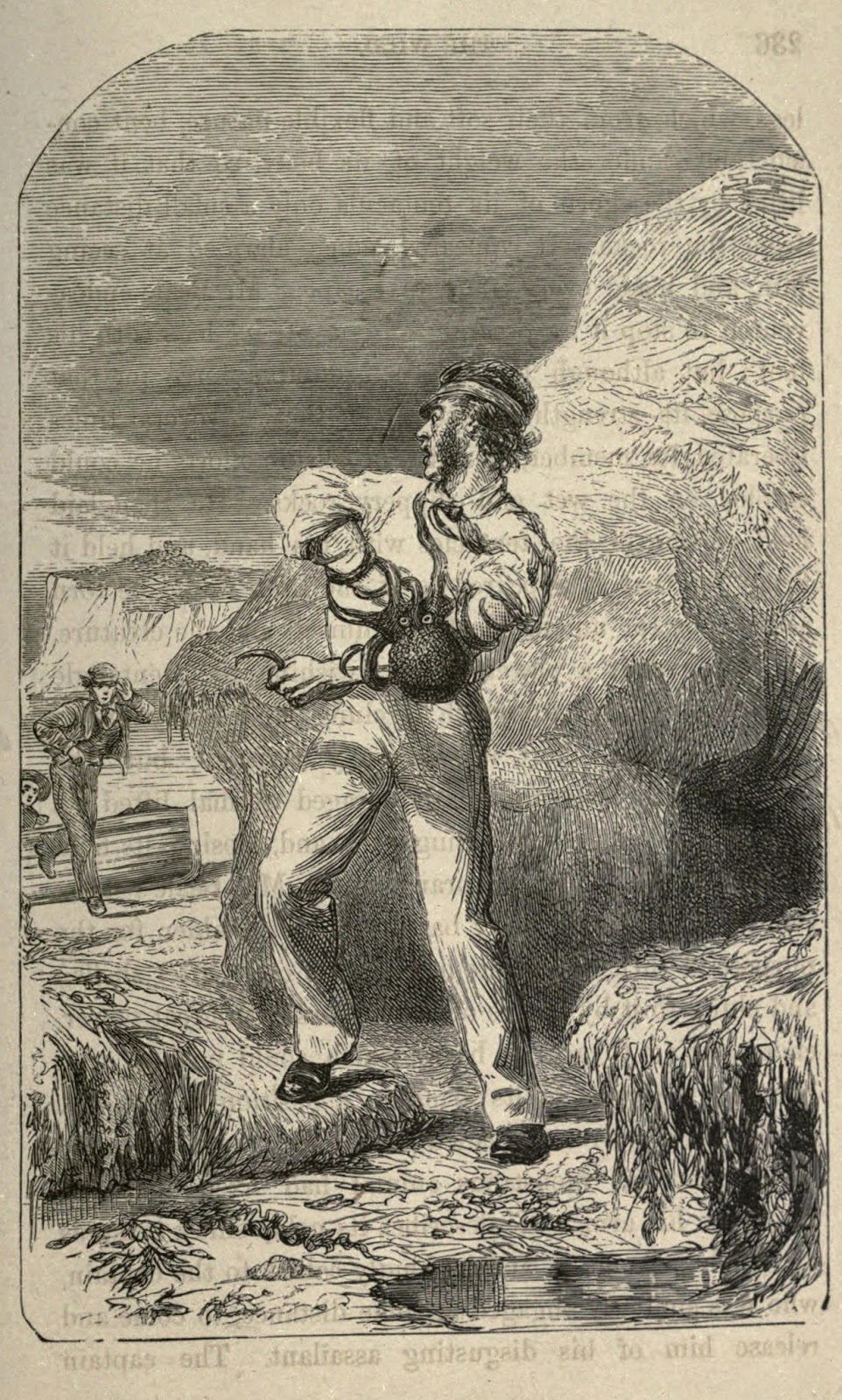
Perhaps the most sensational, and damaging, account of the octopus was presented by Victor Hugo in Toilers of the Sea (1866). Within it, Hugo describes his protagonist’s (Gillat) encounter with an octopus in a cave, which does its utmost to annihilate him. Hugo writes of the beast’s attack: “The hydra incorporates itself with the man; the man becomes one with the hydra. The spectre lies upon you…the devil-fish, horrible, sucks your life blood away…Powerless, you feel yourself gradually emptied into this horrible pouch, which is the monster itself.”

View Full Size Image
Gillat’s struggle with the “monster” octopus, as described in Toilers of the Sea. Annual Report of the Board of Regents of the Smithsonian Institution. 1916. http://biodiversitylibrary.org/page/14187072.

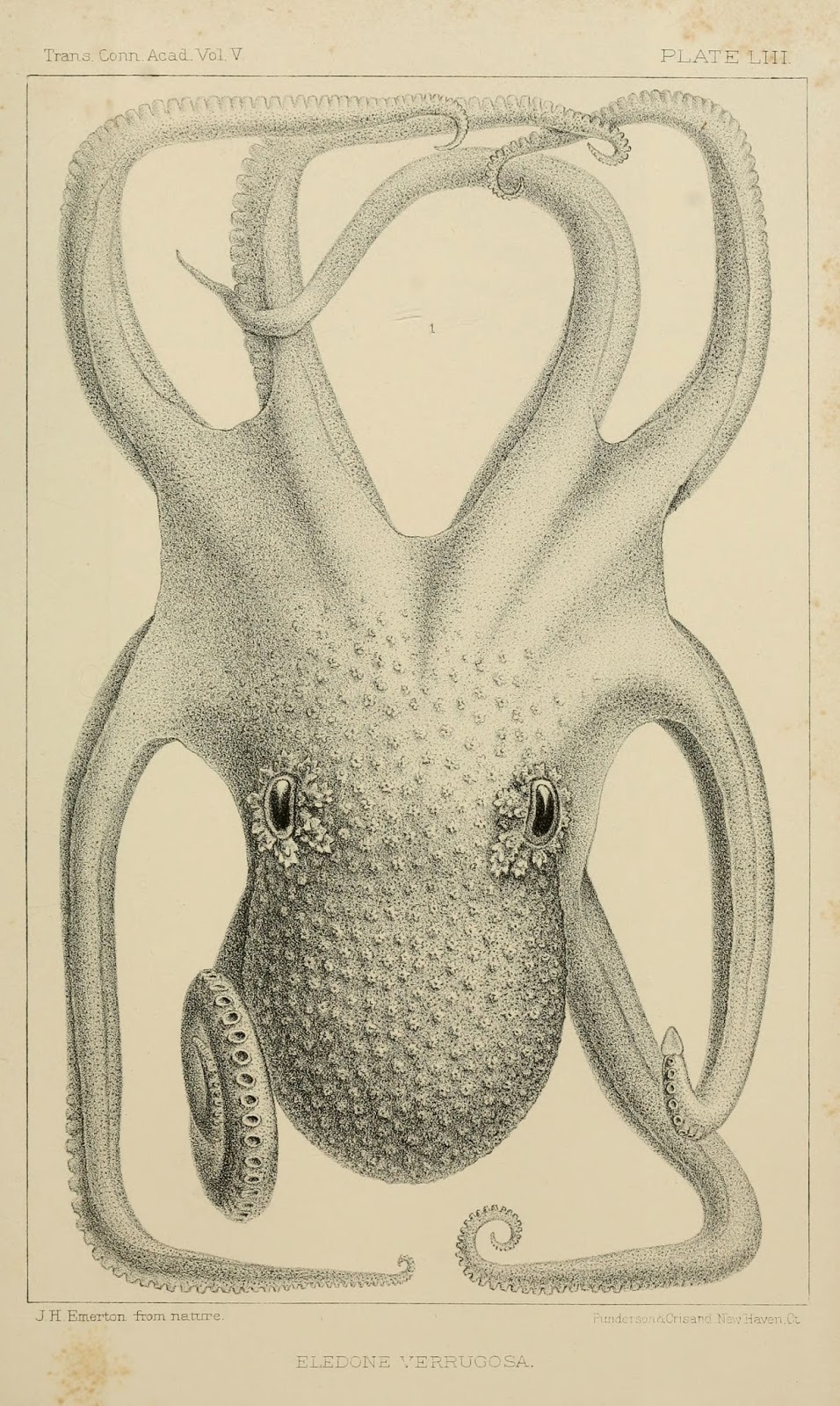
Henry Lee and Addison Verrill, both of whom wrote extensively on squid and octopus, boldly challenged Hugo’s passages, outlining the multiple fallacies included. In Cephalopods of the North-eastern Coast of America, Verrill writes, “The description of the ‘poulpe’ or devil-fish by Victor Hugo…is quite as fabulous and unreal as any of the earlier accounts, and even more bizarre. His description represents no real animal whatever.”

View Full Size Image
Graneledone verrucosa. Verrill, A.E. Cephalopods of the North-eastern Coast of America. v. 2. 1881. http://biodiversitylibrary.org/page/11826821.

Unfortunately, such melodramatic accounts, popular among the public, helped to further secure the octopus’ reputation as a monster, despite the counterarguments against them.

Similar descriptions of the octopus as a monster continued into the twentieth century. For instance, a 1907 fieldbook from Florence Merriam Bailey, American ornithologist and nature writer, whilst in California, deems the octopus a “horrible creature,” describing an episode where a friend was attacked by one in Bermuda. “Their strength is tremendous & they put out [[strikethrough]] au [[/strikethrough]] arms and grasp you and hold on with suction discs & then draw the object up and cut it across the back of the neck with thin knives.”

View Full Size Image
Thomas Beale, surgeon on a British whaling voyage in 1835, claimed he was attacked by an octopus on the beach on the Bonin Islands, south of Japan. Gosse, Philip Henry. The Romance of Natural History. 1864. http://biodiversitylibrary.org/page/23537396.

A 1919 National Geographic article by John Oliver La Gorce, called “Devil-Fishing in the Gulf Stream,” presents the mollusk as “most repulsive, having a large, ugly head, a fierce-looking mouth…two diabolical eyes…capable of sending forth a demonic glare when angered…When challenged [it] will fight to the last, doing its best to pull the object of its wrath beneath the surface of the waters.”

But while natural history has been cruelly unkind to the octopus, presenting the creature itself as a monster, this cephalopod also served to inspire one of mythology’s greatest beasts – The Hydra.

The Hydra: A Case of Mistaken Identity

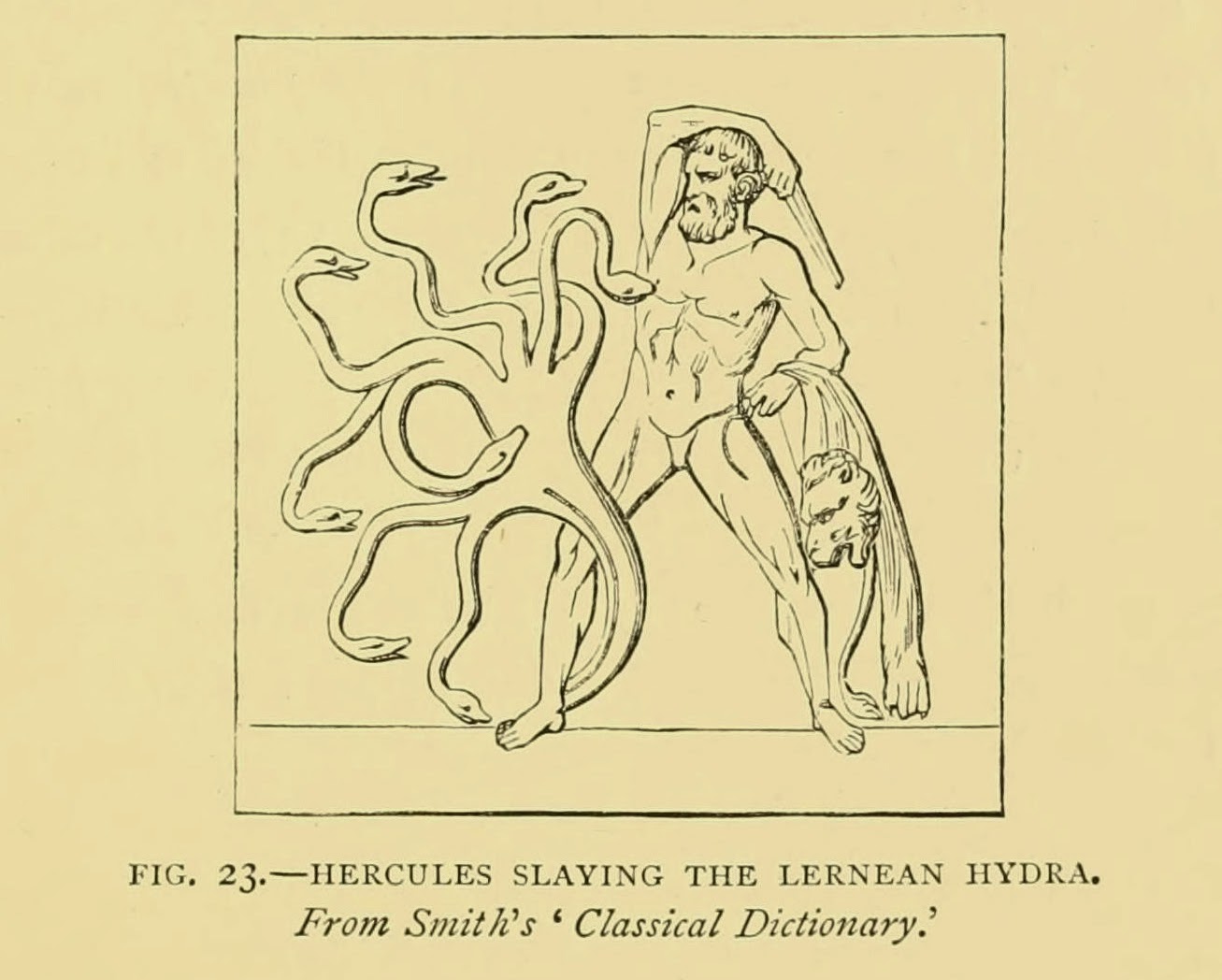
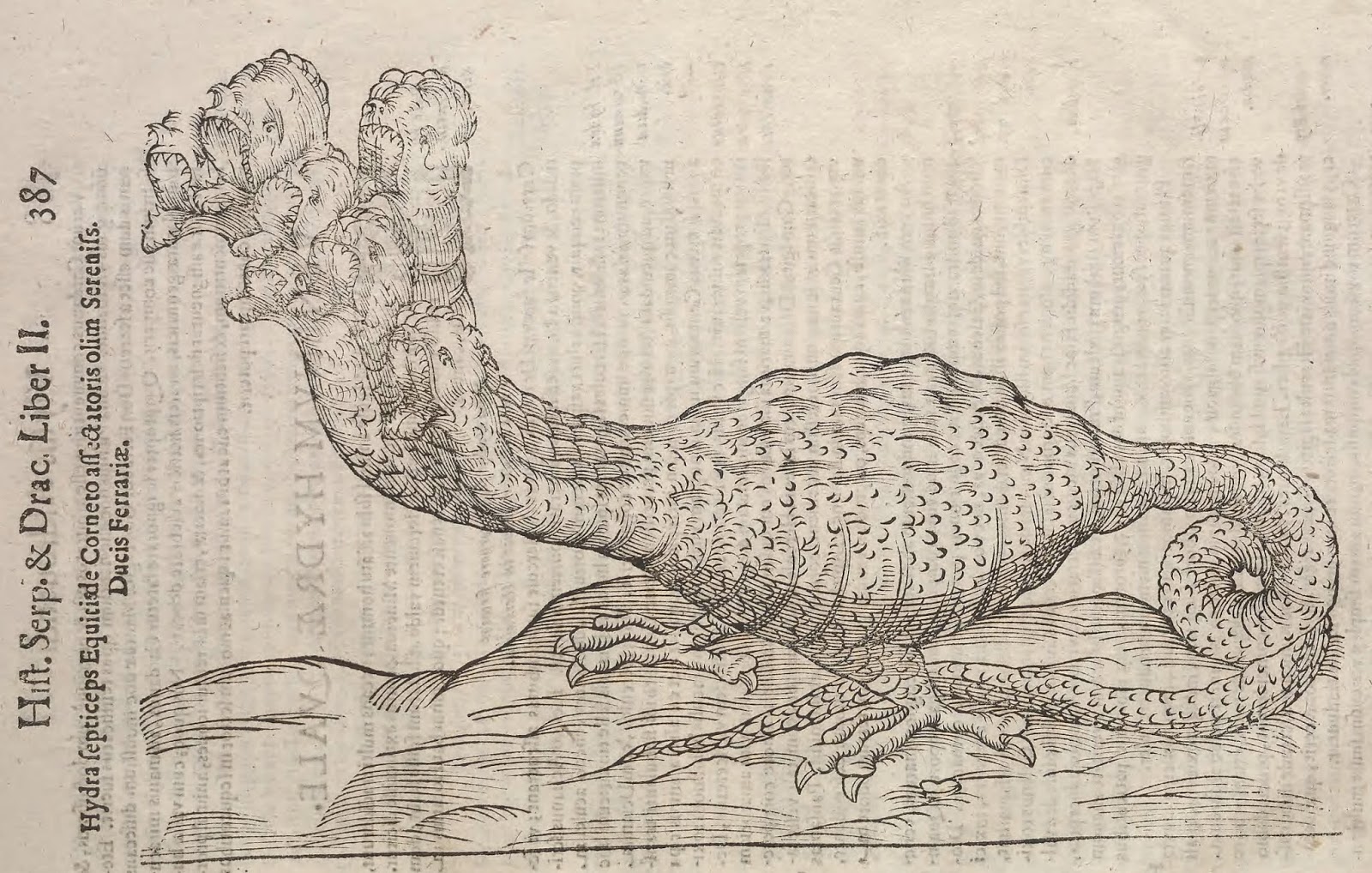
The Hydra is a “mythical” beast most commonly described as having nine heads, each of which will regenerate if decapitated. The Greek hero Hercules was commanded to kill a Hydra as his second labor. The marble tablet in the Vatican depicting this exploit interprets the hydra as a strikingly octopus-like monster.

View Full Size Image
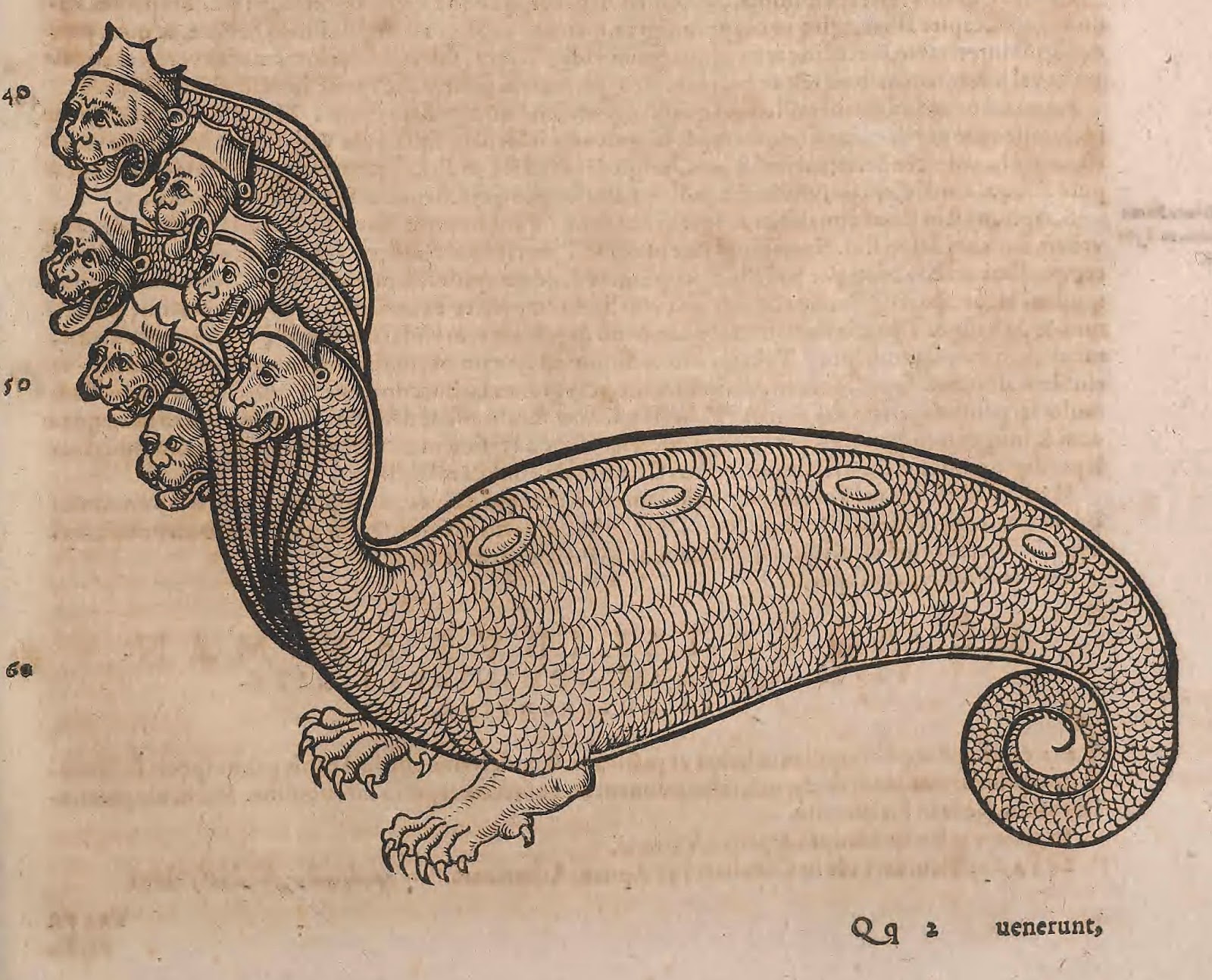
The Hydra, as illustrated by Gessner. Notice the suction-cup like spots on its body…very octopus-like. Gessner, Conrad. Historia Animalium. 2nd Ed. 1604. http://biodiversitylibrary.org/page/42166090.

In the book Sea Fables Explained, Henry Lee writes that the Lernean Hydra was simply a huge Octopus. Many scholars have postulated that hydra are based on octopus. After all, their many tentacles could be misinterpreted as heads, and octopus can regenerate lost limbs, possibly explaining the unending head supply of the hydra.

View Full Size Image
Hercules slaying the Lernean Hydra, as depicted on a marble tablet in the Vatican. Lee, Henry. Sea Fables Explained. 1883. http://biodiversitylibrary.org/page/10985663.

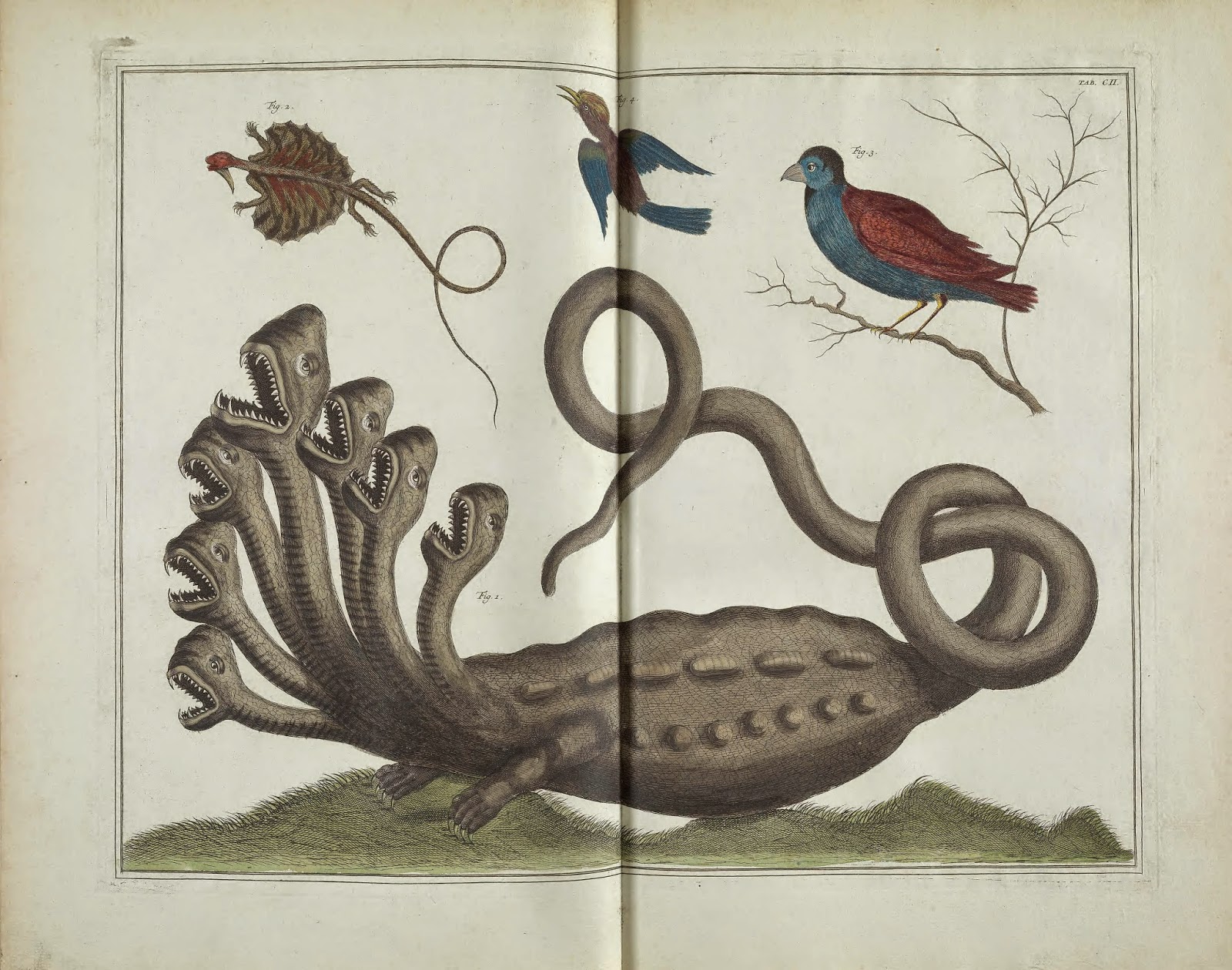
Well into the eighteenth century, many naturalists believed the hydra to be a real creature. Albertus Seba, a famed apothecary from Amsterdam, boasted an extensive cabinet of curiosities, filled with many magnificent biodiversity specimens. From 1734-65, Seba published an account of his cabinet in Locupletissimi rerum naturalium thesauri accurata descriptio, et iconibus artificiosissimis expressio, per universam physices historiam. This work included an image of a hydra, based on a specimen held by the Burgomeister of Hamburg. While Linnaeus later proved this particular specimen to be a fake, an amalgamation of snake skins and weasel heads with possible religious overtones, exaggerated accounts of an octopus likely inspired such monsters in the first place.

View Full Size Image
The Hydra! Seba, Albertus. Locupletissimi rerum naturalium thesauri accurata descriptio, et iconibus artificiosissimis expressio, per universam physices historiam. v. 1. 1734. http://biodiversitylibrary.org/page/41047754.


An Undeserved Reputation and the Monster that Isn’t

The octopus’ “monster” reputation is completely unwarranted. It is hardly necessary to emphasize the fact that the hydra, though inspired by a real animal, is not itself a real species. Debunking longstanding conceptions of the octopus itself as a terrible, vicious monster, however, has proven more difficult.

View Full Size Image
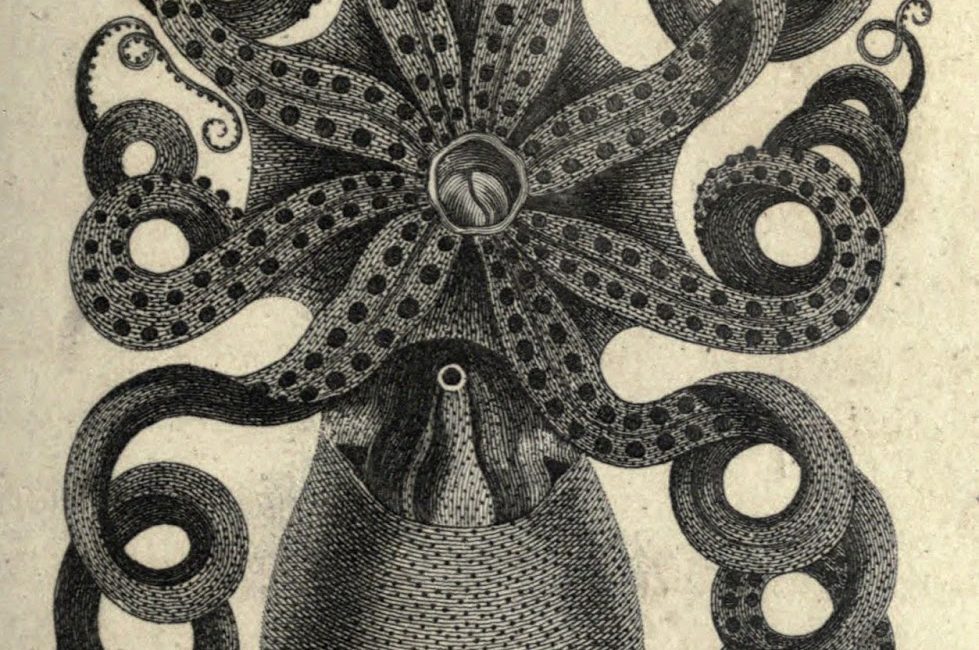
Benthoctopus levis. Chun, Carl. The Cephalopoda. 1975. http://biodiversitylibrary.org/page/32124297.

“The octopus is, in fact, a gentle, curious creature with a surprising ‘intelligence,’” argues marine biologist Richard Ellis of the American Museum of Natural History (Ellis, pg. 261). Around 300 species are recognized, constituting over a third of all cephalopods. They are perhaps the most intelligent invertebrate, demonstrating complex problem-solving abilities and the use of tools.

Octopus range in size from the minute Octopus wolfi, measuring about 0.6 inches in length, to the Giant Pacific Octopus (Enteroctopus dofleini), with a radial span of 20ft (and possibly as much as 32ft) – certainly large enough to inspire some fantastic monster myths. The only octopus species truly dangerous to humans are the three (or perhaps four) species of Blue-Ringed Octopus, which are some of the world’s most venomous marine animals and capable of killing humans.

View Full Size Image
Giant Octopus. Holder, C.F. Along the Florida Reef. 1899. http://biodiversitylibrary.org/page/23386919.

So, in the case of the octopus, it is more a story of the monster that isn’t. These cephalopods most definitely are not, as Victor Hugo asserts in Toilers of the Sea, “the concrete forms of evil,” but are in fact a wonderfully diverse, spectacularly intelligent, and reportedly shy group.

So, are monsters real? In the case of the octopus, no.

View Full Size Image
Hydra. Aldrovandi, Ulisse. Serpentum, et draconum historiæ libri duo. 1640. http://biodiversitylibrary.org/page/41765442.
  • Follow our blog and #bhlMonstersRreal on Twitter and Facebook all week to learn more about monsters and the animals that inspired them.
  • Browse historic illustrations of octopi and squid-inspired monsters and the animals that they’re based on in Flickr.
  • Browse the books that portray these historic monsters in BHL.
  • Carve a Hydra in your Halloween Pumpkin this year! Share your carvings with us on Facebook and Twitter!
  • See some of our favorite monsters come to life on the Smithsonian Libraries’ Tumblr!

Reference:

  • Ellis, Richard. Monsters of the Sea. New York: Alfred A. Knopp, Inc., 1994. Print.
October 30, 2014by Grace Costantino
Blog Reel, Campaigns, Featured Books, Monsters Are Real

Release the Kraken!

“Architeuthis, the giant squid, is the quintessential sea monster, probably responsible for more myths, fables, fantasies, and fictions than all other marine monsters combined…[It] surely is the most remarkable unscheduled arrival in the history of zoology, crypto or otherwise. An animal that was believed by many to be mythological verified its existence…” (Ellis, 122, 133-34).

Science knows it by the name Architeuthis dux. For centuries, however, it was known by an altogether more infamous one – The Kraken.

The Kraken: A History

Aristotle first introduced us to the giant squid (which he called teuthos) in 350 BCE, and then, in AD 77-79, Pliny the Elder related a tale of a “polyp” that was killed during its attempt to steal salted fish from the fish ponds in Carteia (Ellis, pg. 123). Described as having 30-foot long arms, the beast has been identified as a squid.

Giant squids have been seen throughout the world’s oceans, but they are quite common in the seas around Norway and Greenland. Indeed, the word “kraken” comes from the Norwegian “krake,” meaning “fabulous sea monsters.” The late 14th century version of the Icelandic saga Örvar-Oddr gives an account of the Hafgufa (“sea mist”) and Lyngbakr (“heather-back”) – beasts occurring in the Greenland Sea. While Lyngbakr is credited as the “largest whale in the sea,” the Hafgufa

“is the hugest monster in the sea. It is the nature of this creature to swallow men and ships, and even whales and everything else within reach. It stays submerged for days, then rears its head and nostrils above surface and stays that way at least until the change of tide.”

Hafgufa, it has been suggested, is a giant squid. The thirteenth century Norwegian work Konungs skuggsjá describes the beast, saying that it appears “more like an island than a fish.” The 1917 translation identifies this “monster” as the Kraken.

View Full Size Image
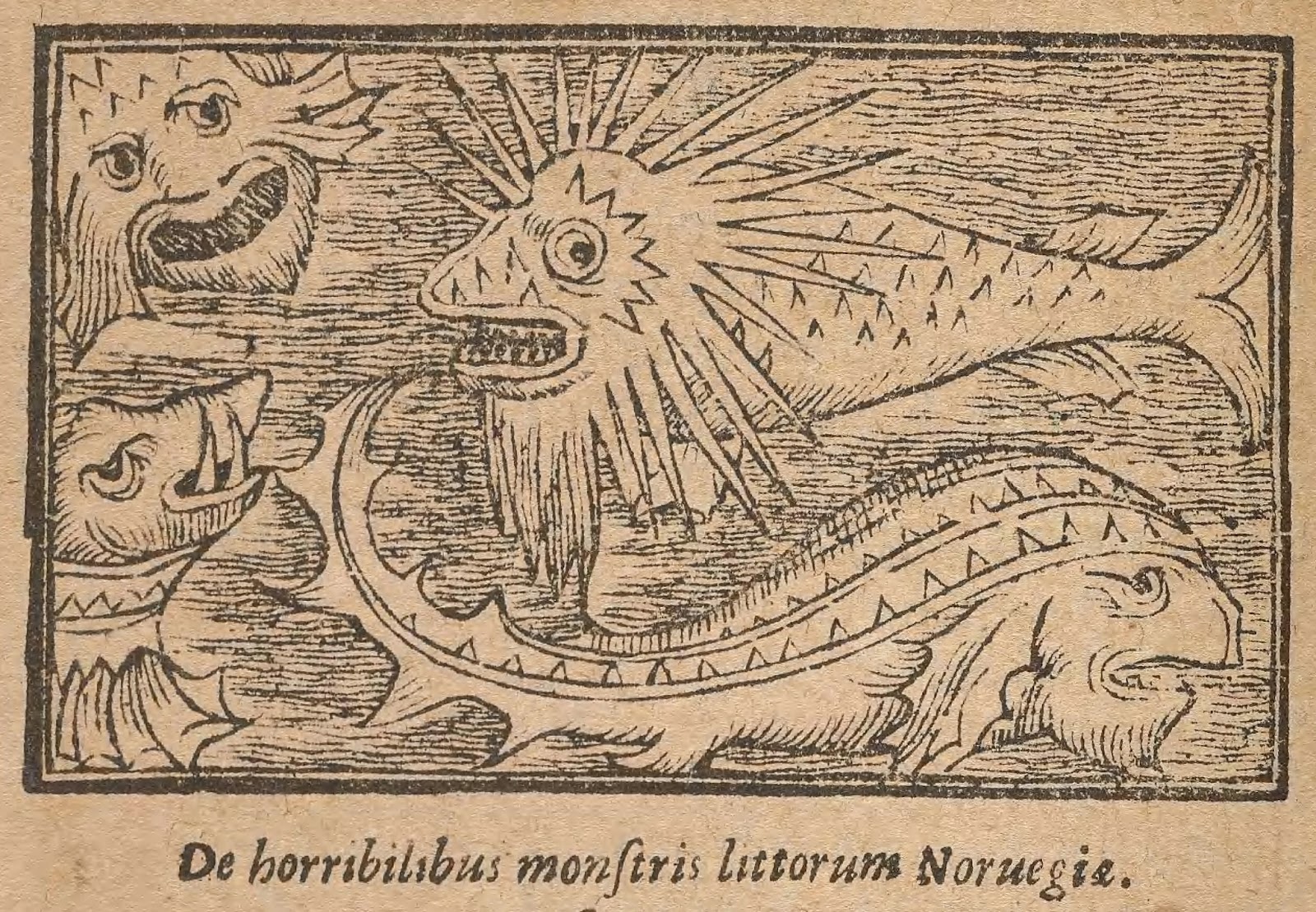
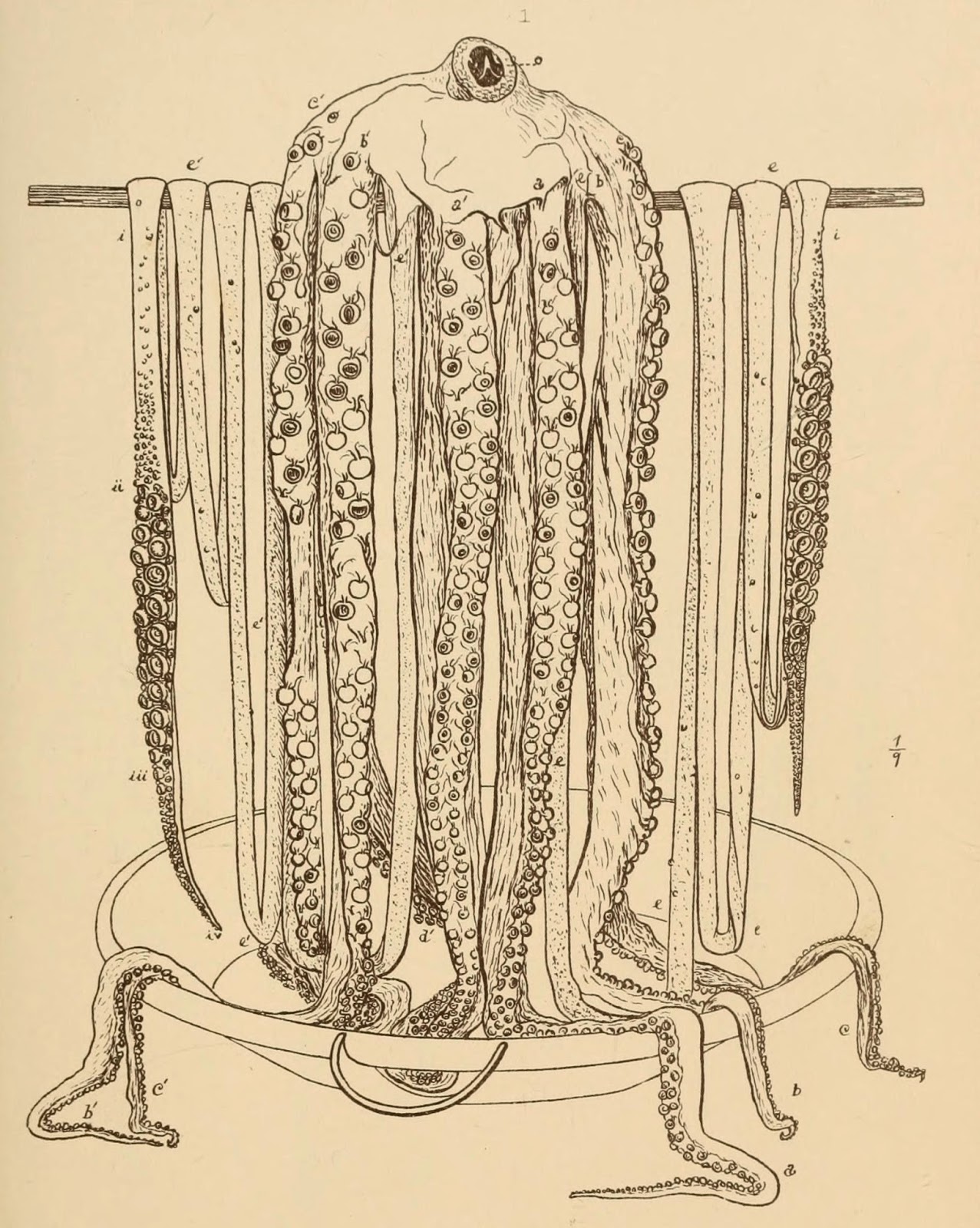
The Kraken. Magnus, Olaus. Historia de Gentibus Septentrionalibus. 1555. http://biodiversitylibrary.org/page/41862917.

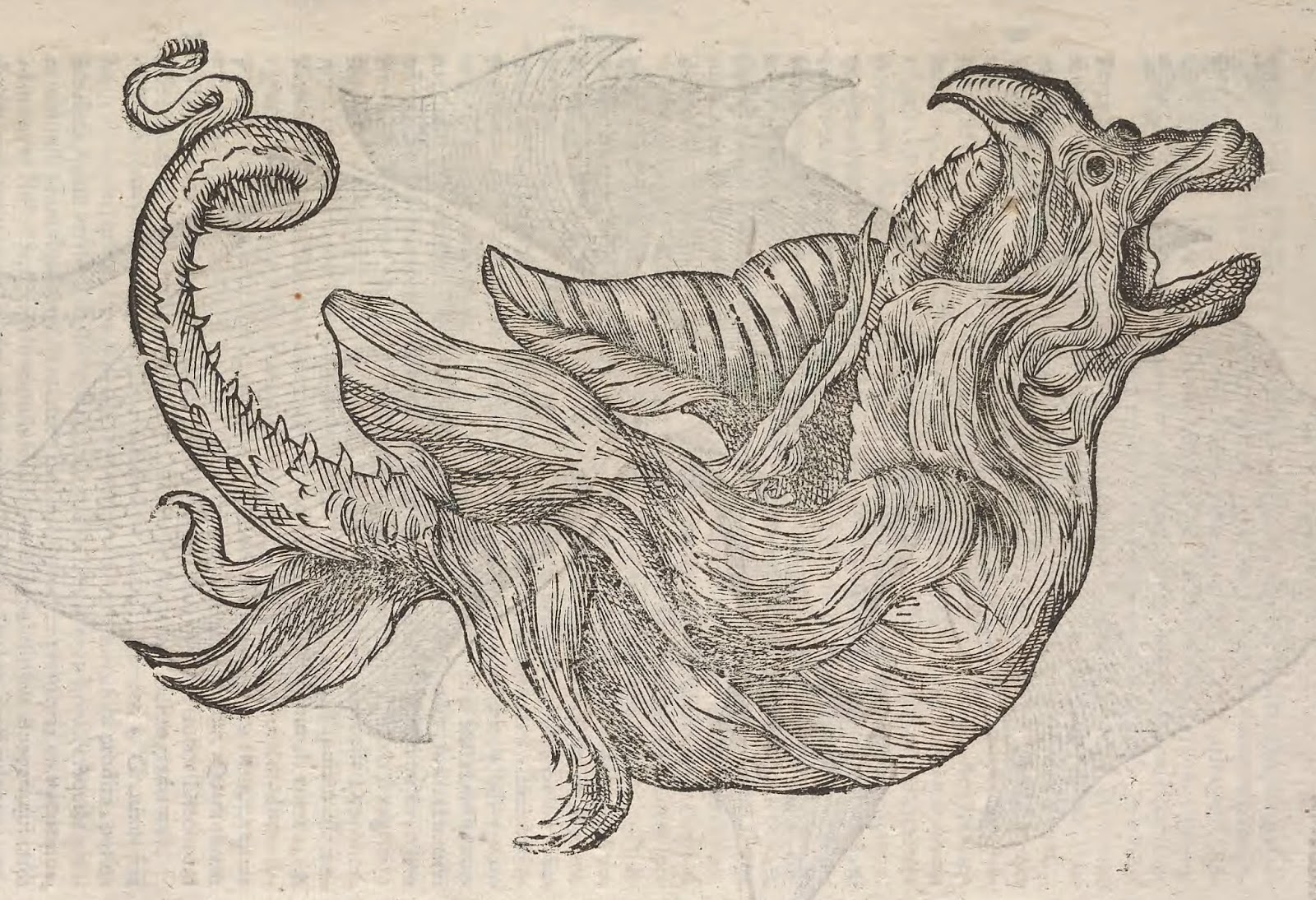
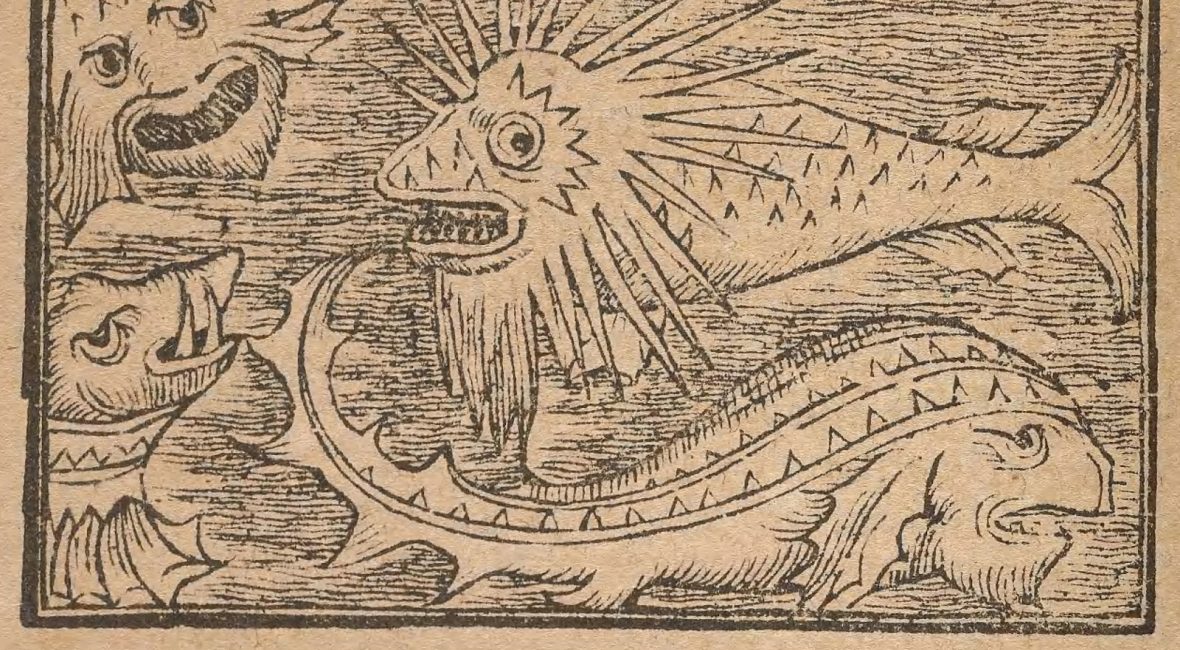
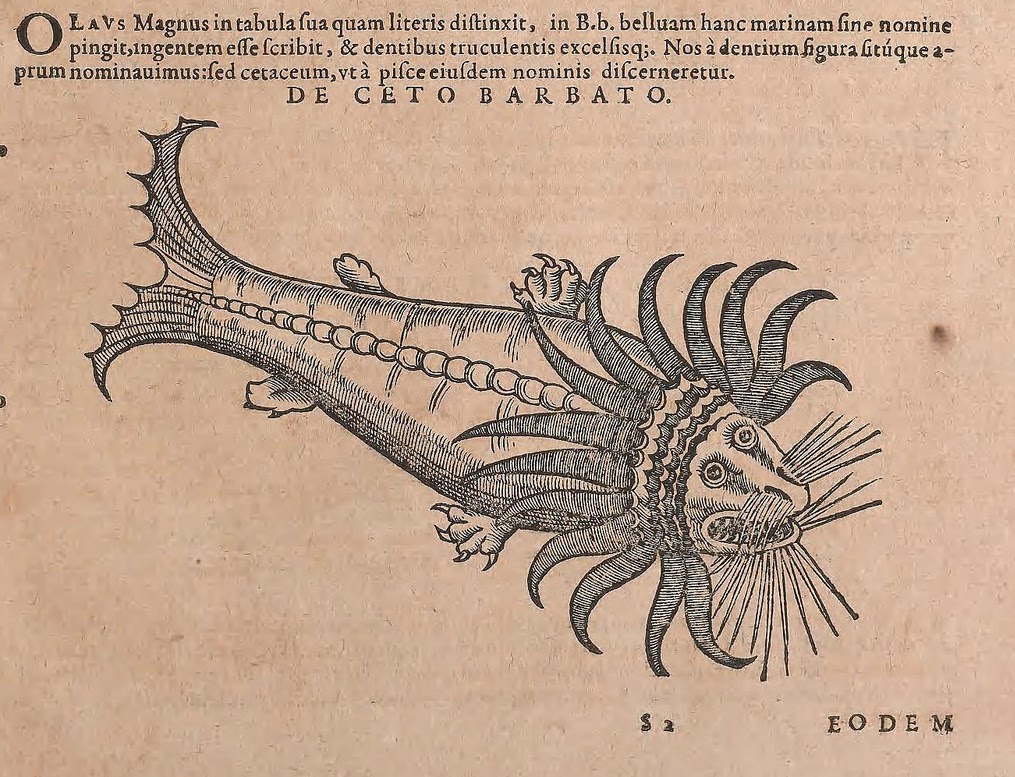
Never missing a chance to tell a good monster tale, Olaus Magnus detailed the kraken as a “monstrous fish” within Historia de Gentibus Septentrionalibus, describing them as having long sharp horns, huge red eyes, and “hairs like goose feathers, thick and long, like a beard hanging down.” He claims that “one of these Sea-Monsters will drown easily many great ships provided with many strong Marriners” – a characteristic reported in the earlier Icelandic work. Magnus’ depiction of the beast, as a strange mix of fish and squid, is quite different from those we find later in the literature, suggesting that his monster is likely a confusion of many sightings, including not only the giant squid but perhaps whales and cuttlefish as well.

View Full Size Image
Kraken, after Magnus. Gessner, Conrad. Historia Animalium. 2nd Ed. 1604. http://biodiversitylibrary.org/page/42165838.

In his first edition of Systema Naturae (1735), Carolus Linnaeus classified the kraken as a cephalopod with the scientific name Microcosmus marinus. Though it was removed from later editions of Systema, Linnaeus’ 1746 publication, Fauna Suecica, describes the kraken as “a unique monster” inhabiting the seas of Norway. He does, however, include a disclaimer that he has never seen the animal himself.

Erik Pontoppidan, bishop of Bergen, in his Det Forste Forsorg paa Norges Naturlige Historie “Natural History of Norway” (Copenhagen, 1752–3), added significantly to the kraken tale. Also writing extensively on mermaids and sea serpents, Pontoppidan describes the kraken as “the largest sea monster in the world…round, flat, and full of arms, or branches.” He writes that not only is the kraken sometimes mistaken for an island, but also that it is possible of pulling the largest ships down to the ocean’s bottom. The greatest danger to sailors he claims, however, is the whirlpool created when it sinks, capable of “draw[ing] everything down with it.”

View Full Size Image
A very octopus-like Kraken. Montfort, Denys. Histoire naturelle, générale et particulière des mollusques : animaux sans vertèbres et a sang blanc. v. 2. 1801. http://biodiversitylibrary.org/page/35755564.

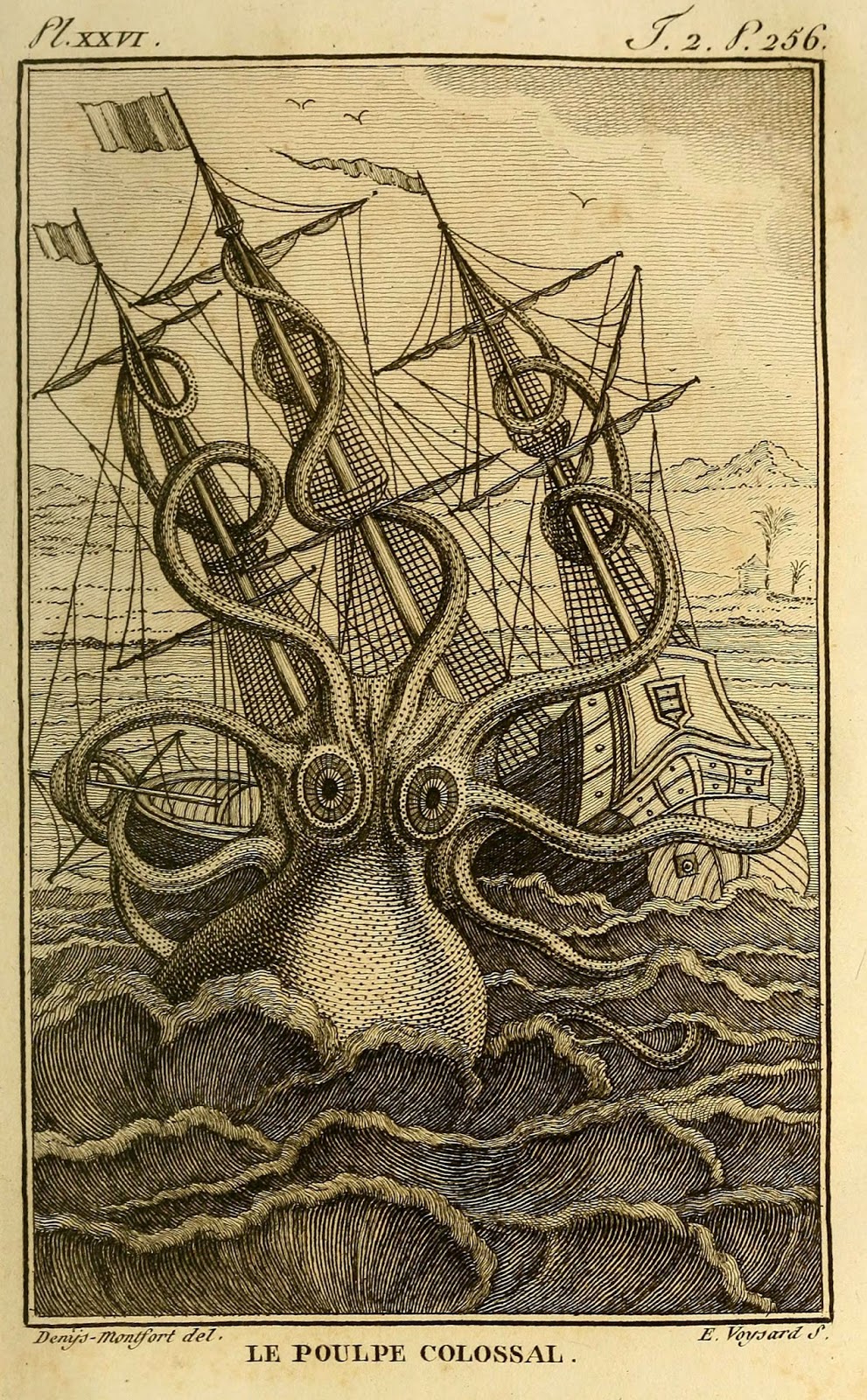
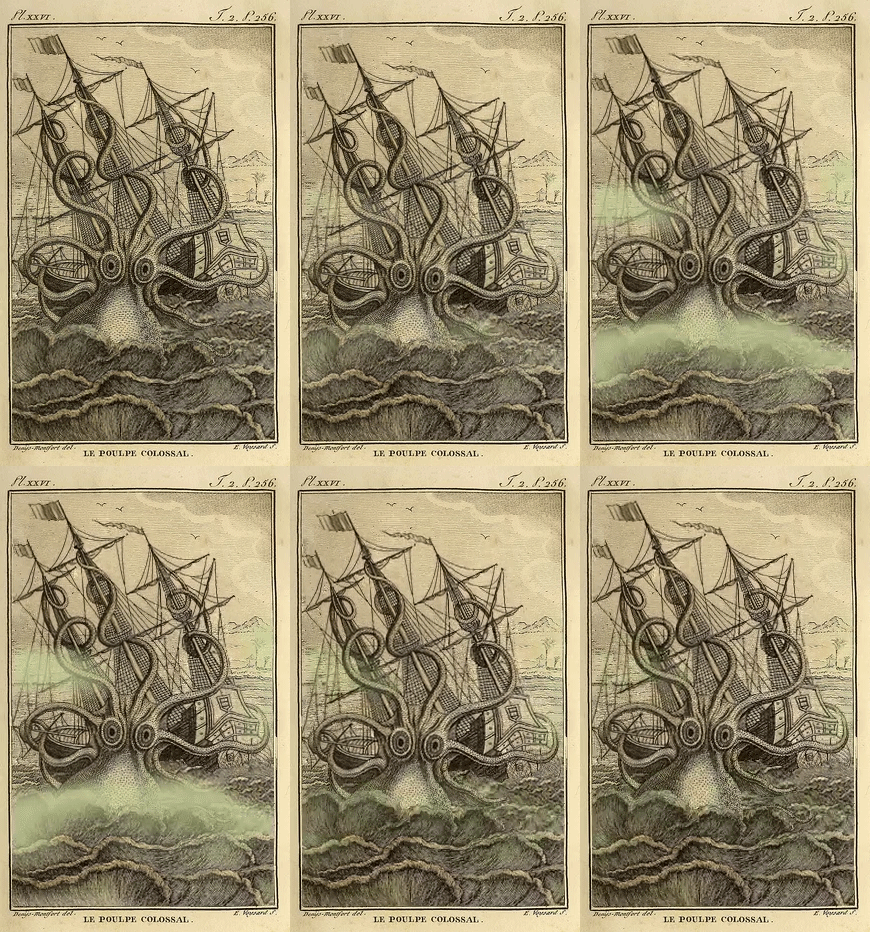
One of the most famous illustrations associated with the kraken, and one in which we see it take a definite cephalopod (if not more octopus-like) persona, comes from French malacologist Pierre Dénys de Montfort’s 1802 book Histoire Naturelle Générale et Particulière des Mollusques. Advertised as an encyclopedic description of mollusks, Montfort describes two kinds of giant octopus in the work: the Kraken Octopus, so often described by Norwegian sailors, and the Colossal Octopus, which he claims attacked a ship off the coast of Angola. The besieged sailors, he reports, prayed to St. Thomas, and were subsequently saved from the creature. He asserts that a votive picture of a ship embraced by this monster octopus was displayed in the St. Thomas chapel at St. Malo, though its existence has not been proven.

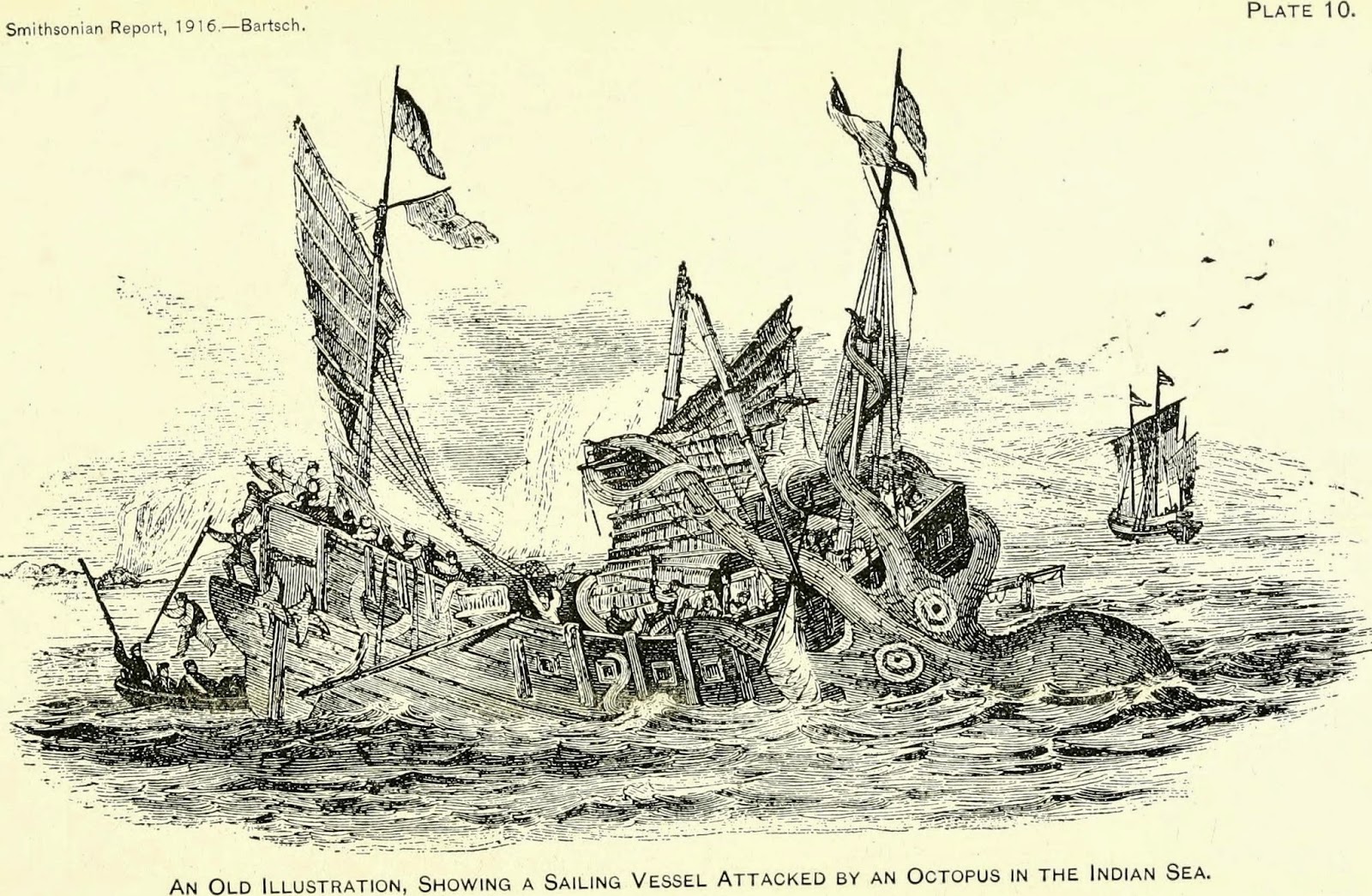
Whether or not Montfort truly believed this tale, he apparently had no qualms about publishing fiction as fact. Henry Lee, author of The Octopus in 1875, quoted Montfort as stating, “If my entangled ship is accepted, I will make my ‘colossal poulpe’ otherthrow a whole fleet.” True to his word, soon after his Histoire Naturelle publication, Montfort claimed that this same giant beast attacked and sunk a fleet of six French man-of-wars and four British ships. His reports, apparently, were influenced by Magnus and Pontoppidan’s description of the kraken’s capabilities.

View Full Size Image
“Kraken” attacking a fleet after a fashion described by Montfort. Annual Report of the Board of Regents of the Smithsonian Institution. 1916. http://biodiversitylibrary.org/page/14187069.

In the mid-1800s, the kraken took an authentic biological form as Architeuthis, passing from myth to science. Prof. Japetus Steenstrup, lecturer at Copenhagen University, introduced the giant squid in a paper that related the original description of the earliest record of a giant squid carcass washing ashore: Thingore Sand, Iceland, in 1639. The paper was read in 1849, and the official scientific name was later published in 1857.

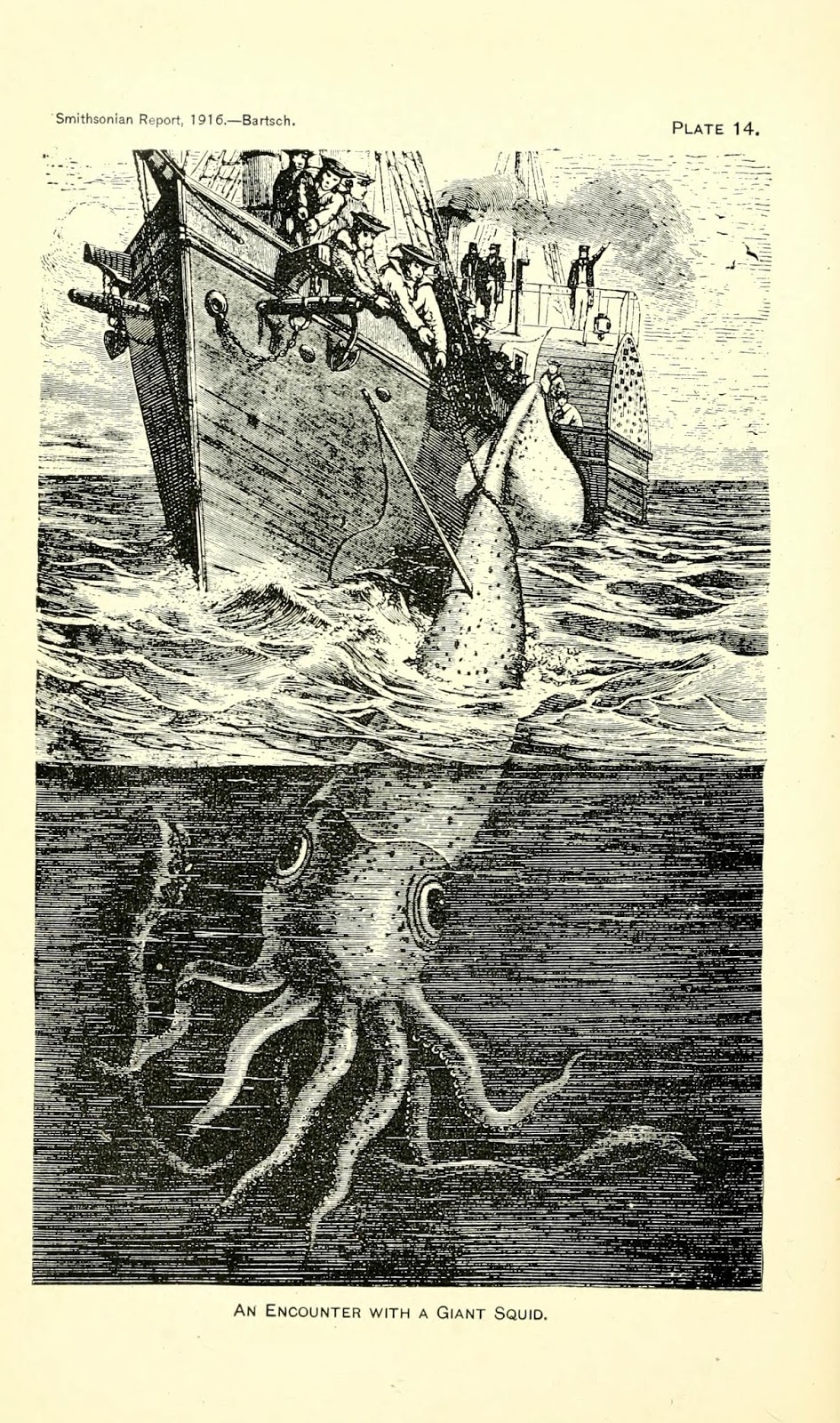
Although the giant squid was finally taxonomically official, physical evidence of the creature remained scarce. A near-catch of a specimen in November, 1861, by the Alecton off Tenerife in the Canary Islands ended with only a detached piece of the squid’s tail as any evidence of the encounter. In 1871 and 1872, two giant squid carcasses were collected on the Grand Banks and at Coombs’ Cove, Fortune Bay, Newfoundland, respectively, the latter of which was a reported 52 feet long.

View Full Size Image
Near-catch of Giant Squid by crew of the Alecton, 1861. Annual Report of the Board of Regents of the Smithsonian Institution. 1916. http://biodiversitylibrary.org/page/14187077.

Finally, in December 1873, science caught a break. Four fishermen in Logy Bay, Newfoundland caught a giant squid in their fishing nets. The in-tact specimen was brought to Reverend Moses Harvey, an amateur naturalist, who draped it over a sponge bath for display. He then contacted Addison Emery Verrill, professor of zoology at Yale University, who conducted a full study of the specimen, which measured in at 32 feet long.

View Full Size Image
Giant Squid specimen draped over a sponge bath, 1873. Verrill, A.E. The Cephalopods of the North-eastern Coast of America. pt. 1. 1882. http://biodiversitylibrary.org/page/11826545.

Verrill collected information on every known specimen of Architeuthis and published his findings in a paper entitled The Cephalopods of the North-eastern Coast of America. Part I. The Giant Squids (Architeuthis) and their Allies; with Observations on Similar Large Species from Foreign Localities.

View Full Size Image
“In 1855, Danish zoologist Japetus Steenstrup proposed that the fabled sea bishop [another mythical monster often associated with mermaids] was actually a giant squid. He offered a picture illustrating how the misunderstanding could have occurred.” Learn more in the American Museum of Natural History’s Mythic Creatures online exhibit, from which this quote is derived. This image: Gessner, Conrad. Historia Animalium. 2nd Ed. 1604. http://biodiversitylibrary.org/page/42166070.

The Giant Squid in Science

But while the giant squid’s acceptance into the scientific canon established the cephalopod as fact, Architeuthis’ habitat, life history, breeding habits, and even definitive size remain shrouded in mystery. It currently holds the record as the second-largest mollusk and extant invertebrate (exceeded only by the colossal squid). Recent studies have revealed that it feeds on deep-sea fish and other squids, but its hunting methods and reproductive cycle are still unknown. While it was long believed that there were many species within the Architeuthis genus, recent genetic analysis suggests there is only one: Architeuthis dux. Claims of lengths reaching 150 -200 feet have been reported, even by scientists, without evidence to justify such claims. The Smithsonian’s National Museum of Natural History suggests maximum lengths of nearly 60 feet.

Until recently, no images of the giant squid in its natural habitat had ever been taken. But, on September 30, 2004, Tsunemi Kubodera (National Science Museum of Japan) and Kyoichi Mori (Ogasawara Whale Watching Association) changed this, capturing 500 photographs of a 26 foot giant squid using a camera attached to a baited line. From 2006-2012, in three separate incidents, the giant squid was reportedly filmed, though two of the specimens were less than twelve feet long.

View Full Size Image
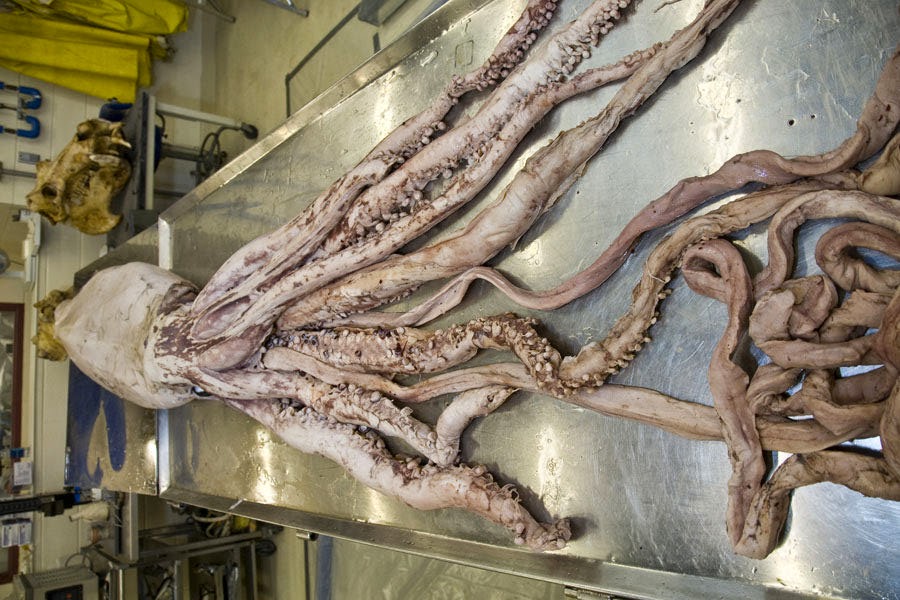
This female giant squid, caught in a net by a Spanish fisherman in 2005, is on display in the Smithsonian’s Sant Ocean Hall. Image Credit: Don Hurlbert/Smithsonian Institution, CC:BY-NC-SA. http://eol.org/data_objects/27480683. Learn more about the Giant Squid from the Smithsonian’s National Museum of Natural History.

While our knowledge about this species is increasing, we still have much to learn. Considering its size, the Giant Squid remains a surprisingly elusive creature. It demonstrates just how much we still have to learn about the ocean.

A World with a Kraken

So, does the kraken really exist? Most definitely. It is the species Architeuthis dux, the giant squid (possibly with some giant cuttlefish, colossal squid, and octopus sightings thrown into the mix).

Is it a warship-sized beast, capable of pulling entire ships to the ocean floor and indiscriminately devouring helpless sailors? No.

Yet again, inexperience and sensationalism turned reality into fiction. And to some degree, this continues to this day. Our research about this animal is still in its infancy, and much misinformation abounds. There is still much we have to learn about the “Kraken.”

  • Follow our blog and #bhlMonstersRreal on Twitter and Facebook all week to learn more about monsters and the animals that inspired them.
  • Browse historic illustrations of octopi and squid-inspired monsters and the animals that they’re based on in Flickr.
  • Browse the books that portray these historic monsters in BHL.
  • Carve a monster in your Halloween Pumpkin this year! Share your carvings with us on Facebook and Twitter!
  • See some of our favorite monsters come to life on the Smithsonian Libraries’ Tumblr!
View Full Size Image
“Release the Kraken!” In H. P. Lovecraft’s short story “The Call of Cthulhu,” Cthulhu (a part man, part dragon, and part octopus monster) attacks a ship. The sailors try to kill the beast by ramming it repeatedly, but Cthulhu simply turns into green mist and reassembles. See more fantastic historic monsters come to life on the Smithsonian Libraries’ Tumblr. GIF created by Richard Naples (Smithsonian Libraries), based on Montfort, Denys. Histoire naturelle, générale et particulière des mollusques : animaux sans vertèbres et a sang blanc. v. 2. 1801. http://biodiversitylibrary.org/page/35755564.


Reference:

  • Ellis, Richard. Monsters of the Sea. New York: Alfred A. Knopp, Inc., 1994. Print.
October 30, 2014by Grace Costantino
Page 41 of 71« First...102030«40414243»506070...Last »

Help Support BHL

BHL's existence depends on the financial support of its patrons. Help us keep this free resource alive!

search

About BHL

The Biodiversity Heritage Library (BHL) is the world’s largest open access digital library for biodiversity literature and archives. BHL operates as a worldwide consortium of natural history, botanical, research, and national libraries working together to digitize the natural history literature held in their collections and make it freely available for open access as part of a global “biodiversity community.”

Join Our Mailing List

Sign up to receive the latest news, content highlights, and promotions.

Subscribe Now

Subscribe to Blog via Email

Enter your email address to subscribe to this blog and receive notifications of new posts by email.

Join 319 other subscribers

Subscribe to Blog Via RSS

Subscribe to the blog RSS feed to stay up-to-date on all the latest BHL posts.

Access RSS Feed

Inspiring Discovery through Free Access to Biodiversity Knowledge.

The Biodiversity Heritage Library makes it easier than ever for you to access the information you need to study and explore life on Earth…for free, anytime, anywhere.


64+ Million Pages of
Biodiversity Literature Online.

EXPLORE

Tools and Services
to Transform Research.

EXPLORE

300,000+
Illustrations on Flickr.

EXPLORE

ABOUT | HARMFUL CONTENT | PRIVACY | SITE MAP | TERMS OF USE