Biodiversity Heritage Library - Program news and collection highlights from BHL
  • Home
  • News
  • Featured Books
    • All Featured Books
    • Book of the Month Series
    • BHL at 20
  • User Stories
  • Campaigns
    • Fossil Stories
    • Garden Stories
    • Monsters Are Real
    • Page Frights
    • Her Natural History
    • Earth Optimism 2020
  • Tech Blog
  • Visit BHL
Home
News
Featured Books
    All Featured Books
    Book of the Month Series
    BHL at 20
User Stories
Campaigns
    Fossil Stories
    Garden Stories
    Monsters Are Real
    Page Frights
    Her Natural History
    Earth Optimism 2020
Tech Blog
Visit BHL
  • Home
  • News
  • Featured Books
    • All Featured Books
    • Book of the Month Series
    • BHL at 20
  • User Stories
  • Campaigns
    • Fossil Stories
    • Garden Stories
    • Monsters Are Real
    • Page Frights
    • Her Natural History
    • Earth Optimism 2020
  • Tech Blog
  • Visit BHL
Biodiversity Heritage Library - Program news and collection highlights from BHL
Blog Reel, User Stories

BHL and Our Users: EOL Rubenstein Fellow, Dr. Breda Zimkus

View Full Size Image

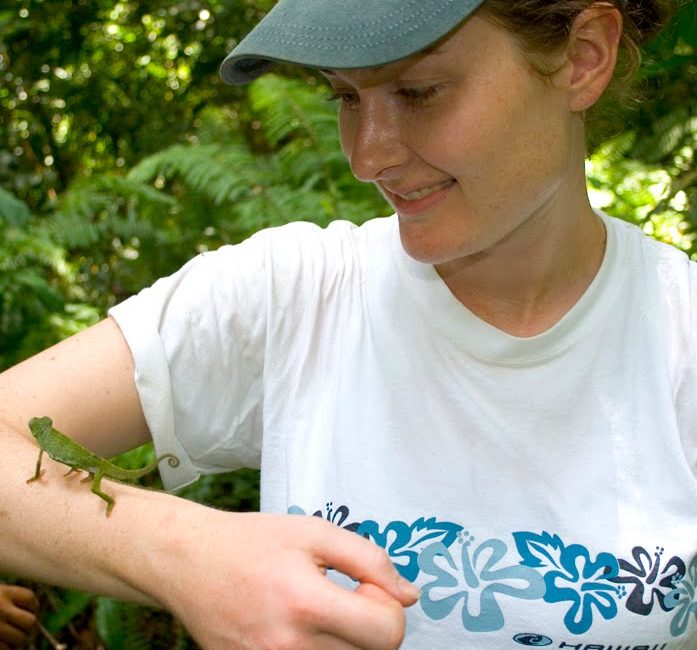
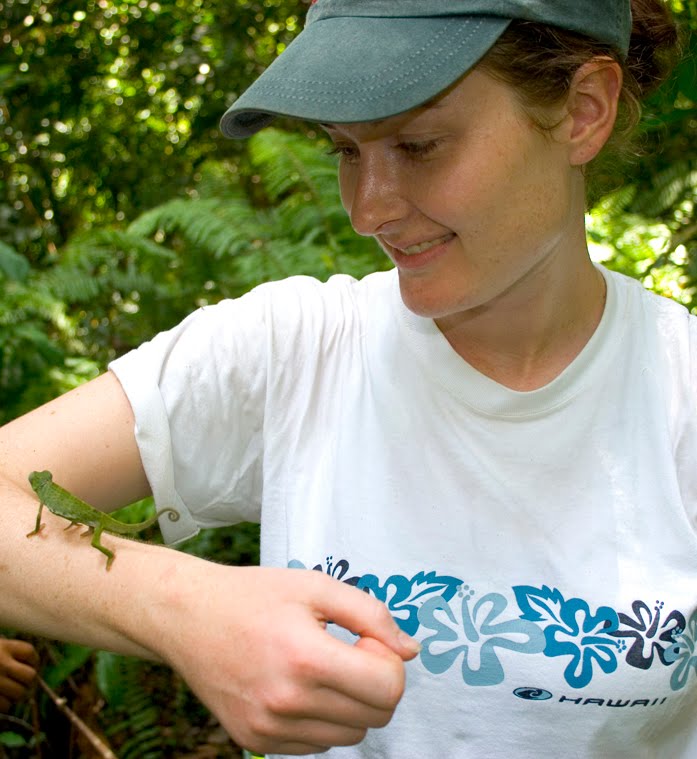
If you caught our blog post yesterday, then you know that this week we’re starting a mini-series within our larger BHL and Our Users series. This mini-series spotlights a few of the EOL Fellows – scientists who have been awarded a fellowship through the EOL Rubenstein Fellows Competition – and discusses not only their work but also how they use BHL to support it. For this, our first post, we feature Dr. Breda Zimkus, a Post-Doctoral Fellow and Genetics Resources Facility Project Manager at the Museum of Comparative Zoology at Harvard University.

Q: What are your research interests/field(s) of study & where do you do the bulk of your work (country)?

A: I am a biologist interested in phylogenetics, biogeography and conservation of amphibians and reptiles. My research integrates a broad range of techniques, including fieldwork, taxonomy and molecular systematics to interpret patterns of speciation and diversity. I am particularly interested in the phylogenetic diversification of African amphibians and use of molecular tools to define species boundaries. I have worked in many East African countries (Ethiopia, Malawi, Tanzania), and my most recent fieldwork in May/June 2011 was in the Central African country of Gabon where I completed a survey of amphibians of the Batéké Plateau National Park, which borders the Republic of Congo.

Q: In the program, Fellowships are expected to serve as a complimentary funding source to existing funding that supports your primary research activities. Please describe what you primary research activities are.

A: I am currently studying a number of frog groups that are distributed across sub-Saharan Africa, including puddle frogs (Phrynobatrachidae), rocket frogs (Ptychadenidae) and sand frogs (Pyxicephalidae: Tomopterna). I am using molecular systematics to identify cryptic species and investigating the complex diversification patterns of these lineages across the continent. In addition to being an Encyclopedia of Life Rubenstein Fellow this past year, I was also the recipient of a Ethel K. Allen, Sigma Delta Epsilon/Graduate Women In Science Fellowship, which funded my post-doctoral work on rocket frogs.

Q: Please describe how you use EOL to disseminate or support your primary research activities, or what your primary duties related to EOL are.

A: Africa still remains one of the most poorly understood areas for amphibians globally, with species rarely collected and basic data on their ecology and distribution incompletely understood. Consequently, conservation status is only adequately known for some species. This lack of knowledge is particularly worrying as concentrations of species are found in a number of sub-Saharan regions seriously threatened by environmental change. There is also a serious conservation risk to amphibians globally with the emerging prevalence of the fungal disease chytridiomycosis, possibly responsible for the extinction of many species. As an EOL fellow, I developed the African amphibian Lifedesk, so basic taxonomic data could be assembled to facilitate research. The website serves as a gateway for information regarding African amphibian species, where participants will write and edit species pages, upload images, and maintain bibliographic resources. In addition to serving as a stand-alone resource, this LifeDesk feeds content directly into the Encyclopedia of Life (EOL) and AmphibiaWeb.

Q: Who is your Mentor, what is their area of interest (research activities), and how have they supported you throughout your Fellowship?

A: I have two mentors for this project. My post-doctoral research, including my EOL work, is currently being conducted in the laboratory of Dr. James Hanken of Harvard University. The Hanken Lab studies the evolution of morphology, developmental biology, and systematics and serves as a community research facility for NSF’s AmphibiaTree project. Most work focuses on amphibians but otherwise addresses a wide range of topics, taxa and methodologies. I am conducting my EOL Fellowship work in collaboration with Dr. Simon Loader, Director of the Molecular Systematics Laboratory and Post-doctoral Researcher at the Institute of Biogeography, University of Basel. His research is specifically focused on the phylogenetic diversification of African amphibians, using an integrative approach to interpret patterns of diversity in Africa.

Q: How does BHL support your Fellows activities, as well as those research activities that fall outside of your duties as an EOL Fellow?

A: BHL has been integral to both my EOL Fellow work and my primary research on discovering African amphibians species because original species descriptions and taxonomic revisions are essential to those working on species identification. One of the major goals of the African amphibians Lifedesk is to make PDFs of all non-copyrighted material available to herpetologists around the world. Many of the most important African amphibian research was done in the early 20th century, and these manuscripts were published in rare journals. Thankfully, BHL has digitized many of these important works, so I was able to assemble PDFs online using the BHL website and upload them to the African amphibians Lifedesk.

Q: When did you first discover BHL?

A: I first heard about BHL from the librarians at the Ernst Mayr Library of the Museum of Comparative Zoology at Harvard University while conducting my PhD research. At that point I used BHL only if I was unable to find a reference in the Ernst Mayr library. When I began my EOL fellowship, I began to use BHL on a daily basis, compiling PDFs to upload to the African amphibians Lifedesk.

Q: What are your favorite features/services on BHL?

A: I am lucky to be at an institution with an amazing library system, but BHL makes biodiversity literature accessible to everyone with an internet connection. It also allows me to have electronic copies of papers on my computer, so I have them whenever I need them.

Q: If you could change one thing about BHL, or suggest one thing to be the next developmental priority for BHL, what would it be?

A: It does take time to assemble PDFs because you must locate the journal, find the issue, select each individual page of that specific issue and then have the document emailed to you. I would love to see a time when I can search for a title of a specific paper and find the PDF already assembled.

Q: Do you have a favorite book in BHL, or a book that has most supported your research activities or EOL responsibilities?

A: George Albert Boulenger (1858-1937) was a zoologist that described an incredible number of amphibians (556 species), reptiles (872 species) and fish (1,096 species). Many of Boulenger’s African amphibian descriptions were published in the Proceedings of the Zoological Society of London. I found his work published in 1900 entitled “A list of the batrachians and reptiles of the Gaboon (French Congo), with descriptions of new genera and species” to be very useful for my recent trip to Gabon.

Thank you, Dr. Zimkus, for all the valuable research you have conducted on amphibians and reptiles, and for your pioneering efforts on the African amphibians Lifedesk for EOL! We are so thrilled that BHL has been a part of the endeavor, particularly as the library at your home institution is one of the key members of BHL (Ernst Mayr Library, Harvard University)! As to your desire to eventually be able to find already-assembled PDF articles from BHL, we have been in the process of creating Citebank for some time now, with just that objective in mind. Citebank will act as an article repository, indexing and providing PDFs to articles found within larger journals and books in BHL. Though still in the developmental stage, Citebank is live on the web and already indexes and provides PDFs for a great deal of articles from BHL. We hope that this, and our other BHL efforts, will continue to play an important role in your vital research and conservation activities!

August 16, 2011by Grace Costantino
Blog Reel, User Stories

BHL and Our Users: Highlighting EOL Fellows!

Portrait version of the Biodiversity Heritage Library logo.

View Full Size Image
(2010 EOL Rubenstein Fellows. Photo Credit: James Di Loreto)

For quite some time now, we’ve been doing a series on our blog entitled BHL and Our Users, in which we feature one of our users in each post and highlight how their work and BHL intersect. We find the users we feature in a variety of ways, such as targeting those users that send us regular feedback, are top content downloaders on our site, are actively involved on our social media platforms, or are curators or researchers at one of the various BHL institutions. One community that we have not yet explored, but that most certainly deserves to be highlighted, considering in particular BHL’s close relationship with it, is the EOL community.

The EOL is “a sweeping global effort to gather and share the vast wealth of information on every creature – animals, plants, and microorganisms – and make it available as a web-based resource.” The goal is to create a web page for every species on the planet, presenting a plethora of information on each species from a variety of sources, all aggregated into one easily-accessible location. And in case you didn’t know, the BHL is one of the five working groups comprising EOL. If you’ve spent any time on EOL, you may have noticed that each species page includes a tab for literature references from the Biodiversity Heritage Library, including links back to pages in BHL mentioning that species.

One of the aspects of the EOL project that is of particular interest to us for the purposes of this blog series is the EOL Rubenstein Fellows program. An international competition, the program supports the work of scientists interested in taking advantage of online collaboration and outreach possibilities for scientific research and information. Each year, the program awards fellowships to a select number of applicants – primarily early-career scientists – providing them with “partial funding for up to one year to translate biodiversity research, databases, and media into rich, online resources through the Encyclopedia of Life.” EOL Fellows are expected to distribute their research through EOL, performing activities that will “add new content, such as images, maps or descriptions, to EOL pages.” Over the four years of the program, which began in 2010, over 60 Fellows are expected to be named. The fellowships are made possible through a donation by David M. Rubenstein to the Smithsonian Institution’s National Museum of Natural History, and Fellows are selected by the Species Pages Group of EOL.

While it is not required for applicants of the 2012 EOL Rubenstein Fellows competition, for which EOL is now taking applications, former Fellows, as part of their fellowship, were required to have a mentor. These mentors were responsible for supporting the Fellows “throughout their fellowship, supervising and reviewing their work and helping them connect with others in their scientific community.” Fellows were instructed to choose mentors with whom they already had a working relationship and were more experienced scientists than themselves.

We were delighted to find that many of the EOL Fellows spend a great deal of time on BHL, taking advantage of the freely-available literature and our various services to support their own research and contribute to the work they do for EOL. This being the case, we thought it only fitting that these Fellows should be highlighted on our blog. Thus, beginning this week, we’re starting a short “mini-series” on EOL Fellows. We hope you’ve enjoyed this brief introduction to EOL and the Fellowship, and be sure to check in tomorrow for the first of our featured Fellows!

August 15, 2011by Grace Costantino
Blog Reel, Featured Books

Book of the Week: Fish Aren’t all About Sharks

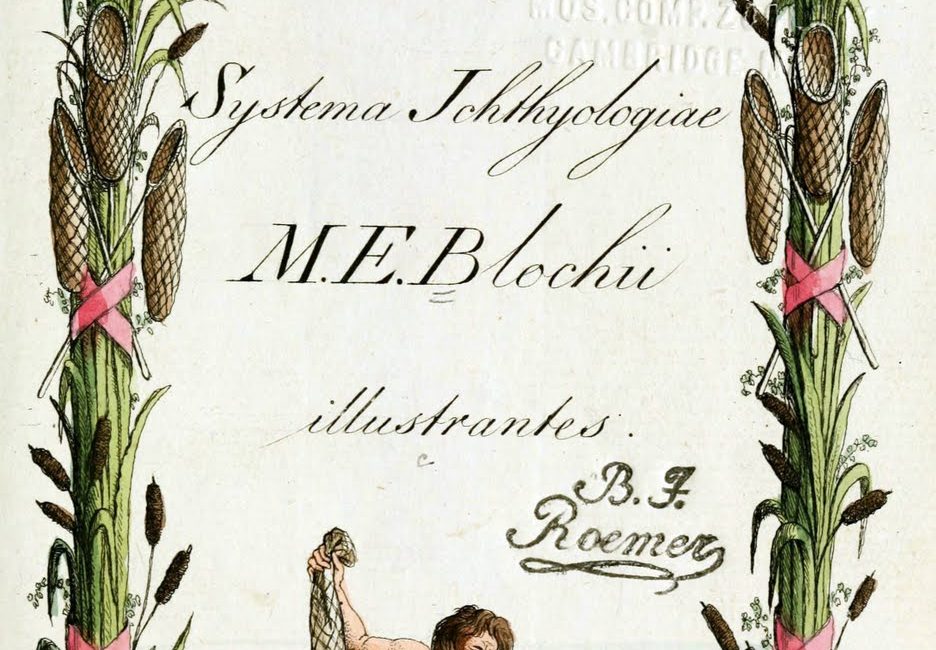
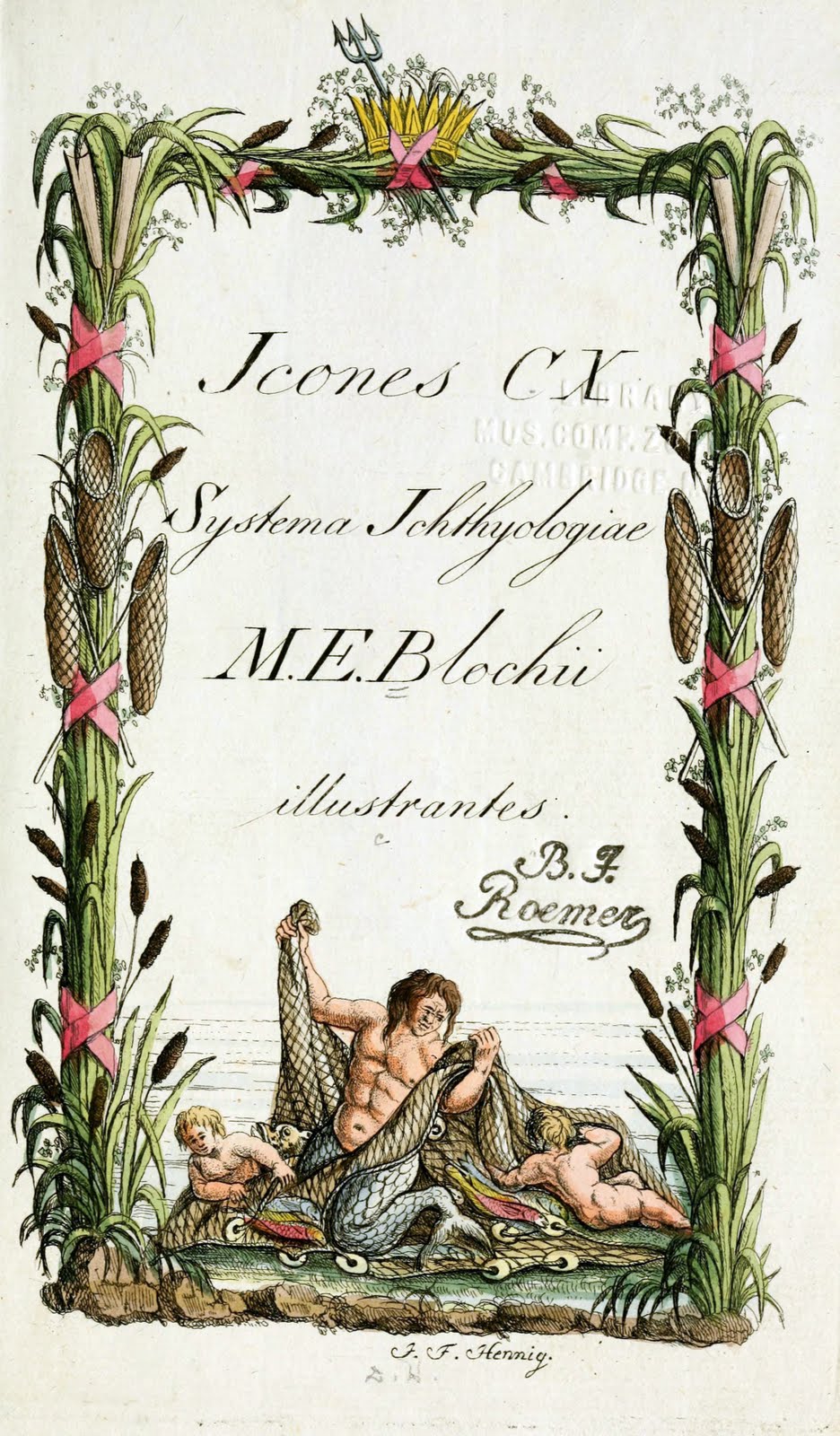
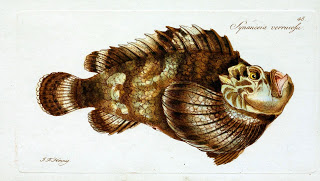
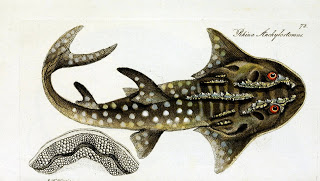
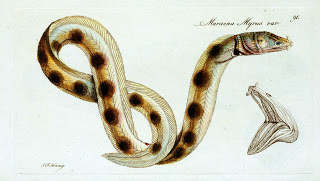
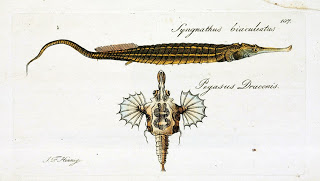
View Full Size ImageLast week we were all about sharks, seeing as it was Shark Week and all. That meant that we were combing through our collections looking for anything that was marked with Shark or even just fish tags. We found a wonderful variety of books and images about sharks (you can peruse them, and lots of other kinds of species, yourself on our Flickr account), but what we also found were a lot of great books about the many other species of fish besides sharks. One of our favorites was Systema Ichthyologiae Iconibus CX Illustratum, volumes 1-2 (1801), by M.E. Bloch & Schneider. While it did contain a few illustrations of sharks, the plethora of other fish species depicted in beautifully vivid colors made us stop and stare. And anything that makes us stop and stare in BHL is worthy of being highlighted somewhere. And today, that somewhere is our blog.

Marcus Elieser Bloch was a German medical doctor and naturalist. He was born into an extremely poor family in Ansbach in 1723 and received very little education growing up. By the time he reached adulthood, he could not even read German, his native language. However, thanks to some knowledge of Hebrew and rabbinical literature, he was able to secure a teaching position with a Jewish surgeon in Hamburg. After learning German and some Latin thoroughly, he began to study anatomy, which in turn sparked his enthusiasm for the natural sciences. He went to Berlin and began to study all branches of science and medicine. Today, he is considered one of the most important ichthyologists of the 18th century, and his encyclopedic work on fishes, captured in a 12-volume series entitled Allgemeine Naturgeschichte der Fische, is still today considered extremely important. Though Bloch didn’t live to see our book of the week published, as he died in 1799, it serves as a beautiful legacy of the incredible career of this dedicated naturalist.

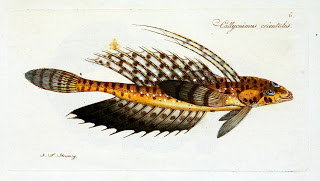
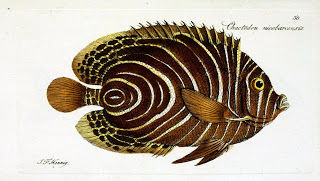
For the post, we thought we’d showcase some of our favorite illustrations from the book. However, we’d be remiss in our duty if we didn’t admit that it was very difficult to choose just a few, and you should spend some time looking through all of the illustrations. They really are worth a few minutes, or even hours, or your time! But, for now, here are our favorites!

View Full Size Image

1) Callionymus orientalis, today known as Synchiropus orientalis

View Full Size Image

2) Chaetodon nicobariensi, today known as Pomacanthus imperator

View Full Size Image

3) Synanceia verrucosa

View Full Size Image

4) Rhina ancylostoma

View Full Size Image

5) Muraena myrus, today known as Echelus myrus

View Full Size Image

6) Syngnathus biaculeatus and Pegasus draconis, today known as Eurypegasus draconis

See all of the illustrations from this book in our Flickr account! This week’s book of the week, Systema Ichthyologiae Iconibus CX Illustratum, volumes 1-2 (1801), by M.E. Bloch, was contributed by Harvard University, MCZ, Ernst Mayr Library.

August 11, 2011by Grace Costantino
Blog Reel, Featured Books

Book of the Week: Shark Week, Part 2. The Mythology of the Shark

View Full Size Image

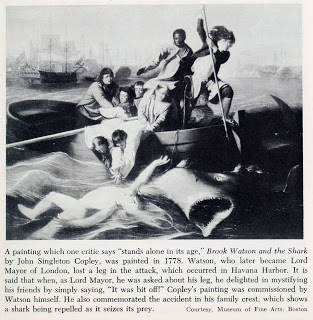
Welcome to Part Two of our Shark Week Book of the Week feature! If you recall from our last post, this week we’re featuring the book Shadows in the Sea (1963) by Harold W. McCormick. Last time, we highlighted shark attacks. This time, we’re recounting the various roles sharks have played in legend and mythology throughout the ages. Sharks have been revered as gods and powerful spiritual beings for thousands of years, long before Zeus, or even Cronus, debuted on the scene. As McCormick writes,

“As the Greeks wrote their myths in the constellations, Orion, the mighty hunter, wheeled across the winter sky in eternal, futile pursuit of Taurus, the great bull, and Leo, the couchant lion. But long before the Greeks looked skyward and evolved their myths, primitive men discerned in the flickering pattern of the stars cosmic enactments of their fearsome struggles with their own devil-god – the shark.”

Like the Greek gods, sharks also have within their repertoire a constellation myth, as told by the Warrau Indians of South America. For this tribe, Orion’s Belt has a far more sinister backstory – it is a severed human leg. According to the legend, the leg once belonged to Nohi-Abassi, who schemed to kill his mother-in-law by enticing a hungry shark to eat her. Unluckily for him, however, his sister-in-law, “playing the role of a shark,” cut off his leg. Nohi-Abassi died, and while his leg now rests in the sky as Orion’s Belt, the rest of him wound up in an altogether less celestial place.

View Full Size Image

Also like the Greeks, whose gods were constantly cavorting with human women and begetting demi-gods, many Hawaiian myths tell of similar erotic behavior among their shark gods. Legend tells that Kamo-hoa-lii, king of the sharks, fell in love with Kalei, a human, and transformed himself into a man to marry her and bear a child with her. “The child, Nanaue, looked like any other child – except that on his back he bore the mark of his shark-father, the mouth of a shark.” The story does not end well for the child, who devoured many islanders after the taboo of never being fed animal flesh was broken, presumably birthing an insatiable desire for human flesh. He was eventually caught – in his shark form – and taken to a hill in Kain-alu that still bears his name.

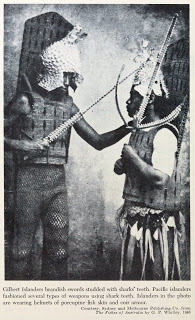
A staple of ancient Roman culture also bears a grisly similarity to the history of cultural practices involving sharks. While the Roman gladiator practice of pitting man against land beasts like lions or tigers is fairly well-known to most people (thanks in large part to Hollywood), gladiator games involving sharks are perhaps somewhat less well-known. But, like Sparatcus, Hawaiian warriors were also matched against fearsome killers for imperial entertainment. Shark pens constructed of large lava stones encircling a 4-acre area at the edge of a bay served as the den for the sharks. Fish and human bait were used to lure sharks into the pens, and Hawaiian warriors battled for their lives using a shark-tooth dagger, which was simply a single shark-tooth affixed to the end of a long stick. The warriors had a single opportunity to prevail: they must allow the sharks to charge them, attempting to dive beneath the shark at the last moment and use the shark-tooth dagger to slit the underside of the shark open.

View Full Size Image

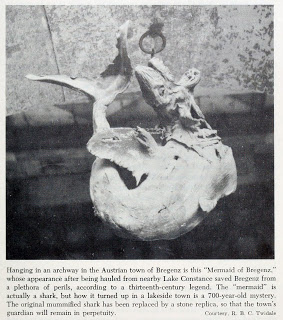
Sharks also find themselves on the list of species with mistaken identities. Just as manatees and similar creatures have been mistaken for mermaids throughout history, so, too, has the shark been given this misnomer. In the town of Bregenz, Austria, a severely contorted, mummified shark has hung from an archway as a reputed “mermaid” guarding the town since, allegedly, the thirteenth century. Legend tells that a fisherman brought the “mermaid” in with his catch early one morning, but before he could return it, the “Spirit of the Lake” told him to hang her from the Arch of the Martinster as she was “beget of a land woman and…of no use [in the water].” Dr. Denys W. Tucker of the British Museum “tentatively identified the mermaid, from a photograph, as a mummified Porbeagle shark.”

The chapter has many more stories to tell. One myth explains how various species of sharks were created as a result of an especially cruel young woman beating, squishing and lashing various sharks. Another relates how two particularly lazy sharks laid still for so long that they became islands. Some cultures tell a Jonah and the Whale type story which would be more aptly named “Jonah and the Shark.”

Moving past myth to historical fact, our book of the week describes “shark charmers” and holy men who kiss sharks in order to overpower and subdue them. Throughout history, holy wars have been fought among tribes, resulting from one tribe inadvertently or otherwise catching and/or defiling the sacred shark species of another tribe. Sharks have even played a central role in the resolution of documented crimes throughout history!

It truly is worth the time to read through this chapter of our book of the week, as it recounts the rich history of the shark as it has evolved through cultural experience. Maybe it will inspire you to see something other than a belt in the night sky 🙂

And, you can see all of the imagesfrom our book of the week, Shadows in the Sea (1963) by Harold W. McCormick, on our Flickr site.

August 4, 2011by Grace Costantino
Blog Reel, Featured Books

Book of the Week: Shark Week, Part 1. Shark Attack!

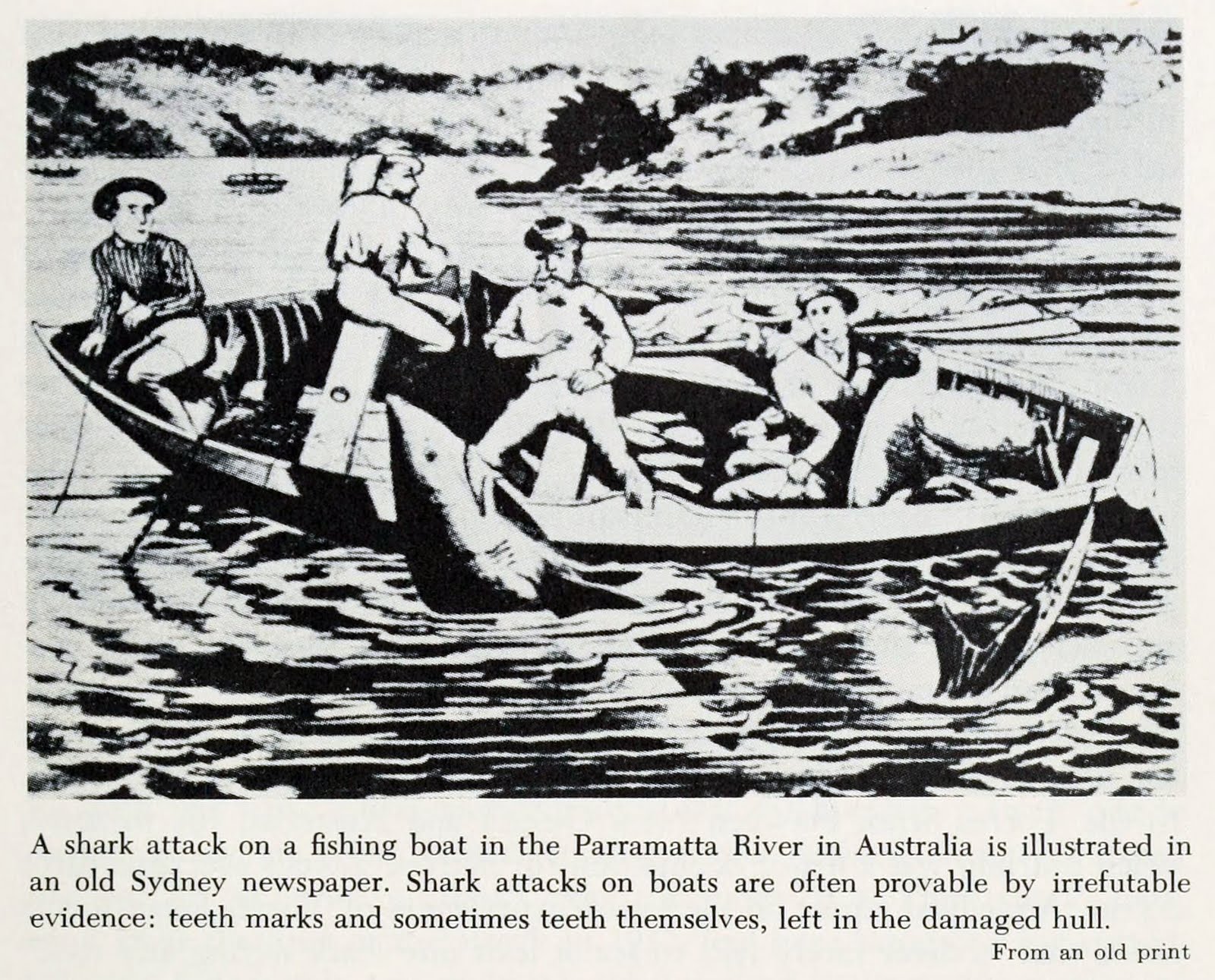
View Full Size ImageYou may have noticed, given all the frenzy about sharks this week on practically every nature-related news stream (and, for that matter, our own social media outlets if you follow us on Facebook or Twitter), it’s SHARK WEEK! So, you know what that means – we’re featuring sharks in our book of the week this week! Combing through the generous collection of books on sharks in BHL, our Collections Coordinator, Bianca Crowley, came across this tantalizing title: Shadows in the Sea (1963), by Harold W. McCormick. Turns out the “shadows” the title refers to are sharks, and we had our book of the week!

This book is full of fascinating, and sometimes gruesome, topics, such as shark attacks on people, sharks in mythology, the origin of sharks, and, of course, a guide to the shark species. It also contains some somewhat less conservation-friendly topics, such as shark fishing, sharks as food, and “shark treasures,” or “the products, other than food, obtained from sharks.” Reading through the book, we were particularly engrossed by content in two select topics – the riveting account of early shark attacks and the role sharks have played in myth and legend. Comprising too much material for a single post, we decided to do our book of the week post this week in two parts (Harry Potter style, you know). Part One, this post, focuses on the gripping shark attack accounts presented in the early chapters of the book. Part two will present the shark as an integral component of various myths and legends throughout the world. So, sit back and enjoy part one of our feature presentation!

“The Shadows Attack: Documented Attacks by Sharks on Men”

Our book begins as though the reader had just opened the first page of an early twentieth century novel, describing a serene oceanside resort in Beach Haven, New Jersey, and the enthusiastic anticipation of one young vacationer as he enjoys his first few blissful moments in the invigorating waters. Unfortunately, all is not well for our protagonist – 23-year old Charles Van Sant. As he strokes powerfully through the waves, an unseen antagonist stalks him.

“Directly behind him, knifing toward him straight and sure, was a gray shadow beneath a black fin that crested the water. They saw it from the beach. Bathers screamed, but the man did not hear their cries…He was still swimming excruciatingly slowly, unaware that he was hunted in a deadly chase.”

Former U.S. Olympic Team swimmer, Alexander Ott, who dove in to save the imperiled young man, was able to retrieve the shark’s victim from the waters after the shark had already attacked. Unfortunately, it was too late. As our story tells us,

“Ott managed to get Van Sant to shore, and there, on the warm sand, Van Sant’s life ebbed away. His legs had been horribly ravaged. He died that night from shock and loss of blood.”

The public was awed and alarmed by the story. “No one could remember a shark ever having killed a swimmer before…Experts said that there never had been an absolutely authenticated case of a shark attacking a swimmer anywhere in the world.” The chapter goes on to tell us of more early shark attacks, and the power with which they gripped the public. For instance, a separate attack, in which a Charles Bruder was killed, received more coverage in the New York papers than the 24 people that died of Polio that same day. As our book of the week asserts, “Such is the glamour and the terror of the shark!”

View Full Size Image

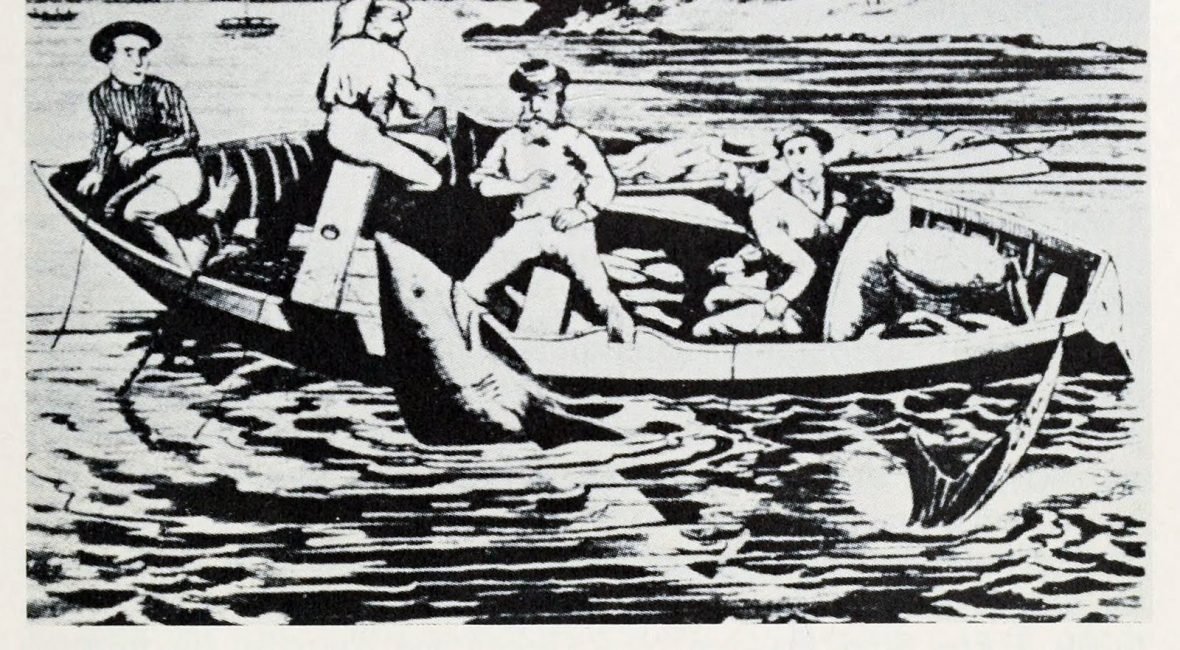
The frenzy that accompanied the birth of the “Shark Attack Era” was as might be expected. Soon, stories of lifeguards “battl[ing] 12-foot shark[s]” with oars and policemen emptying their clips at portentous shadows in the water filled the media. Fortunately, the mounting hysteria was calmed by the “sobering voice of academic authority,” which assured the public that sharks did not possess the unbridled power to rend a man limb from limb as rumors were claiming, and, given the number of swimmers in the water, attacks were extremely rare. Blind panic subsided considerably, swimmers re-entered the waters, and sharks, which had been an economic disaster for oceanside resorts, to some degree slowly became a captivating attraction. Of course, attacks still continued, and with each new attack, a fresh wave of panic erupted, requiring yet another scientific voice of reason to appease it and evoking more and more research regarding shark attacks.

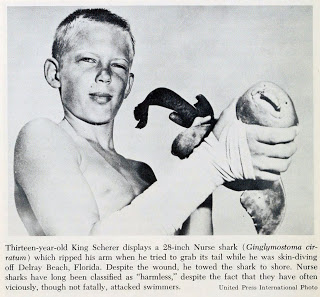
The shark species with more documented attacks on humans than any other is the Great White. Made infamous by director Steven Spielberg in the cult classic Jaws, no other marine species has as much power to grip the heart in terror as this predator does. In the first half of the twentieth century, however, it was believed that this species posed a “negligible hazard”to humans as it was thought to be a tropical shark, uncommon in North American waters and rarely traveling inshore. In 1955, this perception changed. Decade after decade, another “Year of the Shark” emerged as various Great White attacks made headlines, particularly in California. The legend of the Great White as one of the greatest living killers was born.

View Full Size Image

While we are much more educated about sharks – and the circumstances around which attacks might happen – today, our bittersweet love affair with the topic lives on, as evidenced by the popularity of movies such as Jaws, Deep Blue Sea, and concepts like “Shark Week.” We know now that sharks are not the senseless, merciless killers that their reputations claim, but they nevertheless are powerful, majestic creatures quite capable of ending human life (just read the first two chapters of this book if you don’t believe us!). There will likely always be a side of us that sees the monster Jaws in the face of each shark we come across. Perhaps we are destined to forever watch the ocean’s surface in gruesome anticipation of seeing that ominous dark triangle break the peaceful surface. For, “The hazardous creatures of the sea are many, but there is one that man fears above all others – The Shark.”

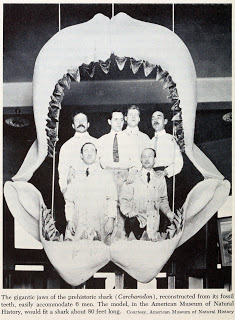
This week’s book of the week, Shadows in the Sea (1963), by Harold W. McCormick, was contributed by the MBL WHOI library. See more images from our book of the week in Flickr! There’s a particularly nice picture of six humans standing inside the jaws of the largest shark to ever live – the Megalodon (pictured above)!

August 2, 2011by Grace Costantino
BHL News, Blog Reel

BHL on Flickr

Ever wanted to take a break and scan through some of the cool images of flora and fauna in the BHL collection? With the BHL Flickr account, you can!

Besides being a low-barrier and fun(!) way of displaying our images, Flickr offers us the opportunity to enhance our collections through citizen science in the form of image tagging.

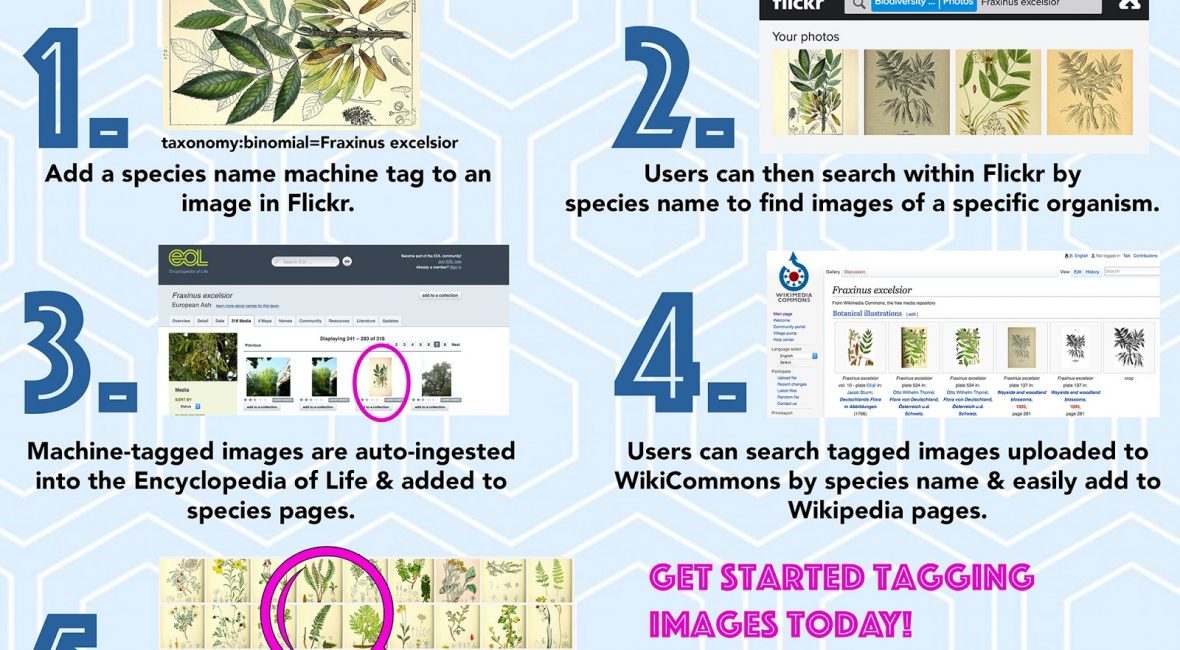
By tagging the images in our Flickr with the names of the species (and other taxonomic ranks) depicted in the image, it allows anyone to search Flickr to find images of specific organisms. We’re asking volunteers to help us add these tags. If you want to jump right in, here are some simple instructions (more details below): http://s.si.edu/BHLTaggingGuide

By volunteering to help us tag images, you’ll be helping to transform biodiversity research.

View Full Size Image

We encourage anyone to help add taxon machine tags to BHL images, especially species name machine tags.

How?

If you’re looking at an image in Flickr for which you know the species name, simply click “add a tag” (after you’ve logged into your own Flickr account) and input the name in the following format:

Taxonomy:Binomial=”Genus species”

Replace the “Genus Species” text with the actual binomial for the creature you are identifying and be sure to put quotation marks around the name as shown above.

So, a complete tag would look like: Taxonomy:Binomial=”Zea mays”

How can you identify the species if you don’t recognize it on sight? Many of our illustrations actually have the species name printed on the image itself. Simply transcribe that name into the machine tag format. If the name isn’t printed on the illustration, you may be able to find an identification in BHL. Click on the link below each image to view that image in BHL, then navigate through the text pages surrounding the image to see if the species identification is given. If so, input the name into the machine tag format in Flickr.

View Full Size Image
How to navigate to this image in BHL from Flickr.

You can also add machine tags for other taxonomic ranks: The following supra-specific ranks are supported:

taxonomy:kingdom=*
taxonomy:phylum=*
taxonomy:class= *
taxonomy:order=*
taxonomy:family=*
taxonomy:genus=*

Replace the * with the name of the taxon.

Learn more in our Flickr Tagging Guide: http://s.si.edu/BHLTaggingGuide

Besides taxon tags, we also welcome tagging for artist names and geographic locations for the depicted species. All of this information can be found in our Flickr Tagging Guide.

Machine tagging is the best-case scenario, but if you would rather simply tag our images with keyword tags, please feel free.

As the BioDivLibrary Flickr profile continues to grow we will keep you posted via our Twitter account and our blog. Enjoy!

August 2, 2011by Grace Costantino
Blog Reel, Featured Books

Book of the Week: Mother Carey’s Chickens

View Full Size Image

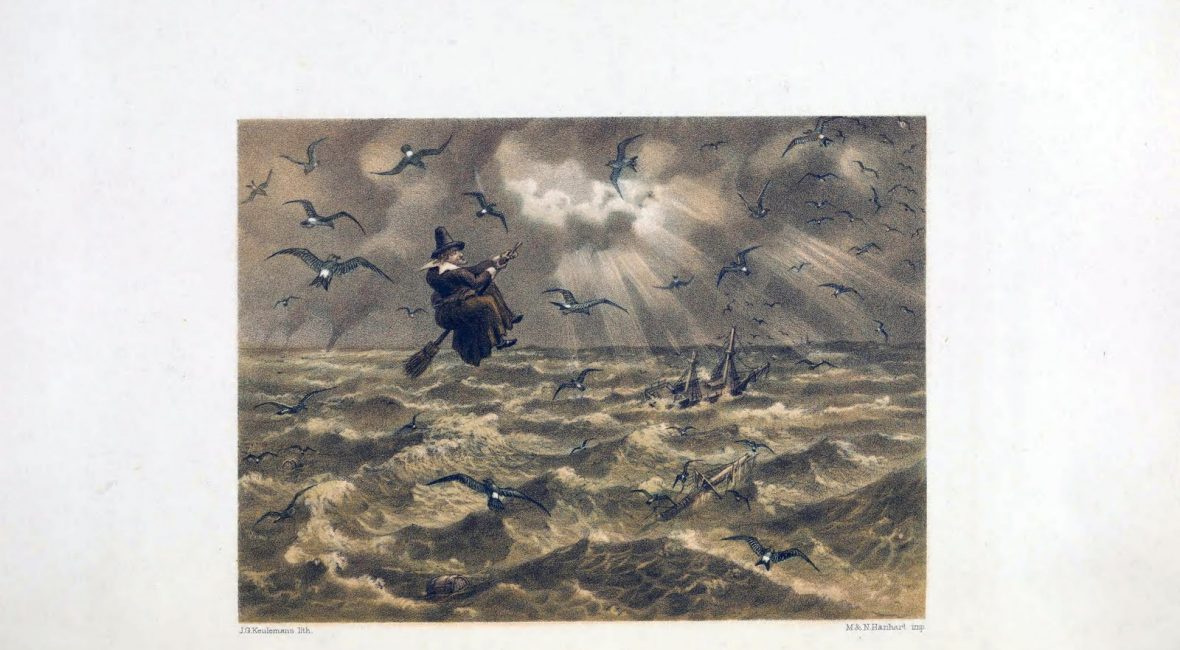
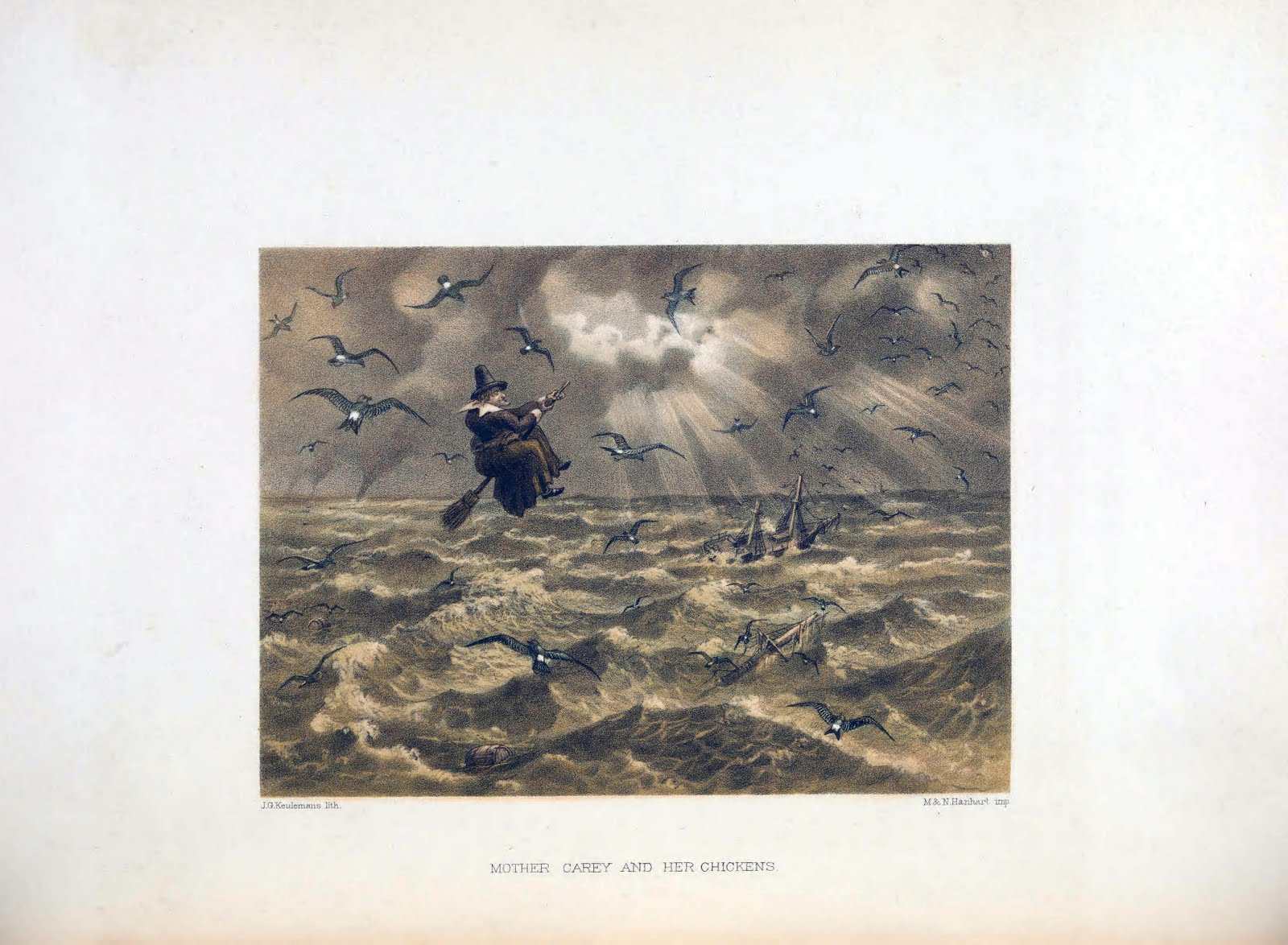
There are some things you just don’t expect to find in BHL, and a witch on a broomstick is one of them. So when one of our book scanners sent a few of us here at BHL an image from one of the books he was scanning, we all did a double take. Indeed, smack-dab in the middle of a book on birds was an illustration of the epitome of a Halloween hag soaring over stormy waters, surrounded by birds. So, of course, we had to ask ourselves, why is there a witch in BHL?

To get more answers, naturally, we went to the source material. The illustration can be found in v. 2 of Ornithological Miscellany. According to this volume, Thalassidroma bullockii and Thalassidroma pelagica have both been given the nickname “Mother Carey’s Chickens” by sailors, who had also given them the delightful alias of “Devil’s Birds.” The origin of this epithet is, apparently, in some dispute, at least according to our book of the week. The author writes that, according to Yarrell,

“These birds are supposed to be seen only before stormy weather, and therefore are not welcome visitors to sailors, who call them Devil’s birds, witches, and Mother Carey’s chickens – the last name said to have been originally bestowed upon them by Captain Carteret’s sailors, probably from some celebrated ideal hag of that name.”

However, the author points out that Hawksworth has a different story to tell. On his authority, Philip Carteret, Esquire, Commander of His Majesty’s sloop the “Swallow,” wrote in his journal, “We also saw a great many Pintado birds, which are prettily spotted with black and white, and constantly on the wing, though they frequently appear as if they were walking upon the water, like Peterels, to which sailors have given the name of Mother Carey’s chickens.”

As the author relates, here Carteret speaks of this nickname as though it is “familiar to them and current in his time.” Encountering such inconsistencies and dead ends, the author finished with, “Not being able to trace the pedigree of ‘Mother Carey,’ the only thing to be done is to have an illustration of herself and her work, with her brood around her.” Indeed, our own research into the subject yielded very few additional discoveries.

We did find that Mother Carey is a supernatural figure that “personif[ied] the cruel and threatening sea” in the same way that Davy Jones does. Indeed, some assert that she is his wife. According to myth, she and Davy Jones are responsible for shipwrecks. Some claim that her name is a derivation of the latin name Mater cara, meaning “Precious Mother,” but there is no concrete evidence to support this. When and where the name was first used in relation to storm-petrels, no one seems to know.

But, perhaps this enigma makes the phrase, and the corresponding illustration, all the more interesting! True, we cannot tell you why or when Mother Carey came into the picture, but we can still enjoy these little nuggets of fascinating art and contextual tidbits that we uncover in BHL. So, for your enjoyment, ladies and gentlemen, Mother Carey and her Chickens, as featured in v. 2 of Ornithological Miscellany!

This week’s book of the week, v. 2 of Ornithological Miscellany, was contributed by the Smithsonian Institution. Love the illustrations and want to see all of them (lots of lovely birds illustrations in addition to witches!) from all volumes of Ornithological Miscellany? Then visit our Flickr site and see the collection on this week’s book of the week!

Flickr: v. 1
Flickr: v. 2
Flickr: v. 3

July 26, 2011by Grace Costantino
Page 62 of 71« First...102030«61626364»70...Last »

Help Support BHL

BHL's existence depends on the financial support of its patrons. Help us keep this free resource alive!

search

About BHL

The Biodiversity Heritage Library (BHL) is the world’s largest open access digital library for biodiversity literature and archives. BHL operates as a worldwide consortium of natural history, botanical, research, and national libraries working together to digitize the natural history literature held in their collections and make it freely available for open access as part of a global “biodiversity community.”

Join Our Mailing List

Sign up to receive the latest news, content highlights, and promotions.

Subscribe Now

Subscribe to Blog via Email

Enter your email address to subscribe to this blog and receive notifications of new posts by email.

Join 319 other subscribers

Subscribe to Blog Via RSS

Subscribe to the blog RSS feed to stay up-to-date on all the latest BHL posts.

Access RSS Feed

Inspiring Discovery through Free Access to Biodiversity Knowledge.

The Biodiversity Heritage Library makes it easier than ever for you to access the information you need to study and explore life on Earth…for free, anytime, anywhere.


ABOUT | HARMFUL CONTENT | PRIVACY | SITE MAP | TERMS OF USE