Biodiversity Heritage Library - Program news and collection highlights from BHL
  • Home
  • News
  • Featured Books
    • All Featured Books
    • Book of the Month Series
    • BHL at 20
  • User Stories
  • Campaigns
    • Fossil Stories
    • Garden Stories
    • Monsters Are Real
    • Page Frights
    • Her Natural History
    • Earth Optimism 2020
  • Tech Blog
  • Visit BHL
Home
News
Featured Books
    All Featured Books
    Book of the Month Series
    BHL at 20
User Stories
Campaigns
    Fossil Stories
    Garden Stories
    Monsters Are Real
    Page Frights
    Her Natural History
    Earth Optimism 2020
Tech Blog
Visit BHL
  • Home
  • News
  • Featured Books
    • All Featured Books
    • Book of the Month Series
    • BHL at 20
  • User Stories
  • Campaigns
    • Fossil Stories
    • Garden Stories
    • Monsters Are Real
    • Page Frights
    • Her Natural History
    • Earth Optimism 2020
  • Tech Blog
  • Visit BHL
Biodiversity Heritage Library - Program news and collection highlights from BHL
BHL News, Blog Reel

Twitterchat on Martha, Extinction, & Historic Literature

View Full Size Image
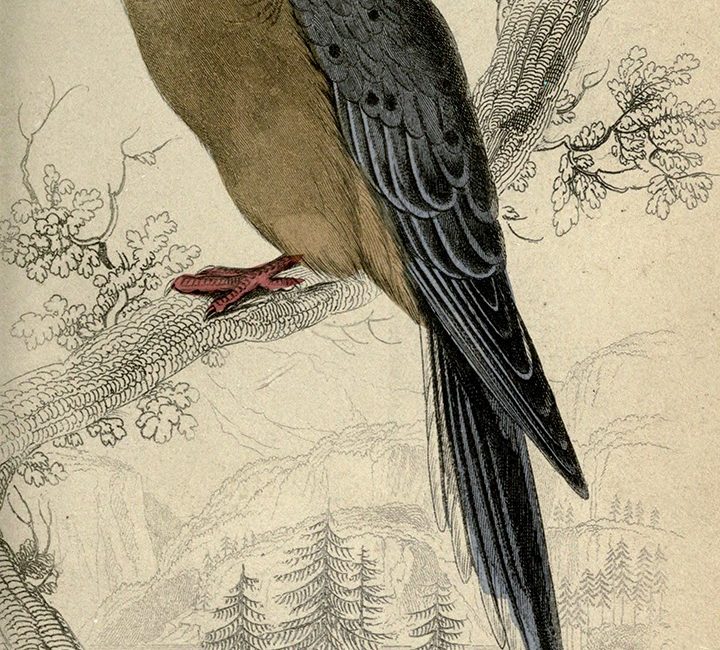
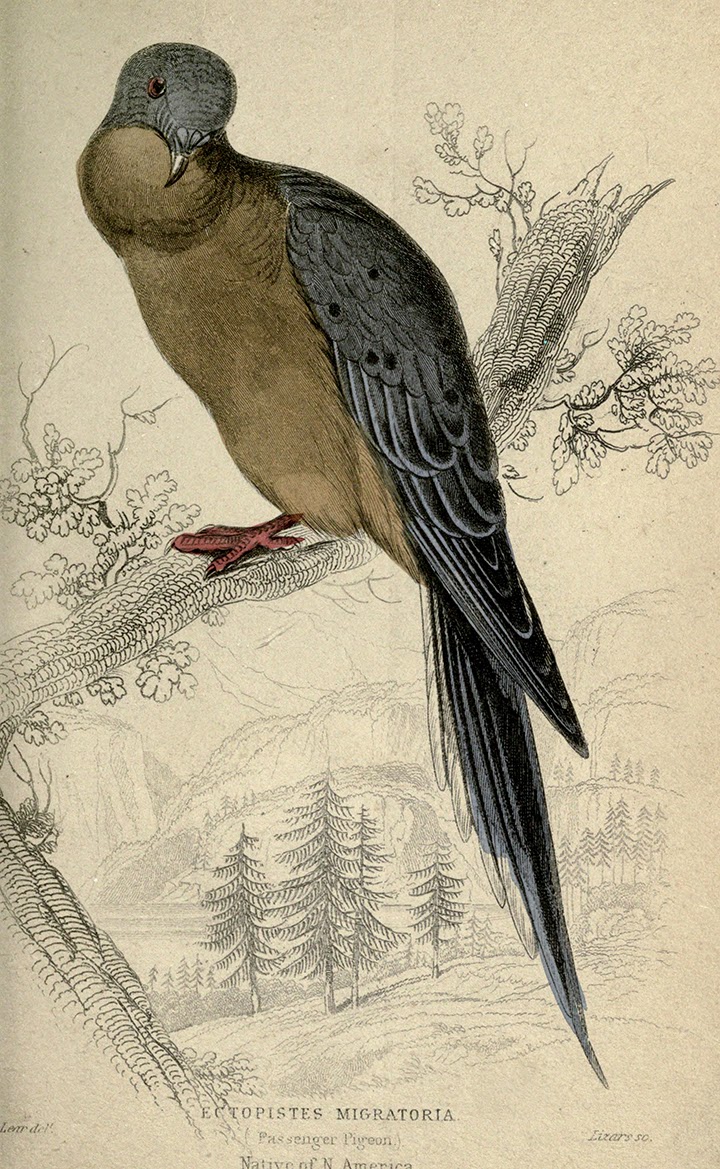
Pigeons. Selby, P. John (1845). http://biodiversitylibrary.org/page/20191792

Please join the Biodiversity Heritage Library (BHL), the Smithsonian Libraries, and the National Museum of Natural History (NMNH) for a twitterchat on September 2nd, 2014. The chat will take place between 2-3 pm (EST) and feature Helen James, Curator of Birds and our recent Once There Were Billions exhibit in NMNH, and Martin Kalfatovic, BHL Program Director.

This September marks the 100th anniversary of the death of the very last passenger pigeon, Martha. In honor of the event, our chat will focus on Martha and the passenger pigeon, extinction and the importance of saving historic taxonomic literature through projects such as BHL. Folks will also have an opportunity to ask questions about Once There Were Billions, species survival or anything else on your minds about birds or biodiversity.

You can send questions using #Martha100 to @BioDivLibrary, @SILibraries, or @NMNH. Helen will be taking over the @NMNH account and Martin will man @BioDivLibrary to answer your questions. Everyone is invited to participate and follow the discussion by using #Martha100. If you’re not on Twitter, feel free to leave your question in a comment below or drop us a line by email at [email protected].

August 25, 2014by Grace Costantino
BHL News, Blog Reel

BHL Update at the EOL Executive Committee Meeting

View Full Size Image

The BHL and Encylopedia of Life (EOL) share the vision of open access to knowledge about life on earth. BHL works to achieve this goal by providing open access to biodiversity literature. EOL tackles this challenge by gathering, generating, and sharing biodiversity knowledge in an open, freely accessible digital repository.

BHL and EOL have been collaborating since 2007, sharing content, best practices, and expertise. Both websites are also extensively interlinked. Taxa identified on pages in BHL are linked to the corresponding species page in EOL. Likewise,  EOL species pages contain links to all identified literature in BHL referencing those species. Through the use of machine tagging, BHL also supplies species illustrations to EOL. To date, 16,496,376 pages in BHL link to EOL species pages, and 1,177,510 EOL pages link to BHL literature. BHL has contributed 13,808 images to EOL.

On 28-29 July, 2014, the EOL Executive Committee Meeting was held at the National Museum of Natural History in Washington, D.C. Agenda topics included strategic planning, EOL content growth and integration with external databases, repackaging content for educational purposes, and the success of Traitbank (a searchable, comprehensive, open digital repository for organism traits, measurements, interactions and other facts for all taxa across the tree of life).

View Full Size Image

Dr. Nancy Gwinn, Director of Smithsonian Libraries and the BHL Executive Committee Chair, was asked to give a BHL update at the meeting. Her presentation highlighted BHL content and membership growth, the Art of Life project, and notable activities over the past six months, including the Field Book Project, participation in the Bouchout Declaration, the joint SIL/BHL exhibit “Once There Were Billions,” Purposeful Gaming, Mining Biodiversity, and the Global Names Project.

Dr. Gwinn also showcased notable BHL/EOL collaborative activities and achievements over the past six months. The May 28th Smithsonian Associates event on Digital Volunteerism, which provided volunteers an opportunity to tag BHL illustrations with species names and explore the iNaturalist platform, was of particular interest.

“Planning for EOL’s future is proceeding with vigor and enthusiasm,” said Dr. Gwinn following the meeting. “I am pleased that BHL continues to contribute to this process.”

Making biodiversity knowledge freely available to everyone is an ambitious goal. But by continuing to share content and collaborate with EOL and like-minded initiatives through joint events, knowledge transfer, and cooperative needs analysis and service development, we are confident we will achieve it.

View Nancy’s Presentation: http://www.slideshare.net/costantinog/bhl-update-at-the-encyclopedia-of-life-executive-committee-meeting-2014

August 19, 2014by Grace Costantino
Blog Reel, Featured Books

The Sea Dog: Exploring the Discovery & Classification of the Shark

It’s that time of year again! That special week set aside to celebrate the fabulously diverse Selachimorpha clade: Shark Week!

If you were to ask an average person to differentiate between a tiger shark, Great White, whale shark, bull shark, or mako, most could probably do so, or would at least be aware that such varieties existed. This wasn’t always the case. A mere six hundred years ago, sharks were known only by the bizarre personas recounted by animated sailors. And even when more accurate depictions and accounts began to circulate, the world was completely ignorant of the vast diversity of these creatures. A shark, generally, was a shark. It took an army of people, and several hundred years, to even begin to comprehend these magnificent fish, and we’ve still only scraped the surface.

The Shark in Myth
View Full Size Image
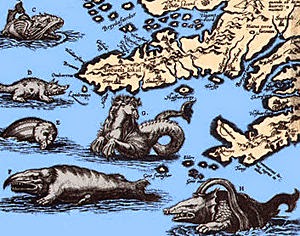
A selection of monsters that supposedly plagued the Atlantic Ocean. By Abraham Ortelius. 1570. Theatrum Orbis Terrarum.

Eleven hundred years ago, man was just starting to venture boldly into the open oceans. At that time, and throughout the Middle Ages, the sea was a place of mysticism and superstition, with countless tales of leviathans, monsters, and spirits plaguing the waters. Researchers believe many of these tales were actually based on real creatures, however exaggerated. Some of the beasts may have been at least partially informed by shark sightings.

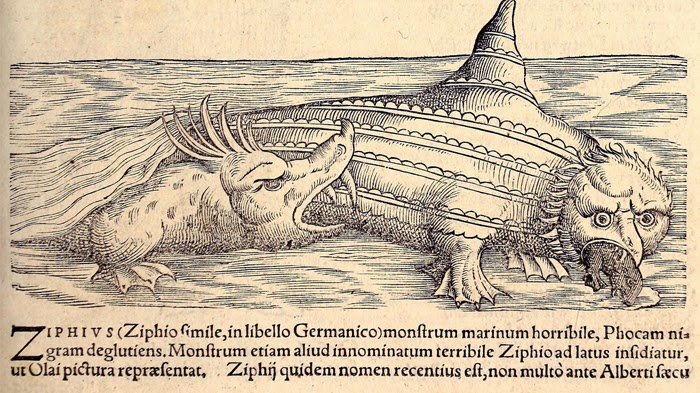
Conrad Gessner (the man behind our strange walrus a few weeks ago) depicted the Ziphius in his 1560 work Icones Animalium. Many researchers believe the beast with the back fin may be a Great White, due in part to the unfortunate seal in its jaws. The porcupine-fish taking a bite out of the Ziphius’ side? The jury’s still out on that one…

View Full Size Image
The Ziphius. Conrad Gessner. 1560. Icones Animalium.

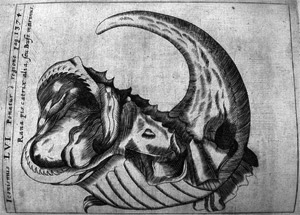
Caspar Schott’s 1662 beast is equally fanciful, but the teeth and jaws suggest that it may be inspired in part by a shark.
View Full Size Image
A shark? Caspar Schott. 1662. Physica Curiosa.

Despite limited contact with sharks, or perhaps because of it, artists generally portrayed the fish as ravenous man-eaters. Olaus Magnus’ 1539 Carta Marina shows a hapless man besieged by a gang of sharks. Fortunately for him, a kind-hearted ray-like creature has come to the rescue.
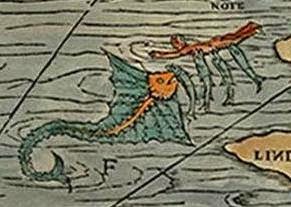
View Full Size Image
Olaus Magnus. 1539. Carta Marina.

Also in the Middle Ages, fossilized shark teeth were identified as petrified dragon tongues, called glossopetrae. If ground into a powder and consumed, these were said to be an antidote for a variety of poisons.

The Shark as a Sea Dog

By the time of the Renaissance, the existence of sharks was more generally known, though their diversity was woefully underestimated. Only those species that were clearly distinct based on color, size, and shape – such as hammerheads, blue sharks, and smaller sharks such as dogfish – were distinguished. As for the Lamnidae – Great Whites, makos, and porbeagles – these were identified as a single species.

In the 1550s, we see the Great White debut to an audience that would remain captivated by it for hundreds of years, though under a rather strange monicker.

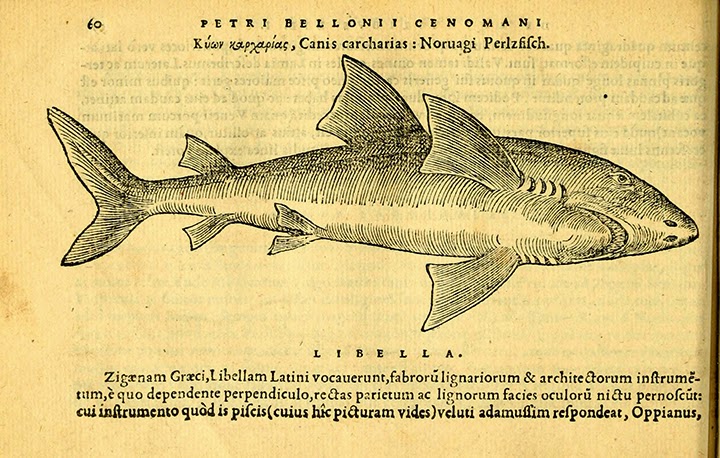
In 1553, Pierre Belon, a French naturalist, published De aquatilibus duo, cum eiconibus ad vivam ipsorum effigiem quoad ejus fieri potuit, ad amplissimum cardinalem Castilioneum. Belon attempted the first comparative analysis of sharks, and presented 110 species of fish in a much more realistic light than previously provided. In addition to a hammerhead, Belon included a woodcut of a shark he named Canis carcharias.

View Full Size Image
Canis carcharias. Pierre Belon. 1553. De aquatilibus duo.

Some readers may recognize that “Canis” is the genus currently assigned to dogs. Belon was not attempting to classify sharks with dogs by asserting this name. Indeed, systematic classification based on ranked hierarchies would not come onto the scene for over two hundred years. The common practice at this time was to choose descriptive names based on physical characteristics. Colloquial speech referred to sharks as “sea dogs,” and carcharias comes from the Greek “Carcharos” (ragged), which Belon associated with the appearance of the shark’s teeth.

View Full Size Image
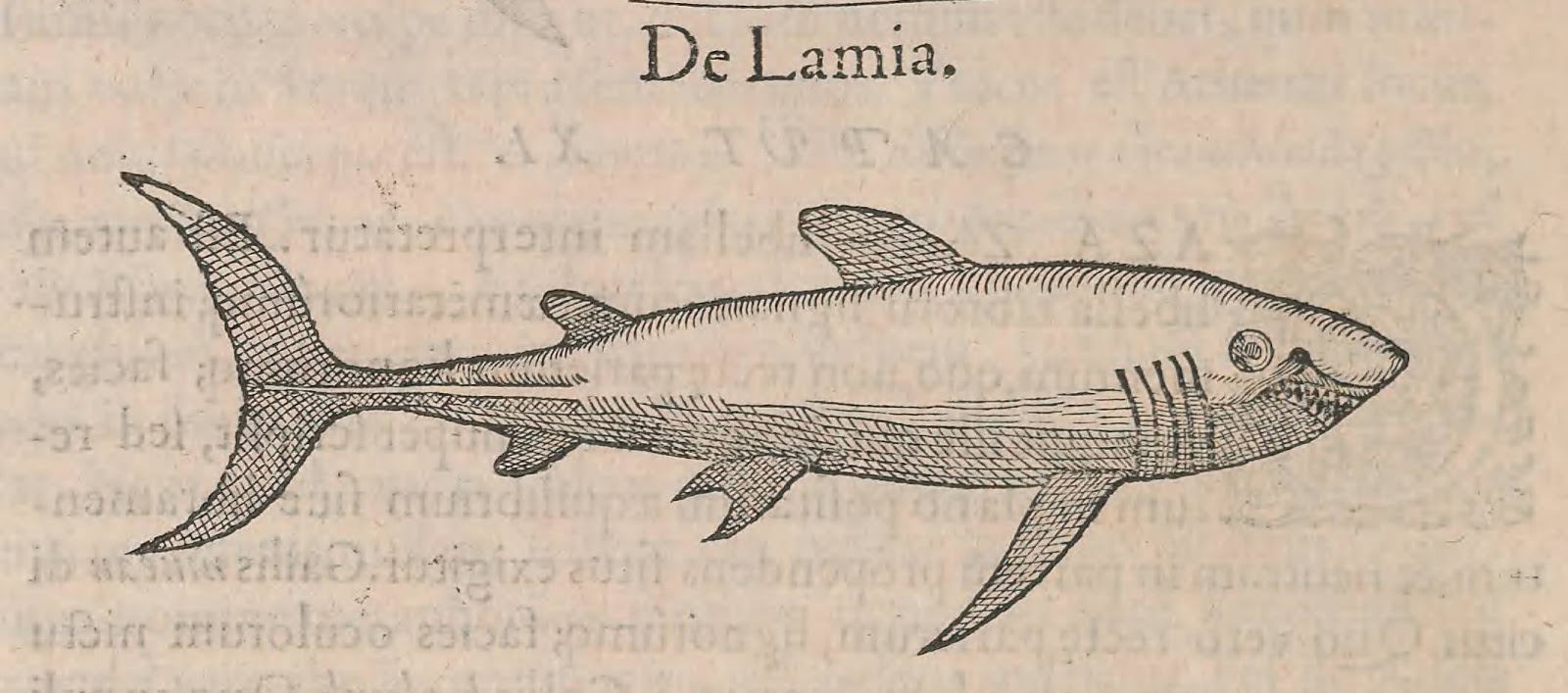
De Lamia. Guillaume Rondelet. 1554. Libri de Piscibus.

In 1554, French physician Guillaume Rondelet gave us another illustration of a Great White, under the name De Lamia (a child-eating demon in Greek mythology). Publishing Libri de Piscibus Marinis, Rondelet described more than 440 species of aquatic animals. Along with his illustration, Rondelet conveyed a tale of one specimen found with a full suit of armor in its belly. He also proposed that it was this fish, and not a whale, that was the culprit behind Jonah’s Biblical plight. A whale, he postulated, did not have a throat wide enough to swallow a man whole and regurgitate him later.

View Full Size Image
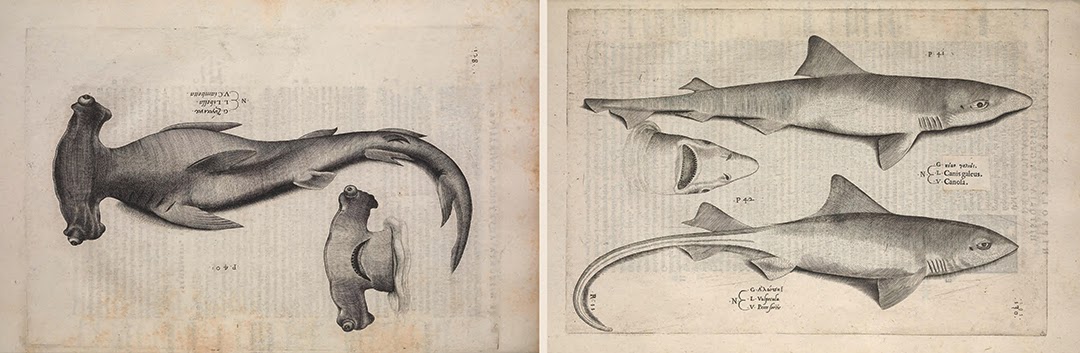
Hammerhead and Catsharks. Ippolito Salviani. 1554. Aquatilium Animalium Historiae.

That same year, Ippolito Salviani published another book on fish, Aquatilium Animalium Historiae, replete with engravings that included the hammerhead and (most likely) catsharks.

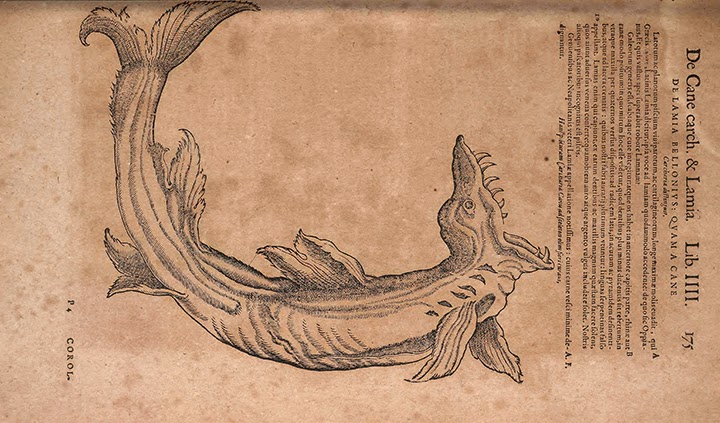
Though Conrad Gessner may have published accounts of many mythical beasts (such as the Ziphius in 1560), his 1558 work Historia Animalium (2nd edition linked here) was an attempt to give a factual representation of the known world of natural history. Within it, he included a much more recognizable illustration of the Great White (under both names Lamia and Canis carcharias). The study was based on a dried specimen, thus accounting for the rather desiccated appearance.

View Full Size Image
Gessner’s Lamia. Conrad Gessner. 1604. Historia Animalium (2nd edition).

Finally, in 1569, the word “Sharke” finally finds its place in the English language, popularized by Sir John Hawkins’ sailors, who brought home a shark specimen that was exhibited in London that year.

Influenced by the violent, and commonly exaggerated, stories circulated by sailors and explorers, general perception pegged sharks as ravenous beasts intent on devouring everything in sight.

Sharks and the “Modern” Era

By the 1600s, a more widespread attempt to classify fish according to form and habitat, and a fresh curiosity in shark research and diversity, found a footing in scientific research.

In 1616, Italian botanist Fabio Colonna published an article, De glossopetris dissertatio, in which he postulated that the mystical glossopetrae were actually fossilized shark teeth. The article had little impact, but in 1667, following the dissection of a Great White shark head, Danish naturalist Niels Stensen (aka Steno) published a comparative study of shark teeth, theorizing for the first time that fossils are the remains of living animals and again suggesting that glossopetrae were indeed fossilized shark teeth.

In the mid-1700s, a famous figure emerged. In 1735, Swedish botanist and physician Carl Linnaeus published his first version of Systema Naturae, at a mere 11 pages. Within this first edition, he classified sharks in the group Condropterygii, along with lampreys and sturgeon.

Linnaeus continued expanding his classification system, and in 1758 he published the tenth edition of Systema Naturae – the work we consider the beginning of zoological nomenclature. Within this edition, Linnaeus introduced binomial nomenclature, a naming scheme which identifies organisms by genus and species, with an attempt to reflect ranked hierarchies. This system provides the foundation of modern biological nomenclature, which groups organisms by inferred evolutionary relatedness.

View Full Size Image
Squalus carcharias. Carl Linnaeus. 1758. Systema Naturae (10th ed.).

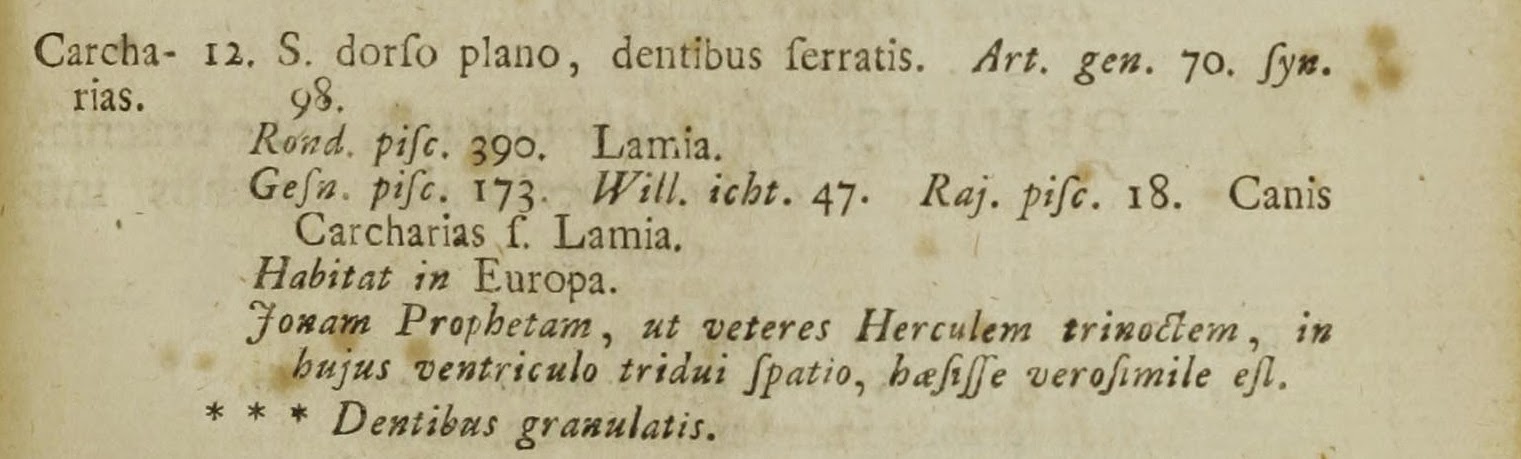
Within Systema Naturae (10th ed.), Linnaeus identified 14 shark species, all of which he placed in the genus Squalus, which today is reserved only for typical spurdogs. He also presents his binomial for the Great White: Squalus carcharias. And he, like Rondelet before him, suggests that it was indeed a Great White that swallowed Jonah whole in ancient times.

View Full Size Image
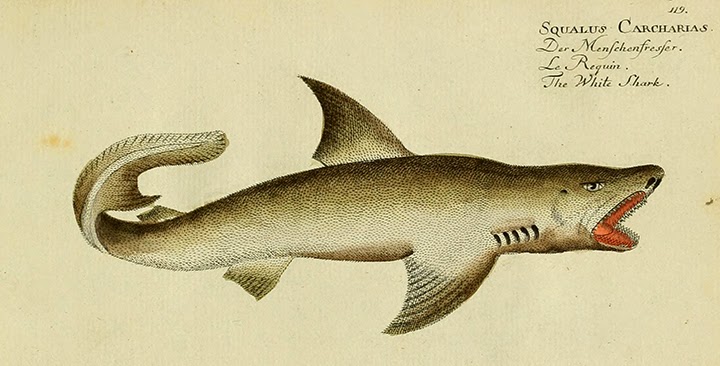
Squalus carcharias. Marcus Bloch. 1796. Allgemeine Naturgeschichte der Fische.

By the late 1700s, we see a greater attempt to distinguish between the varieties of white sharks. From 1783-1795, Marcus Elieser Bloch published twelve volumes on fish under the title Allgemeine Naturgeschichte der Fische, with 216 illustrations. His Great White, perhaps the first in color, bears Linnaeus’ name. And in 1788, French naturalist Pierre Joseph Bonnaterre gave the porbeagle shark its first scientific name, Squalus nasus, distinguishing another “white shark” as a distinct species.

View Full Size Image
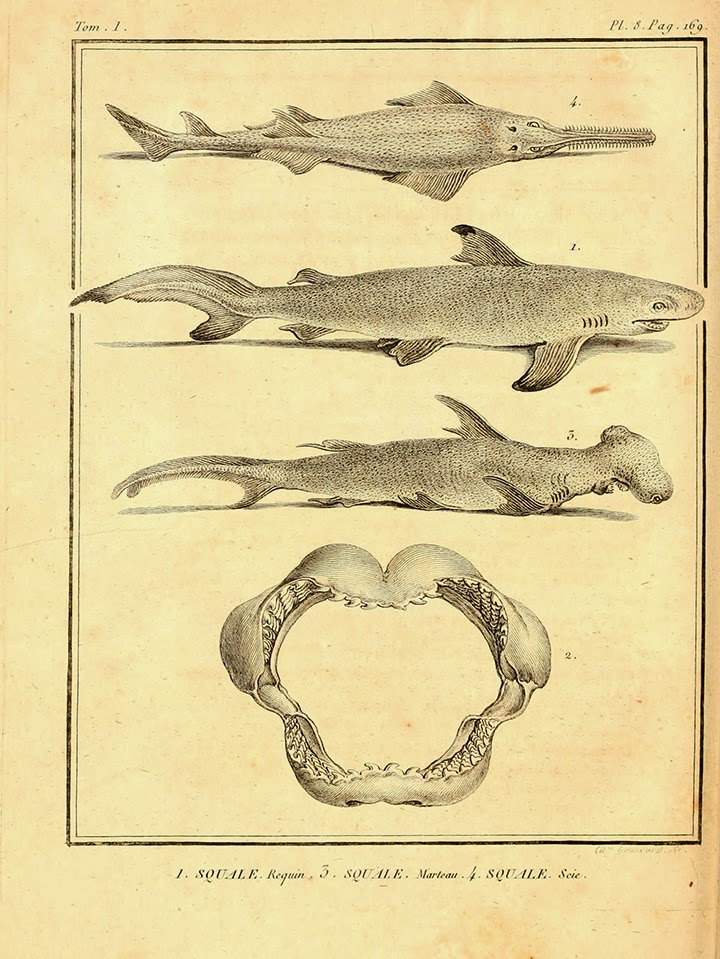
Squalus. Bernard Germain de La Cepede. 1798. Histoire Naturelle des Poissons.

French zoologist Bernard Germain de La Cepede grouped sharks, rays, and chimaeras as “cartilaginous fish,” identifying 32 types, in his 1798 work Histoire Naturelle des Poissons. He describes the “white shark” as the largest shark (a distinction truly held by the whale shark).

View Full Size Image
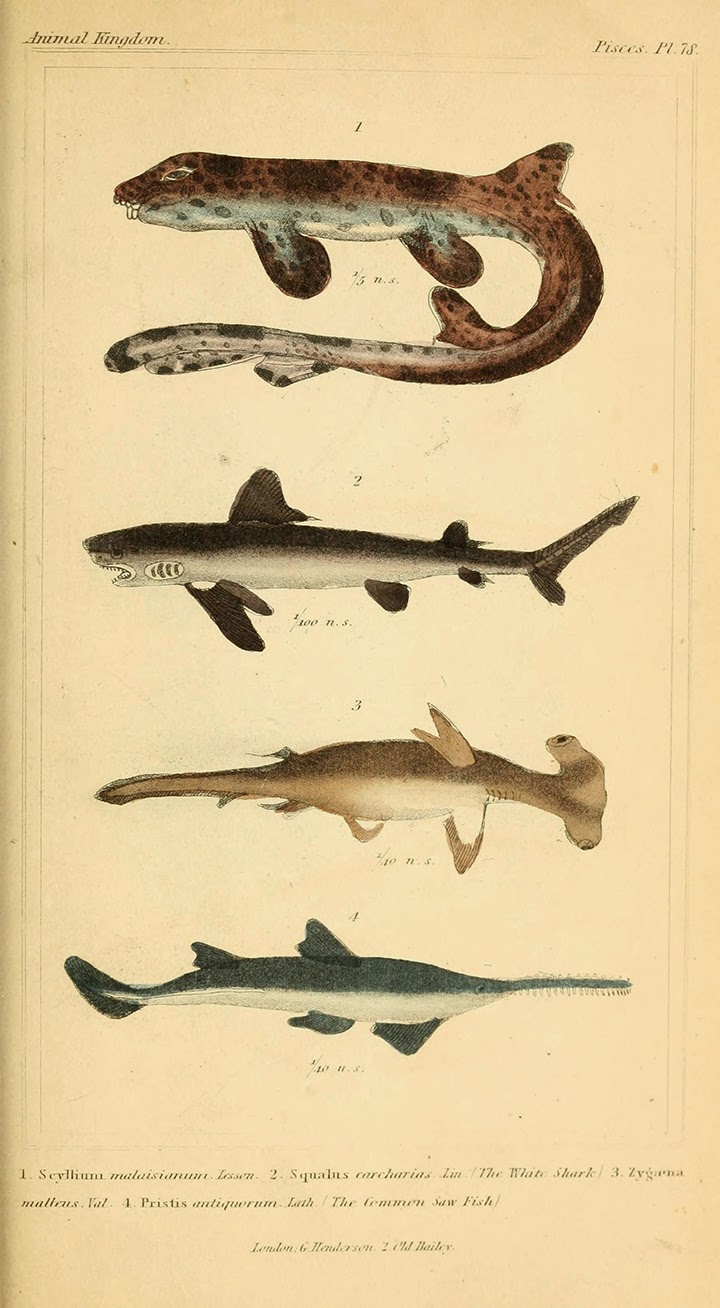
Selachians. Georges Cuvier.
The Animal Kingdom (1837 ed.).

In his 1817 work The Animal Kingdom, French anatomist Georges Cuvier listed sharks as “selachians,” a term still in use today as the clade including sharks: Selachimorpha.

In 1838 we see the first use of the modern Great White genus name. Scottish physician and zoologist Andrew Smith proposed the generic name Carcharodon in a work by Johannes Müller and Fredrich Henle (linked here in Smith’s later 1840s publication), pulling together the Greek “carcharos” (meaning ragged and used in the association by Belon nearly 300 years earlier) and “odon” (Greek for “tooth”). Thus, Smith was proposing a name meaning “ragged tooth.”

Finally, in 1878, Smith’s genus name “Carcharodon,” and Linnaeus’ species name “carcharias” were pulled together to form the scientific name we know the Great White by today: Carcharodon carcharias.

Thanks to the dedication and curiosity of past naturalists and contemporary taxonomists, we’re now aware of the incredible diversity of sharks. There are over 470 species known today; that’s quite a leap from the mere 14 species identified by Linnaeus over 250 years ago!

Want more Shark content? Get over 350 free shark illustrations in the BHL Flickr collection, and browse dozens of historic books on sharks in our BHL and iTunes U collections. You can also explore the incredible diversity of sharks in the Ocean Portal.

Happy Shark Week!

August 12, 2014by Grace Costantino
BHL News, Blog Reel

BHL Africa Report from Internet Archive’s Global Director

View Full Size Image

Since it’s initial organization in 2012 and launch in 2013, BHL Africa has been hard at work developing a strategy, framework, and methodology for contributing the valuable biodiversity information held within the node’s participating institutions to BHL. Significant progress occurred in April and June, 2014, with the arrival and subsequent installation of Internet Archive scanning machines at the University of Pretoria in South Africa.

View Full Size Image
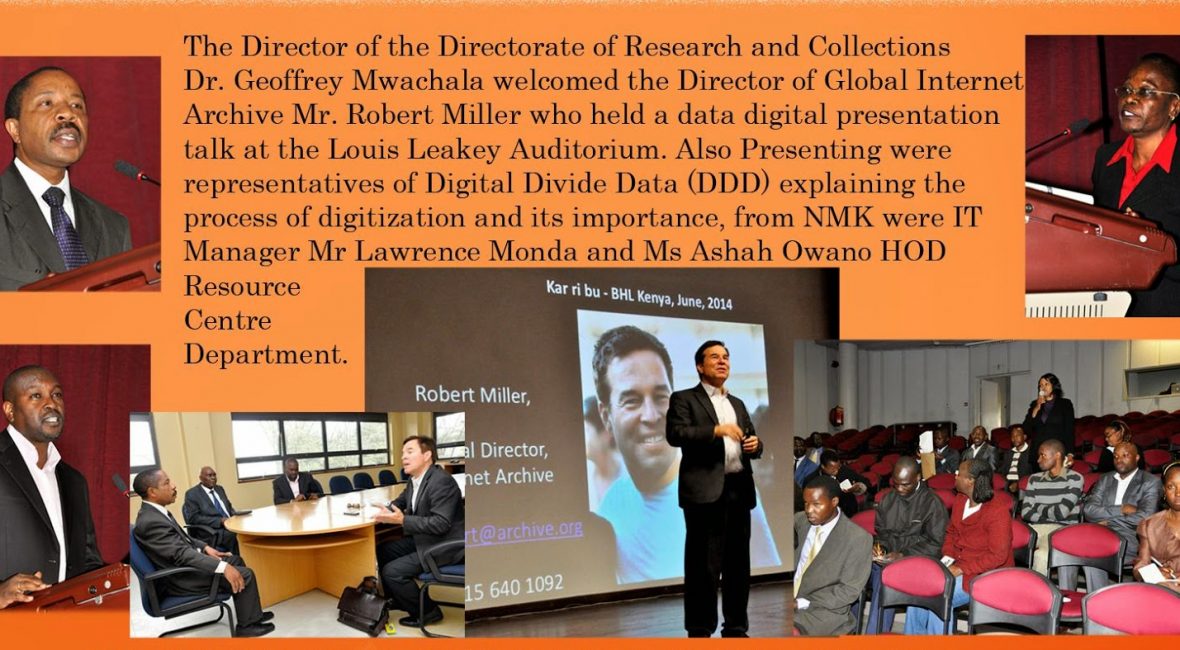
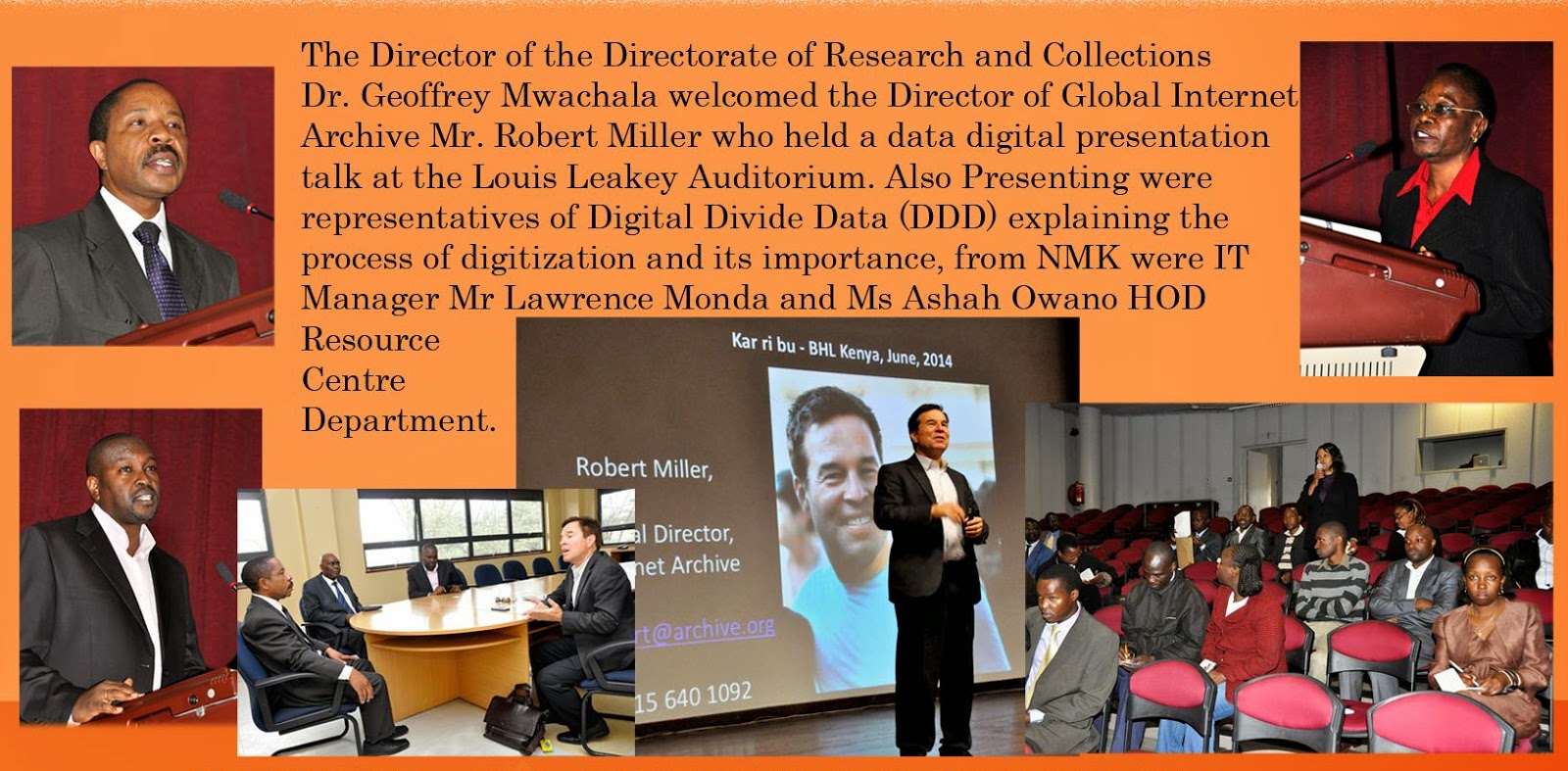
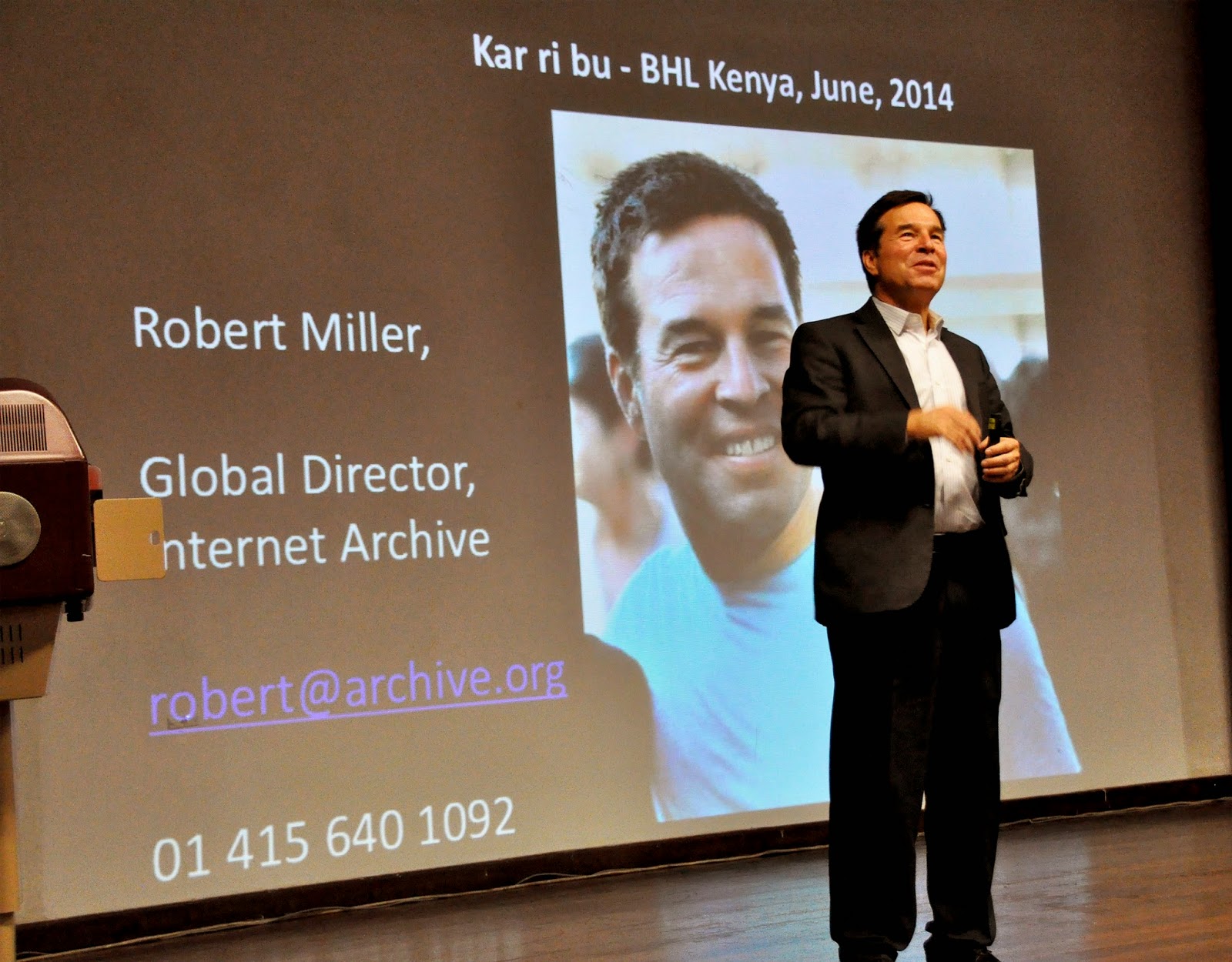
Robert Miller presenting at National Museums of Kenya

Robert Miller, Global Director of the Internet Archive, and his colleague Gemma Waterston (IA Satellite Coordinator) traveled to South Africa in June to provide installation support and operational training for the new machines. Following a successful instatement, Miller then traveled to the National Museums of Kenya (NMK) in Nairobi to discuss digitization and collaboration opportunities.

“Over many years,  I have had many wonderful opportunities to live (Asia, Europe and North America) and travel to many countries (45, in fact, prior to this trip),” commented Miller. “My trip to Kenya (country 46) was made all the more special by the warm welcome and hospitality I received by Ashah Owano [Resource Centre Manager, NMK] and Lawrence Monda [ICT Manager, NMK] and their staff at the National Museums of Kenya in Nairobi, Kenya. They arranged for me to present and talk with representatives of over 25 different institutions and present the work that the Internet Archive has done with the global BHL family.”

View Full Size Image
Robert Miller with representatives from NMK

Miller’s presentation highlighted Internet Archive’s work to bring books and media to people all over the world. Since its inception, BHL has partnered with IA for digitization and access support, contributing to IA’s current 19 petabytes of available data. Miller’s visit was a valuable opportunity for our Kenyan colleagues to better understand the services and options available to them and for Miller to form new global relationships.

“What will I remember?” pondered Miller in response to a request for information on his presentation and experiences in Kenya. “That a wonderful Museum system exists in Kenya, an amazing collection of content is found there and, most importantly, a great group of passionate people are working hard to share their world with the global community. I am so excited to build on this first meeting and hope to return soon.”

We’re excited to see where these newly-forged connections within a long-standing relationship between BHL and IA lead as well. One thing we know for sure: with the passion and determination of our African colleagues guiding an ambitious effort to provide open access to African biodiversity knowledge through BHL, our goal to become the “largest reliable, reputable, and responsive repository of biodiversity literature and archival materials” is now one step closer to becoming a full-fledged reality.

*All pictures courtesy Robert Miller

August 7, 2014by Grace Costantino
Blog Reel, Featured Books

The Walrus as you Never Knew Him

View Full Size Image
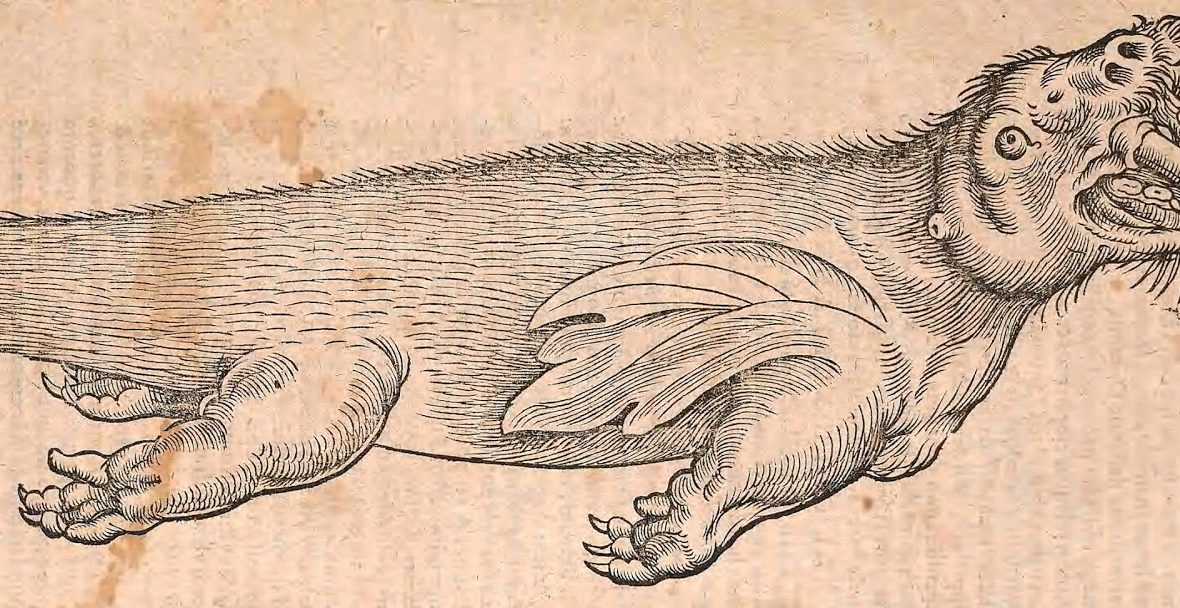
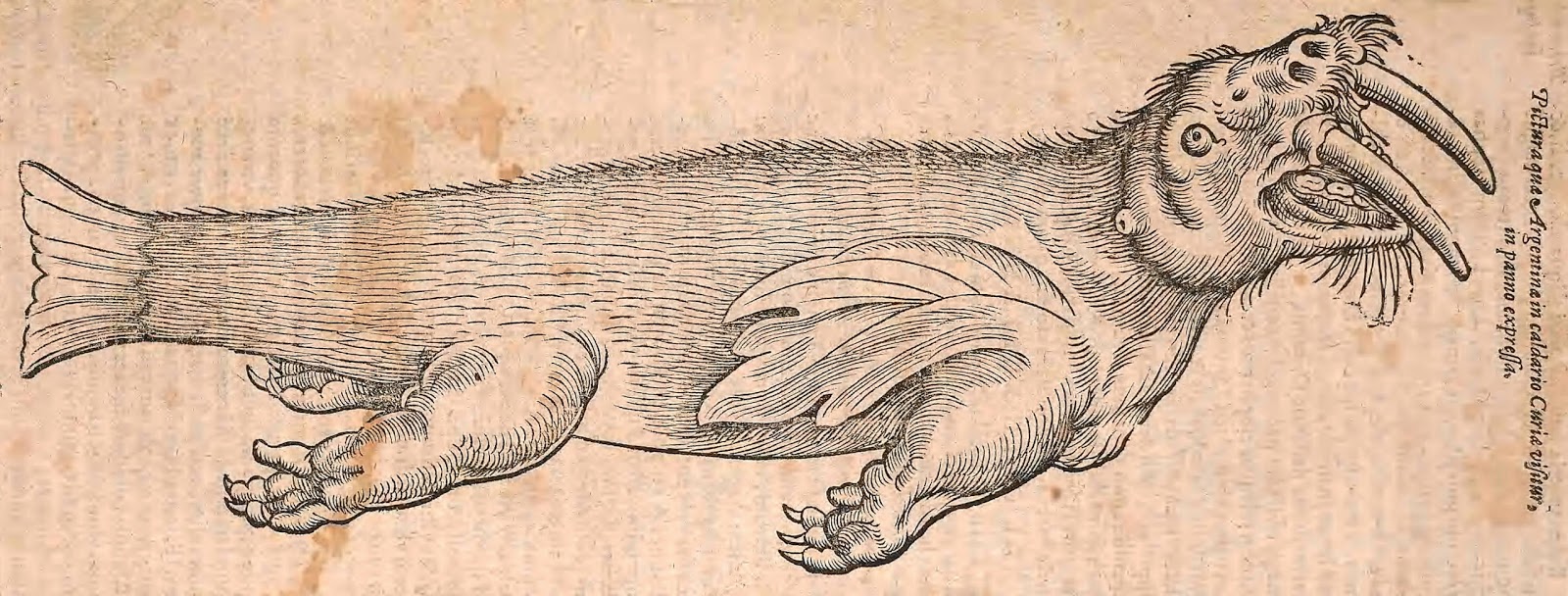
Conrad Gessner’s Walrus. 1558. Historia Animalium. http://biodiversitylibrary.org/page/42165842

Conrad Gessner desired to reconcile ancient knowledge about the animal kingdom with the modern discoveries of the Renaissance. This endeavor spurred him to produce his magnificent Historia Animalium, a work synonymous with the beginning of modern zoology. This five-volume masterpiece covered the subjects of “live-bearing four footed animals” (mammals), “egg-laying quadrupeds” (crocodiles and lizards), birds, fish and sea creatures, and a fifth posthumous volume on snakes and scorpions.

Compiling knowledge from Old Testament, Greek, Hebrew and Latin sources, Animalium boasts a rich collection of woodcut illustrations – something uncommon in other contemporary natural history publications. Gessner repurposed images from many famous researchers of his time, including Olaus Magnus, Guillaume Rondelet, Pierre Belon, Ulisse Aldrovandi, and Albrecht Durer. Their existing images were carved into woodblocks by craftsmen, which were used to “stamp” the reproductions onto designated pages within the text blocks.

Though Gessner intended to produce an authoritative encyclopedia of scientific knowledge about the natural world, his five volumes do include mythical beasts and fancifully-rendered factual creatures. Many of the more exotic of the species he depicted were based on textual or second-hand accounts, explaining the sometimes substantial divergence from reality.

Case in point: The Walrus.

View Full Size Image
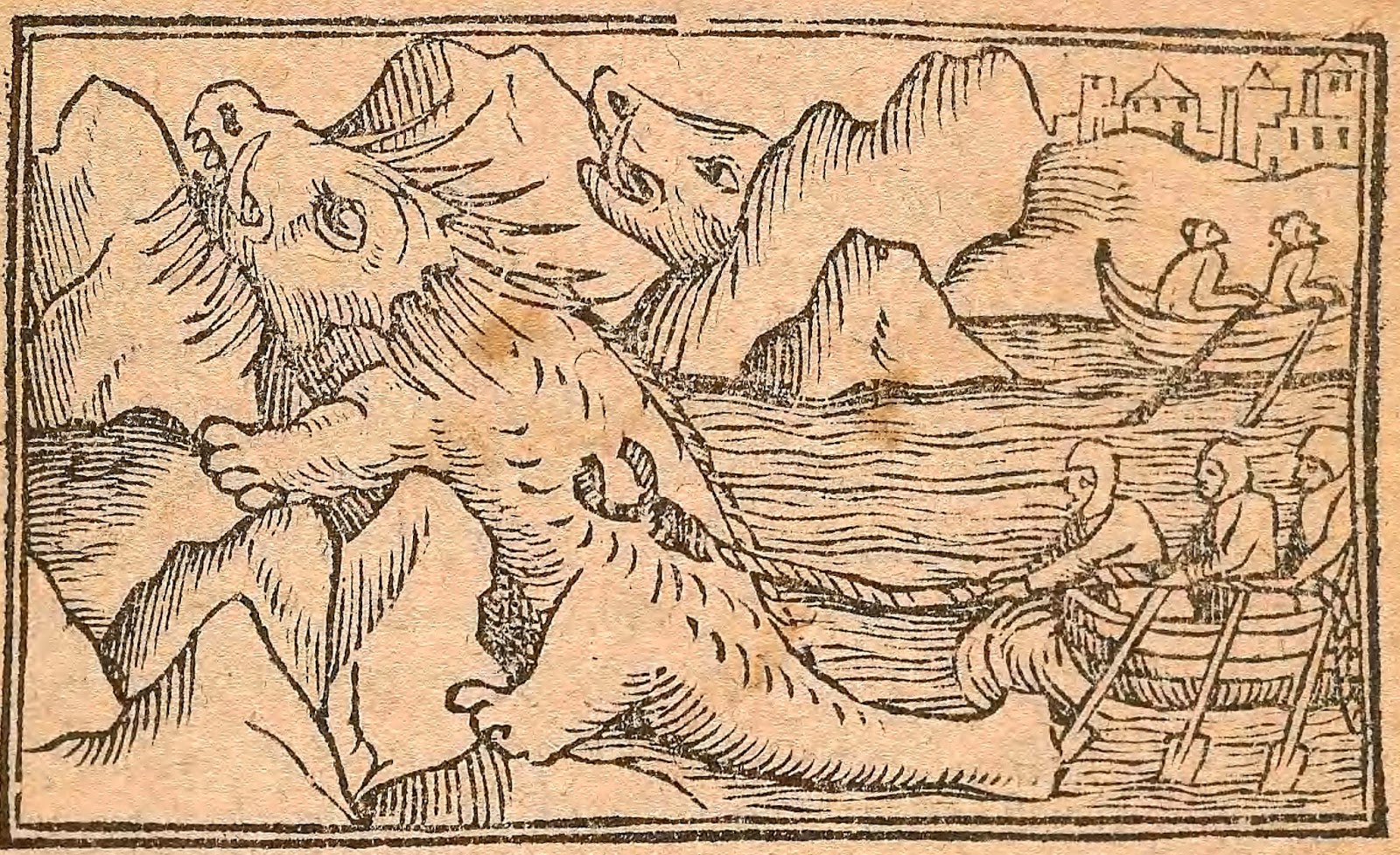
Olaus Magnus’ Walrus. 1555.  
Historia de Gentibus Septentrionalibus.
http://biodiversitylibrary.org/page/41862934

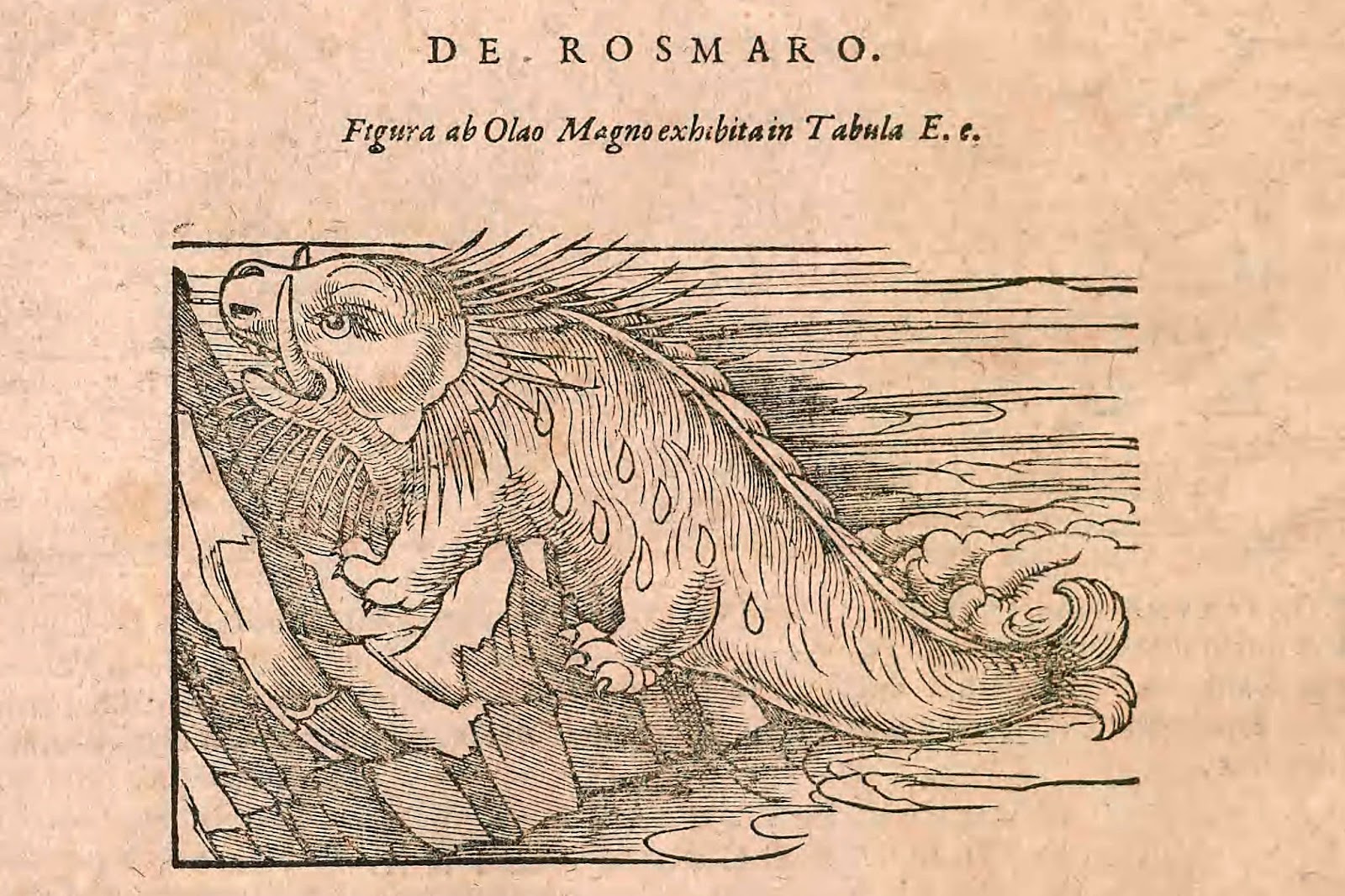
Gessner’s Walrus comes from descriptions by Olaus Magnus in his work on the northern European ocean: Historia de Gentibus Septentrionalibus (1555). Basing his description on Albertus Magnus’ thirteenth century accounts of walrus hunting and reports from two more recent travelers to Russia (Maciej z Miechowa, 1517, and Paolo Giovio, 1525), Olaus recounted the walrus as “a mighty fish, as big as an elephant, called morse or rosmari” that was capable of climbing mountains. The rendering he provided for the creature depicted a beast with legs and tusks in its lower jaw.

Gessner voiced some hesitations about Magnus’ representation of the Walrus. Writing that he believed Olaus based many of his creatures on sailors’ accounts rather than life studies, Gessner reasoned that “fish don’t have feet.” Since common wisdom of the day, and even Olaus himself, grouped Walrus with fish, it was an understandable concern. Nevertheless, Olaus was a well-respected authority, with a good family lineage and a travel resume that had brought him further north than any of his intellectual European contemporaries. Thus, Gessner included two illustrations in his work, one closely resembling Olaus’ beast and another more recognizable as the pinniped we know today.

View Full Size Image
Gessner Walrus, resembling Magnus’ image. 1558. Historia Animalium. http://biodiversitylibrary.org/page/42165841

The inaccurate renderings of Magnus and Gessner’s Walrus, and many other Walrus depictions of the time, may have originated in part from confused reports on ivory sources. The ivory trade in China consisted of a combination of elephant, walrus, and narwhal tusks. Practically no documentation was kept regarding the source of the ivory, and while the European ivory trade was more segmented among source types, the Scandinavians, Russians, and Nenets that supplied the western trade did not share information readily. Thus, natural historians like Olaus Magnus likely tailored their depictions to reconcile the vague second-hand accounts they received with the appearance of other animals they knew produced ivory tusks – elephants. Indeed, many other Walrus portraits of the day (such as those by Waldseemüller and Fries) portray the animal in a much more elephant-like manner, complete with long legs, floppy ears, and, in the case of Fries, even a trunk.

Thus, all things considered, though we today may look at Gessner’s Walrus and giggle, his was actually a much more accurate representation of the animal than many alternative sources in his time. Despite the factual deviations it may contain, “for an understanding of the history of zoology and a peek at some truly fascinating and five-hundred-year-old illustrations, there is no better historical guide than Conrad Gessner’s Historia Animalium.” (Ellis, pg. 2).

And, come on, Gessner’s Walrus is pretty adorable!

Sources:

  • Ellis, Richard. “The First Animal Book.” Natural Histories. Ed. Thomas Baione. New York: Sterling Publishing, 2012. pg. 1-2.
  • McKay, John. “The White Elephant of Rucheni.” Scientific American Blog. Scientific American, 25 July, 2014. http://blogs.scientificamerican.com/guest-blog/2011/11/22/the-white-elephant-of-rucheni/
  • Scott, Michon. “Sea Monsters.” Strange Science. 25 July, 2014. http://www.strangescience.net/stsea2.htm


July 31, 2014by Grace Costantino
BHL News, Blog Reel

The Latest News from BHL!

Want to catch up on all the juicy news from BHL? You’re in luck! Our latest quarterly report and newsletter are now available! Check them out!

Stay up to date on all the latest news by joining our mailing list.

View Full Size Image


July 29, 2014by Grace Costantino
BHL News, Blog Reel

BHL Welcomes Two New Affiliate Members

We are pleased to announce that the Research Library at the Natural History Museum of Los Angeles County and the Lenhardt Library of the Chicago Botanic Garden have joined the Biodiversity Heritage Library as BHL Affiliates. The addition of these libraries not only expands BHL’s presence within the research community, but will also greatly strengthen our library through the incorporation of literature unique to these affiliates’ collections.

View Full Size Image

The Research Library at the Natural History Museum of Los Angeles County (NHMLAC) holds over 200,000 books, journals, maps, rare books and Special Collections materials pertaining to a variety of natural history fields. With such a rich collection of biodiversity-related materials, and a research staff that already makes heavy use of BHL resources, an active partnership with BHL was a logical step for NHMLAC.

“I was very excited to attend the BHL Life and Literature meeting in Chicago a few years ago and realize that so many librarian and other colleagues of similar institutions were there,” said Richard Hulser, Chief Librarian of the NHMLAC Research Library. “I believe participation in BHL will help heighten awareness of NHMLAC unique resources to a wider audience and enable my institution to contribute to the exciting new digital library and big data initiatives currently transforming the study of natural history.”

Within its affiliate capacity, NHMLAC aims to contribute missing volumes for existing titles within BHL, as well as other works not yet part of BHL. Hulser will also leverage his existing relationships in the natural history and library communities to help increase awareness about BHL, as through his scheduled presentation for Internet Librarian International in the UK in October 2014.

View Full Size Image

The Lenhardt Library of the Chicago Botanic Garden holds 125,000 volumes pertaining to gardening, botany, plant conservation, and landscape design, with formats ranging from rare books to e-books. As part of its affiliation, the Lenhardt Library plans to contribute digitized rare books and journals to BHL, as well as missing issues from titles currently in our collection.

“I am so pleased that the Lenhardt Library has the opportunity to share its unique digitized botanical literature with a subject-specific audience of biodiversity researchers,” said Leora Siegel, Lenhardt Library Director. “BHL is innovative, and I look forward to learning more about its offerings and other potential avenues for contributing resources.”

With the addition of NMHLAC and Chicago Botanic Garden, BHL now recognizes four affiliate institutions. BHL Affiliates are institutions or organizations that wish to participate in BHL outside of the membership dues-paying structure. Affiliates can contribute content, provide technical services, and participate in BHL committees, task forces, and working groups.

In addition to its affiliates, BHL currently consists of 16 member libraries. BHL Members may contribute content to BHL, participate in appropriate groups and committees, provide technical services, contribute financial support, vote on strategic directives, and generally help govern the BHL program. Visit BHL to learn more about BHL Members and Affiliates.

We are excited to welcome the NMHLAC and the Chicago Botanic Garden to the BHL family, and look forward to the valuable contributions they will make to our library. Follow us on Twitter and Facebook to receive updates about BHL Member and Affiliate contributions and events.

July 24, 2014by Grace Costantino
Page 44 of 71« First...102030«43444546»506070...Last »

Help Support BHL

BHL's existence depends on the financial support of its patrons. Help us keep this free resource alive!

search

About BHL

The Biodiversity Heritage Library (BHL) is the world’s largest open access digital library for biodiversity literature and archives. BHL operates as a worldwide consortium of natural history, botanical, research, and national libraries working together to digitize the natural history literature held in their collections and make it freely available for open access as part of a global “biodiversity community.”

Join Our Mailing List

Sign up to receive the latest news, content highlights, and promotions.

Subscribe Now

Subscribe to Blog via Email

Enter your email address to subscribe to this blog and receive notifications of new posts by email.

Join 319 other subscribers

Subscribe to Blog Via RSS

Subscribe to the blog RSS feed to stay up-to-date on all the latest BHL posts.

Access RSS Feed

Inspiring Discovery through Free Access to Biodiversity Knowledge.

The Biodiversity Heritage Library makes it easier than ever for you to access the information you need to study and explore life on Earth…for free, anytime, anywhere.


ABOUT | HARMFUL CONTENT | PRIVACY | SITE MAP | TERMS OF USE